SUBSTANCE USE
DISORDERS
Niharika Thakkar

Child Guidance Centre and
Department of Behavioural Sciences and Mental
Health,
Sahyadri Hospitals ltd, Pune
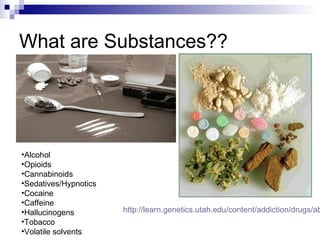
What are Substances??


•Alcohol
•Opioids
•Cannabinoids
•Sedatives/Hypnotics
•Cocaine
•Caffeine
•Hallucinogens         http://learn.genetics.utah.edu/content/addiction/drugs/ab
•Tobacco
•Volatile solvents
How to identify?
 Self report data
 Analysis of blood, urine etc
 Presence of drug samples
 Clinical signs and symptoms (Disturbances in
  levels of consciousness, perception, affect,
  behavior, psycho-physiological functions and
  responses)
 Informant history
 Comorbidity with other psychotic disorders
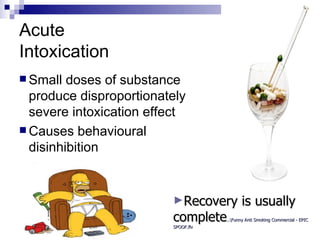
Acute
Intoxication
 Small  doses of substance
  produce disproportionately
  severe intoxication effect
 Causes behavioural
  disinhibition


                         ►Recovery          is usually
                         complete    ..Funny Anti Smoking Commercial - EPIC
                         SPOOF.flv
Harmful Use
 Pattern of Use
 Abusing the Substance
 Binging
Dependence Syndrome


 Strong   desire or compulsion
 Difficulty in controlling in terms of onset,
  termination or levels of use
 Withdrawal state
 Evidence of tolerance
 Neglect of alternative pleasures
 Persistent use inspite of

consequences
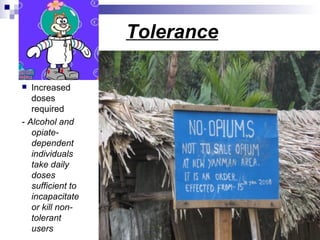
Tolerance

  Increased
   doses
   required
- Alcohol and
   opiate-
   dependent
   individuals
   take daily
   doses
   sufficient to
   incapacitate
   or kill non-
   tolerant
   users
Withdrawal State
 Indicator of Dependence
  Syndrome
 Repeated prolonged high dose
 Onset and Course is time
  limited
 Physical symptoms
 Psychological disturbances:
  Anxiety, Depression & Sleep
  disorders
Withdrawal State with Delirium
 Delirium  tremens:
 Short lived
 Occasionally life threatening
 Toxic-confusional state with accompanying
  somatic disturbances: Insomnia,
  tremulousness and fear
 Clouding of consciousness, vivid
  hallucinations and illusions affecting any
  sensory modality, delusions, agitation,
  automatic over activity.
http://learn.genetics.utah.edu/content/addiction/drugs/abuse.html
Psychotic Disorder
   During or immediately after
     psychoactive substance use
   Vivid hallucinations
   Misidentifications
   Delusions or ideas of reference
   Psychomotor disturbances
   Abnormal affect : Fear to ecstasy
   Immediately or in 48 hours (or late onset)
   Resolves within a month and fully within 6
    months
Amnesic Syndrome
 Chronic impairment in memory
 Remote memory lost, immediate memory
  preserved
 Disorientation
 Confabulation
 Personality changes


Korsakov’s syndrome         ..Requiem for a Dream.flv
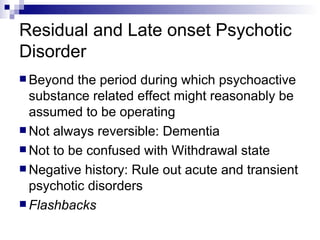
Residual and Late onset Psychotic
Disorder
 Beyond  the period during which psychoactive
  substance related effect might reasonably be
  assumed to be operating
 Not always reversible: Dementia
 Not to be confused with Withdrawal state
 Negative history: Rule out acute and transient
  psychotic disorders
 Flashbacks
Guess the Celebrity??
Articles
   SUBSTANCE ABUSE IN INDIA, Ahmad Nadeem, Bano
    Rubeena, Agarwal V.K., Kalakoti Piyush

 Tobacco use in India: prevalence and predictors of
  smoking
and chewing in a national cross sectional household survey
M Rani, S Bonu, P Jha, S N Nguyen, L Jamjoum

Substance use disorders

  • 1.
    SUBSTANCE USE DISORDERS Niharika Thakkar ChildGuidance Centre and Department of Behavioural Sciences and Mental Health, Sahyadri Hospitals ltd, Pune
  • 2.
    What are Substances?? •Alcohol •Opioids •Cannabinoids •Sedatives/Hypnotics •Cocaine •Caffeine •Hallucinogens http://learn.genetics.utah.edu/content/addiction/drugs/ab •Tobacco •Volatile solvents
  • 3.
    How to identify? Self report data  Analysis of blood, urine etc  Presence of drug samples  Clinical signs and symptoms (Disturbances in levels of consciousness, perception, affect, behavior, psycho-physiological functions and responses)  Informant history  Comorbidity with other psychotic disorders
  • 4.
    Acute Intoxication  Small doses of substance produce disproportionately severe intoxication effect  Causes behavioural disinhibition ►Recovery is usually complete ..Funny Anti Smoking Commercial - EPIC SPOOF.flv
  • 5.
    Harmful Use  Patternof Use  Abusing the Substance  Binging
  • 6.
    Dependence Syndrome  Strong desire or compulsion  Difficulty in controlling in terms of onset, termination or levels of use  Withdrawal state  Evidence of tolerance  Neglect of alternative pleasures  Persistent use inspite of consequences
  • 7.
    Tolerance  Increased doses required - Alcohol and opiate- dependent individuals take daily doses sufficient to incapacitate or kill non- tolerant users
  • 8.
    Withdrawal State  Indicatorof Dependence Syndrome  Repeated prolonged high dose  Onset and Course is time limited  Physical symptoms  Psychological disturbances: Anxiety, Depression & Sleep disorders
  • 9.
    Withdrawal State withDelirium  Delirium tremens:  Short lived  Occasionally life threatening  Toxic-confusional state with accompanying somatic disturbances: Insomnia, tremulousness and fear  Clouding of consciousness, vivid hallucinations and illusions affecting any sensory modality, delusions, agitation, automatic over activity. http://learn.genetics.utah.edu/content/addiction/drugs/abuse.html
  • 10.
    Psychotic Disorder  During or immediately after psychoactive substance use  Vivid hallucinations  Misidentifications  Delusions or ideas of reference  Psychomotor disturbances  Abnormal affect : Fear to ecstasy  Immediately or in 48 hours (or late onset)  Resolves within a month and fully within 6 months
  • 11.
    Amnesic Syndrome  Chronicimpairment in memory  Remote memory lost, immediate memory preserved  Disorientation  Confabulation  Personality changes Korsakov’s syndrome ..Requiem for a Dream.flv
  • 12.
    Residual and Lateonset Psychotic Disorder  Beyond the period during which psychoactive substance related effect might reasonably be assumed to be operating  Not always reversible: Dementia  Not to be confused with Withdrawal state  Negative history: Rule out acute and transient psychotic disorders  Flashbacks
  • 14.
  • 16.
    Articles  SUBSTANCE ABUSE IN INDIA, Ahmad Nadeem, Bano Rubeena, Agarwal V.K., Kalakoti Piyush  Tobacco use in India: prevalence and predictors of smoking and chewing in a national cross sectional household survey M Rani, S Bonu, P Jha, S N Nguyen, L Jamjoum