Compiled by Col Mukteshwar Prasad(Retd),
MTech,CE(I),FIE(I),FIETE,FISLE,FInstOD,AMCSI
Contact -9007224278, e-mail –
muktesh_prasad@yahoo.co.in
for book ”Decoding Services Selection Board” and SSB
guidance and training at Shivnandani Edu and Defence
Academy
Eysenck Type Personality Test
(Extravet/introvert ,Stable/Unstable and
Psychoticism)
Eysenck Type Personality Test
 Hans Eysenck was born in Germany in 1916, fled to England at the age of
18. Here he became a famous psychiatrist. He wrote 75 books, until he died
in 1997
 Eysenck devoted his life to the study of temperaments. This means that part
of the personality, which is rooted in our genes and biological
processes. His starting point was the classical Greek four temperaments
together with Pavlov's studies of dogs.,
 Phlegmatic-Calm and Stable
 Choleric-Irascible and Quick Tempered
 Sanguine –Cheerful and Optimistic and
 Melancholic-Sad and Depressed
 Originally Eysenck characterized an individual's personality on two scales.
Introversion - extraversion and stable - unstable. A person may thus be
 Introverted and Stable,
 Introverted and Unstable,
 Extraverted and Stable or
 Extraverted and Unstable.
 The scale, stable - unstable, measures an increasing level of neuroticism.
Eysenck's term "neuroticism" does not mean that the persons actually have
neurosis, only that they are more inclined to get one.
 They are continuous scales, so one can of course also score in the middle,
for example, only 50% unstable and only 50% introverted.
Introvert - Extravert according to Eysenck
 Eysenck believed that extraverted people have a kind of
innate black out or repression function in the brain.
 If for example they have had a car accident, they typically
do not remember anything afterwards. Precisely
because they remember nothing, they will not hesitate to
place themselves behind a steering wheel the day after,
they have been discharged from hospital.
 If they have had a bad social experience, let's say they
have been humiliated in front of a big audience at a party,
or they have been rejected by a woman, they love, then
their brain's effective repression function makes them
quickly forget the bad experiences. Precisely because
they have eradicated their bad memories, they will not
hesitate to promote themselves at the next big party or
introduce themselves to the next women, with whom they
fall in love.
 This black-out function can of course be more or less
effective for different people.
Introvert - Extravert according to Eysenck
 Very introverted people have no black-out function at
all.
 They remember with painful accuracy and in all details,
how the vehicle skidded, the windshield splintered, screams
and blood everywhere. Therefore, they may choose not to
drive car long after they have been discharged from
hospital.
 An introverted person will remember in details, how the
whole party laughed heartily, when he could not
remember the text of a song and also probably sang
out of tune. For the rest of his life he will remember the
impulsive, condescending laughter, his very special one
made, when he asked her to marry. Because he so detailed
remembers his bad social experiences, he will gradually
take less and less social initiatives.
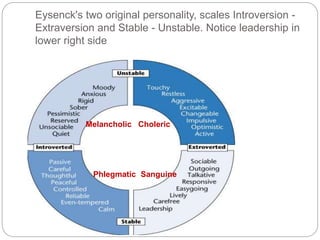
Eysenck's two original personality, scales Introversion -
Extraversion and Stable - Unstable. Notice leadership in
lower right side
Sanguine
CholericMelancholic
Phlegmatic
Stable - Unstable according to Eysenck
 Increasing level of unstability means for Eysenck
increasing level of neuroticism.
 Let us imagine that we have to cross a narrow wooden
bridge, let's say one meter wide, without handrails. The
bridge leads over an abyss 50 meters deep.
 One meter wide is quite convenient, one does not need to
be a tightrope dancer to set the foot the right places; only
the situation requires a certain concentration. Our
brain will receive the signal, that now it may well turn
off the dream program and concentrate a bit. Then
most will pass the bridge concentrated but stable.
 But for some their innate alarm signal to the brain will be
so powerful that their entire signal system goes into
overdrive. The concentration, which the first alarm
signal triggers, will make them to look down, and then
an even stronger alarm signal will be sent to the brain,
and so forth. The person panics.
 Eysenck compares the situation with the resonance that
Stable - Unstable according to Eysenck…
 The scale, stable - unstable, represents the degree of
neuroticism. An unstable person is characterized by high
degree of neuroticism.
 That a person is neurotic in Eysenck's sense do not mean
that he actually has a neurosis.
 It just means that such persons are more likely to get one,
because their innate alarm system is more sensitive and
efficient than other people's.
 Woody Allen must be said to play the part of a typically
unstable personality, with a high degree of neuroticism.
 Eysenck's neuroticism is rather close to excessive anxiety.
 Actual neuroses may be
 fear of heights,
 fear of narrow spaces,
 fear of open spaces,
 fear of crowds,
Psychoticism according to Eysenck
 In his later years Eysenck found a third personality parameter, which he
called Psychoticism.
 Similar as it is the case with his neuroticism, a high score on psychoticism
does not mean that the test person is psychotic or necessarily will be in the
future.
 It only means that he shares some personality traits with psychotic
persons and under unfortunate circumstances can develop psykoses.
 Psykotisme is a scale that goes from a social well-adapted
personality toward a personality prone to psychosis, with
psychopathy as a halfway stage.
 Examples of such psychotic tendencies are
 Irresponsibility and Recklessness,
 the downgrading of Common sense and Inappropriate emotional
expressions.
 Some have found that people with a high score on psychoticism also
often have
o a Hostile attitude to cultural norms and authorities,
o they may seem Immature and somewhat Insensitive and
Psychoticism as a Precondition for Creativity
 Eysenck is known for his theory that high scores on psychoticism is a
precondition for creativity, where he again stresses that it does not mean
that creative people are also psychopaths or have developed psychotic
disorders, they only have greater risk of developing such diseases.
 This idea is often represented in a popular way with the painter Vincent van
Gogh, who cut off his ear, and the mathematician John Nash, who
developed game theory, differential geometry and partial differential
equations, and later came to suffer from paranoid Schizophrenia. Nash
has been portraited in the film "A Beautiful Mind".
 John Forbes Nash was awarded a shared Nobel Prize in Economic Sciences
for his work on game theory in 1994.
 Artists have always had a tendency to profile themselves as eccentric
and a little crazy to make probable that they also are creative.
 Eysenck wrote that creative intelligence fundamentally can be
characterized as a search process in the brain, which aims
to find not generic solutions - during this process different
elements from memory are brought together to generate
new solutions to problems.
 Eysenck believed that there are strong evidences that this search for
new solutions are always driven by conscious or unconscious ideas of
relevance.
Psychoticism as a Precondition for Creativity
 Socially well-adjusted person will, according to Eysenck, have some
rather narrow ideas of relevance; they will instinctively be more
conventional and restrictive in their search.
 Thus they will unconsciously exclude potential solutions that are not
socially appropriate.
 They will be more limited in their search for potential solutions, and
thus less creative.
 On the other hand, less socially adjusted persons, who will score quite
high on his psychoticism scale, will have ideas about relevance, which
are much broader and more spacious than the more socially adapted's
ideas of relevance.
 Deep down in their minds they find cultural norms, authorities and
other social contexts less important, and therefore they
unconsciously will not let such considerations limit their search for
solutions.
 Therefore persons with a certain level of psykotisme will have a
tendency to be more creative than very socially adapted people.
Psychoticism as a Precondition for Creativity
 Fillip Side
 Some test persons could be tempted more or less unconsciously to
score on psychoticism in order to profile themselves as creative.
 Some do not feel so good in exam grades and experience; and therefore
they can be attracted to an idea that on the other hand, they may well
be creative.
 Firstly, most employers are not particularly interested in creativity.
 They want employees, who are doing, what they are told, and are able to
follow procedures and work descriptions.
 Such as pilots are assumed to follow detailed emergency procedures,
when they have problems.
 Eysenck was probably right that a certain level of psychoticism is a
prerequisite for creativity, but that does not lead to that you can conclude
the reverse; that is, if a person is a little crazy, it will also imply creativity.
 It is certain that most crazy people are not especially creative.
 It is generally not good to score too much on psychoticism.
Self Portrait by Vincent van Gogh
with a bandage on his cut ear
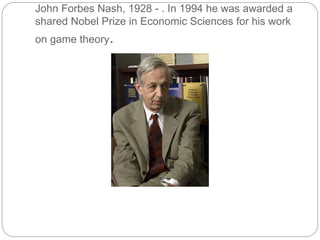
John Forbes Nash, 1928 - . In 1994 he was awarded a
shared Nobel Prize in Economic Sciences for his work
on game theory.
An Educational Eysenck Test
A highly abridged and simplified
test as an introduction to the
Eysenck universe. It can be used
as a guide and inspiration in
completing a real Eysenck
personality test.
Answer the questions. Weight truth
value of following statements with
1 to 5.
1 means not true at all, and 5
Introverted-
Extraverted
Neuroticism Psychoticism
1. Are you a rather
lively person?
---
2. Does your mood
often change up and
down without real
reasons?
----
3. Do you have many
different hobbies?
---
4. Are you a talkative
person?
----
5. Would you feel
worried by making
debt?
---
6. Do you ever feel
"just miserable" for
no reason?
---
7. Do you lock your
door carefully for
the night?
---
Introverted-
Extraverted
Neuroticism Psychoticism
8. Do you stop for a
split of a moment
thinking things over
before doing
anything?
----
9. Would you become
upset to see a child or
an animal suffer ?
----
10. Do you often
worry about things
you should not have
said or done
----
11. Can you usually
let yourself go and
enjoy yourself at a
lively party?
----
12. Are you an
irritable person?
---
Introverted-
Extraverted
Neuroticism Psychoticism
13. Do you like
meeting new people?
---
14. Do you believe
insurance planning is
a good idea ?
---
15. Are your feelings
easily hurt?
---
Total :
An Educational Eysenck Test
 As you can see, one can very easily score too much on
neuroticism and psychoticism, without really knowing what
actually is going on.
 Eysenck believed that our personalities are determined by
our genes.
 We are just such persons, extraverted or introverted, neurotic
or psychotic, and we will continue to be such person until the
day of our death.
 Just as some people are characterized as white, and others
as black. Most likely his many supporters still think so.
 If a candidate has first been labeled with neuroticism or
psychoticism, he has got a serious problem. It is believed
 We believe that all future job search, the consultants can
take the filed test report from the drawer (or USB) and
Introvert - Extravert according to Eysenck

Very introverted people have no black-out function at all. They
remember with painful accuracy and in all details, how the vehicle skidded,
the windshield splintered, screams and blood everywhere. Therefore, they
may choose not to drive car long after they have been discharged from
hospital.
An introverted person will remember in details, how the whole party laughed
heartily, when he could not remember the text of a song and also probably
sang out of tune. For the rest of his life he will remember the impulsive,
condescending laughter, his very special one made, when he asked her to
marry. Because he so detailed remembers his bad social experiences, he will
gradually take less and less social initiatives.
 Stable - Unstable according to Eysenck
 Eysenck's two original personality, scales Introversion - Extraversion and
Stable - Unstable. Notice leadership in lower right side.
Increasing level of unstability means for Eysenck increasing level of
neuroticism.
Let us imagine that we have to cross a narrow wooden bridge, let's say one

Eysenck type personality test

  • 1.
    Compiled by ColMukteshwar Prasad(Retd), MTech,CE(I),FIE(I),FIETE,FISLE,FInstOD,AMCSI Contact -9007224278, e-mail – muktesh_prasad@yahoo.co.in for book ”Decoding Services Selection Board” and SSB guidance and training at Shivnandani Edu and Defence Academy Eysenck Type Personality Test (Extravet/introvert ,Stable/Unstable and Psychoticism)
  • 2.
    Eysenck Type PersonalityTest  Hans Eysenck was born in Germany in 1916, fled to England at the age of 18. Here he became a famous psychiatrist. He wrote 75 books, until he died in 1997  Eysenck devoted his life to the study of temperaments. This means that part of the personality, which is rooted in our genes and biological processes. His starting point was the classical Greek four temperaments together with Pavlov's studies of dogs.,  Phlegmatic-Calm and Stable  Choleric-Irascible and Quick Tempered  Sanguine –Cheerful and Optimistic and  Melancholic-Sad and Depressed  Originally Eysenck characterized an individual's personality on two scales. Introversion - extraversion and stable - unstable. A person may thus be  Introverted and Stable,  Introverted and Unstable,  Extraverted and Stable or  Extraverted and Unstable.  The scale, stable - unstable, measures an increasing level of neuroticism. Eysenck's term "neuroticism" does not mean that the persons actually have neurosis, only that they are more inclined to get one.  They are continuous scales, so one can of course also score in the middle, for example, only 50% unstable and only 50% introverted.
  • 3.
    Introvert - Extravertaccording to Eysenck  Eysenck believed that extraverted people have a kind of innate black out or repression function in the brain.  If for example they have had a car accident, they typically do not remember anything afterwards. Precisely because they remember nothing, they will not hesitate to place themselves behind a steering wheel the day after, they have been discharged from hospital.  If they have had a bad social experience, let's say they have been humiliated in front of a big audience at a party, or they have been rejected by a woman, they love, then their brain's effective repression function makes them quickly forget the bad experiences. Precisely because they have eradicated their bad memories, they will not hesitate to promote themselves at the next big party or introduce themselves to the next women, with whom they fall in love.  This black-out function can of course be more or less effective for different people.
  • 4.
    Introvert - Extravertaccording to Eysenck  Very introverted people have no black-out function at all.  They remember with painful accuracy and in all details, how the vehicle skidded, the windshield splintered, screams and blood everywhere. Therefore, they may choose not to drive car long after they have been discharged from hospital.  An introverted person will remember in details, how the whole party laughed heartily, when he could not remember the text of a song and also probably sang out of tune. For the rest of his life he will remember the impulsive, condescending laughter, his very special one made, when he asked her to marry. Because he so detailed remembers his bad social experiences, he will gradually take less and less social initiatives.
  • 5.
    Eysenck's two originalpersonality, scales Introversion - Extraversion and Stable - Unstable. Notice leadership in lower right side Sanguine CholericMelancholic Phlegmatic
  • 6.
    Stable - Unstableaccording to Eysenck  Increasing level of unstability means for Eysenck increasing level of neuroticism.  Let us imagine that we have to cross a narrow wooden bridge, let's say one meter wide, without handrails. The bridge leads over an abyss 50 meters deep.  One meter wide is quite convenient, one does not need to be a tightrope dancer to set the foot the right places; only the situation requires a certain concentration. Our brain will receive the signal, that now it may well turn off the dream program and concentrate a bit. Then most will pass the bridge concentrated but stable.  But for some their innate alarm signal to the brain will be so powerful that their entire signal system goes into overdrive. The concentration, which the first alarm signal triggers, will make them to look down, and then an even stronger alarm signal will be sent to the brain, and so forth. The person panics.  Eysenck compares the situation with the resonance that
  • 7.
    Stable - Unstableaccording to Eysenck…  The scale, stable - unstable, represents the degree of neuroticism. An unstable person is characterized by high degree of neuroticism.  That a person is neurotic in Eysenck's sense do not mean that he actually has a neurosis.  It just means that such persons are more likely to get one, because their innate alarm system is more sensitive and efficient than other people's.  Woody Allen must be said to play the part of a typically unstable personality, with a high degree of neuroticism.  Eysenck's neuroticism is rather close to excessive anxiety.  Actual neuroses may be  fear of heights,  fear of narrow spaces,  fear of open spaces,  fear of crowds,
  • 8.
    Psychoticism according toEysenck  In his later years Eysenck found a third personality parameter, which he called Psychoticism.  Similar as it is the case with his neuroticism, a high score on psychoticism does not mean that the test person is psychotic or necessarily will be in the future.  It only means that he shares some personality traits with psychotic persons and under unfortunate circumstances can develop psykoses.  Psykotisme is a scale that goes from a social well-adapted personality toward a personality prone to psychosis, with psychopathy as a halfway stage.  Examples of such psychotic tendencies are  Irresponsibility and Recklessness,  the downgrading of Common sense and Inappropriate emotional expressions.  Some have found that people with a high score on psychoticism also often have o a Hostile attitude to cultural norms and authorities, o they may seem Immature and somewhat Insensitive and
  • 9.
    Psychoticism as aPrecondition for Creativity  Eysenck is known for his theory that high scores on psychoticism is a precondition for creativity, where he again stresses that it does not mean that creative people are also psychopaths or have developed psychotic disorders, they only have greater risk of developing such diseases.  This idea is often represented in a popular way with the painter Vincent van Gogh, who cut off his ear, and the mathematician John Nash, who developed game theory, differential geometry and partial differential equations, and later came to suffer from paranoid Schizophrenia. Nash has been portraited in the film "A Beautiful Mind".  John Forbes Nash was awarded a shared Nobel Prize in Economic Sciences for his work on game theory in 1994.  Artists have always had a tendency to profile themselves as eccentric and a little crazy to make probable that they also are creative.  Eysenck wrote that creative intelligence fundamentally can be characterized as a search process in the brain, which aims to find not generic solutions - during this process different elements from memory are brought together to generate new solutions to problems.  Eysenck believed that there are strong evidences that this search for new solutions are always driven by conscious or unconscious ideas of relevance.
  • 10.
    Psychoticism as aPrecondition for Creativity  Socially well-adjusted person will, according to Eysenck, have some rather narrow ideas of relevance; they will instinctively be more conventional and restrictive in their search.  Thus they will unconsciously exclude potential solutions that are not socially appropriate.  They will be more limited in their search for potential solutions, and thus less creative.  On the other hand, less socially adjusted persons, who will score quite high on his psychoticism scale, will have ideas about relevance, which are much broader and more spacious than the more socially adapted's ideas of relevance.  Deep down in their minds they find cultural norms, authorities and other social contexts less important, and therefore they unconsciously will not let such considerations limit their search for solutions.  Therefore persons with a certain level of psykotisme will have a tendency to be more creative than very socially adapted people.
  • 11.
    Psychoticism as aPrecondition for Creativity  Fillip Side  Some test persons could be tempted more or less unconsciously to score on psychoticism in order to profile themselves as creative.  Some do not feel so good in exam grades and experience; and therefore they can be attracted to an idea that on the other hand, they may well be creative.  Firstly, most employers are not particularly interested in creativity.  They want employees, who are doing, what they are told, and are able to follow procedures and work descriptions.  Such as pilots are assumed to follow detailed emergency procedures, when they have problems.  Eysenck was probably right that a certain level of psychoticism is a prerequisite for creativity, but that does not lead to that you can conclude the reverse; that is, if a person is a little crazy, it will also imply creativity.  It is certain that most crazy people are not especially creative.  It is generally not good to score too much on psychoticism.
  • 12.
    Self Portrait byVincent van Gogh with a bandage on his cut ear
  • 13.
    John Forbes Nash,1928 - . In 1994 he was awarded a shared Nobel Prize in Economic Sciences for his work on game theory.
  • 14.
    An Educational EysenckTest A highly abridged and simplified test as an introduction to the Eysenck universe. It can be used as a guide and inspiration in completing a real Eysenck personality test. Answer the questions. Weight truth value of following statements with 1 to 5. 1 means not true at all, and 5
  • 15.
    Introverted- Extraverted Neuroticism Psychoticism 1. Areyou a rather lively person? --- 2. Does your mood often change up and down without real reasons? ---- 3. Do you have many different hobbies? --- 4. Are you a talkative person? ---- 5. Would you feel worried by making debt? --- 6. Do you ever feel "just miserable" for no reason? --- 7. Do you lock your door carefully for the night? ---
  • 16.
    Introverted- Extraverted Neuroticism Psychoticism 8. Doyou stop for a split of a moment thinking things over before doing anything? ---- 9. Would you become upset to see a child or an animal suffer ? ---- 10. Do you often worry about things you should not have said or done ---- 11. Can you usually let yourself go and enjoy yourself at a lively party? ---- 12. Are you an irritable person? ---
  • 17.
    Introverted- Extraverted Neuroticism Psychoticism 13. Doyou like meeting new people? --- 14. Do you believe insurance planning is a good idea ? --- 15. Are your feelings easily hurt? --- Total :
  • 18.
    An Educational EysenckTest  As you can see, one can very easily score too much on neuroticism and psychoticism, without really knowing what actually is going on.  Eysenck believed that our personalities are determined by our genes.  We are just such persons, extraverted or introverted, neurotic or psychotic, and we will continue to be such person until the day of our death.  Just as some people are characterized as white, and others as black. Most likely his many supporters still think so.  If a candidate has first been labeled with neuroticism or psychoticism, he has got a serious problem. It is believed  We believe that all future job search, the consultants can take the filed test report from the drawer (or USB) and
  • 19.
    Introvert - Extravertaccording to Eysenck  Very introverted people have no black-out function at all. They remember with painful accuracy and in all details, how the vehicle skidded, the windshield splintered, screams and blood everywhere. Therefore, they may choose not to drive car long after they have been discharged from hospital. An introverted person will remember in details, how the whole party laughed heartily, when he could not remember the text of a song and also probably sang out of tune. For the rest of his life he will remember the impulsive, condescending laughter, his very special one made, when he asked her to marry. Because he so detailed remembers his bad social experiences, he will gradually take less and less social initiatives.  Stable - Unstable according to Eysenck  Eysenck's two original personality, scales Introversion - Extraversion and Stable - Unstable. Notice leadership in lower right side. Increasing level of unstability means for Eysenck increasing level of neuroticism. Let us imagine that we have to cross a narrow wooden bridge, let's say one