MOOD
DISORDERS
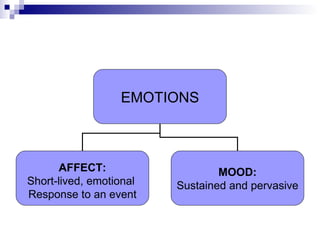
EMOTIONS


       AFFECT:                   MOOD:
Short-lived, emotional   Sustained and pervasive
Response to an event
   Healthy persons experience a wide range of
    moods and have a large repertoire of emotional
    expressions, feel in control

   Mood disorders are a group of clinical conditions
    which are characterized a by sense of loss of
    control over one’s mood and subjective sense of
    distress, impaired interpersonal, social and
    occupational functioning
History
   Hippocrates (400 B.C.) used the terms mania
    and melancholia to describe mental
    disturbances

   Roman physician (30 A.D.) described
    melancholia as depression caused by black bile
   In 1854, Jules Farlet described a condition
    called folie circulaire: alternating moods of
    depression and mania

   In 1899, Emil Kraepelin described manic-
    depressive psychosis using most of the criteria
    that psychiatrists use now
CLASSIFICATION
 Manic Episode
 Depressive Episode
 Bipolar Affective Disorder
 Recurrent Depressive Disorder
 Persistent Mood Disorder (cyclothymia
  and dysthymia)
Mania: Clinical Features
 Core features
     Elevated/irritable mood
     Increased speech
     Decreased need for sleep
     Increased psychomotor activity


   Psychotic features
     Delusions
     Hallucinations


   Others
                                       7
1. Elevated/ irritable mood:
  o   Euphoria/ Grade 1: mild elevation of mood, increased
      sense of psychological well being and happiness, not in
      keeping with ongoing events

  o   Elation/ Grade 2: moderate elevation of mood, feeling of
      confidence and enjoyment, along with increased
      psychomotor activity

  o   Exaltation/ Grade 3: severe elevation of mood, intense
      elation with delusions of grandiosity

  o   Ecstasy/ Grade 4: very severe elevation of mood,
      intense sense of rapture or blissfulness
                                                               8
2. Increased speech
  o   Volubility
  o   Acceleration
  o   Pressured speech- difficult to interrupt
  o   Flight of ideas- shift from topic to topic with
      cues
  o   Prolixity- ordered flight of ideas


3. Increased psychomotor activity
  o   Over activity/ restlessness
  o   Excitement
  o   Stupor
                                                        9
4. Psychotic symptoms
   Delusions: grandiose, love, persecutory

   Hallucinations
5. Other symptoms

 o   Over religiosity
 o   Over spending/ expansive ideas
 o   Over familiarity/ disinhibition
 o   Appearance
 o   Appetite may be increased, but decreased
     food intake due to over-activity
 o   Decreased need for sleep
Psychiatric Interview
   http://www.youtube.com/watch?v
    =zA-fqvC02oM&feature=relmfu
DEPRESSIVE EPISODE: Clinical
Features
1.   Depressed Mood:
    Pervasive and persistent sadness
    Quantitatively and qualitatively different from
     sadness encountered in normal depression or
     grief
    Varies little from day to day and is often
     unresponsive to environmental stimuli
2. Anhedonia:
   Loss of interest or pleasure in almost all
    activities/ earlier pleasurable activities
   Results in social withdrawal
   Decreased ability to function in occupational and
    interpersonal areas
3. Anergia:

   Easy fatigability
   Increased effort to perform simple tasks
4. Depressive ideation:
   Hopelessness
   Helplessness
   Worthlessness
   Feelings of guilt
   Death wishes
   Suicidal ideas
5. Psychomotor Activity:
   Younger patients (less than 40): slowed thinking and
    activity, decreased energy, monotonous voice

   Older patients: agitation, marked anxiety, restlessness

   Severe depression: stupor
6. Biological functions/ somatic syndrome:
   Insomnia
   Loss of appetite and weight
   Loss of sexual drive
   Early morning awakening (atleast 2 hrs)
   Diurnal variation
7. Psychotic Symptoms:

   Delusions of guilt, nihilism, poverty

   Hallucinations
Other symptoms
 Difficulty in concentration
 Forgetfulness
 Low self-esteem
 Decreased self-confidence
Psychiatric Interview
   http://www.youtube.com/watch?v
    =4YhpWZCdiZc
Bipolar affective disorder
   Characterized by repeated episodes of disturbed
    mood and activity levels

   Disturbance consisting of elevation of mood,
    increased energy and activity on some occasion
    and on others of low mood, decreased energy
    and activity

   Recovery is usually complete in between the
    episodes
                                                  22
Recurrent Depressive Disorder
   Recurrent (at least 2 depressive episodes) of
    unipolar depression
   First episode occurs later than in bipolar, usually
    in the 5th decade
   Episodes last between 3 to 12 months
   Recovery is usually complete
   Often precipitated by stressful life events
Persistent Mood Disorders
   Persistent mood symptoms lasting for more than 2 years

   Not severe enough to be labeled as even hypomanic or
    mild depressive

   Persistent mild depression: dysthymia

   Persistent instability of mood between depression and
    mania: cyclotymia
Next Class
 Course and Prognosis
 Epidemiology
 Treatment
 Differential Diagnosis
 Co-morbidities
 Other syndromes of depression and mania
Psychiatric Interviews
 http://www.youtube.com/watch?v
  =4YhpWZCdiZc
 http://www.youtube.com/watch?v
  =zA-fqvC02oM&feature=relmfu
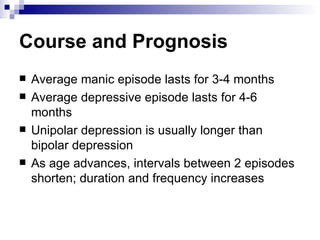
Course and Prognosis
   Average manic episode lasts for 3-4 months
   Average depressive episode lasts for 4-6
    months
   Unipolar depression is usually longer than
    bipolar depression
   As age advances, intervals between 2 episodes
    shorten; duration and frequency increases
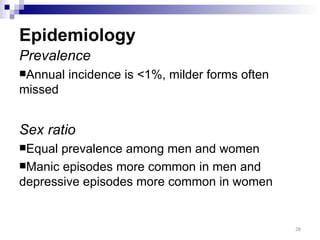
Epidemiology
Prevalence
Annual   incidence is <1%, milder forms often
missed


Sex ratio
Equal prevalence among men and women
Manic episodes more common in men and
depressive episodes more common in women


                                                 28
Age of onset
Onsetearlier than depressive episode
Ranges from 5-50yrs; mean age 30yrs


Marital status
More   common in divorced and single persons

Socioeconomic status
Higher than average incidence among upper
socioeconomic status

                                                29
Classification

   Bipolar type 1- having clinical course of
    one or more manic episodes and major
    depressive episodes

   Bipolar type 2 – characterized by episodes
    of major depression and hypomania


                                                30
Diagnosis- ICD 10 criteria
   Hypomania- lesser degree of mania
    o   Persistent mild elevation of mood- euphoria
    o   Marked feelings of well being and efficiency
    o   Increased energy and activity
    o   Decreased need for sleep
    o   Increased sociability and talkativeness
    o   Not leading to severe disruption of work or
        social rejection
    o   Present for several days on end (4 days)

                                                       31
   Mania without psychotic symptoms
    o   Last for at least 1wk
    o   Severe enough to disrupt ordinary work and
        social activities
    o   Elated mood
    o   Increased energy with over activity
    o   Pressured speech
    o   Decreased need for sleep
    o   Marked distractibility
    o   Disinhibited, overspending
    o   Expansive ideas
                                                     32
   Mania with psychotic symptoms
    o   More severe form
    o   Delusions- grandiose and/or persecutory
    o   Perceptual abnormalities
    o   Severe and sustained physical activity,
        excitement
    o   Flight of ideas, incoherence
    o   Impaired personal care


                                                  33
Etiology
Biological theories
2.Genetic factors
3.Neurotransmitter theories- inconsistent
  o   Dopamine- raised in mania and vice versa
4.Neuroendocrine    theories
  o   CSF somatostatin- raised in mania and vice
      versa
5.Neuroimaging    and anatomy
  o   Regions involved in regulation of normal
      emotions- PFC, antr cingulate, hippocampus,
      amygdala                                  34
Contd-
Psychosocial theories
2.Life events and stress
  o   Play a formative role in depression;
      precipitating in mania
  o   More often precede first rather than the
      subsequent episodes


                                                 35
Course
 Most often first episode is depression
 Average manic episode lasts 3-4mnths
  and depressive episodes 4-6mnths
 Long term follow up- 15% are well, 45%
  are well with multiple relapses, 30% in
  partial remission, 10% are chronically ill


                                               36
Treatment
   Pharmacological- Acute- Mood stabilizers
                              Antipsychotics

    Benzodiazapines
                              Antidepressants
                              ECTs
                      Prophylaxis- Mood
    stabilizers
   Non pharmacological- Psycho education
                           CBT
                           Interpersonal        37
Contd-
Mood stabilizers
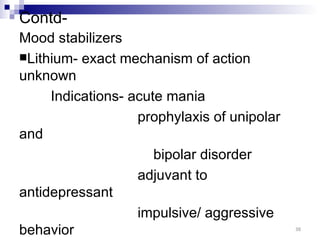
Lithium- exact mechanism of action
unknown
     Indications- acute mania
                   prophylaxis of unipolar
and
                      bipolar disorder
                   adjuvant to
antidepressant
                   impulsive/ aggressive
behavior                                     38
Contd-
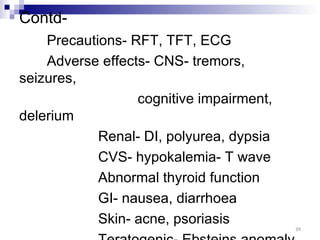
    Precautions- RFT, TFT, ECG
    Adverse effects- CNS- tremors,
seizures,
                  cognitive impairment,
delerium
            Renal- DI, polyurea, dypsia
            CVS- hypokalemia- T wave
            Abnormal thyroid function
            GI- nausea, diarrhoea
            Skin- acne, psoriasis
                                          39
Contd-
 Sodium valproate- acute mania,
  prophylaxis
                       750-2500mg/day
                       rapid onset of
  response
 Carbamazepine
 Oxcarbazepine
 Lamotrigine- depression, prophylaxis; skin
 Topiramate

                                           40
41
Summary
   Clinical features- 4 core features
                         psychotic features
                         others

   Management- pharmacological- acute

    prophylaxis
                     non-pharmacological

                                              42
Poor prognostic factors
 Young onset
 Longer duration of episodes
 Presence of psychotic features
 Inter episode depressive features
 Premorbid poor occupational status
 Comorbid medical and psychiatric
  problems


                                       43
Etiology
Biological theories
2.Genetic factors
  o   3 fold increase in biological relative
  o   Increased concordance rate for monozygotic
      twins
  o   Chromosome 18, 21, 22


4.Neurotransmitter    theories- inconsistent
  o   Serotonin and norepinephrine- depression
  o   Dopamine- reduced in depression and
      increased in mania                           44
Contd-
1.   Neuroendocrine theories
     o   Elevated HPA activity, hypothyroidism-
         depression
     o   CSF somatostatin- raised in mania and vice
         versa


3.   Neuroimaging and anatomy
     o   Regions involved in regulation of normal
         emotions- PFC, antr cingulate, hippocampus,
         amygdala
     o   Ventricular enlargement                   45
Contd-
Psychosocial theories
•Psychoanalytic theory- mania as defense
against underlying depression

•Life   events and stress
  o     Play a formative role in depression;
        precipitating in mania
  o     More often precede first rather than the
        subsequent episodes


6.Cognitive    theory- depression
                                                   46
Course
 Most often first episode is depression
 10-20% experience only manic episodes
 Manic episodes typically have rapid onset
 Average manic episode lasts 3-4mnths
  and depressive episodes 4-6mnths
 Long term follow up- 15% are well, 45%
  are well with multiple relapses, 30% in
  partial remission, 10% are chronically ill

                                               47

Mood disorders

  • 1.
  • 2.
    EMOTIONS AFFECT: MOOD: Short-lived, emotional Sustained and pervasive Response to an event
  • 3.
    Healthy persons experience a wide range of moods and have a large repertoire of emotional expressions, feel in control  Mood disorders are a group of clinical conditions which are characterized a by sense of loss of control over one’s mood and subjective sense of distress, impaired interpersonal, social and occupational functioning
  • 4.
    History  Hippocrates (400 B.C.) used the terms mania and melancholia to describe mental disturbances  Roman physician (30 A.D.) described melancholia as depression caused by black bile
  • 5.
    In 1854, Jules Farlet described a condition called folie circulaire: alternating moods of depression and mania  In 1899, Emil Kraepelin described manic- depressive psychosis using most of the criteria that psychiatrists use now
  • 6.
    CLASSIFICATION  Manic Episode Depressive Episode  Bipolar Affective Disorder  Recurrent Depressive Disorder  Persistent Mood Disorder (cyclothymia and dysthymia)
  • 7.
    Mania: Clinical Features Core features  Elevated/irritable mood  Increased speech  Decreased need for sleep  Increased psychomotor activity  Psychotic features  Delusions  Hallucinations  Others 7
  • 8.
    1. Elevated/ irritablemood: o Euphoria/ Grade 1: mild elevation of mood, increased sense of psychological well being and happiness, not in keeping with ongoing events o Elation/ Grade 2: moderate elevation of mood, feeling of confidence and enjoyment, along with increased psychomotor activity o Exaltation/ Grade 3: severe elevation of mood, intense elation with delusions of grandiosity o Ecstasy/ Grade 4: very severe elevation of mood, intense sense of rapture or blissfulness 8
  • 9.
    2. Increased speech o Volubility o Acceleration o Pressured speech- difficult to interrupt o Flight of ideas- shift from topic to topic with cues o Prolixity- ordered flight of ideas 3. Increased psychomotor activity o Over activity/ restlessness o Excitement o Stupor 9
  • 10.
    4. Psychotic symptoms  Delusions: grandiose, love, persecutory  Hallucinations
  • 11.
    5. Other symptoms o Over religiosity o Over spending/ expansive ideas o Over familiarity/ disinhibition o Appearance o Appetite may be increased, but decreased food intake due to over-activity o Decreased need for sleep
  • 12.
    Psychiatric Interview  http://www.youtube.com/watch?v =zA-fqvC02oM&feature=relmfu
  • 13.
    DEPRESSIVE EPISODE: Clinical Features 1. Depressed Mood:  Pervasive and persistent sadness  Quantitatively and qualitatively different from sadness encountered in normal depression or grief  Varies little from day to day and is often unresponsive to environmental stimuli
  • 14.
    2. Anhedonia:  Loss of interest or pleasure in almost all activities/ earlier pleasurable activities  Results in social withdrawal  Decreased ability to function in occupational and interpersonal areas
  • 15.
    3. Anergia:  Easy fatigability  Increased effort to perform simple tasks
  • 16.
    4. Depressive ideation:  Hopelessness  Helplessness  Worthlessness  Feelings of guilt  Death wishes  Suicidal ideas
  • 17.
    5. Psychomotor Activity:  Younger patients (less than 40): slowed thinking and activity, decreased energy, monotonous voice  Older patients: agitation, marked anxiety, restlessness  Severe depression: stupor
  • 18.
    6. Biological functions/somatic syndrome:  Insomnia  Loss of appetite and weight  Loss of sexual drive  Early morning awakening (atleast 2 hrs)  Diurnal variation
  • 19.
    7. Psychotic Symptoms:  Delusions of guilt, nihilism, poverty  Hallucinations
  • 20.
    Other symptoms  Difficultyin concentration  Forgetfulness  Low self-esteem  Decreased self-confidence
  • 21.
    Psychiatric Interview  http://www.youtube.com/watch?v =4YhpWZCdiZc
  • 22.
    Bipolar affective disorder  Characterized by repeated episodes of disturbed mood and activity levels  Disturbance consisting of elevation of mood, increased energy and activity on some occasion and on others of low mood, decreased energy and activity  Recovery is usually complete in between the episodes 22
  • 23.
    Recurrent Depressive Disorder  Recurrent (at least 2 depressive episodes) of unipolar depression  First episode occurs later than in bipolar, usually in the 5th decade  Episodes last between 3 to 12 months  Recovery is usually complete  Often precipitated by stressful life events
  • 24.
    Persistent Mood Disorders  Persistent mood symptoms lasting for more than 2 years  Not severe enough to be labeled as even hypomanic or mild depressive  Persistent mild depression: dysthymia  Persistent instability of mood between depression and mania: cyclotymia
  • 25.
    Next Class  Courseand Prognosis  Epidemiology  Treatment  Differential Diagnosis  Co-morbidities  Other syndromes of depression and mania
  • 26.
    Psychiatric Interviews  http://www.youtube.com/watch?v =4YhpWZCdiZc  http://www.youtube.com/watch?v =zA-fqvC02oM&feature=relmfu
  • 27.
    Course and Prognosis  Average manic episode lasts for 3-4 months  Average depressive episode lasts for 4-6 months  Unipolar depression is usually longer than bipolar depression  As age advances, intervals between 2 episodes shorten; duration and frequency increases
  • 28.
    Epidemiology Prevalence Annual incidence is <1%, milder forms often missed Sex ratio Equal prevalence among men and women Manic episodes more common in men and depressive episodes more common in women 28
  • 29.
    Age of onset Onsetearlierthan depressive episode Ranges from 5-50yrs; mean age 30yrs Marital status More common in divorced and single persons Socioeconomic status Higher than average incidence among upper socioeconomic status 29
  • 30.
    Classification  Bipolar type 1- having clinical course of one or more manic episodes and major depressive episodes  Bipolar type 2 – characterized by episodes of major depression and hypomania 30
  • 31.
    Diagnosis- ICD 10criteria  Hypomania- lesser degree of mania o Persistent mild elevation of mood- euphoria o Marked feelings of well being and efficiency o Increased energy and activity o Decreased need for sleep o Increased sociability and talkativeness o Not leading to severe disruption of work or social rejection o Present for several days on end (4 days) 31
  • 32.
    Mania without psychotic symptoms o Last for at least 1wk o Severe enough to disrupt ordinary work and social activities o Elated mood o Increased energy with over activity o Pressured speech o Decreased need for sleep o Marked distractibility o Disinhibited, overspending o Expansive ideas 32
  • 33.
    Mania with psychotic symptoms o More severe form o Delusions- grandiose and/or persecutory o Perceptual abnormalities o Severe and sustained physical activity, excitement o Flight of ideas, incoherence o Impaired personal care 33
  • 34.
    Etiology Biological theories 2.Genetic factors 3.Neurotransmittertheories- inconsistent o Dopamine- raised in mania and vice versa 4.Neuroendocrine theories o CSF somatostatin- raised in mania and vice versa 5.Neuroimaging and anatomy o Regions involved in regulation of normal emotions- PFC, antr cingulate, hippocampus, amygdala 34
  • 35.
    Contd- Psychosocial theories 2.Life eventsand stress o Play a formative role in depression; precipitating in mania o More often precede first rather than the subsequent episodes 35
  • 36.
    Course  Most oftenfirst episode is depression  Average manic episode lasts 3-4mnths and depressive episodes 4-6mnths  Long term follow up- 15% are well, 45% are well with multiple relapses, 30% in partial remission, 10% are chronically ill 36
  • 37.
    Treatment  Pharmacological- Acute- Mood stabilizers Antipsychotics Benzodiazapines Antidepressants ECTs Prophylaxis- Mood stabilizers  Non pharmacological- Psycho education CBT Interpersonal 37
  • 38.
    Contd- Mood stabilizers Lithium- exactmechanism of action unknown Indications- acute mania prophylaxis of unipolar and bipolar disorder adjuvant to antidepressant impulsive/ aggressive behavior 38
  • 39.
    Contd- Precautions- RFT, TFT, ECG Adverse effects- CNS- tremors, seizures, cognitive impairment, delerium Renal- DI, polyurea, dypsia CVS- hypokalemia- T wave Abnormal thyroid function GI- nausea, diarrhoea Skin- acne, psoriasis 39
  • 40.
    Contd-  Sodium valproate-acute mania, prophylaxis 750-2500mg/day rapid onset of response  Carbamazepine  Oxcarbazepine  Lamotrigine- depression, prophylaxis; skin  Topiramate 40
  • 41.
  • 42.
    Summary  Clinical features- 4 core features psychotic features others  Management- pharmacological- acute prophylaxis non-pharmacological 42
  • 43.
    Poor prognostic factors Young onset  Longer duration of episodes  Presence of psychotic features  Inter episode depressive features  Premorbid poor occupational status  Comorbid medical and psychiatric problems 43
  • 44.
    Etiology Biological theories 2.Genetic factors o 3 fold increase in biological relative o Increased concordance rate for monozygotic twins o Chromosome 18, 21, 22 4.Neurotransmitter theories- inconsistent o Serotonin and norepinephrine- depression o Dopamine- reduced in depression and increased in mania 44
  • 45.
    Contd- 1. Neuroendocrine theories o Elevated HPA activity, hypothyroidism- depression o CSF somatostatin- raised in mania and vice versa 3. Neuroimaging and anatomy o Regions involved in regulation of normal emotions- PFC, antr cingulate, hippocampus, amygdala o Ventricular enlargement 45
  • 46.
    Contd- Psychosocial theories •Psychoanalytic theory-mania as defense against underlying depression •Life events and stress o Play a formative role in depression; precipitating in mania o More often precede first rather than the subsequent episodes 6.Cognitive theory- depression 46
  • 47.
    Course  Most oftenfirst episode is depression  10-20% experience only manic episodes  Manic episodes typically have rapid onset  Average manic episode lasts 3-4mnths and depressive episodes 4-6mnths  Long term follow up- 15% are well, 45% are well with multiple relapses, 30% in partial remission, 10% are chronically ill 47