Qualitative Research
“ Not everything that can be counted counts,
and not everything that counts can be
counted.”
~ Albert Einstein
Presenter
Muthuvenkatachalam S., D.Pharm, M.Sc (AIIMS), PhD Scholar
(RGUHS)
2
Scheme
 Introduction
 What is Qualitative Research?
 Major Qualitative Research Designs
 Observations
 When to Choose A Qualitative Approach?
 Qualitative Research Design: Case Study
 Qualitative Research Design: Ethnography
 Qualitative Research Design: Phenomenological Study
 Qualitative Research Design: Grounded Theory Study
 Qualitative Research Design: Content Analysis
 Collecting, Organizing, and Analyzing Data In Qualitative Research
 What Makes Good Qualitative Research?
3
Introduction
No single or ultimate truth to be discovered, more likely there are multiple perspectives
What do you see?
4
Agenda
 Introduction
 What is Qualitative Research?
 Major Qualitative Research Designs
 Observations
 When to Choose A Qualitative Approach?
 Qualitative Research Design: Case Study
 Qualitative Research Design: Ethnography
 Qualitative Research Design: Phenomenological Study
 Qualitative Research Design: Grounded Theory Study
 Qualitative Research Design: Content Analysis
 Collecting, Organizing, and Analyzing Data In Qualitative Research
 What Makes Good Qualitative Research?
5
Qualitative Research - Definition
“Qualitative research is a loosely defined category of
research designs or models, all of which elicit verbal,
visual, tactile, olfactory, and gustatory data in the form
of descriptive narratives like field notes, recordings, or
other transcriptions from audio- and videotapes and
other written records and pictures or films.”
6
What is Qualitative Research?
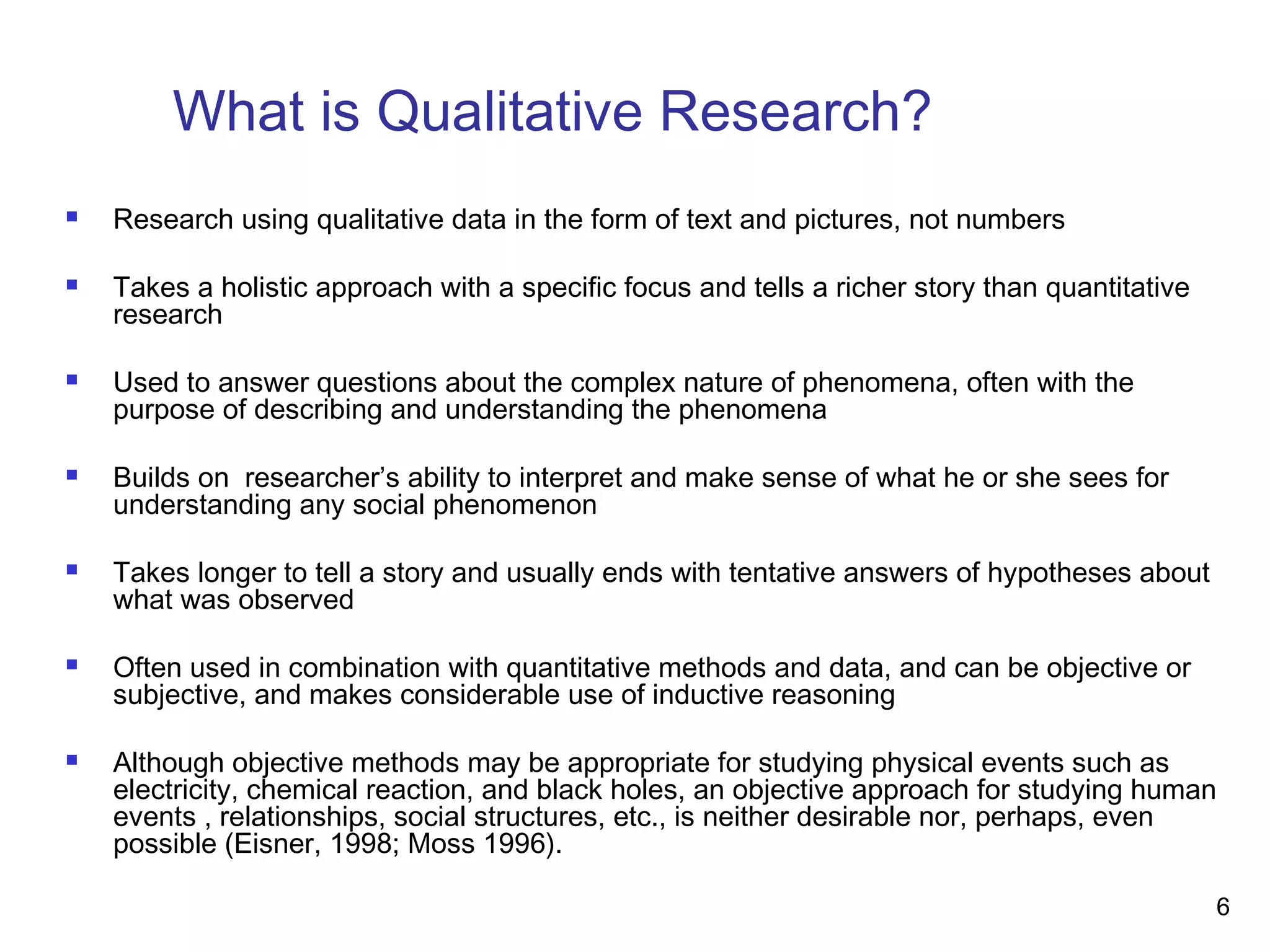
 Research using qualitative data in the form of text and pictures, not numbers
 Takes a holistic approach with a specific focus and tells a richer story than quantitative
research
 Used to answer questions about the complex nature of phenomena, often with the
purpose of describing and understanding the phenomena
 Builds on researcher’s ability to interpret and make sense of what he or she sees for
understanding any social phenomenon
 Takes longer to tell a story and usually ends with tentative answers of hypotheses about
what was observed
 Often used in combination with quantitative methods and data, and can be objective or
subjective, and makes considerable use of inductive reasoning
 Although objective methods may be appropriate for studying physical events such as
electricity, chemical reaction, and black holes, an objective approach for studying human
events , relationships, social structures, etc., is neither desirable nor, perhaps, even
possible (Eisner, 1998; Moss 1996).
7
Major Qualitative Research Designs
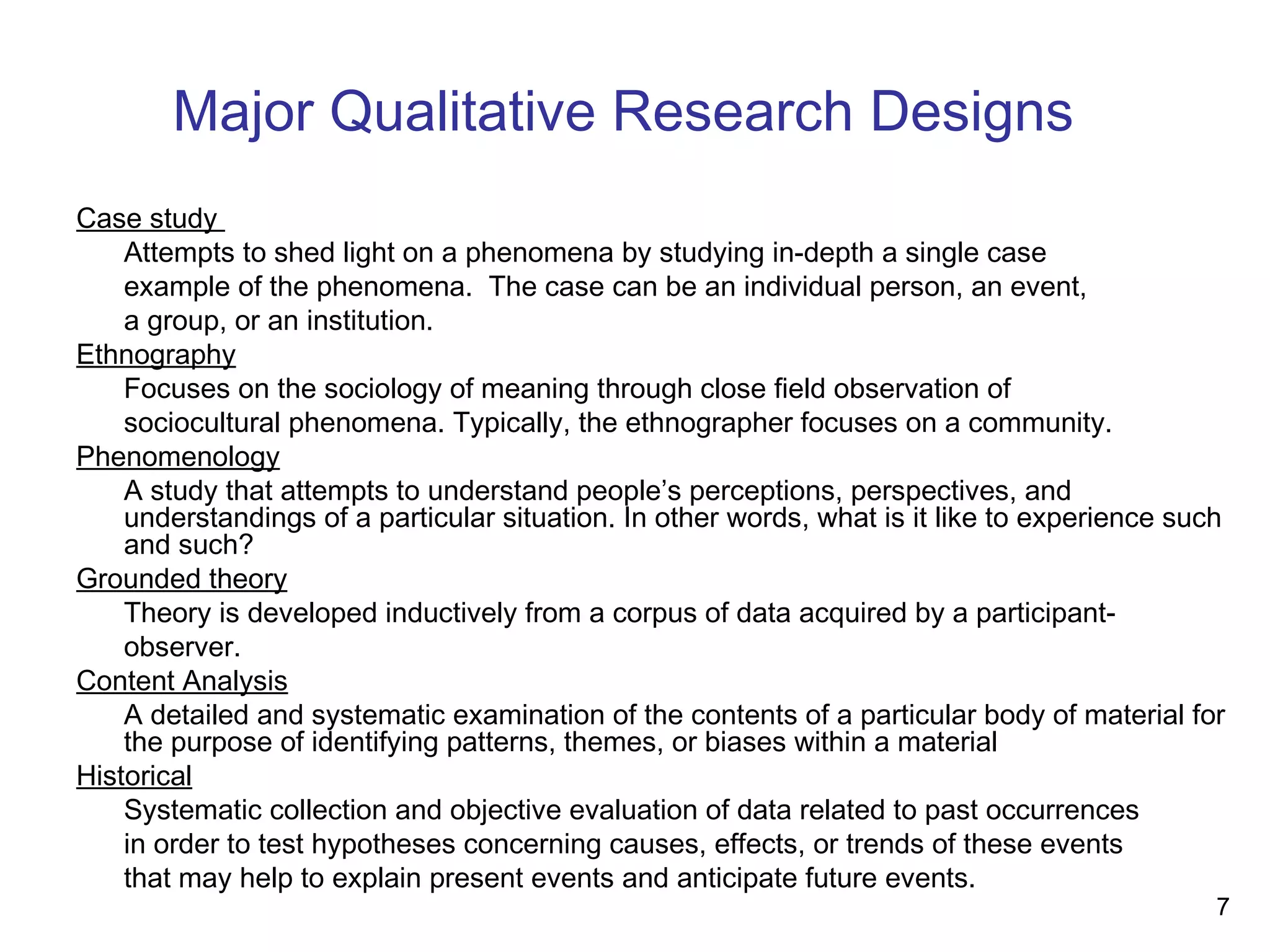
Case study
Attempts to shed light on a phenomena by studying in-depth a single case
example of the phenomena.  The case can be an individual person, an event,
a group, or an institution.
Ethnography
Focuses on the sociology of meaning through close field observation of
sociocultural phenomena. Typically, the ethnographer focuses on a community.
Phenomenology
A study that attempts to understand people’s perceptions, perspectives, and
understandings of a particular situation. In other words, what is it like to experience such
and such?
Grounded theory
Theory is developed inductively from a corpus of data acquired by a participant-
observer.
Content Analysis
A detailed and systematic examination of the contents of a particular body of material for
the purpose of identifying patterns, themes, or biases within a material
Historical
Systematic collection and objective evaluation of data related to past occurrences
in order to test hypotheses concerning causes, effects, or trends of these events
that may help to explain present events and anticipate future events.
8
Observations
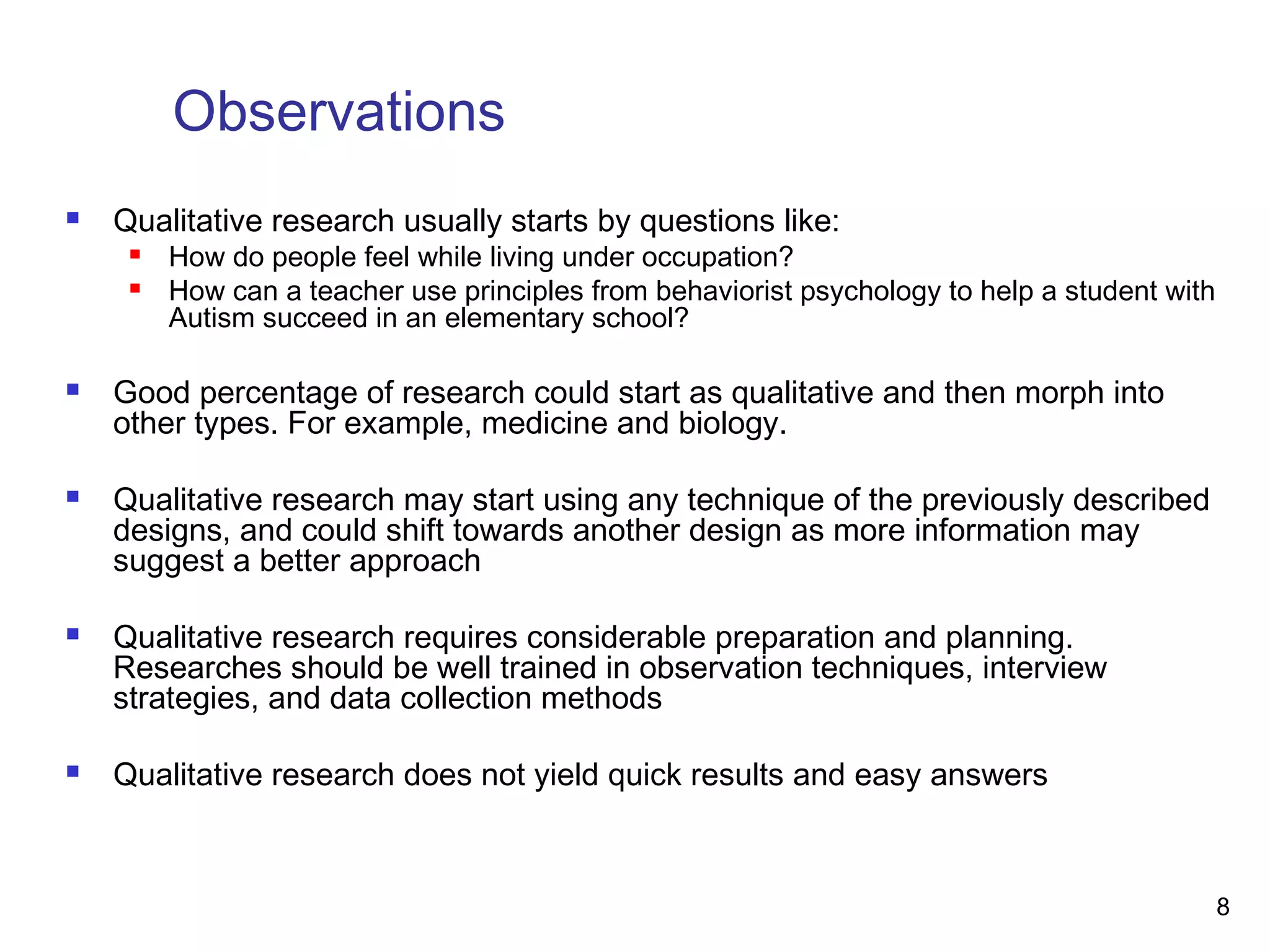
 Qualitative research usually starts by questions like:
 How do people feel while living under occupation?
 How can a teacher use principles from behaviorist psychology to help a student with
Autism succeed in an elementary school?
 Good percentage of research could start as qualitative and then morph into
other types. For example, medicine and biology.
 Qualitative research may start using any technique of the previously described
designs, and could shift towards another design as more information may
suggest a better approach
 Qualitative research requires considerable preparation and planning.
Researches should be well trained in observation techniques, interview
strategies, and data collection methods
 Qualitative research does not yield quick results and easy answers
9
When To Choose A Qualitative Approach
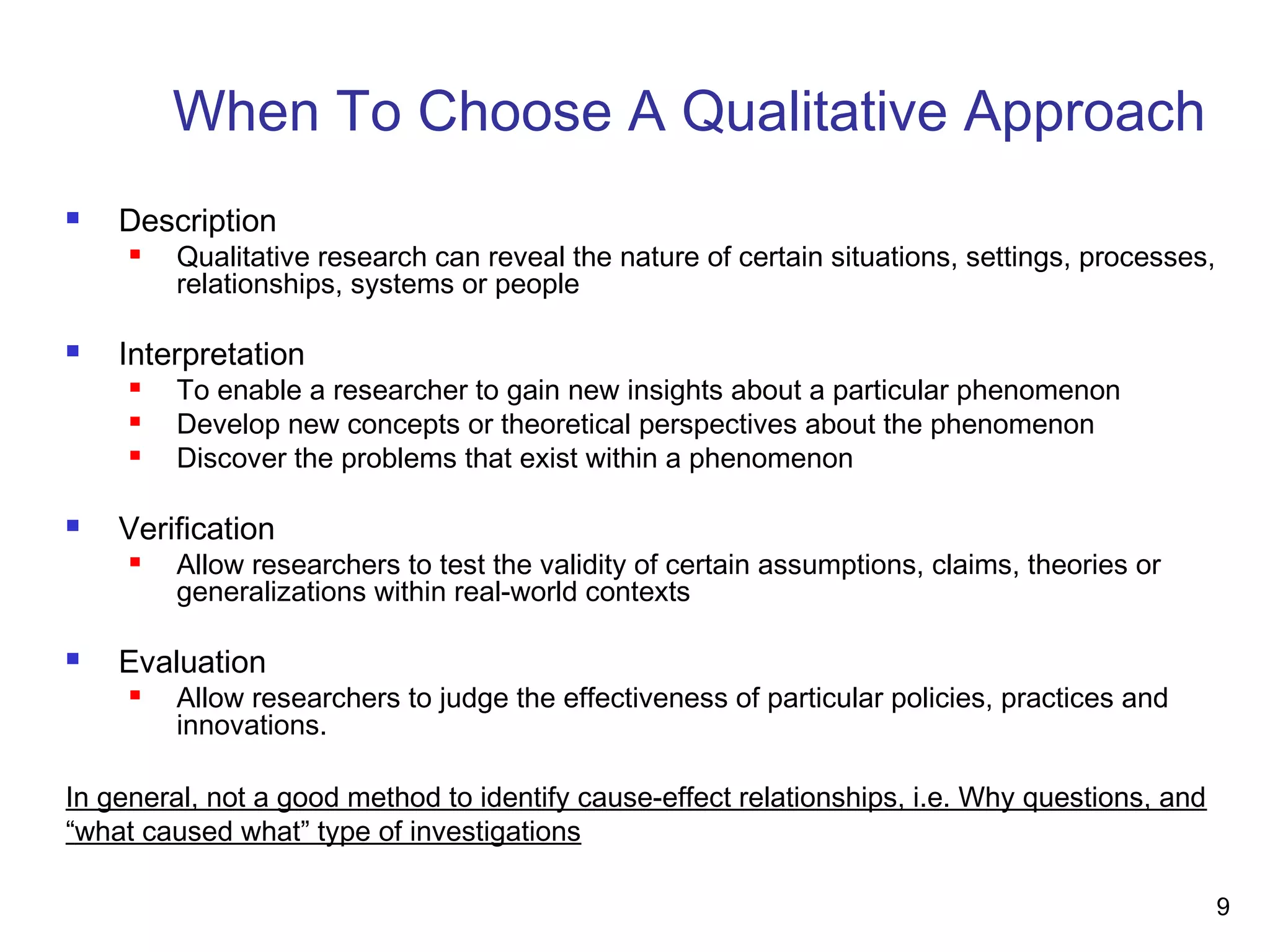
 Description
 Qualitative research can reveal the nature of certain situations, settings, processes,
relationships, systems or people
 Interpretation
 To enable a researcher to gain new insights about a particular phenomenon
 Develop new concepts or theoretical perspectives about the phenomenon
 Discover the problems that exist within a phenomenon
 Verification
 Allow researchers to test the validity of certain assumptions, claims, theories or
generalizations within real-world contexts
 Evaluation
 Allow researchers to judge the effectiveness of particular policies, practices and
innovations.
In general, not a good method to identify cause-effect relationships, i.e. Why questions, and
“what caused what” type of investigations
10
Agenda
 Introduction
 What is Qualitative Research?
 Major Qualitative Research Designs
 Observations
 When to Choose A Qualitative Approach?
 Qualitative Research Design: Case Study
 Qualitative Research Design: Ethnography
 Qualitative Research Design: Phenomenological Study
 Qualitative Research Design: Grounded Theory Study
 Qualitative Research Design: Content Analysis
 Collecting, Organizing, and Analyzing Data In Qualitative Research
 What Makes Good Qualitative Research?
11
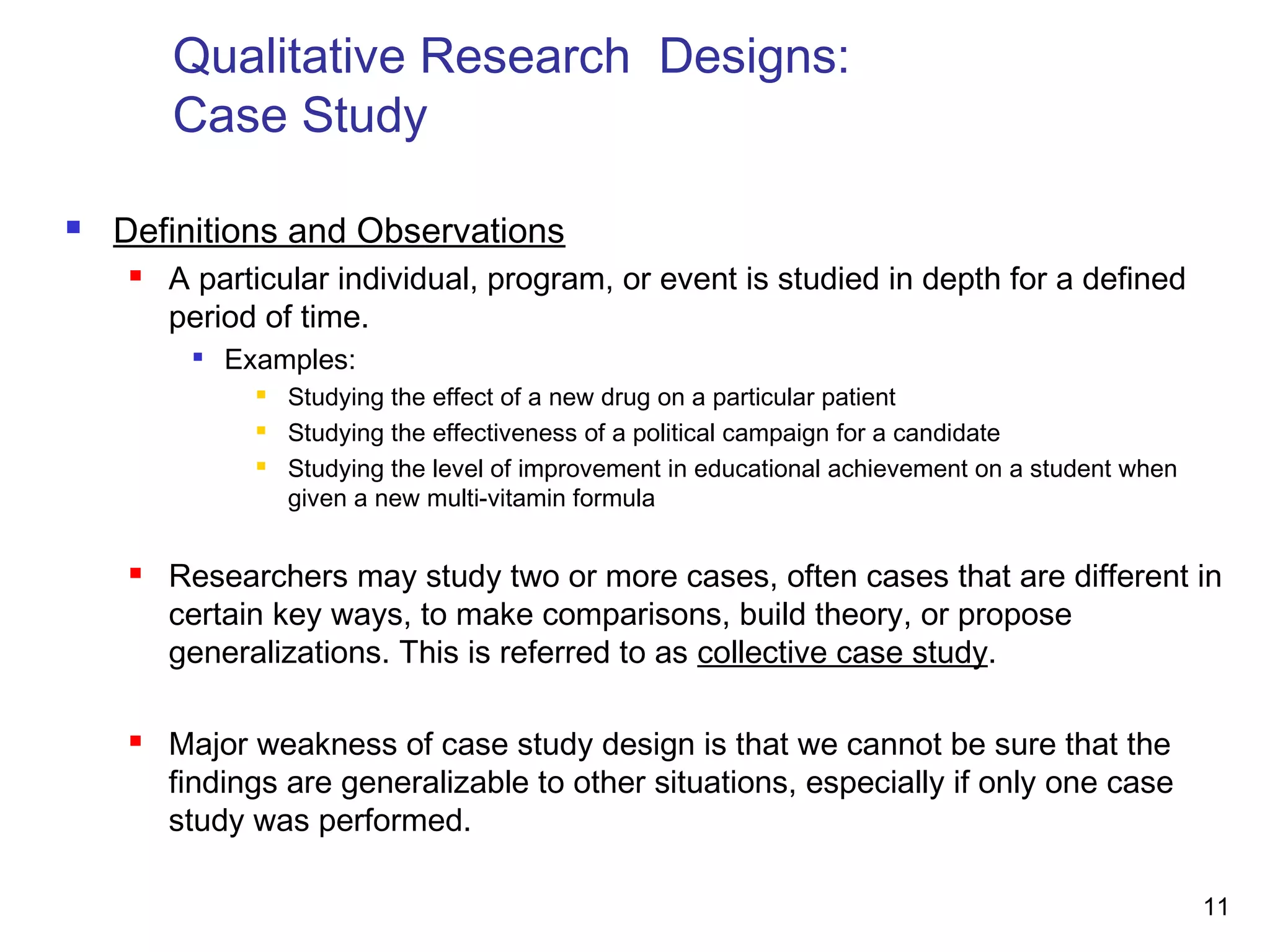
Qualitative Research Designs:
Case Study
 Definitions and Observations
 A particular individual, program, or event is studied in depth for a defined
period of time.

Examples:
 Studying the effect of a new drug on a particular patient
 Studying the effectiveness of a political campaign for a candidate
 Studying the level of improvement in educational achievement on a student when
given a new multi-vitamin formula
 Researchers may study two or more cases, often cases that are different in
certain key ways, to make comparisons, build theory, or propose
generalizations. This is referred to as collective case study.
 Major weakness of case study design is that we cannot be sure that the
findings are generalizable to other situations, especially if only one case
study was performed.
12
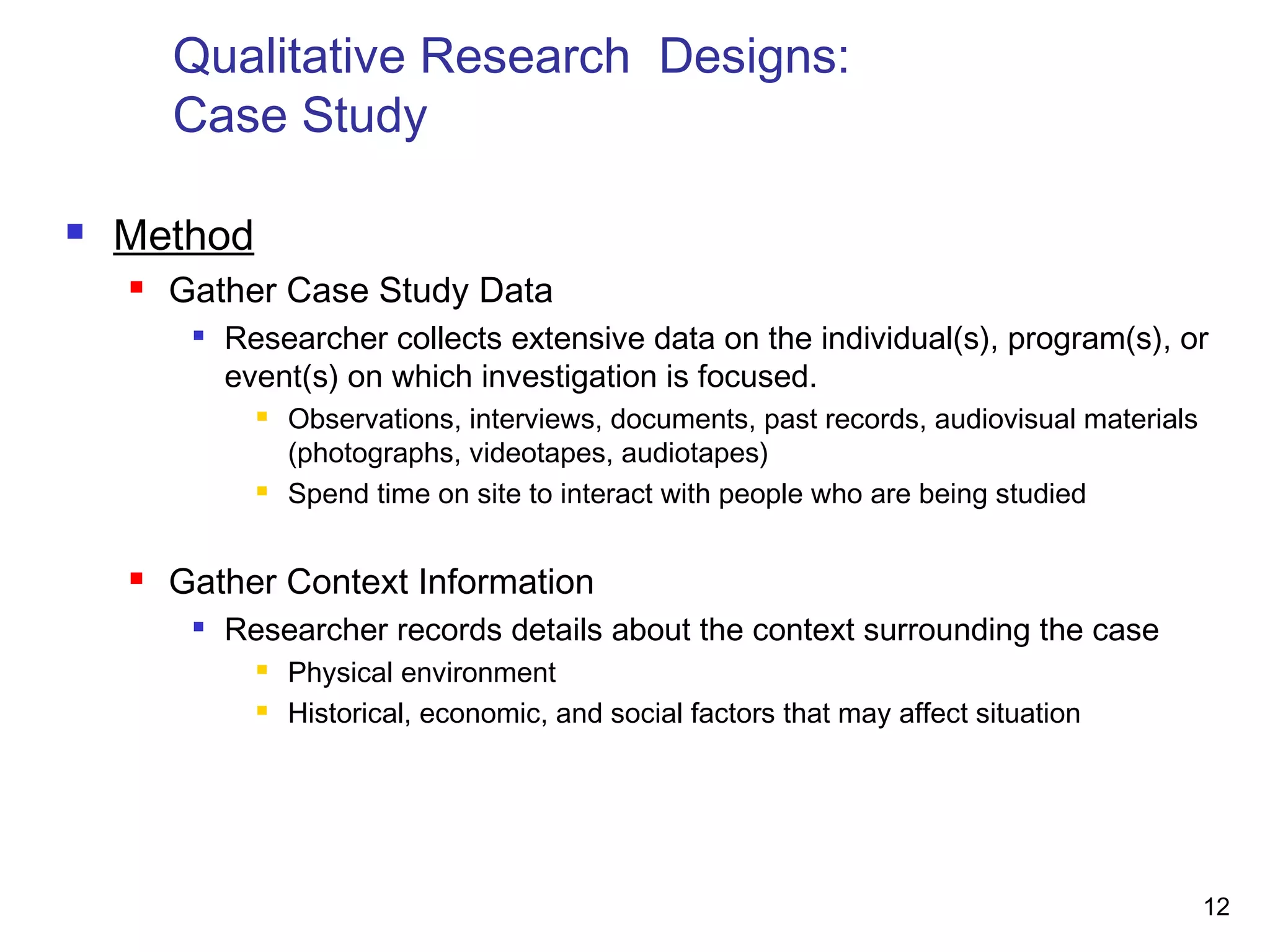
Qualitative Research Designs:
Case Study
 Method
 Gather Case Study Data

Researcher collects extensive data on the individual(s), program(s), or
event(s) on which investigation is focused.
 Observations, interviews, documents, past records, audiovisual materials
(photographs, videotapes, audiotapes)
 Spend time on site to interact with people who are being studied
 Gather Context Information

Researcher records details about the context surrounding the case
 Physical environment
 Historical, economic, and social factors that may affect situation
13
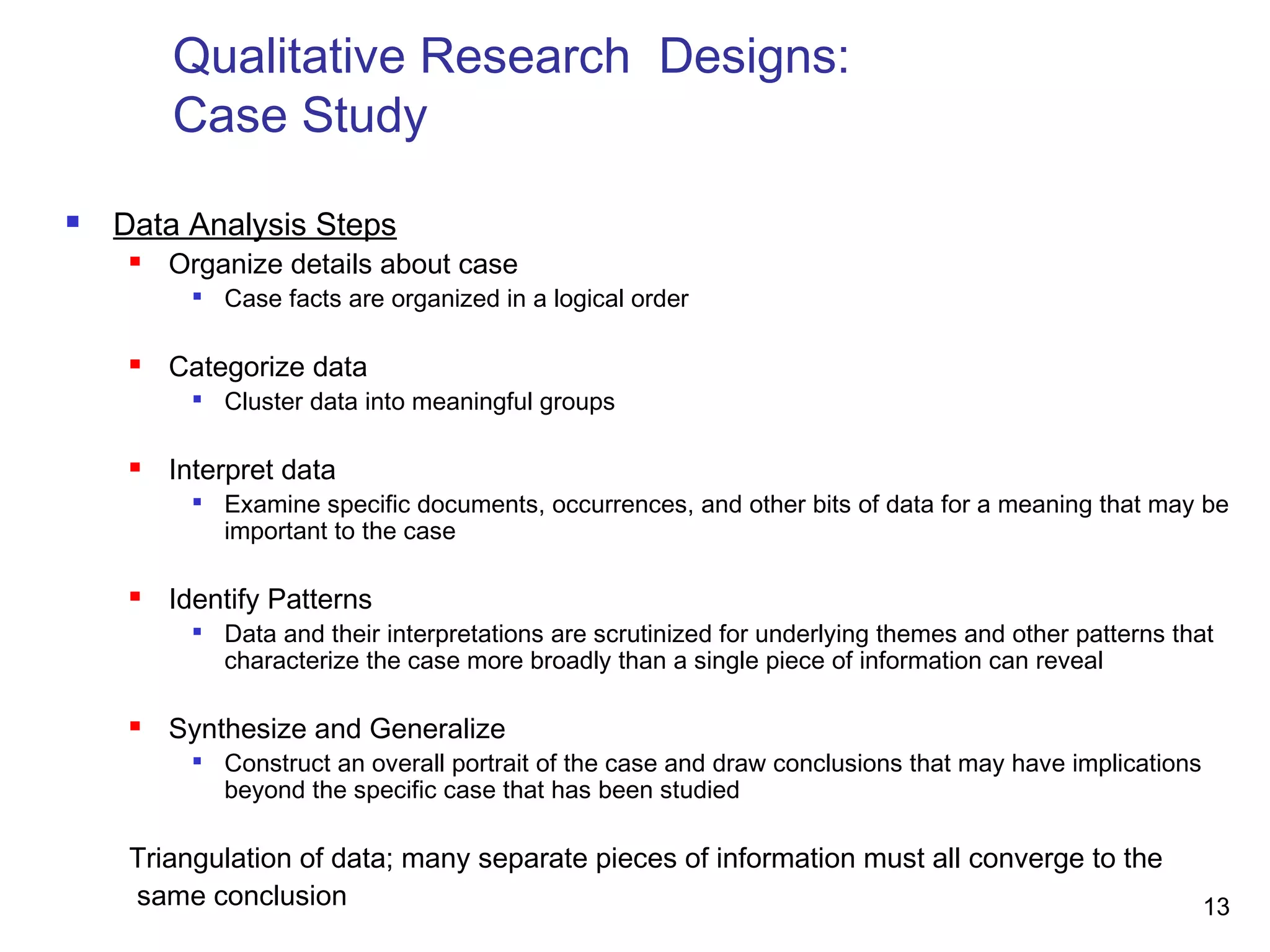
Qualitative Research Designs:
Case Study
 Data Analysis Steps
 Organize details about case

Case facts are organized in a logical order
 Categorize data

Cluster data into meaningful groups
 Interpret data

Examine specific documents, occurrences, and other bits of data for a meaning that may be
important to the case
 Identify Patterns

Data and their interpretations are scrutinized for underlying themes and other patterns that
characterize the case more broadly than a single piece of information can reveal
 Synthesize and Generalize

Construct an overall portrait of the case and draw conclusions that may have implications
beyond the specific case that has been studied
Triangulation of data; many separate pieces of information must all converge to the
same conclusion
14
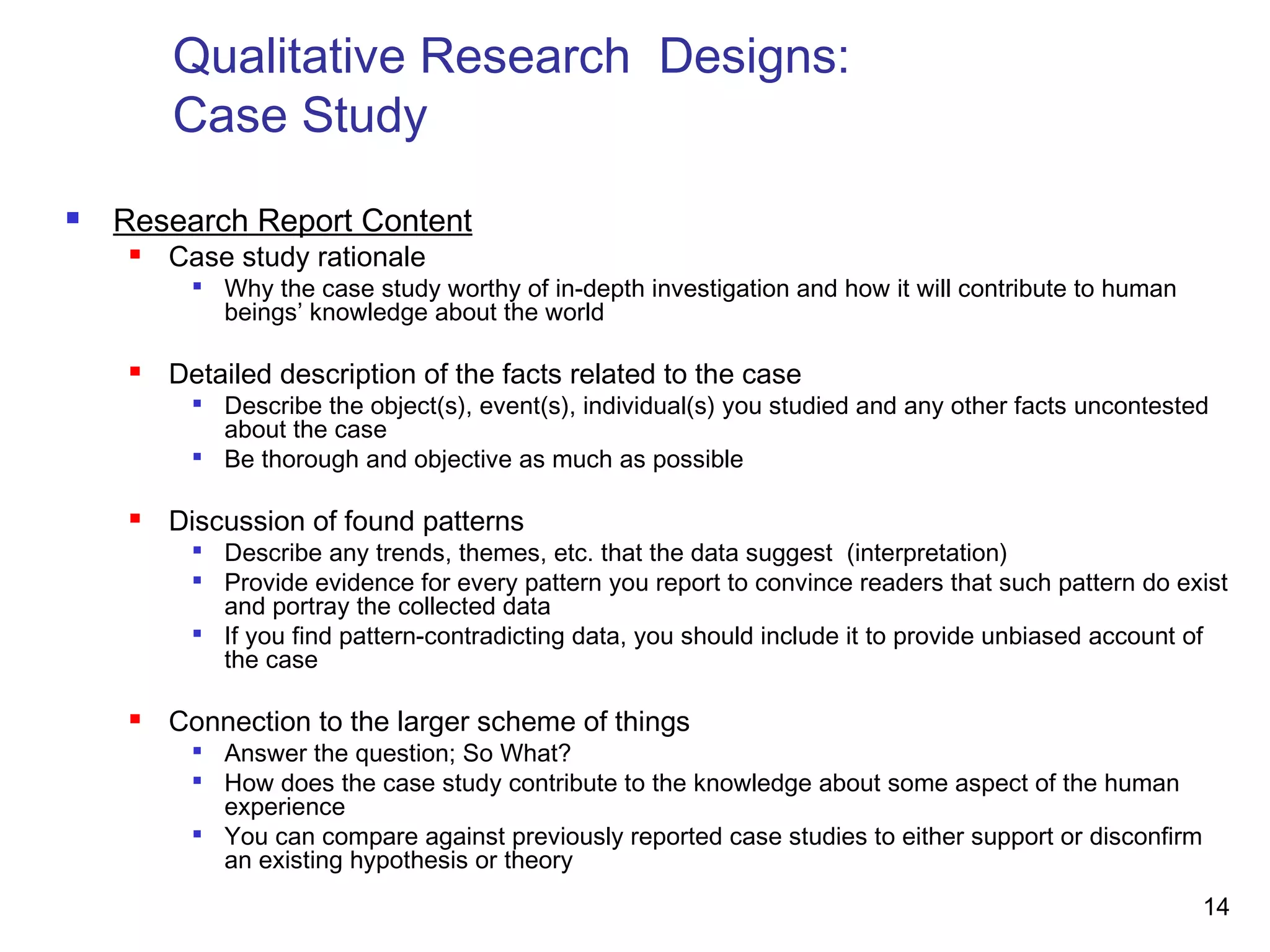
Qualitative Research Designs:
Case Study
 Research Report Content
 Case study rationale

Why the case study worthy of in-depth investigation and how it will contribute to human
beings’ knowledge about the world
 Detailed description of the facts related to the case

Describe the object(s), event(s), individual(s) you studied and any other facts uncontested
about the case

Be thorough and objective as much as possible
 Discussion of found patterns

Describe any trends, themes, etc. that the data suggest (interpretation)

Provide evidence for every pattern you report to convince readers that such pattern do exist
and portray the collected data

If you find pattern-contradicting data, you should include it to provide unbiased account of
the case
 Connection to the larger scheme of things

Answer the question; So What?

How does the case study contribute to the knowledge about some aspect of the human
experience

You can compare against previously reported case studies to either support or disconfirm
an existing hypothesis or theory
15
Agenda
 Introduction
 What is Qualitative Research?
 Major Qualitative Research Designs
 Observations
 When to Choose A Qualitative Approach?
 Qualitative Research Design: Case Study
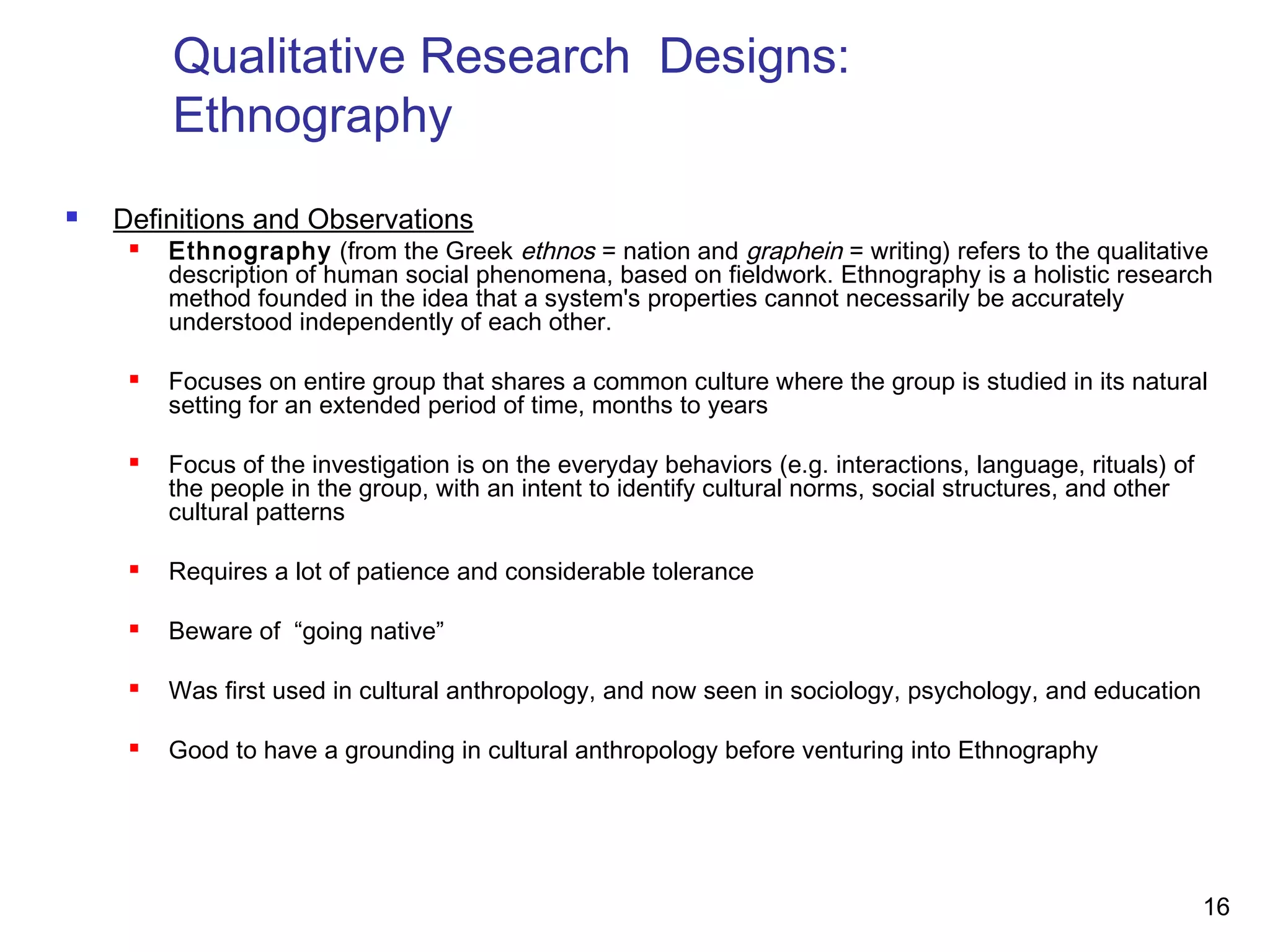
 Qualitative Research Design: Ethnography
 Qualitative Research Design: Phenomenological Study
 Qualitative Research Design: Grounded Theory Study
 Qualitative Research Design: Content Analysis
 Collecting, Organizing, and Analyzing Data In Qualitative Research
 What Makes Good Qualitative Research?
16
Qualitative Research Designs:
Ethnography
 Definitions and Observations
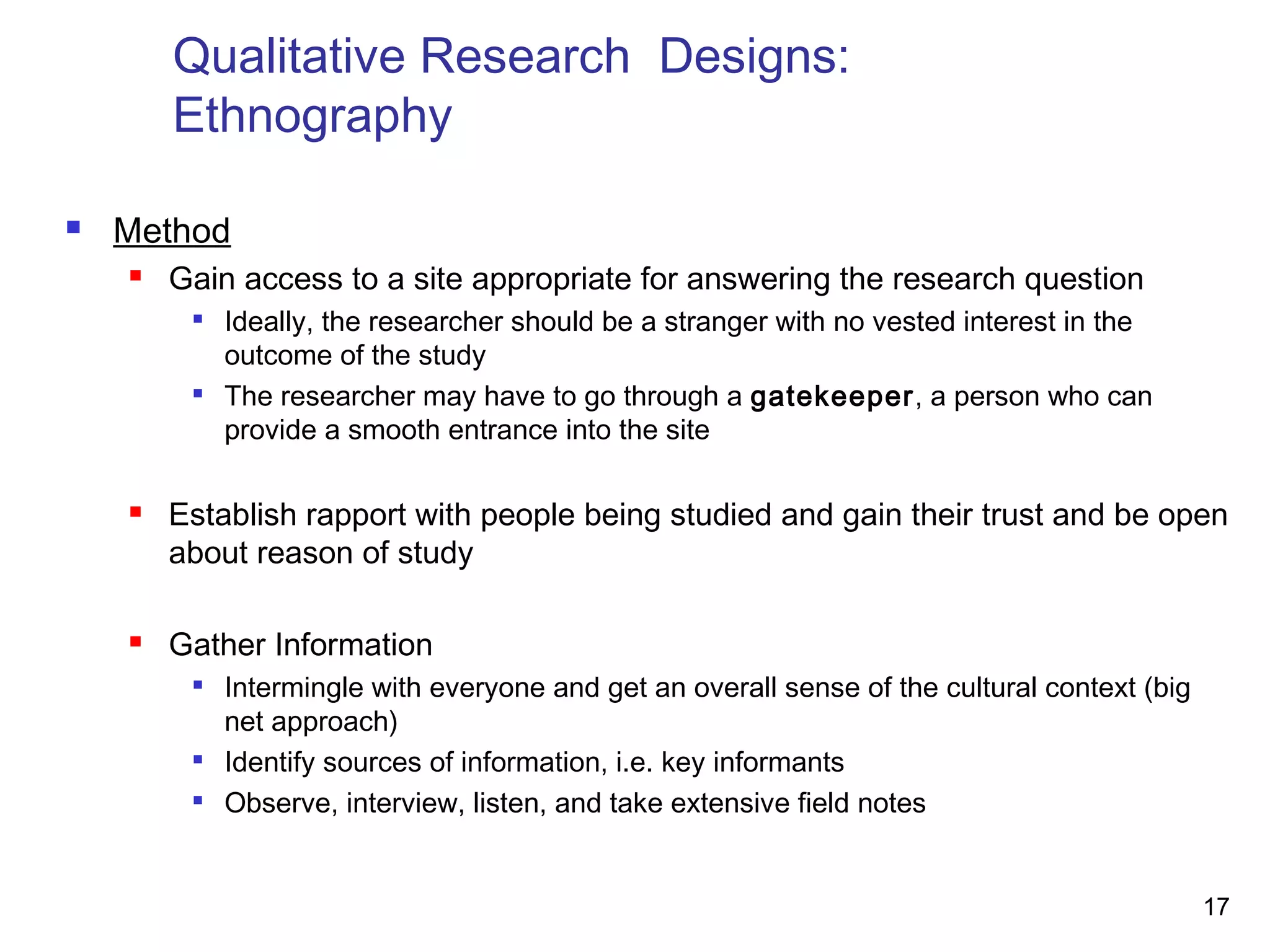
 Ethnography (from the Greek ethnos = nation and graphein = writing) refers to the qualitative
description of human social phenomena, based on fieldwork. Ethnography is a holistic research
method founded in the idea that a system's properties cannot necessarily be accurately
understood independently of each other.
 Focuses on entire group that shares a common culture where the group is studied in its natural
setting for an extended period of time, months to years
 Focus of the investigation is on the everyday behaviors (e.g. interactions, language, rituals) of
the people in the group, with an intent to identify cultural norms, social structures, and other
cultural patterns
 Requires a lot of patience and considerable tolerance
 Beware of “going native”
 Was first used in cultural anthropology, and now seen in sociology, psychology, and education
 Good to have a grounding in cultural anthropology before venturing into Ethnography
17
Qualitative Research Designs:
Ethnography
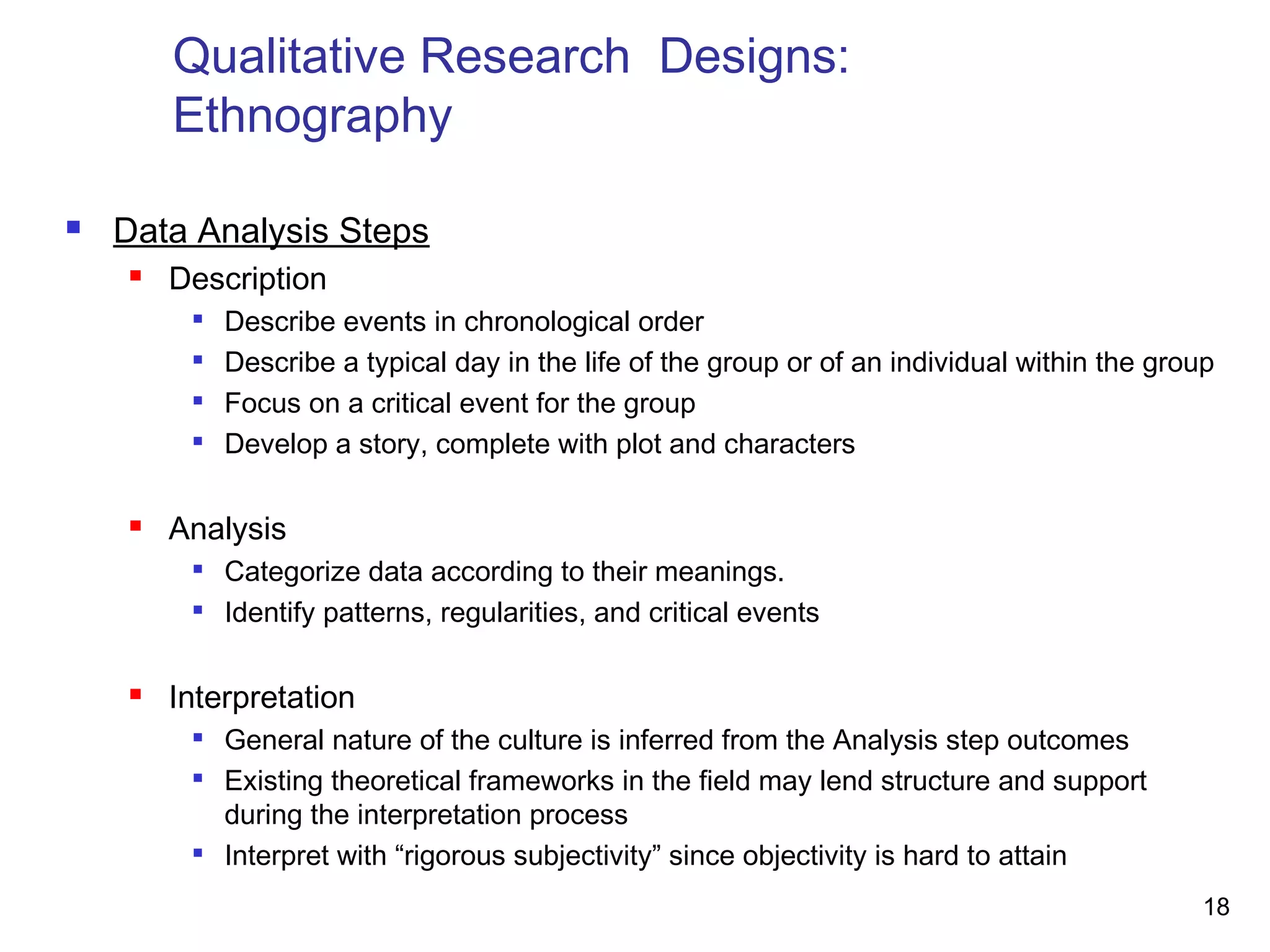
 Method
 Gain access to a site appropriate for answering the research question

Ideally, the researcher should be a stranger with no vested interest in the
outcome of the study

The researcher may have to go through a gatekeeper, a person who can
provide a smooth entrance into the site
 Establish rapport with people being studied and gain their trust and be open
about reason of study
 Gather Information

Intermingle with everyone and get an overall sense of the cultural context (big
net approach)

Identify sources of information, i.e. key informants

Observe, interview, listen, and take extensive field notes
18
Qualitative Research Designs:
Ethnography
 Data Analysis Steps
 Description

Describe events in chronological order

Describe a typical day in the life of the group or of an individual within the group

Focus on a critical event for the group

Develop a story, complete with plot and characters
 Analysis

Categorize data according to their meanings.

Identify patterns, regularities, and critical events
 Interpretation

General nature of the culture is inferred from the Analysis step outcomes

Existing theoretical frameworks in the field may lend structure and support
during the interpretation process

Interpret with “rigorous subjectivity” since objectivity is hard to attain
19
Qualitative Research Designs:
Ethnography
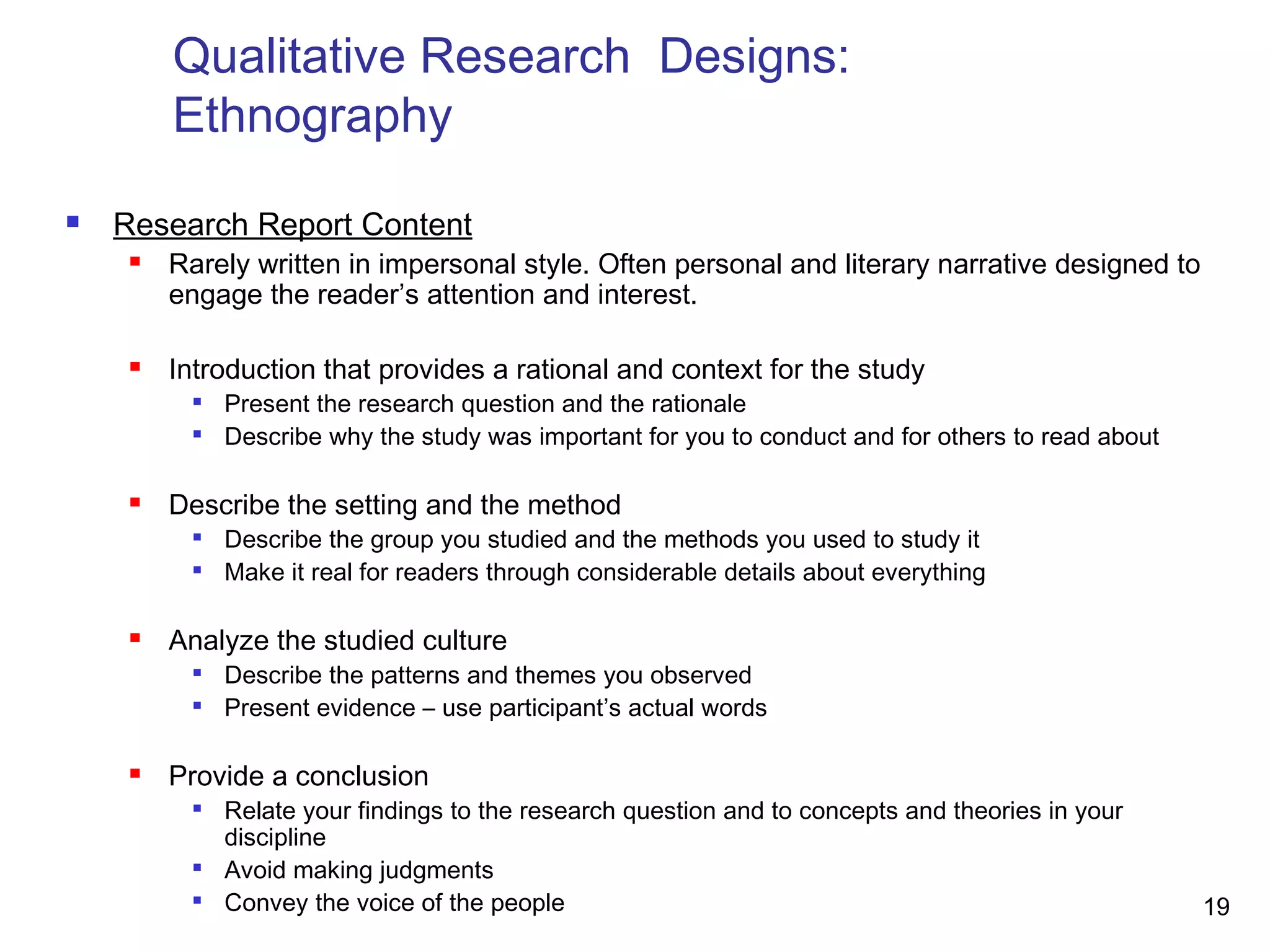
 Research Report Content
 Rarely written in impersonal style. Often personal and literary narrative designed to
engage the reader’s attention and interest.
 Introduction that provides a rational and context for the study

Present the research question and the rationale

Describe why the study was important for you to conduct and for others to read about
 Describe the setting and the method

Describe the group you studied and the methods you used to study it

Make it real for readers through considerable details about everything
 Analyze the studied culture

Describe the patterns and themes you observed

Present evidence – use participant’s actual words
 Provide a conclusion

Relate your findings to the research question and to concepts and theories in your
discipline

Avoid making judgments

Convey the voice of the people
20
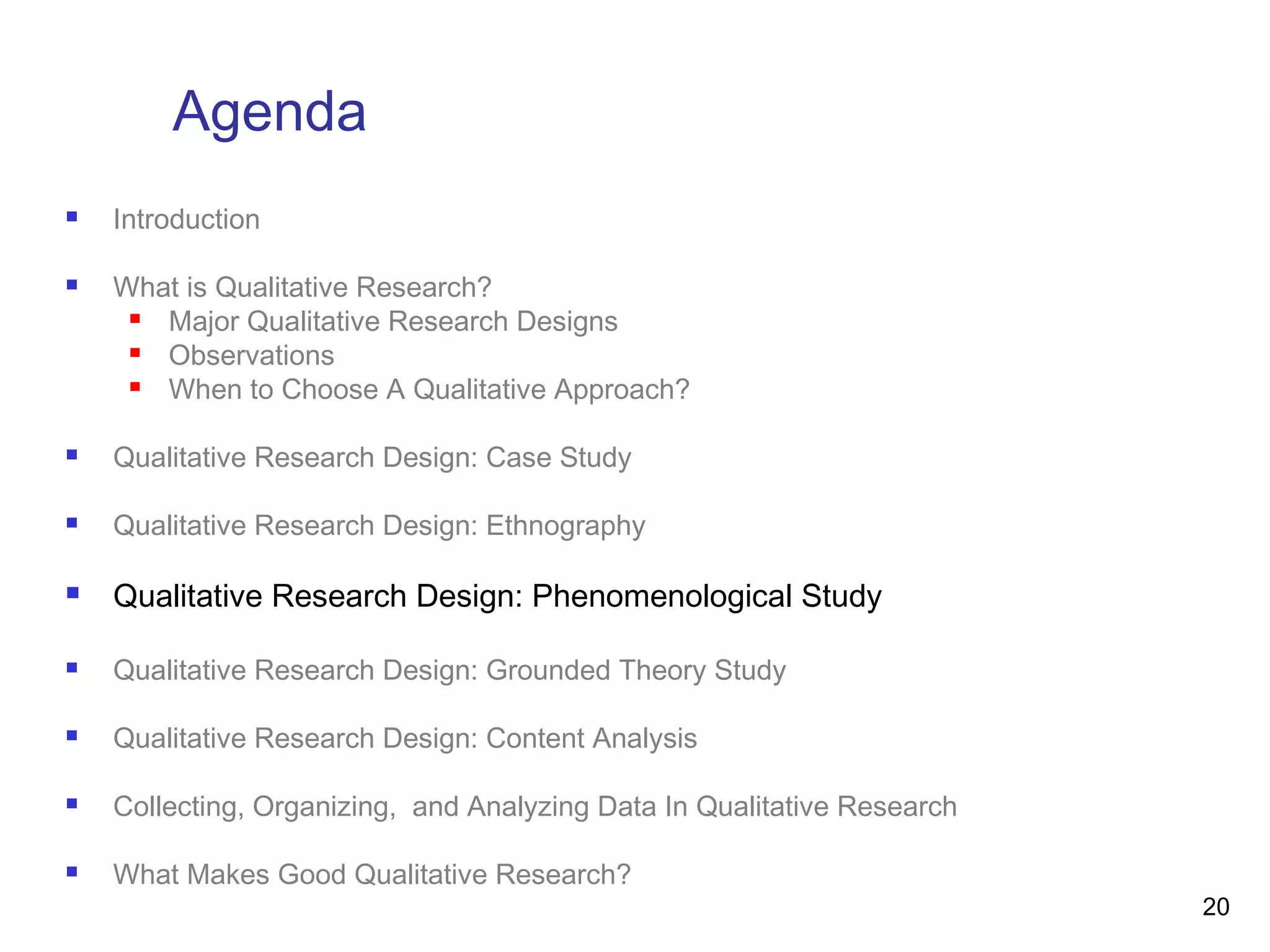
Agenda
 Introduction
 What is Qualitative Research?
 Major Qualitative Research Designs
 Observations
 When to Choose A Qualitative Approach?
 Qualitative Research Design: Case Study
 Qualitative Research Design: Ethnography
 Qualitative Research Design: Phenomenological Study
 Qualitative Research Design: Grounded Theory Study
 Qualitative Research Design: Content Analysis
 Collecting, Organizing, and Analyzing Data In Qualitative Research
 What Makes Good Qualitative Research?
21
Qualitative Research Designs:
Phenomenological Study
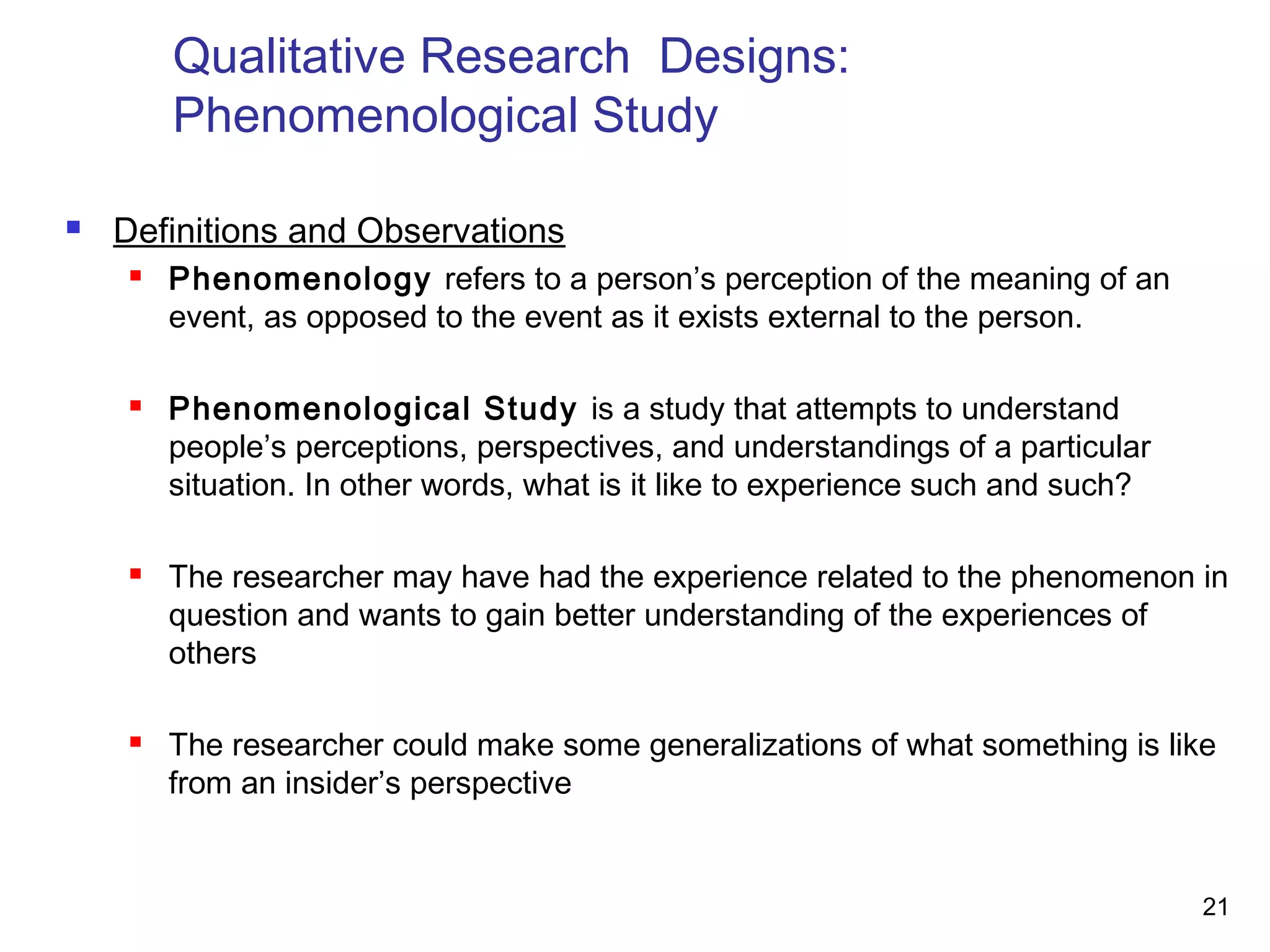
 Definitions and Observations
 Phenomenology refers to a person’s perception of the meaning of an
event, as opposed to the event as it exists external to the person.
 Phenomenological Study is a study that attempts to understand
people’s perceptions, perspectives, and understandings of a particular
situation. In other words, what is it like to experience such and such?
 The researcher may have had the experience related to the phenomenon in
question and wants to gain better understanding of the experiences of
others
 The researcher could make some generalizations of what something is like
from an insider’s perspective
22
Qualitative Research Designs:
Phenomenological Study
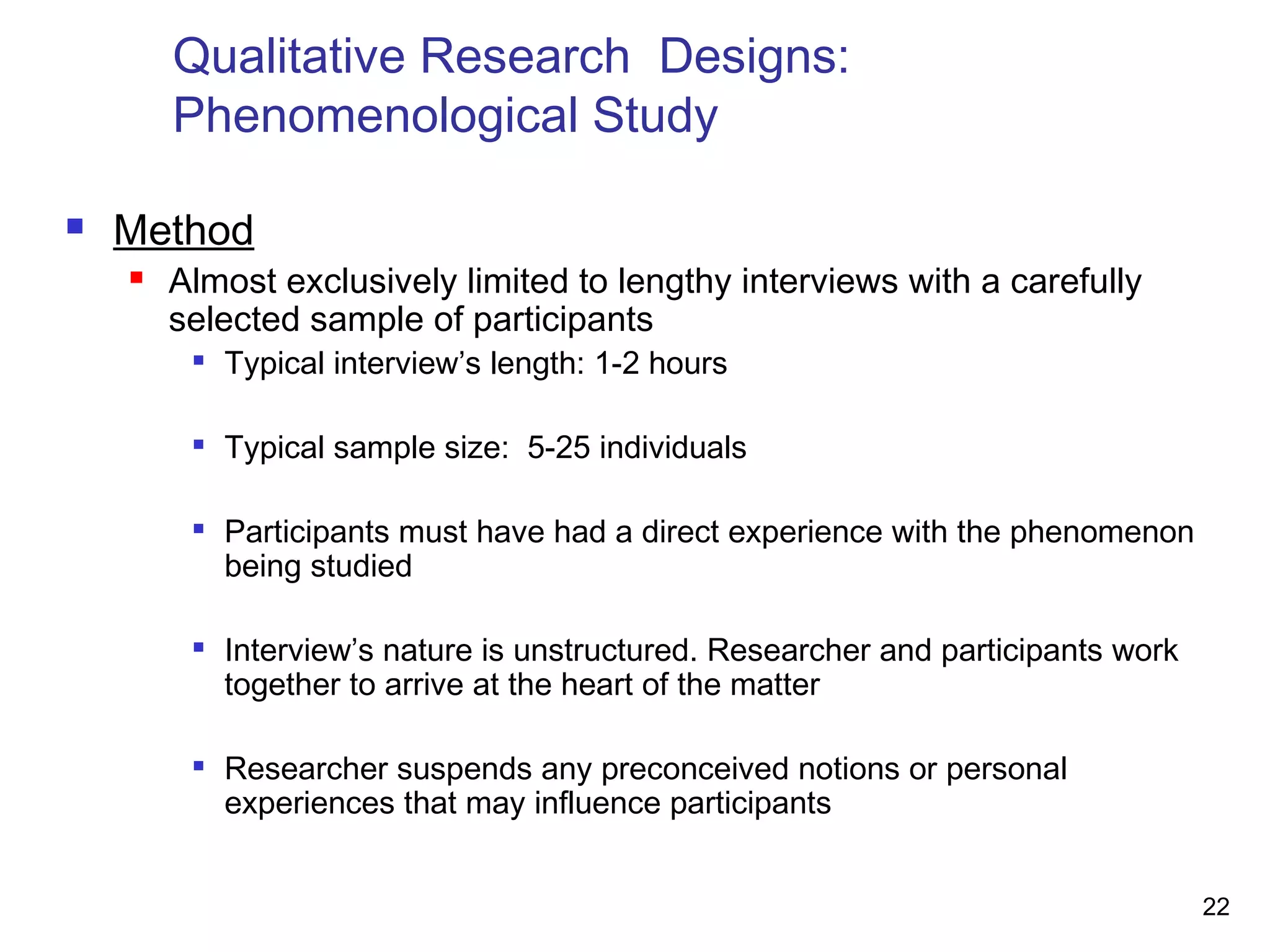
 Method
 Almost exclusively limited to lengthy interviews with a carefully
selected sample of participants

Typical interview’s length: 1-2 hours

Typical sample size: 5-25 individuals

Participants must have had a direct experience with the phenomenon
being studied

Interview’s nature is unstructured. Researcher and participants work
together to arrive at the heart of the matter

Researcher suspends any preconceived notions or personal
experiences that may influence participants
23
Qualitative Research Designs:
Phenomenological Study
 Data Analysis Steps
 Identify statements that relate to the topic

Researcher separates relevant from irrelevant information

Break relevant information into small segments that each reflect a single,
specific thought
 Group statements into “meaning units”

Researcher groups the segments into categories that reflect the various aspects
(“meanings”) of the phenomenon as it is experienced
 Seek divergent perspectives

Researcher looks and considers the various ways in which different people
experience the phenomenon
 Construct a composite

Researcher uses various meanings identified to develop an overall description
of the phenomenon as people typically experience it

The final result is a general description of the phenomenon as seen through the
eyes of the people who have experienced it firsthand.

Focus on common themes despite diversity in the individuals and settings
studied
24
Qualitative Research Designs:
Phenomenological Study
 Research Report Content
 No specific structure for the report
 Present research problem or question
 Describe methods of data collection and analysis
 Draw a conclusion about the phenomenon
 Discuss practical implications of your findings
25
Agenda
 Introduction
 What is Qualitative Research?
 Major Qualitative Research Designs
 Observations
 When to Choose A Qualitative Approach?
 Qualitative Research Design: Case Study
 Qualitative Research Design: Ethnography
 Qualitative Research Design: Phenomenological Study
 Qualitative Research Design: Grounded Theory Study
 Qualitative Research Design: Content Analysis
 Collecting, Organizing, and Analyzing Data In Qualitative Research
 What Makes Good Qualitative Research?
26
Qualitative Research Designs:
Grounded Theory Study
 Definitions and Observations
 A type of research that begins with the data and use it to develop a
“grounded” theory
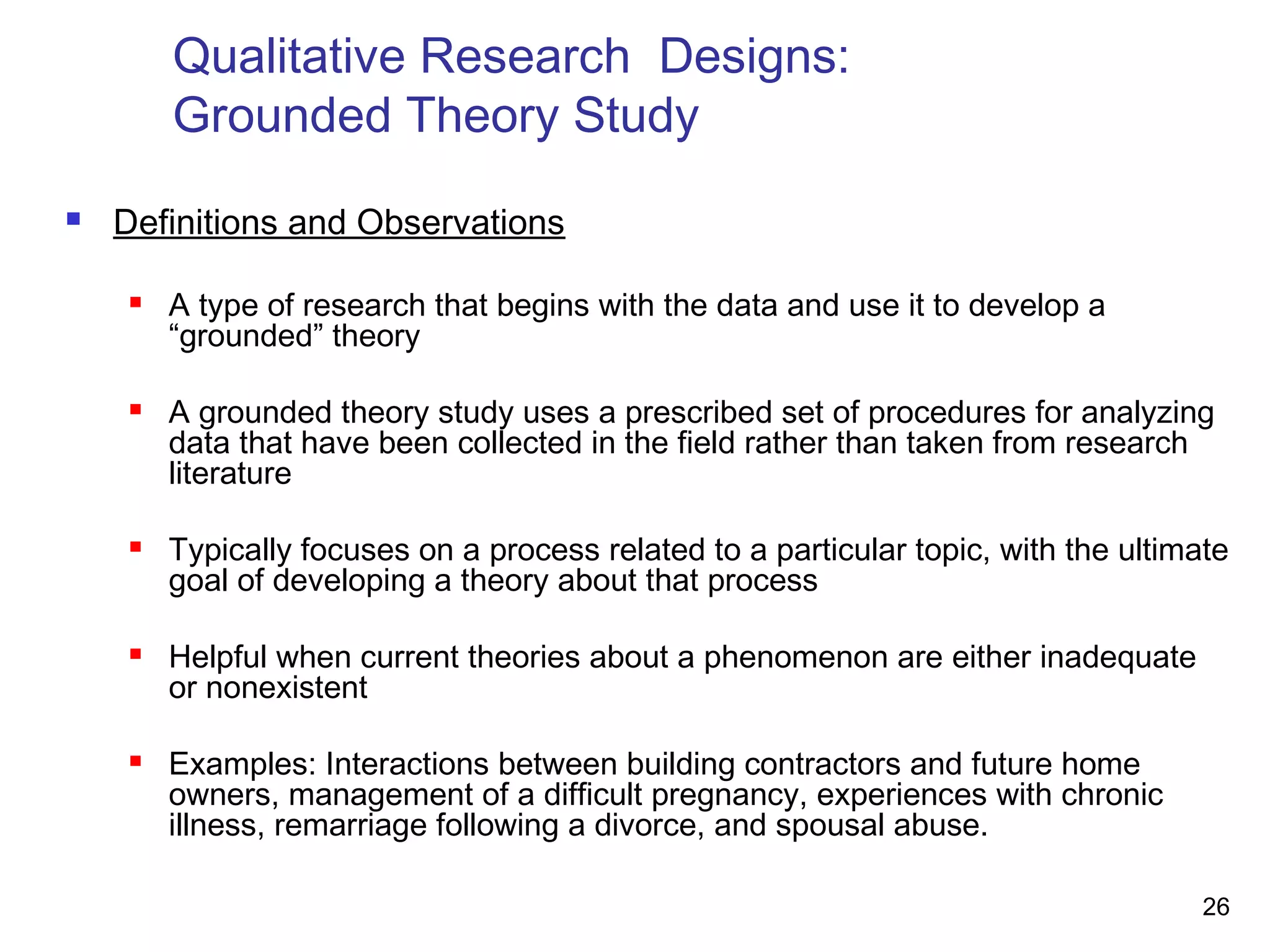
 A grounded theory study uses a prescribed set of procedures for analyzing
data that have been collected in the field rather than taken from research
literature
 Typically focuses on a process related to a particular topic, with the ultimate
goal of developing a theory about that process
 Helpful when current theories about a phenomenon are either inadequate
or nonexistent
 Examples: Interactions between building contractors and future home
owners, management of a difficult pregnancy, experiences with chronic
illness, remarriage following a divorce, and spousal abuse.
27
Qualitative Research Designs:
Grounded Theory Study
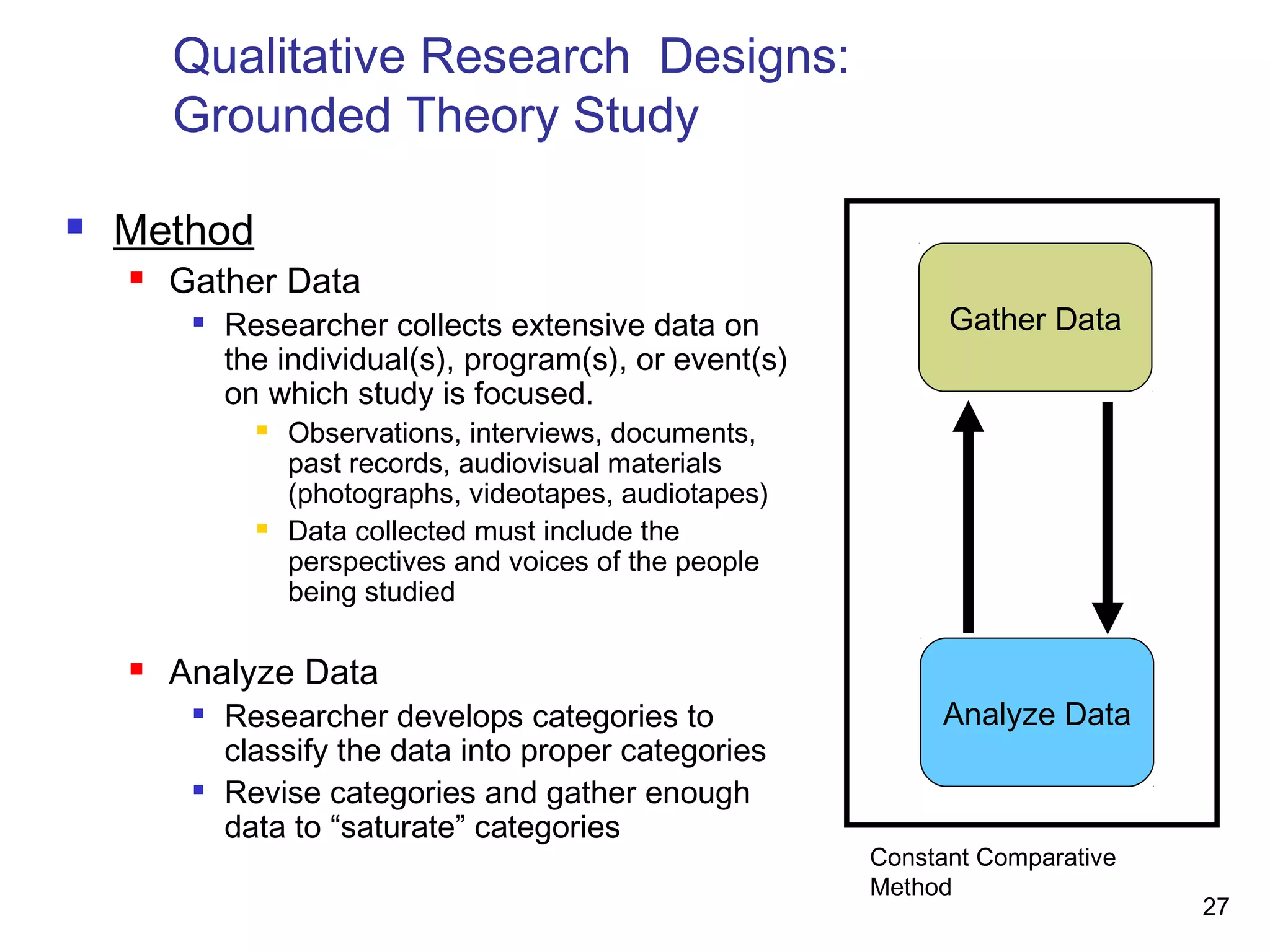
 Method
 Gather Data

Researcher collects extensive data on
the individual(s), program(s), or event(s)
on which study is focused.
 Observations, interviews, documents,
past records, audiovisual materials
(photographs, videotapes, audiotapes)
 Data collected must include the
perspectives and voices of the people
being studied
 Analyze Data

Researcher develops categories to
classify the data into proper categories

Revise categories and gather enough
data to “saturate” categories
Gather Data
Analyze Data
Constant Comparative
Method
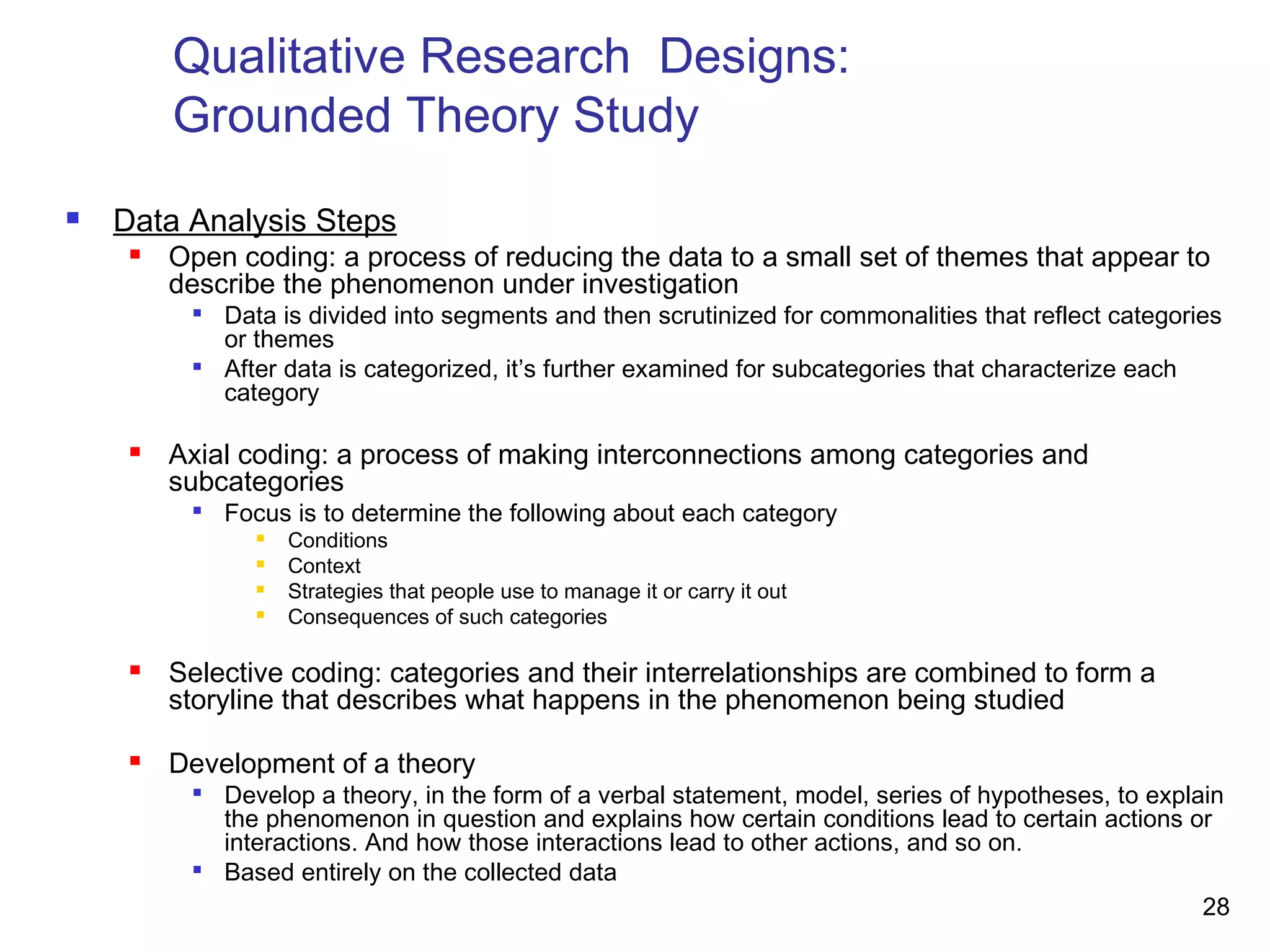
28
Qualitative Research Designs:
Grounded Theory Study
 Data Analysis Steps
 Open coding: a process of reducing the data to a small set of themes that appear to
describe the phenomenon under investigation

Data is divided into segments and then scrutinized for commonalities that reflect categories
or themes

After data is categorized, it’s further examined for subcategories that characterize each
category
 Axial coding: a process of making interconnections among categories and
subcategories

Focus is to determine the following about each category
 Conditions
 Context
 Strategies that people use to manage it or carry it out
 Consequences of such categories
 Selective coding: categories and their interrelationships are combined to form a
storyline that describes what happens in the phenomenon being studied
 Development of a theory

Develop a theory, in the form of a verbal statement, model, series of hypotheses, to explain
the phenomenon in question and explains how certain conditions lead to certain actions or
interactions. And how those interactions lead to other actions, and so on.

Based entirely on the collected data
29
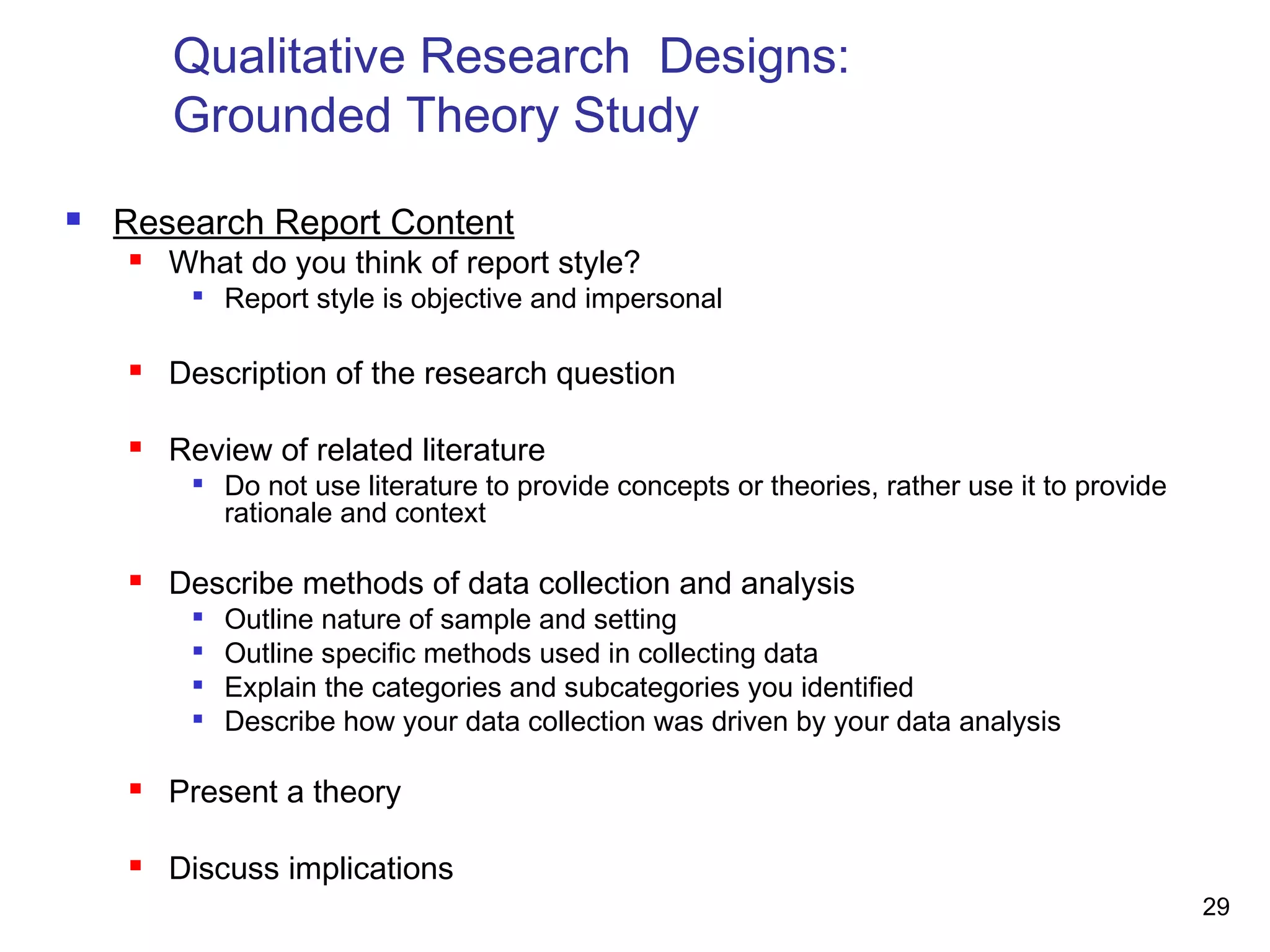
Qualitative Research Designs:
Grounded Theory Study
 Research Report Content
 What do you think of report style?

Report style is objective and impersonal
 Description of the research question
 Review of related literature

Do not use literature to provide concepts or theories, rather use it to provide
rationale and context
 Describe methods of data collection and analysis

Outline nature of sample and setting

Outline specific methods used in collecting data

Explain the categories and subcategories you identified

Describe how your data collection was driven by your data analysis
 Present a theory
 Discuss implications
30
Agenda
 Introduction
 What is Qualitative Research?
 Major Qualitative Research Designs
 Observations
 When to Choose A Qualitative Approach?
 Qualitative Research Design: Case Study
 Qualitative Research Design: Ethnography
 Qualitative Research Design: Phenomenological Study
 Qualitative Research Design: Grounded Theory Study
 Qualitative Research Design: Content Analysis
 Collecting, Organizing, and Analyzing Data In Qualitative Research
 What Makes Good Qualitative Research?
31
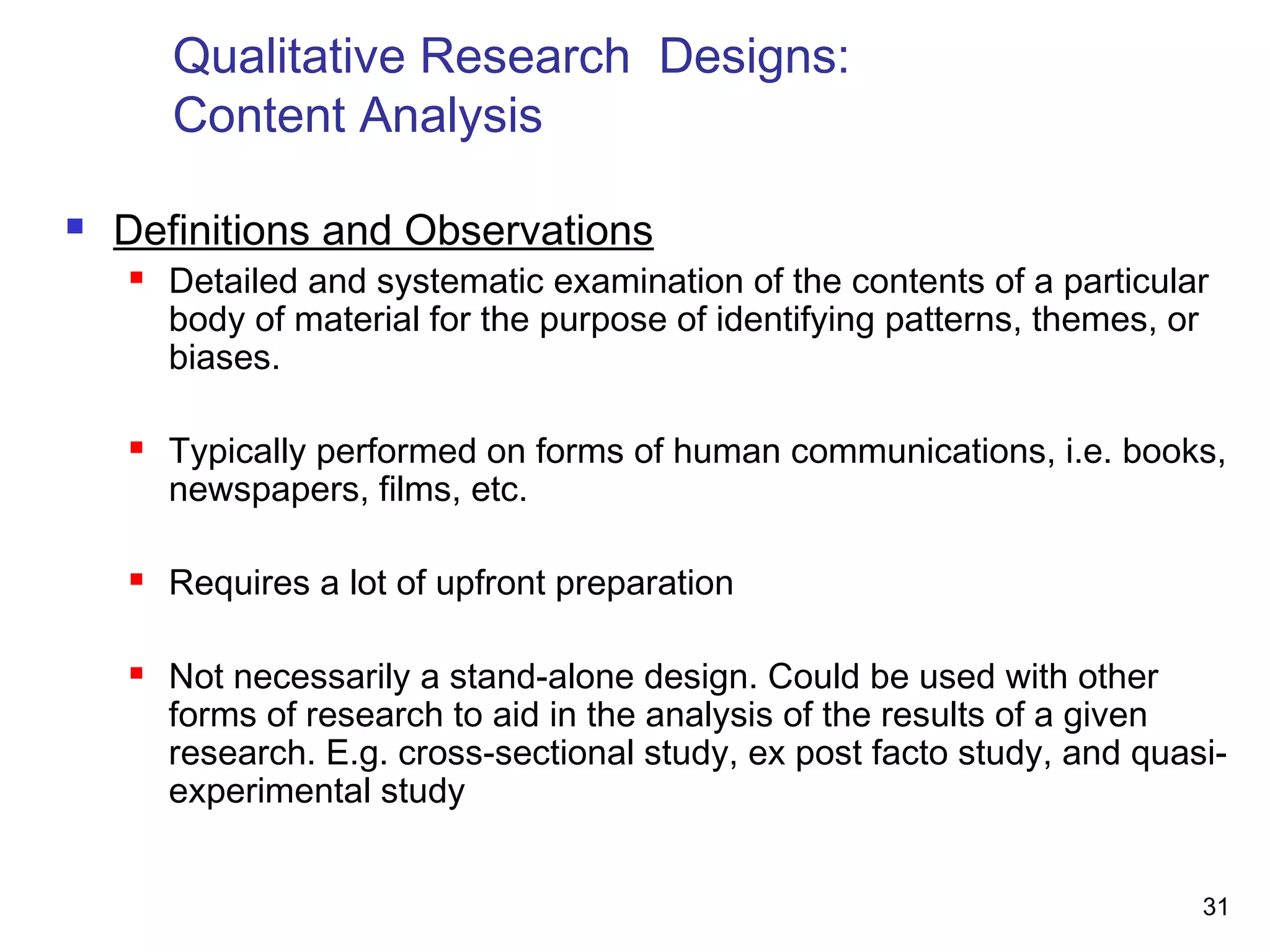
Qualitative Research Designs:
Content Analysis
 Definitions and Observations
 Detailed and systematic examination of the contents of a particular
body of material for the purpose of identifying patterns, themes, or
biases.
 Typically performed on forms of human communications, i.e. books,
newspapers, films, etc.
 Requires a lot of upfront preparation
 Not necessarily a stand-alone design. Could be used with other
forms of research to aid in the analysis of the results of a given
research. E.g. cross-sectional study, ex post facto study, and quasi-
experimental study
32
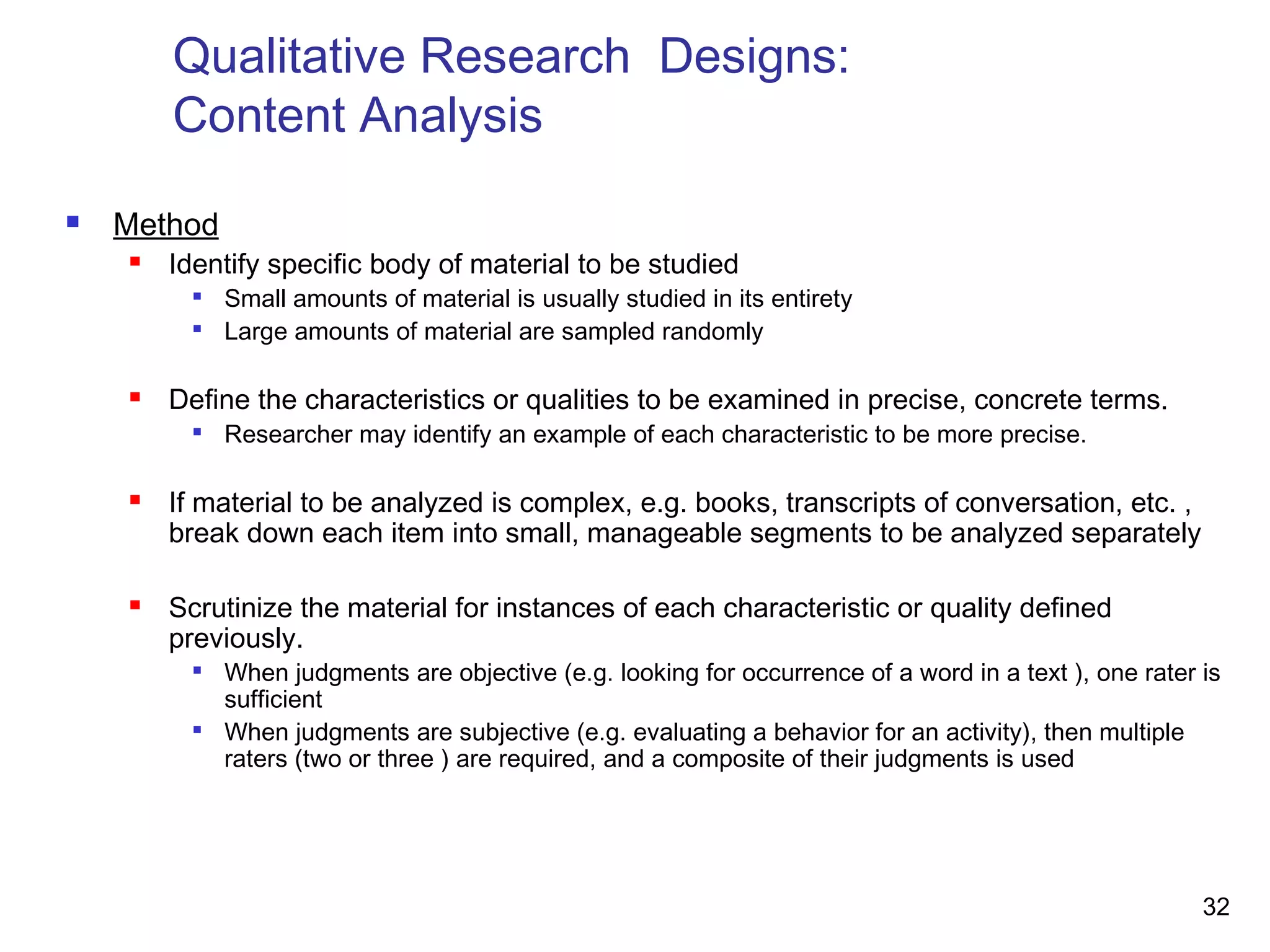
Qualitative Research Designs:
Content Analysis
 Method
 Identify specific body of material to be studied

Small amounts of material is usually studied in its entirety

Large amounts of material are sampled randomly
 Define the characteristics or qualities to be examined in precise, concrete terms.

Researcher may identify an example of each characteristic to be more precise.
 If material to be analyzed is complex, e.g. books, transcripts of conversation, etc. ,
break down each item into small, manageable segments to be analyzed separately
 Scrutinize the material for instances of each characteristic or quality defined
previously.

When judgments are objective (e.g. looking for occurrence of a word in a text ), one rater is
sufficient

When judgments are subjective (e.g. evaluating a behavior for an activity), then multiple
raters (two or three ) are required, and a composite of their judgments is used
33
Qualitative Research Designs:
Content Analysis
 Data Analysis Steps
 Tabulate the frequency of each characteristic found in the studied
material – quantitative approach
 Often times, statistical analyses are performed on the frequencies
or percentages obtained to determine whether significant
differences exist relevant to the research question
 Use tabulations and statistical analyses to interpret the data as they
reflect on the problem under investigation
34
Qualitative Research Designs:
Content Analysis
 Research Report Content
 Description of the material studied

Describe the overall studied material and any sampling procedures used, if any
 Precise definition and description of the investigated characteristics

Define each characteristic enough such that other researchers could replicate
the study

Consider using specific examples from your data to illustrate each characteristic
 Description of the rating procedure

Describe the rating procedure used to evaluate the material, and how multiple
ratings were combined
 Tabulation of each characteristic

Report frequencies or percentages (or both) for each characteristic.

Consider using tables and graphs for illustration
 Descriptions of found patterns

Identify themes or trends in the studied material
35
Agenda
 Introduction
 What is Qualitative Research?
 Major Qualitative Research Designs
 Observations
 When to Choose A Qualitative Approach?
 Qualitative Research Design: Case Study
 Qualitative Research Design: Ethnography
 Qualitative Research Design: Phenomenological Study
 Qualitative Research Design: Grounded Theory Study
 Qualitative Research Design: Content Analysis
 Collecting, Organizing, and Analyzing Data In Qualitative Research
 What Makes Good Qualitative Research?
36
Colleting Data in Qualitative Research
 Need for Sampling
 Purposeful sampling: Selecting individuals or objects that would yield the most information
about the topic under investigation

Theoretical sampling: Choosing data sources that are most apt to help develop a theory of the process in
question

Discriminant sampling: Returning to data sources that are most apt to help validate a theory
 Observations
 Experiment with various recording strategies
 Get introduced to the people you are watching
 Remain quiet and inconspicuous, yet be friendly when approached
 Record and interpret at the same time
 Interviews
 Rarely structured. Either open-ended or semi-structured
 Could interview multiple people in a focus group
 Identify questions in advance with, carefully pick your sample, proper location, written
permission, rapport, actual vs. abstract or hypothetical, listen, record verbatim, keep reactions to
self, and interviews do not necessarily reveal facts
 Pay attention to group dynamics when conducting focus groups
37
Organizing and Analyzing Data from Qualitative Studies
Synthesis
Offering hypothesis or propositions
Constructing tables, diagrams, hierarchies
Synthesis
Offering hypothesis or propositions
Constructing tables, diagrams, hierarchies
Classification
Grouping the data into categories or themes
Finding meaning in the data
Classification
Grouping the data into categories or themes
Finding meaning in the data
Organization
Filling
Creating a computer database
Breaking large units into smaller ones
Organization
Filling
Creating a computer database
Breaking large units into smaller ones
Perusal
Getting an overall sense of the data
Jotting down preliminary interpretations
Perusal
Getting an overall sense of the data
Jotting down preliminary interpretations
The Final Report
The Raw Data
The Data Analysis Spiral
Creswell, 1998
38
Agenda
 Introduction
 What is Qualitative Research?
 Major Qualitative Research Designs
 Observations
 When to Choose A Qualitative Approach?
 Qualitative Research Design: Case Study
 Qualitative Research Design: Ethnography
 Qualitative Research Design: Phenomenological Study
 Qualitative Research Design: Grounded Theory Study
 Qualitative Research Design: Content Analysis
 Collecting, Organizing, and Analyzing Data In Qualitative Research
 What Makes Good Qualitative Research?
39
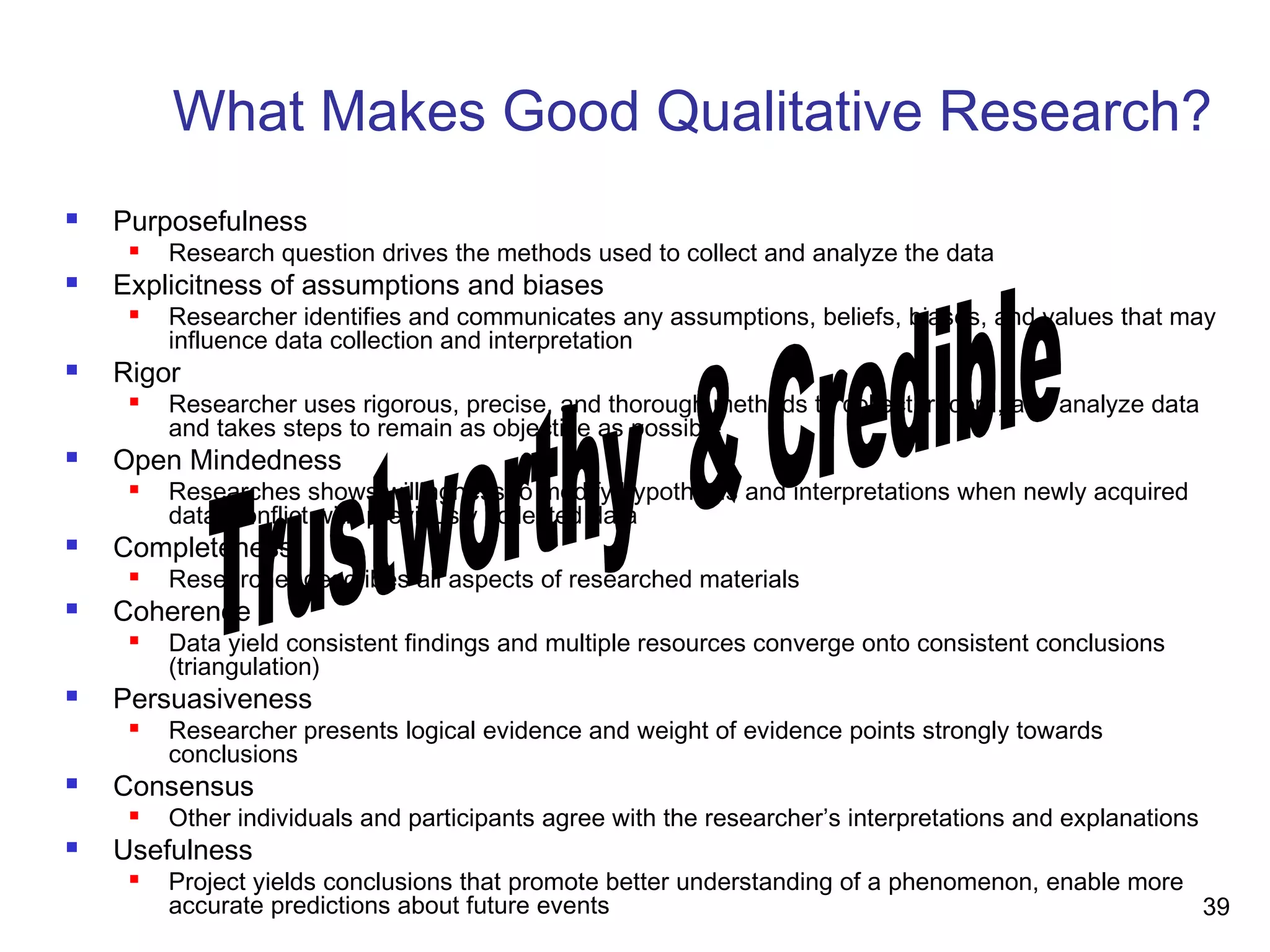
What Makes Good Qualitative Research?
 Purposefulness
 Research question drives the methods used to collect and analyze the data
 Explicitness of assumptions and biases
 Researcher identifies and communicates any assumptions, beliefs, biases, and values that may
influence data collection and interpretation
 Rigor
 Researcher uses rigorous, precise, and thorough methods to collect, record, and analyze data
and takes steps to remain as objective as possible
 Open Mindedness
 Researches shows willingness to modify hypothesis and interpretations when newly acquired
data conflict with previously collected data
 Completeness
 Researcher describes all aspects of researched materials
 Coherence
 Data yield consistent findings and multiple resources converge onto consistent conclusions
(triangulation)
 Persuasiveness
 Researcher presents logical evidence and weight of evidence points strongly towards
conclusions
 Consensus
 Other individuals and participants agree with the researcher’s interpretations and explanations
 Usefulness
 Project yields conclusions that promote better understanding of a phenomenon, enable more
accurate predictions about future events
40
Question & Answer

Qualitative research designs

  • 1.
    Qualitative Research “ Noteverything that can be counted counts, and not everything that counts can be counted.” ~ Albert Einstein Presenter Muthuvenkatachalam S., D.Pharm, M.Sc (AIIMS), PhD Scholar (RGUHS)
  • 2.
    2 Scheme  Introduction  Whatis Qualitative Research?  Major Qualitative Research Designs  Observations  When to Choose A Qualitative Approach?  Qualitative Research Design: Case Study  Qualitative Research Design: Ethnography  Qualitative Research Design: Phenomenological Study  Qualitative Research Design: Grounded Theory Study  Qualitative Research Design: Content Analysis  Collecting, Organizing, and Analyzing Data In Qualitative Research  What Makes Good Qualitative Research?
  • 3.
    3 Introduction No single orultimate truth to be discovered, more likely there are multiple perspectives What do you see?
  • 4.
    4 Agenda  Introduction  Whatis Qualitative Research?  Major Qualitative Research Designs  Observations  When to Choose A Qualitative Approach?  Qualitative Research Design: Case Study  Qualitative Research Design: Ethnography  Qualitative Research Design: Phenomenological Study  Qualitative Research Design: Grounded Theory Study  Qualitative Research Design: Content Analysis  Collecting, Organizing, and Analyzing Data In Qualitative Research  What Makes Good Qualitative Research?
  • 5.
    5 Qualitative Research -Definition “Qualitative research is a loosely defined category of research designs or models, all of which elicit verbal, visual, tactile, olfactory, and gustatory data in the form of descriptive narratives like field notes, recordings, or other transcriptions from audio- and videotapes and other written records and pictures or films.”
  • 6.
    6 What is QualitativeResearch?  Research using qualitative data in the form of text and pictures, not numbers  Takes a holistic approach with a specific focus and tells a richer story than quantitative research  Used to answer questions about the complex nature of phenomena, often with the purpose of describing and understanding the phenomena  Builds on researcher’s ability to interpret and make sense of what he or she sees for understanding any social phenomenon  Takes longer to tell a story and usually ends with tentative answers of hypotheses about what was observed  Often used in combination with quantitative methods and data, and can be objective or subjective, and makes considerable use of inductive reasoning  Although objective methods may be appropriate for studying physical events such as electricity, chemical reaction, and black holes, an objective approach for studying human events , relationships, social structures, etc., is neither desirable nor, perhaps, even possible (Eisner, 1998; Moss 1996).
  • 7.
    7 Major Qualitative ResearchDesigns Case study Attempts to shed light on a phenomena by studying in-depth a single case example of the phenomena.  The case can be an individual person, an event, a group, or an institution. Ethnography Focuses on the sociology of meaning through close field observation of sociocultural phenomena. Typically, the ethnographer focuses on a community. Phenomenology A study that attempts to understand people’s perceptions, perspectives, and understandings of a particular situation. In other words, what is it like to experience such and such? Grounded theory Theory is developed inductively from a corpus of data acquired by a participant- observer. Content Analysis A detailed and systematic examination of the contents of a particular body of material for the purpose of identifying patterns, themes, or biases within a material Historical Systematic collection and objective evaluation of data related to past occurrences in order to test hypotheses concerning causes, effects, or trends of these events that may help to explain present events and anticipate future events.
  • 8.
    8 Observations  Qualitative researchusually starts by questions like:  How do people feel while living under occupation?  How can a teacher use principles from behaviorist psychology to help a student with Autism succeed in an elementary school?  Good percentage of research could start as qualitative and then morph into other types. For example, medicine and biology.  Qualitative research may start using any technique of the previously described designs, and could shift towards another design as more information may suggest a better approach  Qualitative research requires considerable preparation and planning. Researches should be well trained in observation techniques, interview strategies, and data collection methods  Qualitative research does not yield quick results and easy answers
  • 9.
    9 When To ChooseA Qualitative Approach  Description  Qualitative research can reveal the nature of certain situations, settings, processes, relationships, systems or people  Interpretation  To enable a researcher to gain new insights about a particular phenomenon  Develop new concepts or theoretical perspectives about the phenomenon  Discover the problems that exist within a phenomenon  Verification  Allow researchers to test the validity of certain assumptions, claims, theories or generalizations within real-world contexts  Evaluation  Allow researchers to judge the effectiveness of particular policies, practices and innovations. In general, not a good method to identify cause-effect relationships, i.e. Why questions, and “what caused what” type of investigations
  • 10.
    10 Agenda  Introduction  Whatis Qualitative Research?  Major Qualitative Research Designs  Observations  When to Choose A Qualitative Approach?  Qualitative Research Design: Case Study  Qualitative Research Design: Ethnography  Qualitative Research Design: Phenomenological Study  Qualitative Research Design: Grounded Theory Study  Qualitative Research Design: Content Analysis  Collecting, Organizing, and Analyzing Data In Qualitative Research  What Makes Good Qualitative Research?
  • 11.
    11 Qualitative Research Designs: CaseStudy  Definitions and Observations  A particular individual, program, or event is studied in depth for a defined period of time.  Examples:  Studying the effect of a new drug on a particular patient  Studying the effectiveness of a political campaign for a candidate  Studying the level of improvement in educational achievement on a student when given a new multi-vitamin formula  Researchers may study two or more cases, often cases that are different in certain key ways, to make comparisons, build theory, or propose generalizations. This is referred to as collective case study.  Major weakness of case study design is that we cannot be sure that the findings are generalizable to other situations, especially if only one case study was performed.
  • 12.
    12 Qualitative Research Designs: CaseStudy  Method  Gather Case Study Data  Researcher collects extensive data on the individual(s), program(s), or event(s) on which investigation is focused.  Observations, interviews, documents, past records, audiovisual materials (photographs, videotapes, audiotapes)  Spend time on site to interact with people who are being studied  Gather Context Information  Researcher records details about the context surrounding the case  Physical environment  Historical, economic, and social factors that may affect situation
  • 13.
    13 Qualitative Research Designs: CaseStudy  Data Analysis Steps  Organize details about case  Case facts are organized in a logical order  Categorize data  Cluster data into meaningful groups  Interpret data  Examine specific documents, occurrences, and other bits of data for a meaning that may be important to the case  Identify Patterns  Data and their interpretations are scrutinized for underlying themes and other patterns that characterize the case more broadly than a single piece of information can reveal  Synthesize and Generalize  Construct an overall portrait of the case and draw conclusions that may have implications beyond the specific case that has been studied Triangulation of data; many separate pieces of information must all converge to the same conclusion
  • 14.
    14 Qualitative Research Designs: CaseStudy  Research Report Content  Case study rationale  Why the case study worthy of in-depth investigation and how it will contribute to human beings’ knowledge about the world  Detailed description of the facts related to the case  Describe the object(s), event(s), individual(s) you studied and any other facts uncontested about the case  Be thorough and objective as much as possible  Discussion of found patterns  Describe any trends, themes, etc. that the data suggest (interpretation)  Provide evidence for every pattern you report to convince readers that such pattern do exist and portray the collected data  If you find pattern-contradicting data, you should include it to provide unbiased account of the case  Connection to the larger scheme of things  Answer the question; So What?  How does the case study contribute to the knowledge about some aspect of the human experience  You can compare against previously reported case studies to either support or disconfirm an existing hypothesis or theory
  • 15.
    15 Agenda  Introduction  Whatis Qualitative Research?  Major Qualitative Research Designs  Observations  When to Choose A Qualitative Approach?  Qualitative Research Design: Case Study  Qualitative Research Design: Ethnography  Qualitative Research Design: Phenomenological Study  Qualitative Research Design: Grounded Theory Study  Qualitative Research Design: Content Analysis  Collecting, Organizing, and Analyzing Data In Qualitative Research  What Makes Good Qualitative Research?
  • 16.
    16 Qualitative Research Designs: Ethnography Definitions and Observations  Ethnography (from the Greek ethnos = nation and graphein = writing) refers to the qualitative description of human social phenomena, based on fieldwork. Ethnography is a holistic research method founded in the idea that a system's properties cannot necessarily be accurately understood independently of each other.  Focuses on entire group that shares a common culture where the group is studied in its natural setting for an extended period of time, months to years  Focus of the investigation is on the everyday behaviors (e.g. interactions, language, rituals) of the people in the group, with an intent to identify cultural norms, social structures, and other cultural patterns  Requires a lot of patience and considerable tolerance  Beware of “going native”  Was first used in cultural anthropology, and now seen in sociology, psychology, and education  Good to have a grounding in cultural anthropology before venturing into Ethnography
  • 17.
    17 Qualitative Research Designs: Ethnography Method  Gain access to a site appropriate for answering the research question  Ideally, the researcher should be a stranger with no vested interest in the outcome of the study  The researcher may have to go through a gatekeeper, a person who can provide a smooth entrance into the site  Establish rapport with people being studied and gain their trust and be open about reason of study  Gather Information  Intermingle with everyone and get an overall sense of the cultural context (big net approach)  Identify sources of information, i.e. key informants  Observe, interview, listen, and take extensive field notes
  • 18.
    18 Qualitative Research Designs: Ethnography Data Analysis Steps  Description  Describe events in chronological order  Describe a typical day in the life of the group or of an individual within the group  Focus on a critical event for the group  Develop a story, complete with plot and characters  Analysis  Categorize data according to their meanings.  Identify patterns, regularities, and critical events  Interpretation  General nature of the culture is inferred from the Analysis step outcomes  Existing theoretical frameworks in the field may lend structure and support during the interpretation process  Interpret with “rigorous subjectivity” since objectivity is hard to attain
  • 19.
    19 Qualitative Research Designs: Ethnography Research Report Content  Rarely written in impersonal style. Often personal and literary narrative designed to engage the reader’s attention and interest.  Introduction that provides a rational and context for the study  Present the research question and the rationale  Describe why the study was important for you to conduct and for others to read about  Describe the setting and the method  Describe the group you studied and the methods you used to study it  Make it real for readers through considerable details about everything  Analyze the studied culture  Describe the patterns and themes you observed  Present evidence – use participant’s actual words  Provide a conclusion  Relate your findings to the research question and to concepts and theories in your discipline  Avoid making judgments  Convey the voice of the people
  • 20.
    20 Agenda  Introduction  Whatis Qualitative Research?  Major Qualitative Research Designs  Observations  When to Choose A Qualitative Approach?  Qualitative Research Design: Case Study  Qualitative Research Design: Ethnography  Qualitative Research Design: Phenomenological Study  Qualitative Research Design: Grounded Theory Study  Qualitative Research Design: Content Analysis  Collecting, Organizing, and Analyzing Data In Qualitative Research  What Makes Good Qualitative Research?
  • 21.
    21 Qualitative Research Designs: PhenomenologicalStudy  Definitions and Observations  Phenomenology refers to a person’s perception of the meaning of an event, as opposed to the event as it exists external to the person.  Phenomenological Study is a study that attempts to understand people’s perceptions, perspectives, and understandings of a particular situation. In other words, what is it like to experience such and such?  The researcher may have had the experience related to the phenomenon in question and wants to gain better understanding of the experiences of others  The researcher could make some generalizations of what something is like from an insider’s perspective
  • 22.
    22 Qualitative Research Designs: PhenomenologicalStudy  Method  Almost exclusively limited to lengthy interviews with a carefully selected sample of participants  Typical interview’s length: 1-2 hours  Typical sample size: 5-25 individuals  Participants must have had a direct experience with the phenomenon being studied  Interview’s nature is unstructured. Researcher and participants work together to arrive at the heart of the matter  Researcher suspends any preconceived notions or personal experiences that may influence participants
  • 23.
    23 Qualitative Research Designs: PhenomenologicalStudy  Data Analysis Steps  Identify statements that relate to the topic  Researcher separates relevant from irrelevant information  Break relevant information into small segments that each reflect a single, specific thought  Group statements into “meaning units”  Researcher groups the segments into categories that reflect the various aspects (“meanings”) of the phenomenon as it is experienced  Seek divergent perspectives  Researcher looks and considers the various ways in which different people experience the phenomenon  Construct a composite  Researcher uses various meanings identified to develop an overall description of the phenomenon as people typically experience it  The final result is a general description of the phenomenon as seen through the eyes of the people who have experienced it firsthand.  Focus on common themes despite diversity in the individuals and settings studied
  • 24.
    24 Qualitative Research Designs: PhenomenologicalStudy  Research Report Content  No specific structure for the report  Present research problem or question  Describe methods of data collection and analysis  Draw a conclusion about the phenomenon  Discuss practical implications of your findings
  • 25.
    25 Agenda  Introduction  Whatis Qualitative Research?  Major Qualitative Research Designs  Observations  When to Choose A Qualitative Approach?  Qualitative Research Design: Case Study  Qualitative Research Design: Ethnography  Qualitative Research Design: Phenomenological Study  Qualitative Research Design: Grounded Theory Study  Qualitative Research Design: Content Analysis  Collecting, Organizing, and Analyzing Data In Qualitative Research  What Makes Good Qualitative Research?
  • 26.
    26 Qualitative Research Designs: GroundedTheory Study  Definitions and Observations  A type of research that begins with the data and use it to develop a “grounded” theory  A grounded theory study uses a prescribed set of procedures for analyzing data that have been collected in the field rather than taken from research literature  Typically focuses on a process related to a particular topic, with the ultimate goal of developing a theory about that process  Helpful when current theories about a phenomenon are either inadequate or nonexistent  Examples: Interactions between building contractors and future home owners, management of a difficult pregnancy, experiences with chronic illness, remarriage following a divorce, and spousal abuse.
  • 27.
    27 Qualitative Research Designs: GroundedTheory Study  Method  Gather Data  Researcher collects extensive data on the individual(s), program(s), or event(s) on which study is focused.  Observations, interviews, documents, past records, audiovisual materials (photographs, videotapes, audiotapes)  Data collected must include the perspectives and voices of the people being studied  Analyze Data  Researcher develops categories to classify the data into proper categories  Revise categories and gather enough data to “saturate” categories Gather Data Analyze Data Constant Comparative Method
  • 28.
    28 Qualitative Research Designs: GroundedTheory Study  Data Analysis Steps  Open coding: a process of reducing the data to a small set of themes that appear to describe the phenomenon under investigation  Data is divided into segments and then scrutinized for commonalities that reflect categories or themes  After data is categorized, it’s further examined for subcategories that characterize each category  Axial coding: a process of making interconnections among categories and subcategories  Focus is to determine the following about each category  Conditions  Context  Strategies that people use to manage it or carry it out  Consequences of such categories  Selective coding: categories and their interrelationships are combined to form a storyline that describes what happens in the phenomenon being studied  Development of a theory  Develop a theory, in the form of a verbal statement, model, series of hypotheses, to explain the phenomenon in question and explains how certain conditions lead to certain actions or interactions. And how those interactions lead to other actions, and so on.  Based entirely on the collected data
  • 29.
    29 Qualitative Research Designs: GroundedTheory Study  Research Report Content  What do you think of report style?  Report style is objective and impersonal  Description of the research question  Review of related literature  Do not use literature to provide concepts or theories, rather use it to provide rationale and context  Describe methods of data collection and analysis  Outline nature of sample and setting  Outline specific methods used in collecting data  Explain the categories and subcategories you identified  Describe how your data collection was driven by your data analysis  Present a theory  Discuss implications
  • 30.
    30 Agenda  Introduction  Whatis Qualitative Research?  Major Qualitative Research Designs  Observations  When to Choose A Qualitative Approach?  Qualitative Research Design: Case Study  Qualitative Research Design: Ethnography  Qualitative Research Design: Phenomenological Study  Qualitative Research Design: Grounded Theory Study  Qualitative Research Design: Content Analysis  Collecting, Organizing, and Analyzing Data In Qualitative Research  What Makes Good Qualitative Research?
  • 31.
    31 Qualitative Research Designs: ContentAnalysis  Definitions and Observations  Detailed and systematic examination of the contents of a particular body of material for the purpose of identifying patterns, themes, or biases.  Typically performed on forms of human communications, i.e. books, newspapers, films, etc.  Requires a lot of upfront preparation  Not necessarily a stand-alone design. Could be used with other forms of research to aid in the analysis of the results of a given research. E.g. cross-sectional study, ex post facto study, and quasi- experimental study
  • 32.
    32 Qualitative Research Designs: ContentAnalysis  Method  Identify specific body of material to be studied  Small amounts of material is usually studied in its entirety  Large amounts of material are sampled randomly  Define the characteristics or qualities to be examined in precise, concrete terms.  Researcher may identify an example of each characteristic to be more precise.  If material to be analyzed is complex, e.g. books, transcripts of conversation, etc. , break down each item into small, manageable segments to be analyzed separately  Scrutinize the material for instances of each characteristic or quality defined previously.  When judgments are objective (e.g. looking for occurrence of a word in a text ), one rater is sufficient  When judgments are subjective (e.g. evaluating a behavior for an activity), then multiple raters (two or three ) are required, and a composite of their judgments is used
  • 33.
    33 Qualitative Research Designs: ContentAnalysis  Data Analysis Steps  Tabulate the frequency of each characteristic found in the studied material – quantitative approach  Often times, statistical analyses are performed on the frequencies or percentages obtained to determine whether significant differences exist relevant to the research question  Use tabulations and statistical analyses to interpret the data as they reflect on the problem under investigation
  • 34.
    34 Qualitative Research Designs: ContentAnalysis  Research Report Content  Description of the material studied  Describe the overall studied material and any sampling procedures used, if any  Precise definition and description of the investigated characteristics  Define each characteristic enough such that other researchers could replicate the study  Consider using specific examples from your data to illustrate each characteristic  Description of the rating procedure  Describe the rating procedure used to evaluate the material, and how multiple ratings were combined  Tabulation of each characteristic  Report frequencies or percentages (or both) for each characteristic.  Consider using tables and graphs for illustration  Descriptions of found patterns  Identify themes or trends in the studied material
  • 35.
    35 Agenda  Introduction  Whatis Qualitative Research?  Major Qualitative Research Designs  Observations  When to Choose A Qualitative Approach?  Qualitative Research Design: Case Study  Qualitative Research Design: Ethnography  Qualitative Research Design: Phenomenological Study  Qualitative Research Design: Grounded Theory Study  Qualitative Research Design: Content Analysis  Collecting, Organizing, and Analyzing Data In Qualitative Research  What Makes Good Qualitative Research?
  • 36.
    36 Colleting Data inQualitative Research  Need for Sampling  Purposeful sampling: Selecting individuals or objects that would yield the most information about the topic under investigation  Theoretical sampling: Choosing data sources that are most apt to help develop a theory of the process in question  Discriminant sampling: Returning to data sources that are most apt to help validate a theory  Observations  Experiment with various recording strategies  Get introduced to the people you are watching  Remain quiet and inconspicuous, yet be friendly when approached  Record and interpret at the same time  Interviews  Rarely structured. Either open-ended or semi-structured  Could interview multiple people in a focus group  Identify questions in advance with, carefully pick your sample, proper location, written permission, rapport, actual vs. abstract or hypothetical, listen, record verbatim, keep reactions to self, and interviews do not necessarily reveal facts  Pay attention to group dynamics when conducting focus groups
  • 37.
    37 Organizing and AnalyzingData from Qualitative Studies Synthesis Offering hypothesis or propositions Constructing tables, diagrams, hierarchies Synthesis Offering hypothesis or propositions Constructing tables, diagrams, hierarchies Classification Grouping the data into categories or themes Finding meaning in the data Classification Grouping the data into categories or themes Finding meaning in the data Organization Filling Creating a computer database Breaking large units into smaller ones Organization Filling Creating a computer database Breaking large units into smaller ones Perusal Getting an overall sense of the data Jotting down preliminary interpretations Perusal Getting an overall sense of the data Jotting down preliminary interpretations The Final Report The Raw Data The Data Analysis Spiral Creswell, 1998
  • 38.
    38 Agenda  Introduction  Whatis Qualitative Research?  Major Qualitative Research Designs  Observations  When to Choose A Qualitative Approach?  Qualitative Research Design: Case Study  Qualitative Research Design: Ethnography  Qualitative Research Design: Phenomenological Study  Qualitative Research Design: Grounded Theory Study  Qualitative Research Design: Content Analysis  Collecting, Organizing, and Analyzing Data In Qualitative Research  What Makes Good Qualitative Research?
  • 39.
    39 What Makes GoodQualitative Research?  Purposefulness  Research question drives the methods used to collect and analyze the data  Explicitness of assumptions and biases  Researcher identifies and communicates any assumptions, beliefs, biases, and values that may influence data collection and interpretation  Rigor  Researcher uses rigorous, precise, and thorough methods to collect, record, and analyze data and takes steps to remain as objective as possible  Open Mindedness  Researches shows willingness to modify hypothesis and interpretations when newly acquired data conflict with previously collected data  Completeness  Researcher describes all aspects of researched materials  Coherence  Data yield consistent findings and multiple resources converge onto consistent conclusions (triangulation)  Persuasiveness  Researcher presents logical evidence and weight of evidence points strongly towards conclusions  Consensus  Other individuals and participants agree with the researcher’s interpretations and explanations  Usefulness  Project yields conclusions that promote better understanding of a phenomenon, enable more accurate predictions about future events
  • 40.

Editor's Notes

  • #4 No single truth Primarily found in anthropology, sociology, history, political science, medicine, psychology, and education
  • #9 No single truth Primarily found in anthropology, sociology, history, political science, medicine, psychology, and education