AN INTRODUCTION
TO EDUCATIONAL
RESEARCH
Dr Saira Farooq Shah
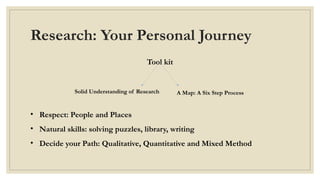
Research: Your Personal Journey
Tool kit
Solid Understanding of Research A Map: A Six Step Process
• Respect: People and Places
• Natural skills: solving puzzles, library, writing
• Decide your Path: Qualitative, Quantitative and Mixed Method
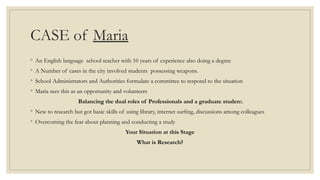
CASE of Maria
◦ An English language school teacher with 10 years of experience also doing a degree
◦ A Number of cases in the city involved students possessing weapons.
◦ School Administrators and Authorities formulate a committee to respond to the situation
◦ Maria sees this as an opportunity and volunteers
Balancing the dual roles of Professionals and a graduate student.
◦ New to research but got basic skills of using library, internet surfing, discussions among colleagues
◦ Overcoming the fear about planning and conducting a study
Your Situation at this Stage
What is Research?
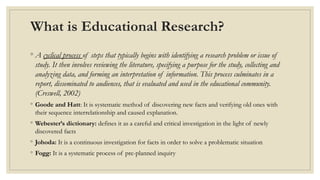
What is Educational Research?
◦ A cyclical process of steps that typically begins with identifying a research problem or issue of
study. It then involves reviewing the literature, specifying a purpose for the study, collecting and
analyzing data, and forming an interpretation of information. This process culminates in a
report, disseminated to audiences, that is evaluated and used in the educational community.
(Creswell, 2002)
◦ Goode and Hatt: It is systematic method of discovering new facts and verifying old ones with
their sequence interrelationship and caused explanation.
◦ Webester’s dictionary: defines it as a careful and critical investigation in the light of newly
discovered facts
◦ Johoda: It is a continuous investigation for facts in order to solve a problematic situation
◦ Fogg: It is a systematic process of pre-planned inquiry
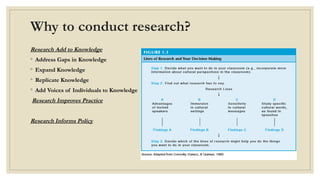
Why to conduct research?
Research Add to Knowledge
◦ Address Gaps in Knowledge
◦ Expand Knowledge
◦ Replicate Knowledge
◦ Add Voices of Individuals to Knowledge
Research Improves Practice
Research Informs Policy
Problems with research today
◦ I read through every single evaluation… looking for a hard sentence – a declarative sentence– something that
I could put into the legislation, and there were very few. ( Viaderro 1999, p.36 )
◦ Questionable Data
Inappropriate sample
Number of participants
Statistical tools and there application
Unclear Statement about the intent of study
Lack of disclosure of Data
Remember! Just because a research is published in a well-known journal does not automatically make it
“good”
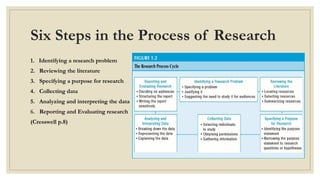
Six Steps in the Process of Research
1. Identifying a research problem
2. Reviewing the literature
3. Specifying a purpose for research
4. Collecting data
5. Analyzing and interpreting the data
6. Reporting and Evaluating research
(Cresswell p.8)
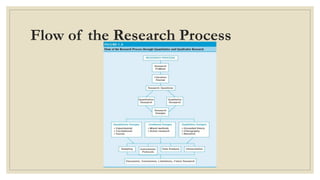
Flow of the Research Process
WHAT IS QUALITATIVE RESEARCH?
◦ Qualitative research is multimethod in focus,
involving an interpretive, naturalistic approach to
its subject matter. This means that qualitative
researchers study things in their natural settings,
attempting to make sense of, or interpret,
phenomena in terms of the meanings people
bring to them. Qualitative research involves the
studied use and collection of a variety of
empirical materials - case study, personal
experience, introspective, life story, interview,
observational, historical, interactional, and visual
texts - that describe routine and problematic
moments and meanings in individuals' lives.
Accordingly, qualitative researchers deploy a wide
range of interconnected methods, hoping always
to get a better fix on the subject matter at hand.
(Denzin and Lincoln, 1994: 2)
◦ Qualitative research is ... grounded in a philosophical
position which is broadly `interpretivist' in the sense that
it is concerned with how the social world is interpreted,
understood, experienced or produced ... based on
methods of data generation which are flexible and
sensitive to the social context in which data are produced
(rather than rigidly standardized or structured, or
removed from `real life' or `natural' social context, as in
some forms of experimental method) ... based on
methods of analysis and explanation building which
involve understandings of complexity, detail and context.
Qualitative research aims to produce rounded
understandings on the basis of rich, contextual and
detailed data. There is more emphasis on `holistic' forms
of analysis and explanation in this sense, than on
charting surface patterns, trends and correlations.
Qualitative research usually does use some form of
quantification, but statistical forms of analysis are not
seen as central. (Mason, 1996: 4)
Qualitative Research…involves finding out what people think, and
how they feel - or at any rate, what they say they think and how they
say they feel. This kind of information is subjective. It involves
feelings and impressions, rather than numbers’
Bellenger, Bernhardt and Goldstucker, Qualitative Research in Marketing,
American Marketing Association
◦ A holistic approach to questions--a recognition that human realities are
complex. Broad questions.
◦ The focus is on human experience
◦ The research strategies used generally feature sustained contact with
people in settings where those people normally spend their time.
Contexts of Human Behavior.
◦ There is typically a high level of researcher involvement with subjects;
strategies of participant observation and in-depth, unstructured
interviews are often used.
◦ The data produced provide a description, usually narrative, of people
living through events in situations.
◦ Cited from Boyd, pp. 67-68 in Munhall, 2001
The Nature of Qualitative Research
◦ Qualitative research should be conducted systematically and rigorously.
◦ Qualitative research should be conducted in a flexible and contextual way.
◦ Qualitative research should be conducted through critical, self-reflexive enquiry.
◦ Qualitative research should produce social explanations to intellectual puzzles. #
◦ Qualitative research is not a unified body of philosophy and practice.
◦ Qualitative research should be conducted as ethical practice.
Characteristics of Qualitative Research
◦ Natural Setting
◦ Researcher as a key Instrument
◦ Multiple Sources of Data
◦ Inductive Data Analysis
◦ Participants’ Meanings
◦ Emergent design
◦ Theoretical Lens
◦ Interpretive Inquiry
◦ Holistic Account
Contd.
◆ Exploring a problem and developing a detailed understanding of a central phenomenon
◆ Having the literature review play a minor role but justify the problem
◆ Stating the purpose and research questions in a general and broad way so as to the
participants’ experiences
◆ Collecting data based on words from a small number of individuals so that the
participants’ views are obtained
◆ Analyzing the data for description and themes using text analysis and interpreting the
larger meaning of the findings
◆ Writing the report using flexible, emerging structures and evaluative criteria, and including
the researchers’ subjective reflexivity and bias


Introduction to research,this is the presentation

  • 1.
  • 2.
    Research: Your PersonalJourney Tool kit Solid Understanding of Research A Map: A Six Step Process • Respect: People and Places • Natural skills: solving puzzles, library, writing • Decide your Path: Qualitative, Quantitative and Mixed Method
  • 3.
    CASE of Maria ◦An English language school teacher with 10 years of experience also doing a degree ◦ A Number of cases in the city involved students possessing weapons. ◦ School Administrators and Authorities formulate a committee to respond to the situation ◦ Maria sees this as an opportunity and volunteers Balancing the dual roles of Professionals and a graduate student. ◦ New to research but got basic skills of using library, internet surfing, discussions among colleagues ◦ Overcoming the fear about planning and conducting a study Your Situation at this Stage What is Research?
  • 4.
    What is EducationalResearch? ◦ A cyclical process of steps that typically begins with identifying a research problem or issue of study. It then involves reviewing the literature, specifying a purpose for the study, collecting and analyzing data, and forming an interpretation of information. This process culminates in a report, disseminated to audiences, that is evaluated and used in the educational community. (Creswell, 2002) ◦ Goode and Hatt: It is systematic method of discovering new facts and verifying old ones with their sequence interrelationship and caused explanation. ◦ Webester’s dictionary: defines it as a careful and critical investigation in the light of newly discovered facts ◦ Johoda: It is a continuous investigation for facts in order to solve a problematic situation ◦ Fogg: It is a systematic process of pre-planned inquiry
  • 5.
    Why to conductresearch? Research Add to Knowledge ◦ Address Gaps in Knowledge ◦ Expand Knowledge ◦ Replicate Knowledge ◦ Add Voices of Individuals to Knowledge Research Improves Practice Research Informs Policy
  • 6.
    Problems with researchtoday ◦ I read through every single evaluation… looking for a hard sentence – a declarative sentence– something that I could put into the legislation, and there were very few. ( Viaderro 1999, p.36 ) ◦ Questionable Data Inappropriate sample Number of participants Statistical tools and there application Unclear Statement about the intent of study Lack of disclosure of Data Remember! Just because a research is published in a well-known journal does not automatically make it “good”
  • 7.
    Six Steps inthe Process of Research 1. Identifying a research problem 2. Reviewing the literature 3. Specifying a purpose for research 4. Collecting data 5. Analyzing and interpreting the data 6. Reporting and Evaluating research (Cresswell p.8)
  • 8.
    Flow of theResearch Process
  • 9.
    WHAT IS QUALITATIVERESEARCH? ◦ Qualitative research is multimethod in focus, involving an interpretive, naturalistic approach to its subject matter. This means that qualitative researchers study things in their natural settings, attempting to make sense of, or interpret, phenomena in terms of the meanings people bring to them. Qualitative research involves the studied use and collection of a variety of empirical materials - case study, personal experience, introspective, life story, interview, observational, historical, interactional, and visual texts - that describe routine and problematic moments and meanings in individuals' lives. Accordingly, qualitative researchers deploy a wide range of interconnected methods, hoping always to get a better fix on the subject matter at hand. (Denzin and Lincoln, 1994: 2) ◦ Qualitative research is ... grounded in a philosophical position which is broadly `interpretivist' in the sense that it is concerned with how the social world is interpreted, understood, experienced or produced ... based on methods of data generation which are flexible and sensitive to the social context in which data are produced (rather than rigidly standardized or structured, or removed from `real life' or `natural' social context, as in some forms of experimental method) ... based on methods of analysis and explanation building which involve understandings of complexity, detail and context. Qualitative research aims to produce rounded understandings on the basis of rich, contextual and detailed data. There is more emphasis on `holistic' forms of analysis and explanation in this sense, than on charting surface patterns, trends and correlations. Qualitative research usually does use some form of quantification, but statistical forms of analysis are not seen as central. (Mason, 1996: 4)
  • 10.
    Qualitative Research…involves findingout what people think, and how they feel - or at any rate, what they say they think and how they say they feel. This kind of information is subjective. It involves feelings and impressions, rather than numbers’ Bellenger, Bernhardt and Goldstucker, Qualitative Research in Marketing, American Marketing Association
  • 11.
    ◦ A holisticapproach to questions--a recognition that human realities are complex. Broad questions. ◦ The focus is on human experience ◦ The research strategies used generally feature sustained contact with people in settings where those people normally spend their time. Contexts of Human Behavior. ◦ There is typically a high level of researcher involvement with subjects; strategies of participant observation and in-depth, unstructured interviews are often used. ◦ The data produced provide a description, usually narrative, of people living through events in situations. ◦ Cited from Boyd, pp. 67-68 in Munhall, 2001
  • 12.
    The Nature ofQualitative Research ◦ Qualitative research should be conducted systematically and rigorously. ◦ Qualitative research should be conducted in a flexible and contextual way. ◦ Qualitative research should be conducted through critical, self-reflexive enquiry. ◦ Qualitative research should produce social explanations to intellectual puzzles. # ◦ Qualitative research is not a unified body of philosophy and practice. ◦ Qualitative research should be conducted as ethical practice.
  • 13.
    Characteristics of QualitativeResearch ◦ Natural Setting ◦ Researcher as a key Instrument ◦ Multiple Sources of Data ◦ Inductive Data Analysis ◦ Participants’ Meanings ◦ Emergent design ◦ Theoretical Lens ◦ Interpretive Inquiry ◦ Holistic Account
  • 14.
    Contd. ◆ Exploring aproblem and developing a detailed understanding of a central phenomenon ◆ Having the literature review play a minor role but justify the problem ◆ Stating the purpose and research questions in a general and broad way so as to the participants’ experiences ◆ Collecting data based on words from a small number of individuals so that the participants’ views are obtained ◆ Analyzing the data for description and themes using text analysis and interpreting the larger meaning of the findings ◆ Writing the report using flexible, emerging structures and evaluative criteria, and including the researchers’ subjective reflexivity and bias