Sampling Procedure

           A.M.Somoray
Two General Types of
          Sampling:
Probability sampling - is taking a sample
  from the population.
• It ensures that there is a possibility for
  each person in a sample population to be
  selected
Types of Probability Sampling

• Random Sampling – This is similar to
  lottery method that provides everyone in
  the population the equal chance to be
  picked as sample.
• Systematic Sampling – This is used if a
  high density of a population is at stake.
• Stratified Random Sampling - dividing up the
  population into smaller groups, and randomly
  sampling from each group.
• Cluster Sampling - is similar to stratified
  sampling because the population to be sampled
  is subdivided into mutually exclusive groups.
  However, in cluster sampling the groups are
  defined so as to maintain the heterogeneity of
  the population.
  Example: Female members of Baranggay San
  Isidro
Non-Probability Sampling
• Non-probability sampling represents
  a group of sampling techniques that help
  researchers to select units from
  a population that they are interested in
  studying. Collectively, these units form
  the sample that the researcher studies
Types of Non-Probability Sampling

Network sampling – “referral sampling”
 that stems from one or few identified
 samples who after being involved in the
 study will lead the researcher to other
 samples who possess the same
 attributes.
“word of mouth" approach of acquiring
 participants. 
• Accidental Sampling - A sampling by
  opportunity in which the researcher takes the
  respondents from those he meets
  unexpectedly.


• Purposive Sampling – “Judgmental
  sampling”. A deliberate selection of
  individuals by the researcher based on
  predefined criteria
• Convenience Sampling – Selecting respondents
  in the easiest way. The respondents may be
  the nearest people, friends, relatives,
  accessible organization, available person.

• Quota Sampling - A sampling method of
  gathering representative data from a group. 
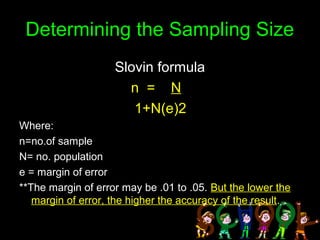
Determining the Sampling Size
                    Slovin formula
                      n = N
                       1+N(e)2
Where:
n=no.of sample
N= no. population
e = margin of error
**The margin of error may be .01 to .05. But the lower the
   margin of error, the higher the accuracy of the result.
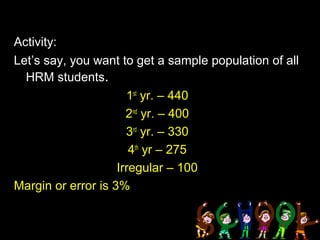
Activity:
Let’s say, you want to get a sample population of all
  HRM students.
                      1st yr. – 440
                      2nd yr. – 400
                      3rd yr. – 330
                       4th yr – 275
                    Irregular – 100
Margin or error is 3%

Chapter 4 sampling procedure

  • 1.
  • 2.
    Two General Typesof Sampling: Probability sampling - is taking a sample from the population. • It ensures that there is a possibility for each person in a sample population to be selected
  • 3.
    Types of ProbabilitySampling • Random Sampling – This is similar to lottery method that provides everyone in the population the equal chance to be picked as sample. • Systematic Sampling – This is used if a high density of a population is at stake.
  • 4.
    • Stratified RandomSampling - dividing up the population into smaller groups, and randomly sampling from each group. • Cluster Sampling - is similar to stratified sampling because the population to be sampled is subdivided into mutually exclusive groups. However, in cluster sampling the groups are defined so as to maintain the heterogeneity of the population. Example: Female members of Baranggay San Isidro
  • 5.
    Non-Probability Sampling • Non-probabilitysampling represents a group of sampling techniques that help researchers to select units from a population that they are interested in studying. Collectively, these units form the sample that the researcher studies
  • 6.
    Types of Non-ProbabilitySampling Network sampling – “referral sampling” that stems from one or few identified samples who after being involved in the study will lead the researcher to other samples who possess the same attributes. “word of mouth" approach of acquiring participants. 
  • 7.
    • Accidental Sampling- A sampling by opportunity in which the researcher takes the respondents from those he meets unexpectedly. • Purposive Sampling – “Judgmental sampling”. A deliberate selection of individuals by the researcher based on predefined criteria
  • 8.
    • Convenience Sampling– Selecting respondents in the easiest way. The respondents may be the nearest people, friends, relatives, accessible organization, available person. • Quota Sampling - A sampling method of gathering representative data from a group. 
  • 9.
    Determining the SamplingSize Slovin formula n = N 1+N(e)2 Where: n=no.of sample N= no. population e = margin of error **The margin of error may be .01 to .05. But the lower the margin of error, the higher the accuracy of the result.
  • 10.
    Activity: Let’s say, youwant to get a sample population of all HRM students. 1st yr. – 440 2nd yr. – 400 3rd yr. – 330 4th yr – 275 Irregular – 100 Margin or error is 3%

Editor's Notes

  • #2 Sampling refers to taking a representative subsection of the population. Contacting, questioning, and obtaining information from a large population, such as the 370,000 households residing in Antipolo City, is extremely expensive, difficult, and time consuming. A properly designed probability sample, however, provides a reliable means of inferring information about a population without examining every member or element
  • #3 Example: If you wanted the opinions of an HRM students a probability sample would mean that every HRM students would have an equal chance of participating in the research.
  • #6 Non-probability sampling comes in various shapes and sizes, but the essence of it is that a bias exists in the group of people you are surveying. Let’s think about it in the context of our fictional color preference survey. If I asked the question to all of my friends, the results are not representative of anything other than the opinion of my friends and, specifically, those friends to whom I decided to send the survey. Another example of non-probability sampling would occur if I were to send you the survey and then ask you to pass the survey onto a friend. This effect, called snowballing, creates a biased sample wherein not everyone has an equal chance of being sampled.
  • #9 QUOTA - For example, an interviewer may be told to sample 200 females and 300 males between the age of 45 and 60. This means that individuals can put a demand on who they want to sample (targeting).
  • #10 Determining sample size is a very important issue because samples that are too large may waste time, resources and money, while samples that are too small may lead to inaccurate results. There is no general rule regarding the sample size. However, we can say that the higher the percentage, the higher the validity. It is natural to say that the bigger the population, the lesser percentage of the sample is taken.
  • #11 N = 1545 n= 1545 E = (.03)2 = .0009 ---------- 1+1545 (.0009) 1545 1545 ------------------ n = ---------------- 1+ 1.3905 2.3905 n= 646