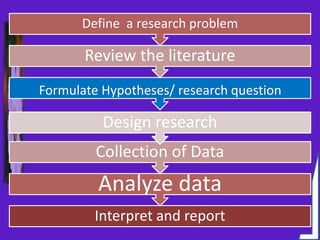
Interpret and report
Analyze data
Collection of Data
Design research
Formulate Hypotheses/ research question
Review the literature
Define a research problem
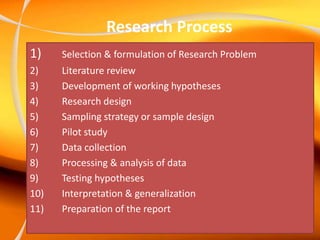
Research Process
1) Selection & formulation of Research Problem
2) Literature review
3) Development of working hypotheses
4) Research design
5) Sampling strategy or sample design
6) Pilot study
7) Data collection
8) Processing & analysis of data
9) Testing hypotheses
10) Interpretation & generalization
11) Preparation of the report
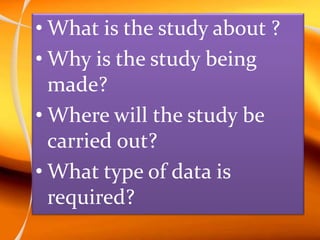
• What is the study about ?
• Why is the study being
made?
• Where will the study be
carried out?
• What type of data is
required?
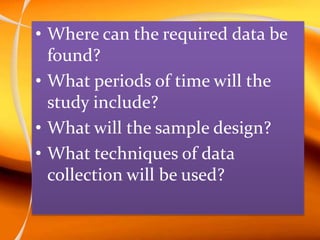
• Where can the required data be
found?
• What periods of time will the
study include?
• What will the sample design?
• What techniques of data
collection will be used?
• How will the data be
analyzed?
• In what style will the report
be prepared
• How will the issues of
ethics/privacy be addressed?
a. What are the distinguishing characteristics
of qualitative research?
b. What are the essential strategies of
qualitative research?
c. What is your role as a researcher?
d. What topic might you want to study?
Hypothesis
• A provisional assertion assumed to be
true for the purpose of testing its
validity.
• Hypothesis are a statements of your
tentative answers to the questions –
what you think is going on.
Research question
• The conceptual framework keeps you
grounded.
• What you specifically want to understand
by doing a research.
• Reserarch questions state what you want to
learn
Qualitative Research
Any kind of research that produces
findings not arrived at by means of
statistical procedures or other means
of quantification.
(Strauss & Corbin, 1990)
What is qualitative research?
Qualitative researchers study things
in their natural settings,
attempting to make sense of, or to
interpret, phenomena in terms of
the meanings people bring to
them (Denzin 1994).
Qualitative Researchers seek
answers to their questions in the
real world.
They gather what they see, hear,
and read from people and places
and from events and activities
• Qualitative research is intended to
penetrate to the deeper significance
that the subject of the research
ascribes to the topic being researched.
• It involves an interpretive,
naturalistic approach to its subject
matter and gives priority to what the
data contribute to important research
questions or existing information.
• Qualitative research
encompasses a range of
philosophies, research designs
and specific techniques
including in-depth qualitative
interviews; participant and non-
participant observation; focus
groups; document analyses; and
a number of other methods of
data collection
• ‘Qualitative Research…involves
finding out what people think,
and how they feel - or at any rate,
what they say they think and
how they say they feel. This kind
of information is subjective. It
involves feelings and
impressions, rather than
numbers’
Qualitative research has two unique
features:
 The researcher is the means through
which the study conducted.
The purpose is to learn about some facet
of the social world
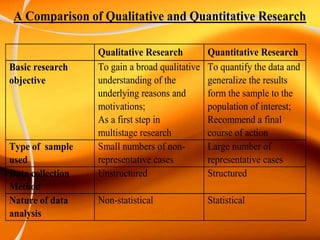
A Comparison of Qualitative and Quantitative Research
Qualitative Research Quantitative Research
Basic research
objective
To gain a broad qualitative
understanding of the
underlying reasons and
motivations;
As a first step in
multistage research
To quantify the data and
generalize the results
form the sample to the
population of interest;
Recommend a final
course of action
Type of sample
used
Small numbers of non-
representative cases
Large number of
representative cases
Data collection
Method
Unstructured Structured
Nature of data
analysis
Non-statistical Statistical
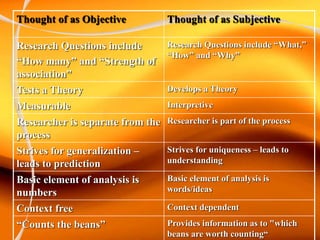
Thought of as Objective Thought of as Subjective
Research Questions include
“How many” and “Strength of
association”
Research Questions include “What,”
“How” and “Why”
Tests a Theory Develops a Theory
Measurable Interpretive
Researcher is separate from the
process
Researcher is part of the process
Strives for generalization –
leads to prediction
Strives for uniqueness – leads to
understanding
Basic element of analysis is
numbers
Basic element of analysis is
words/ideas
Context free Context dependent
“Counts the beans” Provides information as to "which
beans are worth counting“
Interactive Nature of the Qualitative
Process
• Data collection, data analysis and the development
and verification of relationships and conclusion
are all interrelated and interactive set of processes
• Allows researcher to recognise important themes,
patterns and relationships as you collect data
• Allows you to re-categorise existing data to see
whether themes and patterns and relationships
exist in the data already collected
• Allows you to adjust your future data collection
approach to see whether they exist in other cases
Common Characteristics
Qualitative research …..
Takes place in the natural world
Uses multiple methods
Focuses on context
Is emerging rather than tightly
prefigured
Is fundamentally interpretive
Positivist Paradigm
• Emphasises that human reason is supreme and that
there is a single objective truth that can be
discovered by science
• Encourages us to stress the function of objects,
celebrate technology and to regard the world as a
rational, ordered place with a clearly defined past,
present and future
Non-Positivist Paradigm
• Questions the assumptions of the positivist paradigm
• Argues that our society places too much emphasis on science
and technology
• Argues that this ordered, rational view of consumers denies
the complexity of the social and cultural world we live in
• Stresses the importance of symbolic, subjective experience
The Five moments of Qualitative Research
Traditional Period: 1900’s-World War II
• Wrote objective colonising accounts of field
experiences that were reflective of the positivist
scientist paradigm.
• Concerned with offering valid, reliable, and
objective interpretations in their writings.
• The ‘subject’ who was studied was alien,
foreign, and strange.
The Modernist Phase
Post war-1970’s
• The modernist ethnographer and
sociological participant observer
attempted rigorous, qualitative studies
of important social processes, including
social control in the classroom and
society
• Researchers were drawn to qualitative
research because it allowed them to give
a voice to society’s ‘underclass’
Blurred Genres
1970-1986
• Researchers had a full complement of paradigms, methods
and strategies
• Applied qualitative research was gaining in stature
• Research strategies ranged from grounded theory to the
case study methodology
• Methods included qualitative interviewing and
observational, visual, personal and documentary methods.
• Computers were becoming more prevalent
• Boundaries between the social sciences and humanities had
become blurred
• Social science was borrowing models, theories and methods
of analysis from the humanities
• Researcher acknowledged as being part of the research
process
Crisis of Representation
Mid 1980’s-Current Day
• Caused by the publication of a book called Anthropology
as Cultural Critique (Marcus and Fischer, 1986)
• Made research and writing more reflexive and called into
question the issues of gender, class and race.
• Interpretative theories as opposed to grounded theories
were more common as writers challenge old models of
truth and meaning
• Crisis of Representation and Legitimisation
The Fifth Moment
Current Day
• Defined and shaped by the dual crisis of
representation and legitimisation
• Theories now beginning to be read in narrative
terms as ‘tales of the field’
• Concept of an aloof researcher has finally been fully
abandoned
• More action oriented research is on the horizon
• More Social criticism and social critique
• The search for grand narratives is being replaced by
more local, small-scale theories fitted to specific
problems and specific situations
Popularity of Qualitative Research
1 Usually much cheaper than quantitative
research
2 No better way than qualitative research to
understand in-depth the motivations and
feelings of consumers
3 Qualitative research can improve the
efficiency and effectiveness of quantitative
research
Limitations of Qualitative Research
1 Marketing successes and failures are based on
small differences in the marketing mix.
Qualitative research doesn’t distinguish these
differences as well as quantitative research can.
2 Not representative of the population that is of
interest to the researcher
3 The multitude of individuals who, without
formal training, profess to be experts in the
field
Qualitative Research as a Process
• Theory
• Method
• Analysis
• All three interconnect to define the
qualitative research process
• Comfort with ambiguity
• Capacity to make reasoned decision and to
articulate the logic behind those decisions.
• Deep interpersonal or emotional sensitivity
• Ethical sensitivity of potential consequences to
individuals and groups
• Political sensitivity
• Perseverance and self-discipline
• Awareness of when to bring closure
Considerations in selecting a research
problem:
Interest:
Magnitude:
Measurement of concepts
Level of expertise
Relevance:
Availability of data
Ethical issues
Steps in formulation of a research problem
:
• Step 1 Identify a broad field or subject area of
interest to you.
• Step 2 Dissect the broad area into sub areas.
• Step 3 Select what is of most interest to you.
• Step 4 Raise research questions.
• Step 5 Formulate objectives.
• Step 6 Assess your objectives.
• Step 7 Double check.
•
Research Methodology
• Aims to describe and analyze methods,
throw light on their limitations and
resources, clarify their presuppositions and
consequences, relating their potentialities
to the twilight zone at the ‘frontiers of
knowledge’
RESEARCH METHOD
Behavior and instruments used in selecting
and constructing technique (a range of
approaches used to gather data)
Examples: Observation, questionnaire,
interview, analysis of records, case study,
etc.
Strategies for ensuring credibility and rigor
• Triangulation
• Being there
• Participant validation
• Using critical friend
• Using the community of
practice
• Is the study trustworthy
• Is the study competently
conducted
• Is it ethically conducted
Standards for practice
• Does the study confirm to standards
for acceptable and competent
practice?
• Is the study credible?
• Is it systematic and rigorous?
• Is the study potentially useful?
Is the study credible?
• Does the research derive from the
participants’ views?
• Does the researcher reflect on his/her
role?
• Can another researcher follow the
internal logic in developing
conclusions
Is the study systematic and rigorous?
Are the methodological decisions grounded in
a conceptual framework?
Is the methodology and design reasoning
transparent?
Does the researcher document and reveal
her/his decision making process?
Qualitative Data Collection Techniques
• In depth Interviewing
• Focus Groups
• Participant Observations
• Ethnographic Studies
• Projective Techniques
Analysis Qualitative Data:
An Approach
• Categorisation
• Unitising data
• Recognising relationships and developing
the categories you are using to facilitate
this
• Developing and testing hypotheses to reach
conclusion
Interactive Nature of the Qualitative
Process
• Data collection, data analysis and the development
and verification of relationships and conclusion are all
interrelated and interactive set of processes
• Allows researcher to recognise important themes,
patterns and relationships as you collect data
• Allows you to re-categorise existing data to see
whether themes and patterns and relationships exist
in the data already collected
• Allows you to adjust your future data collection
approach to see whether they exist in other cases
qualitative research.pptx

qualitative research.pptx

  • 2.
    Interpret and report Analyzedata Collection of Data Design research Formulate Hypotheses/ research question Review the literature Define a research problem
  • 3.
    Research Process 1) Selection& formulation of Research Problem 2) Literature review 3) Development of working hypotheses 4) Research design 5) Sampling strategy or sample design 6) Pilot study 7) Data collection 8) Processing & analysis of data 9) Testing hypotheses 10) Interpretation & generalization 11) Preparation of the report
  • 4.
    • What isthe study about ? • Why is the study being made? • Where will the study be carried out? • What type of data is required?
  • 5.
    • Where canthe required data be found? • What periods of time will the study include? • What will the sample design? • What techniques of data collection will be used?
  • 6.
    • How willthe data be analyzed? • In what style will the report be prepared • How will the issues of ethics/privacy be addressed?
  • 7.
    a. What arethe distinguishing characteristics of qualitative research? b. What are the essential strategies of qualitative research? c. What is your role as a researcher? d. What topic might you want to study?
  • 8.
    Hypothesis • A provisionalassertion assumed to be true for the purpose of testing its validity. • Hypothesis are a statements of your tentative answers to the questions – what you think is going on.
  • 9.
    Research question • Theconceptual framework keeps you grounded. • What you specifically want to understand by doing a research. • Reserarch questions state what you want to learn
  • 10.
    Qualitative Research Any kindof research that produces findings not arrived at by means of statistical procedures or other means of quantification. (Strauss & Corbin, 1990)
  • 11.
    What is qualitativeresearch? Qualitative researchers study things in their natural settings, attempting to make sense of, or to interpret, phenomena in terms of the meanings people bring to them (Denzin 1994).
  • 12.
    Qualitative Researchers seek answersto their questions in the real world. They gather what they see, hear, and read from people and places and from events and activities
  • 13.
    • Qualitative researchis intended to penetrate to the deeper significance that the subject of the research ascribes to the topic being researched. • It involves an interpretive, naturalistic approach to its subject matter and gives priority to what the data contribute to important research questions or existing information.
  • 14.
    • Qualitative research encompassesa range of philosophies, research designs and specific techniques including in-depth qualitative interviews; participant and non- participant observation; focus groups; document analyses; and a number of other methods of data collection
  • 15.
    • ‘Qualitative Research…involves findingout what people think, and how they feel - or at any rate, what they say they think and how they say they feel. This kind of information is subjective. It involves feelings and impressions, rather than numbers’
  • 16.
    Qualitative research hastwo unique features:  The researcher is the means through which the study conducted. The purpose is to learn about some facet of the social world
  • 17.
    A Comparison ofQualitative and Quantitative Research Qualitative Research Quantitative Research Basic research objective To gain a broad qualitative understanding of the underlying reasons and motivations; As a first step in multistage research To quantify the data and generalize the results form the sample to the population of interest; Recommend a final course of action Type of sample used Small numbers of non- representative cases Large number of representative cases Data collection Method Unstructured Structured Nature of data analysis Non-statistical Statistical
  • 18.
    Thought of asObjective Thought of as Subjective Research Questions include “How many” and “Strength of association” Research Questions include “What,” “How” and “Why” Tests a Theory Develops a Theory Measurable Interpretive Researcher is separate from the process Researcher is part of the process Strives for generalization – leads to prediction Strives for uniqueness – leads to understanding Basic element of analysis is numbers Basic element of analysis is words/ideas Context free Context dependent “Counts the beans” Provides information as to "which beans are worth counting“
  • 19.
    Interactive Nature ofthe Qualitative Process • Data collection, data analysis and the development and verification of relationships and conclusion are all interrelated and interactive set of processes • Allows researcher to recognise important themes, patterns and relationships as you collect data • Allows you to re-categorise existing data to see whether themes and patterns and relationships exist in the data already collected • Allows you to adjust your future data collection approach to see whether they exist in other cases
  • 20.
    Common Characteristics Qualitative research….. Takes place in the natural world Uses multiple methods Focuses on context Is emerging rather than tightly prefigured Is fundamentally interpretive
  • 21.
    Positivist Paradigm • Emphasisesthat human reason is supreme and that there is a single objective truth that can be discovered by science • Encourages us to stress the function of objects, celebrate technology and to regard the world as a rational, ordered place with a clearly defined past, present and future
  • 22.
    Non-Positivist Paradigm • Questionsthe assumptions of the positivist paradigm • Argues that our society places too much emphasis on science and technology • Argues that this ordered, rational view of consumers denies the complexity of the social and cultural world we live in • Stresses the importance of symbolic, subjective experience
  • 23.
    The Five momentsof Qualitative Research Traditional Period: 1900’s-World War II • Wrote objective colonising accounts of field experiences that were reflective of the positivist scientist paradigm. • Concerned with offering valid, reliable, and objective interpretations in their writings. • The ‘subject’ who was studied was alien, foreign, and strange.
  • 24.
    The Modernist Phase Postwar-1970’s • The modernist ethnographer and sociological participant observer attempted rigorous, qualitative studies of important social processes, including social control in the classroom and society • Researchers were drawn to qualitative research because it allowed them to give a voice to society’s ‘underclass’
  • 25.
    Blurred Genres 1970-1986 • Researchershad a full complement of paradigms, methods and strategies • Applied qualitative research was gaining in stature • Research strategies ranged from grounded theory to the case study methodology • Methods included qualitative interviewing and observational, visual, personal and documentary methods. • Computers were becoming more prevalent • Boundaries between the social sciences and humanities had become blurred • Social science was borrowing models, theories and methods of analysis from the humanities • Researcher acknowledged as being part of the research process
  • 26.
    Crisis of Representation Mid1980’s-Current Day • Caused by the publication of a book called Anthropology as Cultural Critique (Marcus and Fischer, 1986) • Made research and writing more reflexive and called into question the issues of gender, class and race. • Interpretative theories as opposed to grounded theories were more common as writers challenge old models of truth and meaning • Crisis of Representation and Legitimisation
  • 27.
    The Fifth Moment CurrentDay • Defined and shaped by the dual crisis of representation and legitimisation • Theories now beginning to be read in narrative terms as ‘tales of the field’ • Concept of an aloof researcher has finally been fully abandoned • More action oriented research is on the horizon • More Social criticism and social critique • The search for grand narratives is being replaced by more local, small-scale theories fitted to specific problems and specific situations
  • 28.
    Popularity of QualitativeResearch 1 Usually much cheaper than quantitative research 2 No better way than qualitative research to understand in-depth the motivations and feelings of consumers 3 Qualitative research can improve the efficiency and effectiveness of quantitative research
  • 29.
    Limitations of QualitativeResearch 1 Marketing successes and failures are based on small differences in the marketing mix. Qualitative research doesn’t distinguish these differences as well as quantitative research can. 2 Not representative of the population that is of interest to the researcher 3 The multitude of individuals who, without formal training, profess to be experts in the field
  • 30.
    Qualitative Research asa Process • Theory • Method • Analysis • All three interconnect to define the qualitative research process
  • 31.
    • Comfort withambiguity • Capacity to make reasoned decision and to articulate the logic behind those decisions. • Deep interpersonal or emotional sensitivity • Ethical sensitivity of potential consequences to individuals and groups • Political sensitivity • Perseverance and self-discipline • Awareness of when to bring closure
  • 32.
    Considerations in selectinga research problem: Interest: Magnitude: Measurement of concepts Level of expertise Relevance: Availability of data Ethical issues
  • 33.
    Steps in formulationof a research problem : • Step 1 Identify a broad field or subject area of interest to you. • Step 2 Dissect the broad area into sub areas. • Step 3 Select what is of most interest to you. • Step 4 Raise research questions. • Step 5 Formulate objectives. • Step 6 Assess your objectives. • Step 7 Double check. •



  • 34.
    Research Methodology • Aimsto describe and analyze methods, throw light on their limitations and resources, clarify their presuppositions and consequences, relating their potentialities to the twilight zone at the ‘frontiers of knowledge’
  • 35.
    RESEARCH METHOD Behavior andinstruments used in selecting and constructing technique (a range of approaches used to gather data) Examples: Observation, questionnaire, interview, analysis of records, case study, etc.
  • 37.
    Strategies for ensuringcredibility and rigor • Triangulation • Being there • Participant validation • Using critical friend • Using the community of practice
  • 38.
    • Is thestudy trustworthy • Is the study competently conducted • Is it ethically conducted
  • 39.
    Standards for practice •Does the study confirm to standards for acceptable and competent practice? • Is the study credible? • Is it systematic and rigorous? • Is the study potentially useful?
  • 40.
    Is the studycredible? • Does the research derive from the participants’ views? • Does the researcher reflect on his/her role? • Can another researcher follow the internal logic in developing conclusions
  • 41.
    Is the studysystematic and rigorous? Are the methodological decisions grounded in a conceptual framework? Is the methodology and design reasoning transparent? Does the researcher document and reveal her/his decision making process?
  • 42.
    Qualitative Data CollectionTechniques • In depth Interviewing • Focus Groups • Participant Observations • Ethnographic Studies • Projective Techniques
  • 43.
    Analysis Qualitative Data: AnApproach • Categorisation • Unitising data • Recognising relationships and developing the categories you are using to facilitate this • Developing and testing hypotheses to reach conclusion
  • 44.
    Interactive Nature ofthe Qualitative Process • Data collection, data analysis and the development and verification of relationships and conclusion are all interrelated and interactive set of processes • Allows researcher to recognise important themes, patterns and relationships as you collect data • Allows you to re-categorise existing data to see whether themes and patterns and relationships exist in the data already collected • Allows you to adjust your future data collection approach to see whether they exist in other cases