Network Security
Tariq Ahmed
Dr. A. Q. Khan Institute of Information
Technology and Computer sciences(KICSIT)
mrbokhari2000@yahoo.com
 
• Instructor:
- Tariq Ahmed
• Tel: 051 9285342
• Email: mrbokhari2000@yahoo.com
Course Staff
• Lectures
- Wednesday: 4:00 - 7:00 p.m.
• Assignments
-
• Quizes
-
• Midterm exam
-
• Final exam
-
 
Course Schedule
• Assignments 10%
– Late assignments are not accepted
• Quizes 10%
• Midterm exam 20%
• Final exam 60%
Grading Policy
Academic Honesty
• Your work in this class must be your own
• If students are found to have collaborated
excessively or to have cheated (e.g. by
copying or sharing answers during an
examination), all involved will at a minimum
receive grades of 0 for the first infraction
• Further infractions will result in failure in
the course.
Course Material
Reference books
– No single textbook covers the whole course!
• Lot of research papers!
– Many will be made available
• RFCs and Internet drafts
– Related to Network security protocols
• Web resources
– Tutorials, white papers, reports, etc.
Course Information
• Pre-requisites
– Computer Networks course
• You are assumed to have good knowledge of
TCP/IP protocol suite
– Operating Systems
– Basic understanding of programming
languages
Course Contents
• Introduction to network security
• I. CRYPTOGRAPHY
– Symmetric Encryption and Message Confidentiality
– Public-Key Cryptography and Message Authentication
• II. NETWORK SECURITY APPLICATIONS
– Authentication Applications (Kerberos, X.509)
– Electronic Mail Security (PGP, S/MIME)
– IP Security (IPSec, AH, ESP, IKE)
– Web Security (SSL, TLS, SET)
– Network Management Security (SNMP)
Course Contents
• III. SYSTEM SECURITY
– Intruders and intrusion detection
– Malicious Software (viruses)
– Firewalls and trusted systems
– Operating System Security
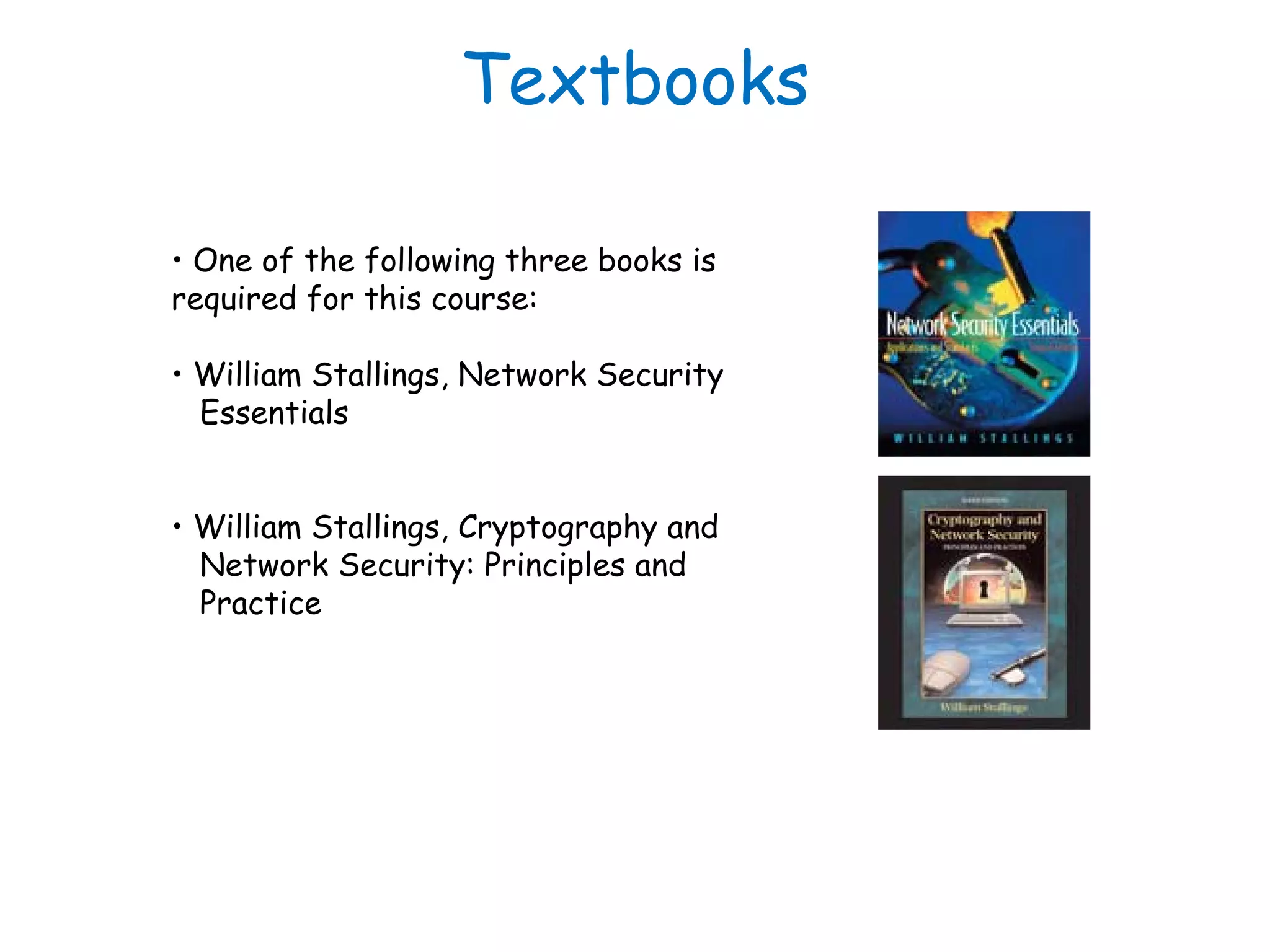
Textbooks
• One of the following three books is
required for this course:
• William Stallings, Network Security
Essentials
• William Stallings, Cryptography and
Network Security: Principles and
Practice
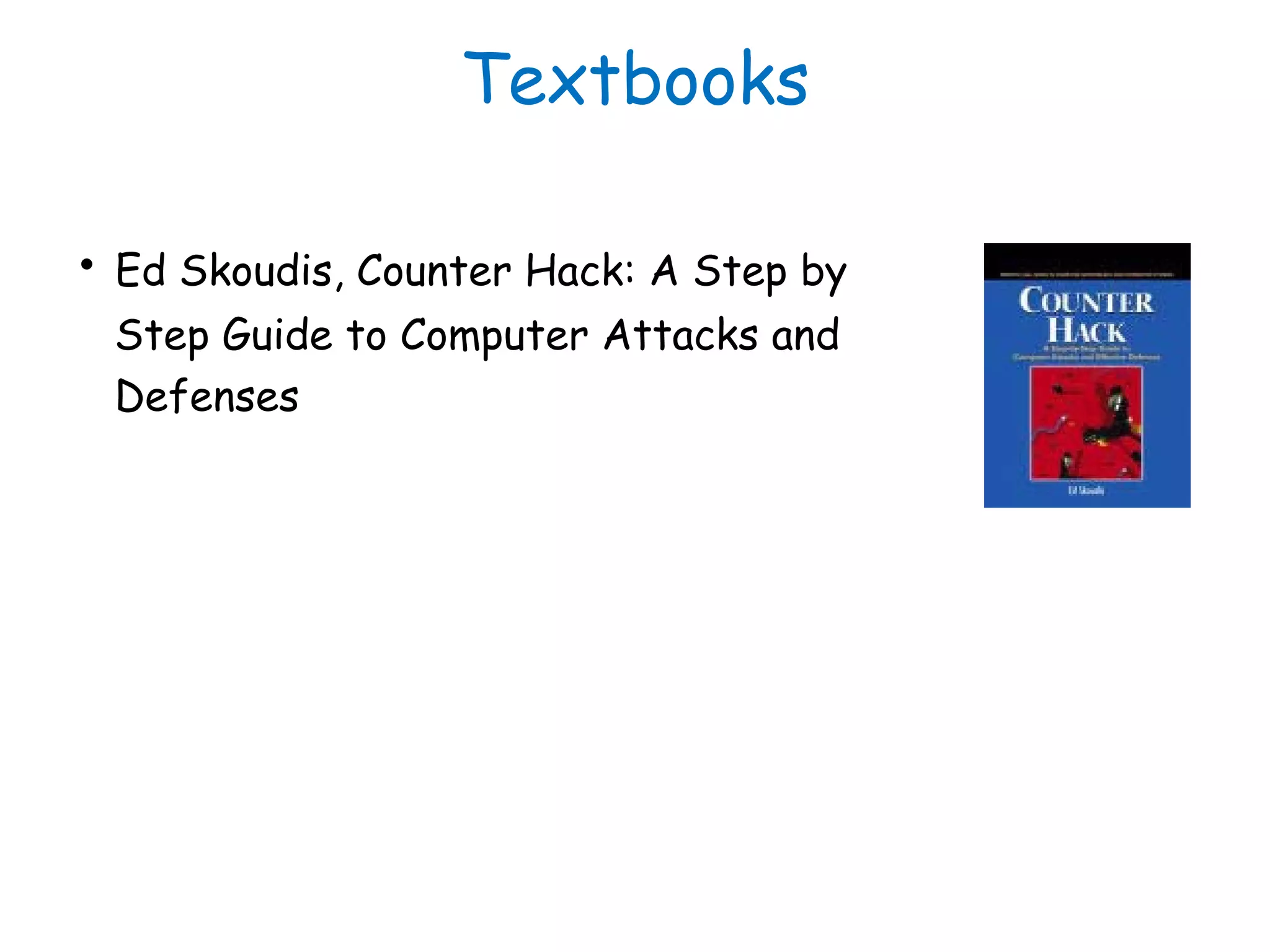
Textbooks
• Ed Skoudis, Counter Hack: A Step by
Step Guide to Computer Attacks and
Defenses
Expectations
What do you want (or expect) to learn
from
this class ?
Expectations
• This class IS about …
– Network security principles and concepts
– Cryptography, its use, principles and
major algorithms
– Message authentication and encryption
techniques
– Security of network “system”
– Operating system security
– Security practices and applications
Expectations
• This class IS NOT about …
– Survey of existing protocol standards
– Survey of loopholes in current protocols
– How to hack the network of KICSIT!
– Tools and tips to breach Internet
security
– How you can become a good hacker …
Expectations
We will learn
Why and How
networks are made secure
Outline
• Attacks, services and mechanisms
• Security attacks
• Security services
• Methods of Defense
• A model for Internetwork Security
• Internet standards and RFCs
Background
• Information Security requirements have
changed in recent times
• Traditionally provided by physical and
administrative mechanisms
• Computer use requires automated tools to
protect files and other stored information
• Use of networks and communications links
requires measures to protect data during
transmission
Definitions
• Computer Security - generic name for the
collection of tools designed to protect data
and to thwart hackers
• Network Security - measures to protect
data during their transmission
• Internet Security - measures to protect
data during their transmission over a
collection of interconnected networks
Aim of this Course
• Our focus is on internet security
• Consists of measures to deter,
prevent, detect, and correct security
violations that involve the transmission of
information
• Requirements seem straightforward,
but the mechanisms used to meet
them can be quite complex …
Services, Mechanisms, Attacks
• Need systematic way to define
requirements
• Consider three aspects of
information security:
– security attack
– security mechanism
– security service
• Consider in reverse order
Security Service
• Is something that enhances the security of the
data processing systems and the information
transfers of an organization
• Intended to counter security attacks
• Make use of one or more security mechanisms to
provide the service
• Replicate functions normally associated with
physical documents e.g.
– have signatures or dates
– need protection from disclosure, tampering, or
destruction
– be notarized or witnessed
– be recorded or licensed
Security Mechanism
• A mechanism that is designed to detect,
prevent, or recover from a security attack
• No single mechanism that will support all
functions required
• However one particular element underlies
many of the security mechanisms in use:
cryptographic techniques
• Hence our focus is on this area
Security Attack
• Any action that compromises the security
of information owned by an organization
• Information security is about how to
prevent attacks, or failing that, to detect
attacks on information-based systems
• Have a wide range of attacks
• Can focus on generic types of attacks
– Note: often threat & attack mean same
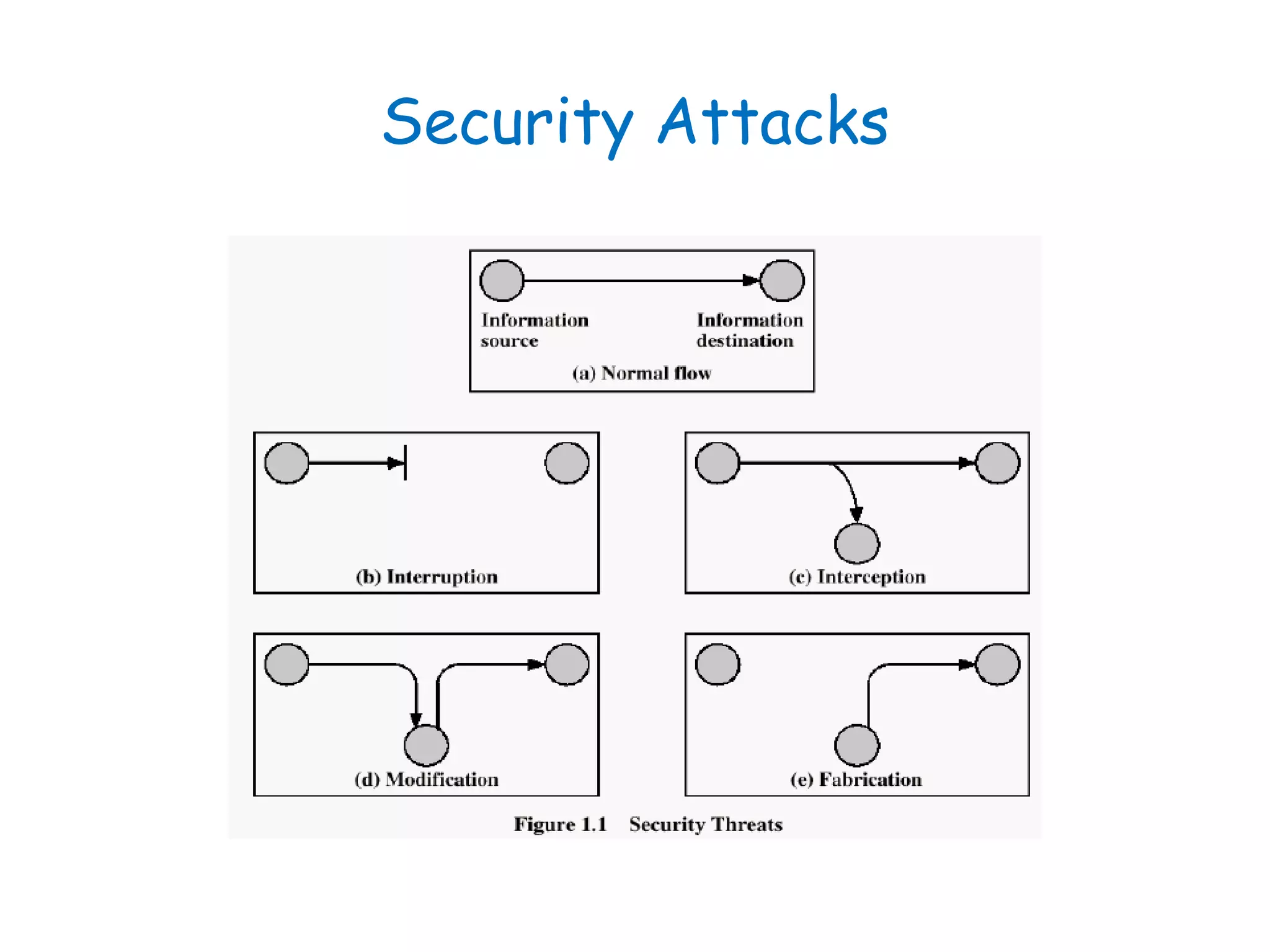
Security Attacks
Security Attacks
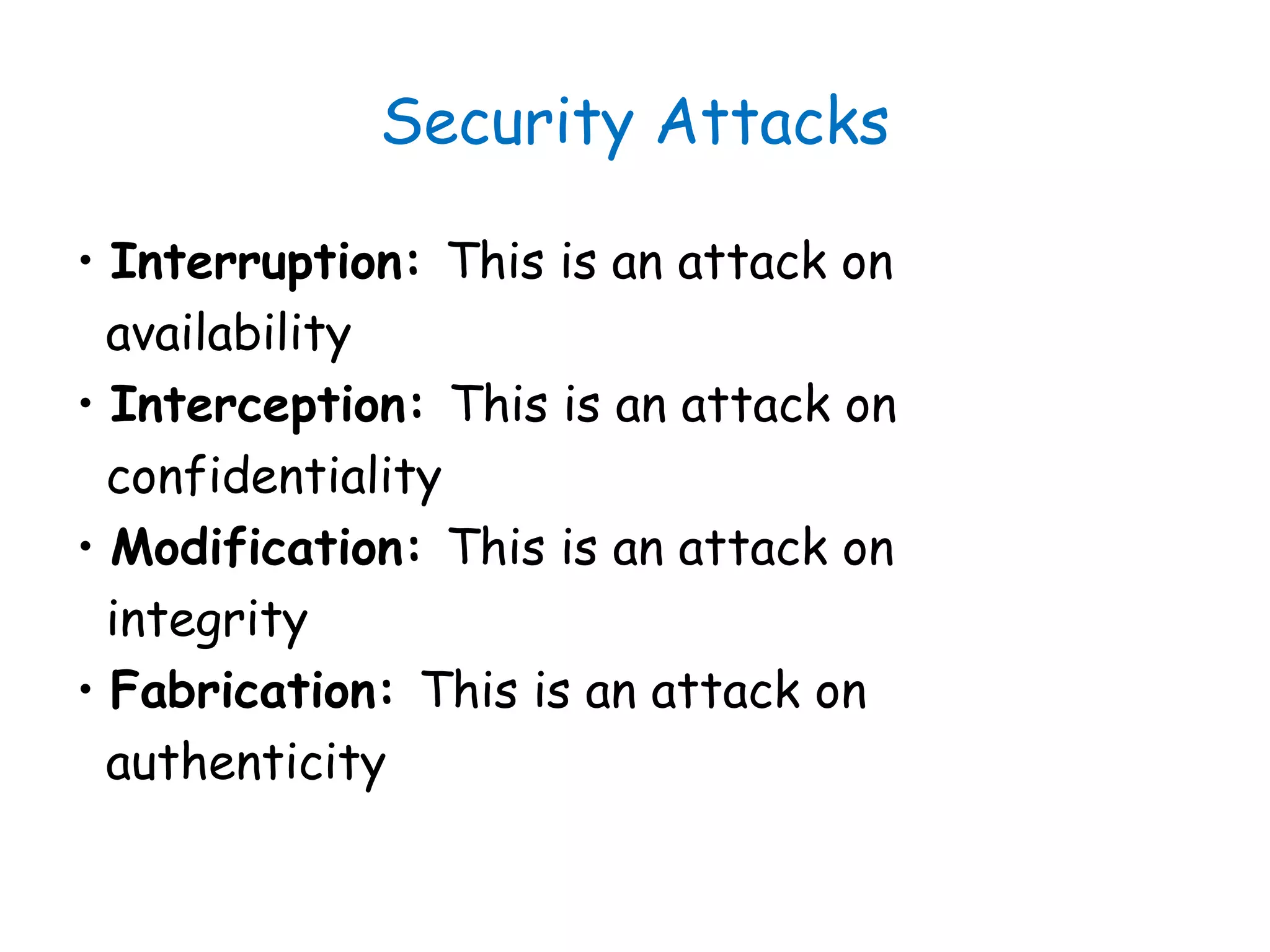
• Interruption: This is an attack on
availability
• Interception: This is an attack on
confidentiality
• Modification: This is an attack on
integrity
• Fabrication: This is an attack on
authenticity
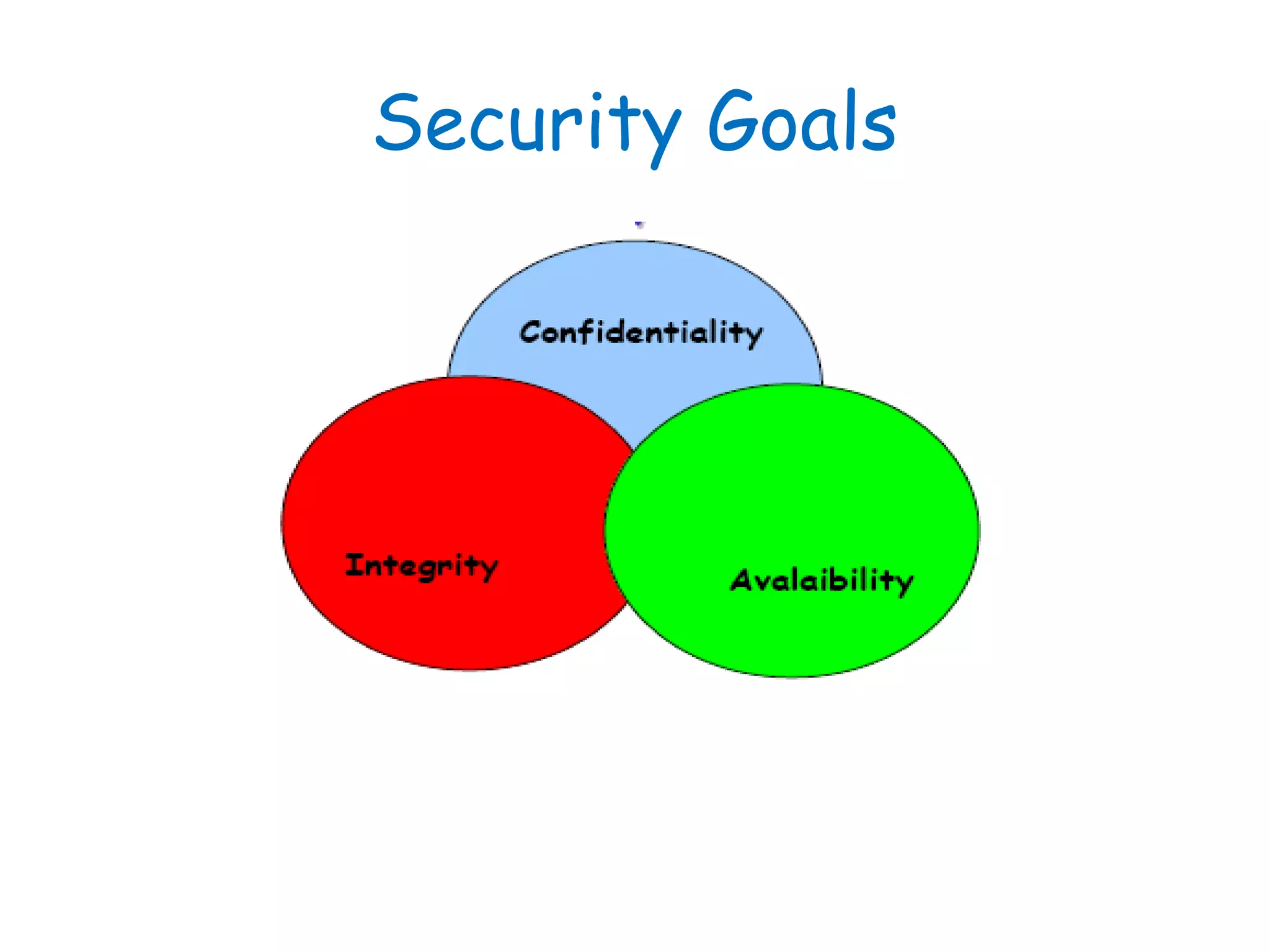
Security Goals
Summary: Attacks, Services
and Mechanisms
• Security Attack: Any action that
compromises the security of information.
• Security Mechanism: A mechanism that is
designed to detect, prevent, or recover from a
security attack.
• Security Service: A service that enhances
the security of data processing systems and
information transfers. A security service
makes use of one or more security mechanisms
OSI Security Architecture
• ITU-T X.800 Security Architecture
for OSI
• Defines a systematic way of defining
and providing security requirements
• For us it provides a useful, if
abstract, overview of concepts we will
study
Security Services
• X.800 defines it as: a service provided by a
protocol layer of communicating open
systems, which ensures adequate security
of the systems or of data transfers
• RFC 2828 defines it as: a processing or
communication service provided by a
system to give a specific kind of protection
to system resources
Security Services (X.800)
• X.800 defines security services in 5 major
categories
– Authentication - assurance that the communicating
entity is the one claimed
– Access Control - prevention of the unauthorized use of
a resource
– Data Confidentiality –protection of data from
unauthorized disclosure
– Data Integrity - assurance that data received is as sent
by an authorized entity
– Non-Repudiation - protection against denial by one of
the parties in a communication
Security Services
• Confidentiality (privacy)
• Authentication (who created or sent the data)
• Integrity (has not been altered)
• Non-repudiation (the order is final)
• Access control (prevent misuse of resources)
• Availability (permanence, non-erasure)
– Denial of Service Attacks
– Virus that deletes files
Security Mechanisms
(X.800)
• Specific security mechanisms:
– Encipherment: Converting data into form that is
not readable
– Digital signatures: To check authenticity and
integrity of data
– Access controls: Enforcing access rights to
resources
– Data integrity
– Authentication exchange
– Traffic padding: Insertion of bits to frustrate
traffic analysis
– Routing control: Selection of secure routes
– Notarization: Use of trusted third party for
data exchange
Security Mechanisms (X.800)
• Pervasive security mechanisms:
– trusted functionality: percieved to be
correct with respect to some criteria
– security labels:
– event detection: detection of security
relevant events
– security audit trails:
– security recovery:
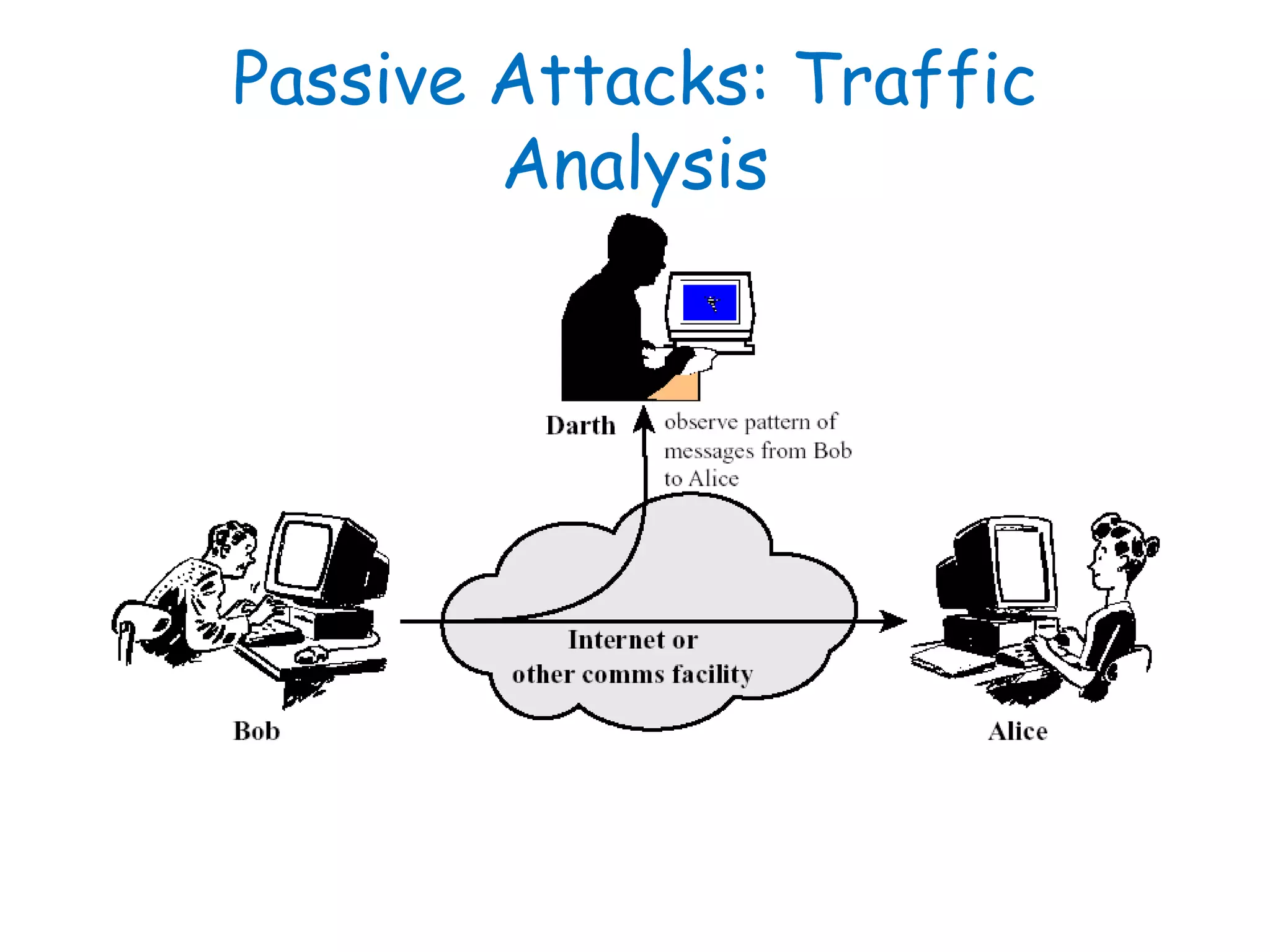
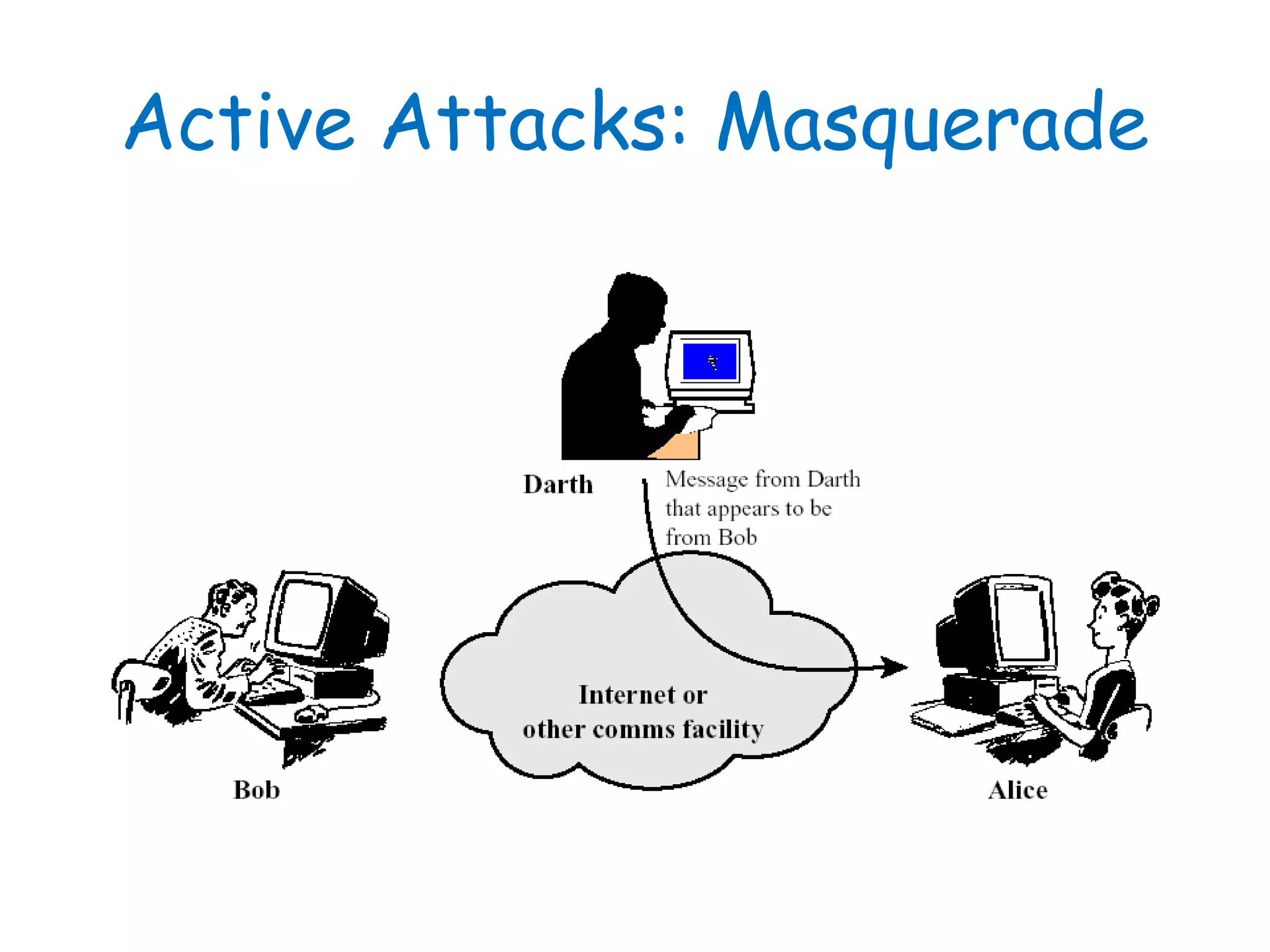
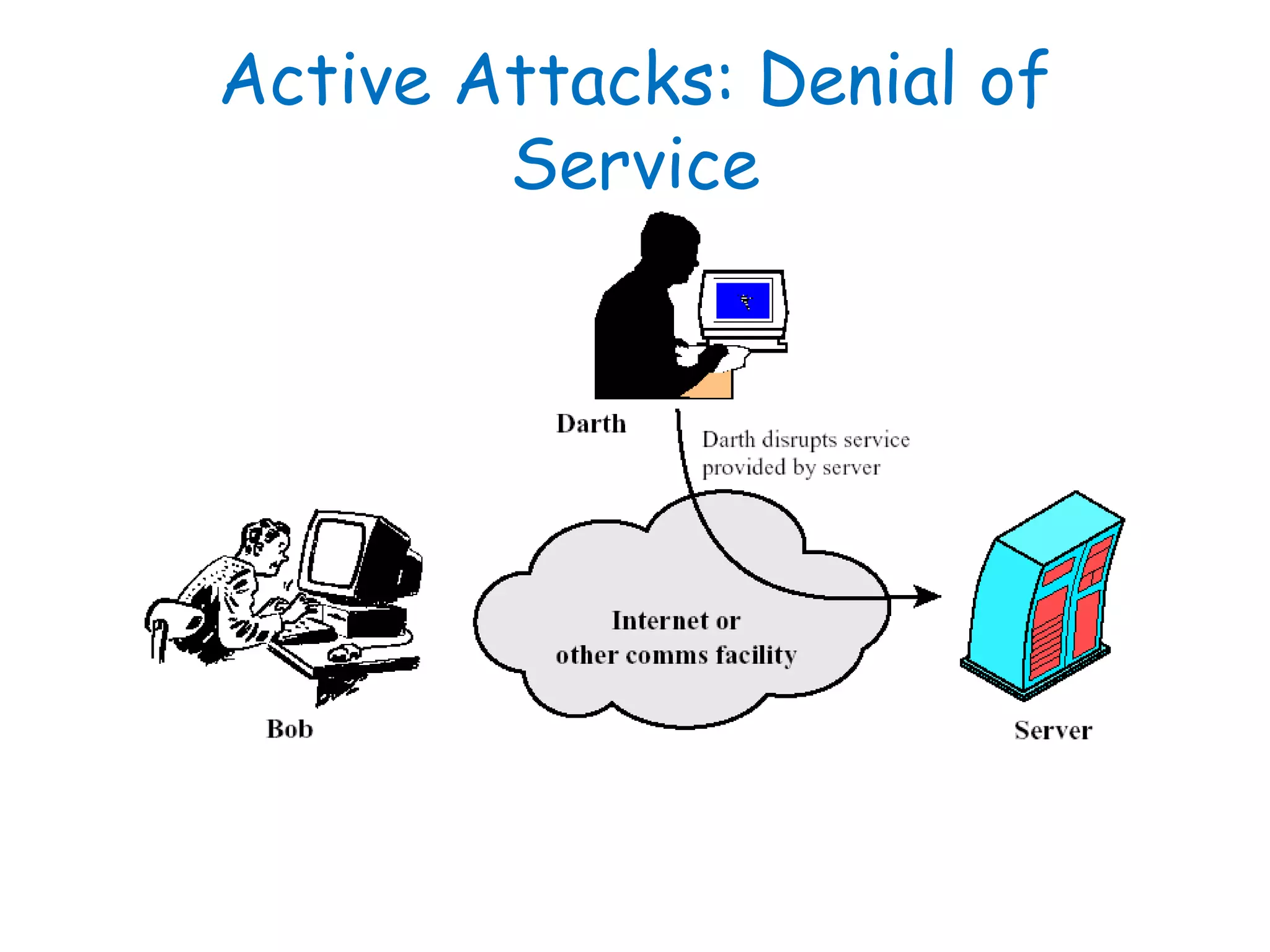
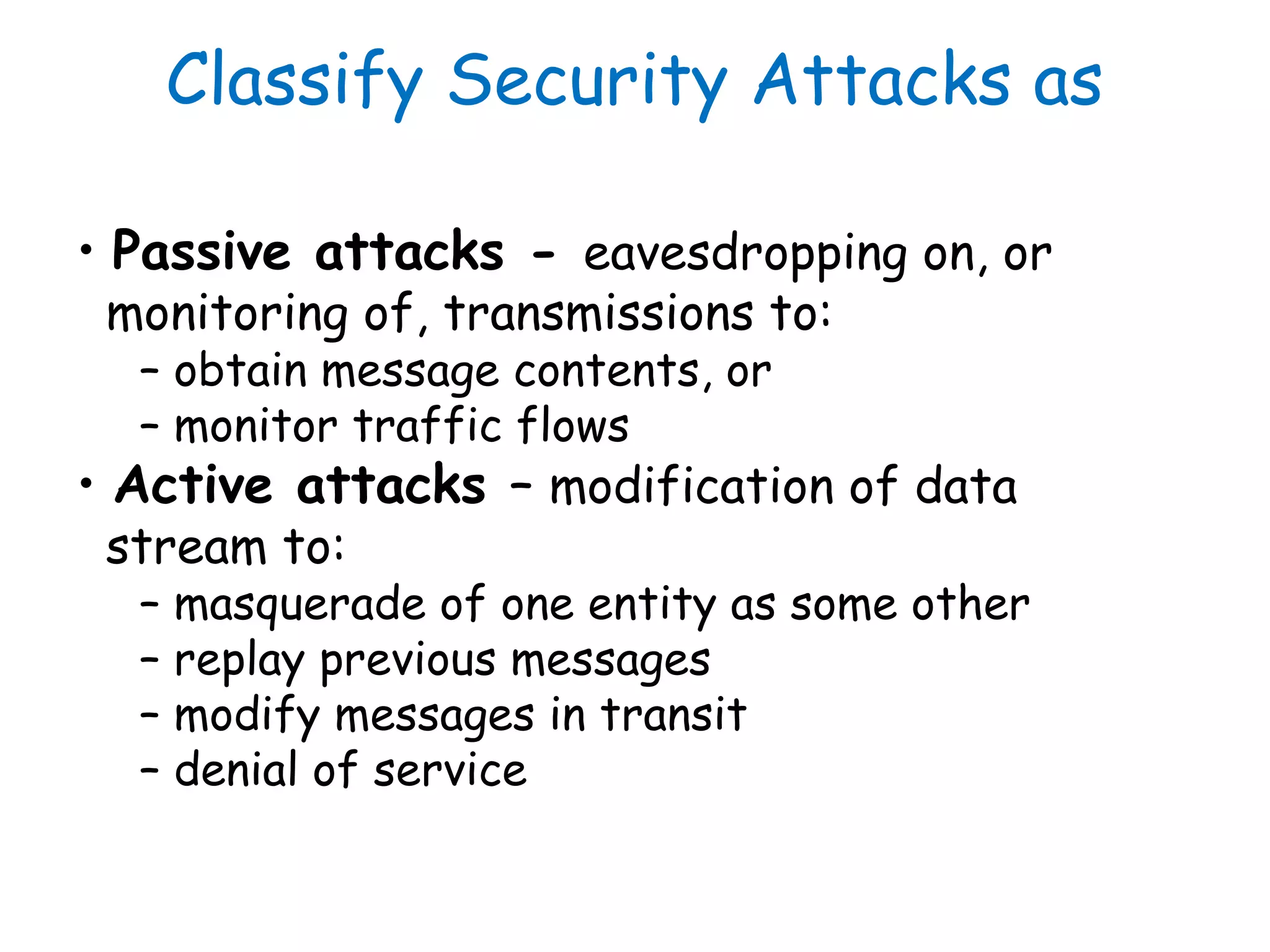
Classify Security Attacks as
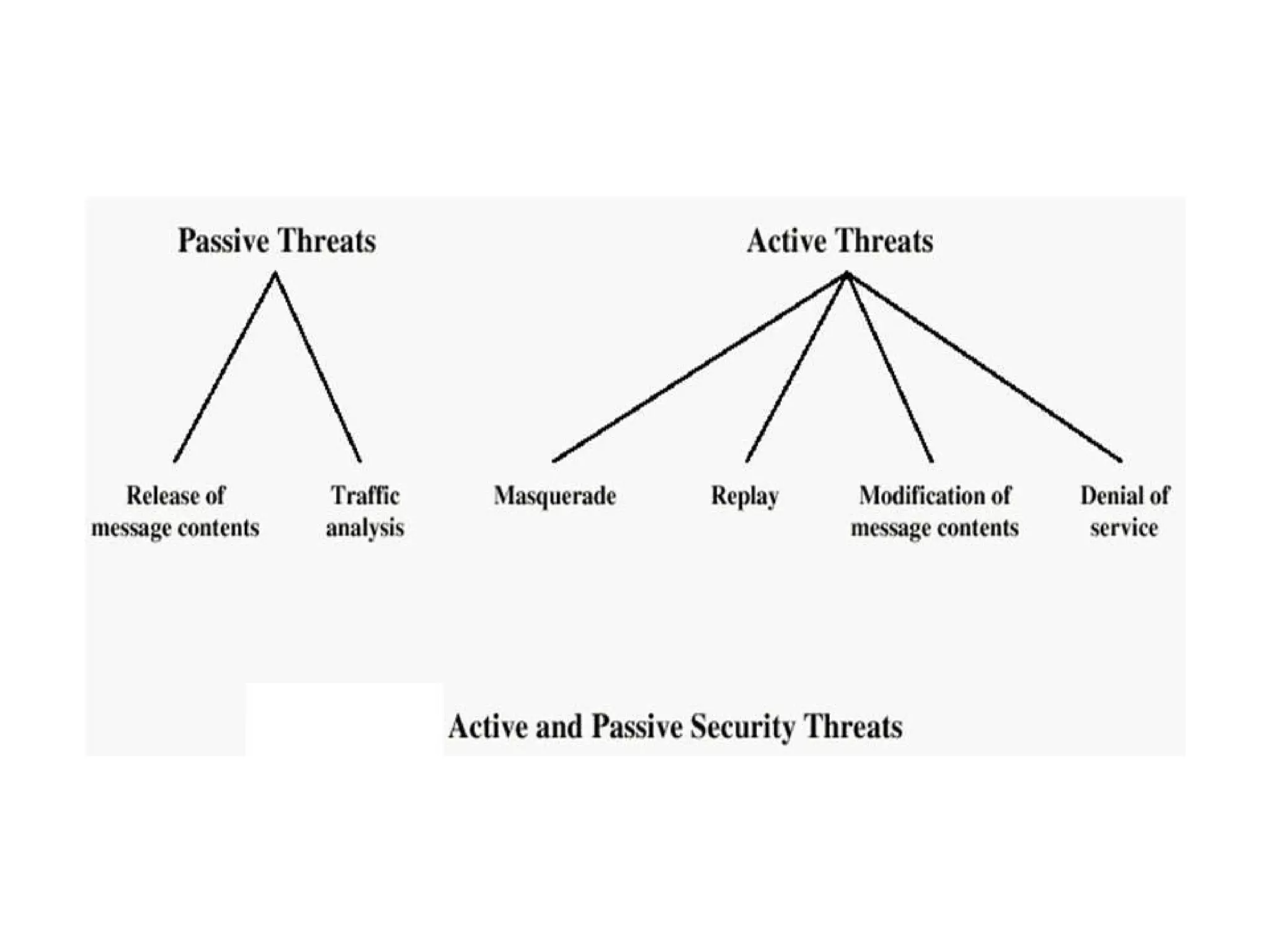
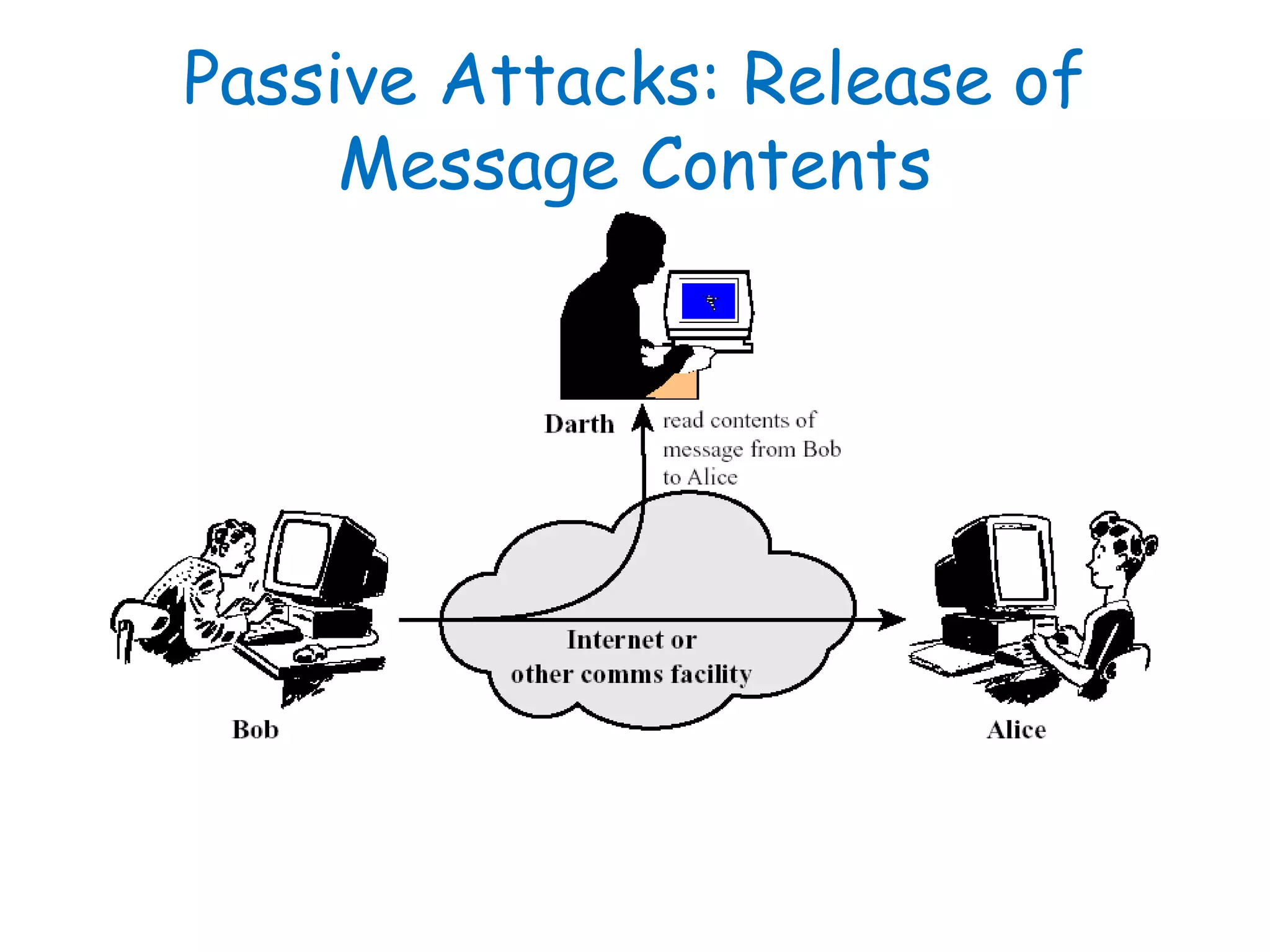
• Passive attacks - eavesdropping on, or
monitoring of, transmissions to:
– obtain message contents, or
– monitor traffic flows
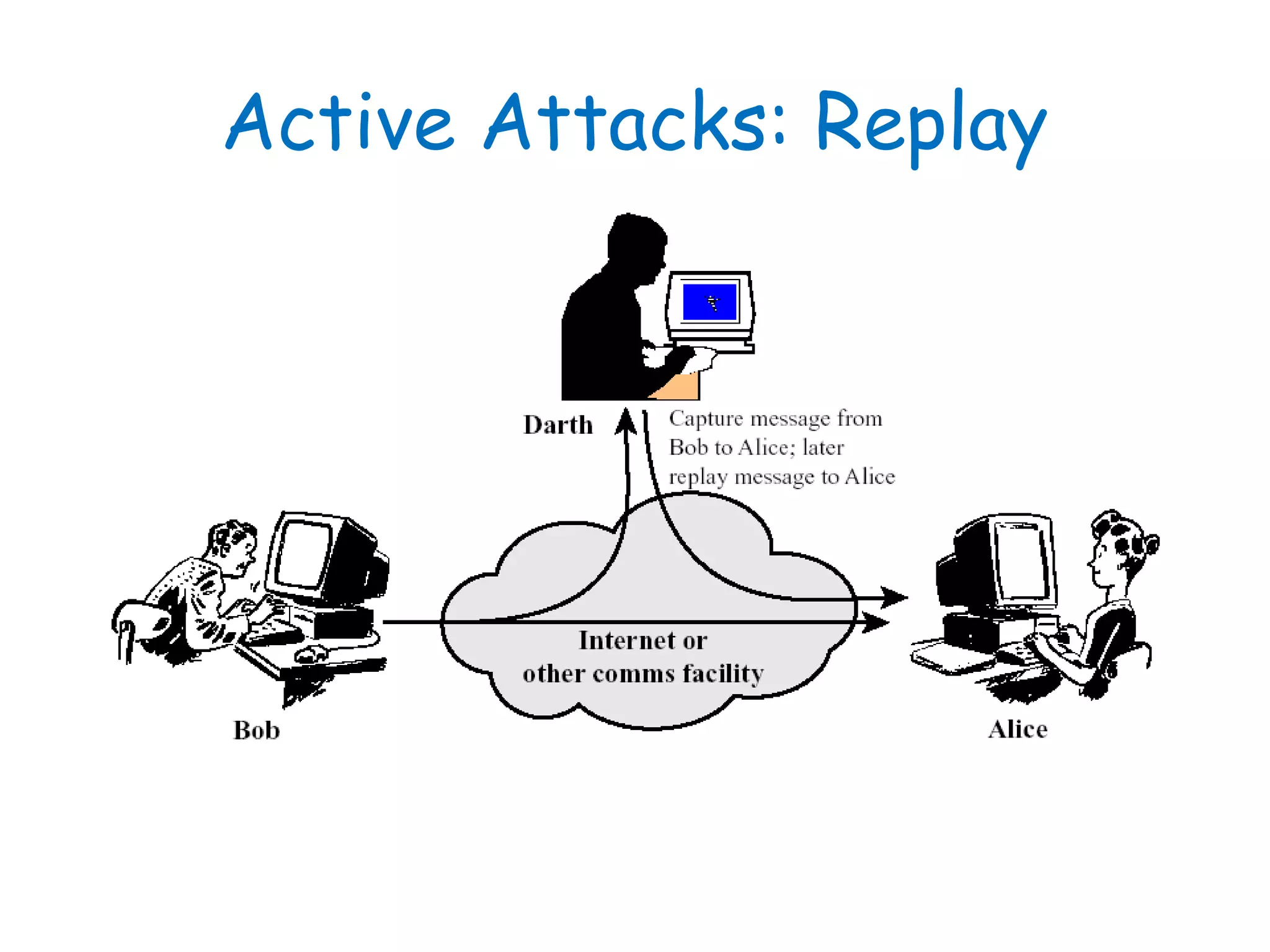
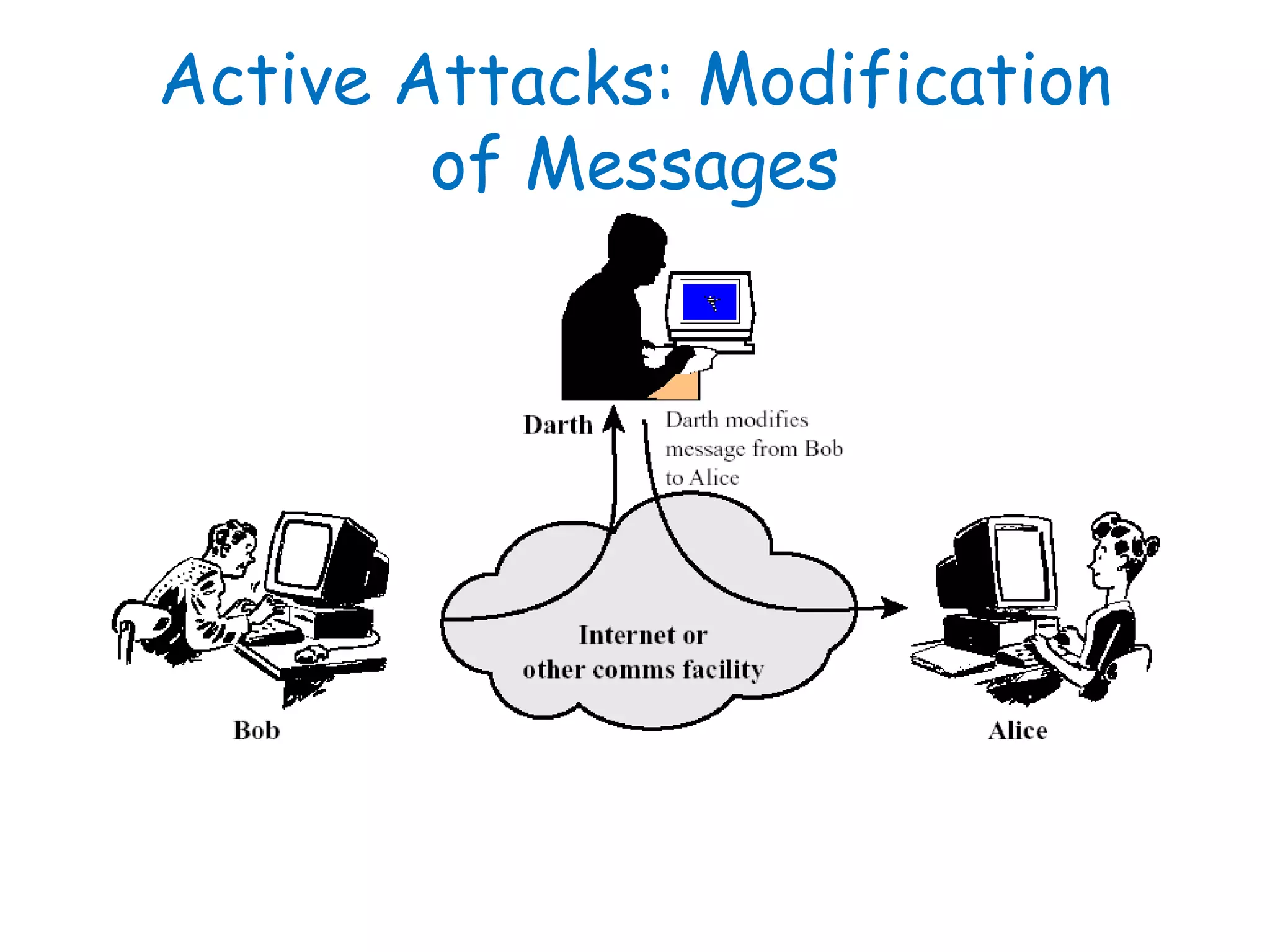
• Active attacks – modification of data
stream to:
– masquerade of one entity as some other
– replay previous messages
– modify messages in transit
– denial of service
Passive Attacks: Release of
Message Contents
Passive Attacks: Traffic
Analysis
Active Attacks: Masquerade
Active Attacks: Replay
Active Attacks: Modification
of Messages
Active Attacks: Denial of
Service
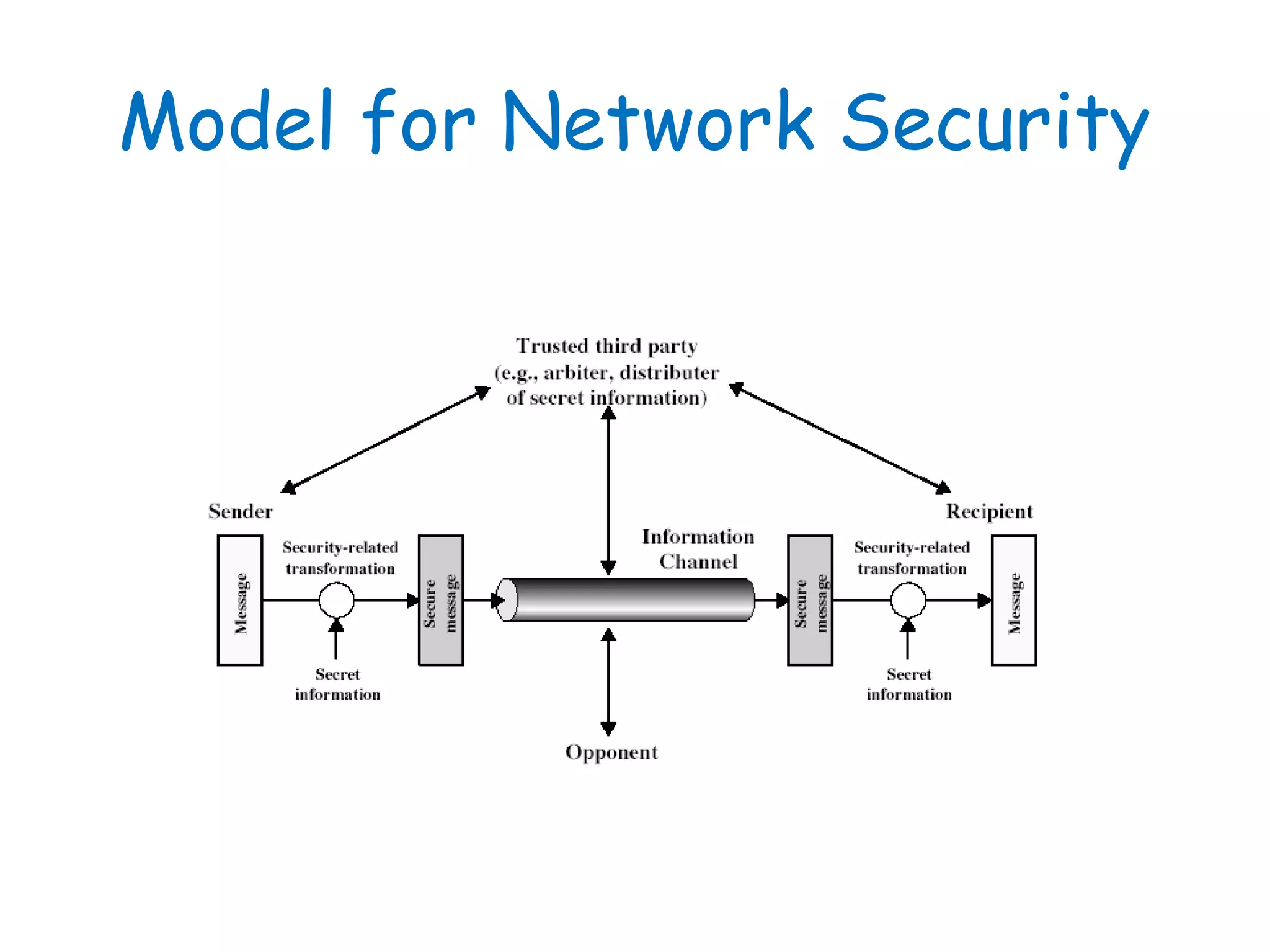
Model for Network Security
• Using this model requires us to:
– design a suitable algorithm for the security
transformation
– generate the secret information (keys) used by
the algorithm
– develop methods to distribute and share the
secret information
– specify a protocol enabling the principals to use
the transformation and secret information for
a security service
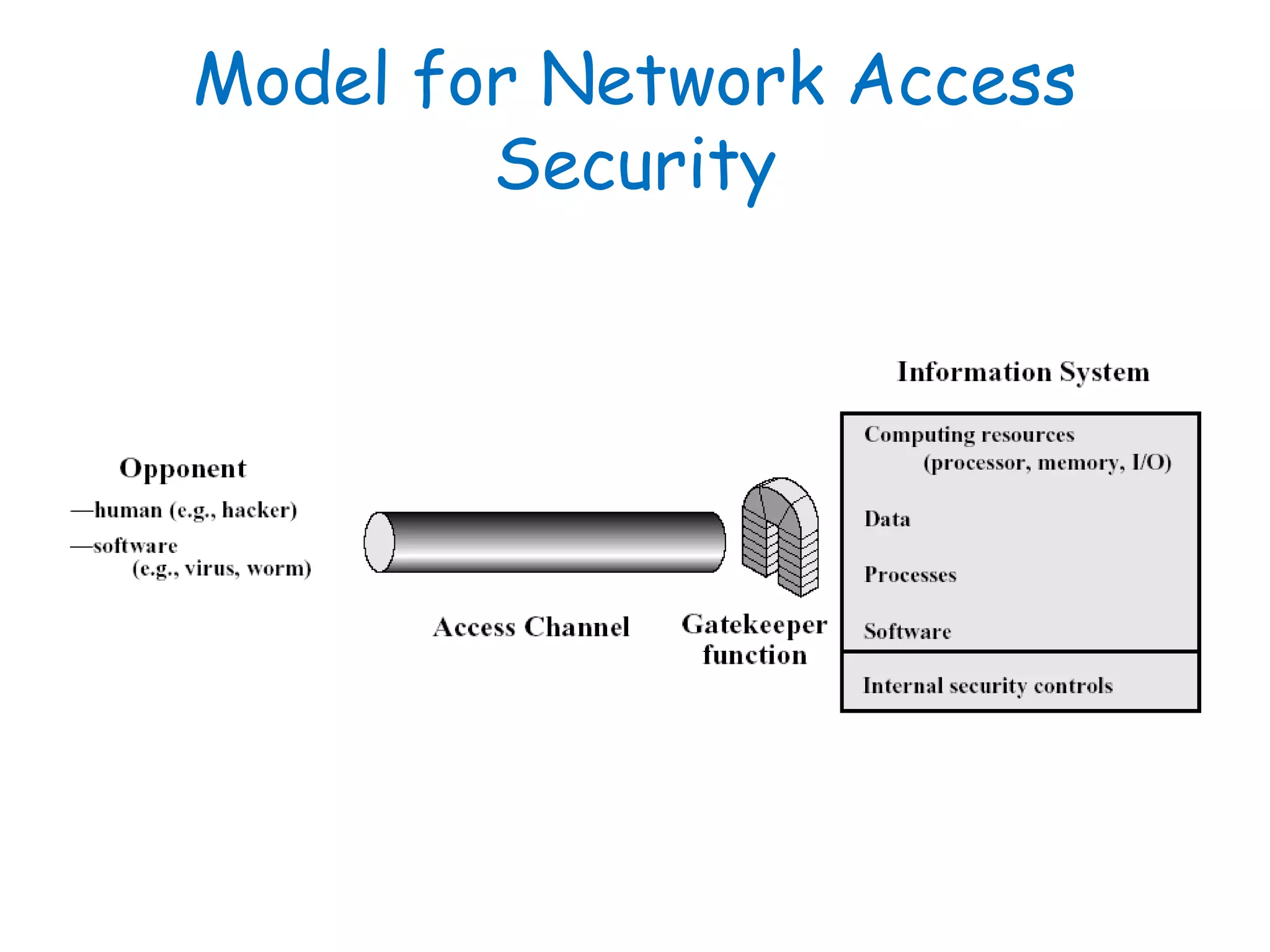
Model for Network Access
Security
Model for Network Access
Security
• Using this model requires us to:
– select appropriate gatekeeper functions
to identify users
– implement security controls to ensure
only authorised users access designated
information or resources
• Trusted computer systems can be
used to implement this model
Methods of Defense
• Encryption
• Software Controls (access limitations
in a data base, in operating system
protect each user from other users)
• Hardware Controls (smartcard)
• Policies (frequent changes of
passwords)
• Physical Controls
Internet standards and
RFCs
• The Internet society
– Internet Architecture Board (IAB)
– Internet Engineering Task Force (IETF)
– Internet Engineering Steering Group
(IESG)
Summary
• Have considered:
– computer, network, internet security
def’s
– security services, mechanisms, attacks
– X.800 standard
– models for network (access) security

Network Security 1st Lecture

  • 1.
    Network Security Tariq Ahmed Dr.A. Q. Khan Institute of Information Technology and Computer sciences(KICSIT) mrbokhari2000@yahoo.com  
  • 2.
    • Instructor: - TariqAhmed • Tel: 051 9285342 • Email: mrbokhari2000@yahoo.com Course Staff
  • 3.
    • Lectures - Wednesday:4:00 - 7:00 p.m. • Assignments - • Quizes - • Midterm exam - • Final exam -   Course Schedule
  • 4.
    • Assignments 10% –Late assignments are not accepted • Quizes 10% • Midterm exam 20% • Final exam 60% Grading Policy
  • 5.
    Academic Honesty • Yourwork in this class must be your own • If students are found to have collaborated excessively or to have cheated (e.g. by copying or sharing answers during an examination), all involved will at a minimum receive grades of 0 for the first infraction • Further infractions will result in failure in the course.
  • 6.
    Course Material Reference books –No single textbook covers the whole course! • Lot of research papers! – Many will be made available • RFCs and Internet drafts – Related to Network security protocols • Web resources – Tutorials, white papers, reports, etc.
  • 7.
    Course Information • Pre-requisites –Computer Networks course • You are assumed to have good knowledge of TCP/IP protocol suite – Operating Systems – Basic understanding of programming languages
  • 8.
    Course Contents • Introductionto network security • I. CRYPTOGRAPHY – Symmetric Encryption and Message Confidentiality – Public-Key Cryptography and Message Authentication • II. NETWORK SECURITY APPLICATIONS – Authentication Applications (Kerberos, X.509) – Electronic Mail Security (PGP, S/MIME) – IP Security (IPSec, AH, ESP, IKE) – Web Security (SSL, TLS, SET) – Network Management Security (SNMP)
  • 9.
    Course Contents • III.SYSTEM SECURITY – Intruders and intrusion detection – Malicious Software (viruses) – Firewalls and trusted systems – Operating System Security
  • 10.
    Textbooks • One ofthe following three books is required for this course: • William Stallings, Network Security Essentials • William Stallings, Cryptography and Network Security: Principles and Practice
  • 11.
    Textbooks • Ed Skoudis,Counter Hack: A Step by Step Guide to Computer Attacks and Defenses
  • 12.
    Expectations What do youwant (or expect) to learn from this class ?
  • 13.
    Expectations • This classIS about … – Network security principles and concepts – Cryptography, its use, principles and major algorithms – Message authentication and encryption techniques – Security of network “system” – Operating system security – Security practices and applications
  • 14.
    Expectations • This classIS NOT about … – Survey of existing protocol standards – Survey of loopholes in current protocols – How to hack the network of KICSIT! – Tools and tips to breach Internet security – How you can become a good hacker …
  • 15.
    Expectations We will learn Whyand How networks are made secure
  • 16.
    Outline • Attacks, servicesand mechanisms • Security attacks • Security services • Methods of Defense • A model for Internetwork Security • Internet standards and RFCs
  • 17.
    Background • Information Securityrequirements have changed in recent times • Traditionally provided by physical and administrative mechanisms • Computer use requires automated tools to protect files and other stored information • Use of networks and communications links requires measures to protect data during transmission
  • 18.
    Definitions • Computer Security- generic name for the collection of tools designed to protect data and to thwart hackers • Network Security - measures to protect data during their transmission • Internet Security - measures to protect data during their transmission over a collection of interconnected networks
  • 19.
    Aim of thisCourse • Our focus is on internet security • Consists of measures to deter, prevent, detect, and correct security violations that involve the transmission of information • Requirements seem straightforward, but the mechanisms used to meet them can be quite complex …
  • 20.
    Services, Mechanisms, Attacks •Need systematic way to define requirements • Consider three aspects of information security: – security attack – security mechanism – security service • Consider in reverse order
  • 21.
    Security Service • Issomething that enhances the security of the data processing systems and the information transfers of an organization • Intended to counter security attacks • Make use of one or more security mechanisms to provide the service • Replicate functions normally associated with physical documents e.g. – have signatures or dates – need protection from disclosure, tampering, or destruction – be notarized or witnessed – be recorded or licensed
  • 22.
    Security Mechanism • Amechanism that is designed to detect, prevent, or recover from a security attack • No single mechanism that will support all functions required • However one particular element underlies many of the security mechanisms in use: cryptographic techniques • Hence our focus is on this area
  • 23.
    Security Attack • Anyaction that compromises the security of information owned by an organization • Information security is about how to prevent attacks, or failing that, to detect attacks on information-based systems • Have a wide range of attacks • Can focus on generic types of attacks – Note: often threat & attack mean same
  • 24.
  • 25.
    Security Attacks • Interruption:This is an attack on availability • Interception: This is an attack on confidentiality • Modification: This is an attack on integrity • Fabrication: This is an attack on authenticity
  • 26.
  • 27.
    Summary: Attacks, Services andMechanisms • Security Attack: Any action that compromises the security of information. • Security Mechanism: A mechanism that is designed to detect, prevent, or recover from a security attack. • Security Service: A service that enhances the security of data processing systems and information transfers. A security service makes use of one or more security mechanisms
  • 28.
    OSI Security Architecture •ITU-T X.800 Security Architecture for OSI • Defines a systematic way of defining and providing security requirements • For us it provides a useful, if abstract, overview of concepts we will study
  • 29.
    Security Services • X.800defines it as: a service provided by a protocol layer of communicating open systems, which ensures adequate security of the systems or of data transfers • RFC 2828 defines it as: a processing or communication service provided by a system to give a specific kind of protection to system resources
  • 30.
    Security Services (X.800) •X.800 defines security services in 5 major categories – Authentication - assurance that the communicating entity is the one claimed – Access Control - prevention of the unauthorized use of a resource – Data Confidentiality –protection of data from unauthorized disclosure – Data Integrity - assurance that data received is as sent by an authorized entity – Non-Repudiation - protection against denial by one of the parties in a communication
  • 31.
    Security Services • Confidentiality(privacy) • Authentication (who created or sent the data) • Integrity (has not been altered) • Non-repudiation (the order is final) • Access control (prevent misuse of resources) • Availability (permanence, non-erasure) – Denial of Service Attacks – Virus that deletes files
  • 32.
    Security Mechanisms (X.800) • Specificsecurity mechanisms: – Encipherment: Converting data into form that is not readable – Digital signatures: To check authenticity and integrity of data – Access controls: Enforcing access rights to resources – Data integrity – Authentication exchange – Traffic padding: Insertion of bits to frustrate traffic analysis – Routing control: Selection of secure routes – Notarization: Use of trusted third party for data exchange
  • 33.
    Security Mechanisms (X.800) •Pervasive security mechanisms: – trusted functionality: percieved to be correct with respect to some criteria – security labels: – event detection: detection of security relevant events – security audit trails: – security recovery:
  • 34.
    Classify Security Attacksas • Passive attacks - eavesdropping on, or monitoring of, transmissions to: – obtain message contents, or – monitor traffic flows • Active attacks – modification of data stream to: – masquerade of one entity as some other – replay previous messages – modify messages in transit – denial of service
  • 35.
    Passive Attacks: Releaseof Message Contents
  • 36.
  • 37.
  • 38.
  • 39.
  • 40.
  • 42.
  • 43.
    Model for NetworkSecurity • Using this model requires us to: – design a suitable algorithm for the security transformation – generate the secret information (keys) used by the algorithm – develop methods to distribute and share the secret information – specify a protocol enabling the principals to use the transformation and secret information for a security service
  • 44.
    Model for NetworkAccess Security
  • 45.
    Model for NetworkAccess Security • Using this model requires us to: – select appropriate gatekeeper functions to identify users – implement security controls to ensure only authorised users access designated information or resources • Trusted computer systems can be used to implement this model
  • 46.
    Methods of Defense •Encryption • Software Controls (access limitations in a data base, in operating system protect each user from other users) • Hardware Controls (smartcard) • Policies (frequent changes of passwords) • Physical Controls
  • 47.
    Internet standards and RFCs •The Internet society – Internet Architecture Board (IAB) – Internet Engineering Task Force (IETF) – Internet Engineering Steering Group (IESG)
  • 48.
    Summary • Have considered: –computer, network, internet security def’s – security services, mechanisms, attacks – X.800 standard – models for network (access) security