1
Cryptography and Network
Security
Sixth Edition
by William Stallings
2
Background
• Information Security requirements have
changed in recent times
• traditionally provided by physical and
administrative mechanisms
• computer use requires automated tools to
protect files and other stored information
• use of networks and communications links
requires measures to protect data during
transmission
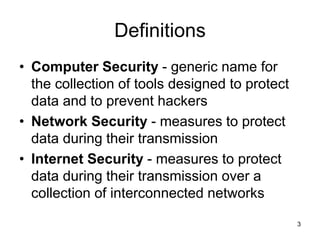
3
Definitions
• Computer Security - generic name for
the collection of tools designed to protect
data and to prevent hackers
• Network Security - measures to protect
data during their transmission
• Internet Security - measures to protect
data during their transmission over a
collection of interconnected networks
4
Services, Mechanisms, Attacks
• need systematic way to define requirements
• consider three aspects of information security:
– security attack
– security mechanism
– security service
• consider in reverse order
5
Security Attack
• any action that compromises the security
of information owned by an organization
• information security is about how to
prevent attacks, or failing that, to detect
attacks on information-based systems
• often threat & attack used to mean same
thing
• have a wide range of attacks
• can focus of generic types of attacks
– passive
– active
6
Security Threats and Attacks
• A threat is a potential violation of security, a possible danger that
might exploit a vulnerability
– Flaws in design, implementation, and operation.
• An attack is any action that violates security or an assault on system
security from an intelligent threat
– Active adversary.
7
Security Service
– is something that enhances the security of the
data processing systems and the information
transfers of an organization
– intended to counter security attacks
– make use of one or more security
mechanisms to provide the service
– replicate functions normally associated with
physical documents
• eg have signatures, dates; need protection from
disclosure, tampering, or destruction; be notarized
or witnessed; be recorded or licensed
8
Security Mechanism
• a mechanism that is designed to detect,
prevent, or recover from a security attack
• no single mechanism that will support all
functions required
• however one particular element underlies
many of the security mechanisms in use:
cryptographic techniques
• hence our focus on this area
9
OSI Security Architecture
• ITU-T X.800 Security Architecture for OSI
• defines a systematic way of defining and
providing security requirements
• for us it provides a useful, if abstract,
overview of concepts we will study
10
Security Services
• X.800 defines it as: a service provided by
a protocol layer of communicating open
systems, which ensures adequate security
of the systems or of data transfers
• RFC 2828 defines it as: a processing or
communication service provided by a
system to give a specific kind of protection
to system resources
• X.800 defines it in 5 major categories
11
Security Services (X.800)
• Authentication - assurance that the communicating entity
is the one claimed
– Peer entity authentication: in communication initiation
and during the session
– Data origin authentication: the source of the message,
not for message duplication and/or modification
• Access Control - prevention of the unauthorized use of a
resource
• Data Confidentiality –protection of data from unauthorized
disclosure
• Data Integrity - assurance that data received is exactly as
sent by an authorized entity
• Non-Repudiation - protection against denial by one of the
parties in a communication
12
Security Mechanisms (X.800)
• specific security mechanisms:
– encipherment, digital signatures, access
controls, data integrity, authentication
exchange, traffic padding, routing control,
notarization
• pervasive security mechanisms:
– trusted functionality, security labels, event
detection, security audit trails, security
recovery
13
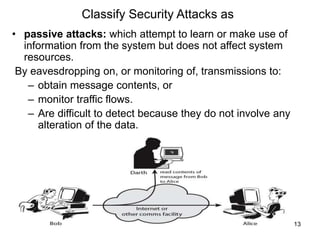
Classify Security Attacks as
• passive attacks: which attempt to learn or make use of
information from the system but does not affect system
resources.
By eavesdropping on, or monitoring of, transmissions to:
– obtain message contents, or
– monitor traffic flows.
– Are difficult to detect because they do not involve any
alteration of the data.
14
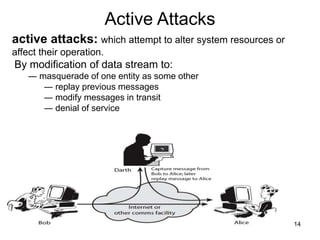
Active Attacks
active attacks: which attempt to alter system resources or
affect their operation.
By modification of data stream to:
― masquerade of one entity as some other
― replay previous messages
― modify messages in transit
― denial of service
15
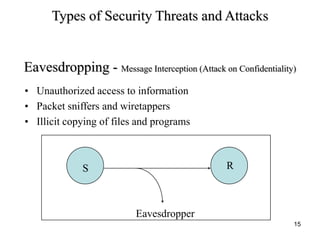
Types of Security Threats and Attacks
Eavesdropping - Message Interception (Attack on Confidentiality)
• Unauthorized access to information
• Packet sniffers and wiretappers
• Illicit copying of files and programs
S R
Eavesdropper
16
Types of Security Threats and Attacks
modification
Integrity Attack - Tampering With Messages
• Stop the flow of the message
• Delay and optionally modify the message
• Release the message again
S R
Perpetrator
17
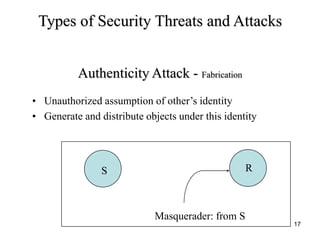
Types of Security Threats and Attacks
Authenticity Attack - Fabrication
• Unauthorized assumption of other’s identity
• Generate and distribute objects under this identity
S R
Masquerader: from S
18
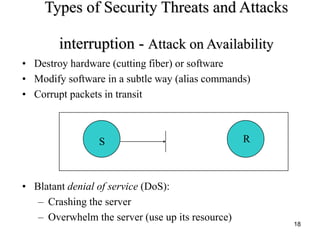
Types of Security Threats and Attacks
interruption - Attack on Availability
• Destroy hardware (cutting fiber) or software
• Modify software in a subtle way (alias commands)
• Corrupt packets in transit
• Blatant denial of service (DoS):
– Crashing the server
– Overwhelm the server (use up its resource)
S R
19
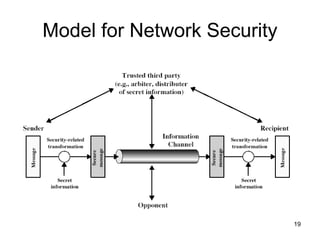
Model for Network Security
20
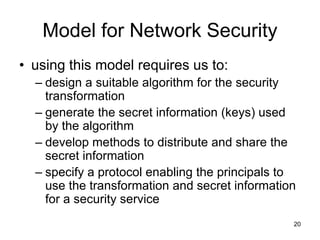
Model for Network Security
• using this model requires us to:
– design a suitable algorithm for the security
transformation
– generate the secret information (keys) used
by the algorithm
– develop methods to distribute and share the
secret information
– specify a protocol enabling the principals to
use the transformation and secret information
for a security service
21
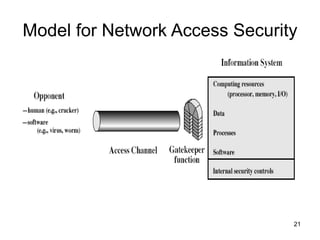
Model for Network Access Security
22
Model for Network Access Security
• using this model requires us to:
– select appropriate gatekeeper functions to
identify users
– implement security controls to ensure only
authorised users access designated
information or resources
• trusted computer systems can be used to
implement this model

dokumen.tips_1-cryptography-and-network-security-third-edition-by-william-stallings-lecturer.ppt

  • 1.
    1 Cryptography and Network Security SixthEdition by William Stallings
  • 2.
    2 Background • Information Securityrequirements have changed in recent times • traditionally provided by physical and administrative mechanisms • computer use requires automated tools to protect files and other stored information • use of networks and communications links requires measures to protect data during transmission
  • 3.
    3 Definitions • Computer Security- generic name for the collection of tools designed to protect data and to prevent hackers • Network Security - measures to protect data during their transmission • Internet Security - measures to protect data during their transmission over a collection of interconnected networks
  • 4.
    4 Services, Mechanisms, Attacks •need systematic way to define requirements • consider three aspects of information security: – security attack – security mechanism – security service • consider in reverse order
  • 5.
    5 Security Attack • anyaction that compromises the security of information owned by an organization • information security is about how to prevent attacks, or failing that, to detect attacks on information-based systems • often threat & attack used to mean same thing • have a wide range of attacks • can focus of generic types of attacks – passive – active
  • 6.
    6 Security Threats andAttacks • A threat is a potential violation of security, a possible danger that might exploit a vulnerability – Flaws in design, implementation, and operation. • An attack is any action that violates security or an assault on system security from an intelligent threat – Active adversary.
  • 7.
    7 Security Service – issomething that enhances the security of the data processing systems and the information transfers of an organization – intended to counter security attacks – make use of one or more security mechanisms to provide the service – replicate functions normally associated with physical documents • eg have signatures, dates; need protection from disclosure, tampering, or destruction; be notarized or witnessed; be recorded or licensed
  • 8.
    8 Security Mechanism • amechanism that is designed to detect, prevent, or recover from a security attack • no single mechanism that will support all functions required • however one particular element underlies many of the security mechanisms in use: cryptographic techniques • hence our focus on this area
  • 9.
    9 OSI Security Architecture •ITU-T X.800 Security Architecture for OSI • defines a systematic way of defining and providing security requirements • for us it provides a useful, if abstract, overview of concepts we will study
  • 10.
    10 Security Services • X.800defines it as: a service provided by a protocol layer of communicating open systems, which ensures adequate security of the systems or of data transfers • RFC 2828 defines it as: a processing or communication service provided by a system to give a specific kind of protection to system resources • X.800 defines it in 5 major categories
  • 11.
    11 Security Services (X.800) •Authentication - assurance that the communicating entity is the one claimed – Peer entity authentication: in communication initiation and during the session – Data origin authentication: the source of the message, not for message duplication and/or modification • Access Control - prevention of the unauthorized use of a resource • Data Confidentiality –protection of data from unauthorized disclosure • Data Integrity - assurance that data received is exactly as sent by an authorized entity • Non-Repudiation - protection against denial by one of the parties in a communication
  • 12.
    12 Security Mechanisms (X.800) •specific security mechanisms: – encipherment, digital signatures, access controls, data integrity, authentication exchange, traffic padding, routing control, notarization • pervasive security mechanisms: – trusted functionality, security labels, event detection, security audit trails, security recovery
  • 13.
    13 Classify Security Attacksas • passive attacks: which attempt to learn or make use of information from the system but does not affect system resources. By eavesdropping on, or monitoring of, transmissions to: – obtain message contents, or – monitor traffic flows. – Are difficult to detect because they do not involve any alteration of the data.
  • 14.
    14 Active Attacks active attacks:which attempt to alter system resources or affect their operation. By modification of data stream to: ― masquerade of one entity as some other ― replay previous messages ― modify messages in transit ― denial of service
  • 15.
    15 Types of SecurityThreats and Attacks Eavesdropping - Message Interception (Attack on Confidentiality) • Unauthorized access to information • Packet sniffers and wiretappers • Illicit copying of files and programs S R Eavesdropper
  • 16.
    16 Types of SecurityThreats and Attacks modification Integrity Attack - Tampering With Messages • Stop the flow of the message • Delay and optionally modify the message • Release the message again S R Perpetrator
  • 17.
    17 Types of SecurityThreats and Attacks Authenticity Attack - Fabrication • Unauthorized assumption of other’s identity • Generate and distribute objects under this identity S R Masquerader: from S
  • 18.
    18 Types of SecurityThreats and Attacks interruption - Attack on Availability • Destroy hardware (cutting fiber) or software • Modify software in a subtle way (alias commands) • Corrupt packets in transit • Blatant denial of service (DoS): – Crashing the server – Overwhelm the server (use up its resource) S R
  • 19.
  • 20.
    20 Model for NetworkSecurity • using this model requires us to: – design a suitable algorithm for the security transformation – generate the secret information (keys) used by the algorithm – develop methods to distribute and share the secret information – specify a protocol enabling the principals to use the transformation and secret information for a security service
  • 21.
    21 Model for NetworkAccess Security
  • 22.
    22 Model for NetworkAccess Security • using this model requires us to: – select appropriate gatekeeper functions to identify users – implement security controls to ensure only authorised users access designated information or resources • trusted computer systems can be used to implement this model