2
Introduction
… teaches usto rely not on the likelihood of the
enemy's not coming, but on our own readiness
to receive him; not on the chance of his not
attacking, but rather on the fact that we have
made our position unassailable.
—The Art of War, Sun Tzu
3.
3
Outline
Outline
• Background
• Attacks,services and mechanisms
• Security attacks
• Security services
• Methods of Defense
• A model for Internetwork Security
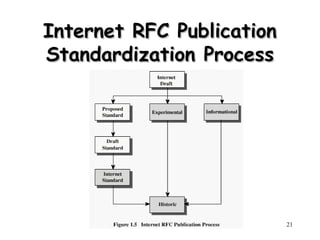
• Internet standards and RFCs
4.
4
Background
Background
• Information Securityrequirements have
changed in recent times
– Traditionally provided by physical and
administrative mechanisms
– Many daily activities have been shifted from
physical world to cyber space
• Use of computers
– Protect files and other stored information
• Use of networks and communications links
– Protect data during transmission
• The focus of many funding agencies in US
– DOD, NSF, DHS, etc.
– ONR: game theory for cyber security
5.
5
Definitions
Definitions
• Computer Security
–Generic name for the collection of tools
designed to protect data and to thwart
hackers
• Network Security
– Measures to protect data during their
transmission
• Internet Security (our focus!)
– Measures to protect data during their
transmission over a collection of
interconnected networks
7
3 Aspects ofInfo Security
3 Aspects of Info Security
• Security Attack
– Any action that compromises the security of
information.
• Security Mechanism
– A mechanism that is designed to detect, prevent, or
recover from a security attack.
• Security Service
– A service that enhances the security of data
processing systems and information transfers.
• Makes use of one or more security mechanisms.
8.
8
Security Attack
Security Attacks
s
•Threat & attack
– Often used equivalently
• There are a wide range of attacks
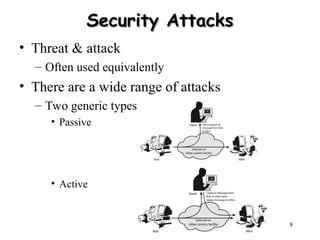
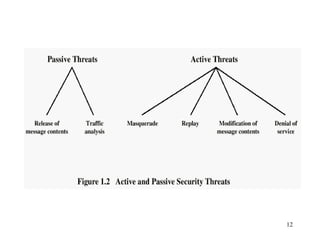
– Two generic types of attacks
• Passive
• Active
10
Security Attacks
Security Attacks
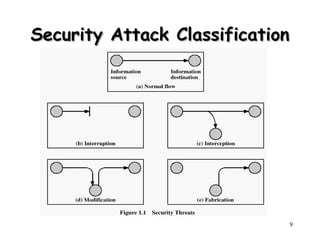
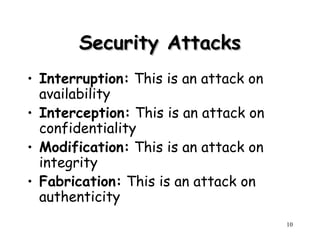
•Interruption: This is an attack on
availability
• Interception: This is an attack on
confidentiality
• Modification: This is an attack on
integrity
• Fabrication: This is an attack on
authenticity
13
Security Services
Security Services
X.800
–A service provided by a protocol layer of communicating open systems,
which ensures adequate security of the systems or of data transfers
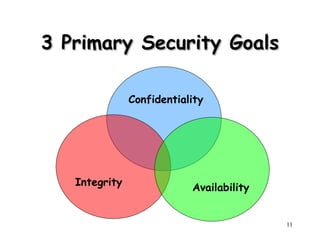
• Confidentiality (privacy)
• Authentication (who created or sent the data)
• Integrity (has not been altered)
• Non-repudiation (the order is final)
• Access control (prevent misuse of resources)
• Availability (permanence, non-erasure)
– Denial of Service Attacks
– Virus that deletes files
14.
14
Security Mechanism
Security Mechanism
•Features designed to detect, prevent, or
recover from a security attack
• No single mechanism that will support all
services required
• One particular element underlies many of
the security mechanisms in use:
– Cryptographic techniques
– Hence we will focus on this topic first
16
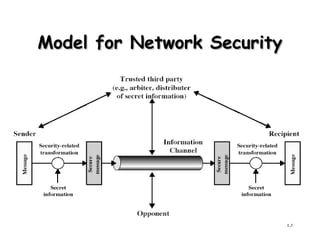
Model for NetworkSecurity
Model for Network Security
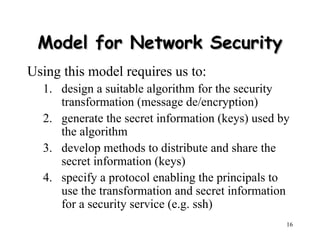
Using this model requires us to:
1. design a suitable algorithm for the security
transformation (message de/encryption)
2. generate the secret information (keys) used by
the algorithm
3. develop methods to distribute and share the
secret information (keys)
4. specify a protocol enabling the principals to
use the transformation and secret information
for a security service (e.g. ssh)
18
Model for NetworkAccess Security
Model for Network Access Security
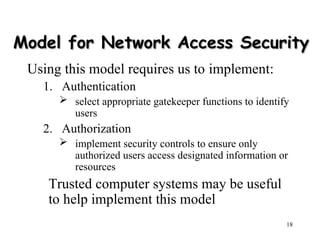
Using this model requires us to implement:
1. Authentication
select appropriate gatekeeper functions to identify
users
2. Authorization
implement security controls to ensure only
authorized users access designated information or
resources
Trusted computer systems may be useful
to help implement this model
19.
19
Methods of Defense
Methodsof Defense
• Encryption
• Software Controls
– Limit access in a database or in operating systems
– Protect each user from other users
• Hardware Controls
– Smartcard (ICC, used for digital signature and
secure identification)
• Policies
– Frequent changes of passwords
– Recent study shows controversial arguments
• Physical Controls
20.
20
Internet standards andRFCs
Internet standards and RFCs
• Three organizations in the Internet
society
– Internet Architecture Board (IAB)
• Defining overall Internet architecture
• Providing guidance to IETF
– Internet Engineering Task Force (IETF)
• Actual development of protocols and standards
– Internet Engineering Steering Group (IESG)
• Technical management of IETF activities and
Internet standards process
#2 This quote from the start of Ch0 sets the scene for why we want to study these issues.
#4 The requirements of information security within an organization have undergone two major changes in the last several decades. Before the widespread use of data processing equipment,the security of information felt to be valuable to an organization was provided primarily by physical (eg. rugged filing cabinets with locks) and administrative mechanisms (eg. Personnel screening procedures during hiring process).
Growing computer use implies a need for automated tools for protecting files and other information stored on it. This is especially the case for a shared system, such as a time-sharing system, and even more so for systems that can be accessed over a public telephone network, data network, or the Internet.
The second major change that affected security is the introduction of distributed systems and the use of networks and communications facilities for carrying data between terminal user and computer and between computer and computer. Network security measures are needed to protect data during their transmission.
#5 Here are some key definitions, note boundaries between them are blurred.
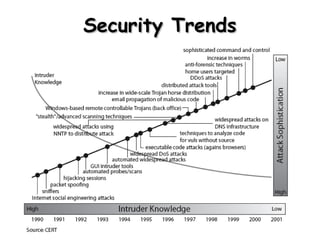
#6 Discuss observed security trends (Stallings section 1.1 & Figure 1.2 above), noting growth in sophistication of attacks contrasting with decrease in skill & knowledge needed to mount an attack.
#8 Expand on definition and use of “security attack”, as detailed above.
See Stallings Table 1.1 for definitions of threat and attack.
#14 Now introduce “Security Mechanism” which are the specific means of implementing one or more security services.
Note these mechanisms span a wide range of technical components, but one aspect seen in many is the use of cryptographic techniques.
#15 In considering the place of encryption, its useful to use the following two models from Stallings section 1.6.
The first, illustrated in Figure 1.5, models information flowing over an insecure communications channel, in the presence of possible opponents. Hence an appropriate security transform (encryption algorithm) can be used, with suitable keys, possibly negotiated using the presence of a trusted third party.
#16 This general model shows that there are four basic tasks in designing a particular security service, as listed.
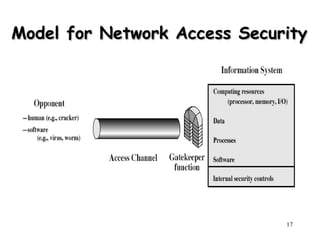
#17 The second, illustrated in Figure 1.6, model is concerned with controlled access to information or resources on a computer system, in the presence of possible opponents. Here appropriate controls are needed on the access and within the system, to provide suitable security. Some cryptographic techniques are useful here also.
#18 Detail here the tasks needed to use this model.
Note that trusted computer systems (discussed in Ch 20 can be useful here).