2
Introduction
… teaches usto rely not on the likelihood of the
enemy's not coming, but on our own readiness
to receive him; not on the chance of his not
attacking, but rather on the fact that we have
made our position unassailable.
—The Art of War, Sun Tzu
3.
3
Outline
Outline
• Background
• Attacks,services and mechanisms
• Security attacks
• Security services
• Methods of Defense
• A model for Internetwork Security
• Internet standards and RFCs
4.
4
Background
Background
• Information Securityrequirements have
changed in recent times
– Traditionally provided by physical and
administrative mechanisms
– Many daily activities have been shifted from
physical world to cyber space
• Use of computers
– Protect files and other stored information
• Use of networks and communications links
– Protect data during transmission
• The focus of many funding agencies in US
– DOD, NSF, DHS, etc.
– ONR: game theory for cyber security
5.
5
Definitions
Definitions
• Computer Security
–Generic name for the collection of tools
designed to protect data and to thwart
hackers
• Network Security
– Measures to protect data during their
transmission
• Internet Security (our focus!)
– Measures to protect data during their
transmission over a collection of
interconnected networks
7
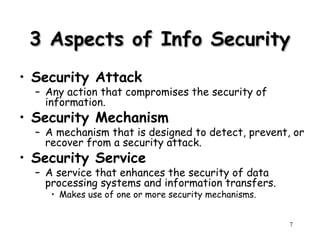
3 Aspects ofInfo Security
3 Aspects of Info Security
• Security Attack
– Any action that compromises the security of
information.
• Security Mechanism
– A mechanism that is designed to detect, prevent, or
recover from a security attack.
• Security Service
– A service that enhances the security of data
processing systems and information transfers.
• Makes use of one or more security mechanisms.
8.
8
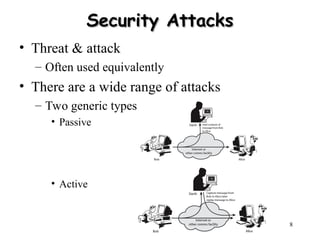
Security Attack
Security Attacks
s
•Threat & attack
– Often used equivalently
• There are a wide range of attacks
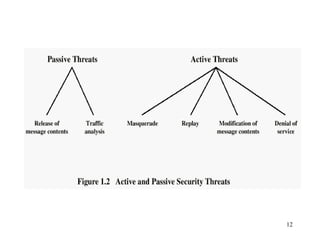
– Two generic types of attacks
• Passive
• Active
10
Security Attacks
Security Attacks
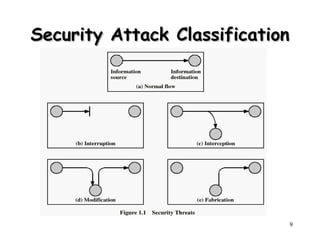
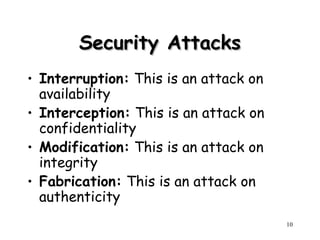
•Interruption: This is an attack on
availability
• Interception: This is an attack on
confidentiality
• Modification: This is an attack on
integrity
• Fabrication: This is an attack on
authenticity
13
Security Services
Security Services
X.800
–A service provided by a protocol layer of communicating open systems,
which ensures adequate security of the systems or of data transfers
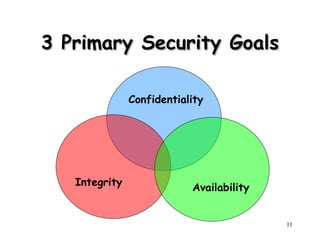
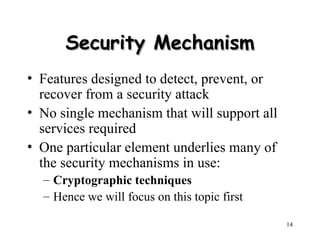
• Confidentiality (privacy)
• Authentication (who created or sent the data)
• Integrity (has not been altered)
• Non-repudiation (the order is final)
• Access control (prevent misuse of resources)
• Availability (permanence, non-erasure)
– Denial of Service Attacks
– Virus that deletes files
14.
14
Security Mechanism
Security Mechanism
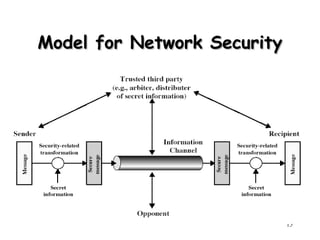
•Features designed to detect, prevent, or
recover from a security attack
• No single mechanism that will support all
services required
• One particular element underlies many of
the security mechanisms in use:
– Cryptographic techniques
– Hence we will focus on this topic first
16
Model for NetworkSecurity
Model for Network Security
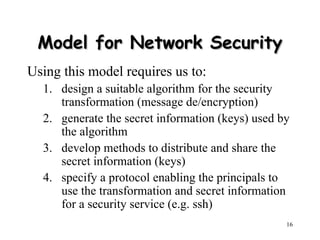
Using this model requires us to:
1. design a suitable algorithm for the security
transformation (message de/encryption)
2. generate the secret information (keys) used by
the algorithm
3. develop methods to distribute and share the
secret information (keys)
4. specify a protocol enabling the principals to
use the transformation and secret information
for a security service (e.g. ssh)
18
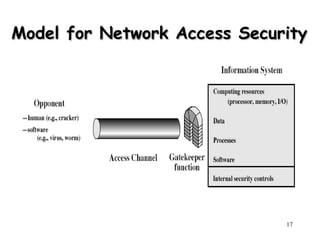
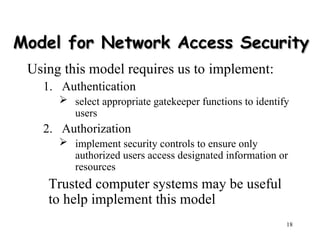
Model for NetworkAccess Security
Model for Network Access Security
Using this model requires us to implement:
1. Authentication
select appropriate gatekeeper functions to identify
users
2. Authorization
implement security controls to ensure only
authorized users access designated information or
resources
Trusted computer systems may be useful
to help implement this model
19.
19
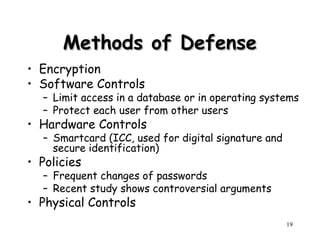
Methods of Defense
Methodsof Defense
• Encryption
• Software Controls
– Limit access in a database or in operating systems
– Protect each user from other users
• Hardware Controls
– Smartcard (ICC, used for digital signature and
secure identification)
• Policies
– Frequent changes of passwords
– Recent study shows controversial arguments
• Physical Controls
20.
20
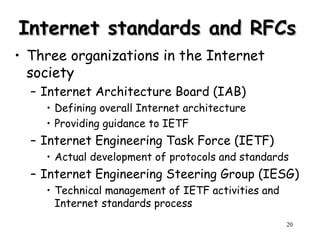
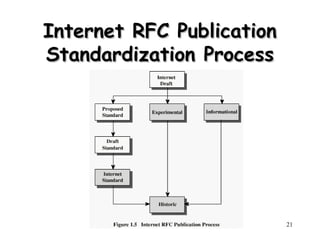
Internet standards andRFCs
Internet standards and RFCs
• Three organizations in the Internet
society
– Internet Architecture Board (IAB)
• Defining overall Internet architecture
• Providing guidance to IETF
– Internet Engineering Task Force (IETF)
• Actual development of protocols and standards
– Internet Engineering Steering Group (IESG)
• Technical management of IETF activities and
Internet standards process