“ Heart Failure”
Definition of Heart Failure HF is a complex clinical syndrome that can result from any structural or functional cardiac disorder that impairs the ability of the ventricle to fill with or eject blood. Manifests as Dyspnea and fatigue Limits exercise tolerance Fluid retention Pulmonary congestion and peripheral edema
“ Heart Failure” vs. “Congestive Heart Failure” Because not all patients have volume overload at the time of initial or subsequent evaluation, the term “heart failure” is preferred over the older  term “congestive heart failure.”
Causes of HF Type  Example  -  Cardiac  Myocardial damage  MI Myocarditis Cardiomyopathy  Some chemotherapy drugs Valvular disorders  Aortic stenosis Mitral regurgitation Arrhythmias  Bradyarrhythmias Tachyarrhythmias Conduction defects  Left bundle branch block -  Systemic Disorders that increase demand for CO  Hyperthyroidism Disorders that increase resistance to output  Hypertension
Classification of HF Systolic vs. Diastolic HF NYHA functional class I, II, III, IV AHA/ACC staging classification A, B, C, D Left-sided vs. Right-sided HF Low-output vs. High-output HF
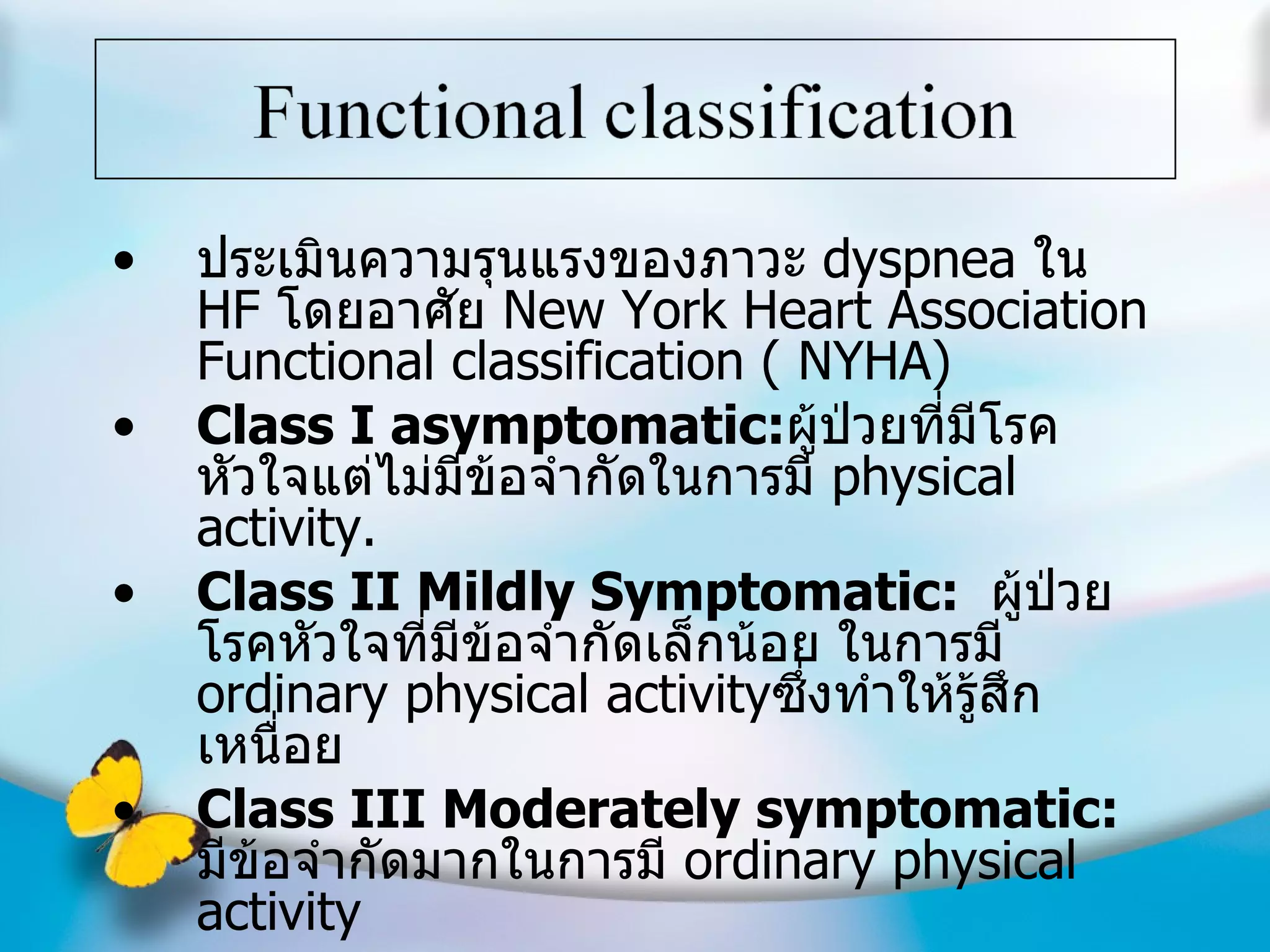
ประเมินความรุนแรงของภาวะ  dyspnea  ใน  HF  โดยอาศัย  New York Heart Association Functional classification ( NYHA) Class I asymptomatic: ผู้ป่วยที่มีโรคหัวใจแต่ไม่มีข้อจำกัดในการมี  physical activity. Class II Mildly Symptomatic:  ผู้ป่วยโรคหัวใจที่มีข้อจำกัดเล็กน้อย ในการมี  ordinary physical activity ซึ่งทำให้รู้สึกเหนื่อย Class III Moderately symptomatic:  มีข้อจำกัดมากในการมี  ordinary physical activity Class IV Severe/Symptoms at rest:   ไม่สามารถทำอะไรได้เลย บางครั้งมีอาการแม้อยู่เฉยๆ
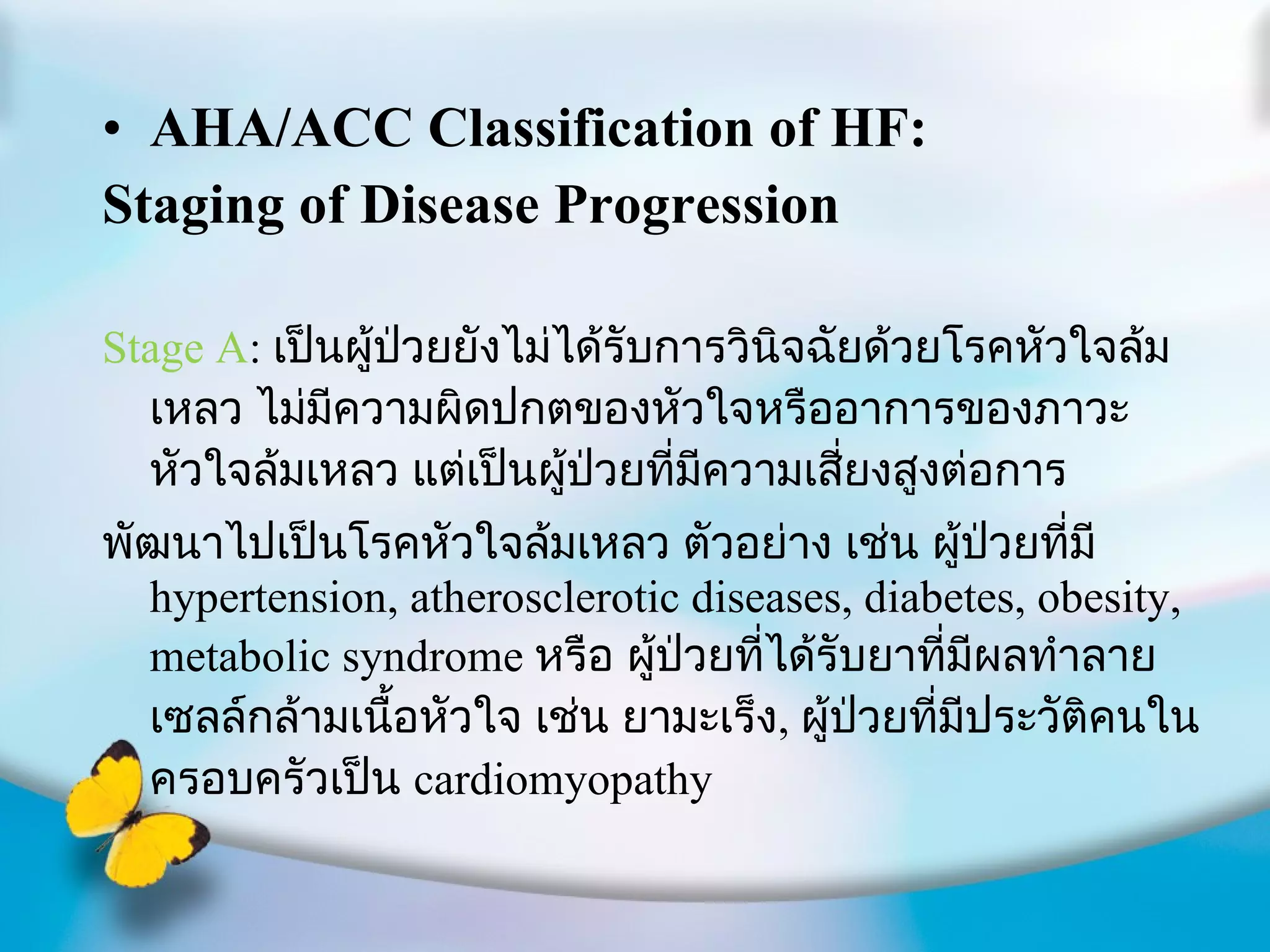
AHA/ACC Classification of HF: Staging of Disease Progression Stage A :  เป็นผู้ป่วยยังไม่ได้รับการวินิจฉัยด้วยโรคหัวใจล้มเหลว ไม่มีความผิดปกตของหัวใจหรืออาการของภาวะหัวใจล้มเหลว แต่เป็นผู้ป่วยที่มีความเสี่ยงสูงต่อการ พัฒนาไปเป็นโรคหัวใจล้มเหลว ตัวอย่าง เช่น ผู้ป่วยที่มี  hypertension, atherosclerotic diseases, diabetes, obesity, metabolic syndrome  หรือ ผู้ป่วยที่ได้รับยาที่มีผลทำลายเซลล์กล้ามเนื้อหัวใจ เช่น ยามะเร็ง ,  ผู้ป่วยที่มีประวัติคนในครอบครัวเป็น  cardiomyopathy
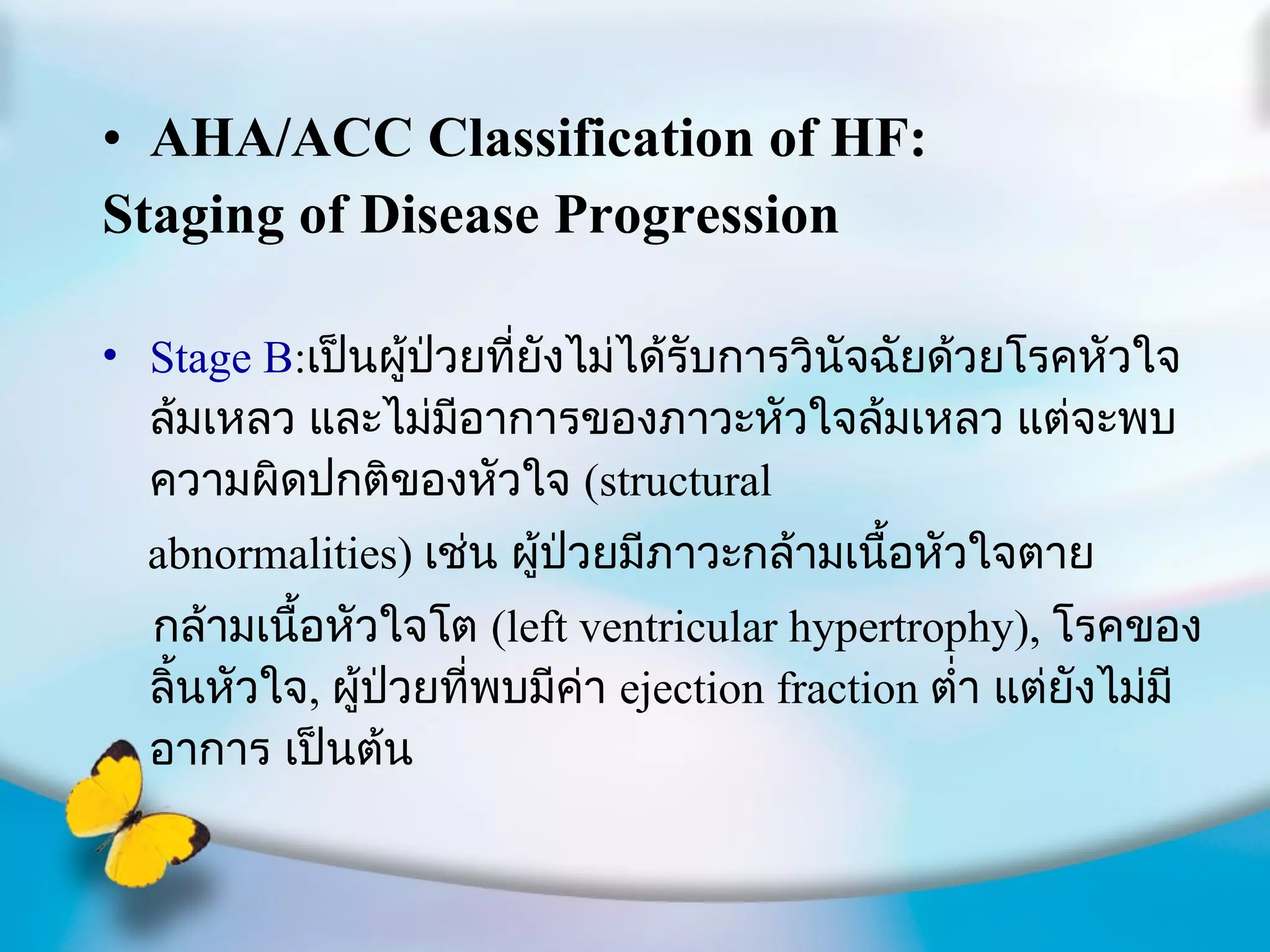
AHA/ACC Classification of HF: Staging of Disease Progression Stage B : เป็นผู้ป่วยที่ยังไม่ได้รับการวินัจฉัยด้วยโรคหัวใจล้มเหลว และไม่มีอาการของภาวะหัวใจล้มเหลว แต่จะพบความผิดปกติของหัวใจ  ( structural abnormalities)  เช่น ผู้ป่วยมีภาวะกล้ามเนื้อหัวใจตาย กล้ามเนื้อหัวใจโต  ( left ventricular hypertrophy),  โรคของลิ้นหัวใจ ,  ผู้ป่วยที่พบมีค่า  ejection fraction  ต่ำ แต่ยังไม่มีอาการ เป็นต้น
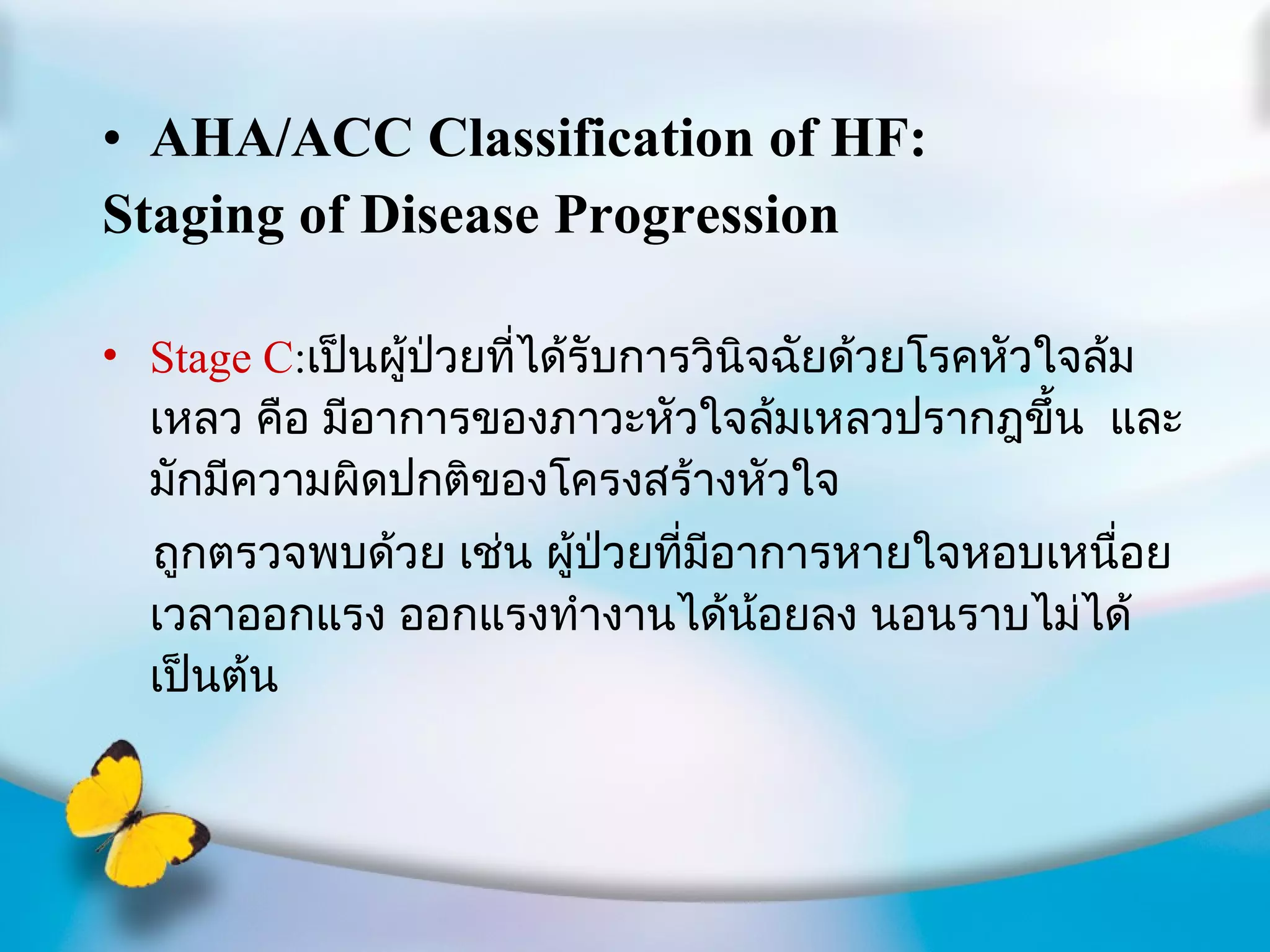
AHA/ACC Classification of HF: Staging of Disease Progression Stage C : เป็นผู้ป่วยที่ได้รับการวินิจฉัยด้วยโรคหัวใจล้มเหลว คือ มีอาการของภาวะหัวใจล้มเหลวปรากฎขึ้น  และมักมีความผิดปกติของโครงสร้างหัวใจ ถูกตรวจพบด้วย เช่น ผู้ป่วยที่มีอาการหายใจหอบเหนื่อยเวลาออกแรง ออกแรงทำงานได้น้อยลง นอนราบไม่ได้ เป็นต้น
AHA/ACC Classification of HF: Staging of Disease Progression Stage D : เป็นผู้ป่วยที่ได้รับการวินิจฉัยด้วยโรคหัวใจล้มเหลว โดยเป็นผู้ป่วยที่มีอาการหัวใจล้มเหลวในขั้นรุนแรง เช่น มีอาการขณะพักทั้งๆ ที่ได้รับการรักษา ด้วยยาอย่างเหมาะสมแล้ว จัดเป็น  refractory heart failure  รวมถึงผู้ป่วยที่จำเป็นต้องอาศัยเครื่องมือหรือ วิธีการพิเศษที่ช่วยให้ดำรงชีวิตอยู่ได้ เช่น ventricular assisted device, chronic inotropic therapy เป็นต้น
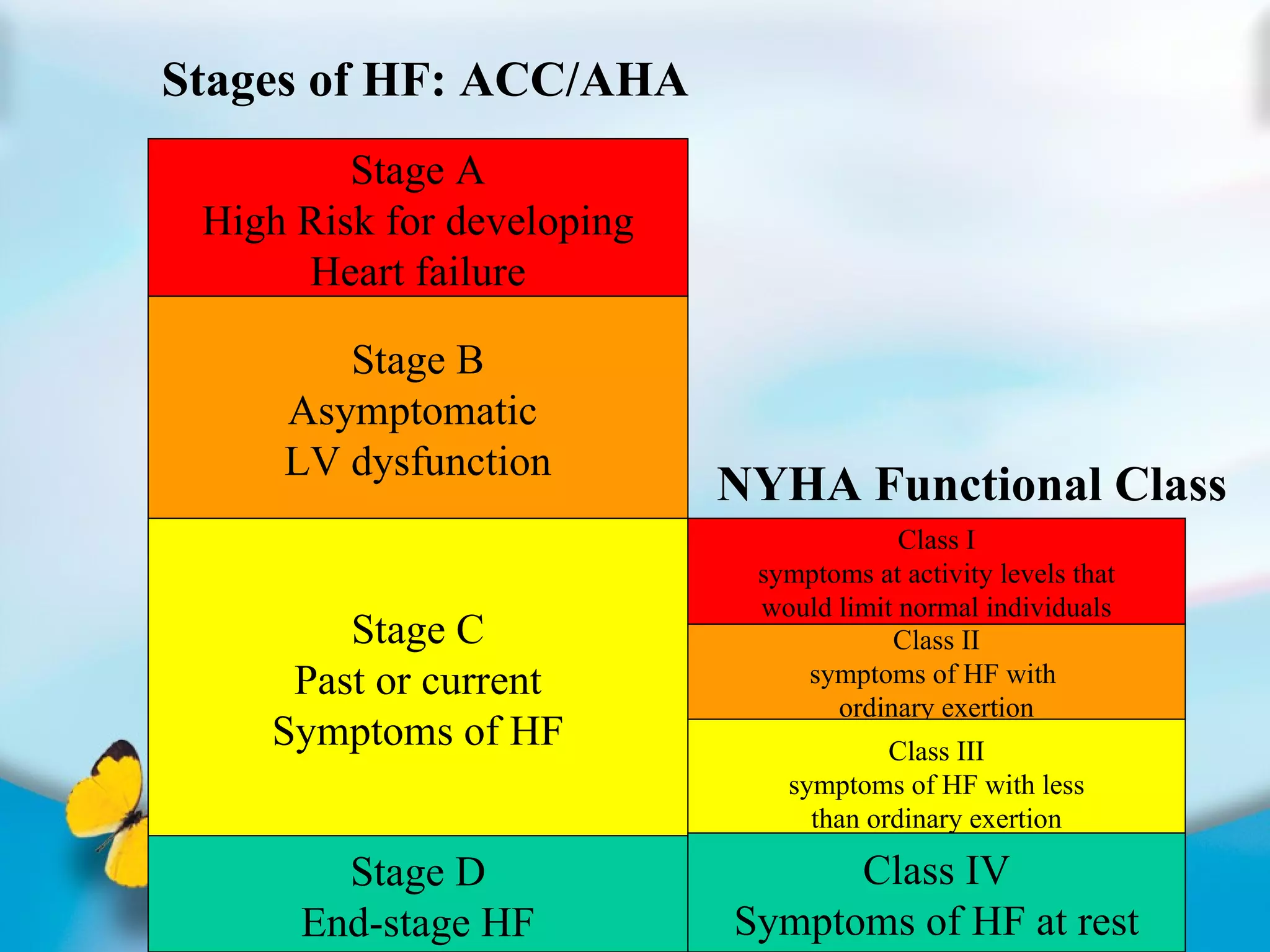
Stage A High Risk for developing Heart failure Stage B Asymptomatic  LV dysfunction Stage C Past or current Symptoms of HF Stage D End-stage HF Stages of HF: ACC/AHA Class I symptoms at activity levels that would limit normal individuals Class II symptoms of HF with  ordinary exertion Class III symptoms of HF with less than ordinary exertion Class IV Symptoms of HF at rest NYHA Functional Class
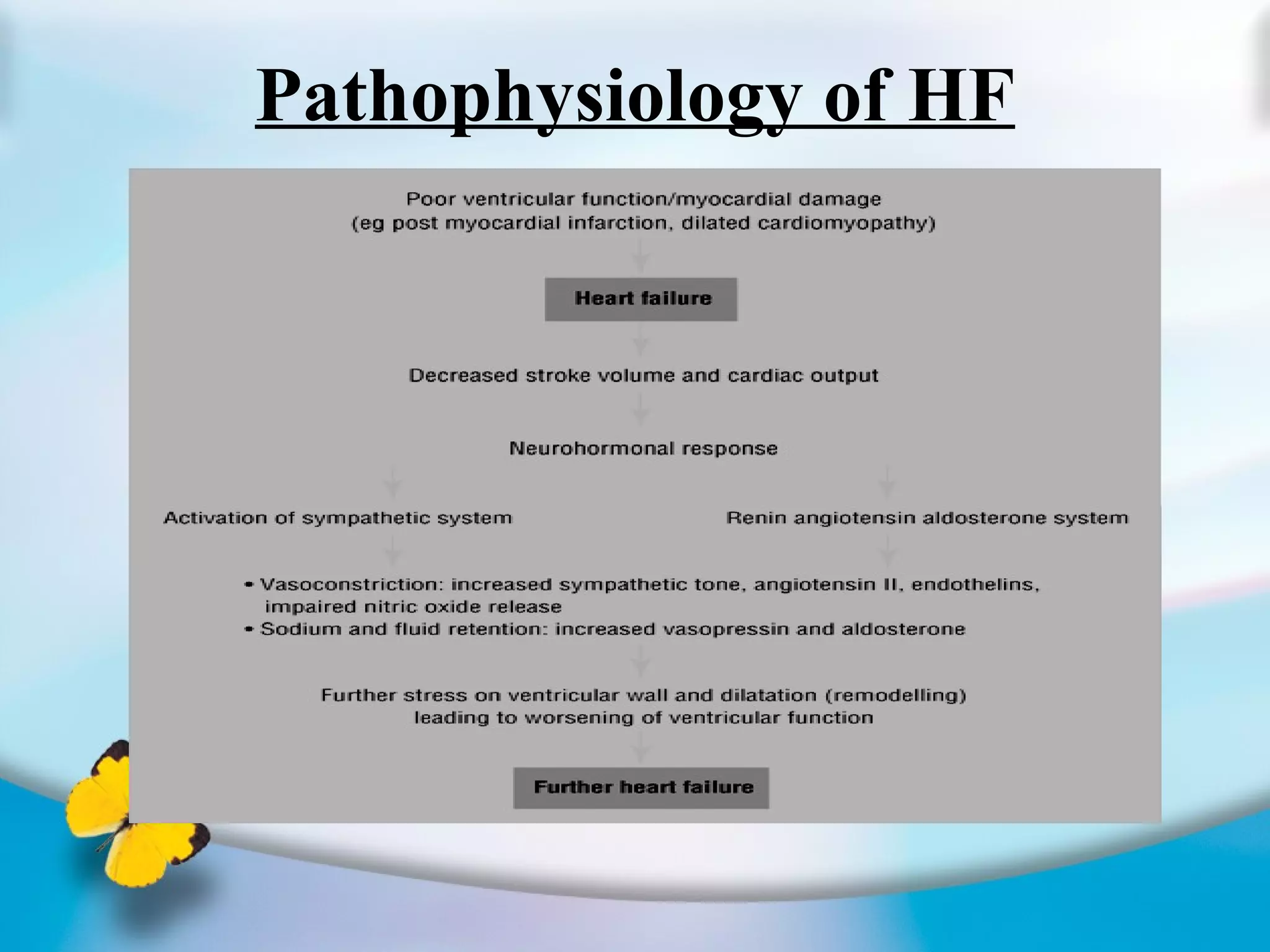
Pathophysiology of HF
Initial Assessment History and Physical History PMHx of HTN, CAD, DM, thyroid disease, valvular disease, chemotherapy or  OSA, rheumatic heart disease Functional status Social history: tobacco Family history: HF, CAD, SCD Physical Vitals (admission weight) Cardiopulmonary exam, volume assessment(fluid retension, tissue perfusion)
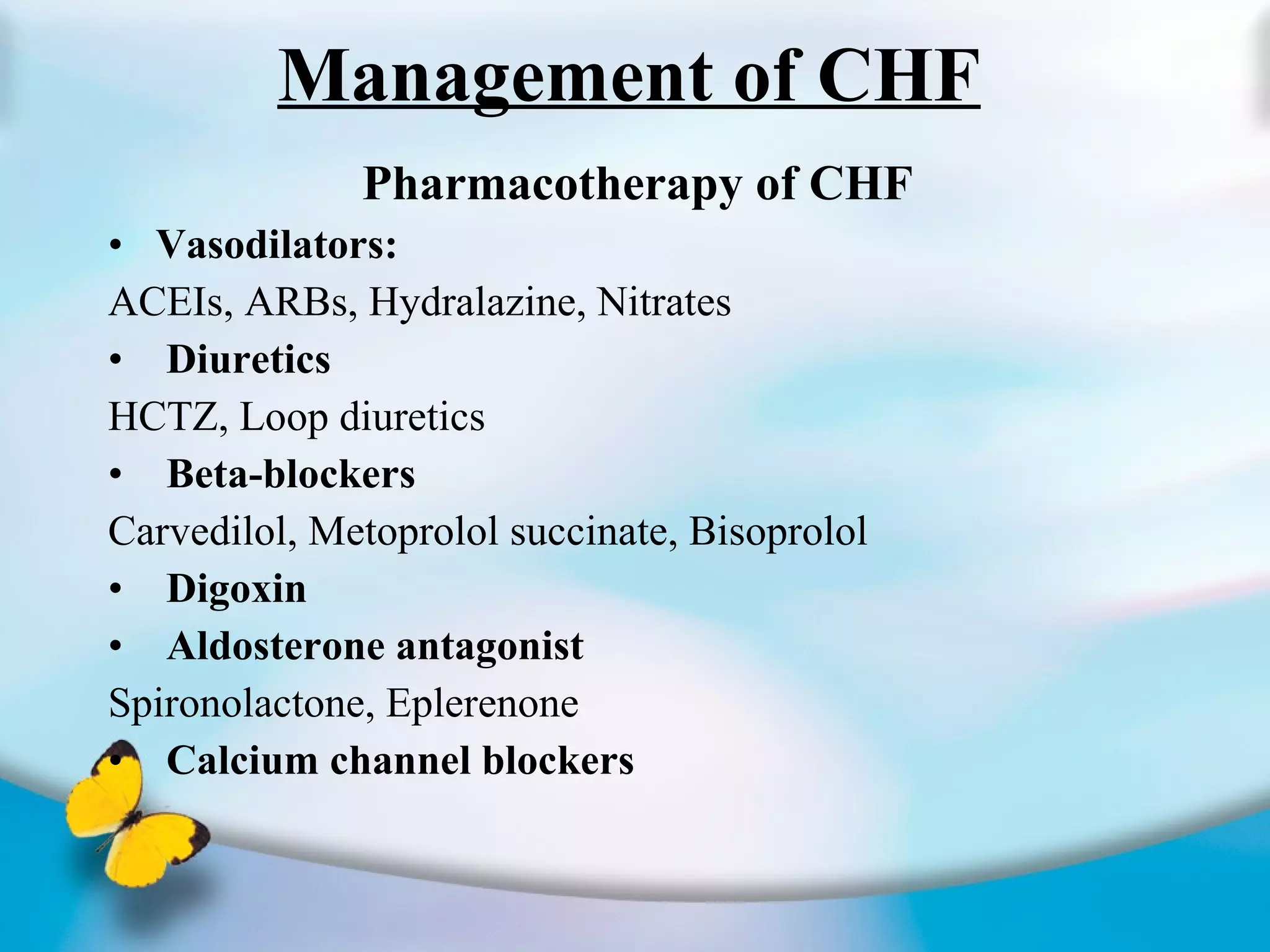
Initial Assessment Labs: E’lyte, CBC, Ca, Mg, TFT (especially thyroid-stimulating hormone)  Lipid profile ,   liver   function,U/A BNP or pro-BNP levels when diagnosis is unclear 12 lead EKG, CXR Assessment of ventricular function 2-D echo MUGA (Multiple gated cardiac scan   ใช้ Technetium-99m   เป็น  radiotracer  ตรวจเพื่อประเมินการหา  EF  ของหัวใจ มีความแม่นยำสูงมาก เป็นการประเมิน  left venticle  แบบ  3  มิติ เป็นที่นิยมอย่างยิ่งโดยเฉพาะในกลุ่มของ  oncologist  เนื่องจากการให้เคมีบำบัดบางชนิดมี  cardiotoxic  การตรวจ จะเป็น  early detection  ของ  cardiotoxic  จากเคมีบำบัดนั้น )   if poor echo windows CAG , CTA coronary
pro-BNP pro-BNP  เป็นฮอร์โมนที่เป็นสารต้นกำเนิดของการสร้าง  BNP BNP  ย่อมาจาก  Brain natriuretic peptide  เป็นฮอร์โมนหลั่งมาจากสมองและหัวใจห้องล่าง  (ventricles) BNP  จะมีการหลั่งเพิ่มขึ้นในภาวะหัวใจล้มเหลว ซึ่งในภาวะนี้จะมีแรงดันต่อผนังหัวใจห้องล่างที่สูงขึ้น อายุ ≤  50  ปี ใช้ค่า  cut-off NT-proBNP 100 pg/ml อายุ  >  50  ปี ใช้ค่า  cut-off NT-proBNP 200 pg/ml ซึ่งสามารถแปลผลได้ว่า ถ้าค่ามากกว่า  cut off value  ถือว่ามีภาวะหัวใจล้มเหลว จะได้ค่าความแม่นยำในการทดสอบ ดังนี้ - sensitivity 90%  ในการวินิจฉัย  heart failure - specificity 84%  ในการวินิจฉัย  heart failure
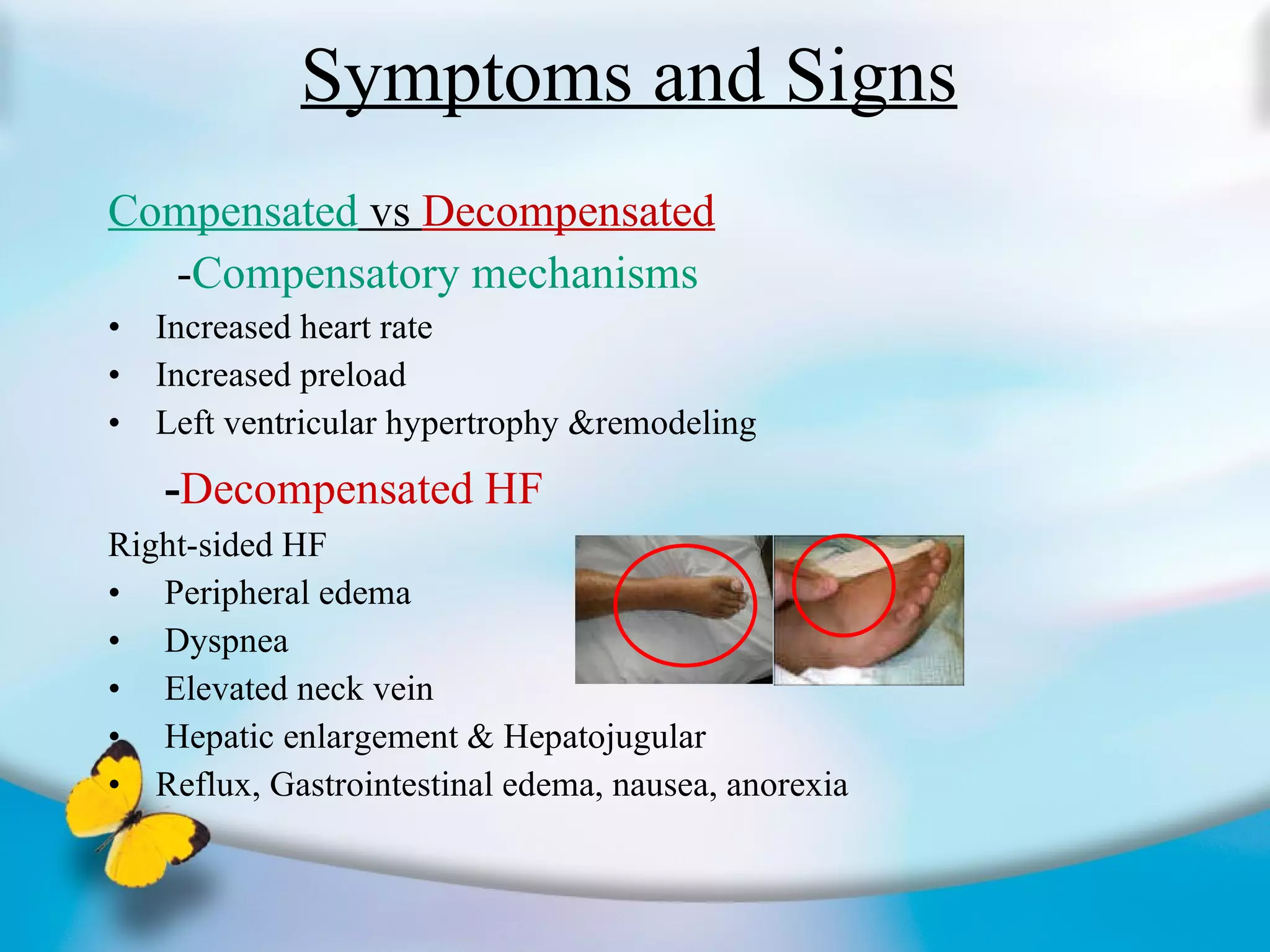
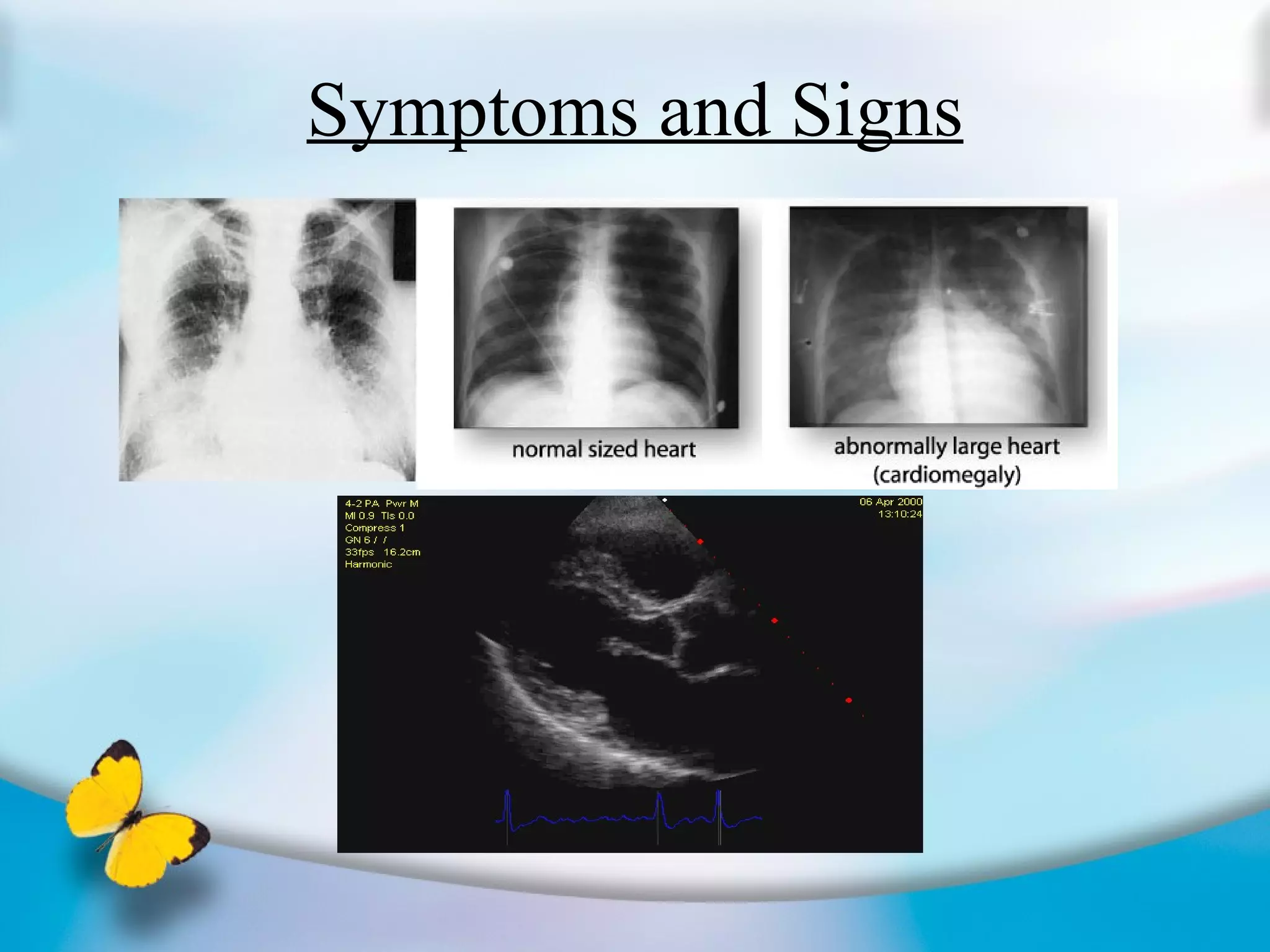
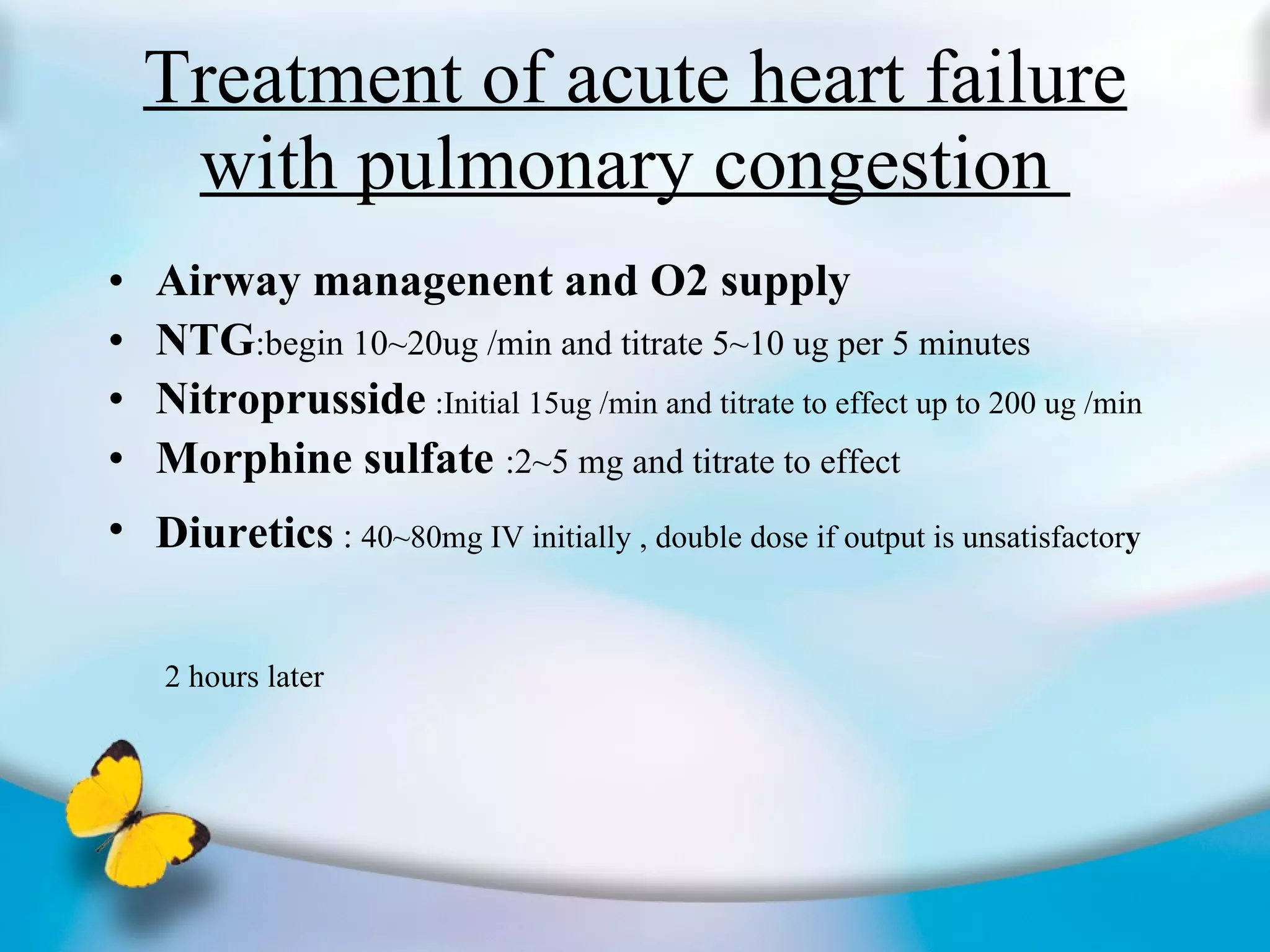
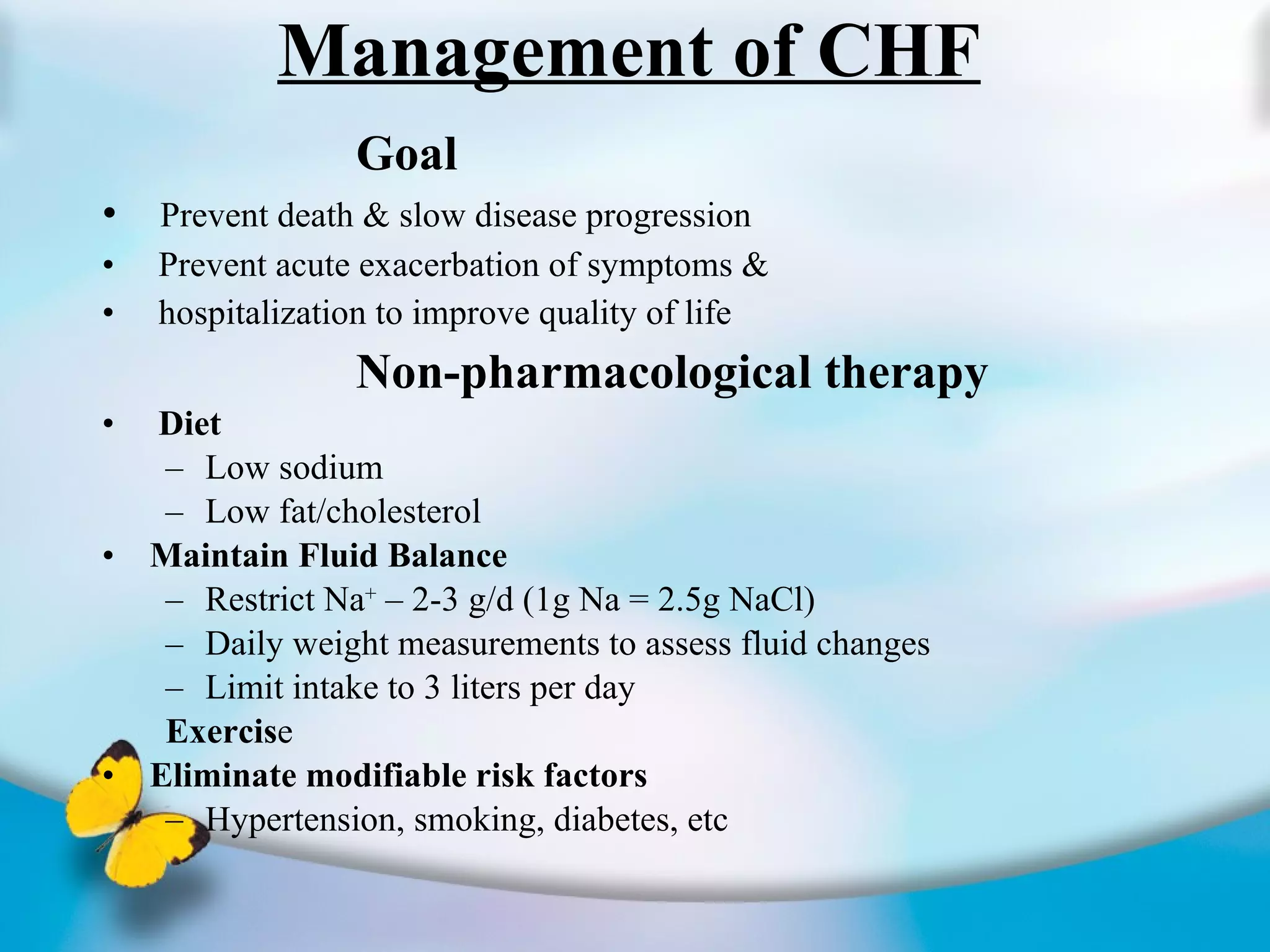
Symptoms and Signs Compensated  vs  Decompensated - Compensatory mechanisms Increased heart rate Increased preload Left ventricular hypertrophy &remodeling  - Decompensated HF Right-sided HF Peripheral edema Dyspnea Elevated neck vein Hepatic enlargement & Hepatojugular Reflux, Gastrointestinal edema, nausea, anorexia
Symptoms and Signs - Decompensated HF(continue) Left-sided HF Dyspnea ,Cheyne-Strokes Orthopnea, Paroxysmal Nocturnal Dyspnea Pulmonary edema Mental confusion, Fatigue, Weakness Signs & Symptoms of right-sided HF
Symptoms and Signs
Treatment of acute heart failure with pulmonary congestion  Airway managenent and O2 supply  NTG :begin 10~20ug /min and titrate 5~10 ug per 5 minutes  Nitroprusside   :Initial 15ug /min and titrate to effect up to 200 ug /min Morphine sulfate  :2~5 mg and titrate to effect  Diuretics  :  40~80mg IV initially , double dose if output is unsatisfactor y   2 hours later
Management of CHF Goal Prevent death & slow disease progression Prevent acute exacerbation of symptoms & hospitalization to improve quality of life Non-pharmacological therapy Diet Low sodium  Low fat/cholesterol Maintain Fluid Balance Restrict Na +  – 2-3 g/d (1g Na = 2.5g NaCl) Daily weight measurements to assess fluid changes Limit intake to 3 liters per day Exercis e Eliminate modifiable risk factors Hypertension, smoking, diabetes, etc
Management of CHF Pharmacotherapy of CHF Vasodilators: ACEIs, ARBs, Hydralazine, Nitrates Diuretics HCTZ, Loop diuretics Beta-blockers Carvedilol, Metoprolol succinate, Bisoprolol Digoxin Aldosterone antagonist Spironolactone, Eplerenone Calcium channel blockers
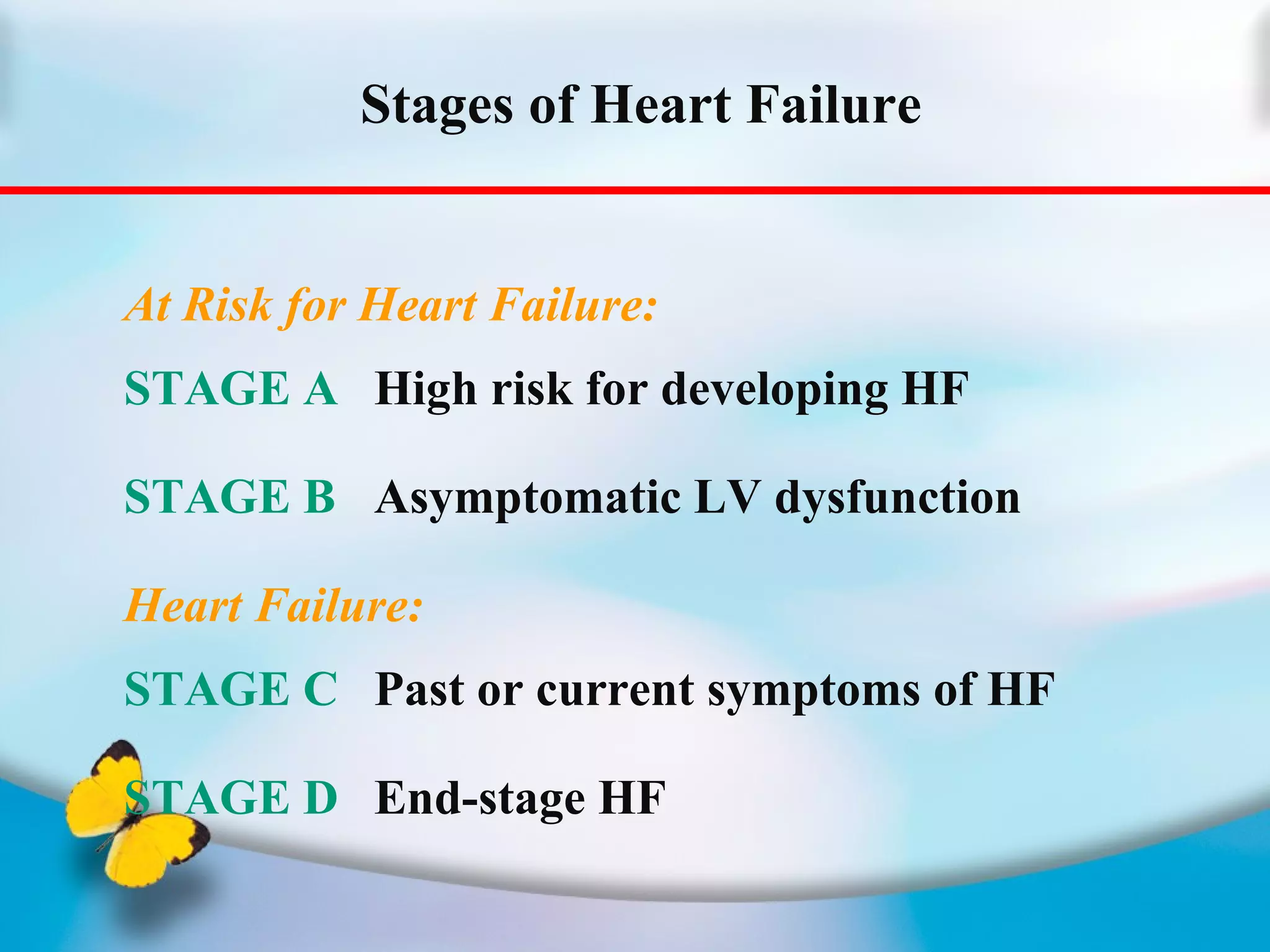
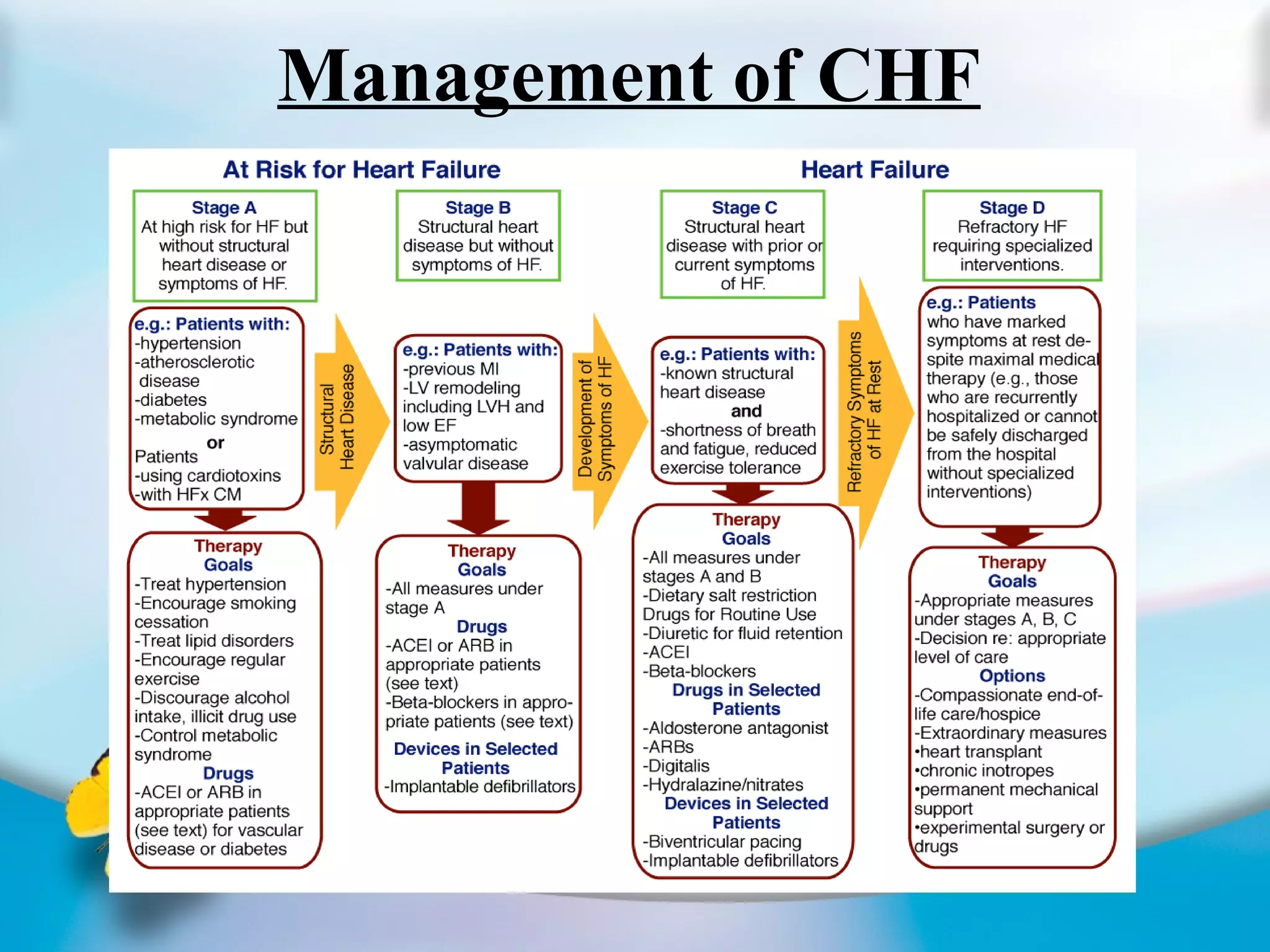
Stages of Heart Failure At Risk for Heart Failure: STAGE A  High risk for developing HF STAGE B   Asymptomatic LV dysfunction Heart Failure: STAGE C   Past or current symptoms of HF STAGE D   End-stage HF
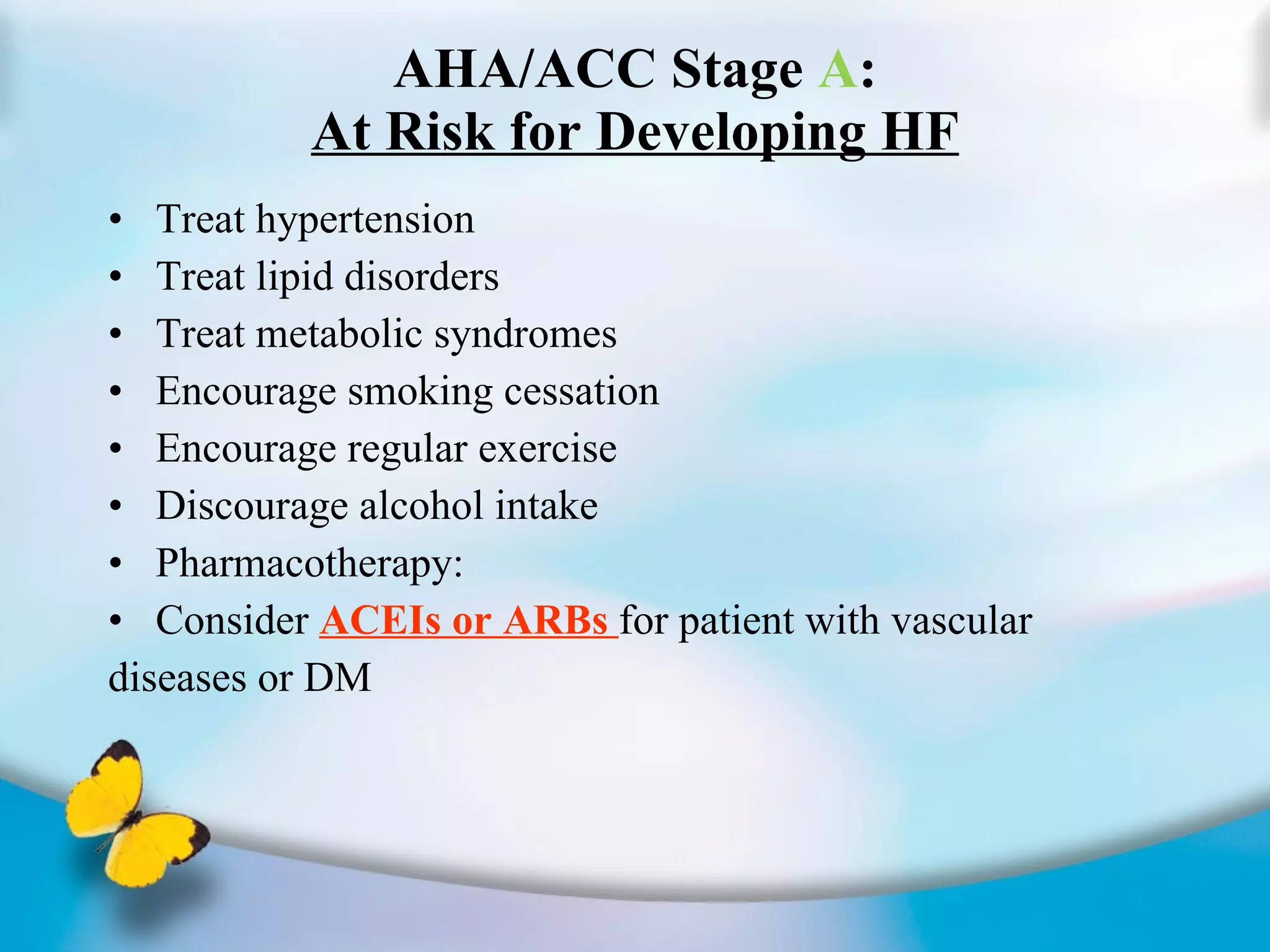
AHA/ACC Stage  A : At Risk for Developing HF Treat hypertension Treat lipid disorders Treat metabolic syndromes Encourage smoking cessation Encourage regular exercise Discourage alcohol intake Pharmacotherapy: Consider  ACEIs or ARBs  for patient with vascular diseases or DM
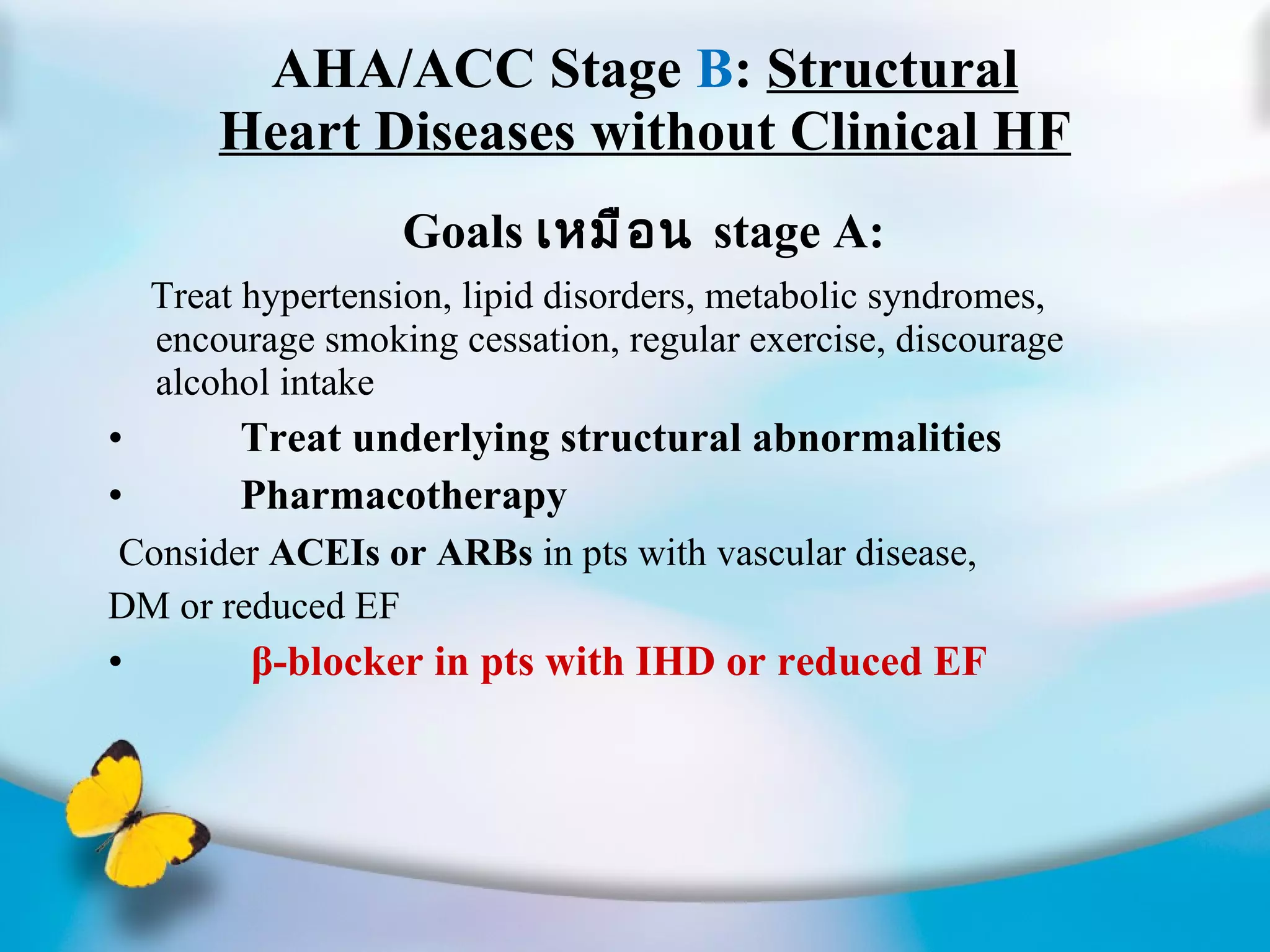
AHA/ACC Stage  B :  Structural Heart Diseases without Clinical HF Goals  เหมือน  stage A:  Treat hypertension, lipid disorders, metabolic syndromes, encourage smoking cessation, regular exercise, discourage alcohol intake Treat underlying structural abnormalities Pharmacotherapy Consider  ACEIs or ARBs  in pts with vascular disease, DM or reduced EF β-blocker in pts with IHD or reduced EF
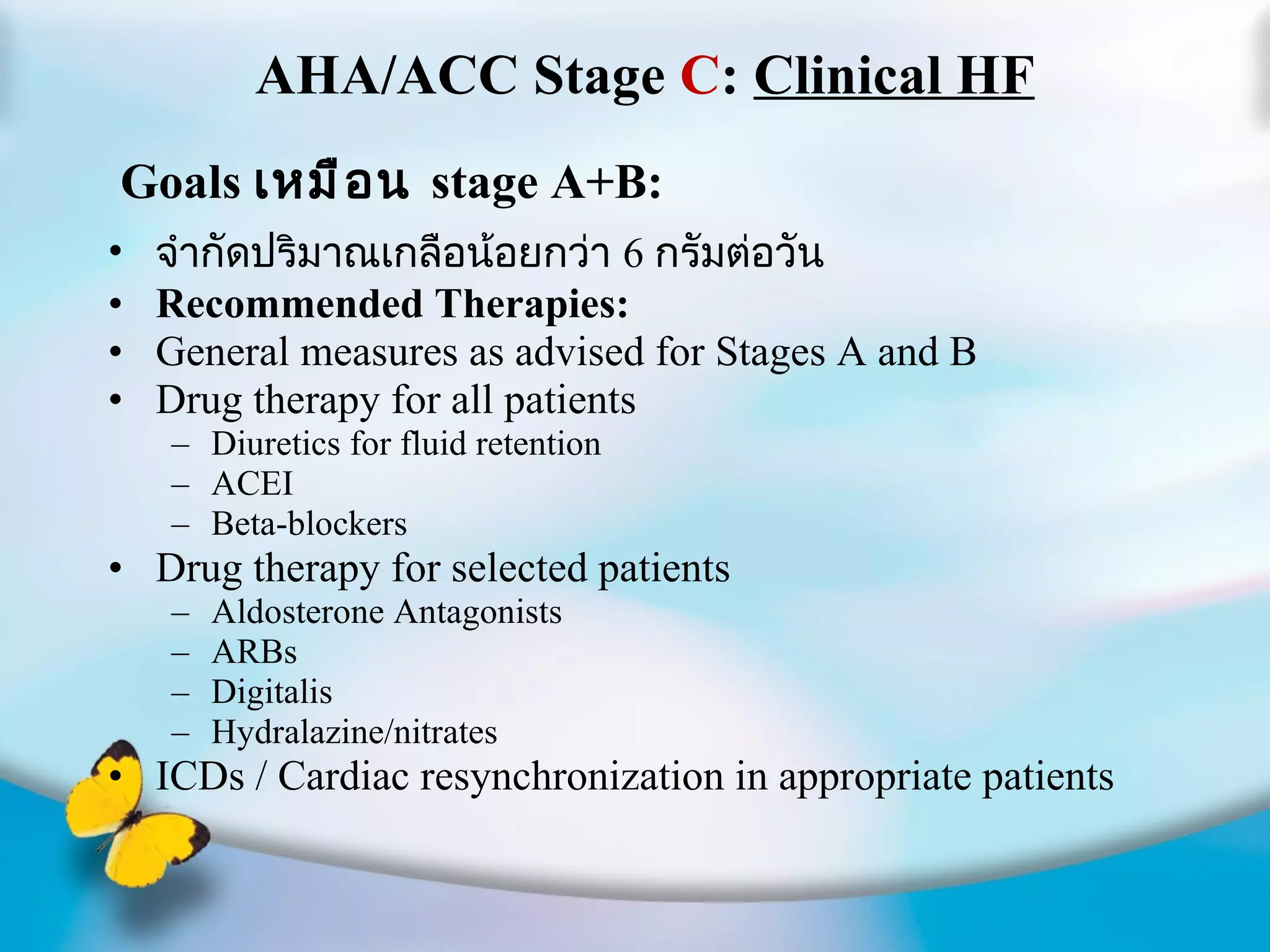
AHA/ACC Stage  C :  Clinical HF Goals  เหมือน  stage A+B: จำกัดปริมาณเกลือน้อยกว่า  6  กรัมต่อวัน Recommended Therapies: General measures as advised for Stages A and B Drug therapy for all patients Diuretics for fluid retention ACEI Beta-blockers Drug therapy for selected patients Aldosterone Antagonists ARBs Digitalis Hydralazine/nitrates ICDs / Cardiac resynchronization in appropriate patients
AHA/ACC Stage  D :  Clinical HF Goals  เหมือน  stage A+B+C+D Pharmacotherapy:  เหมือน  stage C Extraordinary measure -  Heart transplantation -  Positive inotropes infusion -  EECP Permanent mechanical support End-of-life care
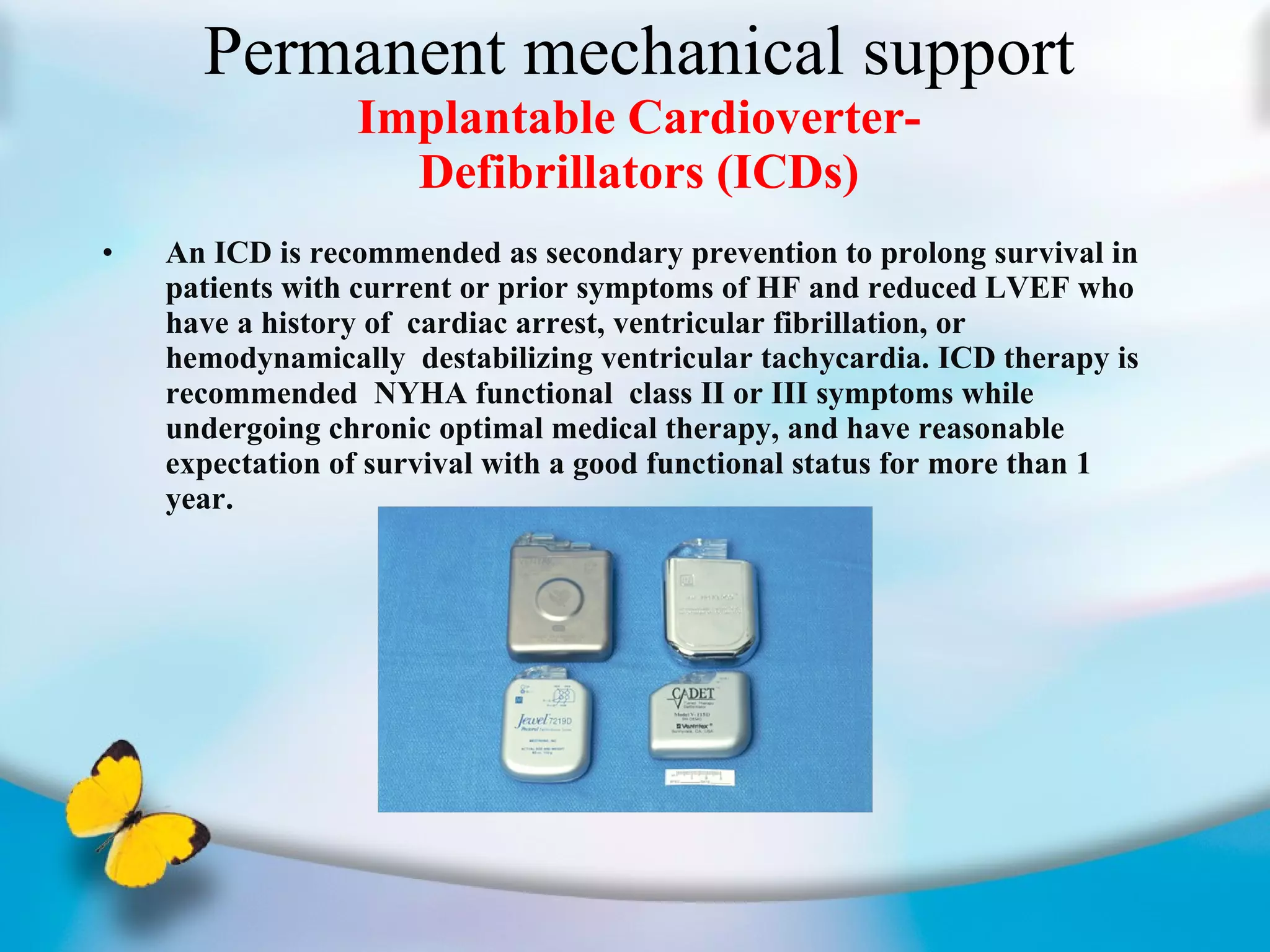
Permanent mechanical support Implantable Cardioverter- Defibrillators (ICDs) An ICD is recommended as secondary prevention to prolong survival in patients with current or prior symptoms of HF and reduced LVEF who have a history of  cardiac arrest, ventricular fibrillation, or hemodynamically  destabilizing ventricular tachycardia. ICD therapy is recommended  NYHA functional  class II or III symptoms while undergoing chronic optimal medical therapy, and have reasonable expectation of survival with a good functional status for more than 1 year.
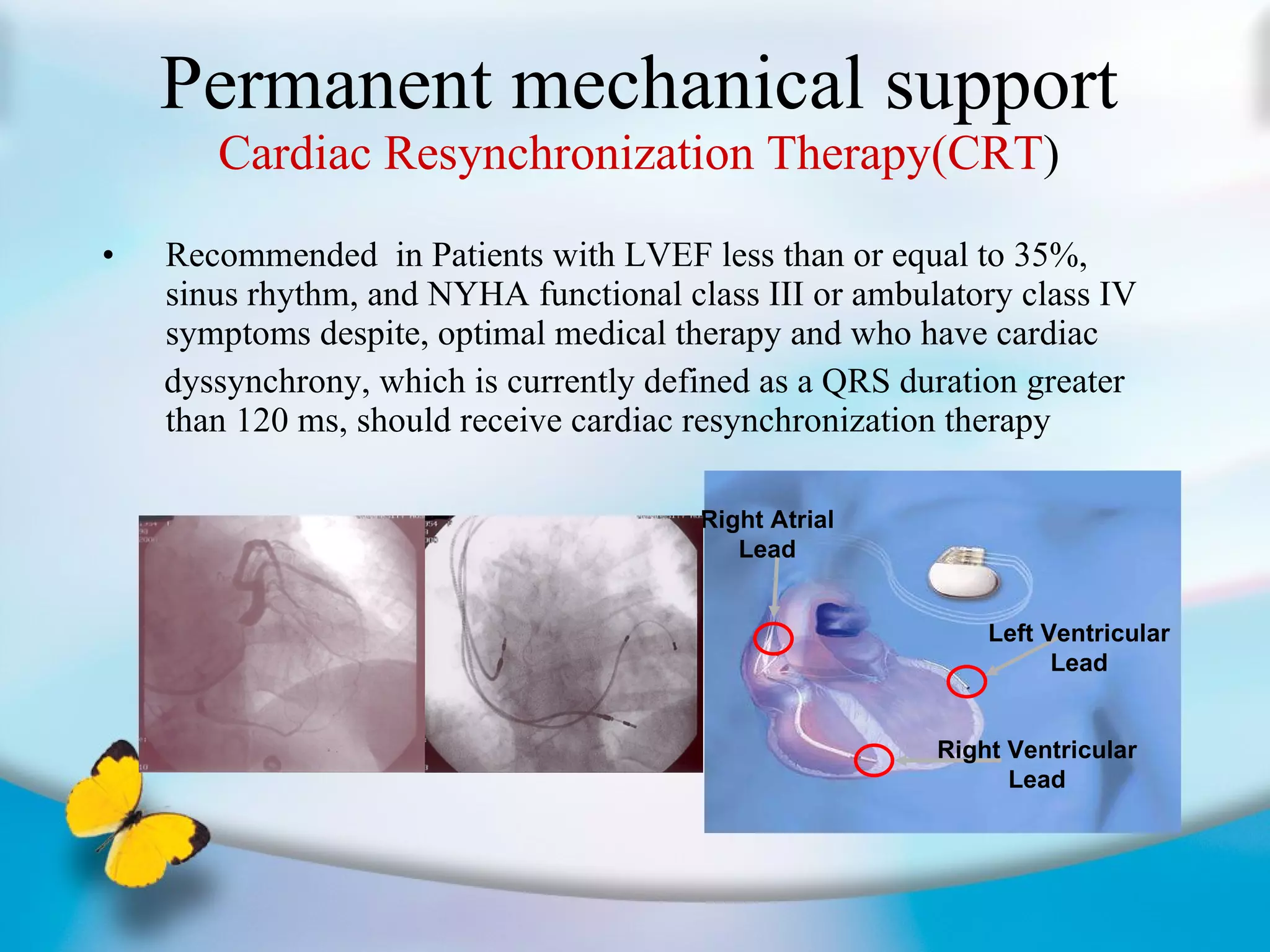
Permanent mechanical support Cardiac Resynchronization Therapy(CRT ) Recommended  in Patients with LVEF less than or equal to 35%, sinus rhythm, and NYHA functional class III or ambulatory class IV symptoms despite, optimal medical therapy and who have cardiac  dyssynchrony, which is currently defined as a QRS duration greater than 120 ms, should receive cardiac resynchronization therapy  Right Atrial Lead Right Ventricular Lead Left Ventricular Lead
Management of CHF

Chf

  • 1.
  • 2.
    Definition of HeartFailure HF is a complex clinical syndrome that can result from any structural or functional cardiac disorder that impairs the ability of the ventricle to fill with or eject blood. Manifests as Dyspnea and fatigue Limits exercise tolerance Fluid retention Pulmonary congestion and peripheral edema
  • 3.
    “ Heart Failure”vs. “Congestive Heart Failure” Because not all patients have volume overload at the time of initial or subsequent evaluation, the term “heart failure” is preferred over the older term “congestive heart failure.”
  • 4.
    Causes of HFType Example - Cardiac Myocardial damage MI Myocarditis Cardiomyopathy Some chemotherapy drugs Valvular disorders Aortic stenosis Mitral regurgitation Arrhythmias Bradyarrhythmias Tachyarrhythmias Conduction defects Left bundle branch block - Systemic Disorders that increase demand for CO Hyperthyroidism Disorders that increase resistance to output Hypertension
  • 5.
    Classification of HFSystolic vs. Diastolic HF NYHA functional class I, II, III, IV AHA/ACC staging classification A, B, C, D Left-sided vs. Right-sided HF Low-output vs. High-output HF
  • 6.
    ประเมินความรุนแรงของภาวะ dyspnea ใน HF โดยอาศัย New York Heart Association Functional classification ( NYHA) Class I asymptomatic: ผู้ป่วยที่มีโรคหัวใจแต่ไม่มีข้อจำกัดในการมี physical activity. Class II Mildly Symptomatic: ผู้ป่วยโรคหัวใจที่มีข้อจำกัดเล็กน้อย ในการมี ordinary physical activity ซึ่งทำให้รู้สึกเหนื่อย Class III Moderately symptomatic: มีข้อจำกัดมากในการมี ordinary physical activity Class IV Severe/Symptoms at rest: ไม่สามารถทำอะไรได้เลย บางครั้งมีอาการแม้อยู่เฉยๆ
  • 7.
    AHA/ACC Classification ofHF: Staging of Disease Progression Stage A : เป็นผู้ป่วยยังไม่ได้รับการวินิจฉัยด้วยโรคหัวใจล้มเหลว ไม่มีความผิดปกตของหัวใจหรืออาการของภาวะหัวใจล้มเหลว แต่เป็นผู้ป่วยที่มีความเสี่ยงสูงต่อการ พัฒนาไปเป็นโรคหัวใจล้มเหลว ตัวอย่าง เช่น ผู้ป่วยที่มี hypertension, atherosclerotic diseases, diabetes, obesity, metabolic syndrome หรือ ผู้ป่วยที่ได้รับยาที่มีผลทำลายเซลล์กล้ามเนื้อหัวใจ เช่น ยามะเร็ง , ผู้ป่วยที่มีประวัติคนในครอบครัวเป็น cardiomyopathy
  • 8.
    AHA/ACC Classification ofHF: Staging of Disease Progression Stage B : เป็นผู้ป่วยที่ยังไม่ได้รับการวินัจฉัยด้วยโรคหัวใจล้มเหลว และไม่มีอาการของภาวะหัวใจล้มเหลว แต่จะพบความผิดปกติของหัวใจ ( structural abnormalities) เช่น ผู้ป่วยมีภาวะกล้ามเนื้อหัวใจตาย กล้ามเนื้อหัวใจโต ( left ventricular hypertrophy), โรคของลิ้นหัวใจ , ผู้ป่วยที่พบมีค่า ejection fraction ต่ำ แต่ยังไม่มีอาการ เป็นต้น
  • 9.
    AHA/ACC Classification ofHF: Staging of Disease Progression Stage C : เป็นผู้ป่วยที่ได้รับการวินิจฉัยด้วยโรคหัวใจล้มเหลว คือ มีอาการของภาวะหัวใจล้มเหลวปรากฎขึ้น และมักมีความผิดปกติของโครงสร้างหัวใจ ถูกตรวจพบด้วย เช่น ผู้ป่วยที่มีอาการหายใจหอบเหนื่อยเวลาออกแรง ออกแรงทำงานได้น้อยลง นอนราบไม่ได้ เป็นต้น
  • 10.
    AHA/ACC Classification ofHF: Staging of Disease Progression Stage D : เป็นผู้ป่วยที่ได้รับการวินิจฉัยด้วยโรคหัวใจล้มเหลว โดยเป็นผู้ป่วยที่มีอาการหัวใจล้มเหลวในขั้นรุนแรง เช่น มีอาการขณะพักทั้งๆ ที่ได้รับการรักษา ด้วยยาอย่างเหมาะสมแล้ว จัดเป็น refractory heart failure รวมถึงผู้ป่วยที่จำเป็นต้องอาศัยเครื่องมือหรือ วิธีการพิเศษที่ช่วยให้ดำรงชีวิตอยู่ได้ เช่น ventricular assisted device, chronic inotropic therapy เป็นต้น
  • 11.
    Stage A HighRisk for developing Heart failure Stage B Asymptomatic LV dysfunction Stage C Past or current Symptoms of HF Stage D End-stage HF Stages of HF: ACC/AHA Class I symptoms at activity levels that would limit normal individuals Class II symptoms of HF with ordinary exertion Class III symptoms of HF with less than ordinary exertion Class IV Symptoms of HF at rest NYHA Functional Class
  • 12.
  • 13.
    Initial Assessment Historyand Physical History PMHx of HTN, CAD, DM, thyroid disease, valvular disease, chemotherapy or OSA, rheumatic heart disease Functional status Social history: tobacco Family history: HF, CAD, SCD Physical Vitals (admission weight) Cardiopulmonary exam, volume assessment(fluid retension, tissue perfusion)
  • 14.
    Initial Assessment Labs:E’lyte, CBC, Ca, Mg, TFT (especially thyroid-stimulating hormone) Lipid profile , liver function,U/A BNP or pro-BNP levels when diagnosis is unclear 12 lead EKG, CXR Assessment of ventricular function 2-D echo MUGA (Multiple gated cardiac scan ใช้ Technetium-99m เป็น radiotracer ตรวจเพื่อประเมินการหา EF ของหัวใจ มีความแม่นยำสูงมาก เป็นการประเมิน left venticle แบบ 3 มิติ เป็นที่นิยมอย่างยิ่งโดยเฉพาะในกลุ่มของ oncologist เนื่องจากการให้เคมีบำบัดบางชนิดมี cardiotoxic การตรวจ จะเป็น early detection ของ cardiotoxic จากเคมีบำบัดนั้น ) if poor echo windows CAG , CTA coronary
  • 15.
    pro-BNP pro-BNP เป็นฮอร์โมนที่เป็นสารต้นกำเนิดของการสร้าง BNP BNP ย่อมาจาก Brain natriuretic peptide เป็นฮอร์โมนหลั่งมาจากสมองและหัวใจห้องล่าง (ventricles) BNP จะมีการหลั่งเพิ่มขึ้นในภาวะหัวใจล้มเหลว ซึ่งในภาวะนี้จะมีแรงดันต่อผนังหัวใจห้องล่างที่สูงขึ้น อายุ ≤ 50 ปี ใช้ค่า cut-off NT-proBNP 100 pg/ml อายุ > 50 ปี ใช้ค่า cut-off NT-proBNP 200 pg/ml ซึ่งสามารถแปลผลได้ว่า ถ้าค่ามากกว่า cut off value ถือว่ามีภาวะหัวใจล้มเหลว จะได้ค่าความแม่นยำในการทดสอบ ดังนี้ - sensitivity 90% ในการวินิจฉัย heart failure - specificity 84% ในการวินิจฉัย heart failure
  • 16.
    Symptoms and SignsCompensated vs Decompensated - Compensatory mechanisms Increased heart rate Increased preload Left ventricular hypertrophy &remodeling - Decompensated HF Right-sided HF Peripheral edema Dyspnea Elevated neck vein Hepatic enlargement & Hepatojugular Reflux, Gastrointestinal edema, nausea, anorexia
  • 17.
    Symptoms and Signs- Decompensated HF(continue) Left-sided HF Dyspnea ,Cheyne-Strokes Orthopnea, Paroxysmal Nocturnal Dyspnea Pulmonary edema Mental confusion, Fatigue, Weakness Signs & Symptoms of right-sided HF
  • 18.
  • 19.
    Treatment of acuteheart failure with pulmonary congestion Airway managenent and O2 supply NTG :begin 10~20ug /min and titrate 5~10 ug per 5 minutes Nitroprusside :Initial 15ug /min and titrate to effect up to 200 ug /min Morphine sulfate :2~5 mg and titrate to effect Diuretics : 40~80mg IV initially , double dose if output is unsatisfactor y 2 hours later
  • 20.
    Management of CHFGoal Prevent death & slow disease progression Prevent acute exacerbation of symptoms & hospitalization to improve quality of life Non-pharmacological therapy Diet Low sodium Low fat/cholesterol Maintain Fluid Balance Restrict Na + – 2-3 g/d (1g Na = 2.5g NaCl) Daily weight measurements to assess fluid changes Limit intake to 3 liters per day Exercis e Eliminate modifiable risk factors Hypertension, smoking, diabetes, etc
  • 21.
    Management of CHFPharmacotherapy of CHF Vasodilators: ACEIs, ARBs, Hydralazine, Nitrates Diuretics HCTZ, Loop diuretics Beta-blockers Carvedilol, Metoprolol succinate, Bisoprolol Digoxin Aldosterone antagonist Spironolactone, Eplerenone Calcium channel blockers
  • 22.
    Stages of HeartFailure At Risk for Heart Failure: STAGE A High risk for developing HF STAGE B Asymptomatic LV dysfunction Heart Failure: STAGE C Past or current symptoms of HF STAGE D End-stage HF
  • 23.
    AHA/ACC Stage A : At Risk for Developing HF Treat hypertension Treat lipid disorders Treat metabolic syndromes Encourage smoking cessation Encourage regular exercise Discourage alcohol intake Pharmacotherapy: Consider ACEIs or ARBs for patient with vascular diseases or DM
  • 24.
    AHA/ACC Stage B : Structural Heart Diseases without Clinical HF Goals เหมือน stage A: Treat hypertension, lipid disorders, metabolic syndromes, encourage smoking cessation, regular exercise, discourage alcohol intake Treat underlying structural abnormalities Pharmacotherapy Consider ACEIs or ARBs in pts with vascular disease, DM or reduced EF β-blocker in pts with IHD or reduced EF
  • 25.
    AHA/ACC Stage C : Clinical HF Goals เหมือน stage A+B: จำกัดปริมาณเกลือน้อยกว่า 6 กรัมต่อวัน Recommended Therapies: General measures as advised for Stages A and B Drug therapy for all patients Diuretics for fluid retention ACEI Beta-blockers Drug therapy for selected patients Aldosterone Antagonists ARBs Digitalis Hydralazine/nitrates ICDs / Cardiac resynchronization in appropriate patients
  • 26.
    AHA/ACC Stage D : Clinical HF Goals เหมือน stage A+B+C+D Pharmacotherapy: เหมือน stage C Extraordinary measure - Heart transplantation - Positive inotropes infusion - EECP Permanent mechanical support End-of-life care
  • 27.
    Permanent mechanical supportImplantable Cardioverter- Defibrillators (ICDs) An ICD is recommended as secondary prevention to prolong survival in patients with current or prior symptoms of HF and reduced LVEF who have a history of cardiac arrest, ventricular fibrillation, or hemodynamically destabilizing ventricular tachycardia. ICD therapy is recommended NYHA functional class II or III symptoms while undergoing chronic optimal medical therapy, and have reasonable expectation of survival with a good functional status for more than 1 year.
  • 28.
    Permanent mechanical supportCardiac Resynchronization Therapy(CRT ) Recommended in Patients with LVEF less than or equal to 35%, sinus rhythm, and NYHA functional class III or ambulatory class IV symptoms despite, optimal medical therapy and who have cardiac dyssynchrony, which is currently defined as a QRS duration greater than 120 ms, should receive cardiac resynchronization therapy Right Atrial Lead Right Ventricular Lead Left Ventricular Lead
  • 29.