
Engaging  Digital Natives  through Blogging Examining 21 st  century literacies and applications for blogging in the classroom. Jennifer Carrier Dorman
We are at a turning point in the tech industry and perhaps even in the history of the world Tim O’Reilly – Feb. 14, 2006
The Case for 21 st  Century Education Education is changing. Competition is changing internationally. The workplace, jobs, and skill demands are changing.
 
Global Implications These changes, among others, are ushering us toward a world where knowledge, power, and productive capability will be more dispersed than at any time in our history—a world where value creation will be fast, fluid, and persistently disruptive.  A world where only the connected will survive.  Wikinomics: How Mass Collaboration Changes Everything
Global Implications A power shift is underway, and a tough new business rule is emerging: Harness the new collaboration or perish.  Those who fail to grasp this will find themselves ever more isolated—cut off from the networks that are sharing, adapting, and updating knowledge to create value. Wikinomics: How Mass Collaboration Changes Everything
Get flat or be flattened
Implications for Schools For smart schools [companies], the rising tide of mass collaboration offers vast opportunity…Schools [Companies] can reach beyond their walls to sow the seeds of innovation and harvest a bountiful crop.  (edits by Will Richardson, original words in brackets) Wikinomics: How Mass Collaboration Changes Everything
Implications for Schools Indeed, educators [firms] that cultivate nimble, trust-based relationships with external collaborators are positioned to form vibrant classroom [business] ecosystems that enhance learning [create value] more effectively than hierarchically organized schools [businesses].  (edits by Will Richardson, original words in brackets) Wikinomics: How Mass Collaboration Changes Everything
Digital Natives Who are the digital natives and what is their learning profile?
Who are the digital natives? Our students today are all “native speakers” of the digital language of computers, video games, instantaneous communication, and the Internet. Those of us who were not born into the digital world but have, at some later point in our lives, become fascinated by and adopted many or most aspects of the new technology are  Digital Immigrants .
The Nomadic Grazing Patterns of Digital Natives Digital Natives are used to receiving information really fast.  They like to parallel process and multi-task.  They prefer their graphics  before  their text rather than the opposite.
The Nomadic Grazing Patterns of Digital Natives They prefer random access (like hypertext).  They function best when networked.  They thrive on instant gratification and frequent rewards.  They prefer games to “serious” work.
Web 2.0 The evolution of the semantic read/write web
Web 1.0    Web 2.0
What is Web 2.0? Web 2.0 is a term often applied to a perceived ongoing transition of the World Wide Web from a collection of static websites to a full-fledged computing platform serving web applications to end users.  Tim O’Reilly
Confronting the Challenges of a Participatory Culture Media Education for the 21 st  Century Henry Jenkins, Director of the Comparative Media Studies Program at MIT
“ If it were possible to define generally the mission of education, it could be said that its fundamental purpose is to ensure that all students benefit from learning in ways that allow them to participate fully in public, community, [Creative] and economic life.”  —  New London Group (2000)
Participatory Culture According to a recent study from the Pew Internet & American Life project (Lenhardt & Madden, 2005), more than one-half of all teens have created media content, and roughly one-third of teens who use the Internet have shared content they produced.
A Participatory Culture . . . Relatively low barriers to artistic expression and civic engagement Strong support for creating and sharing one’s creations with others Some type of informal mentorship whereby what is known by the most experienced is passed along to novices
A Participatory Culture . . . Members believe that their contributions matter Members feel some degree of social connection with one another (at the least they care what other people think about what they have created)
Forms of Participatory Culture Affiliations   — memberships, formal and informal, in online communities centered around various forms of media, such as Friendster, Facebook, message boards, metagaming, Second Life, or MySpace Expressions   — producing new creative forms, such as digital sampling, skinning and modding, fan videomaking, fan fiction writing, zines, mash-ups
Forms of Participatory Culture Collaborative Problem-solving   — working together in teams, formal and informal, to complete tasks and develop new knowledge (such as through  Wikipedia , alternative reality gaming, spoiling). Circulations   — Shaping the flow of media (such as podcasting, blogging).
Implications A growing body of scholarship suggests potential benefits of these forms of participatory culture, including: opportunities for peer-to-peer learning,  a changed attitude toward intellectual property,  the diversification of cultural expression,  the development of skills valued in the modern workplace, and a more empowered conception of citizenship.
Implications Participatory culture shifts the focus of literacy from one of individual expression to community involvement. The new literacies almost all involve social skills developed through collaboration and networking. These skills build on the foundation of traditional literacy, research skills, technical skills, and critical analysis skills taught in the classroom.
The New Literacies Play  — the capacity to experiment with one’s surroundings as a form of problem-solving Performance  — the ability to adopt alternative identities for the purpose of improvisation and discovery Simulation  — the ability to interpret and construct dynamic models of real-world processes Appropriation  — the ability to meaningfully sample and remix media content
The New Literacies Multitasking  — the ability to scan one’s environment and shift focus as needed to salient details. Distributed Cognition  — the ability to interact meaningfully with tools that expand mental capacities Collective Intelligence  — the ability to pool knowledge and compare notes with others toward a common goal Judgment  — the ability to evaluate the reliability and credibility of different information sources
The New Literacies Transmedia Navigation  — the ability to follow the flow of stories and information across multiple modalities Networking  — the ability to search for, synthesize, and disseminate information Negotiation  — the ability to travel across diverse communities, discerning and respecting multiple perspectives, and grasping and following alternative norms.
Blogs Students as Creators
Blogs A blog is a website for which an individual or a group frequently generates text, photographs, video or audio files, and/or links, typically (but not always) on a daily basis.  The term is a shortened form of weblog.  Authoring a blog, maintaining a blog or adding an article to an existing blog is called "blogging".  Individual articles on a blog are called "blog posts," "posts," or "entries".  The person who posts these entries is called a "blogger".
Why the sudden popularity of blogs? RSS - Really Simple Syndication
Bloglines http://www.bloglines.com/
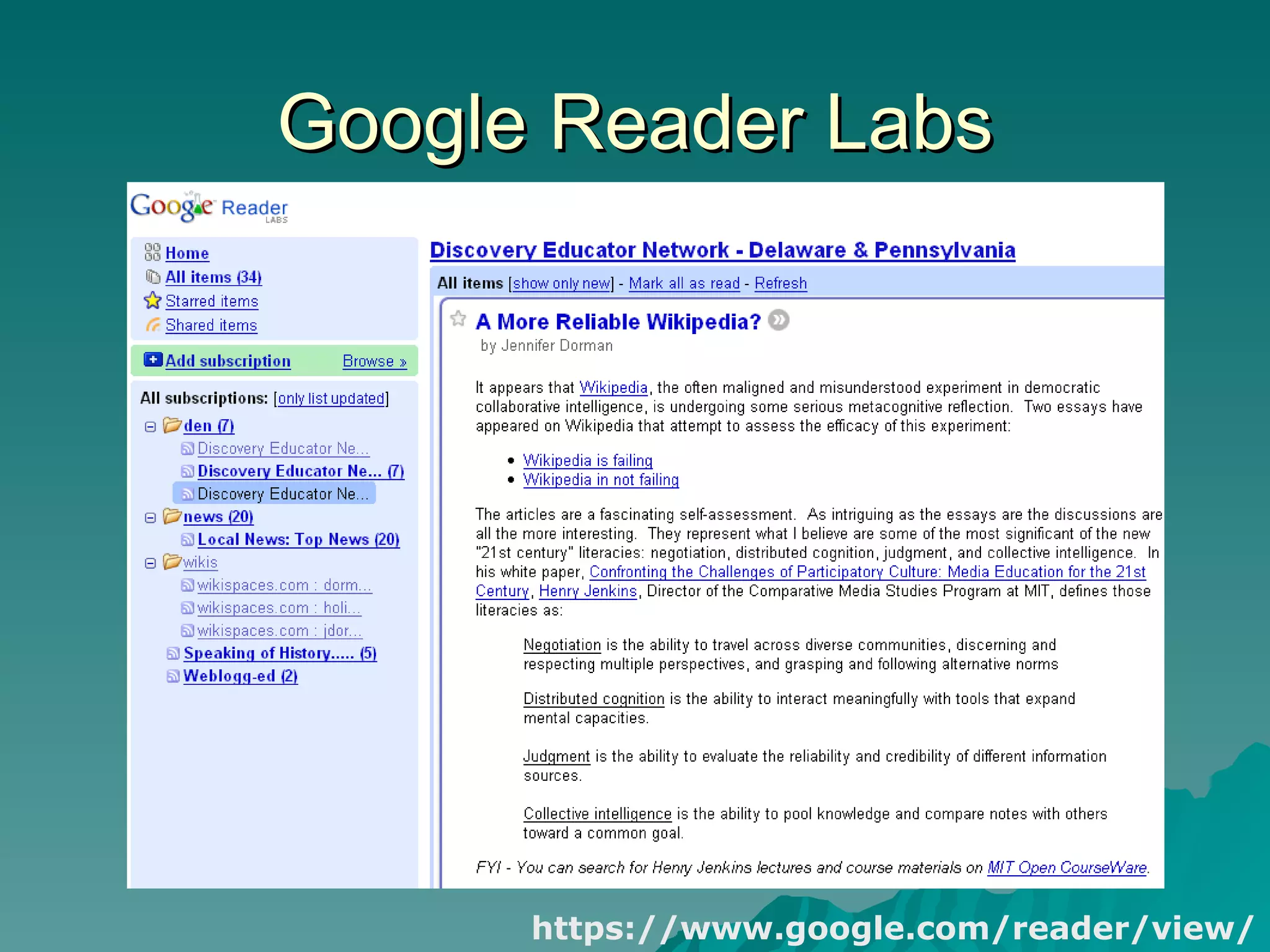
Google Reader Labs https://www.google.com/reader/view/
The Power of RSS RSS + Feed Reader/Aggregator = personalized learning/affinity network The new WWW in action RSS is not limited to blogs News feeds Podcasts Wiki edits and discussions Social bookmarking Multiple users
Blogs in School? Blogs are tools, and like any tools they can be used or misused.  Misuse occurs more often when there's a lack of instruction.  (MySpace, Xanga, Facebook) Interactivity, publishing, collective intelligence
Why Students Shouldn’t Blog People will read it.  People might not like it.  They might share test answers with others.  They might be found by a child predator online  They might write something inappropriate.  They might find something inappropriate.  They might get other students to start blogging.  http://blogging101.wikispaces.com/whywhynot
Why Students Should Blog People will read it.  They might like it.  They might share what they've learned with others.  They might participate in a collaborative learning project.  They might become inspired to learn.  They might inspire others to learn.  They might get other students to start blogging.  If they don't talk in class, they might on a blog.  http://blogging101.wikispaces.com/whywhynot
Blogs in School Teacher Blogs Homework Keep Parents in the Loop Virtual In-service Professional collaboration Student Blogs This week in class, we... Student Work Online portfolio Peer/teacher feedback Book blogs Connect with an expert
Successful Tips for “Book” Blogs Get comfortable with blogging Choose a relevant book [article, topic, etc.] Devise interesting questions Solicit the author’s involvement Welcome bloggers [experts] from outside the classroom Erik Langhorst – “The Dixie Clicks” 12/1/2006 http://www.schoollibraryjournal.com/article/CA6395089.html
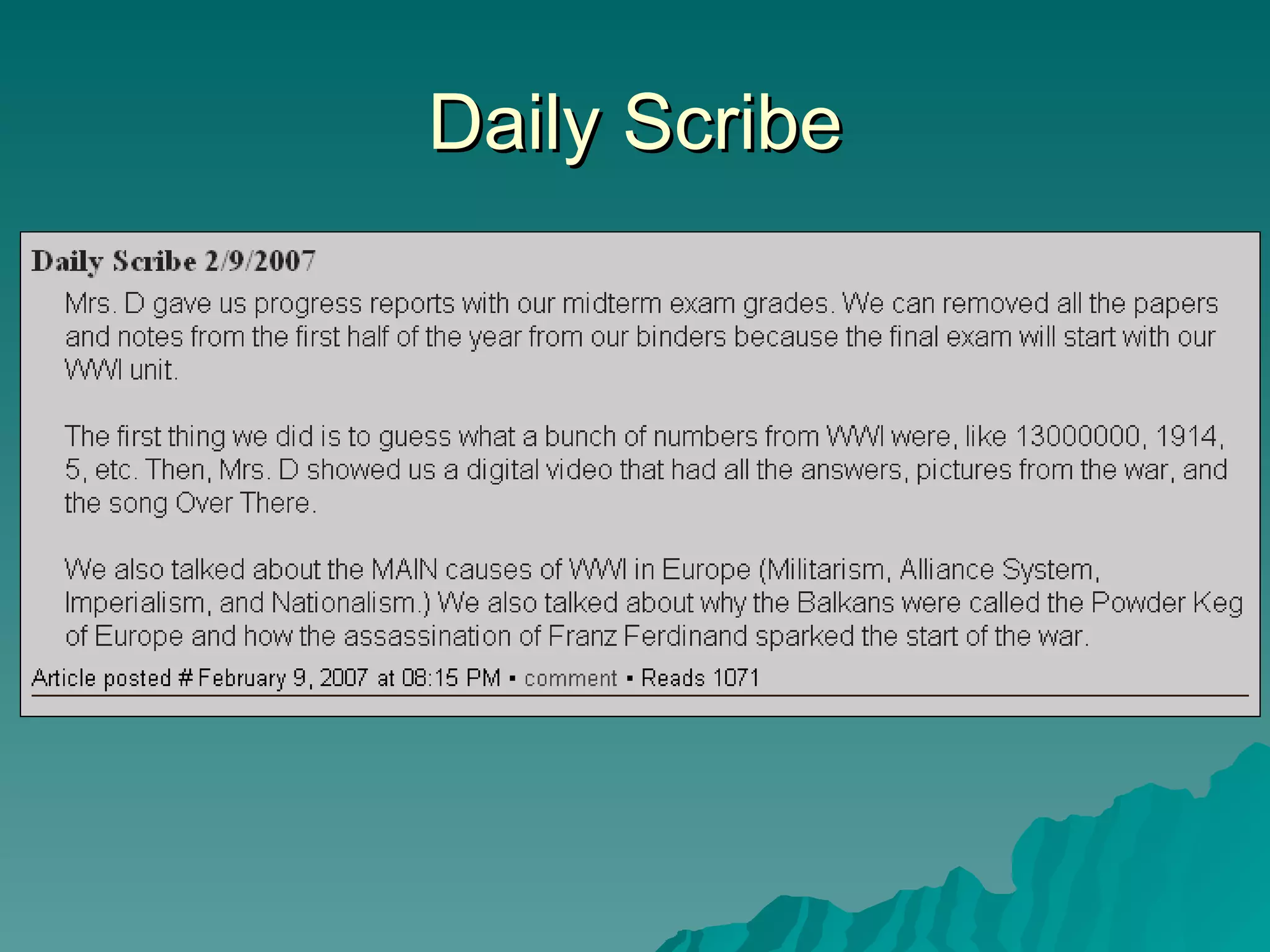
Daily Scribe
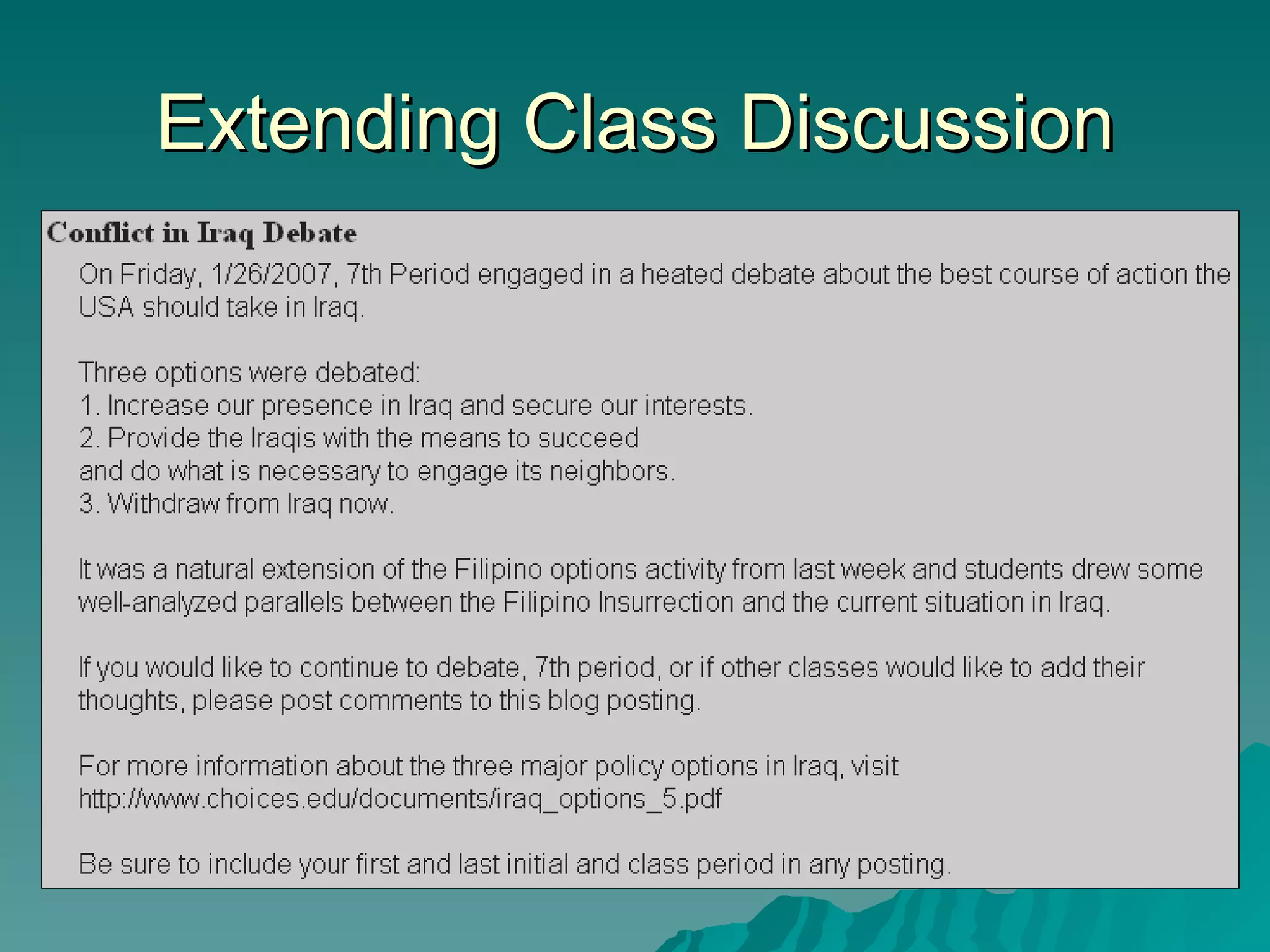
Extending Class Discussion
Student Work Showcase
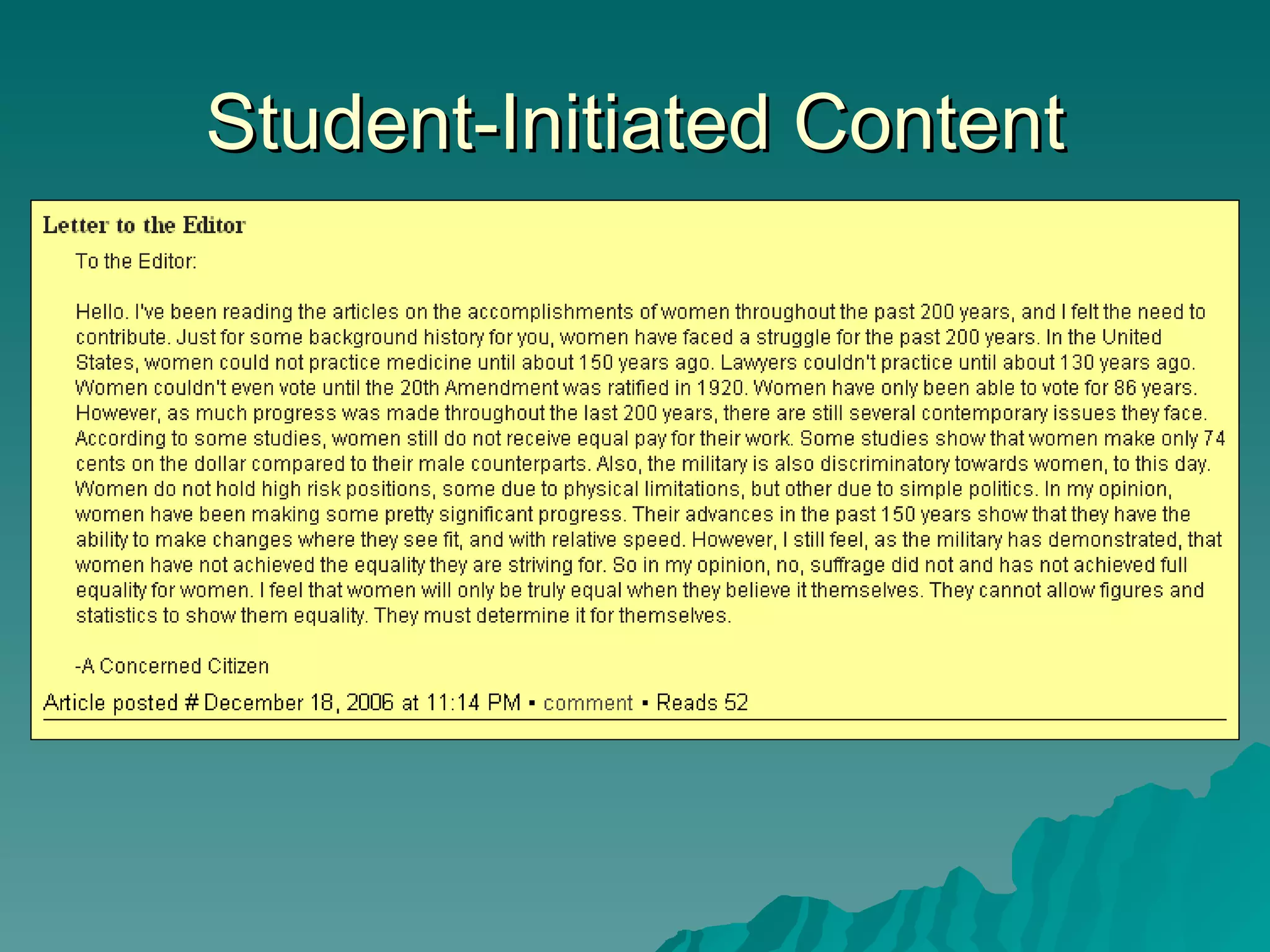
Student-Initiated Content
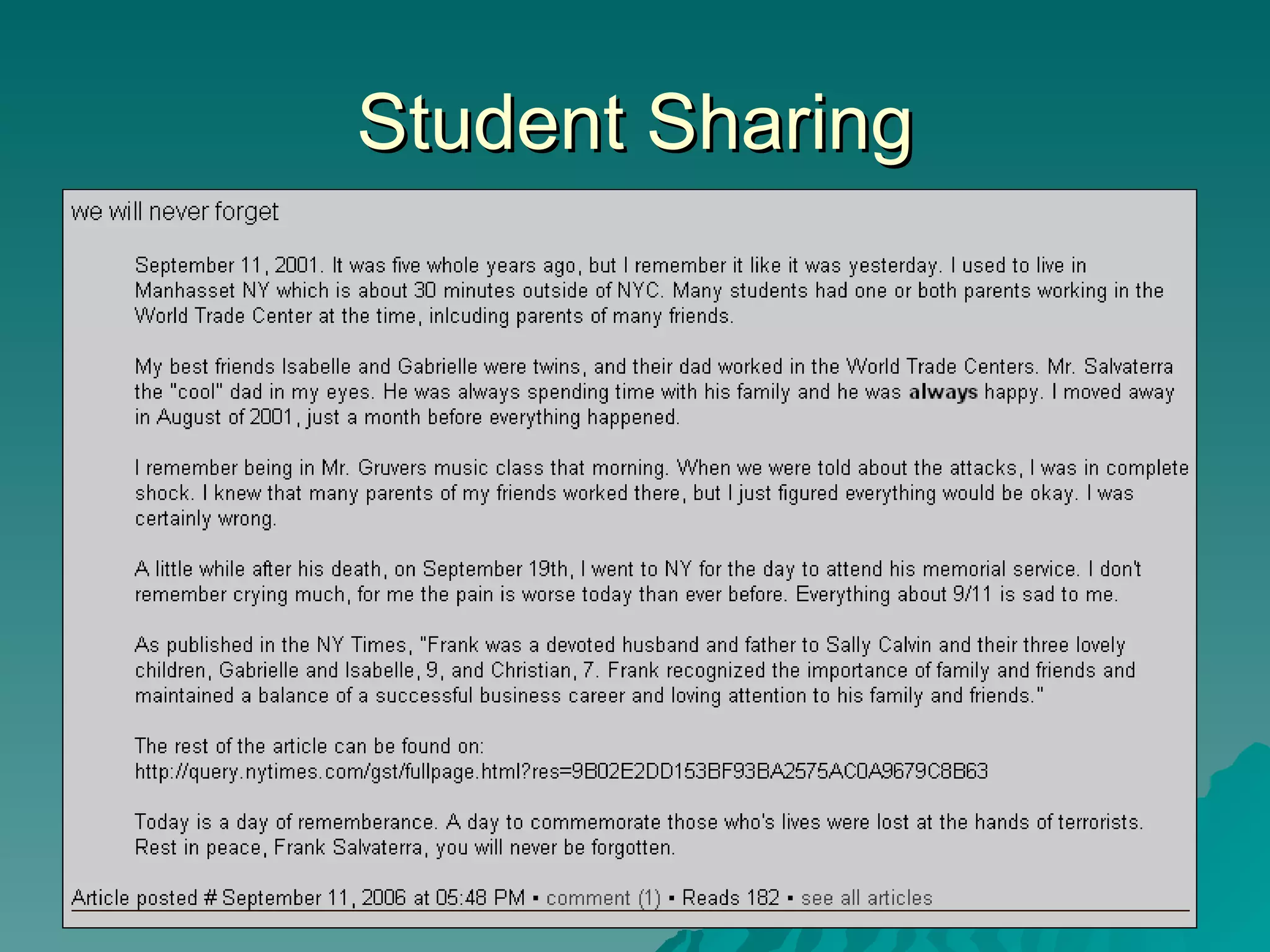
Student Sharing
Tips for Blogging http://blogging101.wikispaces.com/bloggersbeware
Blog Hosting for Schools Blogmeister -  http://classblogmeister.com/   Edublogs -  http://edublogs.org/
Questions to Consider Who are your teachers? How are you building your own learning networks? How are you modeling your learning for your students? Will Richardson - http://www.weblogg-ed.com/
Learn More, Get Involved Jen Dorman’s “Digital Tools for Digital Natives” wiki http://jdorman.wikispaces.com   Jen Dorman’s blog http://cliotech.blogspot.com/   Jen’s Class Web Page http://www.cbsd.org/holicong/jendorman/   Discovery Educator Network PA blog http://discoveryeducation.typepad.com/pennsylvania/
Discovery Educator Network Join the Discovery Educator Network to connect to over 20,000 educators worldwide who collaborate to support the integration of 21 st  century technologies in education. Learn more at  http://jdorman.wikispaces.com/DiscoveryEducatorNetwork

Engaging Digital Natives Through Blogging

  • 1.
    Engaging DigitalNatives through Blogging Examining 21 st century literacies and applications for blogging in the classroom. Jennifer Carrier Dorman
  • 2.
    We are ata turning point in the tech industry and perhaps even in the history of the world Tim O’Reilly – Feb. 14, 2006
  • 3.
    The Case for21 st Century Education Education is changing. Competition is changing internationally. The workplace, jobs, and skill demands are changing.
  • 4.
  • 5.
    Global Implications Thesechanges, among others, are ushering us toward a world where knowledge, power, and productive capability will be more dispersed than at any time in our history—a world where value creation will be fast, fluid, and persistently disruptive. A world where only the connected will survive. Wikinomics: How Mass Collaboration Changes Everything
  • 6.
    Global Implications Apower shift is underway, and a tough new business rule is emerging: Harness the new collaboration or perish. Those who fail to grasp this will find themselves ever more isolated—cut off from the networks that are sharing, adapting, and updating knowledge to create value. Wikinomics: How Mass Collaboration Changes Everything
  • 7.
    Get flat orbe flattened
  • 8.
    Implications for SchoolsFor smart schools [companies], the rising tide of mass collaboration offers vast opportunity…Schools [Companies] can reach beyond their walls to sow the seeds of innovation and harvest a bountiful crop. (edits by Will Richardson, original words in brackets) Wikinomics: How Mass Collaboration Changes Everything
  • 9.
    Implications for SchoolsIndeed, educators [firms] that cultivate nimble, trust-based relationships with external collaborators are positioned to form vibrant classroom [business] ecosystems that enhance learning [create value] more effectively than hierarchically organized schools [businesses]. (edits by Will Richardson, original words in brackets) Wikinomics: How Mass Collaboration Changes Everything
  • 10.
    Digital Natives Whoare the digital natives and what is their learning profile?
  • 11.
    Who are thedigital natives? Our students today are all “native speakers” of the digital language of computers, video games, instantaneous communication, and the Internet. Those of us who were not born into the digital world but have, at some later point in our lives, become fascinated by and adopted many or most aspects of the new technology are Digital Immigrants .
  • 12.
    The Nomadic GrazingPatterns of Digital Natives Digital Natives are used to receiving information really fast. They like to parallel process and multi-task. They prefer their graphics before their text rather than the opposite.
  • 13.
    The Nomadic GrazingPatterns of Digital Natives They prefer random access (like hypertext). They function best when networked. They thrive on instant gratification and frequent rewards. They prefer games to “serious” work.
  • 14.
    Web 2.0 Theevolution of the semantic read/write web
  • 15.
    Web 1.0  Web 2.0
  • 16.
    What is Web2.0? Web 2.0 is a term often applied to a perceived ongoing transition of the World Wide Web from a collection of static websites to a full-fledged computing platform serving web applications to end users. Tim O’Reilly
  • 17.
    Confronting the Challengesof a Participatory Culture Media Education for the 21 st Century Henry Jenkins, Director of the Comparative Media Studies Program at MIT
  • 18.
    “ If itwere possible to define generally the mission of education, it could be said that its fundamental purpose is to ensure that all students benefit from learning in ways that allow them to participate fully in public, community, [Creative] and economic life.” — New London Group (2000)
  • 19.
    Participatory Culture Accordingto a recent study from the Pew Internet & American Life project (Lenhardt & Madden, 2005), more than one-half of all teens have created media content, and roughly one-third of teens who use the Internet have shared content they produced.
  • 20.
    A Participatory Culture. . . Relatively low barriers to artistic expression and civic engagement Strong support for creating and sharing one’s creations with others Some type of informal mentorship whereby what is known by the most experienced is passed along to novices
  • 21.
    A Participatory Culture. . . Members believe that their contributions matter Members feel some degree of social connection with one another (at the least they care what other people think about what they have created)
  • 22.
    Forms of ParticipatoryCulture Affiliations — memberships, formal and informal, in online communities centered around various forms of media, such as Friendster, Facebook, message boards, metagaming, Second Life, or MySpace Expressions — producing new creative forms, such as digital sampling, skinning and modding, fan videomaking, fan fiction writing, zines, mash-ups
  • 23.
    Forms of ParticipatoryCulture Collaborative Problem-solving — working together in teams, formal and informal, to complete tasks and develop new knowledge (such as through Wikipedia , alternative reality gaming, spoiling). Circulations — Shaping the flow of media (such as podcasting, blogging).
  • 24.
    Implications A growingbody of scholarship suggests potential benefits of these forms of participatory culture, including: opportunities for peer-to-peer learning, a changed attitude toward intellectual property, the diversification of cultural expression, the development of skills valued in the modern workplace, and a more empowered conception of citizenship.
  • 25.
    Implications Participatory cultureshifts the focus of literacy from one of individual expression to community involvement. The new literacies almost all involve social skills developed through collaboration and networking. These skills build on the foundation of traditional literacy, research skills, technical skills, and critical analysis skills taught in the classroom.
  • 26.
    The New LiteraciesPlay — the capacity to experiment with one’s surroundings as a form of problem-solving Performance — the ability to adopt alternative identities for the purpose of improvisation and discovery Simulation — the ability to interpret and construct dynamic models of real-world processes Appropriation — the ability to meaningfully sample and remix media content
  • 27.
    The New LiteraciesMultitasking — the ability to scan one’s environment and shift focus as needed to salient details. Distributed Cognition — the ability to interact meaningfully with tools that expand mental capacities Collective Intelligence — the ability to pool knowledge and compare notes with others toward a common goal Judgment — the ability to evaluate the reliability and credibility of different information sources
  • 28.
    The New LiteraciesTransmedia Navigation — the ability to follow the flow of stories and information across multiple modalities Networking — the ability to search for, synthesize, and disseminate information Negotiation — the ability to travel across diverse communities, discerning and respecting multiple perspectives, and grasping and following alternative norms.
  • 29.
  • 30.
    Blogs A blogis a website for which an individual or a group frequently generates text, photographs, video or audio files, and/or links, typically (but not always) on a daily basis. The term is a shortened form of weblog. Authoring a blog, maintaining a blog or adding an article to an existing blog is called "blogging". Individual articles on a blog are called "blog posts," "posts," or "entries". The person who posts these entries is called a "blogger".
  • 31.
    Why the suddenpopularity of blogs? RSS - Really Simple Syndication
  • 32.
  • 33.
    Google Reader Labshttps://www.google.com/reader/view/
  • 34.
    The Power ofRSS RSS + Feed Reader/Aggregator = personalized learning/affinity network The new WWW in action RSS is not limited to blogs News feeds Podcasts Wiki edits and discussions Social bookmarking Multiple users
  • 35.
    Blogs in School?Blogs are tools, and like any tools they can be used or misused. Misuse occurs more often when there's a lack of instruction. (MySpace, Xanga, Facebook) Interactivity, publishing, collective intelligence
  • 36.
    Why Students Shouldn’tBlog People will read it. People might not like it. They might share test answers with others. They might be found by a child predator online They might write something inappropriate. They might find something inappropriate. They might get other students to start blogging. http://blogging101.wikispaces.com/whywhynot
  • 37.
    Why Students ShouldBlog People will read it. They might like it. They might share what they've learned with others. They might participate in a collaborative learning project. They might become inspired to learn. They might inspire others to learn. They might get other students to start blogging. If they don't talk in class, they might on a blog. http://blogging101.wikispaces.com/whywhynot
  • 38.
    Blogs in SchoolTeacher Blogs Homework Keep Parents in the Loop Virtual In-service Professional collaboration Student Blogs This week in class, we... Student Work Online portfolio Peer/teacher feedback Book blogs Connect with an expert
  • 39.
    Successful Tips for“Book” Blogs Get comfortable with blogging Choose a relevant book [article, topic, etc.] Devise interesting questions Solicit the author’s involvement Welcome bloggers [experts] from outside the classroom Erik Langhorst – “The Dixie Clicks” 12/1/2006 http://www.schoollibraryjournal.com/article/CA6395089.html
  • 40.
  • 41.
  • 42.
  • 43.
  • 44.
  • 45.
    Tips for Blogginghttp://blogging101.wikispaces.com/bloggersbeware
  • 46.
    Blog Hosting forSchools Blogmeister - http://classblogmeister.com/ Edublogs - http://edublogs.org/
  • 47.
    Questions to ConsiderWho are your teachers? How are you building your own learning networks? How are you modeling your learning for your students? Will Richardson - http://www.weblogg-ed.com/
  • 48.
    Learn More, GetInvolved Jen Dorman’s “Digital Tools for Digital Natives” wiki http://jdorman.wikispaces.com Jen Dorman’s blog http://cliotech.blogspot.com/ Jen’s Class Web Page http://www.cbsd.org/holicong/jendorman/ Discovery Educator Network PA blog http://discoveryeducation.typepad.com/pennsylvania/
  • 49.
    Discovery Educator NetworkJoin the Discovery Educator Network to connect to over 20,000 educators worldwide who collaborate to support the integration of 21 st century technologies in education. Learn more at http://jdorman.wikispaces.com/DiscoveryEducatorNetwork