PML 9
Participatory culture: What does this mean for my future
                        practice?
Agenda


Blogs

Discussion of Jenkins article

Evaluations

Your questions
Participatory Culture


a culture with relatively low barriers to artistic expression and
civic engagement, strong support for creating and sharing one’s
creations, and some type of informal mentorship whereby what is
known by the most experienced is passed along to novices.
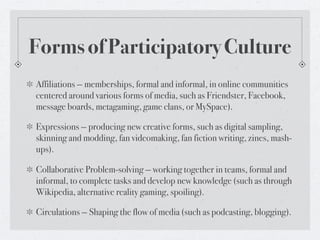
Forms of Participatory Culture
Affiliations — memberships, formal and informal, in online communities
centered around various forms of media, such as Friendster, Facebook,
message boards, metagaming, game clans, or MySpace).

Expressions — producing new creative forms, such as digital sampling,
skinning and modding, fan videomaking, fan fiction writing, zines, mash-
ups).

Collaborative Problem-solving — working together in teams, formal and
informal, to complete tasks and develop new knowledge (such as through
Wikipedia, alternative reality gaming, spoiling).

Circulations — Shaping the flow of media (such as podcasting, blogging).
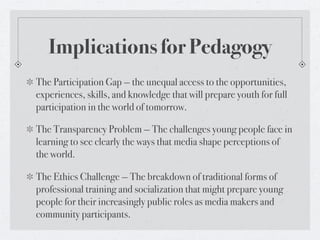
Implications for Pedagogy
The Participation Gap — the unequal access to the opportunities,
experiences, skills, and knowledge that will prepare youth for full
participation in the world of tomorrow.

The Transparency Problem — The challenges young people face in
learning to see clearly the ways that media shape perceptions of
the world.

The Ethics Challenge — The breakdown of traditional forms of
professional training and socialization that might prepare young
people for their increasingly public roles as media makers and
community participants.
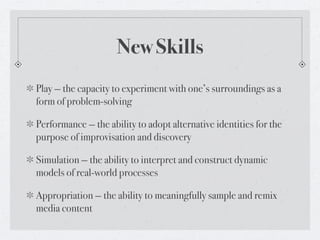
New Skills
Play — the capacity to experiment with one’s surroundings as a
form of problem-solving

Performance — the ability to adopt alternative identities for the
purpose of improvisation and discovery

Simulation — the ability to interpret and construct dynamic
models of real-world processes

Appropriation — the ability to meaningfully sample and remix
media content
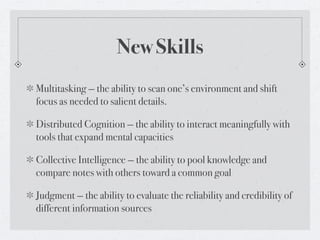
New Skills
Multitasking — the ability to scan one’s environment and shift
focus as needed to salient details.

Distributed Cognition — the ability to interact meaningfully with
tools that expand mental capacities

Collective Intelligence — the ability to pool knowledge and
compare notes with others toward a common goal

Judgment — the ability to evaluate the reliability and credibility of
different information sources
New Skills

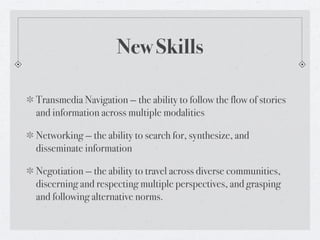
Transmedia Navigation — the ability to follow the flow of stories
and information across multiple modalities

Networking — the ability to search for, synthesize, and
disseminate information

Negotiation — the ability to travel across diverse communities,
discerning and respecting multiple perspectives, and grasping
and following alternative norms.
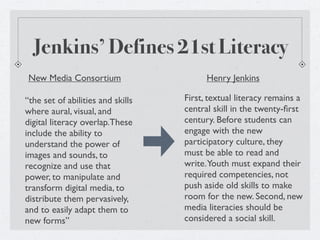
Jenkins’ Defines 21st Literacy
 New Media Consortium                    Henry Jenkins

“the set of abilities and skills   First, textual literacy remains a
where aural, visual, and           central skill in the twenty-first
digital literacy overlap.These     century. Before students can
include the ability to             engage with the new
understand the power of            participatory culture, they
images and sounds, to              must be able to read and
recognize and use that             write.Youth must expand their
power, to manipulate and           required competencies, not
transform digital media, to        push aside old skills to make
distribute them pervasively,       room for the new. Second, new
and to easily adapt them to        media literacies should be
new forms”                         considered a social skill.
What Might Be Done?
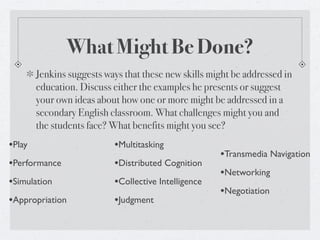
        Jenkins suggests ways that these new skills might be addressed in
        education. Discuss either the examples he presents or suggest
        your own ideas about how one or more might be addressed in a
        secondary English classroom. What challenges might you and
        the students face? What benefits might you see?
•Play                      •Multitasking
                                                      •Transmedia Navigation
•Performance               •Distributed Cognition
                                                      •Networking
•Simulation                •Collective Intelligence
                                                      •Negotiation
•Appropriation             •Judgment
Addressing Your Questions

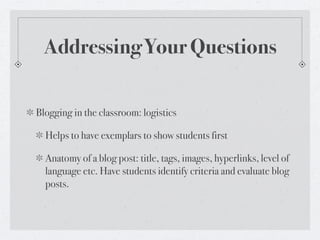
Blogging in the classroom: logistics

  Helps to have exemplars to show students first

  Anatomy of a blog post: title, tags, images, hyperlinks, level of
  language etc. Have students identify criteria and evaluate blog
  posts.
Blogging Logistics


Staying organized. Setting up an RSS Feed.

How to create an RSS Bundle in Google Reader
Blogging Logistics


Book Club Blog handout and rubric.

Assessment: What is a blog? (handout)
Video Games


Gaming Classroom Wiki
Classroom Management Tips

In a lab? Review procedures first: Teacher is talking=monitors
off.

Cell phones: depends on school policy, but I prefer to have them
out on the desk, face-down, and incorporate opportunities to use
the devices for learning eg/ Google SMS search

Focus on the behaviour, not the device.

A great blog on cellphones in the classroom.
Digital Citizenship
As a class, brainstorm guidelines for posting information online. Possible ideas
might be:

Never post personal information: address, phone number, email

Use first name and last initial only

Do not use others’ work without permission

Never say anything online that you wouldn’t say to a person’s face

Never post something you wouldn’t want your grandmother or a future boss to see

Be supportive and constructive

Post these guidelines somewhere visible. You may even have them post them as a
practice blog post
Restrictions/Filters


Find out who the computer administrator is for your school

Be able to articulate why you want to use the site

The kids know how to get around filters by using proxy servers
But I don’t have access to a
        computer lab...

Most schools now have wifi

Consider a BYOD policy (bring your own device)

Differentiated instruction: Not all students need to be doing the
same thing at the same time. Break students into smaller groups
and rotate tasks.
Final Tips


Get on Twitter! Follow this list!

Join the English Companion Ning

Pml9

  • 1.
    PML 9 Participatory culture:What does this mean for my future practice?
  • 2.
    Agenda Blogs Discussion of Jenkinsarticle Evaluations Your questions
  • 3.
    Participatory Culture a culturewith relatively low barriers to artistic expression and civic engagement, strong support for creating and sharing one’s creations, and some type of informal mentorship whereby what is known by the most experienced is passed along to novices.
  • 4.
    Forms of ParticipatoryCulture Affiliations — memberships, formal and informal, in online communities centered around various forms of media, such as Friendster, Facebook, message boards, metagaming, game clans, or MySpace). Expressions — producing new creative forms, such as digital sampling, skinning and modding, fan videomaking, fan fiction writing, zines, mash- ups). Collaborative Problem-solving — working together in teams, formal and informal, to complete tasks and develop new knowledge (such as through Wikipedia, alternative reality gaming, spoiling). Circulations — Shaping the flow of media (such as podcasting, blogging).
  • 5.
    Implications for Pedagogy TheParticipation Gap — the unequal access to the opportunities, experiences, skills, and knowledge that will prepare youth for full participation in the world of tomorrow. The Transparency Problem — The challenges young people face in learning to see clearly the ways that media shape perceptions of the world. The Ethics Challenge — The breakdown of traditional forms of professional training and socialization that might prepare young people for their increasingly public roles as media makers and community participants.
  • 6.
    New Skills Play —the capacity to experiment with one’s surroundings as a form of problem-solving Performance — the ability to adopt alternative identities for the purpose of improvisation and discovery Simulation — the ability to interpret and construct dynamic models of real-world processes Appropriation — the ability to meaningfully sample and remix media content
  • 7.
    New Skills Multitasking —the ability to scan one’s environment and shift focus as needed to salient details. Distributed Cognition — the ability to interact meaningfully with tools that expand mental capacities Collective Intelligence — the ability to pool knowledge and compare notes with others toward a common goal Judgment — the ability to evaluate the reliability and credibility of different information sources
  • 8.
    New Skills Transmedia Navigation— the ability to follow the flow of stories and information across multiple modalities Networking — the ability to search for, synthesize, and disseminate information Negotiation — the ability to travel across diverse communities, discerning and respecting multiple perspectives, and grasping and following alternative norms.
  • 9.
    Jenkins’ Defines 21stLiteracy New Media Consortium Henry Jenkins “the set of abilities and skills First, textual literacy remains a where aural, visual, and central skill in the twenty-first digital literacy overlap.These century. Before students can include the ability to engage with the new understand the power of participatory culture, they images and sounds, to must be able to read and recognize and use that write.Youth must expand their power, to manipulate and required competencies, not transform digital media, to push aside old skills to make distribute them pervasively, room for the new. Second, new and to easily adapt them to media literacies should be new forms” considered a social skill.
  • 10.
    What Might BeDone? Jenkins suggests ways that these new skills might be addressed in education. Discuss either the examples he presents or suggest your own ideas about how one or more might be addressed in a secondary English classroom. What challenges might you and the students face? What benefits might you see? •Play •Multitasking •Transmedia Navigation •Performance •Distributed Cognition •Networking •Simulation •Collective Intelligence •Negotiation •Appropriation •Judgment
  • 11.
    Addressing Your Questions Bloggingin the classroom: logistics Helps to have exemplars to show students first Anatomy of a blog post: title, tags, images, hyperlinks, level of language etc. Have students identify criteria and evaluate blog posts.
  • 12.
    Blogging Logistics Staying organized.Setting up an RSS Feed. How to create an RSS Bundle in Google Reader
  • 13.
    Blogging Logistics Book ClubBlog handout and rubric. Assessment: What is a blog? (handout)
  • 14.
  • 15.
    Classroom Management Tips Ina lab? Review procedures first: Teacher is talking=monitors off. Cell phones: depends on school policy, but I prefer to have them out on the desk, face-down, and incorporate opportunities to use the devices for learning eg/ Google SMS search Focus on the behaviour, not the device. A great blog on cellphones in the classroom.
  • 16.
    Digital Citizenship As aclass, brainstorm guidelines for posting information online. Possible ideas might be: Never post personal information: address, phone number, email Use first name and last initial only Do not use others’ work without permission Never say anything online that you wouldn’t say to a person’s face Never post something you wouldn’t want your grandmother or a future boss to see Be supportive and constructive Post these guidelines somewhere visible. You may even have them post them as a practice blog post
  • 17.
    Restrictions/Filters Find out whothe computer administrator is for your school Be able to articulate why you want to use the site The kids know how to get around filters by using proxy servers
  • 18.
    But I don’thave access to a computer lab... Most schools now have wifi Consider a BYOD policy (bring your own device) Differentiated instruction: Not all students need to be doing the same thing at the same time. Break students into smaller groups and rotate tasks.
  • 19.
    Final Tips Get onTwitter! Follow this list! Join the English Companion Ning