
Networked Learning:  experience the educational power of the network and the participatory culture of the web Honor Moorman  Internship and Service Learning Coordinator The International School of the Americas San Antonio, Texas
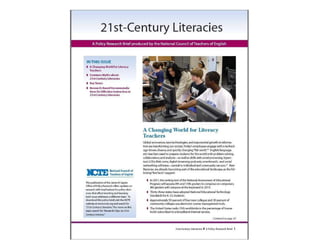
“ As new technologies shape literacies, they bring opportunities for teachers at all levels to foster reading and writing in more diverse and participatory contexts.” “ A Changing World for Literacy Teachers”  21 st -Century  Literacies : A Policy Research Brief National Council of Teachers of English, 2007
 
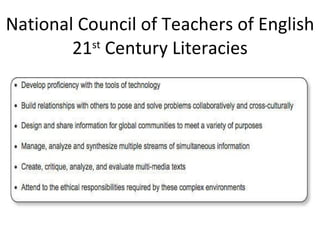
National Council of Teachers of English 21 st  Century Literacies
What are these new technologies  & how are they shaping literacies? “ The read/write web changes everything”  ~Will Richardson
“ Web 2.0 is an umbrella term that is used to refer to a new era of Web-enabled applications that are built around user-generated or user-manipulated content, such as wikis, blogs, podcasts, and social networking sites.” Pew Internet and American Life Project  “Research on Web 2.0”
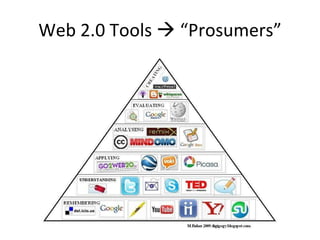
Web 2.0 Tools    “Prosumers”
A Brief History of Web 2.0 Blogs Wikis Social Networking Resources for further information: “7 Things You Should Know About . . . ”  from Educause Learning Initiative Links to School Bloggers Examples of Educational Wikis
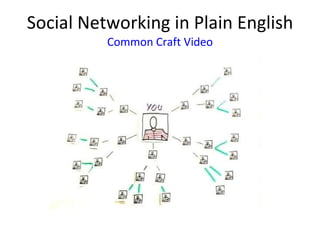
Social Networking in Plain English Common Craft Video
“ Participatory culture shifts the focus of literacy from one of individual expression to community involvement.” Confronting the Challenge of Participatory Culture: Media Education for the 21 st  Century Henry Jenkins, et al MacArthur Foundation, 2006
 
“ Literacy encompasses reading, writing, and a variety of social and intellectual practices that call upon the voice as well as the eye and hand. It also extends to new media—including non-digitized multimedia, digitized multimedia, and hypertext or hypermedia.” Adolescent Literacy: A Policy Research Brief National Council of Teachers of English, 2007
“ Literacy has always been a collection of cultural and communicative practices shared among members of particular groups. As society and technology change, so does literacy. Because technology has increased the intensity and complexity of literate environments, the 21 st  century demands that a literate person possess a wide range of abilities and competencies, many literacies.” Adolescent Literacy: A Policy Research Brief National Council of Teachers of English, 2007
“ Literacy has always been a collection of  cultural and communicative practices shared among members of particular groups.  As society and technology change, so does literacy. Because technology has increased the intensity and complexity of literate environments, the 21 st  century demands that a literate person possess a wide range of abilities and competencies, many literacies.” NCTE Framework for 21st Century Curriculum and Assessment adopted Nov. 19, 2008
“ These literacies—from reading online newspapers to participating in virtual classrooms—are multiple, dynamic, and malleable. As in the past, they are inextricably linked with particular histories, life possibilities, and social trajectories of individuals and groups.” NCTE Framework for 21st Century Curriculum and Assessment adopted Nov. 19, 2008
New Literacy Skills Needed in a Participatory Culture Play Performance Simulation Appropriation Multitasking Distributed Cognition Collective Intelligence Judgment Transmedia Navigation Networking Negotiation
 
8 Roles and Responsibilities  that will create the new middle class Collaborators and orchestrators Synthesizers Explainers Leveragers Adapters Green People Personalizers Localizers Thomas Friedman,  The World is Flat , chapter 6
 
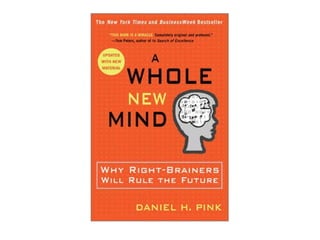
Why Right-Brainers Will Rule the Future Agricultural Age (farmers)  Industrial Age (factory workers)  Information Age (knowledge workers)  Conceptual Age (creators and empathizers) “ A Whole New Mind  reveals the six essential aptitudes on which professional success and personal fulfillment now depend . . .” Daniel Pink,  A Whole New Mind
Daniel Pink’s “Six Senses” Design  - Moving beyond function to engage the sense.  Story  - Narrative added to products and services - not just argument. Best of the six senses.  Symphony  - Adding invention and big picture thinking (not just detail focus).  Empathy  - Going beyond logic and engaging emotion and intuition.  Play  - Bringing humor and light-heartedness to business and products.  Meaning  - Immaterial feelings and values of products. Daniel Pink,  A Whole New Mind
How I Discovered Ning “ Did You Know”/“Did You Know 2.0”  ~Karl Fisch and Scott McCloud Exponential change, technological innovation, globalization, mass collaboration “ The Machine is Us/ing Us” ~Michael Wesch “ There’s a blog born every half second” ~Candace Lombardi, CNET.com, Aug. 7, 2006
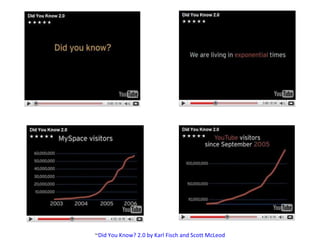
~ Did You Know? 2.0 by Karl Fisch and Scott McLeod
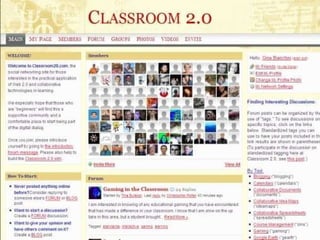
How I Discovered Ning, cont. My impetus to begin blogging Need to read other blogs Ed Tech Bloggers’ Blogrolls Edublog Awards Classroom 2.0  - “the social network for those interested in Web 2.0 and collaborative technologies in education”
 
Ning Social Networks “ the aggregation of a set of web tools for building connections, community, and content” ~Steve Hargadon, Classroom 2.0 Blogging – you have to publish to an empty room for a while before you get noticed Social network – you have a built-in audience and interactive community
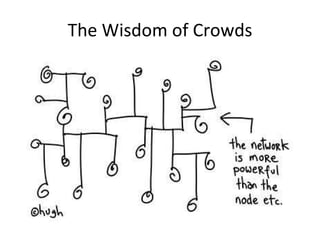
The Wisdom of Crowds
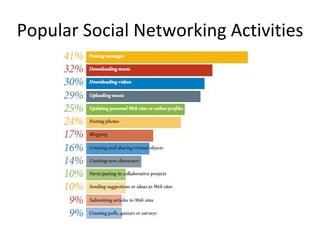
2 Reasons to Incorporate Social Networking in Education #1 – The world is doing it 71% of students with online access use social networking tools on a weekly basis #2 – It’s pedagogically sound Aggregation of tools that together provide for collaboration and learning
Popular Social Networking Activities
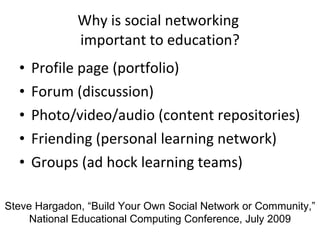
Why is social networking  important to education? Profile page (portfolio) Forum (discussion) Photo/video/audio (content repositories) Friending (personal learning network) Groups (ad hock learning teams) Steve Hargadon, “Build Your Own Social Network or Community,” National Educational Computing Conference, July 2009
 
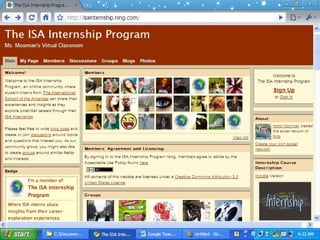
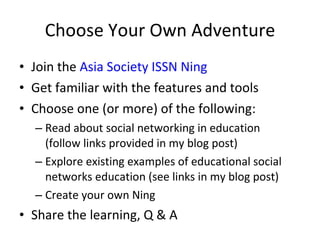
Choose Your Own Adventure Join the  Asia Society ISSN Ning Get familiar with the features and tools Choose one (or more) of the following: Read about social networking in education  (follow links provided in my blog post) Explore existing examples of educational social networks education (see links in my blog post) Create your own Ning Share the learning, Q & A

Networked Learning

  • 1.
    Networked Learning: experience the educational power of the network and the participatory culture of the web Honor Moorman Internship and Service Learning Coordinator The International School of the Americas San Antonio, Texas
  • 2.
    “ As newtechnologies shape literacies, they bring opportunities for teachers at all levels to foster reading and writing in more diverse and participatory contexts.” “ A Changing World for Literacy Teachers” 21 st -Century Literacies : A Policy Research Brief National Council of Teachers of English, 2007
  • 3.
  • 4.
    National Council ofTeachers of English 21 st Century Literacies
  • 5.
    What are thesenew technologies & how are they shaping literacies? “ The read/write web changes everything” ~Will Richardson
  • 6.
    “ Web 2.0is an umbrella term that is used to refer to a new era of Web-enabled applications that are built around user-generated or user-manipulated content, such as wikis, blogs, podcasts, and social networking sites.” Pew Internet and American Life Project “Research on Web 2.0”
  • 7.
    Web 2.0 Tools  “Prosumers”
  • 8.
    A Brief Historyof Web 2.0 Blogs Wikis Social Networking Resources for further information: “7 Things You Should Know About . . . ” from Educause Learning Initiative Links to School Bloggers Examples of Educational Wikis
  • 9.
    Social Networking inPlain English Common Craft Video
  • 10.
    “ Participatory cultureshifts the focus of literacy from one of individual expression to community involvement.” Confronting the Challenge of Participatory Culture: Media Education for the 21 st Century Henry Jenkins, et al MacArthur Foundation, 2006
  • 11.
  • 12.
    “ Literacy encompassesreading, writing, and a variety of social and intellectual practices that call upon the voice as well as the eye and hand. It also extends to new media—including non-digitized multimedia, digitized multimedia, and hypertext or hypermedia.” Adolescent Literacy: A Policy Research Brief National Council of Teachers of English, 2007
  • 13.
    “ Literacy hasalways been a collection of cultural and communicative practices shared among members of particular groups. As society and technology change, so does literacy. Because technology has increased the intensity and complexity of literate environments, the 21 st century demands that a literate person possess a wide range of abilities and competencies, many literacies.” Adolescent Literacy: A Policy Research Brief National Council of Teachers of English, 2007
  • 14.
    “ Literacy hasalways been a collection of cultural and communicative practices shared among members of particular groups. As society and technology change, so does literacy. Because technology has increased the intensity and complexity of literate environments, the 21 st century demands that a literate person possess a wide range of abilities and competencies, many literacies.” NCTE Framework for 21st Century Curriculum and Assessment adopted Nov. 19, 2008
  • 15.
    “ These literacies—fromreading online newspapers to participating in virtual classrooms—are multiple, dynamic, and malleable. As in the past, they are inextricably linked with particular histories, life possibilities, and social trajectories of individuals and groups.” NCTE Framework for 21st Century Curriculum and Assessment adopted Nov. 19, 2008
  • 16.
    New Literacy SkillsNeeded in a Participatory Culture Play Performance Simulation Appropriation Multitasking Distributed Cognition Collective Intelligence Judgment Transmedia Navigation Networking Negotiation
  • 17.
  • 18.
    8 Roles andResponsibilities that will create the new middle class Collaborators and orchestrators Synthesizers Explainers Leveragers Adapters Green People Personalizers Localizers Thomas Friedman, The World is Flat , chapter 6
  • 19.
  • 20.
    Why Right-Brainers WillRule the Future Agricultural Age (farmers) Industrial Age (factory workers) Information Age (knowledge workers) Conceptual Age (creators and empathizers) “ A Whole New Mind reveals the six essential aptitudes on which professional success and personal fulfillment now depend . . .” Daniel Pink, A Whole New Mind
  • 21.
    Daniel Pink’s “SixSenses” Design - Moving beyond function to engage the sense. Story - Narrative added to products and services - not just argument. Best of the six senses. Symphony - Adding invention and big picture thinking (not just detail focus). Empathy - Going beyond logic and engaging emotion and intuition. Play - Bringing humor and light-heartedness to business and products. Meaning - Immaterial feelings and values of products. Daniel Pink, A Whole New Mind
  • 22.
    How I DiscoveredNing “ Did You Know”/“Did You Know 2.0” ~Karl Fisch and Scott McCloud Exponential change, technological innovation, globalization, mass collaboration “ The Machine is Us/ing Us” ~Michael Wesch “ There’s a blog born every half second” ~Candace Lombardi, CNET.com, Aug. 7, 2006
  • 23.
    ~ Did YouKnow? 2.0 by Karl Fisch and Scott McLeod
  • 24.
    How I DiscoveredNing, cont. My impetus to begin blogging Need to read other blogs Ed Tech Bloggers’ Blogrolls Edublog Awards Classroom 2.0 - “the social network for those interested in Web 2.0 and collaborative technologies in education”
  • 25.
  • 26.
    Ning Social Networks“ the aggregation of a set of web tools for building connections, community, and content” ~Steve Hargadon, Classroom 2.0 Blogging – you have to publish to an empty room for a while before you get noticed Social network – you have a built-in audience and interactive community
  • 27.
  • 28.
    2 Reasons toIncorporate Social Networking in Education #1 – The world is doing it 71% of students with online access use social networking tools on a weekly basis #2 – It’s pedagogically sound Aggregation of tools that together provide for collaboration and learning
  • 29.
  • 30.
    Why is socialnetworking important to education? Profile page (portfolio) Forum (discussion) Photo/video/audio (content repositories) Friending (personal learning network) Groups (ad hock learning teams) Steve Hargadon, “Build Your Own Social Network or Community,” National Educational Computing Conference, July 2009
  • 31.
  • 32.
    Choose Your OwnAdventure Join the Asia Society ISSN Ning Get familiar with the features and tools Choose one (or more) of the following: Read about social networking in education (follow links provided in my blog post) Explore existing examples of educational social networks education (see links in my blog post) Create your own Ning Share the learning, Q & A