Web 2.0: turning passive learners into active learners By Jonathan Civitella  M.Ed. Technology in Education Lesley University Created for International School of Trieste INSET March 19, 2010
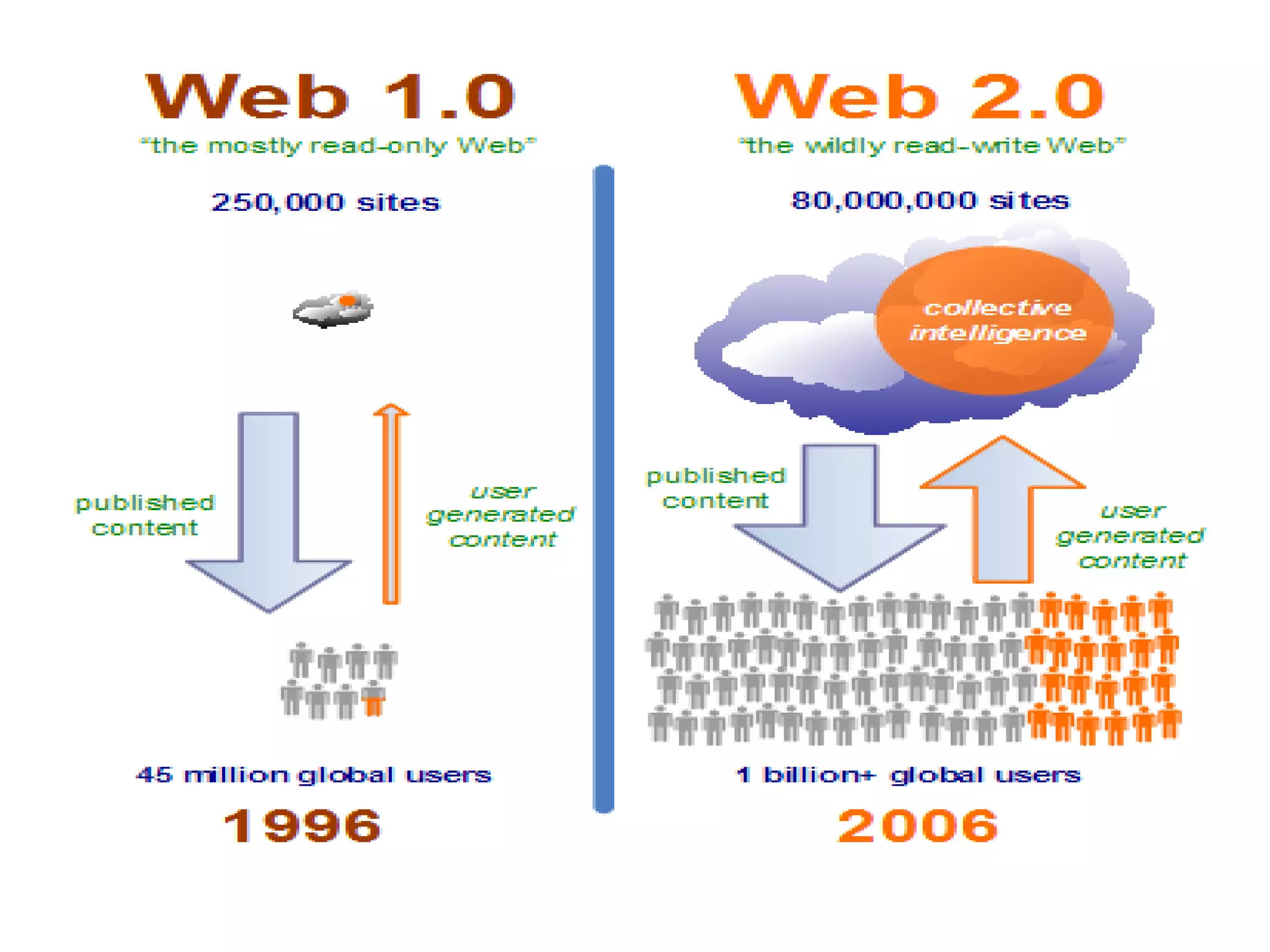
What is Web 2.0? Term coined by O’Reilly Media in 2004 Business     Education Users as co-developers  Harnessing collective intelligence  Open Source software Web 1.0 versus Web 2.0 Reading     Writing Companies     Communities  Owning     Sharing Wires     Wireless Web 2.0: An Introduction
 
“ Today's [digital learners] brains are shaped by various information streams… constantly popping and sparking and competing for attention” ( Susan Blackmore, Ph.D in Psychology, Oxford University ) “ Young people (ages 8-18) mainline electronic media for more than six hours a day, on average” ( Henry J. Kaiser Family Foundation ) “ Students attitudes towards learning and their own self-concept improved consistently when computers were being used” ( Jay Sivin-Kachala research study 1998 ) “ [computer usage] Maximizes student reflection and encourages progressive thought, taking multiple perspectives, and independent thinking” ( Scardamalia & Bereiter’s CSILE studies 1996 ) Web 2.0: Studies Have Shown…
Web 2.0: +/- Positives Extends learning (school to home) Grabs/holds attention Relevance (utilizing  their  tools) Personalization (individual education) Globalization  Special Education Negatives Focus (technology  over  education) Dependency (reliable resources) Power shift (teacher to community) Credibility (objective or subjective) Disposition/Social (introvert over extrovert) Digital Native versus Digital Immigrant (student versus teacher)
 
Benefits Students learn at their own pace, wherever and whenever they want (put iPods to good use) Provide supplemental information Post-secondary preparation Stay connected/informed Create original audio content Audacity   Free audio editor and recorder Example: Operation Bernhard  Utilize existing content iTunes U free educational media  Example: Introduction to Spanish Web 2.0: Podcasting
Benefits Collaboration (student    student; student    teacher; teacher    teacher) Accessibility Interactive  Peer to peer editing Accountability  Create/edit original written content PBWorks Free online collaboration forum Example: Colleagues building an educational database  Web 2.0: Wiki’s
Benefits Bloom’s categories (analysis; synthesis; etc.) Engaging Interactive  Personalization  Research  Assessments  for  learning  (help students learn) WebQuest Guiding questions & Internet links Example: Visiting the BBC WWI Web site (i.e. text; flash; simulations) Assessments  of  learning  (verify achievement) ePortfolio Collection of evidence (online) Example: Upload compare/contrast paper on George Orwell’s novels Web 2.0: Assessments
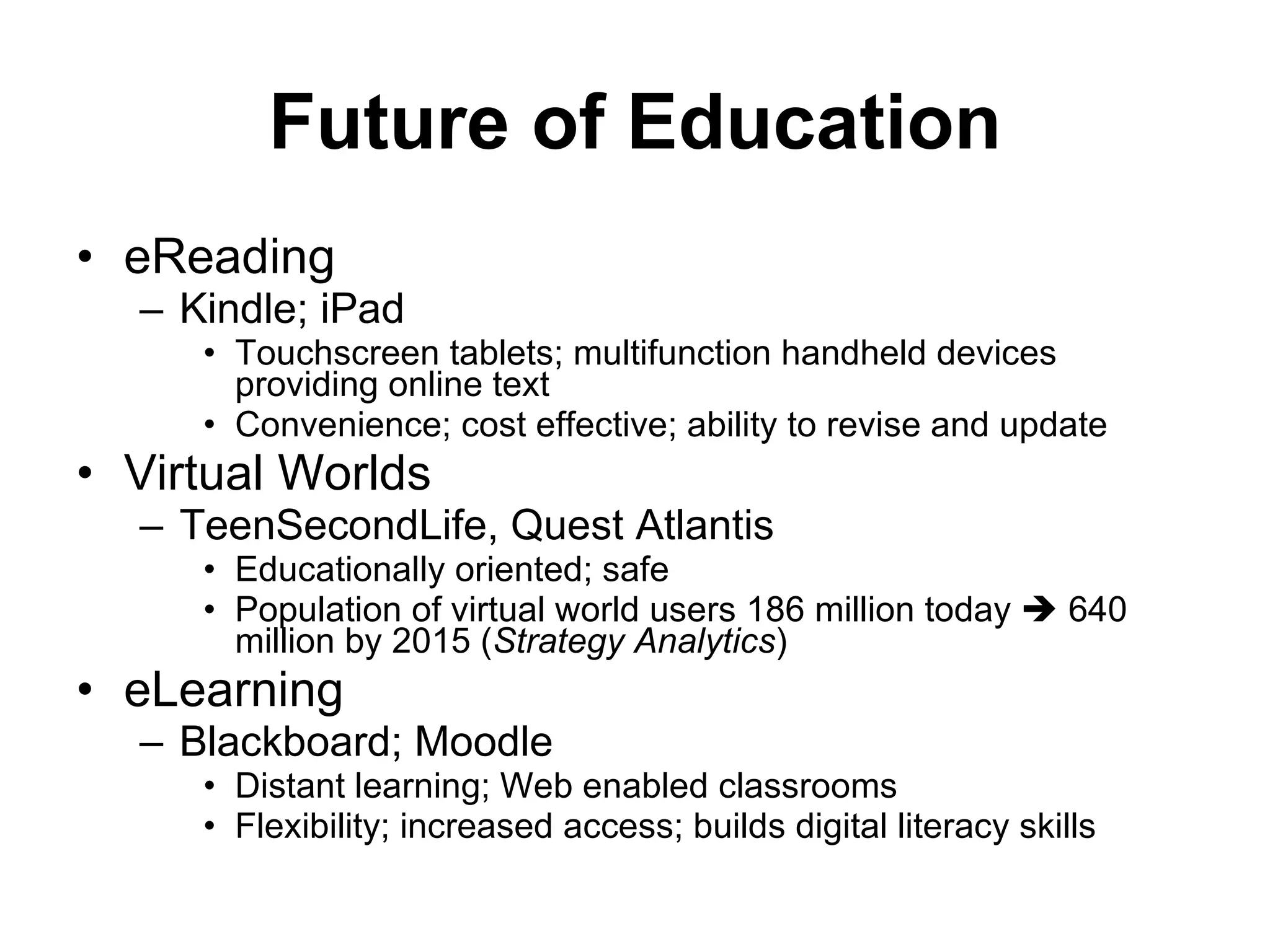
eReading Kindle; iPad Touchscreen tablets; multifunction handheld devices providing online text Convenience; cost effective; ability to revise and update  Virtual Worlds TeenSecondLife, Quest Atlantis Educationally oriented; safe  Population of virtual world users 186 million today    640 million by 2015 ( Strategy Analytics ) eLearning Blackboard; Moodle Distant learning; Web enabled classrooms Flexibility; increased access; builds digital literacy skills Future of Education
Rework lesson to incorporate Web 2.0 Web 2.0: Closing Activity
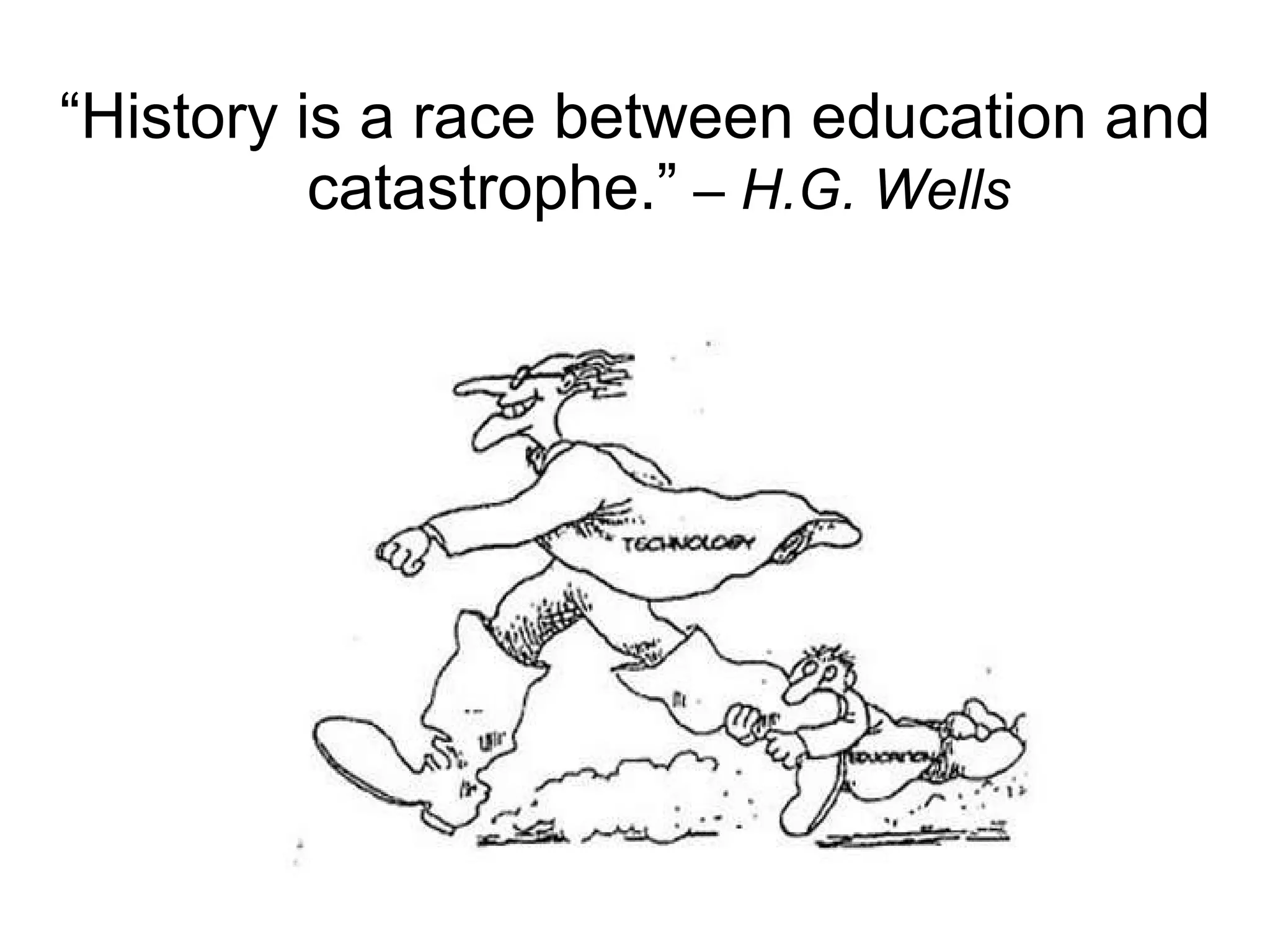
“ History is a race between education and catastrophe.”  –  H.G. Wells
ONLINE EDUCA December 2-4, 2009, Berlin, Germany  Debate - Technology and social software is damaging student’s minds and undermining the benefits of traditional methods of learning (view  debate ) Video - We Are The People Movie (educational reform, directed by Lord Puttnam – view  video ) Further Information
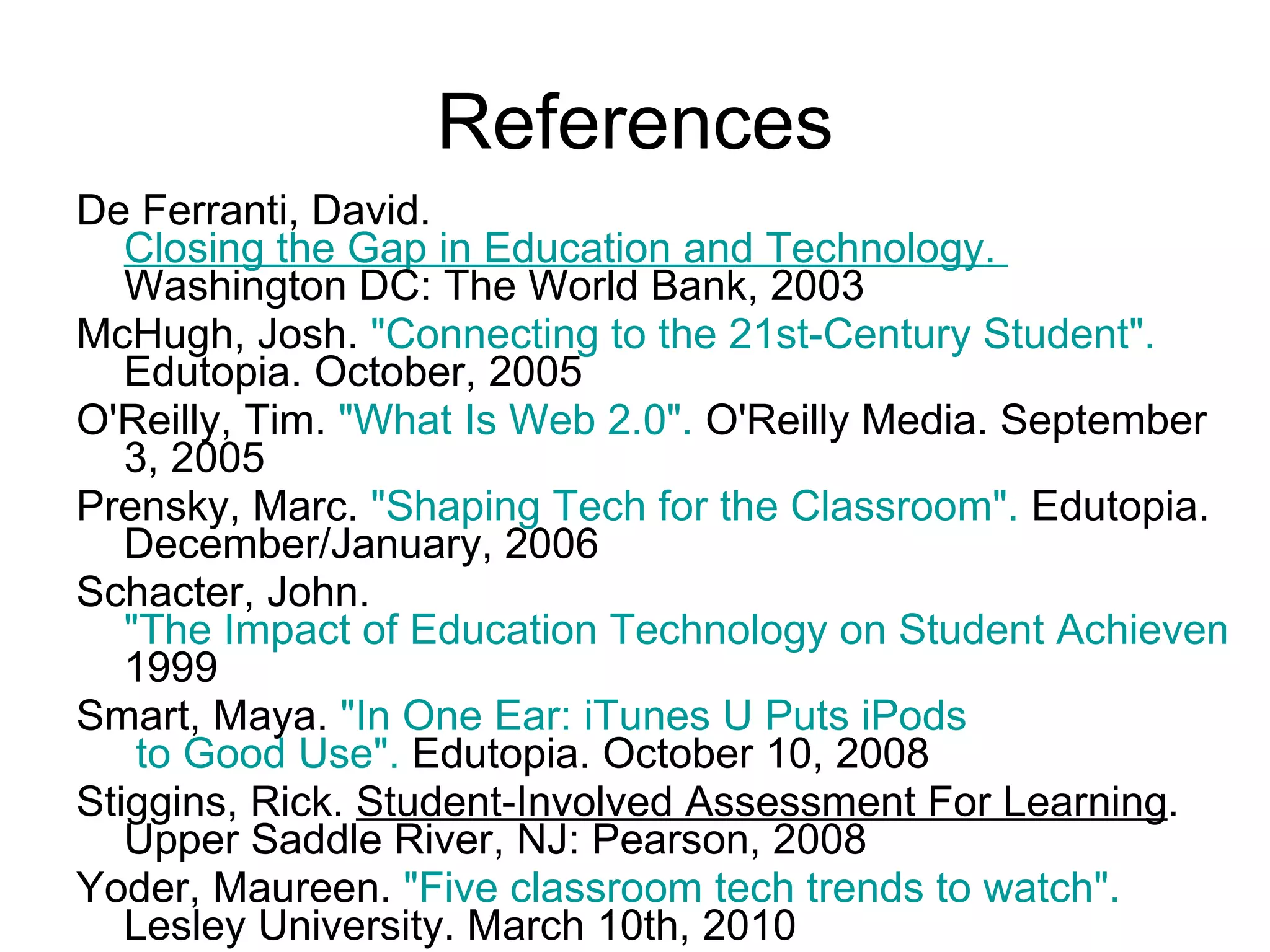
De Ferranti, David.  Closing the Gap in Education and Technology .  Washington DC: The World Bank, 2003 McHugh, Josh.  "Connecting to the 21st-Century Student".  Edutopia. October, 2005  O'Reilly, Tim.  "What Is Web 2.0".  O'Reilly Media. September 3, 2005  Prensky, Marc.  "Shaping Tech for the Classroom".  Edutopia. December/January, 2006  Schacter, John.  "The Impact of Education Technology on Student Achievement".  1999  Smart, Maya.  "In One Ear:  iTunes  U Puts  iPods  to Good Use".  Edutopia. October 10, 2008  Stiggins, Rick.  Student-Involved Assessment For Learning . Upper Saddle River, NJ: Pearson, 2008 Yoder, Maureen.  "Five classroom tech trends to watch".  Lesley University. March 10th, 2010  References

Web 2point0

  • 1.
    Web 2.0: turningpassive learners into active learners By Jonathan Civitella M.Ed. Technology in Education Lesley University Created for International School of Trieste INSET March 19, 2010
  • 2.
    What is Web2.0? Term coined by O’Reilly Media in 2004 Business  Education Users as co-developers Harnessing collective intelligence Open Source software Web 1.0 versus Web 2.0 Reading  Writing Companies  Communities Owning  Sharing Wires  Wireless Web 2.0: An Introduction
  • 3.
  • 4.
    “ Today's [digitallearners] brains are shaped by various information streams… constantly popping and sparking and competing for attention” ( Susan Blackmore, Ph.D in Psychology, Oxford University ) “ Young people (ages 8-18) mainline electronic media for more than six hours a day, on average” ( Henry J. Kaiser Family Foundation ) “ Students attitudes towards learning and their own self-concept improved consistently when computers were being used” ( Jay Sivin-Kachala research study 1998 ) “ [computer usage] Maximizes student reflection and encourages progressive thought, taking multiple perspectives, and independent thinking” ( Scardamalia & Bereiter’s CSILE studies 1996 ) Web 2.0: Studies Have Shown…
  • 5.
    Web 2.0: +/-Positives Extends learning (school to home) Grabs/holds attention Relevance (utilizing their tools) Personalization (individual education) Globalization Special Education Negatives Focus (technology over education) Dependency (reliable resources) Power shift (teacher to community) Credibility (objective or subjective) Disposition/Social (introvert over extrovert) Digital Native versus Digital Immigrant (student versus teacher)
  • 6.
  • 7.
    Benefits Students learnat their own pace, wherever and whenever they want (put iPods to good use) Provide supplemental information Post-secondary preparation Stay connected/informed Create original audio content Audacity Free audio editor and recorder Example: Operation Bernhard Utilize existing content iTunes U free educational media Example: Introduction to Spanish Web 2.0: Podcasting
  • 8.
    Benefits Collaboration (student  student; student  teacher; teacher  teacher) Accessibility Interactive Peer to peer editing Accountability Create/edit original written content PBWorks Free online collaboration forum Example: Colleagues building an educational database Web 2.0: Wiki’s
  • 9.
    Benefits Bloom’s categories(analysis; synthesis; etc.) Engaging Interactive Personalization Research Assessments for learning (help students learn) WebQuest Guiding questions & Internet links Example: Visiting the BBC WWI Web site (i.e. text; flash; simulations) Assessments of learning (verify achievement) ePortfolio Collection of evidence (online) Example: Upload compare/contrast paper on George Orwell’s novels Web 2.0: Assessments
  • 10.
    eReading Kindle; iPadTouchscreen tablets; multifunction handheld devices providing online text Convenience; cost effective; ability to revise and update Virtual Worlds TeenSecondLife, Quest Atlantis Educationally oriented; safe Population of virtual world users 186 million today  640 million by 2015 ( Strategy Analytics ) eLearning Blackboard; Moodle Distant learning; Web enabled classrooms Flexibility; increased access; builds digital literacy skills Future of Education
  • 11.
    Rework lesson toincorporate Web 2.0 Web 2.0: Closing Activity
  • 12.
    “ History isa race between education and catastrophe.” – H.G. Wells
  • 13.
    ONLINE EDUCA December2-4, 2009, Berlin, Germany Debate - Technology and social software is damaging student’s minds and undermining the benefits of traditional methods of learning (view debate ) Video - We Are The People Movie (educational reform, directed by Lord Puttnam – view video ) Further Information
  • 14.
    De Ferranti, David. Closing the Gap in Education and Technology . Washington DC: The World Bank, 2003 McHugh, Josh. "Connecting to the 21st-Century Student". Edutopia. October, 2005 O'Reilly, Tim. "What Is Web 2.0". O'Reilly Media. September 3, 2005 Prensky, Marc. "Shaping Tech for the Classroom". Edutopia. December/January, 2006 Schacter, John. "The Impact of Education Technology on Student Achievement". 1999 Smart, Maya. "In One Ear: iTunes U Puts iPods to Good Use". Edutopia. October 10, 2008 Stiggins, Rick. Student-Involved Assessment For Learning . Upper Saddle River, NJ: Pearson, 2008 Yoder, Maureen. "Five classroom tech trends to watch". Lesley University. March 10th, 2010 References