























Middle School BE Courses: When They’re
Not Looking…Throw in 21st Century Skills!


                   Melanie Wiscount
                   Hershey Middle School – Derry Township School District
                   NBEA 2008 Convention – San Antonio, TX
                   March 20, 2008
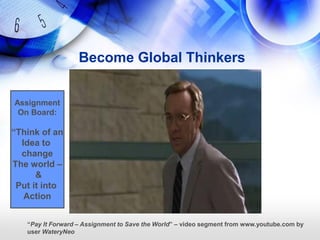
Become Global Thinkers


Assignment
 On Board:

“Think of an
  Idea to
  change
The world –
      &
 Put it into
   Action


   “Pay It Forward – Assignment to Save the World” – video segment from www.youtube.com by
   user WateryNeo
The World is Different


“World is in my hand” - Photo from flickr.com ~by simply fred
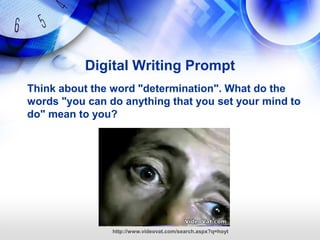
Digital Writing Prompt
Think about the word "determination". What do the
words "you can do anything that you set your mind to
do" mean to you?


                http://www.videovat.com/search.aspx?q=hoyt
Things to Think About…
 Internet users ages 12 to 28 years old have
  embraced the online applications that enable
  communicative, creative, and social uses.

 The growth rate of China's internet user
  population has been outpacing that of the U.S.,
  and China is projected to overtake the U.S. in the
  total number of users within a few years.
http://www.pewinternet.org
Things To Think About…

        Internet became available to the average
         American less than a decade ago
        Moore‘s Law
        Metcalf‘s Law


"Children are native to cyberspace and we, as adults, are immigrants."
“Playing the Future” Douglas Rushkoff (2001, personal communication)
What Did We Do Before the Internet?
 54% in the number of adults who said the internet played a major role as
  they helped another person cope with a major illness
 50% in the number who said the internet played a major role as they
  pursued more training for their careers
 45% in the number who said the internet played a major role as they
  made major investment or financial decisions
 43% in the number who said the internet played a major role when they
  looked for a new place to live
 42% in the number who said the internet played a major role as they
  decided about a school or a college for themselves or their children
 23% in the number who said the internet played a major role when they
  bought a car

  http://www.pewinternet.org/PPF/r/181/report_display.asp
How Can We Describe Our Students'
         Generation?
    • Computers aren‘t technology.
    • The Internet is better than TV.
    • Reality is no longer real.
    • Doing is more important than knowing.
    • Learning more closely resembles Nintendo than
      logic.
    • Multitasking is a way of life.
    • Typing is preferred to handwriting.
    • Staying connected is essential.
    • There is zero tolerance for delays.
    • Consumer and creator are blurring.
McMahon, Tim & Huette, Scott. (2005) The Net Generation Comes to
College! University of Oregon.
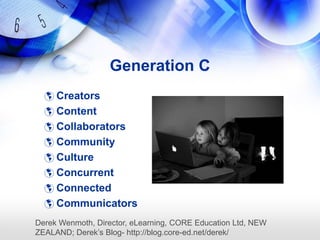
Generation C
   Creators
   Content
   Collaborators
   Community
   Culture
   Concurrent
   Connected
   Communicators
Derek Wenmoth, Director, eLearning, CORE Education Ltd, NEW
ZEALAND; Derek‘s Blog- http://blog.core-ed.net/derek/
Gwen's Communication for the
       Month of December
 Text messages - 904 messages
 Voice cell phone - 1,000 minutes
 AIM messages - 2880 messages sent
 FaceBook - Check 10 times daily
 MySpace - Check 2 times daily
 Bloom. U. Email - 24 emails
Socialized in a Different Way
"Different kinds of experiences lead to different kinds of brain
structures."
                     Dr. Bruce D. Berry, Baylor College of Medicine

 10,000 hours playing video games
 Over 200,000 instant messages & emails
 Over 10,000 hours talking on cell phones
 Over 20,000 hours watching TV
 At the most 5,000 hours reading

   Prensky, Marc. "Do They Really Think Differently?". On the Horizon
   (NCB University Press, Vo 6, December 2001) l. 9
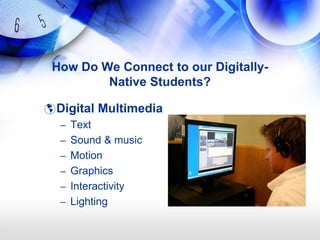
How Do We Connect to our Digitally-
         Native Students?

 Digital Multimedia
  – Text
  – Sound & music
  – Motion
  – Graphics
  – Interactivity
  – Lighting
National Economy

"The current and future health of America's 21st
  century economy depends directly on how
  broadly and deeply Americans reach a new
  level of literacy—'21st Century Literacy' "

            The 21st Century Workforce Commission's (2000)
            National Alliance of Business
The New Responsibility of Citizen

―The explosive growth of technology in every
  aspect of society offers us a unique
  opportunity to engage our citizens in
  economic and civic life "

            The 21st Century Workforce Commission's (2000)
            National Alliance of Business
Technology

―Information and communication technologies
   are raising the bar on the competencies
   needed to succeed in the 21st century "


            The 21st Century Workforce Commission's (2000)
            National Alliance of Business
Our Graduates Need to be:
    – a critical thinker
    – a problem solver
    – an innovator
    – an effective communicator
    – an effective collaborator
    – information and media literate
    – globally aware
    – civically engaged
    – financially and economically literate
Preparing Students for Jobs That Do Not Exist, Chris Pearson, August 16, 2007
http://squeakymouse.wordpress.com/2007/08/16/preparing-students-for-jobs-that-
do-not-exist/
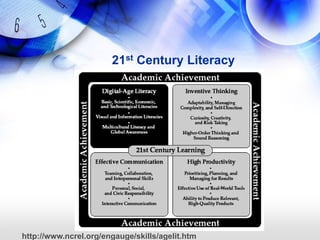
21st Century Literacy

 Digital Age literacy
 Inventive Thinking
 Effective Communication
 High Productivity
21st Century Literacy


http://www.ncrel.org/engauge/skills/agelit.htm
Learning Objectives

 Explore how we as teachers can effectively
  provide experiences that ‗connect‘ to the
  global society of the 21st century learner

 Infuse 21st century skills by using Web 2.0
  resources & tools that can be integrated into
  business education curriculum
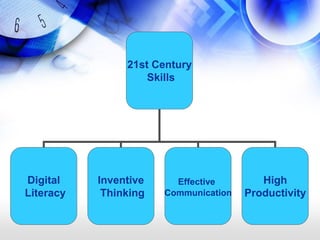
21st Century
                    Skills


Digital    Inventive     Effective        High
Literacy    Thinking   Communication   Productivity
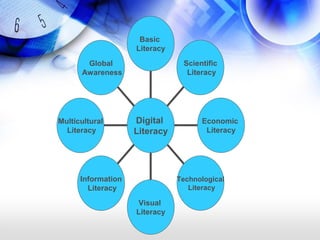
Basic
                    Literacy
       Global                   Scientific
      Awareness                  Literacy


Multicultural       Digital          Economic
  Literacy          Literacy          Literacy


      Information              Technological
        Literacy                  Literacy

                    Visual
                    Literacy
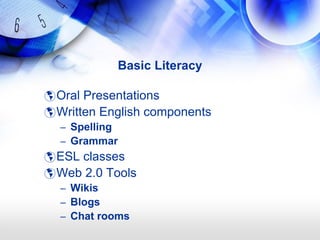
Basic Literacy

 Oral Presentations
 Written English components
  – Spelling
  – Grammar
 ESL classes
 Web 2.0 Tools
  – Wikis
  – Blogs
  – Chat rooms
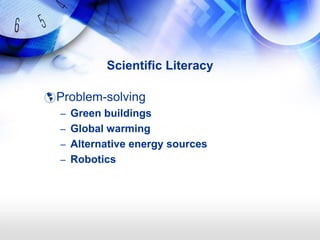
Scientific Literacy

 Problem-solving
  – Green buildings
  – Global warming
  – Alternative energy sources
  – Robotics
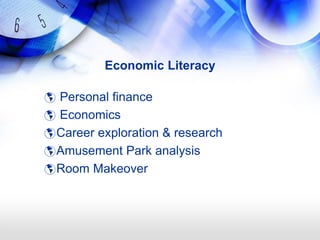
Economic Literacy

 Personal finance
 Economics
 Career exploration & research
 Amusement Park analysis
 Room Makeover
Visual Literacy

 Photo-editing
 Video creation & editing
 MovieMaker
 Flikr
 Asterpix Interactive Video
 YouTube
 Tutorials
Information Literacy

 Smart Searching
 Scavenger Hits
 Google – one hit
 Social networking
Multicultural Literacy
Global Awareness
Technological Literacy
What is Web 2.0?
     ―an emerging network-centric platform to
       support distributed, collaborative and
       cumulative creation by its users.‖
      John Hagel, Business, Strategy, and Technology Speaker
      http://www.readwriteweb.com/archives/web_20_elevator.php

 More social – more communication
 More collaborative
 Content created by users
 Services can be built coordinating data and code
  from other services
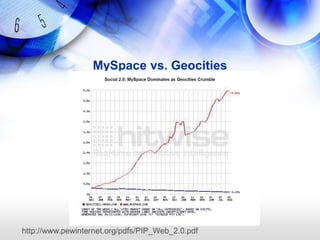
MySpace vs. Geocities


http://www.pewinternet.org/pdfs/PIP_Web_2.0.pdf
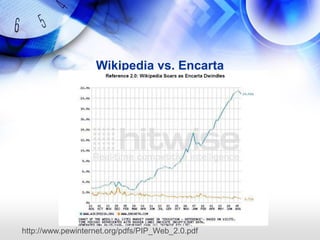
Wikipedia vs. Encarta


http://www.pewinternet.org/pdfs/PIP_Web_2.0.pdf
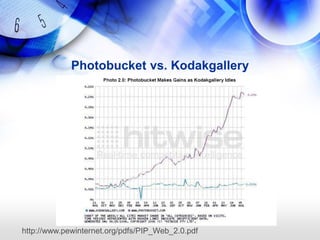
Photobucket vs. Kodakgallery


http://www.pewinternet.org/pdfs/PIP_Web_2.0.pdf
Social Bookmarking
       Users save bookmarks to a publicly accessible
        web site
             – Make your bookmarks available on multiple
               computers
             – Share your bookmarks with a group of
               colleagues and see their bookmarks
             – Share your bookmarks with the wider Internet
 •Del.icio.us
 •digg.com
 •Technorati.com
http://newsletter.blizzardinternet.com/advantages-of-social-bookmarking-for-
smbs-and-hospitality-businesses/2006/07/31/
Social Bookmarking Project
User Ratings Project
Blogging

 Technorati now tracks over 35.3 Million blogs
 The blogosphere is doubling in size every 6
  months
 It is now over 60 times bigger than it was 3 years
  ago
 On average, a new weblog is created every
  second of every day
 19.4 million bloggers (55%) are still posting 3
  months after their blogs are created
 Technorati tracks about 1.2 Million new blog posts
  each day, about 50,000 per hour
Blogging Projects
Wikis
Wikis Projects
WiFi
Podcasts
Podcasting Project

 Vozme.com
Photo Editing
Online Tools
Online Applications

 Zoho
 Picasa
 Google docs
Technology for the Teacher
Google Docs
Open Office
Voice Recognition
MovieMaker
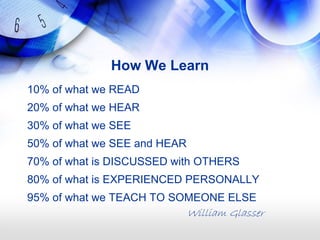
How We Learn
10% of what we READ
20% of what we HEAR
30% of what we SEE
50% of what we SEE and HEAR
70% of what is DISCUSSED with OTHERS
80% of what is EXPERIENCED PERSONALLY
95% of what we TEACH TO SOMEONE ELSE
                              William Glasser
Activities
 Grouping
 Student Choice
 Shout Outs
 Post-Its Graffiti
 Writing Prompts
Writing Prompt
Writing Prompt

   Scenario One

   Scenario Two

   Scenario Three
Activities

 Information Seekers
 Write/Wipe Boards
 Scattergories®
 Ring Around the Research
Ring Around the Research

A - Reader
B - Paraphraser
C - Predictor
Activities

 Financial Fitness for Life
 Stock Portfolio
 Problem-solving Scenarios
 World View
Projects - PBLs

 Community Highlights/History
 Totem Pole Presentation
 Career Project
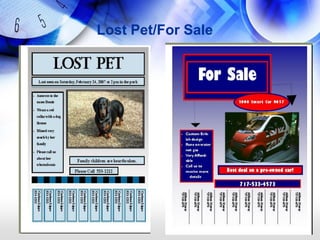
 Lost Pet/For Sale
Lost Pet/For Sale
Projects - PBLs

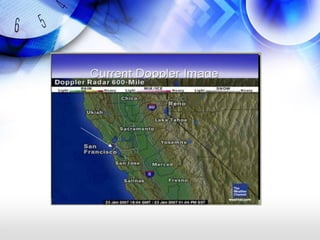
 Meteorologist for a Day
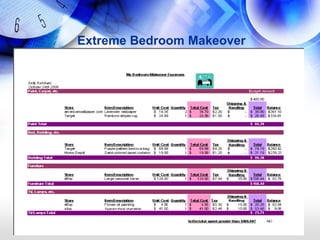
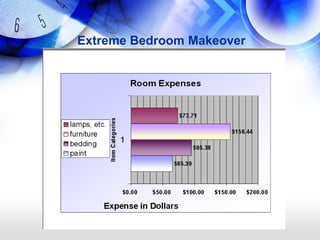
 Extreme Bedroom Makeover
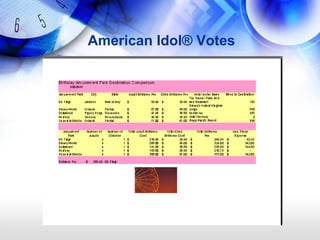
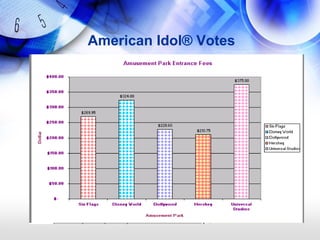
 American Idol® Votes
Meteorologist for a Day
Extreme Bedroom Makeover
American Idol® Votes
Projects - PBLs

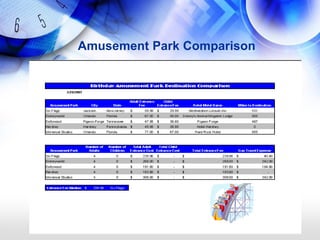
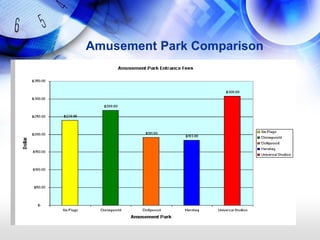
 Amusement Park Comparison
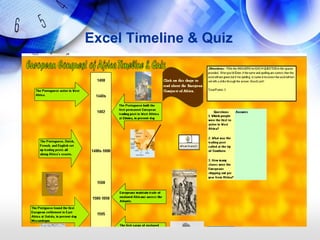
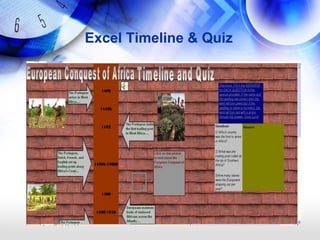
 Excel Timeline
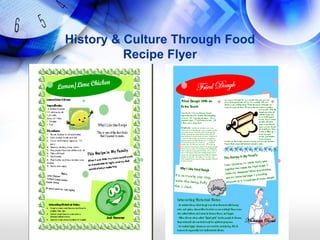
 History & Culture through Food Flyer
Amusement Park Comparison
Excel Timeline & Quiz
History & Culture Through Food
          Recipe Flyer
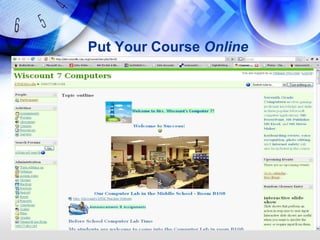
Put Your Course Online

 Course Management System
  – Moodle
     • Calendar
     • Screencasts
     • Resources – paper
     • Resources – electronic
  – derrymoodle.caiu.org (no www.)
Put Your Course Online
Online Learning & Assessment

 Moodle
 United Streaming
 Track Star
 Quizlab
Digital Tools

Voice Recognition
Screencasts – Vodcasts
Scanners
Digital Cameras
Answer Remotes
Soft Skills - Collaboration

Family of Learners
Teamwork
Discussion Board – Wikis – Blogs
Soft Skills - Collaboration


Monster Exchange
Change Seats
Peer Help
Chat Room Etiquette
Soft Skills

Pay Attention to Detail
Time Management
Nonverbal Communication
Problem-solving
Soft Skills

Listening
Introductions
Name Association
Organization Skills
Health & Well-being

  Ergonomics
  Workstation Workout
  Non-food Rewards
  Great Web Sites


NMSA: Exploring Essential Components: Physical Activity,
Nutrition, and the Young Adolescent ppt
Ultimate Goal

 Life-long Learner
  – Success
  – Self-sufficiency
  – Progression & Self-improvement
“World is in my hand” - Photo from flickr.com ~by simply fred
“earth” - Photo from flickr.com ~by copycat899
“World Connection in Blue” - Photo from flickr.com ~by meyshanworld
http://creativecommons.org/licenses/by/2.0/
“green globe” - Photo from flickr.com ~by Natural Existence LCC
“Earth N America Plus” - Photo from flickr.com ~by LakeRae
Castronova says:

        In 1814 everybody was on foot
          In 1914 they were on trains
           In 1940 they were in cars
In 2040 there will be 100 million avatars in the
                synthetic worlds

      Right???                          Wrong!!!
  Immersion slideshow on www.slideshare.net by danrev; slide 65
It will be sooner than 2040…

 Second Life was created at the end of 2003
 October 18, 2006, the population of Second
  Life hit 1,000,000 residents
 January 14, 2007, the population of Second
  Life was 2,573,932
 January 19, 2008, the population of Second
  Life was
Second Life Blog Comments

  Second Life has been just that for me and
    has given me a world in which I have finally
    found freedom. Thank you!


http://blog.secondlife.com/2008/01/10/tip-of-the-week-17-how-to-
run-multiple-viewers-at-the-same-time/

NBEA 2008 Convention in San Antonio

  • 1.
    Middle School BECourses: When They’re Not Looking…Throw in 21st Century Skills! Melanie Wiscount Hershey Middle School – Derry Township School District NBEA 2008 Convention – San Antonio, TX March 20, 2008
  • 2.
    Become Global Thinkers Assignment On Board: “Think of an Idea to change The world – & Put it into Action “Pay It Forward – Assignment to Save the World” – video segment from www.youtube.com by user WateryNeo
  • 3.
    The World isDifferent “World is in my hand” - Photo from flickr.com ~by simply fred
  • 4.
    Digital Writing Prompt Thinkabout the word "determination". What do the words "you can do anything that you set your mind to do" mean to you? http://www.videovat.com/search.aspx?q=hoyt
  • 5.
    Things to ThinkAbout…  Internet users ages 12 to 28 years old have embraced the online applications that enable communicative, creative, and social uses.  The growth rate of China's internet user population has been outpacing that of the U.S., and China is projected to overtake the U.S. in the total number of users within a few years. http://www.pewinternet.org
  • 6.
    Things To ThinkAbout…  Internet became available to the average American less than a decade ago  Moore‘s Law  Metcalf‘s Law "Children are native to cyberspace and we, as adults, are immigrants." “Playing the Future” Douglas Rushkoff (2001, personal communication)
  • 7.
    What Did WeDo Before the Internet?  54% in the number of adults who said the internet played a major role as they helped another person cope with a major illness  50% in the number who said the internet played a major role as they pursued more training for their careers  45% in the number who said the internet played a major role as they made major investment or financial decisions  43% in the number who said the internet played a major role when they looked for a new place to live  42% in the number who said the internet played a major role as they decided about a school or a college for themselves or their children  23% in the number who said the internet played a major role when they bought a car http://www.pewinternet.org/PPF/r/181/report_display.asp
  • 8.
    How Can WeDescribe Our Students' Generation? • Computers aren‘t technology. • The Internet is better than TV. • Reality is no longer real. • Doing is more important than knowing. • Learning more closely resembles Nintendo than logic. • Multitasking is a way of life. • Typing is preferred to handwriting. • Staying connected is essential. • There is zero tolerance for delays. • Consumer and creator are blurring. McMahon, Tim & Huette, Scott. (2005) The Net Generation Comes to College! University of Oregon.
  • 9.
    Generation C  Creators  Content  Collaborators  Community  Culture  Concurrent  Connected  Communicators Derek Wenmoth, Director, eLearning, CORE Education Ltd, NEW ZEALAND; Derek‘s Blog- http://blog.core-ed.net/derek/
  • 10.
    Gwen's Communication forthe Month of December  Text messages - 904 messages  Voice cell phone - 1,000 minutes  AIM messages - 2880 messages sent  FaceBook - Check 10 times daily  MySpace - Check 2 times daily  Bloom. U. Email - 24 emails
  • 11.
    Socialized in aDifferent Way "Different kinds of experiences lead to different kinds of brain structures." Dr. Bruce D. Berry, Baylor College of Medicine  10,000 hours playing video games  Over 200,000 instant messages & emails  Over 10,000 hours talking on cell phones  Over 20,000 hours watching TV  At the most 5,000 hours reading Prensky, Marc. "Do They Really Think Differently?". On the Horizon (NCB University Press, Vo 6, December 2001) l. 9
  • 12.
    How Do WeConnect to our Digitally- Native Students?  Digital Multimedia – Text – Sound & music – Motion – Graphics – Interactivity – Lighting
  • 13.
    National Economy "The currentand future health of America's 21st century economy depends directly on how broadly and deeply Americans reach a new level of literacy—'21st Century Literacy' " The 21st Century Workforce Commission's (2000) National Alliance of Business
  • 14.
    The New Responsibilityof Citizen ―The explosive growth of technology in every aspect of society offers us a unique opportunity to engage our citizens in economic and civic life " The 21st Century Workforce Commission's (2000) National Alliance of Business
  • 15.
    Technology ―Information and communicationtechnologies are raising the bar on the competencies needed to succeed in the 21st century " The 21st Century Workforce Commission's (2000) National Alliance of Business
  • 16.
    Our Graduates Needto be: – a critical thinker – a problem solver – an innovator – an effective communicator – an effective collaborator – information and media literate – globally aware – civically engaged – financially and economically literate Preparing Students for Jobs That Do Not Exist, Chris Pearson, August 16, 2007 http://squeakymouse.wordpress.com/2007/08/16/preparing-students-for-jobs-that- do-not-exist/
  • 17.
    21st Century Literacy Digital Age literacy  Inventive Thinking  Effective Communication  High Productivity
  • 18.
  • 19.
    Learning Objectives  Explorehow we as teachers can effectively provide experiences that ‗connect‘ to the global society of the 21st century learner  Infuse 21st century skills by using Web 2.0 resources & tools that can be integrated into business education curriculum
  • 20.
    21st Century Skills Digital Inventive Effective High Literacy Thinking Communication Productivity
  • 21.
    Basic Literacy Global Scientific Awareness Literacy Multicultural Digital Economic Literacy Literacy Literacy Information Technological Literacy Literacy Visual Literacy
  • 22.
    Basic Literacy  OralPresentations  Written English components – Spelling – Grammar  ESL classes  Web 2.0 Tools – Wikis – Blogs – Chat rooms
  • 23.
    Scientific Literacy  Problem-solving – Green buildings – Global warming – Alternative energy sources – Robotics
  • 24.
    Economic Literacy  Personalfinance  Economics  Career exploration & research  Amusement Park analysis  Room Makeover
  • 25.
    Visual Literacy  Photo-editing Video creation & editing  MovieMaker  Flikr  Asterpix Interactive Video  YouTube  Tutorials
  • 26.
    Information Literacy  SmartSearching  Scavenger Hits  Google – one hit  Social networking
  • 27.
  • 28.
  • 29.
  • 30.
    What is Web2.0? ―an emerging network-centric platform to support distributed, collaborative and cumulative creation by its users.‖ John Hagel, Business, Strategy, and Technology Speaker http://www.readwriteweb.com/archives/web_20_elevator.php  More social – more communication  More collaborative  Content created by users  Services can be built coordinating data and code from other services
  • 31.
  • 32.
  • 33.
  • 34.
    Social Bookmarking Users save bookmarks to a publicly accessible web site – Make your bookmarks available on multiple computers – Share your bookmarks with a group of colleagues and see their bookmarks – Share your bookmarks with the wider Internet •Del.icio.us •digg.com •Technorati.com http://newsletter.blizzardinternet.com/advantages-of-social-bookmarking-for- smbs-and-hospitality-businesses/2006/07/31/
  • 35.
  • 36.
  • 37.
    Blogging  Technorati nowtracks over 35.3 Million blogs  The blogosphere is doubling in size every 6 months  It is now over 60 times bigger than it was 3 years ago  On average, a new weblog is created every second of every day  19.4 million bloggers (55%) are still posting 3 months after their blogs are created  Technorati tracks about 1.2 Million new blog posts each day, about 50,000 per hour
  • 38.
  • 39.
  • 40.
  • 41.
  • 42.
  • 43.
  • 44.
  • 45.
  • 46.
    Online Applications  Zoho Picasa  Google docs
  • 47.
  • 48.
  • 49.
  • 50.
  • 51.
  • 52.
    How We Learn 10%of what we READ 20% of what we HEAR 30% of what we SEE 50% of what we SEE and HEAR 70% of what is DISCUSSED with OTHERS 80% of what is EXPERIENCED PERSONALLY 95% of what we TEACH TO SOMEONE ELSE William Glasser
  • 53.
    Activities  Grouping  StudentChoice  Shout Outs  Post-Its Graffiti  Writing Prompts
  • 54.
  • 55.
    Writing Prompt Scenario One Scenario Two Scenario Three
  • 56.
    Activities  Information Seekers Write/Wipe Boards  Scattergories®  Ring Around the Research
  • 57.
    Ring Around theResearch A - Reader B - Paraphraser C - Predictor
  • 58.
    Activities  Financial Fitnessfor Life  Stock Portfolio  Problem-solving Scenarios  World View
  • 59.
    Projects - PBLs Community Highlights/History  Totem Pole Presentation  Career Project  Lost Pet/For Sale
  • 60.
  • 61.
    Projects - PBLs Meteorologist for a Day  Extreme Bedroom Makeover  American Idol® Votes
  • 62.
  • 63.
  • 64.
  • 65.
  • 66.
  • 67.
    Projects - PBLs Amusement Park Comparison  Excel Timeline  History & Culture through Food Flyer
  • 68.
  • 69.
  • 70.
  • 71.
  • 72.
    History & CultureThrough Food Recipe Flyer
  • 73.
    Put Your CourseOnline  Course Management System – Moodle • Calendar • Screencasts • Resources – paper • Resources – electronic – derrymoodle.caiu.org (no www.)
  • 74.
  • 75.
    Online Learning &Assessment  Moodle  United Streaming  Track Star  Quizlab
  • 76.
    Digital Tools Voice Recognition Screencasts– Vodcasts Scanners Digital Cameras Answer Remotes
  • 77.
    Soft Skills -Collaboration Family of Learners Teamwork Discussion Board – Wikis – Blogs
  • 78.
    Soft Skills -Collaboration Monster Exchange Change Seats Peer Help Chat Room Etiquette
  • 79.
    Soft Skills Pay Attentionto Detail Time Management Nonverbal Communication Problem-solving
  • 80.
  • 81.
    Health & Well-being Ergonomics Workstation Workout Non-food Rewards Great Web Sites NMSA: Exploring Essential Components: Physical Activity, Nutrition, and the Young Adolescent ppt
  • 82.
    Ultimate Goal  Life-longLearner – Success – Self-sufficiency – Progression & Self-improvement
  • 83.
    “World is inmy hand” - Photo from flickr.com ~by simply fred
  • 84.
    “earth” - Photofrom flickr.com ~by copycat899
  • 85.
    “World Connection inBlue” - Photo from flickr.com ~by meyshanworld http://creativecommons.org/licenses/by/2.0/
  • 86.
    “green globe” -Photo from flickr.com ~by Natural Existence LCC
  • 87.
    “Earth N AmericaPlus” - Photo from flickr.com ~by LakeRae
  • 88.
    Castronova says: In 1814 everybody was on foot In 1914 they were on trains In 1940 they were in cars In 2040 there will be 100 million avatars in the synthetic worlds Right??? Wrong!!! Immersion slideshow on www.slideshare.net by danrev; slide 65
  • 89.
    It will besooner than 2040…  Second Life was created at the end of 2003  October 18, 2006, the population of Second Life hit 1,000,000 residents  January 14, 2007, the population of Second Life was 2,573,932  January 19, 2008, the population of Second Life was
  • 90.
    Second Life BlogComments  Second Life has been just that for me and has given me a world in which I have finally found freedom. Thank you! http://blog.secondlife.com/2008/01/10/tip-of-the-week-17-how-to- run-multiple-viewers-at-the-same-time/