Educational Technology Examining 21st century literacies and their implications for teaching and learning in the digital age.
The Case for 21 st  Century Education Education is changing. Competition is changing internationally. The workplace, jobs, and skill demands are changing.
 
Digital Natives “ Different kinds of experiences lead to different brain structures” - Dr. Bruce D. Berry of Baylor College of Medicine.  it is very likely that  our students’ brains have physically changed  – and are different from ours – as a result of how they grew up
Digital Natives It is now clear that as a result of this ubiquitous information environment and the sheer volume of their interaction with it, today’s students  think and process information fundamentally differently  from their predecessors. Marc Prensky – “Digital Natives, Digital Immigrants” 2001
Who are the digital natives? Our students today are all “native speakers” of the digital language of computers, video games, instantaneous communication, and the Internet. Those of us who were not born into the digital world but have, at some later point in our lives, become fascinated by and adopted many or most aspects of the new technology are  Digital Immigrants .
The Nomadic Grazing Patterns of Digital Natives Digital Natives are used to receiving information really fast.  They like to parallel process and multi-task.  They prefer their graphics  before  their text rather than the opposite.  They prefer random access (like hypertext).  They function best when networked.  They thrive on instant gratification and frequent rewards.  They prefer games to “serious” work.
We are no longer teaching if what we teach is more important than who we teach or how we teach. (Carol Ann Tomlinson 2003)
The Challenge Our Digital Immigrant instructors, who speak an outdated language (that of the pre-digital age), are struggling to teach a population that speaks an entirely new language
Content Legacy reading, writing, arithmetic, logical thinking, understanding the writings and ideas of the past, etc. – all of our “traditional” curriculum .   Future software, hardware, robotics, nanotechnology, genomics, etc. ethics, politics, sociology, languages and other things that go with them
Essential Questions How can we teach rigorous and relevant knowledge, skills, and understandings to all students in a diverse academic setting? How can differentiated instruction be enhanced through the integration of educational technologies in the classroom?
Many educators believe in the ‘exceptionality’ of computers, viewing them as instructional talismans that can do for student learning what other reforms cannot. “ Tools for the Mind” – Mary Burns
Technology & Student Learning This has resulted in the narrow focus on technology at the expense of the more important pillars of learning . . . cognition,  instruction,  assessment,  and curriculum.
I hear and I forget.  I see and I remember.  I do and I understand. - Confucius
Tell me and I forget. Teach me and remember. Involve me and I learn. - Benjamin Franklin
Enduring Understanding We learn. . . 10% of what we READ 20% of what we HEAR 30% of what we SEE 40% of what we both SEE and HEAR 70% of what is DISCUSSED with others 80% of what we EXPERIENCE personally 95% of what we TEACH someone else --William Glasser
The New Literacies Play  — the capacity to experiment with one’s surroundings as a form of problem-solving Performance  — the ability to adopt alternative identities for the purpose of improvisation and discovery Simulation  — the ability to interpret and construct dynamic models of real-world processes Appropriation  — the ability to meaningfully sample and remix media content
The New Literacies Multitasking  — the ability to scan one’s environment and shift focus as needed to salient details. Distributed Cognition  — the ability to interact meaningfully with tools that expand mental capacities Collective Intelligence  — the ability to pool knowledge and compare notes with others toward a common goal Judgment  — the ability to evaluate the reliability and credibility of different information sources
The New Literacies Transmedia Navigation  — the ability to follow the flow of stories and information across multiple modalities Networking  — the ability to search for, synthesize, and disseminate information Negotiation  — the ability to travel across diverse communities, discerning and respecting multiple perspectives, and grasping and following alternative norms.
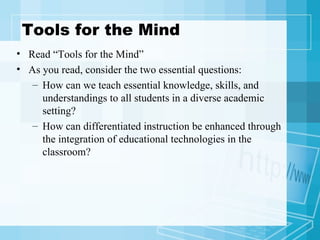
Tools for the Mind Read “Tools for the Mind” As you read, consider the two essential questions: How can we teach essential knowledge, skills, and understandings to all students in a diverse academic setting? How can differentiated instruction be enhanced through the integration of educational technologies in the classroom?
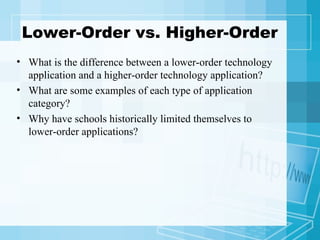
Lower-Order vs. Higher-Order What is the difference between a lower-order technology application and a higher-order technology application? What are some examples of each type of application category?  Why have schools historically limited themselves to lower-order applications?
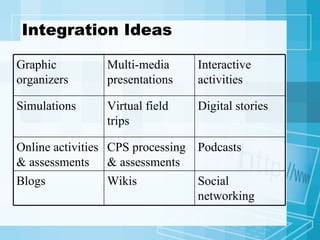
Integration Ideas Social networking Wikis Blogs Podcasts CPS processing & assessments Online activities & assessments Digital stories Virtual field trips Simulations Interactive activities Multi-media presentations Graphic organizers
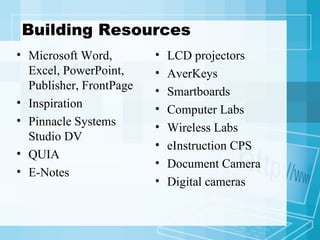
Building Resources Microsoft Word, Excel, PowerPoint, Publisher, FrontPage Inspiration Pinnacle Systems Studio DV QUIA E-Notes LCD projectors AverKeys Smartboards Computer Labs Wireless Labs eInstruction CPS Document Camera Digital cameras
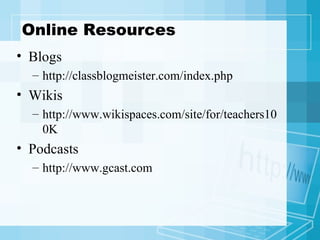
Online Resources Blogs http://classblogmeister.com/index.php  Wikis http://www.wikispaces.com/site/for/teachers100K  Podcasts http://www.gcast.com
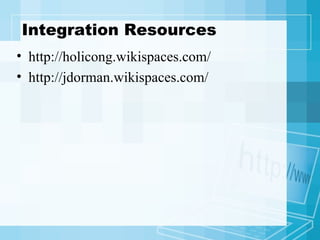
Integration Resources http://holicong.wikispaces.com/ http://jdorman.wikispaces.com/

Technology Integrations New Teacher Meeting

  • 1.
    Educational Technology Examining21st century literacies and their implications for teaching and learning in the digital age.
  • 2.
    The Case for21 st Century Education Education is changing. Competition is changing internationally. The workplace, jobs, and skill demands are changing.
  • 3.
  • 4.
    Digital Natives “Different kinds of experiences lead to different brain structures” - Dr. Bruce D. Berry of Baylor College of Medicine. it is very likely that our students’ brains have physically changed – and are different from ours – as a result of how they grew up
  • 5.
    Digital Natives Itis now clear that as a result of this ubiquitous information environment and the sheer volume of their interaction with it, today’s students think and process information fundamentally differently from their predecessors. Marc Prensky – “Digital Natives, Digital Immigrants” 2001
  • 6.
    Who are thedigital natives? Our students today are all “native speakers” of the digital language of computers, video games, instantaneous communication, and the Internet. Those of us who were not born into the digital world but have, at some later point in our lives, become fascinated by and adopted many or most aspects of the new technology are Digital Immigrants .
  • 7.
    The Nomadic GrazingPatterns of Digital Natives Digital Natives are used to receiving information really fast. They like to parallel process and multi-task. They prefer their graphics before their text rather than the opposite. They prefer random access (like hypertext). They function best when networked. They thrive on instant gratification and frequent rewards. They prefer games to “serious” work.
  • 8.
    We are nolonger teaching if what we teach is more important than who we teach or how we teach. (Carol Ann Tomlinson 2003)
  • 9.
    The Challenge OurDigital Immigrant instructors, who speak an outdated language (that of the pre-digital age), are struggling to teach a population that speaks an entirely new language
  • 10.
    Content Legacy reading,writing, arithmetic, logical thinking, understanding the writings and ideas of the past, etc. – all of our “traditional” curriculum . Future software, hardware, robotics, nanotechnology, genomics, etc. ethics, politics, sociology, languages and other things that go with them
  • 11.
    Essential Questions Howcan we teach rigorous and relevant knowledge, skills, and understandings to all students in a diverse academic setting? How can differentiated instruction be enhanced through the integration of educational technologies in the classroom?
  • 12.
    Many educators believein the ‘exceptionality’ of computers, viewing them as instructional talismans that can do for student learning what other reforms cannot. “ Tools for the Mind” – Mary Burns
  • 13.
    Technology & StudentLearning This has resulted in the narrow focus on technology at the expense of the more important pillars of learning . . . cognition, instruction, assessment, and curriculum.
  • 14.
    I hear andI forget. I see and I remember. I do and I understand. - Confucius
  • 15.
    Tell me andI forget. Teach me and remember. Involve me and I learn. - Benjamin Franklin
  • 16.
    Enduring Understanding Welearn. . . 10% of what we READ 20% of what we HEAR 30% of what we SEE 40% of what we both SEE and HEAR 70% of what is DISCUSSED with others 80% of what we EXPERIENCE personally 95% of what we TEACH someone else --William Glasser
  • 17.
    The New LiteraciesPlay — the capacity to experiment with one’s surroundings as a form of problem-solving Performance — the ability to adopt alternative identities for the purpose of improvisation and discovery Simulation — the ability to interpret and construct dynamic models of real-world processes Appropriation — the ability to meaningfully sample and remix media content
  • 18.
    The New LiteraciesMultitasking — the ability to scan one’s environment and shift focus as needed to salient details. Distributed Cognition — the ability to interact meaningfully with tools that expand mental capacities Collective Intelligence — the ability to pool knowledge and compare notes with others toward a common goal Judgment — the ability to evaluate the reliability and credibility of different information sources
  • 19.
    The New LiteraciesTransmedia Navigation — the ability to follow the flow of stories and information across multiple modalities Networking — the ability to search for, synthesize, and disseminate information Negotiation — the ability to travel across diverse communities, discerning and respecting multiple perspectives, and grasping and following alternative norms.
  • 20.
    Tools for theMind Read “Tools for the Mind” As you read, consider the two essential questions: How can we teach essential knowledge, skills, and understandings to all students in a diverse academic setting? How can differentiated instruction be enhanced through the integration of educational technologies in the classroom?
  • 21.
    Lower-Order vs. Higher-OrderWhat is the difference between a lower-order technology application and a higher-order technology application? What are some examples of each type of application category? Why have schools historically limited themselves to lower-order applications?
  • 22.
    Integration Ideas Socialnetworking Wikis Blogs Podcasts CPS processing & assessments Online activities & assessments Digital stories Virtual field trips Simulations Interactive activities Multi-media presentations Graphic organizers
  • 23.
    Building Resources MicrosoftWord, Excel, PowerPoint, Publisher, FrontPage Inspiration Pinnacle Systems Studio DV QUIA E-Notes LCD projectors AverKeys Smartboards Computer Labs Wireless Labs eInstruction CPS Document Camera Digital cameras
  • 24.
    Online Resources Blogshttp://classblogmeister.com/index.php Wikis http://www.wikispaces.com/site/for/teachers100K Podcasts http://www.gcast.com
  • 25.