Libraries 2.0?
Web 2.0, Social Media, Learning
The 3rd Annual Bloomsbury Libraries and eLearning Conference 2011
#blelib11
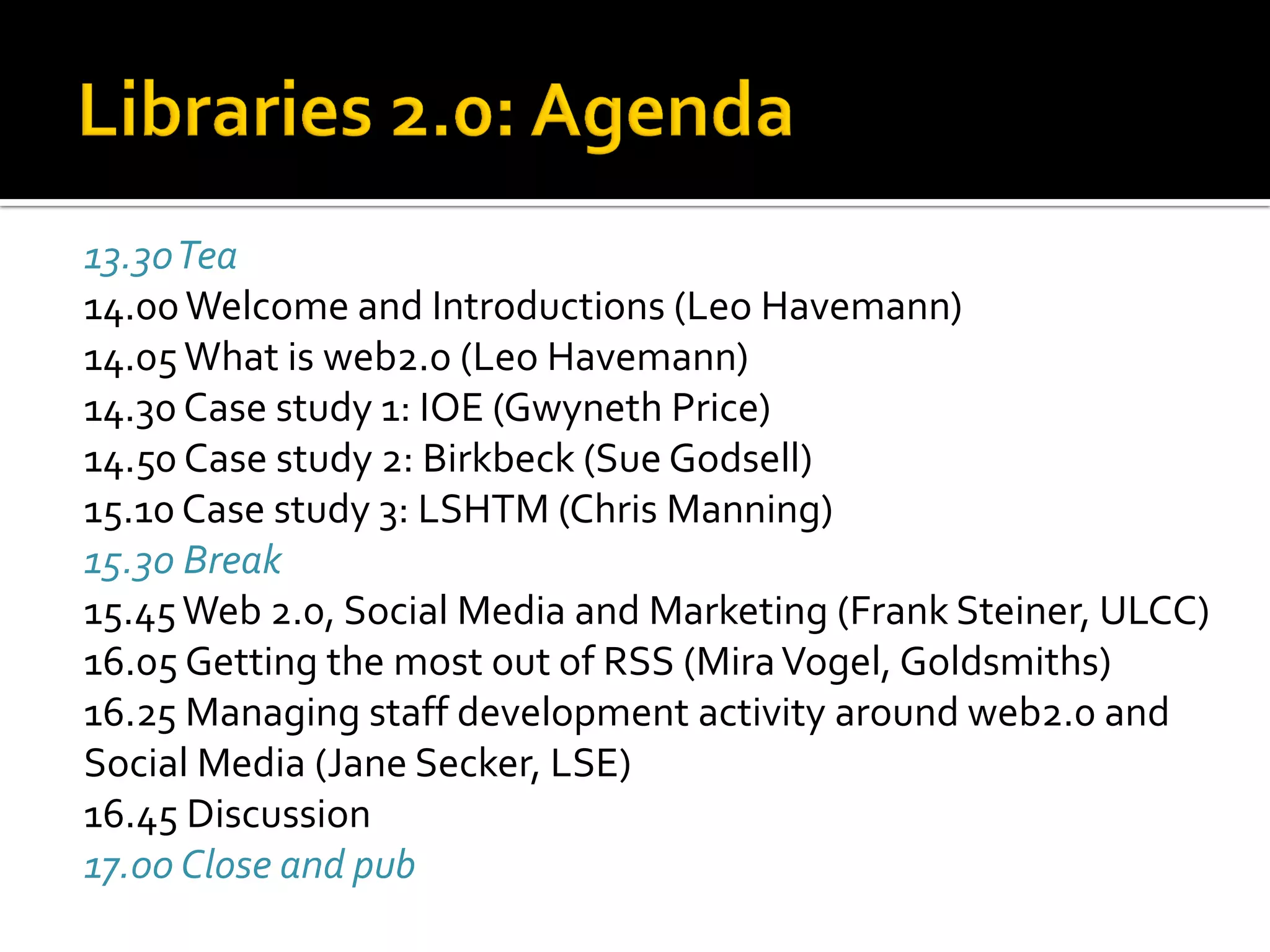
13.30Tea
14.00Welcome and Introductions (Leo Havemann)
14.05What is web2.0 (Leo Havemann)
14.30 Case study 1: IOE (Gwyneth Price)
14.50 Case study 2: Birkbeck (Sue Godsell)
15.10 Case study 3: LSHTM (Chris Manning)
15.30 Break
15.45Web 2.0, Social Media and Marketing (Frank Steiner, ULCC)
16.05 Getting the most out of RSS (MiraVogel, Goldsmiths)
16.25 Managing staff development activity around web2.0 and
Social Media (Jane Secker, LSE)
16.45 Discussion
17.00 Close and pub
(And why should we care?)
 Leo Havemann
LearningTechnology Support
Birkbeck
l.havemann@bbk.ac.uk
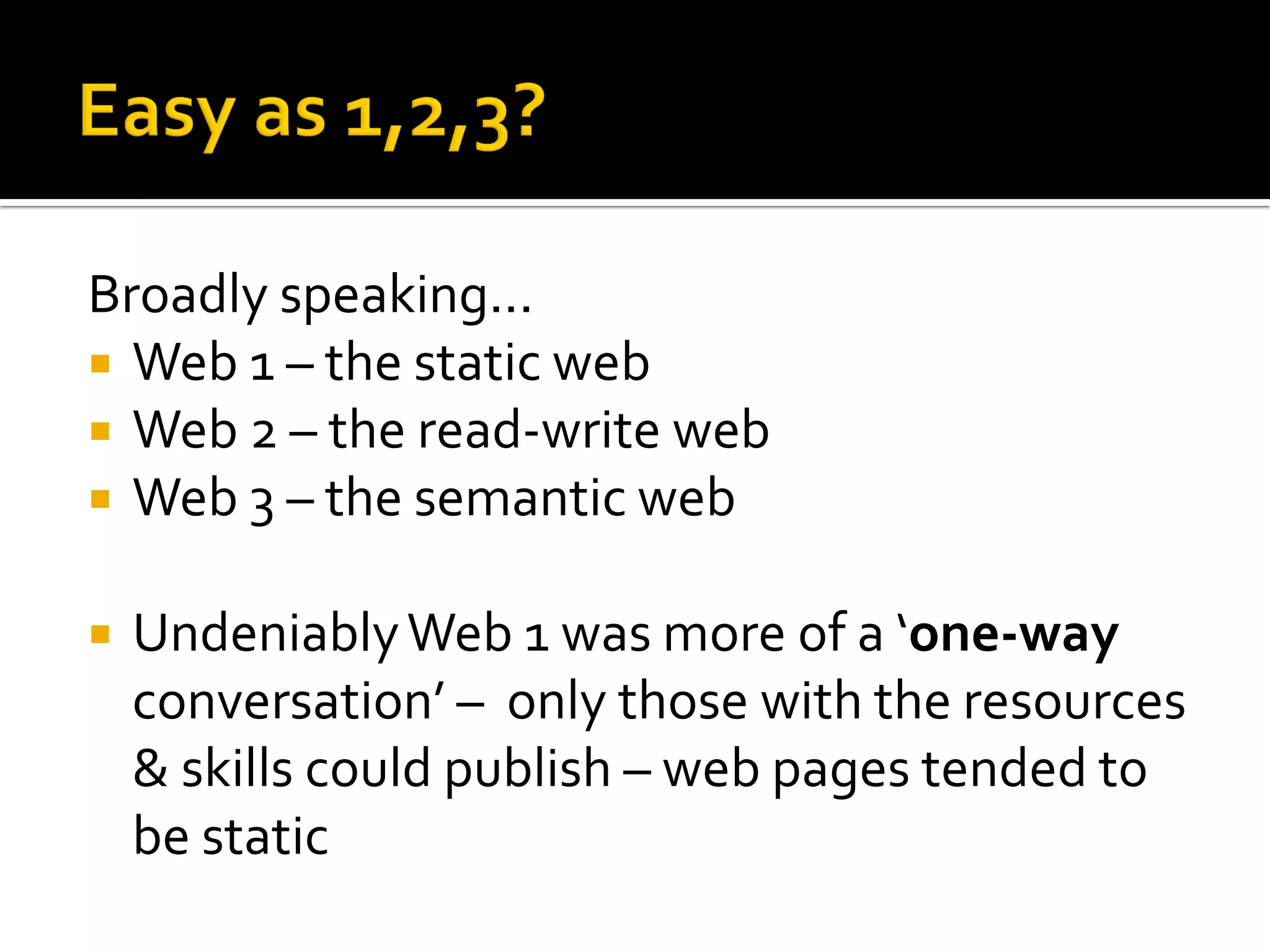
Broadly speaking...
 Web 1 – the static web
 Web 2 – the read-write web
 Web 3 – the semantic web
 UndeniablyWeb 1 was more of a ‘one-way
conversation’ – only those with the resources
& skills could publish – web pages tended to
be static
 The concept ofWeb 2 at its heart is the idea of
user generated content – that is, on the new
web it’s much easier for (non-technical,
ordinary) people to put their own content up
on the web
 RegardingWeb 3 see:
http://en.wikipedia.org/wiki/Semantic_Web
 - a quick quote:
 ‘Web 3.0 will ... center its efforts towards more
graphically capable environments, "non-browser
applications and non-computer based
devices...geographic or location-based information
retrieval" and even more applicable use and growth of
Artificial Intelligence.[9] ...Web 3.0 is where "the
computer is generating new information", rather than
humans.[10]’
▪ (but I’m not going to discuss this! Back toWeb 2)
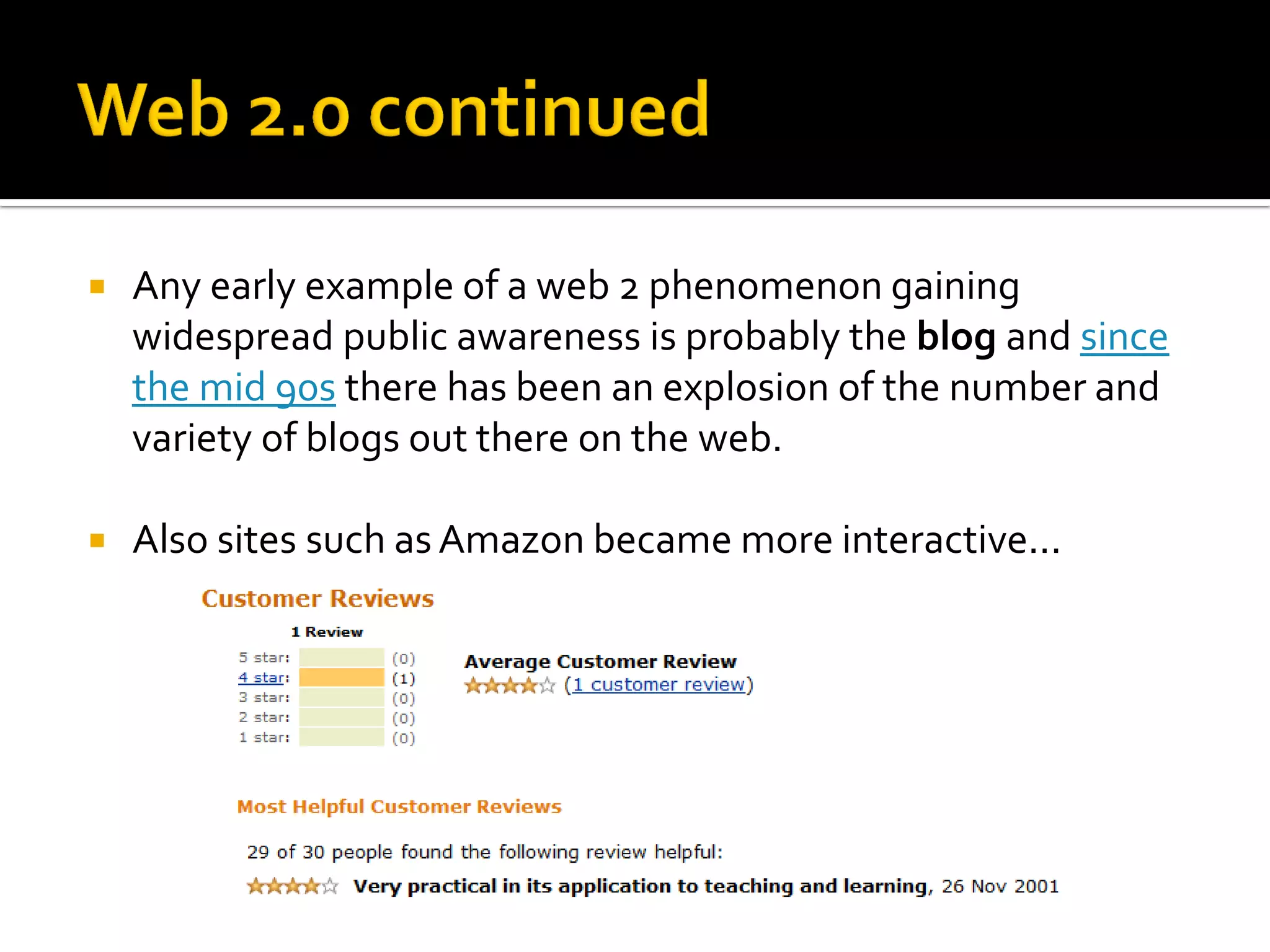
 Any early example of a web 2 phenomenon gaining
widespread public awareness is probably the blog and since
the mid 90s there has been an explosion of the number and
variety of blogs out there on the web.
 Also sites such as Amazon became more interactive...
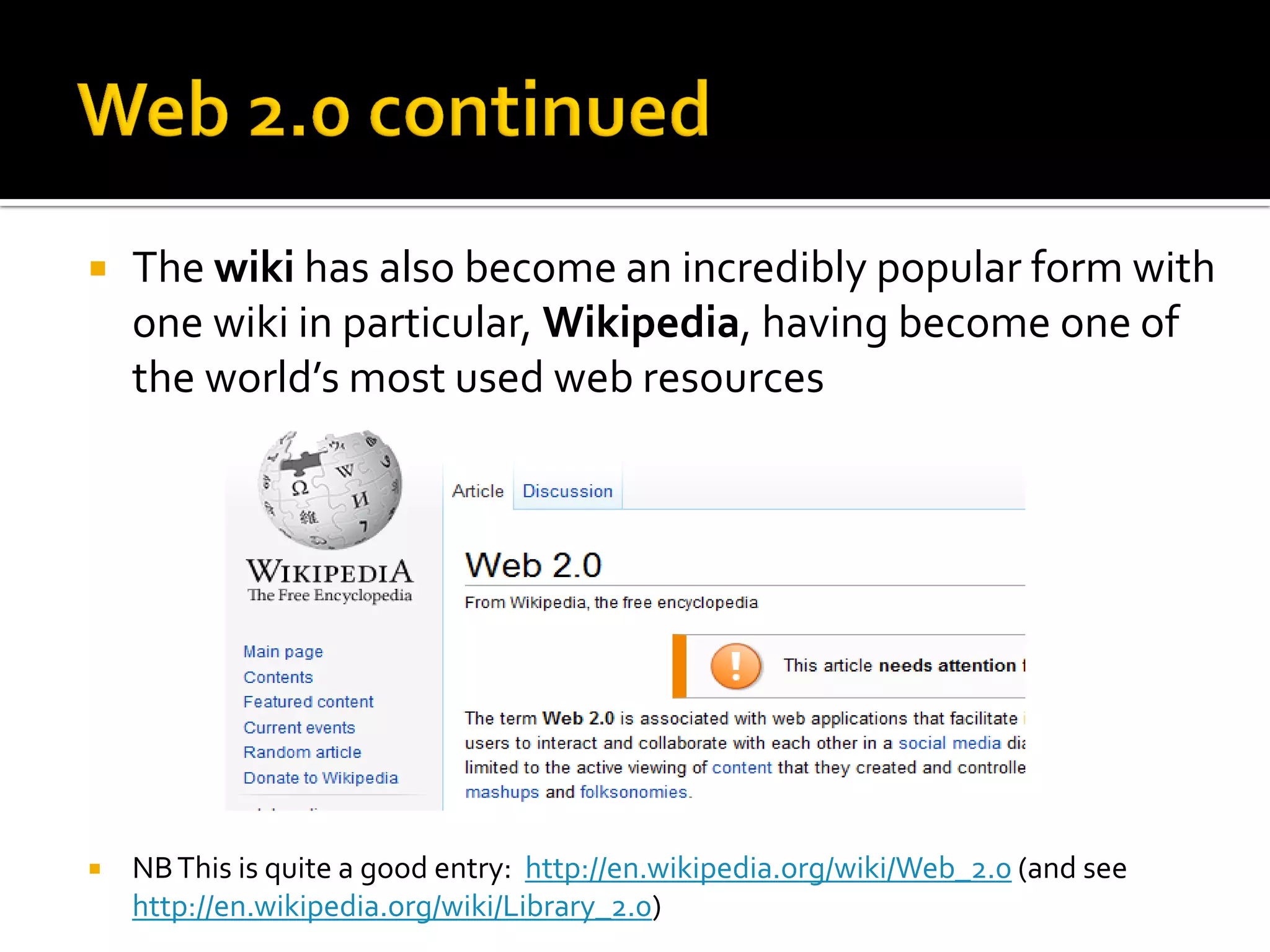
 The wiki has also become an incredibly popular form with
one wiki in particular, Wikipedia, having become one of
the world’s most used web resources
 NBThis is quite a good entry: http://en.wikipedia.org/wiki/Web_2.0 (and see
http://en.wikipedia.org/wiki/Library_2.0)
 AlongsideWeb 2 technology has come the
rise of Social Networking, with the
convergence of these strands often referred
to as ‘Social Media’
 Social networks include: Facebook, LinkedIn,
Twitter (sort of)
 Web 2 apps that include social elements
include: Delicious, flickr,YouTube, Spotify
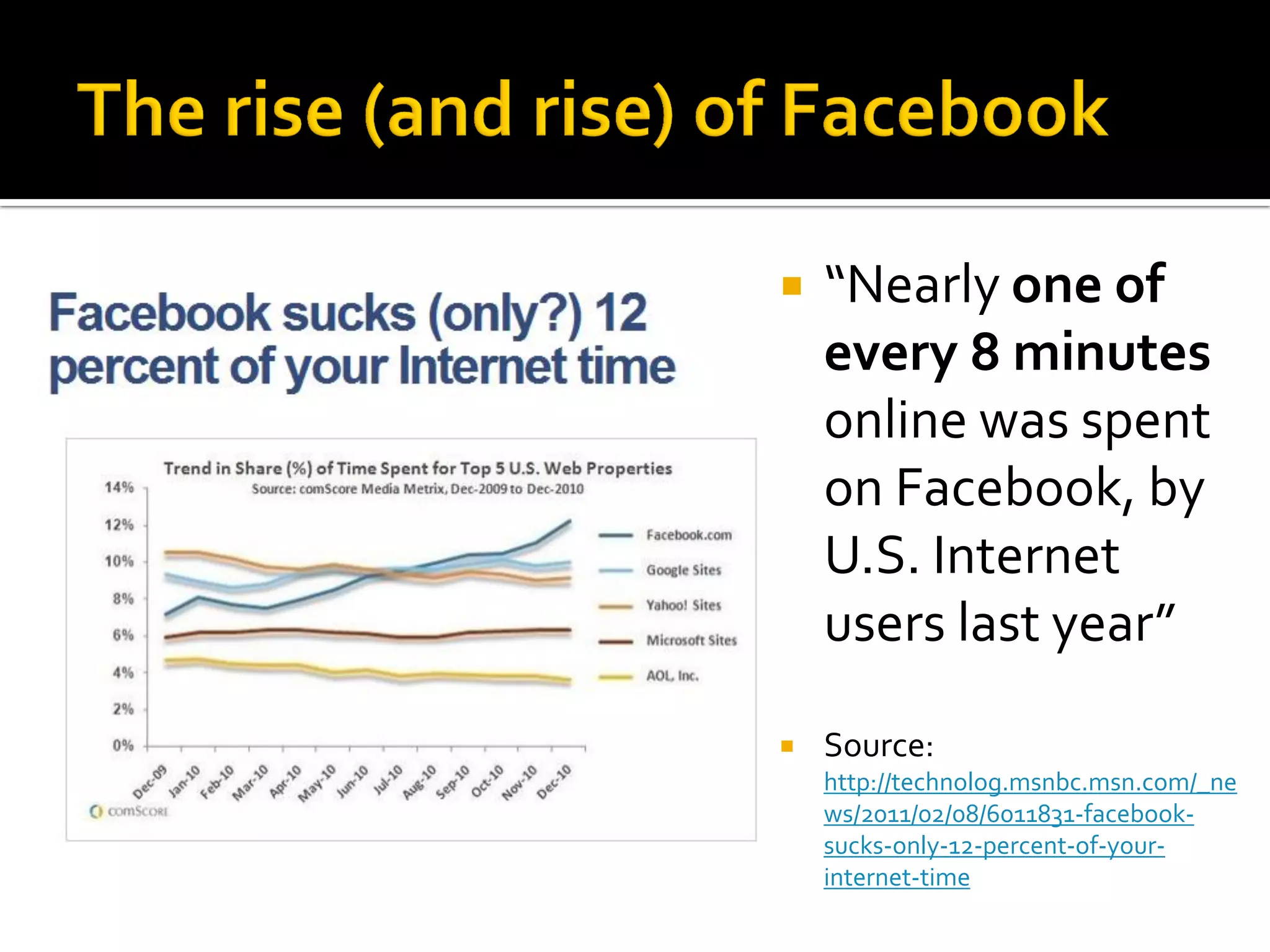
 “Nearly one of
every 8 minutes
online was spent
on Facebook, by
U.S. Internet
users last year”
 Source:
http://technolog.msnbc.msn.com/_ne
ws/2011/02/08/6011831-facebook-
sucks-only-12-percent-of-your-
internet-time
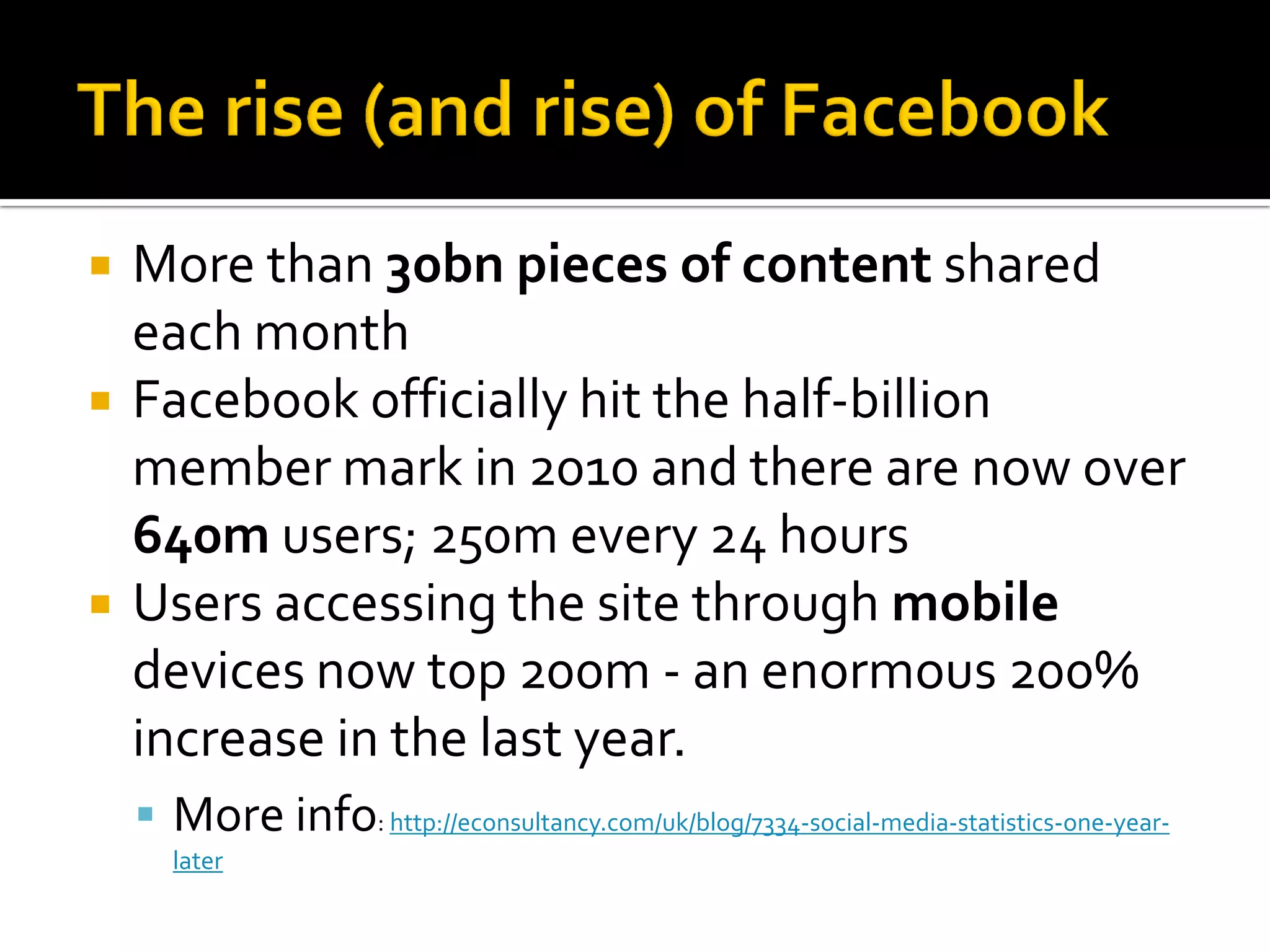
 More than 30bn pieces of content shared
each month
 Facebook officially hit the half-billion
member mark in 2010 and there are now over
640m users; 250m every 24 hours
 Users accessing the site through mobile
devices now top 200m - an enormous 200%
increase in the last year.
 More info: http://econsultancy.com/uk/blog/7334-social-media-statistics-one-year-
later
 Social Media Revolution video:
http://www.youtube.com/watch?v=lFZ0z5Fm-
Ng&feature=youtube_gdata_player
 Breaking web 2 / social media news:
mashable.com, readwriteweb.com
 My bookmarks:
▪ http://www.delicious.com/leohavemann/web2.0
▪ http://www.delicious.com/leohavemann/socialmedia
 Prevalence of web 2 is important but not the
whole story – what is its impact or contribution
in an HE context?
 Specifically:
“What isWeb 2.0 and why
should university students and
staff be using it?”
▪ Which maybe implies a sub-question, “can’t they ‘do
elearning’ within the institutional VLE?”
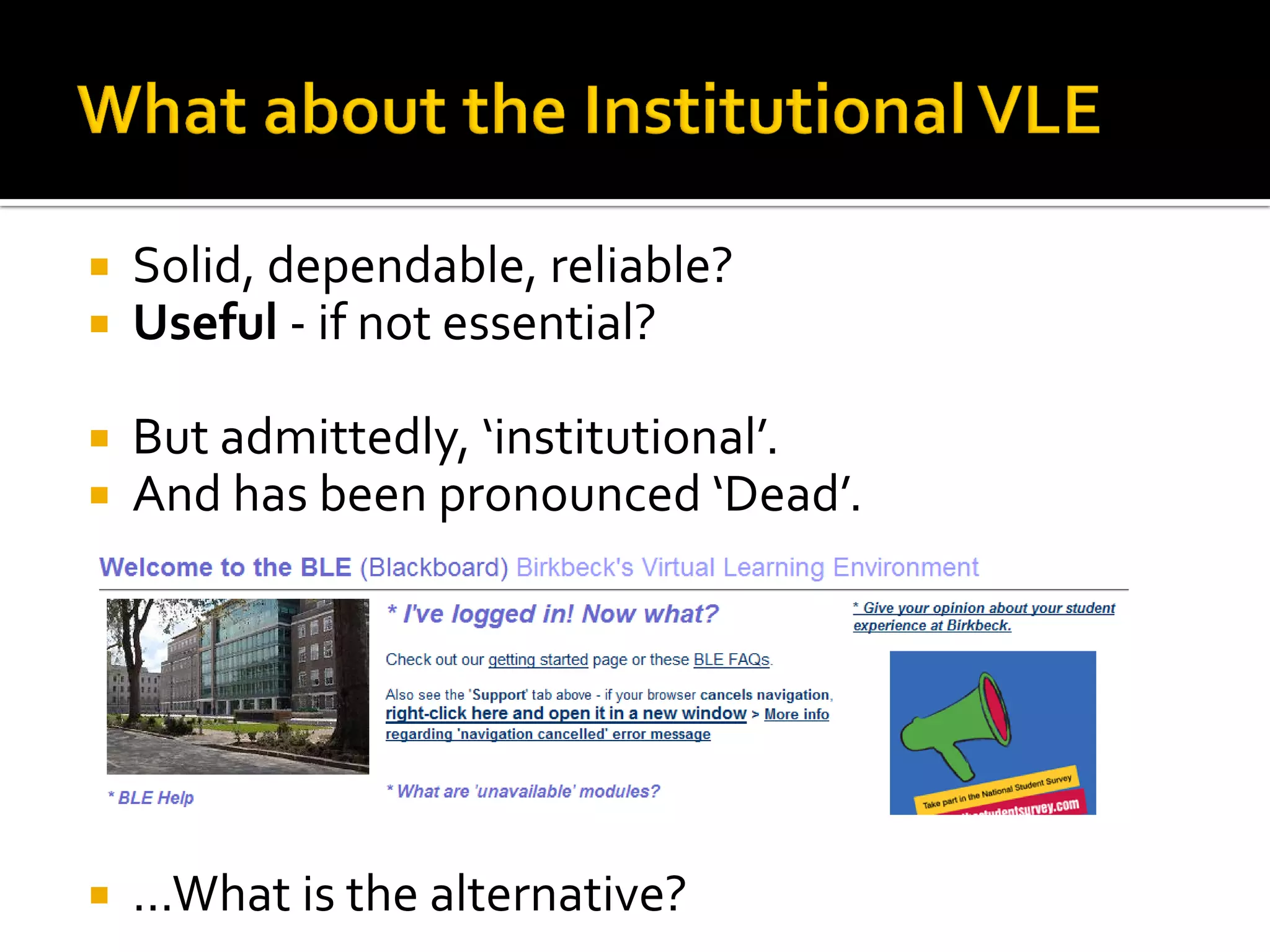
 Solid, dependable, reliable?
 Useful - if not essential?
 But admittedly, ‘institutional’.
 And has been pronounced ‘Dead’.
 ...What is the alternative?
 The ‘Personal(ised) Learning Environment’
 “PLEs are the spaces in which people interact,
communicate and whose result is learning and
development of collective know-how” --
http://isitjustme.de/2010/07/a-definition-of-the-ple-open-workshop-at-the-ple-conference/
 Instead of (or including) aVLE, students would
select a set of tools they find most
useful/appropriate (see also PLN, as in PLN
Yourself)
 Nancy Rubin talks about the ‘personal web’
as
 “...a collection of technologies that are used to
configure and manage the ways in which one
views and uses the Internet”
 “... it is easy to create a customized, personal
web-based environment — a personal web — that
explicitly supports one’s social, professional,
learning, and other activities” -
http://www.slideshare.net/rubin2606/personal-learning-environments-creating-
usercentric-learning-spaces?from=ss_embed
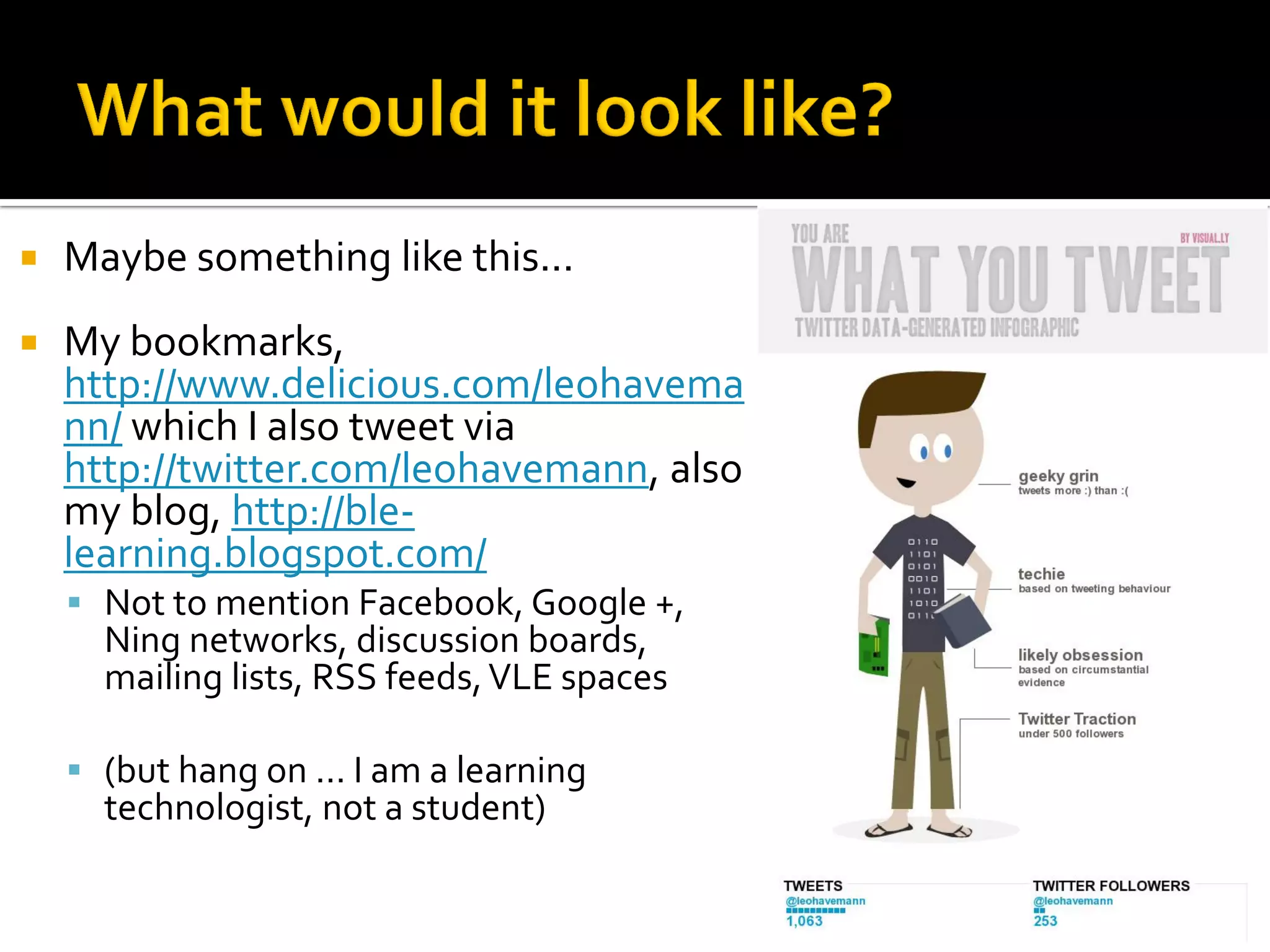
 Maybe something like this...
 My bookmarks,
http://www.delicious.com/leohavema
nn/ which I also tweet via
http://twitter.com/leohavemann, also
my blog, http://ble-
learning.blogspot.com/
 Not to mention Facebook, Google +,
Ning networks, discussion boards,
mailing lists, RSS feeds,VLE spaces
 (but hang on ... I am a learning
technologist, not a student)
 Tendency toward polarised and
oversimplified arguments e.g.
 We should go where the students are - all courses
should be taught on Facebook now
 They are all digital natives and know these
technologies better than we do, therefore
▪ A) we can ditchVLEs, go ahead and use them, great!
▪ B) actually we don’t need to bother, they know it all
already
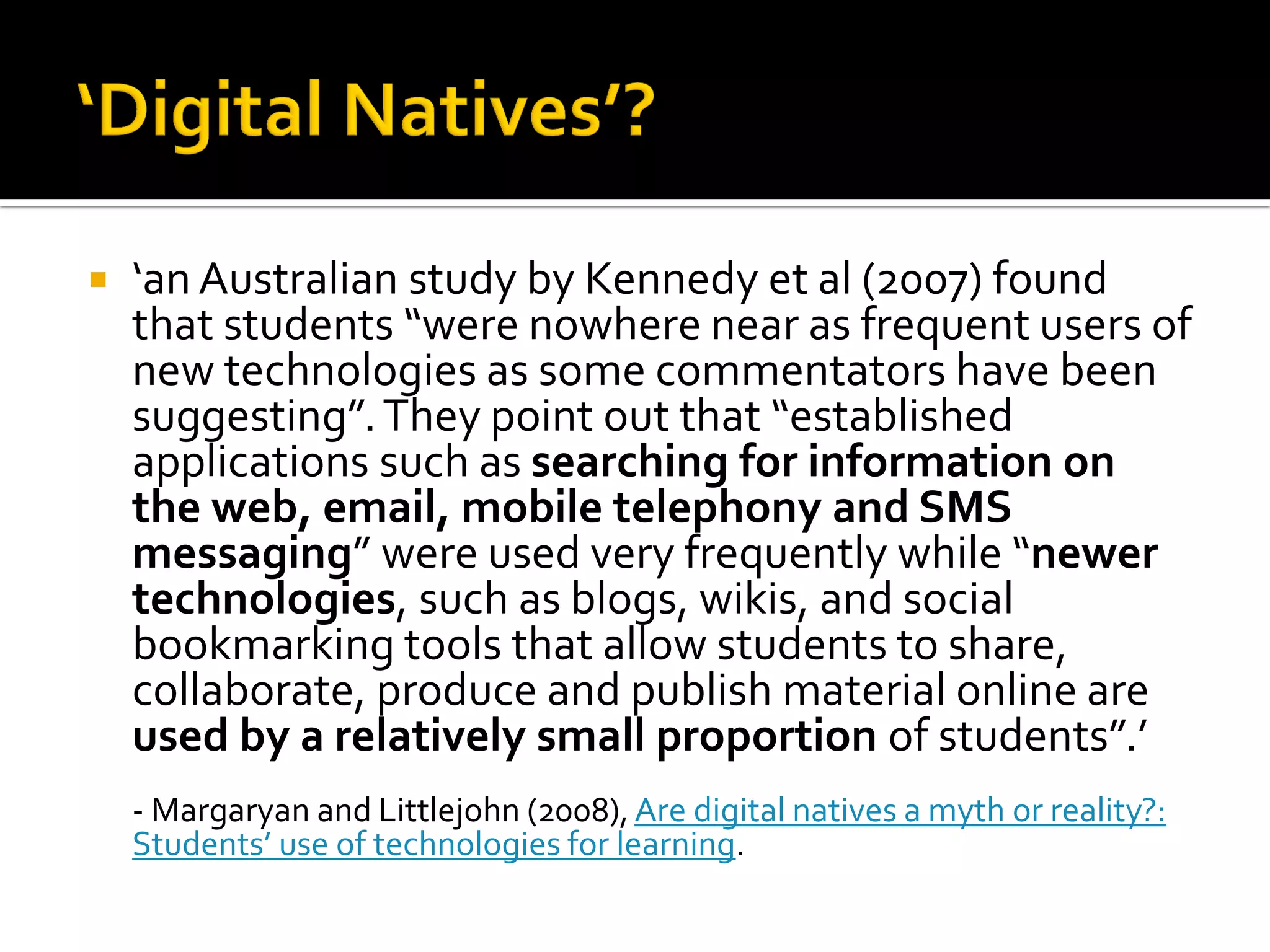
 ‘an Australian study by Kennedy et al (2007) found
that students “were nowhere near as frequent users of
new technologies as some commentators have been
suggesting”.They point out that “established
applications such as searching for information on
the web, email, mobile telephony and SMS
messaging” were used very frequently while “newer
technologies, such as blogs, wikis, and social
bookmarking tools that allow students to share,
collaborate, produce and publish material online are
used by a relatively small proportion of students”.’
- Margaryan and Littlejohn (2008),Are digital natives a myth or reality?:
Students’ use of technologies for learning.
 Students are not all millenials (let alone digital
natives) – average age at Birkbeck is mid 30s
 Millenials are not a homogenous group, and
show a diversity of technical/information
literacies
 While our students might be confident sharing
on Facebook or following celebrities onTwitter,
they are less likely to know how to go about
constructing a personal/social learning network
 Many of our staff are in a similar position.
 Web 2 and Social Media are increasingly seen
as key marketing and PR channels – but they
are different from print and broadcast media
 They are starting to be taken up as tools for
enhancing learning and teaching
 Staff need an awareness and understanding
of these tools in order to demonstrate and
design effect practice
 Over to you!

What is Web 2.0 ... (and why should we care?)

  • 1.
    Libraries 2.0? Web 2.0,Social Media, Learning The 3rd Annual Bloomsbury Libraries and eLearning Conference 2011 #blelib11
  • 2.
    13.30Tea 14.00Welcome and Introductions(Leo Havemann) 14.05What is web2.0 (Leo Havemann) 14.30 Case study 1: IOE (Gwyneth Price) 14.50 Case study 2: Birkbeck (Sue Godsell) 15.10 Case study 3: LSHTM (Chris Manning) 15.30 Break 15.45Web 2.0, Social Media and Marketing (Frank Steiner, ULCC) 16.05 Getting the most out of RSS (MiraVogel, Goldsmiths) 16.25 Managing staff development activity around web2.0 and Social Media (Jane Secker, LSE) 16.45 Discussion 17.00 Close and pub
  • 3.
    (And why shouldwe care?)  Leo Havemann LearningTechnology Support Birkbeck l.havemann@bbk.ac.uk
  • 4.
    Broadly speaking...  Web1 – the static web  Web 2 – the read-write web  Web 3 – the semantic web  UndeniablyWeb 1 was more of a ‘one-way conversation’ – only those with the resources & skills could publish – web pages tended to be static
  • 5.
     The conceptofWeb 2 at its heart is the idea of user generated content – that is, on the new web it’s much easier for (non-technical, ordinary) people to put their own content up on the web
  • 6.
     RegardingWeb 3see: http://en.wikipedia.org/wiki/Semantic_Web  - a quick quote:  ‘Web 3.0 will ... center its efforts towards more graphically capable environments, "non-browser applications and non-computer based devices...geographic or location-based information retrieval" and even more applicable use and growth of Artificial Intelligence.[9] ...Web 3.0 is where "the computer is generating new information", rather than humans.[10]’ ▪ (but I’m not going to discuss this! Back toWeb 2)
  • 7.
     Any earlyexample of a web 2 phenomenon gaining widespread public awareness is probably the blog and since the mid 90s there has been an explosion of the number and variety of blogs out there on the web.  Also sites such as Amazon became more interactive...
  • 8.
     The wikihas also become an incredibly popular form with one wiki in particular, Wikipedia, having become one of the world’s most used web resources  NBThis is quite a good entry: http://en.wikipedia.org/wiki/Web_2.0 (and see http://en.wikipedia.org/wiki/Library_2.0)
  • 9.
     AlongsideWeb 2technology has come the rise of Social Networking, with the convergence of these strands often referred to as ‘Social Media’  Social networks include: Facebook, LinkedIn, Twitter (sort of)  Web 2 apps that include social elements include: Delicious, flickr,YouTube, Spotify
  • 10.
     “Nearly oneof every 8 minutes online was spent on Facebook, by U.S. Internet users last year”  Source: http://technolog.msnbc.msn.com/_ne ws/2011/02/08/6011831-facebook- sucks-only-12-percent-of-your- internet-time
  • 11.
     More than30bn pieces of content shared each month  Facebook officially hit the half-billion member mark in 2010 and there are now over 640m users; 250m every 24 hours  Users accessing the site through mobile devices now top 200m - an enormous 200% increase in the last year.  More info: http://econsultancy.com/uk/blog/7334-social-media-statistics-one-year- later
  • 12.
     Social MediaRevolution video: http://www.youtube.com/watch?v=lFZ0z5Fm- Ng&feature=youtube_gdata_player  Breaking web 2 / social media news: mashable.com, readwriteweb.com  My bookmarks: ▪ http://www.delicious.com/leohavemann/web2.0 ▪ http://www.delicious.com/leohavemann/socialmedia
  • 13.
     Prevalence ofweb 2 is important but not the whole story – what is its impact or contribution in an HE context?  Specifically: “What isWeb 2.0 and why should university students and staff be using it?” ▪ Which maybe implies a sub-question, “can’t they ‘do elearning’ within the institutional VLE?”
  • 14.
     Solid, dependable,reliable?  Useful - if not essential?  But admittedly, ‘institutional’.  And has been pronounced ‘Dead’.  ...What is the alternative?
  • 15.
     The ‘Personal(ised)Learning Environment’  “PLEs are the spaces in which people interact, communicate and whose result is learning and development of collective know-how” -- http://isitjustme.de/2010/07/a-definition-of-the-ple-open-workshop-at-the-ple-conference/  Instead of (or including) aVLE, students would select a set of tools they find most useful/appropriate (see also PLN, as in PLN Yourself)
  • 16.
     Nancy Rubintalks about the ‘personal web’ as  “...a collection of technologies that are used to configure and manage the ways in which one views and uses the Internet”  “... it is easy to create a customized, personal web-based environment — a personal web — that explicitly supports one’s social, professional, learning, and other activities” - http://www.slideshare.net/rubin2606/personal-learning-environments-creating- usercentric-learning-spaces?from=ss_embed
  • 17.
     Maybe somethinglike this...  My bookmarks, http://www.delicious.com/leohavema nn/ which I also tweet via http://twitter.com/leohavemann, also my blog, http://ble- learning.blogspot.com/  Not to mention Facebook, Google +, Ning networks, discussion boards, mailing lists, RSS feeds,VLE spaces  (but hang on ... I am a learning technologist, not a student)
  • 18.
     Tendency towardpolarised and oversimplified arguments e.g.  We should go where the students are - all courses should be taught on Facebook now  They are all digital natives and know these technologies better than we do, therefore ▪ A) we can ditchVLEs, go ahead and use them, great! ▪ B) actually we don’t need to bother, they know it all already
  • 19.
     ‘an Australianstudy by Kennedy et al (2007) found that students “were nowhere near as frequent users of new technologies as some commentators have been suggesting”.They point out that “established applications such as searching for information on the web, email, mobile telephony and SMS messaging” were used very frequently while “newer technologies, such as blogs, wikis, and social bookmarking tools that allow students to share, collaborate, produce and publish material online are used by a relatively small proportion of students”.’ - Margaryan and Littlejohn (2008),Are digital natives a myth or reality?: Students’ use of technologies for learning.
  • 20.
     Students arenot all millenials (let alone digital natives) – average age at Birkbeck is mid 30s  Millenials are not a homogenous group, and show a diversity of technical/information literacies  While our students might be confident sharing on Facebook or following celebrities onTwitter, they are less likely to know how to go about constructing a personal/social learning network  Many of our staff are in a similar position.
  • 21.
     Web 2and Social Media are increasingly seen as key marketing and PR channels – but they are different from print and broadcast media  They are starting to be taken up as tools for enhancing learning and teaching  Staff need an awareness and understanding of these tools in order to demonstrate and design effect practice  Over to you!