Welcome
GENOMIC
LIBRARY
Lulu S Kumar
Introduction
 In humans, approximately 25,000 genes exit among the
3 billion base pairs of DNA in the genome.
 To study anyone of these genes, a researcher first
isolates it from all of the other genes in an organisms
DNA.
 One isolation method has a relatively long history and
involves the construction of a DNA library
 When a gene is identified and copied, it is said to have
been “cloned”
DNA LIBRARY
 The term “library” can refer to a population of organism,
each of which carries a DNA molecule inserted into a
cloning vector, or alternatively to the collection of all of
the cloned vector molecules.
 Collection of DNA fragments that have been cloned into
vectors so that researchers can identify and isolate the
DNA fragments that interest them for further study.
 For ease of purification, storage and analysis.
Two types of DNA Library
Genomic library
(made from genomic DNA)
DNA Library
cDNA Library
(made from cDNA- copy of mRNA)
For the construction of DNA Library
 Size of the gene
 Capacity of the vector
 Molecular tools
 Vectors
Size of the Library
(ensure enough clones)
 Must contain a certain no: of recombinants for there to
be a high probability of it containing any particular
sequence.
 The formula to calculate the no: of recombinants:
ln (1-P)
N =
ln (1-F)
P: desired probability
F: the fraction of the genome in one insert
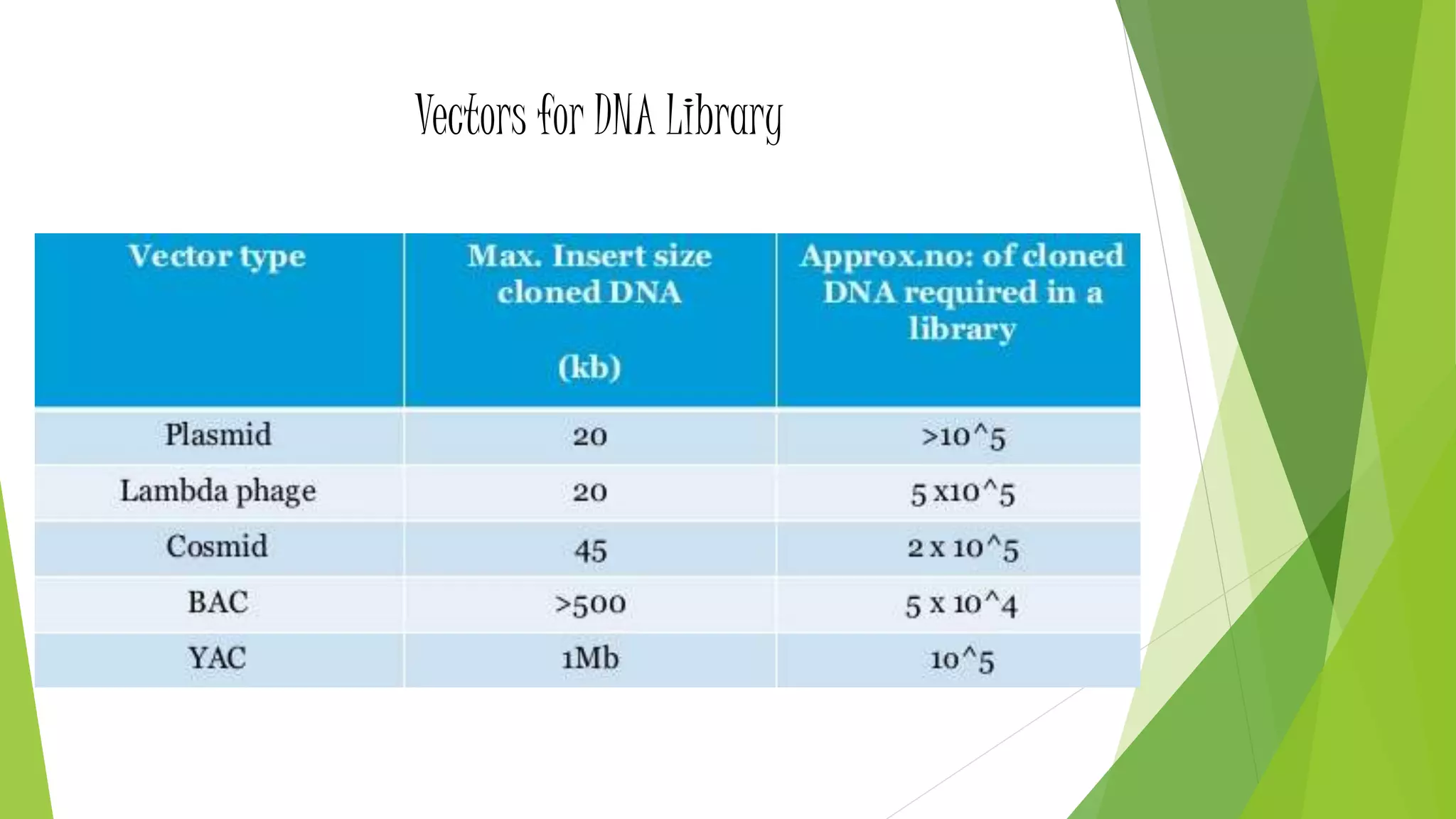
Vectors for DNA Library
Genomic Library
A library for me???
Why not?...You are the
Backbone of Life……
What is Genomic Library?
 Contains DNA fragments representing entire genome of an
organism.
 Created using molecular cloning
 Genome size is expressed in terms of no: of base pairs.
 The sizes of genomes in different species are variable.
 There is a distinct difference in the genes of prokaryotes and
eukaryotes.
 In prokaryotes, the structural genes coding for proteins are
continuous while in eukaryotes, the coding regions ( exons )
are separated by non-coding regions ( introns ).
 Therefore, the construction of gene libraries for eukaryotes is
more complicated.
Steps of Genomic Library construction
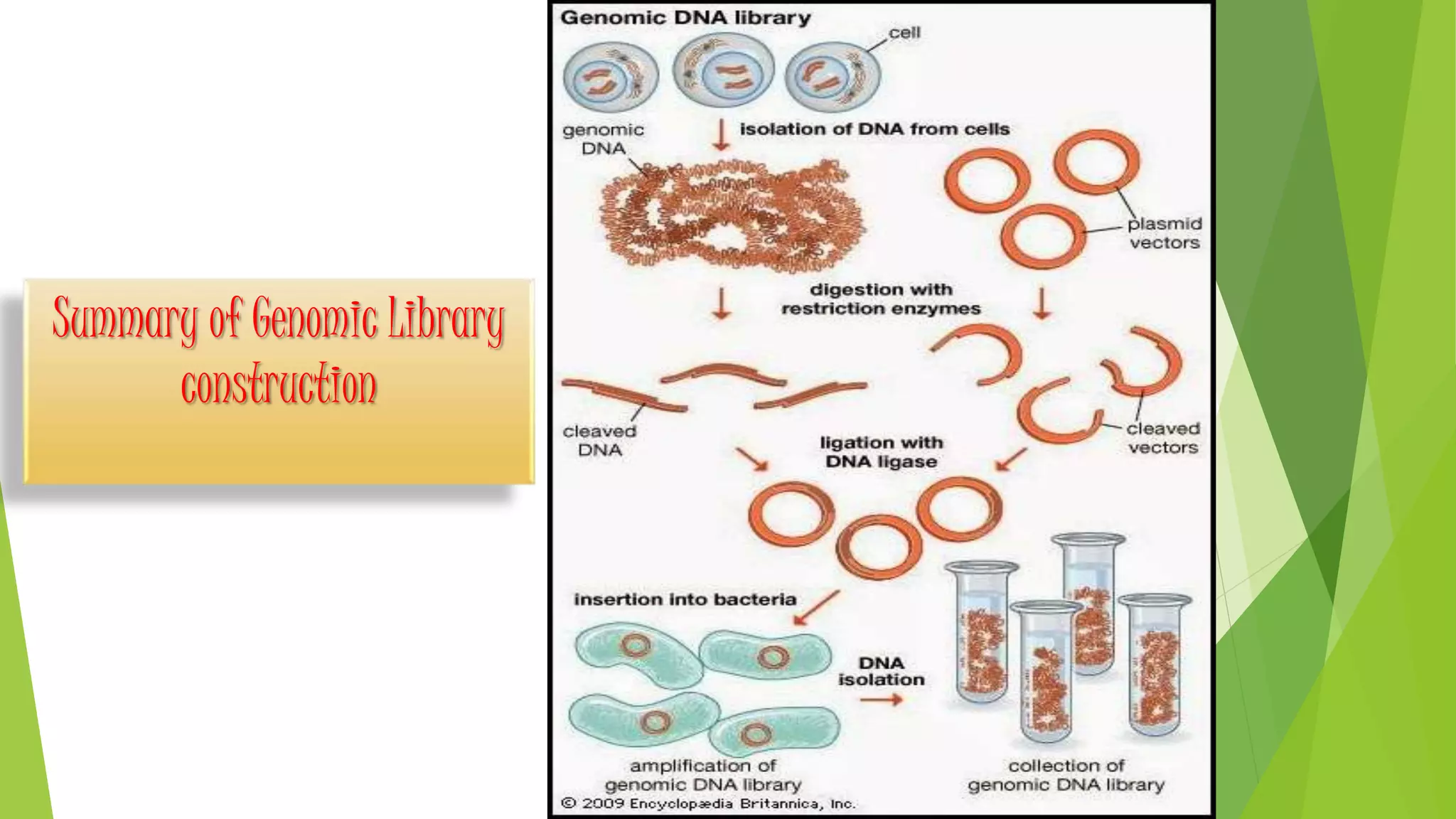
 Isolation of DNA from cells
 Digestion into small fragments
 Introduction into suitable vectors
 Insertion into bacteria
 DNA isolation
 Collection of Genomic DNA library
1. Isolation of DNA
(purification)
Eukaryotes : Prepare cell nuclei, remove
proteins, lipids and other unwanted
macromolecules by protease
digestion and phase extraction.
Prokaryotes : Extracted DNA directly from cells.
2. Digestion into small fragments
Physical shearing : Pipetting, mixing
Restriction enzyme digestion : Partial
digestion
is preferred to get a greater lengths of DNA
fragments.
Selection of restriction enzymes
1. Ends produced (sticky or blunt) & the cleaved ends of the
vector to be vector
2. Whether the enzyme is inhibited by DNA modifications
3. Time of digestion and ratio of restriction enzyme to DNA
is dependent on the desired insert size range.
3. Introduction into suitable vectors
 Each fragment is different and have a
unique DNA sequence
 Inserted into suitable vectors
including plasmids and bacteriophage
vectors.
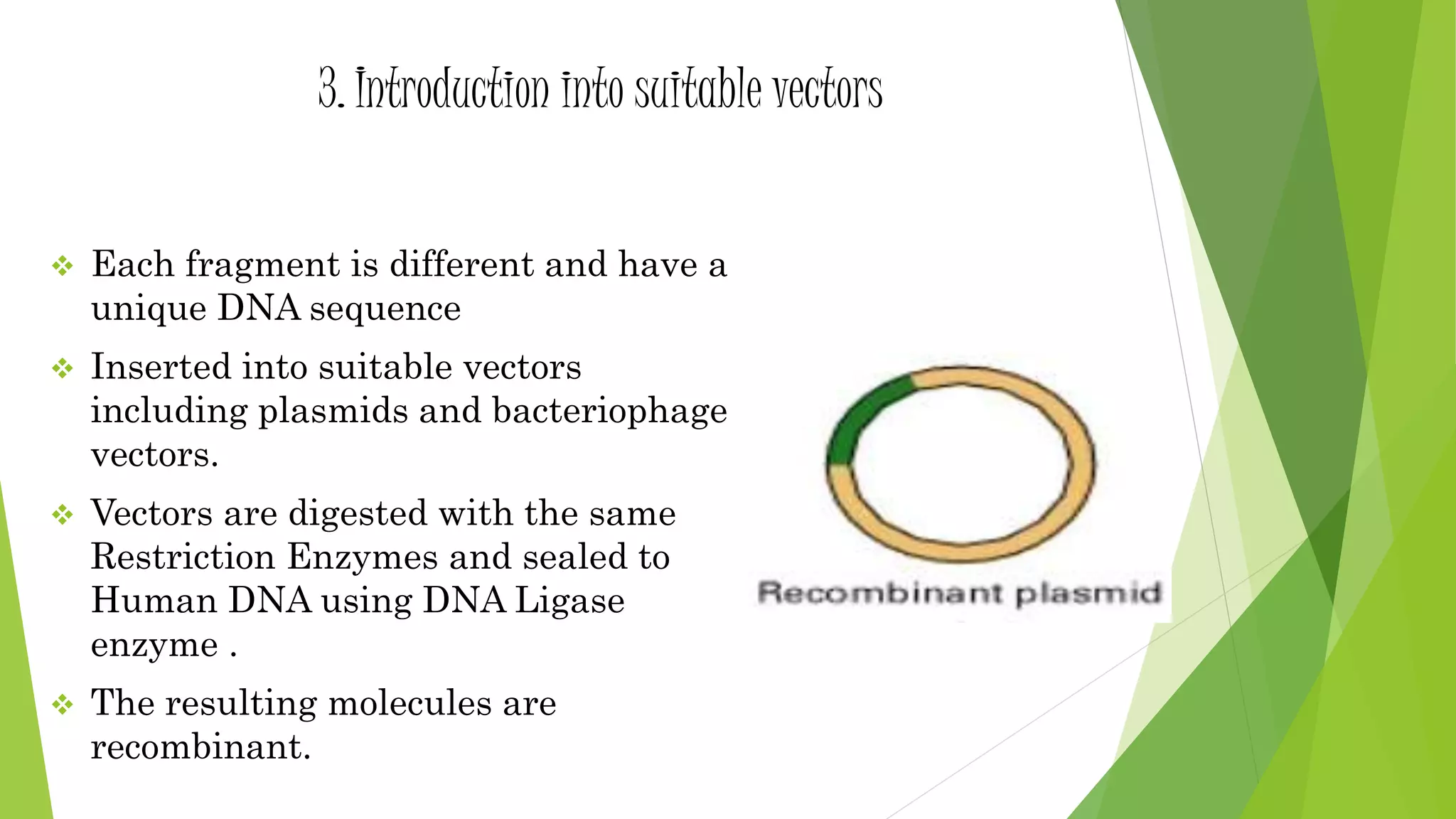
 Vectors are digested with the same
Restriction Enzymes and sealed to
Human DNA using DNA Ligase
enzyme .
 The resulting molecules are
recombinant.
4. Insertion into Bacteria
 Inserted into host bacteria ( E.coli )
 The microbes are grown in culture.
 They are made to take up the DNA.
 They replicate their genome along with
the vector genome contained with them.
 Produce clones of the original genome.
 This collection of clones which contains
all the sequences found in the original
source, including the sequence of
interest forms the genomic library.
Multiplication and Production of
clones
 Independent plasmid
replication
 Host cell replication
Summary of Genomic Library
construction
Screening of clones
The methods used for the selection of recombinants
include:
 Expression Screening or Direct Selection of
Recombinants
 Insertional Selection Inactivation Method
 Blue-White Selection Method
 Colony Hybridisation (Nucleic Acid Hybridisation)
Technique
What are the uses of Genomic Library?
 Researchers can explore the genome of an organism to learn more about
genomic structure and function
 They can map the genome, identifying the locations of specific genes.
 Helps to develop tests which can be used to locate genetic variations
including mutations
 Useful in Recombinant DNA Technology, helps to genetically modify
organisms and produce clones of desired types.
 Genomic library construction is the first step in any DNA sequencing
projects.
 Genomic library helps in identification of the novel pharmaceutically
important genes.
Shotgun sequencing
 Also known as shotgun cloning
 Originally used by Fred Sanger and his colleagues to
sequence small genomes such as those of viruses and
bacteria.
 DNA broken up into small fragments Sequenced
using chain termination method to obtain reads
Multiple overlapping reads of the target DNA are
obtained Computer programmes use the
overlapping ends of different reads to assemble them
into a continuous sequence.
Random shotgun sequencing
1. DNA isolated
2. Cleaved into several fragments
3. Randomly inserted into plasmids
4. A) Some plasmids contain inserts which will be different
from the others B) Some plasmids will have inserts
which may contain some regions present in one insert
and a few region present in other insert i.e. overlapping
inserts.
5. Overlapping sequences are identified using computer
programmes which joins all sequences into one
contiguous stretch.
Whole genome shotgun sequencing
This includes 4 stages:
1. Library construction :- A library of plasmid clones are constructed by
transforming E.coli strains with plasmid.
2. Random sequencing :- DNA is purified from plasmid. Thousands of DNA
fragments are sequenced using automated sequencer and the whole genome is
sequenced several times.
3. Fragment alignment and gap closure :- Computer programmes assemble the
sequenced fragments into longer stretches of sequence by comparing the
overlapping sequence This ‘overlap comparison method’ resulted in a set
of larger contiguous nucleotide sequence called contigs Contigs aligned
in a proper order to form the completed genome sequence If there is gap
between contigs, they are analysed and filled.
4. Proof reading :- Ambiguities in the sequence can be resolved and mutations can
be corrected.
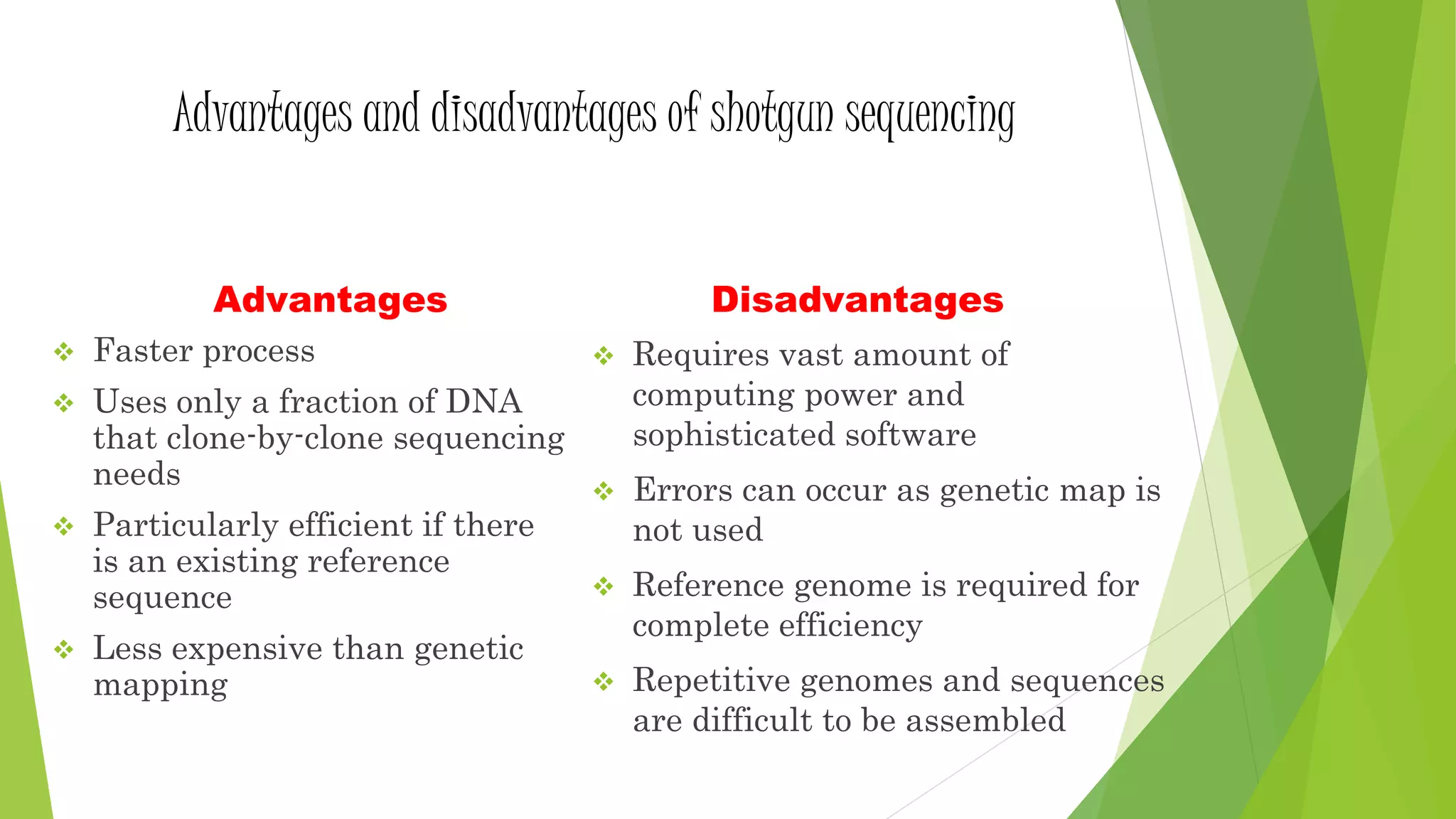
Advantages and disadvantages of shotgun sequencing
Advantages
 Faster process
 Uses only a fraction of DNA
that clone-by-clone sequencing
needs
 Particularly efficient if there
is an existing reference
sequence
 Less expensive than genetic
mapping
Disadvantages
 Requires vast amount of
computing power and
sophisticated software
 Errors can occur as genetic map is
not used
 Reference genome is required for
complete efficiency
 Repetitive genomes and sequences
are difficult to be assembled
Reference
 Dr R. C. Dubey, A textbook of Biotechnology, 5th edition, S. Chand Publishing, 2014,
Chapter 6, Techniques of Genetic Engineering (Cloning Methods and DNA Analysis)
Genomic Library, 98-131, Chapter 7, Genomics and Proteomics, 158-180
 http://www.sumanasinc.com/webcontent/animations/content/dnalibrary.html,
Construction of Genomic Library, 2006
 http://www.slideshare.net/MariamNaseer/genomic-library, Genomic library,
 http://www.slideshare.net/abdullahabobakr7/dna-library-lecturegene-libraries-and-
screening, Genomic library, cDNA library and screening procedures
 http://www.yourgenome.org/facts/what-is-shotgun-sequencing, shot gun sequencing,
2014
 https://en.wikipedia.org/wiki/Shotgun_sequencing, shotgun sequencing, 2015
 https://en.wikipedia.org/wiki/Genomic_library, genomic library, 2015
Genomic library

Genomic library

  • 1.
  • 2.
  • 3.
    Introduction  In humans,approximately 25,000 genes exit among the 3 billion base pairs of DNA in the genome.  To study anyone of these genes, a researcher first isolates it from all of the other genes in an organisms DNA.  One isolation method has a relatively long history and involves the construction of a DNA library  When a gene is identified and copied, it is said to have been “cloned”
  • 4.
    DNA LIBRARY  Theterm “library” can refer to a population of organism, each of which carries a DNA molecule inserted into a cloning vector, or alternatively to the collection of all of the cloned vector molecules.  Collection of DNA fragments that have been cloned into vectors so that researchers can identify and isolate the DNA fragments that interest them for further study.  For ease of purification, storage and analysis.
  • 5.
    Two types ofDNA Library Genomic library (made from genomic DNA) DNA Library cDNA Library (made from cDNA- copy of mRNA)
  • 6.
    For the constructionof DNA Library  Size of the gene  Capacity of the vector  Molecular tools  Vectors
  • 7.
    Size of theLibrary (ensure enough clones)  Must contain a certain no: of recombinants for there to be a high probability of it containing any particular sequence.  The formula to calculate the no: of recombinants: ln (1-P) N = ln (1-F) P: desired probability F: the fraction of the genome in one insert
  • 8.
  • 9.
    Genomic Library A libraryfor me??? Why not?...You are the Backbone of Life……
  • 10.
    What is GenomicLibrary?  Contains DNA fragments representing entire genome of an organism.  Created using molecular cloning  Genome size is expressed in terms of no: of base pairs.  The sizes of genomes in different species are variable.  There is a distinct difference in the genes of prokaryotes and eukaryotes.  In prokaryotes, the structural genes coding for proteins are continuous while in eukaryotes, the coding regions ( exons ) are separated by non-coding regions ( introns ).  Therefore, the construction of gene libraries for eukaryotes is more complicated.
  • 11.
    Steps of GenomicLibrary construction  Isolation of DNA from cells  Digestion into small fragments  Introduction into suitable vectors  Insertion into bacteria  DNA isolation  Collection of Genomic DNA library
  • 12.
    1. Isolation ofDNA (purification) Eukaryotes : Prepare cell nuclei, remove proteins, lipids and other unwanted macromolecules by protease digestion and phase extraction. Prokaryotes : Extracted DNA directly from cells.
  • 13.
    2. Digestion intosmall fragments Physical shearing : Pipetting, mixing Restriction enzyme digestion : Partial digestion is preferred to get a greater lengths of DNA fragments.
  • 14.
    Selection of restrictionenzymes 1. Ends produced (sticky or blunt) & the cleaved ends of the vector to be vector 2. Whether the enzyme is inhibited by DNA modifications 3. Time of digestion and ratio of restriction enzyme to DNA is dependent on the desired insert size range.
  • 15.
    3. Introduction intosuitable vectors  Each fragment is different and have a unique DNA sequence  Inserted into suitable vectors including plasmids and bacteriophage vectors.  Vectors are digested with the same Restriction Enzymes and sealed to Human DNA using DNA Ligase enzyme .  The resulting molecules are recombinant.
  • 16.
    4. Insertion intoBacteria  Inserted into host bacteria ( E.coli )  The microbes are grown in culture.  They are made to take up the DNA.  They replicate their genome along with the vector genome contained with them.  Produce clones of the original genome.  This collection of clones which contains all the sequences found in the original source, including the sequence of interest forms the genomic library.
  • 17.
    Multiplication and Productionof clones  Independent plasmid replication  Host cell replication
  • 18.
    Summary of GenomicLibrary construction
  • 19.
    Screening of clones Themethods used for the selection of recombinants include:  Expression Screening or Direct Selection of Recombinants  Insertional Selection Inactivation Method  Blue-White Selection Method  Colony Hybridisation (Nucleic Acid Hybridisation) Technique
  • 20.
    What are theuses of Genomic Library?  Researchers can explore the genome of an organism to learn more about genomic structure and function  They can map the genome, identifying the locations of specific genes.  Helps to develop tests which can be used to locate genetic variations including mutations  Useful in Recombinant DNA Technology, helps to genetically modify organisms and produce clones of desired types.  Genomic library construction is the first step in any DNA sequencing projects.  Genomic library helps in identification of the novel pharmaceutically important genes.
  • 21.
    Shotgun sequencing  Alsoknown as shotgun cloning  Originally used by Fred Sanger and his colleagues to sequence small genomes such as those of viruses and bacteria.  DNA broken up into small fragments Sequenced using chain termination method to obtain reads Multiple overlapping reads of the target DNA are obtained Computer programmes use the overlapping ends of different reads to assemble them into a continuous sequence.
  • 22.
    Random shotgun sequencing 1.DNA isolated 2. Cleaved into several fragments 3. Randomly inserted into plasmids 4. A) Some plasmids contain inserts which will be different from the others B) Some plasmids will have inserts which may contain some regions present in one insert and a few region present in other insert i.e. overlapping inserts. 5. Overlapping sequences are identified using computer programmes which joins all sequences into one contiguous stretch.
  • 23.
    Whole genome shotgunsequencing This includes 4 stages: 1. Library construction :- A library of plasmid clones are constructed by transforming E.coli strains with plasmid. 2. Random sequencing :- DNA is purified from plasmid. Thousands of DNA fragments are sequenced using automated sequencer and the whole genome is sequenced several times. 3. Fragment alignment and gap closure :- Computer programmes assemble the sequenced fragments into longer stretches of sequence by comparing the overlapping sequence This ‘overlap comparison method’ resulted in a set of larger contiguous nucleotide sequence called contigs Contigs aligned in a proper order to form the completed genome sequence If there is gap between contigs, they are analysed and filled. 4. Proof reading :- Ambiguities in the sequence can be resolved and mutations can be corrected.
  • 24.
    Advantages and disadvantagesof shotgun sequencing Advantages  Faster process  Uses only a fraction of DNA that clone-by-clone sequencing needs  Particularly efficient if there is an existing reference sequence  Less expensive than genetic mapping Disadvantages  Requires vast amount of computing power and sophisticated software  Errors can occur as genetic map is not used  Reference genome is required for complete efficiency  Repetitive genomes and sequences are difficult to be assembled
  • 25.
    Reference  Dr R.C. Dubey, A textbook of Biotechnology, 5th edition, S. Chand Publishing, 2014, Chapter 6, Techniques of Genetic Engineering (Cloning Methods and DNA Analysis) Genomic Library, 98-131, Chapter 7, Genomics and Proteomics, 158-180  http://www.sumanasinc.com/webcontent/animations/content/dnalibrary.html, Construction of Genomic Library, 2006  http://www.slideshare.net/MariamNaseer/genomic-library, Genomic library,  http://www.slideshare.net/abdullahabobakr7/dna-library-lecturegene-libraries-and- screening, Genomic library, cDNA library and screening procedures  http://www.yourgenome.org/facts/what-is-shotgun-sequencing, shot gun sequencing, 2014  https://en.wikipedia.org/wiki/Shotgun_sequencing, shotgun sequencing, 2015  https://en.wikipedia.org/wiki/Genomic_library, genomic library, 2015