Risk Analysis 
Dr. I. M. Mishra 
Pt. G. B. Pant Chair Professor of Environmental Pollution 
Abatement, Professor of Chemical Engineering and 
Dean Saharanpur Campus 
Indian Institute of Technology, Roorkee 
E-mail:- imishfch@iitr.ernet.in
Some Important Definitions 
 Risk 
 A measure of the potential for loss in terms of both the 
likelihood (events/year) of the incident and the 
consequences (effects/event) of the incident 
 Mathematically Risk = Σ probability of event × 
consequence of event 
Risk Analysis 
 The development of a quantitative estimate of risk based on 
engineering evaluation & mathematical techniques for 
combining estimates of incident likelihood and 
consequences
Some Important Definitions 
 Risk Assessment 
 The process by which the results of a risk analysis (i.e., risk 
estimates) are used to make decisions, either through 
relative ranking or through comparison with risk targets 
 Risk Management 
 The planning, organizing, leading and controlling of an 
organization’s assets and activities in ways, which minimize 
the adverse operational and financial effects of accidental 
losses upon the organization
Risk Analysis? 
 It is an important part and precursor of risk assessment and 
management 
 A full analysis involves the estimation of the frequency and 
consequences of a range of hazards scenarios and the damages 
expected. 
 Damages include injury and loss of life, damage to the 
environment and equipment, loss of work, and finally also 
economic loss to the plant
Why Risk Analysis? 
 Chemicals have become a part 
of our life 
 Chemicals have their own 
inherent properties and hazards 
and so do the processes by 
which they are manufactured 
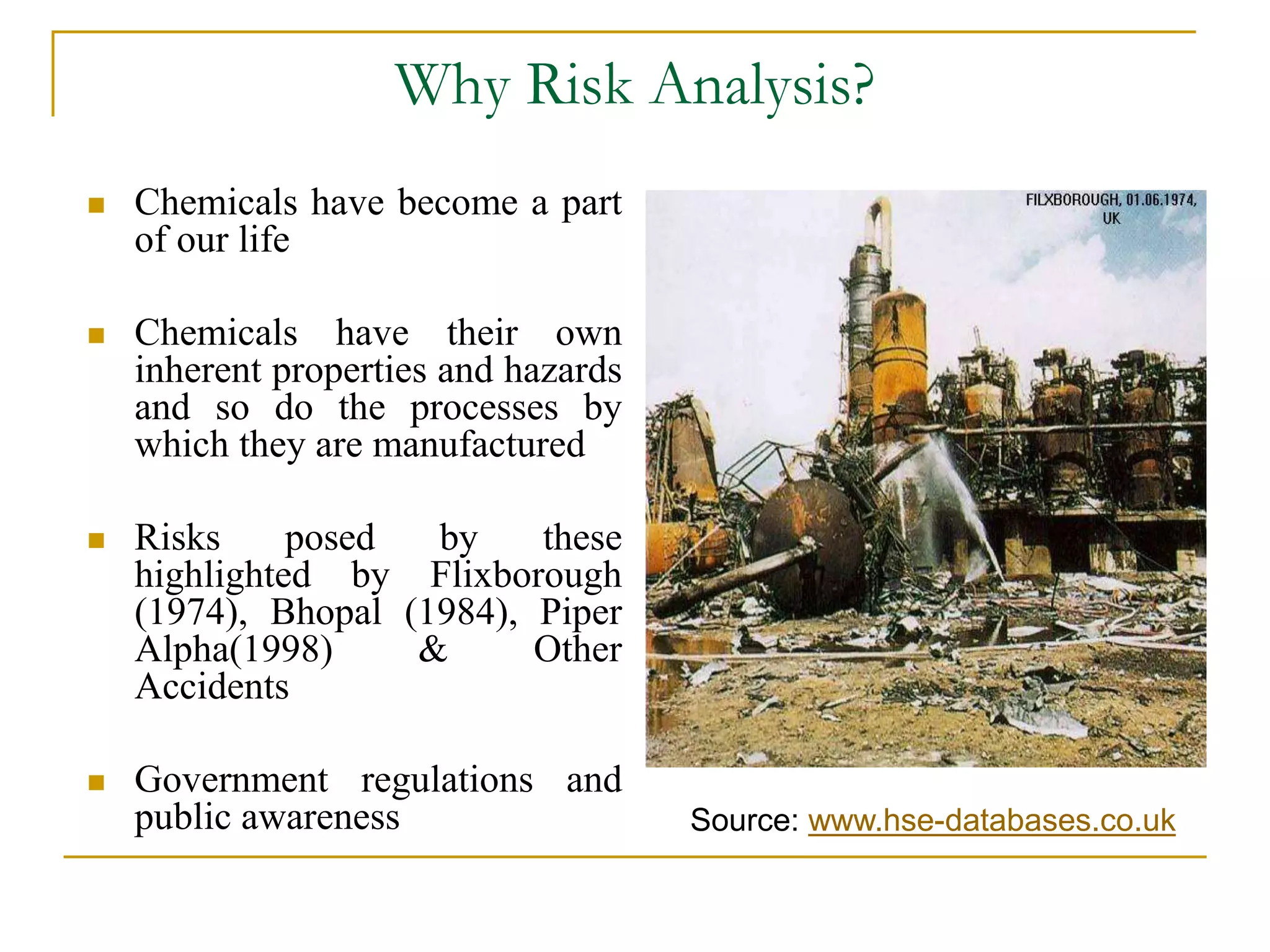
 Risks posed by these 
highlighted by Flixborough 
(1974), Bhopal (1984), Piper 
Alpha(1998) & Other 
Accidents 
 Government regulations and 
public awareness Source: www.hse-databases.co.uk
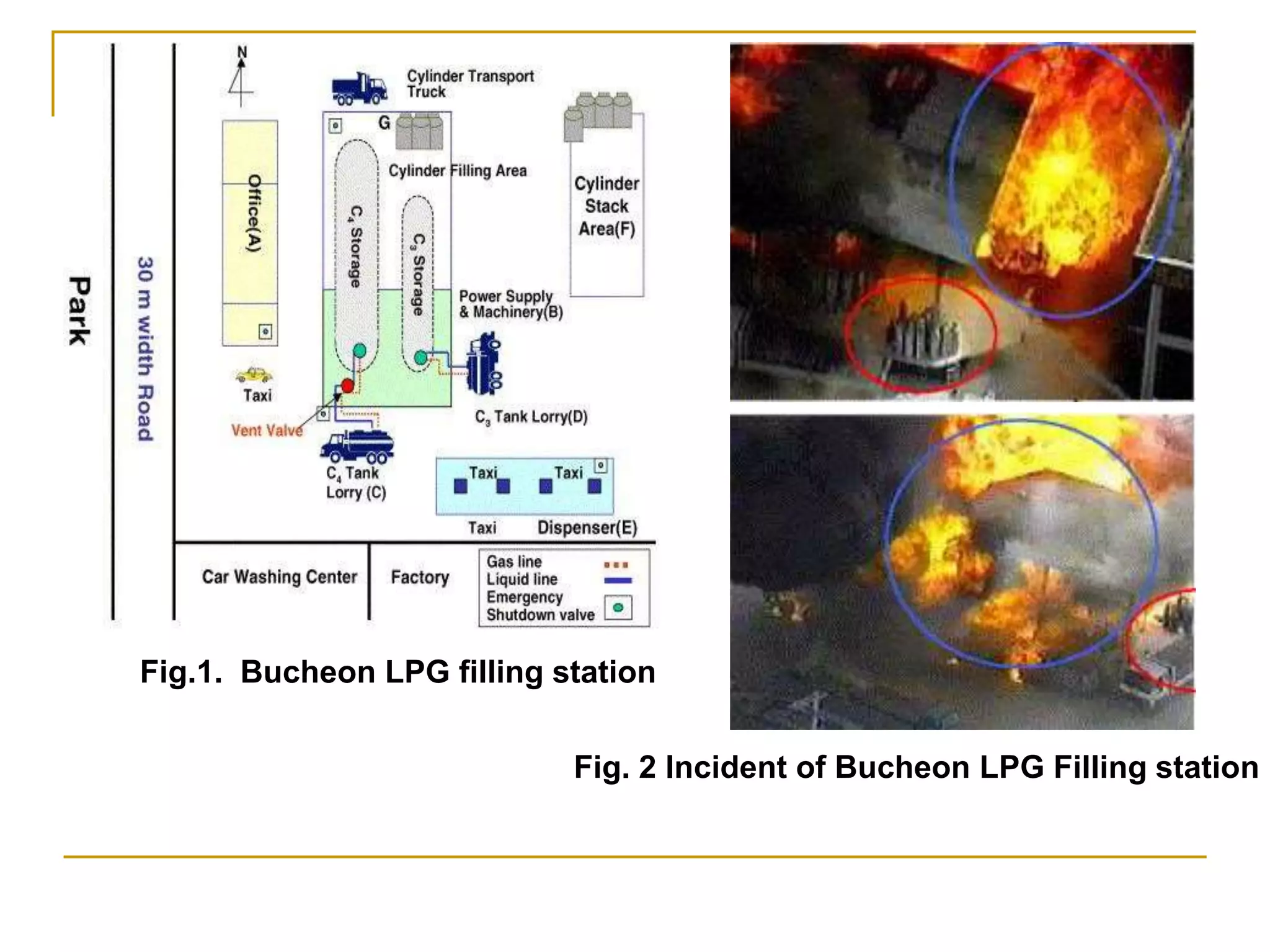
Fig.1. Bucheon LPG filling station 
Fig. 2 Incident of Bucheon LPG Filling station
History of Risk & Risk Analysis 
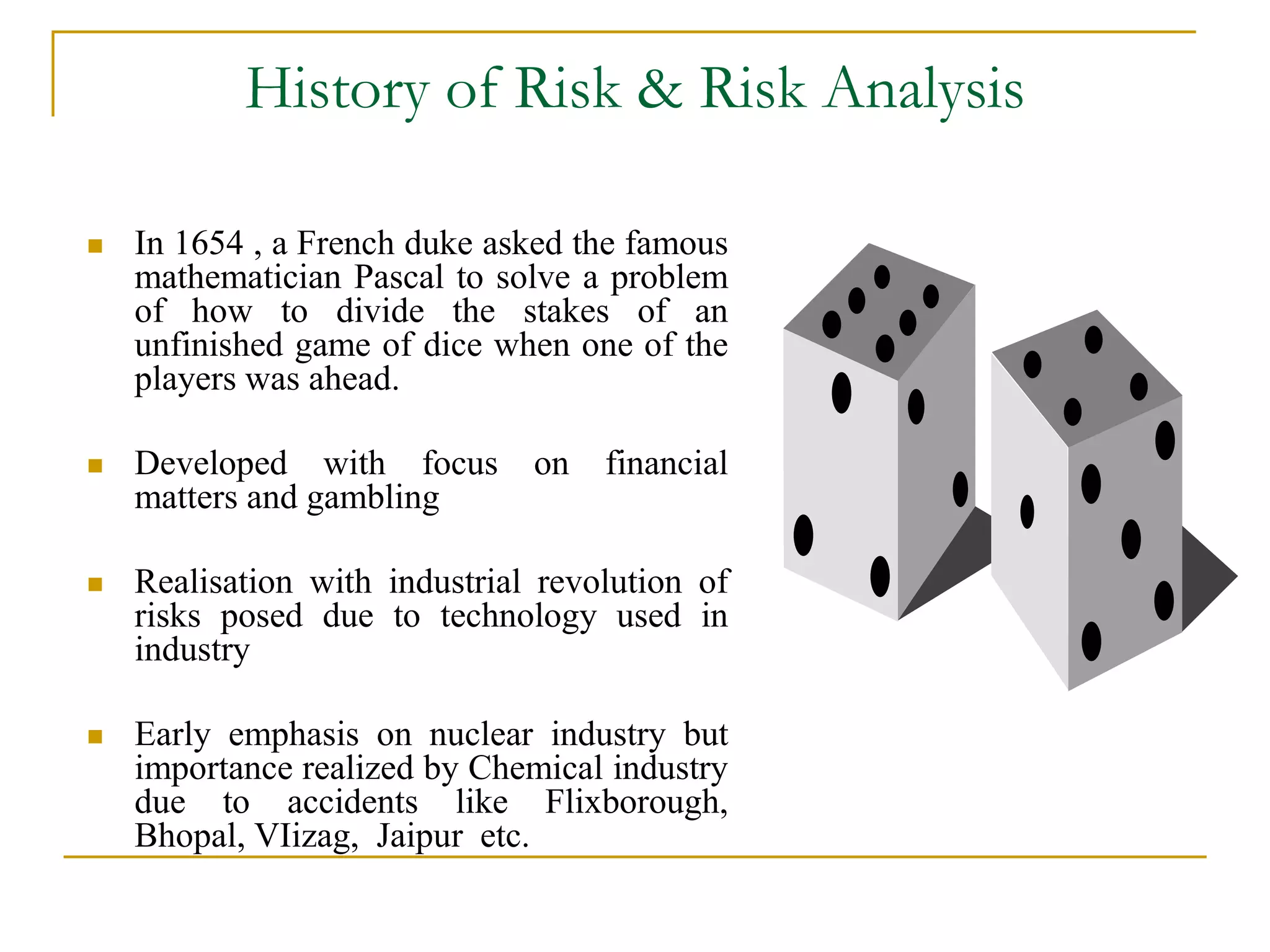
 In 1654 , a French duke asked the famous 
mathematician Pascal to solve a problem 
of how to divide the stakes of an 
unfinished game of dice when one of the 
players was ahead. 
 Developed with focus on financial 
matters and gambling 
 Realisation with industrial revolution of 
risks posed due to technology used in 
industry 
 Early emphasis on nuclear industry but 
importance realized by Chemical industry 
due to accidents like Flixborough, 
Bhopal, VIizag, Jaipur etc.
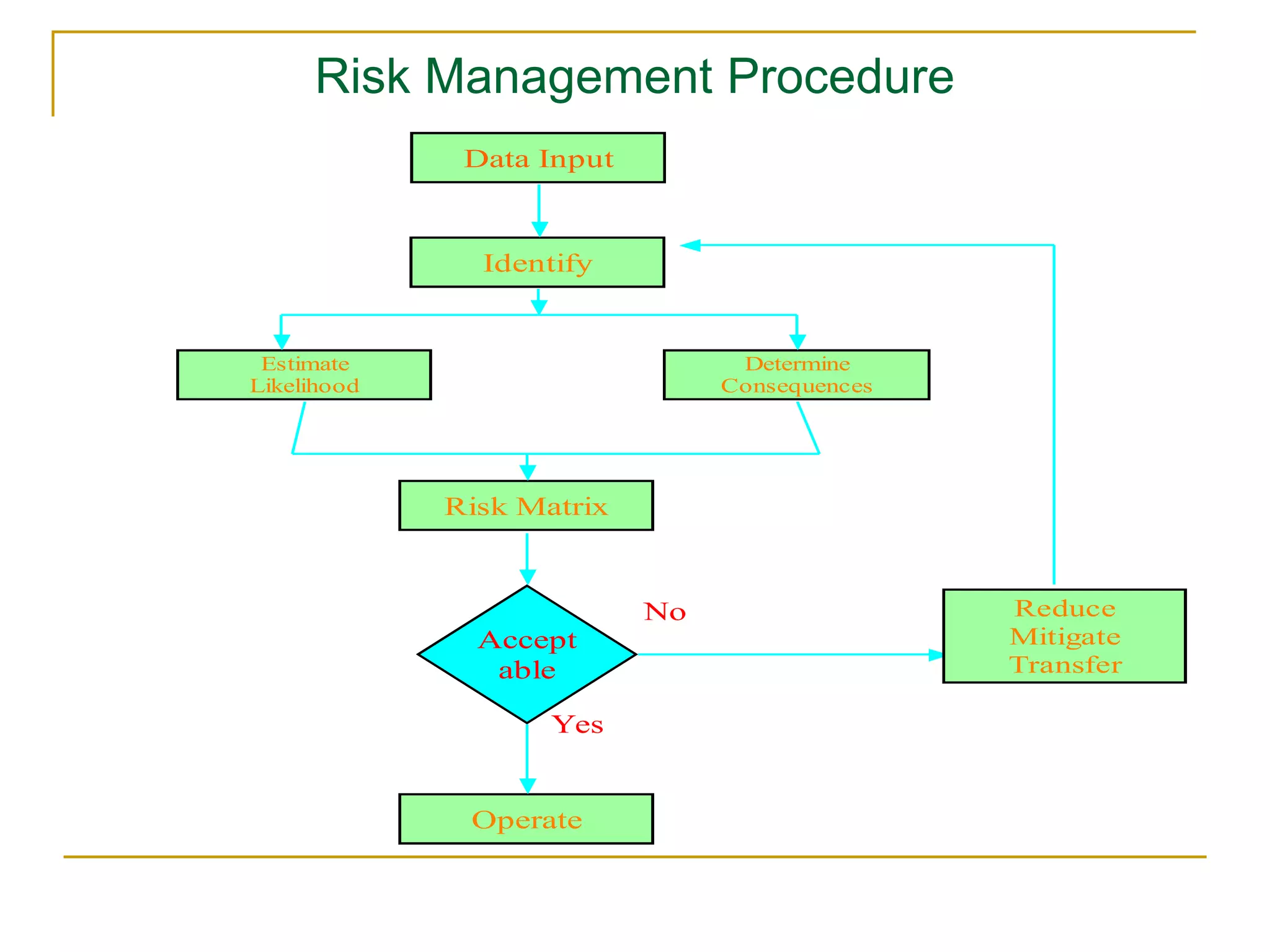
Risk Management Procedure 
Data Input 
Identify 
Estimate 
Likelihood 
Determine 
Consequences 
Risk Matrix 
Accept 
able 
Operate 
Reduce 
Mitigate 
Transfer 
Yes 
No
Sources of Data Input 
 Chemical Usage, Contractor Activity, EH&S Policies, 
Equipment Reliability, External Events, Facility & Process 
Descriptions, Historical Accident, Human Reliability 
 Manuals for Policies & Procedures, Engineering Design, 
Safety, Maintenance and data from Material Usage, 
Meteorological, Population etc
General Steps in Risk Analysis 
The general steps in any hazard identification 
technique are 
1. Assembling a team 
2. Collection of data 
3. Deciding on level of detail 
4. Applying the technique 
5. Documenting the results
Methods For Risk Analysis 
 Risk analysis can be carried out by a number of methods 
 Cause-Consequence Analysis, Checklist, Event Tree Analysis 
Failure Modes, Effects and Criticality Analysis (FMECA) 
Fault Tree Analysis (FTA), Hazard & Operability Analysis 
(HAZOP), Bow Ties, Petri nets 
 Method usage depends on level of detail and resources 
available
Classification of Methods 
 The methods can be classified in to the following categories: 
1. Qualitative 
2. Quantitative 
 These can further be divided into: 
1. Deterministic 
2. Probabilistic
Methods for Risk Analysis 
 The deterministic methods take into consideration the 
products, the equipment and the quantification of 
consequences for various targets such as people, environment 
and equipment. 
 The probabilistic methods are based on the probability or 
frequency of hazardous situation apparitions or on the 
occurrence of potential accident. 
 The probabilistic methods are mainly focused on failure 
probability of equipment or their components.
Some Qualitative Methods 
Preliminary Risk Analysis 
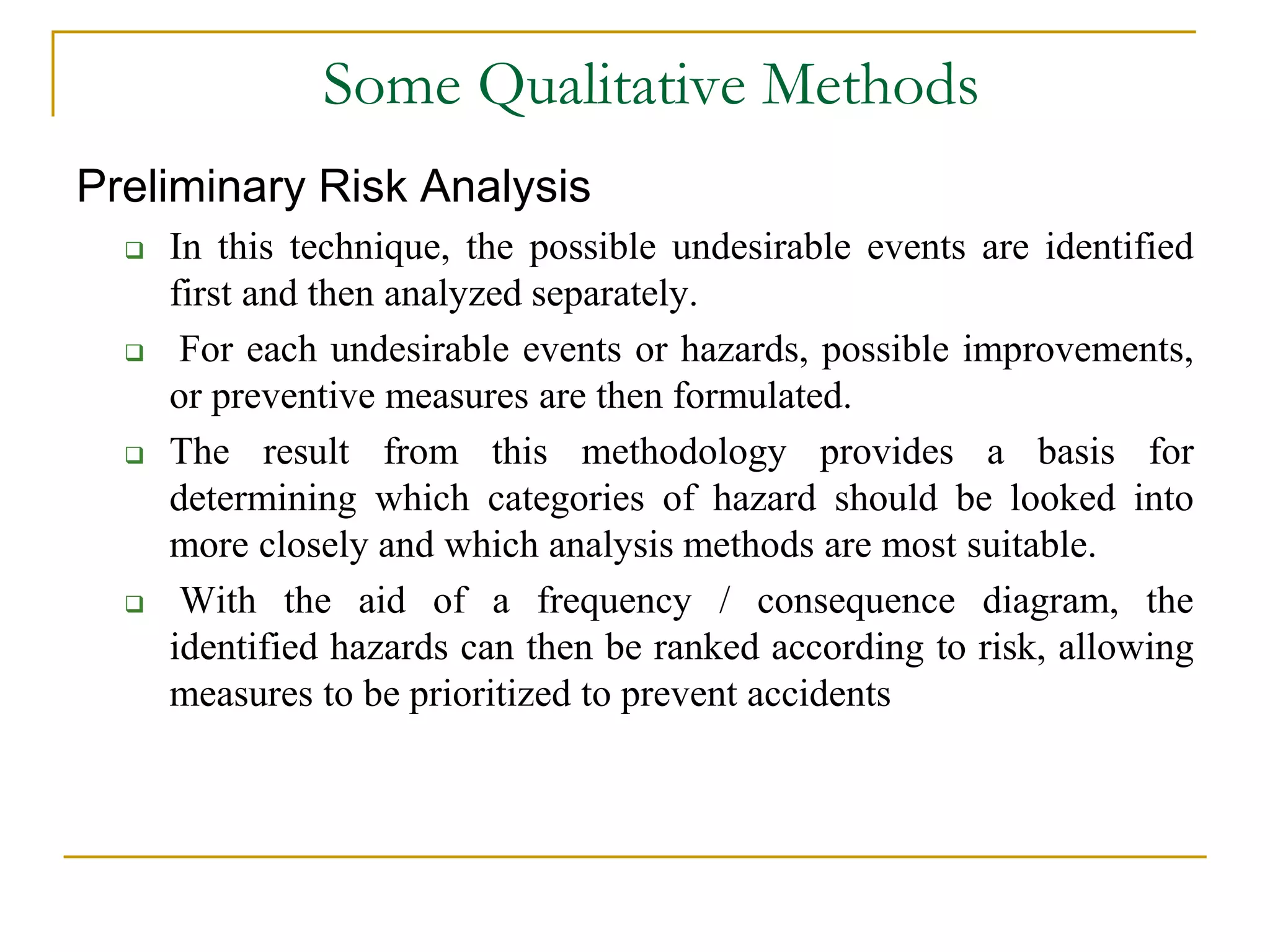
 In this technique, the possible undesirable events are identified 
first and then analyzed separately. 
 For each undesirable events or hazards, possible improvements, 
or preventive measures are then formulated. 
 The result from this methodology provides a basis for 
determining which categories of hazard should be looked into 
more closely and which analysis methods are most suitable. 
 With the aid of a frequency / consequence diagram, the 
identified hazards can then be ranked according to risk, allowing 
measures to be prioritized to prevent accidents
Some Qualitative Methods 
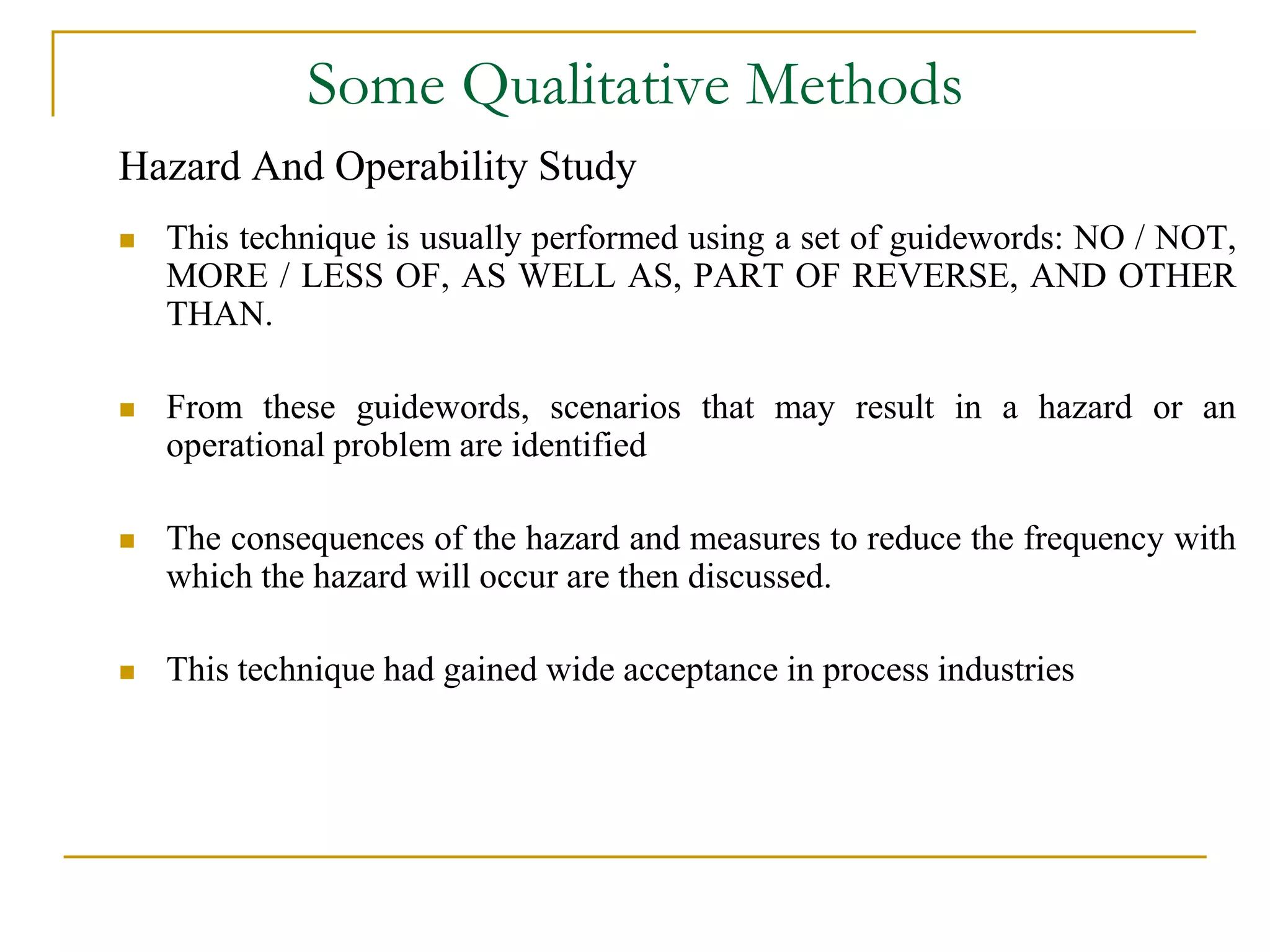
Hazard And Operability Study 
 This technique is usually performed using a set of guidewords: NO / NOT, 
MORE / LESS OF, AS WELL AS, PART OF REVERSE, AND OTHER 
THAN. 
 From these guidewords, scenarios that may result in a hazard or an 
operational problem are identified 
 The consequences of the hazard and measures to reduce the frequency with 
which the hazard will occur are then discussed. 
 This technique had gained wide acceptance in process industries
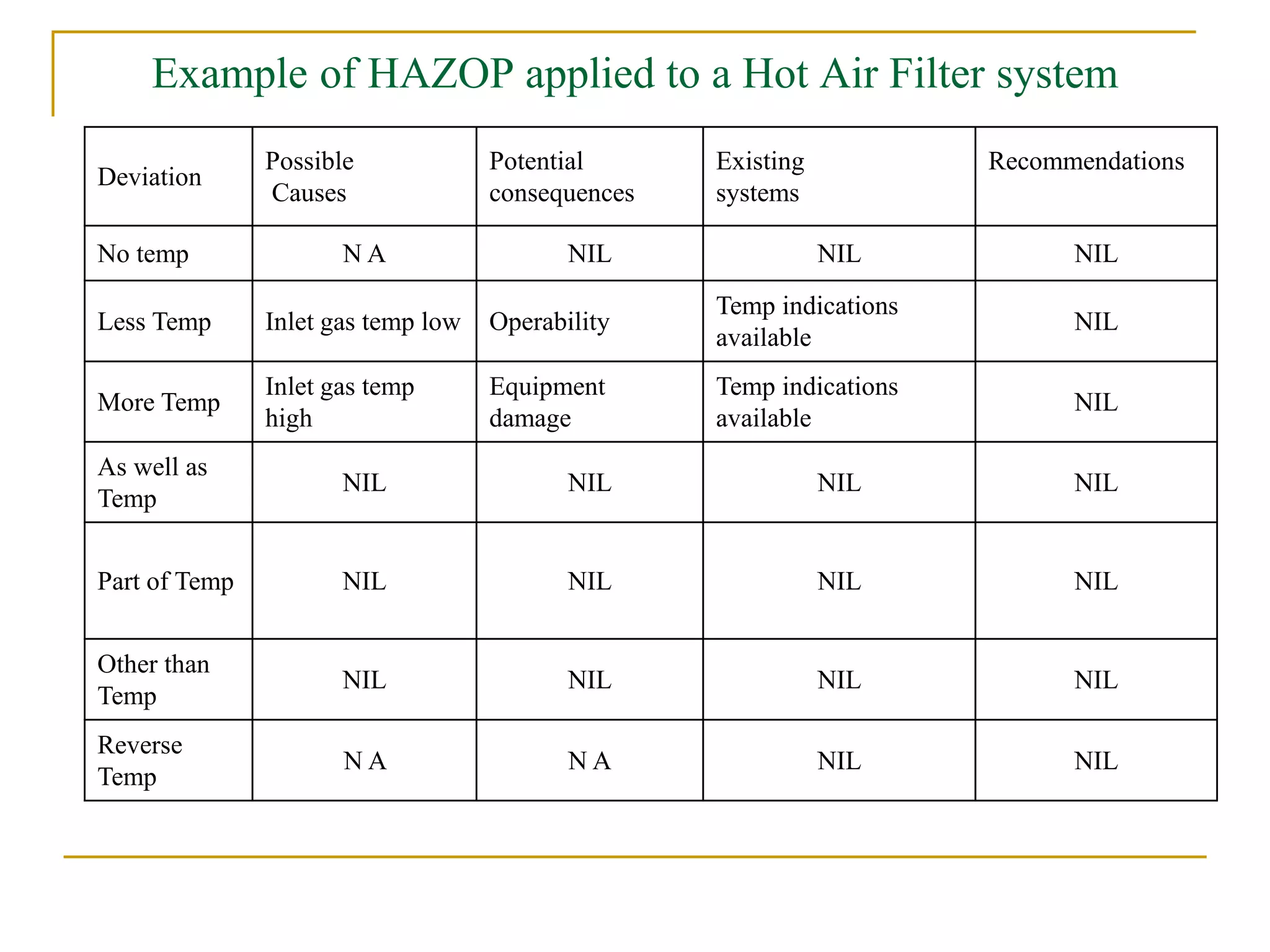
Example of HAZOP applied to a Hot Air Filter system 
Deviation 
Possible 
Causes 
Potential 
consequences 
Existing 
systems 
Recommendations 
No temp N A NIL NIL NIL 
Less Temp Inlet gas temp low Operability 
Temp indications 
available 
NIL 
More Temp 
Inlet gas temp 
high 
Equipment 
damage 
Temp indications 
available 
NIL 
As well as 
Temp 
NIL NIL NIL NIL 
Part of Temp NIL NIL NIL NIL 
Other than 
Temp 
NIL NIL NIL NIL 
Reverse 
Temp 
N A N A NIL NIL
Some Qualitative Methods 
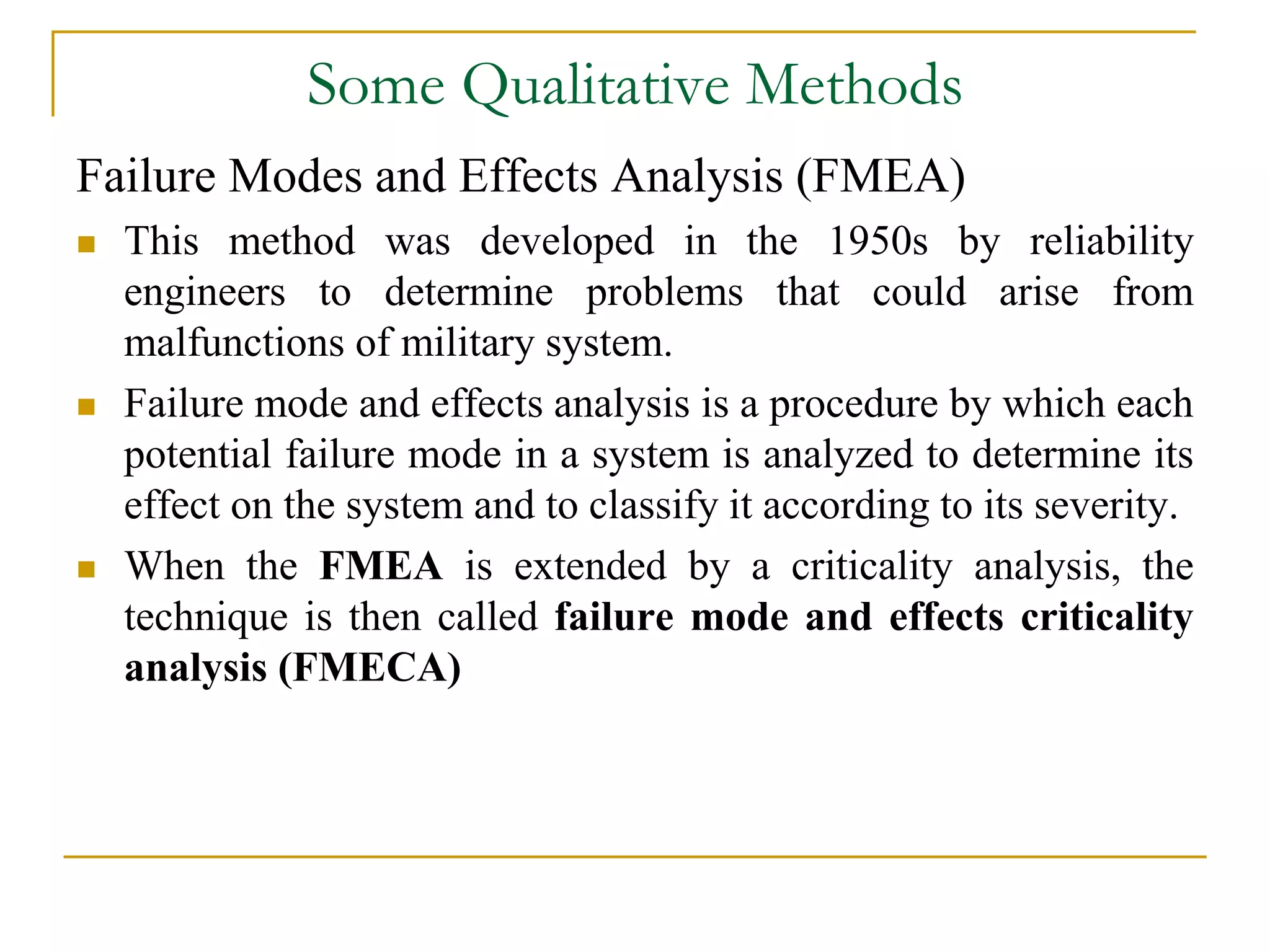
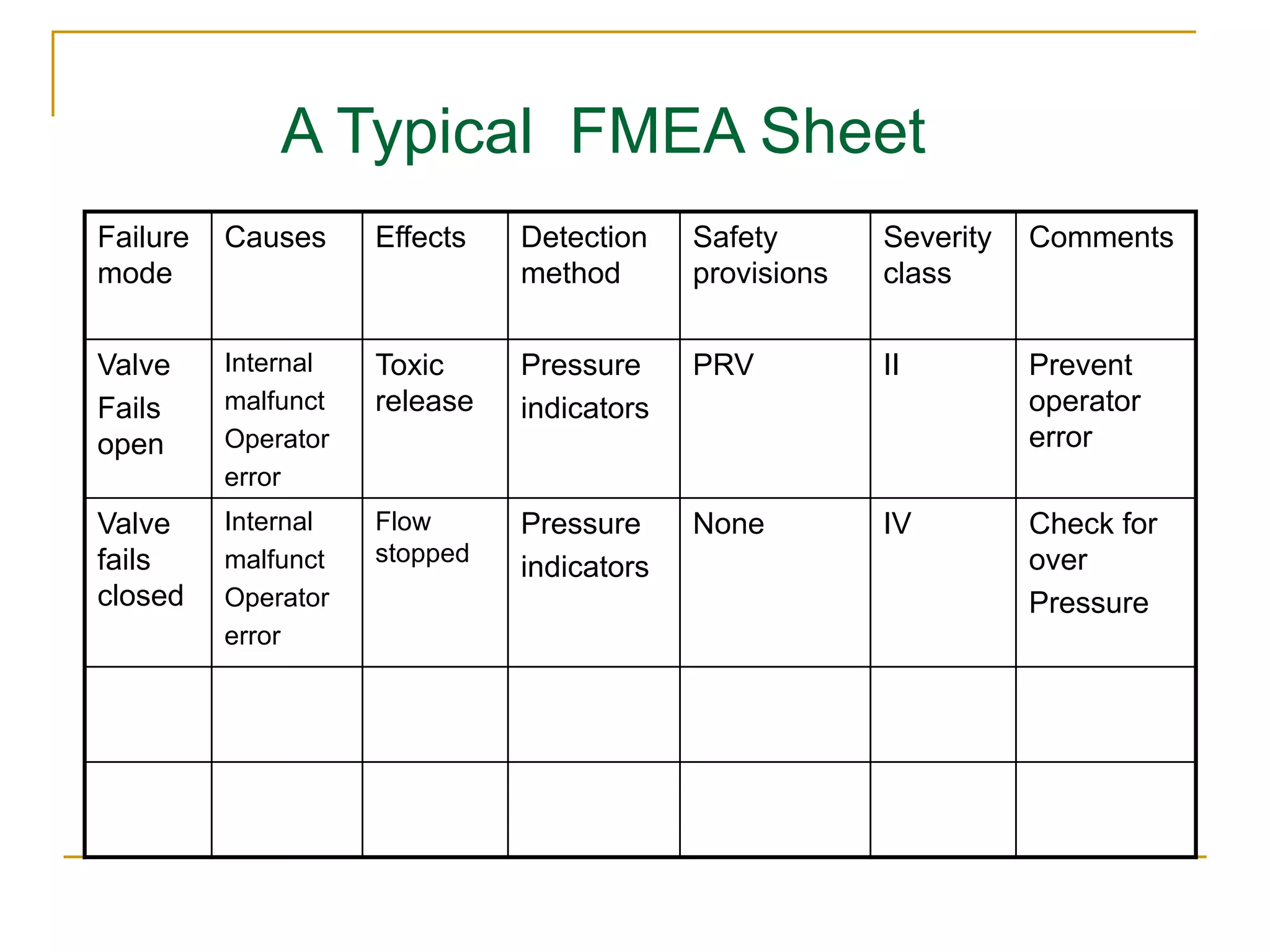
Failure Modes and Effects Analysis (FMEA) 
 This method was developed in the 1950s by reliability 
engineers to determine problems that could arise from 
malfunctions of military system. 
 Failure mode and effects analysis is a procedure by which each 
potential failure mode in a system is analyzed to determine its 
effect on the system and to classify it according to its severity. 
 When the FMEA is extended by a criticality analysis, the 
technique is then called failure mode and effects criticality 
analysis (FMECA)
Failure 
mode 
Causes Effects Detection 
method 
Safety 
provisions 
Severity 
class 
Comments 
Valve 
Fails 
open 
Internal 
malfunct 
Operator 
error 
Toxic 
release 
Pressure 
indicators 
PRV II Prevent 
operator 
error 
Valve 
fails 
closed 
Internal 
malfunct 
Operator 
error 
Flow 
stopped 
Pressure 
indicators 
None IV Check for 
over 
Pressure 
A Typical FMEA Sheet
Some Qualitative Methods 
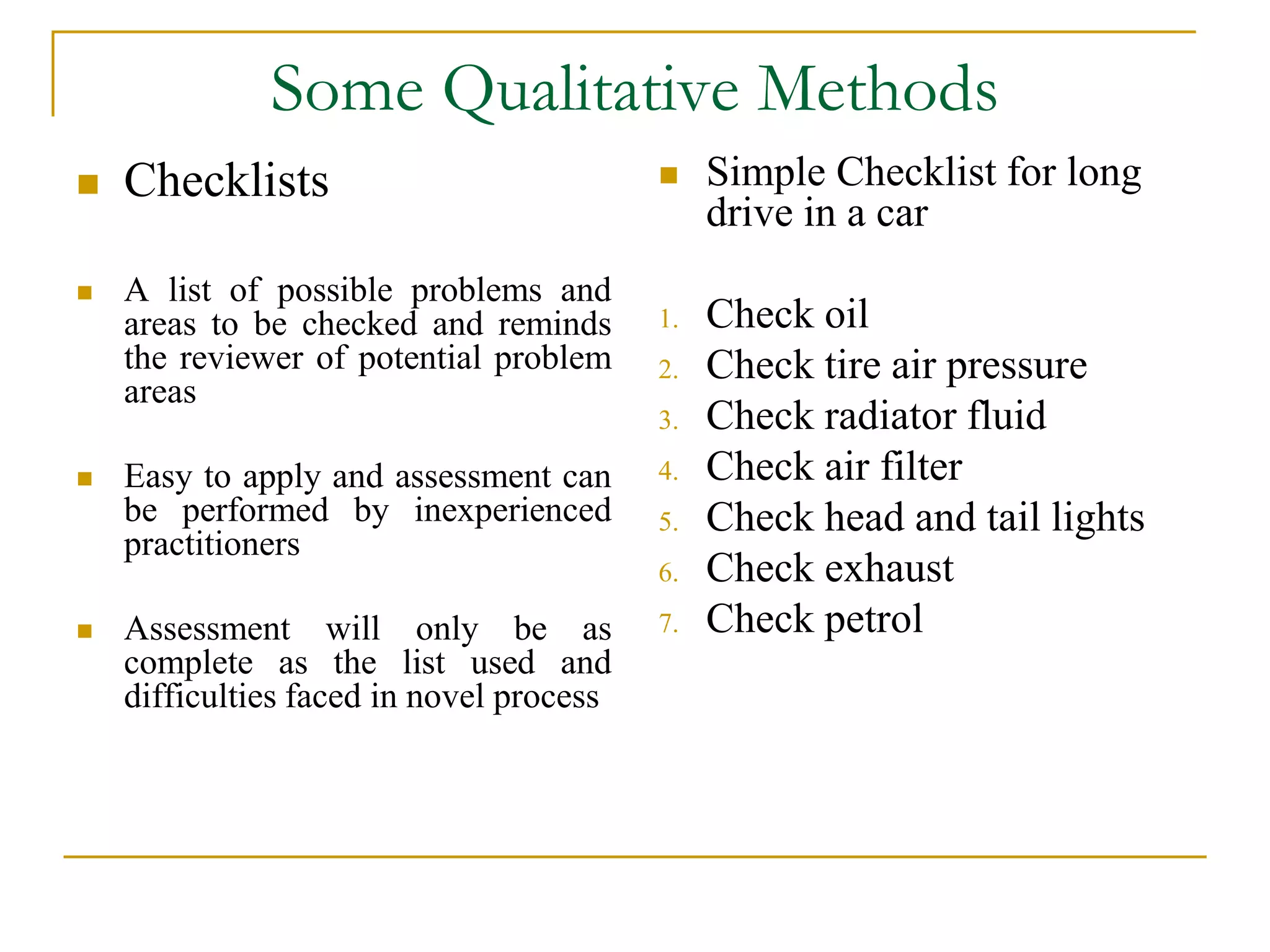
 Checklists 
 A list of possible problems and 
areas to be checked and reminds 
the reviewer of potential problem 
areas 
 Easy to apply and assessment can 
be performed by inexperienced 
practitioners 
 Assessment will only be as 
complete as the list used and 
difficulties faced in novel process 
 Simple Checklist for long 
drive in a car 
1. Check oil 
2. Check tire air pressure 
3. Check radiator fluid 
4. Check air filter 
5. Check head and tail lights 
6. Check exhaust 
7. Check petrol
Pros and Cons of Qualitative Techniques 
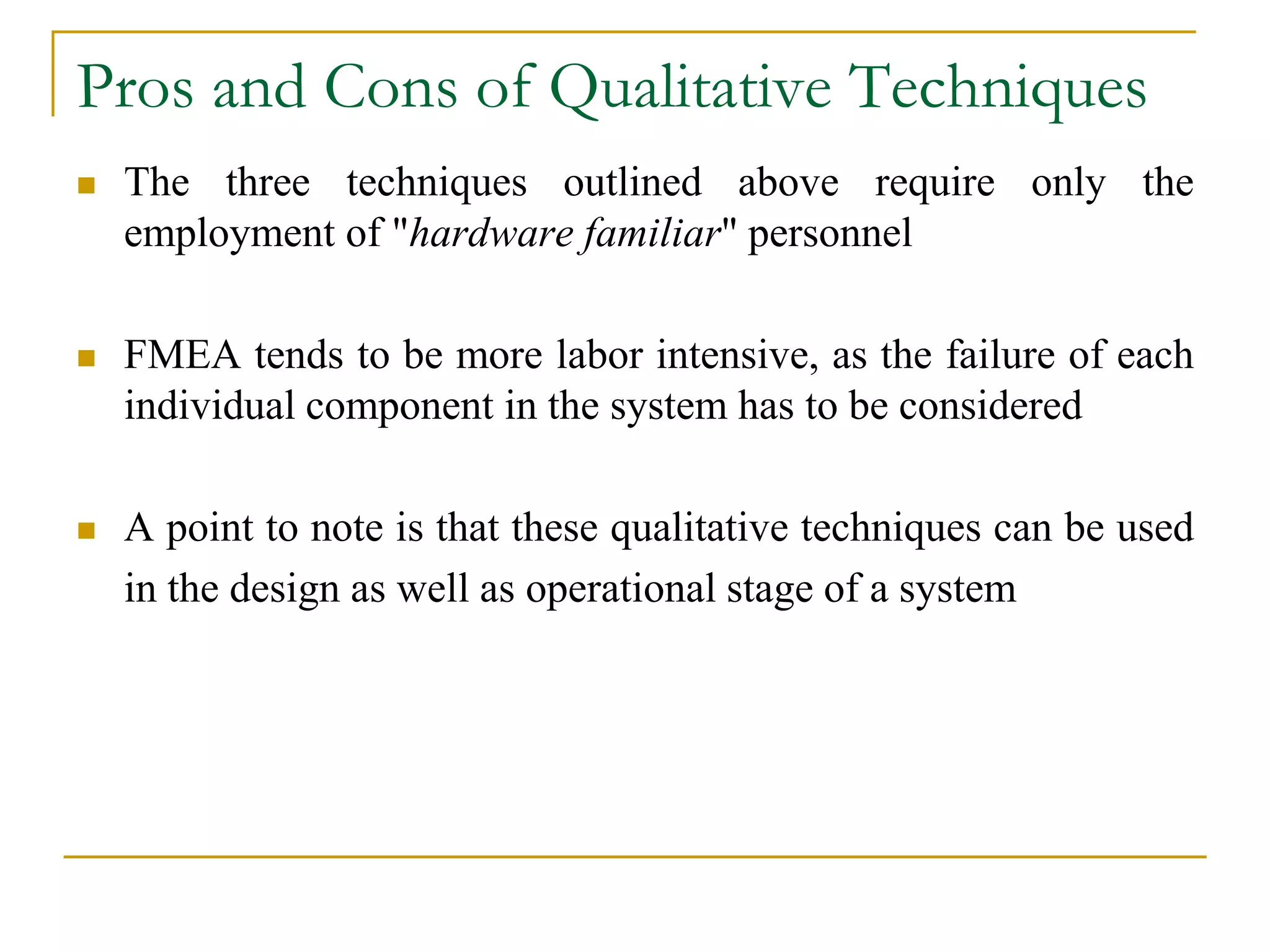
 The three techniques outlined above require only the 
employment of "hardware familiar" personnel 
 FMEA tends to be more labor intensive, as the failure of each 
individual component in the system has to be considered 
 A point to note is that these qualitative techniques can be used 
in the design as well as operational stage of a system
Some Quantitative Techniques 
Fault Tree Analysis 
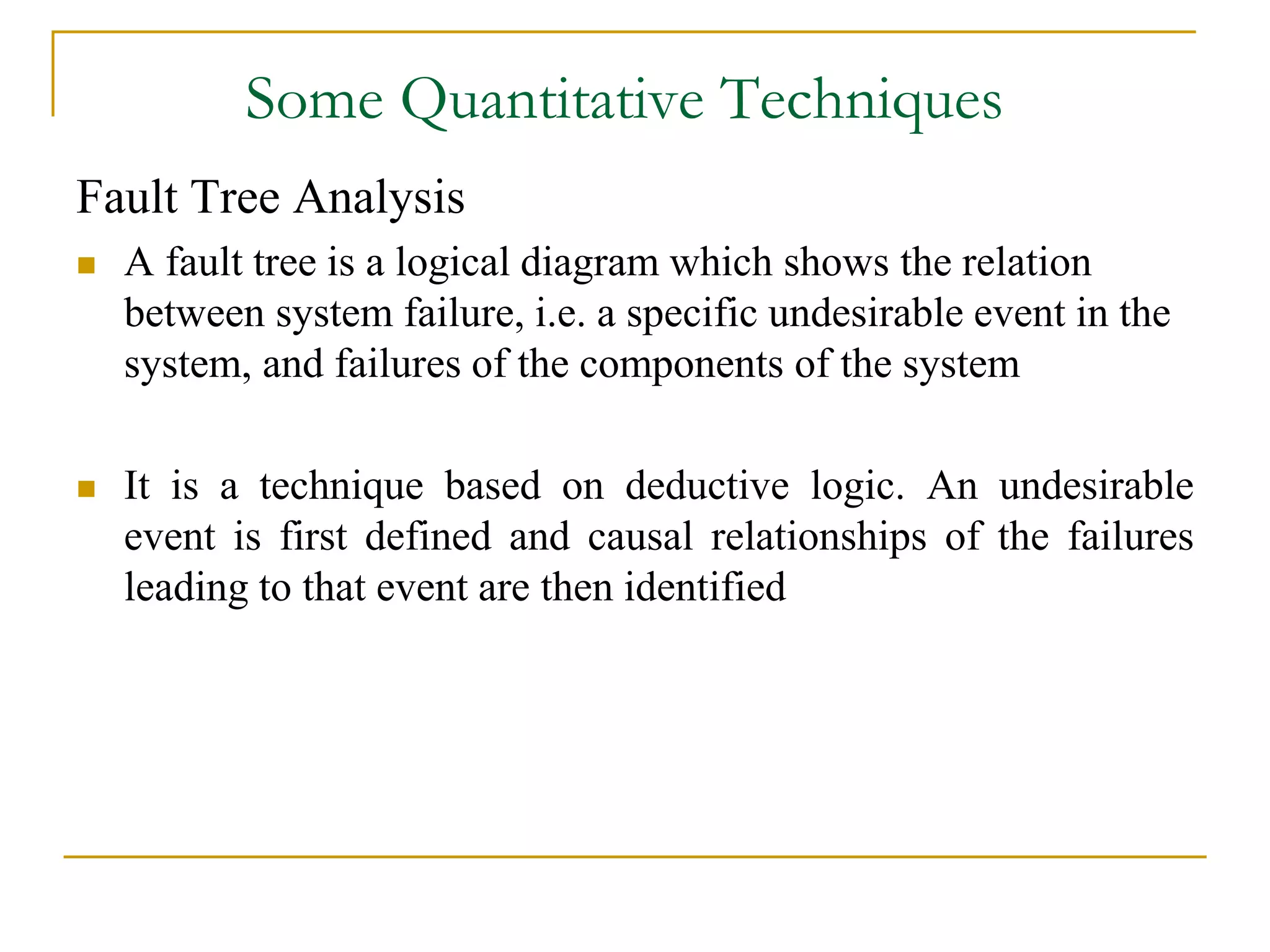
 A fault tree is a logical diagram which shows the relation 
between system failure, i.e. a specific undesirable event in the 
system, and failures of the components of the system 
 It is a technique based on deductive logic. An undesirable 
event is first defined and causal relationships of the failures 
leading to that event are then identified
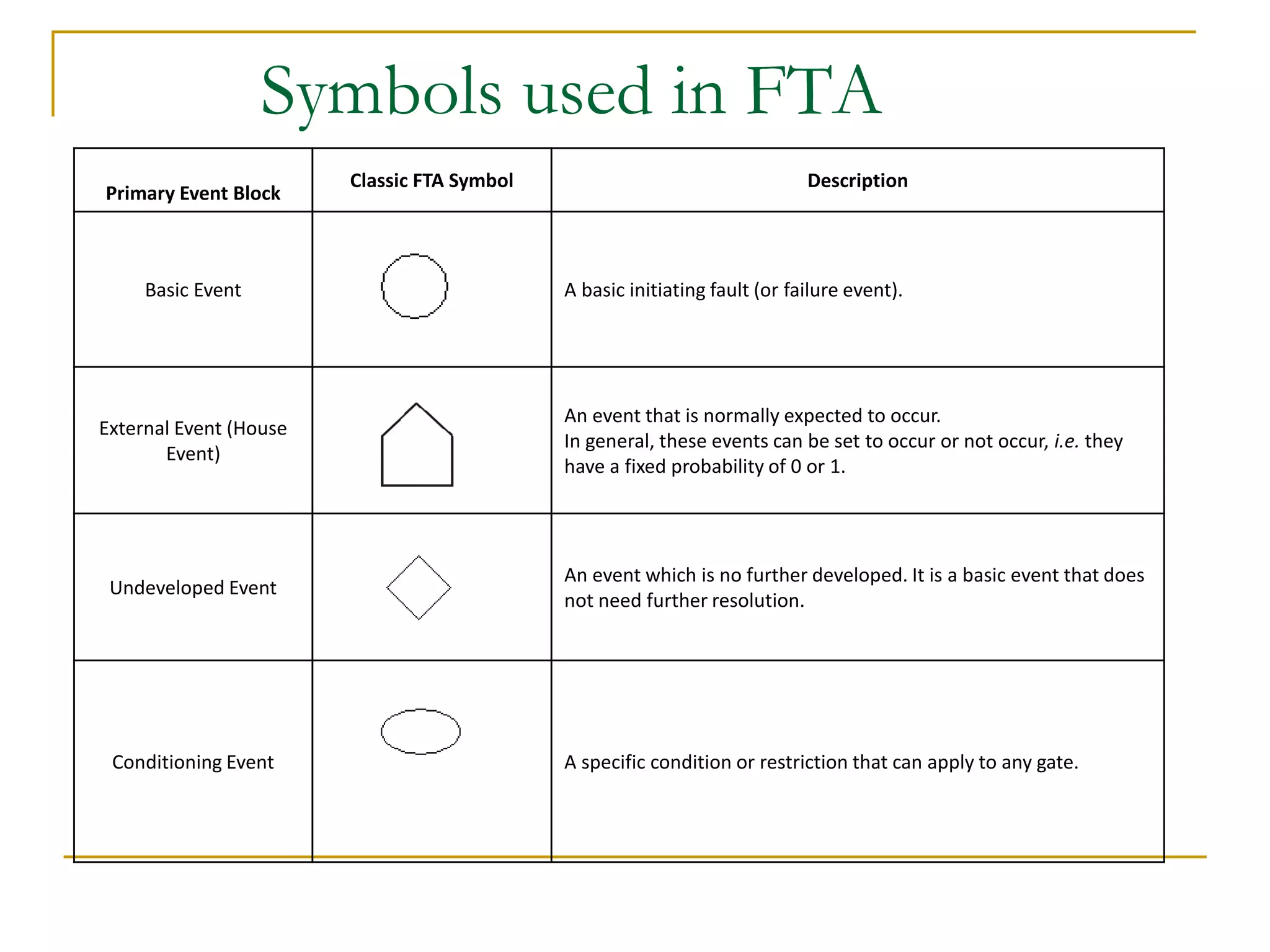
Symbols used in FTA 
Primary Event Block 
Classic FTA Symbol Description 
Basic Event A basic initiating fault (or failure event). 
External Event (House 
Event) 
An event that is normally expected to occur. 
In general, these events can be set to occur or not occur, i.e. they 
have a fixed probability of 0 or 1. 
Undeveloped Event 
An event which is no further developed. It is a basic event that does 
not need further resolution. 
Conditioning Event A specific condition or restriction that can apply to any gate.
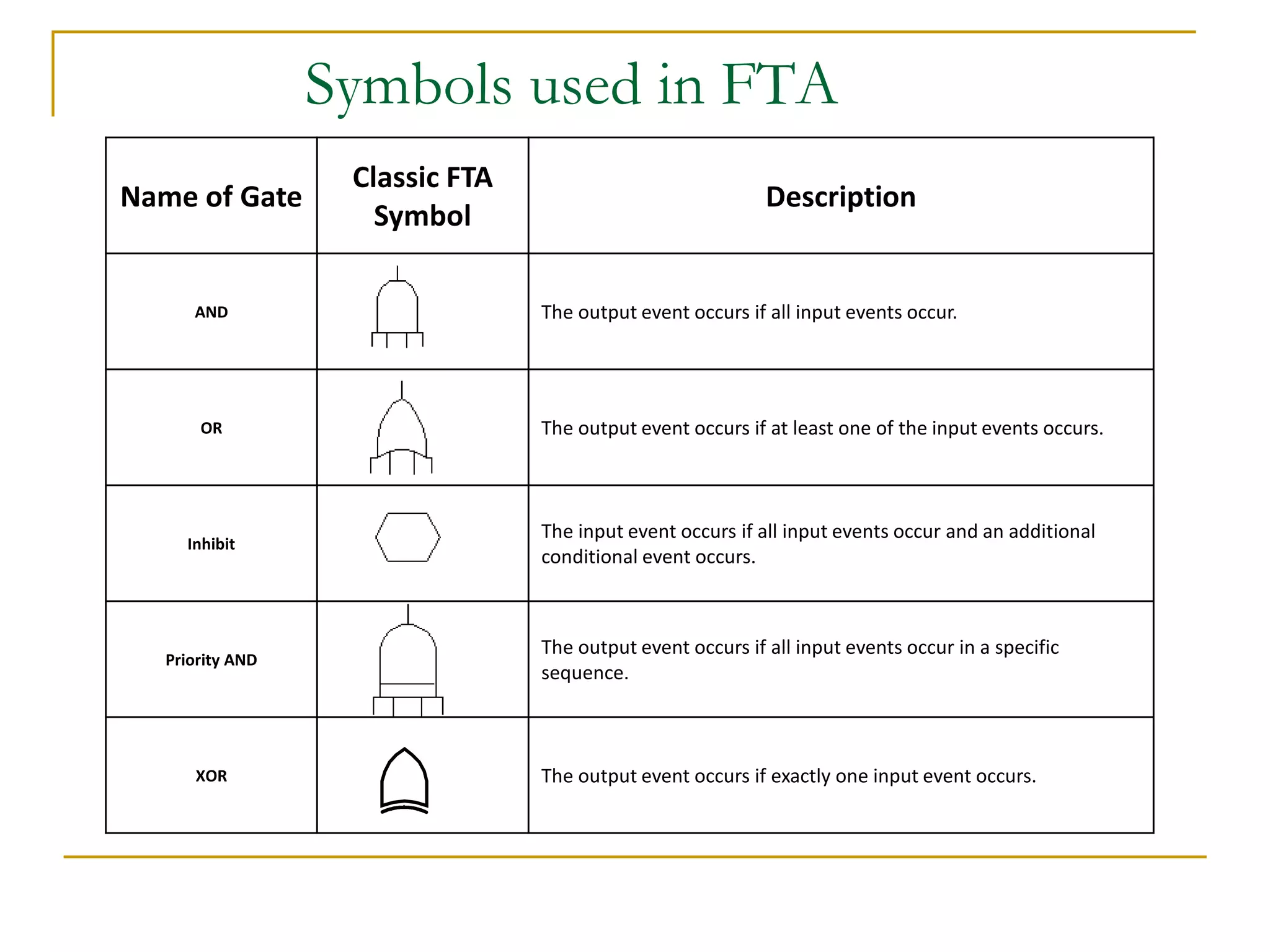
Symbols used in FTA 
Name of Gate 
Classic FTA 
Symbol 
Description 
AND The output event occurs if all input events occur. 
OR The output event occurs if at least one of the input events occurs. 
Inhibit 
The input event occurs if all input events occur and an additional 
conditional event occurs. 
Priority AND 
The output event occurs if all input events occur in a specific 
sequence. 
XOR The output event occurs if exactly one input event occurs.
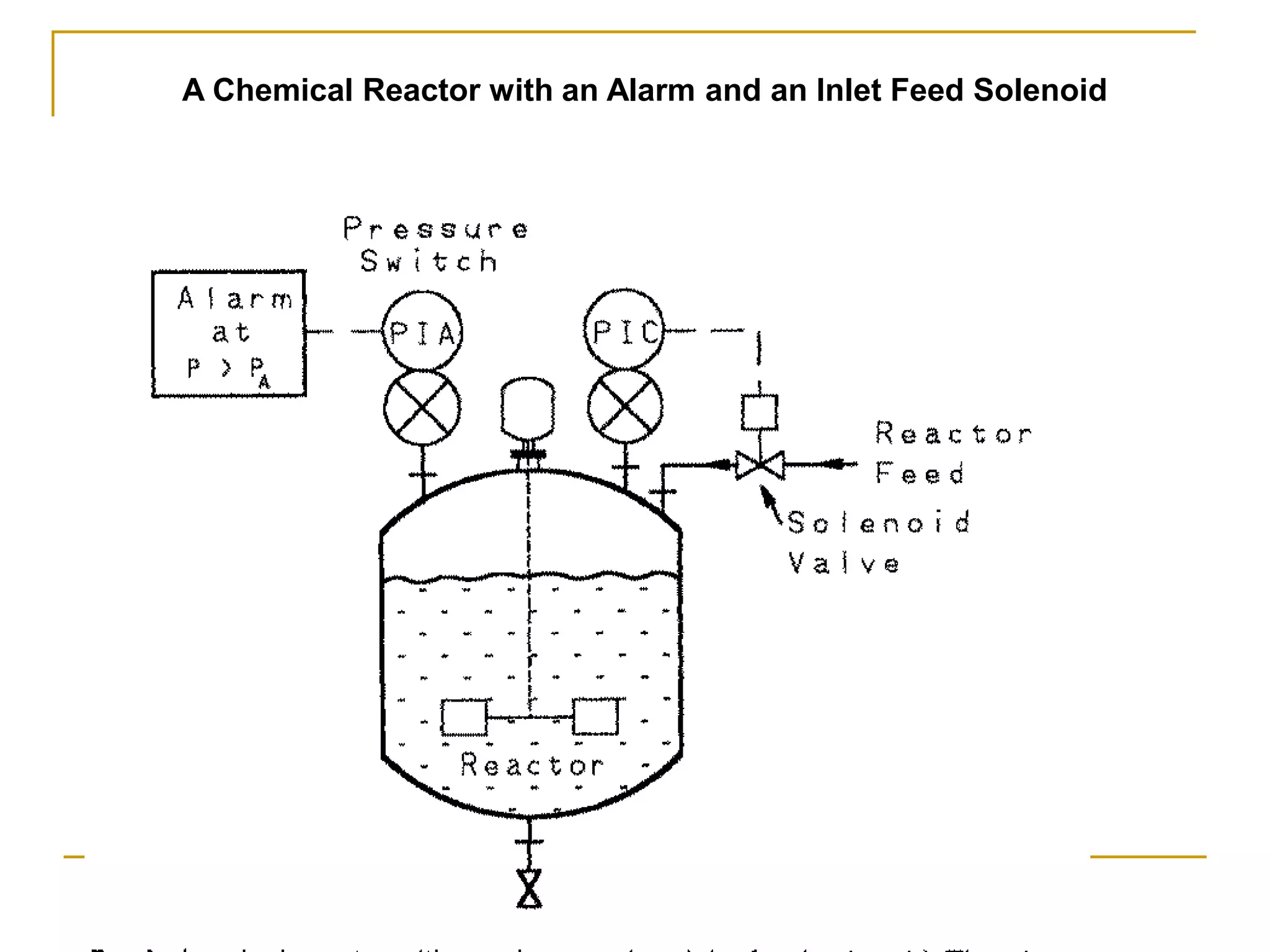
A Chemical Reactor with an Alarm and an Inlet Feed Solenoid
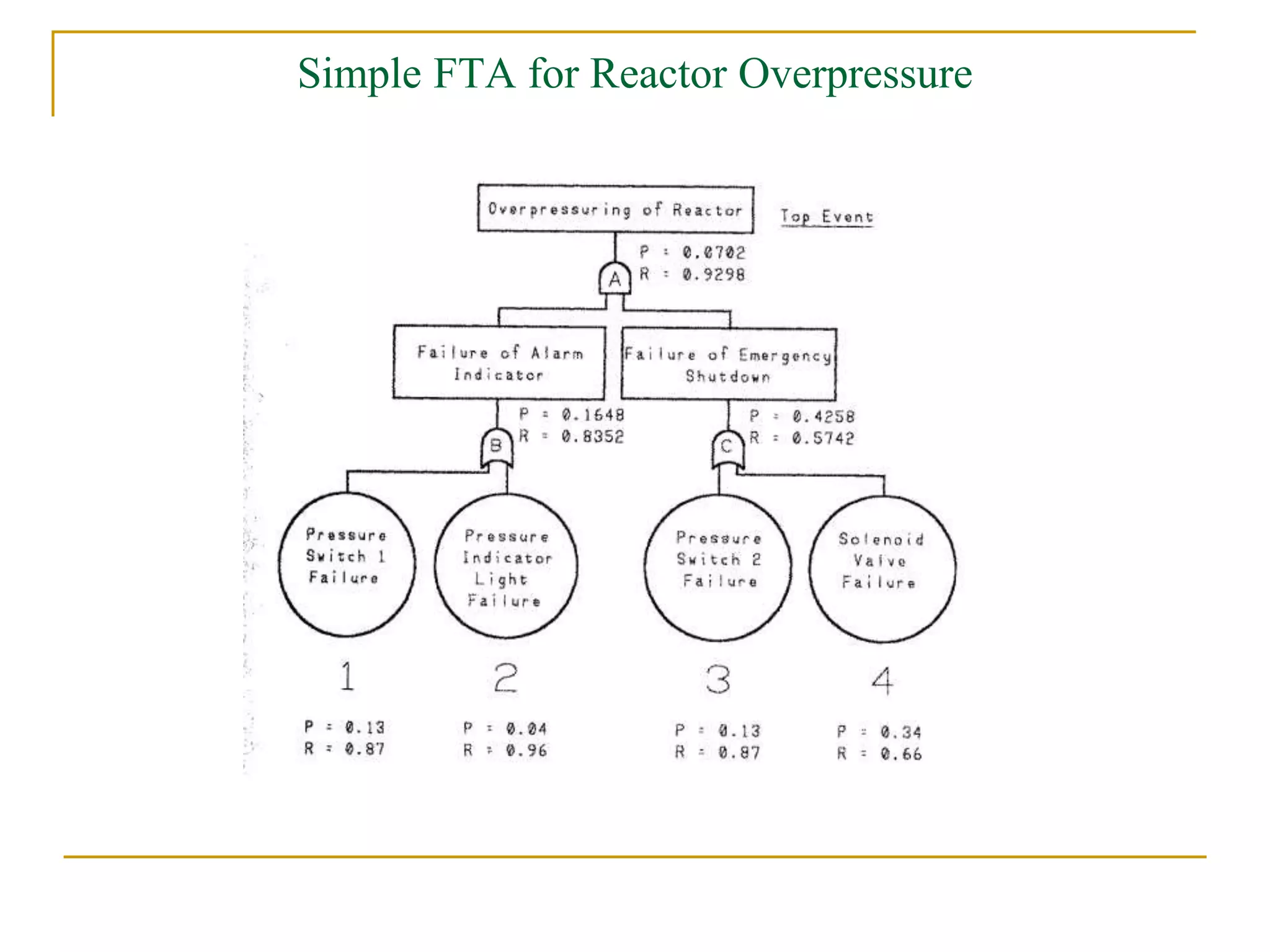
Simple FTA for Reactor Overpressure
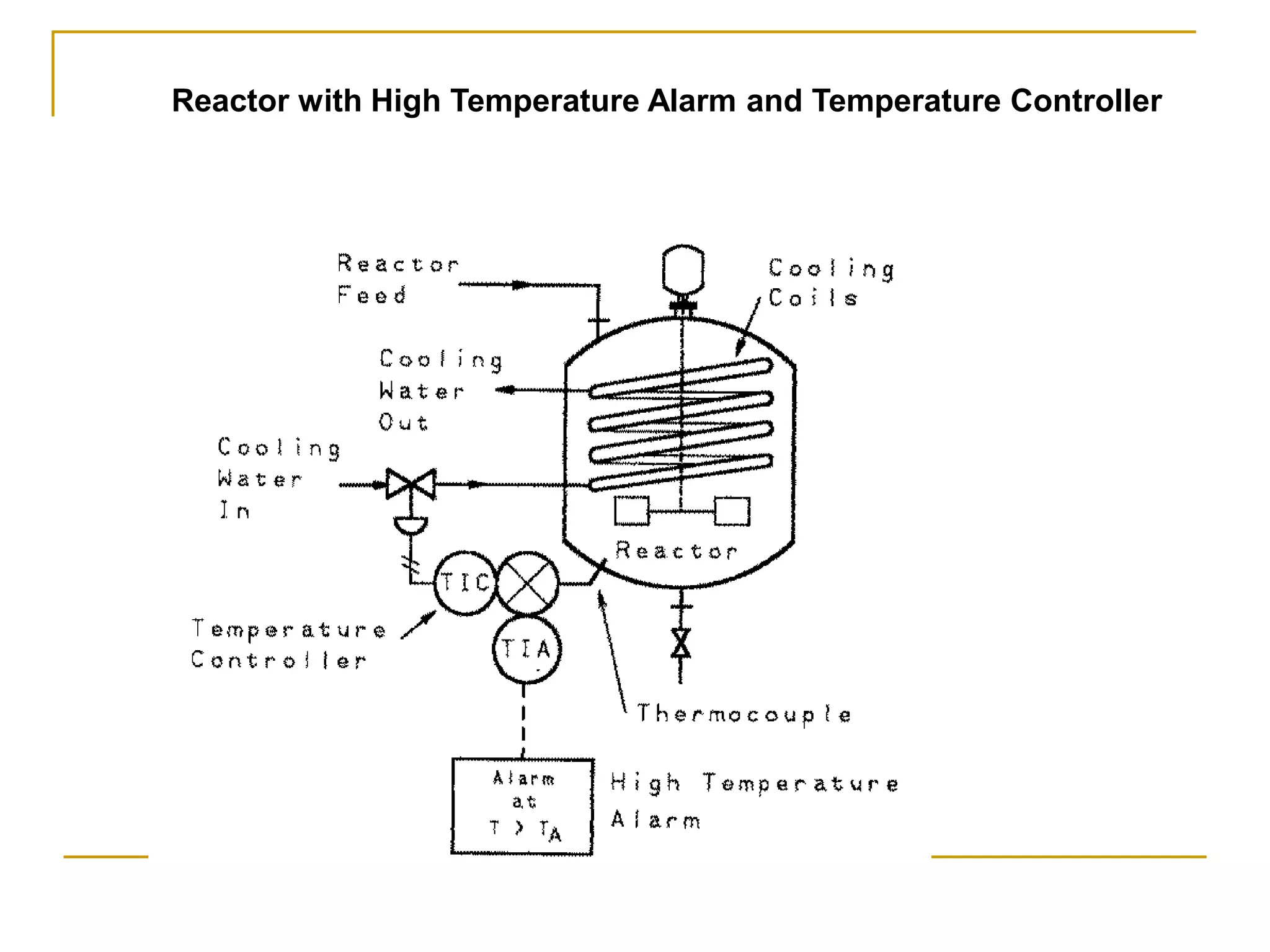
Reactor with High Temperature Alarm and Temperature Controller
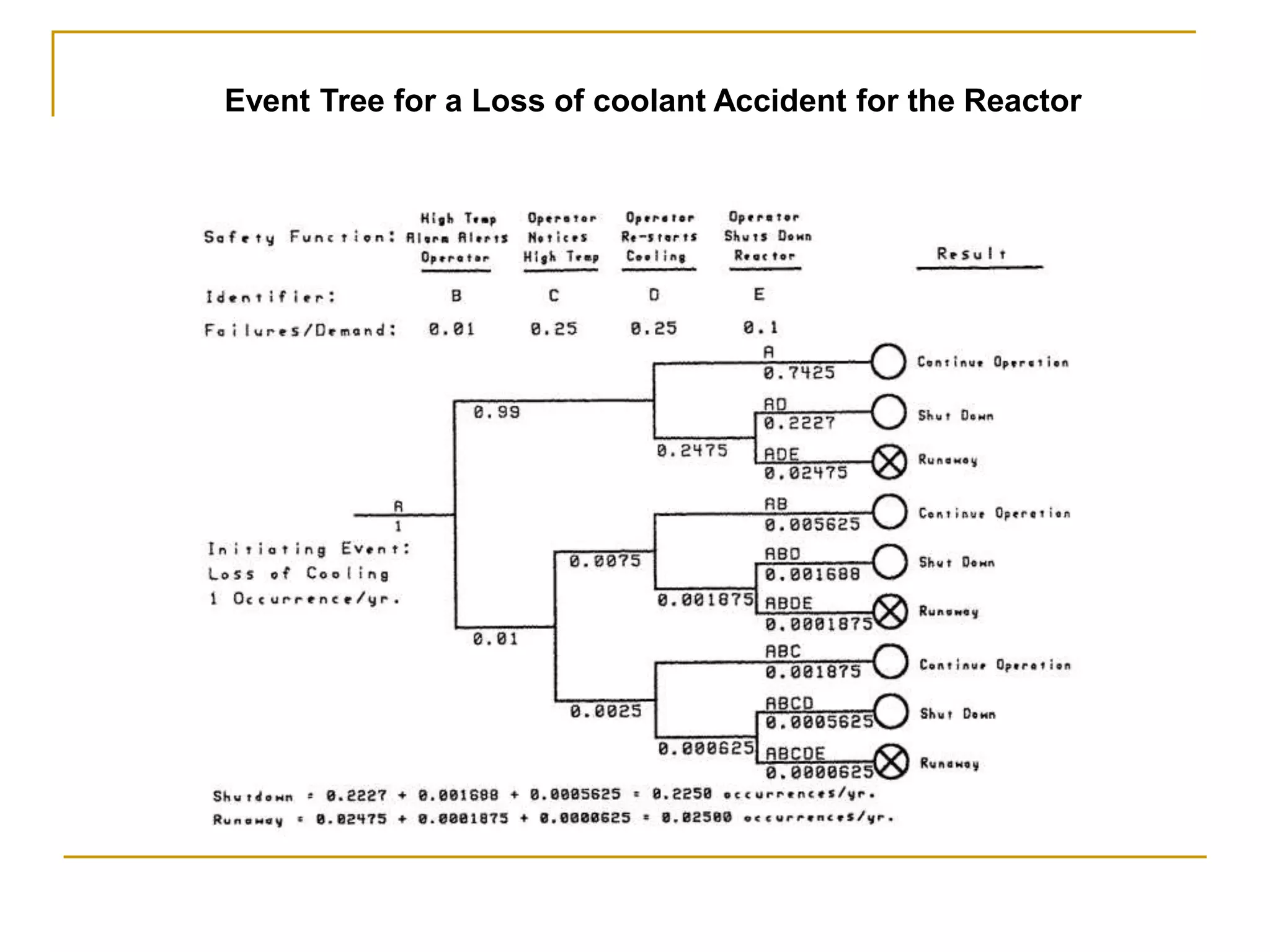
Event Tree for a Loss of coolant Accident for the Reactor
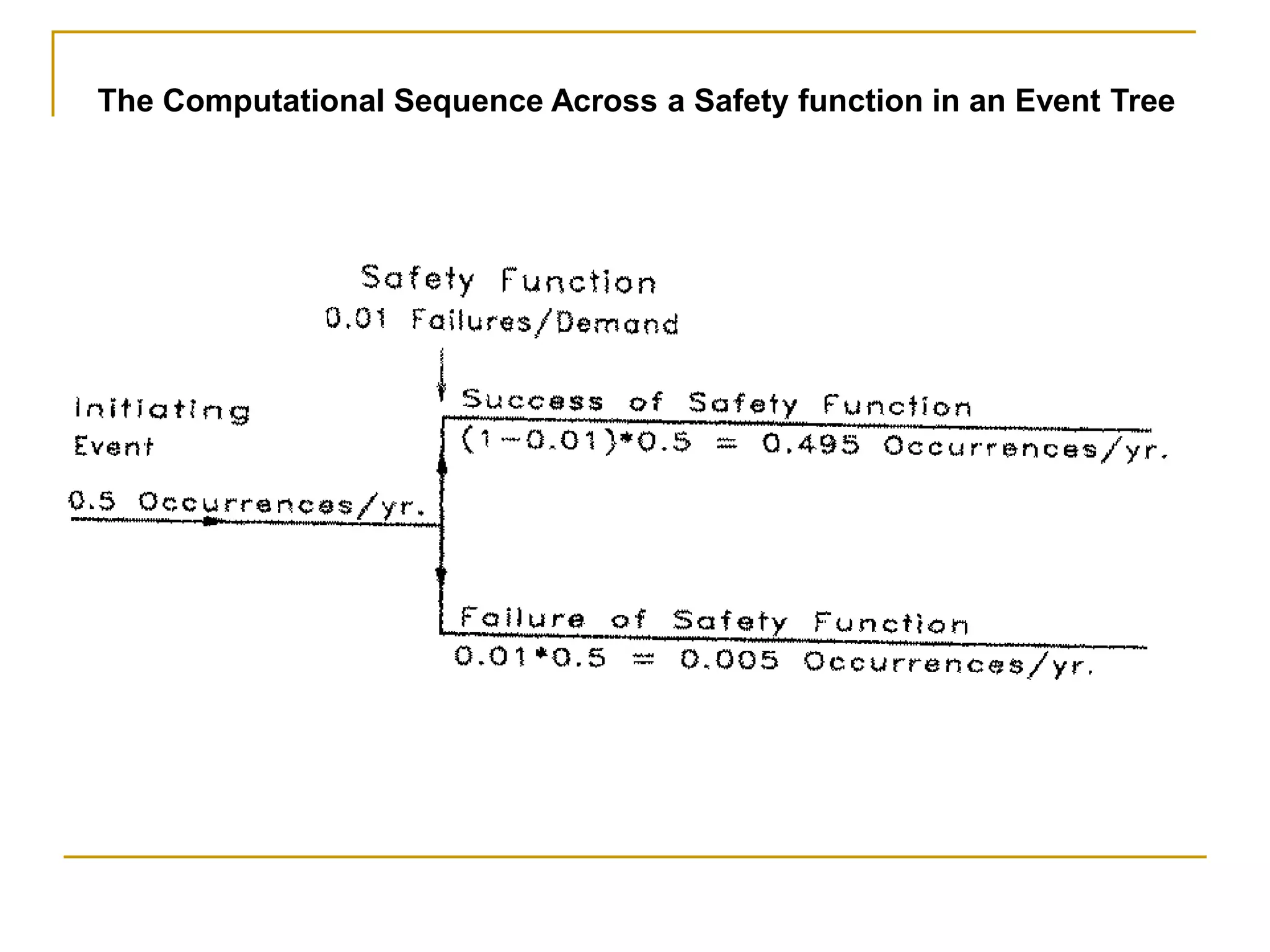
The Computational Sequence Across a Safety function in an Event Tree
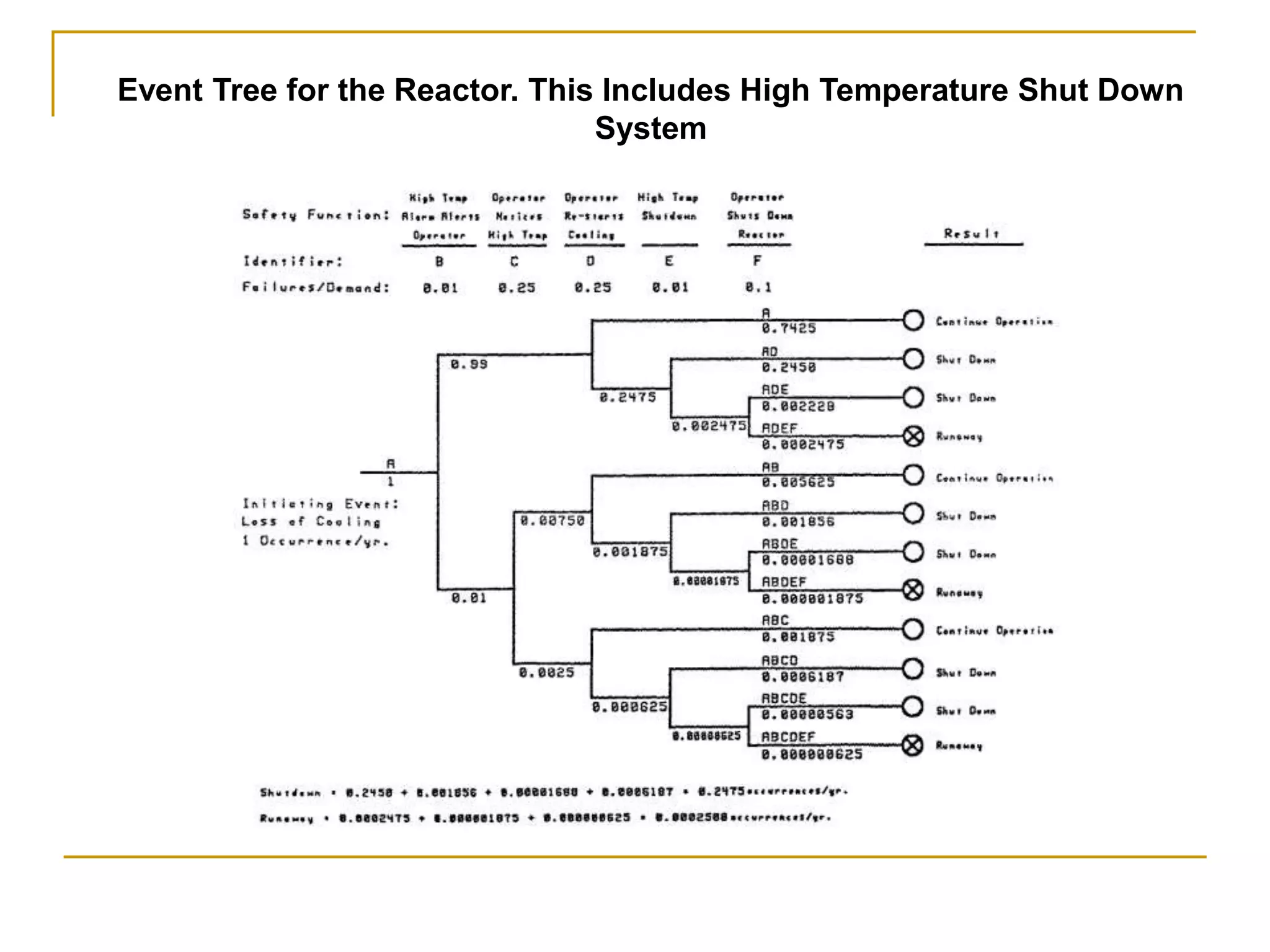
Event Tree for the Reactor. This Includes High Temperature Shut Down 
System
Some Quantitative Techniques 
Event Tree Analysis 
 Event tree analysis - consists of an analysis of possible causes 
starting at a system level and working down through the 
system, sub-system, equipment and component, identifying all 
possible causes. (What faults might we expect? How may they 
be arrived at?) 
 Assessment methods which allow quantifying the probability 
of an accident and the risk associated with plant operation 
based on the graphic description of accident sequences employ 
the fault tree or event tree analysis (FTA or ETA) techniques
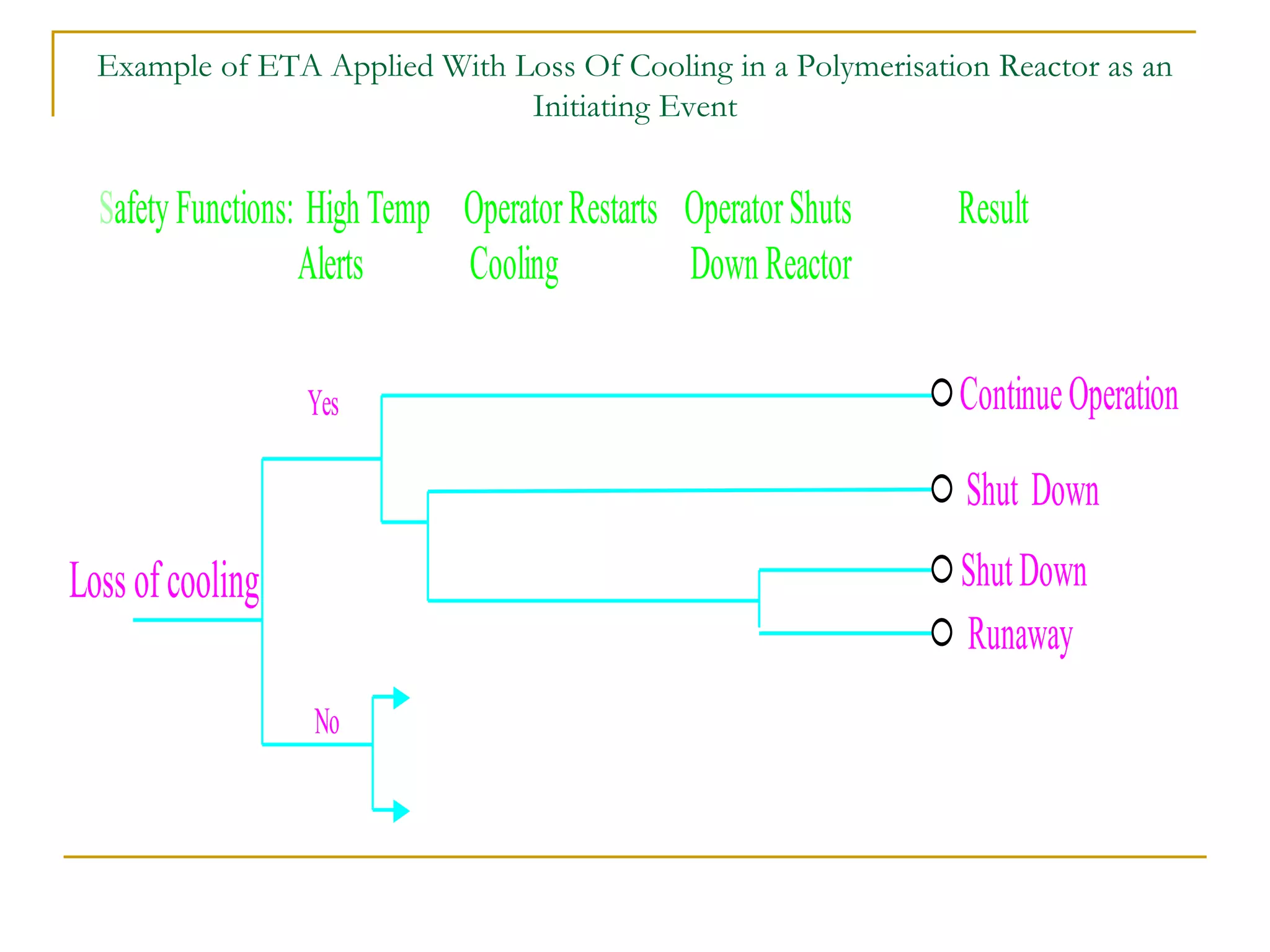
Example of ETA Applied With Loss Of Cooling in a Polymerisation Reactor as an 
Safety Functions: High Temp Operator Restarts Operator Shuts Result 
Continue Operation 
Shut Down 
Shut Down 
Runaway 
Alerts Cooling Down Reactor 
Yes 
No 
Loss of cooling 
Initiating Event
Some Quantitative Techniques 
Cause Consequence Analysis 
 Cause-consequence analysis (CCA) is a blend of fault tree and 
event tree analysis. This technique combines cause analysis 
(described by fault trees) and consequence analysis (described 
by event trees), and hence deductive and inductive analysis is 
used. 
 The purpose of CCA is to identify chains of events that can 
result in undesirable consequences. With the probabilities of 
the various events in the CCA diagram, the probabilities of the 
various consequences can be calculated, thus establishing the 
risk level of the system
Typical Cause Consequence Analysis 
Consequence Consequence 
Yes No 
Initiating event 
Fault Tree 
Event Tree Side
Some Quantitative Techniques 
Management Oversight Risk Tree 
 MORT is a diagram which arranges safety program elements 
in an orderly and logical manner. 
 Its analysis is carried out by means of fault tree, where the top 
event is "Damage, destruction, other costs, lost production or 
reduced credibility of the enterprise in the eyes of society". 
 The tree gives an overview of the causes of the top event from 
management oversights and omissions or from assumed risks 
or both
Some Quantitative Techniques 
Safety Management Organization Review Technique 
 This technique is structured by means of analysis levels with 
associated checklists. 
 The SMORT analysis includes data collection based on the 
checklists and their associated questions, in addition to 
evaluation of results. 
 The information can be collected from interviews, studies of 
documents and investigations. This technique can be used to 
perform detailed investigation of accidents and near misses. It 
also servs well as a method for safety audits and planning of 
safety measures
Some Quantitative Techniques 
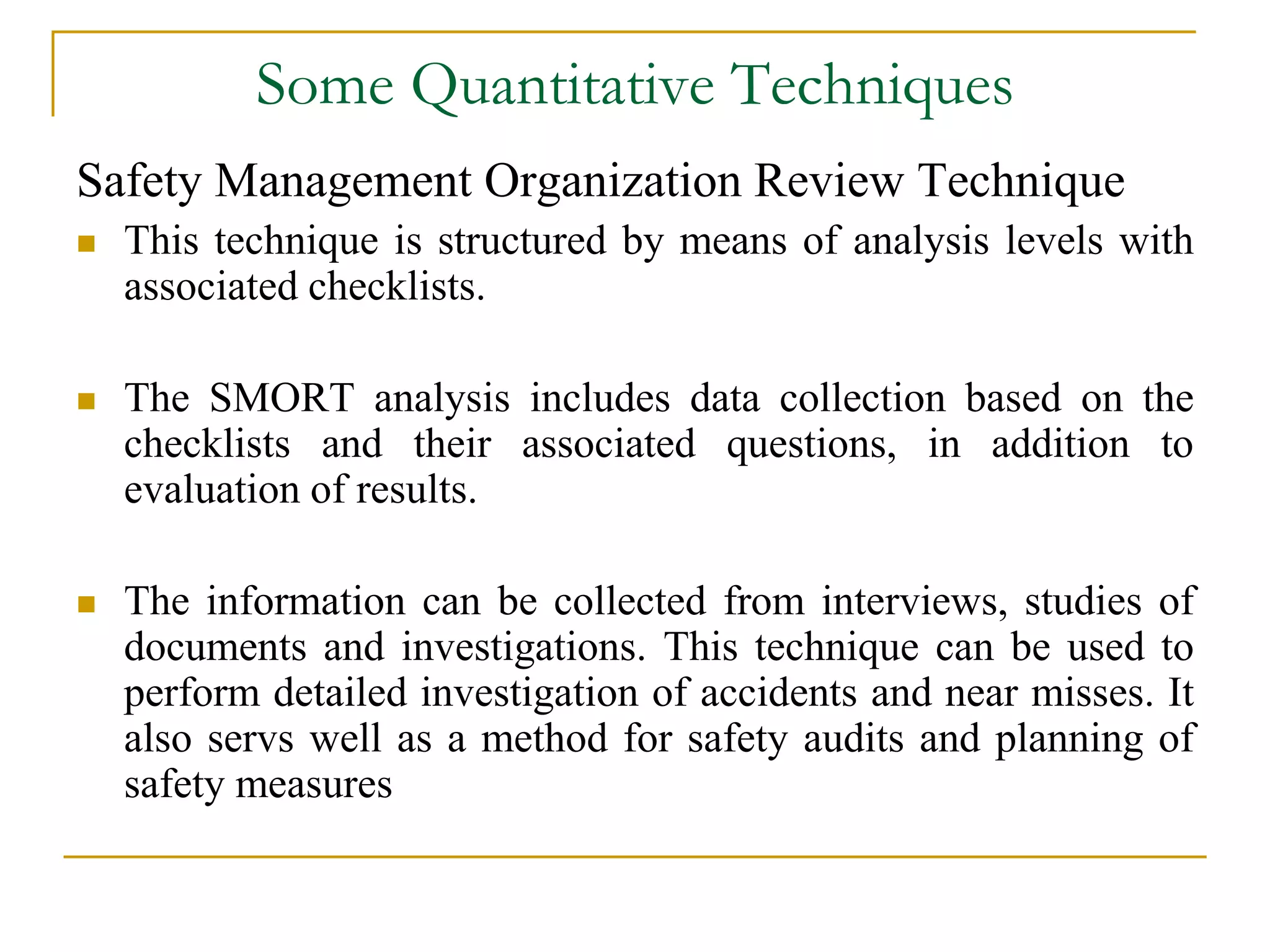
Petri Nets 
 A graphical methodology based on ARTIFEX software 
package. 
 A circle represents a place and a rectangle represents a 
transition 
 A Petri Net is composed of four parts, A set of places, A set of 
transitions, An input function, An output function 
 Either bottom-up or top-down 
 Other techniques like GO, Diagraph modeling, Markov 
modeling
A Petri Net Diagram 
Normal Operations 
Transitions 
Reduced 
operations
Pros and Cons of Quantitative Methods 
 These methods are mainly used to find cut-sets leading to the 
undesired events. 
 Event tree and fault tree have been widely used to quantify the 
probabilities of occurrence of accidents and other undesired 
events leading to the loss of life or economic losses in 
probabilistic risk assessment. 
 However, the usage of fault tree and event tree are confined to 
static, logic modeling of accident scenarios. In giving the same 
treatment to hardware failures and human errors in fault tree and 
event tree analysis, the conditions affecting human behavior can 
not be modeled explicitly
Qualitative Vs Quantitative 
 Qualitative methodologies though lacking the ability to 
account the dependencies between events are effective 
in identifying potential hazards and failures within the 
system. 
 The Quantitative techniques addressed this deficiency 
by taking into consideration the dependencies between 
each event. The probabilities of occurrence of the 
undesired event can also be quantified with the 
availability of operational data.
Human Reliability Analysis 
Human Hazards Identification ( Task Analysis) 
 Identify hazards occurring due to human error while performing 
standard procedures 
 The task is a set of operations/actions required to achieve a set goal and 
assesses what people might do while performing the operations 
 Questions such as “What actions do the operators perform ?”, “How do 
operators respond to different cues in the environment ?” 
 Main limitation being that it is only applicable to human interaction 
with the process
Human Reliability Analysis 
 Hierarchical Task Analysis 
 Same methodology as task analysis, but a hierarchy is placed on the 
order of the tasks to be investigated 
 Methodology produces either a tree structure, with the most complex 
task on the top and the simplest on the bottom, or a list of steps that are 
required to be performed in order to produce the required goal 
 The technique provides an easily understandable breakdown of the 
tasks and order of which they are to be performed 
 Other techniques such as Human Interaction with Machine (HIM) , 
Human Error Analysis (HEA)
Likelihood Calculation 
 Incident History 
 Industry Experience 
 Site Experience 
 Equipment Vendor Experience 
 Specialty Consulting Firm Experience 
 Component Failure Rate Data, Handbooks 
 Non-electronic Parts Reliability Data
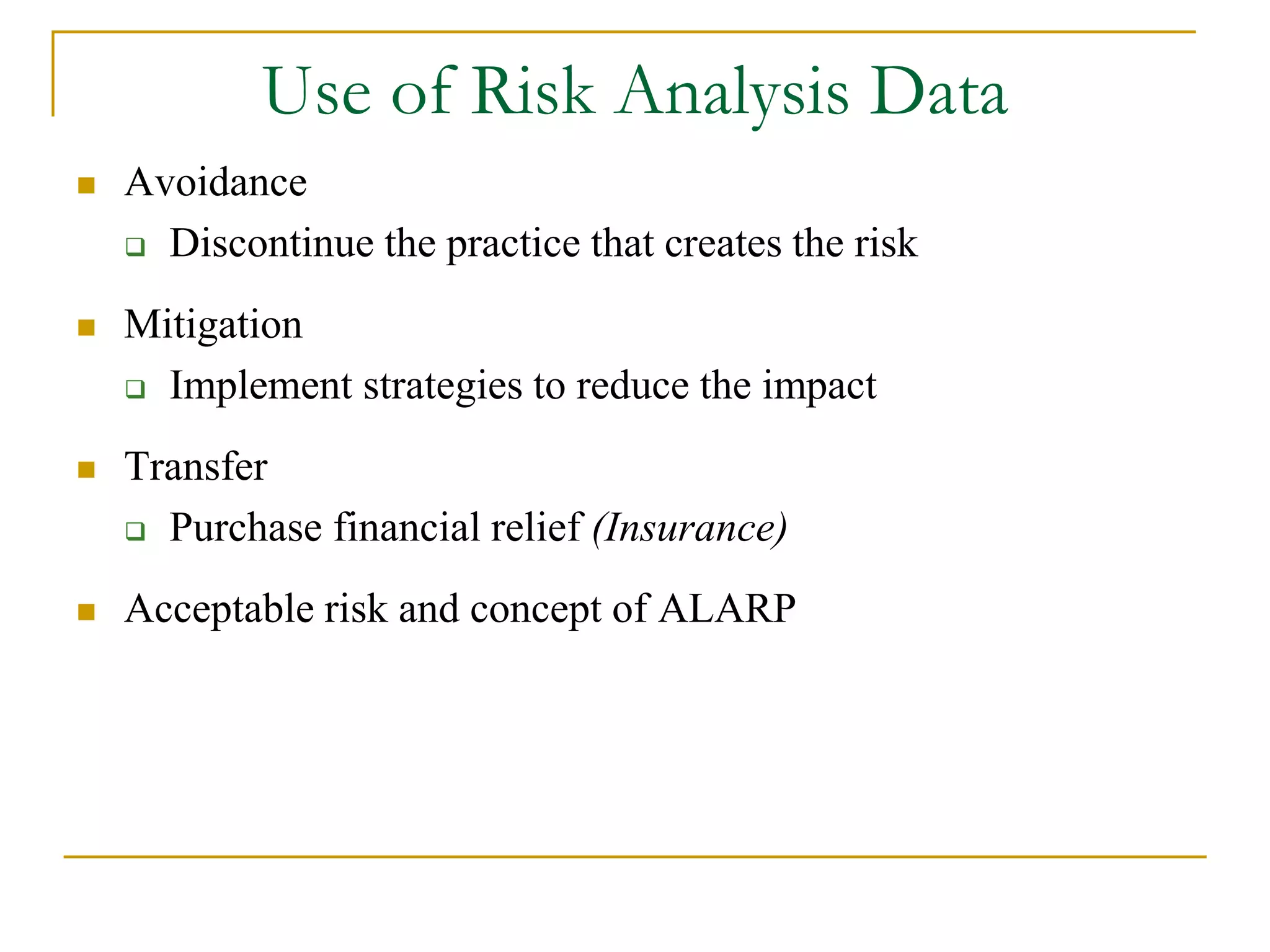
Use of Risk Analysis Data 
 Avoidance 
 Discontinue the practice that creates the risk 
 Mitigation 
 Implement strategies to reduce the impact 
 Transfer 
 Purchase financial relief (Insurance) 
 Acceptable risk and concept of ALARP
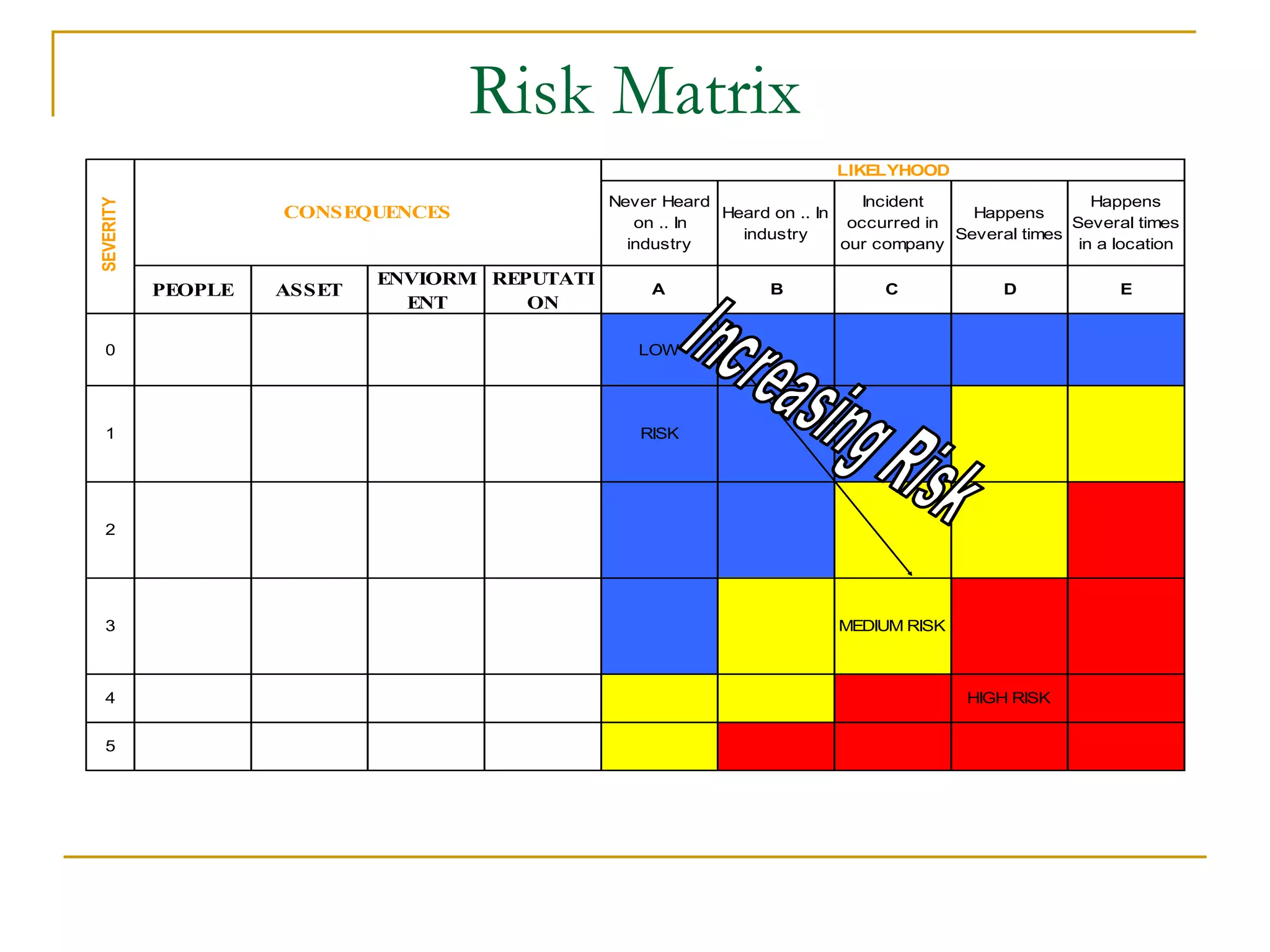
Risk Matrix 
Never Heard 
on .. In 
industry 
Heard on .. In 
industry 
Incident 
occurred in 
our company 
Happens 
Several times 
Happens 
Several times 
in a location 
PEOPLE ASSET 
ENVIORM 
ENT 
REPUTATI 
ON 
A B C D E 
0 
No health 
effect/ 
Injury 
No damage No effect No Impact LOW 
1 
Slight 
Health 
effect/ 
injury 
Slight 
Damage 
Slight effect 
slight 
Impact 
RISK 
2 
Minor 
Health 
effect/ 
injury 
Minor 
Damage 
Minor 
effect 
Limited 
impact 
3 
Major 
Health 
effect/ 
injury 
Localised 
Damaged 
Localised 
effect 
Considerabl 
e impact 
MEDIUM RISK 
4 
1 to 3 
fatalities 
Major 
Damage 
major effect 
National 
impact 
HIGH RISK 
5 
Multiple 
Fatalities 
Extensive 
Damage 
Massive 
effect 
internationa 
l impact 
LIKELYHOOD 
CONSEQUENCES 
SEVERITY
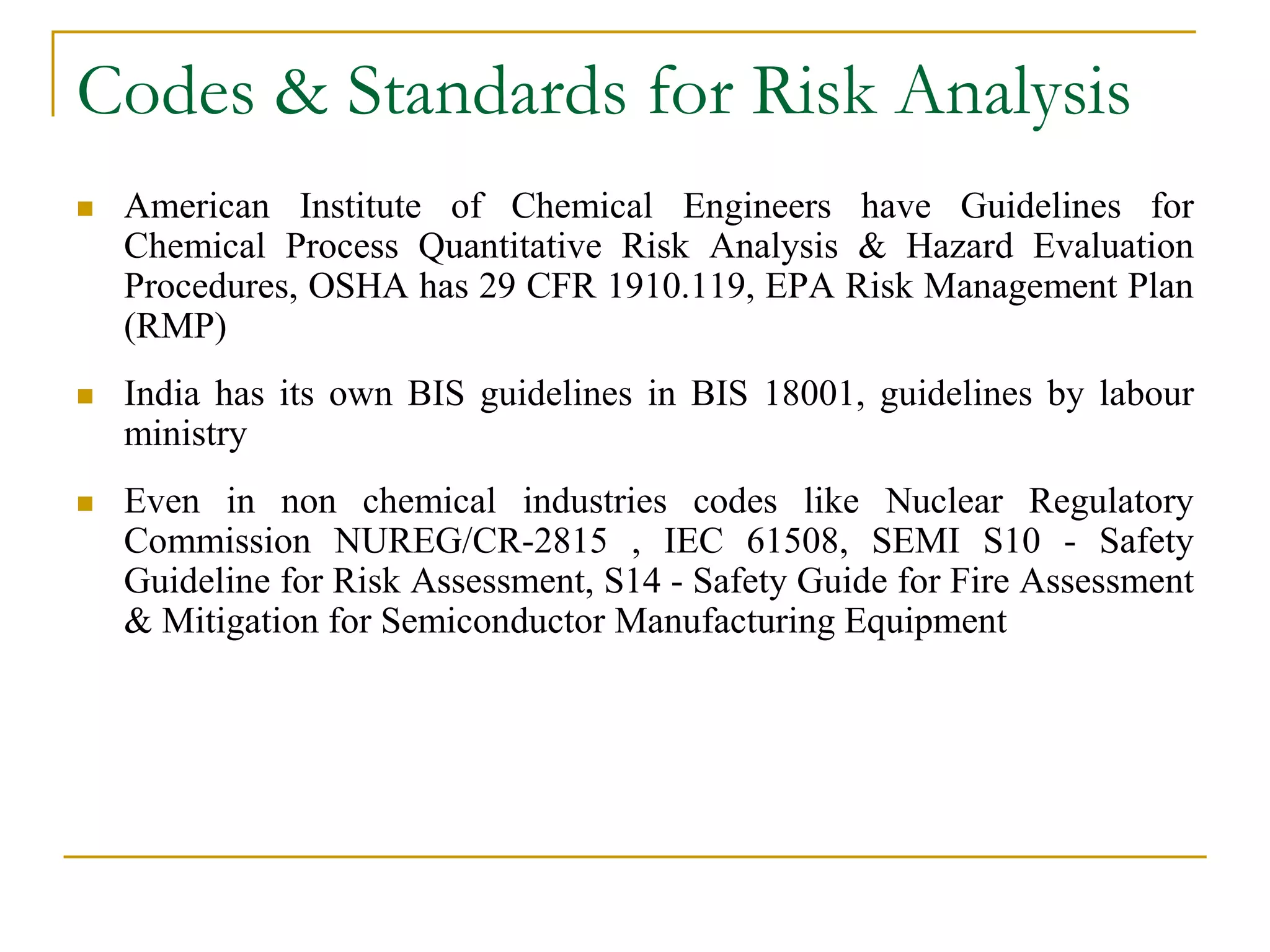
Codes & Standards for Risk Analysis 
 American Institute of Chemical Engineers have Guidelines for 
Chemical Process Quantitative Risk Analysis & Hazard Evaluation 
Procedures, OSHA has 29 CFR 1910.119, EPA Risk Management Plan 
(RMP) 
 India has its own BIS guidelines in BIS 18001, guidelines by labour 
ministry 
 Even in non chemical industries codes like Nuclear Regulatory 
Commission NUREG/CR-2815 , IEC 61508, SEMI S10 - Safety 
Guideline for Risk Assessment, S14 - Safety Guide for Fire Assessment 
& Mitigation for Semiconductor Manufacturing Equipment
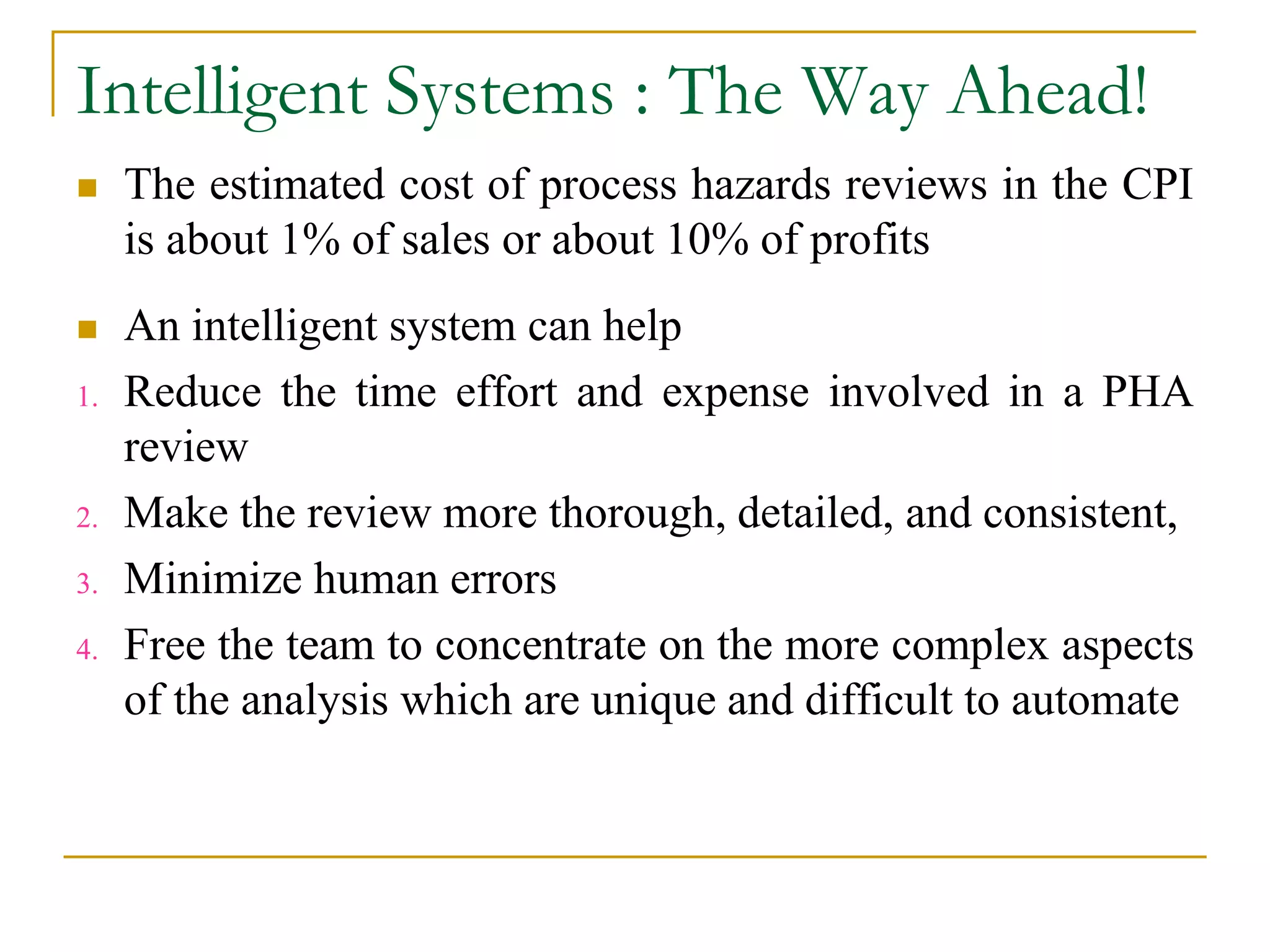
Intelligent Systems : The Way Ahead! 
 The estimated cost of process hazards reviews in the CPI 
is about 1% of sales or about 10% of profits 
 An intelligent system can help 
1. Reduce the time effort and expense involved in a PHA 
review 
2. Make the review more thorough, detailed, and consistent, 
3. Minimize human errors 
4. Free the team to concentrate on the more complex aspects 
of the analysis which are unique and difficult to automate
 An example is the HAZOP Expert a model-based, object-oriented, 
intelligent system for automating HAZOP analysis 
 Other well known software packages include HAZTEC, 
CARA BRAVO, CAFTAN, RISKMAN, QRAS
Conclusions 
 Risk is a subjective concept varying according to context 
 In actual industry a number of variations are applied to 
methods of risk analysis and sometimes steps are 
completed simultaneously or given a miss according to 
need and resources present 
 Risk analysis can be qualitative as well as quantitative. 
Quantitative methods are being given more stress since 
they allow for a better comparison of risk levels and 
reduce subjectivity in decision making process
Conclusions 
 Probabilistic risk analysis is perhaps the best 
methodology available at present for application of low 
probability high impact systems like CPI 
 Intelligent systems hold the key to reduction in resource 
utilization and increasing accuracy of risk analysis and 
hence risk assessment 
 There is no possibility of eliminating all hazards 
completely and concept of allowable risk becomes 
important
END GAME 
Hazards and overall risk associated with 
technology is a crucial element for triggering 
regulatory action, public protest and a host of 
other problems, so it is of utmost importance to 
find the origins of risks, to strengthen safeguards 
and thus preserve the acceptability of hazardous 
facilities or activities. It constitutes a real need 
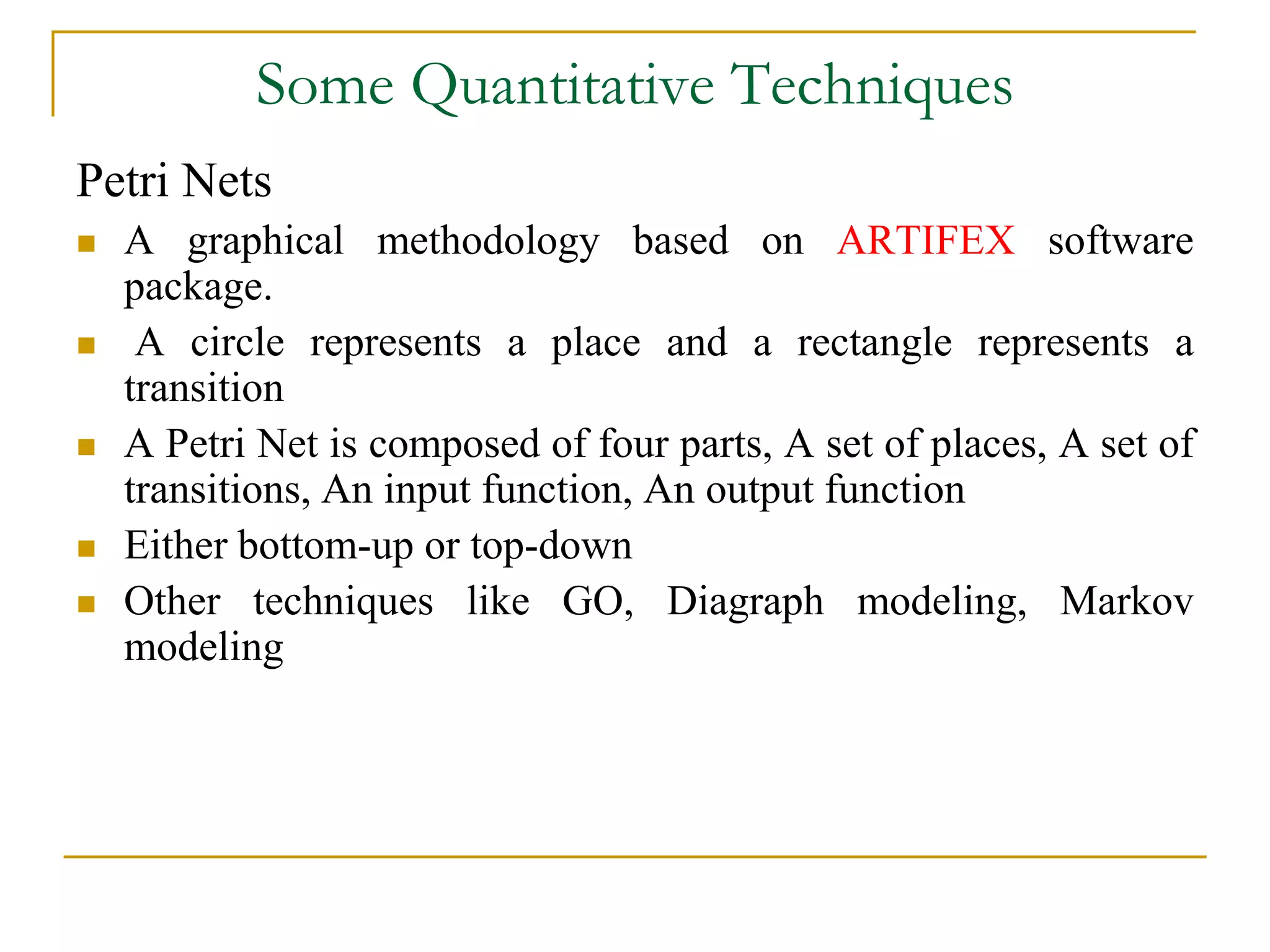
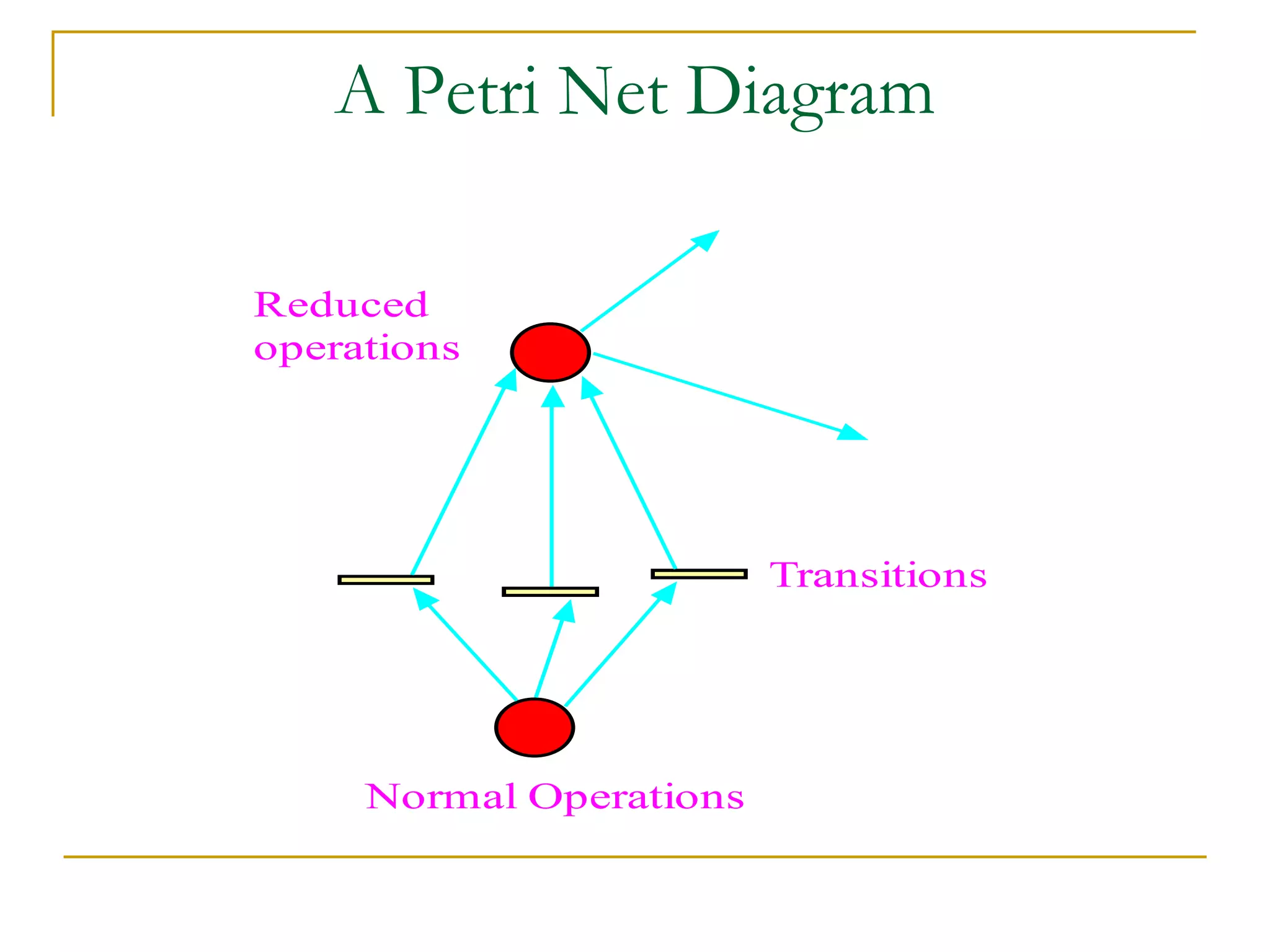
then, to provide a coherent strategy to maximise 
performance and minimize risk
References 
 Center for Chemical Process Safety (CCPS). Guidelines for Hazard Evaluation 
Procedures, Second Edition with Worked Examples; Publication G18; American 
Institute of Chemical Engineers, New York (1992) 
 Lees, F. P. Loss Prevention In The Process Industries: Hazard Identification, 
Assessment And Control. (2001) (3rd Ed). UK: Butterworth- Heinemann 
 Crowl D, Louvar J. Chemical process safety fundamentals with applications. 
(1990). Prentice Hall 
 Bernstein PL . “Against the Gods: The Remarkable Story of Risk”. (1996). Wiley 
New York. 
 Nivolianitou Z.S. Comparison Of Techniques For Accident Scenario Analysis In 
Hazardous Systems. Journal of Loss Prevention in the Process Industries, (2004), v- 
17, pp- 467–475
References 
 Wells G., Whetton C. Preliminary Safety Analysis. Journal of Loss 
Prevention in the Process Industry, (1993), v-6, no 1, pp-47-60 
 Venkatasubramanian V., Zhao J. Viswanathan S . Intelligent Systems 
For Hazop Analysis Of Complex Process Plants. Computers and 
Chemical Engineering (2000),v-24, 2291–23 
 Cacciabue, P. C. Human Factors On Risks Analysis Of Complex 
Systems. Journal of Hazardous Materials (2000), v-71, 101–116. 
 Robert D. Choosing The Level Of Detail For Hazard Identification. 
Process Safety Progress (1995), v-14, no 3
Any Questions ? 
Any Questions ?

Risk analysis

  • 1.
    Risk Analysis Dr.I. M. Mishra Pt. G. B. Pant Chair Professor of Environmental Pollution Abatement, Professor of Chemical Engineering and Dean Saharanpur Campus Indian Institute of Technology, Roorkee E-mail:- imishfch@iitr.ernet.in
  • 2.
    Some Important Definitions  Risk  A measure of the potential for loss in terms of both the likelihood (events/year) of the incident and the consequences (effects/event) of the incident  Mathematically Risk = Σ probability of event × consequence of event Risk Analysis  The development of a quantitative estimate of risk based on engineering evaluation & mathematical techniques for combining estimates of incident likelihood and consequences
  • 3.
    Some Important Definitions  Risk Assessment  The process by which the results of a risk analysis (i.e., risk estimates) are used to make decisions, either through relative ranking or through comparison with risk targets  Risk Management  The planning, organizing, leading and controlling of an organization’s assets and activities in ways, which minimize the adverse operational and financial effects of accidental losses upon the organization
  • 4.
    Risk Analysis? It is an important part and precursor of risk assessment and management  A full analysis involves the estimation of the frequency and consequences of a range of hazards scenarios and the damages expected.  Damages include injury and loss of life, damage to the environment and equipment, loss of work, and finally also economic loss to the plant
  • 5.
    Why Risk Analysis?  Chemicals have become a part of our life  Chemicals have their own inherent properties and hazards and so do the processes by which they are manufactured  Risks posed by these highlighted by Flixborough (1974), Bhopal (1984), Piper Alpha(1998) & Other Accidents  Government regulations and public awareness Source: www.hse-databases.co.uk
  • 6.
    Fig.1. Bucheon LPGfilling station Fig. 2 Incident of Bucheon LPG Filling station
  • 7.
    History of Risk& Risk Analysis  In 1654 , a French duke asked the famous mathematician Pascal to solve a problem of how to divide the stakes of an unfinished game of dice when one of the players was ahead.  Developed with focus on financial matters and gambling  Realisation with industrial revolution of risks posed due to technology used in industry  Early emphasis on nuclear industry but importance realized by Chemical industry due to accidents like Flixborough, Bhopal, VIizag, Jaipur etc.
  • 8.
    Risk Management Procedure Data Input Identify Estimate Likelihood Determine Consequences Risk Matrix Accept able Operate Reduce Mitigate Transfer Yes No
  • 9.
    Sources of DataInput  Chemical Usage, Contractor Activity, EH&S Policies, Equipment Reliability, External Events, Facility & Process Descriptions, Historical Accident, Human Reliability  Manuals for Policies & Procedures, Engineering Design, Safety, Maintenance and data from Material Usage, Meteorological, Population etc
  • 10.
    General Steps inRisk Analysis The general steps in any hazard identification technique are 1. Assembling a team 2. Collection of data 3. Deciding on level of detail 4. Applying the technique 5. Documenting the results
  • 11.
    Methods For RiskAnalysis  Risk analysis can be carried out by a number of methods  Cause-Consequence Analysis, Checklist, Event Tree Analysis Failure Modes, Effects and Criticality Analysis (FMECA) Fault Tree Analysis (FTA), Hazard & Operability Analysis (HAZOP), Bow Ties, Petri nets  Method usage depends on level of detail and resources available
  • 12.
    Classification of Methods  The methods can be classified in to the following categories: 1. Qualitative 2. Quantitative  These can further be divided into: 1. Deterministic 2. Probabilistic
  • 13.
    Methods for RiskAnalysis  The deterministic methods take into consideration the products, the equipment and the quantification of consequences for various targets such as people, environment and equipment.  The probabilistic methods are based on the probability or frequency of hazardous situation apparitions or on the occurrence of potential accident.  The probabilistic methods are mainly focused on failure probability of equipment or their components.
  • 14.
    Some Qualitative Methods Preliminary Risk Analysis  In this technique, the possible undesirable events are identified first and then analyzed separately.  For each undesirable events or hazards, possible improvements, or preventive measures are then formulated.  The result from this methodology provides a basis for determining which categories of hazard should be looked into more closely and which analysis methods are most suitable.  With the aid of a frequency / consequence diagram, the identified hazards can then be ranked according to risk, allowing measures to be prioritized to prevent accidents
  • 15.
    Some Qualitative Methods Hazard And Operability Study  This technique is usually performed using a set of guidewords: NO / NOT, MORE / LESS OF, AS WELL AS, PART OF REVERSE, AND OTHER THAN.  From these guidewords, scenarios that may result in a hazard or an operational problem are identified  The consequences of the hazard and measures to reduce the frequency with which the hazard will occur are then discussed.  This technique had gained wide acceptance in process industries
  • 16.
    Example of HAZOPapplied to a Hot Air Filter system Deviation Possible Causes Potential consequences Existing systems Recommendations No temp N A NIL NIL NIL Less Temp Inlet gas temp low Operability Temp indications available NIL More Temp Inlet gas temp high Equipment damage Temp indications available NIL As well as Temp NIL NIL NIL NIL Part of Temp NIL NIL NIL NIL Other than Temp NIL NIL NIL NIL Reverse Temp N A N A NIL NIL
  • 17.
    Some Qualitative Methods Failure Modes and Effects Analysis (FMEA)  This method was developed in the 1950s by reliability engineers to determine problems that could arise from malfunctions of military system.  Failure mode and effects analysis is a procedure by which each potential failure mode in a system is analyzed to determine its effect on the system and to classify it according to its severity.  When the FMEA is extended by a criticality analysis, the technique is then called failure mode and effects criticality analysis (FMECA)
  • 18.
    Failure mode CausesEffects Detection method Safety provisions Severity class Comments Valve Fails open Internal malfunct Operator error Toxic release Pressure indicators PRV II Prevent operator error Valve fails closed Internal malfunct Operator error Flow stopped Pressure indicators None IV Check for over Pressure A Typical FMEA Sheet
  • 19.
    Some Qualitative Methods  Checklists  A list of possible problems and areas to be checked and reminds the reviewer of potential problem areas  Easy to apply and assessment can be performed by inexperienced practitioners  Assessment will only be as complete as the list used and difficulties faced in novel process  Simple Checklist for long drive in a car 1. Check oil 2. Check tire air pressure 3. Check radiator fluid 4. Check air filter 5. Check head and tail lights 6. Check exhaust 7. Check petrol
  • 20.
    Pros and Consof Qualitative Techniques  The three techniques outlined above require only the employment of "hardware familiar" personnel  FMEA tends to be more labor intensive, as the failure of each individual component in the system has to be considered  A point to note is that these qualitative techniques can be used in the design as well as operational stage of a system
  • 21.
    Some Quantitative Techniques Fault Tree Analysis  A fault tree is a logical diagram which shows the relation between system failure, i.e. a specific undesirable event in the system, and failures of the components of the system  It is a technique based on deductive logic. An undesirable event is first defined and causal relationships of the failures leading to that event are then identified
  • 22.
    Symbols used inFTA Primary Event Block Classic FTA Symbol Description Basic Event A basic initiating fault (or failure event). External Event (House Event) An event that is normally expected to occur. In general, these events can be set to occur or not occur, i.e. they have a fixed probability of 0 or 1. Undeveloped Event An event which is no further developed. It is a basic event that does not need further resolution. Conditioning Event A specific condition or restriction that can apply to any gate.
  • 23.
    Symbols used inFTA Name of Gate Classic FTA Symbol Description AND The output event occurs if all input events occur. OR The output event occurs if at least one of the input events occurs. Inhibit The input event occurs if all input events occur and an additional conditional event occurs. Priority AND The output event occurs if all input events occur in a specific sequence. XOR The output event occurs if exactly one input event occurs.
  • 24.
    A Chemical Reactorwith an Alarm and an Inlet Feed Solenoid
  • 25.
    Simple FTA forReactor Overpressure
  • 28.
    Reactor with HighTemperature Alarm and Temperature Controller
  • 29.
    Event Tree fora Loss of coolant Accident for the Reactor
  • 30.
    The Computational SequenceAcross a Safety function in an Event Tree
  • 31.
    Event Tree forthe Reactor. This Includes High Temperature Shut Down System
  • 32.
    Some Quantitative Techniques Event Tree Analysis  Event tree analysis - consists of an analysis of possible causes starting at a system level and working down through the system, sub-system, equipment and component, identifying all possible causes. (What faults might we expect? How may they be arrived at?)  Assessment methods which allow quantifying the probability of an accident and the risk associated with plant operation based on the graphic description of accident sequences employ the fault tree or event tree analysis (FTA or ETA) techniques
  • 33.
    Example of ETAApplied With Loss Of Cooling in a Polymerisation Reactor as an Safety Functions: High Temp Operator Restarts Operator Shuts Result Continue Operation Shut Down Shut Down Runaway Alerts Cooling Down Reactor Yes No Loss of cooling Initiating Event
  • 34.
    Some Quantitative Techniques Cause Consequence Analysis  Cause-consequence analysis (CCA) is a blend of fault tree and event tree analysis. This technique combines cause analysis (described by fault trees) and consequence analysis (described by event trees), and hence deductive and inductive analysis is used.  The purpose of CCA is to identify chains of events that can result in undesirable consequences. With the probabilities of the various events in the CCA diagram, the probabilities of the various consequences can be calculated, thus establishing the risk level of the system
  • 35.
    Typical Cause ConsequenceAnalysis Consequence Consequence Yes No Initiating event Fault Tree Event Tree Side
  • 36.
    Some Quantitative Techniques Management Oversight Risk Tree  MORT is a diagram which arranges safety program elements in an orderly and logical manner.  Its analysis is carried out by means of fault tree, where the top event is "Damage, destruction, other costs, lost production or reduced credibility of the enterprise in the eyes of society".  The tree gives an overview of the causes of the top event from management oversights and omissions or from assumed risks or both
  • 37.
    Some Quantitative Techniques Safety Management Organization Review Technique  This technique is structured by means of analysis levels with associated checklists.  The SMORT analysis includes data collection based on the checklists and their associated questions, in addition to evaluation of results.  The information can be collected from interviews, studies of documents and investigations. This technique can be used to perform detailed investigation of accidents and near misses. It also servs well as a method for safety audits and planning of safety measures
  • 38.
    Some Quantitative Techniques Petri Nets  A graphical methodology based on ARTIFEX software package.  A circle represents a place and a rectangle represents a transition  A Petri Net is composed of four parts, A set of places, A set of transitions, An input function, An output function  Either bottom-up or top-down  Other techniques like GO, Diagraph modeling, Markov modeling
  • 39.
    A Petri NetDiagram Normal Operations Transitions Reduced operations
  • 40.
    Pros and Consof Quantitative Methods  These methods are mainly used to find cut-sets leading to the undesired events.  Event tree and fault tree have been widely used to quantify the probabilities of occurrence of accidents and other undesired events leading to the loss of life or economic losses in probabilistic risk assessment.  However, the usage of fault tree and event tree are confined to static, logic modeling of accident scenarios. In giving the same treatment to hardware failures and human errors in fault tree and event tree analysis, the conditions affecting human behavior can not be modeled explicitly
  • 41.
    Qualitative Vs Quantitative  Qualitative methodologies though lacking the ability to account the dependencies between events are effective in identifying potential hazards and failures within the system.  The Quantitative techniques addressed this deficiency by taking into consideration the dependencies between each event. The probabilities of occurrence of the undesired event can also be quantified with the availability of operational data.
  • 42.
    Human Reliability Analysis Human Hazards Identification ( Task Analysis)  Identify hazards occurring due to human error while performing standard procedures  The task is a set of operations/actions required to achieve a set goal and assesses what people might do while performing the operations  Questions such as “What actions do the operators perform ?”, “How do operators respond to different cues in the environment ?”  Main limitation being that it is only applicable to human interaction with the process
  • 43.
    Human Reliability Analysis  Hierarchical Task Analysis  Same methodology as task analysis, but a hierarchy is placed on the order of the tasks to be investigated  Methodology produces either a tree structure, with the most complex task on the top and the simplest on the bottom, or a list of steps that are required to be performed in order to produce the required goal  The technique provides an easily understandable breakdown of the tasks and order of which they are to be performed  Other techniques such as Human Interaction with Machine (HIM) , Human Error Analysis (HEA)
  • 44.
    Likelihood Calculation Incident History  Industry Experience  Site Experience  Equipment Vendor Experience  Specialty Consulting Firm Experience  Component Failure Rate Data, Handbooks  Non-electronic Parts Reliability Data
  • 45.
    Use of RiskAnalysis Data  Avoidance  Discontinue the practice that creates the risk  Mitigation  Implement strategies to reduce the impact  Transfer  Purchase financial relief (Insurance)  Acceptable risk and concept of ALARP
  • 46.
    Risk Matrix NeverHeard on .. In industry Heard on .. In industry Incident occurred in our company Happens Several times Happens Several times in a location PEOPLE ASSET ENVIORM ENT REPUTATI ON A B C D E 0 No health effect/ Injury No damage No effect No Impact LOW 1 Slight Health effect/ injury Slight Damage Slight effect slight Impact RISK 2 Minor Health effect/ injury Minor Damage Minor effect Limited impact 3 Major Health effect/ injury Localised Damaged Localised effect Considerabl e impact MEDIUM RISK 4 1 to 3 fatalities Major Damage major effect National impact HIGH RISK 5 Multiple Fatalities Extensive Damage Massive effect internationa l impact LIKELYHOOD CONSEQUENCES SEVERITY
  • 47.
    Codes & Standardsfor Risk Analysis  American Institute of Chemical Engineers have Guidelines for Chemical Process Quantitative Risk Analysis & Hazard Evaluation Procedures, OSHA has 29 CFR 1910.119, EPA Risk Management Plan (RMP)  India has its own BIS guidelines in BIS 18001, guidelines by labour ministry  Even in non chemical industries codes like Nuclear Regulatory Commission NUREG/CR-2815 , IEC 61508, SEMI S10 - Safety Guideline for Risk Assessment, S14 - Safety Guide for Fire Assessment & Mitigation for Semiconductor Manufacturing Equipment
  • 48.
    Intelligent Systems :The Way Ahead!  The estimated cost of process hazards reviews in the CPI is about 1% of sales or about 10% of profits  An intelligent system can help 1. Reduce the time effort and expense involved in a PHA review 2. Make the review more thorough, detailed, and consistent, 3. Minimize human errors 4. Free the team to concentrate on the more complex aspects of the analysis which are unique and difficult to automate
  • 49.
     An exampleis the HAZOP Expert a model-based, object-oriented, intelligent system for automating HAZOP analysis  Other well known software packages include HAZTEC, CARA BRAVO, CAFTAN, RISKMAN, QRAS
  • 50.
    Conclusions  Riskis a subjective concept varying according to context  In actual industry a number of variations are applied to methods of risk analysis and sometimes steps are completed simultaneously or given a miss according to need and resources present  Risk analysis can be qualitative as well as quantitative. Quantitative methods are being given more stress since they allow for a better comparison of risk levels and reduce subjectivity in decision making process
  • 51.
    Conclusions  Probabilisticrisk analysis is perhaps the best methodology available at present for application of low probability high impact systems like CPI  Intelligent systems hold the key to reduction in resource utilization and increasing accuracy of risk analysis and hence risk assessment  There is no possibility of eliminating all hazards completely and concept of allowable risk becomes important
  • 52.
    END GAME Hazardsand overall risk associated with technology is a crucial element for triggering regulatory action, public protest and a host of other problems, so it is of utmost importance to find the origins of risks, to strengthen safeguards and thus preserve the acceptability of hazardous facilities or activities. It constitutes a real need then, to provide a coherent strategy to maximise performance and minimize risk
  • 53.
    References  Centerfor Chemical Process Safety (CCPS). Guidelines for Hazard Evaluation Procedures, Second Edition with Worked Examples; Publication G18; American Institute of Chemical Engineers, New York (1992)  Lees, F. P. Loss Prevention In The Process Industries: Hazard Identification, Assessment And Control. (2001) (3rd Ed). UK: Butterworth- Heinemann  Crowl D, Louvar J. Chemical process safety fundamentals with applications. (1990). Prentice Hall  Bernstein PL . “Against the Gods: The Remarkable Story of Risk”. (1996). Wiley New York.  Nivolianitou Z.S. Comparison Of Techniques For Accident Scenario Analysis In Hazardous Systems. Journal of Loss Prevention in the Process Industries, (2004), v- 17, pp- 467–475
  • 54.
    References  WellsG., Whetton C. Preliminary Safety Analysis. Journal of Loss Prevention in the Process Industry, (1993), v-6, no 1, pp-47-60  Venkatasubramanian V., Zhao J. Viswanathan S . Intelligent Systems For Hazop Analysis Of Complex Process Plants. Computers and Chemical Engineering (2000),v-24, 2291–23  Cacciabue, P. C. Human Factors On Risks Analysis Of Complex Systems. Journal of Hazardous Materials (2000), v-71, 101–116.  Robert D. Choosing The Level Of Detail For Hazard Identification. Process Safety Progress (1995), v-14, no 3
  • 55.
    Any Questions ? Any Questions ?