ITEC 459 
Project Management 
Project Risk Management
Learning Outcome 5 
Identify solutions to possible risks that affect the 
planning and executing of an IT project. 
5.1 Identify potential risks that may occur at different 
stages of the project. 
5.2 Analyze risks using quantitative and qualitative 
techniques such as decision trees, probabilities, 
simulation and sensitivity analysis. 
5.3 Develop a risk response plan that will eliminate or 
reduce the effect of potential risks
Lesson Objectives 
 Understand Risk Management 
 Risk Management Processes
What is Risk? 
 Risk 
– It is the possibility of loss or injury 
– It is everywhere 
• Driving a car 
• Walking down the street 
• Traveling, etc. 
 Project Risk 
– Part of any project and represents the 
uncertainty element in the project 
• No escaping it! 
– Unplanned events or conditions that can have 
an effect on the project 
• The effects can be negative or positive
Risk Management 
 Project Risk Management is an activity 
undertaken to lessen the impact of potentially 
adverse events on the project 
– Think of it as an insurance against surprises 
 Risk Management can help improve project 
success by helping select good projects, 
determining project scope, and developing 
realistic estimates 
 Failure to address Risk Management issues can 
translate into losses 
– Financial losses due to the credit crisis of 2008
Risks 
 Risks can be positive or negative 
– Positive Risks: Result in good things or 
opportunities 
– Negative Risks: Results in losses 
 The goal of Project Risk Management 
is to minimize potential negative 
risks while maximizing potential 
positive risks
Risk Management Processes 
1. Risk Management Planning 
2. Risk Identification 
3. Qualitative Risk Analysis 
4. Quantitative Risk Analysis 
5. Risk Response Planning 
6. Risk Monitoring & Control
1. Risk Management Planning 
 It is deciding how to approach the 
risk 
 Output  Risk management plan 
 This plan summarizes the result in risk 
identification, quantitative & qualitative 
analysis and response method 
 It also includes Contingency plan which is 
a predefined action that a project team 
will take if an identified risk event occurs
Contingency and Fallback Plans, Contingency 
Reserves 
 Contingency plans are predefined actions that the 
project team will take if an identified risk event 
occurs 
 Fallback plans are developed for risks that have a 
high impact on meeting project objectives and are 
put into effect if attempts to reduce the risk are not 
effective 
 Contingency reserves or allowances are 
provisions held by the project sponsor or 
organization to reduce the risk of cost or schedule 
overruns to an acceptable level
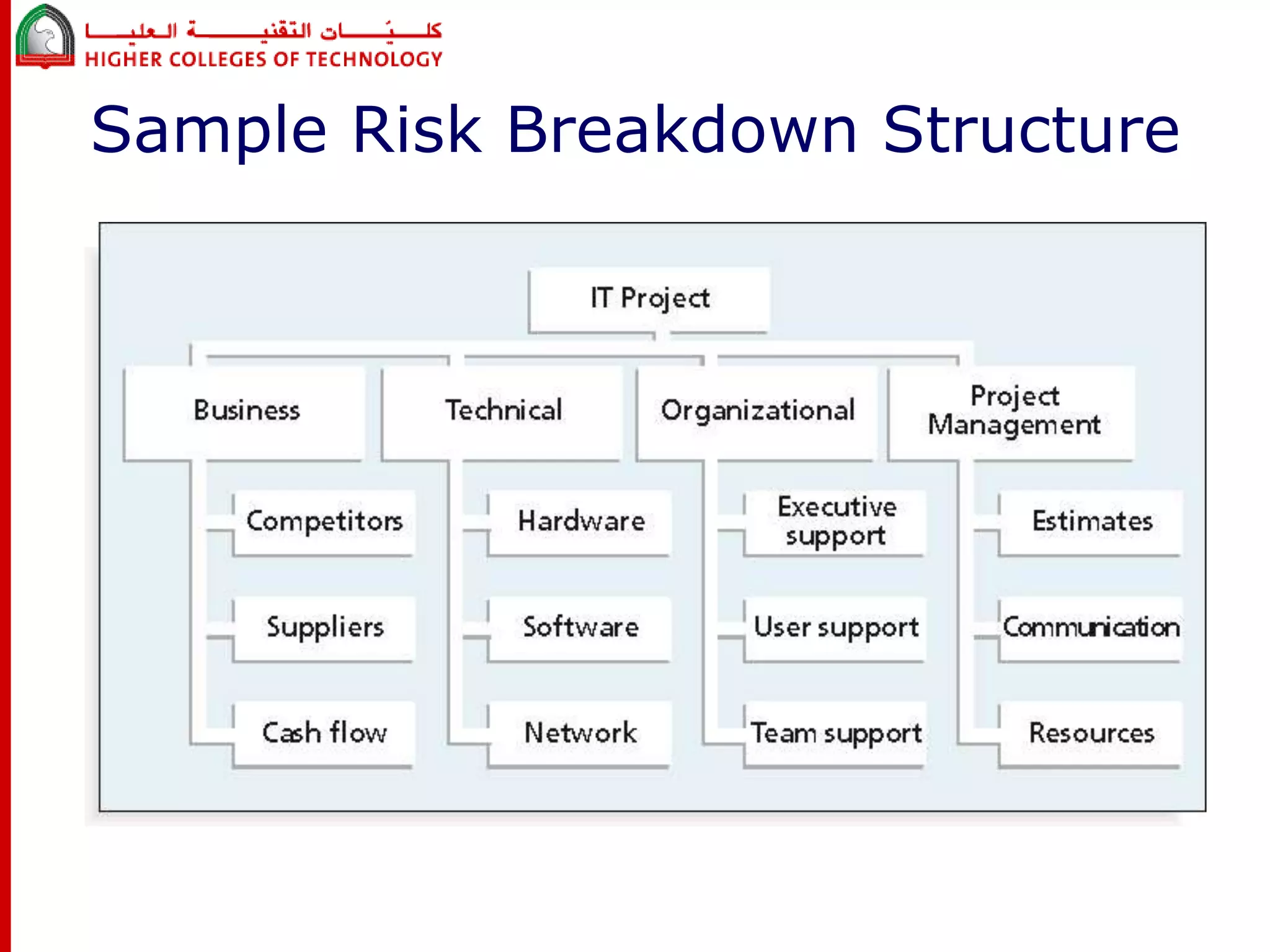
Risk Breakdown Structure 
 A risk breakdown structure is a 
hierarchy of potential risk categories 
for a project 
 Similar to a work breakdown 
structure but used to identify and 
categorize risks
Sample Risk Breakdown Structure
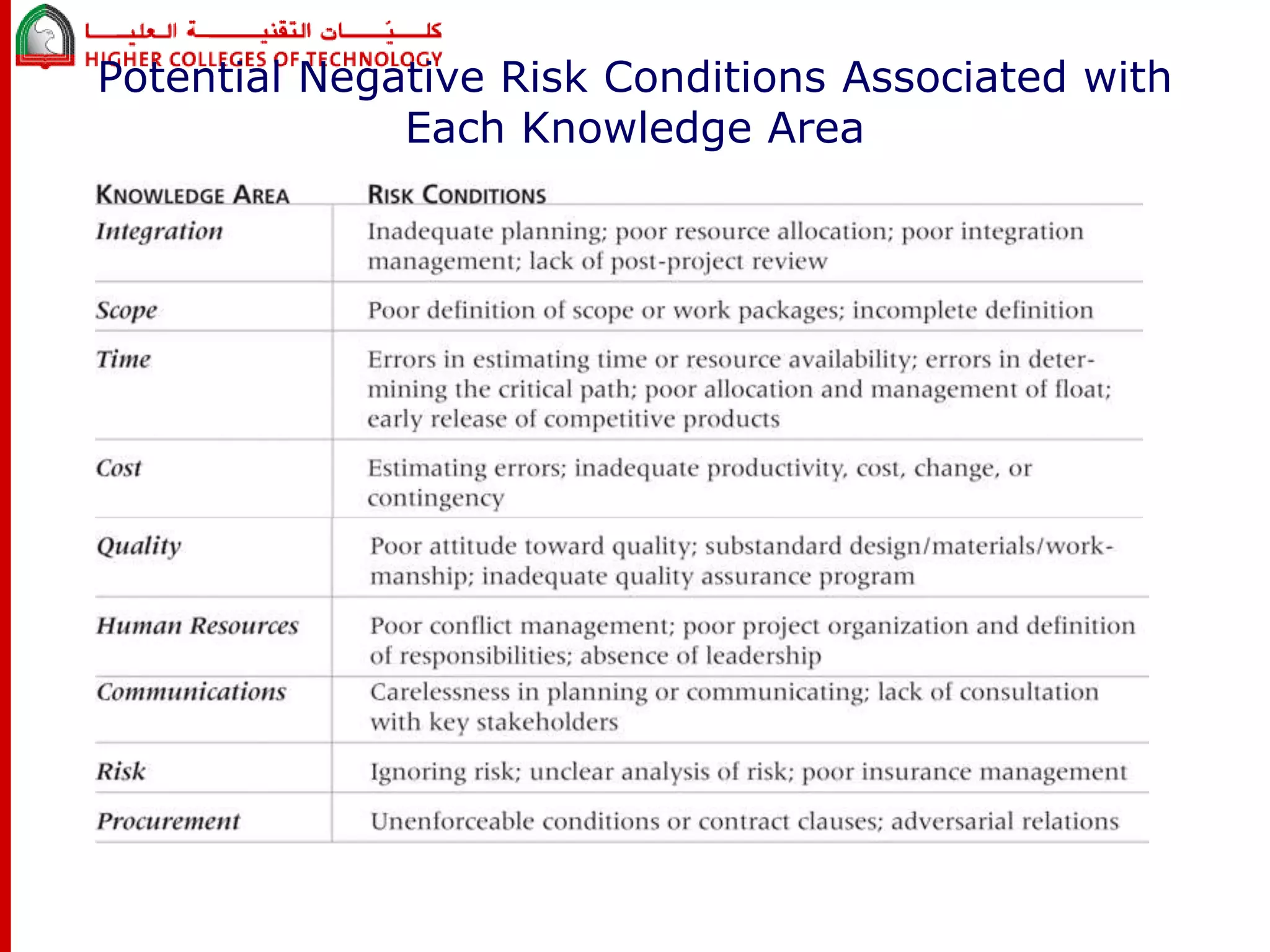
Potential Negative Risk Conditions Associated with 
Each Knowledge Area
2. Risk Identification 
 It is the process of gaining understanding 
of the potentially unsatisfactory outcomes 
that can occur to the project 
– What can potentially go wrong? 
 Historical information can help identifying 
the areas where risk is high 
 Risk is present in all project management 
areas, like Scope, Time, Cost, Quality, HR, 
Communication, Risk , Procurement and 
Integration
Sources of Risk in IT projects 
 Technical Risk 
– From new, unproven or complex technology (what 
if it doesn’t work?) 
 Quality Risk 
– From levels of expectations (what if quality 
measure are set too high?) 
 Financial Risk 
– From budget (what if project goes over budget?) 
 Project Management Risk 
– From improper project management (what if we 
were wrong in time and resources allocation?) 
 External Risk 
– From things external to the project such as nature 
and political situations (what if a tornado hit or a 
war erupted?)
Risk Identification Techniques 
 Reviewing Project Documents 
– Project plan, scope, etc. 
 Brainstorming 
– Project team 
 Interviewing 
– Subject matter experts and project stakeholders 
 Delphi Technique 
– An anonymous method to query experts about foreseeable 
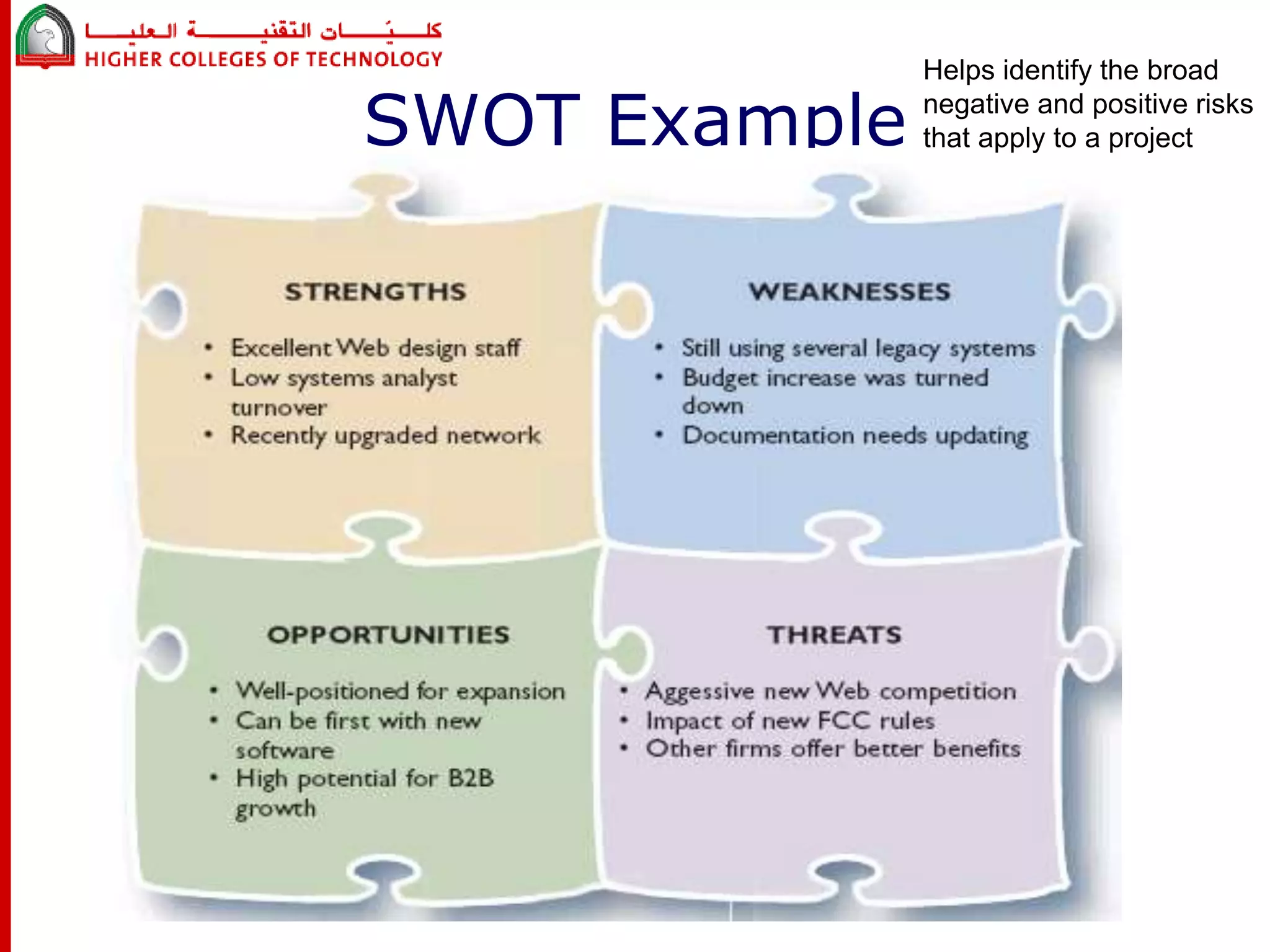
 SWOT Analysis 
– Strengths, Weaknesses, Opportunities & Threats 
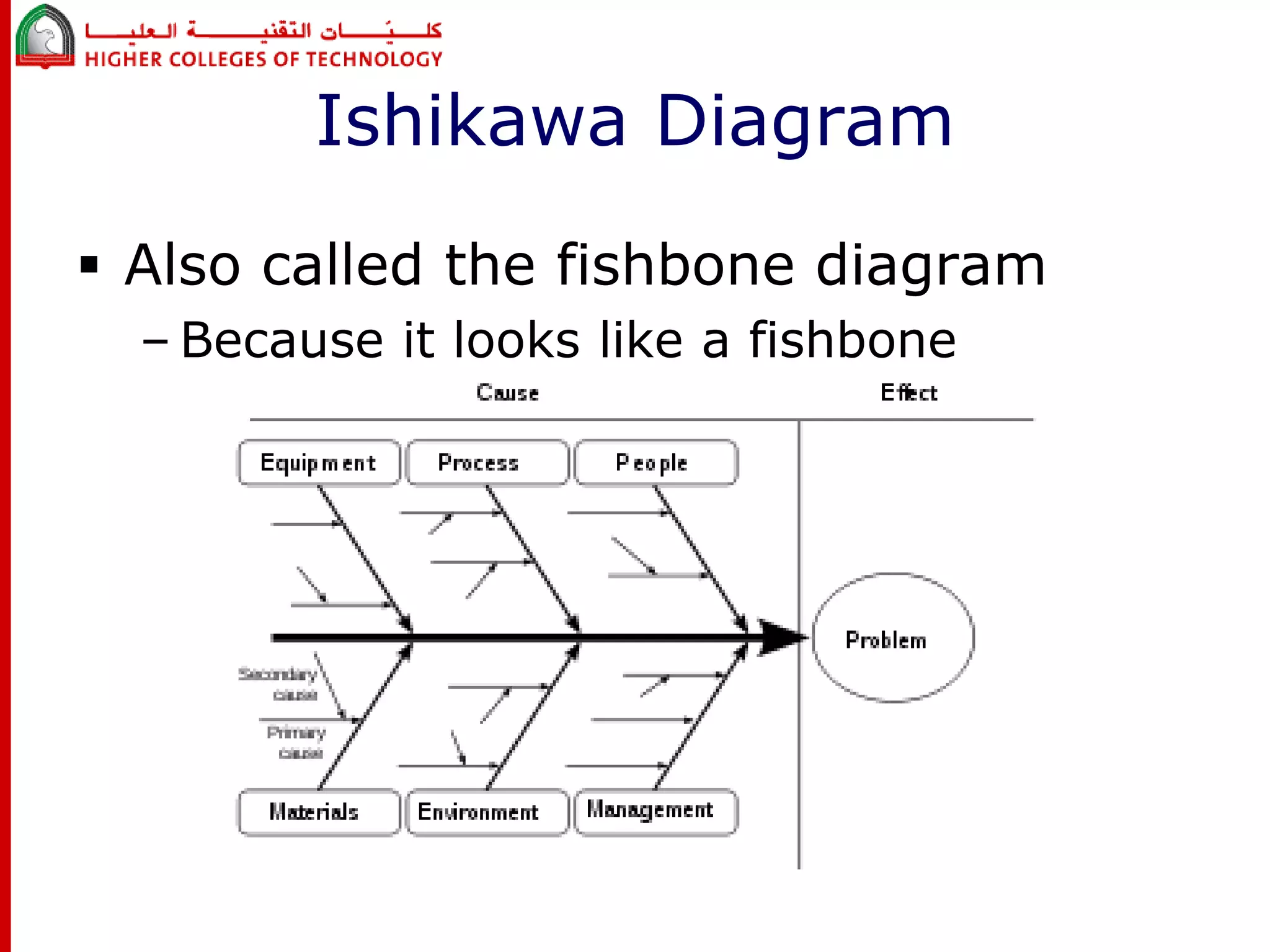
 Diagramming Techniques 
– Ishikawa (Fishbone) and Flow charts 
 Usually a combination of these methods is used to asses 
risk involved
The Delphi Technique 
 A forecasting method that relies on a 
number of independent experts 
 A questionnaire related to project 
risk is given to the experts 
– They answer anonymously 
 Results are analyzed and then re-circulated 
for more round and 
discussions
SWOT Example 
Helps identify the broad 
negative and positive risks 
that apply to a project
Ishikawa Diagram 
 Also called the fishbone diagram 
– Because it looks like a fishbone
3. Qualitative Risk Analysis 
 It involves assessing the likelihood احتمال 
قوي and impact of identified risks, then 
determine their magnitude and priority 
– In other words, prioritizing risks based on their probability and 
impact of occurrence (put high probability in the first) 
 Methods of qualitative risk analysis 
include 
– Using Probability/Impact matrix 
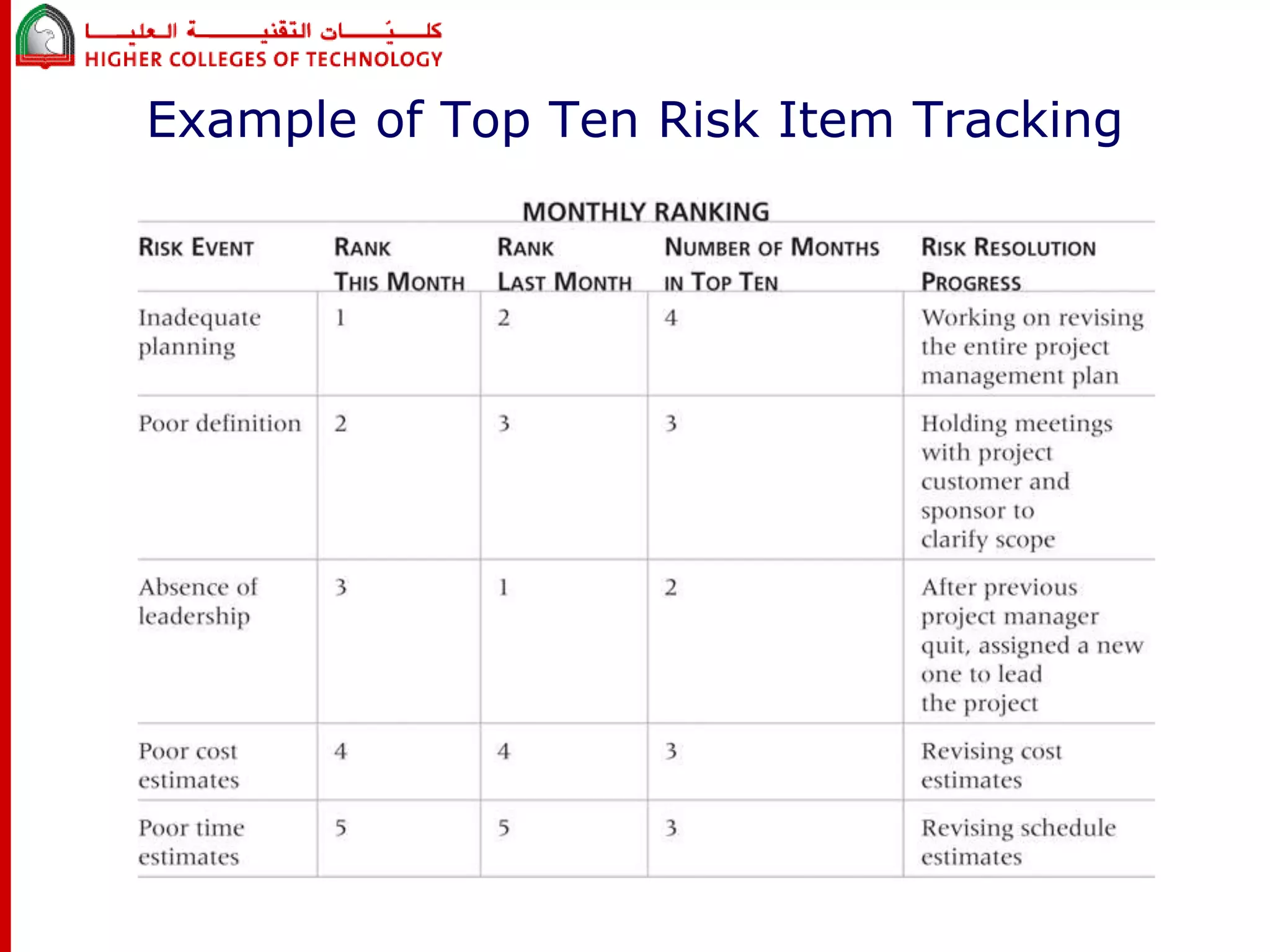
– Top 10 risk item tracking 
– Expert Judgment
Probability/Impact Method 
 The project risks are rated according to their probability 
and impact 
– Risk probability 
• is the likelihood that a risk event may happen 
– Risk impact 
• is the consequence that the result of the event will have on the project 
objectives 
 Two ways to rank 
– Cardinal 
• Example 
– 0.01 very low 
– 1.0 is certain 
– Ordinal 
• Example 
– Very high 
– High 
– Unlikely 
– Very unlikely
Probability/Impact Matrix (1) 
 Example: 
– An identified risk in a project is the 
possibility that the vendor may be late 
in delivering the hardware 
– Step 1  Identify the risk 
– Step 2  Decide on the risk ranking
Probability/Impact Matrix (2) 
 Example -continued: 
– Step 1  the vendor maybe late in 
delivering the HW 
– Step 2  
• Probability ranking: 0.1, 0.3, 0.5, 0.7, 0.9 
• Impact ranking: 0.05, 0.10, 0.20, 0.40 0.80
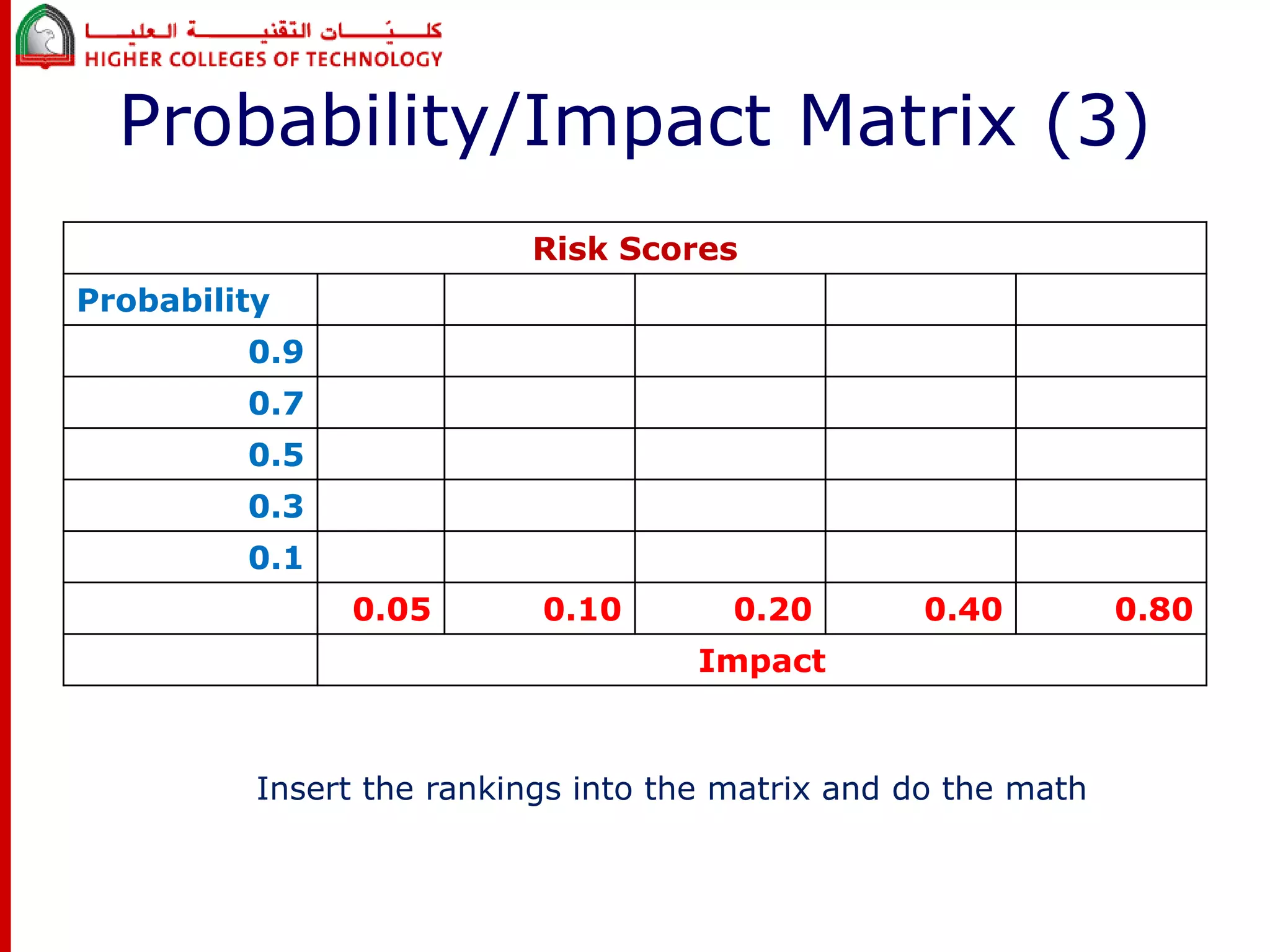
Probability/Impact Matrix (3) 
Risk Scores 
Probability 
0.9 
0.7 
0.5 
0.3 
0.1 
0.05 0.10 0.20 0.40 0.80 
Impact 
Insert the rankings into the matrix and do the math
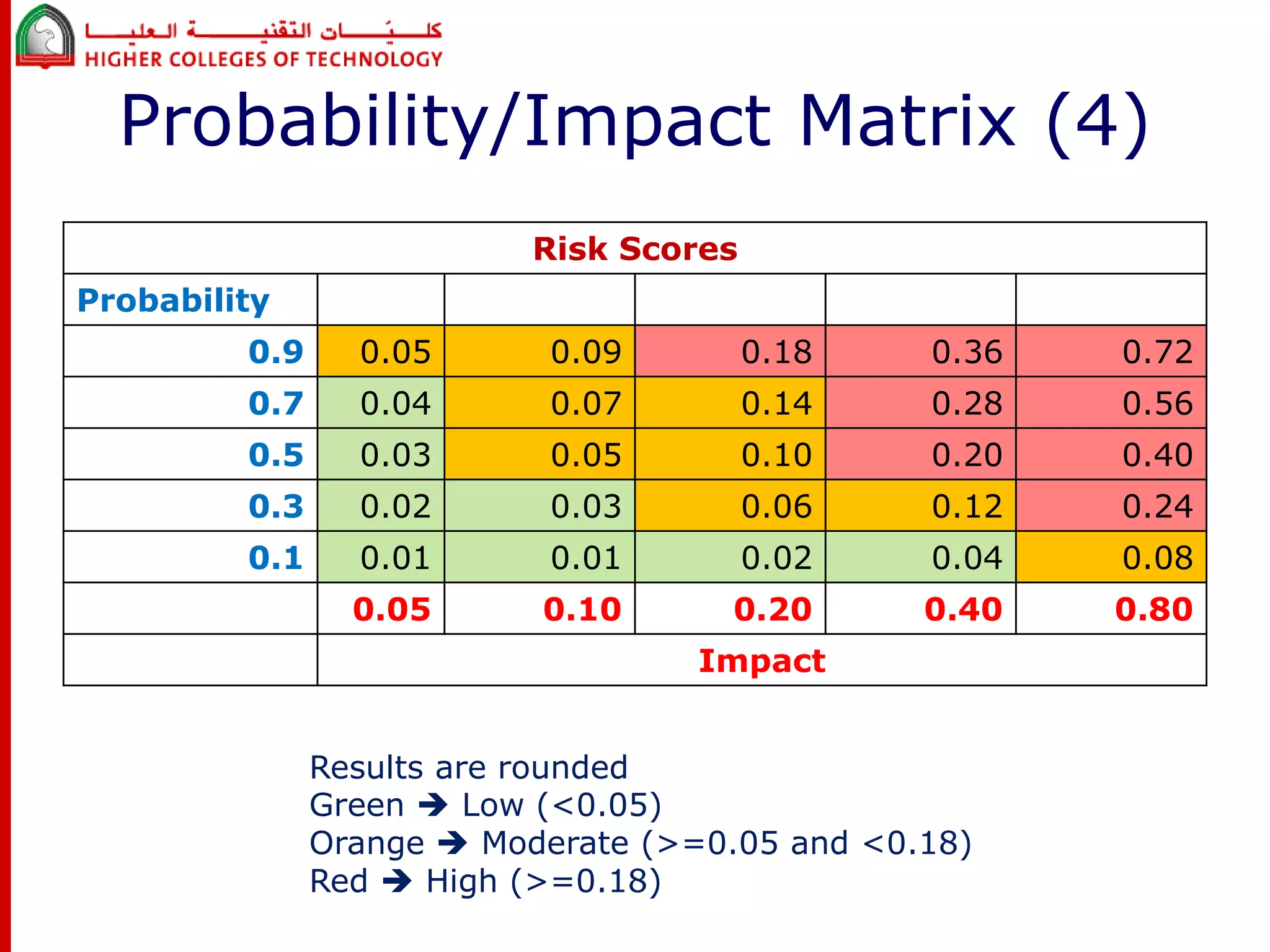
Probability/Impact Matrix (4) 
Risk Scores 
Probability 
0.9 0.05 0.09 0.18 0.36 0.72 
0.7 0.04 0.07 0.14 0.28 0.56 
0.5 0.03 0.05 0.10 0.20 0.40 
0.3 0.02 0.03 0.06 0.12 0.24 
0.1 0.01 0.01 0.02 0.04 0.08 
0.05 0.10 0.20 0.40 0.80 
Impact 
Results are rounded 
Green  Low (<0.05) 
Orange  Moderate (>=0.05 and <0.18) 
Red  High (>=0.18)
Example of Top Ten Risk Item Tracking
3. Quantitative Risk Analysis 
 Quantitative risk analysis attempts to 
numerically assess the probability and 
impact of the identified risks 
 Quantitative risk analysis also creates 
an overall risk score for the project 
 Methods 
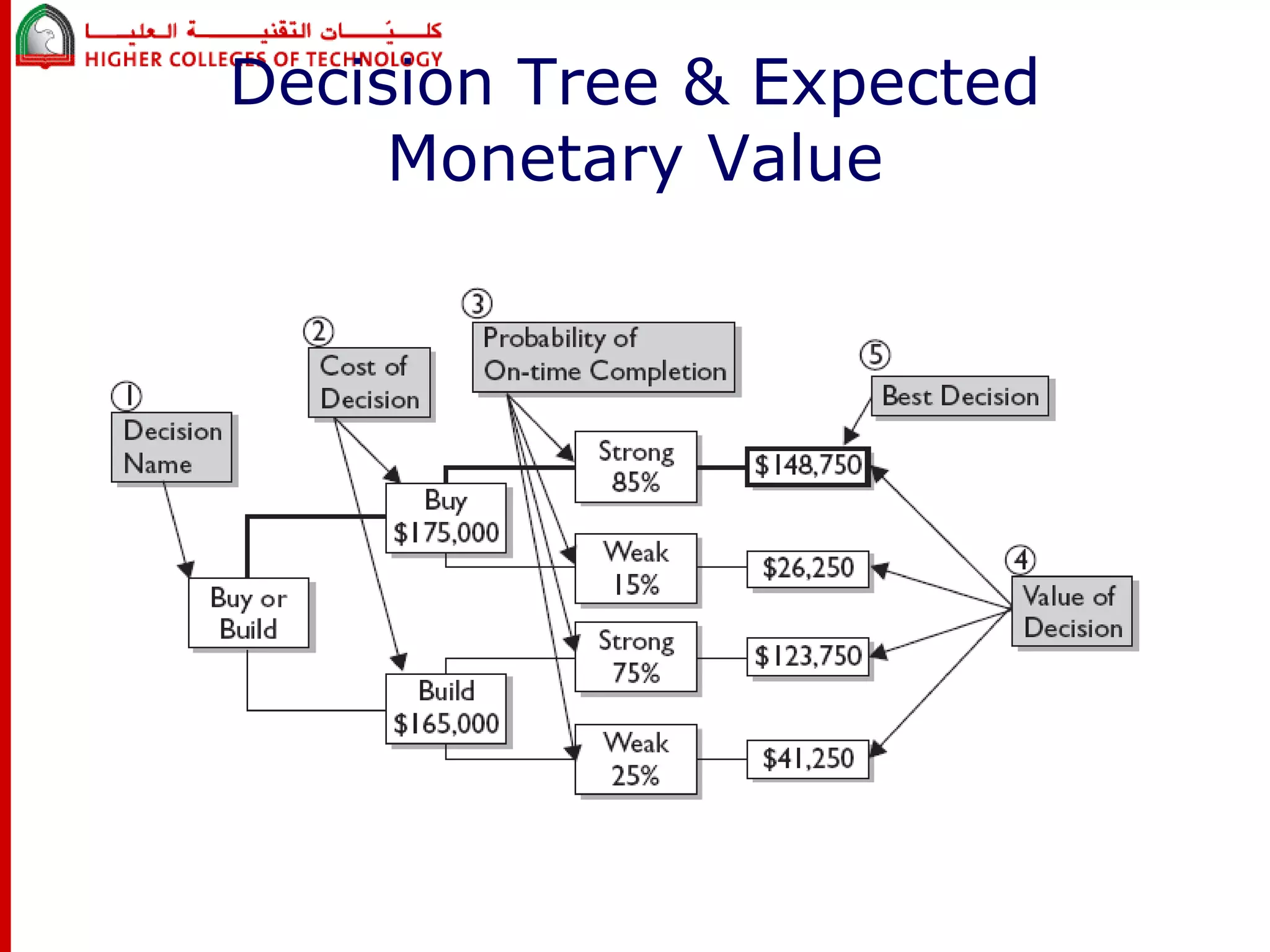
– Decision Trees & Expected Monetary Value 
– Simulation 
• What-If analysis (Monte Carlo technique) 
– Sensitivity analysis
Decision Tree & Expected 
Monetary Value
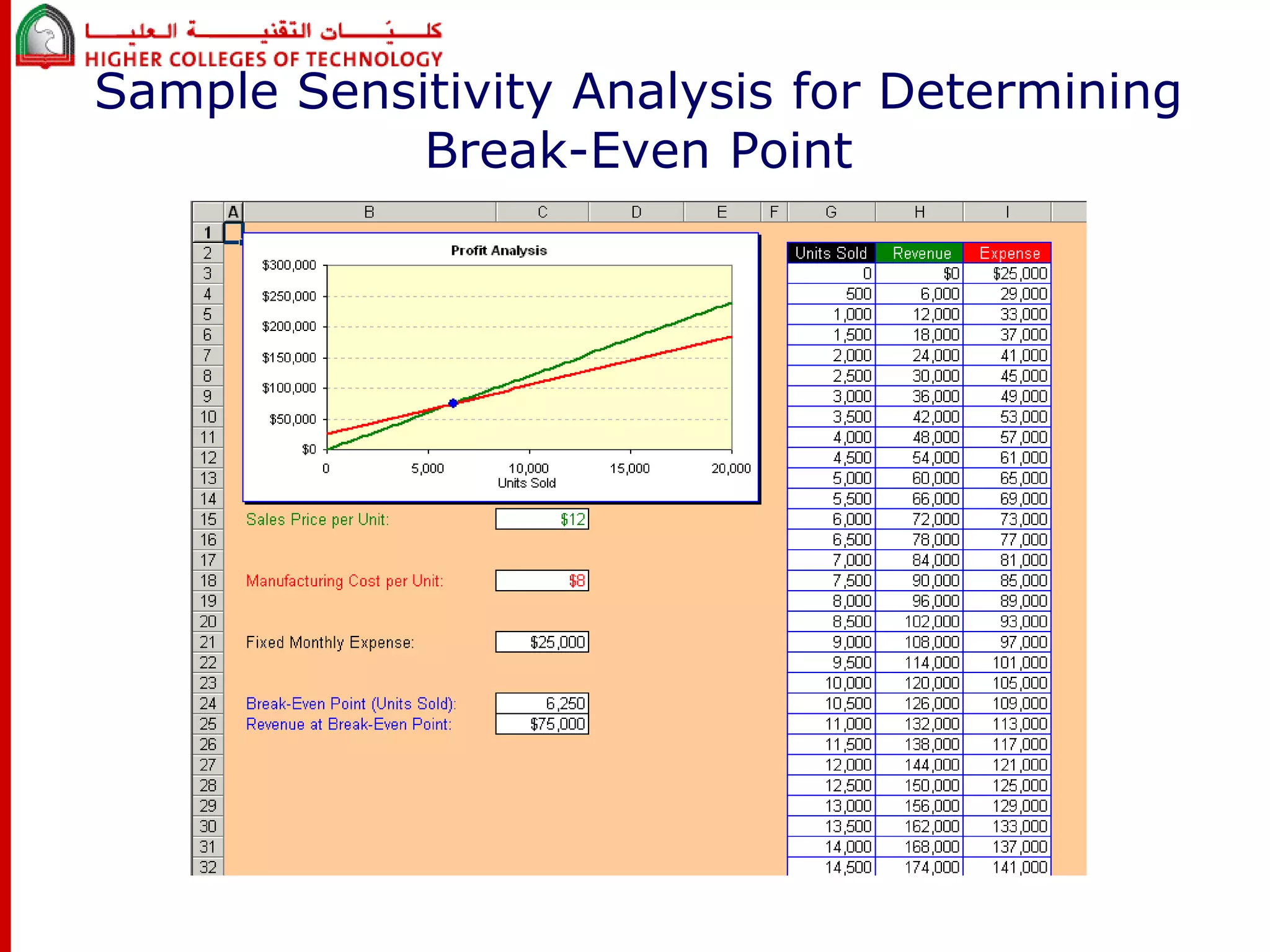
Sensitivity Analysis 
 Sensitivity analysis is a technique used to 
show the effects of changing one or more 
variables on an outcome 
 For example, many people use it to determine 
what the monthly payments for a loan will be 
given different interest rates or periods of the 
loan, or for determining break-even points 
based on different assumptions 
 Spreadsheet software, such as Excel, is a 
common tool for performing sensitivity analysis
Sample Sensitivity Analysis for Determining 
Break-Even Point
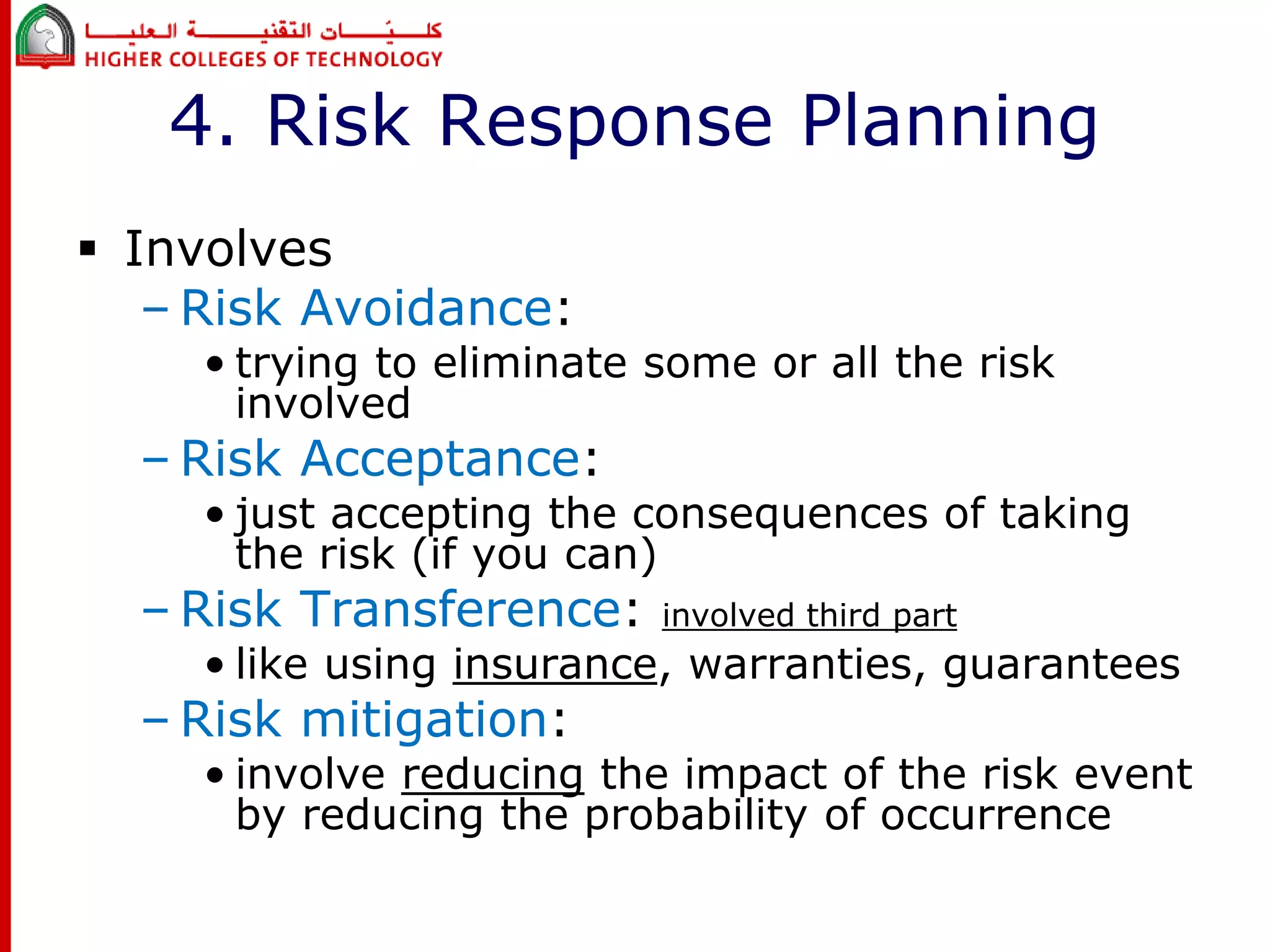
4. Risk Response Planning 
 Involves 
– Risk Avoidance: 
• trying to eliminate some or all the risk 
involved 
– Risk Acceptance: 
• just accepting the consequences of taking 
the risk (if you can) 
– Risk Transference: involved third part 
• like using insurance, warranties, guarantees 
– Risk mitigation: 
• involve reducing the impact of the risk event 
by reducing the probability of occurrence
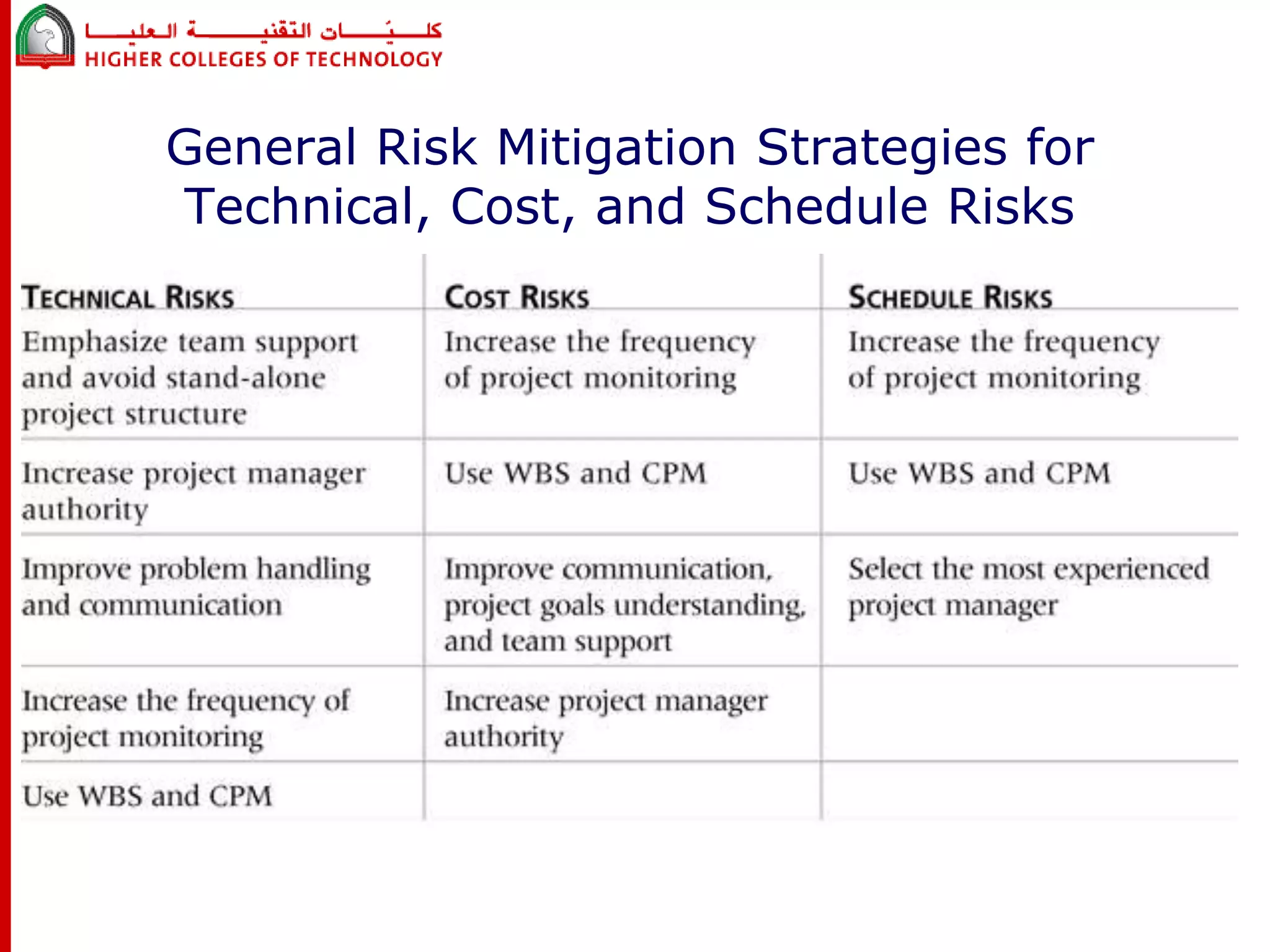
General Risk Mitigation Strategies for 
Technical, Cost, and Schedule Risks
5. Risk Monitoring and Control 
 Risk monitoring and control is the 
process of monitoring identified risks 
for signs that they may be occurring, 
controlling identified risks with the 
agreed responses, and looking for 
new risks that may creep into the 
project

Project Risk Management

  • 1.
    ITEC 459 ProjectManagement Project Risk Management
  • 2.
    Learning Outcome 5 Identify solutions to possible risks that affect the planning and executing of an IT project. 5.1 Identify potential risks that may occur at different stages of the project. 5.2 Analyze risks using quantitative and qualitative techniques such as decision trees, probabilities, simulation and sensitivity analysis. 5.3 Develop a risk response plan that will eliminate or reduce the effect of potential risks
  • 3.
    Lesson Objectives Understand Risk Management  Risk Management Processes
  • 4.
    What is Risk?  Risk – It is the possibility of loss or injury – It is everywhere • Driving a car • Walking down the street • Traveling, etc.  Project Risk – Part of any project and represents the uncertainty element in the project • No escaping it! – Unplanned events or conditions that can have an effect on the project • The effects can be negative or positive
  • 5.
    Risk Management Project Risk Management is an activity undertaken to lessen the impact of potentially adverse events on the project – Think of it as an insurance against surprises  Risk Management can help improve project success by helping select good projects, determining project scope, and developing realistic estimates  Failure to address Risk Management issues can translate into losses – Financial losses due to the credit crisis of 2008
  • 6.
    Risks  Riskscan be positive or negative – Positive Risks: Result in good things or opportunities – Negative Risks: Results in losses  The goal of Project Risk Management is to minimize potential negative risks while maximizing potential positive risks
  • 7.
    Risk Management Processes 1. Risk Management Planning 2. Risk Identification 3. Qualitative Risk Analysis 4. Quantitative Risk Analysis 5. Risk Response Planning 6. Risk Monitoring & Control
  • 8.
    1. Risk ManagementPlanning  It is deciding how to approach the risk  Output  Risk management plan  This plan summarizes the result in risk identification, quantitative & qualitative analysis and response method  It also includes Contingency plan which is a predefined action that a project team will take if an identified risk event occurs
  • 9.
    Contingency and FallbackPlans, Contingency Reserves  Contingency plans are predefined actions that the project team will take if an identified risk event occurs  Fallback plans are developed for risks that have a high impact on meeting project objectives and are put into effect if attempts to reduce the risk are not effective  Contingency reserves or allowances are provisions held by the project sponsor or organization to reduce the risk of cost or schedule overruns to an acceptable level
  • 10.
    Risk Breakdown Structure  A risk breakdown structure is a hierarchy of potential risk categories for a project  Similar to a work breakdown structure but used to identify and categorize risks
  • 11.
  • 12.
    Potential Negative RiskConditions Associated with Each Knowledge Area
  • 13.
    2. Risk Identification  It is the process of gaining understanding of the potentially unsatisfactory outcomes that can occur to the project – What can potentially go wrong?  Historical information can help identifying the areas where risk is high  Risk is present in all project management areas, like Scope, Time, Cost, Quality, HR, Communication, Risk , Procurement and Integration
  • 14.
    Sources of Riskin IT projects  Technical Risk – From new, unproven or complex technology (what if it doesn’t work?)  Quality Risk – From levels of expectations (what if quality measure are set too high?)  Financial Risk – From budget (what if project goes over budget?)  Project Management Risk – From improper project management (what if we were wrong in time and resources allocation?)  External Risk – From things external to the project such as nature and political situations (what if a tornado hit or a war erupted?)
  • 15.
    Risk Identification Techniques  Reviewing Project Documents – Project plan, scope, etc.  Brainstorming – Project team  Interviewing – Subject matter experts and project stakeholders  Delphi Technique – An anonymous method to query experts about foreseeable  SWOT Analysis – Strengths, Weaknesses, Opportunities & Threats  Diagramming Techniques – Ishikawa (Fishbone) and Flow charts  Usually a combination of these methods is used to asses risk involved
  • 16.
    The Delphi Technique  A forecasting method that relies on a number of independent experts  A questionnaire related to project risk is given to the experts – They answer anonymously  Results are analyzed and then re-circulated for more round and discussions
  • 17.
    SWOT Example Helpsidentify the broad negative and positive risks that apply to a project
  • 18.
    Ishikawa Diagram Also called the fishbone diagram – Because it looks like a fishbone
  • 19.
    3. Qualitative RiskAnalysis  It involves assessing the likelihood احتمال قوي and impact of identified risks, then determine their magnitude and priority – In other words, prioritizing risks based on their probability and impact of occurrence (put high probability in the first)  Methods of qualitative risk analysis include – Using Probability/Impact matrix – Top 10 risk item tracking – Expert Judgment
  • 20.
    Probability/Impact Method The project risks are rated according to their probability and impact – Risk probability • is the likelihood that a risk event may happen – Risk impact • is the consequence that the result of the event will have on the project objectives  Two ways to rank – Cardinal • Example – 0.01 very low – 1.0 is certain – Ordinal • Example – Very high – High – Unlikely – Very unlikely
  • 21.
    Probability/Impact Matrix (1)  Example: – An identified risk in a project is the possibility that the vendor may be late in delivering the hardware – Step 1  Identify the risk – Step 2  Decide on the risk ranking
  • 22.
    Probability/Impact Matrix (2)  Example -continued: – Step 1  the vendor maybe late in delivering the HW – Step 2  • Probability ranking: 0.1, 0.3, 0.5, 0.7, 0.9 • Impact ranking: 0.05, 0.10, 0.20, 0.40 0.80
  • 23.
    Probability/Impact Matrix (3) Risk Scores Probability 0.9 0.7 0.5 0.3 0.1 0.05 0.10 0.20 0.40 0.80 Impact Insert the rankings into the matrix and do the math
  • 24.
    Probability/Impact Matrix (4) Risk Scores Probability 0.9 0.05 0.09 0.18 0.36 0.72 0.7 0.04 0.07 0.14 0.28 0.56 0.5 0.03 0.05 0.10 0.20 0.40 0.3 0.02 0.03 0.06 0.12 0.24 0.1 0.01 0.01 0.02 0.04 0.08 0.05 0.10 0.20 0.40 0.80 Impact Results are rounded Green  Low (<0.05) Orange  Moderate (>=0.05 and <0.18) Red  High (>=0.18)
  • 25.
    Example of TopTen Risk Item Tracking
  • 26.
    3. Quantitative RiskAnalysis  Quantitative risk analysis attempts to numerically assess the probability and impact of the identified risks  Quantitative risk analysis also creates an overall risk score for the project  Methods – Decision Trees & Expected Monetary Value – Simulation • What-If analysis (Monte Carlo technique) – Sensitivity analysis
  • 27.
    Decision Tree &Expected Monetary Value
  • 28.
    Sensitivity Analysis Sensitivity analysis is a technique used to show the effects of changing one or more variables on an outcome  For example, many people use it to determine what the monthly payments for a loan will be given different interest rates or periods of the loan, or for determining break-even points based on different assumptions  Spreadsheet software, such as Excel, is a common tool for performing sensitivity analysis
  • 29.
    Sample Sensitivity Analysisfor Determining Break-Even Point
  • 30.
    4. Risk ResponsePlanning  Involves – Risk Avoidance: • trying to eliminate some or all the risk involved – Risk Acceptance: • just accepting the consequences of taking the risk (if you can) – Risk Transference: involved third part • like using insurance, warranties, guarantees – Risk mitigation: • involve reducing the impact of the risk event by reducing the probability of occurrence
  • 31.
    General Risk MitigationStrategies for Technical, Cost, and Schedule Risks
  • 32.
    5. Risk Monitoringand Control  Risk monitoring and control is the process of monitoring identified risks for signs that they may be occurring, controlling identified risks with the agreed responses, and looking for new risks that may creep into the project