Risk Assessment and Management
Tanmoy Sinha
07 June, 2019
Outline
2
• Objectives of Risk Assessment and Management
• Definition of Risk
• Definition of Assessment and Management
• Risk Analysis Framework
• Five Steps to Risk Assessment
• Typical Example of Risk Assessment Process
• Definition of Risk Management
• Phases of Risk Management Process
• Typical Example of Risk Management Process
• Failure of Risk Management (A Short Video Clip)
• Summary
• Acknowledgments
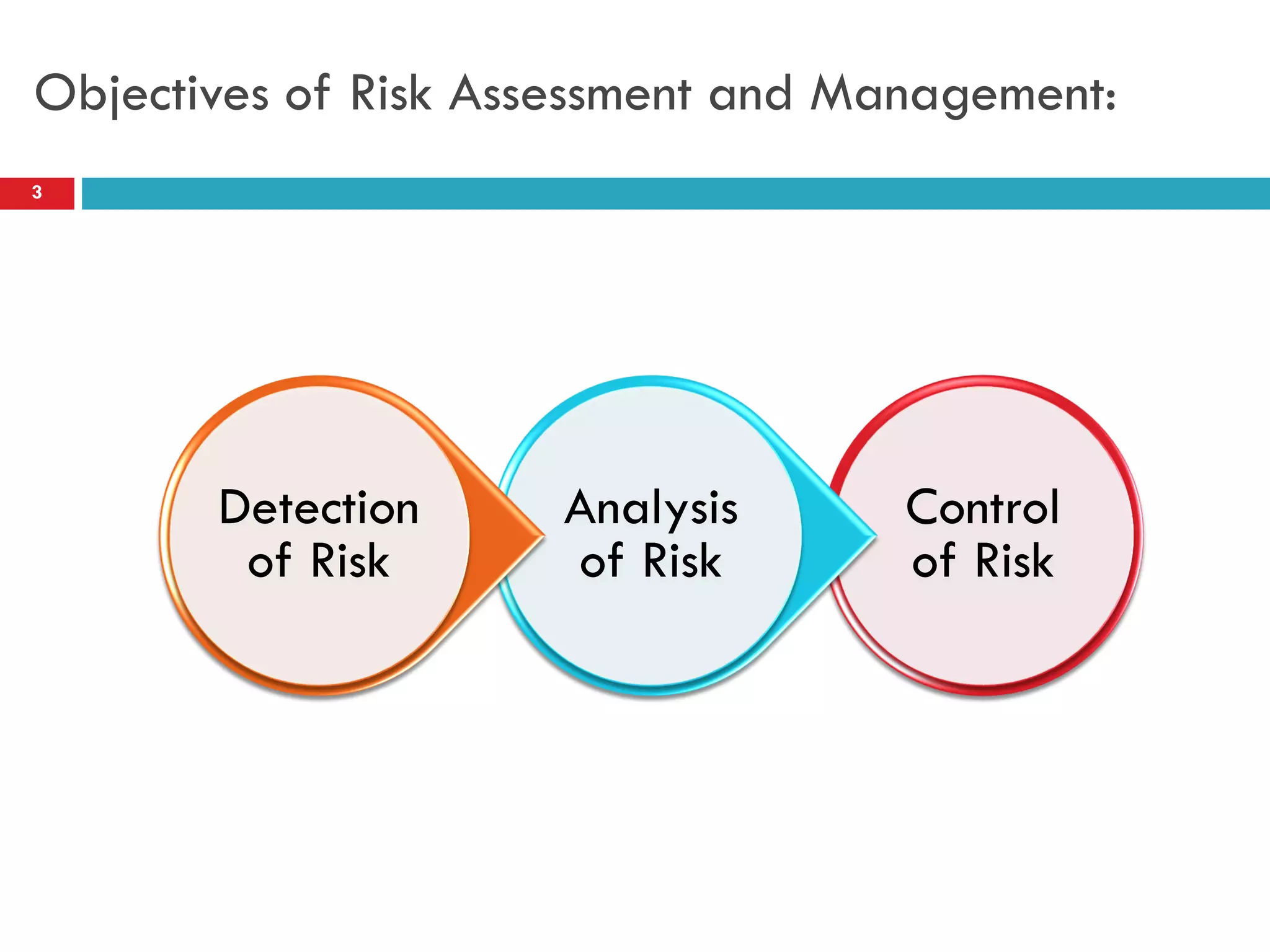
Objectives of Risk Assessment and Management:
3
Control
of Risk
Analysis
of Risk
Detection
of Risk
Definition of Risk
4
What is
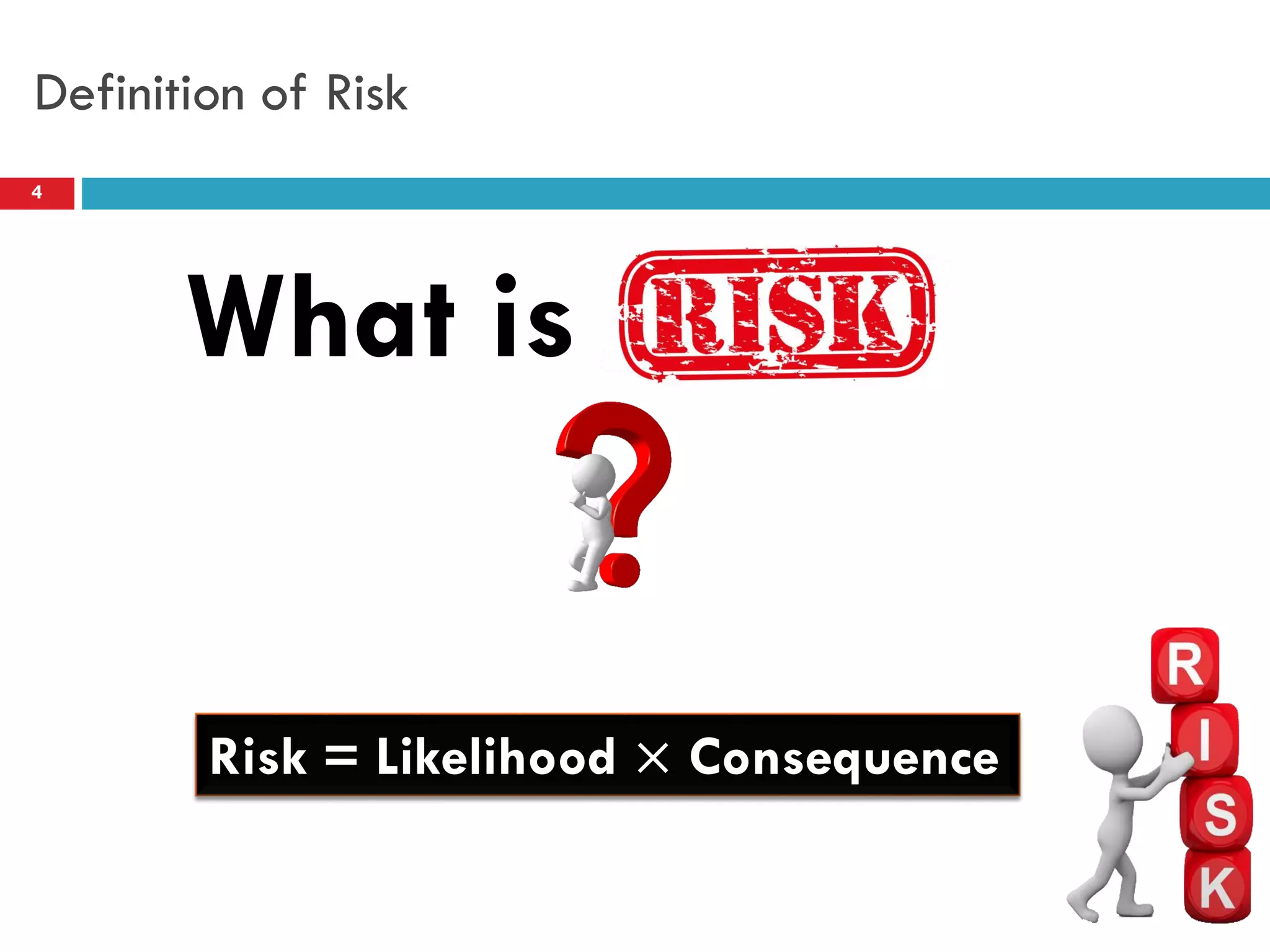
Risk = Likelihood × Consequence
Definition of Risk
5
What is
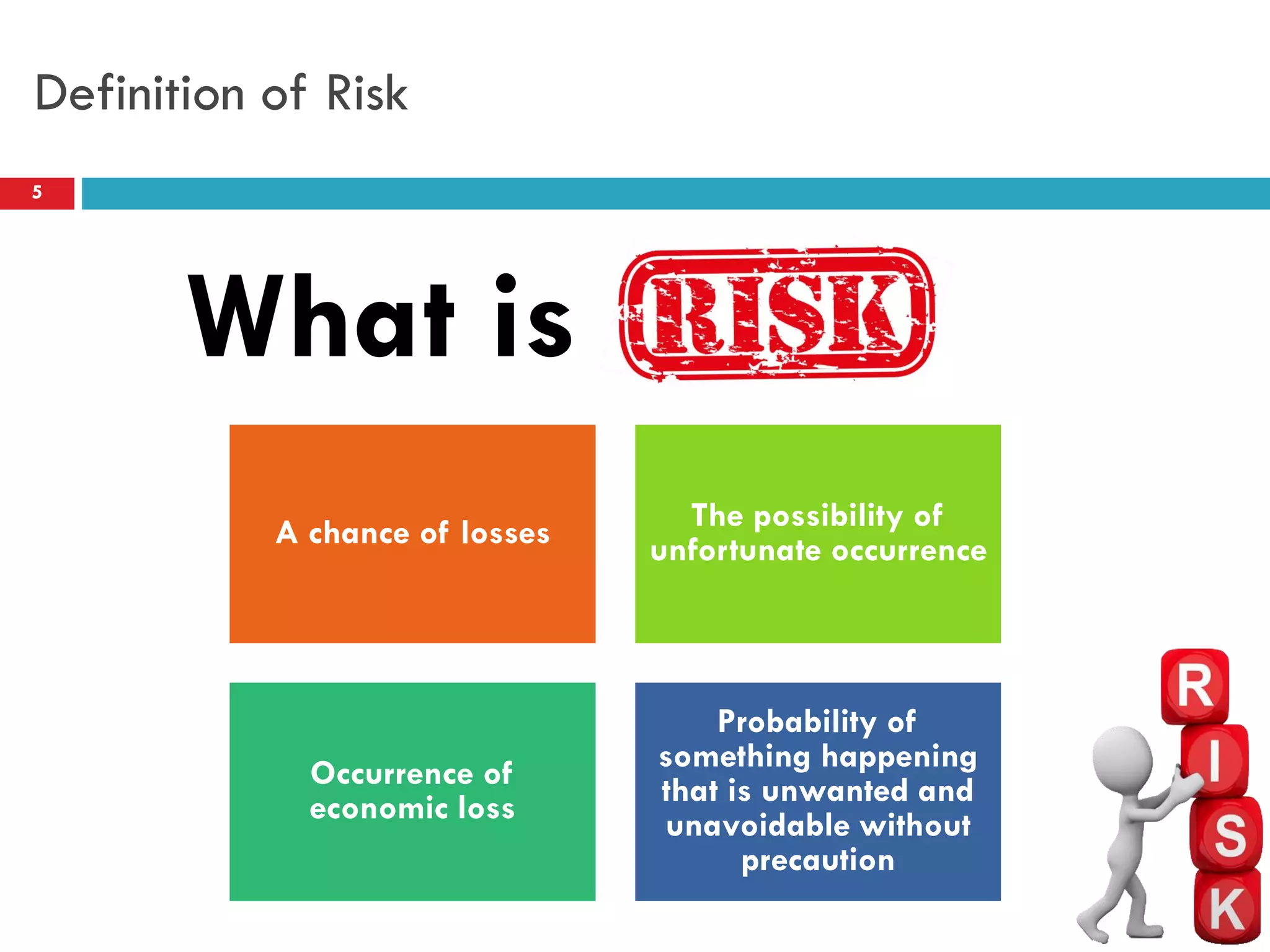
A chance of losses The possibility of
unfortunate occurrence
Occurrence of
economic loss
Probability of
something happening
that is unwanted and
unavoidable without
precaution
Typical Example of Risk
6
Safety risk
Asset loss
or damage
Reputation
al Risk
Financial
risk
Risk
Operational
risk
Environmental
risk
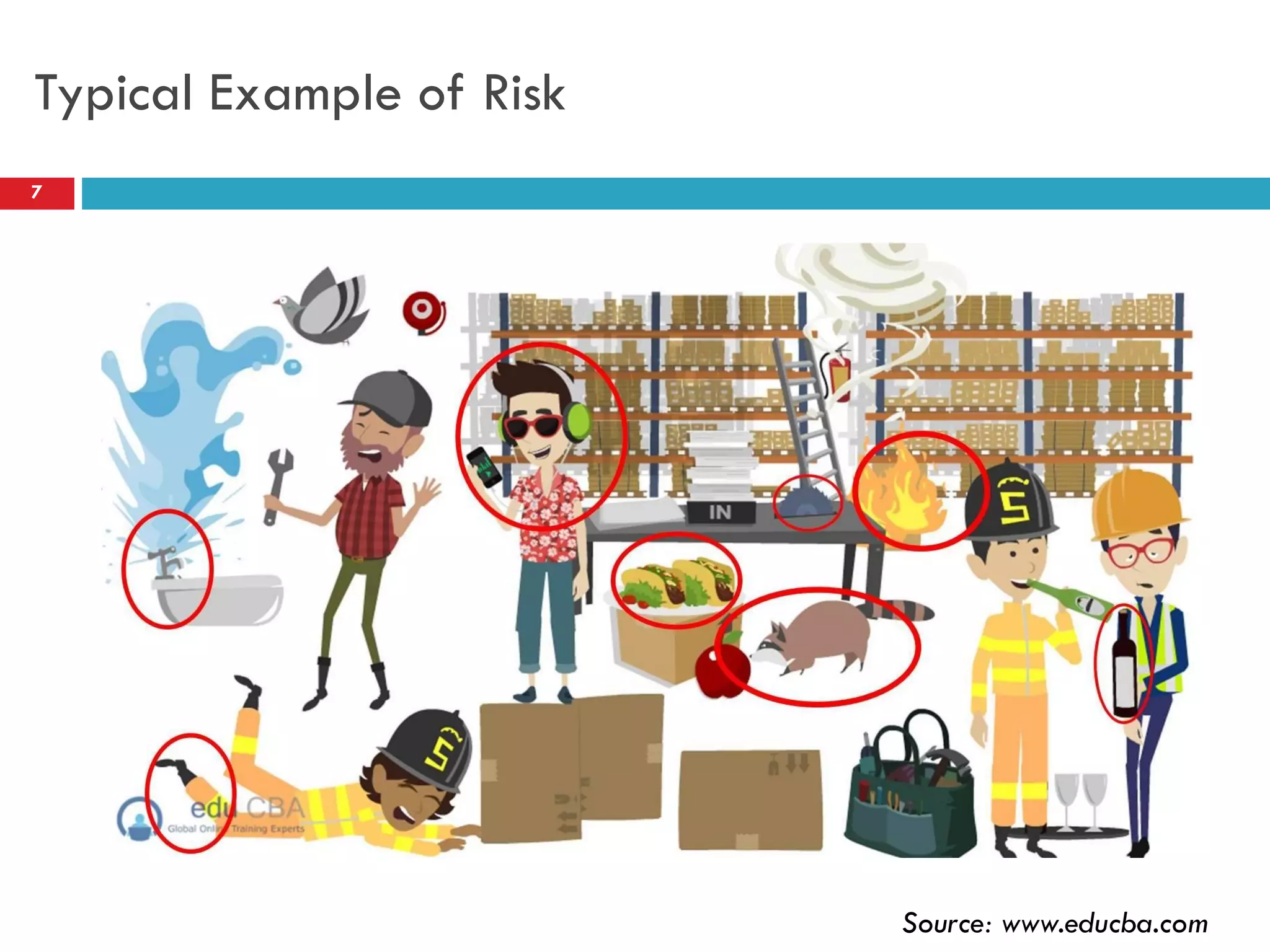
Typical Example of Risk
7
Source: www.educba.com
Typical Example of Risk
8
Source: www.giphy.com Source: www.tenor.com
Definition of Assessment and Management
9
• Evaluation or estimation of the
nature, quality, or ability of someone
or something.
• E.g. Risk assessment, Educational
assessment
Assessment
• Process of dealing with or controlling
things or people.
• E.g. Risk management, Financial
management
Management
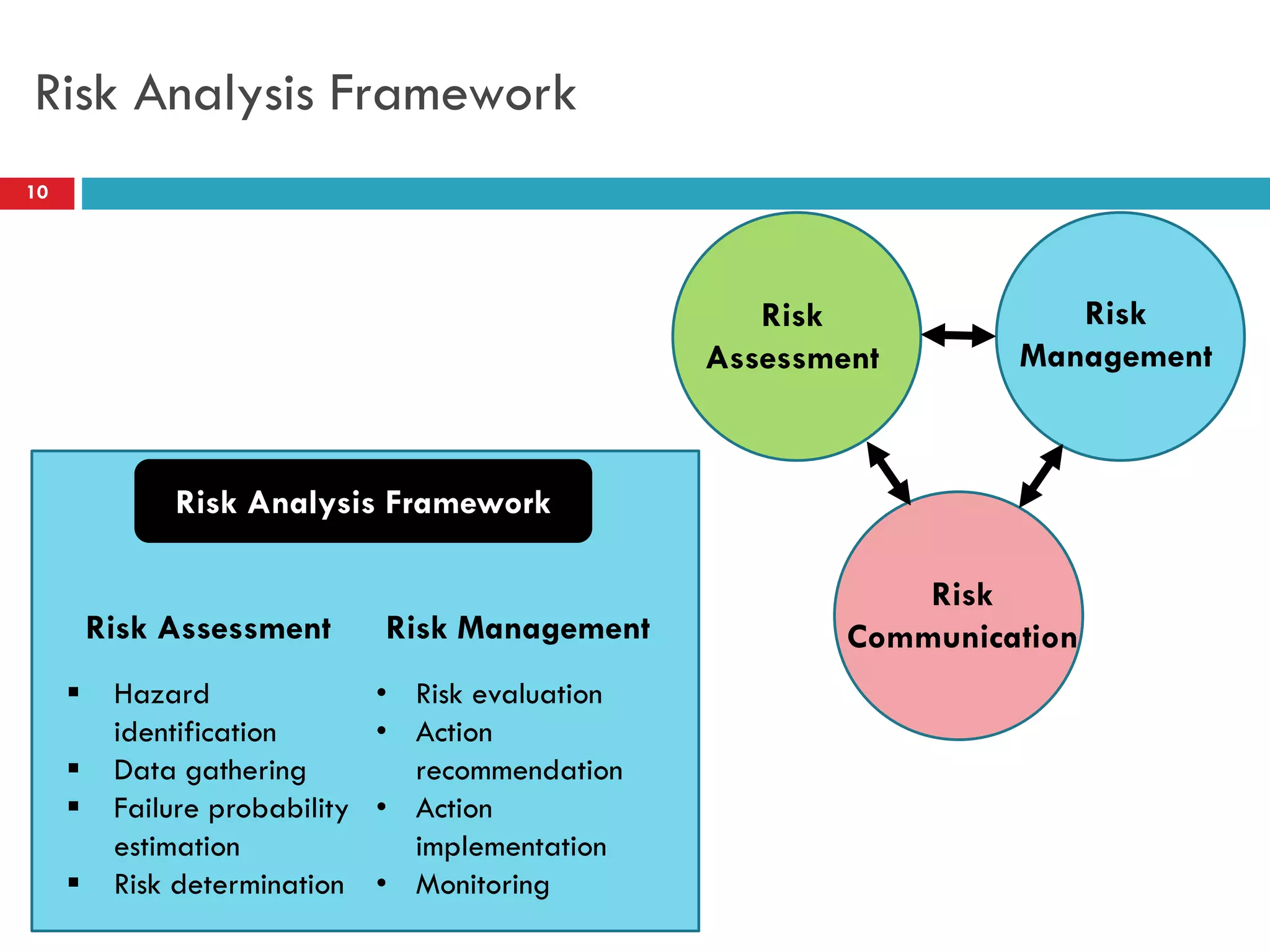
Risk Analysis Framework
10
Risk
Assessment
Risk
Management
Risk
Communication
Risk Analysis Framework
Risk Assessment Risk Management
▪ Hazard
identification
▪ Data gathering
▪ Failure probability
estimation
▪ Risk determination
• Risk evaluation
• Action
recommendation
• Action
implementation
• Monitoring
Definition of Risk Assessment
11
The overall process of hazard
identification, failure
estimation, data gathering
and risk determination.
What is Risk Assessment
Five Steps to Risk Assessment
12
Identify the hazard
Decide who might be harmed
Evaluate the risks and decide on the precautions
Record the findings and put them into place
Review the risk assessment
Five Steps to Risk Assessment
13
Step 1: Identify the hazard
Walk around your workplace and look at what could
reasonably be expected to cause harm.
Ask your employees what they think. They may have
noticed things that are not immediately obvious to you.
Check manufacturers data sheets for chemicals and
equipment as they may identify hazards.
Look over accident books as they may contain information
not immediately obvious to you.
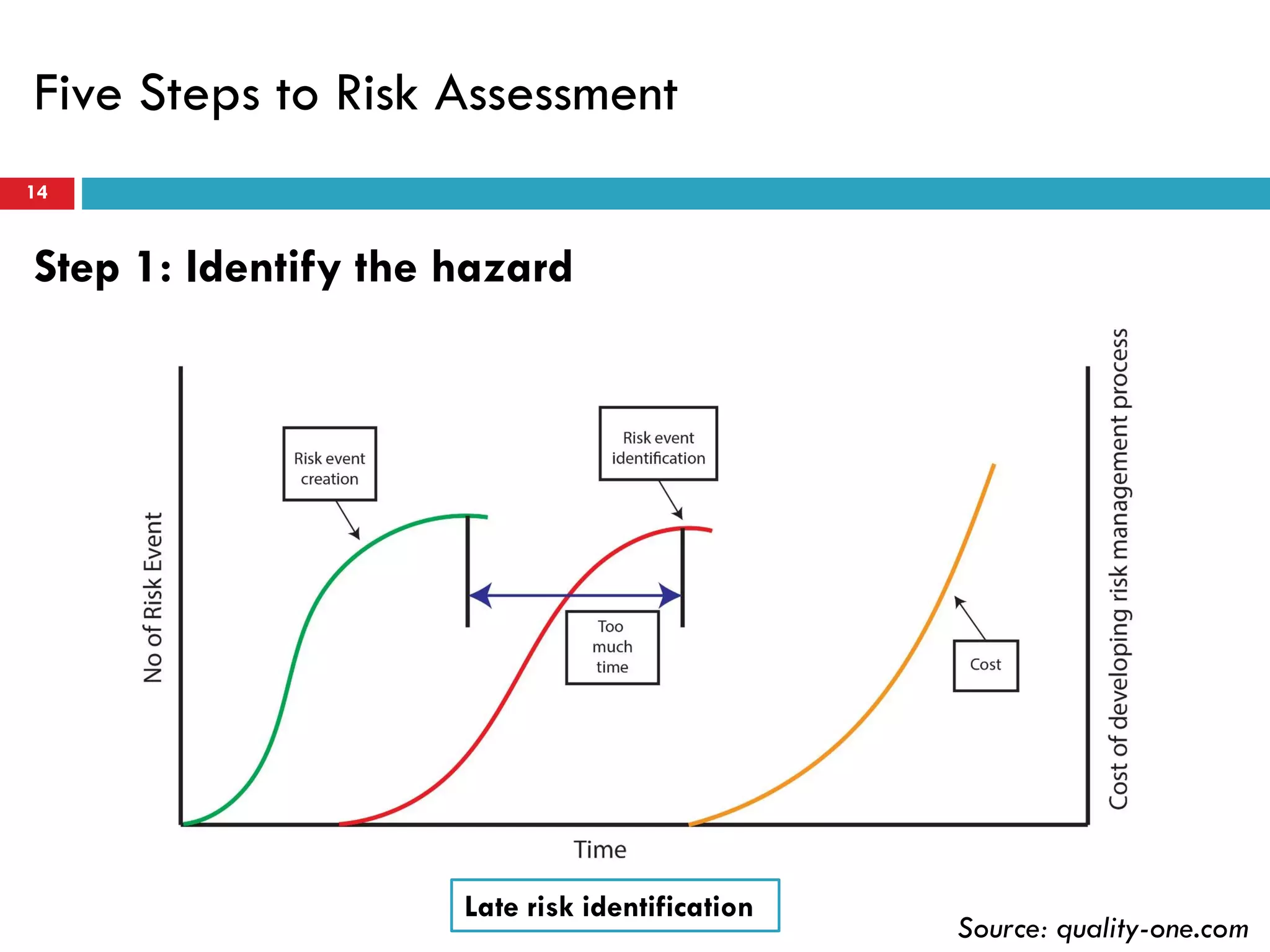
Five Steps to Risk Assessment
14
Step 1: Identify the hazard
Late risk identification
Source: quality-one.com
Five Steps to Risk Assessment
15
Step 1: Identify the hazard
Early risk identification
Source: quality-one.com
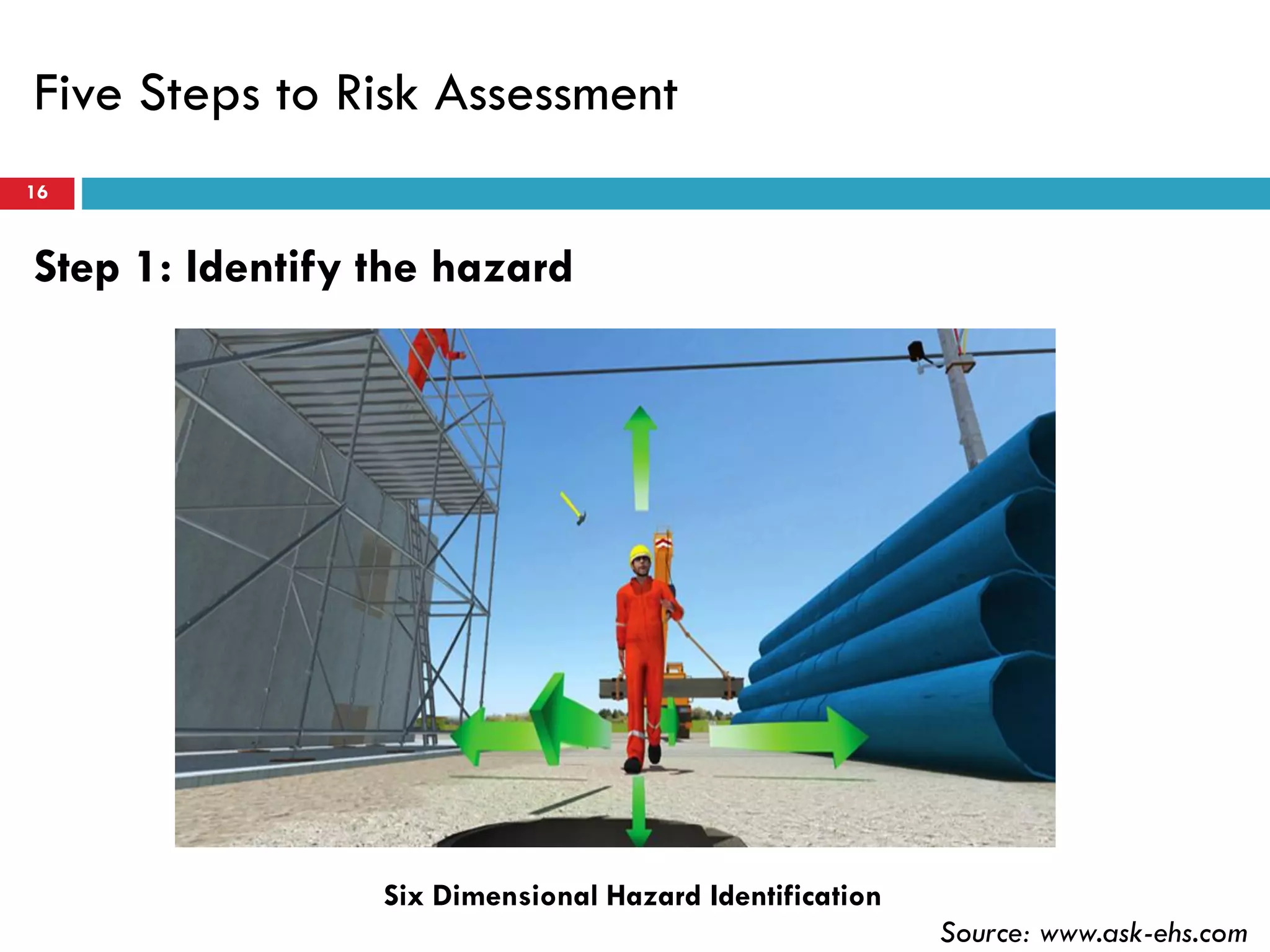
Five Steps to Risk Assessment
16
Step 1: Identify the hazard
Six Dimensional Hazard Identification
Source: www.ask-ehs.com
Five Steps to Risk Assessment
17
Step 2: Decide who might be harmed
❖ For each hazard, you need to be clear about
who might be harmed
❖ Don't just think about those carrying out the
task.
❖ If the task creates dust or fumes, that could
spread to other workers nearby.
Consider:
-The worker or
operators
-Adjacent workers
-Visitors
-Other occupants
-Members of the public
Five Steps to Risk Assessment
18
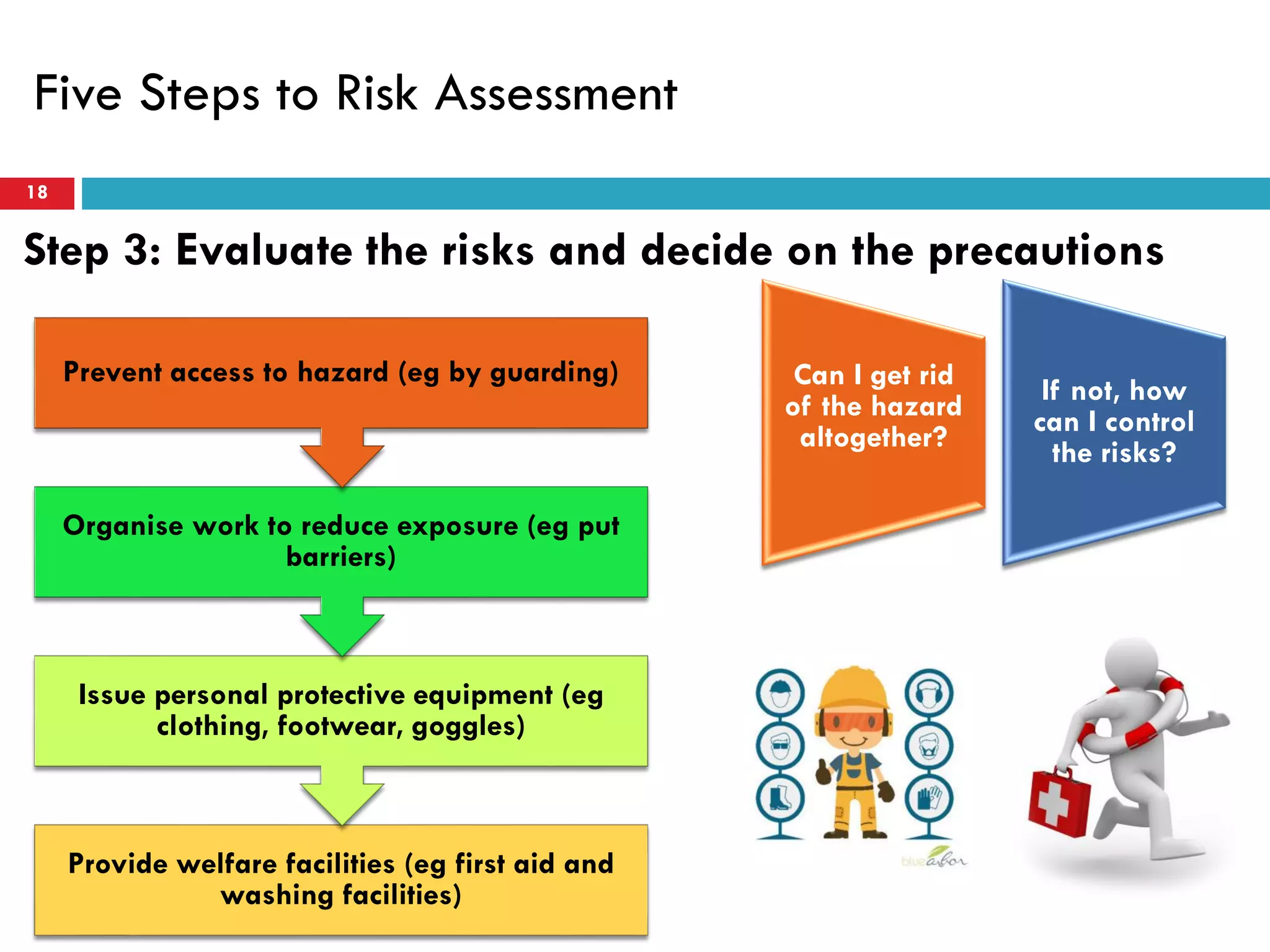
Step 3: Evaluate the risks and decide on the precautions
Can I get rid
of the hazard
altogether?
If not, how
can I control
the risks?
Provide welfare facilities (eg first aid and
washing facilities)
Issue personal protective equipment (eg
clothing, footwear, goggles)
Organise work to reduce exposure (eg put
barriers)
Prevent access to hazard (eg by guarding)
Five Steps to Risk Assessment
19
Step 4: Record the findings and put them into place
A proper check was made
You asked who might be
affected
You dealt with the obvious
significant hazards
You involved your staff/their
representatives in the process
Five Steps to Risk Assessment
20
Step 5: Review the risk assessments
Any significant
changes
Any
improvements
that still need to
be made
Have your
workers spotted
anything?
Have you learnt
from accidents?
Typical Example of Risk Assessment Process
21
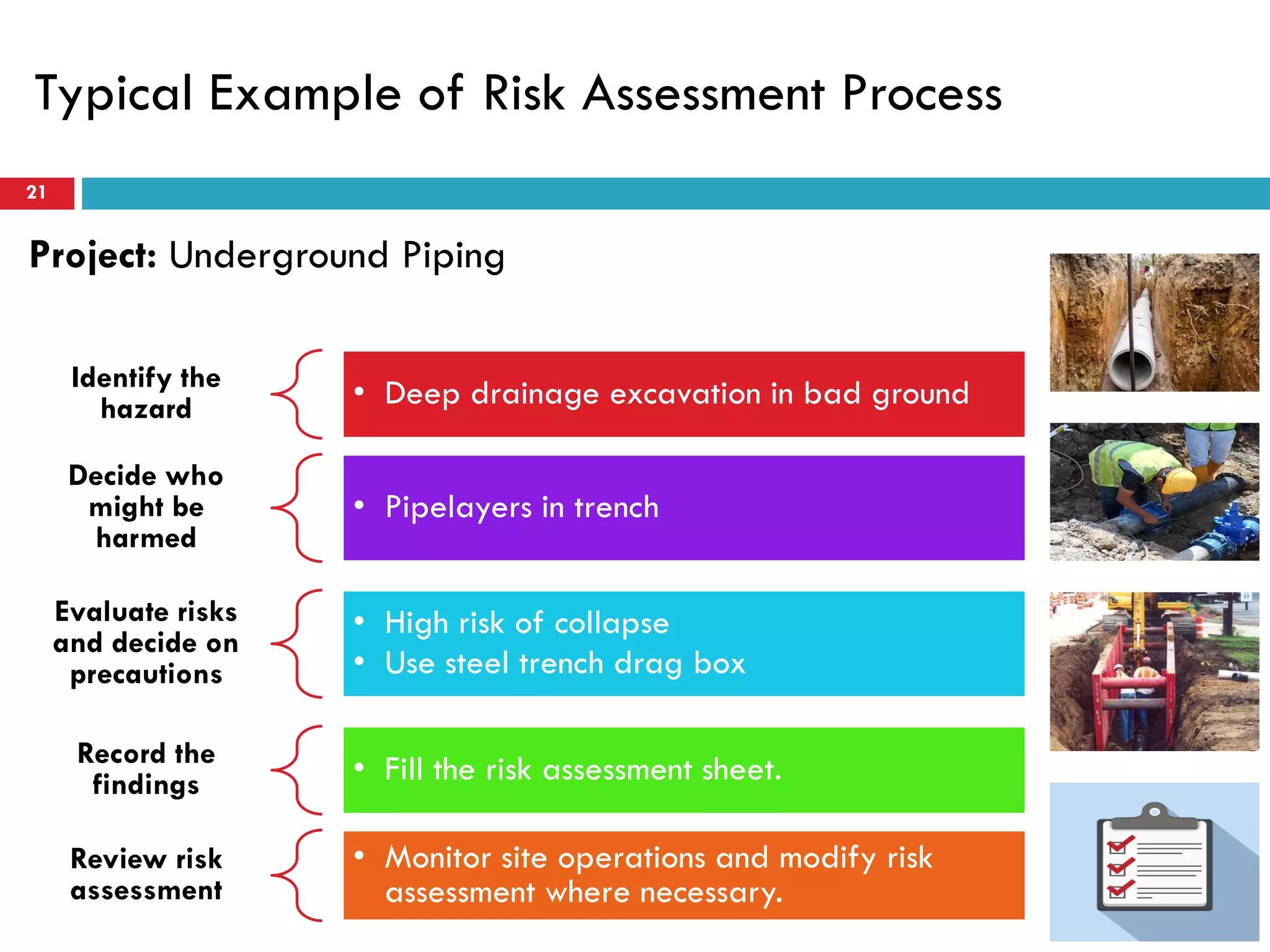
Identify the
hazard • Deep drainage excavation in bad ground
Decide who
might be
harmed
• Pipelayers in trench
Evaluate risks
and decide on
precautions
• High risk of collapse
• Use steel trench drag box
Record the
findings • Fill the risk assessment sheet.
Review risk
assessment
• Monitor site operations and modify risk
assessment where necessary.
Project: Underground Piping
Risk Management
22
Risk
Management
Definition of Risk Management
23
The practice of risk evaluation, action
recommendation, implementation and monitoring to
reduce or eliminate the risk situation
Phases of Risk Management Process
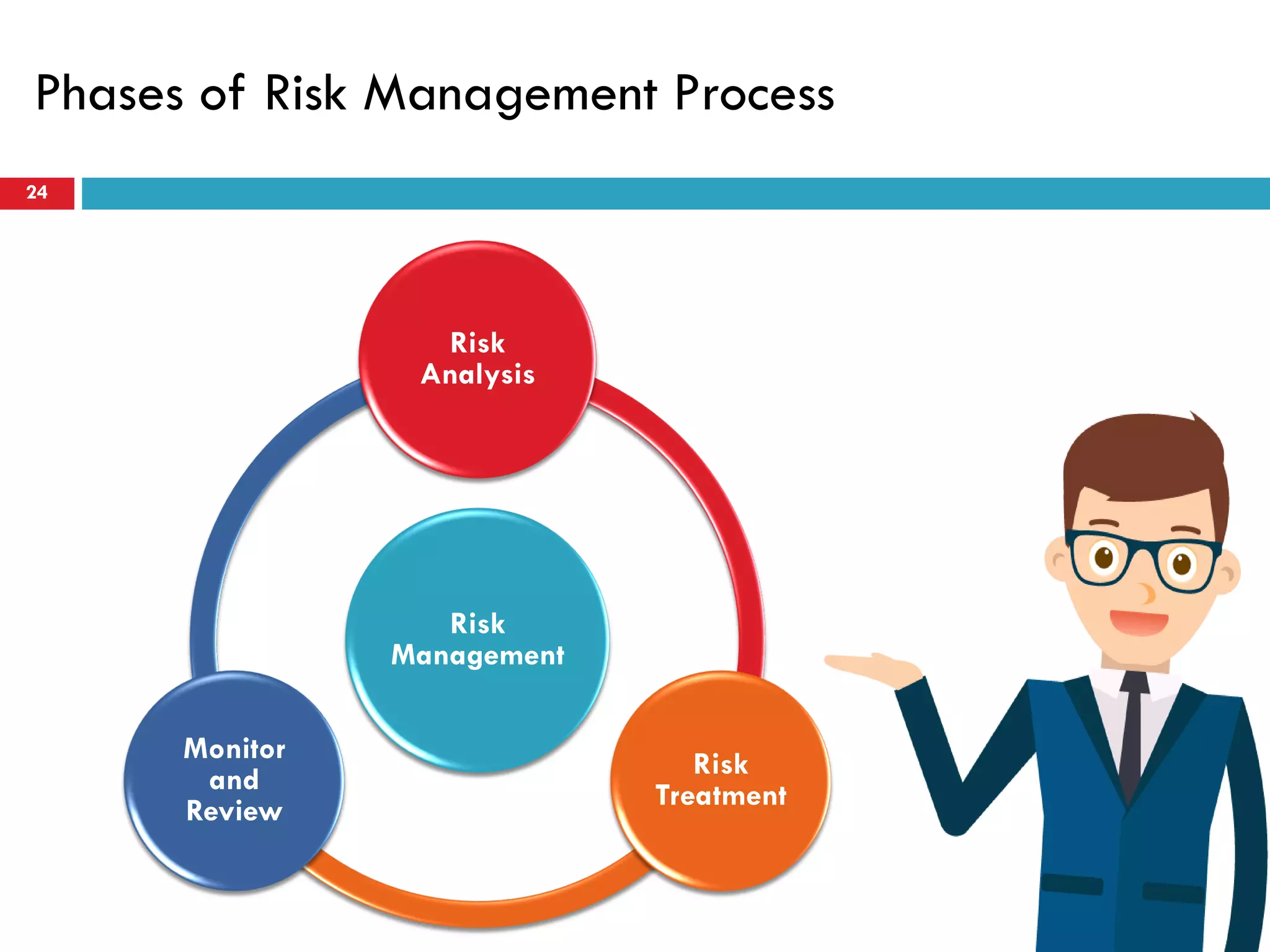
24
Risk
Management
Risk
Analysis
Risk
Treatment
Monitor
and
Review
Phases of Risk Management Process
25
Analyse inherent
risk
What is the likelihood and consequence of a risk
event if it were to occur in an uncontrolled
environment?
Identify and
evaluate controls
What existing controls are in place to address the
identified risk and how effective are these controls?
Analyse residual
risk
What is the likelihood and consequence of a risk
event if it were to occur in the current control
environment?
Phase 1: Risk analysis
Phases of Risk Management Process
26
Phase 1: Risk analysis
Risk
Condition
Action
Extreme
/ High-Risk
Serious danger. Immediate action
required in this type of risk
Medium Risk
Moderate danger. Action as soon as
possible to implement controls to
reduce the risk to as low as
reasonably practical
Low Risk
It may range from minor to negligible
danger. Assess if further action can be
taken.
Phases of Risk Management Process
27
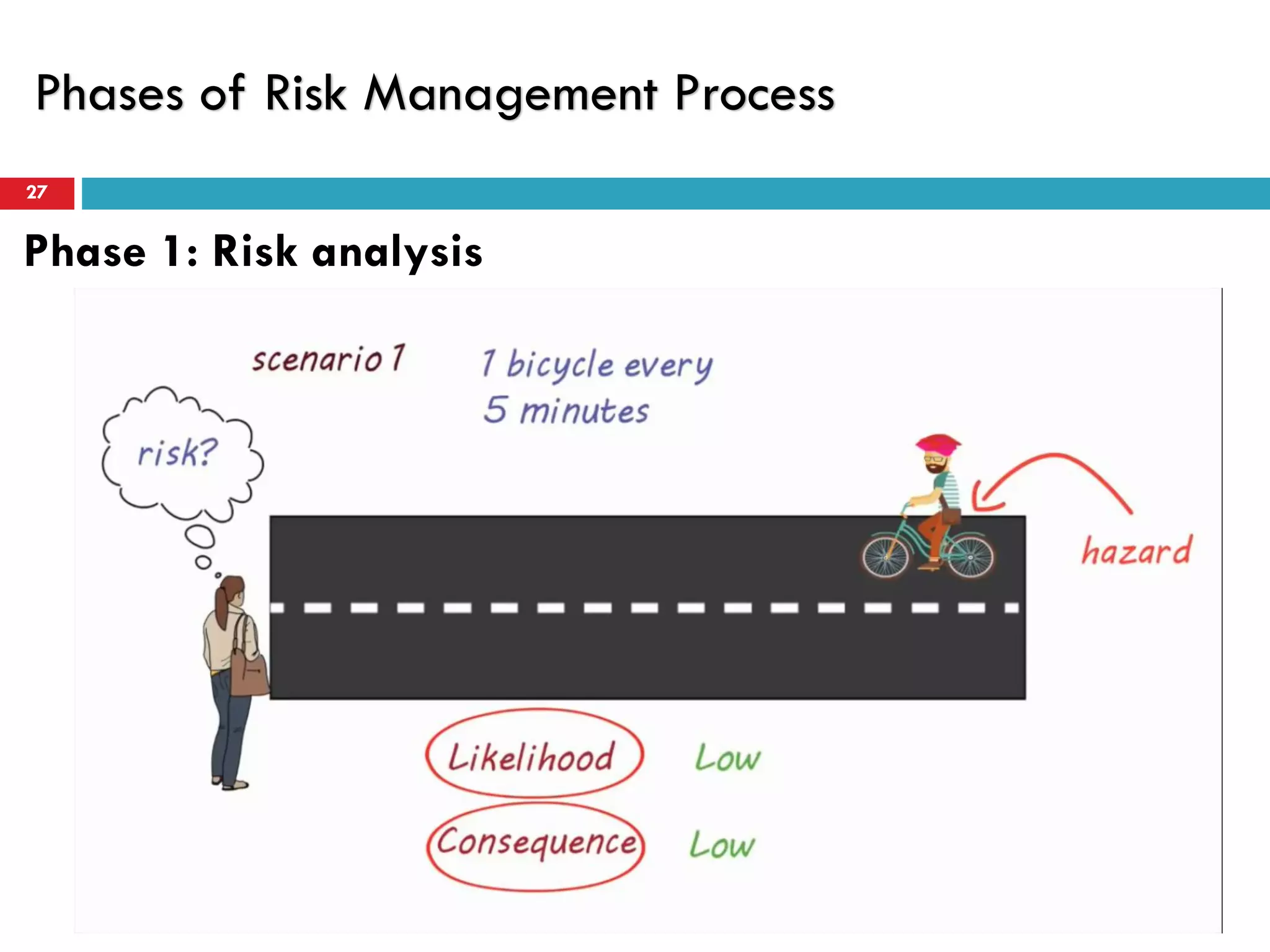
Phase 1: Risk analysis
Phases of Risk Management Process
28
Phase 1: Risk analysis
Phases of Risk Management Process
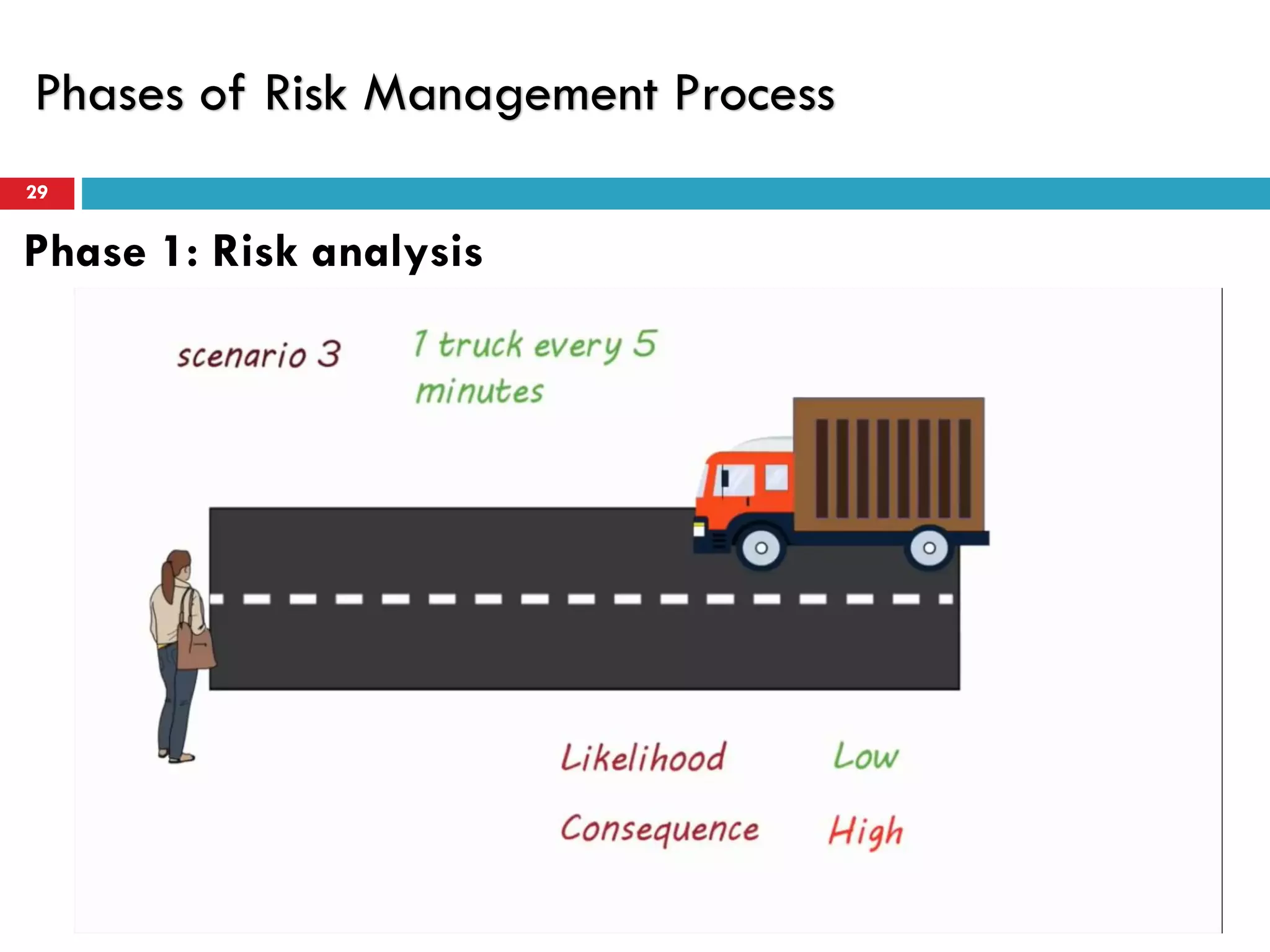
29
Phase 1: Risk analysis
Phases of Risk Management Process
30
Phase 1: Risk analysis
Phases of Risk Management Process
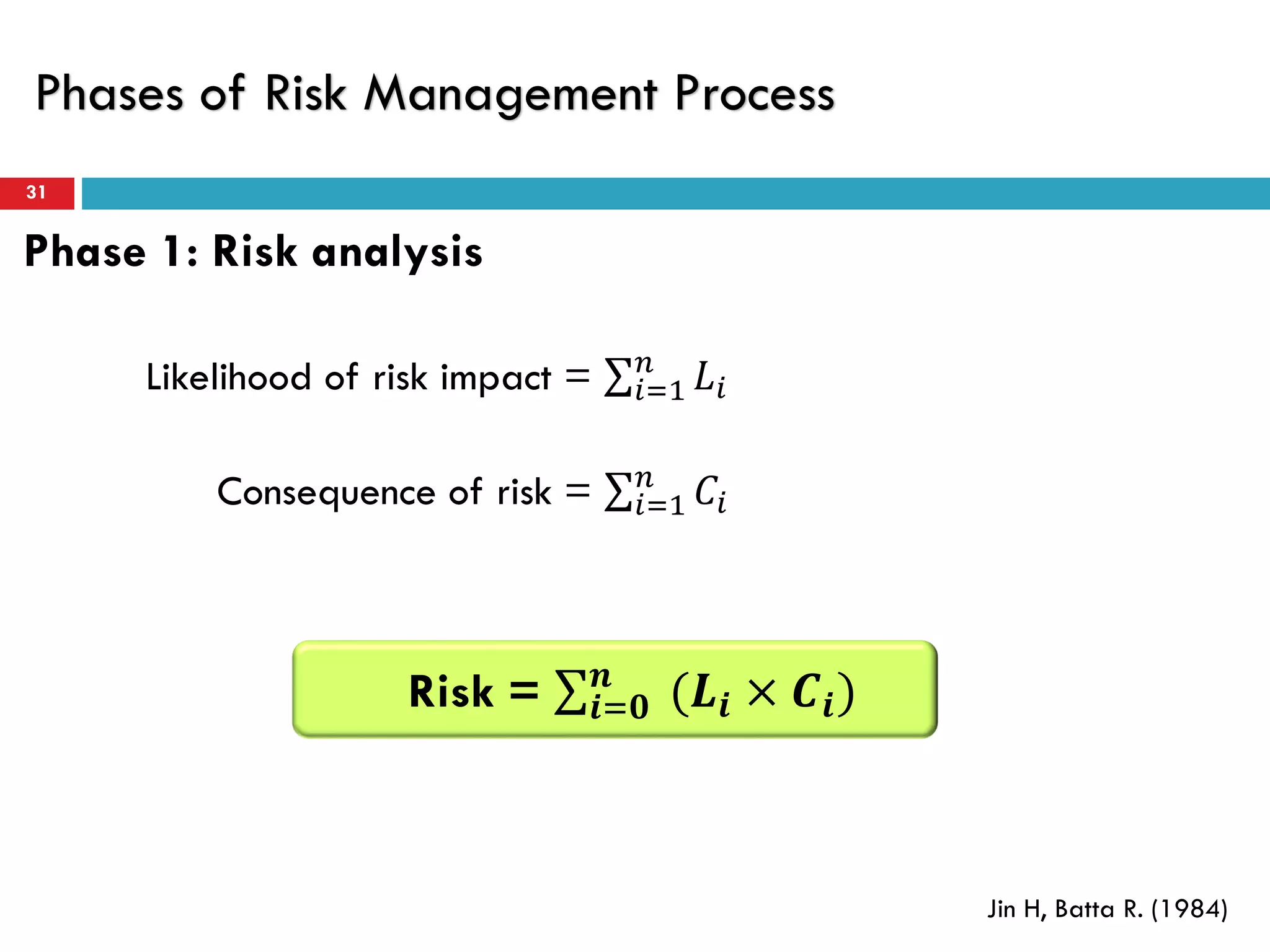
31
Phase 1: Risk analysis
Likelihood of risk impact = σ𝑖=1
𝑛
𝐿𝑖
Consequence of risk = σ𝑖=1
𝑛
𝐶𝑖
Risk = σ𝒊=𝟎
𝒏
(𝑳𝒊 × 𝑪𝒊)
Jin H, Batta R. (1984)
Phases of Risk Management Process
32
Phase 1: Risk analysis
Typical Likelihood Scale:
Level Likelihood Description
4 Very likely Happens more than once a year
3 Likely Happens about once a year
2 Unlikely Happens every 10 years or more
1 Very unlikely Has only happened once
Typical Consequence Scale:
Level Consequence Description
4 Fatality Financial losses greater than $50,000
3 Major injuries Financial losses between $10,000 and $50,000
2 Minor injuries Financial losses between $1000 and $10,000
1 Negligible injuries Financial losses less than $1000
Phases of Risk Management Process
33
Phase 2: Risk treatment
• Deciding not to proceed with the
activity that introduced the
unacceptable risk
Avoid the risk
• Implementing a strategy that is
designed to reduce the likelihood or
consequence of the risk
Reduce the risk
• Implementing a strategy that shares or
transfers the risk to another party or
parties
Share or transfer
the risk
• Making an informed decision that the
risk rating is at an acceptable level or
that the cost of the treatment is low
Accept the risk
Phases of Risk Management Process
34
Phase 3: Monitor and review
• Ensuring that controls are effective and efficient
in both design and operation
• Obtaining further information to improve risk
assessment
• Analysing and learning lessons from risk events
• Identifying emerging risks.
35
Typical Example of Risk Management Process
Project: Underground Piping
Risk Risk Analysis
Risk
Treatment
Monitoring
High risk of
collapse
Likelihood Consequence Action
Accept the
risk Regular
monitoring to
ensure the
effectivenessVery likely Major injuries High
Install steel
trench drag
box
36
Risk Management Software
nTask Resolver TimeCamp
Integrum Qualys CURA
Source: www.ntaskmanager.com
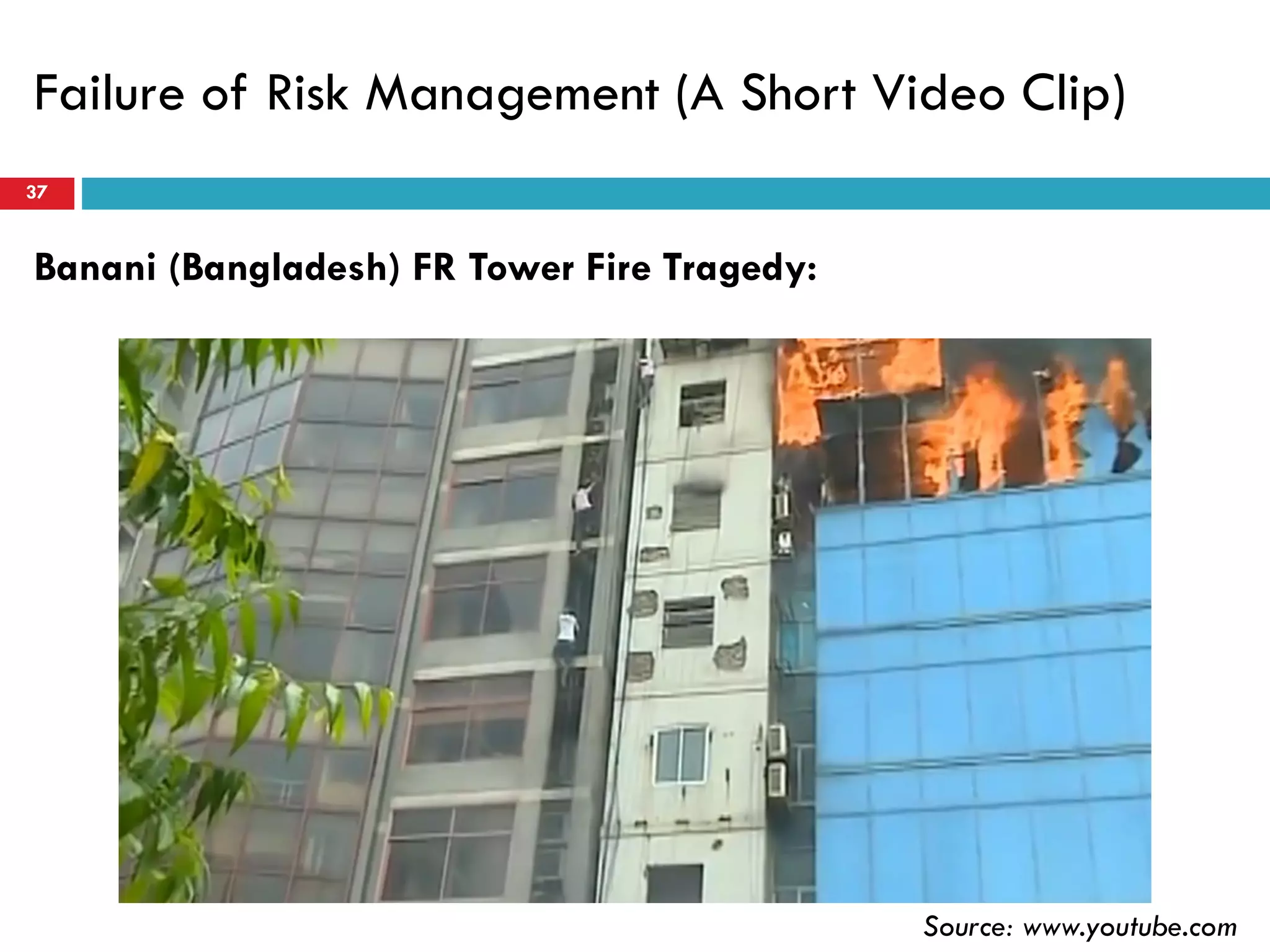
Failure of Risk Management (A Short Video Clip)
37
Banani (Bangladesh) FR Tower Fire Tragedy:
Source: www.youtube.com
Summary
38
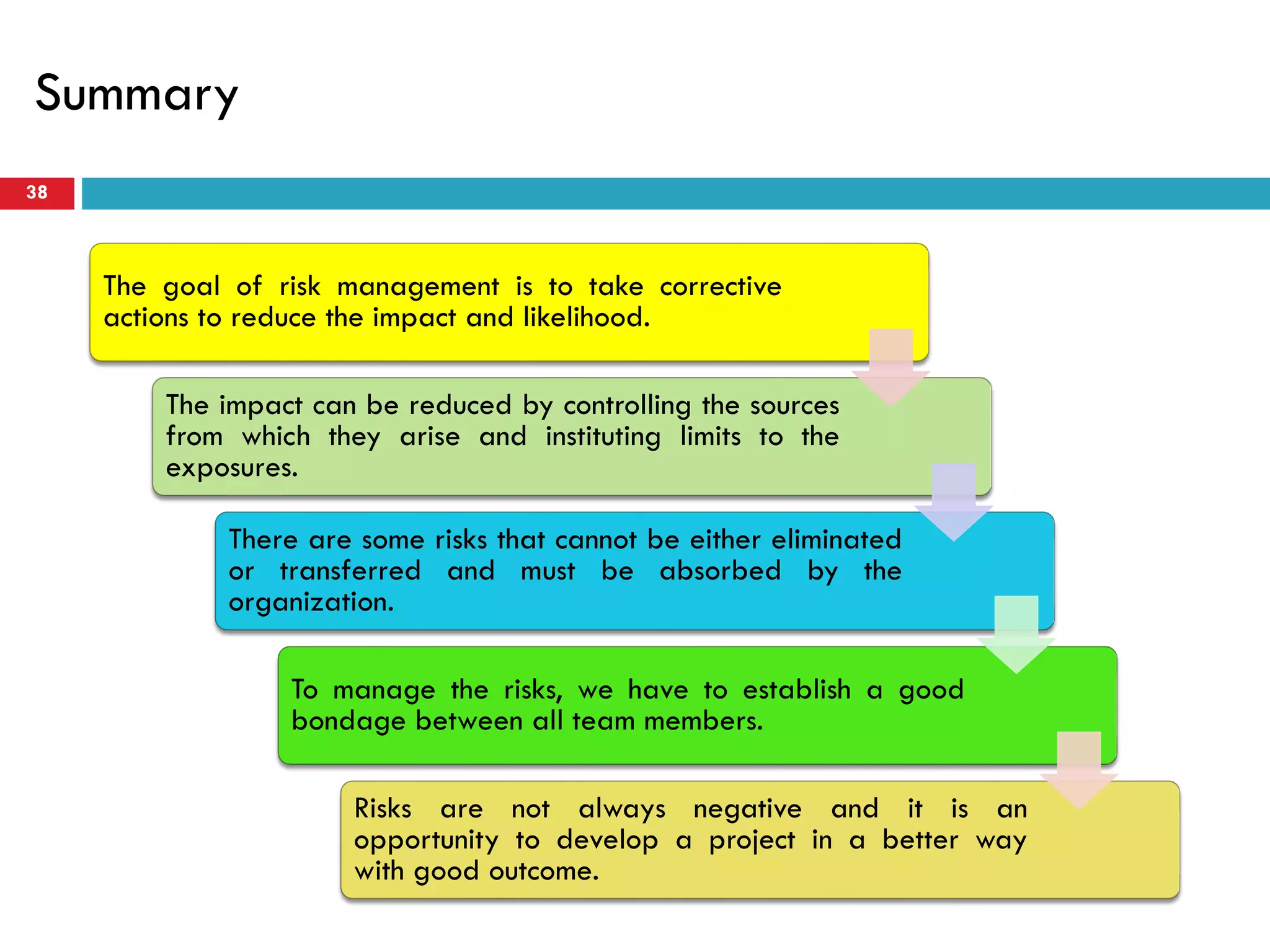
The goal of risk management is to take corrective
actions to reduce the impact and likelihood.
The impact can be reduced by controlling the sources
from which they arise and instituting limits to the
exposures.
There are some risks that cannot be either eliminated
or transferred and must be absorbed by the
organization.
To manage the risks, we have to establish a good
bondage between all team members.
Risks are not always negative and it is an
opportunity to develop a project in a better way
with good outcome.
Summary
39
Acknowledgments
40
https://www.risk.net/risk-management
https://road-asset.piarc.org/en
https://www.educba.com/risk-management-process/
https://www.nap.edu/read/25261/chapter/9
https://survey.charteredaccountantsanz.com/risk_management/smallfirms/monitor.aspx
https://www.stakeholdermap.com/risk/risk-management-construction.html
https://doi.org/10.1016/S0013-7952(01)00093-X
https://doi.org/10.1080/17499518.2017.1416643
https://doi.org/10.1088/1757-899X/392/6/062080
http://dx.doi.org/10.3846/20294913.2014.994582
https://doi.org/10.1139/t04-053
https://doi.org/10.1016/j.ejor.2015.12.023
https://www.researchgate.net/publication/283350329
https://www.researchgate.net/publication/242117931
https://www.researchgate.net/publication/237820979
41
Thank
You

Risk assessment and management

  • 1.
    Risk Assessment andManagement Tanmoy Sinha 07 June, 2019
  • 2.
    Outline 2 • Objectives ofRisk Assessment and Management • Definition of Risk • Definition of Assessment and Management • Risk Analysis Framework • Five Steps to Risk Assessment • Typical Example of Risk Assessment Process • Definition of Risk Management • Phases of Risk Management Process • Typical Example of Risk Management Process • Failure of Risk Management (A Short Video Clip) • Summary • Acknowledgments
  • 3.
    Objectives of RiskAssessment and Management: 3 Control of Risk Analysis of Risk Detection of Risk
  • 4.
    Definition of Risk 4 Whatis Risk = Likelihood × Consequence
  • 5.
    Definition of Risk 5 Whatis A chance of losses The possibility of unfortunate occurrence Occurrence of economic loss Probability of something happening that is unwanted and unavoidable without precaution
  • 6.
    Typical Example ofRisk 6 Safety risk Asset loss or damage Reputation al Risk Financial risk Risk Operational risk Environmental risk
  • 7.
    Typical Example ofRisk 7 Source: www.educba.com
  • 8.
    Typical Example ofRisk 8 Source: www.giphy.com Source: www.tenor.com
  • 9.
    Definition of Assessmentand Management 9 • Evaluation or estimation of the nature, quality, or ability of someone or something. • E.g. Risk assessment, Educational assessment Assessment • Process of dealing with or controlling things or people. • E.g. Risk management, Financial management Management
  • 10.
    Risk Analysis Framework 10 Risk Assessment Risk Management Risk Communication RiskAnalysis Framework Risk Assessment Risk Management ▪ Hazard identification ▪ Data gathering ▪ Failure probability estimation ▪ Risk determination • Risk evaluation • Action recommendation • Action implementation • Monitoring
  • 11.
    Definition of RiskAssessment 11 The overall process of hazard identification, failure estimation, data gathering and risk determination. What is Risk Assessment
  • 12.
    Five Steps toRisk Assessment 12 Identify the hazard Decide who might be harmed Evaluate the risks and decide on the precautions Record the findings and put them into place Review the risk assessment
  • 13.
    Five Steps toRisk Assessment 13 Step 1: Identify the hazard Walk around your workplace and look at what could reasonably be expected to cause harm. Ask your employees what they think. They may have noticed things that are not immediately obvious to you. Check manufacturers data sheets for chemicals and equipment as they may identify hazards. Look over accident books as they may contain information not immediately obvious to you.
  • 14.
    Five Steps toRisk Assessment 14 Step 1: Identify the hazard Late risk identification Source: quality-one.com
  • 15.
    Five Steps toRisk Assessment 15 Step 1: Identify the hazard Early risk identification Source: quality-one.com
  • 16.
    Five Steps toRisk Assessment 16 Step 1: Identify the hazard Six Dimensional Hazard Identification Source: www.ask-ehs.com
  • 17.
    Five Steps toRisk Assessment 17 Step 2: Decide who might be harmed ❖ For each hazard, you need to be clear about who might be harmed ❖ Don't just think about those carrying out the task. ❖ If the task creates dust or fumes, that could spread to other workers nearby. Consider: -The worker or operators -Adjacent workers -Visitors -Other occupants -Members of the public
  • 18.
    Five Steps toRisk Assessment 18 Step 3: Evaluate the risks and decide on the precautions Can I get rid of the hazard altogether? If not, how can I control the risks? Provide welfare facilities (eg first aid and washing facilities) Issue personal protective equipment (eg clothing, footwear, goggles) Organise work to reduce exposure (eg put barriers) Prevent access to hazard (eg by guarding)
  • 19.
    Five Steps toRisk Assessment 19 Step 4: Record the findings and put them into place A proper check was made You asked who might be affected You dealt with the obvious significant hazards You involved your staff/their representatives in the process
  • 20.
    Five Steps toRisk Assessment 20 Step 5: Review the risk assessments Any significant changes Any improvements that still need to be made Have your workers spotted anything? Have you learnt from accidents?
  • 21.
    Typical Example ofRisk Assessment Process 21 Identify the hazard • Deep drainage excavation in bad ground Decide who might be harmed • Pipelayers in trench Evaluate risks and decide on precautions • High risk of collapse • Use steel trench drag box Record the findings • Fill the risk assessment sheet. Review risk assessment • Monitor site operations and modify risk assessment where necessary. Project: Underground Piping
  • 22.
  • 23.
    Definition of RiskManagement 23 The practice of risk evaluation, action recommendation, implementation and monitoring to reduce or eliminate the risk situation
  • 24.
    Phases of RiskManagement Process 24 Risk Management Risk Analysis Risk Treatment Monitor and Review
  • 25.
    Phases of RiskManagement Process 25 Analyse inherent risk What is the likelihood and consequence of a risk event if it were to occur in an uncontrolled environment? Identify and evaluate controls What existing controls are in place to address the identified risk and how effective are these controls? Analyse residual risk What is the likelihood and consequence of a risk event if it were to occur in the current control environment? Phase 1: Risk analysis
  • 26.
    Phases of RiskManagement Process 26 Phase 1: Risk analysis Risk Condition Action Extreme / High-Risk Serious danger. Immediate action required in this type of risk Medium Risk Moderate danger. Action as soon as possible to implement controls to reduce the risk to as low as reasonably practical Low Risk It may range from minor to negligible danger. Assess if further action can be taken.
  • 27.
    Phases of RiskManagement Process 27 Phase 1: Risk analysis
  • 28.
    Phases of RiskManagement Process 28 Phase 1: Risk analysis
  • 29.
    Phases of RiskManagement Process 29 Phase 1: Risk analysis
  • 30.
    Phases of RiskManagement Process 30 Phase 1: Risk analysis
  • 31.
    Phases of RiskManagement Process 31 Phase 1: Risk analysis Likelihood of risk impact = σ𝑖=1 𝑛 𝐿𝑖 Consequence of risk = σ𝑖=1 𝑛 𝐶𝑖 Risk = σ𝒊=𝟎 𝒏 (𝑳𝒊 × 𝑪𝒊) Jin H, Batta R. (1984)
  • 32.
    Phases of RiskManagement Process 32 Phase 1: Risk analysis Typical Likelihood Scale: Level Likelihood Description 4 Very likely Happens more than once a year 3 Likely Happens about once a year 2 Unlikely Happens every 10 years or more 1 Very unlikely Has only happened once Typical Consequence Scale: Level Consequence Description 4 Fatality Financial losses greater than $50,000 3 Major injuries Financial losses between $10,000 and $50,000 2 Minor injuries Financial losses between $1000 and $10,000 1 Negligible injuries Financial losses less than $1000
  • 33.
    Phases of RiskManagement Process 33 Phase 2: Risk treatment • Deciding not to proceed with the activity that introduced the unacceptable risk Avoid the risk • Implementing a strategy that is designed to reduce the likelihood or consequence of the risk Reduce the risk • Implementing a strategy that shares or transfers the risk to another party or parties Share or transfer the risk • Making an informed decision that the risk rating is at an acceptable level or that the cost of the treatment is low Accept the risk
  • 34.
    Phases of RiskManagement Process 34 Phase 3: Monitor and review • Ensuring that controls are effective and efficient in both design and operation • Obtaining further information to improve risk assessment • Analysing and learning lessons from risk events • Identifying emerging risks.
  • 35.
    35 Typical Example ofRisk Management Process Project: Underground Piping Risk Risk Analysis Risk Treatment Monitoring High risk of collapse Likelihood Consequence Action Accept the risk Regular monitoring to ensure the effectivenessVery likely Major injuries High Install steel trench drag box
  • 36.
    36 Risk Management Software nTaskResolver TimeCamp Integrum Qualys CURA Source: www.ntaskmanager.com
  • 37.
    Failure of RiskManagement (A Short Video Clip) 37 Banani (Bangladesh) FR Tower Fire Tragedy: Source: www.youtube.com
  • 38.
    Summary 38 The goal ofrisk management is to take corrective actions to reduce the impact and likelihood. The impact can be reduced by controlling the sources from which they arise and instituting limits to the exposures. There are some risks that cannot be either eliminated or transferred and must be absorbed by the organization. To manage the risks, we have to establish a good bondage between all team members. Risks are not always negative and it is an opportunity to develop a project in a better way with good outcome.
  • 39.
  • 40.
  • 41.