Risk Assessment
Introduction for Stonemasons
Stonemasonry Department 2012
Introduction
The contents of this presentation
have been taken from the HSE
publication “Five Steps to Risk
Assessment” and have been
contextualised for those working in
the stonemasonry industry.
To access the original document visit
the following website:
http://www.hse.gov.uk/pubns/ind
g163.pdf
Hazard or Risk?
Before considering risk assessments it is important to be able to
identify the difference between a hazard and a risk.
A hazard is anything that may cause harm such as chemicals,
electricity, working from height or machinery
A risk is the chance, high or low that someone could be harmed by a
hazard together with an indication of how serious the harm
could be.
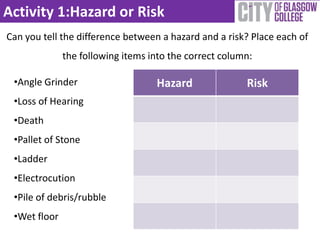
Activity 1:Hazard or Risk
Can you tell the difference between a hazard and a risk? Place each of
the following items into the correct column:
Hazard Risk•Angle Grinder
•Loss of Hearing
•Death
•Pallet of Stone
•Ladder
•Electrocution
•Pile of debris/rubble
•Wet floor
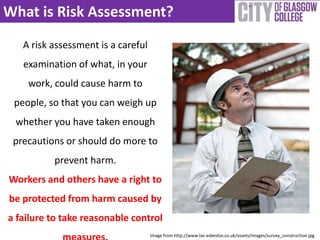
What is Risk Assessment?
A risk assessment is a careful
examination of what, in your
work, could cause harm to
people, so that you can weigh up
whether you have taken enough
precautions or should do more to
prevent harm.
Workers and others have a right to
be protected from harm caused by
a failure to take reasonable control
Image from http://www.las-asbestos.co.uk/assets/images/survey_construction.jpg
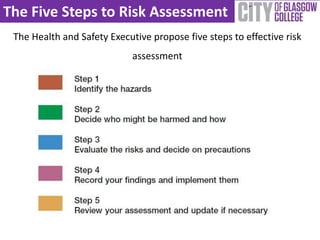
The Five Steps to Risk Assessment
The Health and Safety Executive propose five steps to effective risk
assessment
Identify the Hazards
The first step is to identify the hazards. There are a number of ways
you can do this. Can you think of any?
•Walk around your workplace and look at what could cause harm.
•Ask your employees or co-workers what they think. They may have noticed things
you haven’t thought about.
•Visit the HSE website or visit stonemasonry related websites, trade
associations, forums and magazines to gather further information.
•Check manufacturers data sheets for chemicals and equipment as they may
identify hazards
•Look over accident books as they may contain information not immediately
obvious to you
Activity 2: Hazards
As a stonemason you can expect to be exposed to a
number of hazards on a daily basis. Spend five minutes
discussing what hazards you have seen whilst on site or
in the workshop.
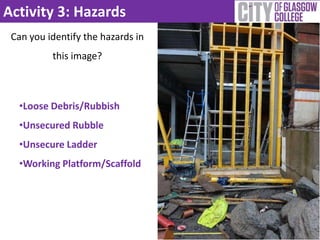
Activity 3: Hazards
Can you identify the hazards in
this image?
•Loose Debris/Rubbish
•Unsecured Rubble
•Unsecure Ladder
•Working Platform/Scaffold
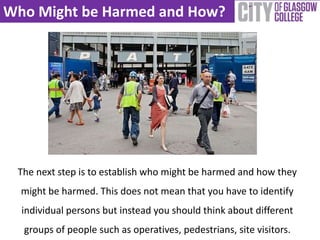
Who Might be Harmed and How?
The next step is to establish who might be harmed and how they
might be harmed. This does not mean that you have to identify
individual persons but instead you should think about different
groups of people such as operatives, pedestrians, site visitors.
Evaluate and Establish Precautions
Ask yourself if you can get rid of the hazard altogether? If not, how can you
control the risks so that harm is unlikely?
try a less risky option
prevent access to the hazard
organise work to reduce exposure to the hazard
issue personal protective equipment
provide welfare facilities
Improving health and safety need not cost a lot. For instance, placing a padlock
on the power source for a primary cutting saw is a low-cost precaution
considering the risks. Failure to take simple precautions can cost you a lot more
if an accident does happen.
Record Your Findings
Risk assessments are not expected to be perfect. HSE accepts that
unforeseen accidents can and do occur and are very difficult to plan
for. Provided you can prove that you have done the following, you
have met your responsibilities regarding risk assessment.
you asked who might be affected
you dealt with all the significant hazards, taking into account the
number of people who could be involved
the precautions you have suggested are reasonable, and the
remaining risk is low
you involved your staff or their representatives in the process.
Review Your Findings
Few workplaces stay the same. Sooner or later, you will bring in new
equipment, substances and procedures that could lead to new
hazards. It makes sense, therefore, to review what you are doing on
an ongoing basis. Every year or so formally review where you are, to
make sure you are still improving, or at least not sliding back. Look at
your risk assessment again. Have there been any changes? Are there
improvements you still need to make? Have your workers spotted a
problem? Have you learnt anything from accidents or near misses?
Make sure your risk assessment stays up to date.
Activity 4: Risk Assessment
Your course tutor will now provide you with a blank risk assessment
for which you are expected to complete for cutting stone. Your
completed risk assessment should be submitted to your course
tutor within three days of this presentation.
Developed by The Stonemasonry Department
City of Glasgow College
2012

Risk assessment

  • 1.
    Risk Assessment Introduction forStonemasons Stonemasonry Department 2012
  • 2.
    Introduction The contents ofthis presentation have been taken from the HSE publication “Five Steps to Risk Assessment” and have been contextualised for those working in the stonemasonry industry. To access the original document visit the following website: http://www.hse.gov.uk/pubns/ind g163.pdf
  • 3.
    Hazard or Risk? Beforeconsidering risk assessments it is important to be able to identify the difference between a hazard and a risk. A hazard is anything that may cause harm such as chemicals, electricity, working from height or machinery A risk is the chance, high or low that someone could be harmed by a hazard together with an indication of how serious the harm could be.
  • 4.
    Activity 1:Hazard orRisk Can you tell the difference between a hazard and a risk? Place each of the following items into the correct column: Hazard Risk•Angle Grinder •Loss of Hearing •Death •Pallet of Stone •Ladder •Electrocution •Pile of debris/rubble •Wet floor
  • 5.
    What is RiskAssessment? A risk assessment is a careful examination of what, in your work, could cause harm to people, so that you can weigh up whether you have taken enough precautions or should do more to prevent harm. Workers and others have a right to be protected from harm caused by a failure to take reasonable control Image from http://www.las-asbestos.co.uk/assets/images/survey_construction.jpg
  • 6.
    The Five Stepsto Risk Assessment The Health and Safety Executive propose five steps to effective risk assessment
  • 7.
    Identify the Hazards Thefirst step is to identify the hazards. There are a number of ways you can do this. Can you think of any? •Walk around your workplace and look at what could cause harm. •Ask your employees or co-workers what they think. They may have noticed things you haven’t thought about. •Visit the HSE website or visit stonemasonry related websites, trade associations, forums and magazines to gather further information. •Check manufacturers data sheets for chemicals and equipment as they may identify hazards •Look over accident books as they may contain information not immediately obvious to you
  • 8.
    Activity 2: Hazards Asa stonemason you can expect to be exposed to a number of hazards on a daily basis. Spend five minutes discussing what hazards you have seen whilst on site or in the workshop.
  • 9.
    Activity 3: Hazards Canyou identify the hazards in this image? •Loose Debris/Rubbish •Unsecured Rubble •Unsecure Ladder •Working Platform/Scaffold
  • 10.
    Who Might beHarmed and How? The next step is to establish who might be harmed and how they might be harmed. This does not mean that you have to identify individual persons but instead you should think about different groups of people such as operatives, pedestrians, site visitors.
  • 11.
    Evaluate and EstablishPrecautions Ask yourself if you can get rid of the hazard altogether? If not, how can you control the risks so that harm is unlikely? try a less risky option prevent access to the hazard organise work to reduce exposure to the hazard issue personal protective equipment provide welfare facilities Improving health and safety need not cost a lot. For instance, placing a padlock on the power source for a primary cutting saw is a low-cost precaution considering the risks. Failure to take simple precautions can cost you a lot more if an accident does happen.
  • 12.
    Record Your Findings Riskassessments are not expected to be perfect. HSE accepts that unforeseen accidents can and do occur and are very difficult to plan for. Provided you can prove that you have done the following, you have met your responsibilities regarding risk assessment. you asked who might be affected you dealt with all the significant hazards, taking into account the number of people who could be involved the precautions you have suggested are reasonable, and the remaining risk is low you involved your staff or their representatives in the process.
  • 13.
    Review Your Findings Fewworkplaces stay the same. Sooner or later, you will bring in new equipment, substances and procedures that could lead to new hazards. It makes sense, therefore, to review what you are doing on an ongoing basis. Every year or so formally review where you are, to make sure you are still improving, or at least not sliding back. Look at your risk assessment again. Have there been any changes? Are there improvements you still need to make? Have your workers spotted a problem? Have you learnt anything from accidents or near misses? Make sure your risk assessment stays up to date.
  • 14.
    Activity 4: RiskAssessment Your course tutor will now provide you with a blank risk assessment for which you are expected to complete for cutting stone. Your completed risk assessment should be submitted to your course tutor within three days of this presentation.
  • 15.
    Developed by TheStonemasonry Department City of Glasgow College 2012