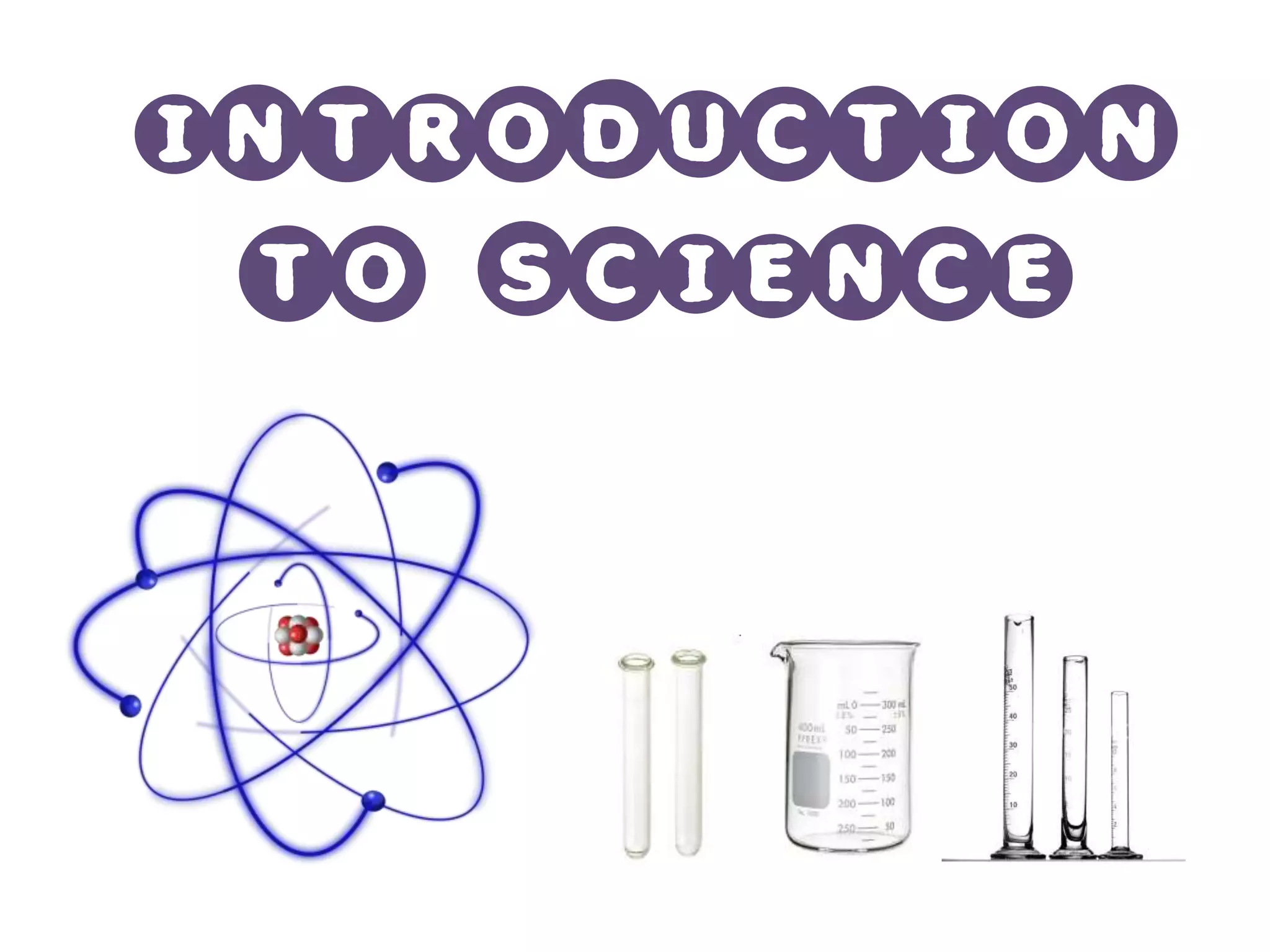

INTRODUCTION
 TO SCIENCE
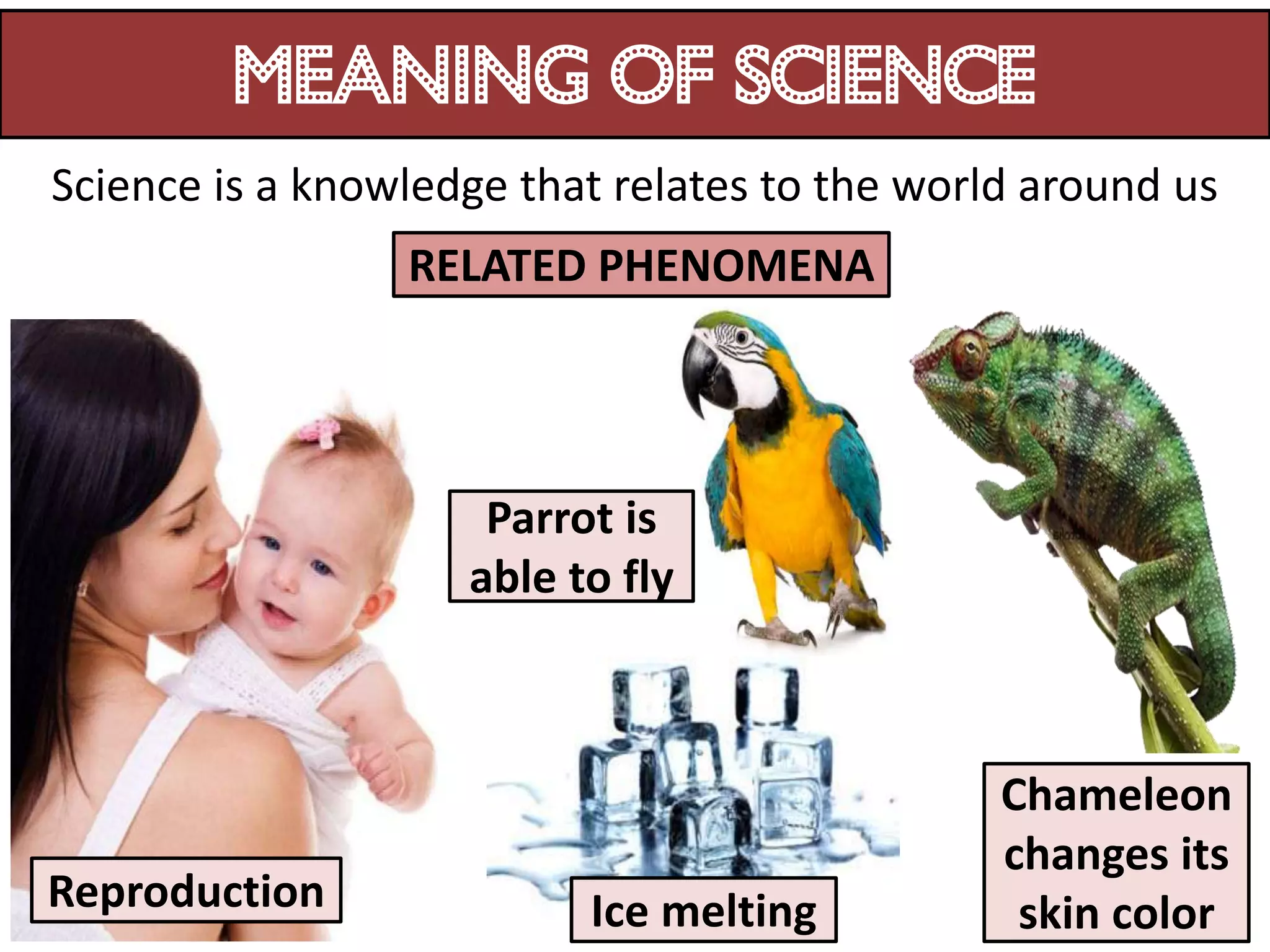
MEANING OF science
Science is a knowledge that relates to the world around us
                 RELATED PHENOMENA


                     Parrot is
                    able to fly


                                               Chameleon
                                               changes its
Reproduction              Ice melting           skin color
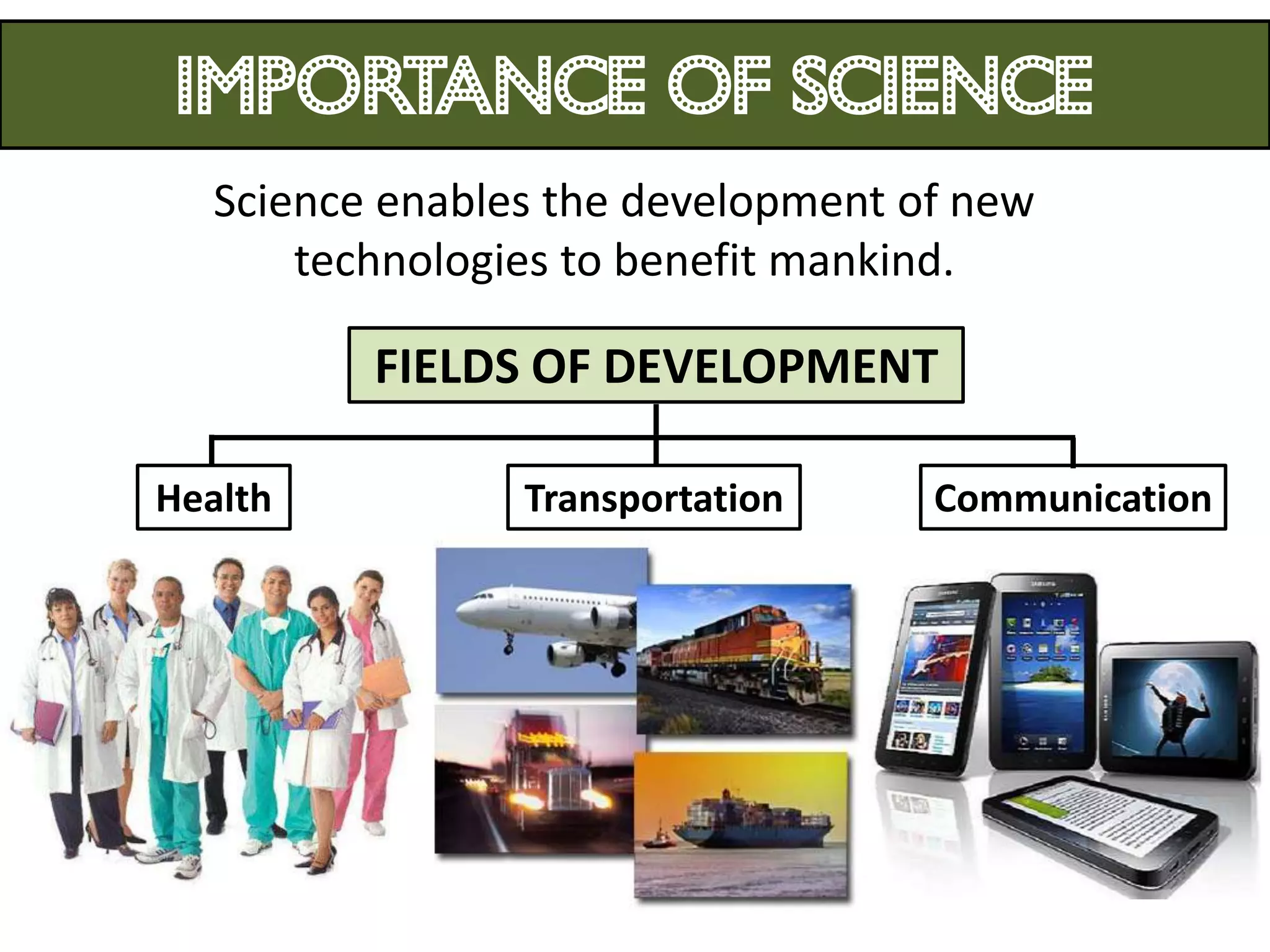
Importance of science
  Science enables the development of new
      technologies to benefit mankind.

         FIELDS OF DEVELOPMENT

Health          Transportation     Communication
Career in the science field
                   Scientists


          Nurses


Doctors                         Engineers
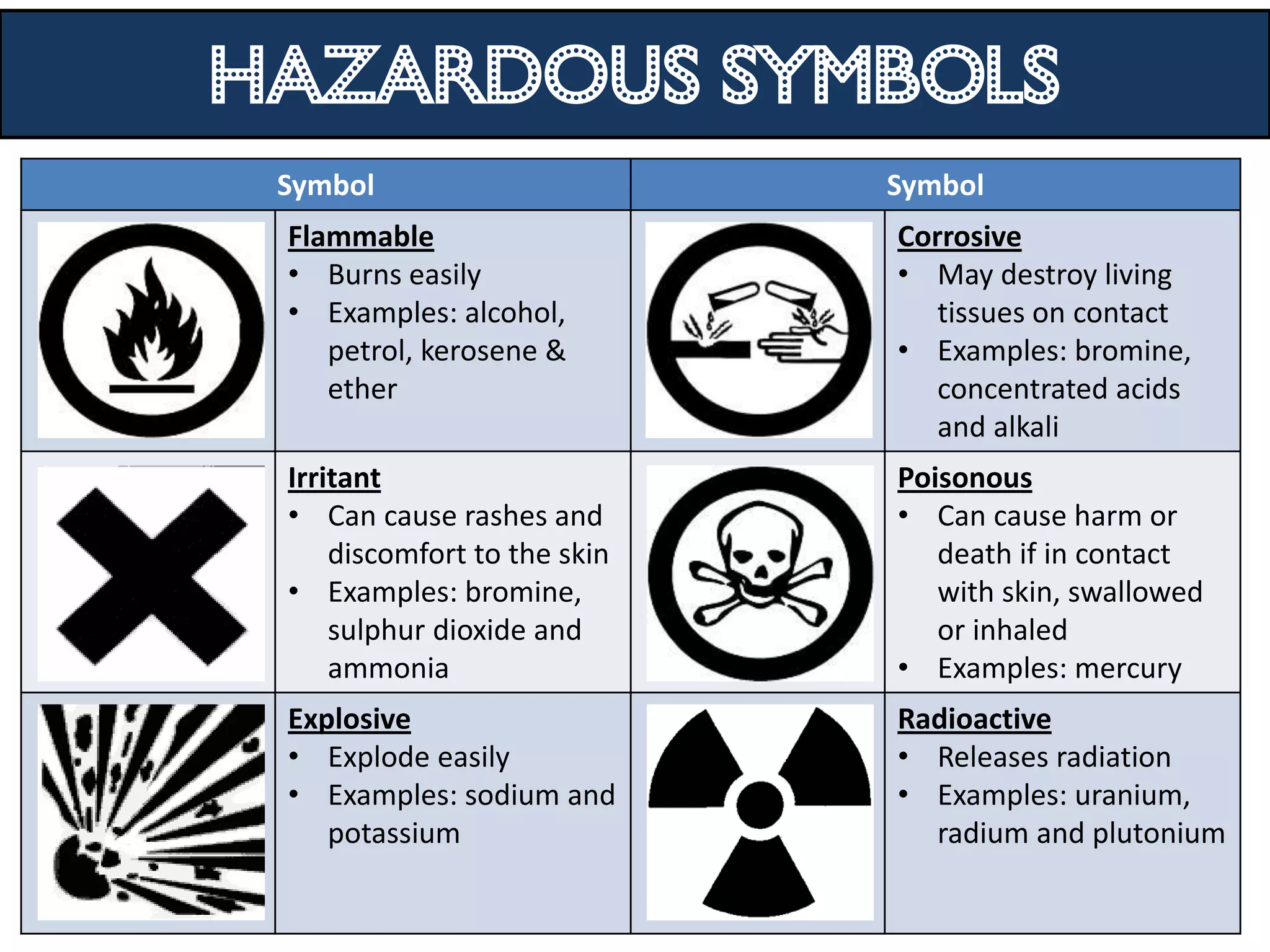
HAZARDOUS symbols
 Symbol                       Symbol
 Flammable                    Corrosive
 • Burns easily               • May destroy living
 • Examples: alcohol,            tissues on contact
    petrol, kerosene &        • Examples: bromine,
    ether                        concentrated acids
                                 and alkali
 Irritant                     Poisonous
 • Can cause rashes and       • Can cause harm or
     discomfort to the skin      death if in contact
 • Examples: bromine,            with skin, swallowed
     sulphur dioxide and         or inhaled
     ammonia                  • Examples: mercury
 Explosive                    Radioactive
 • Explode easily             • Releases radiation
 • Examples: sodium and       • Examples: uranium,
    potassium                   radium and plutonium
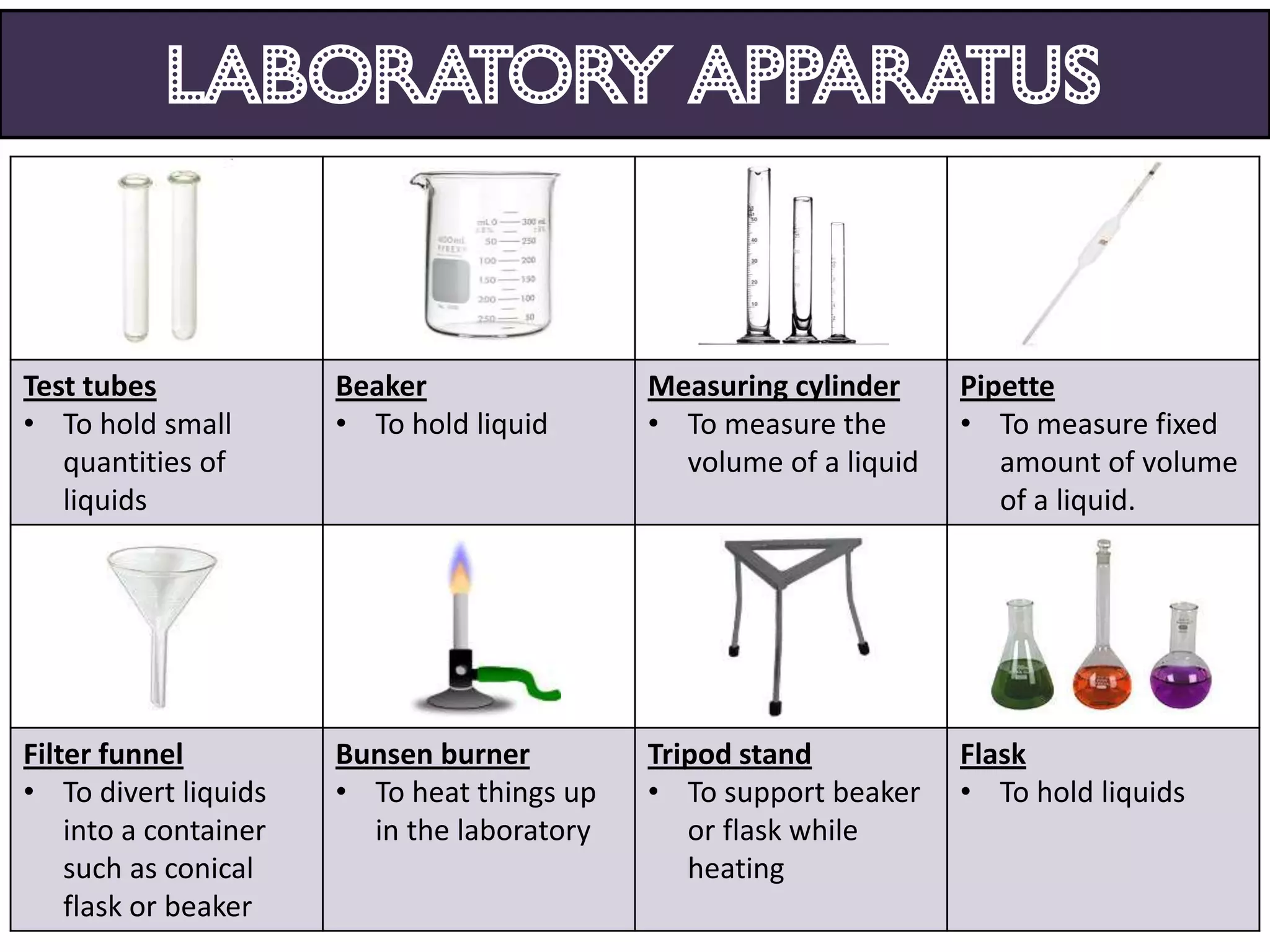
Laboratory apparatus


Test tubes             Beaker                Measuring cylinder     Pipette
• To hold small        • To hold liquid      • To measure the       • To measure fixed
   quantities of                               volume of a liquid      amount of volume
   liquids                                                             of a liquid.


Filter funnel          Bunsen burner         Tripod stand           Flask
• To divert liquids    • To heat things up   • To support beaker    • To hold liquids
    into a container     in the laboratory      or flask while
    such as conical                             heating
    flask or beaker
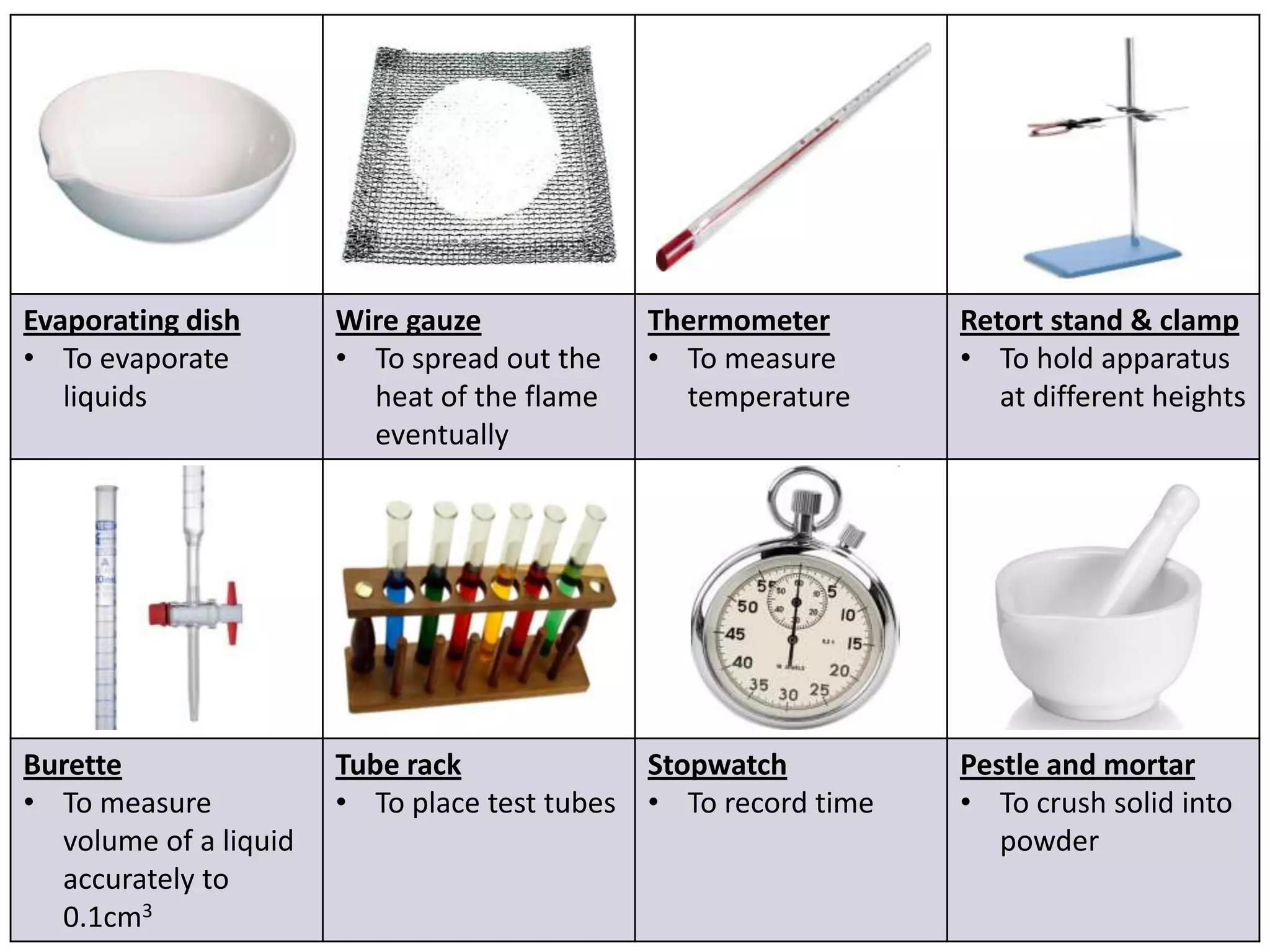
Evaporating dish       Wire gauze            Thermometer        Retort stand & clamp
• To evaporate         • To spread out the   • To measure       • To hold apparatus
   liquids               heat of the flame     temperature         at different heights
                         eventually


Burette                Tube rack             Stopwatch          Pestle and mortar
• To measure           • To place test tubes • To record time   • To crush solid into
  volume of a liquid                                               powder
  accurately to
  0.1cm3
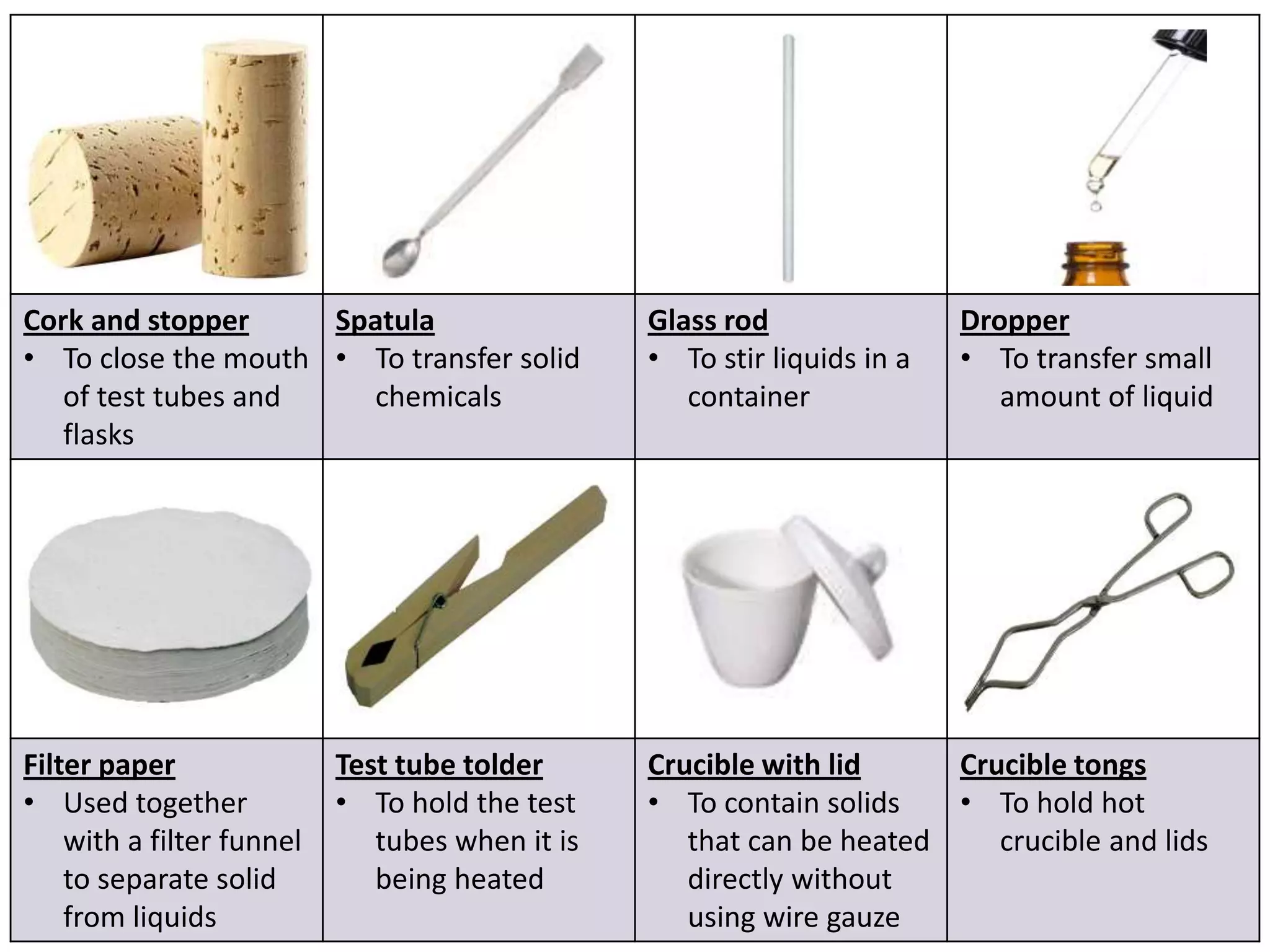
Cork and stopper     Spatula                     Glass rod                Dropper
• To close the mouth • To transfer solid         • To stir liquids in a   • To transfer small
   of test tubes and   chemicals                    container                amount of liquid
   flasks


Filter paper               Test tube tolder      Crucible with lid     Crucible tongs
• Used together            • To hold the test    • To contain solids   • To hold hot
    with a filter funnel      tubes when it is      that can be heated    crucible and lids
    to separate solid         being heated          directly without
    from liquids                                    using wire gauze
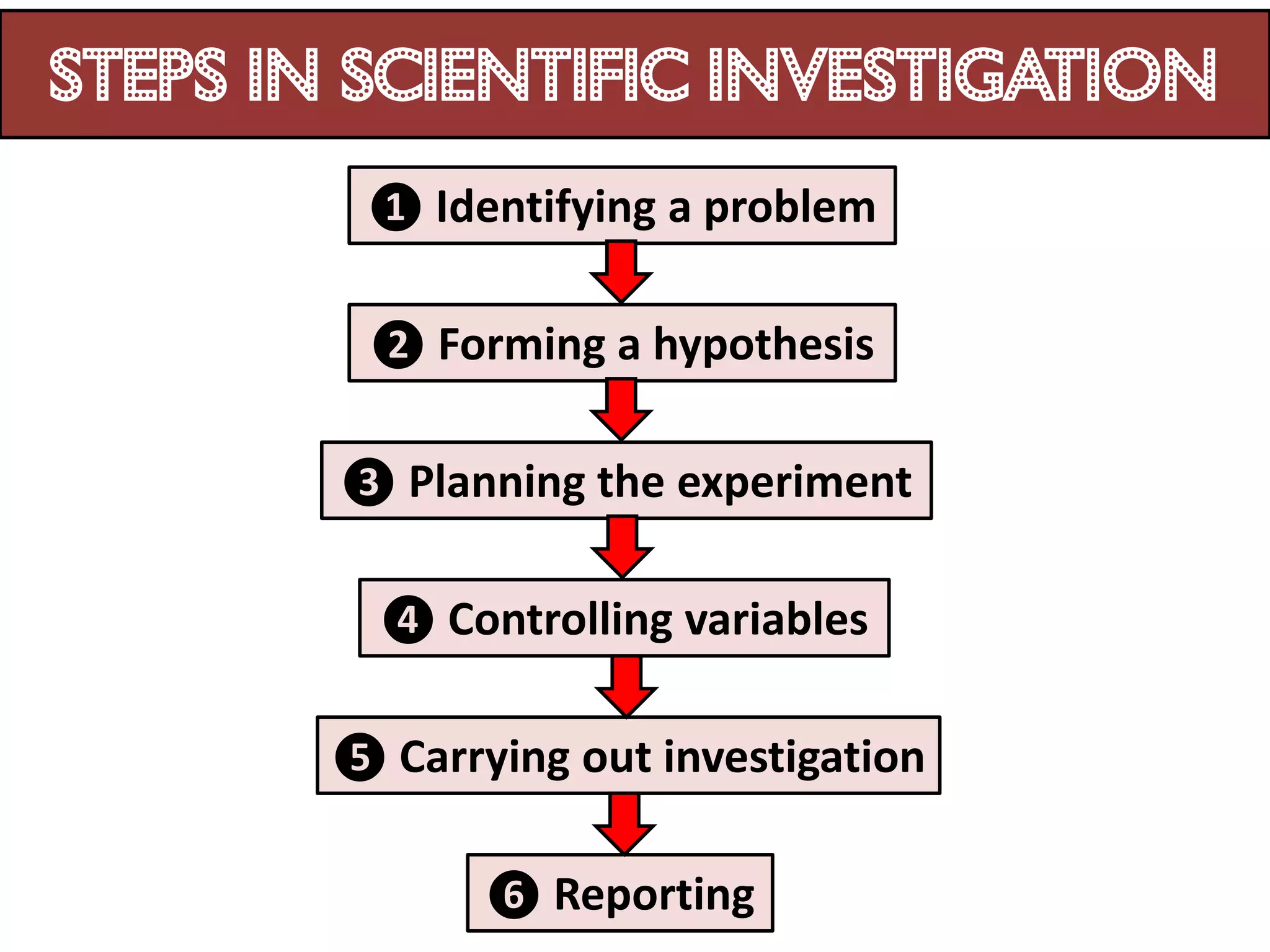
Steps in scientific investigation
         ❶ Identifying a problem


         ❷ Forming a hypothesis


        ❸ Planning the experiment


         ❹ Controlling variables


       ❺ Carrying out investigation


              ❻ Reporting
❶ Identifying a problem

• Arise from a desire to know what happens in our
  surroundings.
• Examples:
   - Why do birds fly but not ostrich?
   - Why do cactus able to grow on a deserted land
     with no water available?

            ❷ Forming a     hypothesis
• A hypothesis is an early idea or explanation for the
  phenomena that we observe.
• A hypothesis can only be accepted or proven true
  after going through experiments. If the hypothesis
  is not true, a new hypothesis has to be formed.
❸ Planning the experiment

• A list of material and apparatus required and the
  way they should be carry out are made before an
  experiment can begin.
• Moreover, we need to determine the way to
  collect, analyze and interpret the data obtained
  from the experiments.
❹ Controlling variables

• Variables are situations and factors that are controlled
  and change in an investigation.
• Types of variables:
  (a) A variable that is kept constant
       - variables that are kept constant or fixed
  (b) A variable that is manipulated (changed)
       - variables that are used to test the hypothesis
  (c) A variable that responds
       - results are collected from the variables that are
         changed when testing a hypothesis
❺ Carrying out    investigation
• Steps that are to be followed:
  (1) Collecting data
       - all data are observed and measured accurately
  (2) Analyzing and interpreting data
       - the data is then presented in a table or chart
       - interpretation is made from the table or chart
  (3) Making conclusions
       - an accurate statement to describe the problems
         identified throughout the experiment
       - determine whether to accept or reject the
         hypothesis
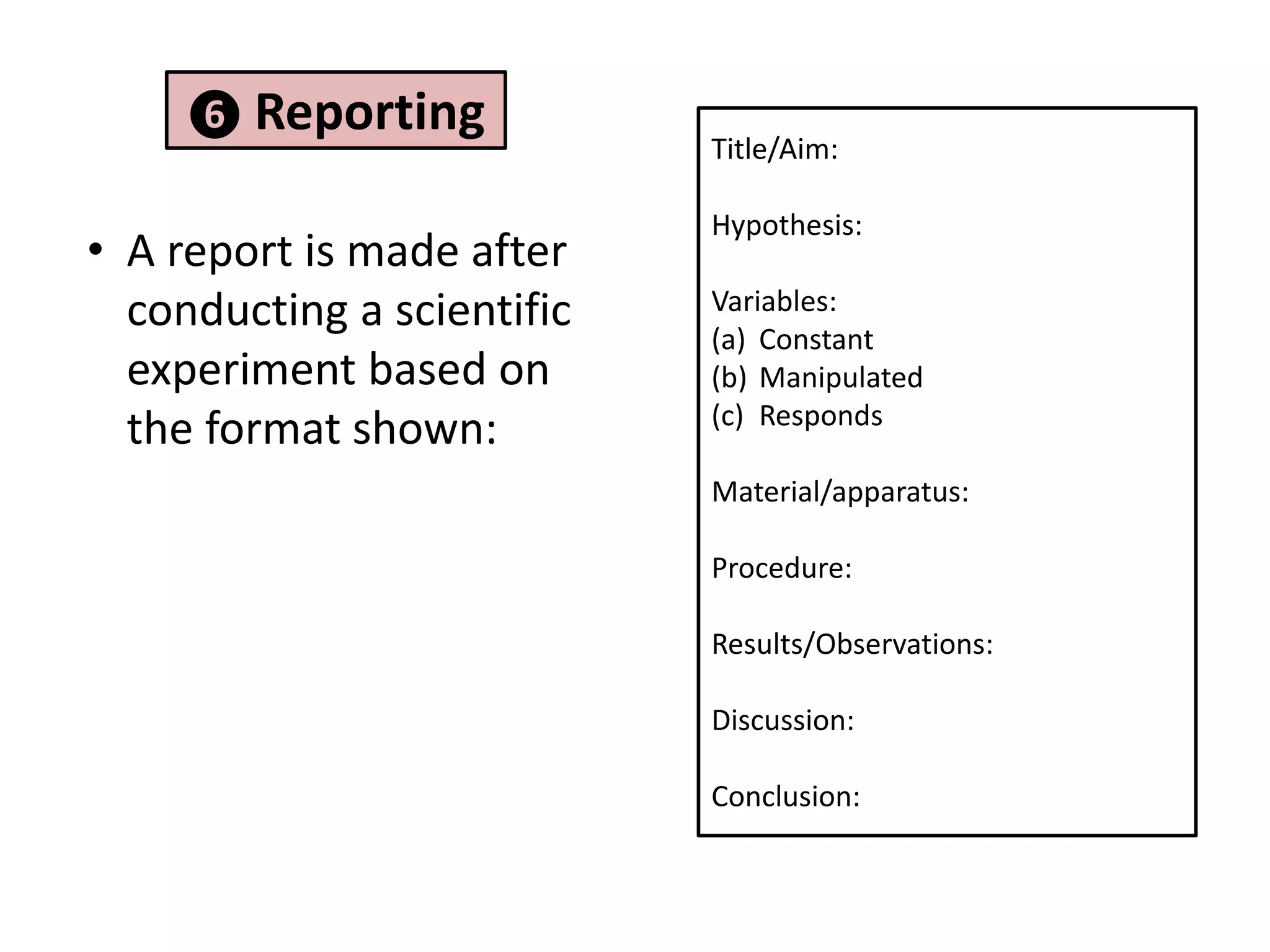
❻ Reporting
                            Title/Aim:

                            Hypothesis:
• A report is made after
  conducting a scientific   Variables:
                            (a) Constant
  experiment based on       (b) Manipulated
                            (c) Responds
  the format shown:
                            Material/apparatus:

                            Procedure:

                            Results/Observations:

                            Discussion:

                            Conclusion:
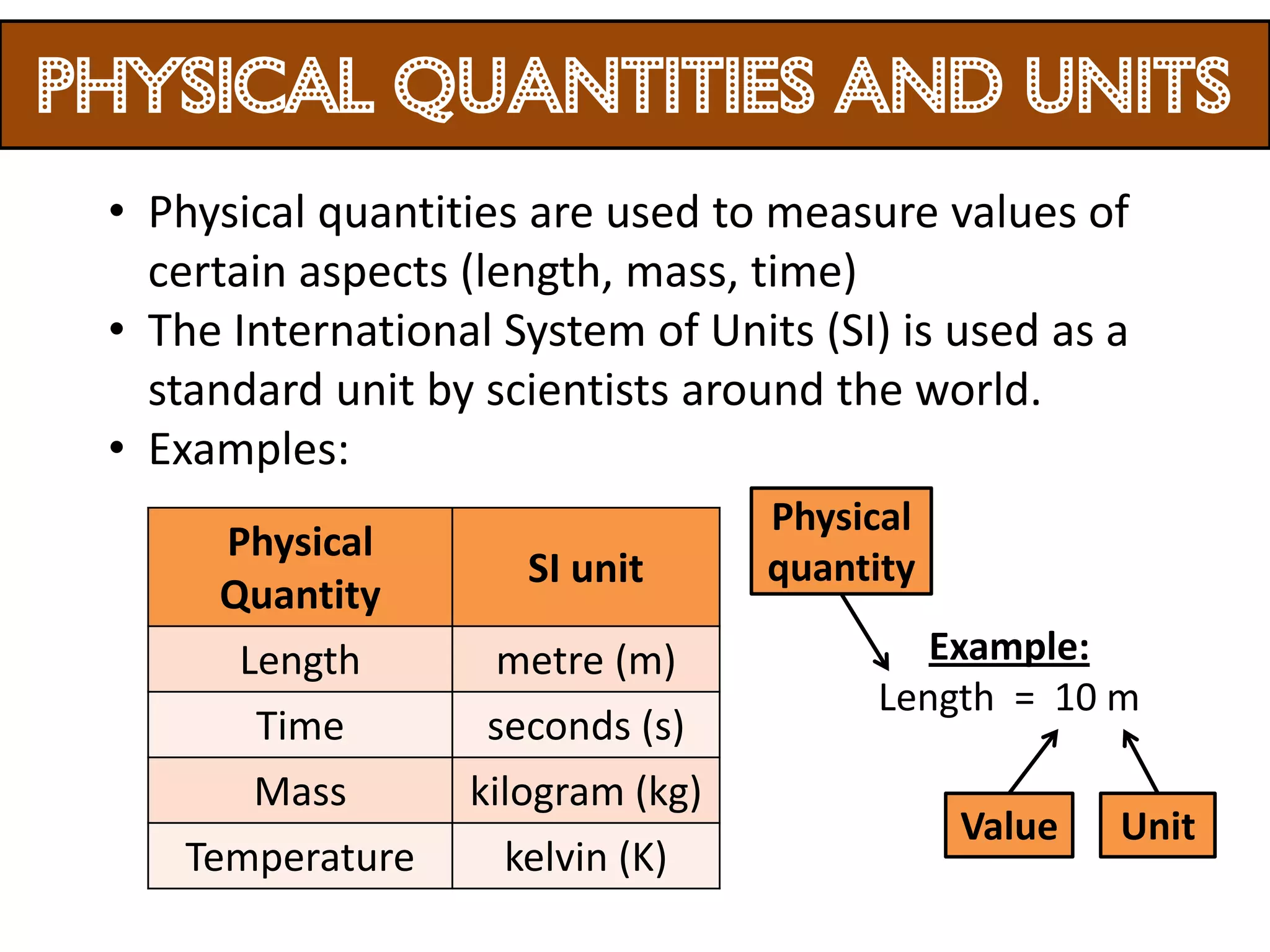
Physical quantities and units
 • Physical quantities are used to measure values of
   certain aspects (length, mass, time)
 • The International System of Units (SI) is used as a
   standard unit by scientists around the world.
 • Examples:
                                   Physical
       Physical
                      SI unit      quantity
       Quantity
        Length       metre (m)             Example:
                                        Length = 10 m
         Time       seconds (s)
         Mass      kilogram (kg)
                                              Value   Unit
     Temperature     kelvin (K)
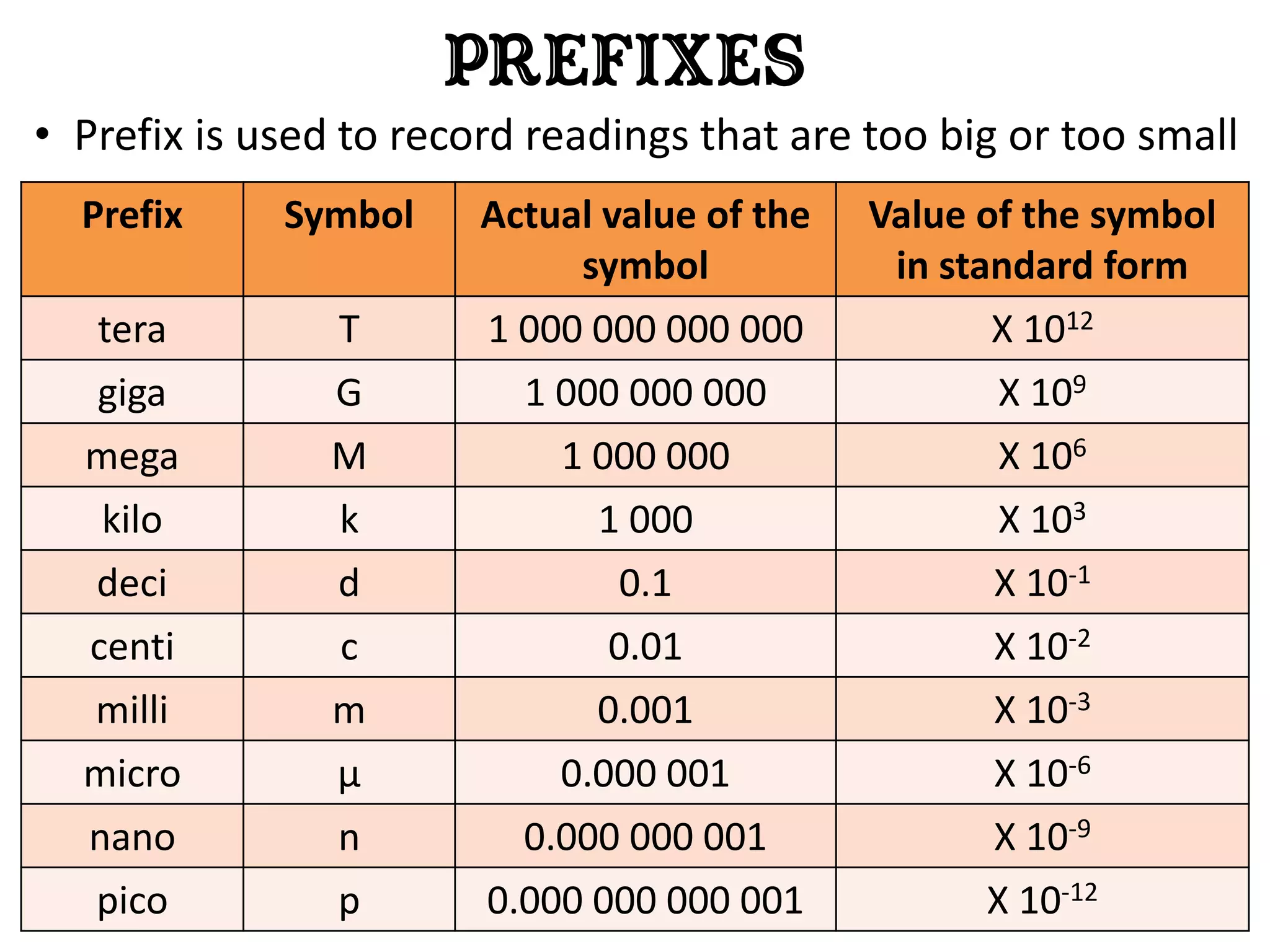
Prefixes
• Prefix is used to record readings that are too big or too small
  Prefix     Symbol     Actual value of the   Value of the symbol
                             symbol            in standard form
  tera          T       1 000 000 000 000           X 1012
  giga          G         1 000 000 000              X 109
  mega          M           1 000 000                X 106
   kilo         k             1 000                  X 103
  deci          d              0.1                  X 10-1
  centi         c              0.01                 X 10-2
  milli         m             0.001                 X 10-3
  micro         μ           0.000 001               X 10-6
  nano          n         0.000 000 001             X 10-9
  pico          p       0.000 000 000 001           X 10-12
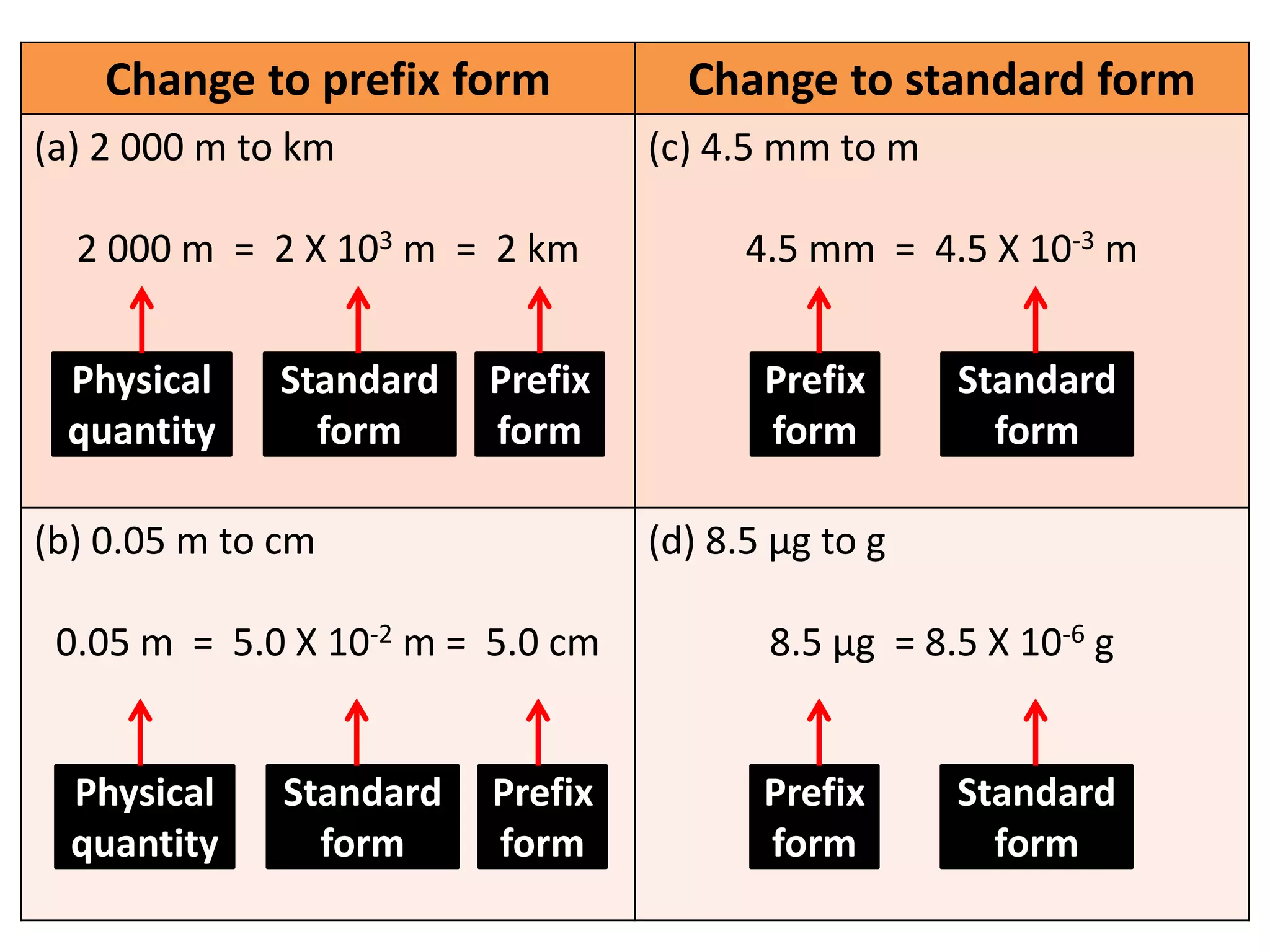
Change to prefix form           Change to standard form
(a) 2 000 m to km                 (c) 4.5 mm to m

  2 000 m = 2 X 10³ m = 2 km            4.5 mm = 4.5 X 10⁻³ m


 Physical    Standard    Prefix          Prefix     Standard
 quantity      form      form            form         form

(b) 0.05 m to cm                  (d) 8.5 μg to g

 0.05 m = 5.0 X 10⁻² m = 5.0 cm          8.5 μg = 8.5 X 10⁻⁶ g


  Physical    Standard   Prefix          Prefix     Standard
  quantity      form     form            form         form
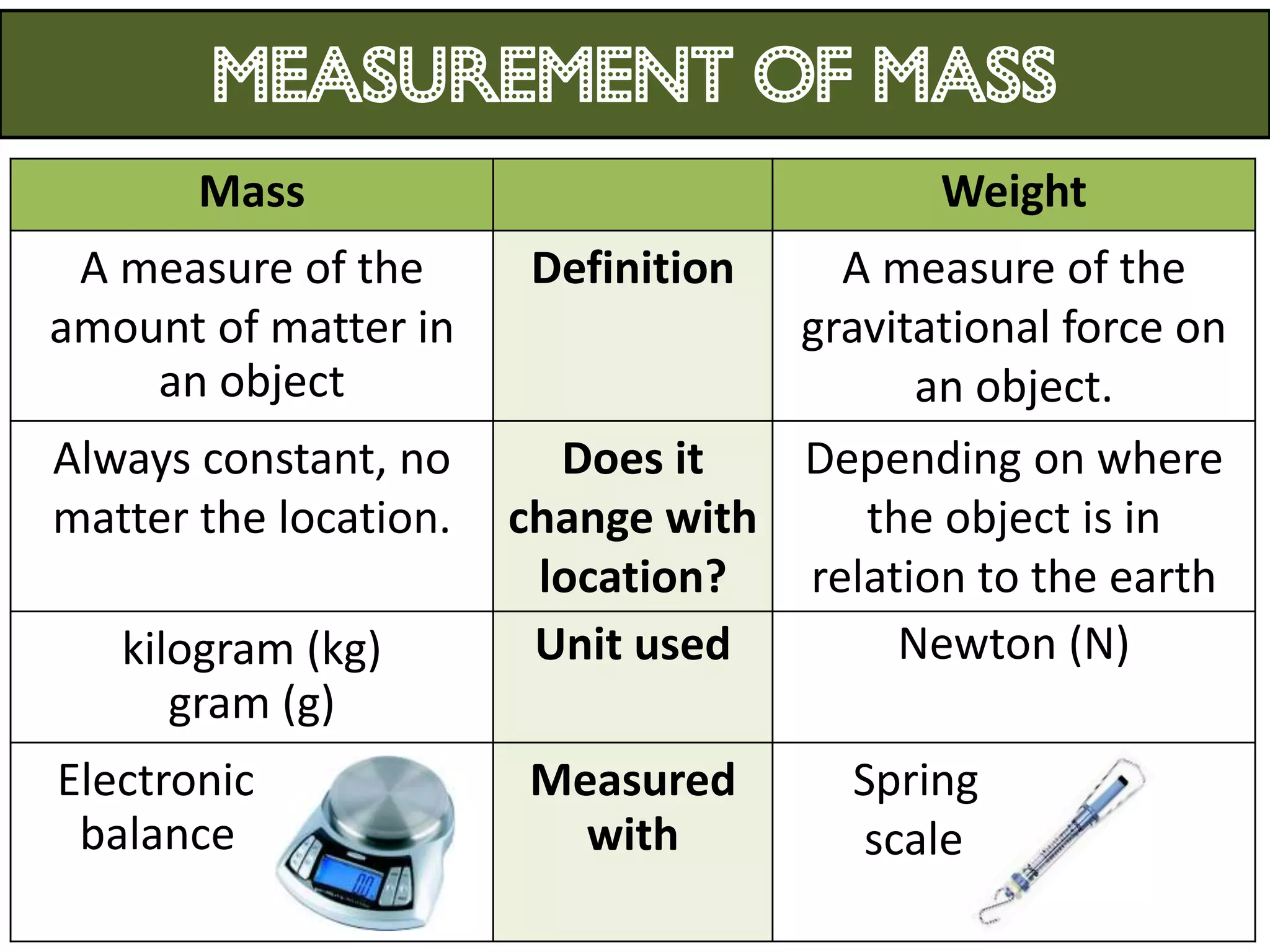
MEASUREMENT OF MASS
       Mass                                Weight
 A measure of the       Definition   A measure of the
amount of matter in                gravitational force on
    an object                            an object.
Always constant, no      Does it   Depending on where
matter the location.   change with    the object is in
                        location?  relation to the earth
   kilogram (kg)        Unit used       Newton (N)
      gram (g)
Electronic              Measured       Spring
 balance                  with         scale
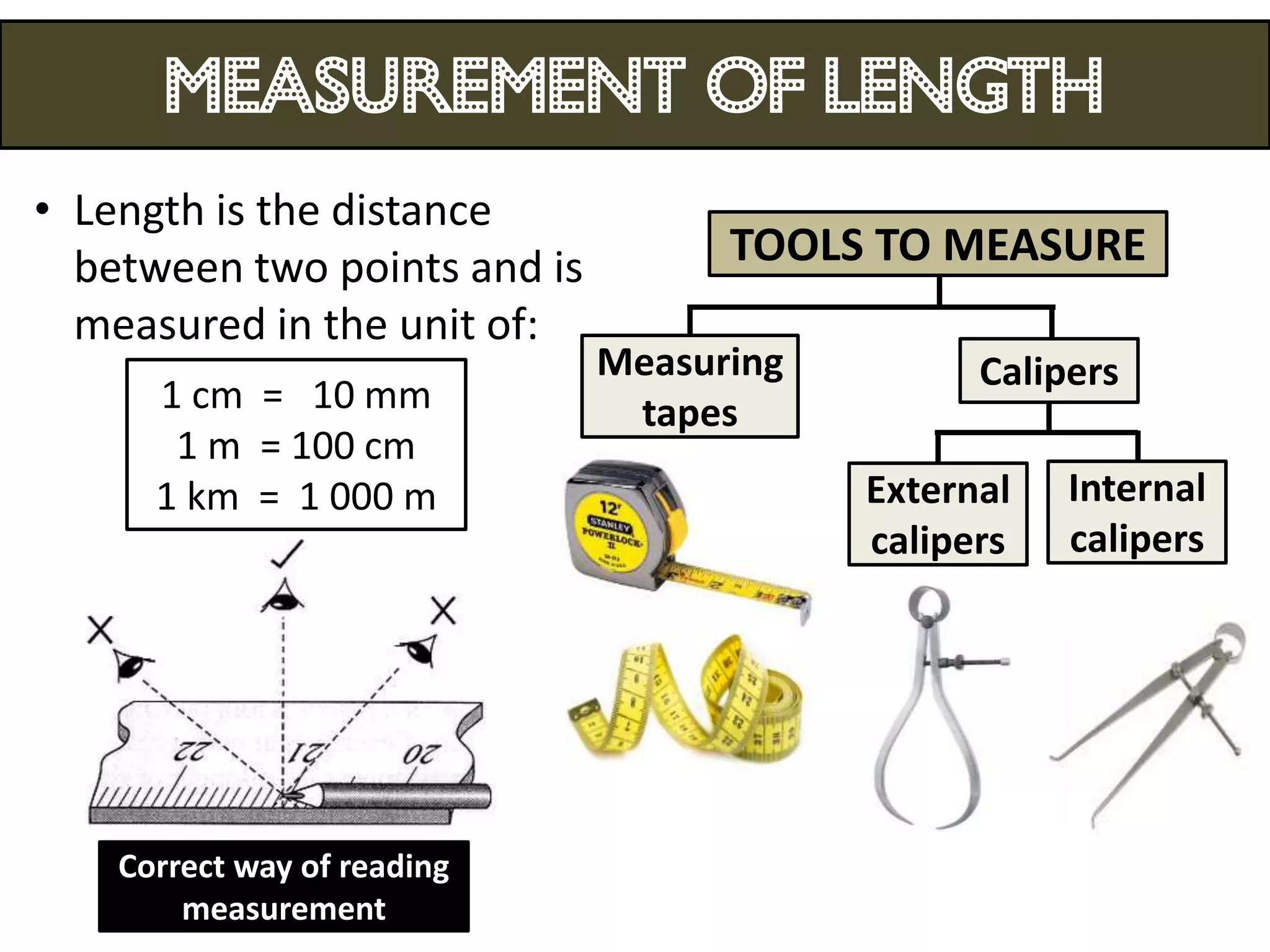
MEASUREMENT OF LENGTH
• Length is the distance
  between two points and is         TOOLS TO MEASURE
  measured in the unit of:
                              Measuring         Calipers
      1 cm = 10 mm             tapes
       1 m = 100 cm
      1 km = 1 000 m                      External   Internal
                                          calipers   calipers


    Correct way of reading
        measurement
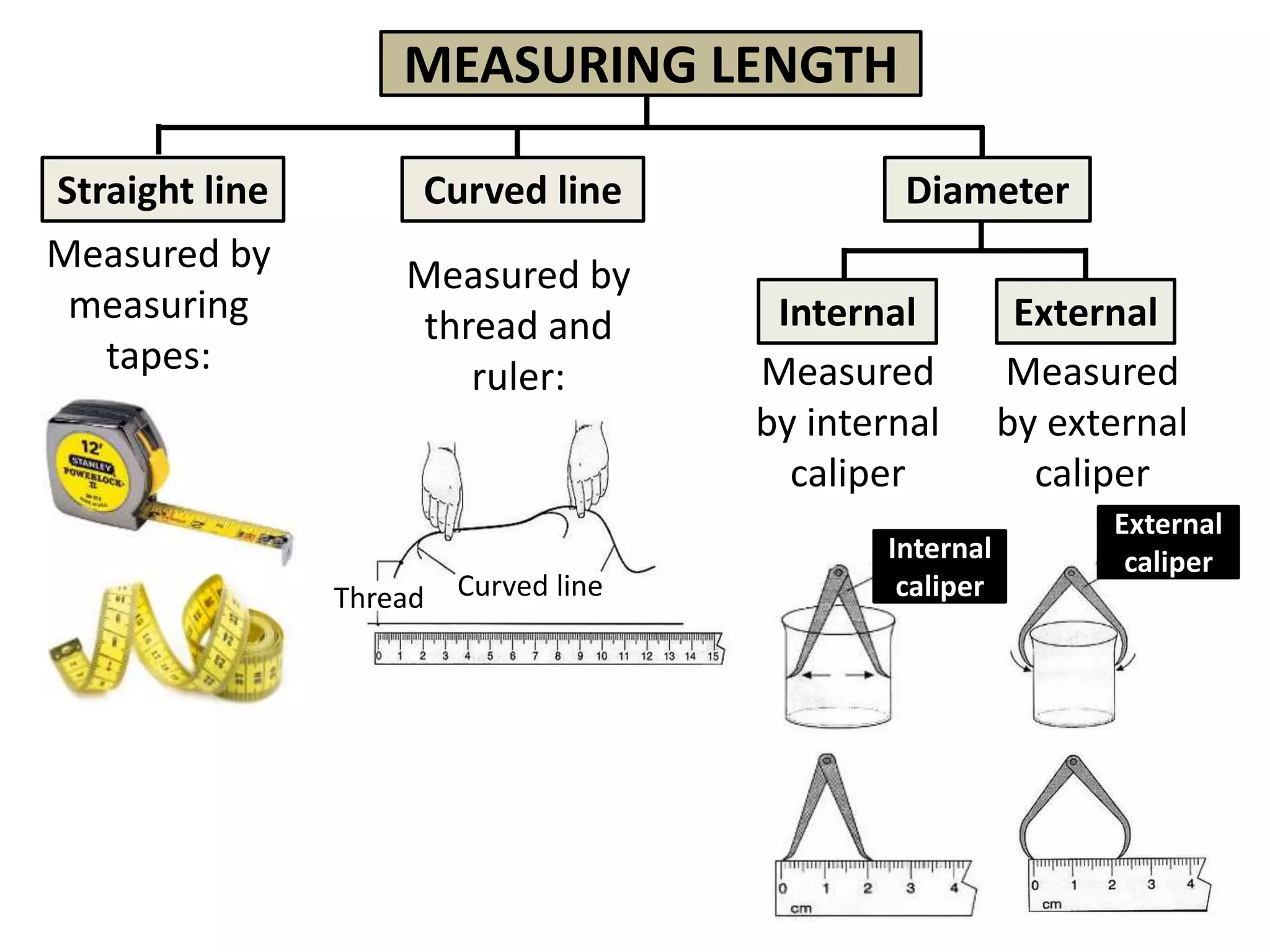
MEASURING LENGTH

Straight line        Curved line               Diameter
Measured by         Measured by
 measuring                              Internal          External
                     thread and
   tapes:               ruler:         Measured          Measured
                                       by internal       by external
                                         caliper           caliper
                                                               External
                                              Internal          caliper
                Thread   Curved line           caliper
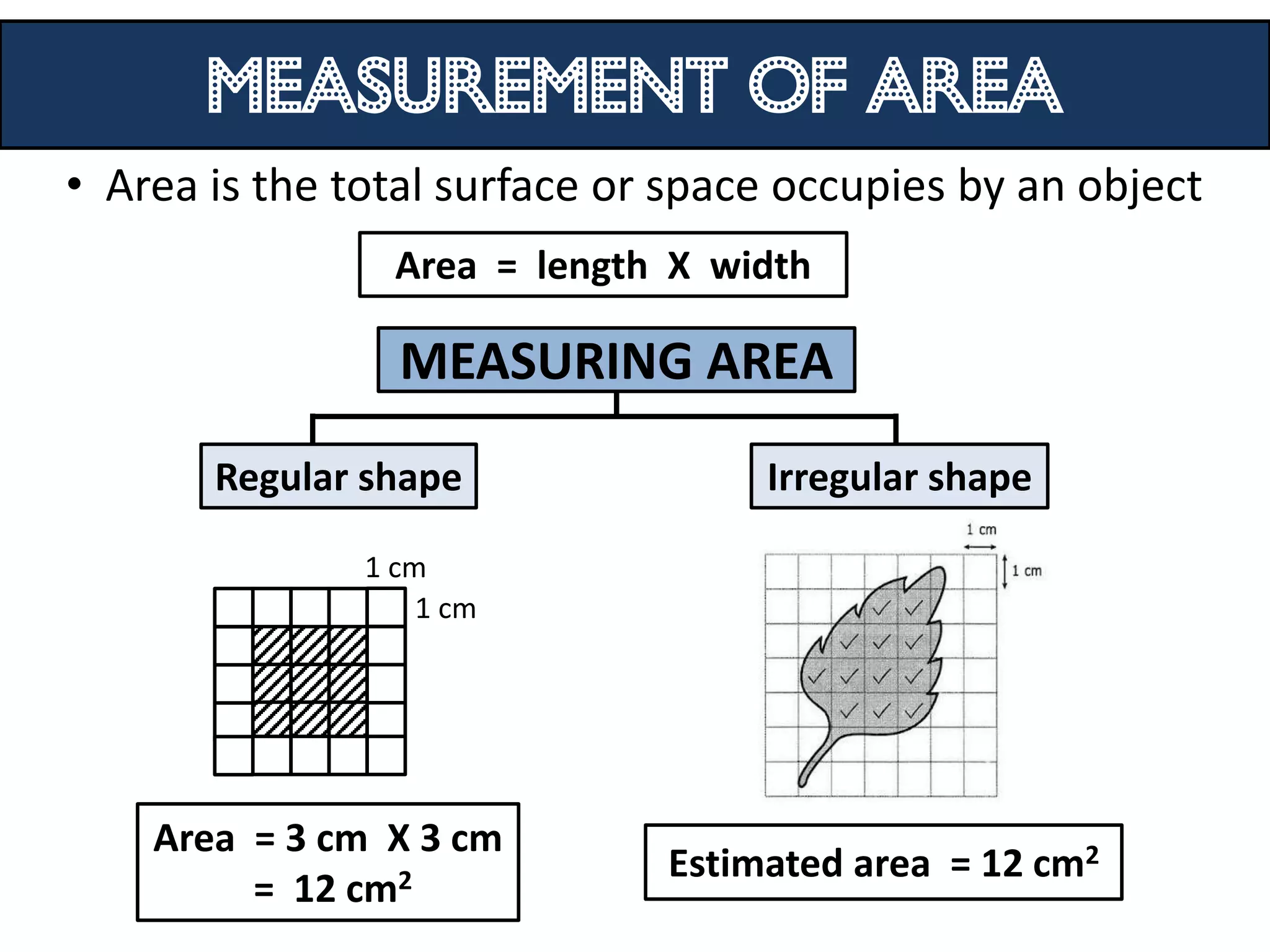
MEASUREMENT OF AREA
• Area is the total surface or space occupies by an object
                 Area = length X width

                 MEASURING AREA
       Regular shape               Irregular shape

               1 cm
                   1 cm


    Area = 3 cm X 3 cm
                              Estimated area = 12 cm2
         = 12 cm2
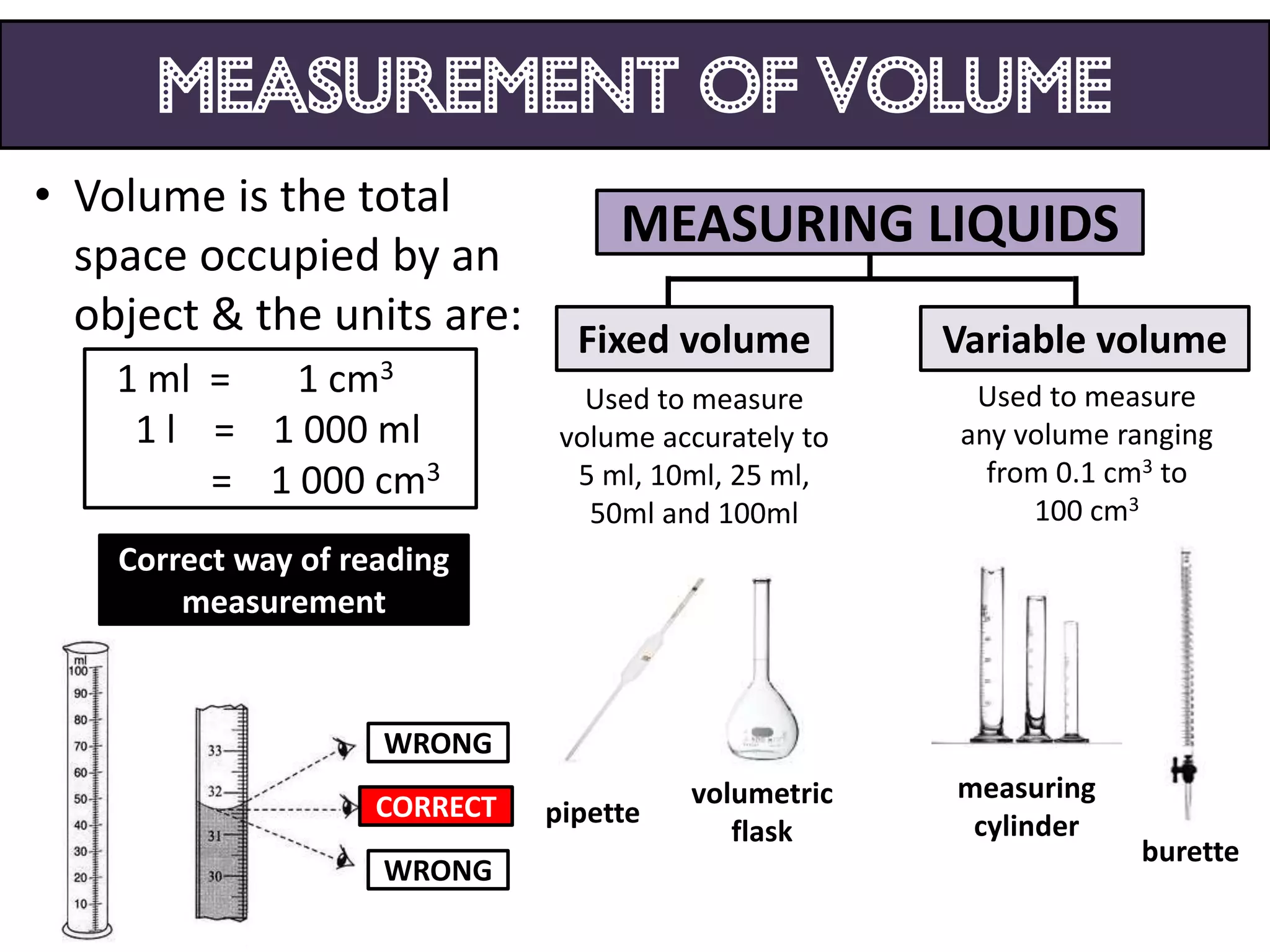
MEASUREMENT OF volume
• Volume is the total
                                    MEASURING LIQUIDS
  space occupied by an
  object & the units are:        Fixed volume          Variable volume
    1 ml =   1   cm3              Used to measure       Used to measure
     1 l = 1 000 ml             volume accurately to   any volume ranging
         = 1 000 cm3             5 ml, 10ml, 25 ml,      from 0.1 cm3 to
                                  50ml and 100ml            100 cm3
    Correct way of reading
        measurement


                     WRONG
                                         volumetric    measuring
                     CORRECT   pipette
                                            flask       cylinder
                                                                   burette
                     WRONG
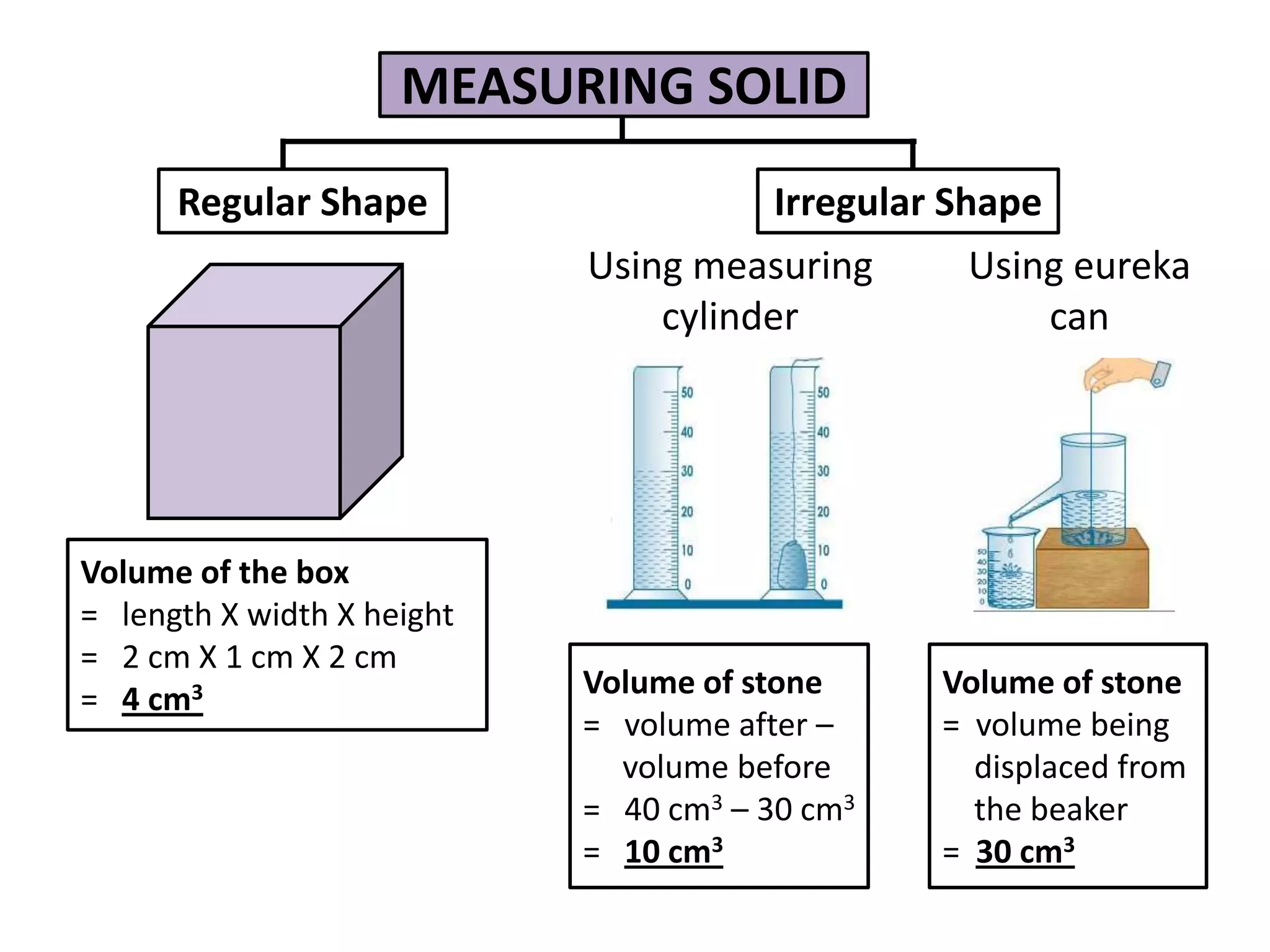
MEASURING SOLID
      Regular Shape                    Irregular Shape
                            Using measuring        Using eureka
                                cylinder               can


Volume of the box
= length X width X height
= 2 cm X 1 cm X 2 cm
= 4 cm3                     Volume of stone     Volume of stone
                            = volume after –    = volume being
                              volume before       displaced from
                            = 40 cm3 – 30 cm3     the beaker
                            = 10 cm3            = 30 cm3

Introduction to Science

  • 1.
  • 2.
    MEANING OF science Scienceis a knowledge that relates to the world around us RELATED PHENOMENA Parrot is able to fly Chameleon changes its Reproduction Ice melting skin color
  • 3.
    Importance of science Science enables the development of new technologies to benefit mankind. FIELDS OF DEVELOPMENT Health Transportation Communication
  • 4.
    Career in thescience field Scientists Nurses Doctors Engineers
  • 5.
    HAZARDOUS symbols Symbol Symbol Flammable Corrosive • Burns easily • May destroy living • Examples: alcohol, tissues on contact petrol, kerosene & • Examples: bromine, ether concentrated acids and alkali Irritant Poisonous • Can cause rashes and • Can cause harm or discomfort to the skin death if in contact • Examples: bromine, with skin, swallowed sulphur dioxide and or inhaled ammonia • Examples: mercury Explosive Radioactive • Explode easily • Releases radiation • Examples: sodium and • Examples: uranium, potassium radium and plutonium
  • 6.
    Laboratory apparatus Test tubes Beaker Measuring cylinder Pipette • To hold small • To hold liquid • To measure the • To measure fixed quantities of volume of a liquid amount of volume liquids of a liquid. Filter funnel Bunsen burner Tripod stand Flask • To divert liquids • To heat things up • To support beaker • To hold liquids into a container in the laboratory or flask while such as conical heating flask or beaker
  • 7.
    Evaporating dish Wire gauze Thermometer Retort stand & clamp • To evaporate • To spread out the • To measure • To hold apparatus liquids heat of the flame temperature at different heights eventually Burette Tube rack Stopwatch Pestle and mortar • To measure • To place test tubes • To record time • To crush solid into volume of a liquid powder accurately to 0.1cm3
  • 8.
    Cork and stopper Spatula Glass rod Dropper • To close the mouth • To transfer solid • To stir liquids in a • To transfer small of test tubes and chemicals container amount of liquid flasks Filter paper Test tube tolder Crucible with lid Crucible tongs • Used together • To hold the test • To contain solids • To hold hot with a filter funnel tubes when it is that can be heated crucible and lids to separate solid being heated directly without from liquids using wire gauze
  • 9.
    Steps in scientificinvestigation ❶ Identifying a problem ❷ Forming a hypothesis ❸ Planning the experiment ❹ Controlling variables ❺ Carrying out investigation ❻ Reporting
  • 10.
    ❶ Identifying aproblem • Arise from a desire to know what happens in our surroundings. • Examples: - Why do birds fly but not ostrich? - Why do cactus able to grow on a deserted land with no water available? ❷ Forming a hypothesis • A hypothesis is an early idea or explanation for the phenomena that we observe. • A hypothesis can only be accepted or proven true after going through experiments. If the hypothesis is not true, a new hypothesis has to be formed.
  • 11.
    ❸ Planning theexperiment • A list of material and apparatus required and the way they should be carry out are made before an experiment can begin. • Moreover, we need to determine the way to collect, analyze and interpret the data obtained from the experiments.
  • 12.
    ❹ Controlling variables •Variables are situations and factors that are controlled and change in an investigation. • Types of variables: (a) A variable that is kept constant - variables that are kept constant or fixed (b) A variable that is manipulated (changed) - variables that are used to test the hypothesis (c) A variable that responds - results are collected from the variables that are changed when testing a hypothesis
  • 13.
    ❺ Carrying out investigation • Steps that are to be followed: (1) Collecting data - all data are observed and measured accurately (2) Analyzing and interpreting data - the data is then presented in a table or chart - interpretation is made from the table or chart (3) Making conclusions - an accurate statement to describe the problems identified throughout the experiment - determine whether to accept or reject the hypothesis
  • 14.
    ❻ Reporting Title/Aim: Hypothesis: • A report is made after conducting a scientific Variables: (a) Constant experiment based on (b) Manipulated (c) Responds the format shown: Material/apparatus: Procedure: Results/Observations: Discussion: Conclusion:
  • 15.
    Physical quantities andunits • Physical quantities are used to measure values of certain aspects (length, mass, time) • The International System of Units (SI) is used as a standard unit by scientists around the world. • Examples: Physical Physical SI unit quantity Quantity Length metre (m) Example: Length = 10 m Time seconds (s) Mass kilogram (kg) Value Unit Temperature kelvin (K)
  • 16.
    Prefixes • Prefix isused to record readings that are too big or too small Prefix Symbol Actual value of the Value of the symbol symbol in standard form tera T 1 000 000 000 000 X 1012 giga G 1 000 000 000 X 109 mega M 1 000 000 X 106 kilo k 1 000 X 103 deci d 0.1 X 10⁻¹ centi c 0.01 X 10⁻² milli m 0.001 X 10⁻³ micro μ 0.000 001 X 10-6 nano n 0.000 000 001 X 10-9 pico p 0.000 000 000 001 X 10-12
  • 17.
    Change to prefixform Change to standard form (a) 2 000 m to km (c) 4.5 mm to m 2 000 m = 2 X 10³ m = 2 km 4.5 mm = 4.5 X 10⁻³ m Physical Standard Prefix Prefix Standard quantity form form form form (b) 0.05 m to cm (d) 8.5 μg to g 0.05 m = 5.0 X 10⁻² m = 5.0 cm 8.5 μg = 8.5 X 10⁻⁶ g Physical Standard Prefix Prefix Standard quantity form form form form
  • 18.
    MEASUREMENT OF MASS Mass Weight A measure of the Definition A measure of the amount of matter in gravitational force on an object an object. Always constant, no Does it Depending on where matter the location. change with the object is in location? relation to the earth kilogram (kg) Unit used Newton (N) gram (g) Electronic Measured Spring balance with scale
  • 19.
    MEASUREMENT OF LENGTH •Length is the distance between two points and is TOOLS TO MEASURE measured in the unit of: Measuring Calipers 1 cm = 10 mm tapes 1 m = 100 cm 1 km = 1 000 m External Internal calipers calipers Correct way of reading measurement
  • 20.
    MEASURING LENGTH Straight line Curved line Diameter Measured by Measured by measuring Internal External thread and tapes: ruler: Measured Measured by internal by external caliper caliper External Internal caliper Thread Curved line caliper
  • 21.
    MEASUREMENT OF AREA •Area is the total surface or space occupies by an object Area = length X width MEASURING AREA Regular shape Irregular shape 1 cm 1 cm Area = 3 cm X 3 cm Estimated area = 12 cm2 = 12 cm2
  • 22.
    MEASUREMENT OF volume •Volume is the total MEASURING LIQUIDS space occupied by an object & the units are: Fixed volume Variable volume 1 ml = 1 cm3 Used to measure Used to measure 1 l = 1 000 ml volume accurately to any volume ranging = 1 000 cm3 5 ml, 10ml, 25 ml, from 0.1 cm3 to 50ml and 100ml 100 cm3 Correct way of reading measurement WRONG volumetric measuring CORRECT pipette flask cylinder burette WRONG
  • 23.
    MEASURING SOLID Regular Shape Irregular Shape Using measuring Using eureka cylinder can Volume of the box = length X width X height = 2 cm X 1 cm X 2 cm = 4 cm3 Volume of stone Volume of stone = volume after – = volume being volume before displaced from = 40 cm3 – 30 cm3 the beaker = 10 cm3 = 30 cm3