Unit 1 
•Living vs. Non-living 
•Measurement 
•Scientific Method
What is Science? 
Science is an ongoing study of our world. 
Why do people study science? 
• To solve problems 
• To invent new technology 
What is Biology? 
Biology is the study of life. 
Bio = life - ology = The study of
Living vs. Non-living 
Objectives: 
1. Know the six characteristics all living things must 
have. 
2. Know the four factors an organism needs to remain 
alive.
In your notebook, complete the following: 
1. Put today’s date on the top of the page. 
2. Draw a box about half the size of the page. 
3. Inside the box, at the top, write the following question: 
How do we know something is alive? 
4. You have 5 minutes to list your ideas. I am not looking 
for the right answer, just what you think. There should 
be no talking. You are doing this on your own.
How do we know if something is alive? 
Living things: 
1. Have one or more cells 
2. Sense and respond to change 
3. Reproduce 
4. Have genetic material (DNA) 
5. Use energy to carry out activities 
6. Grow and develop
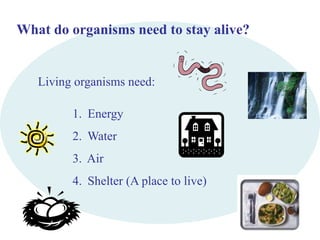
What do organisms need to stay alive? 
Living organisms need: 
1. Energy 
2. Water 
3. Air 
4. Shelter (A place to live)
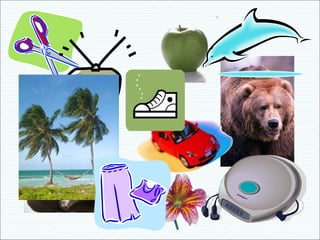
Living vs. Non-living Poster 
Day 1: 
• Look for living and non-living objects in magazines. 
• You need to cut out 7 living and 7 non-living pictures. 
• You can not use pictures of people, weapons, or anything 
inappropriate.
Living vs. Non-living Poster 
Day 2: 
• Continue looking for 7 living and 7 non-living objects. 
• After you have your pictures cut out you may get a piece 
of construction paper. 
• You need to glue your pictures on the paper and 
decorate the poster. 
• You must identify the objects and classify them as living 
or non-living. 
• Make sure your name and class period are on the poster.
Living vs. Non-living Poster 
Day 3: Presentations 
• You need to talk about 2 or 3 living and 2 or 
3 non-living objects. 
• You need to explain at least 1 of the 6 
characteristics that makes the object living or 
non-living.
What do scientists do? 
- They do research and experiments to solve problems. 
How do they do their job? 
• Use safety procedures 
• Use equipment 
• Use measurement
Safety Rules 
1. Know where safety equipment is. 
2. DO NOT eat or drink in the lab! 
3. Never taste chemicals! 
4. Be careful with glassware. 
5. Report cuts, spills, and broken glass to the teacher 
immediately. 
6. Wash your hands after experiments 
7. Wear goggles when working with chemicals. 
8. Tie hair back when working with fire. 
9. Use mitts or tongs to pick up hot glassware.
Measurement 
Objectives: 
1. Know the appropriate metric unit for mass, volume, 
temperature and length. 
2. Know the appropriate instrument for measuring mass, 
volume, temperature and length. 
3. Know how to use a ruler, balance, thermometer and 
graduated cylinder and read measurements. 
4. Know how to convert between metric units and 
determine larger or smaller measurements.
Measurement 
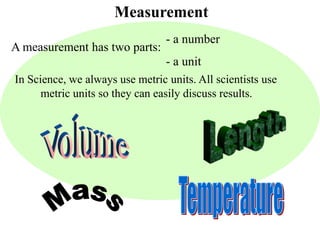
A measurement has two parts: 
- a number 
- a unit 
In Science, we always use metric units. All scientists use 
metric units so they can easily discuss results.
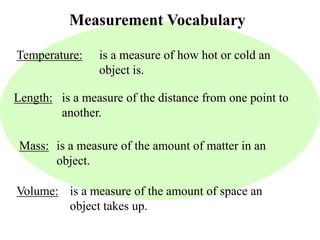
Measurement Vocabulary 
Temperature: 
Length: 
Mass: 
Volume: 
is a measure of how hot or cold an 
object is. 
is a measure of the distance from one point to 
another. 
is a measure of the amount of matter in an 
object. 
is a measure of the amount of space an 
object takes up.
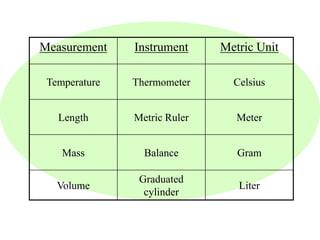
Measurement Instrument Metric Unit 
Temperature Thermometer Celsius 
Length Metric Ruler Meter 
Mass Balance Gram 
Volume 
Graduated 
cylinder 
Liter
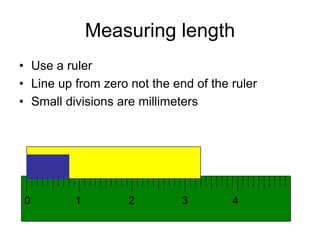
Measuring length 
• Use a ruler 
• Line up from zero not the end of the ruler 
• Small divisions are millimeters 
0 1 2 3 4
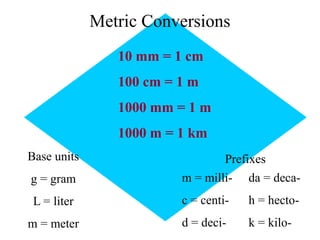
Metric Conversions 
10 mm = 1 cm 
100 cm = 1 m 
1000 mm = 1 m 
1000 m = 1 km 
Base units 
g = gram 
L = liter 
m = meter 
Prefixes 
m = milli-c 
= centi-d 
= deci-da 
= deca-h 
= hecto-k 
= kilo-
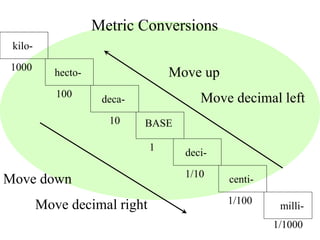
Metric Conversions 
kilo-hecto-deca- 
Move up 
BASE 
Move decimal left 
deci-centi-milli- 
Move down 
Move decimal right 
1000 
100 
1 
1/10 
1/100 
1/1000 
10
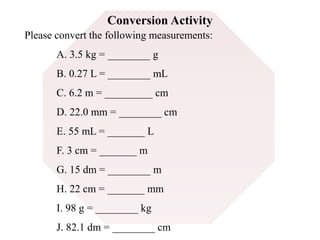
Conversion Activity 
Please convert the following measurements: 
A. 3.5 kg = ________ g 
B. 0.27 L = ________ mL 
C. 6.2 m = _________ cm 
D. 22.0 mm = ________ cm 
E. 55 mL = _______ L 
F. 3 cm = _______ m 
G. 15 dm = ________ m 
H. 22 cm = _______ mm 
I. 98 g = ________ kg 
J. 82.1 dm = ________ cm
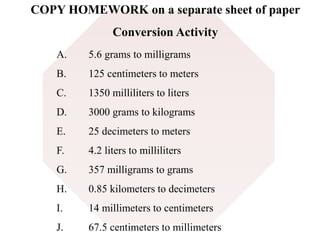
COPY HOMEWORK on a separate sheet of paper 
Conversion Activity 
A. 5.6 grams to milligrams 
B. 125 centimeters to meters 
C. 1350 milliliters to liters 
D. 3000 grams to kilograms 
E. 25 decimeters to meters 
F. 4.2 liters to milliliters 
G. 357 milligrams to grams 
H. 0.85 kilometers to decimeters 
I. 14 millimeters to centimeters 
J. 67.5 centimeters to millimeters
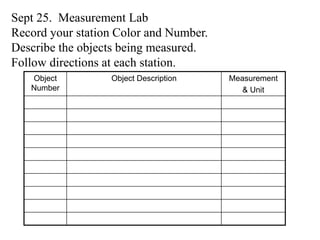
Sept 25. Measurement Lab 
Record your station Color and Number. 
Describe the objects being measured. 
Follow directions at each station. 
Object 
Number 
Object Description Measurement 
& Unit
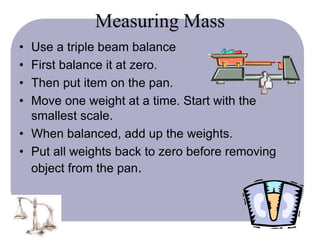
Measuring Mass 
• Use a triple beam balance 
• First balance it at zero. 
• Then put item on the pan. 
• Move one weight at a time. Start with the 
smallest scale. 
• When balanced, add up the weights. 
• Put all weights back to zero before removing 
object from the pan.
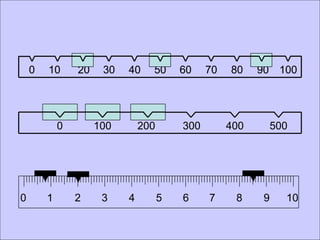
0 10 20 30 40 50 60 70 80 90 100 
0 100 200 300 400 500 
0 1 2 3 4 5 6 7 8 9 10
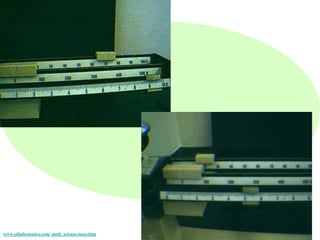
www.edinformatics.com/ math_science/mass.htm
Metric Conversions 
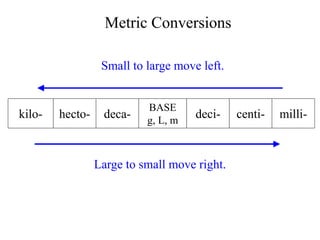
Small to large move left. 
kilo- hecto- deca- 
BASE 
g, L, m 
deci- centi- milli- 
Large to small move right.
Measuring Volume 
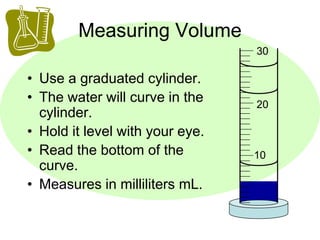
• Use a graduated cylinder. 
• The water will curve in the 
cylinder. 
• Hold it level with your eye. 
• Read the bottom of the 
curve. 
• Measures in milliliters mL. 
30 
20 
10
Reading a graduated cylinder 
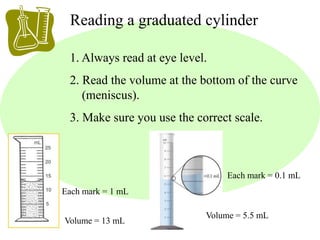
1. Always read at eye level. 
2. Read the volume at the bottom of the curve 
(meniscus). 
3. Make sure you use the correct scale. 
Each mark = 1 mL 
Volume = 13 mL 
Each mark = 0.1 mL 
Volume = 5.5 mL
Measuring Temperature 
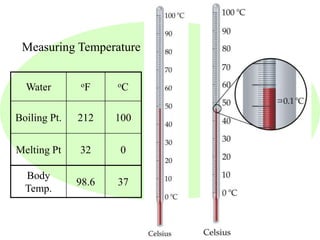
Water oF oC 
Boiling Pt. 212 100 
Melting Pt 32 0 
Body 
Temp. 
98.6 37
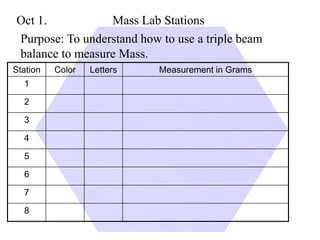
Oct 1. Mass Lab Stations 
Purpose: To understand how to use a triple beam 
balance to measure Mass. 
Station Color Letters Measurement in Grams 
1 
2 
3 
4 
5 
6 
7 
8
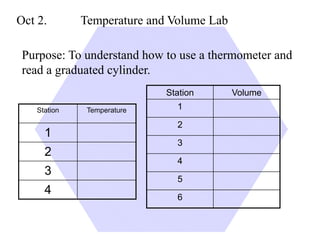
Oct 2. Temperature and Volume Lab 
Purpose: To understand how to use a thermometer and 
read a graduated cylinder. 
Station Temperature 
1 
2 
3 
4 
Station Volume 
1 
2 
3 
4 
5 
6
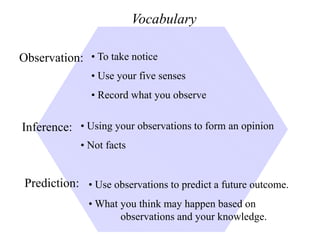
Vocabulary 
Observation: 
Inference: 
• To take notice 
• Use your five senses 
• Record what you observe 
• Using your observations to form an opinion 
• Not facts 
Prediction: • Use observations to predict a future outcome. 
•What you think may happen based on 
observations and your knowledge.
Observations: Inference: Prediction:
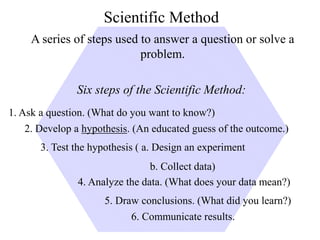
Scientific Method 
A series of steps used to answer a question or solve a 
problem. 
Six steps of the Scientific Method: 
1. Ask a question. (What do you want to know?) 
2. Develop a hypothesis. (An educated guess of the outcome.) 
3. Test the hypothesis ( a. Design an experiment 
b. Collect data) 
4. Analyze the data. (What does your data mean?) 
5. Draw conclusions. (What did you learn?) 
6. Communicate results.
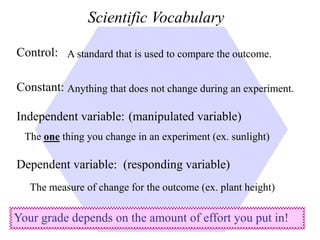
Scientific Vocabulary 
Control: A standard that is used to compare the outcome. 
Constant: 
Anything that does not change during an experiment. 
Independent variable: 
The one thing you change in an experiment (ex. sunlight) 
Dependent variable: 
(manipulated variable) 
(responding variable) 
The measure of change for the outcome (ex. plant height) 
Your grade depends on the amount of effort you put in!
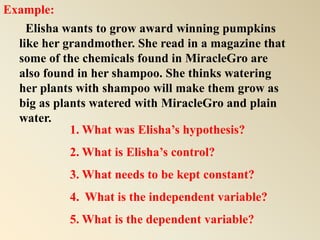
Example: 
Elisha wants to grow award winning pumpkins 
like her grandmother. She read in a magazine that 
some of the chemicals found in MiracleGro are 
also found in her shampoo. She thinks watering 
her plants with shampoo will make them grow as 
big as plants watered with MiracleGro and plain 
water. 
1. What was Elisha’s hypothesis? 
2. What is Elisha’s control? 
3. What needs to be kept constant? 
4. What is the independent variable? 
5. What is the dependent variable?

2014 15 unit 1

  • 1.
    Unit 1 •Livingvs. Non-living •Measurement •Scientific Method
  • 2.
    What is Science? Science is an ongoing study of our world. Why do people study science? • To solve problems • To invent new technology What is Biology? Biology is the study of life. Bio = life - ology = The study of
  • 3.
    Living vs. Non-living Objectives: 1. Know the six characteristics all living things must have. 2. Know the four factors an organism needs to remain alive.
  • 5.
    In your notebook,complete the following: 1. Put today’s date on the top of the page. 2. Draw a box about half the size of the page. 3. Inside the box, at the top, write the following question: How do we know something is alive? 4. You have 5 minutes to list your ideas. I am not looking for the right answer, just what you think. There should be no talking. You are doing this on your own.
  • 6.
    How do weknow if something is alive? Living things: 1. Have one or more cells 2. Sense and respond to change 3. Reproduce 4. Have genetic material (DNA) 5. Use energy to carry out activities 6. Grow and develop
  • 7.
    What do organismsneed to stay alive? Living organisms need: 1. Energy 2. Water 3. Air 4. Shelter (A place to live)
  • 8.
    Living vs. Non-livingPoster Day 1: • Look for living and non-living objects in magazines. • You need to cut out 7 living and 7 non-living pictures. • You can not use pictures of people, weapons, or anything inappropriate.
  • 9.
    Living vs. Non-livingPoster Day 2: • Continue looking for 7 living and 7 non-living objects. • After you have your pictures cut out you may get a piece of construction paper. • You need to glue your pictures on the paper and decorate the poster. • You must identify the objects and classify them as living or non-living. • Make sure your name and class period are on the poster.
  • 10.
    Living vs. Non-livingPoster Day 3: Presentations • You need to talk about 2 or 3 living and 2 or 3 non-living objects. • You need to explain at least 1 of the 6 characteristics that makes the object living or non-living.
  • 11.
    What do scientistsdo? - They do research and experiments to solve problems. How do they do their job? • Use safety procedures • Use equipment • Use measurement
  • 12.
    Safety Rules 1.Know where safety equipment is. 2. DO NOT eat or drink in the lab! 3. Never taste chemicals! 4. Be careful with glassware. 5. Report cuts, spills, and broken glass to the teacher immediately. 6. Wash your hands after experiments 7. Wear goggles when working with chemicals. 8. Tie hair back when working with fire. 9. Use mitts or tongs to pick up hot glassware.
  • 13.
    Measurement Objectives: 1.Know the appropriate metric unit for mass, volume, temperature and length. 2. Know the appropriate instrument for measuring mass, volume, temperature and length. 3. Know how to use a ruler, balance, thermometer and graduated cylinder and read measurements. 4. Know how to convert between metric units and determine larger or smaller measurements.
  • 14.
    Measurement A measurementhas two parts: - a number - a unit In Science, we always use metric units. All scientists use metric units so they can easily discuss results.
  • 15.
    Measurement Vocabulary Temperature: Length: Mass: Volume: is a measure of how hot or cold an object is. is a measure of the distance from one point to another. is a measure of the amount of matter in an object. is a measure of the amount of space an object takes up.
  • 16.
    Measurement Instrument MetricUnit Temperature Thermometer Celsius Length Metric Ruler Meter Mass Balance Gram Volume Graduated cylinder Liter
  • 17.
    Measuring length •Use a ruler • Line up from zero not the end of the ruler • Small divisions are millimeters 0 1 2 3 4
  • 18.
    Metric Conversions 10mm = 1 cm 100 cm = 1 m 1000 mm = 1 m 1000 m = 1 km Base units g = gram L = liter m = meter Prefixes m = milli-c = centi-d = deci-da = deca-h = hecto-k = kilo-
  • 19.
    Metric Conversions kilo-hecto-deca- Move up BASE Move decimal left deci-centi-milli- Move down Move decimal right 1000 100 1 1/10 1/100 1/1000 10
  • 20.
    Conversion Activity Pleaseconvert the following measurements: A. 3.5 kg = ________ g B. 0.27 L = ________ mL C. 6.2 m = _________ cm D. 22.0 mm = ________ cm E. 55 mL = _______ L F. 3 cm = _______ m G. 15 dm = ________ m H. 22 cm = _______ mm I. 98 g = ________ kg J. 82.1 dm = ________ cm
  • 21.
    COPY HOMEWORK ona separate sheet of paper Conversion Activity A. 5.6 grams to milligrams B. 125 centimeters to meters C. 1350 milliliters to liters D. 3000 grams to kilograms E. 25 decimeters to meters F. 4.2 liters to milliliters G. 357 milligrams to grams H. 0.85 kilometers to decimeters I. 14 millimeters to centimeters J. 67.5 centimeters to millimeters
  • 22.
    Sept 25. MeasurementLab Record your station Color and Number. Describe the objects being measured. Follow directions at each station. Object Number Object Description Measurement & Unit
  • 23.
    Measuring Mass •Use a triple beam balance • First balance it at zero. • Then put item on the pan. • Move one weight at a time. Start with the smallest scale. • When balanced, add up the weights. • Put all weights back to zero before removing object from the pan.
  • 24.
    0 10 2030 40 50 60 70 80 90 100 0 100 200 300 400 500 0 1 2 3 4 5 6 7 8 9 10
  • 25.
  • 26.
    Metric Conversions Smallto large move left. kilo- hecto- deca- BASE g, L, m deci- centi- milli- Large to small move right.
  • 27.
    Measuring Volume •Use a graduated cylinder. • The water will curve in the cylinder. • Hold it level with your eye. • Read the bottom of the curve. • Measures in milliliters mL. 30 20 10
  • 28.
    Reading a graduatedcylinder 1. Always read at eye level. 2. Read the volume at the bottom of the curve (meniscus). 3. Make sure you use the correct scale. Each mark = 1 mL Volume = 13 mL Each mark = 0.1 mL Volume = 5.5 mL
  • 29.
    Measuring Temperature WateroF oC Boiling Pt. 212 100 Melting Pt 32 0 Body Temp. 98.6 37
  • 30.
    Oct 1. MassLab Stations Purpose: To understand how to use a triple beam balance to measure Mass. Station Color Letters Measurement in Grams 1 2 3 4 5 6 7 8
  • 31.
    Oct 2. Temperatureand Volume Lab Purpose: To understand how to use a thermometer and read a graduated cylinder. Station Temperature 1 2 3 4 Station Volume 1 2 3 4 5 6
  • 32.
    Vocabulary Observation: Inference: • To take notice • Use your five senses • Record what you observe • Using your observations to form an opinion • Not facts Prediction: • Use observations to predict a future outcome. •What you think may happen based on observations and your knowledge.
  • 33.
  • 34.
    Scientific Method Aseries of steps used to answer a question or solve a problem. Six steps of the Scientific Method: 1. Ask a question. (What do you want to know?) 2. Develop a hypothesis. (An educated guess of the outcome.) 3. Test the hypothesis ( a. Design an experiment b. Collect data) 4. Analyze the data. (What does your data mean?) 5. Draw conclusions. (What did you learn?) 6. Communicate results.
  • 35.
    Scientific Vocabulary Control:A standard that is used to compare the outcome. Constant: Anything that does not change during an experiment. Independent variable: The one thing you change in an experiment (ex. sunlight) Dependent variable: (manipulated variable) (responding variable) The measure of change for the outcome (ex. plant height) Your grade depends on the amount of effort you put in!
  • 36.
    Example: Elisha wantsto grow award winning pumpkins like her grandmother. She read in a magazine that some of the chemicals found in MiracleGro are also found in her shampoo. She thinks watering her plants with shampoo will make them grow as big as plants watered with MiracleGro and plain water. 1. What was Elisha’s hypothesis? 2. What is Elisha’s control? 3. What needs to be kept constant? 4. What is the independent variable? 5. What is the dependent variable?