Unit 1
THE SCIENTIFIC WORK
Physics and Chemistry

    What do they have in common?
      
          Physicists and Chemists study
          the same: matter.
      
          Physicists, Chemists and other
          scientists work in the same way:
            
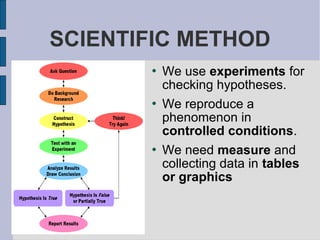
                SCIENTIFIC METHOD
Physics and Chemistry

    What makes them different?
      
          Physics studies
          phenomena that don't
          change the
          composition of matter.
      
          Chemistry studies
          phenomena that change
          the composition of
          matter.
SCIENTIFIC METHOD
SCIENTIFIC METHOD
            The observation of a
             phenomenon and
             curiosity make
             scientists ask
             questions.
            Before doing anything
             else, it's necessary to
             look for the previous
             knowledge about the
             phenomenon.
SCIENTIFIC METHOD
            Hypotheses are
             possible answers to
             the questions we
             asked.
            They are only
             testable predictions
             about the
             phenomenon.
SCIENTIFIC METHOD
          We use experiments for
           checking hypotheses.
          We reproduce a
           phenomenon in
           controlled conditions.
          We need measure and
           collecting data in tables
           or graphics
SCIENTIFIC METHOD
          We study the relationships
           between different
           variables.
          In an experiment there are
           three kinds of variables
              −   Independent
                  variables: they can be
                  changed.
              −   Dependent variables:
                  they are measured.
              −   Controlled variables:
                  they don't change.
SCIENTIFIC METHOD
           After the experiment, we
            analyse its results and
            draw a conclusion.
           If the hypothesis is true,
            we have learnt
            something new and it
            becomes in a law
           If the hypothesis is false.
            We must look for a new
            hypothesis and continue
            the research.
Magnitudes,
measurements and units

    Physical Magnitude: It refers to every
    property of matter that can be measured.
        −   Length, mass, surface, volume, density,
            velocity, force, temperature,...

    Measure: It compares a quantity of a
    magnitude with other that we use as a
    reference (unit).

    Unit: It is a quantity of a magnitude used to
    measure other quantities of the same
    magnitude. It's only useful if every people uses
    the same unit.
Magnitudes,
measurements and units
     Length of the classroom = 10 m
                  means
The length of the classroom is 10 times the
              length of 1 metre.
The International System
               of Units

    The SI has:
       −   a small group of magnitudes whose units
           are fixed directly: the fundamental
           magnitudes.
             
                  E.g.: Length → meter (m); Time → second
                  (s)
       −    The units for the other magnitudes are
           defined in relationship with the fundamental
           units: the derivative magnitudes.
             
                  E. g.: speed → meter/second (m/s)
The International System
             of Units
The fundamental magnitudes and their units


Length                     meter        m
 Mass               kilogram       kg
 Time                      second        s
 Amount of substance       mole         mol
 Temperature               Kelvin        K
 Electric current          amperes       A
 Luminous intensity        candela      cd
The International System
              of Units
Some examples of how to build the units of derivative
 magnitudes:
      −   Area = Length · width → m·m = m2
      −   Volume = Length · width · height → m·m·m =
          m3
      −   Speed = distance / time → m/s
      −   Acceleration = change of speed / time →
          (m/s)/s = m/s2
The International System
              of Units
Some examples of how to build the units of derivative
 magnitudes:
      −   Area = Length · width → m·m = m2
      −   Volume = Length · width · height → m·m·m =
          m3
      −   Speed = distance / time → m/s
      −   Acceleration = change of speed / time →
          (m/s)/s = m/s2
The International System
               of Units
More derivative units.

     Quantity            Name           Symbol
       Area                       square meter
       m2
       Volume        cubic meter     m3
       Force              Newton        N
       Pressure           Pascal              Pa
       Energy        Joule              J
       Power         Watt          W
       Voltage       volt          V
       Frequency          Hertz             Hz
       Electric charge    Coulomb      C
The International System
                   of Units
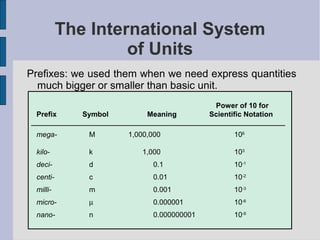
Prefixes: we used them when we need express quantities
  much bigger or smaller than basic unit.
                                                  Power of 10 for
 Prefix       Symbol            Meaning          Scientific Notation
_______________________________________________________________________
 mega-          M          1,000,000                    106

 kilo-          k              1,000                    103
 deci-          d                 0.1                   10-1
 centi-         c                 0.01                  10-2
 milli-         m                 0.001                 10-3
 micro-         µ                 0.000001              10-6
 nano-          n                 0.000000001           10-9
The International System
               of Units
Prefixes: the whole list
   Factor      Name      Symbol    Factor     Name     Symbol
       10-1      decimeter    dm       101      decameter     dam
       10-2      centimeter   cm       102      hectometer    hm

       10-3      millimeter   mm       103      kilometer     km

       10-6      micrometer   µm       106      megameter     Mm
       10-9      nanometer    nm       109      gigameter     Gm

       10-12     picometer    pm       1012      terameter    Tm

       10-15     femtometer   fm       1015      petameter    Pm

       10-18     attometer    am       1018      exameter     Em
       10-21     zeptometer   zm       1021      zettameter   Zm

       10-24     yoctometer   ym       1024      yottameter   Ym
Changing units

    We can change a quantity into another unit.
    Conversion factors help us to do it.

    A conversion factor is a fraction with the
    same quantity in its denominator and in its
    numerator but expressed in different units.

               1h           1 km
                     =1           =1
              60 min       1000 m

              60 min       1000 m
                     =1           =1
               1h           1 km
Changing units
 Let's see a few examples of how to use them
                       1 km    2570 km ·1
           2570 m ·          =            =2,570 km
                      1000 m     1000
                      1 h 1 min 3500 h
           3500 s ·       ·     =      =0,972 h
                    60 min 60 s   3600
                  2

       
500 cm² ·
           1m
          100 cm  
                 =500 cm² ·     
                               1m²
                            10000 cm²
                                      =    
                                        500 m²
                                        10000
                                               =0,05 m²

     m   m 1 km 3600 s 30 · 3600 km      km
   30 =30 ·      ·    =             =108
     s   s 1000 m 1 h     1000 h          h
Significant figures
•
    They indicate precision of a measurement.
•
    Sig Figs in a measurement are the really
    known digits.

                        2.3 cm
Significant figures

    Counting Sig Figs:
       −   Which are sig figs?
             
               All nonzero digits.
            
               Zeros between nonzero digits
       −   Which aren't sig figs?
             
                 Leading zeros – 0,0025
             
                 Final zeros without
                 a decimal point – 250

    Examples:
       −   0,00120 → 3 sig figs;   15000 → 2 sig figs
       −   15000, → 5 sig figs;           13,04 → 4 sig
Significant figures

    Calculating with sig figs
       −   Multiplicate or divide: the factor with the
           fewer number of sig figs determines the
           number of sig figs of the result:
             
                 2,345 m · 4,55 m = 10,66975 m 2 = 10,7 m2
             
                 (4 sig figs) (3 sig figs) → (3 sig figs)
       −   Add or substract: the number with the
           fewer number of decimal places
           determines the number of decimal places
           of the result:
             
                 3,456 m + 2,35 m = 5,806 m = 5,81 m
             
                 (3 decimal places) (2 decimal places) → (2 decimal places)
Significant figures

    Calculating with sig figs
       −   Exact number have no limit of sig fig:
             
                 Example: Area = ½ · Base · height.
             
                 ½ isn't taken into account to round the
                 result.
       −   Rounding the result:
             
                 If the first figure is 5, 6, 7, 8 or 9, the last
                 figure taken into account is increased in 1
             
                 If not, it doesn't change.
Scientific notation

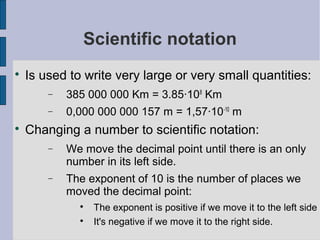
    Is used to write very large or very small quantities:
        −   385 000 000 Km = 3.85·108 Km
        −   0,000 000 000 157 m = 1,57·10-10 m

    Changing a number to scientific notation:
        −   We move the decimal point until there is an only
            number in its left side.
        −   The exponent of 10 is the number of places we
            moved the decimal point:
              
                  The exponent is positive if we move it to the left side
              
                  It's negative if we move it to the right side.
Measurement errors

    It's impossible to measure a quantity with
    total precision.

    When we measure, we'll never know the
    real value of the quantity.

    Every measurement has an error because:
       −   The measurement instrument can only see
           a few sig figs.
       −   It may not be well built or calibrated.
       −   We are using it in the wrong way.
Measurement errors

    There are two ways for expressing the error
    of a measurement:
       −   Absolute error: it is the difference
           between the value of the measurement and
           the value accepted as exact.
       −   Relative error: it is the absolute error in
           relationship with the quantity.
Measurement errors

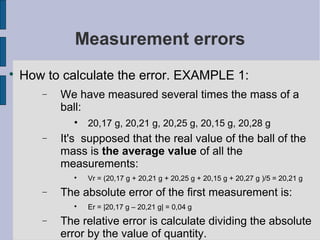
    How to calculate the error. EXAMPLE 1:
       −   We have measured several times the mass of a
           ball:
             
                 20,17 g, 20,21 g, 20,25 g, 20,15 g, 20,28 g
       −   It's supposed that the real value of the ball of the
           mass is the average value of all the
           measurements:
             
                 Vr = (20,17 g + 20,21 g + 20,25 g + 20,15 g + 20,27 g )/5 = 20,21 g
       −   The absolute error of the first measurement is:
             
                 Er = |20,17 g – 20,21 g| = 0,04 g
       −   The relative error is calculate dividing the absolute
           error by the value of quantity.
Measurement error

    How to calculate the error. EXAMPLE 2:
       −   We have measured once the length of a
           piece of paper using a ruler that is
           graduated in millimetres: 29,7 cm
       −   We suppose that the real value is the
           measured value.
       −   The absolute error is the precision of the
           rule:
                Ea = 0,1 cm
       −   Relative error:
             
                 Er = 0,1 cm / 29,7 cm = 0,0034 = 0,34 %

Scientific Work

  • 1.
  • 2.
    Physics and Chemistry  What do they have in common?  Physicists and Chemists study the same: matter.  Physicists, Chemists and other scientists work in the same way:  SCIENTIFIC METHOD
  • 3.
    Physics and Chemistry  What makes them different?  Physics studies phenomena that don't change the composition of matter.  Chemistry studies phenomena that change the composition of matter.
  • 4.
  • 5.
    SCIENTIFIC METHOD  The observation of a phenomenon and curiosity make scientists ask questions.  Before doing anything else, it's necessary to look for the previous knowledge about the phenomenon.
  • 6.
    SCIENTIFIC METHOD  Hypotheses are possible answers to the questions we asked.  They are only testable predictions about the phenomenon.
  • 7.
    SCIENTIFIC METHOD  We use experiments for checking hypotheses.  We reproduce a phenomenon in controlled conditions.  We need measure and collecting data in tables or graphics
  • 8.
    SCIENTIFIC METHOD  We study the relationships between different variables.  In an experiment there are three kinds of variables − Independent variables: they can be changed. − Dependent variables: they are measured. − Controlled variables: they don't change.
  • 9.
    SCIENTIFIC METHOD  After the experiment, we analyse its results and draw a conclusion.  If the hypothesis is true, we have learnt something new and it becomes in a law  If the hypothesis is false. We must look for a new hypothesis and continue the research.
  • 10.
    Magnitudes, measurements and units  Physical Magnitude: It refers to every property of matter that can be measured. − Length, mass, surface, volume, density, velocity, force, temperature,...  Measure: It compares a quantity of a magnitude with other that we use as a reference (unit).  Unit: It is a quantity of a magnitude used to measure other quantities of the same magnitude. It's only useful if every people uses the same unit.
  • 11.
    Magnitudes, measurements and units Length of the classroom = 10 m means The length of the classroom is 10 times the length of 1 metre.
  • 12.
    The International System of Units  The SI has: − a small group of magnitudes whose units are fixed directly: the fundamental magnitudes.  E.g.: Length → meter (m); Time → second (s) − The units for the other magnitudes are defined in relationship with the fundamental units: the derivative magnitudes.  E. g.: speed → meter/second (m/s)
  • 13.
    The International System of Units The fundamental magnitudes and their units Length meter m Mass kilogram kg Time second s Amount of substance mole mol Temperature Kelvin K Electric current amperes A Luminous intensity candela cd
  • 14.
    The International System of Units Some examples of how to build the units of derivative magnitudes: − Area = Length · width → m·m = m2 − Volume = Length · width · height → m·m·m = m3 − Speed = distance / time → m/s − Acceleration = change of speed / time → (m/s)/s = m/s2
  • 15.
    The International System of Units Some examples of how to build the units of derivative magnitudes: − Area = Length · width → m·m = m2 − Volume = Length · width · height → m·m·m = m3 − Speed = distance / time → m/s − Acceleration = change of speed / time → (m/s)/s = m/s2
  • 16.
    The International System of Units More derivative units. Quantity Name Symbol Area square meter m2 Volume cubic meter m3 Force Newton N Pressure Pascal Pa Energy Joule J Power Watt W Voltage volt V Frequency Hertz Hz Electric charge Coulomb C
  • 17.
    The International System of Units Prefixes: we used them when we need express quantities much bigger or smaller than basic unit. Power of 10 for Prefix Symbol Meaning Scientific Notation _______________________________________________________________________ mega- M 1,000,000 106 kilo- k 1,000 103 deci- d 0.1 10-1 centi- c 0.01 10-2 milli- m 0.001 10-3 micro- µ 0.000001 10-6 nano- n 0.000000001 10-9
  • 18.
    The International System of Units Prefixes: the whole list Factor Name Symbol Factor Name Symbol 10-1 decimeter dm 101 decameter dam 10-2 centimeter cm 102 hectometer hm 10-3 millimeter mm 103 kilometer km 10-6 micrometer µm 106 megameter Mm 10-9 nanometer nm 109 gigameter Gm 10-12 picometer pm 1012 terameter Tm 10-15 femtometer fm 1015 petameter Pm 10-18 attometer am 1018 exameter Em 10-21 zeptometer zm 1021 zettameter Zm 10-24 yoctometer ym 1024 yottameter Ym
  • 19.
    Changing units  We can change a quantity into another unit. Conversion factors help us to do it.  A conversion factor is a fraction with the same quantity in its denominator and in its numerator but expressed in different units. 1h 1 km =1 =1 60 min 1000 m 60 min 1000 m =1 =1 1h 1 km
  • 20.
    Changing units Let'ssee a few examples of how to use them 1 km 2570 km ·1 2570 m · = =2,570 km 1000 m 1000 1 h 1 min 3500 h 3500 s · · = =0,972 h 60 min 60 s 3600 2  500 cm² · 1m 100 cm  =500 cm² ·  1m² 10000 cm² =  500 m² 10000 =0,05 m² m m 1 km 3600 s 30 · 3600 km km 30 =30 · · = =108 s s 1000 m 1 h 1000 h h
  • 21.
    Significant figures • They indicate precision of a measurement. • Sig Figs in a measurement are the really known digits. 2.3 cm
  • 22.
    Significant figures  Counting Sig Figs: − Which are sig figs?  All nonzero digits.  Zeros between nonzero digits − Which aren't sig figs?  Leading zeros – 0,0025  Final zeros without a decimal point – 250  Examples: − 0,00120 → 3 sig figs; 15000 → 2 sig figs − 15000, → 5 sig figs; 13,04 → 4 sig
  • 23.
    Significant figures  Calculating with sig figs − Multiplicate or divide: the factor with the fewer number of sig figs determines the number of sig figs of the result:  2,345 m · 4,55 m = 10,66975 m 2 = 10,7 m2  (4 sig figs) (3 sig figs) → (3 sig figs) − Add or substract: the number with the fewer number of decimal places determines the number of decimal places of the result:  3,456 m + 2,35 m = 5,806 m = 5,81 m  (3 decimal places) (2 decimal places) → (2 decimal places)
  • 24.
    Significant figures  Calculating with sig figs − Exact number have no limit of sig fig:  Example: Area = ½ · Base · height.  ½ isn't taken into account to round the result. − Rounding the result:  If the first figure is 5, 6, 7, 8 or 9, the last figure taken into account is increased in 1  If not, it doesn't change.
  • 25.
    Scientific notation  Is used to write very large or very small quantities: − 385 000 000 Km = 3.85·108 Km − 0,000 000 000 157 m = 1,57·10-10 m  Changing a number to scientific notation: − We move the decimal point until there is an only number in its left side. − The exponent of 10 is the number of places we moved the decimal point:  The exponent is positive if we move it to the left side  It's negative if we move it to the right side.
  • 26.
    Measurement errors  It's impossible to measure a quantity with total precision.  When we measure, we'll never know the real value of the quantity.  Every measurement has an error because: − The measurement instrument can only see a few sig figs. − It may not be well built or calibrated. − We are using it in the wrong way.
  • 27.
    Measurement errors  There are two ways for expressing the error of a measurement: − Absolute error: it is the difference between the value of the measurement and the value accepted as exact. − Relative error: it is the absolute error in relationship with the quantity.
  • 28.
    Measurement errors  How to calculate the error. EXAMPLE 1: − We have measured several times the mass of a ball:  20,17 g, 20,21 g, 20,25 g, 20,15 g, 20,28 g − It's supposed that the real value of the ball of the mass is the average value of all the measurements:  Vr = (20,17 g + 20,21 g + 20,25 g + 20,15 g + 20,27 g )/5 = 20,21 g − The absolute error of the first measurement is:  Er = |20,17 g – 20,21 g| = 0,04 g − The relative error is calculate dividing the absolute error by the value of quantity.
  • 29.
    Measurement error  How to calculate the error. EXAMPLE 2: − We have measured once the length of a piece of paper using a ruler that is graduated in millimetres: 29,7 cm − We suppose that the real value is the measured value. − The absolute error is the precision of the rule:  Ea = 0,1 cm − Relative error:  Er = 0,1 cm / 29,7 cm = 0,0034 = 0,34 %