Chromosomal aberrations are substantial changes in chromosome structure that can occur in two primary ways: 1) altering the total amount of genetic material through deficiencies/deletions or duplications/insertions, or 2) rearranging the genetic material through inversions or translocations. Specific chromosomal aberrations include deletions where parts of chromosomes are missing, duplications where chromosomal segments are repeated, inversions where genetic material changes direction along a chromosome, and translocations where segments are transferred between non-homologous chromosomes. While most chromosomal aberrations have no phenotypic effect, some can cause genetic disorders and abnormalities.
Chromosomal Aberrations
“ Substantialchanges in chromosome structure
are called chromosomal aberrations”
*There are TWO primary ways in which the
structure of chromosomes can be altered
1-The total amount of genetic information in the
chromosome can change ;
* Decrease : Deficiencies / Deletions
* Increase : Duplications / Insertions
2.
Chromosomal Aberrations
2-The geneticmaterial may remain the same , but
is rearranged;
* Inversions
*Translocations
Alterations in Chromosome structure
-Deletion : Loss of a chromosomal segment .
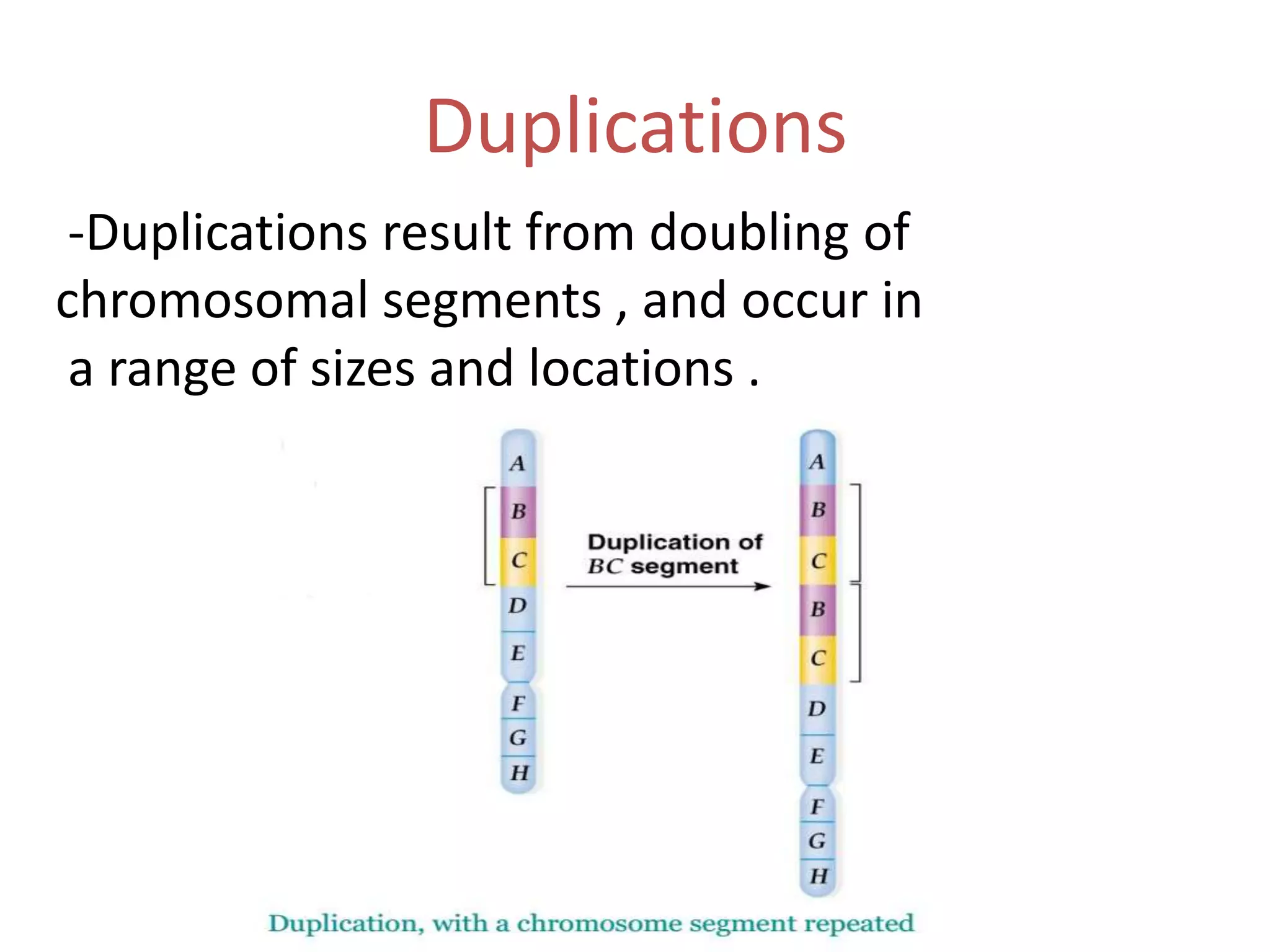
-Duplication : Repetition of a chromosomal
segment .
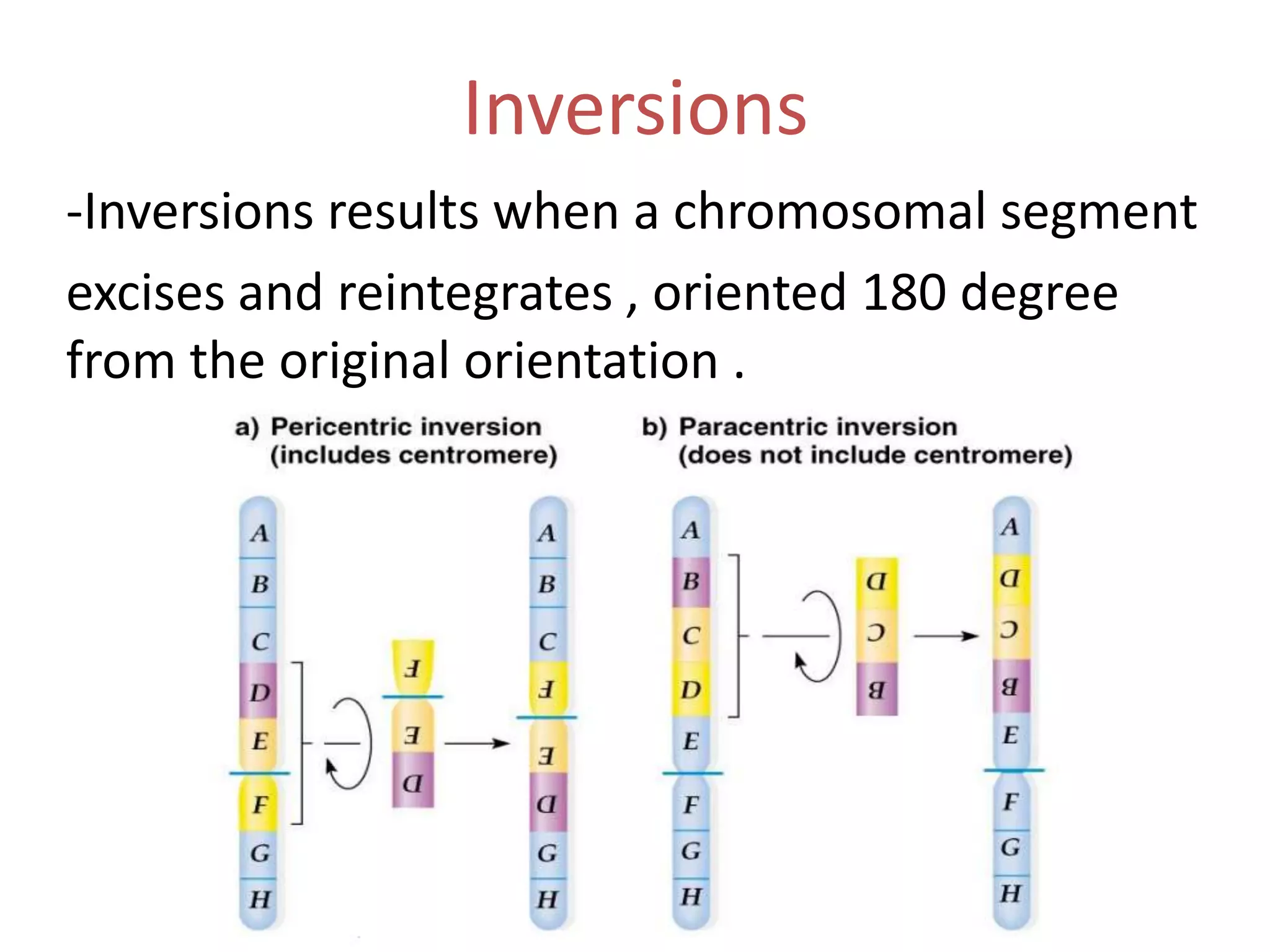
-Inversion : A change in the direction of genetic
material along a single chromosome.
3.
Chromosomal Aberrations
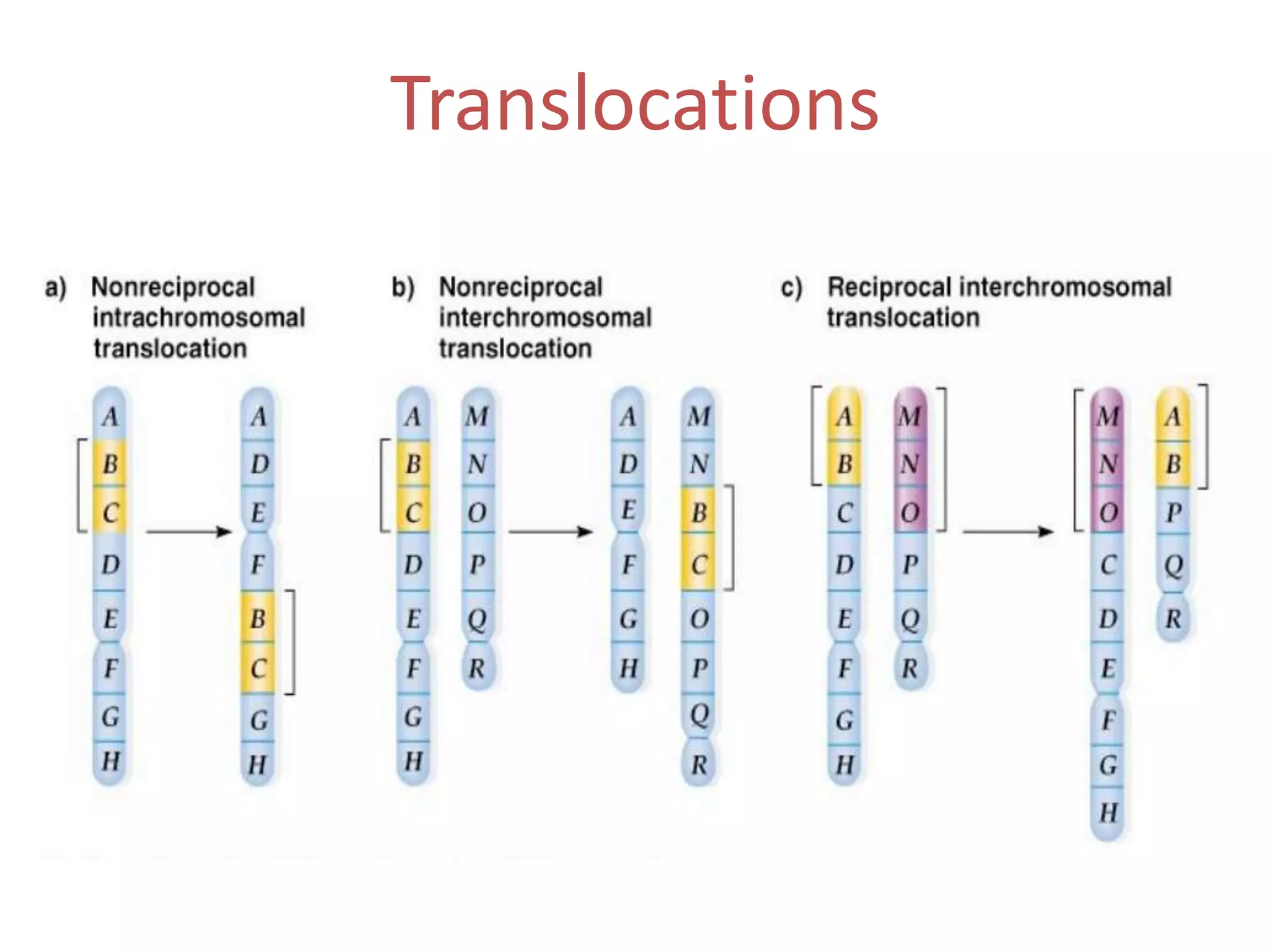
-Translocation :A segment of one •
chromosome becomes attached to a non
homologous chromosome
* Simple Translocations
- one way transfer
* Reciprocal Translocations
- Two way transfer
4.
Deletions
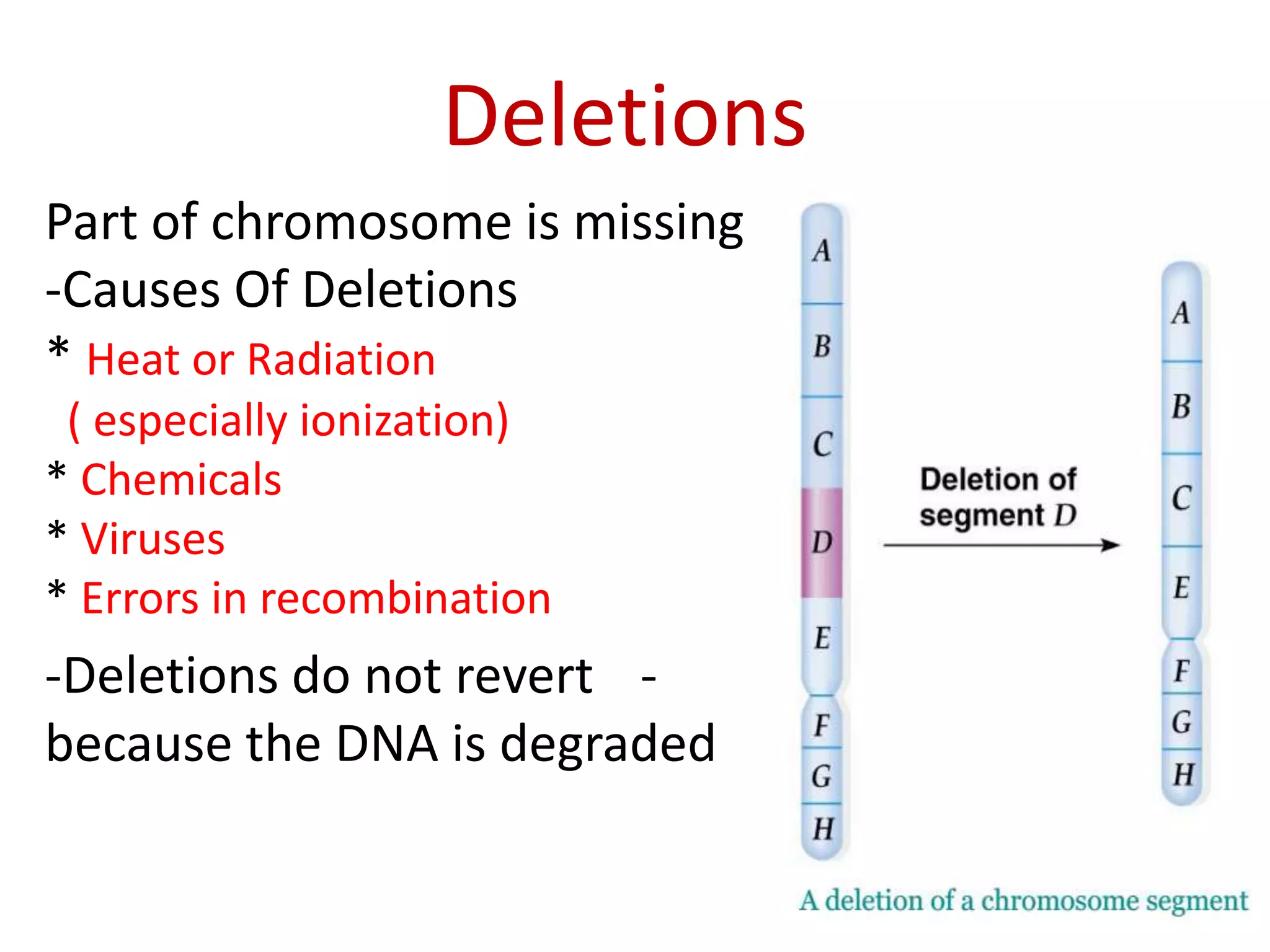
Part of chromosomeis missing
-Causes Of Deletions
* Heat or Radiation
( especially ionization)
* Chemicals
* Viruses
* Errors in recombination
-Deletions do not revert because the DNA is degraded
-
5.
Deletions
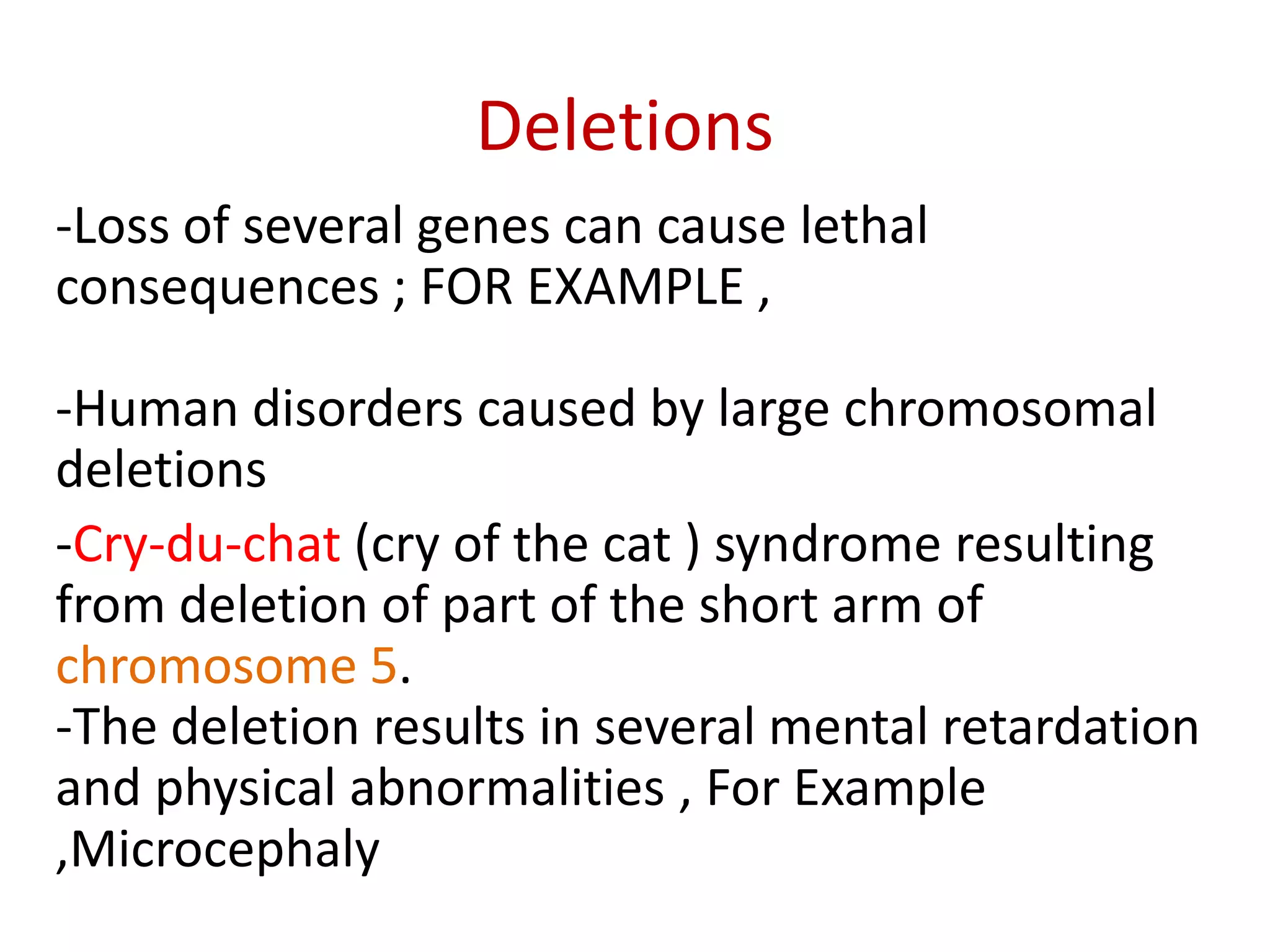
-Loss of severalgenes can cause lethal
consequences ; FOR EXAMPLE ,
-Human disorders caused by large chromosomal
deletions
-Cry-du-chat (cry of the cat ) syndrome resulting
from deletion of part of the short arm of
chromosome 5.
-The deletion results in several mental retardation
and physical abnormalities , For Example
,Microcephaly
Duplication
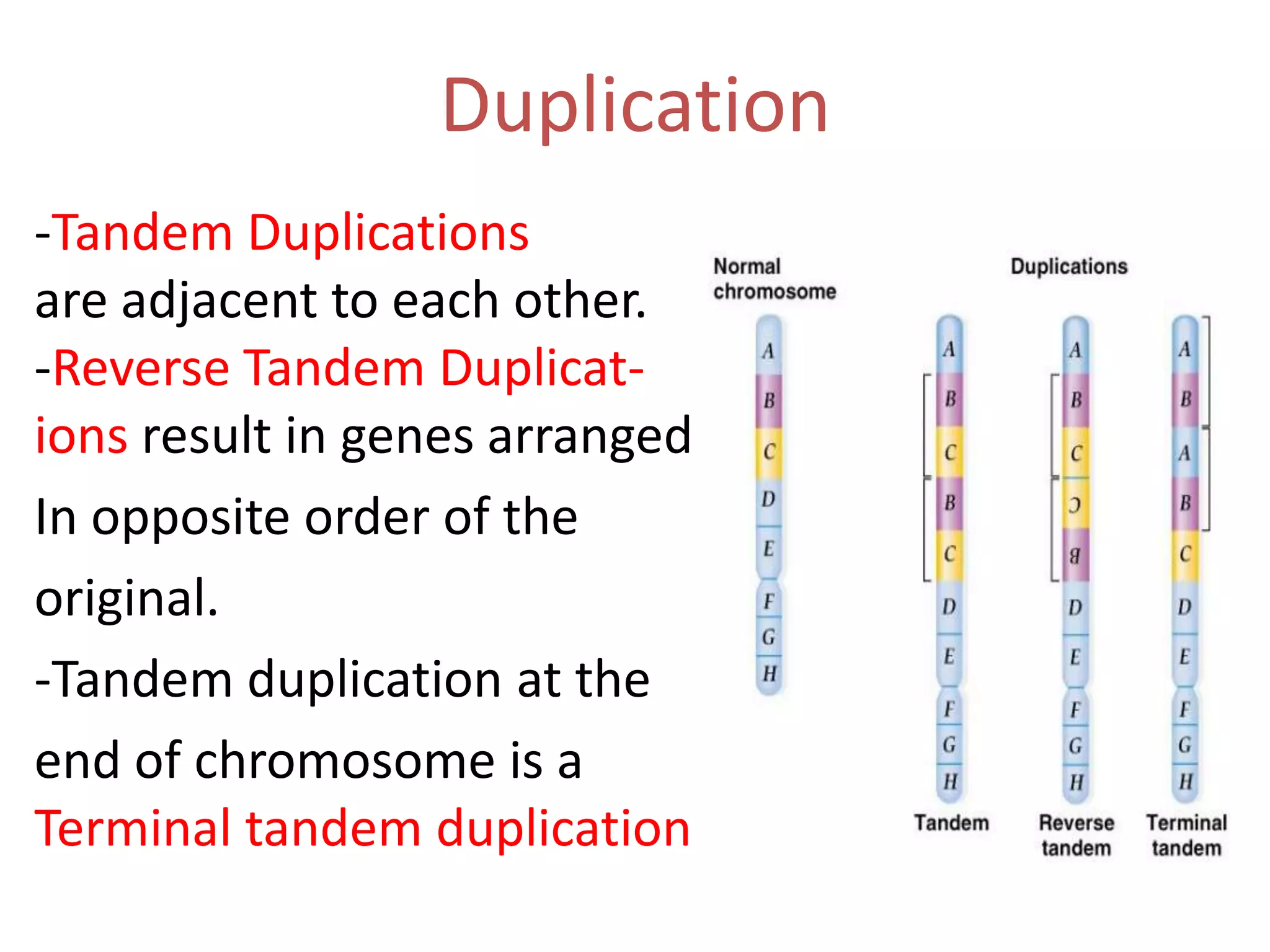
-Tandem Duplications
are adjacentto each other.
-Reverse Tandem Duplications result in genes arranged
In opposite order of the
original.
-Tandem duplication at the
end of chromosome is a
Terminal tandem duplication .
Inversion
*In an Inversion, the total amount of genetic •
information stays the same.
-Therefore ,the great majority of inversions have no •
phenotypic consequences
*In rare cases, inversions can alter the •
phenotype of an individual,
-Break point effect :
-The breaks leading to the inversions occur in a vital •
gene
•
10.
Inversions
-Position effect :•
-A gene is repositioned in a way that alters its gene •
expression
-About 2 % of the human population carries •
inversions that are detectable with a light
microscope.
-most of these individuals are phenotypically normal •
-However , a few produce offspring with genetic •
abnormalities
11.
Translocations
-Translocation occurs whena segment of one •
chromosome becomes attached to another.
-There are two main types of translocations ;
*Reciprocal (balanced) translocations
*Robertsonian(unbalanced) translocations
-Both types of translocations can cause disease in
humans.
Reciprocal Translocations
-In Reciprocaltranslocations two non-homologous
Chromosomes exchange genetic material.
-Reciprocal translocation arise from two different
mechanisms ;
1-chromosomal breakage and DNA repair
2-Abnormal crossovers
-Reciprocal translocations
lead to the rearrangement of the genetic material,
-not a change in the total amount
-thus , they are also called balanced translocations
14.
Robertsonian Translocations
-In Robertsoniantranslocations the transfer of •
genetic material occurs in only one direction.
-Robertsonian translocations are associated with
phenotypic abnormalities or even lethality.
-EXAMPLE :Familial Down Syndrome
-in this condition , the majority of chromosome
21 is attached to chromosome 14 .
-The individual would have three copies of genes
found on a large segment of chromosome 21