Chromosomal Aberrations
Dr. A. S. Wabale
Assistant Professor and Research Guide
Post Graduate Department of Botany and Research Centre,
Padmashri Vikhe Patil College of Arts, Science and
Commerce, Pravaranagar- 413 713
dranilwabale78@gmail.com
CONTENTS
Types of structural changes in chromosomes
A) Deletion: types, cytology and genetic effects
B) Duplication: types and cytology, position effect and bar eye phenotype in Drosophila
C) Inversion: types and their cytology,
D) Translocation: types and translocation complexes
E) Variation in chromosome morphology: Isochromosomes, ring chromosomes and
Robertsonian translocation
April 8, 2021 Dr. A. S. Wabale
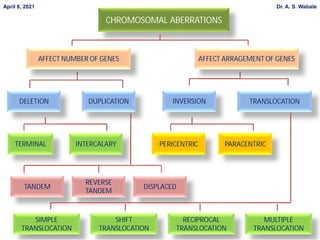
CHROMOSOMAL ABERRATIONS
PERICENTRIC PARACENTRIC
TRANSLOCATION
DELETION
TERMINAL INTERCALARY
SIMPLE
TRANSLOCATION
AFFECT NUMBER OF GENES AFFECT ARRAGEMENT OF GENES
TANDEM
REVERSE
TANDEM
DISPLACED
DUPLICATION INVERSION
RECIPROCAL
TRANSLOCATION
MULTIPLE
TRANSLOCATION
SHIFT
TRANSLOCATION
April 8, 2021 Dr. A. S. Wabale
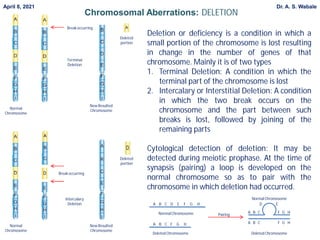
Chromosomal Aberrations: DELETION
Deletion or deficiency is a condition in which a
small portion of the chromosome is lost resulting
in change in the number of genes of that
chromosome. Mainly it is of two types
1. Terminal Deletion: A condition in which the
terminal part of the chromosome is lost
2. Intercalary or Interstitial Deletion: A condition
in which the two break occurs on the
chromosome and the part between such
breaks is lost, followed by joining of the
remaining parts
Cytological detection of deletion: It may be
detected during meiotic prophase. At the time of
synapsis (pairing) a loop is developed on the
normal chromosome so as to pair with the
chromosome in which deletion had occurred.
Deleted
portion
New Resulted
Chromosome
Break occurring
Normal
Chromosome
Terminal
Deletion
Normal
Chromosome
New Resulted
Chromosome
Deleted
portion
Break occurring
Intercalary
Deletion A B C D E F G H
A B C F G H
Normal Chromosome
Deleted Chromosome
Pairing
Deleted Chromosome
A B C F G H
D E
Normal Chromosome
A B C F G H
April 8, 2021 Dr. A. S. Wabale
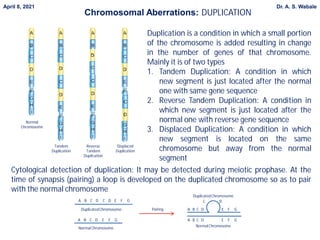
Chromosomal Aberrations: DUPLICATION
Duplication is a condition in which a small portion
of the chromosome is added resulting in change
in the number of genes of that chromosome.
Mainly it is of two types
1. Tandem Duplication: A condition in which
new segment is just located after the normal
one with same gene sequence
2. Reverse Tandem Duplication: A condition in
which new segment is just located after the
normal one with reverse gene sequence
3. Displaced Duplication: A condition in which
new segment is located on the same
chromosome but away from the normal
segment
Normal
Chromosome
Tandem
Duplication
Reverse
Tandem
Duplication
Displaced
Duplication
Cytological detection of duplication: It may be detected during meiotic prophase. At the
time of synapsis (pairing) a loop is developed on the duplicated chromosome so as to pair
with the normal chromosome
A B C D C D E F G
DuplicatedChromosome
Normal Chromosome
Pairing
Normal Chromosome
A B C D E F G
C D
DuplicatedChromosome
A B C D E F G
A B C D E F G
April 8, 2021 Dr. A. S. Wabale
Chromosome
Structure
Phenotype
X-16A
X-16A
Normal Eye Female
X-16A-16A
X-16A
Bar Eye Female
X-16A-16A
X-16A-16A
Bar eye female (more restricted, 68
facets)
X-16A-16A-16A
X-16A
Double bar eye female (45 facets)
X-16A-16A-16A
X-16A-16A-16A
Double bar eye female (further
reduced)
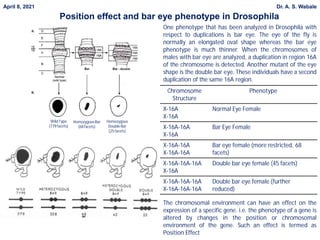
One phenotype that has been analyzed in Drosophila with
respect to duplications is bar eye. The eye of the fly is
normally an elongated oval shape whereas the bar eye
phenotype is much thinner. When the chromosomes of
males with bar eye are analyzed, a duplication in region 16A
of the chromosome is detected. Another mutant of the eye
shape is the double bar eye. These individuals have a second
duplication of the same 16A region.
The chromosomal environment can have an effect on the
expression of a specific gene. i.e. the phenotype of a gene is
altered by changes in the position or chromosomal
environment of the gene. Such an effect is termed as
Position Effect
Wild Type
(779 facets)
HomozygousBar
(68 facets)
Homozygous
Double Bar
(25 facets)
Position effect and bar eye phenotype in Drosophila
April 8, 2021 Dr. A. S. Wabale
Chromosomal Aberrations: INVERSION
A event in which two breaks occur in a chromosome, the region between these breaks
rotates at 180 degrees and rejoins with the two end fragments refers to Inversion. Unlike
deletions and duplications, inversions do not change the overall amount of the genetic
material, so inversions are generally viable and show no particular abnormalities at the
phenotypic level.
Depending upon the involvement of centromere, inversion is of two types:
1. If the centromere is outside the inversion, then the inversion is said to be paracentric
2. If the centromere is within inverted part then the inversion is said to be pericentric
PARACENTRIC
INVERSION
PERICENTRIC
INVERSION
April 8, 2021 Dr. A. S. Wabale
https://www.youtube.com/watch?v=QXU7XojaEOs
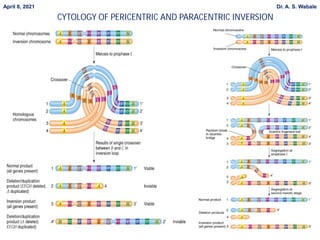
CYTOLOGY OF PERICENTRIC AND PARACENTRIC INVERSION
April 8, 2021 Dr. A. S. Wabale
TRANSLOCATION
April 8, 2021 Dr. A. S. Wabale
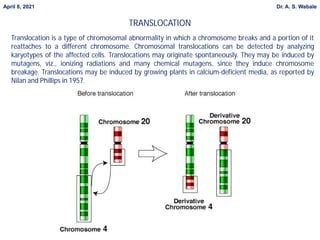
Translocation is a type of chromosomal abnormality in which a chromosome breaks and a portion of it
reattaches to a different chromosome. Chromosomal translocations can be detected by analyzing
karyotypes of the affected cells. Translocations may originate spontaneously. They may be induced by
mutagens, viz., ionizing radiations and many chemical mutagens, since they induce chromosome
breakage. Translocations may be induced by growing plants in calcium-deficient media, as reported by
Nilan and Phillips in 1957.
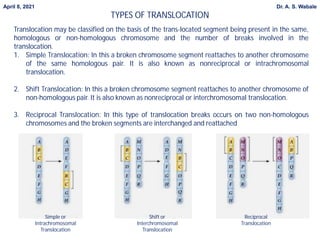
Translocation may be classified on the basis of the trans-located segment being present in the same,
homologous or non-homologous chromosome and the number of breaks involved in the
translocation.
1. Simple Translocation: In this a broken chromosome segment reattaches to another chromosome
of the same homologous pair. It is also known as nonreciprocal or intrachromosomal
translocation.
2. Shift Translocation: In this a broken chromosome segment reattaches to another chromosome of
non-homologous pair. It is also known as nonreciprocal or interchromosomal translocation.
3. Reciprocal Translocation: In this type of translocation breaks occurs on two non-homologous
chromosomes and the broken segments are interchanged and reattached
Simple or
Intrachromosomal
Translocation
Shift or
Interchromosomal
Translocation
Reciprocal
Translocation
TYPES OF TRANSLOCATION
April 8, 2021 Dr. A. S. Wabale
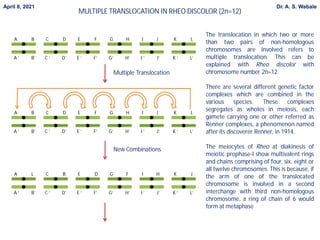
MULTIPLE TRANSLOCATION IN RHEO DISCOLOR (2n=12)
April 8, 2021 Dr. A. S. Wabale
A B C D E F G H I J K L
A ‘ B’ C ‘ D’ E ‘ F’ G‘ H’ I ‘ J’ K ‘ L’
A B C D E F G H I J K L
A ‘ B’ C ‘ D’ E ‘ F’ G‘ H’ I ‘ J’ K ‘ L’
Multiple Translocation
New Combinations
A L C B E D G F I H K J
A ‘ B’ C ‘ D’ E ‘ F’ G‘ H’ I ‘ J’ K ‘ L’
The translocation in which two or more
than two pairs of non-homologous
chromosomes are involved refers to
multiple translocation. This can be
explained with Rheo discolor with
chromosome number 2n=12.
There are several different genetic factor
complexes which are combined in the
various species. These complexes
segregates as wholes in meiosis, each
gamete carrying one or other referred as
Renner complexes, a phenomenon named
after its discoverer Renner, in 1914.
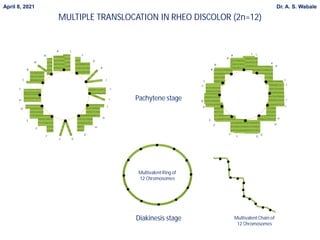
The meiocytes of Rheo at diakinesis of
meiotic prophase-I show multivalent rings
and chains comprising of four, six, eight or
all twelve chromosomes. This is because, if
the arm of one of the translocated
chromosome is involved in a second
interchange with third non-homologous
chromosome, a ring of chain of 6 would
form at metaphase
A L
L’
K’
K
J
J ’
I ’
I
H
H ‘
G ’
G
F
F ‘
E ‘
E
D
D ’
C ’
C
B
B ‘
A ‘
Pachytene stage
MULTIPLE TRANSLOCATION IN RHEO DISCOLOR (2n=12)
April 8, 2021 Dr. A. S. Wabale
MultivalentRing of
12 Chromosomes
Diakinesis stage
A
L L’
K’
K
J
J ’
I ’
I
H
H ‘
G ’
G
F
F ‘
E ‘
E
D
D ’
C ’
C
B
B ‘
A ‘
MultivalentChain of
12 Chromosomes
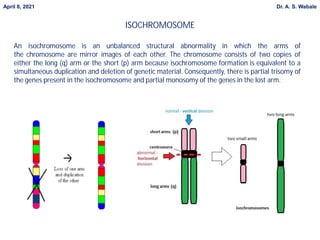
An isochromosome is an unbalanced structural abnormality in which the arms of
the chromosome are mirror images of each other. The chromosome consists of two copies of
either the long (q) arm or the short (p) arm because isochromosome formation is equivalent to a
simultaneous duplication and deletion of genetic material. Consequently, there is partial trisomy of
the genes present in the isochromosome and partial monosomy of the genes in the lost arm.
ISOCHROMOSOME
April 8, 2021 Dr. A. S. Wabale
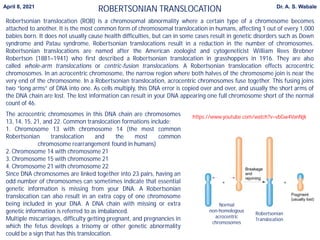
Robertsonian translocation (ROB) is a chromosomal abnormality where a certain type of a chromosome becomes
attached to another. It is the most common form of chromosomal translocation in humans, affecting 1 out of every 1,000
babies born. It does not usually cause health difficulties, but can in some cases result in genetic disorders such as Down
syndrome and Patau syndrome. Robertsonian translocations result in a reduction in the number of chromosomes.
Robertsonian translocations are named after the American zoologist and cytogeneticist William Rees Brebner
Robertson (1881–1941) who first described a Robertsonian translocation in grasshoppers in 1916. They are also
called whole-arm translocations or centric-fusion translocations. A Robertsonian translocation effects acrocentric
chromosomes. In an acrocentric chromosome, the narrow region where both halves of the chromosome join is near the
very end of the chromosome. In a Robertsonian translocation, acrocentric chromosomes fuse together. This fusing joins
two “long arms” of DNA into one. As cells multiply, this DNA error is copied over and over, and usually the short arms of
the DNA chain are lost. The lost information can result in your DNA appearing one full chromosome short of the normal
count of 46.
The acrocentric chromosomes in this DNA chain are chromosomes
13, 14, 15, 21, and 22. Common translocation formations include:
1. Chromosome 13 with chromosome 14 (the most common
Robertsonian translocation and the most common
chromosome rearrangement found in humans)
2. Chromosome 14 with chromosome 21
3. Chromosome 15 with chromosome 21
4. Chromosome 21 with chromosome 22
Since DNA chromosomes are linked together into 23 pairs, having an
odd number of chromosomes can sometimes indicate that essential
genetic information is missing from your DNA. A Robertsonian
translocation can also result in an extra copy of one chromosome
being included in your DNA. A DNA chain with missing or extra
genetic information is referred to as imbalanced.
Multiple miscarriages, difficulty getting pregnant, and pregnancies in
which the fetus develops a trisomy or other genetic abnormality
could be a sign that has this translocation.
https://www.youtube.com/watch?v=vbGw4VanNjk
Robertsonian
Translocation
Normal
non-homologous
acrocentric
chromosomes
ROBERTSONIAN TRANSLOCATION
April 8, 2021 Dr. A. S. Wabale
ASSIGNMENT
April 8, 2021 Dr. A. S. Wabale
Que.1) Explain Chromosomal Aberration / Structural changes in chromosomes in brief
Que.2) Explain deletion, its types, cytological detection y and genetic effects
Que.3) Explain duplication, its types, cytological detection y and genetic effects
Que.4) Explain inversion and its types
Que.5) Explain pericentric inversion in detail
Que.6) Explain paracentric inversion in detail
Que.7) Explain translocation and its types
Que.8) Explain multiple translocation in Rhoe discolor
Que.9) Comment on Robertsonian translocation
Que.10) Comment on Isochromosome

Chromosomal aberrations

  • 1.
    Chromosomal Aberrations Dr. A.S. Wabale Assistant Professor and Research Guide Post Graduate Department of Botany and Research Centre, Padmashri Vikhe Patil College of Arts, Science and Commerce, Pravaranagar- 413 713 dranilwabale78@gmail.com
  • 2.
    CONTENTS Types of structuralchanges in chromosomes A) Deletion: types, cytology and genetic effects B) Duplication: types and cytology, position effect and bar eye phenotype in Drosophila C) Inversion: types and their cytology, D) Translocation: types and translocation complexes E) Variation in chromosome morphology: Isochromosomes, ring chromosomes and Robertsonian translocation April 8, 2021 Dr. A. S. Wabale
  • 3.
    CHROMOSOMAL ABERRATIONS PERICENTRIC PARACENTRIC TRANSLOCATION DELETION TERMINALINTERCALARY SIMPLE TRANSLOCATION AFFECT NUMBER OF GENES AFFECT ARRAGEMENT OF GENES TANDEM REVERSE TANDEM DISPLACED DUPLICATION INVERSION RECIPROCAL TRANSLOCATION MULTIPLE TRANSLOCATION SHIFT TRANSLOCATION April 8, 2021 Dr. A. S. Wabale
  • 4.
    Chromosomal Aberrations: DELETION Deletionor deficiency is a condition in which a small portion of the chromosome is lost resulting in change in the number of genes of that chromosome. Mainly it is of two types 1. Terminal Deletion: A condition in which the terminal part of the chromosome is lost 2. Intercalary or Interstitial Deletion: A condition in which the two break occurs on the chromosome and the part between such breaks is lost, followed by joining of the remaining parts Cytological detection of deletion: It may be detected during meiotic prophase. At the time of synapsis (pairing) a loop is developed on the normal chromosome so as to pair with the chromosome in which deletion had occurred. Deleted portion New Resulted Chromosome Break occurring Normal Chromosome Terminal Deletion Normal Chromosome New Resulted Chromosome Deleted portion Break occurring Intercalary Deletion A B C D E F G H A B C F G H Normal Chromosome Deleted Chromosome Pairing Deleted Chromosome A B C F G H D E Normal Chromosome A B C F G H April 8, 2021 Dr. A. S. Wabale
  • 5.
    Chromosomal Aberrations: DUPLICATION Duplicationis a condition in which a small portion of the chromosome is added resulting in change in the number of genes of that chromosome. Mainly it is of two types 1. Tandem Duplication: A condition in which new segment is just located after the normal one with same gene sequence 2. Reverse Tandem Duplication: A condition in which new segment is just located after the normal one with reverse gene sequence 3. Displaced Duplication: A condition in which new segment is located on the same chromosome but away from the normal segment Normal Chromosome Tandem Duplication Reverse Tandem Duplication Displaced Duplication Cytological detection of duplication: It may be detected during meiotic prophase. At the time of synapsis (pairing) a loop is developed on the duplicated chromosome so as to pair with the normal chromosome A B C D C D E F G DuplicatedChromosome Normal Chromosome Pairing Normal Chromosome A B C D E F G C D DuplicatedChromosome A B C D E F G A B C D E F G April 8, 2021 Dr. A. S. Wabale
  • 6.
    Chromosome Structure Phenotype X-16A X-16A Normal Eye Female X-16A-16A X-16A BarEye Female X-16A-16A X-16A-16A Bar eye female (more restricted, 68 facets) X-16A-16A-16A X-16A Double bar eye female (45 facets) X-16A-16A-16A X-16A-16A-16A Double bar eye female (further reduced) One phenotype that has been analyzed in Drosophila with respect to duplications is bar eye. The eye of the fly is normally an elongated oval shape whereas the bar eye phenotype is much thinner. When the chromosomes of males with bar eye are analyzed, a duplication in region 16A of the chromosome is detected. Another mutant of the eye shape is the double bar eye. These individuals have a second duplication of the same 16A region. The chromosomal environment can have an effect on the expression of a specific gene. i.e. the phenotype of a gene is altered by changes in the position or chromosomal environment of the gene. Such an effect is termed as Position Effect Wild Type (779 facets) HomozygousBar (68 facets) Homozygous Double Bar (25 facets) Position effect and bar eye phenotype in Drosophila April 8, 2021 Dr. A. S. Wabale
  • 7.
    Chromosomal Aberrations: INVERSION Aevent in which two breaks occur in a chromosome, the region between these breaks rotates at 180 degrees and rejoins with the two end fragments refers to Inversion. Unlike deletions and duplications, inversions do not change the overall amount of the genetic material, so inversions are generally viable and show no particular abnormalities at the phenotypic level. Depending upon the involvement of centromere, inversion is of two types: 1. If the centromere is outside the inversion, then the inversion is said to be paracentric 2. If the centromere is within inverted part then the inversion is said to be pericentric PARACENTRIC INVERSION PERICENTRIC INVERSION April 8, 2021 Dr. A. S. Wabale https://www.youtube.com/watch?v=QXU7XojaEOs
  • 8.
    CYTOLOGY OF PERICENTRICAND PARACENTRIC INVERSION April 8, 2021 Dr. A. S. Wabale
  • 9.
    TRANSLOCATION April 8, 2021Dr. A. S. Wabale Translocation is a type of chromosomal abnormality in which a chromosome breaks and a portion of it reattaches to a different chromosome. Chromosomal translocations can be detected by analyzing karyotypes of the affected cells. Translocations may originate spontaneously. They may be induced by mutagens, viz., ionizing radiations and many chemical mutagens, since they induce chromosome breakage. Translocations may be induced by growing plants in calcium-deficient media, as reported by Nilan and Phillips in 1957.
  • 10.
    Translocation may beclassified on the basis of the trans-located segment being present in the same, homologous or non-homologous chromosome and the number of breaks involved in the translocation. 1. Simple Translocation: In this a broken chromosome segment reattaches to another chromosome of the same homologous pair. It is also known as nonreciprocal or intrachromosomal translocation. 2. Shift Translocation: In this a broken chromosome segment reattaches to another chromosome of non-homologous pair. It is also known as nonreciprocal or interchromosomal translocation. 3. Reciprocal Translocation: In this type of translocation breaks occurs on two non-homologous chromosomes and the broken segments are interchanged and reattached Simple or Intrachromosomal Translocation Shift or Interchromosomal Translocation Reciprocal Translocation TYPES OF TRANSLOCATION April 8, 2021 Dr. A. S. Wabale
  • 11.
    MULTIPLE TRANSLOCATION INRHEO DISCOLOR (2n=12) April 8, 2021 Dr. A. S. Wabale A B C D E F G H I J K L A ‘ B’ C ‘ D’ E ‘ F’ G‘ H’ I ‘ J’ K ‘ L’ A B C D E F G H I J K L A ‘ B’ C ‘ D’ E ‘ F’ G‘ H’ I ‘ J’ K ‘ L’ Multiple Translocation New Combinations A L C B E D G F I H K J A ‘ B’ C ‘ D’ E ‘ F’ G‘ H’ I ‘ J’ K ‘ L’ The translocation in which two or more than two pairs of non-homologous chromosomes are involved refers to multiple translocation. This can be explained with Rheo discolor with chromosome number 2n=12. There are several different genetic factor complexes which are combined in the various species. These complexes segregates as wholes in meiosis, each gamete carrying one or other referred as Renner complexes, a phenomenon named after its discoverer Renner, in 1914. The meiocytes of Rheo at diakinesis of meiotic prophase-I show multivalent rings and chains comprising of four, six, eight or all twelve chromosomes. This is because, if the arm of one of the translocated chromosome is involved in a second interchange with third non-homologous chromosome, a ring of chain of 6 would form at metaphase
  • 12.
    A L L’ K’ K J J ’ I’ I H H ‘ G ’ G F F ‘ E ‘ E D D ’ C ’ C B B ‘ A ‘ Pachytene stage MULTIPLE TRANSLOCATION IN RHEO DISCOLOR (2n=12) April 8, 2021 Dr. A. S. Wabale MultivalentRing of 12 Chromosomes Diakinesis stage A L L’ K’ K J J ’ I ’ I H H ‘ G ’ G F F ‘ E ‘ E D D ’ C ’ C B B ‘ A ‘ MultivalentChain of 12 Chromosomes
  • 13.
    An isochromosome isan unbalanced structural abnormality in which the arms of the chromosome are mirror images of each other. The chromosome consists of two copies of either the long (q) arm or the short (p) arm because isochromosome formation is equivalent to a simultaneous duplication and deletion of genetic material. Consequently, there is partial trisomy of the genes present in the isochromosome and partial monosomy of the genes in the lost arm. ISOCHROMOSOME April 8, 2021 Dr. A. S. Wabale
  • 14.
    Robertsonian translocation (ROB)is a chromosomal abnormality where a certain type of a chromosome becomes attached to another. It is the most common form of chromosomal translocation in humans, affecting 1 out of every 1,000 babies born. It does not usually cause health difficulties, but can in some cases result in genetic disorders such as Down syndrome and Patau syndrome. Robertsonian translocations result in a reduction in the number of chromosomes. Robertsonian translocations are named after the American zoologist and cytogeneticist William Rees Brebner Robertson (1881–1941) who first described a Robertsonian translocation in grasshoppers in 1916. They are also called whole-arm translocations or centric-fusion translocations. A Robertsonian translocation effects acrocentric chromosomes. In an acrocentric chromosome, the narrow region where both halves of the chromosome join is near the very end of the chromosome. In a Robertsonian translocation, acrocentric chromosomes fuse together. This fusing joins two “long arms” of DNA into one. As cells multiply, this DNA error is copied over and over, and usually the short arms of the DNA chain are lost. The lost information can result in your DNA appearing one full chromosome short of the normal count of 46. The acrocentric chromosomes in this DNA chain are chromosomes 13, 14, 15, 21, and 22. Common translocation formations include: 1. Chromosome 13 with chromosome 14 (the most common Robertsonian translocation and the most common chromosome rearrangement found in humans) 2. Chromosome 14 with chromosome 21 3. Chromosome 15 with chromosome 21 4. Chromosome 21 with chromosome 22 Since DNA chromosomes are linked together into 23 pairs, having an odd number of chromosomes can sometimes indicate that essential genetic information is missing from your DNA. A Robertsonian translocation can also result in an extra copy of one chromosome being included in your DNA. A DNA chain with missing or extra genetic information is referred to as imbalanced. Multiple miscarriages, difficulty getting pregnant, and pregnancies in which the fetus develops a trisomy or other genetic abnormality could be a sign that has this translocation. https://www.youtube.com/watch?v=vbGw4VanNjk Robertsonian Translocation Normal non-homologous acrocentric chromosomes ROBERTSONIAN TRANSLOCATION April 8, 2021 Dr. A. S. Wabale
  • 15.
    ASSIGNMENT April 8, 2021Dr. A. S. Wabale Que.1) Explain Chromosomal Aberration / Structural changes in chromosomes in brief Que.2) Explain deletion, its types, cytological detection y and genetic effects Que.3) Explain duplication, its types, cytological detection y and genetic effects Que.4) Explain inversion and its types Que.5) Explain pericentric inversion in detail Que.6) Explain paracentric inversion in detail Que.7) Explain translocation and its types Que.8) Explain multiple translocation in Rhoe discolor Que.9) Comment on Robertsonian translocation Que.10) Comment on Isochromosome