Wel come 
• Topic :- structural Chromosomes aberrations and 
there role in plant breeding 
presented by, 
shrishaila 
PG14AGR6066 
UAS Raichur 
UASR shri cd 1
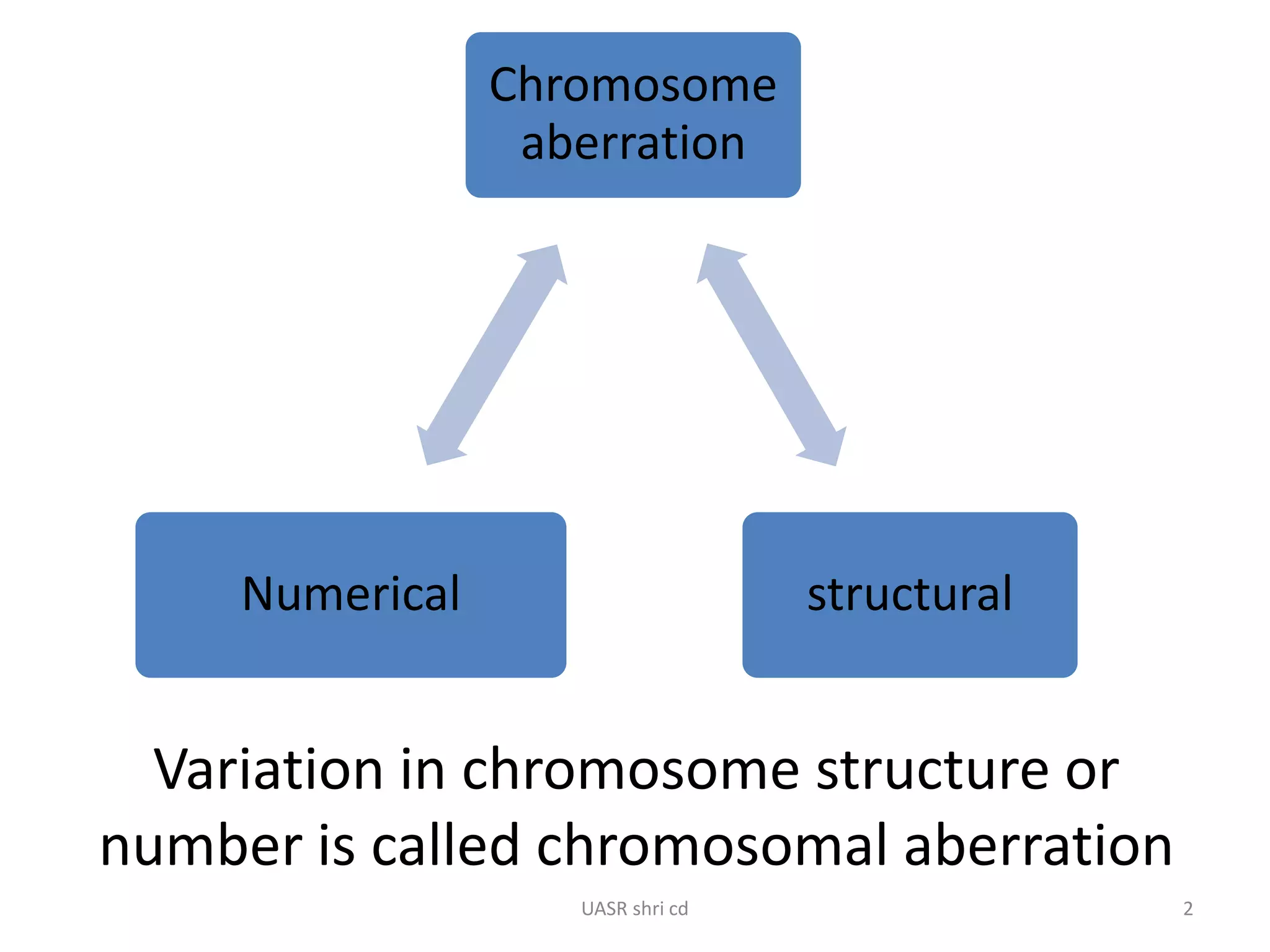
Chromosome 
aberration 
Numerical structural 
Variation in chromosome structure or 
number is called chromosomal aberration 
UASR shri cd 2
Chromosome Structural aberrations 
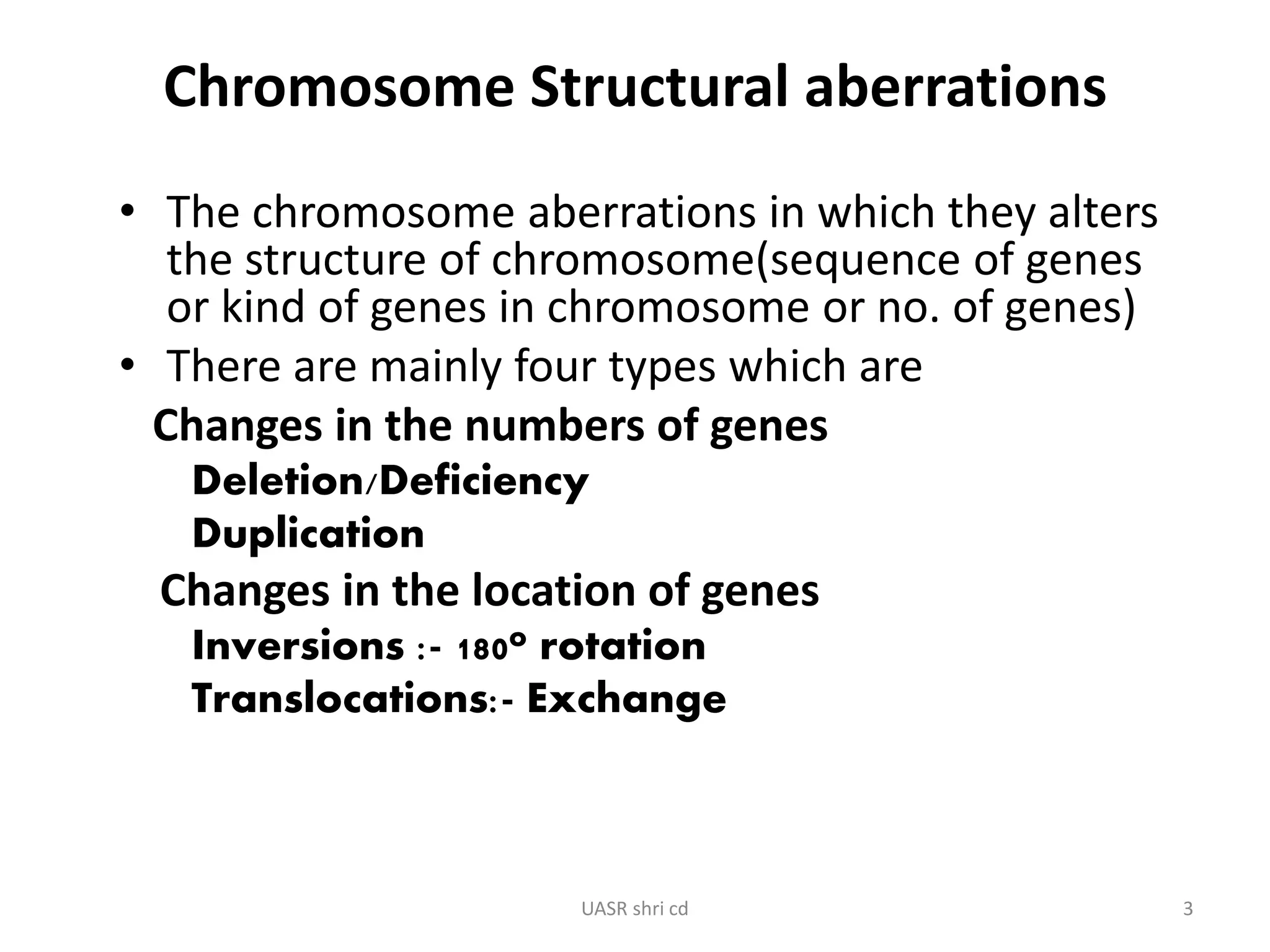
• The chromosome aberrations in which they alters 
the structure of chromosome(sequence of genes 
or kind of genes in chromosome or no. of genes) 
• There are mainly four types which are 
Changes in the numbers of genes 
Deletion/Deficiency 
Duplication 
Changes in the location of genes 
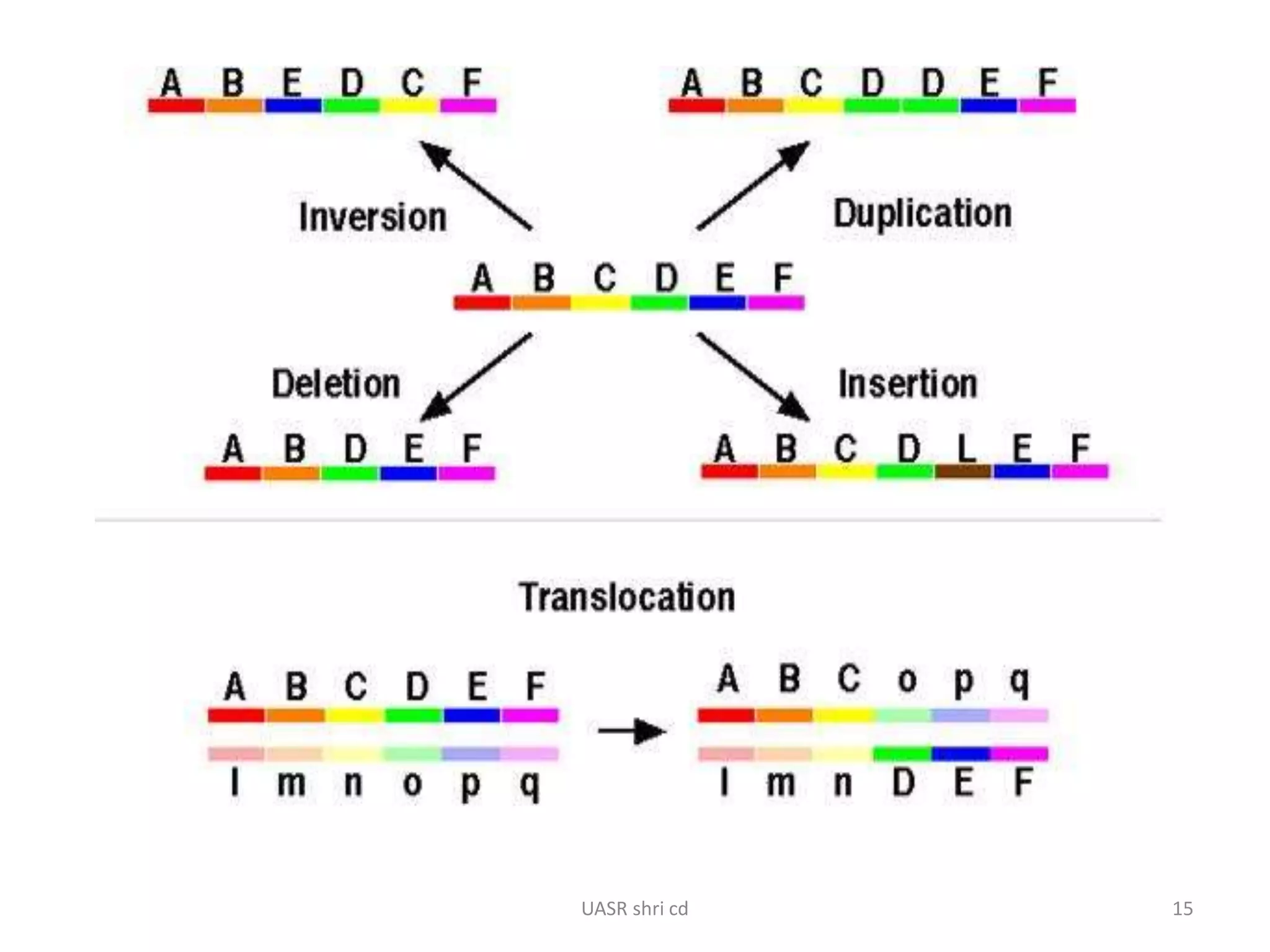
Inversions :- 180o rotation 
Translocations:- Exchange 
UASR shri cd 3
Origin of structural aberrations 
Deletion 
• spontaneously or may induced 
• Mis-division of the centromere 
• radiation, UV, chemicals, viruses may increase 
breakage 
Duplication 
• Unequal crossing over 
• Crossing over in inversion heterozygotes 
• Crossing over in translocated heterozygotes 
UASR shri cd 4
Inversion 
• Spontaneously and induced 
• Naturally in Drosophila 
• Produced through breakage and 
reassociation of chromosome 
Translocation 
• Spontaneously 
• Induced by mutagens 
• Growing a plants in ca deficit medium 
UASR shri cd 5
Deletion 
• First chromosome aberration discovered by 
the Bridges in 1917 in Drosophila 
• Usually detected by based on unpaired 
region of normal chromosome produces a 
loop during pachytene stage 
Two types which are 
Terminal 
Intercalary 
UASR shri cd 6
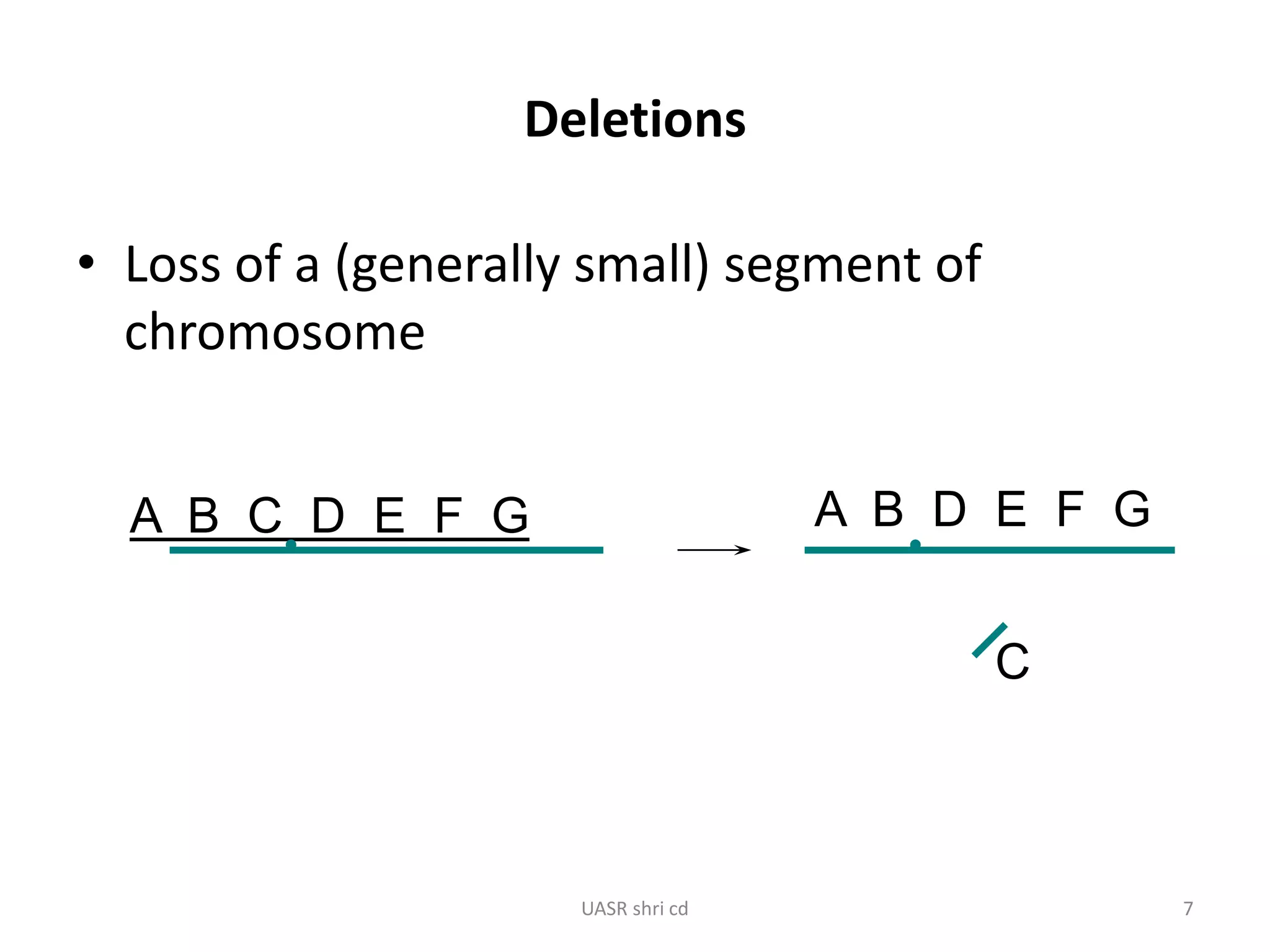
Deletions 
• Loss of a (generally small) segment of 
chromosome 
A B C D E F G A B D E F G 
C 
UASR shri cd 7
Terminal deletion 
• Loss of segment contain a telomere of 
affected chromosome 
• In 1938 Muller postulated that loss of 
telomere makes chromosome unstable so it is 
not commonly observed 
Ex:maize 
UASR shri cd 8
Intercalary deletion 
• Loss of segment in between centromere and 
telomere 
• It is commonly observed 
Ex:Drosophila 
UASR shri cd 9
Effects of deletion 
• Pseudo dominance 
• Crossing over not there 
• Harmful effect on diploid organisms 
• Most are as recessive Lethals 
• Morphological effects 
UASR shri cd 10
Duplication 
• Bridges in 1919 
• It is detected by presence of loop formation 
during pachytene stage in duplicated region 
or cross pairing between segments of 
non-homologus chromosomes 
UASR shri cd 11
Duplications 
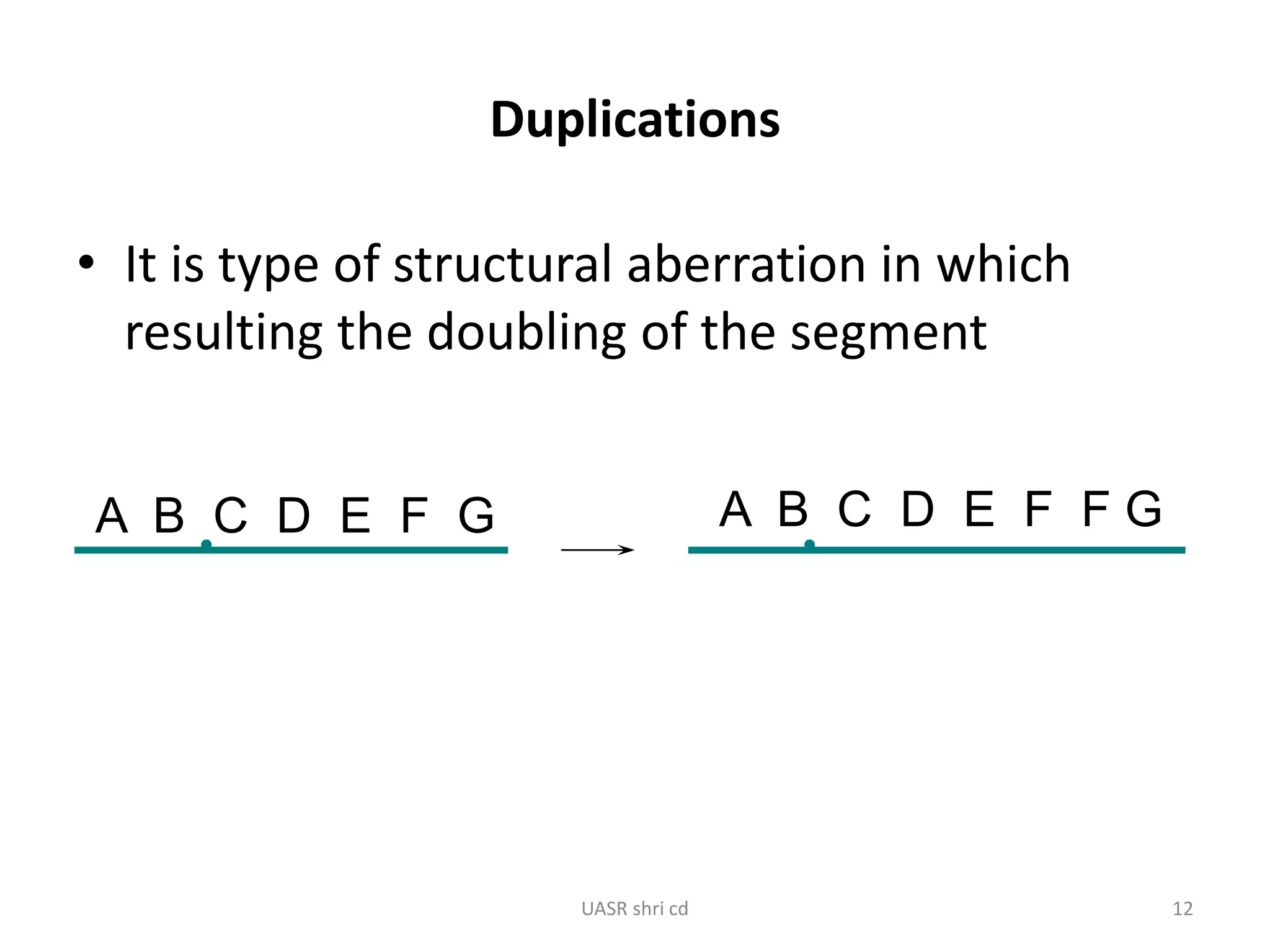
• It is type of structural aberration in which 
resulting the doubling of the segment 
A B C D E F G A B C D E F F G 
UASR shri cd 12
Mainly four types 
Tandem Intrachomosomal 
Reverse tandem 
Displaced 
Translocated Interchromosomal 
UASR shri cd 13
Effects of duplication 
• According to Ohno(1970) origin of new genes 
mainly due to duplication resulted the 
evolution 
• Position effect 
Ex: Bar eye is result of duplication of 16A 
region of X chromosome of Drosophila 
• Activity of certain enzymes may be doubled 
Ex:chromosome 6 of barley increased the 
activity of α-amylase (hagberg in 1965) 
UASR shri cd 14
UASR shri cd 15
Inversion 
• Sturtevant & punnet in 1921 in Drosophila 
Detected by 
• presence of partial male sterility 
• comparing with the normal strain by using 
linkage map 
• presence of inversion loop during pachytene 
• absence of crossing over. 
UASR shri cd 16
Inversions 
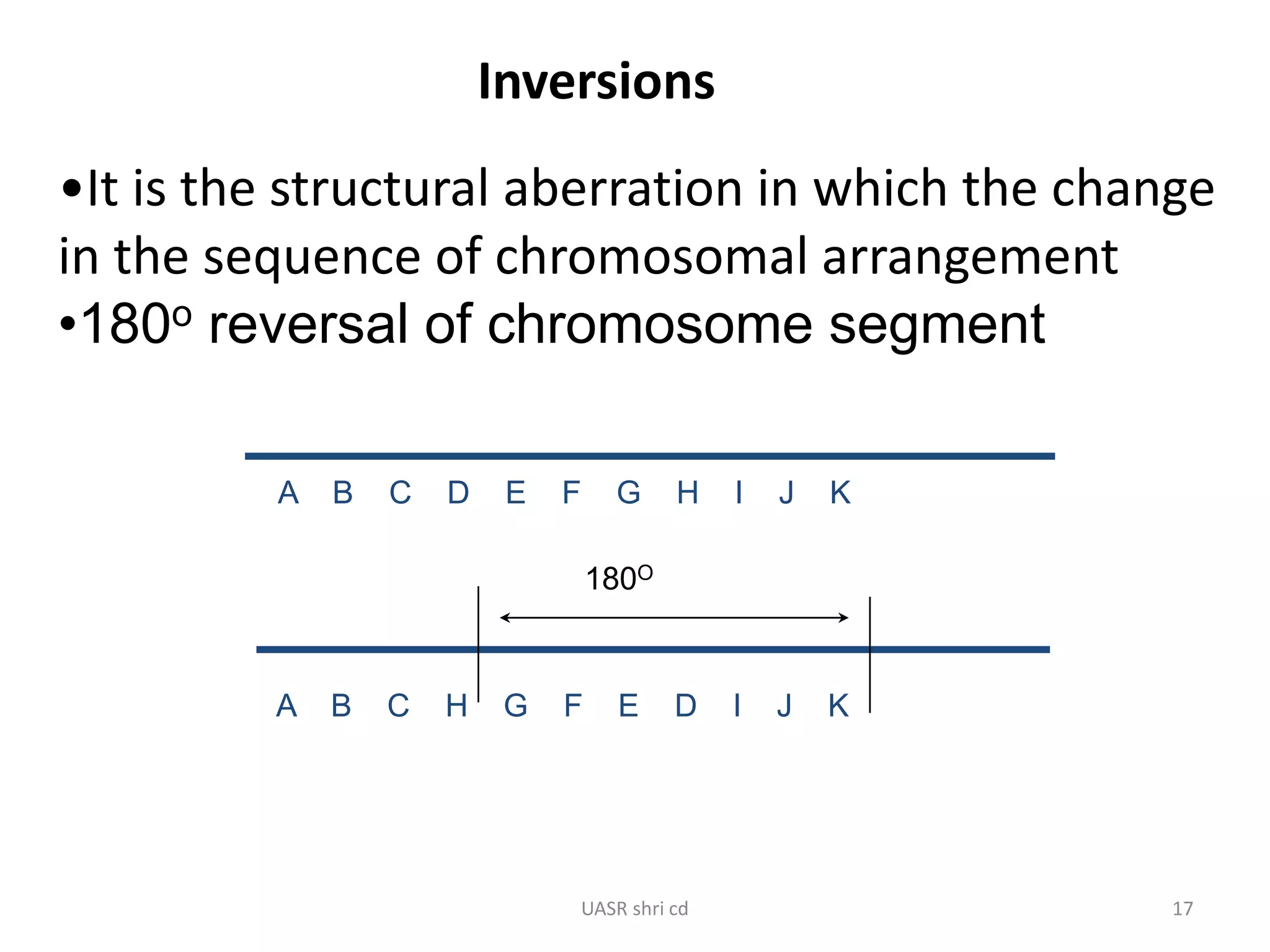
•It is the structural aberration in which the change 
in the sequence of chromosomal arrangement 
•180o reversal of chromosome segment 
A B C D E F G H I J K 
180O 
A B C H G F E D I J K 
UASR shri cd 17
Types of inversion 
• Paracentric:- inverted segment does not 
include centromere and confined to one arm 
• Pericentric:- included the centromere 
UASR shri cd 18
Effects of inversion 
• Partial male sterility 
• Formation of Recessive mutation 
• Position effect 
• Effects the activity of the NOR of complement 
chromosome 
• move active genes to sites generally inactive; 
lose gene function and vice versa 
UASR shri cd 19
Translocations 
• It is a type of structural chromosome in which 
change in position of the segment in such that 
they become integrated into same or 
homologous or non homologous chromosome 
Detected by 
• formation of cross shaped configuration at 
pachytene between two non homologous 
chromosomes 
• Ring of 4 chromosomes at metaphase 1 due to 
pairing between homologous chromosomes 
UASR shri cd 20
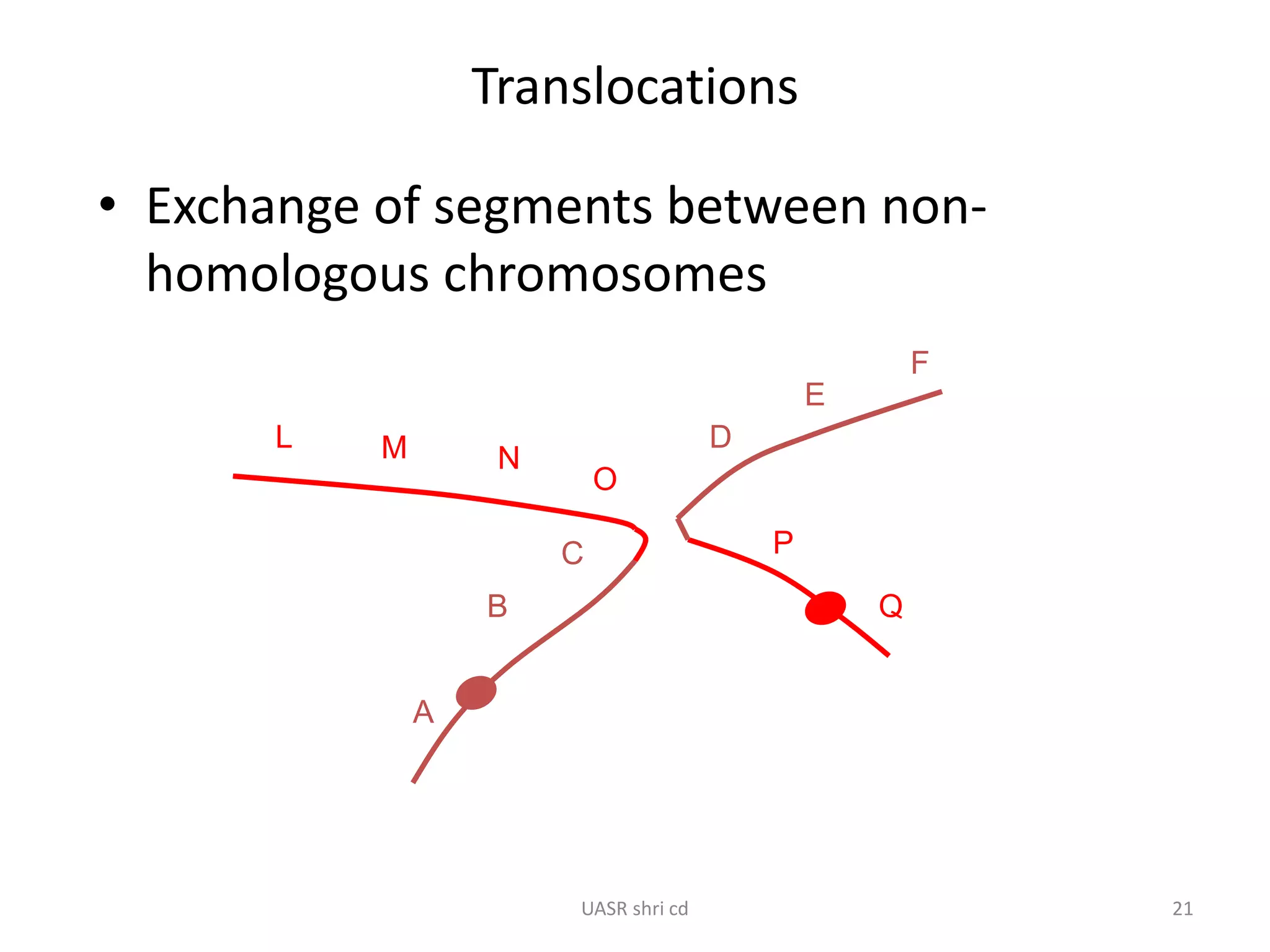
Translocations 
• Exchange of segments between non-homologous 
chromosomes 
F 
A 
B 
C 
D 
E 
L M N 
O 
P 
Q 
UASR shri cd 21
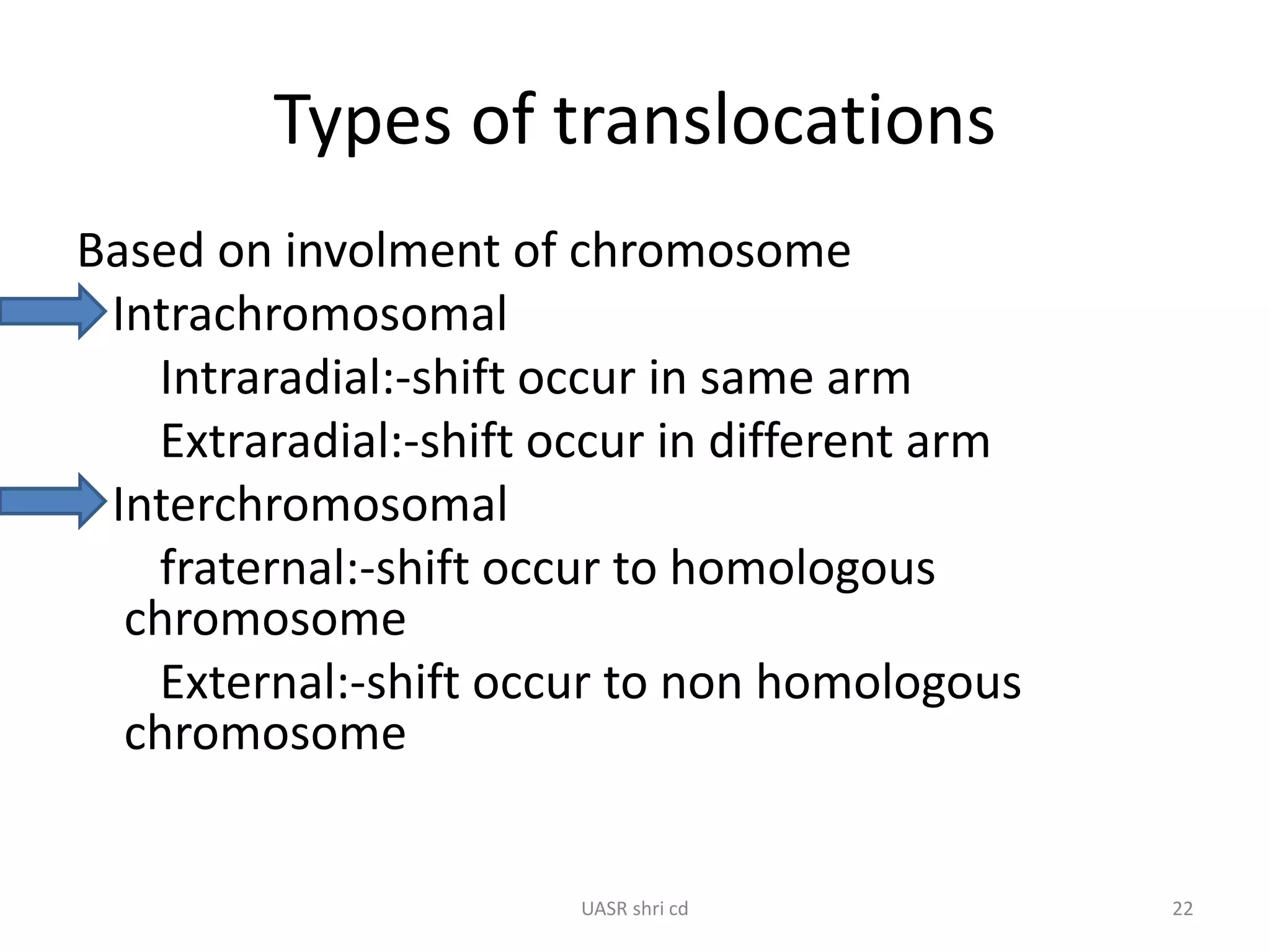
Types of translocations 
Based on involment of chromosome 
Intrachromosomal 
Intraradial:-shift occur in same arm 
Extraradial:-shift occur in different arm 
Interchromosomal 
fraternal:-shift occur to homologous 
chromosome 
External:-shift occur to non homologous 
chromosome 
UASR shri cd 22
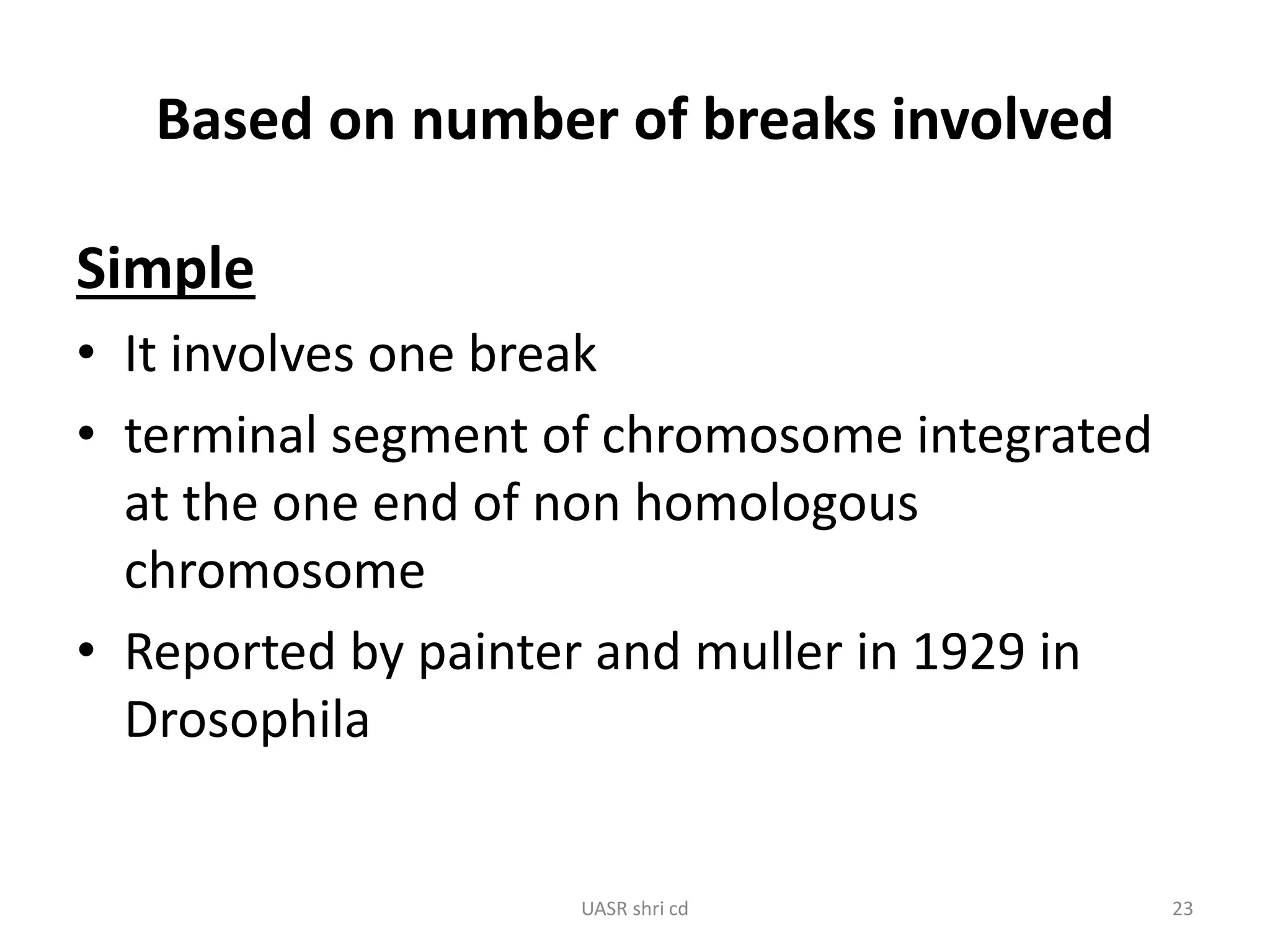
Based on number of breaks involved 
Simple 
• It involves one break 
• terminal segment of chromosome integrated 
at the one end of non homologous 
chromosome 
• Reported by painter and muller in 1929 in 
Drosophila 
UASR shri cd 23
Shift translocation 
• It requires three breaks 
• Intercalary segment of a chromosome is 
integrated within a non homologous 
chromosomes 
• Commonly seen in Drosophila ,Neurospora 
UASR shri cd 24
Reciprocal translocations 
• It requires one break in each of the 
chromosomes 
• Segments will exchanged between non 
homologous chromosomes 
• Designated by prefix ‘T’ 
UASR shri cd 25
Effects of translocations 
• Alters the chromosome morphology 
• Position effect 
• Damage to DNA may result in formation of 
recessive lethals 
• Lead to impaired fertility 
• complications to synopsis and segregation 
UASR shri cd 26
Uses of structural aberration 
Study of chromosome pairing and its 
behaviour during cell division 
For locating genes on particular chromosome 
To resolve special problems such as relation 
between chaisma and crossing over 
Used in plant breeding by increasing the 
dosage of certain desirable genes for 
increasing the activity 
UASR shri cd 27
Continue... 
Homozygous duplication in heterozygous 
condition will gives the permanent hybrid 
vigour 
Useful in study of position effect 
New genes can be produced only through 
duplications 
Paracentric inversion will used to produce 
acentric fragments intact 
UASR shri cd 28
Cont.... 
 Used to study the specific problems in genetics 
Ex:-C1B Technique by muller in Drosophila 
C:-Inversion 
1:-1 Recessive lethal 
B:-Bar eye 
 Important role in evolution 
 Desirable characters can be detected using inversion 
 Translocation used in determination of unknown locus 
of gene and chromosome mapping 
 Testing the association between linkage groups 
 Used to know the point of intiation of chromosome 
pairing 
 Production of duplication 
 Evolution of allopolyploidy 
UASR shri cd 29
Effects on humans 
Deletions in Humans 
• Cri-du-chat syndrome 
– Micro deletion of chromosome 5 
• DiGeorge syndrome 
– Micro deletion of chromosome 22 
• Angelman syndrome 
– Micro deletion of chromosome 15 
UASR shri cd 30
Translocations 
• Several human cancers are associated with 
reciprocal translocations 
– Chronic myelocytic leukemia 
– Burkitt’s lymphoma 
The Philadelphia Chromosome 
Reciprocal translocation between chr. 22 and 
chr. 9 
UASR shri cd 31
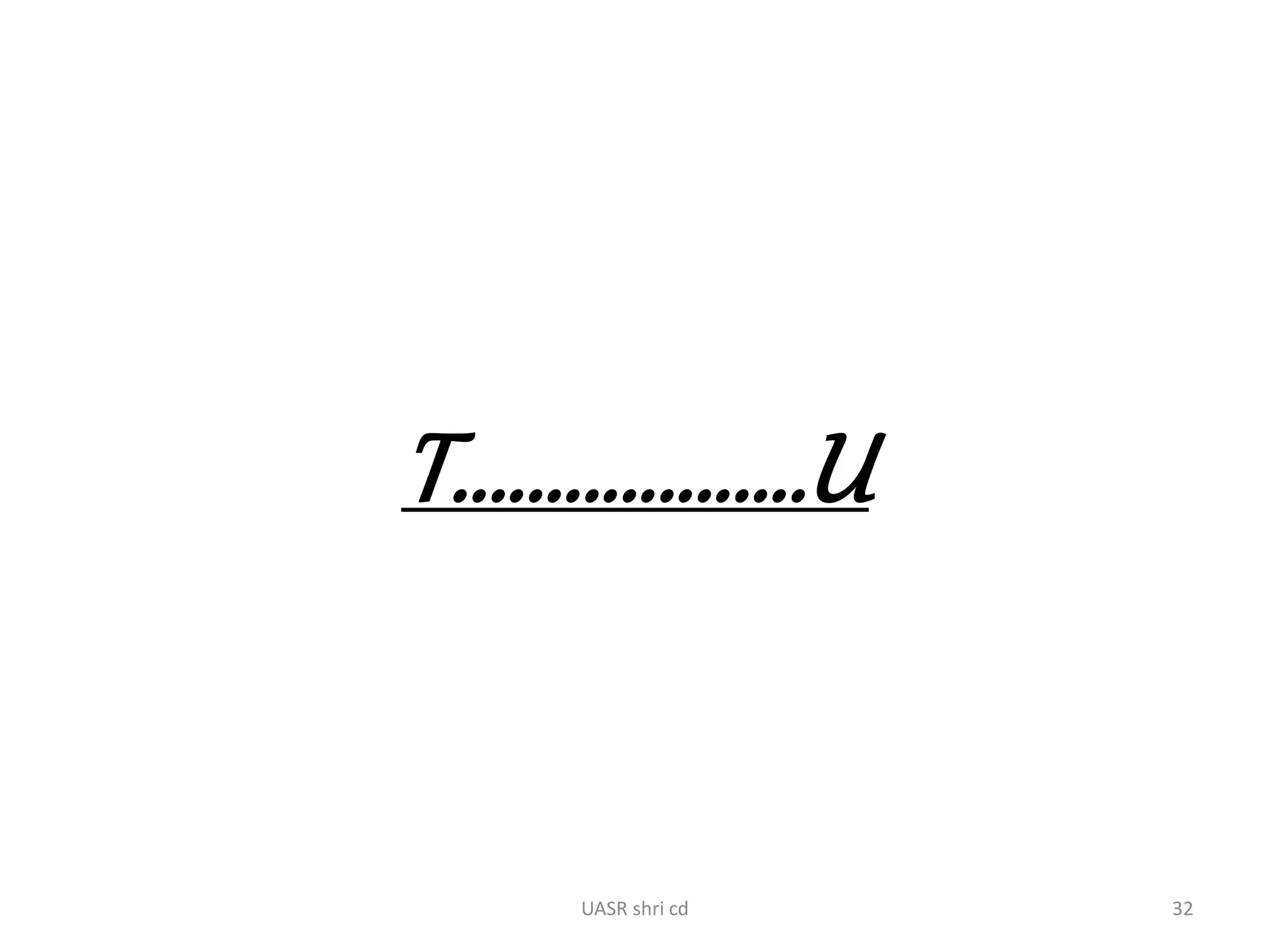
T...................U 
UASR shri cd 32

Structural chromosome aberrations

  • 1.
    Wel come •Topic :- structural Chromosomes aberrations and there role in plant breeding presented by, shrishaila PG14AGR6066 UAS Raichur UASR shri cd 1
  • 2.
    Chromosome aberration Numericalstructural Variation in chromosome structure or number is called chromosomal aberration UASR shri cd 2
  • 3.
    Chromosome Structural aberrations • The chromosome aberrations in which they alters the structure of chromosome(sequence of genes or kind of genes in chromosome or no. of genes) • There are mainly four types which are Changes in the numbers of genes Deletion/Deficiency Duplication Changes in the location of genes Inversions :- 180o rotation Translocations:- Exchange UASR shri cd 3
  • 4.
    Origin of structuralaberrations Deletion • spontaneously or may induced • Mis-division of the centromere • radiation, UV, chemicals, viruses may increase breakage Duplication • Unequal crossing over • Crossing over in inversion heterozygotes • Crossing over in translocated heterozygotes UASR shri cd 4
  • 5.
    Inversion • Spontaneouslyand induced • Naturally in Drosophila • Produced through breakage and reassociation of chromosome Translocation • Spontaneously • Induced by mutagens • Growing a plants in ca deficit medium UASR shri cd 5
  • 6.
    Deletion • Firstchromosome aberration discovered by the Bridges in 1917 in Drosophila • Usually detected by based on unpaired region of normal chromosome produces a loop during pachytene stage Two types which are Terminal Intercalary UASR shri cd 6
  • 7.
    Deletions • Lossof a (generally small) segment of chromosome A B C D E F G A B D E F G C UASR shri cd 7
  • 8.
    Terminal deletion •Loss of segment contain a telomere of affected chromosome • In 1938 Muller postulated that loss of telomere makes chromosome unstable so it is not commonly observed Ex:maize UASR shri cd 8
  • 9.
    Intercalary deletion •Loss of segment in between centromere and telomere • It is commonly observed Ex:Drosophila UASR shri cd 9
  • 10.
    Effects of deletion • Pseudo dominance • Crossing over not there • Harmful effect on diploid organisms • Most are as recessive Lethals • Morphological effects UASR shri cd 10
  • 11.
    Duplication • Bridgesin 1919 • It is detected by presence of loop formation during pachytene stage in duplicated region or cross pairing between segments of non-homologus chromosomes UASR shri cd 11
  • 12.
    Duplications • Itis type of structural aberration in which resulting the doubling of the segment A B C D E F G A B C D E F F G UASR shri cd 12
  • 13.
    Mainly four types Tandem Intrachomosomal Reverse tandem Displaced Translocated Interchromosomal UASR shri cd 13
  • 14.
    Effects of duplication • According to Ohno(1970) origin of new genes mainly due to duplication resulted the evolution • Position effect Ex: Bar eye is result of duplication of 16A region of X chromosome of Drosophila • Activity of certain enzymes may be doubled Ex:chromosome 6 of barley increased the activity of α-amylase (hagberg in 1965) UASR shri cd 14
  • 15.
  • 16.
    Inversion • Sturtevant& punnet in 1921 in Drosophila Detected by • presence of partial male sterility • comparing with the normal strain by using linkage map • presence of inversion loop during pachytene • absence of crossing over. UASR shri cd 16
  • 17.
    Inversions •It isthe structural aberration in which the change in the sequence of chromosomal arrangement •180o reversal of chromosome segment A B C D E F G H I J K 180O A B C H G F E D I J K UASR shri cd 17
  • 18.
    Types of inversion • Paracentric:- inverted segment does not include centromere and confined to one arm • Pericentric:- included the centromere UASR shri cd 18
  • 19.
    Effects of inversion • Partial male sterility • Formation of Recessive mutation • Position effect • Effects the activity of the NOR of complement chromosome • move active genes to sites generally inactive; lose gene function and vice versa UASR shri cd 19
  • 20.
    Translocations • Itis a type of structural chromosome in which change in position of the segment in such that they become integrated into same or homologous or non homologous chromosome Detected by • formation of cross shaped configuration at pachytene between two non homologous chromosomes • Ring of 4 chromosomes at metaphase 1 due to pairing between homologous chromosomes UASR shri cd 20
  • 21.
    Translocations • Exchangeof segments between non-homologous chromosomes F A B C D E L M N O P Q UASR shri cd 21
  • 22.
    Types of translocations Based on involment of chromosome Intrachromosomal Intraradial:-shift occur in same arm Extraradial:-shift occur in different arm Interchromosomal fraternal:-shift occur to homologous chromosome External:-shift occur to non homologous chromosome UASR shri cd 22
  • 23.
    Based on numberof breaks involved Simple • It involves one break • terminal segment of chromosome integrated at the one end of non homologous chromosome • Reported by painter and muller in 1929 in Drosophila UASR shri cd 23
  • 24.
    Shift translocation •It requires three breaks • Intercalary segment of a chromosome is integrated within a non homologous chromosomes • Commonly seen in Drosophila ,Neurospora UASR shri cd 24
  • 25.
    Reciprocal translocations •It requires one break in each of the chromosomes • Segments will exchanged between non homologous chromosomes • Designated by prefix ‘T’ UASR shri cd 25
  • 26.
    Effects of translocations • Alters the chromosome morphology • Position effect • Damage to DNA may result in formation of recessive lethals • Lead to impaired fertility • complications to synopsis and segregation UASR shri cd 26
  • 27.
    Uses of structuralaberration Study of chromosome pairing and its behaviour during cell division For locating genes on particular chromosome To resolve special problems such as relation between chaisma and crossing over Used in plant breeding by increasing the dosage of certain desirable genes for increasing the activity UASR shri cd 27
  • 28.
    Continue... Homozygous duplicationin heterozygous condition will gives the permanent hybrid vigour Useful in study of position effect New genes can be produced only through duplications Paracentric inversion will used to produce acentric fragments intact UASR shri cd 28
  • 29.
    Cont....  Usedto study the specific problems in genetics Ex:-C1B Technique by muller in Drosophila C:-Inversion 1:-1 Recessive lethal B:-Bar eye  Important role in evolution  Desirable characters can be detected using inversion  Translocation used in determination of unknown locus of gene and chromosome mapping  Testing the association between linkage groups  Used to know the point of intiation of chromosome pairing  Production of duplication  Evolution of allopolyploidy UASR shri cd 29
  • 30.
    Effects on humans Deletions in Humans • Cri-du-chat syndrome – Micro deletion of chromosome 5 • DiGeorge syndrome – Micro deletion of chromosome 22 • Angelman syndrome – Micro deletion of chromosome 15 UASR shri cd 30
  • 31.
    Translocations • Severalhuman cancers are associated with reciprocal translocations – Chronic myelocytic leukemia – Burkitt’s lymphoma The Philadelphia Chromosome Reciprocal translocation between chr. 22 and chr. 9 UASR shri cd 31
  • 32.