Thanks for the Feedback
The Science and Art of receiving
feedback well.
Douglas Stone & Sheila Heen
When we ask people to list their
most difficult conversations,
feedback always comes up.
We swim in an ocean of feedback.
When we give feedback, we notice
that the receiver isn’t good at
receiving it. When we receive
feedback, we notice that the giver
isn’t good at giving it!!
The term ‘feedback’ was coined in
the 1860s, during the industrial
revolution to describe the way in
which outputs of energy,
momentum or signals are
returned to their point of origin in
a mechanical system.
Learning about ourselves can be
painful, sometimes brutally so.
Receiving feedback doesn’t mean
you always have to take the
feedback. Receiving it well means
engaging in the conversation
skillfully.
People who are willing to look at
themselves are just easier to work
with and live with. Being with
people who are grounded and
open is energizing.
Most of us just do fine with
positive feedback, although even
praise can sometimes leave us
uneasy.
There are three feedback triggers:
Truth triggers, Relationship
triggers, Identity triggers.
In feedback, separate
appreciation, coaching and
evaluation in the discussion.
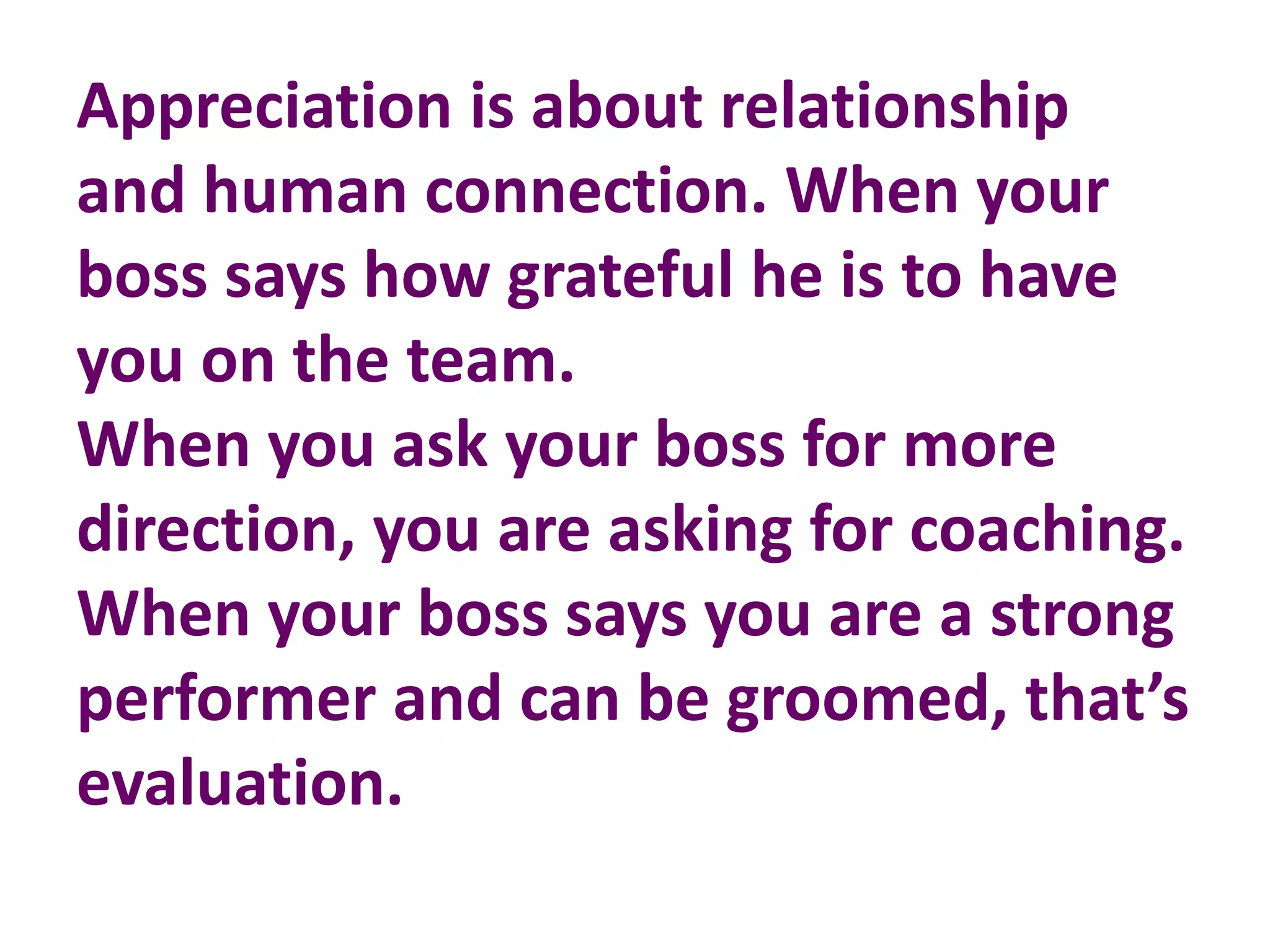
Appreciation is about relationship
and human connection. When your
boss says how grateful he is to have
you on the team.
When you ask your boss for more
direction, you are asking for coaching.
When your boss says you are a strong
performer and can be groomed, that’s
evaluation.
Reassurance, ‘you can do this’, ‘I
trust you to do this’, ’go ahead’
also falls in additional judgments,
but on the positive side.
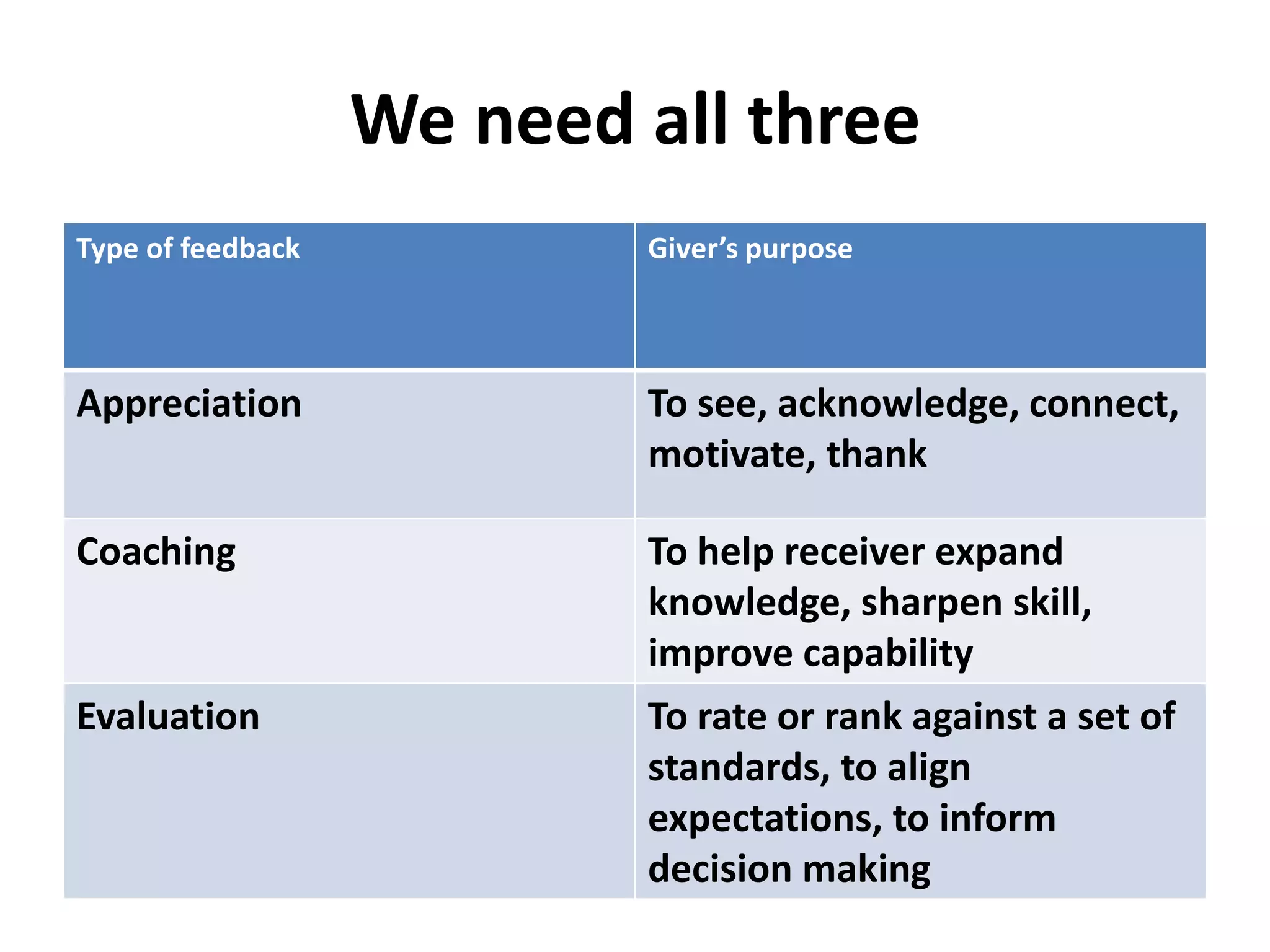
We need all three
Type of feedback Giver’s purpose
Appreciation To see, acknowledge, connect,
motivate, thank
Coaching To help receiver expand
knowledge, sharpen skill,
improve capability
Evaluation To rate or rank against a set of
standards, to align
expectations, to inform
decision making
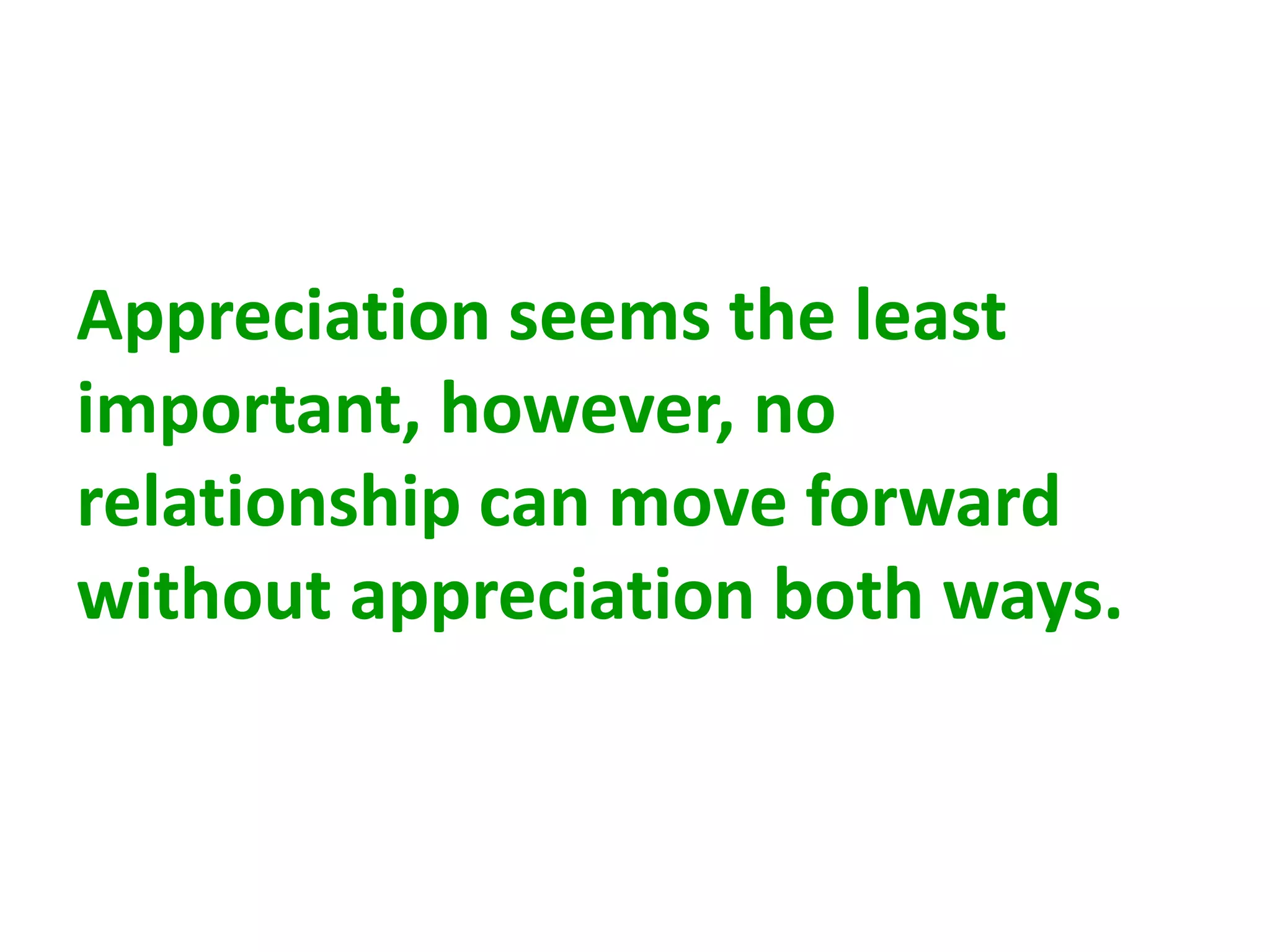
Appreciation seems the least
important, however, no
relationship can move forward
without appreciation both ways.
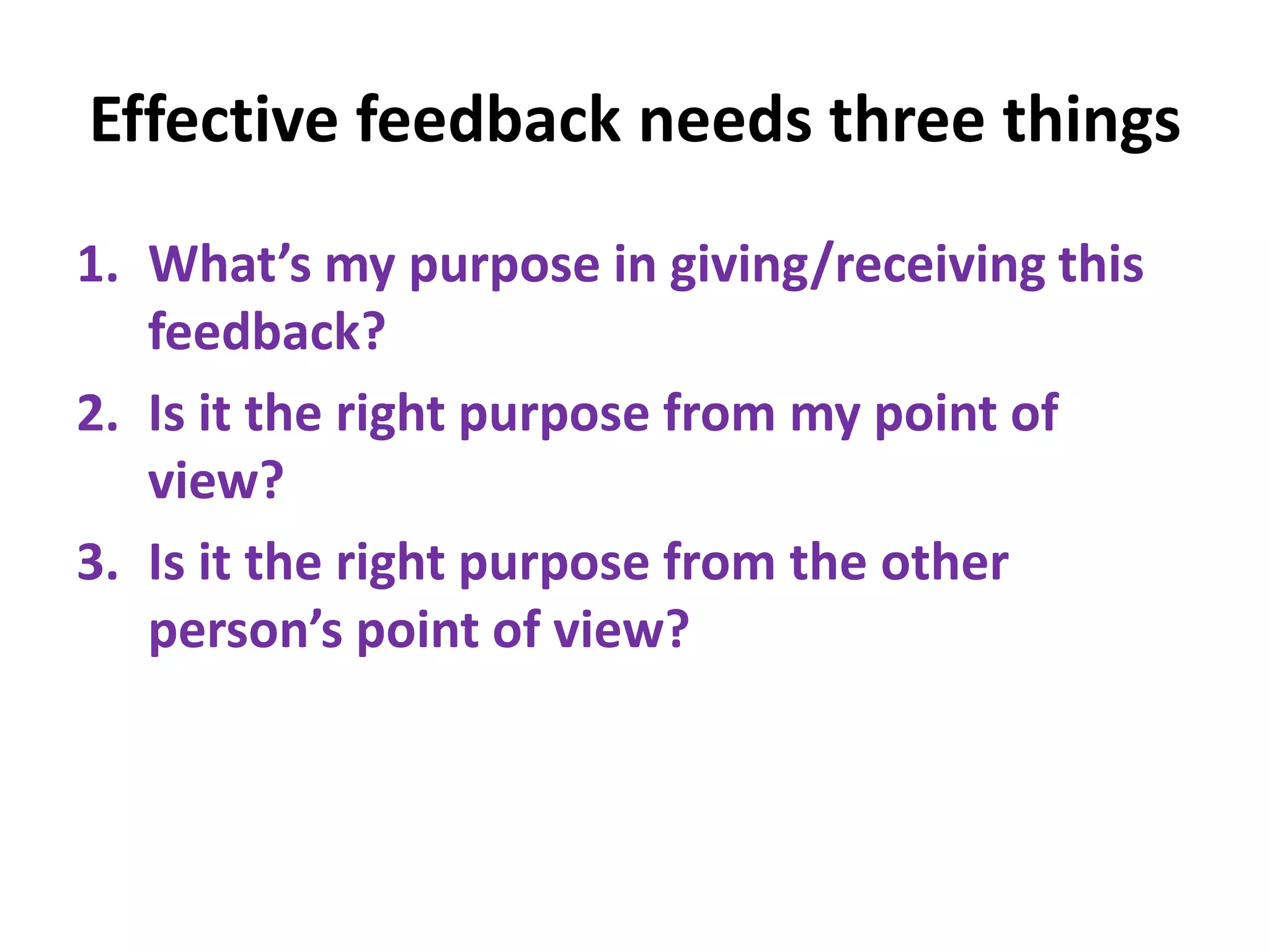
Effective feedback needs three things
1. What’s my purpose in giving/receiving this
feedback?
2. Is it the right purpose from my point of
view?
3. Is it the right purpose from the other
person’s point of view?
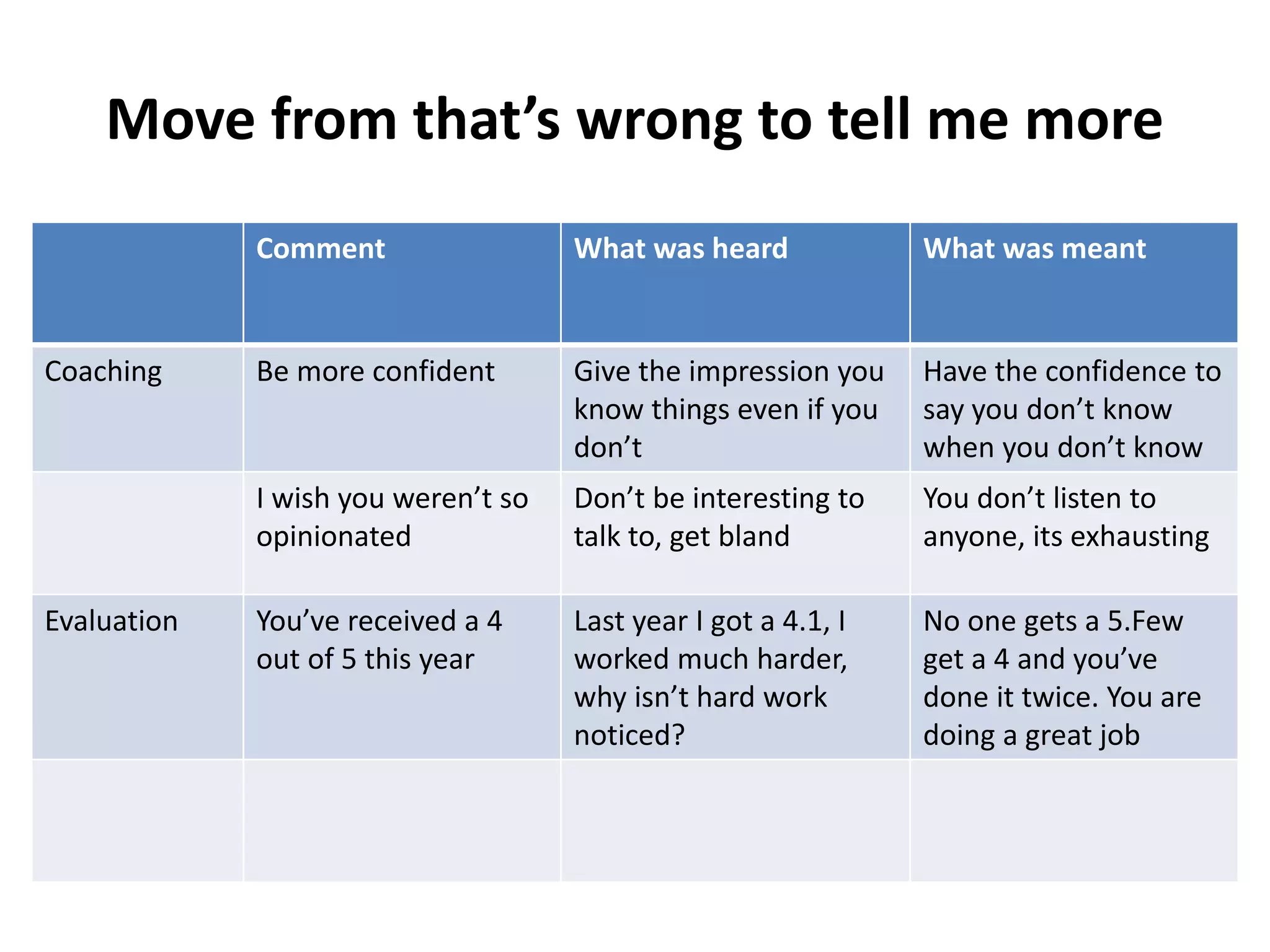
Move from that’s wrong to tell me more
Comment What was heard What was meant
Coaching Be more confident Give the impression you
know things even if you
don’t
Have the confidence to
say you don’t know
when you don’t know
I wish you weren’t so
opinionated
Don’t be interesting to
talk to, get bland
You don’t listen to
anyone, its exhausting
Evaluation You’ve received a 4
out of 5 this year
Last year I got a 4.1, I
worked much harder,
why isn’t hard work
noticed?
No one gets a 5.Few
get a 4 and you’ve
done it twice. You are
doing a great job
Feedback givers arrive at their
feedback in two steps : 1. they
observe data and 2. they interpret
the data that tells a story
Feedback is best when its specific
and not beating around the bush.
Most people are not specific in
conversations for fear of hurting
others.
A blind spot is something we don’t
see about ourselves that others do
see.
Tone of voice also conveys a
surprising amount of information
about our feelings. Sometimes we
need to step up the tone to get
the message.
E mail body language:
ALL CAPS is a signal, a bunch of ?????
Is a signal, someone marked cc on the
mail is a strategic placement , the
reply being slow is another signal,
watch , watch for this. There is
feedback here.
In e mail, we know what they said,
we want to know what they meant.
Emotions play a huge role in the gap
between how others see us and how
we assume we are seen. Emotional
math's is really a subject of a larger
dynamic. When something goes
wrong and I am part of it, I will
attribute it to the situation, you will
tend to attribute it to my character.
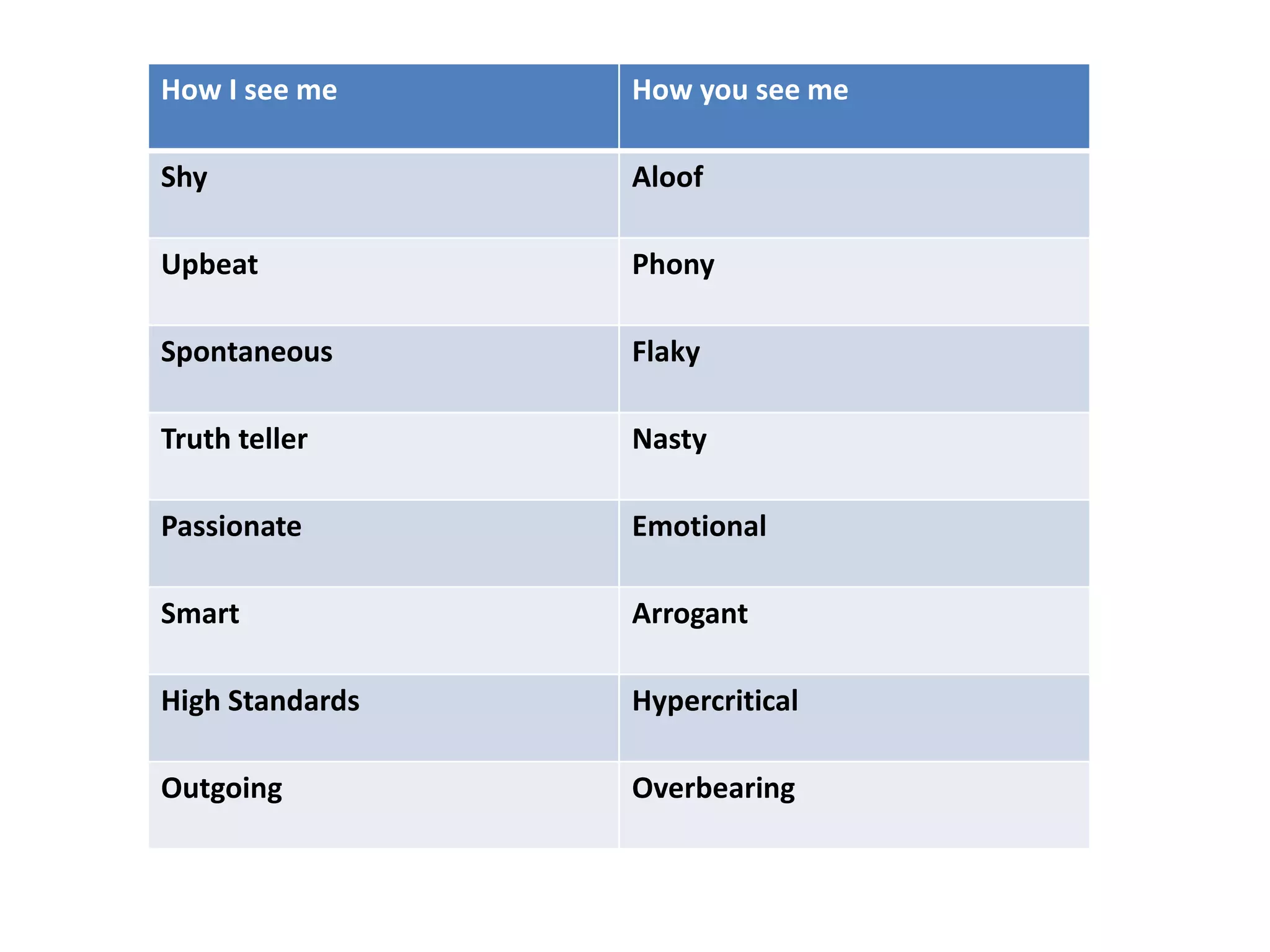
How I see me How you see me
Shy Aloof
Upbeat Phony
Spontaneous Flaky
Truth teller Nasty
Passionate Emotional
Smart Arrogant
High Standards Hypercritical
Outgoing Overbearing
Offering feedback is ‘holding up
the mirror”. Mirrors are two types
– a supportive mirror and am
honest mirror.
A supportive mirror shows us at
our best, a honest mirror shows us
the way look right now.
We all have blind spots because
we cant see our own faces in
conversations, cant hear our tone
of voice and are unaware of our
behavior.
Look at it from a systems point :
Be on the lookout if you are
externalizing, take responsibility
for your part, and see what will
make you change.
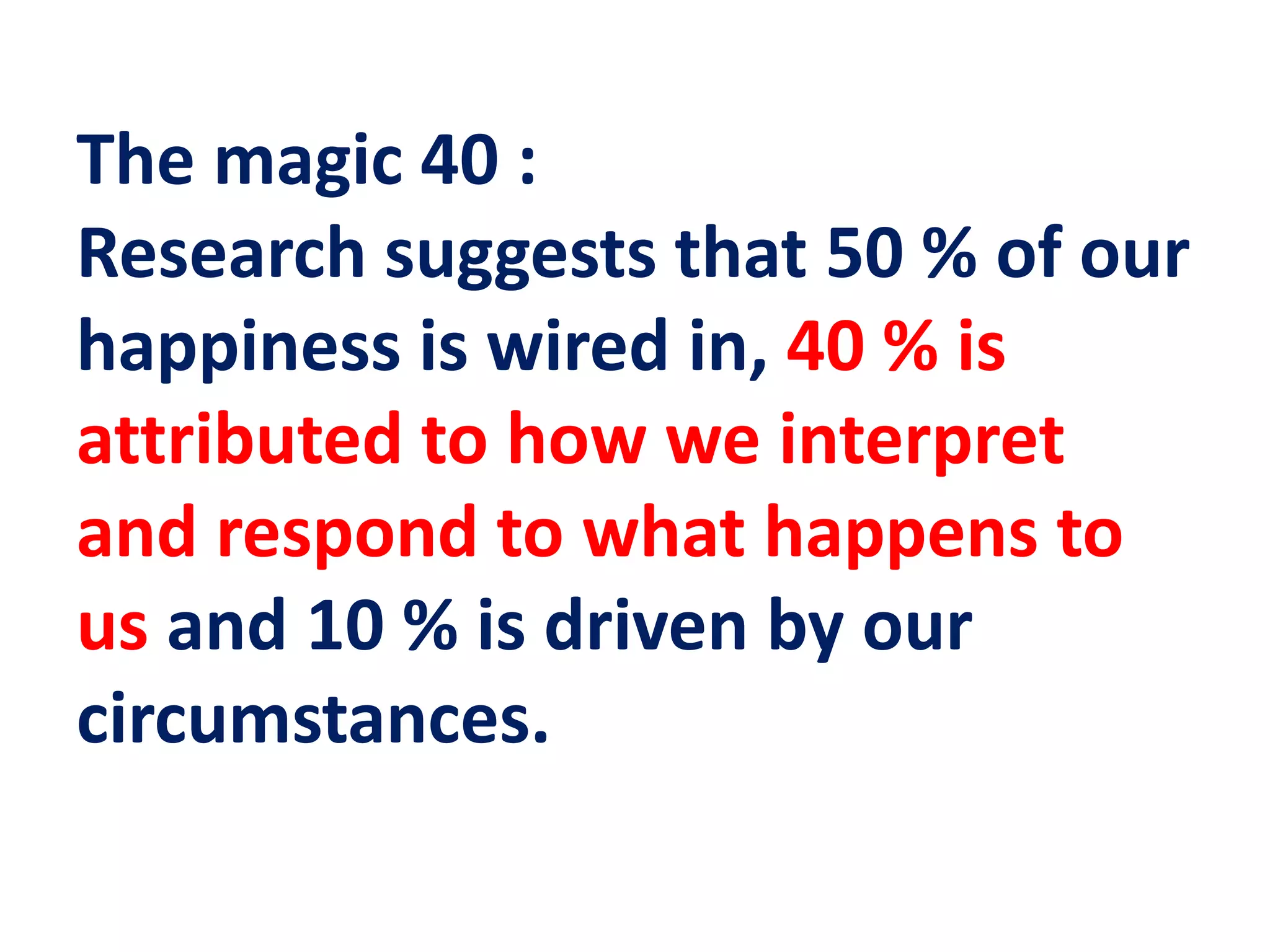
The magic 40 :
Research suggests that 50 % of our
happiness is wired in, 40 % is
attributed to how we interpret
and respond to what happens to
us and 10 % is driven by our
circumstances.
A movie is better when we get lost
in it, and the same is true for life.
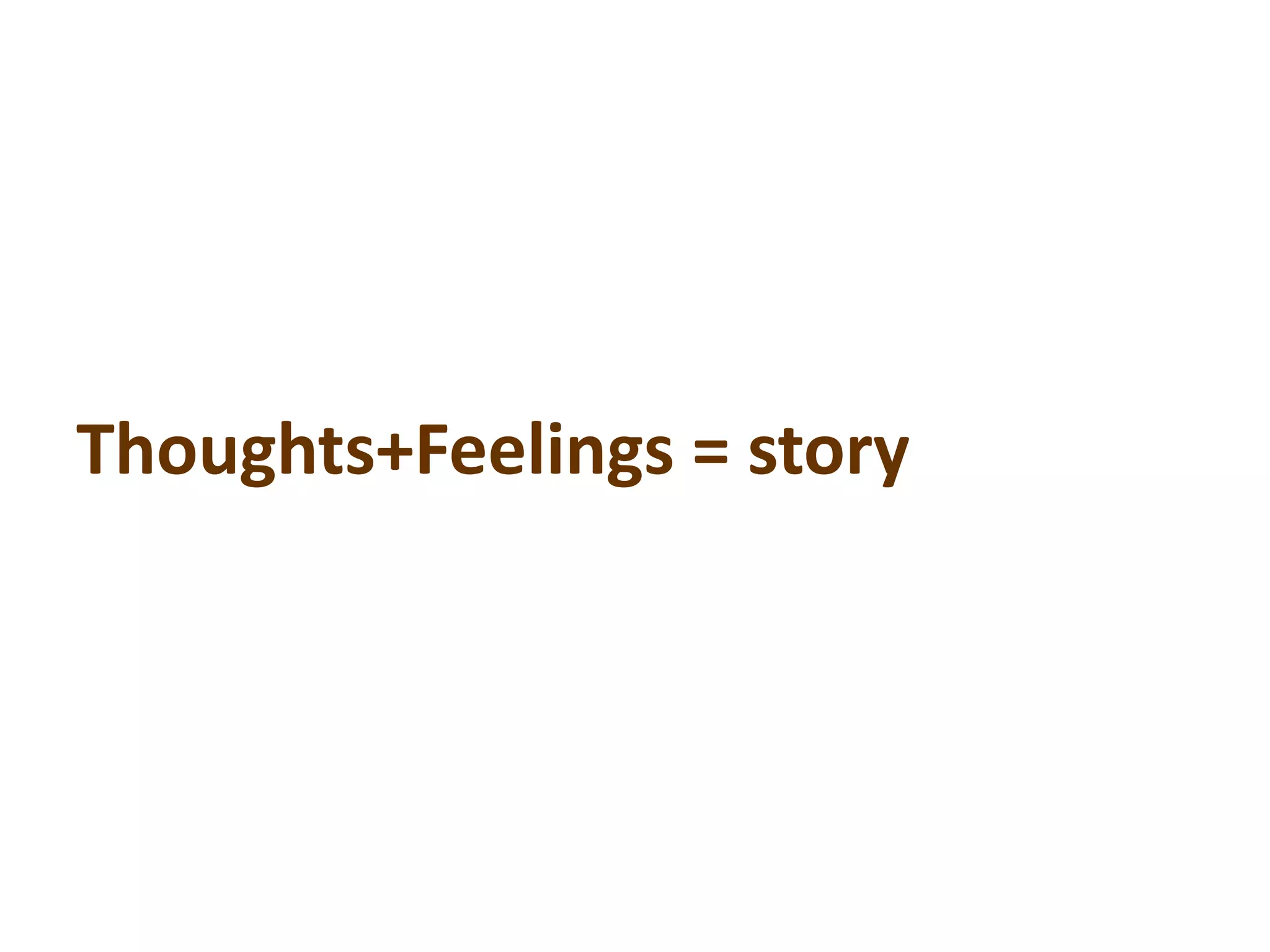
Thoughts+Feelings = story
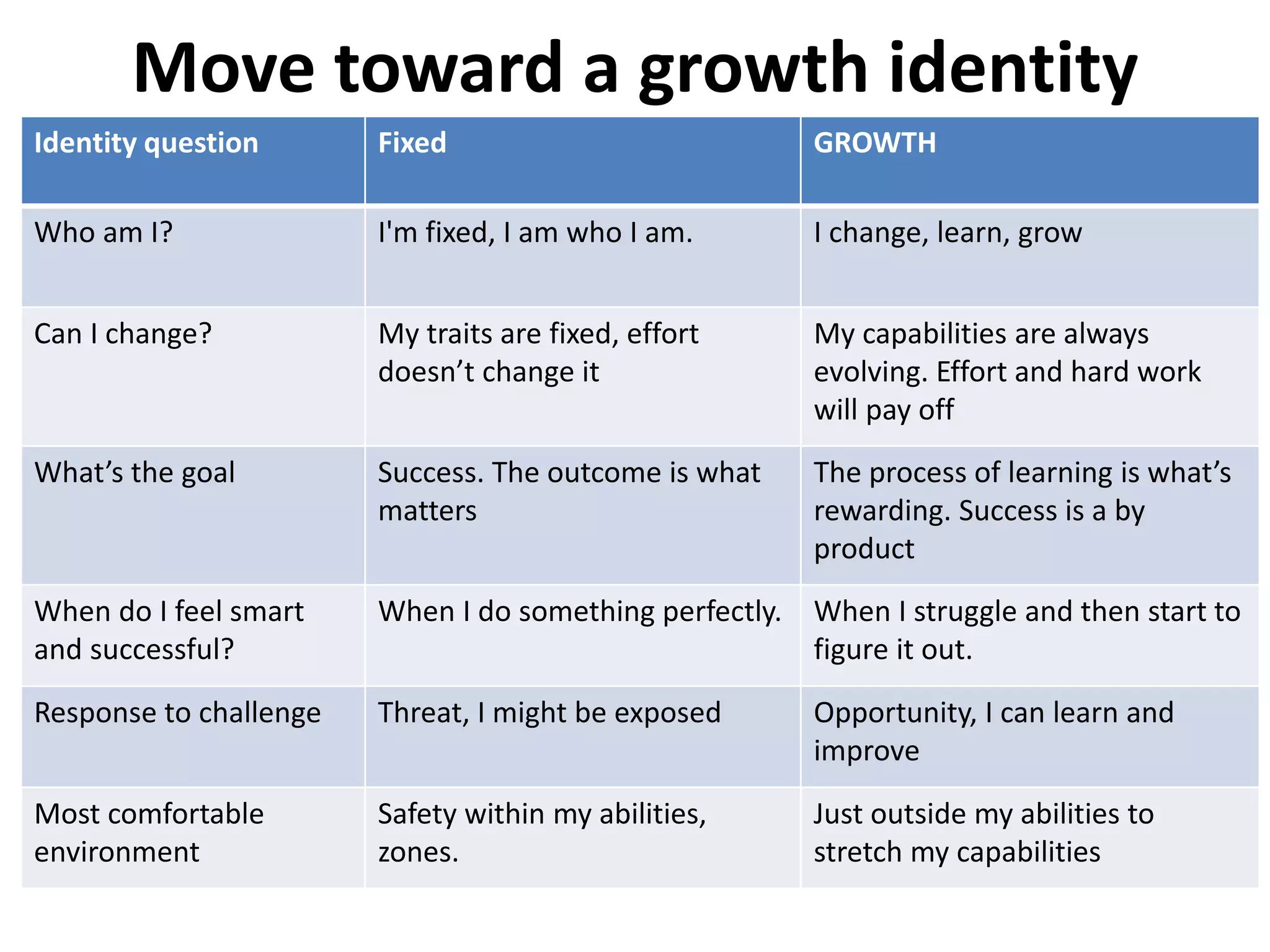
Move toward a growth identity
Identity question Fixed GROWTH
Who am I? I'm fixed, I am who I am. I change, learn, grow
Can I change? My traits are fixed, effort
doesn’t change it
My capabilities are always
evolving. Effort and hard work
will pay off
What’s the goal Success. The outcome is what
matters
The process of learning is what’s
rewarding. Success is a by
product
When do I feel smart
and successful?
When I do something perfectly. When I struggle and then start to
figure it out.
Response to challenge Threat, I might be exposed Opportunity, I can learn and
improve
Most comfortable
environment
Safety within my abilities,
zones.
Just outside my abilities to
stretch my capabilities
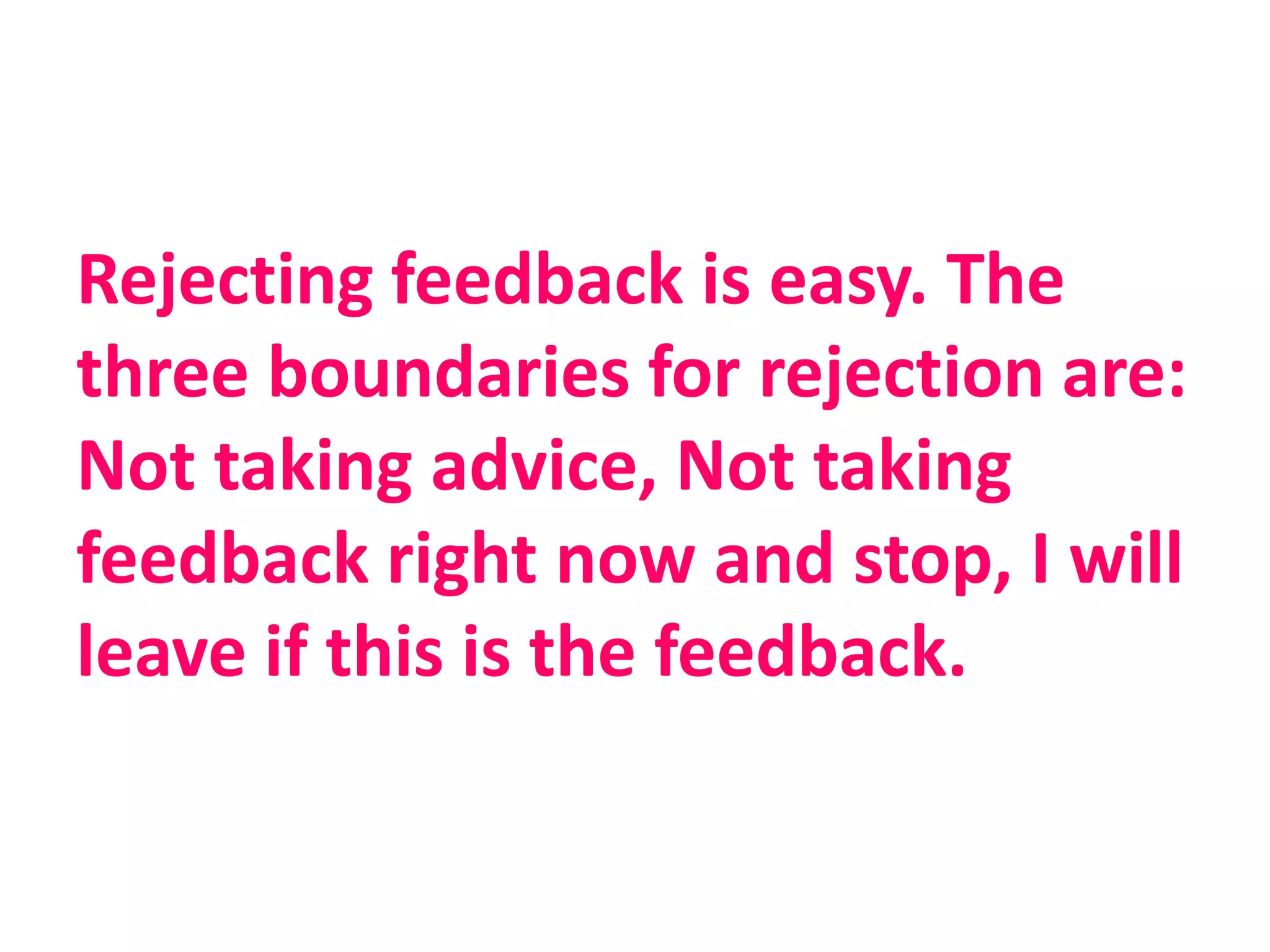
Rejecting feedback is easy. The
three boundaries for rejection are:
Not taking advice, Not taking
feedback right now and stop, I will
leave if this is the feedback.
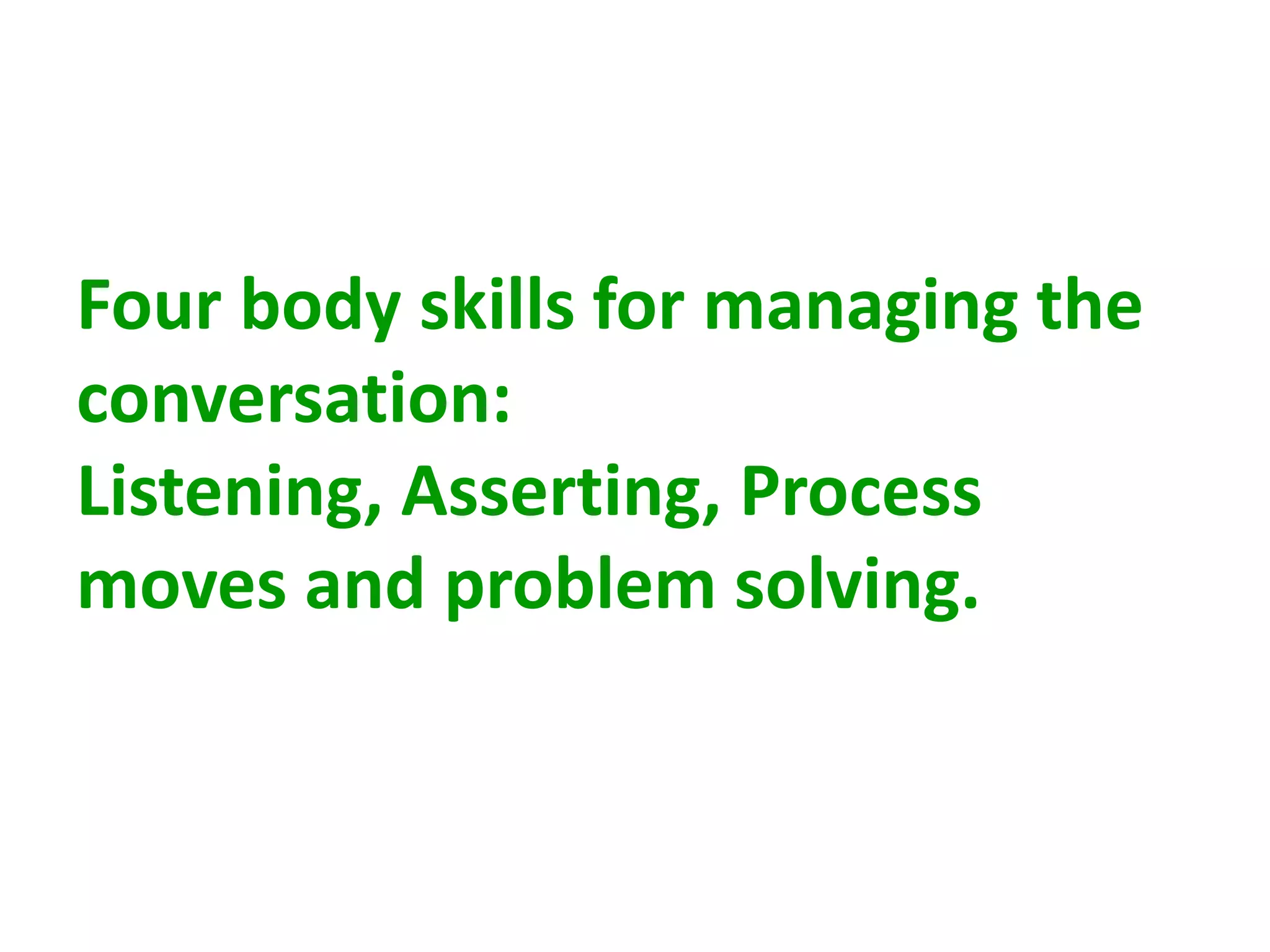
Four body skills for managing the
conversation:
Listening, Asserting, Process
moves and problem solving.
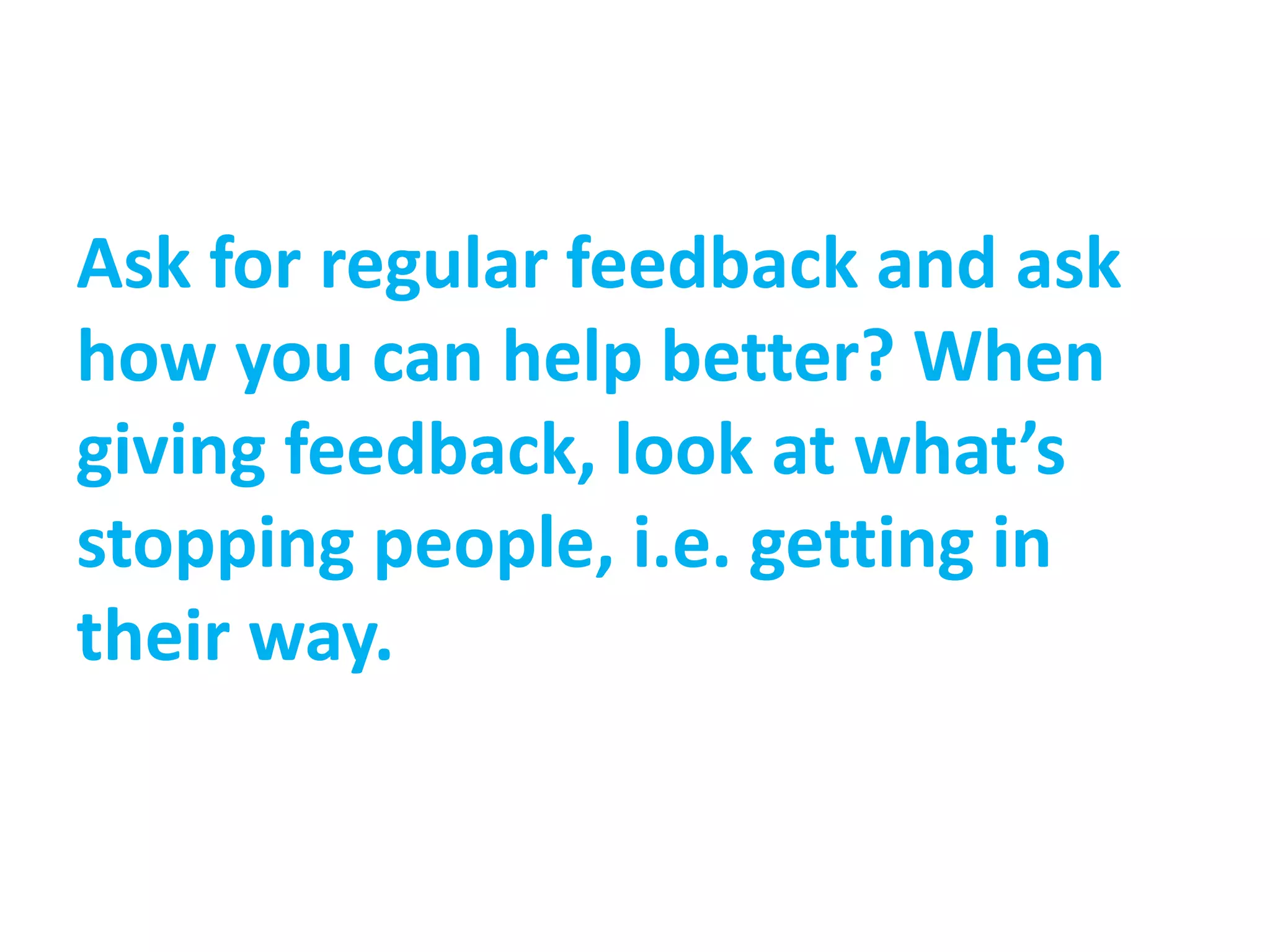
Ask for regular feedback and ask
how you can help better? When
giving feedback, look at what’s
stopping people, i.e. getting in
their way.
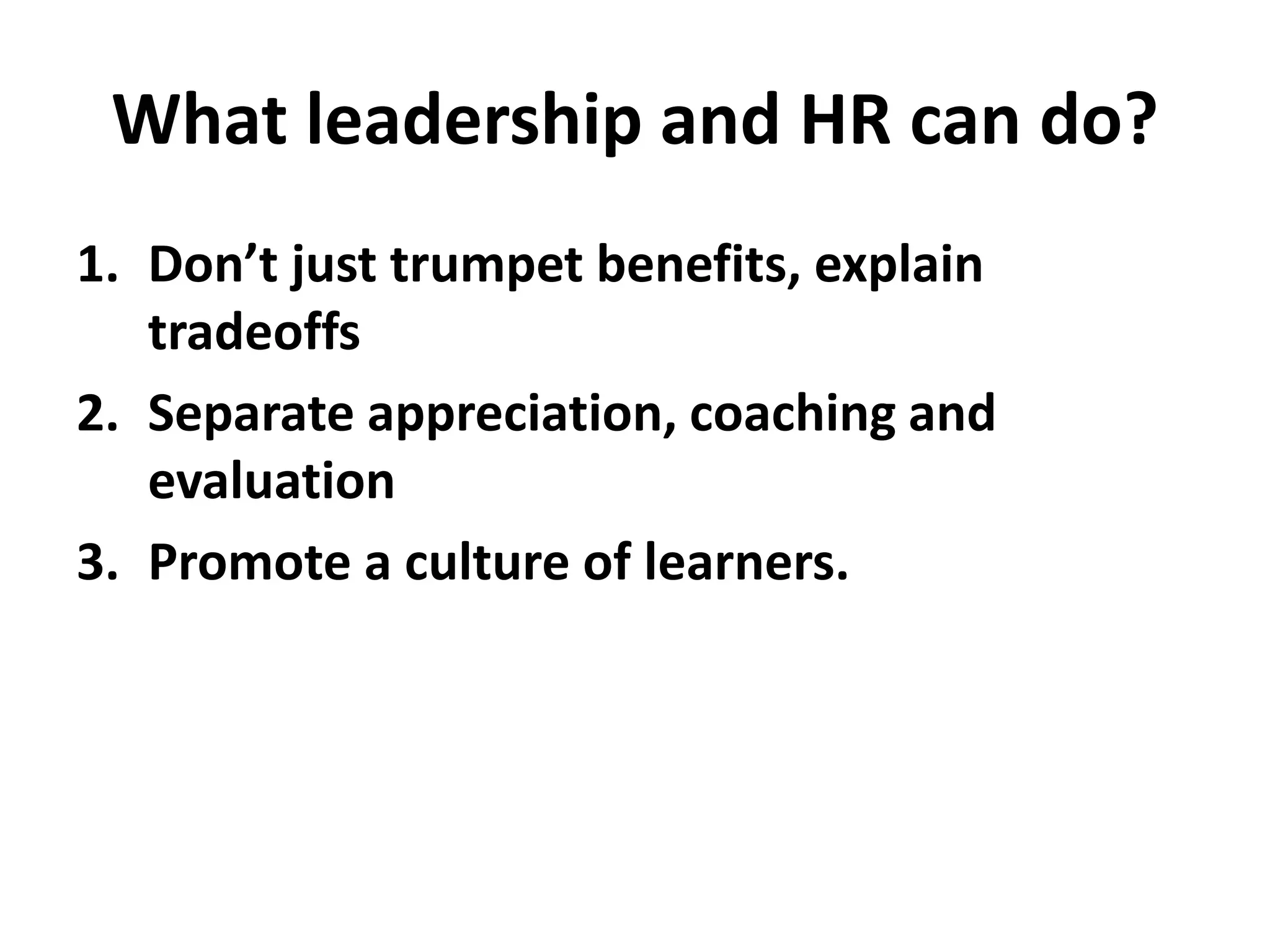
What leadership and HR can do?
1. Don’t just trumpet benefits, explain
tradeoffs
2. Separate appreciation, coaching and
evaluation
3. Promote a culture of learners.
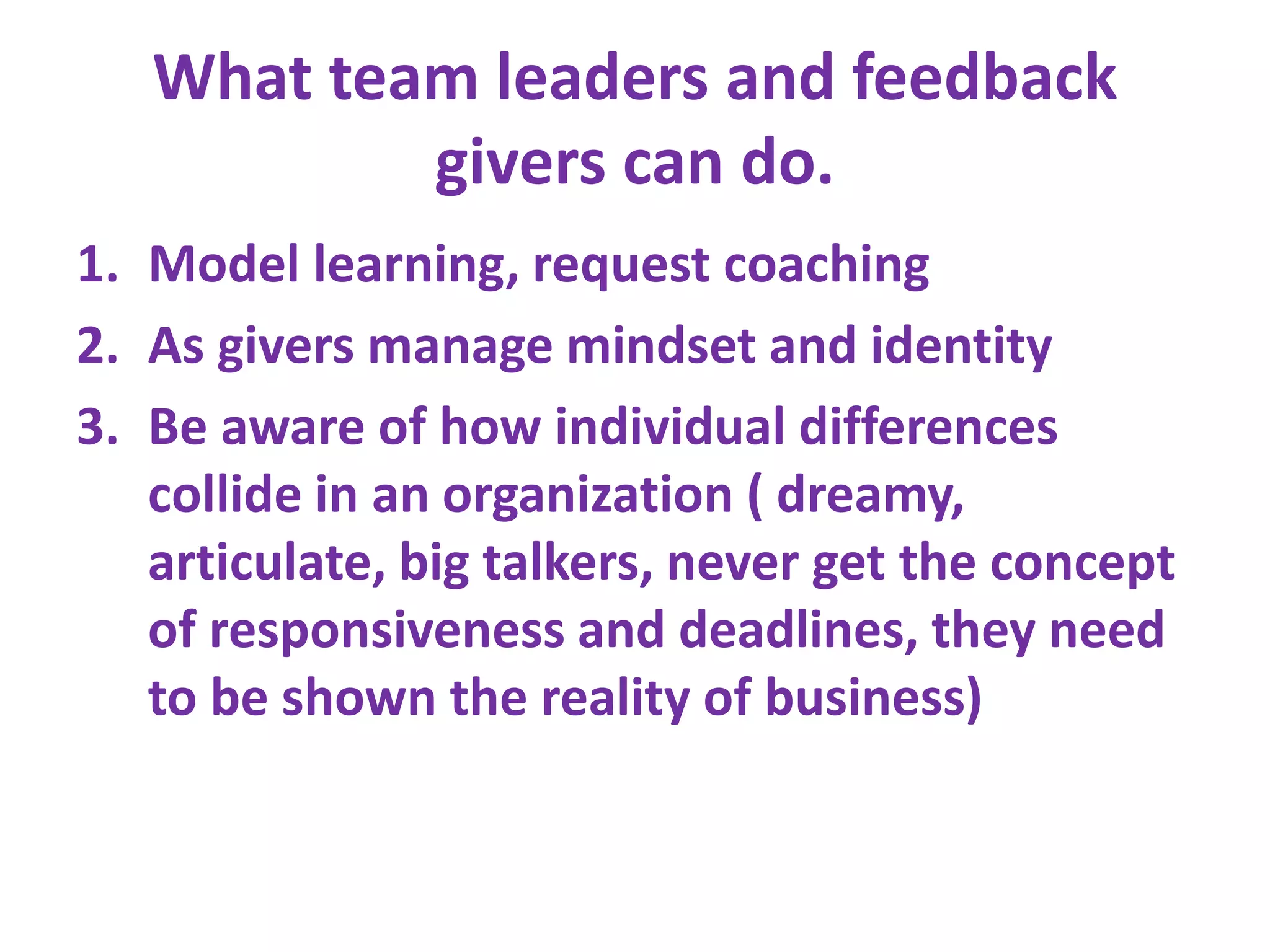
What team leaders and feedback
givers can do.
1. Model learning, request coaching
2. As givers manage mindset and identity
3. Be aware of how individual differences
collide in an organization ( dreamy,
articulate, big talkers, never get the concept
of responsiveness and deadlines, they need
to be shown the reality of business)

Thanks for the feedback - Book Summary

  • 1.
    Thanks for theFeedback The Science and Art of receiving feedback well. Douglas Stone & Sheila Heen
  • 2.
    When we askpeople to list their most difficult conversations, feedback always comes up. We swim in an ocean of feedback.
  • 3.
    When we givefeedback, we notice that the receiver isn’t good at receiving it. When we receive feedback, we notice that the giver isn’t good at giving it!!
  • 4.
    The term ‘feedback’was coined in the 1860s, during the industrial revolution to describe the way in which outputs of energy, momentum or signals are returned to their point of origin in a mechanical system.
  • 5.
    Learning about ourselvescan be painful, sometimes brutally so.
  • 6.
    Receiving feedback doesn’tmean you always have to take the feedback. Receiving it well means engaging in the conversation skillfully.
  • 7.
    People who arewilling to look at themselves are just easier to work with and live with. Being with people who are grounded and open is energizing.
  • 8.
    Most of usjust do fine with positive feedback, although even praise can sometimes leave us uneasy.
  • 9.
    There are threefeedback triggers: Truth triggers, Relationship triggers, Identity triggers.
  • 10.
    In feedback, separate appreciation,coaching and evaluation in the discussion.
  • 11.
    Appreciation is aboutrelationship and human connection. When your boss says how grateful he is to have you on the team. When you ask your boss for more direction, you are asking for coaching. When your boss says you are a strong performer and can be groomed, that’s evaluation.
  • 12.
    Reassurance, ‘you cando this’, ‘I trust you to do this’, ’go ahead’ also falls in additional judgments, but on the positive side.
  • 13.
    We need allthree Type of feedback Giver’s purpose Appreciation To see, acknowledge, connect, motivate, thank Coaching To help receiver expand knowledge, sharpen skill, improve capability Evaluation To rate or rank against a set of standards, to align expectations, to inform decision making
  • 14.
    Appreciation seems theleast important, however, no relationship can move forward without appreciation both ways.
  • 15.
    Effective feedback needsthree things 1. What’s my purpose in giving/receiving this feedback? 2. Is it the right purpose from my point of view? 3. Is it the right purpose from the other person’s point of view?
  • 16.
    Move from that’swrong to tell me more Comment What was heard What was meant Coaching Be more confident Give the impression you know things even if you don’t Have the confidence to say you don’t know when you don’t know I wish you weren’t so opinionated Don’t be interesting to talk to, get bland You don’t listen to anyone, its exhausting Evaluation You’ve received a 4 out of 5 this year Last year I got a 4.1, I worked much harder, why isn’t hard work noticed? No one gets a 5.Few get a 4 and you’ve done it twice. You are doing a great job
  • 17.
    Feedback givers arriveat their feedback in two steps : 1. they observe data and 2. they interpret the data that tells a story
  • 18.
    Feedback is bestwhen its specific and not beating around the bush. Most people are not specific in conversations for fear of hurting others.
  • 19.
    A blind spotis something we don’t see about ourselves that others do see. Tone of voice also conveys a surprising amount of information about our feelings. Sometimes we need to step up the tone to get the message.
  • 20.
    E mail bodylanguage: ALL CAPS is a signal, a bunch of ????? Is a signal, someone marked cc on the mail is a strategic placement , the reply being slow is another signal, watch , watch for this. There is feedback here. In e mail, we know what they said, we want to know what they meant.
  • 21.
    Emotions play ahuge role in the gap between how others see us and how we assume we are seen. Emotional math's is really a subject of a larger dynamic. When something goes wrong and I am part of it, I will attribute it to the situation, you will tend to attribute it to my character.
  • 22.
    How I seeme How you see me Shy Aloof Upbeat Phony Spontaneous Flaky Truth teller Nasty Passionate Emotional Smart Arrogant High Standards Hypercritical Outgoing Overbearing
  • 23.
    Offering feedback is‘holding up the mirror”. Mirrors are two types – a supportive mirror and am honest mirror. A supportive mirror shows us at our best, a honest mirror shows us the way look right now.
  • 24.
    We all haveblind spots because we cant see our own faces in conversations, cant hear our tone of voice and are unaware of our behavior.
  • 25.
    Look at itfrom a systems point : Be on the lookout if you are externalizing, take responsibility for your part, and see what will make you change.
  • 26.
    The magic 40: Research suggests that 50 % of our happiness is wired in, 40 % is attributed to how we interpret and respond to what happens to us and 10 % is driven by our circumstances.
  • 27.
    A movie isbetter when we get lost in it, and the same is true for life.
  • 28.
  • 29.
    Move toward agrowth identity Identity question Fixed GROWTH Who am I? I'm fixed, I am who I am. I change, learn, grow Can I change? My traits are fixed, effort doesn’t change it My capabilities are always evolving. Effort and hard work will pay off What’s the goal Success. The outcome is what matters The process of learning is what’s rewarding. Success is a by product When do I feel smart and successful? When I do something perfectly. When I struggle and then start to figure it out. Response to challenge Threat, I might be exposed Opportunity, I can learn and improve Most comfortable environment Safety within my abilities, zones. Just outside my abilities to stretch my capabilities
  • 30.
    Rejecting feedback iseasy. The three boundaries for rejection are: Not taking advice, Not taking feedback right now and stop, I will leave if this is the feedback.
  • 31.
    Four body skillsfor managing the conversation: Listening, Asserting, Process moves and problem solving.
  • 32.
    Ask for regularfeedback and ask how you can help better? When giving feedback, look at what’s stopping people, i.e. getting in their way.
  • 33.
    What leadership andHR can do? 1. Don’t just trumpet benefits, explain tradeoffs 2. Separate appreciation, coaching and evaluation 3. Promote a culture of learners.
  • 34.
    What team leadersand feedback givers can do. 1. Model learning, request coaching 2. As givers manage mindset and identity 3. Be aware of how individual differences collide in an organization ( dreamy, articulate, big talkers, never get the concept of responsiveness and deadlines, they need to be shown the reality of business)