Effective Communication
Joe Greenstein & Semira Rahemtulla
November 2, 2015
Why are we doing this? (Part 1)
One Big Idea
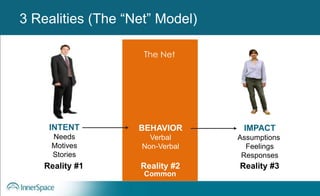
INTENT
Needs
Motives
Stories
Reality #1
BEHAVIOR
Verbal
Non-Verbal
Reality #2
Common
IMPACT
Assumptions
Feelings
Responses
Reality #3
The Net
3 Realities (The “Net” Model)
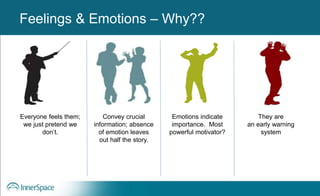
Feelings & Emotions – Why??
Everyone feels them;
we just pretend we
don’t.
Convey crucial
information; absence
of emotion leaves
out half the story.
Emotions indicate
importance. Most
powerful motivator?
They are
an early warning
system
Feelings & Emotions – Why??
Disclosure & Vulnerability
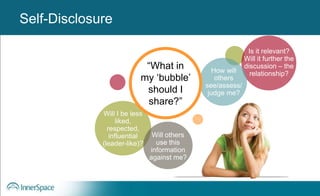
Self-Disclosure
Will I be less
liked,
respected,
influential
(leader-like)?
Is it relevant?
Will it further the
discussion – the
relationship?
Will others
use this
information
against me?
How will
others
see/assess/
judge me?
“What in
my ‘bubble’
should I
share?”
Self-Disclosure
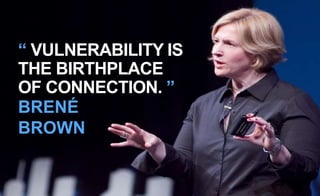
“ VULNERABILITY IS
THE BIRTHPLACE
OF CONNECTION. ”
BRENÉ
BROWN
Authentic Leaders
“The single factor distinguishing top
quartile managers from bottom quartile
managers was strength of affection.”
--“Encouraging the Heart: A Leader’s Guide to Recognizing and Rewarding Others”,
Kouzes & Barry
Authentic Leaders
Photo by Woodleywonderworks [link]
Team & Culture
Photo by Woodleywonderworks [link]
What Makes an Effective Team?
1. Participation
2. Collaboration
3. Cooperation (Commitment)
Research: All of these are correlated to
Group EQ
“Building Emotional Intelligence”, Wolfe & Druskat, Harvard Business Review, 2004
Photo by Woodleywonderworks [link]
“I’m starting to
feel defensive”
Inward
(my emotions)
Outward
(others’ emotions)
Emotional
Awareness
Emotional
Management
(“Regulation”)
“He seems to be
getting agitated”
• Take a deep breath
• “Could you give
me a sec?”
• Take a walk
“Are you ok?”
EQ (Individual)
Photo by Woodleywonderworks [link]
Inward
(Our Team)
Outward
(Other Teams)
Emotional
Awareness
Emotional
Regulation
EQ (Group)
High EQ individuals ≠ High EQ group
Group norms
determine group EQ
Photo by Woodleywonderworks [link]
Group EQ
Feedback & Influence
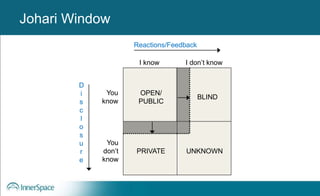
Working AgreementsJohari Window
OPEN/
PUBLIC
PRIVATE UNKNOWN
I know I don’t know
You
know
You
don’t
know
Reactions/Feedback
D
i
s
c
l
o
s
u
r
e
BLIND
Benefits of Self-Disclosure / VulnerabilityWhy is Feedback Important?
1. Personal Development
2. Team Effectiveness
3. Stronger Relationships
Bottom Line: Feedback is how we grow
Photo:RobbieGrubbs
Can I give you some feedback?
Photo by State Farm [link]
Social situations ≈ Physical threats
Threat Response
Photo by Andrew Vargas [link]
David Rock
What social
situations trigger
a threat response?
Status
Certainty
Autonomy
Relatedness
Fairness
SCARF Model
So… how do we communicate feedback
while minimizing defensiveness?
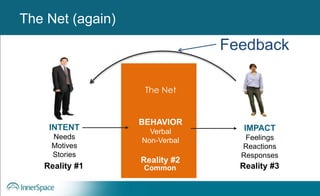
INTENT
Needs
Motives
Stories
Reality #1
BEHAVIOR
Verbal
Non-Verbal
Reality #2
Common
IMPACT
Feelings
Reactions
Responses
Reality #3
The Net
The Net (again)
Feedback
Benefits of Self-Disclosure / VulnerabilityHow to Give Effective Feedback
• Focus on specific, observable behavior
When you do [x]…
• Describe the impact of that behavior on you
I feel [y]…
• Ask about the other person’s motives or
intentions
Can you tell me what’s going on for you?
Benefits of Self-Disclosure / VulnerabilityLet’s try some examples…
1. Joe, you clearly don’t care about this presentation.
2. Joe, I noticed that you are looking at your phone. You are
clearly bored with this presentation.
3. Joe, I noticed that you are looking at your phone. I am
feeling anxious about whether I am doing a good job with
this presentation.
Benefits of Self-Disclosure / VulnerabilityHow to Give Effective Feedback
When you do [x]…
I feel [y == emotion] that / like
And my story is [z].
Can you tell me what’s going on for you?
Photo by Ana Karenina [link]
1:1 Feedback
Benefits of Self-Disclosure / VulnerabilityTips for Receiving Feedback
• Look for “Grains of Truth”
– Learning is better than being right
– Goal is understanding, not winning
• Listen and ask clarifying questions
• Acknowledge your feelings
• Gift mentality
– Say “Thank you!”
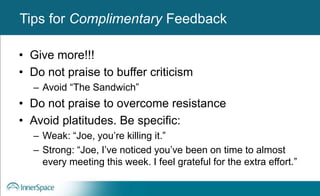
Benefits of Self-Disclosure / VulnerabilityTips for Complimentary Feedback
• Give more!!!
• Do not praise to buffer criticism
– Avoid “The Sandwich”
• Do not praise to overcome resistance
• Avoid platitudes. Be specific:
– Weak: “Joe, you’re killing it.”
– Strong: “Joe, I’ve noticed you’ve been on time to almost
every meeting this week. I feel grateful for the extra effort.”
Benefits of Self-Disclosure / VulnerabilityTips for Constructive Feedback
• Assume good intent; be curious
• Use a soft start
– Emphasize mutual goals & positive intent:
My intention is…
When you do [x], I feel [y].
• Be aware of your own stress
• Goal is joint problem solving
Benefits of Self-Disclosure / VulnerabilitySuggested Topics For Feedback
• Work Product
– Timeliness, quality, quantity, focus area
• Communication & Management
– Too much/ little, choice of format, email etiquette, language
choices, communication style in front of others, transparency of
project status, hiring/firing/promotions
• Role Modeling & Presence
– What energy do you feel from this person, How do they impact
others? What do they model well? Anything you worry about?
Arrival/departure times, attire, how they speak/listen/act?
Thanks, good-bye, and stay on
your side of the net 

Netflix Communication Workshop Nov 2015

  • 1.
    Effective Communication Joe Greenstein& Semira Rahemtulla November 2, 2015
  • 2.
    Why are wedoing this? (Part 1)
  • 3.
  • 4.
  • 5.
    Feelings & Emotions– Why?? Everyone feels them; we just pretend we don’t. Convey crucial information; absence of emotion leaves out half the story. Emotions indicate importance. Most powerful motivator? They are an early warning system Feelings & Emotions – Why??
  • 6.
  • 7.
    Self-Disclosure Will I beless liked, respected, influential (leader-like)? Is it relevant? Will it further the discussion – the relationship? Will others use this information against me? How will others see/assess/ judge me? “What in my ‘bubble’ should I share?” Self-Disclosure
  • 8.
    “ VULNERABILITY IS THEBIRTHPLACE OF CONNECTION. ” BRENÉ BROWN
  • 9.
    Authentic Leaders “The singlefactor distinguishing top quartile managers from bottom quartile managers was strength of affection.” --“Encouraging the Heart: A Leader’s Guide to Recognizing and Rewarding Others”, Kouzes & Barry Authentic Leaders
  • 10.
    Photo by Woodleywonderworks[link] Team & Culture
  • 11.
    Photo by Woodleywonderworks[link] What Makes an Effective Team? 1. Participation 2. Collaboration 3. Cooperation (Commitment) Research: All of these are correlated to Group EQ “Building Emotional Intelligence”, Wolfe & Druskat, Harvard Business Review, 2004
  • 12.
    Photo by Woodleywonderworks[link] “I’m starting to feel defensive” Inward (my emotions) Outward (others’ emotions) Emotional Awareness Emotional Management (“Regulation”) “He seems to be getting agitated” • Take a deep breath • “Could you give me a sec?” • Take a walk “Are you ok?” EQ (Individual)
  • 13.
    Photo by Woodleywonderworks[link] Inward (Our Team) Outward (Other Teams) Emotional Awareness Emotional Regulation EQ (Group)
  • 14.
    High EQ individuals≠ High EQ group Group norms determine group EQ Photo by Woodleywonderworks [link] Group EQ
  • 15.
  • 16.
    Working AgreementsJohari Window OPEN/ PUBLIC PRIVATEUNKNOWN I know I don’t know You know You don’t know Reactions/Feedback D i s c l o s u r e BLIND
  • 17.
    Benefits of Self-Disclosure/ VulnerabilityWhy is Feedback Important? 1. Personal Development 2. Team Effectiveness 3. Stronger Relationships Bottom Line: Feedback is how we grow
  • 18.
  • 19.
    Photo by StateFarm [link] Social situations ≈ Physical threats Threat Response
  • 20.
    Photo by AndrewVargas [link] David Rock What social situations trigger a threat response? Status Certainty Autonomy Relatedness Fairness SCARF Model
  • 21.
    So… how dowe communicate feedback while minimizing defensiveness?
  • 22.
  • 23.
    Benefits of Self-Disclosure/ VulnerabilityHow to Give Effective Feedback • Focus on specific, observable behavior When you do [x]… • Describe the impact of that behavior on you I feel [y]… • Ask about the other person’s motives or intentions Can you tell me what’s going on for you?
  • 24.
    Benefits of Self-Disclosure/ VulnerabilityLet’s try some examples… 1. Joe, you clearly don’t care about this presentation. 2. Joe, I noticed that you are looking at your phone. You are clearly bored with this presentation. 3. Joe, I noticed that you are looking at your phone. I am feeling anxious about whether I am doing a good job with this presentation.
  • 25.
    Benefits of Self-Disclosure/ VulnerabilityHow to Give Effective Feedback When you do [x]… I feel [y == emotion] that / like And my story is [z]. Can you tell me what’s going on for you?
  • 26.
    Photo by AnaKarenina [link] 1:1 Feedback
  • 27.
    Benefits of Self-Disclosure/ VulnerabilityTips for Receiving Feedback • Look for “Grains of Truth” – Learning is better than being right – Goal is understanding, not winning • Listen and ask clarifying questions • Acknowledge your feelings • Gift mentality – Say “Thank you!”
  • 28.
    Benefits of Self-Disclosure/ VulnerabilityTips for Complimentary Feedback • Give more!!! • Do not praise to buffer criticism – Avoid “The Sandwich” • Do not praise to overcome resistance • Avoid platitudes. Be specific: – Weak: “Joe, you’re killing it.” – Strong: “Joe, I’ve noticed you’ve been on time to almost every meeting this week. I feel grateful for the extra effort.”
  • 29.
    Benefits of Self-Disclosure/ VulnerabilityTips for Constructive Feedback • Assume good intent; be curious • Use a soft start – Emphasize mutual goals & positive intent: My intention is… When you do [x], I feel [y]. • Be aware of your own stress • Goal is joint problem solving
  • 30.
    Benefits of Self-Disclosure/ VulnerabilitySuggested Topics For Feedback • Work Product – Timeliness, quality, quantity, focus area • Communication & Management – Too much/ little, choice of format, email etiquette, language choices, communication style in front of others, transparency of project status, hiring/firing/promotions • Role Modeling & Presence – What energy do you feel from this person, How do they impact others? What do they model well? Anything you worry about? Arrival/departure times, attire, how they speak/listen/act?
  • 31.
    Thanks, good-bye, andstay on your side of the net 