Transcription and Translation Transcribe: to copy using the same “DNA language” of nitrogen bases (ATCG or AUCG) Translate: to take from the “DNA language” of bases to a different language – “amino acid language” which is made of codons.
Protein Structure Made up of amino acids Polypeptide - string of amino acids 20 amino acids are arranged in different orders to make a variety of proteins Assembled on a  ribosome
Questions to be answered today How do we get from the bases found in DNA to amino acids?  How do we get from a bunch of amino acids to proteins?
Which codons code for which  amino acids?  Genetic code - the inventory (list) of linkages between nucleotide triplets and the amino acids they code for in any organism A  gene  is a segment of DNA that transcribes a segment of RNA A  codon  is a series of three RNA bases that makes a specific amino acid.
Replication - review DNA double helix unwinds DNA now single-stranded New DNA strand forms using complementary base pairing (A-T, C-G) Used to prepare DNA for cell division Whole genome copied/replicated DNA
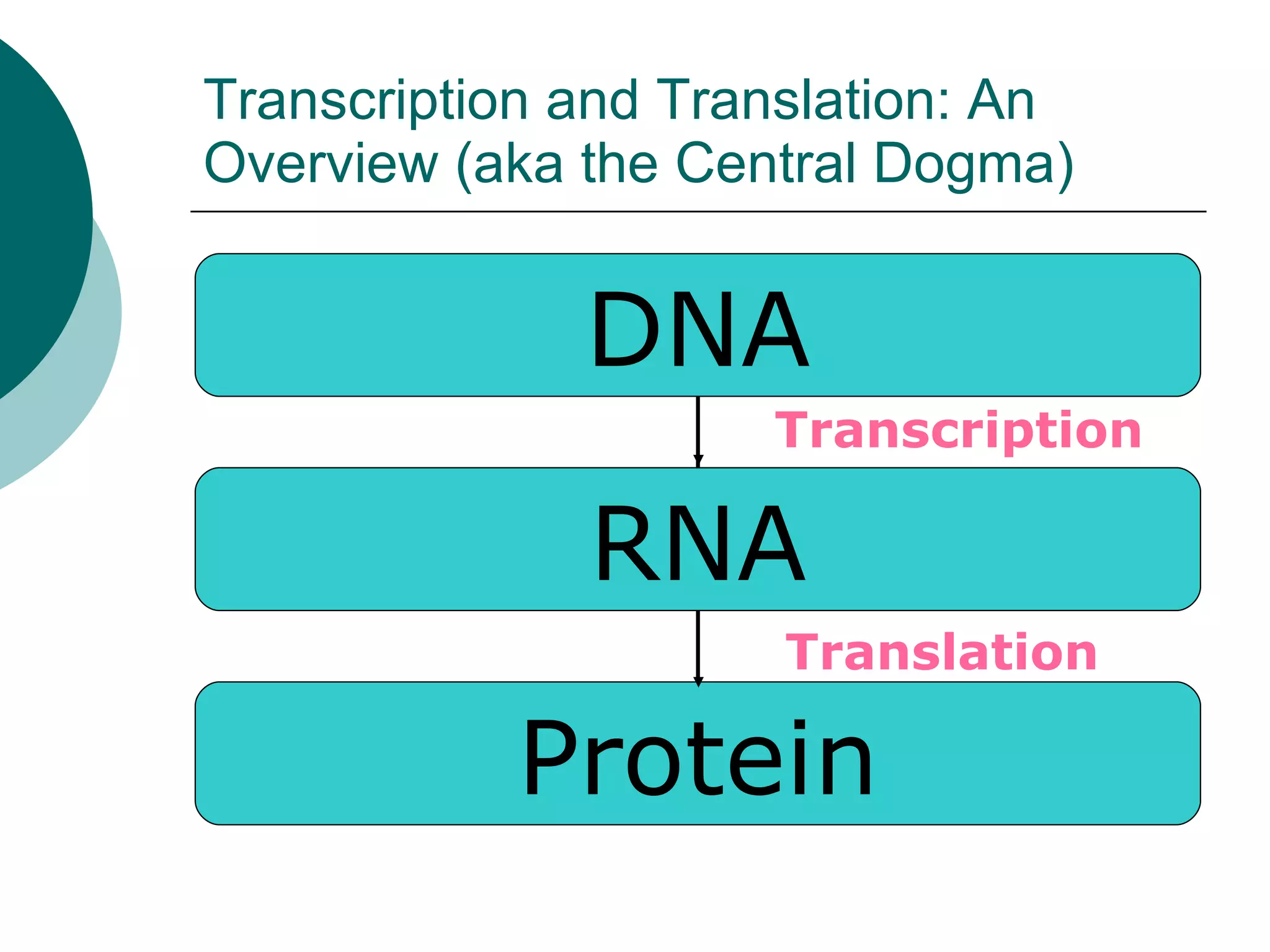
Transcription and Translation: An Overview (aka the Central Dogma) Transcription Translation DNA RNA Protein
RNA vs. DNA DNA Double stranded Deoxyribose sugar  Bases: C,G A,T RNA Single stranded Ribose sugar Bases: C,G,A,U Both contain a sugar, phosphate, and base.
Transcription-DNA to RNA same language RNA forms base pairs with DNA C-G A-U (no T in RNA) Primary transcript - length of RNA that results from the process of transcription
TRANSCRIPTION ACG ATA CCC TGA CGA GCG UGC UAU GGG ACU Now complete the last two transcriptions. DNA strand RNA strand
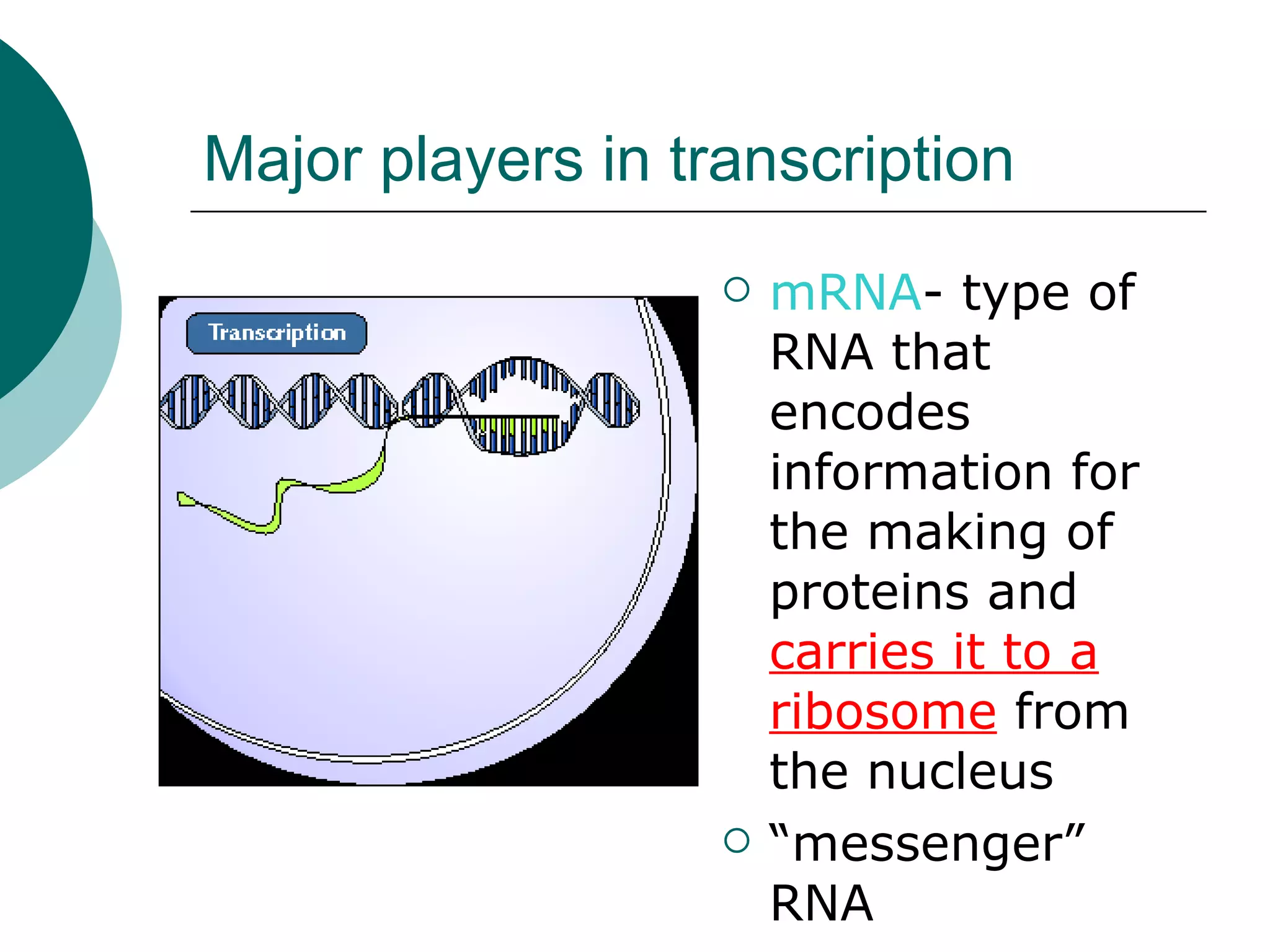
Major players in transcription mRNA - type of RNA that encodes information for the making of proteins and  carries it to a ribosome  from the nucleus “ messenger” RNA
Major players in transcription RNA polymerase - complex of  enzymes with 2 functions : Unwind DNA sequence  Produce primary transcript (definition on slide 7) by stringing together the chain of RNA nucleotides
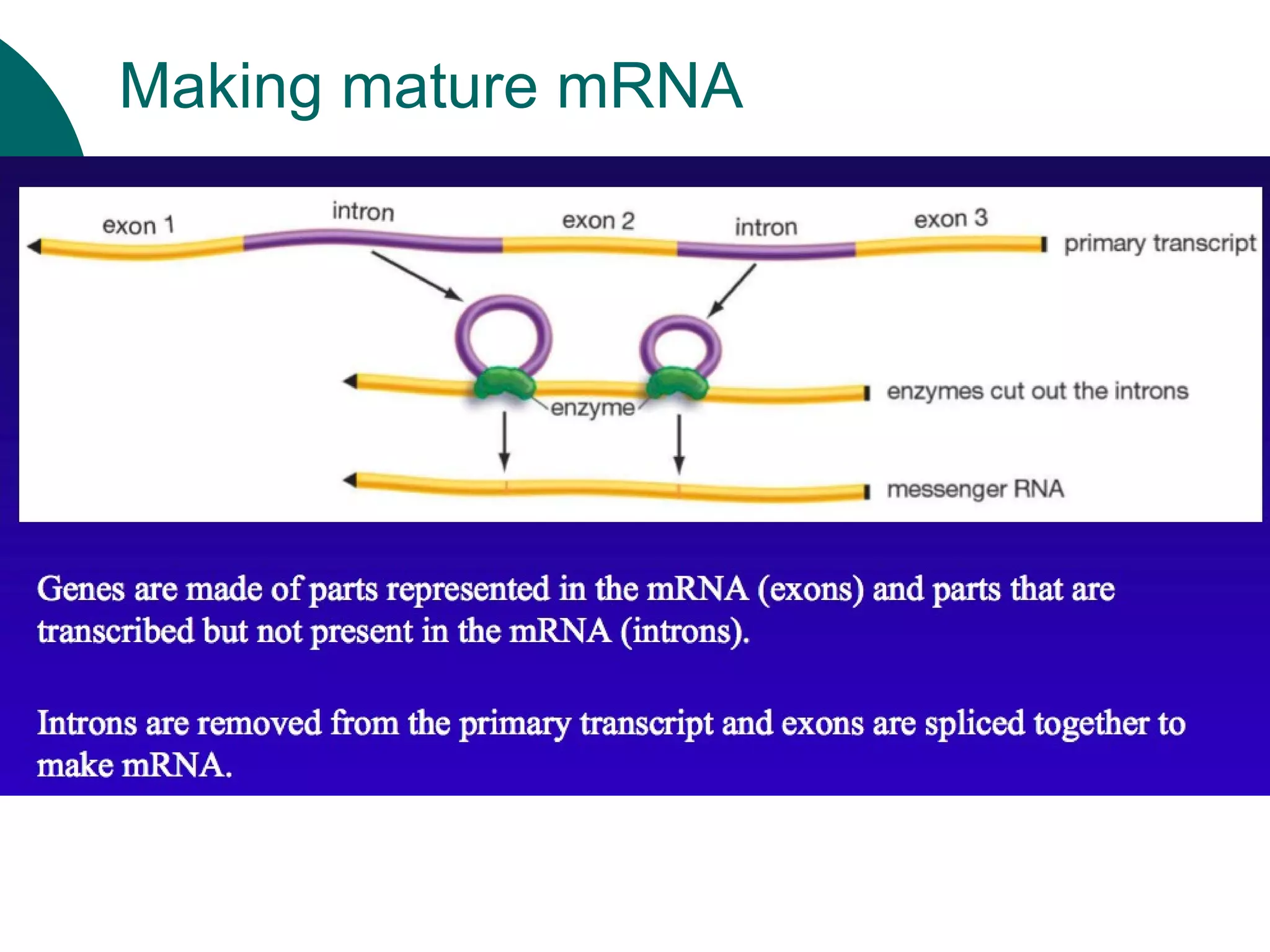
mRNA Processing Primary transcript is not mature mRNA DNA sequence has coding regions ( exons ) and non-coding regions ( introns )  Introns must be removed before primary transcript is mRNA and can leave nucleus
Making mature mRNA
Transcription is done…what now? Now we have mature mRNA transcribed from the cell’s DNA.  It is leaving the nucleus through a nuclear pore.  Once in the cytoplasm, it finds a ribosome so that translation can begin.  We know how mRNA is made, but how do we “read” the code?
Translation- RNA to protein, different languages Second stage of protein production mRNA is on a ribosome
Ribosomes 2 subunits, separate in cytoplasm until they join to begin translation Large Small Contain 3 binding sites E P A
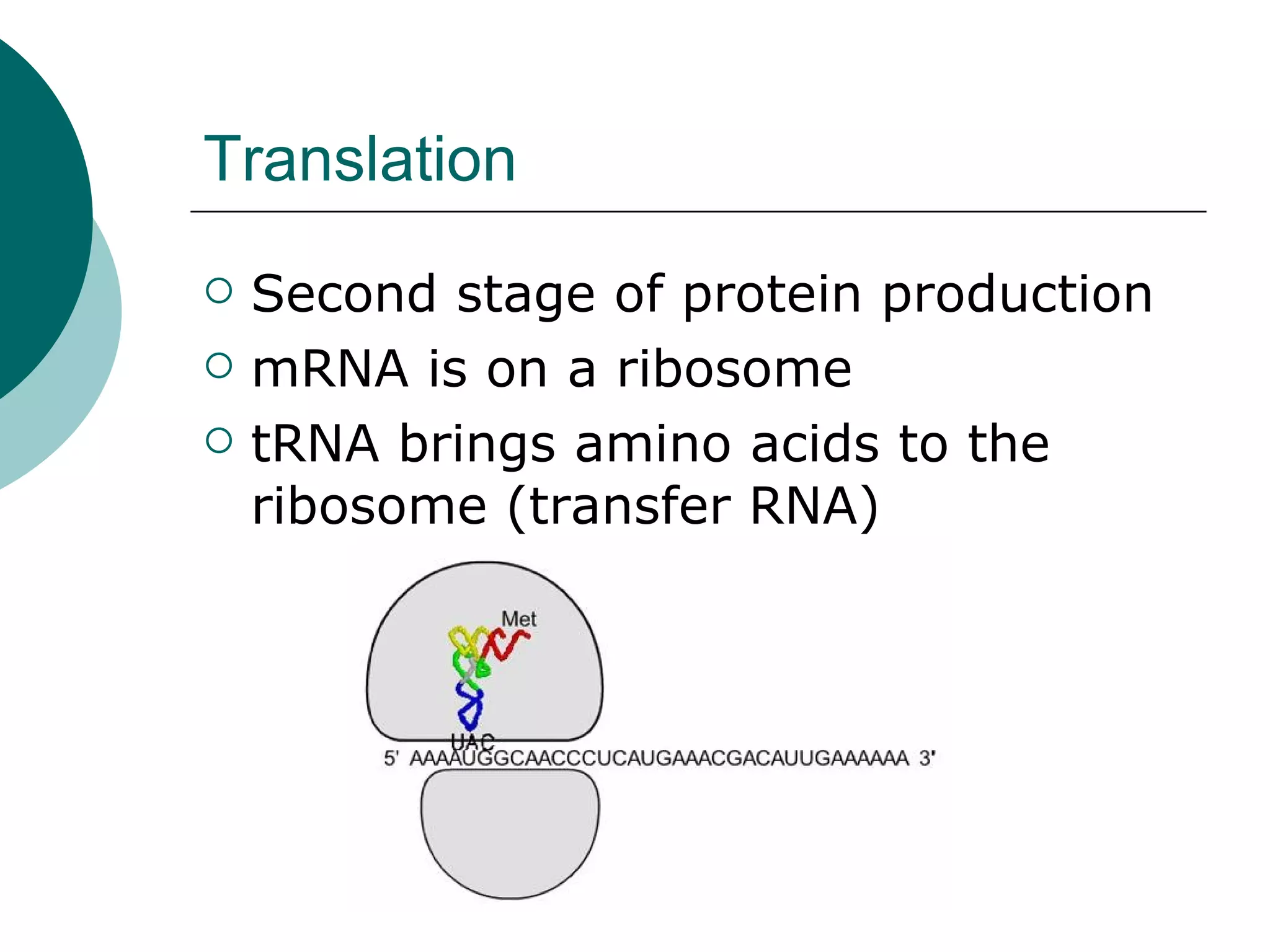
Translation Second stage of protein production mRNA is on a ribosome tRNA brings amino acids to the ribosome (transfer RNA)
tRNA Transfer RNA Bound to one amino acid on one end Anticodon  on the other end complements (matches) mRNA codon (set of three bases in a row)
tRNA Function Amino acids must be in the correct order for the protein to function correctly tRNA lines up amino acids using mRNA code
Types of RNA
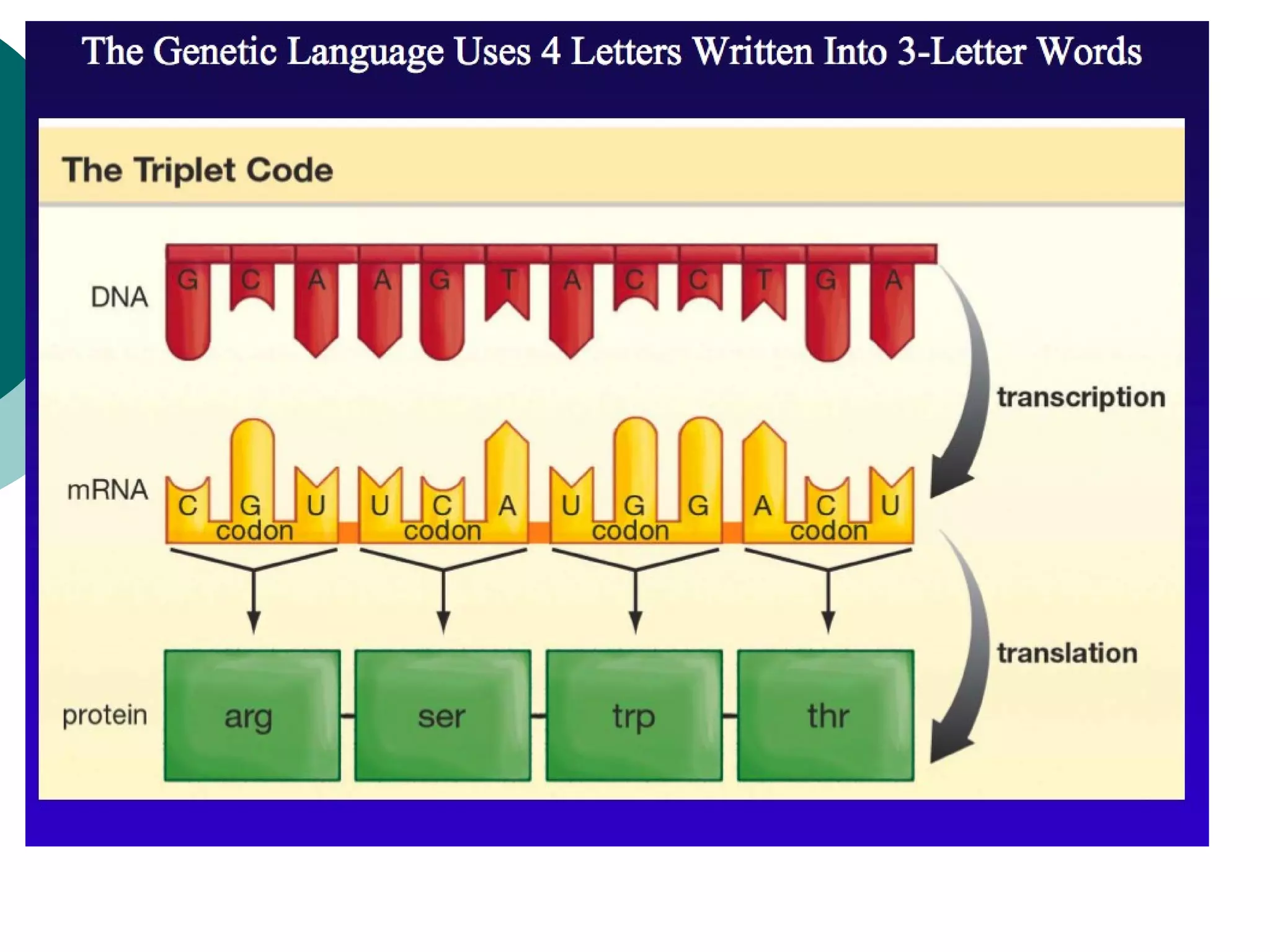
Reading the DNA code Every 3 DNA bases pairs with 3 mRNA bases Every group of 3 mRNA bases encodes a single amino acid Codon - coding triplet of mRNA bases
 
Special codons There is one codon that always starts the process – AUG codes for amino acid called Methionine (MET) There are three codons that stop the process – UAA, UAG, UGA
The Genetic Code-each triplet is the code for an amino acid.  A string of amino acids makes a protein.
Transcription vs. Translation Review Transcription Process by which genetic information encoded in DNA is copied onto messenger RNA Occurs in the nucleus DNA  mRNA Translation Process by which information encoded in mRNA is used to assemble a protein at a ribosome Occurs on a Ribosome mRNA    protein

Transcriptionand translation

  • 1.
    Transcription and TranslationTranscribe: to copy using the same “DNA language” of nitrogen bases (ATCG or AUCG) Translate: to take from the “DNA language” of bases to a different language – “amino acid language” which is made of codons.
  • 2.
    Protein Structure Madeup of amino acids Polypeptide - string of amino acids 20 amino acids are arranged in different orders to make a variety of proteins Assembled on a ribosome
  • 3.
    Questions to beanswered today How do we get from the bases found in DNA to amino acids? How do we get from a bunch of amino acids to proteins?
  • 4.
    Which codons codefor which amino acids? Genetic code - the inventory (list) of linkages between nucleotide triplets and the amino acids they code for in any organism A gene is a segment of DNA that transcribes a segment of RNA A codon is a series of three RNA bases that makes a specific amino acid.
  • 5.
    Replication - reviewDNA double helix unwinds DNA now single-stranded New DNA strand forms using complementary base pairing (A-T, C-G) Used to prepare DNA for cell division Whole genome copied/replicated DNA
  • 6.
    Transcription and Translation:An Overview (aka the Central Dogma) Transcription Translation DNA RNA Protein
  • 7.
    RNA vs. DNADNA Double stranded Deoxyribose sugar Bases: C,G A,T RNA Single stranded Ribose sugar Bases: C,G,A,U Both contain a sugar, phosphate, and base.
  • 8.
    Transcription-DNA to RNAsame language RNA forms base pairs with DNA C-G A-U (no T in RNA) Primary transcript - length of RNA that results from the process of transcription
  • 9.
    TRANSCRIPTION ACG ATACCC TGA CGA GCG UGC UAU GGG ACU Now complete the last two transcriptions. DNA strand RNA strand
  • 10.
    Major players intranscription mRNA - type of RNA that encodes information for the making of proteins and carries it to a ribosome from the nucleus “ messenger” RNA
  • 11.
    Major players intranscription RNA polymerase - complex of enzymes with 2 functions : Unwind DNA sequence Produce primary transcript (definition on slide 7) by stringing together the chain of RNA nucleotides
  • 12.
    mRNA Processing Primarytranscript is not mature mRNA DNA sequence has coding regions ( exons ) and non-coding regions ( introns ) Introns must be removed before primary transcript is mRNA and can leave nucleus
  • 13.
  • 14.
    Transcription is done…whatnow? Now we have mature mRNA transcribed from the cell’s DNA. It is leaving the nucleus through a nuclear pore. Once in the cytoplasm, it finds a ribosome so that translation can begin. We know how mRNA is made, but how do we “read” the code?
  • 15.
    Translation- RNA toprotein, different languages Second stage of protein production mRNA is on a ribosome
  • 16.
    Ribosomes 2 subunits,separate in cytoplasm until they join to begin translation Large Small Contain 3 binding sites E P A
  • 17.
    Translation Second stageof protein production mRNA is on a ribosome tRNA brings amino acids to the ribosome (transfer RNA)
  • 18.
    tRNA Transfer RNABound to one amino acid on one end Anticodon on the other end complements (matches) mRNA codon (set of three bases in a row)
  • 19.
    tRNA Function Aminoacids must be in the correct order for the protein to function correctly tRNA lines up amino acids using mRNA code
  • 20.
  • 21.
    Reading the DNAcode Every 3 DNA bases pairs with 3 mRNA bases Every group of 3 mRNA bases encodes a single amino acid Codon - coding triplet of mRNA bases
  • 22.
  • 23.
    Special codons Thereis one codon that always starts the process – AUG codes for amino acid called Methionine (MET) There are three codons that stop the process – UAA, UAG, UGA
  • 24.
    The Genetic Code-eachtriplet is the code for an amino acid. A string of amino acids makes a protein.
  • 25.
    Transcription vs. TranslationReview Transcription Process by which genetic information encoded in DNA is copied onto messenger RNA Occurs in the nucleus DNA mRNA Translation Process by which information encoded in mRNA is used to assemble a protein at a ribosome Occurs on a Ribosome mRNA protein