response to changeWhat happens to an ecosystem when it is disturbed?
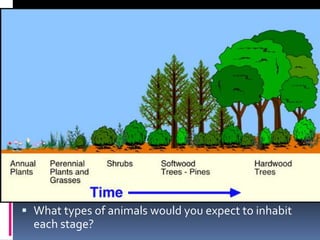
Ecosystem ChangesEcological change is referred to as Successionthe regular pattern of changes over time in the types of species in a communityInteractions among living things results in these changesFirst organisms to arrive, usually small plants, are called pioneersThe end result of these changes, if left undisturbed, is the climax community
What types of animals would you expect to inhabit each stage?
Animals in successionAs succession occurs, the animals correspond to the plants that are presentSmall animals (insects, things that live in soil, small rodents) that eat the pioneer species appear firstThen larger animals that eat the smaller animals and/or the next plant species appearThis continues until you have the climax group of animals as well as plants
Types of SuccessionTwo types depending on how it starts:Primary Succession – new land is created and succession beginsTakes much longer (no soil!)Example: volcanic eruption creates land; bare rock exposed from melted glacierweathering plays a major role in creating soil
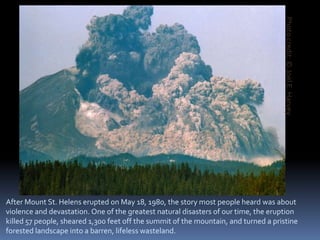
Photo credit: © Joel E. HarveyAfter Mount St. Helens erupted on May 18, 1980, the story most people heard was about violence and devastation. One of the greatest natural disasters of our time, the eruption killed 57 people, sheared 1,300 feet off the summit of the mountain, and turned a pristine forested landscape into a barren, lifeless wasteland.
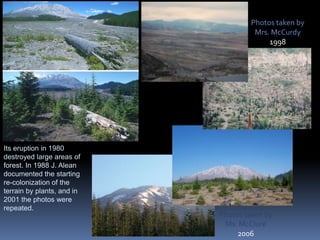
Photos taken by Mrs. McCurdy  1998Its eruption in 1980 destroyed large areas of forest. In 1988 J. Alean documented the starting re-colonization of the terrain by plants, and in 2001 the photos were repeated. Photos taken by Ms. McClure 2006
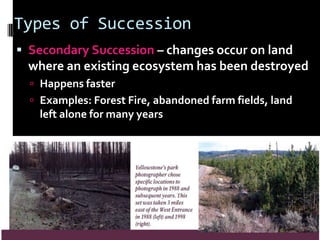
Types of SuccessionSecondary Succession – changes occur on land where an existing ecosystem has been destroyedHappens fasterExamples: Forest Fire, abandoned farm fields, land left alone for many years
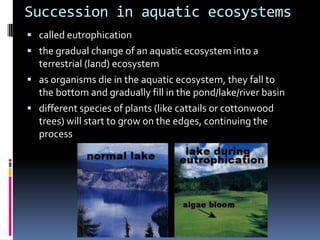
Succession in aquatic ecosystemscalled eutrophicationthe gradual change of an aquatic ecosystem into a terrestrial (land) ecosystemas organisms die in the aquatic ecosystem, they fall to the bottom and gradually fill in the pond/lake/river basindifferent species of plants (like cattails or cottonwood trees) will start to grow on the edges, continuing the process
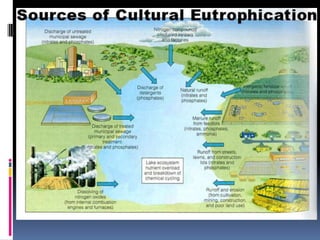
Eutrophication	humans GREATLY speed up this process by polluting the water ways with nitrogen and phosphorus found in many common products like fertilizer, laundry detergentthese elements cause increased plant growth and more rapid animal deathalso speeds up with increased temperatures
Three Categories of Human-Induced Environmental Problems#1  Resource DepletionNatural resources become depleted when a large part of it has been used up. Natural Resources can be either:Renewable - they are constantly being replacedtrees, water, crops, sunNonrenewable - they cannot be replaced (or replenish too slowly)animal and plant species, fossil fuels, minerals
Results of Resource DepletionDeforestation: cutting large areas of trees for use in building products, fuel, etc. or to use the land for other purposes.Desertification: destructive use of land results in the formation of desert conditionsSustainable use can prevent both of these
Human-induced environmental problems #2  PollutionPollution is the introduction of harmful levels of chemicals or waste material into the environmentPollution may be harmful to human healthPollution can occur in air, soil, or waterPollution can take the form of liquid, solid, gas, or even energy
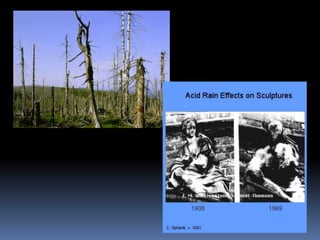
Results of PollutionAcid Precipitation – rain/snow/ice that has a pH less than 7. Results from sulfur oxides and nitrogen oxides in the atmosphere mixing with the water in the atmosphere to form sulfuric and nitric acid.Dangerous to living things – pH in environment may become intolerableDestructive to environment – acid dissolves certain types of stone
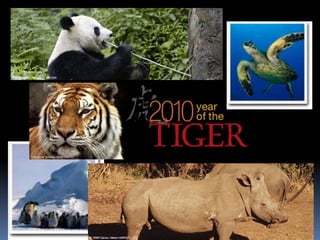
Results of pollutionBiomagnification – process by which a chemical moves through the food chain, becoming more concentrated. May be harmful/lethal to organisms at the top of the food chain, reducing biodiversity.  Biomagnification video - MUST SEEHuman-induced environmental problems #3   ExtinctionExtinction means the last individual of a species has died and the species is gone foreverThousands of species are becoming extinct each yearEndangered species are those whose extinction is very close, and will happen without some sort of intervention
A sustainable worldIn a sustainable world, human populations can continue to exist with a high standard of living and health becauseBiodiversity is preservedHabitats are preservedNonrenewable resource are used sparingly and efficientlyRenewable resources are used no faster than they can be replacedThere are enough resources for the next generation
Biodiversity is preservedBiodiversity – all of the different forms of lifeAll living things are connected, and therefore depend upon each other for survival.Three Levels:Species diversity – all of the different species in an areaGenetic diversity – all of the different genetic combinations in a particular speciesEcosystem diversity – all of the different biological, geological, chemical factors in an area
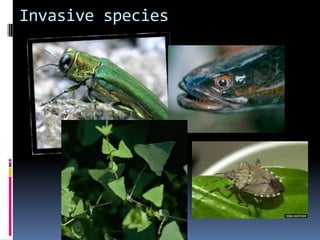
Habitats are preservedDestruction of appropriate habitat can lead to extinctionHabitat fragmentation – some living things require large areas of land. Habitat can be come “fragmented” when human development separates areas.Invasive species– occurs when a species is introduced to a habitat in which it is not naturally found. If there is no predator for that species, it may increase in number at the expense of native species, who will now have to compete for resources
Invasive species
Global Changes occur when ecosystem is disrupted over long periods of timeOzone Depletion – reduction in the thickness of the  ozone layerOzone (O3) – located in the stratosphere, filters UVB light before it reaches the earthOzone is broken down into oxygen gas (O2) by CFC’s (chlorofluorocarbons)Why does this matter?UVB has been linked to skin cancer, cataracts, damage to materials like plastics, and harm to certain crops and marine organisms. Reduction in ozone means an increase in UVB!
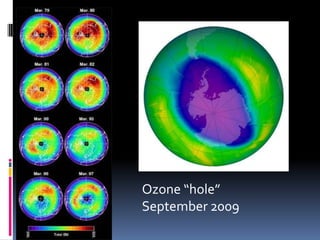
Ozone “hole” September 2009
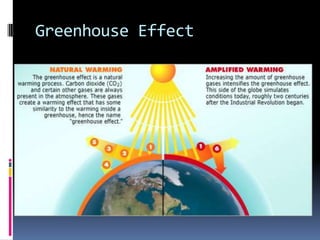
Global Changes (Continued)2. Global Warming: increase in the average temperature of the EarthDependent on the greenhouse effect – the Earth is warmed because the gases in the atmosphere trap heatGreenhouse gases:Carbon dioxideMethaneSurface OzoneCFC’sNitrous oxides
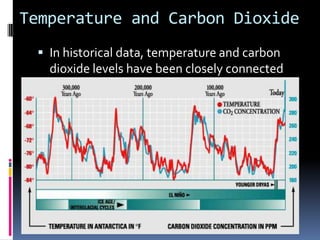
Temperature and Carbon DioxideIn historical data, temperature and carbon dioxide levels have been closely connected
Greenhouse Effect
Results of Increased Global TemperaturesSea level riseLoss of habitable landCoral bleachingShoreline erosionChanges in agricultureMay be positive or negativeAppropriate growing climate may shiftChanges in water resourcesAreas of drought/flooding as weather patterns change
IF nonrenewable resource are used sparingly and efficientlyAND renewable resources are used no faster than they can be replaced
There will be enough resources for the next generationSustainable Use of Natural Resources:More efficient technology to produce electricityIncrease use of alternative energy sourcesIncrease fuel efficiency in automobilesConservation: the act of reducing the amount of resources one consumes.3 R’s – reduce, reuse, recycle
Response to change

Response to change

  • 1.
    response to changeWhathappens to an ecosystem when it is disturbed?
  • 2.
    Ecosystem ChangesEcological changeis referred to as Successionthe regular pattern of changes over time in the types of species in a communityInteractions among living things results in these changesFirst organisms to arrive, usually small plants, are called pioneersThe end result of these changes, if left undisturbed, is the climax community
  • 3.
    What types ofanimals would you expect to inhabit each stage?
  • 4.
    Animals in successionAssuccession occurs, the animals correspond to the plants that are presentSmall animals (insects, things that live in soil, small rodents) that eat the pioneer species appear firstThen larger animals that eat the smaller animals and/or the next plant species appearThis continues until you have the climax group of animals as well as plants
  • 5.
    Types of SuccessionTwotypes depending on how it starts:Primary Succession – new land is created and succession beginsTakes much longer (no soil!)Example: volcanic eruption creates land; bare rock exposed from melted glacierweathering plays a major role in creating soil
  • 6.
    Photo credit: ©Joel E. HarveyAfter Mount St. Helens erupted on May 18, 1980, the story most people heard was about violence and devastation. One of the greatest natural disasters of our time, the eruption killed 57 people, sheared 1,300 feet off the summit of the mountain, and turned a pristine forested landscape into a barren, lifeless wasteland.
  • 7.
    Photos taken byMrs. McCurdy 1998Its eruption in 1980 destroyed large areas of forest. In 1988 J. Alean documented the starting re-colonization of the terrain by plants, and in 2001 the photos were repeated. Photos taken by Ms. McClure 2006
  • 8.
    Types of SuccessionSecondarySuccession – changes occur on land where an existing ecosystem has been destroyedHappens fasterExamples: Forest Fire, abandoned farm fields, land left alone for many years
  • 9.
    Succession in aquaticecosystemscalled eutrophicationthe gradual change of an aquatic ecosystem into a terrestrial (land) ecosystemas organisms die in the aquatic ecosystem, they fall to the bottom and gradually fill in the pond/lake/river basindifferent species of plants (like cattails or cottonwood trees) will start to grow on the edges, continuing the process
  • 10.
    Eutrophication humans GREATLY speedup this process by polluting the water ways with nitrogen and phosphorus found in many common products like fertilizer, laundry detergentthese elements cause increased plant growth and more rapid animal deathalso speeds up with increased temperatures
  • 12.
    Three Categories ofHuman-Induced Environmental Problems#1 Resource DepletionNatural resources become depleted when a large part of it has been used up. Natural Resources can be either:Renewable - they are constantly being replacedtrees, water, crops, sunNonrenewable - they cannot be replaced (or replenish too slowly)animal and plant species, fossil fuels, minerals
  • 13.
    Results of ResourceDepletionDeforestation: cutting large areas of trees for use in building products, fuel, etc. or to use the land for other purposes.Desertification: destructive use of land results in the formation of desert conditionsSustainable use can prevent both of these
  • 14.
    Human-induced environmental problems#2 PollutionPollution is the introduction of harmful levels of chemicals or waste material into the environmentPollution may be harmful to human healthPollution can occur in air, soil, or waterPollution can take the form of liquid, solid, gas, or even energy
  • 15.
    Results of PollutionAcidPrecipitation – rain/snow/ice that has a pH less than 7. Results from sulfur oxides and nitrogen oxides in the atmosphere mixing with the water in the atmosphere to form sulfuric and nitric acid.Dangerous to living things – pH in environment may become intolerableDestructive to environment – acid dissolves certain types of stone
  • 17.
    Results of pollutionBiomagnification– process by which a chemical moves through the food chain, becoming more concentrated. May be harmful/lethal to organisms at the top of the food chain, reducing biodiversity. Biomagnification video - MUST SEEHuman-induced environmental problems #3 ExtinctionExtinction means the last individual of a species has died and the species is gone foreverThousands of species are becoming extinct each yearEndangered species are those whose extinction is very close, and will happen without some sort of intervention
  • 19.
    A sustainable worldIna sustainable world, human populations can continue to exist with a high standard of living and health becauseBiodiversity is preservedHabitats are preservedNonrenewable resource are used sparingly and efficientlyRenewable resources are used no faster than they can be replacedThere are enough resources for the next generation
  • 20.
    Biodiversity is preservedBiodiversity– all of the different forms of lifeAll living things are connected, and therefore depend upon each other for survival.Three Levels:Species diversity – all of the different species in an areaGenetic diversity – all of the different genetic combinations in a particular speciesEcosystem diversity – all of the different biological, geological, chemical factors in an area
  • 21.
    Habitats are preservedDestructionof appropriate habitat can lead to extinctionHabitat fragmentation – some living things require large areas of land. Habitat can be come “fragmented” when human development separates areas.Invasive species– occurs when a species is introduced to a habitat in which it is not naturally found. If there is no predator for that species, it may increase in number at the expense of native species, who will now have to compete for resources
  • 22.
  • 23.
    Global Changes occurwhen ecosystem is disrupted over long periods of timeOzone Depletion – reduction in the thickness of the ozone layerOzone (O3) – located in the stratosphere, filters UVB light before it reaches the earthOzone is broken down into oxygen gas (O2) by CFC’s (chlorofluorocarbons)Why does this matter?UVB has been linked to skin cancer, cataracts, damage to materials like plastics, and harm to certain crops and marine organisms. Reduction in ozone means an increase in UVB!
  • 24.
  • 25.
    Global Changes (Continued)2.Global Warming: increase in the average temperature of the EarthDependent on the greenhouse effect – the Earth is warmed because the gases in the atmosphere trap heatGreenhouse gases:Carbon dioxideMethaneSurface OzoneCFC’sNitrous oxides
  • 26.
    Temperature and CarbonDioxideIn historical data, temperature and carbon dioxide levels have been closely connected
  • 27.
  • 28.
    Results of IncreasedGlobal TemperaturesSea level riseLoss of habitable landCoral bleachingShoreline erosionChanges in agricultureMay be positive or negativeAppropriate growing climate may shiftChanges in water resourcesAreas of drought/flooding as weather patterns change
  • 29.
    IF nonrenewable resourceare used sparingly and efficientlyAND renewable resources are used no faster than they can be replaced
  • 30.
    There will beenough resources for the next generationSustainable Use of Natural Resources:More efficient technology to produce electricityIncrease use of alternative energy sourcesIncrease fuel efficiency in automobilesConservation: the act of reducing the amount of resources one consumes.3 R’s – reduce, reuse, recycle