Levels of Ecological Organization
the study of the relationships between biotic and abiotic factors in environments eco   (G) root  home, abode eco climate eco system eco tourism log, -o, y   (G) suffix  study of zo ology epidemi ology climat ology Ecology Eco logy
LEVELS OF ORGANIZATION Organism  – individual, living thing Population  - all the individuals of the same species (like mallard ducks) in an area
A population is always composed of same-species organisms
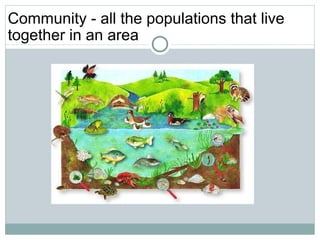
Community - all the populations that live together in an area
Ecosystem - the community plus the physical factors in an area (rain, light, soil..) Examples: Rotting Log Koi Pond Lake Clump of Dirt A field An old maple tree
Biome - large area  that has a particular climate , with certain species of plants and animals living there (e.g., tundra or grassland)
Biosphere - the part of the earth that supports life
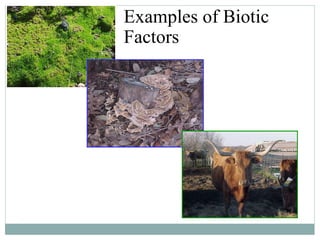
Biotic Factors Bio bio(s), bio(t)   (G) root   life include plants, animals, fungi, microorganisms bio logy bio statistics bio graphy bio technology bio sphere bio mechanics biot ic bio feedback
Examples of Biotic Factors
Abiotic Factors include air, water, soil, temperature, wind, source of energy (usually sun) A a, an (G) prefix  not, without a toxic a moral a biotic a musia
Examples of Abiotic Factors
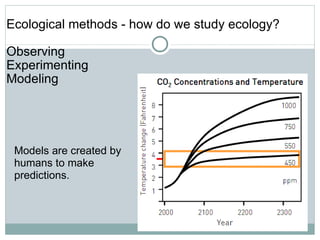
Ecological methods - how do we study ecology? Observing Experimenting Modeling Models are created by humans to make predictions.
Sometimes, you must be cautious in how a model interprets data.... Imagine graphing a person's height as they age.  One could predict that by the time they were age 30, they would be 22 feet tall.    However, the model would need to account for the slowing of growth after adolescence.
McLaren, James E, and Rotundo, Lisa (1985).  Heath Biology.   D. C. Heath and Company. The American Heritage Dictionary of the  English Language , Third Edition. (1992).  Houghton Mifflin Company. Arms. (1996).  Environmental Science .  Orlando,Florida: Holt, Rinehart and  Winston, Inc. Bibliography

Ecology

  • 1.
  • 2.
    the study ofthe relationships between biotic and abiotic factors in environments eco (G) root home, abode eco climate eco system eco tourism log, -o, y (G) suffix study of zo ology epidemi ology climat ology Ecology Eco logy
  • 3.
    LEVELS OF ORGANIZATIONOrganism – individual, living thing Population - all the individuals of the same species (like mallard ducks) in an area
  • 4.
    A population isalways composed of same-species organisms
  • 5.
    Community - allthe populations that live together in an area
  • 6.
    Ecosystem - thecommunity plus the physical factors in an area (rain, light, soil..) Examples: Rotting Log Koi Pond Lake Clump of Dirt A field An old maple tree
  • 7.
    Biome - largearea that has a particular climate , with certain species of plants and animals living there (e.g., tundra or grassland)
  • 8.
    Biosphere - thepart of the earth that supports life
  • 9.
    Biotic Factors Biobio(s), bio(t) (G) root life include plants, animals, fungi, microorganisms bio logy bio statistics bio graphy bio technology bio sphere bio mechanics biot ic bio feedback
  • 10.
  • 11.
    Abiotic Factors includeair, water, soil, temperature, wind, source of energy (usually sun) A a, an (G) prefix not, without a toxic a moral a biotic a musia
  • 12.
  • 13.
    Ecological methods -how do we study ecology? Observing Experimenting Modeling Models are created by humans to make predictions.
  • 14.
    Sometimes, you mustbe cautious in how a model interprets data.... Imagine graphing a person's height as they age.  One could predict that by the time they were age 30, they would be 22 feet tall.    However, the model would need to account for the slowing of growth after adolescence.
  • 15.
    McLaren, James E,and Rotundo, Lisa (1985). Heath Biology. D. C. Heath and Company. The American Heritage Dictionary of the English Language , Third Edition. (1992). Houghton Mifflin Company. Arms. (1996). Environmental Science . Orlando,Florida: Holt, Rinehart and Winston, Inc. Bibliography