Natural and step response
Ahsan Khawaja
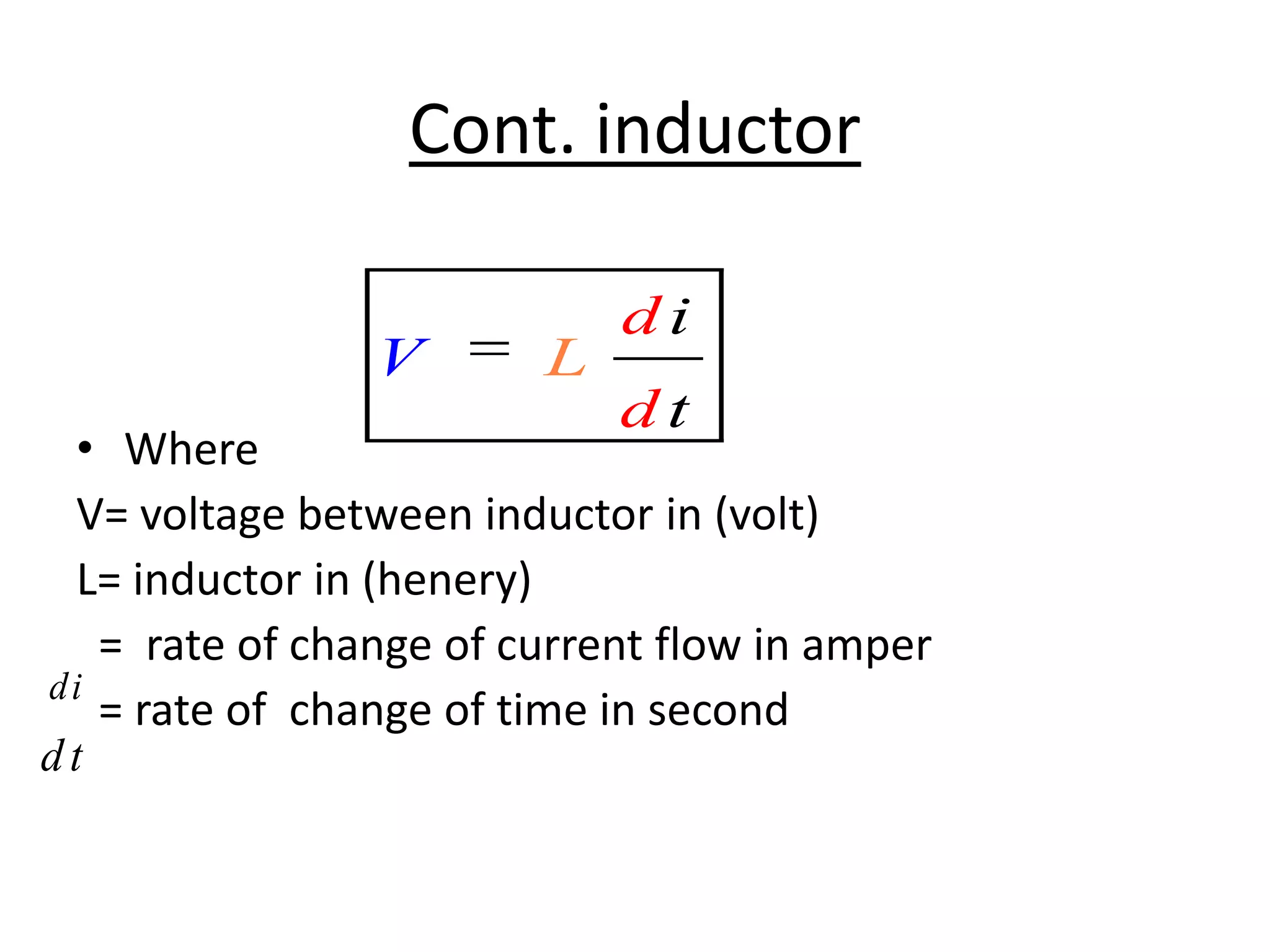
Cont. inductor
V

L

di
dt

• Where
V= voltage between inductor in (volt)
L= inductor in (henery)
= rate of change of current flow in amper
di
= rate of change of time in second
dt
dv

Cont. capacitor
• Mathematical relation

.

i

C

dv
dt

• Where
i= current that in capacitor in (ampere)
C= capacitance in (farad)
d v = rated of change of voltage.
d t = rate of change of time in second
First-Ordersources, resistors and an
Circuits
A circuit that contains only

•

inductor is called an RL circuit.
• A circuit that contains only sources, resistors and a
capacitor is called an RC circuit.
• RL and RC circuits are called first-order circuits
because their voltages and currents are described by
first-order differential equations.
R
i

i

L

vs

–
+

–
+

vs

R

C
6 Different First-Order Circuits
There are six different STC circuits. These
are listed below.
• An inductor and a resistance (called RL
Natural Response).
• A capacitor and a resistance (called RC
Natural Response).
• An inductor and a Thévenin equivalent
(called RL Step Response).
• An inductor and a Norton equivalent
(also called RL Step Response).
• A capacitor and a Thévenin equivalent
(called RC Step Response).
• A capacitor and a Norton equivalent
(also called RC Step Response).

RX

LX

CX

RX

RX

+

vS

LX

-

iS

RX

iS

RX

LX

RX

+

vS

CX

-

These are the simple, first-order cases.
Many circuits can be reduced to one of
these six cases. They all have solutions
which are in similar forms.

CX
6 Different First-Order Circuits
These are the simplest cases, so we
handle them first.

There are six different STC circuits. These
are listed below.
• An inductor and a resistance (called RL
Natural Response).
RX
CX
RX
LX
• A capacitor and a resistance (called RC
Natural Response).
RX
• An inductor and a Thévenin equivalent
+
vS
iS
RX
LX
LX
(called RL Step Response).
• An inductor and a Norton equivalent
(also called RL Step Response).
• A capacitor and a Thévenin equivalent
RX
+
vS
iS
RX
CX
(called RC Step Response).
• A capacitor and a Norton equivalent
(also called RC Step Response).
These are the simple, first-order cases.

CX

They all have solutions which are in similar
forms.
The Natural Response of a Circuit
• The currents and voltages that arise when
energy stored in an inductor or capacitor is
suddenly released into a resistive circuit.
• These “signals” are determined by the circuit
itself, not by external sources!
Step Response
• The sudden application of a DC voltage or
current source is referred to as a “step”.
• The step response consists of the voltages and
currents that arise when energy is being
absorbed by an inductor or capacitor.
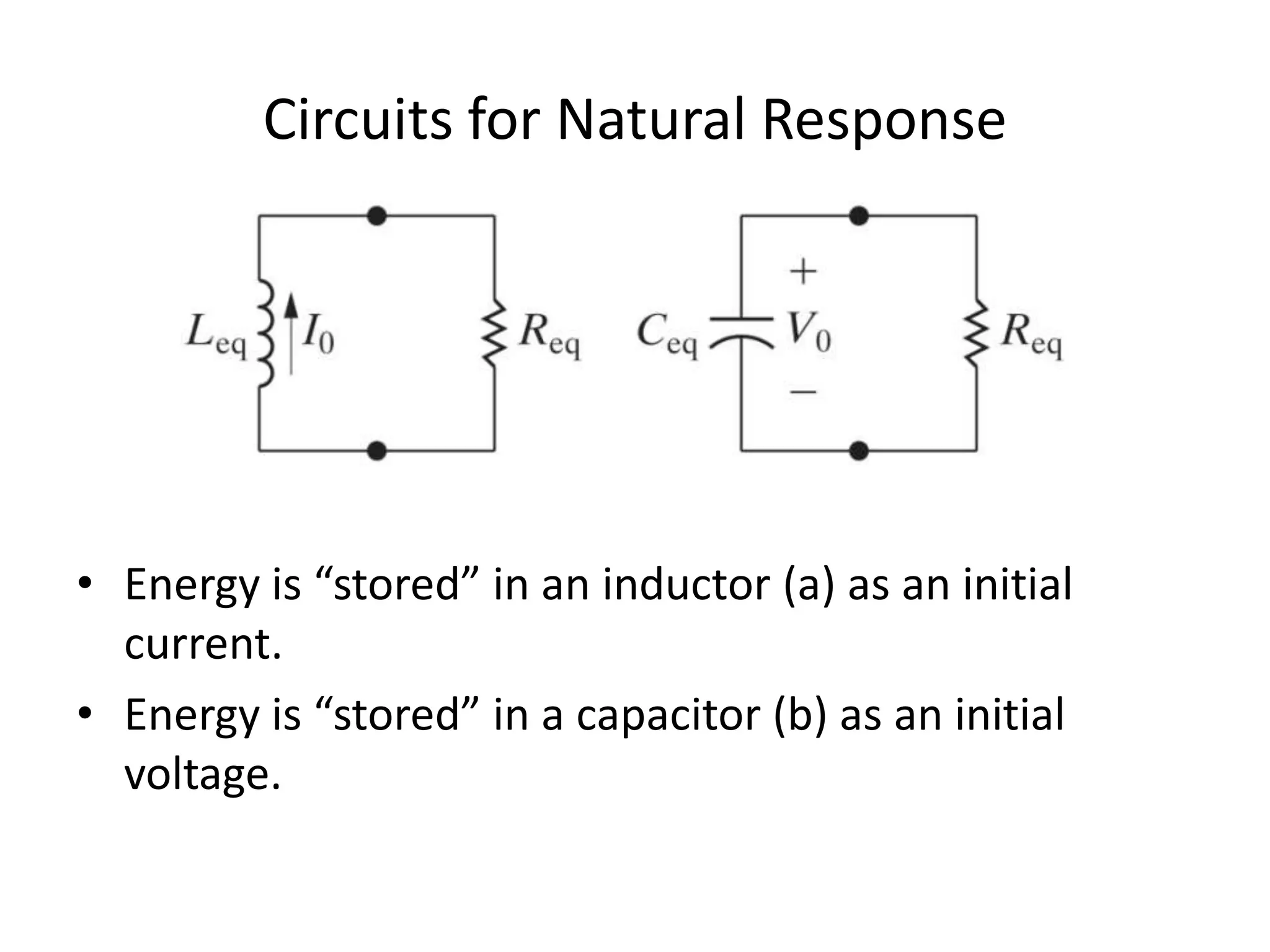
Circuits for Natural Response

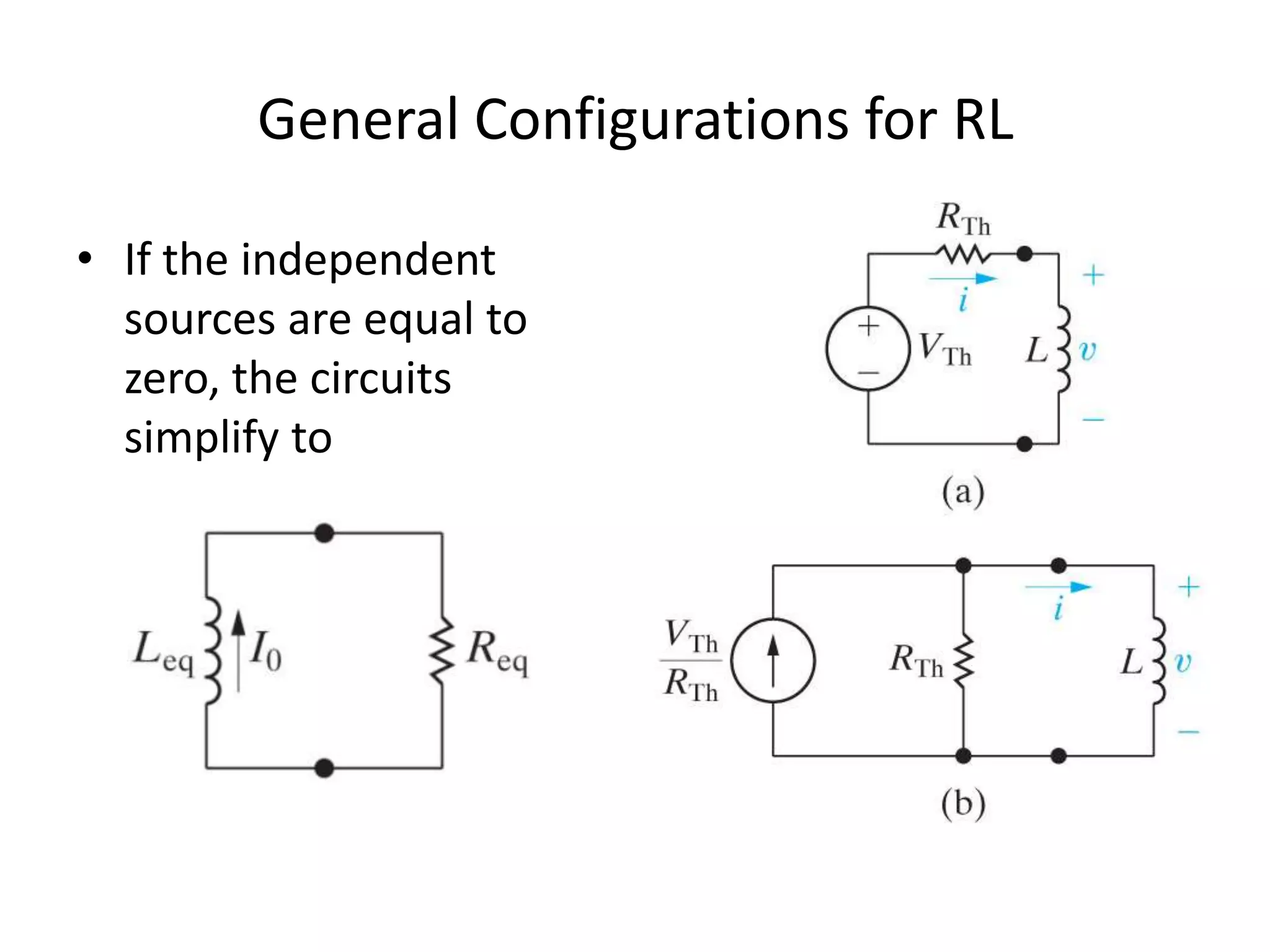
• Energy is “stored” in an inductor (a) as an initial
current.
• Energy is “stored” in a capacitor (b) as an initial
voltage.
General Configurations for RL
• If the independent
sources are equal to
zero, the circuits
simplify to
Natural Response of an RL Circuit
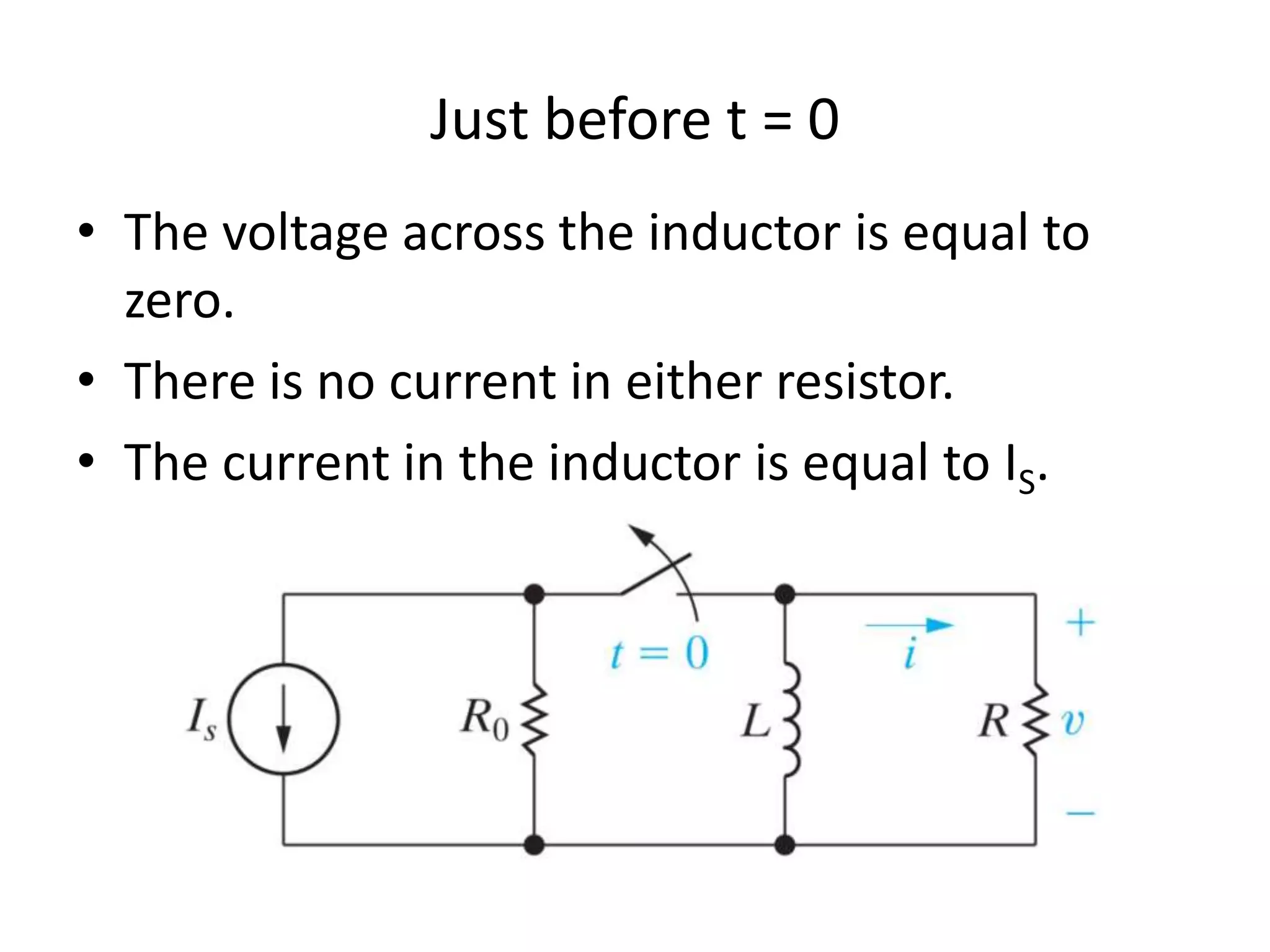
• Consider the circuit shown.
• Assume that the switch has been closed “for a
long time”, and is “opened” at t=0.
What does “for a long time” Mean?
• All of the currents and voltages have reached
a constant (dc) value.
• What is the voltage across the inductor just
before the switch is opened?
Just before t = 0
• The voltage across the inductor is equal to
zero.
• There is no current in either resistor.
• The current in the inductor is equal to IS.
Just after t = 0
• The current source and its parallel resistor R0
are disconnected from the rest of the circuit,
and the inductor begins to release energy.
The Source-Free
RL Circuit
• A first-order RL circuit consists of a inductor L (or its
equivalent) and a resistor (or its equivalent)
By KVL

vL
L

vR

di

0

iR

0

dt
Inductors law

Ohms law

di

R

i

L

dt

i (t )

I0 e

Rt/L
The Source-Free
RC Circuit
• A first-order circuit is characterized by a first-order
differential equation.
By KCL

iR

iC

Ohms law
•
•

0

v

C

R

dv
dt

Capacitor law

Apply Kirchhoff’s laws to purely resistive circuit results in algebraic equations.
Apply the laws to RC and RL circuits produces differential equations.

0
Natural Response of an RL Circuit
• Consider the following circuit, for which the switch is closed
for t < 0, and then opened at t = 0:

t=0
Io

Ro

i
L

+
R

v
–

Notation:
0– is used to denote the time just prior to switching
0+ is used to denote the time immediately after switching

• The current flowing in the inductor at t = 0– is Io
Solving for the Current (t

0)

• For t > 0, the circuit reduces to

i

Io

Ro

L

+

R

v
–

• Applying KVL to the LR circuit:

• Solution:

i (t )

i(0)e

( R / L ) t = I e-(R/L)t
0
Solving for the Voltage (t > 0)
i (t )

( R / L )t

Ioe
+

Io

Ro

L

R

v
–

• Note that the voltage changes abruptly:

v( 0 )

0

for t 0, v(t)

v( 0 )

iR
I0R

I o Re

( R /L )t
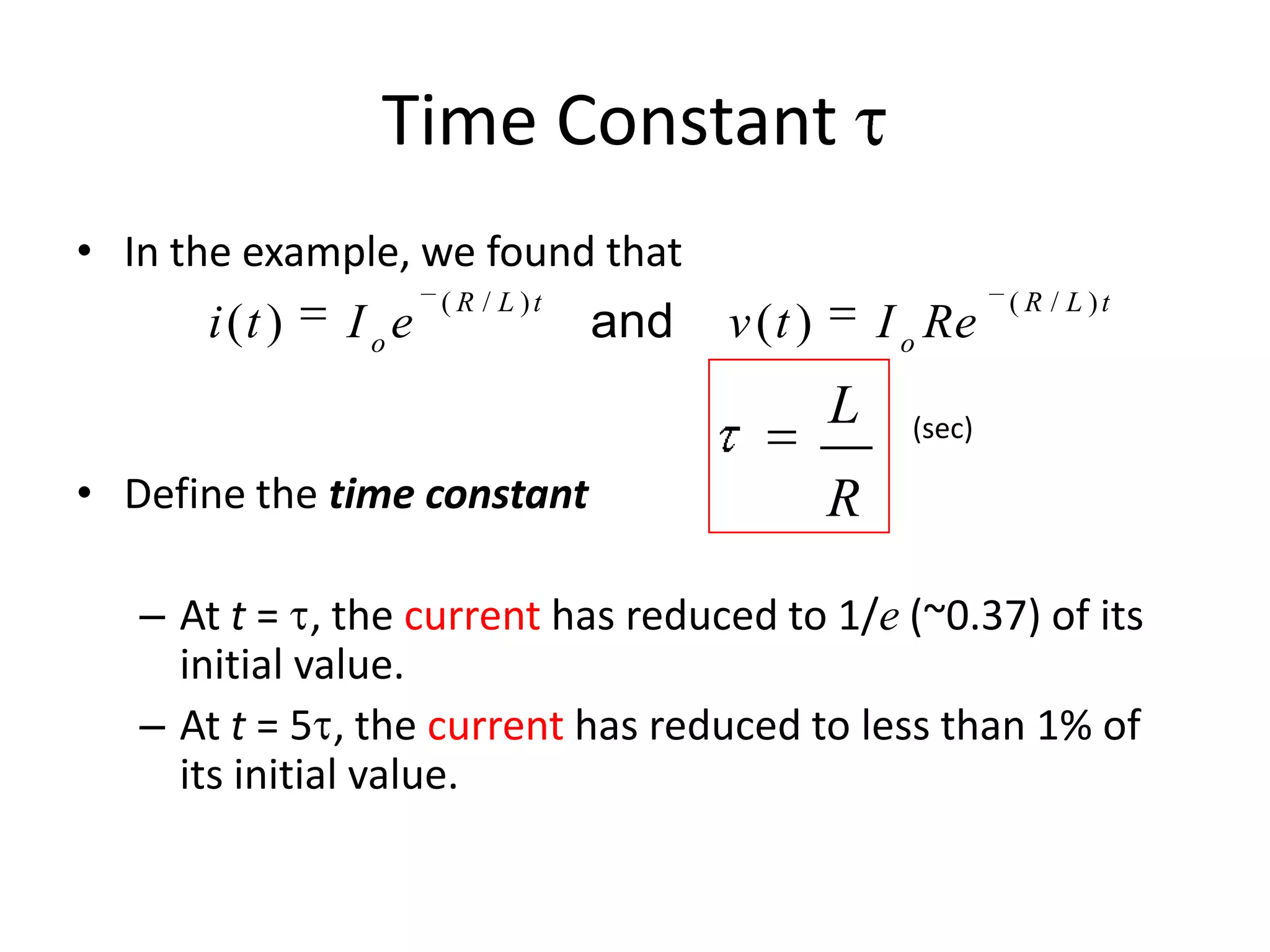
Time Constant
• In the example, we found that

i (t )

I oe

( R / L )t

and

v (t )

I o Re

L
• Define the time constant

( R / L )t

(sec)

R

– At t = , the current has reduced to 1/e (~0.37) of its
initial value.
– At t = 5 , the current has reduced to less than 1% of
its initial value.
The Source-Free
RL Circuit
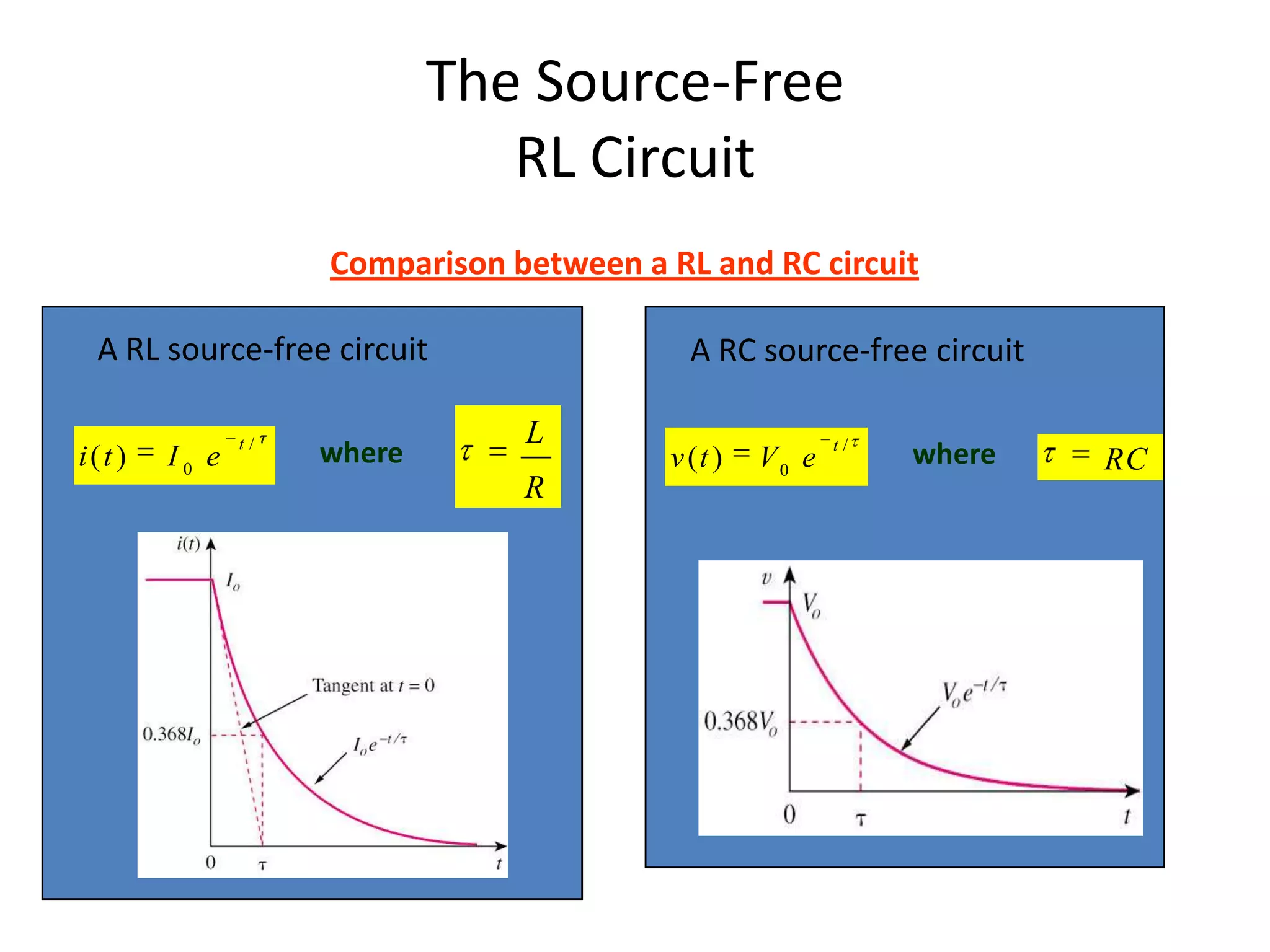
Comparison between a RL and RC circuit
A RL source-free circuit
i(t )

I0 e

t/

where

A RC source-free circuit
L
R

v (t )

V0 e

t/

where

RC
The Complete Solution
R

i (t )

Ie
0

L

t

,t

0
The voltage drop across the resistor

v

iR
R

v

I Re

L

0

t

,t

v(0 )

0

v(0 )

I R
0

0

.
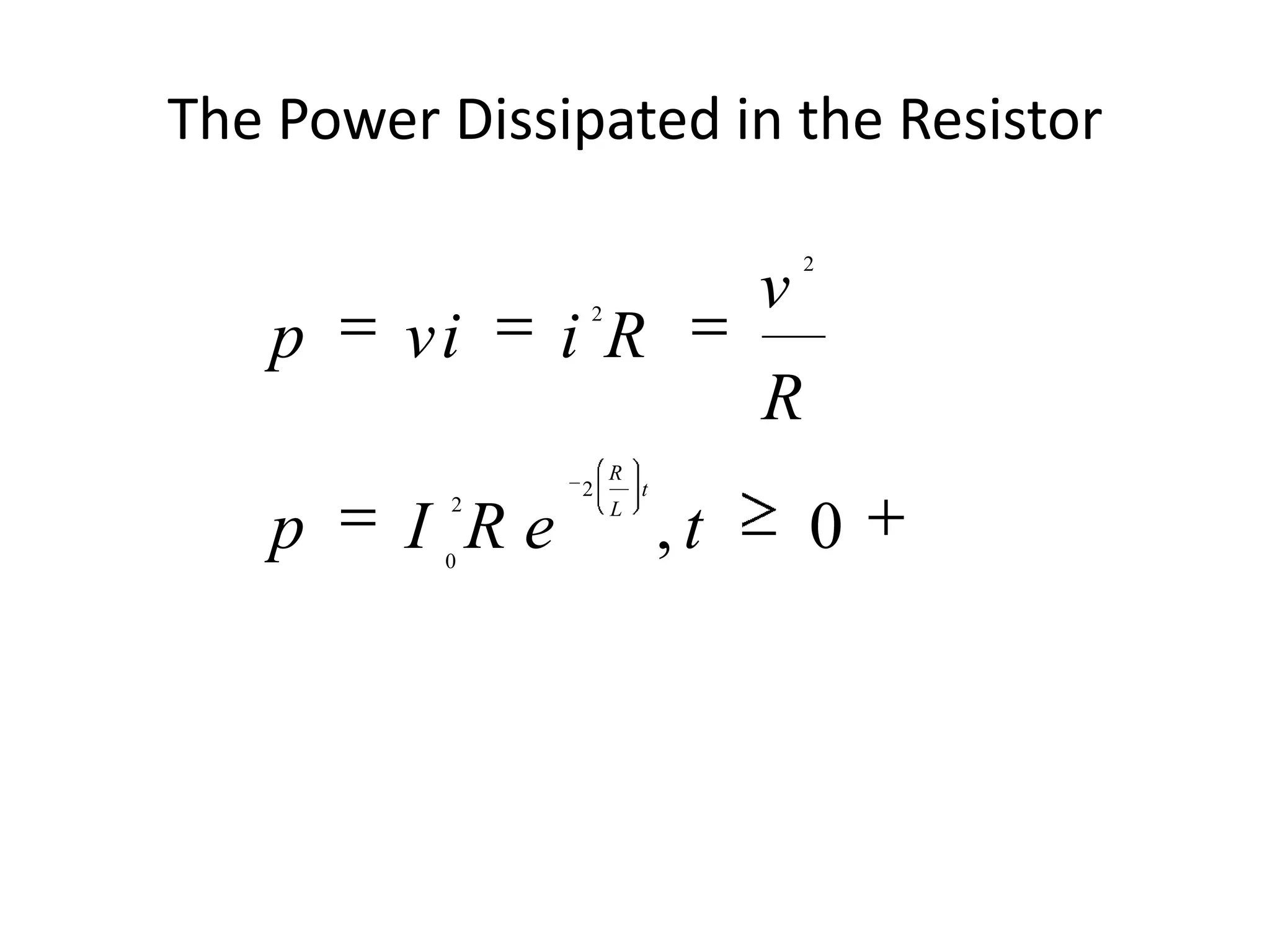
The Power Dissipated in the Resistor

p

vi

v

2

iR

2

R
p

2

I Re
0

2

R
L

t

,t

0
The Energy Delivered to the Resistor
t

w

t

pdx

w
2

0

0

2

2

I R (1

e

0

L
t

,w

R
L

I Re

0

1
R

2

2

1
2

LI

2
0

x

dx
R
L

t

),t

0.
The Source-Free
RL Circuit
A general form representing a RL

i(t )
where

I0 e

t/

L
R

•
•
•

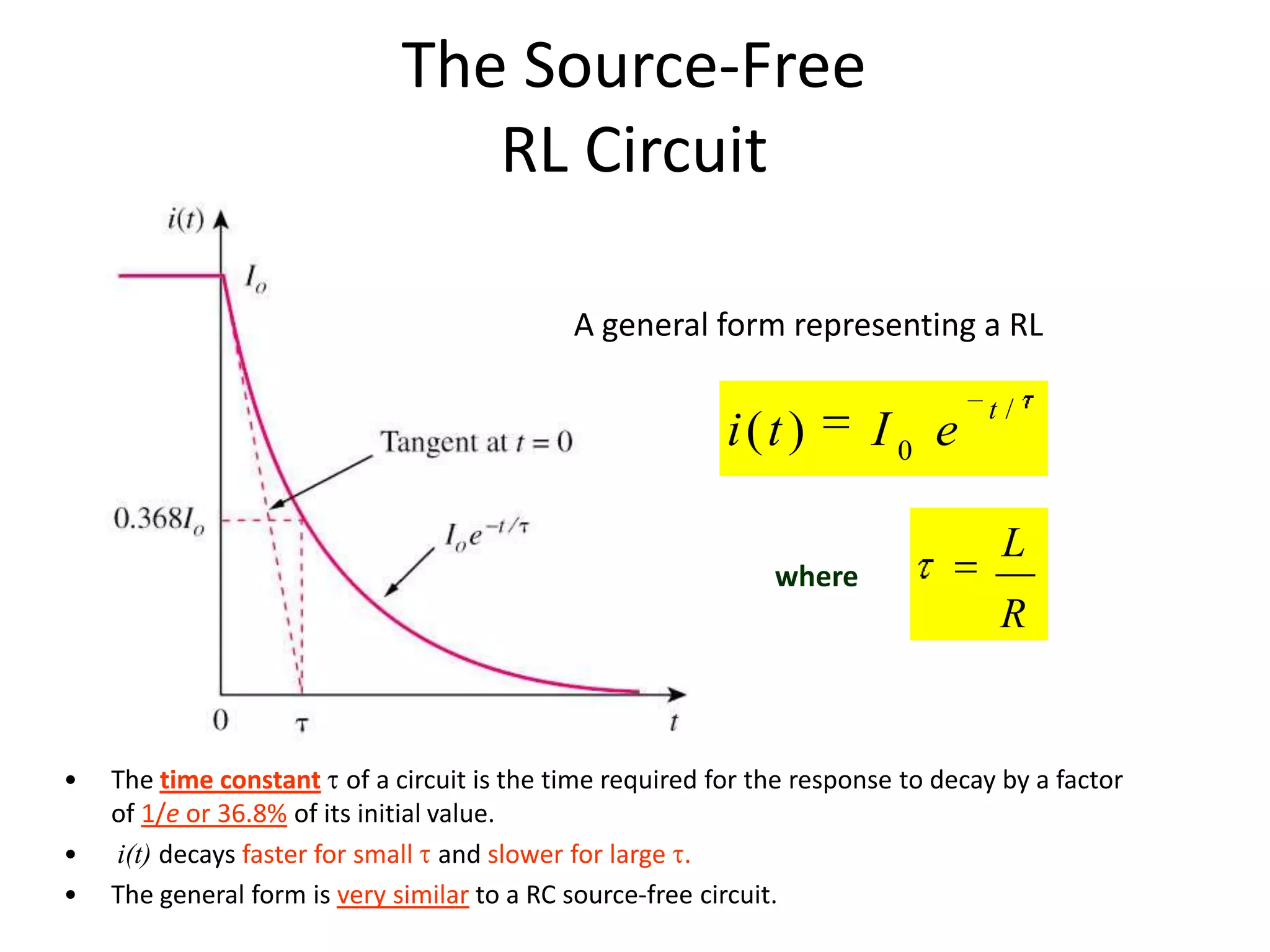
The time constant of a circuit is the time required for the response to decay by a factor
of 1/e or 36.8% of its initial value.
i(t) decays faster for small and slower for large .
The general form is very similar to a RC source-free circuit.
The Source-Free
RC Circuit
• The natural response of a circuit refers to the behavior (in terms of
voltages and currents) of the circuit itself, with no external sources of
excitation.
Time constant

RC
Decays more slowly

Decays faster

•
•

The time constant of a circuit is the time required for the response to decay by a
factor of 1/e or 36.8% of its initial value.
v decays faster for small and slower for large .
Natural Response Summary
RL Circuit

RC Circuit

i

+

L

C

R

v R
–

• Inductor current cannot
change instantaneously

i(0 )
i (t )

•

i(0 )
i(0)e

• time constant

Capacitor voltage cannot
change instantaneously

v (0 )

t/

v (t )
L
R

•

v (0 )
v (0)e

time constant

t/

RC
General Solution for Natural and Step Responses
of RL and RC Circuits
( t t0 )

x (t )

xf

[ x (t 0 )

x f ]e

Final Value

Time Constant

Initial Value

Determine the initial and final values of the
variable of interest and the time constant of the
circuit.
Substitute into the given expression.
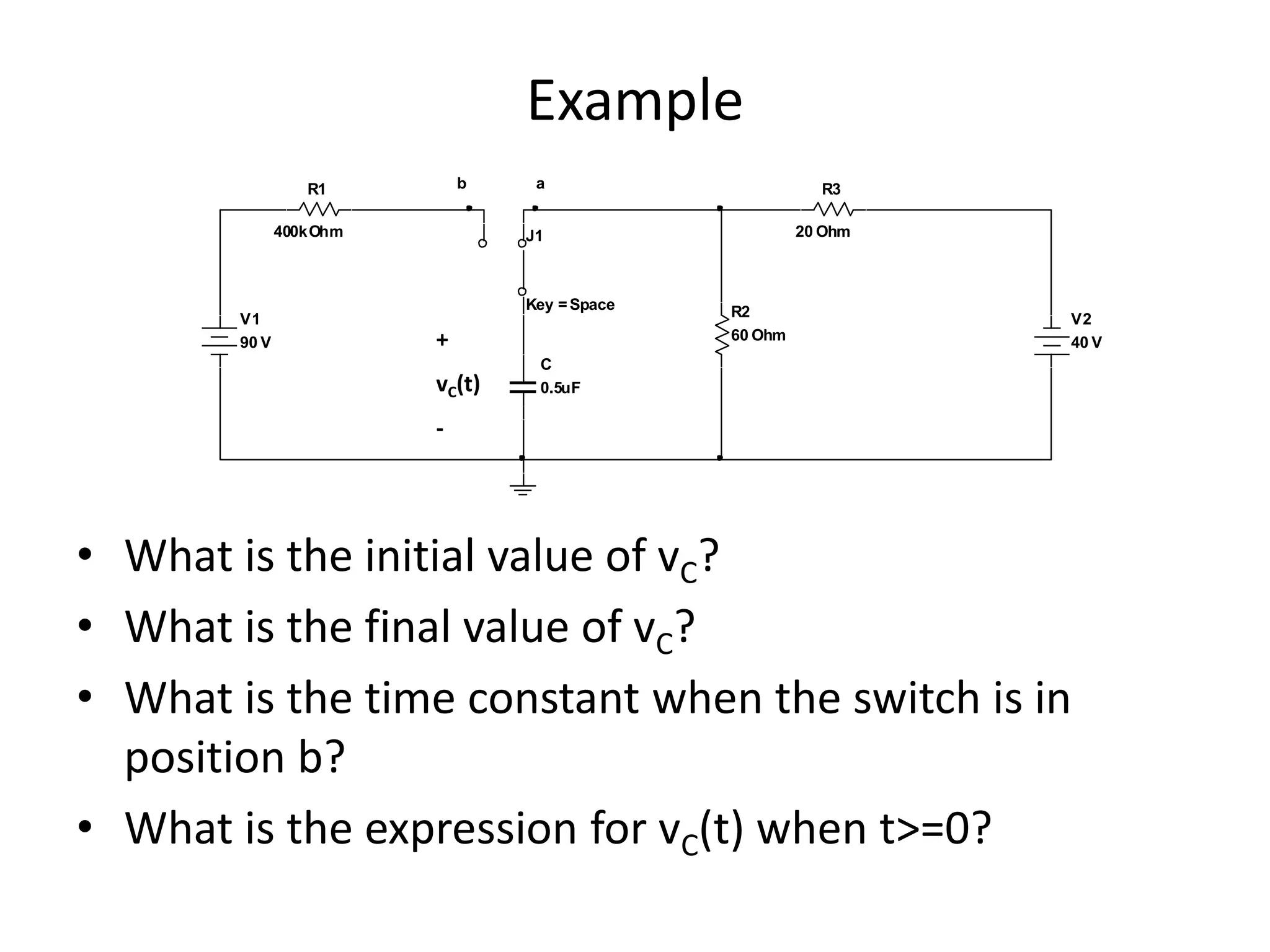
Example
b

R1
400kOhm

V1
90 V

a

R3
20 Ohm

J1

Key = Space

+
vC(t)

R2
60 Ohm

V2
40 V

C
0.5uF

-

• What is the initial value of vC?
• What is the final value of vC?
• What is the time constant when the switch is in
position b?
• What is the expression for vC(t) when t>=0?
Initial Value of vC
b

R1
400kOhm

a

R3
20 Ohm

J1

+
V1
90 V

Key = Space

V60

+
vC(0)

C
0.5uF

R2
60 Ohm

V2
40 V

-

-

• The capacitor looks like an open circuit, so the
voltage @ C is the same as the voltage @ 60Ω.
v C (0 )

60

4 0V
20

3 0V
60
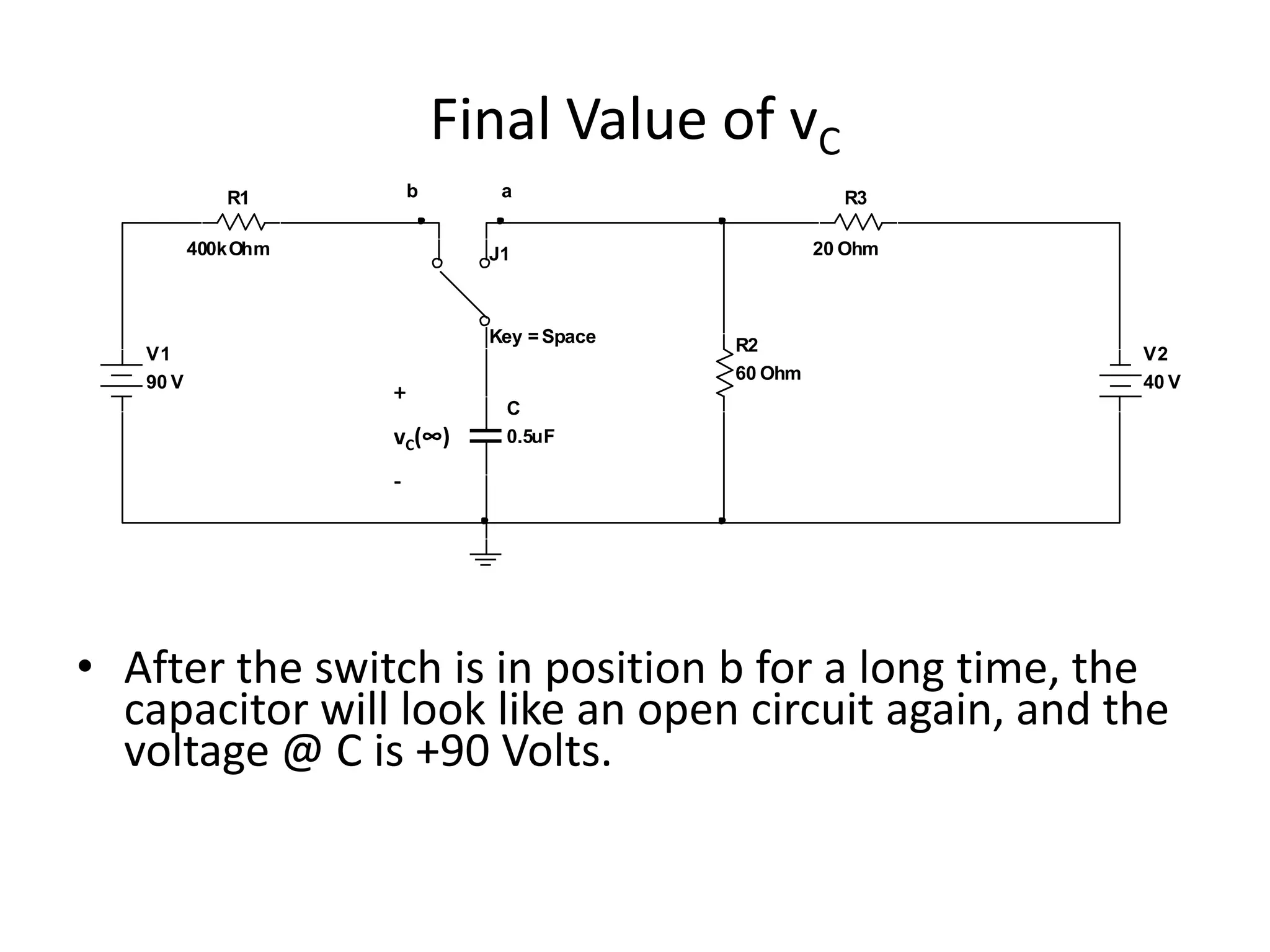
Final Value of vC
b

R1
400kOhm

V1
90 V

a

R3
20 Ohm

J1

Key = Space

+
vC(∞)

R2
60 Ohm

V2
40 V

C
0.5uF

-

• After the switch is in position b for a long time, the
capacitor will look like an open circuit again, and the
voltage @ C is +90 Volts.
The time constant of the circuit when the switch
is in position b
R1
400kOhm

V1
90 V

b

a

R3
20 Ohm

J1

Key = Space

R2
60 Ohm

C
0.5uF

• The time constant τ = RC = (400kΩ)(0.5μF)
• τ = 0.2 s

V2
40 V
The expression for vC(t) for t>=0
t

vC (t )

vC ( )

[ v C (0)

v C ( )]e
t

vC (t )

90

[ 30

vC (t )

90

120 e

90]e
5t

V

0.2
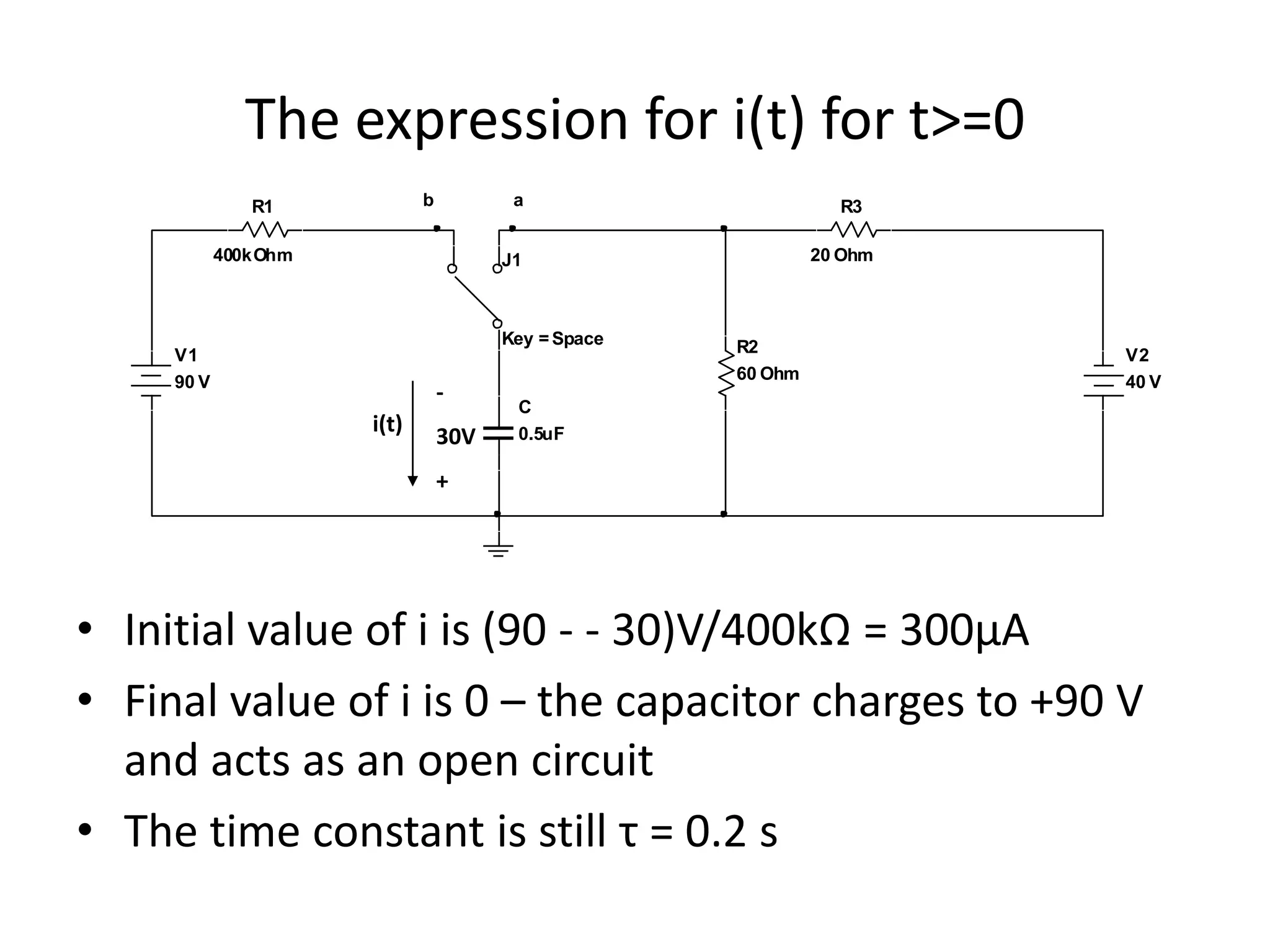
The expression for i(t) for t>=0
b

R1

a

400kOhm

R3
20 Ohm

J1

Key = Space

V1
90 V

i(t)

30V

R2
60 Ohm

V2
40 V

C
0.5uF

+

• Initial value of i is (90 - - 30)V/400kΩ = 300μA
• Final value of i is 0 – the capacitor charges to +90 V
and acts as an open circuit
• The time constant is still τ = 0.2 s
The expression for i(t) (continued)
t

i (t )

i( )

[ i (0 )

i ( )]e
t

i (t )
i (t )

0

[300 10

300 e

5t

A

6

0] e

0.2
How long after the switch is in position b does
the capacitor voltage equal 0?
vC (t )
120e
e

5t

90
5t

120e

5t

0

90
90

120
5t

ln

90

0 .2 8 7 6 8

120
t

0 .0 5 7 5 4 s

5 7 .5 4 m s
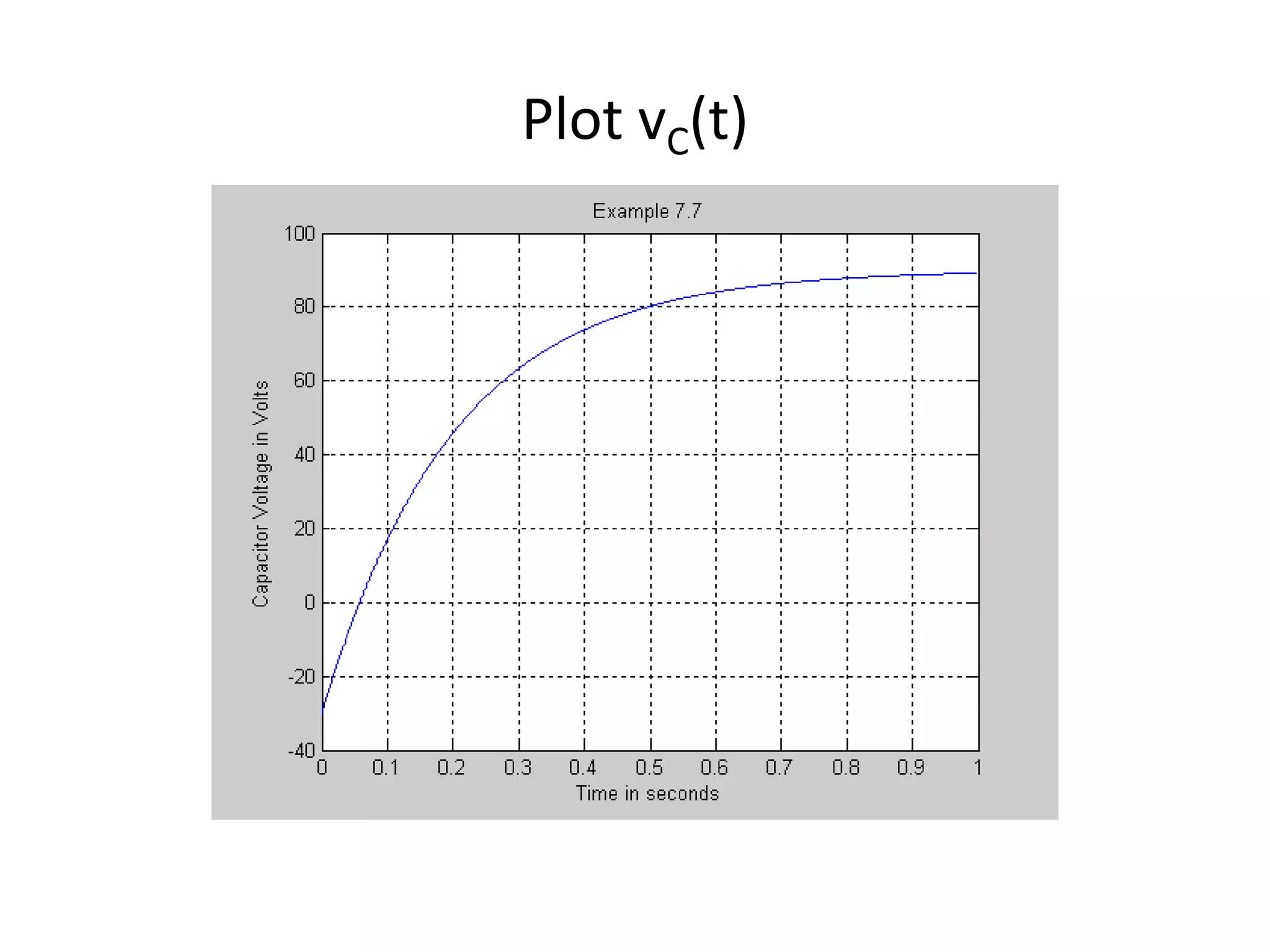
Plot vC(t)
Plot i(t)

Step natural

  • 1.
    Natural and stepresponse Ahsan Khawaja
  • 2.
    Cont. inductor V L di dt • Where V=voltage between inductor in (volt) L= inductor in (henery) = rate of change of current flow in amper di = rate of change of time in second dt
  • 3.
    dv Cont. capacitor • Mathematicalrelation . i C dv dt • Where i= current that in capacitor in (ampere) C= capacitance in (farad) d v = rated of change of voltage. d t = rate of change of time in second
  • 4.
    First-Ordersources, resistors andan Circuits A circuit that contains only • inductor is called an RL circuit. • A circuit that contains only sources, resistors and a capacitor is called an RC circuit. • RL and RC circuits are called first-order circuits because their voltages and currents are described by first-order differential equations. R i i L vs – + – + vs R C
  • 5.
    6 Different First-OrderCircuits There are six different STC circuits. These are listed below. • An inductor and a resistance (called RL Natural Response). • A capacitor and a resistance (called RC Natural Response). • An inductor and a Thévenin equivalent (called RL Step Response). • An inductor and a Norton equivalent (also called RL Step Response). • A capacitor and a Thévenin equivalent (called RC Step Response). • A capacitor and a Norton equivalent (also called RC Step Response). RX LX CX RX RX + vS LX - iS RX iS RX LX RX + vS CX - These are the simple, first-order cases. Many circuits can be reduced to one of these six cases. They all have solutions which are in similar forms. CX
  • 6.
    6 Different First-OrderCircuits These are the simplest cases, so we handle them first. There are six different STC circuits. These are listed below. • An inductor and a resistance (called RL Natural Response). RX CX RX LX • A capacitor and a resistance (called RC Natural Response). RX • An inductor and a Thévenin equivalent + vS iS RX LX LX (called RL Step Response). • An inductor and a Norton equivalent (also called RL Step Response). • A capacitor and a Thévenin equivalent RX + vS iS RX CX (called RC Step Response). • A capacitor and a Norton equivalent (also called RC Step Response). These are the simple, first-order cases. CX They all have solutions which are in similar forms.
  • 7.
    The Natural Responseof a Circuit • The currents and voltages that arise when energy stored in an inductor or capacitor is suddenly released into a resistive circuit. • These “signals” are determined by the circuit itself, not by external sources!
  • 8.
    Step Response • Thesudden application of a DC voltage or current source is referred to as a “step”. • The step response consists of the voltages and currents that arise when energy is being absorbed by an inductor or capacitor.
  • 9.
    Circuits for NaturalResponse • Energy is “stored” in an inductor (a) as an initial current. • Energy is “stored” in a capacitor (b) as an initial voltage.
  • 10.
    General Configurations forRL • If the independent sources are equal to zero, the circuits simplify to
  • 11.
    Natural Response ofan RL Circuit • Consider the circuit shown. • Assume that the switch has been closed “for a long time”, and is “opened” at t=0.
  • 12.
    What does “fora long time” Mean? • All of the currents and voltages have reached a constant (dc) value. • What is the voltage across the inductor just before the switch is opened?
  • 13.
    Just before t= 0 • The voltage across the inductor is equal to zero. • There is no current in either resistor. • The current in the inductor is equal to IS.
  • 14.
    Just after t= 0 • The current source and its parallel resistor R0 are disconnected from the rest of the circuit, and the inductor begins to release energy.
  • 15.
    The Source-Free RL Circuit •A first-order RL circuit consists of a inductor L (or its equivalent) and a resistor (or its equivalent) By KVL vL L vR di 0 iR 0 dt Inductors law Ohms law di R i L dt i (t ) I0 e Rt/L
  • 16.
    The Source-Free RC Circuit •A first-order circuit is characterized by a first-order differential equation. By KCL iR iC Ohms law • • 0 v C R dv dt Capacitor law Apply Kirchhoff’s laws to purely resistive circuit results in algebraic equations. Apply the laws to RC and RL circuits produces differential equations. 0
  • 17.
    Natural Response ofan RL Circuit • Consider the following circuit, for which the switch is closed for t < 0, and then opened at t = 0: t=0 Io Ro i L + R v – Notation: 0– is used to denote the time just prior to switching 0+ is used to denote the time immediately after switching • The current flowing in the inductor at t = 0– is Io
  • 18.
    Solving for theCurrent (t 0) • For t > 0, the circuit reduces to i Io Ro L + R v – • Applying KVL to the LR circuit: • Solution: i (t ) i(0)e ( R / L ) t = I e-(R/L)t 0
  • 19.
    Solving for theVoltage (t > 0) i (t ) ( R / L )t Ioe + Io Ro L R v – • Note that the voltage changes abruptly: v( 0 ) 0 for t 0, v(t) v( 0 ) iR I0R I o Re ( R /L )t
  • 20.
    Time Constant • Inthe example, we found that i (t ) I oe ( R / L )t and v (t ) I o Re L • Define the time constant ( R / L )t (sec) R – At t = , the current has reduced to 1/e (~0.37) of its initial value. – At t = 5 , the current has reduced to less than 1% of its initial value.
  • 21.
    The Source-Free RL Circuit Comparisonbetween a RL and RC circuit A RL source-free circuit i(t ) I0 e t/ where A RC source-free circuit L R v (t ) V0 e t/ where RC
  • 22.
    The Complete Solution R i(t ) Ie 0 L t ,t 0
  • 23.
    The voltage dropacross the resistor v iR R v I Re L 0 t ,t v(0 ) 0 v(0 ) I R 0 0 .
  • 24.
    The Power Dissipatedin the Resistor p vi v 2 iR 2 R p 2 I Re 0 2 R L t ,t 0
  • 25.
    The Energy Deliveredto the Resistor t w t pdx w 2 0 0 2 2 I R (1 e 0 L t ,w R L I Re 0 1 R 2 2 1 2 LI 2 0 x dx R L t ),t 0.
  • 26.
    The Source-Free RL Circuit Ageneral form representing a RL i(t ) where I0 e t/ L R • • • The time constant of a circuit is the time required for the response to decay by a factor of 1/e or 36.8% of its initial value. i(t) decays faster for small and slower for large . The general form is very similar to a RC source-free circuit.
  • 27.
    The Source-Free RC Circuit •The natural response of a circuit refers to the behavior (in terms of voltages and currents) of the circuit itself, with no external sources of excitation. Time constant RC Decays more slowly Decays faster • • The time constant of a circuit is the time required for the response to decay by a factor of 1/e or 36.8% of its initial value. v decays faster for small and slower for large .
  • 28.
    Natural Response Summary RLCircuit RC Circuit i + L C R v R – • Inductor current cannot change instantaneously i(0 ) i (t ) • i(0 ) i(0)e • time constant Capacitor voltage cannot change instantaneously v (0 ) t/ v (t ) L R • v (0 ) v (0)e time constant t/ RC
  • 29.
    General Solution forNatural and Step Responses of RL and RC Circuits ( t t0 ) x (t ) xf [ x (t 0 ) x f ]e Final Value Time Constant Initial Value Determine the initial and final values of the variable of interest and the time constant of the circuit. Substitute into the given expression.
  • 30.
    Example b R1 400kOhm V1 90 V a R3 20 Ohm J1 Key= Space + vC(t) R2 60 Ohm V2 40 V C 0.5uF - • What is the initial value of vC? • What is the final value of vC? • What is the time constant when the switch is in position b? • What is the expression for vC(t) when t>=0?
  • 31.
    Initial Value ofvC b R1 400kOhm a R3 20 Ohm J1 + V1 90 V Key = Space V60 + vC(0) C 0.5uF R2 60 Ohm V2 40 V - - • The capacitor looks like an open circuit, so the voltage @ C is the same as the voltage @ 60Ω. v C (0 ) 60 4 0V 20 3 0V 60
  • 32.
    Final Value ofvC b R1 400kOhm V1 90 V a R3 20 Ohm J1 Key = Space + vC(∞) R2 60 Ohm V2 40 V C 0.5uF - • After the switch is in position b for a long time, the capacitor will look like an open circuit again, and the voltage @ C is +90 Volts.
  • 33.
    The time constantof the circuit when the switch is in position b R1 400kOhm V1 90 V b a R3 20 Ohm J1 Key = Space R2 60 Ohm C 0.5uF • The time constant τ = RC = (400kΩ)(0.5μF) • τ = 0.2 s V2 40 V
  • 34.
    The expression forvC(t) for t>=0 t vC (t ) vC ( ) [ v C (0) v C ( )]e t vC (t ) 90 [ 30 vC (t ) 90 120 e 90]e 5t V 0.2
  • 35.
    The expression fori(t) for t>=0 b R1 a 400kOhm R3 20 Ohm J1 Key = Space V1 90 V i(t) 30V R2 60 Ohm V2 40 V C 0.5uF + • Initial value of i is (90 - - 30)V/400kΩ = 300μA • Final value of i is 0 – the capacitor charges to +90 V and acts as an open circuit • The time constant is still τ = 0.2 s
  • 36.
    The expression fori(t) (continued) t i (t ) i( ) [ i (0 ) i ( )]e t i (t ) i (t ) 0 [300 10 300 e 5t A 6 0] e 0.2
  • 37.
    How long afterthe switch is in position b does the capacitor voltage equal 0? vC (t ) 120e e 5t 90 5t 120e 5t 0 90 90 120 5t ln 90 0 .2 8 7 6 8 120 t 0 .0 5 7 5 4 s 5 7 .5 4 m s
  • 38.
  • 39.