Power Semiconductor Devices
And Charactoristics
1
Out line
• Introduction
• The power Diode
• SCR,GTO,
• The power Transistor:
– BJT,
– MOSFET,
– IGBT,
– IGCT
2
Power Diode
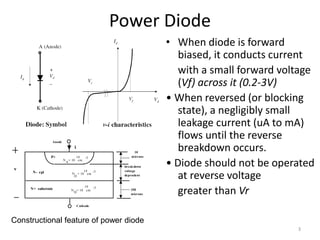
• When diode is forward
biased, it conducts current
with a small forward voltage
(Vf) across it (0.2-3V)
• When reversed (or blocking
state), a negligibly small
leakage current (uA to mA)
flows until the reverse
breakdown occurs.
• Diode should not be operated
at reverse voltage
greater than Vr
P+
N- epi
N+ substrate
v
i
Anode
Cathode
N = 10 cm
19
19
250
microns
10
microns
breakdown
voltage
dependent
N = 10 cm
-3
-3
D
14
N = 10 cm
-3
D
A
Constructional feature of power diode
3
Reverse Recovery
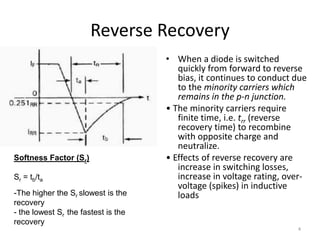
• When a diode is switched
quickly from forward to reverse
bias, it continues to conduct due
to the minority carriers which
remains in the p-n junction.
• The minority carriers require
finite time, i.e. trr (reverse
recovery time) to recombine
with opposite charge and
neutralize.
• Effects of reverse recovery are
increase in switching losses,
increase in voltage rating, over-
voltage (spikes) in inductive
loads
Softness Factor (Sr)
Sr = tb/ta
-The higher the Sr slowest is the
recovery
- the lowest Sr the fastest is the
recovery
4
Cnd…
5
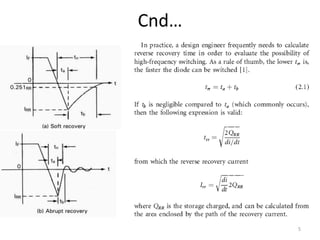
Example
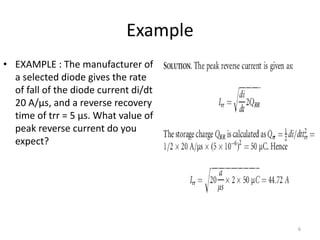
• EXAMPLE : The manufacturer of
a selected diode gives the rate
of fall of the diode current di/dt
20 A/µs, and a reverse recovery
time of trr = 5 µs. What value of
peak reverse current do you
expect?
6
Types of Power Diodes
• Line frequency (general purpose):
– On state voltage: very low (below 1V)
– Large trr (about 25us) (very slow response)
– Very high current ratings (up to 5kA)
– Very high voltage ratings(5kV)
– Used in line-frequency (50/60Hz) applications such as rectifiers
• Fast recovery
– Very low trr (<1us).
– Power levels at several hundred volts and several hundred amps
– Normally used in high frequency circuits
• Schottky
– Very low forward voltage drop (typical 0.3V)
– Limited blocking voltage (50-100V)
– Used in low voltage, high current application such as switched mode
power supplies. 7
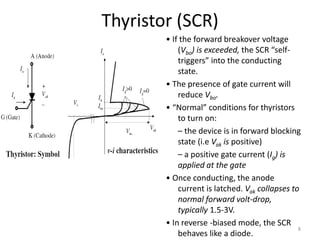
Thyristor (SCR)
• If the forward breakover voltage
(Vbo) is exceeded, the SCR “self-
triggers” into the conducting
state.
• The presence of gate current will
reduce Vbo.
• “Normal” conditions for thyristors
to turn on:
– the device is in forward blocking
state (i.e Vak is positive)
– a positive gate current (Ig) is
applied at the gate
• Once conducting, the anode
current is latched. Vak collapses to
normal forward volt-drop,
typically 1.5-3V.
• In reverse -biased mode, the SCR
behaves like a diode.
8
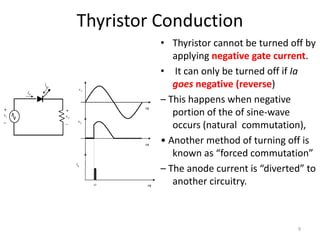
Thyristor Conduction
• Thyristor cannot be turned off by
applying negative gate current.
• It can only be turned off if Ia
goes negative (reverse)
– This happens when negative
portion of the of sine-wave
occurs (natural commutation),
• Another method of turning off is
known as “forced commutation”
– The anode current is “diverted” to
another circuitry.
9
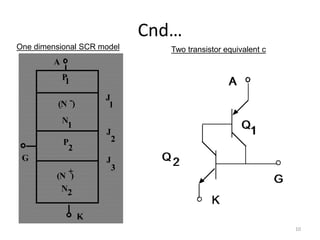
Cnd…
N2
P
2
P
1
N
1
G
K
A
J
1
J
2
J
3
(N )
-
(N )
+
One dimensional SCR model Two transistor equivalent c
10
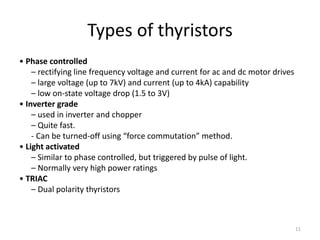
Types of thyristors
• Phase controlled
– rectifying line frequency voltage and current for ac and dc motor drives
– large voltage (up to 7kV) and current (up to 4kA) capability
– low on-state voltage drop (1.5 to 3V)
• Inverter grade
– used in inverter and chopper
– Quite fast.
- Can be turned-off using “force commutation” method.
• Light activated
– Similar to phase controlled, but triggered by pulse of light.
– Normally very high power ratings
• TRIAC
– Dual polarity thyristors
11
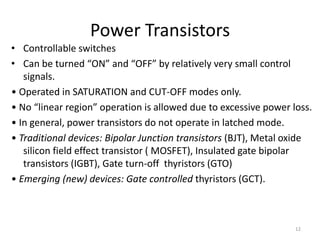
Power Transistors
• Controllable switches
• Can be turned “ON” and “OFF” by relatively very small control
signals.
• Operated in SATURATION and CUT-OFF modes only.
• No “linear region” operation is allowed due to excessive power loss.
• In general, power transistors do not operate in latched mode.
• Traditional devices: Bipolar Junction transistors (BJT), Metal oxide
silicon field effect transistor ( MOSFET), Insulated gate bipolar
transistors (IGBT), Gate turn-off thyristors (GTO)
• Emerging (new) devices: Gate controlled thyristors (GCT).
12
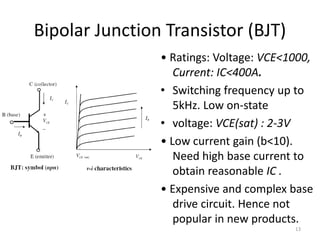
Bipolar Junction Transistor (BJT)
• Ratings: Voltage: VCE<1000,
Current: IC<400A.
• Switching frequency up to
5kHz. Low on-state
• voltage: VCE(sat) : 2-3V
• Low current gain (b<10).
Need high base current to
obtain reasonable IC .
• Expensive and complex base
drive circuit. Hence not
popular in new products.
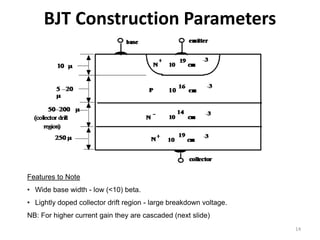
13
BJT Construction Parameters
Features to Note
• Wide base width - low (<10) beta.
• Lightly doped collector drift region - large breakdown voltage.
NB: For higher current gain they are cascaded (next slide)
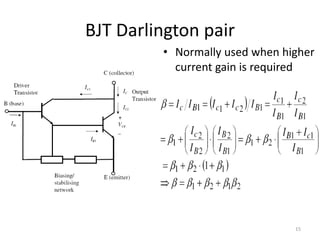
14
BJT Darlington pair
• Normally used when higher
current gain is required
15
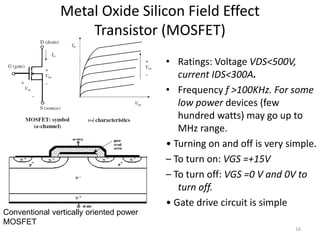
Metal Oxide Silicon Field Effect
Transistor (MOSFET)
• Ratings: Voltage VDS<500V,
current IDS<300A.
• Frequency f >100KHz. For some
low power devices (few
hundred watts) may go up to
MHz range.
• Turning on and off is very simple.
– To turn on: VGS =+15V
– To turn off: VGS =0 V and 0V to
turn off.
• Gate drive circuit is simple
Conventional vertically oriented power
MOSFET
16
MOSFET characteristics
• Basically low voltage device. High voltage device are available
up to 600V but with limited current.
• Can be paralleled quite easily for higher current capability.
• Internal (dynamic) resistance between drain and source during
on state, RDS(ON), , limits the power handling capability of
MOSFET.
• High losses especially for high voltage device due to RDS(ON) .
• Dominant in high frequency application (>100kHz).
• Biggest application is in switched-mode power supplies.
17
Insulated Gate Bipolar
Transistor (IGBT)
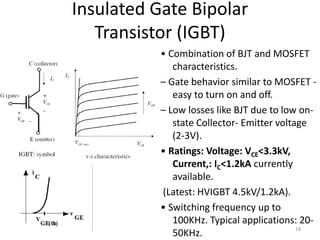
• Combination of BJT and MOSFET
characteristics.
– Gate behavior similar to MOSFET -
easy to turn on and off.
– Low losses like BJT due to low on-
state Collector- Emitter voltage
(2-3V).
• Ratings: Voltage: VCE<3.3kV,
Current,: IC<1.2kA currently
available.
(Latest: HVIGBT 4.5kV/1.2kA).
• Switching frequency up to
100KHz. Typical applications: 20-
50KHz.
18
Construction
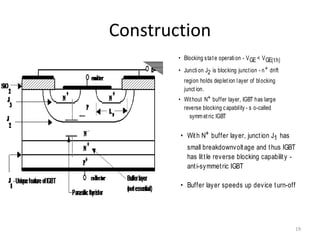
• Blocking state operation - VGE < VGE(th)
• Junction J2 is blocking junction - n+ drift
region holds depletion layer of blocking
junct ion.
• Without N+ buffer layer, IGBT has large
reverse blocking capability - s o-called
symmetric IGBT
• With N+ buffer layer, junction J1 has
small breakdownvoltage and thus IGBT
has little reverse blocking capability -
anti-symmetric IGBT
• Buffer layer speeds up device turn-off
19
Approximate Equivalent Circuits
for IGBTs
gate
drift region
resistance
V
J1
V
drift
I R
C channel
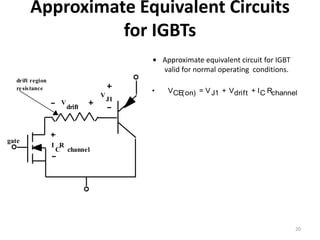
• Approximate equivalent circuit for IGBT
valid for normal operating conditions.
• VCE(on) = VJ1 + Vdrift + IC Rchannel
20
Gate turn-off thyristor (GTO)
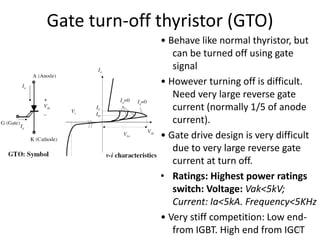
• Behave like normal thyristor, but
can be turned off using gate
signal
• However turning off is difficult.
Need very large reverse gate
current (normally 1/5 of anode
current).
• Gate drive design is very difficult
due to very large reverse gate
current at turn off.
• Ratings: Highest power ratings
switch: Voltage: Vak<5kV;
Current: Ia<5kA. Frequency<5KHz
• Very stiff competition: Low end-
from IGBT. High end from IGCT
21
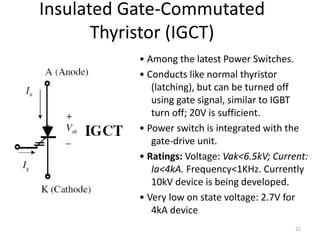
Insulated Gate-Commutated
Thyristor (IGCT)
• Among the latest Power Switches.
• Conducts like normal thyristor
(latching), but can be turned off
using gate signal, similar to IGBT
turn off; 20V is sufficient.
• Power switch is integrated with the
gate-drive unit.
• Ratings: Voltage: Vak<6.5kV; Current:
Ia<4kA. Frequency<1KHz. Currently
10kV device is being developed.
• Very low on state voltage: 2.7V for
4kA device
22
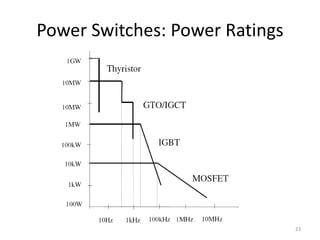
Power Switches: Power Ratings
23
Power switch losses
• Why it is important to consider losses of power switches?
– to ensure that the system operates reliably under prescribed
ambient conditions
– so that heat removal mechanism (e.g. heat sink, radiators,
coolant) can be specified.
- Losses in switches affects the system efficiency
• Heat sinks and other heat removal systems are costly and bulky.
Can be substantial cost of the total system.
• If a power switch is not cooled to its specified junction
temperature, the full power capability of the switch cannot be
realised. Derating of the power switch ratings may be necessary.
• Main losses:
forward conduction losses, blocking state losses and
switching losses 24
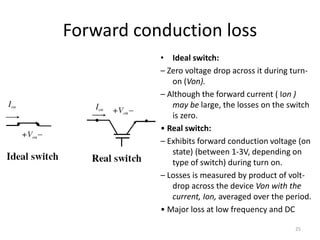
Forward conduction loss
• Ideal switch:
– Zero voltage drop across it during turn-
on (Von).
– Although the forward current ( Ion )
may be large, the losses on the switch
is zero.
• Real switch:
– Exhibits forward conduction voltage (on
state) (between 1-3V, depending on
type of switch) during turn on.
– Losses is measured by product of volt-
drop across the device Von with the
current, Ion, averaged over the period.
• Major loss at low frequency and DC
25
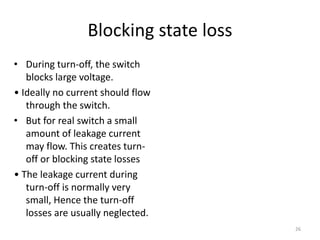
Blocking state loss
• During turn-off, the switch
blocks large voltage.
• Ideally no current should flow
through the switch.
• But for real switch a small
amount of leakage current
may flow. This creates turn-
off or blocking state losses
• The leakage current during
turn-off is normally very
small, Hence the turn-off
losses are usually neglected.
26
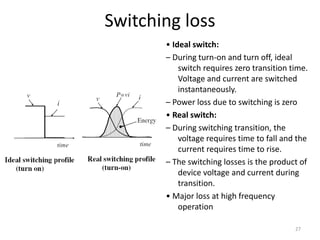
Switching loss
• Ideal switch:
– During turn-on and turn off, ideal
switch requires zero transition time.
Voltage and current are switched
instantaneously.
– Power loss due to switching is zero
• Real switch:
– During switching transition, the
voltage requires time to fall and the
current requires time to rise.
– The switching losses is the product of
device voltage and current during
transition.
• Major loss at high frequency
operation
27
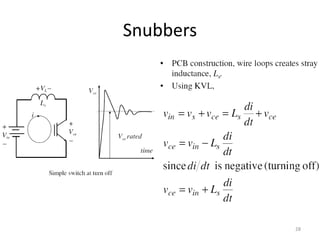
Snubbers
28
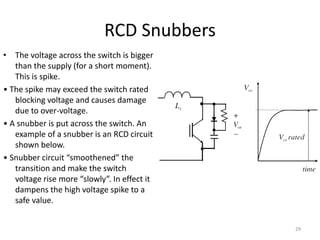
RCD Snubbers
• The voltage across the switch is bigger
than the supply (for a short moment).
This is spike.
• The spike may exceed the switch rated
blocking voltage and causes damage
due to over-voltage.
• A snubber is put across the switch. An
example of a snubber is an RCD circuit
shown below.
• Snubber circuit “smoothened” the
transition and make the switch
voltage rise more “slowly”. In effect it
dampens the high voltage spike to a
safe value.
29
Summary snubber
In general, snubbers are used for:
– turn-on: to minimize large over currents through the device at
turn-on
– turn-off: to minimize large overvoltage across the device
during turn-off.
– Stress reduction: to shape the device switching waveform such
that the voltage and current associated with the device are
not high simultaneously.
• Switches and diodes requires snubbers. However, new
generation of IGBT, MOSFET and IGCT do not require it.
30
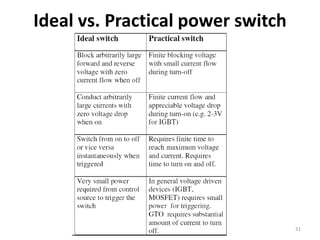
Ideal vs. Practical power switch
31

l2-power semiconductor devices and charactoristics.ppt

  • 1.
  • 2.
    Out line • Introduction •The power Diode • SCR,GTO, • The power Transistor: – BJT, – MOSFET, – IGBT, – IGCT 2
  • 3.
    Power Diode • Whendiode is forward biased, it conducts current with a small forward voltage (Vf) across it (0.2-3V) • When reversed (or blocking state), a negligibly small leakage current (uA to mA) flows until the reverse breakdown occurs. • Diode should not be operated at reverse voltage greater than Vr P+ N- epi N+ substrate v i Anode Cathode N = 10 cm 19 19 250 microns 10 microns breakdown voltage dependent N = 10 cm -3 -3 D 14 N = 10 cm -3 D A Constructional feature of power diode 3
  • 4.
    Reverse Recovery • Whena diode is switched quickly from forward to reverse bias, it continues to conduct due to the minority carriers which remains in the p-n junction. • The minority carriers require finite time, i.e. trr (reverse recovery time) to recombine with opposite charge and neutralize. • Effects of reverse recovery are increase in switching losses, increase in voltage rating, over- voltage (spikes) in inductive loads Softness Factor (Sr) Sr = tb/ta -The higher the Sr slowest is the recovery - the lowest Sr the fastest is the recovery 4
  • 5.
  • 6.
    Example • EXAMPLE :The manufacturer of a selected diode gives the rate of fall of the diode current di/dt 20 A/µs, and a reverse recovery time of trr = 5 µs. What value of peak reverse current do you expect? 6
  • 7.
    Types of PowerDiodes • Line frequency (general purpose): – On state voltage: very low (below 1V) – Large trr (about 25us) (very slow response) – Very high current ratings (up to 5kA) – Very high voltage ratings(5kV) – Used in line-frequency (50/60Hz) applications such as rectifiers • Fast recovery – Very low trr (<1us). – Power levels at several hundred volts and several hundred amps – Normally used in high frequency circuits • Schottky – Very low forward voltage drop (typical 0.3V) – Limited blocking voltage (50-100V) – Used in low voltage, high current application such as switched mode power supplies. 7
  • 8.
    Thyristor (SCR) • Ifthe forward breakover voltage (Vbo) is exceeded, the SCR “self- triggers” into the conducting state. • The presence of gate current will reduce Vbo. • “Normal” conditions for thyristors to turn on: – the device is in forward blocking state (i.e Vak is positive) – a positive gate current (Ig) is applied at the gate • Once conducting, the anode current is latched. Vak collapses to normal forward volt-drop, typically 1.5-3V. • In reverse -biased mode, the SCR behaves like a diode. 8
  • 9.
    Thyristor Conduction • Thyristorcannot be turned off by applying negative gate current. • It can only be turned off if Ia goes negative (reverse) – This happens when negative portion of the of sine-wave occurs (natural commutation), • Another method of turning off is known as “forced commutation” – The anode current is “diverted” to another circuitry. 9
  • 10.
    Cnd… N2 P 2 P 1 N 1 G K A J 1 J 2 J 3 (N ) - (N ) + Onedimensional SCR model Two transistor equivalent c 10
  • 11.
    Types of thyristors •Phase controlled – rectifying line frequency voltage and current for ac and dc motor drives – large voltage (up to 7kV) and current (up to 4kA) capability – low on-state voltage drop (1.5 to 3V) • Inverter grade – used in inverter and chopper – Quite fast. - Can be turned-off using “force commutation” method. • Light activated – Similar to phase controlled, but triggered by pulse of light. – Normally very high power ratings • TRIAC – Dual polarity thyristors 11
  • 12.
    Power Transistors • Controllableswitches • Can be turned “ON” and “OFF” by relatively very small control signals. • Operated in SATURATION and CUT-OFF modes only. • No “linear region” operation is allowed due to excessive power loss. • In general, power transistors do not operate in latched mode. • Traditional devices: Bipolar Junction transistors (BJT), Metal oxide silicon field effect transistor ( MOSFET), Insulated gate bipolar transistors (IGBT), Gate turn-off thyristors (GTO) • Emerging (new) devices: Gate controlled thyristors (GCT). 12
  • 13.
    Bipolar Junction Transistor(BJT) • Ratings: Voltage: VCE<1000, Current: IC<400A. • Switching frequency up to 5kHz. Low on-state • voltage: VCE(sat) : 2-3V • Low current gain (b<10). Need high base current to obtain reasonable IC . • Expensive and complex base drive circuit. Hence not popular in new products. 13
  • 14.
    BJT Construction Parameters Featuresto Note • Wide base width - low (<10) beta. • Lightly doped collector drift region - large breakdown voltage. NB: For higher current gain they are cascaded (next slide) 14
  • 15.
    BJT Darlington pair •Normally used when higher current gain is required 15
  • 16.
    Metal Oxide SiliconField Effect Transistor (MOSFET) • Ratings: Voltage VDS<500V, current IDS<300A. • Frequency f >100KHz. For some low power devices (few hundred watts) may go up to MHz range. • Turning on and off is very simple. – To turn on: VGS =+15V – To turn off: VGS =0 V and 0V to turn off. • Gate drive circuit is simple Conventional vertically oriented power MOSFET 16
  • 17.
    MOSFET characteristics • Basicallylow voltage device. High voltage device are available up to 600V but with limited current. • Can be paralleled quite easily for higher current capability. • Internal (dynamic) resistance between drain and source during on state, RDS(ON), , limits the power handling capability of MOSFET. • High losses especially for high voltage device due to RDS(ON) . • Dominant in high frequency application (>100kHz). • Biggest application is in switched-mode power supplies. 17
  • 18.
    Insulated Gate Bipolar Transistor(IGBT) • Combination of BJT and MOSFET characteristics. – Gate behavior similar to MOSFET - easy to turn on and off. – Low losses like BJT due to low on- state Collector- Emitter voltage (2-3V). • Ratings: Voltage: VCE<3.3kV, Current,: IC<1.2kA currently available. (Latest: HVIGBT 4.5kV/1.2kA). • Switching frequency up to 100KHz. Typical applications: 20- 50KHz. 18
  • 19.
    Construction • Blocking stateoperation - VGE < VGE(th) • Junction J2 is blocking junction - n+ drift region holds depletion layer of blocking junct ion. • Without N+ buffer layer, IGBT has large reverse blocking capability - s o-called symmetric IGBT • With N+ buffer layer, junction J1 has small breakdownvoltage and thus IGBT has little reverse blocking capability - anti-symmetric IGBT • Buffer layer speeds up device turn-off 19
  • 20.
    Approximate Equivalent Circuits forIGBTs gate drift region resistance V J1 V drift I R C channel • Approximate equivalent circuit for IGBT valid for normal operating conditions. • VCE(on) = VJ1 + Vdrift + IC Rchannel 20
  • 21.
    Gate turn-off thyristor(GTO) • Behave like normal thyristor, but can be turned off using gate signal • However turning off is difficult. Need very large reverse gate current (normally 1/5 of anode current). • Gate drive design is very difficult due to very large reverse gate current at turn off. • Ratings: Highest power ratings switch: Voltage: Vak<5kV; Current: Ia<5kA. Frequency<5KHz • Very stiff competition: Low end- from IGBT. High end from IGCT 21
  • 22.
    Insulated Gate-Commutated Thyristor (IGCT) •Among the latest Power Switches. • Conducts like normal thyristor (latching), but can be turned off using gate signal, similar to IGBT turn off; 20V is sufficient. • Power switch is integrated with the gate-drive unit. • Ratings: Voltage: Vak<6.5kV; Current: Ia<4kA. Frequency<1KHz. Currently 10kV device is being developed. • Very low on state voltage: 2.7V for 4kA device 22
  • 23.
  • 24.
    Power switch losses •Why it is important to consider losses of power switches? – to ensure that the system operates reliably under prescribed ambient conditions – so that heat removal mechanism (e.g. heat sink, radiators, coolant) can be specified. - Losses in switches affects the system efficiency • Heat sinks and other heat removal systems are costly and bulky. Can be substantial cost of the total system. • If a power switch is not cooled to its specified junction temperature, the full power capability of the switch cannot be realised. Derating of the power switch ratings may be necessary. • Main losses: forward conduction losses, blocking state losses and switching losses 24
  • 25.
    Forward conduction loss •Ideal switch: – Zero voltage drop across it during turn- on (Von). – Although the forward current ( Ion ) may be large, the losses on the switch is zero. • Real switch: – Exhibits forward conduction voltage (on state) (between 1-3V, depending on type of switch) during turn on. – Losses is measured by product of volt- drop across the device Von with the current, Ion, averaged over the period. • Major loss at low frequency and DC 25
  • 26.
    Blocking state loss •During turn-off, the switch blocks large voltage. • Ideally no current should flow through the switch. • But for real switch a small amount of leakage current may flow. This creates turn- off or blocking state losses • The leakage current during turn-off is normally very small, Hence the turn-off losses are usually neglected. 26
  • 27.
    Switching loss • Idealswitch: – During turn-on and turn off, ideal switch requires zero transition time. Voltage and current are switched instantaneously. – Power loss due to switching is zero • Real switch: – During switching transition, the voltage requires time to fall and the current requires time to rise. – The switching losses is the product of device voltage and current during transition. • Major loss at high frequency operation 27
  • 28.
  • 29.
    RCD Snubbers • Thevoltage across the switch is bigger than the supply (for a short moment). This is spike. • The spike may exceed the switch rated blocking voltage and causes damage due to over-voltage. • A snubber is put across the switch. An example of a snubber is an RCD circuit shown below. • Snubber circuit “smoothened” the transition and make the switch voltage rise more “slowly”. In effect it dampens the high voltage spike to a safe value. 29
  • 30.
    Summary snubber In general,snubbers are used for: – turn-on: to minimize large over currents through the device at turn-on – turn-off: to minimize large overvoltage across the device during turn-off. – Stress reduction: to shape the device switching waveform such that the voltage and current associated with the device are not high simultaneously. • Switches and diodes requires snubbers. However, new generation of IGBT, MOSFET and IGCT do not require it. 30
  • 31.
    Ideal vs. Practicalpower switch 31