Electric Circuit Analysis
Circuit elements
Ahsan Khawaja
Ahsan_khawaja@comsats.edu.pk
Lecturer
Room 102
Department of Electrical Engineering
Base Quantity
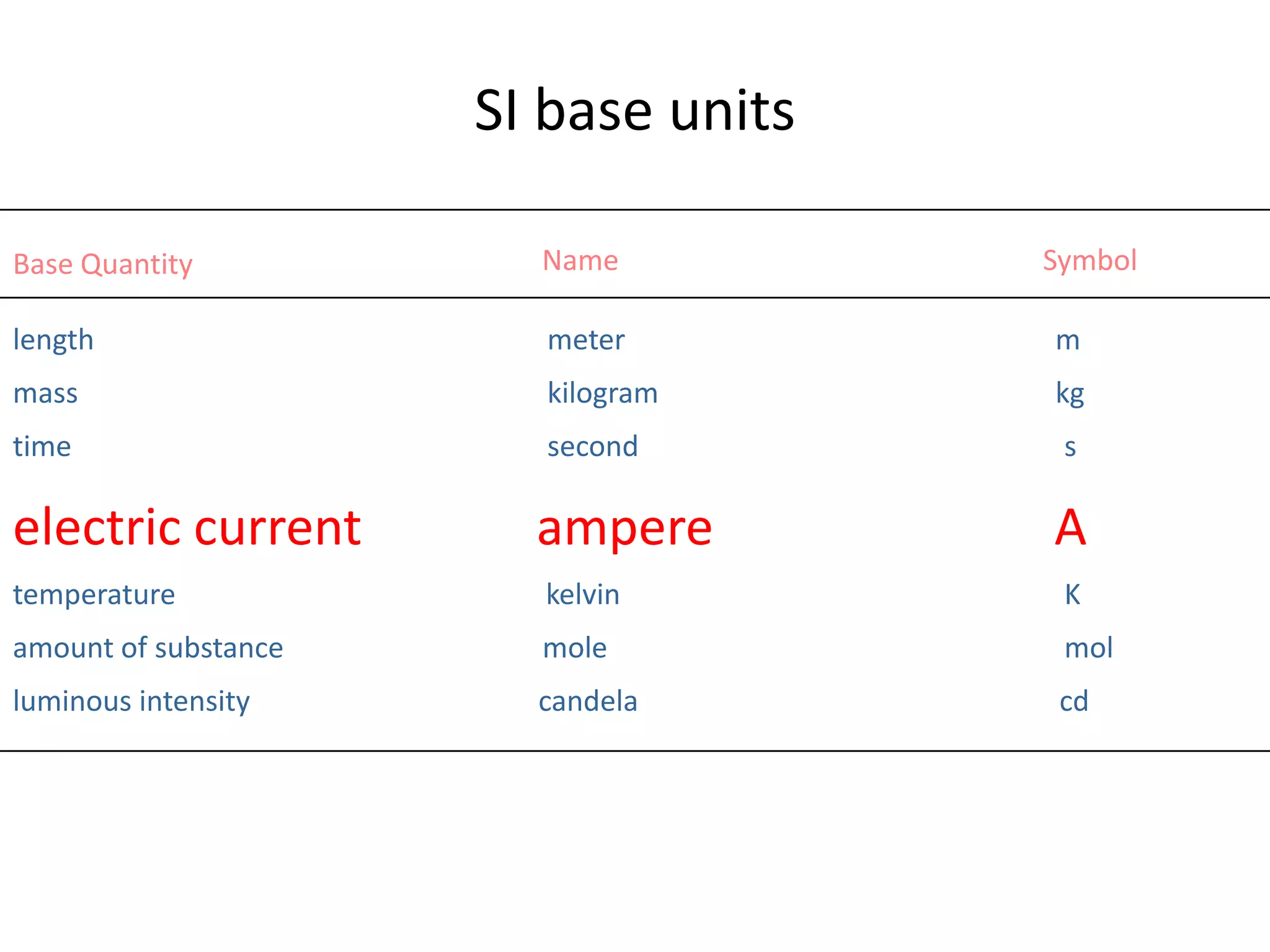
SI base units
Name Symbol
length meter m
mass kilogram kg
time second s
electric current ampere A
temperature kelvin K
amount of substance mole mol
luminous intensity candela cd
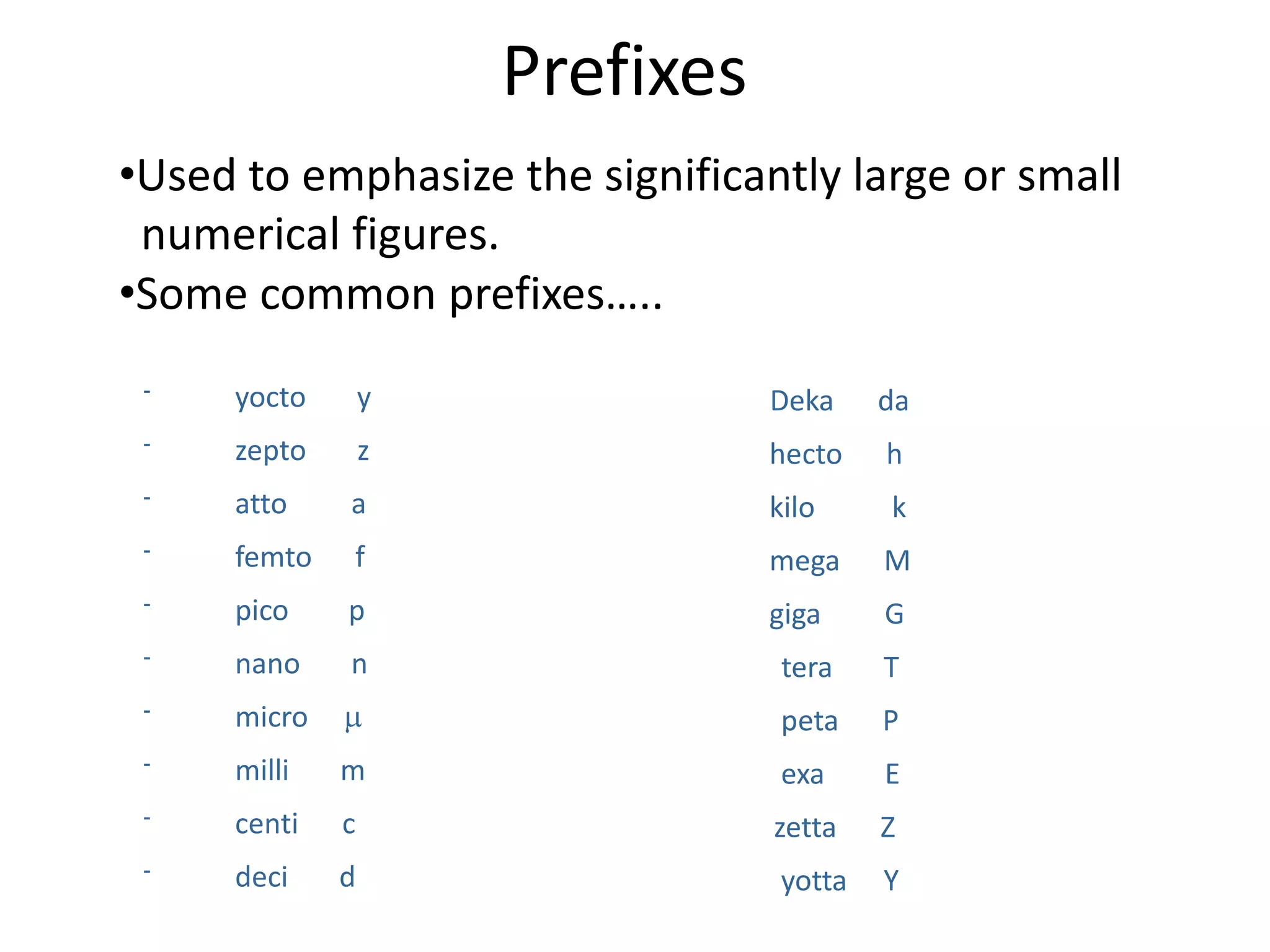
Prefixes
•Used to emphasize the significantly large or small
numerical figures.
•Some common prefixes…..
- yocto y
- zepto z
- atto a
- femto f
- pico p
- nano n
- micro
- milli m
- centi c
- deci d
Deka da
hecto h
kilo k
mega M
giga G
tera T
peta P
exa E
zetta Z
yotta Y
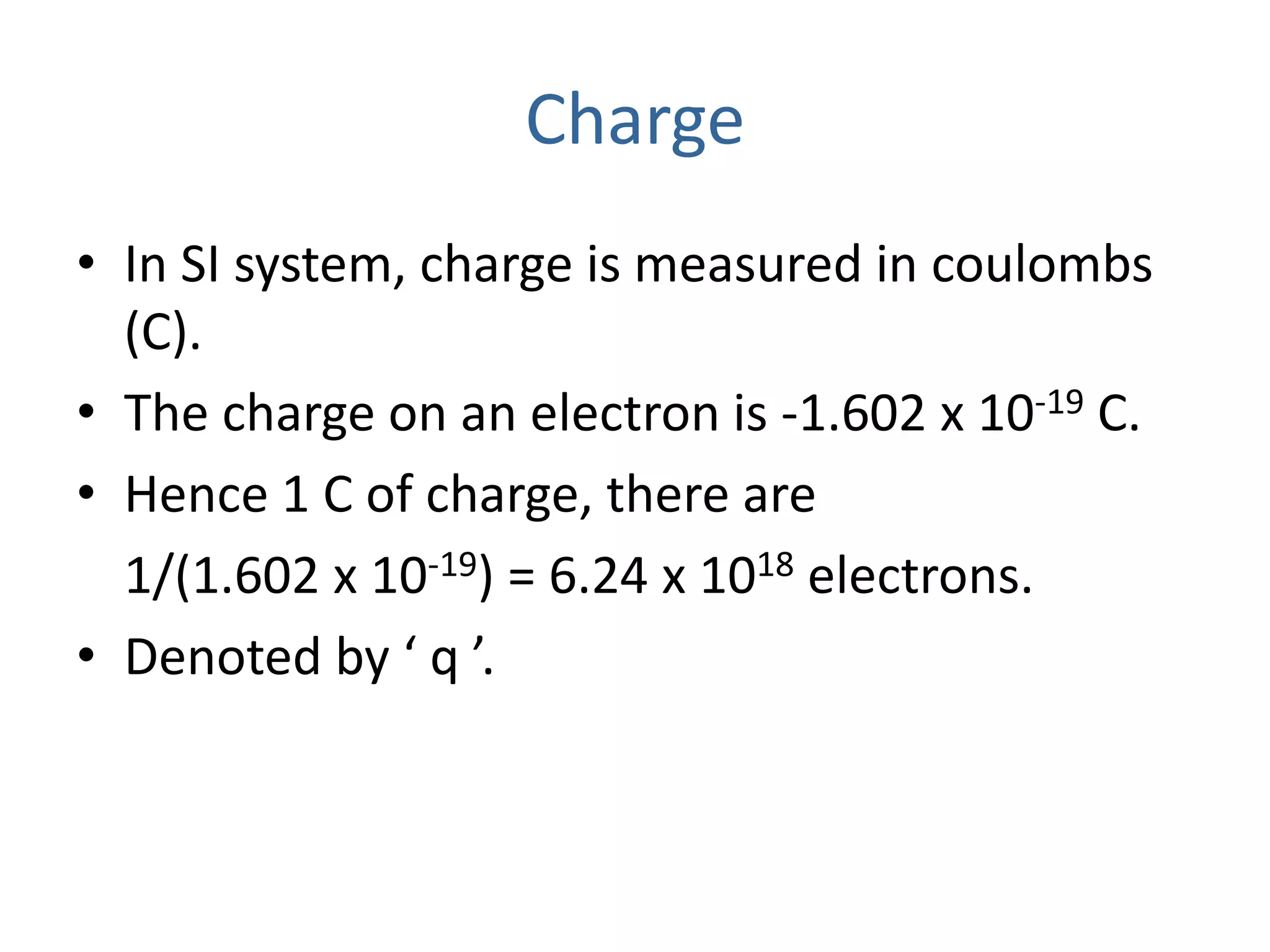
Charge
• In SI system, charge is measured in coulombs
(C).
• The charge on an electron is -1.602 x 10⁻¹⁹ C.
• Hence 1 C of charge, there are
1/(1.602 x 10-19) = 6.24 x 10¹⁸ electrons.
• Denoted by ‘ q ’.
Current
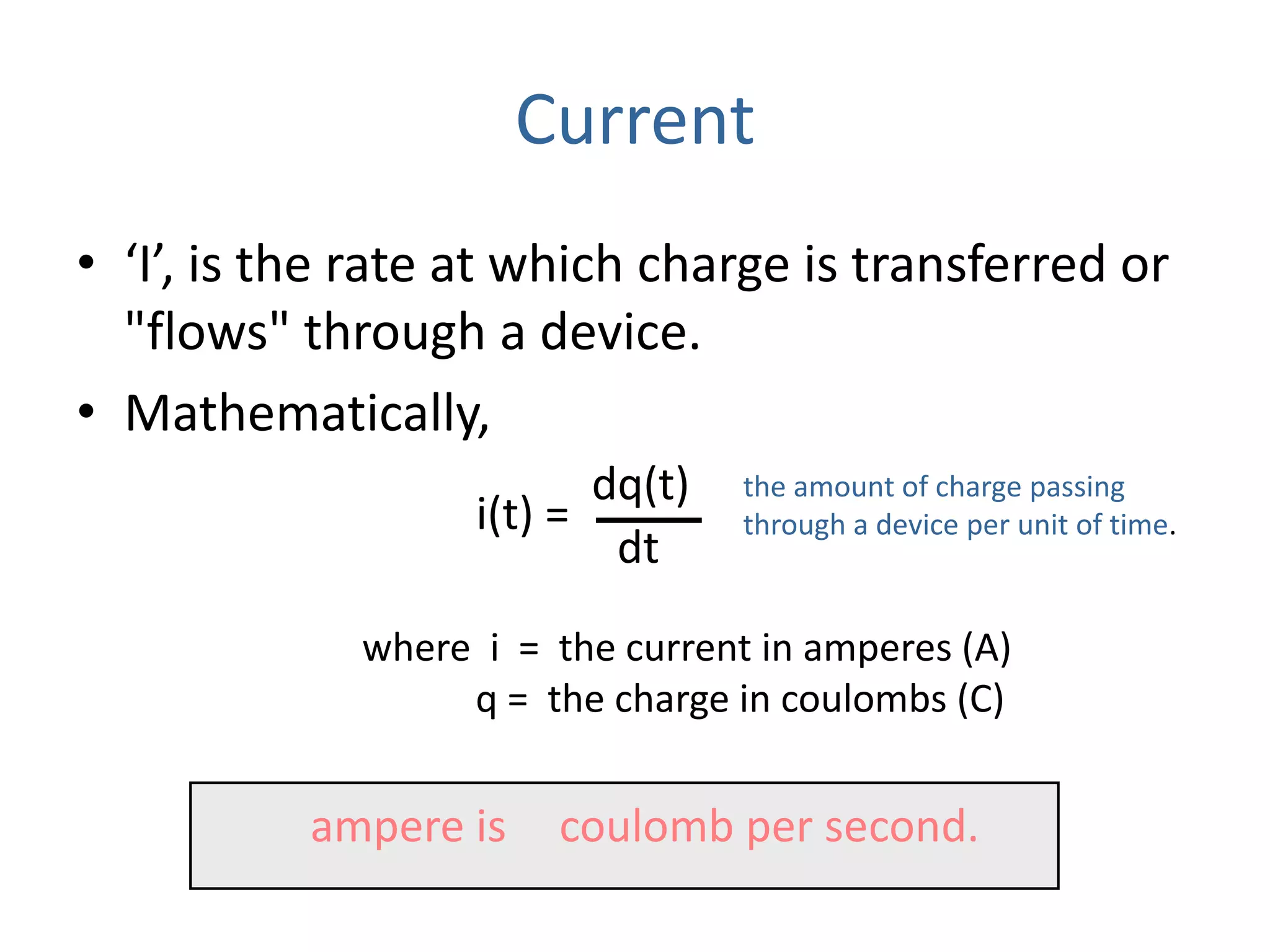
• ‘I’, is the rate at which charge is transferred or
"flows" through a device.
• Mathematically,
dq(t)
dt
i(t) =
where i = the current in amperes (A)
q = the charge in coulombs (C)
the amount of charge passing
through a device per unit of time.
ampere is coulomb per second.
i
t
0 5 10 15 20
-1
-0.5
0
0.5
1
0 5 10 15 20
-0.8
-0.6
-0.4
-0.2
0
0.2
0.4
0.6
0.8
1
0 5 10 15 20
-3
-2
-1
0
1
2
3
4
5
0 5 10 15 20
0
0.2
0.4
0.6
0.8
1
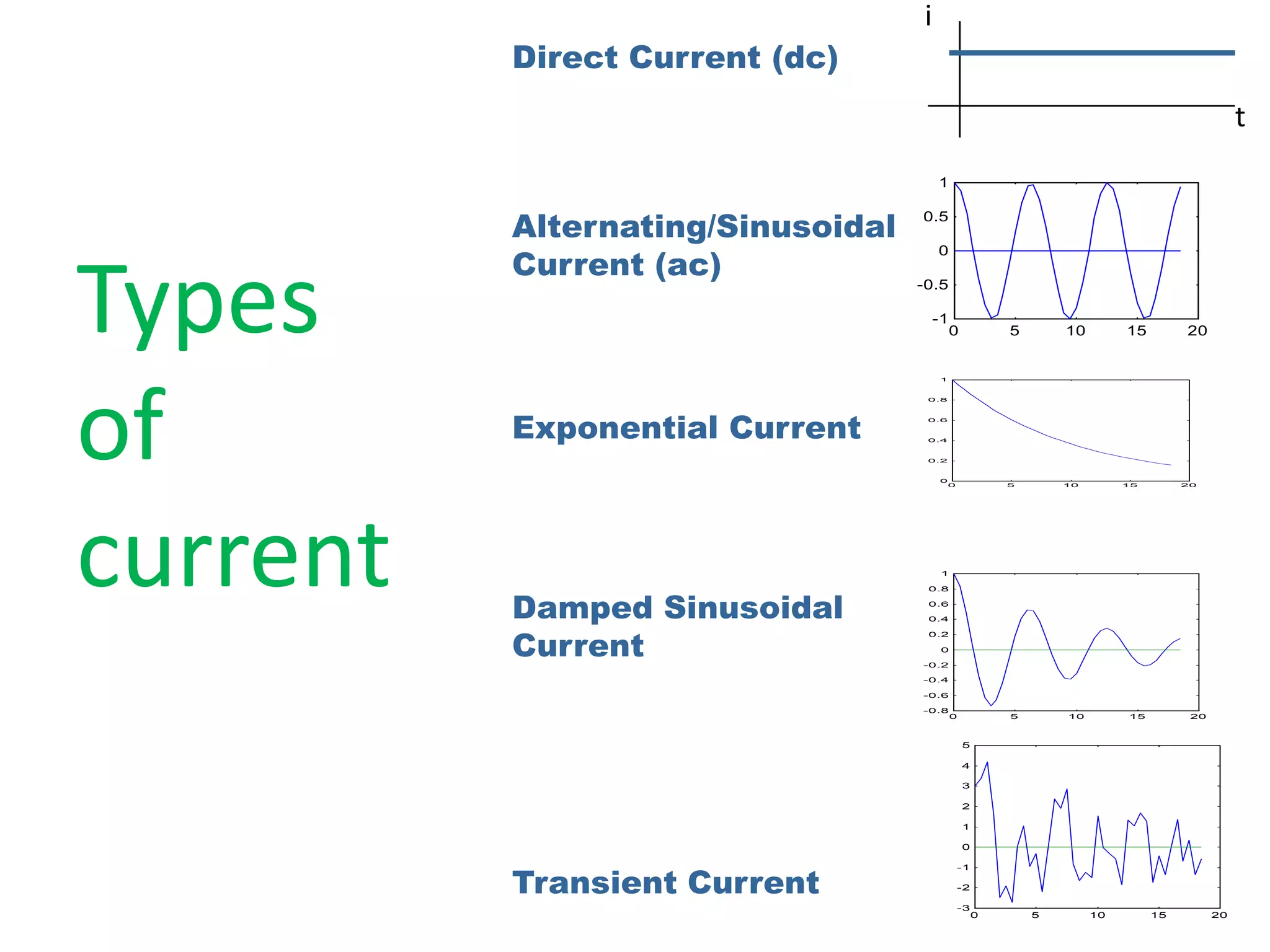
Direct Current (dc)
Alternating/Sinusoidal
Current (ac)
Exponential Current
Damped Sinusoidal
Current
Transient Current
Types
of
current
Current sign convention
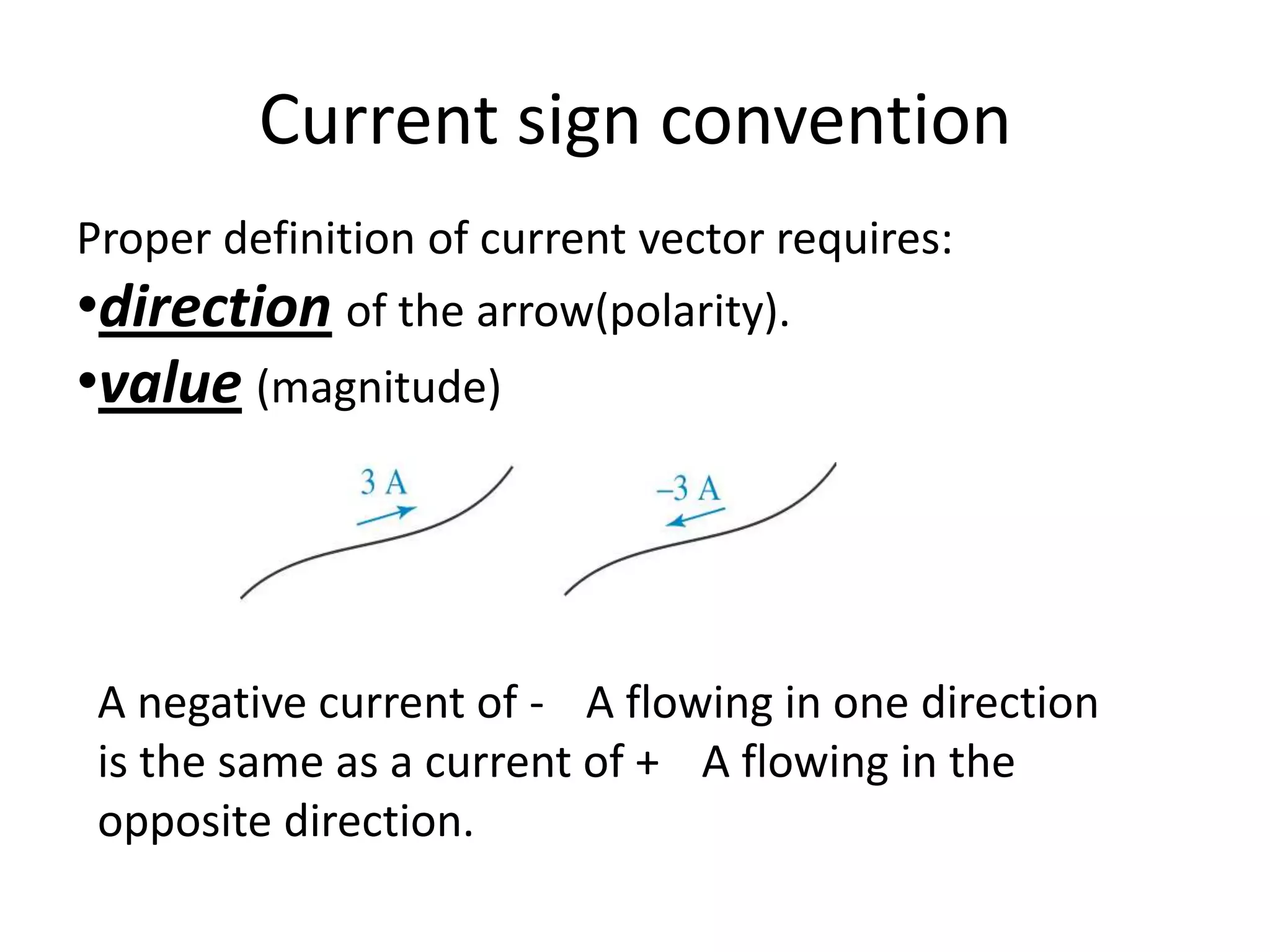
Proper definition of current vector requires:
•direction of the arrow(polarity).
•value (magnitude)
A negative current of - A flowing in one direction
is the same as a current of + A flowing in the
opposite direction.
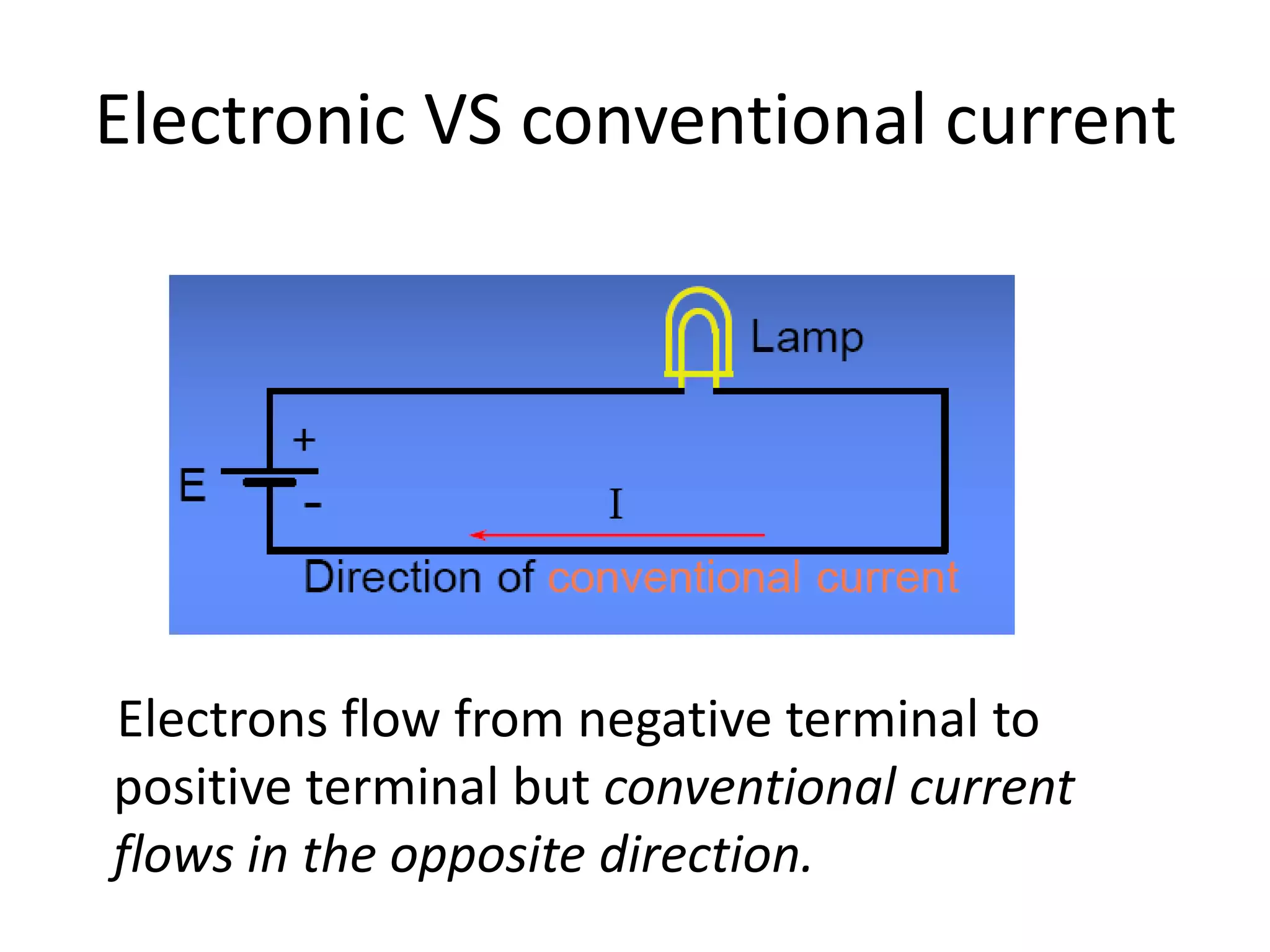
Electronic VS conventional current
Electrons flow from negative terminal to
positive terminal but conventional current
flows in the opposite direction.
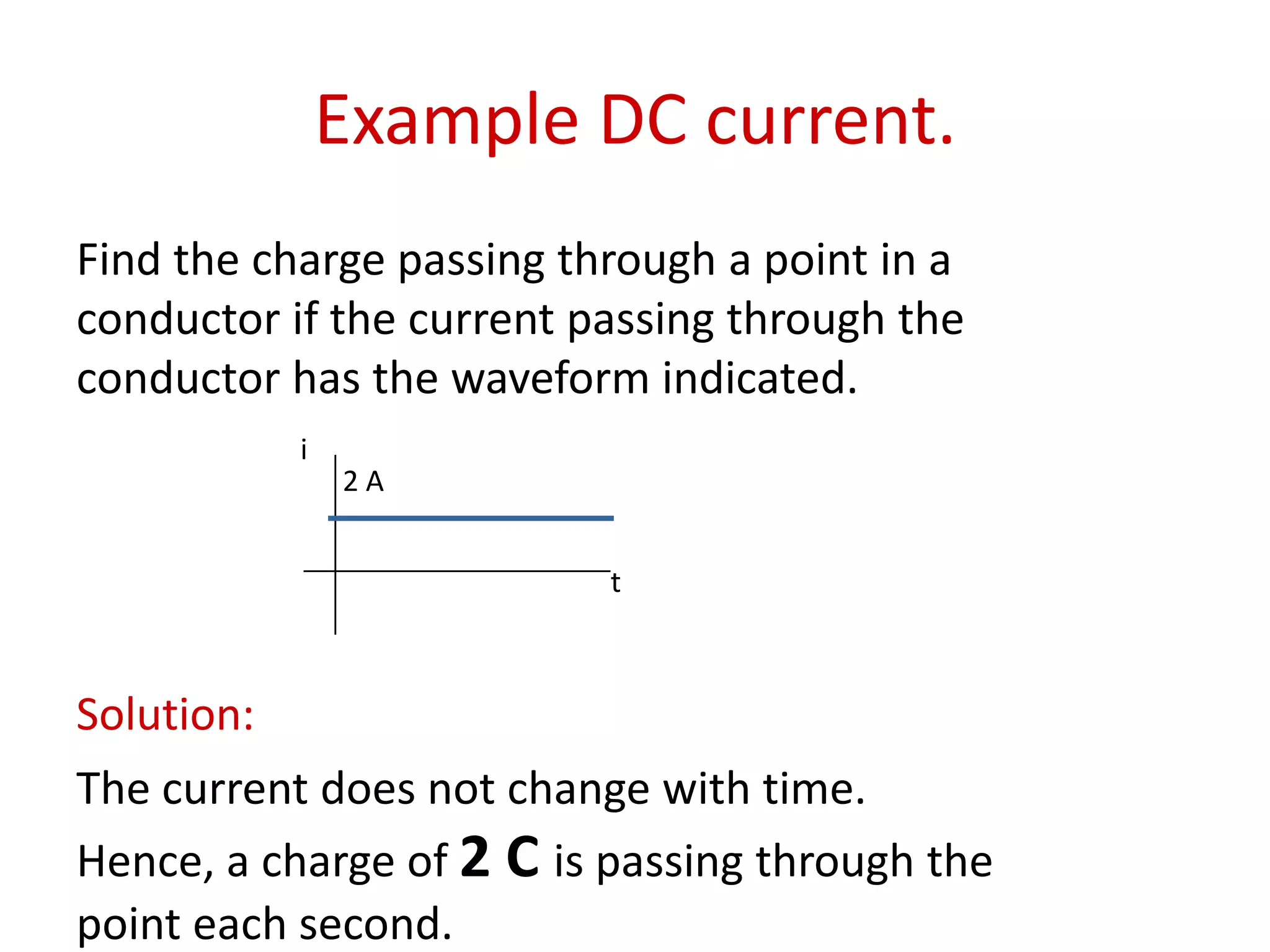
Example DC current.
Find the charge passing through a point in a
conductor if the current passing through the
conductor has the waveform indicated.
i
t
2 A
Solution:
The current does not change with time.
Hence, a charge of 2 C is passing through the
point each second.
Example
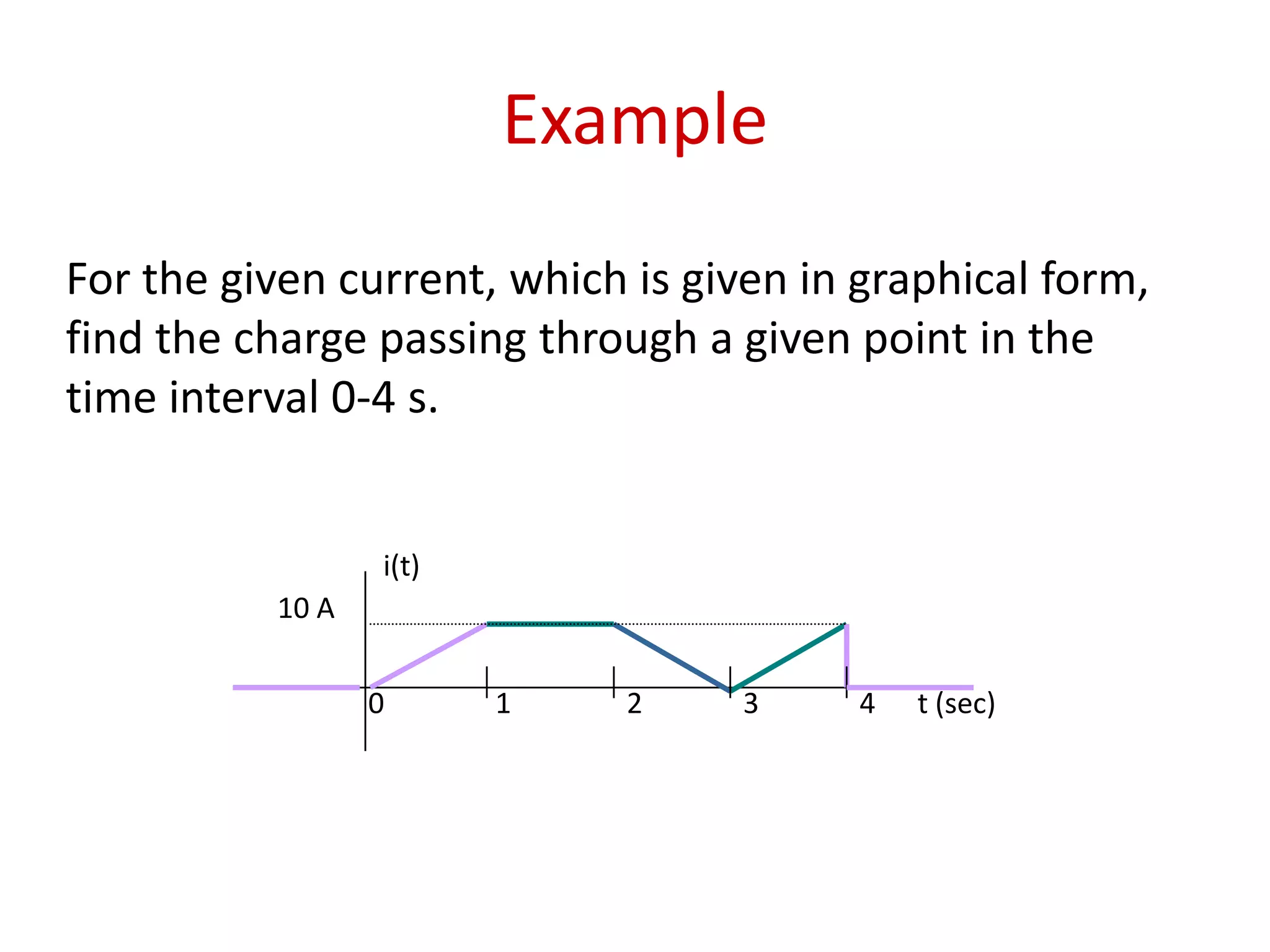
For the given current, which is given in graphical form,
find the charge passing through a given point in the
time interval 0-4 s.
t (sec)
10 A
10 2 43
i(t)
t (sec)
10 A
10 2 43
i(t)
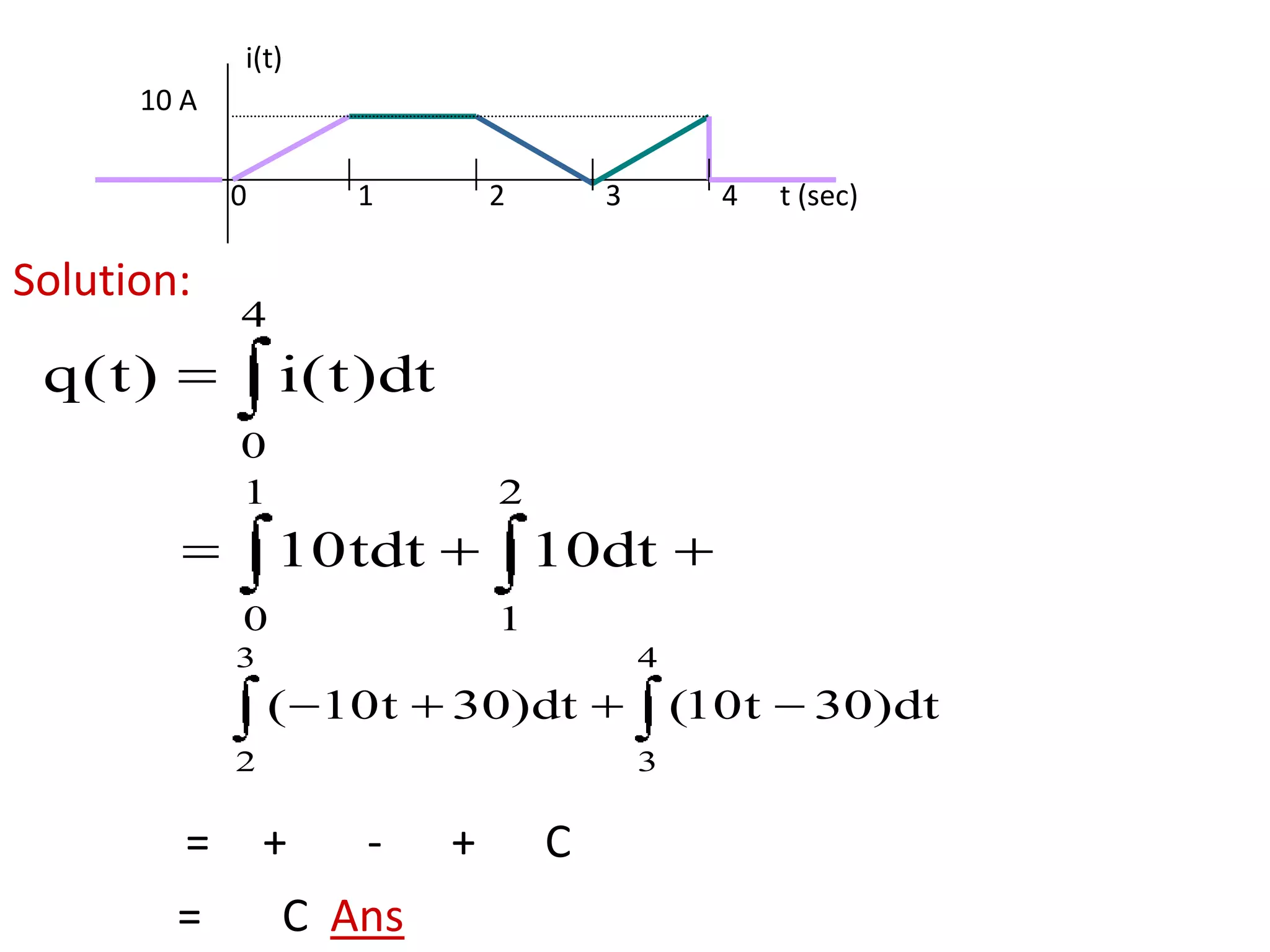
Solution:
4
0
q(t) i(t)dt
1 2
0 1
10tdt 10dt
3 4
2 3
( 10t 30)dt (10t 30)dt
Ans
= + - + C
= C
Voltage
• Recognized by the 18th century Italian physicist
Allessandro Antonio Volta.
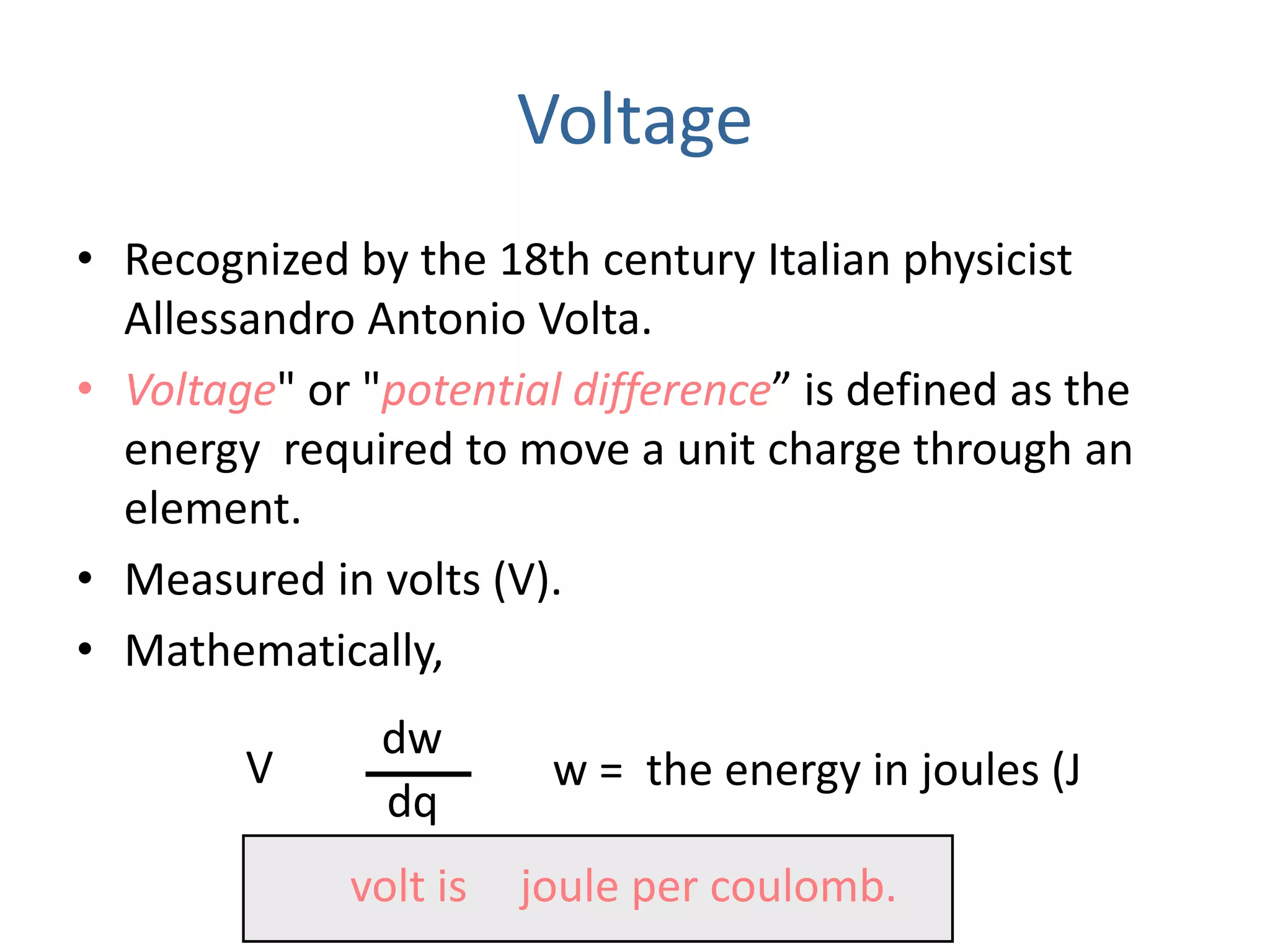
• Voltage" or "potential difference” is defined as the
energy required to move a unit charge through an
element.
• Measured in volts (V).
• Mathematically,
dw
dq
V w = the energy in joules (J
volt is joule per coulomb.
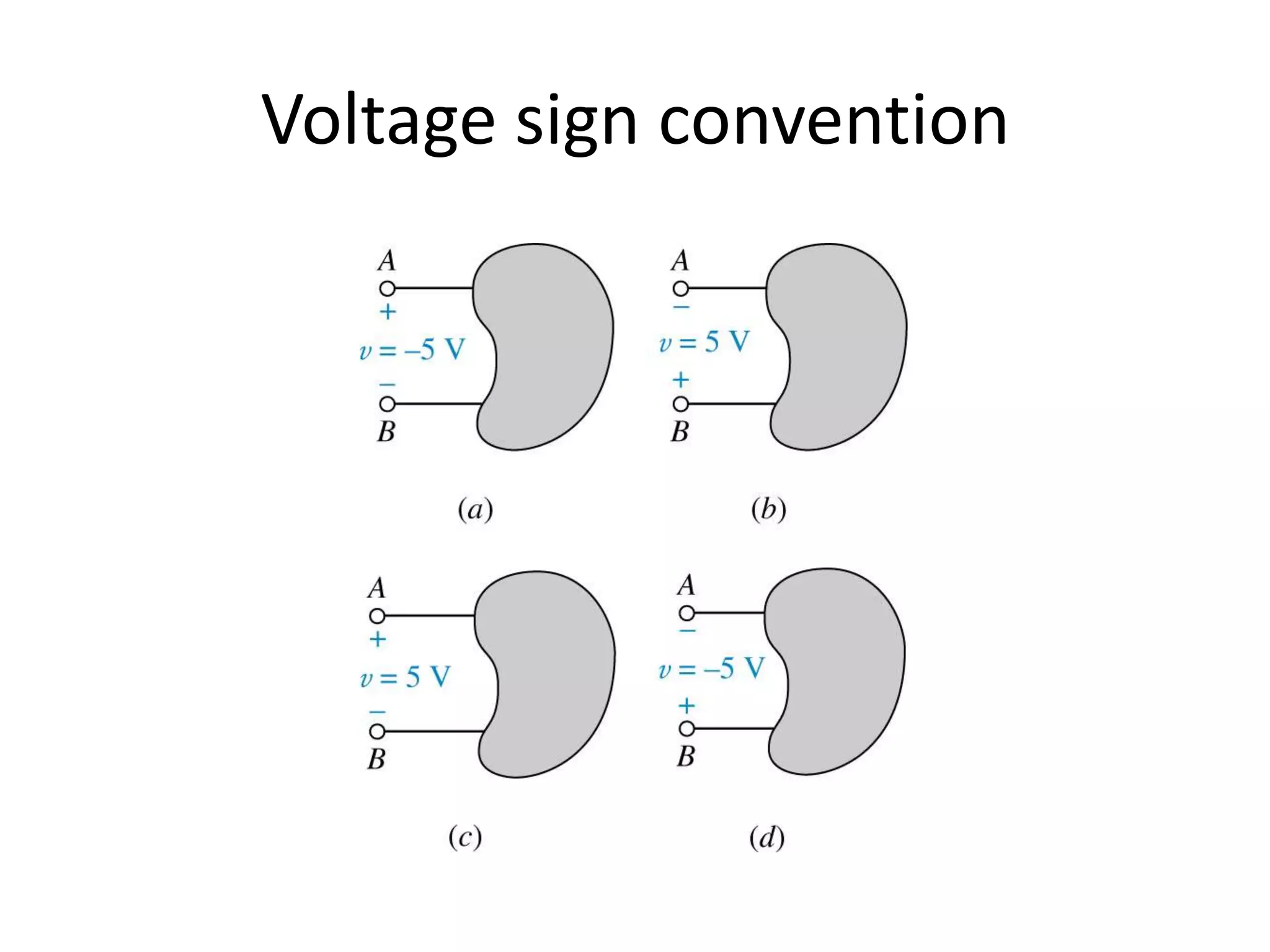
Voltage sign convention
DC and AC voltage
• Like electric current, a constant voltage is
called a “dc voltage” and is represented by
V”, whereas a sinusoidally time-varying
voltage is called an “ac voltage” and is
represented by “v
• A dc voltage is usually produced by a battery
and an ac voltage is produced by an electric
generator.
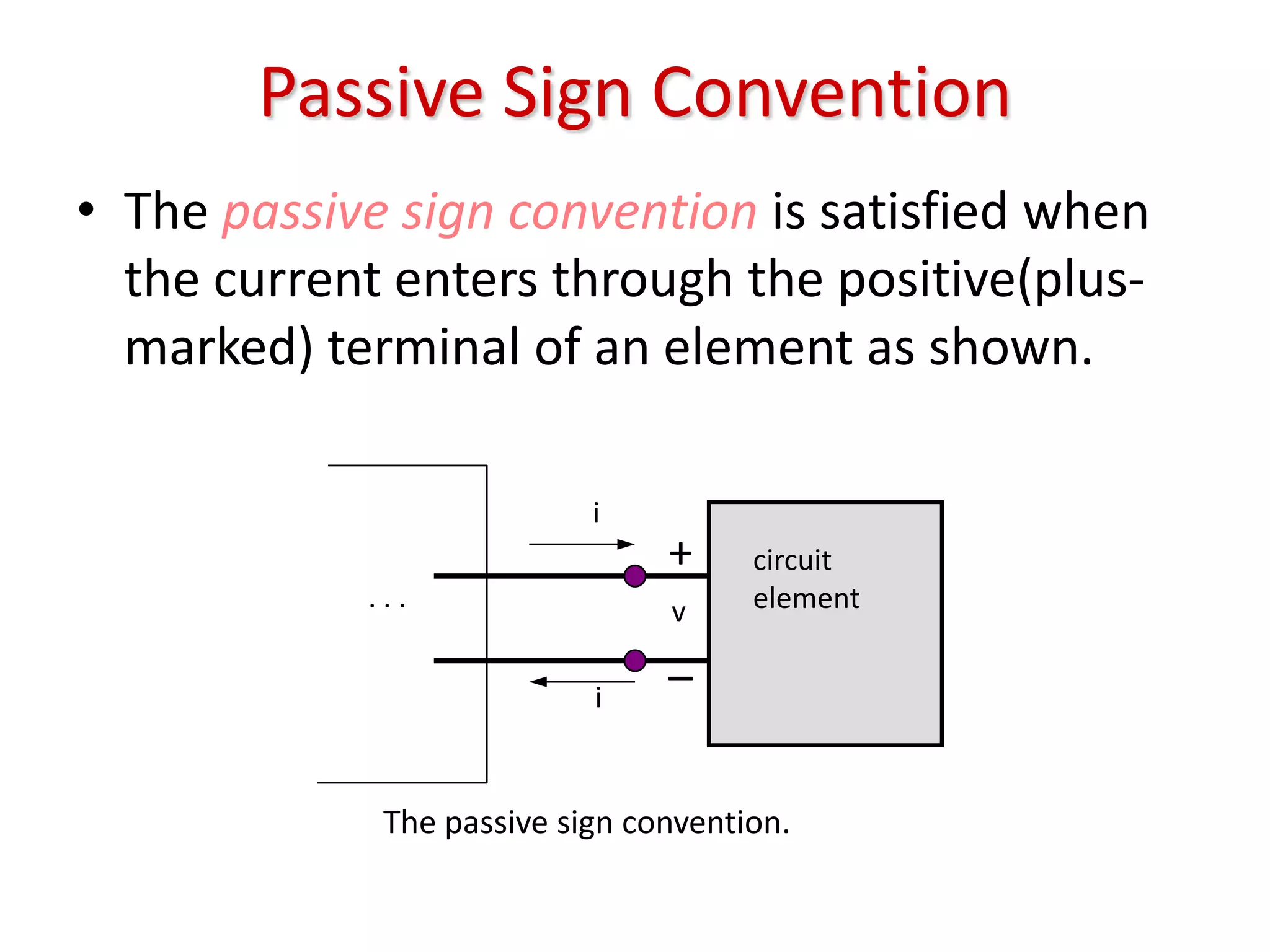
Passive Sign Convention
• The passive sign convention is satisfied when
the current enters through the positive(plus-
marked) terminal of an element as shown.
circuit
elementv
–
+
i
i
. . .
The passive sign convention.
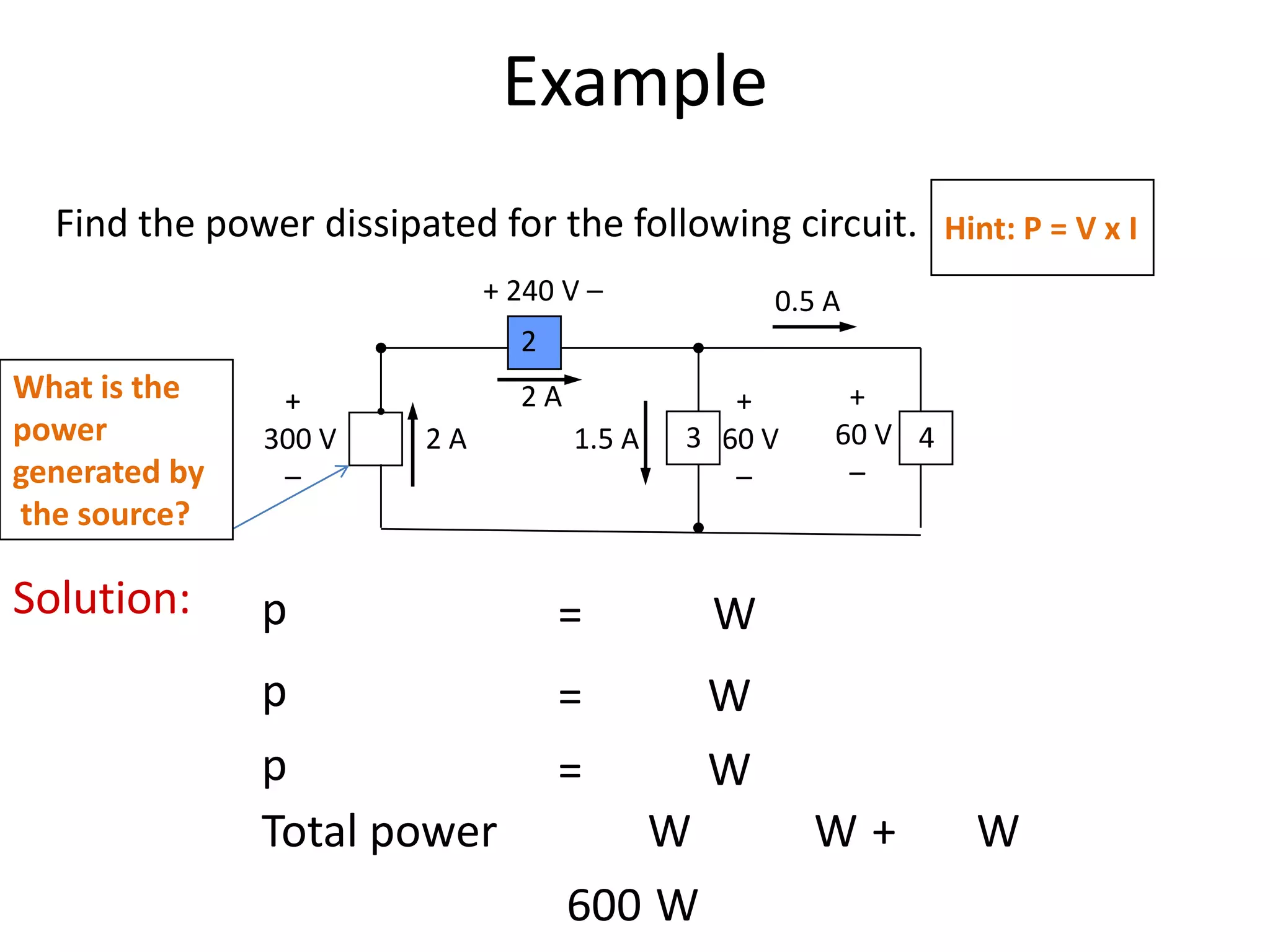
Example
Solution: p = W
p = W
p = W
Total power W W + W
600 W
+
300 V
–
+
60 V
–
+
60 V
–
+ 240 V –
2 A
2 A
1.5 A
0.5 A
3 4
2
Find the power dissipated for the following circuit. Hint: P = V x I
What is the
power
generated by
the source?
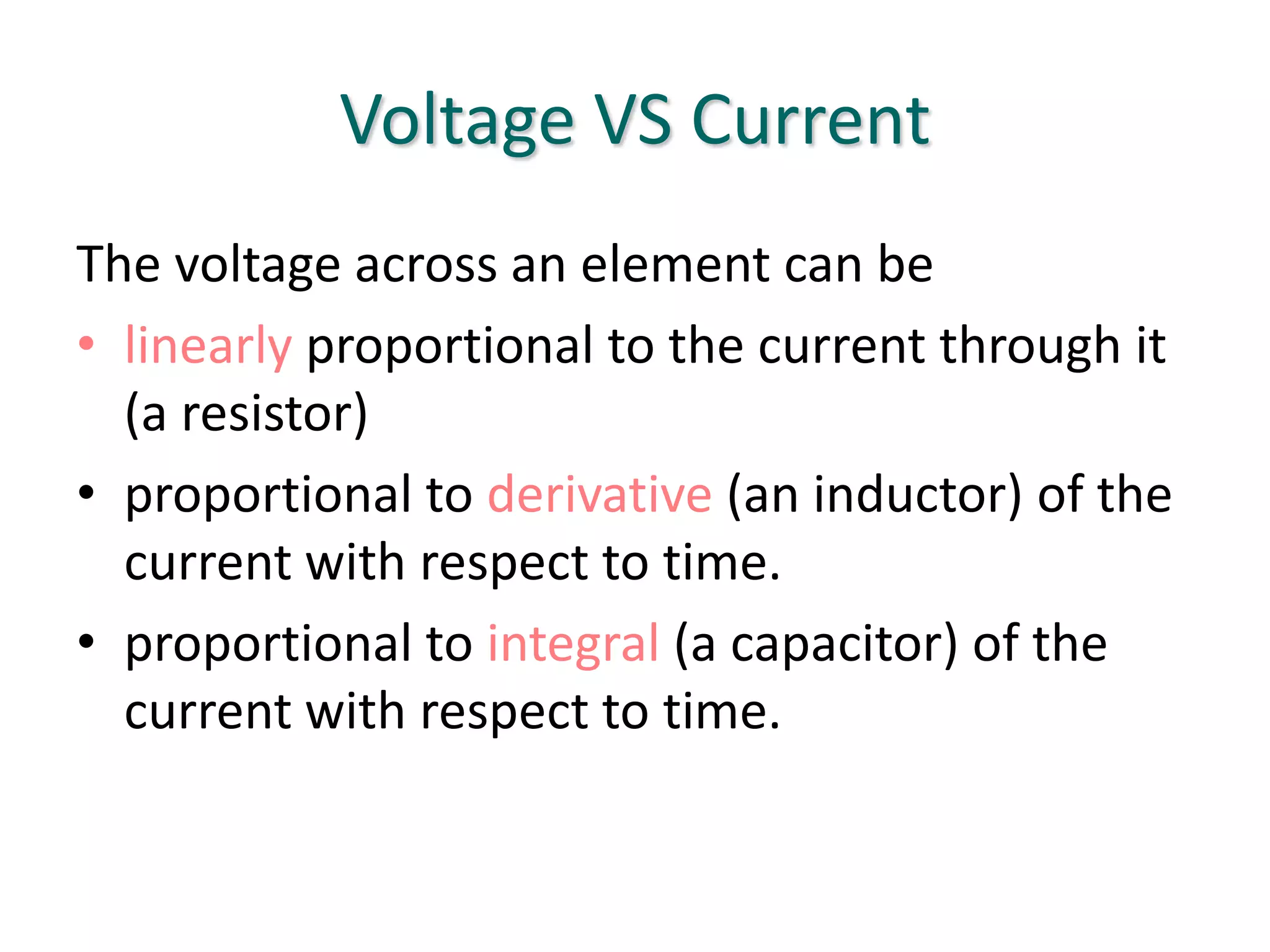
Voltage VS Current
The voltage across an element can be
• linearly proportional to the current through it
(a resistor)
• proportional to derivative (an inductor) of the
current with respect to time.
• proportional to integral (a capacitor) of the
current with respect to time.
Voltage and Current Sources
Two types of basic electrical elements:
• passive elements.(dissipate power)
• active elements. (generate power)
Active elements such as voltage and current
sources can be classified as either independent
or dependent sources.
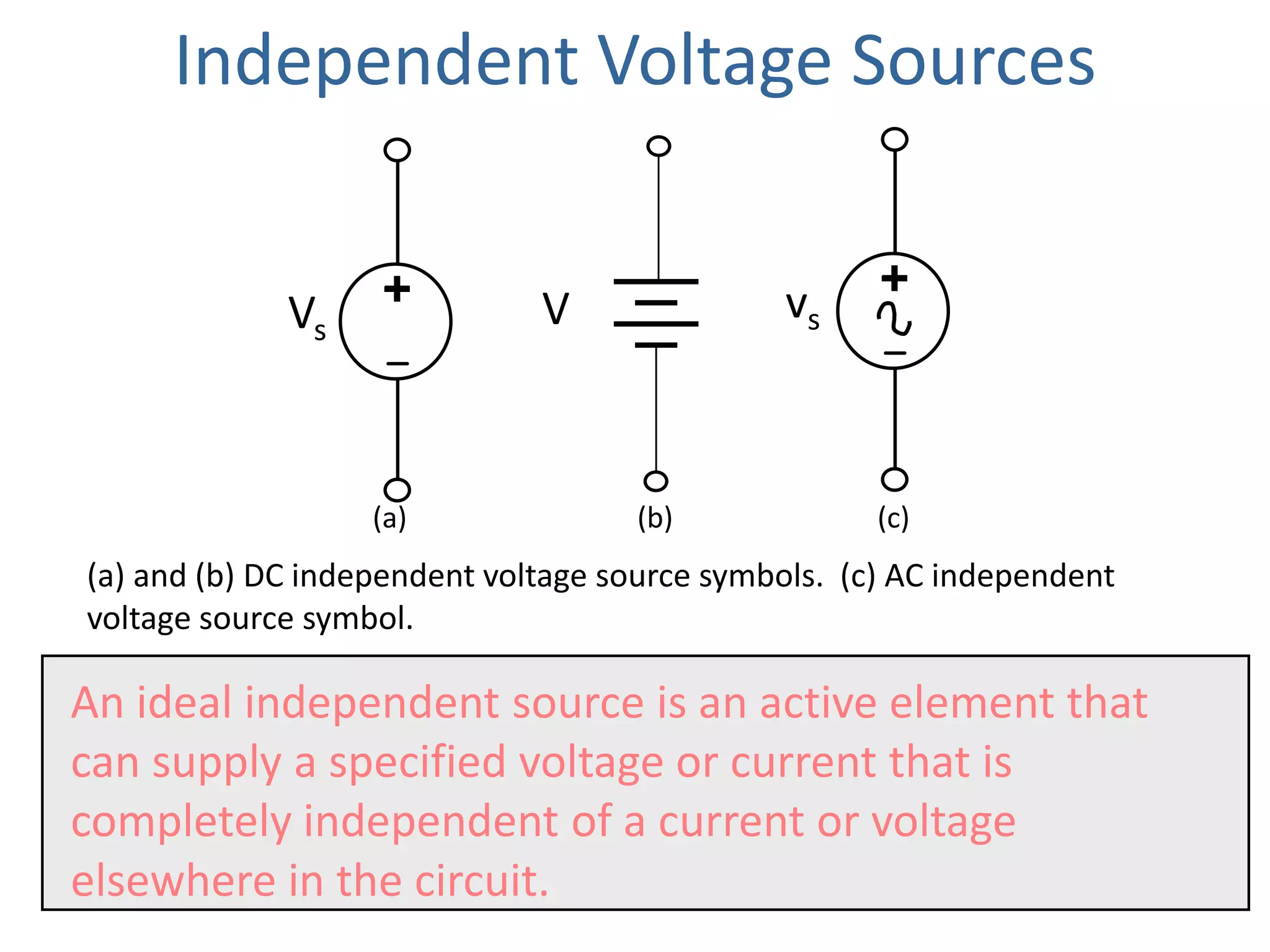
Independent Voltage Sources
An ideal independent source is an active element that
can supply a specified voltage or current that is
completely independent of a current or voltage
elsewhere in the circuit.
vsVs
(a) and (b) DC independent voltage source symbols. (c) AC independent
voltage source symbol.
(a) (b) (c)
V
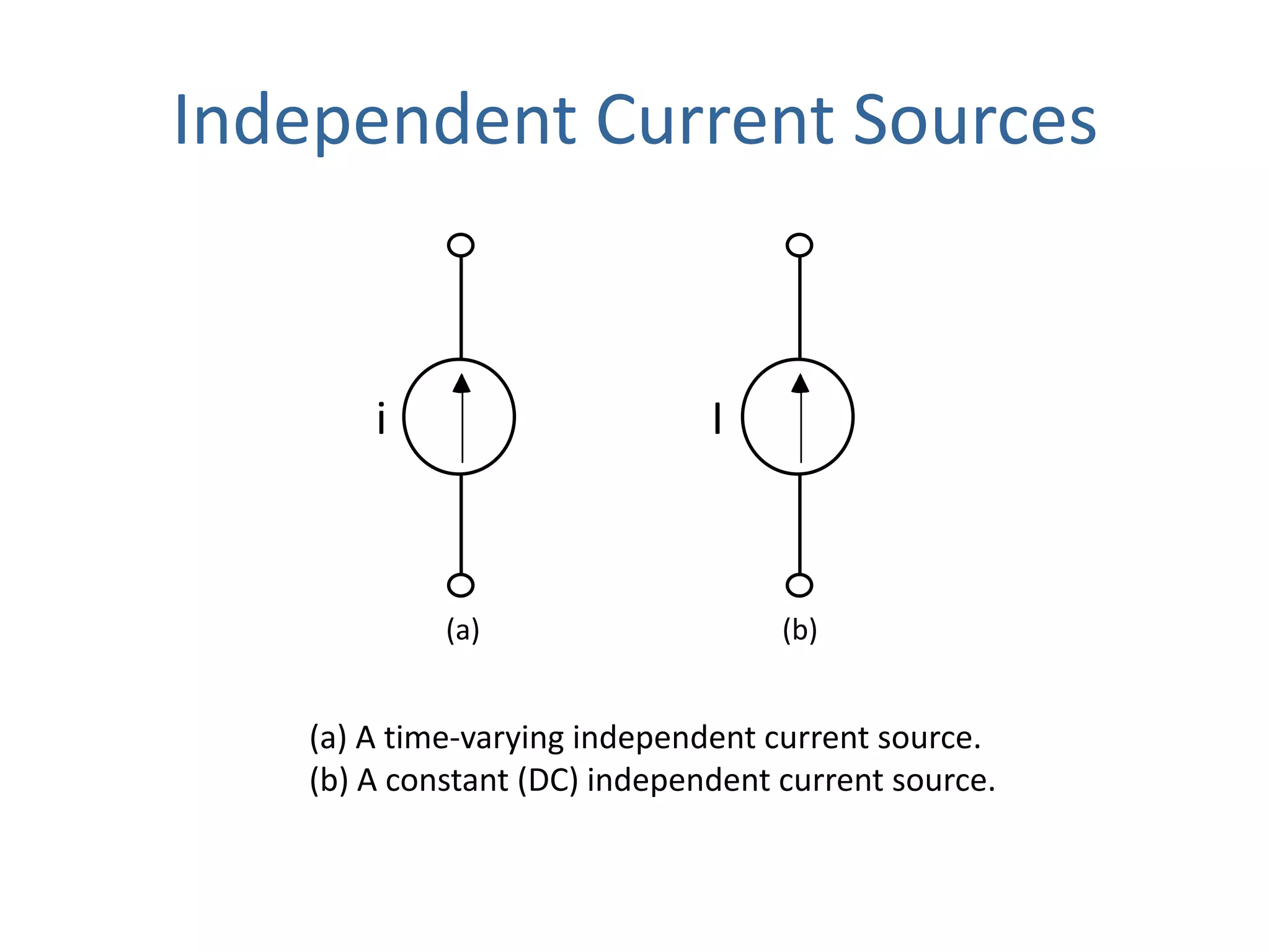
Independent Current Sources
(a) (b)
(a) A time-varying independent current source.
(b) A constant (DC) independent current source.
i I
Dependent Sources
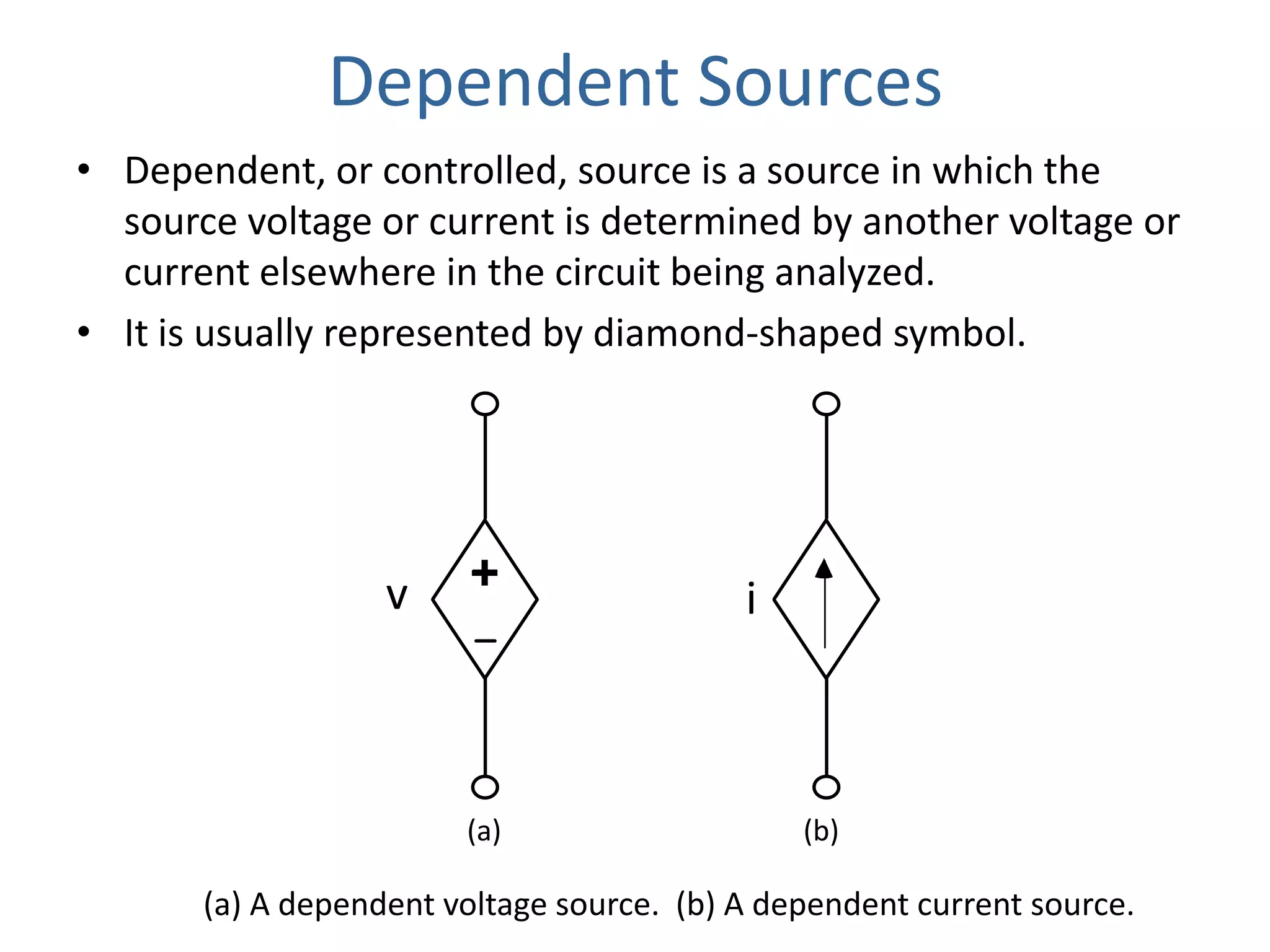
• Dependent, or controlled, source is a source in which the
source voltage or current is determined by another voltage or
current elsewhere in the circuit being analyzed.
• It is usually represented by diamond-shaped symbol.
(a) (b)
(a) A dependent voltage source. (b) A dependent current source.
v i
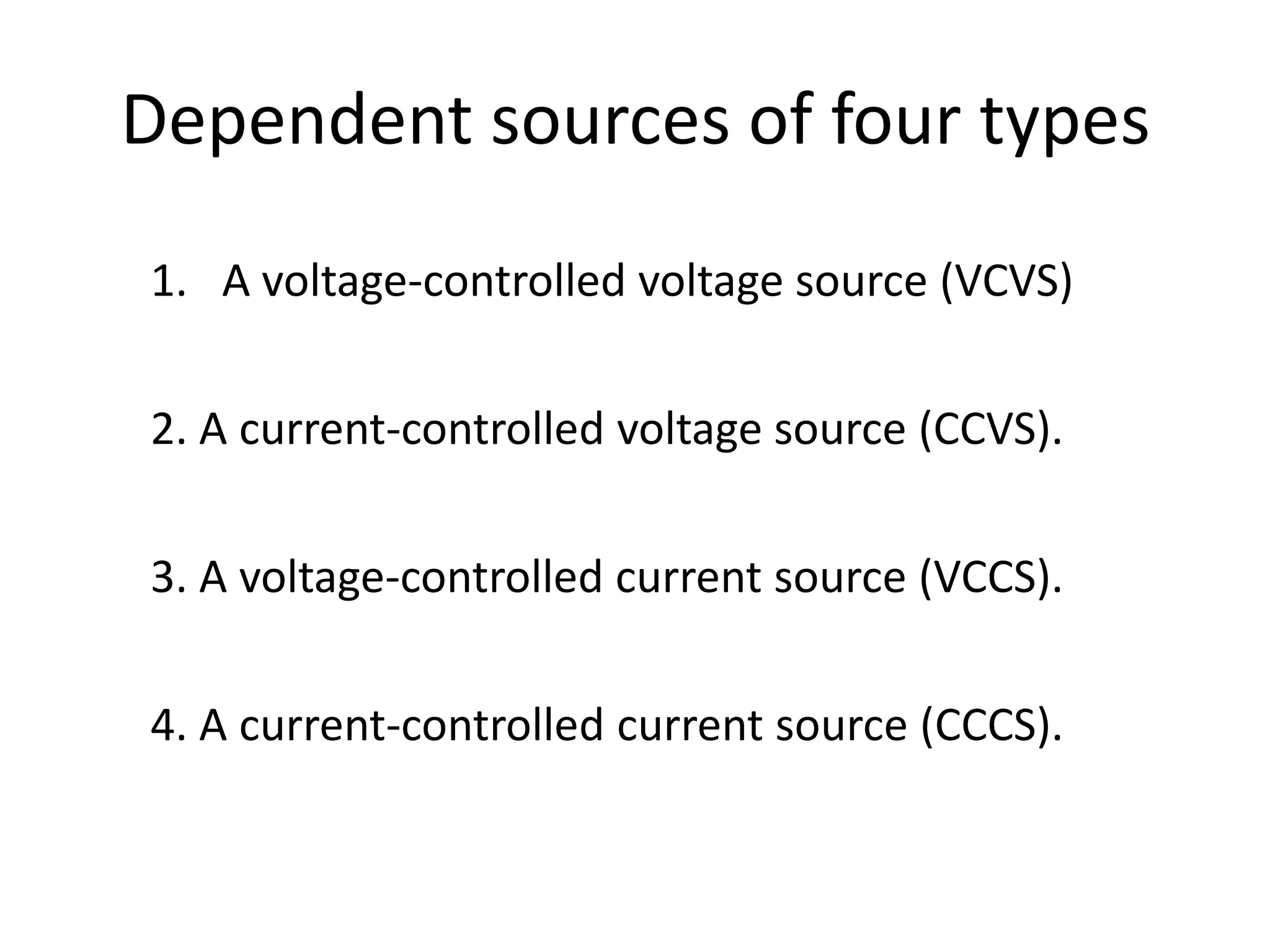
Dependent sources of four types
1. A voltage-controlled voltage source (VCVS)
2. A current-controlled voltage source (CCVS).
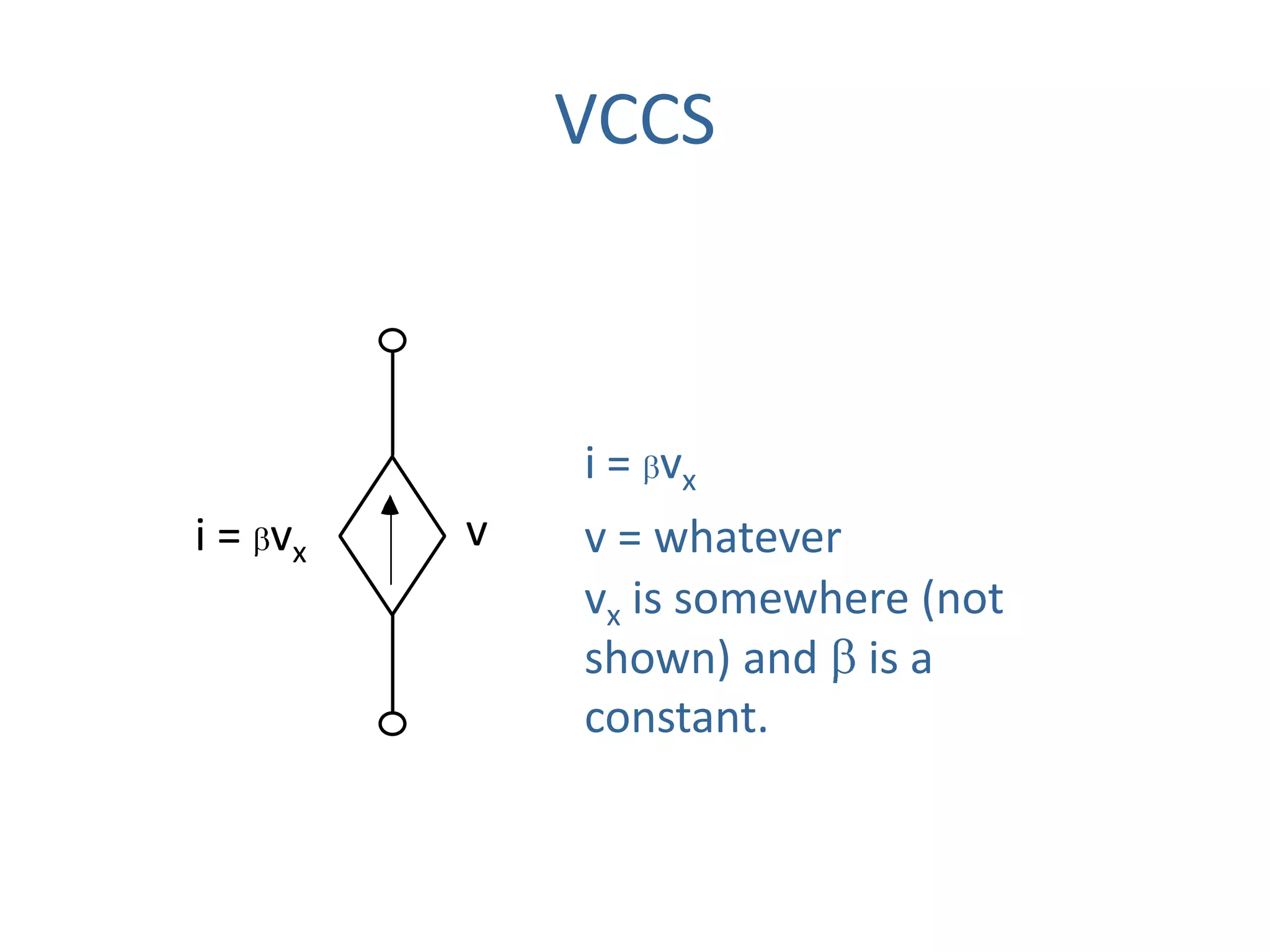
3. A voltage-controlled current source (VCCS).
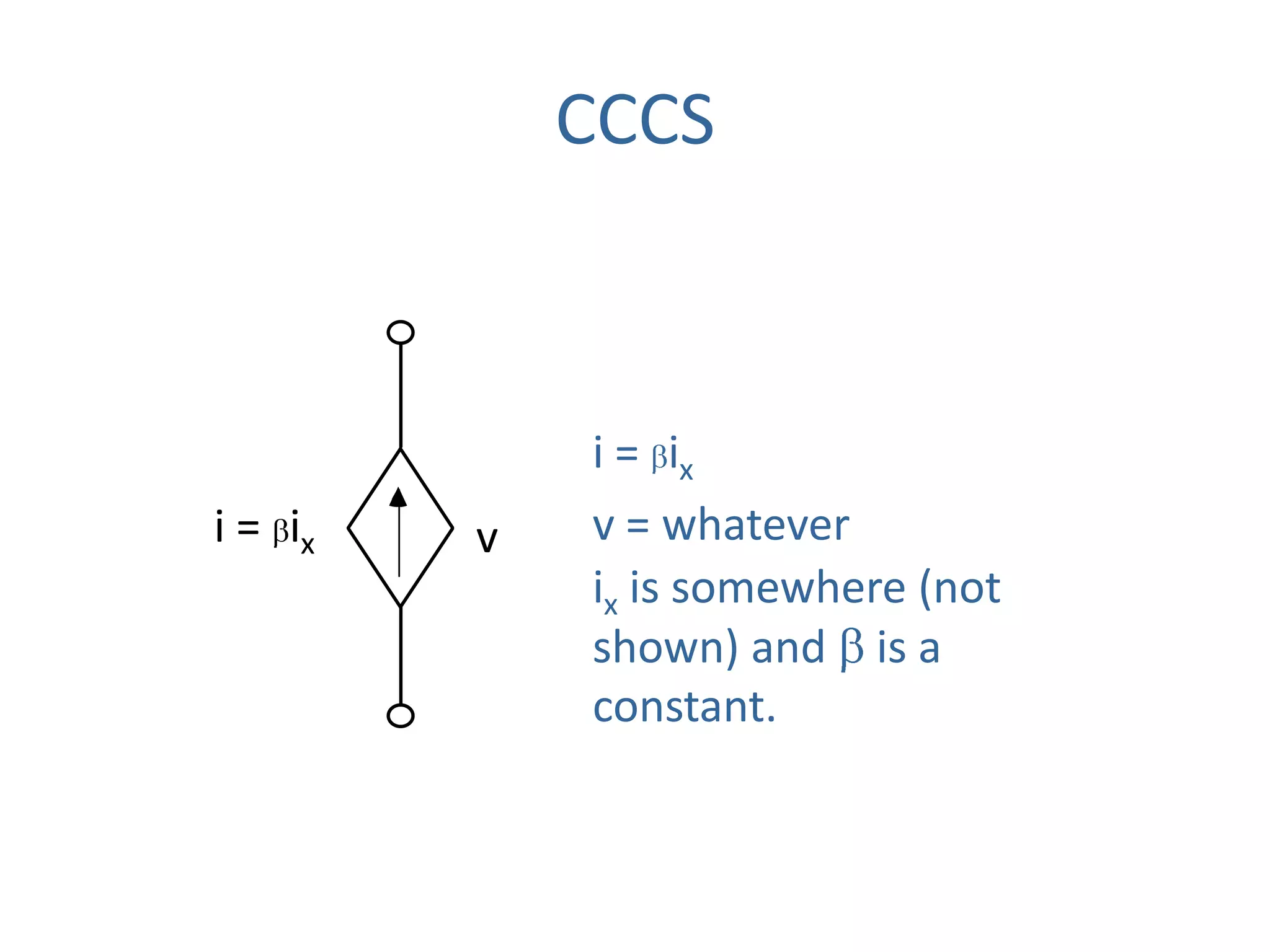
4. A current-controlled current source (CCCS).
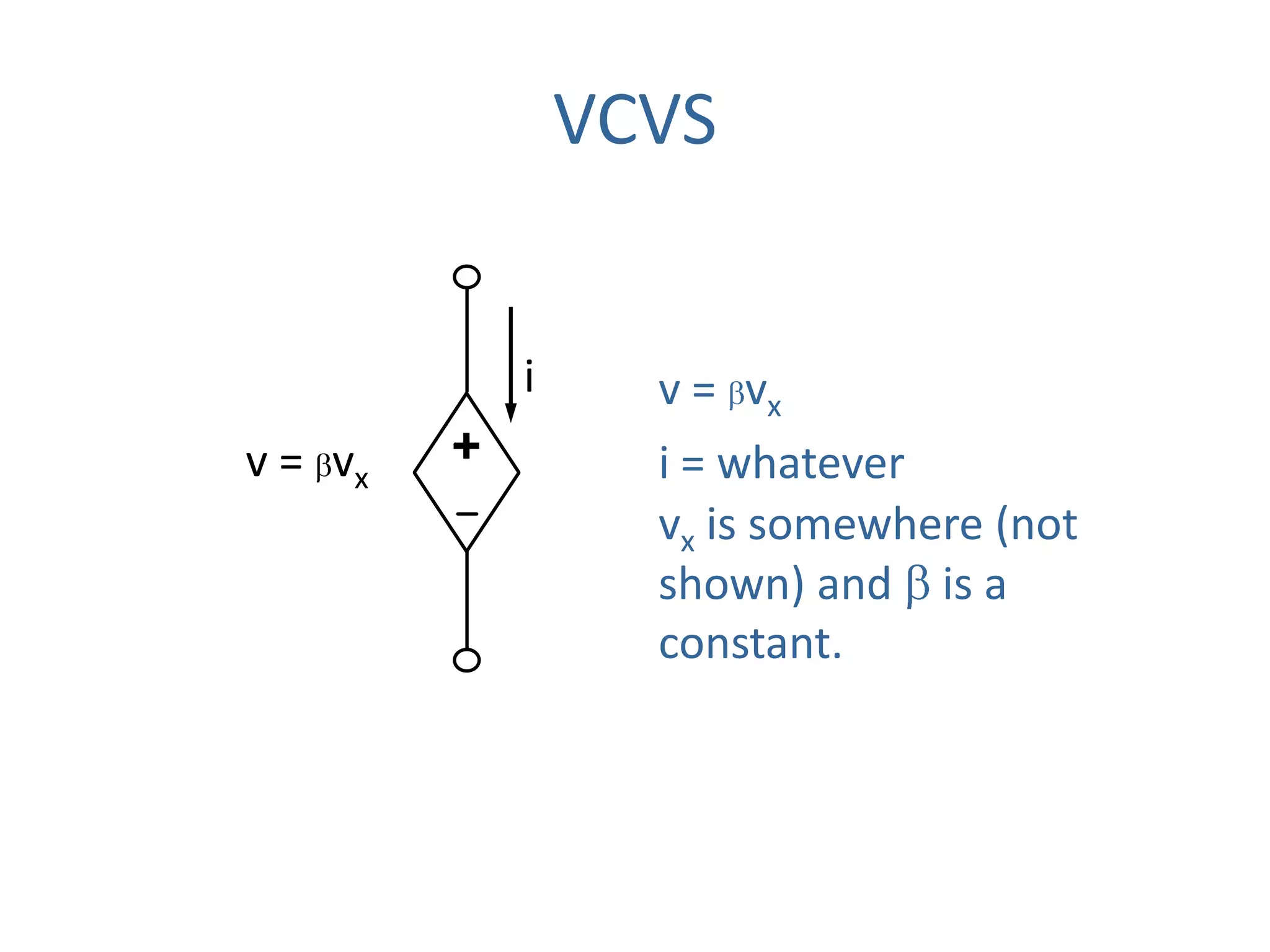
VCVS
i
v = vx
v = vx
vx is somewhere (not
shown) and is a
constant.
i = whatever
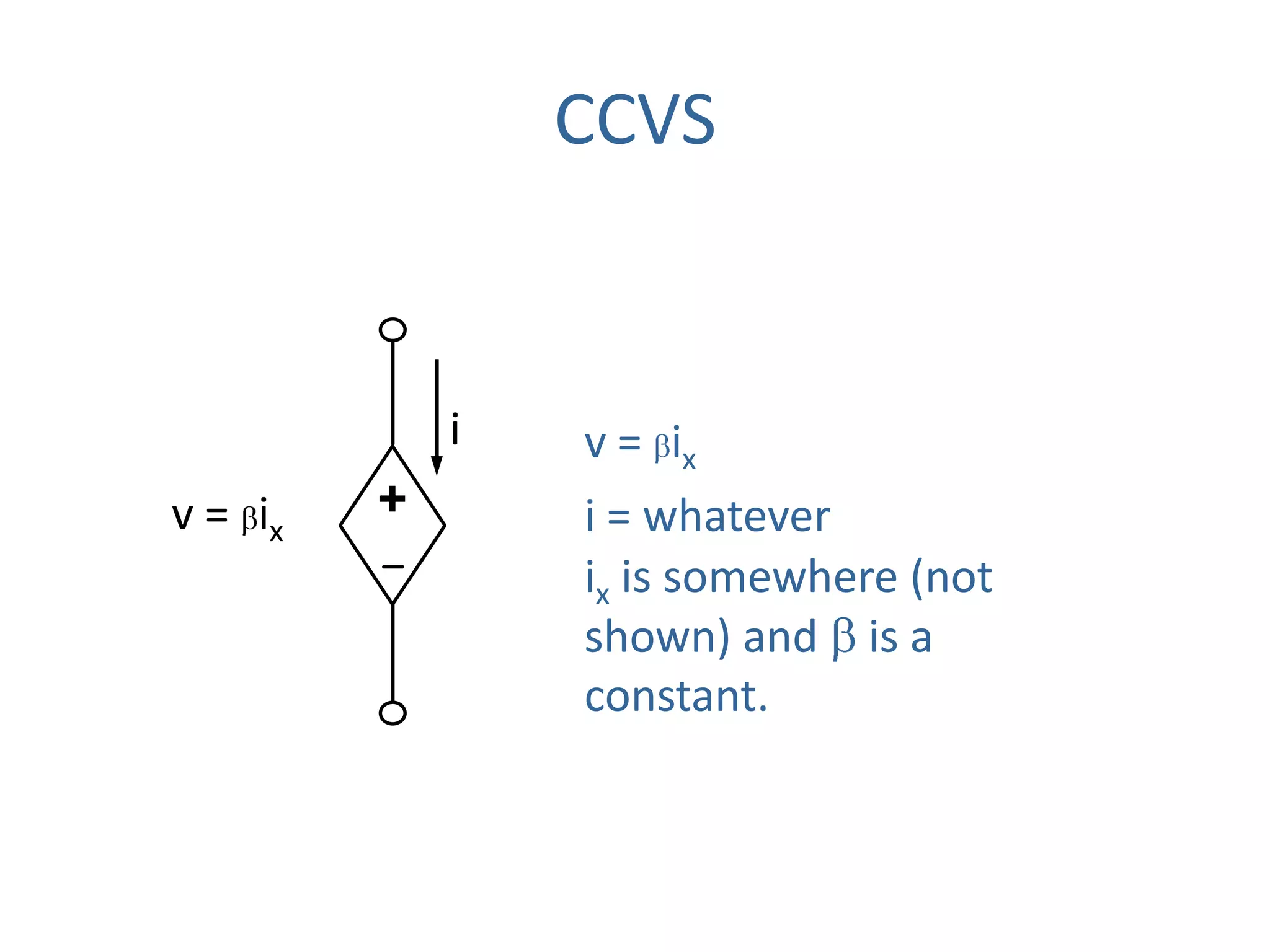
CCVS
i
v = ix
v = ix
i = whatever
ix is somewhere (not
shown) and is a
constant.
VCCS
i = vx
i = vx
vx is somewhere (not
shown) and is a
constant.
v = whateverv
CCCS
i = ix
i = ix
v = whatever
ix is somewhere (not
shown) and is a
constant.
v
Resistance ‘R’
• Unit of resistance is ohms (Ω)
1 Ω = 1 V / A
• Resistance in a circuit arises due to collisions
between the electrons carrying the current
with the fixed atoms inside the conductor.
• Experiments show that for many materials,
including most metals, the resistance remains
constant over a wide range of applied voltages
or currents.
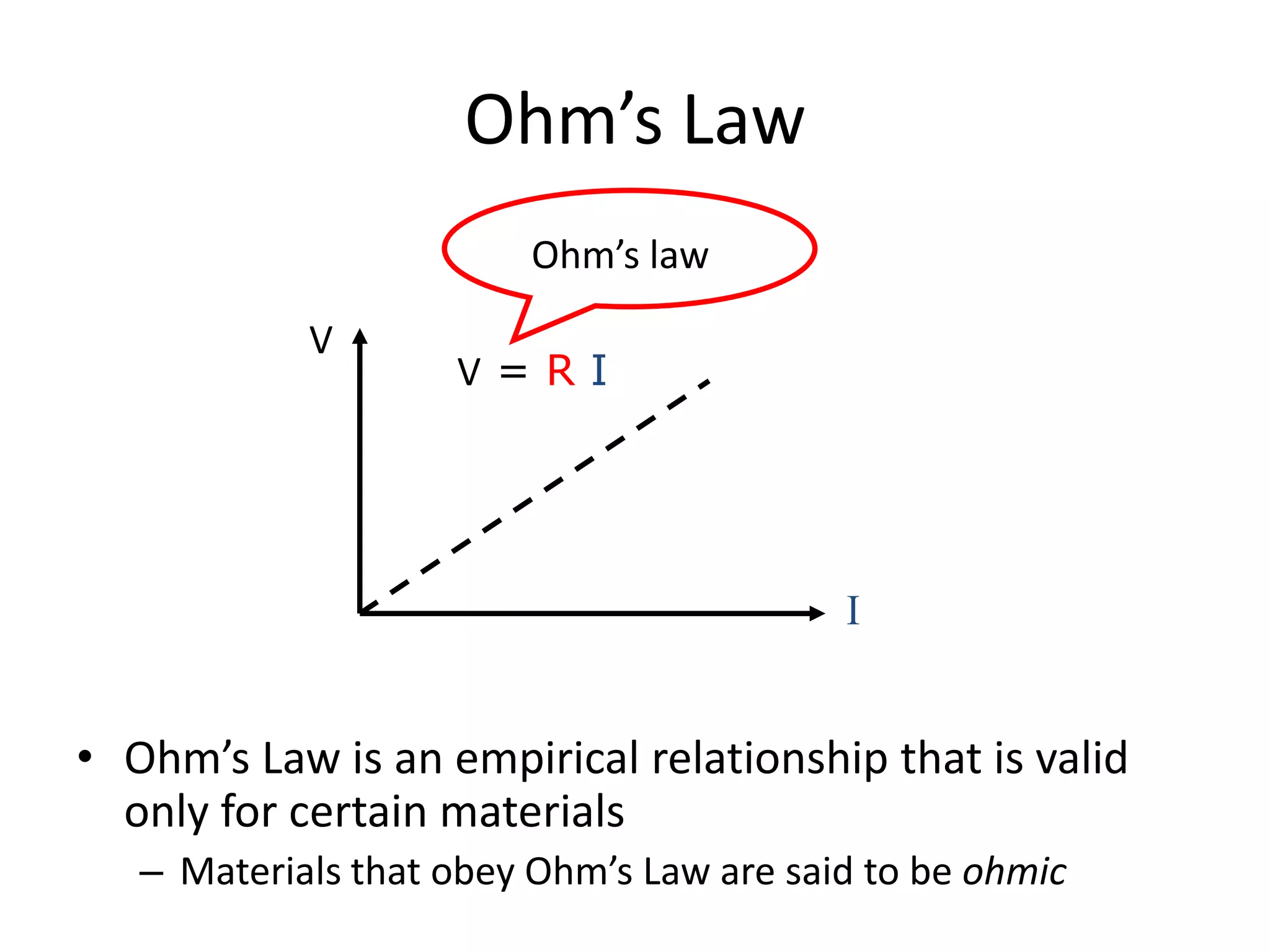
Ohm’s Law
• Ohm’s Law is an empirical relationship that is valid
only for certain materials
– Materials that obey Ohm’s Law are said to be ohmic
V
V = R I
Ohm’s law
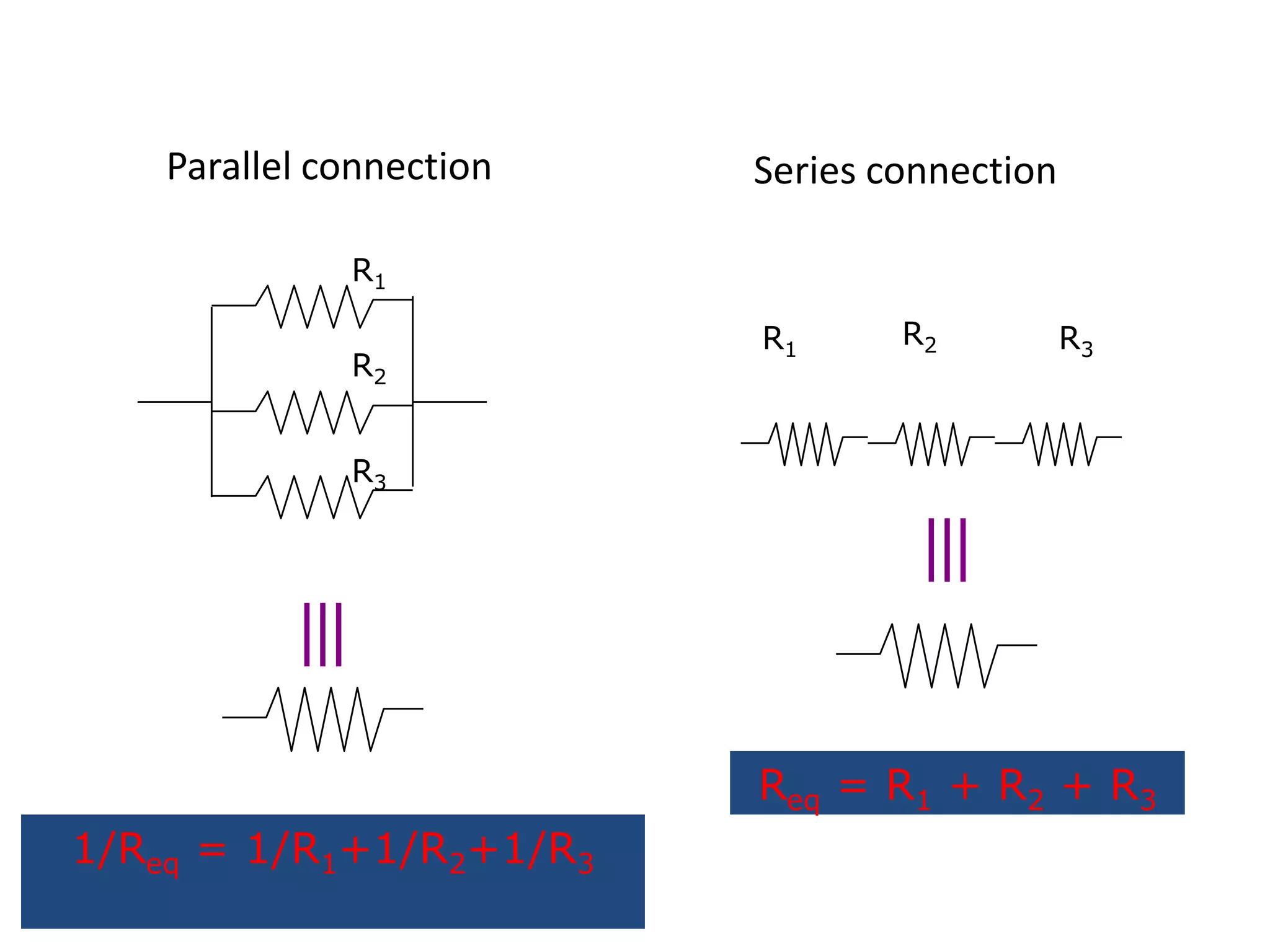
Parallel connection Series connection
R1
R2
R3
R1
R2 R3
Req = R1 + R2 + R3
1/Req = 1/R1+1/R2+1/R3
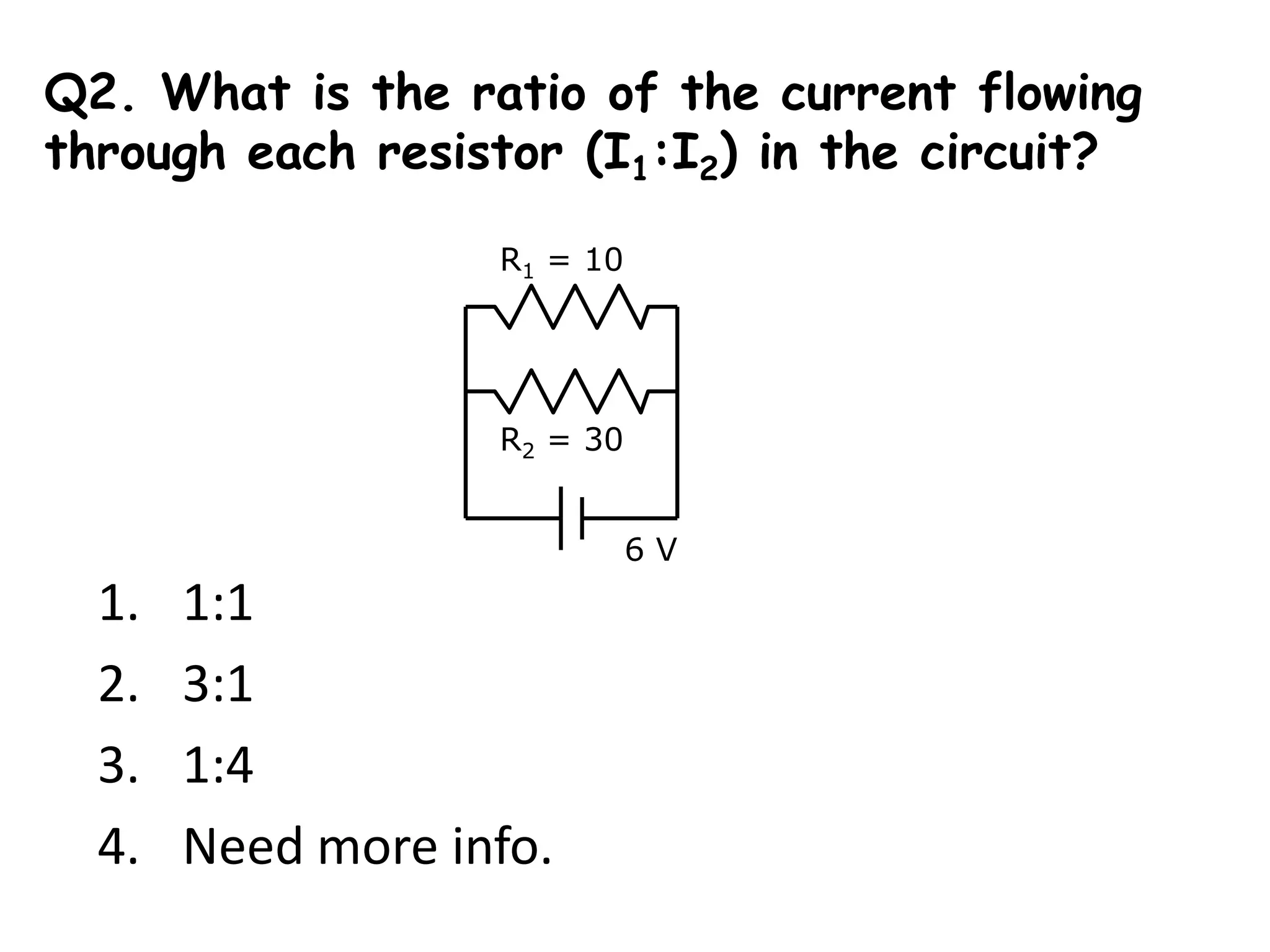
Q2. What is the ratio of the current flowing
through each resistor (I1:I2) in the circuit?
1. 1:1
2. 3:1
3. 1:4
4. Need more info.
6 V
R1 = 10
R2 = 30
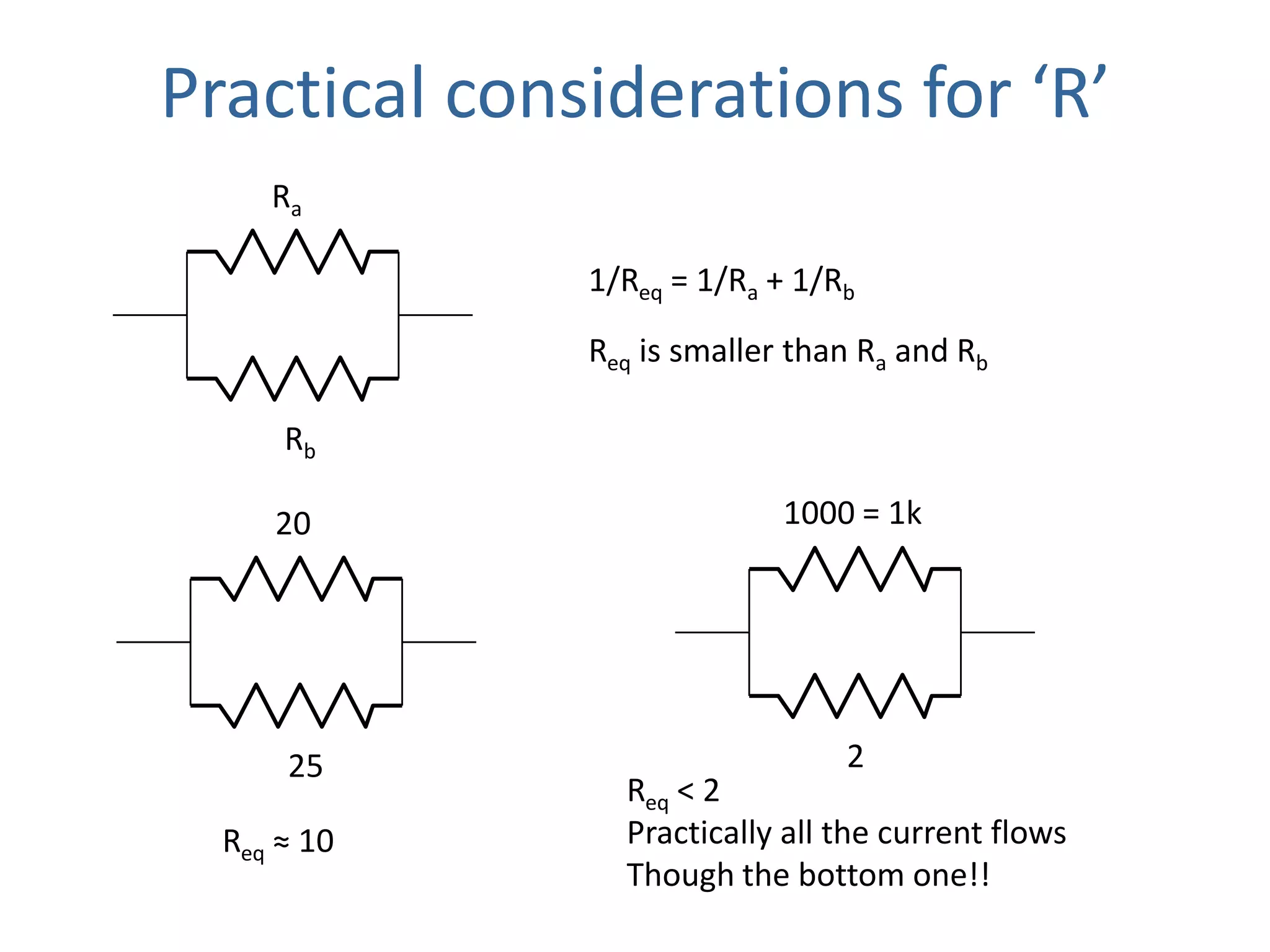
Ra
Rb
1/Req = 1/Ra + 1/Rb
Req is smaller than Ra and Rb
20
25
Req ≈ 10
1000 = 1k
2
Req < 2
Practically all the current flows
Though the bottom one!!
Practical considerations for ‘R’

Electrical Circuit - Lecture#2

  • 1.
    Electric Circuit Analysis Circuitelements Ahsan Khawaja Ahsan_khawaja@comsats.edu.pk Lecturer Room 102 Department of Electrical Engineering
  • 2.
    Base Quantity SI baseunits Name Symbol length meter m mass kilogram kg time second s electric current ampere A temperature kelvin K amount of substance mole mol luminous intensity candela cd
  • 3.
    Prefixes •Used to emphasizethe significantly large or small numerical figures. •Some common prefixes….. - yocto y - zepto z - atto a - femto f - pico p - nano n - micro - milli m - centi c - deci d Deka da hecto h kilo k mega M giga G tera T peta P exa E zetta Z yotta Y
  • 4.
    Charge • In SIsystem, charge is measured in coulombs (C). • The charge on an electron is -1.602 x 10⁻¹⁹ C. • Hence 1 C of charge, there are 1/(1.602 x 10-19) = 6.24 x 10¹⁸ electrons. • Denoted by ‘ q ’.
  • 5.
    Current • ‘I’, isthe rate at which charge is transferred or "flows" through a device. • Mathematically, dq(t) dt i(t) = where i = the current in amperes (A) q = the charge in coulombs (C) the amount of charge passing through a device per unit of time. ampere is coulomb per second.
  • 6.
    i t 0 5 1015 20 -1 -0.5 0 0.5 1 0 5 10 15 20 -0.8 -0.6 -0.4 -0.2 0 0.2 0.4 0.6 0.8 1 0 5 10 15 20 -3 -2 -1 0 1 2 3 4 5 0 5 10 15 20 0 0.2 0.4 0.6 0.8 1 Direct Current (dc) Alternating/Sinusoidal Current (ac) Exponential Current Damped Sinusoidal Current Transient Current Types of current
  • 7.
    Current sign convention Properdefinition of current vector requires: •direction of the arrow(polarity). •value (magnitude) A negative current of - A flowing in one direction is the same as a current of + A flowing in the opposite direction.
  • 8.
    Electronic VS conventionalcurrent Electrons flow from negative terminal to positive terminal but conventional current flows in the opposite direction.
  • 9.
    Example DC current. Findthe charge passing through a point in a conductor if the current passing through the conductor has the waveform indicated. i t 2 A Solution: The current does not change with time. Hence, a charge of 2 C is passing through the point each second.
  • 10.
    Example For the givencurrent, which is given in graphical form, find the charge passing through a given point in the time interval 0-4 s. t (sec) 10 A 10 2 43 i(t)
  • 11.
    t (sec) 10 A 102 43 i(t) Solution: 4 0 q(t) i(t)dt 1 2 0 1 10tdt 10dt 3 4 2 3 ( 10t 30)dt (10t 30)dt Ans = + - + C = C
  • 12.
    Voltage • Recognized bythe 18th century Italian physicist Allessandro Antonio Volta. • Voltage" or "potential difference” is defined as the energy required to move a unit charge through an element. • Measured in volts (V). • Mathematically, dw dq V w = the energy in joules (J volt is joule per coulomb.
  • 13.
  • 14.
    DC and ACvoltage • Like electric current, a constant voltage is called a “dc voltage” and is represented by V”, whereas a sinusoidally time-varying voltage is called an “ac voltage” and is represented by “v • A dc voltage is usually produced by a battery and an ac voltage is produced by an electric generator.
  • 15.
    Passive Sign Convention •The passive sign convention is satisfied when the current enters through the positive(plus- marked) terminal of an element as shown. circuit elementv – + i i . . . The passive sign convention.
  • 16.
    Example Solution: p =W p = W p = W Total power W W + W 600 W + 300 V – + 60 V – + 60 V – + 240 V – 2 A 2 A 1.5 A 0.5 A 3 4 2 Find the power dissipated for the following circuit. Hint: P = V x I What is the power generated by the source?
  • 17.
    Voltage VS Current Thevoltage across an element can be • linearly proportional to the current through it (a resistor) • proportional to derivative (an inductor) of the current with respect to time. • proportional to integral (a capacitor) of the current with respect to time.
  • 18.
    Voltage and CurrentSources Two types of basic electrical elements: • passive elements.(dissipate power) • active elements. (generate power) Active elements such as voltage and current sources can be classified as either independent or dependent sources.
  • 19.
    Independent Voltage Sources Anideal independent source is an active element that can supply a specified voltage or current that is completely independent of a current or voltage elsewhere in the circuit. vsVs (a) and (b) DC independent voltage source symbols. (c) AC independent voltage source symbol. (a) (b) (c) V
  • 20.
    Independent Current Sources (a)(b) (a) A time-varying independent current source. (b) A constant (DC) independent current source. i I
  • 21.
    Dependent Sources • Dependent,or controlled, source is a source in which the source voltage or current is determined by another voltage or current elsewhere in the circuit being analyzed. • It is usually represented by diamond-shaped symbol. (a) (b) (a) A dependent voltage source. (b) A dependent current source. v i
  • 22.
    Dependent sources offour types 1. A voltage-controlled voltage source (VCVS) 2. A current-controlled voltage source (CCVS). 3. A voltage-controlled current source (VCCS). 4. A current-controlled current source (CCCS).
  • 23.
    VCVS i v = vx v= vx vx is somewhere (not shown) and is a constant. i = whatever
  • 24.
    CCVS i v = ix v= ix i = whatever ix is somewhere (not shown) and is a constant.
  • 25.
    VCCS i = vx i= vx vx is somewhere (not shown) and is a constant. v = whateverv
  • 26.
    CCCS i = ix i= ix v = whatever ix is somewhere (not shown) and is a constant. v
  • 27.
    Resistance ‘R’ • Unitof resistance is ohms (Ω) 1 Ω = 1 V / A • Resistance in a circuit arises due to collisions between the electrons carrying the current with the fixed atoms inside the conductor. • Experiments show that for many materials, including most metals, the resistance remains constant over a wide range of applied voltages or currents.
  • 29.
    Ohm’s Law • Ohm’sLaw is an empirical relationship that is valid only for certain materials – Materials that obey Ohm’s Law are said to be ohmic V V = R I Ohm’s law
  • 30.
    Parallel connection Seriesconnection R1 R2 R3 R1 R2 R3 Req = R1 + R2 + R3 1/Req = 1/R1+1/R2+1/R3
  • 31.
    Q2. What isthe ratio of the current flowing through each resistor (I1:I2) in the circuit? 1. 1:1 2. 3:1 3. 1:4 4. Need more info. 6 V R1 = 10 R2 = 30
  • 32.
    Ra Rb 1/Req = 1/Ra+ 1/Rb Req is smaller than Ra and Rb 20 25 Req ≈ 10 1000 = 1k 2 Req < 2 Practically all the current flows Though the bottom one!! Practical considerations for ‘R’