CHAPTER 5
Transient and Steady State
Response
(Second-Order Circuits)
Contents
Natural response of series RLC circuit
Natural response of parallel RLC circuit
Step response of series RLC circuit
Step response of parallel RLC circuit
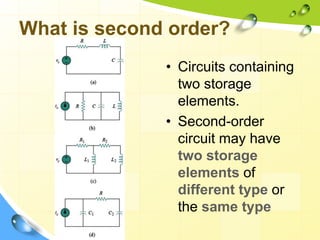
What is second order?
• Circuits containing
two storage
elements.
• Second-order
circuit may have
two storage
elements of
different type or
the same type
Initial and final values
• Combination of R, L and C
• Find v(0), i(0), dv(0)/dt, di(0)/dt, i(∞) & v(∞)
• t(0-)  the time just before switching event
• t(0+)  the time just after switching event
• Assume the switching event take place at t=0
• Voltage polarity across capacitor
• Current direction across inductor
• Capacitor voltage always continuous  v(0+) = v(0-)
• Inductor current always continuous  i(0+)=i(0-)
Example
The switch in the figure shown has been closed for a long
time. It is open at t=0, Find:
(a) i(0+), v(0+)
(b) di(0+)/dt, dv(0+)/dt
(c) i(∞) , v(∞)
12 V
0.25 H4 Ω
0.1 F2 Ω
i
+
V
-
t=0
Exercise
The switch in the figure shown was open for a long time but
closed at t=0. Determine
(a) i(0+), v(0+)
(b) di(0+)/dt, dv(0+)/dt
(c) i(∞) , v(∞)
24 V
0.4 H
1/20 F
2 Ω
i
+
V
-
t=0
10 Ω
The Source-Free Series RLC
• Applying KVL around the loop
𝑅𝑖 + 𝐿
𝑑𝑖
𝑑𝑡
+
1
𝑐 −∞
𝑡
𝑖 𝑑𝑡 = 0
• Differentiate with respect to t
𝑑2 𝑖
𝑑2
+
𝑅
𝐿
𝑑𝑖
𝑑𝑡
+
𝑖
𝐿𝐶
= 0
• Finally,
𝑠2
+
𝑅
𝐿
𝑠 +
1
𝐿𝐶
= 0
The Source-Free Series RLC
• Roots equation
𝑠1 = −
𝑅
2𝐿
+
𝑅
2𝐿
2
−
1
𝐿𝐶
𝑠2 = −
𝑅
2𝐿
−
𝑅
2𝐿
2
−
1
𝐿𝐶
or
𝑠1 = −𝛼 + 𝛼2 − 𝜔0
2
𝑠2 = −𝛼 − 𝛼2 − 𝜔0
2
where
𝛼 =
𝑅
2𝐿
, 𝜔0 =
1
𝐿𝐶
• 𝛼  (Np/s)
• 𝜔0 (rad/s)
The Source-Free Series RLC
Three type of solution
• If α > ω0  overdamped case
• If α = ω0  critically damped case
• If α < ω0  underdamped case
The Source-Free Series RLC
Overdamped case (α>ω0)
• Both roots S1 and S2 are negative and real
• The response is
𝑖 𝑡 = 𝐴1 𝑒 𝑠1 𝑡
+ 𝐴2 𝑒 𝑠2 𝑡
The Source-Free Series RLC
Critically damped case (α= ω0)
• Roots
𝑠1 = 𝑠2 = −𝛼 = −
𝑅
2𝐿
• The response is
𝑖 𝑡 = (𝐴2+𝐴1 𝑡)𝑒−𝛼𝑡
The Source-Free Series RLC
Underdamped case(α<ω0)
• Roots
𝑠1 = −𝛼 + − 𝜔0
2 − 𝛼2 = −𝛼 +j𝜔 𝑑
𝑠2 = −𝛼 − − 𝜔0
2 − 𝛼2 = −𝛼-j𝜔 𝑑
where 𝜔 𝑑 = 𝜔0
2 − 𝛼2
• The response is
𝑖 𝑡 = 𝑒−𝛼𝑡(𝐵1 cos 𝜔 𝑑 𝑡 + 𝐵2 sin 𝜔 𝑑 𝑡)
Example
Find i(t) for t > 0
+
v(t)
-
Exercise
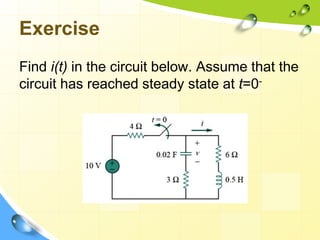
Find i(t) in the circuit below. Assume that the
circuit has reached steady state at t=0-
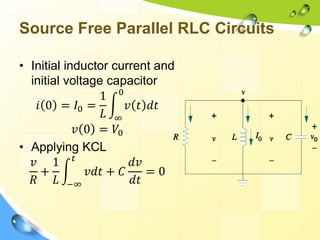
Source Free Parallel RLC Circuits
• Initial inductor current and
initial voltage capacitor
𝑖 0 = 𝐼0 =
1
𝐿 ∞
0
𝑣 𝑡 𝑑𝑡
𝑣 0 = 𝑉0
• Applying KCL
𝑣
𝑅
+
1
𝐿 −∞
𝑡
𝑣𝑑𝑡 + 𝐶
𝑑𝑣
𝑑𝑡
= 0
Source Free Parallel RLC Circuits
• Derivatives with respect t and diving by C
𝑑2
𝑣
𝑑𝑡2
+
1
𝑅𝐶
𝑑𝑣
𝑑𝑡
+
1
𝐿𝐶
𝑣 = 0
or 𝑠2
+
1
𝑅𝐶
𝑠 +
1
𝐿𝐶
• Roots of the characteristics equation are
𝑠1,2 = −
1
2𝑅𝐶
±
1
2𝑅𝐶
2
−
1
𝐿𝐶
Source Free Parallel RLC Circuits
or 𝑠1,2 = −𝛼 ± 𝛼2 − 𝜔0
2
where 𝛼 =
1
2𝑅𝐶
, 𝜔0 =
1
𝐿𝐶
• 𝛼  (Np/s)
• 𝜔0 (rad/s)
The Source-Free Parallel RLC
Three type of solution
• If α > ω0  overdamped case
• If α = ω0  critically damped case
• If α < ω0  underdamped case
The Source-Free Parallel RLC
Overdamped case (α>ω0)
• Both roots S1 and S2 are negative and real
• The response is
𝑣 𝑡 = 𝐴1 𝑒 𝑠1 𝑡
+ 𝐴2 𝑒 𝑠2 𝑡
The Source-Free Parallel RLC
Critically damped case (α= ω0)
• The roots are real and equal so the response is
𝑣 𝑡 = (𝐴1+𝐴2 𝑡)𝑒−𝛼𝑡
The Source-Free Parallel RLC
Underdamped case(α<ω0)
• Roots
𝑠1,2 = −𝛼 ± j𝜔 𝑑
where 𝜔 𝑑 = 𝜔0
2 − 𝛼2
• The response is
𝑣 𝑡 = 𝑒−𝛼𝑡(𝐴1 cos 𝜔 𝑑 𝑡 + 𝐴2 sin 𝜔 𝑑 𝑡)
Example
Find v(t) for t>0 in the RLC circuit shown
below
Step Response of a Series RLC Circuit
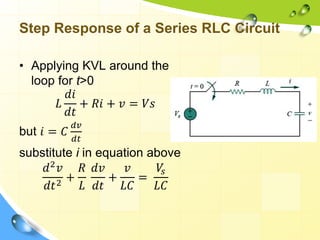
• Applying KVL around the
loop for t>0
𝐿
𝑑𝑖
𝑑𝑡
+ 𝑅𝑖 + 𝑣 = 𝑉𝑠
but 𝑖 = 𝐶
𝑑𝑣
𝑑𝑡
substitute i in equation above
𝑑2 𝑣
𝑑𝑡2
+
𝑅
𝐿
𝑑𝑣
𝑑𝑡
+
𝑣
𝐿𝐶
=
𝑉𝑠
𝐿𝐶
Step Response of a Series RLC Circuit
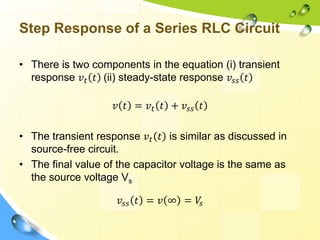
• There is two components in the equation (i) transient
response 𝑣 𝑡 𝑡 (ii) steady-state response 𝑣𝑠𝑠 𝑡
𝑣 𝑡 = 𝑣 𝑡 𝑡 + 𝑣𝑠𝑠 𝑡
• The transient response 𝑣 𝑡 𝑡 is similar as discussed in
source-free circuit.
• The final value of the capacitor voltage is the same as
the source voltage Vs
𝑣𝑠𝑠 𝑡 = 𝑣 ∞ = 𝑉𝑠
Step Response of a Series RLC Circuit
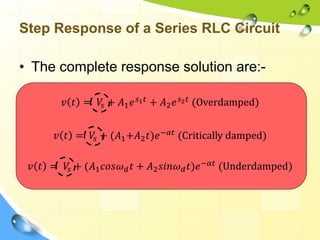
• The complete response solution are:-
𝑣 𝑡 = 𝑉𝑠 + 𝐴1 𝑒 𝑠1 𝑡 + 𝐴2 𝑒 𝑠2 𝑡 (Overdamped)
𝑣 𝑡 = 𝑉𝑠 + (𝐴1+𝐴2 𝑡)𝑒−𝛼𝑡
(Critically damped)
𝑣 𝑡 = 𝑉𝑠 + (𝐴1 𝑐𝑜𝑠𝜔 𝑑 𝑡 + 𝐴2 𝑠𝑖𝑛𝜔 𝑑 𝑡)𝑒−𝛼𝑡 (Underdamped)
Example
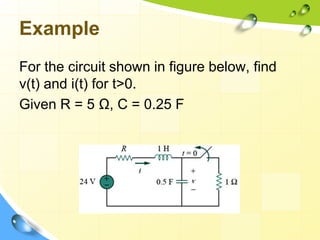
For the circuit shown in figure below, find
v(t) and i(t) for t>0.
Given R = 5 Ω, C = 0.25 F
Step Response of a Parallel RLC Circuit
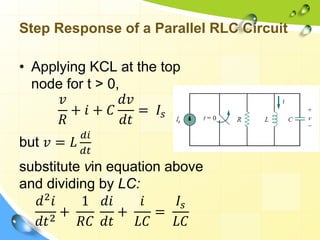
• Applying KCL at the top
node for t > 0,
𝑣
𝑅
+ 𝑖 + 𝐶
𝑑𝑣
𝑑𝑡
= 𝐼𝑠
but 𝑣 = 𝐿
𝑑𝑖
𝑑𝑡
substitute vin equation above
and dividing by LC:
𝑑2
𝑖
𝑑𝑡2
+
1
𝑅𝐶
𝑑𝑖
𝑑𝑡
+
𝑖
𝐿𝐶
=
𝐼𝑠
𝐿𝐶
Step Response of a Parallel RLC Circuit
• There is two components in the equation (i) transient
response 𝑖 𝑡 𝑡 (ii) steady-state response 𝑖 𝑠𝑠 𝑡
𝑖 𝑡 = 𝑖 𝑡 𝑡 + 𝑖 𝑠𝑠 𝑡
• The transient response 𝑖 𝑡 𝑡 is similar as discussed in
source-free circuit.
• The final value of the current through the inductor is the
same as the source current Is
Step Response of a Parallel RLC Circuit
• The complete response solution are:-
𝑖 𝑡 = 𝐼𝑠 + 𝐴1 𝑒 𝑠1 𝑡 + 𝐴2 𝑒 𝑠2 𝑡 (Overdamped)
𝑖 𝑡 = 𝐼𝑠 + (𝐴1+𝐴2 𝑡)𝑒−𝛼𝑡
(Critically damped)
𝑖 𝑡 = 𝐼𝑠 + (𝐴1 𝑐𝑜𝑠𝜔 𝑑 𝑡 + 𝐴2 𝑠𝑖𝑛𝜔 𝑑 𝑡)𝑒−𝛼𝑡 (Underdamped)
Example
Find i(t) and v(t) for t > 0
END

Chapter 5 Transient and steady state response(Second-Order Circuit)

  • 1.
    CHAPTER 5 Transient andSteady State Response (Second-Order Circuits)
  • 2.
    Contents Natural response ofseries RLC circuit Natural response of parallel RLC circuit Step response of series RLC circuit Step response of parallel RLC circuit
  • 3.
    What is secondorder? • Circuits containing two storage elements. • Second-order circuit may have two storage elements of different type or the same type
  • 4.
    Initial and finalvalues • Combination of R, L and C • Find v(0), i(0), dv(0)/dt, di(0)/dt, i(∞) & v(∞) • t(0-)  the time just before switching event • t(0+)  the time just after switching event • Assume the switching event take place at t=0 • Voltage polarity across capacitor • Current direction across inductor • Capacitor voltage always continuous  v(0+) = v(0-) • Inductor current always continuous  i(0+)=i(0-)
  • 5.
    Example The switch inthe figure shown has been closed for a long time. It is open at t=0, Find: (a) i(0+), v(0+) (b) di(0+)/dt, dv(0+)/dt (c) i(∞) , v(∞) 12 V 0.25 H4 Ω 0.1 F2 Ω i + V - t=0
  • 6.
    Exercise The switch inthe figure shown was open for a long time but closed at t=0. Determine (a) i(0+), v(0+) (b) di(0+)/dt, dv(0+)/dt (c) i(∞) , v(∞) 24 V 0.4 H 1/20 F 2 Ω i + V - t=0 10 Ω
  • 7.
    The Source-Free SeriesRLC • Applying KVL around the loop 𝑅𝑖 + 𝐿 𝑑𝑖 𝑑𝑡 + 1 𝑐 −∞ 𝑡 𝑖 𝑑𝑡 = 0 • Differentiate with respect to t 𝑑2 𝑖 𝑑2 + 𝑅 𝐿 𝑑𝑖 𝑑𝑡 + 𝑖 𝐿𝐶 = 0 • Finally, 𝑠2 + 𝑅 𝐿 𝑠 + 1 𝐿𝐶 = 0
  • 8.
    The Source-Free SeriesRLC • Roots equation 𝑠1 = − 𝑅 2𝐿 + 𝑅 2𝐿 2 − 1 𝐿𝐶 𝑠2 = − 𝑅 2𝐿 − 𝑅 2𝐿 2 − 1 𝐿𝐶 or 𝑠1 = −𝛼 + 𝛼2 − 𝜔0 2 𝑠2 = −𝛼 − 𝛼2 − 𝜔0 2 where 𝛼 = 𝑅 2𝐿 , 𝜔0 = 1 𝐿𝐶 • 𝛼  (Np/s) • 𝜔0 (rad/s)
  • 9.
    The Source-Free SeriesRLC Three type of solution • If α > ω0  overdamped case • If α = ω0  critically damped case • If α < ω0  underdamped case
  • 10.
    The Source-Free SeriesRLC Overdamped case (α>ω0) • Both roots S1 and S2 are negative and real • The response is 𝑖 𝑡 = 𝐴1 𝑒 𝑠1 𝑡 + 𝐴2 𝑒 𝑠2 𝑡
  • 11.
    The Source-Free SeriesRLC Critically damped case (α= ω0) • Roots 𝑠1 = 𝑠2 = −𝛼 = − 𝑅 2𝐿 • The response is 𝑖 𝑡 = (𝐴2+𝐴1 𝑡)𝑒−𝛼𝑡
  • 12.
    The Source-Free SeriesRLC Underdamped case(α<ω0) • Roots 𝑠1 = −𝛼 + − 𝜔0 2 − 𝛼2 = −𝛼 +j𝜔 𝑑 𝑠2 = −𝛼 − − 𝜔0 2 − 𝛼2 = −𝛼-j𝜔 𝑑 where 𝜔 𝑑 = 𝜔0 2 − 𝛼2 • The response is 𝑖 𝑡 = 𝑒−𝛼𝑡(𝐵1 cos 𝜔 𝑑 𝑡 + 𝐵2 sin 𝜔 𝑑 𝑡)
  • 13.
    Example Find i(t) fort > 0 + v(t) -
  • 14.
    Exercise Find i(t) inthe circuit below. Assume that the circuit has reached steady state at t=0-
  • 15.
    Source Free ParallelRLC Circuits • Initial inductor current and initial voltage capacitor 𝑖 0 = 𝐼0 = 1 𝐿 ∞ 0 𝑣 𝑡 𝑑𝑡 𝑣 0 = 𝑉0 • Applying KCL 𝑣 𝑅 + 1 𝐿 −∞ 𝑡 𝑣𝑑𝑡 + 𝐶 𝑑𝑣 𝑑𝑡 = 0
  • 16.
    Source Free ParallelRLC Circuits • Derivatives with respect t and diving by C 𝑑2 𝑣 𝑑𝑡2 + 1 𝑅𝐶 𝑑𝑣 𝑑𝑡 + 1 𝐿𝐶 𝑣 = 0 or 𝑠2 + 1 𝑅𝐶 𝑠 + 1 𝐿𝐶 • Roots of the characteristics equation are 𝑠1,2 = − 1 2𝑅𝐶 ± 1 2𝑅𝐶 2 − 1 𝐿𝐶
  • 17.
    Source Free ParallelRLC Circuits or 𝑠1,2 = −𝛼 ± 𝛼2 − 𝜔0 2 where 𝛼 = 1 2𝑅𝐶 , 𝜔0 = 1 𝐿𝐶 • 𝛼  (Np/s) • 𝜔0 (rad/s)
  • 18.
    The Source-Free ParallelRLC Three type of solution • If α > ω0  overdamped case • If α = ω0  critically damped case • If α < ω0  underdamped case
  • 19.
    The Source-Free ParallelRLC Overdamped case (α>ω0) • Both roots S1 and S2 are negative and real • The response is 𝑣 𝑡 = 𝐴1 𝑒 𝑠1 𝑡 + 𝐴2 𝑒 𝑠2 𝑡
  • 20.
    The Source-Free ParallelRLC Critically damped case (α= ω0) • The roots are real and equal so the response is 𝑣 𝑡 = (𝐴1+𝐴2 𝑡)𝑒−𝛼𝑡
  • 21.
    The Source-Free ParallelRLC Underdamped case(α<ω0) • Roots 𝑠1,2 = −𝛼 ± j𝜔 𝑑 where 𝜔 𝑑 = 𝜔0 2 − 𝛼2 • The response is 𝑣 𝑡 = 𝑒−𝛼𝑡(𝐴1 cos 𝜔 𝑑 𝑡 + 𝐴2 sin 𝜔 𝑑 𝑡)
  • 22.
    Example Find v(t) fort>0 in the RLC circuit shown below
  • 23.
    Step Response ofa Series RLC Circuit • Applying KVL around the loop for t>0 𝐿 𝑑𝑖 𝑑𝑡 + 𝑅𝑖 + 𝑣 = 𝑉𝑠 but 𝑖 = 𝐶 𝑑𝑣 𝑑𝑡 substitute i in equation above 𝑑2 𝑣 𝑑𝑡2 + 𝑅 𝐿 𝑑𝑣 𝑑𝑡 + 𝑣 𝐿𝐶 = 𝑉𝑠 𝐿𝐶
  • 24.
    Step Response ofa Series RLC Circuit • There is two components in the equation (i) transient response 𝑣 𝑡 𝑡 (ii) steady-state response 𝑣𝑠𝑠 𝑡 𝑣 𝑡 = 𝑣 𝑡 𝑡 + 𝑣𝑠𝑠 𝑡 • The transient response 𝑣 𝑡 𝑡 is similar as discussed in source-free circuit. • The final value of the capacitor voltage is the same as the source voltage Vs 𝑣𝑠𝑠 𝑡 = 𝑣 ∞ = 𝑉𝑠
  • 25.
    Step Response ofa Series RLC Circuit • The complete response solution are:- 𝑣 𝑡 = 𝑉𝑠 + 𝐴1 𝑒 𝑠1 𝑡 + 𝐴2 𝑒 𝑠2 𝑡 (Overdamped) 𝑣 𝑡 = 𝑉𝑠 + (𝐴1+𝐴2 𝑡)𝑒−𝛼𝑡 (Critically damped) 𝑣 𝑡 = 𝑉𝑠 + (𝐴1 𝑐𝑜𝑠𝜔 𝑑 𝑡 + 𝐴2 𝑠𝑖𝑛𝜔 𝑑 𝑡)𝑒−𝛼𝑡 (Underdamped)
  • 26.
    Example For the circuitshown in figure below, find v(t) and i(t) for t>0. Given R = 5 Ω, C = 0.25 F
  • 27.
    Step Response ofa Parallel RLC Circuit • Applying KCL at the top node for t > 0, 𝑣 𝑅 + 𝑖 + 𝐶 𝑑𝑣 𝑑𝑡 = 𝐼𝑠 but 𝑣 = 𝐿 𝑑𝑖 𝑑𝑡 substitute vin equation above and dividing by LC: 𝑑2 𝑖 𝑑𝑡2 + 1 𝑅𝐶 𝑑𝑖 𝑑𝑡 + 𝑖 𝐿𝐶 = 𝐼𝑠 𝐿𝐶
  • 28.
    Step Response ofa Parallel RLC Circuit • There is two components in the equation (i) transient response 𝑖 𝑡 𝑡 (ii) steady-state response 𝑖 𝑠𝑠 𝑡 𝑖 𝑡 = 𝑖 𝑡 𝑡 + 𝑖 𝑠𝑠 𝑡 • The transient response 𝑖 𝑡 𝑡 is similar as discussed in source-free circuit. • The final value of the current through the inductor is the same as the source current Is
  • 29.
    Step Response ofa Parallel RLC Circuit • The complete response solution are:- 𝑖 𝑡 = 𝐼𝑠 + 𝐴1 𝑒 𝑠1 𝑡 + 𝐴2 𝑒 𝑠2 𝑡 (Overdamped) 𝑖 𝑡 = 𝐼𝑠 + (𝐴1+𝐴2 𝑡)𝑒−𝛼𝑡 (Critically damped) 𝑖 𝑡 = 𝐼𝑠 + (𝐴1 𝑐𝑜𝑠𝜔 𝑑 𝑡 + 𝐴2 𝑠𝑖𝑛𝜔 𝑑 𝑡)𝑒−𝛼𝑡 (Underdamped)
  • 30.
    Example Find i(t) andv(t) for t > 0
  • 31.

Editor's Notes

  • #9 S1 and S1 are called natural frequencies. Wo is the resonant frequency. Alpha is the neper frequency or the damping factor.