Electric Circuit Analysis
Lec4: Nodal analysis
Ahsan Khawaja
Ahsan_khawaja@comsats.edu.pk
Lecturer
Room 102
Department of Electrical Engineering
Steps of Nodal Analysis
1. Choose a reference (ground) node.
2. Assign node voltages to the other nodes.
3. Apply KCL to each node other than the reference
node; express currents in terms of node voltages.
4. Solve the resulting system of linear equations for
the nodal voltages.
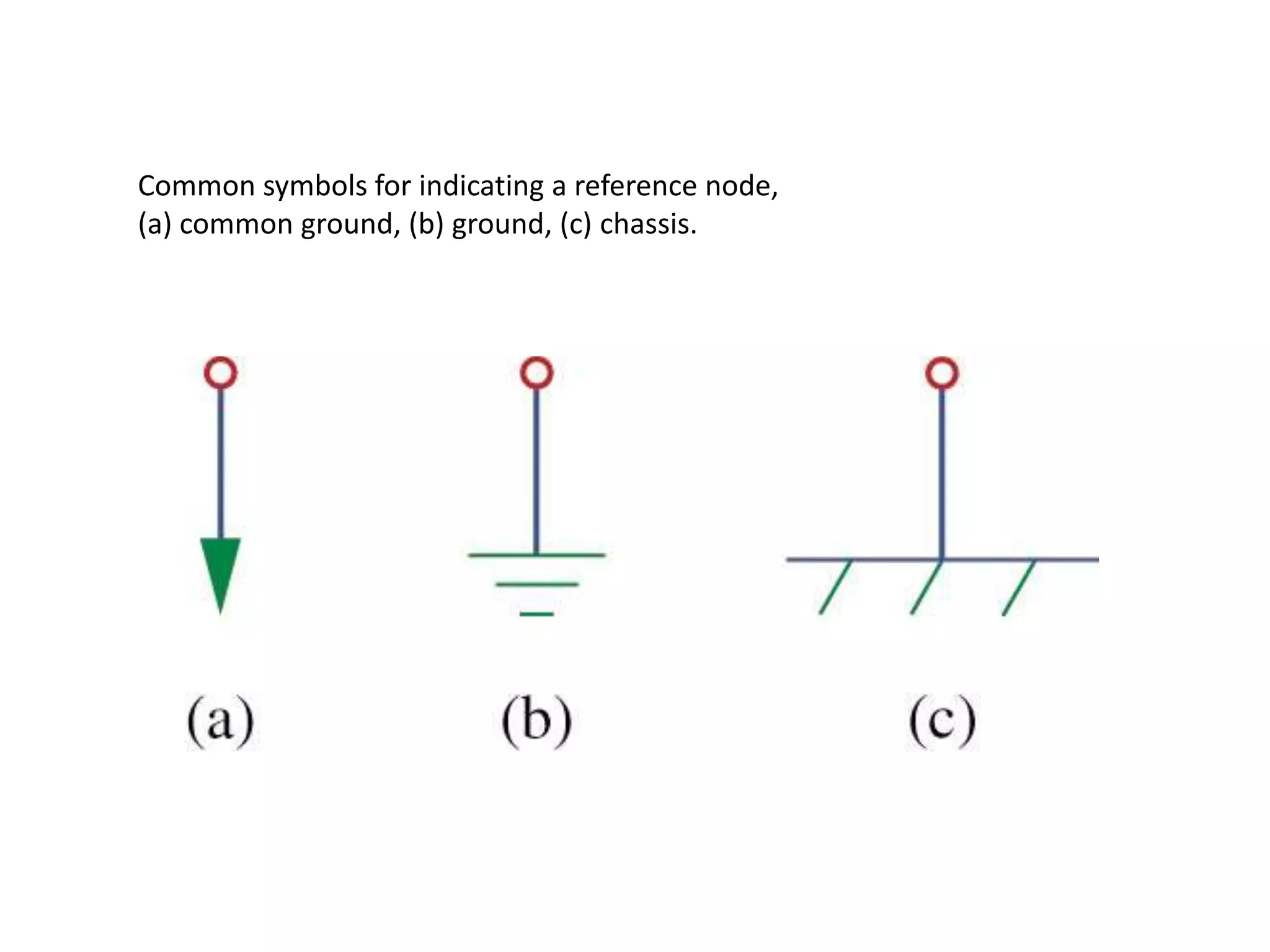
Common symbols for indicating a reference node,
(a) common ground, (b) ground, (c) chassis.
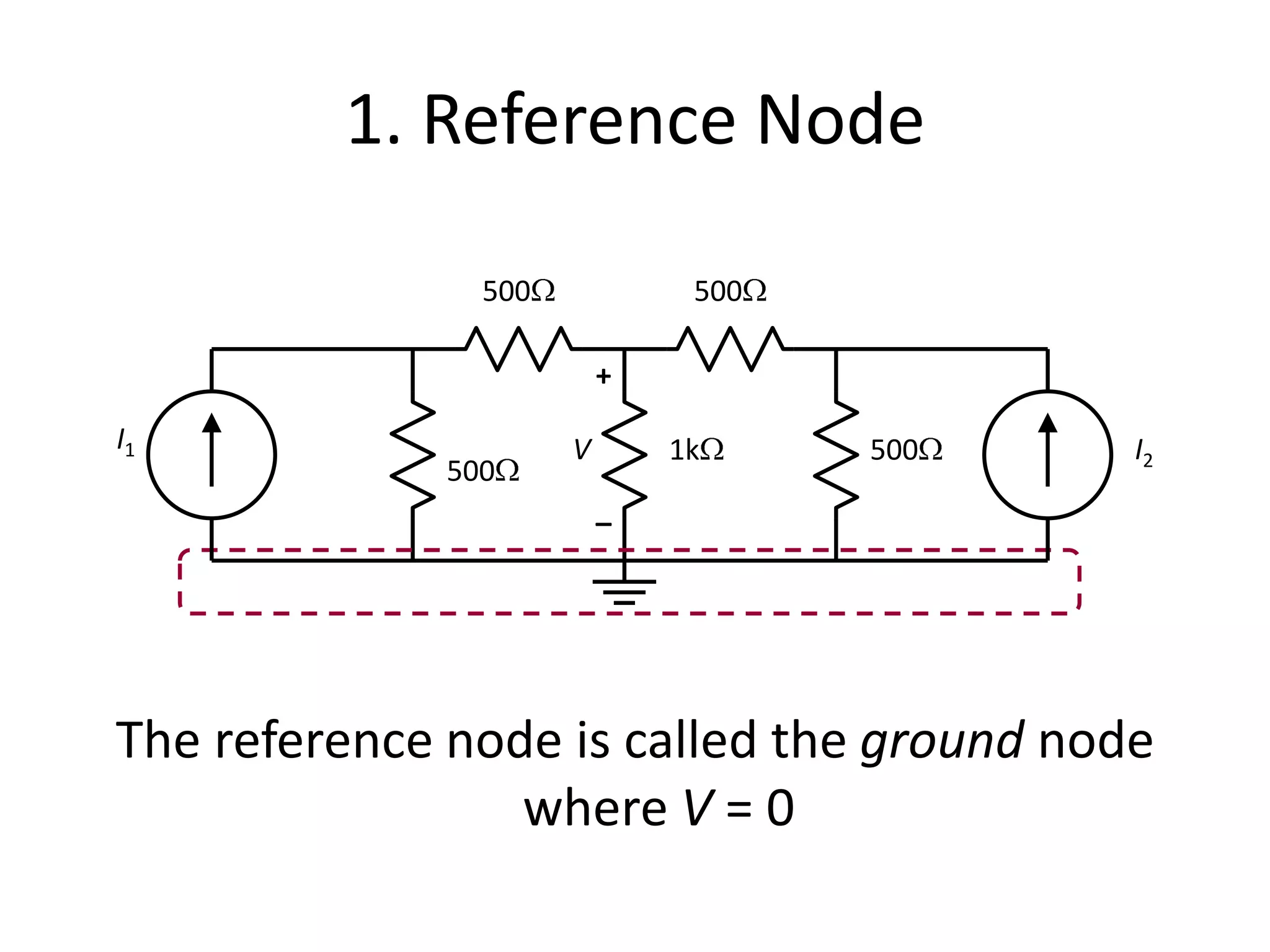
1. Reference Node
The reference node is called the ground node
where V = 0
+
–
V 500
500
1k
500
500
I1 I2
Steps of Nodal Analysis
1. Choose a reference (ground) node.
2. Assign node voltages to the other nodes.
3. Apply KCL to each node other than the reference
node; express currents in terms of node voltages.
4. Solve the resulting system of linear equations for
the nodal voltages.
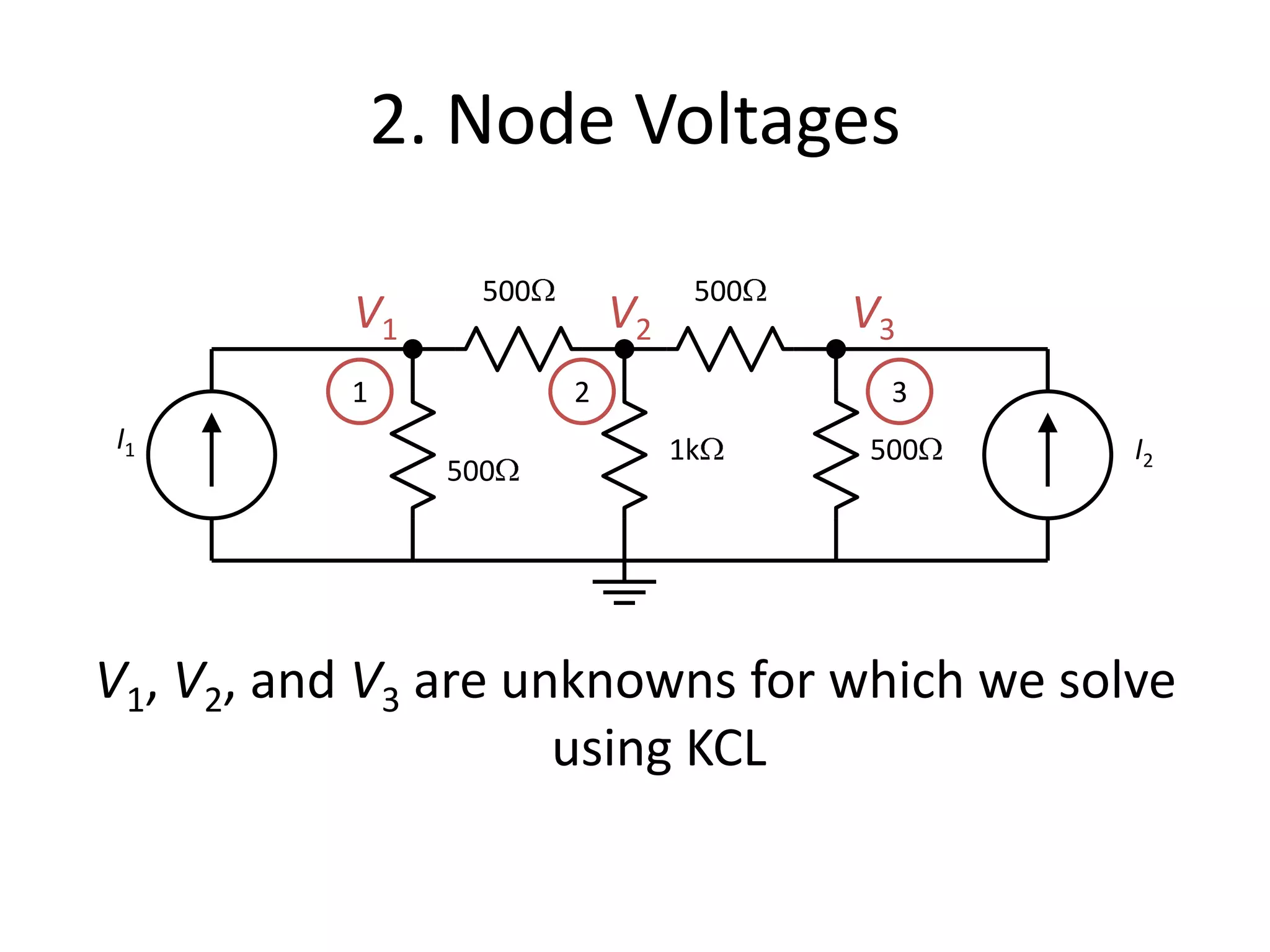
2. Node Voltages
V1, V2, and V3 are unknowns for which we solve
using KCL
500
500
1k
500
500
I1 I2
1 2 3
V1 V2 V3
Steps of Nodal Analysis
1. Choose a reference (ground) node.
2. Assign node voltages to the other nodes.
3. Apply KCL to each node other than the reference
node; express currents in terms of node voltages.
4. Solve the resulting system of linear equations for
the nodal voltages.
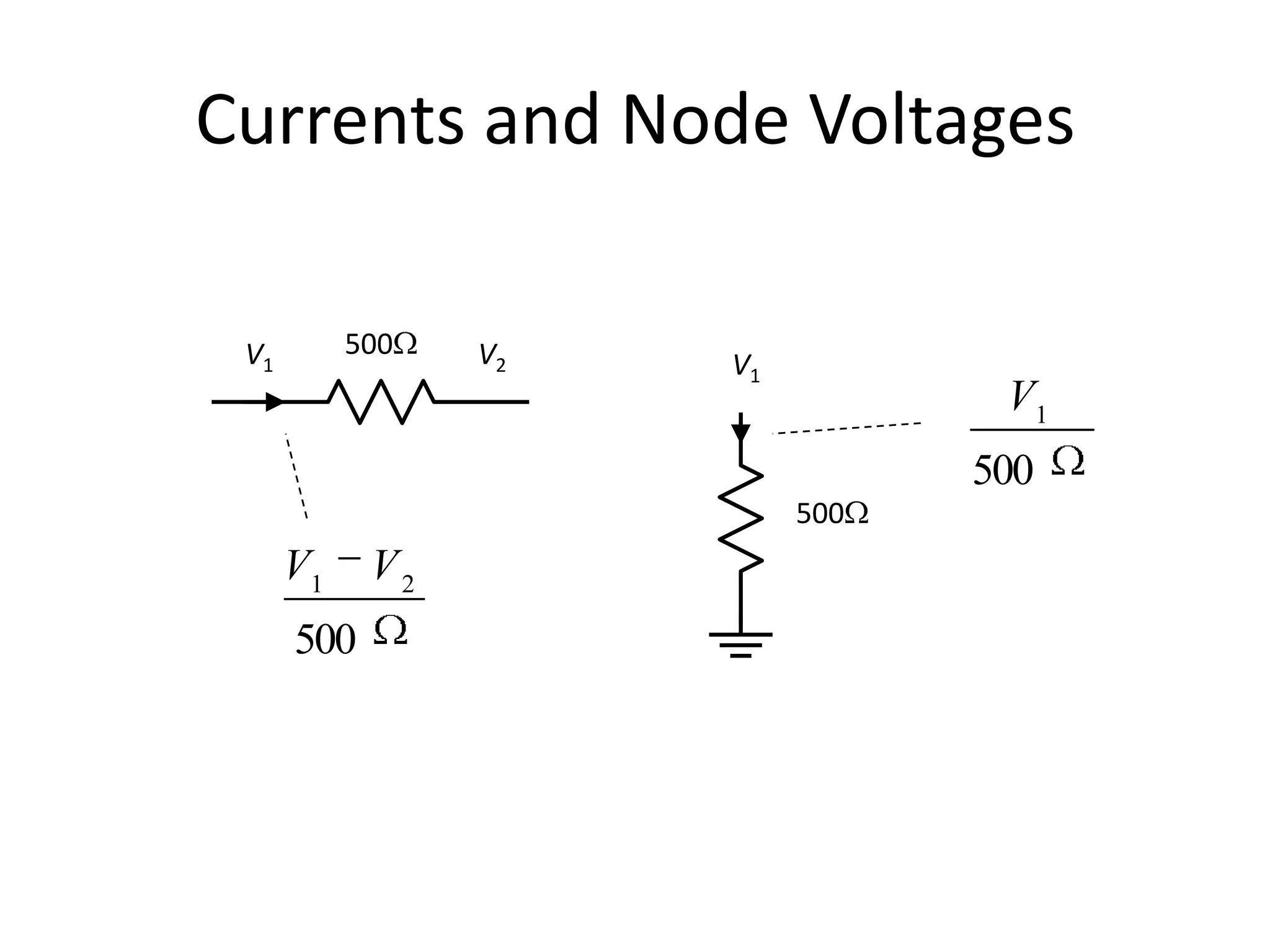
Currents and Node Voltages
500
V1
500V1 V2
500
21
VV
500
1
V
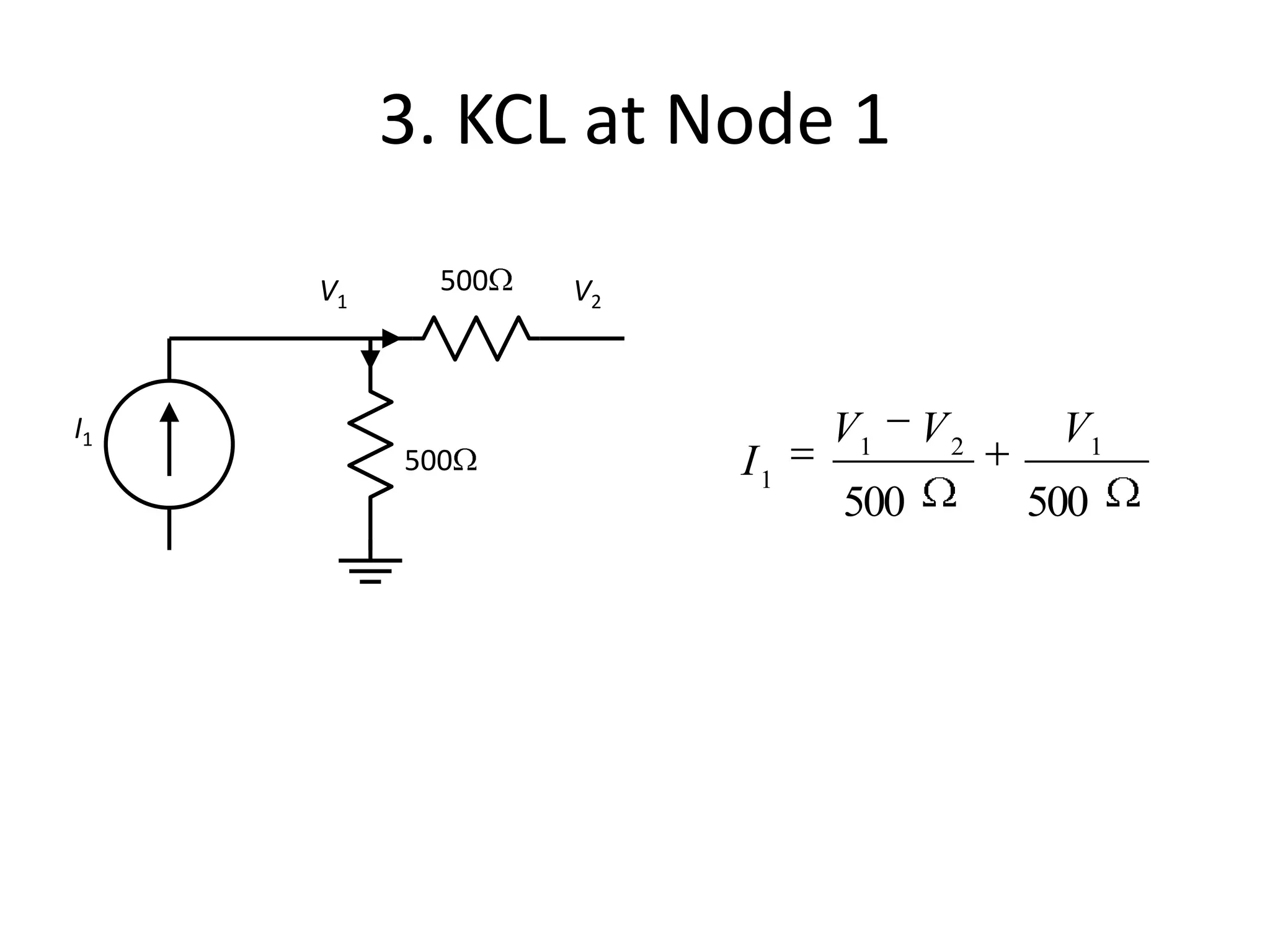
3. KCL at Node 1
500
500
I1
V1 V2
500500
121
1
VVV
I
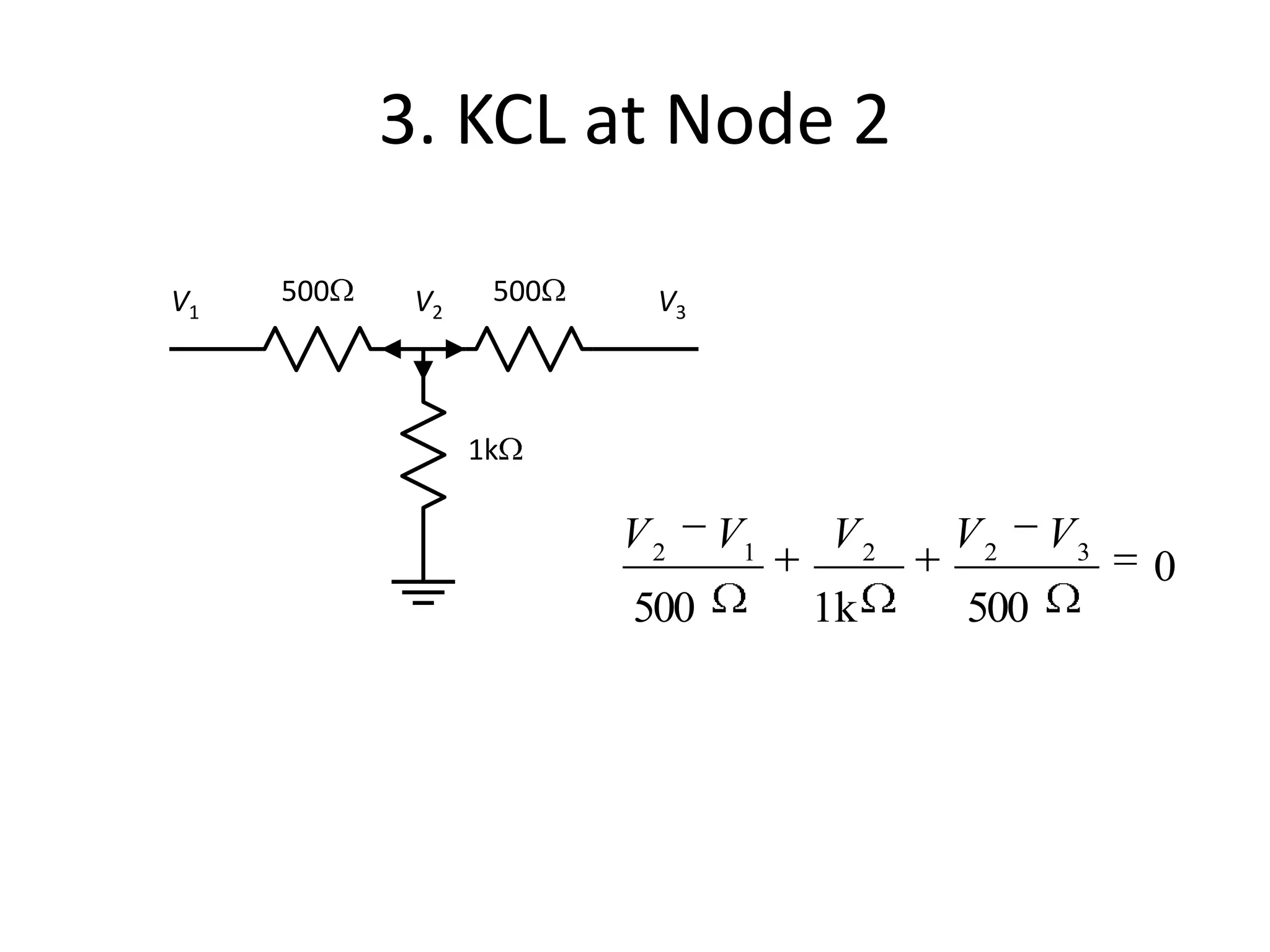
3. KCL at Node 2
500
1k
500 V2 V3V1
0
500k1500
32212
VVVVV
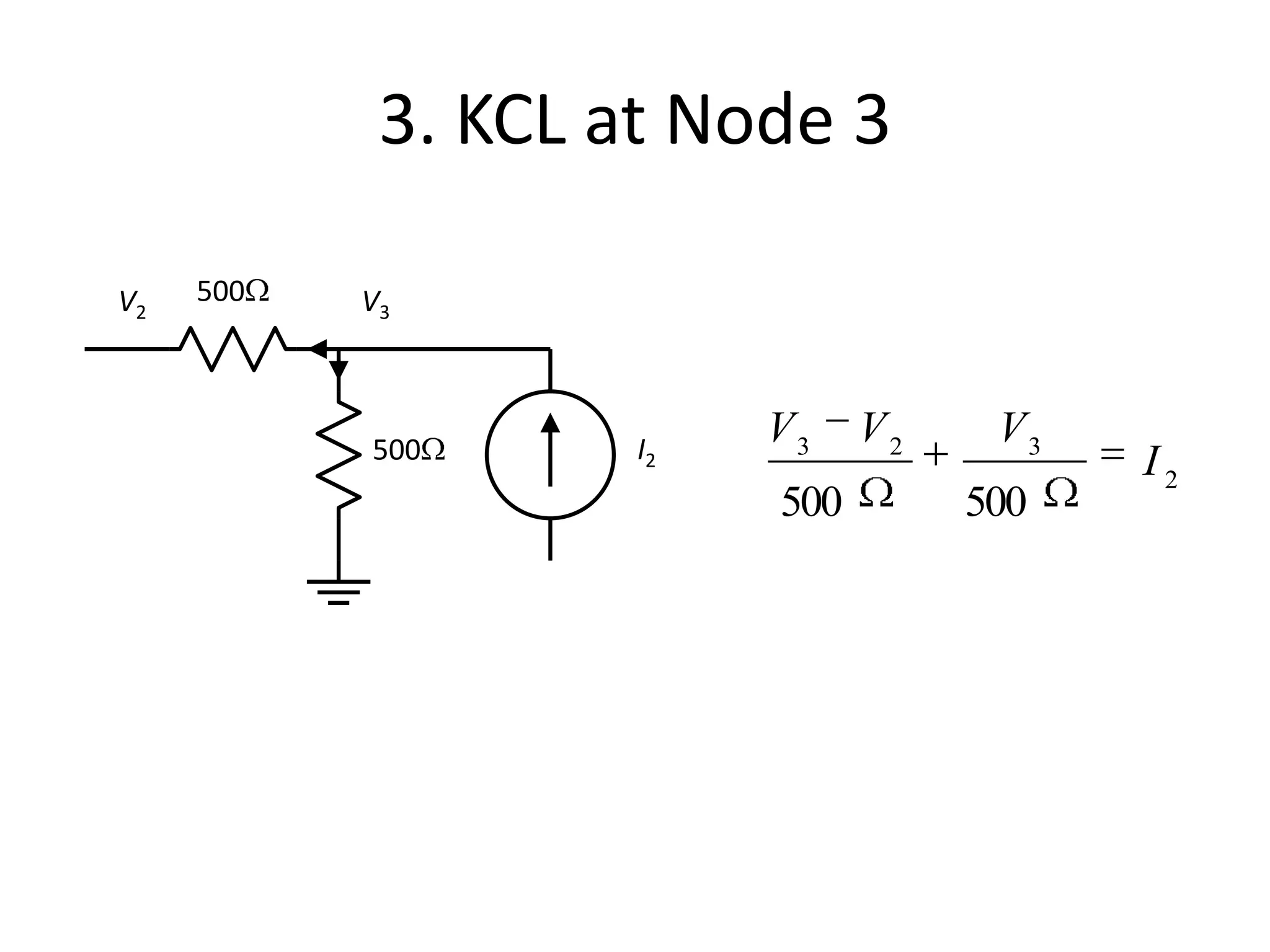
3. KCL at Node 3
2
323
500500
I
VVV500
500
I2
V2 V3
Steps of Nodal Analysis
1. Choose a reference (ground) node.
2. Assign node voltages to the other nodes.
3. Apply KCL to each node other than the reference
node; express currents in terms of node voltages.
4. Solve the resulting system of linear equations for
the nodal voltages.
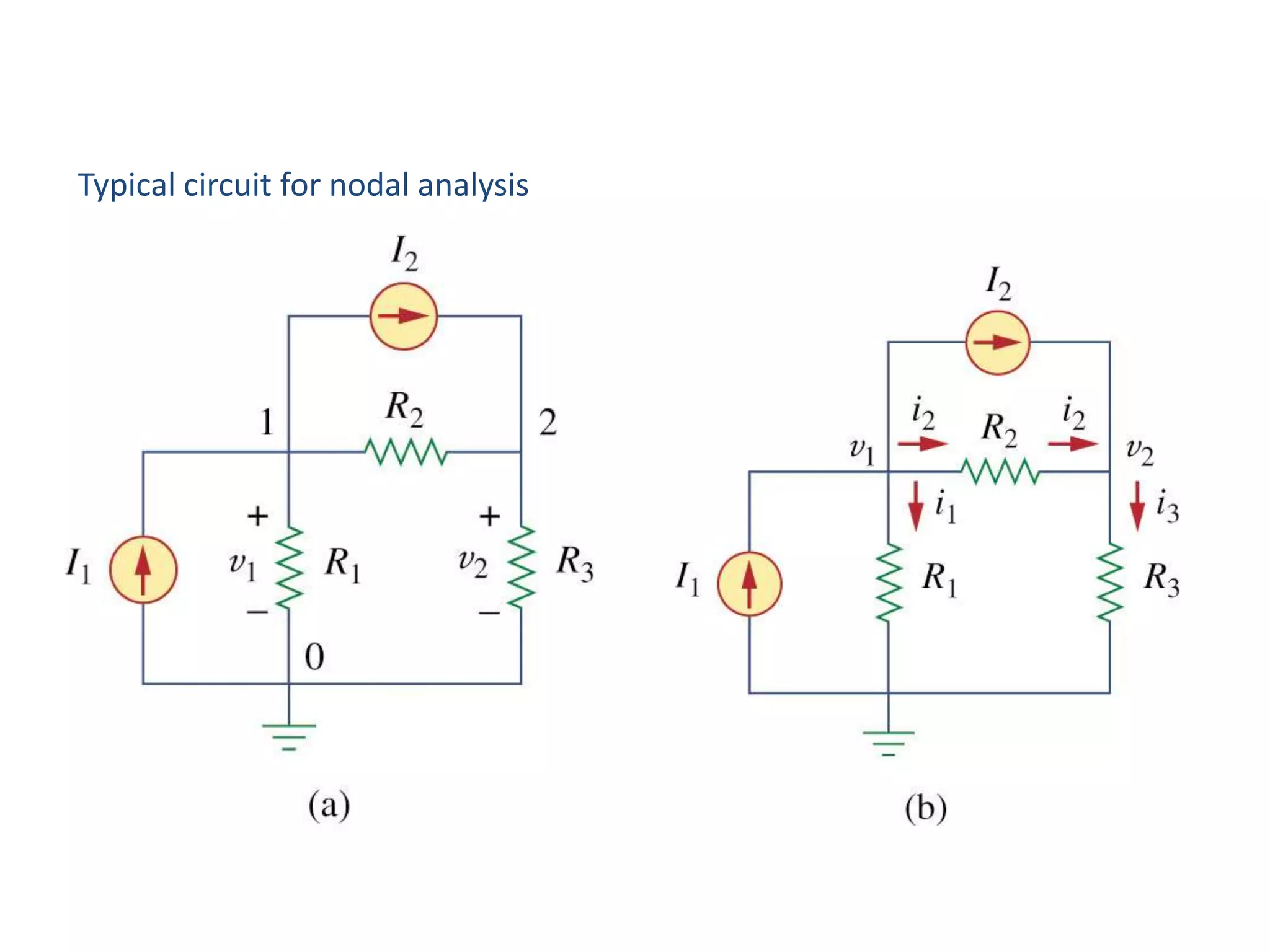
Typical circuit for nodal analysis
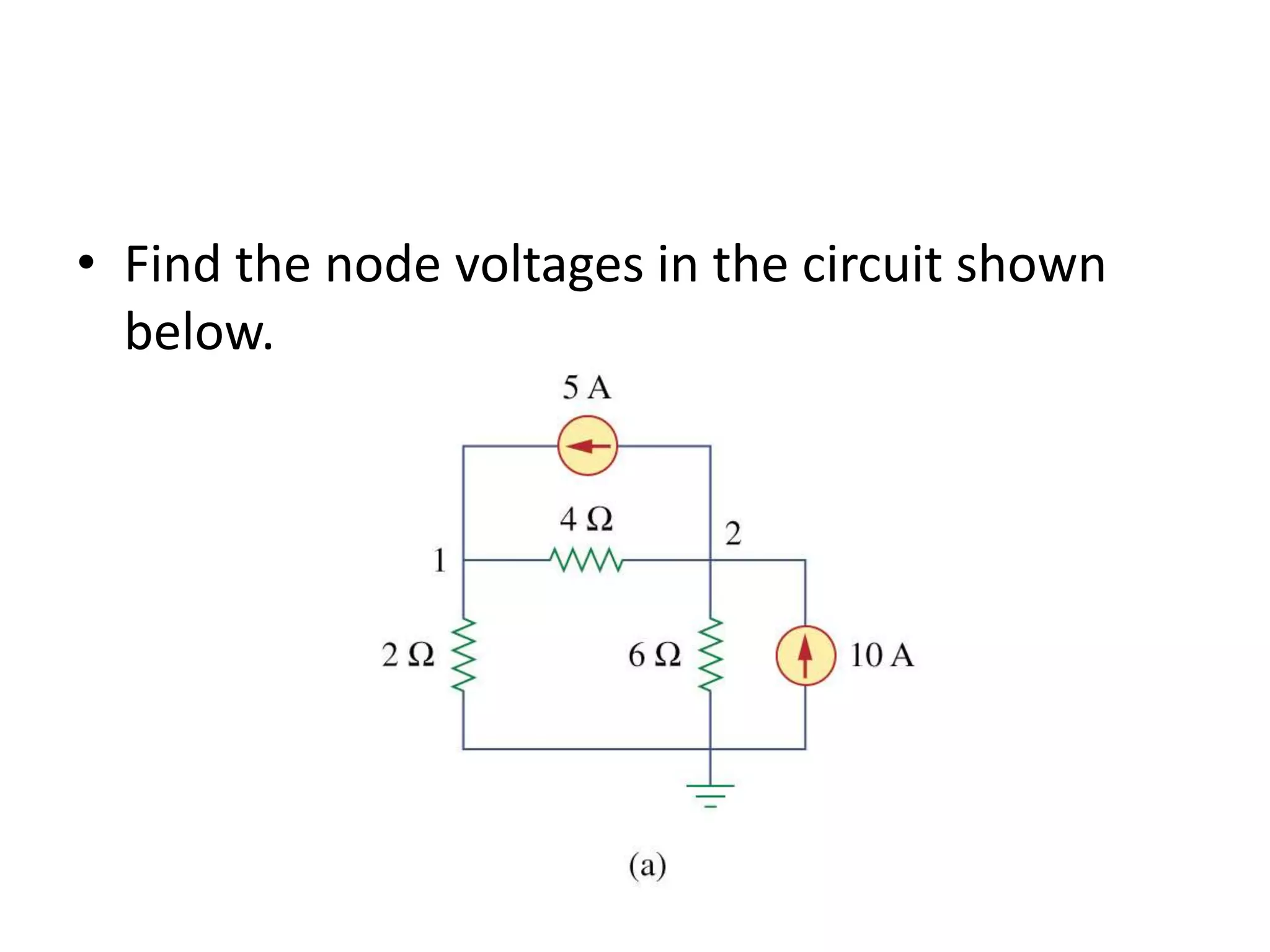
• Find the node voltages in the circuit shown
below.
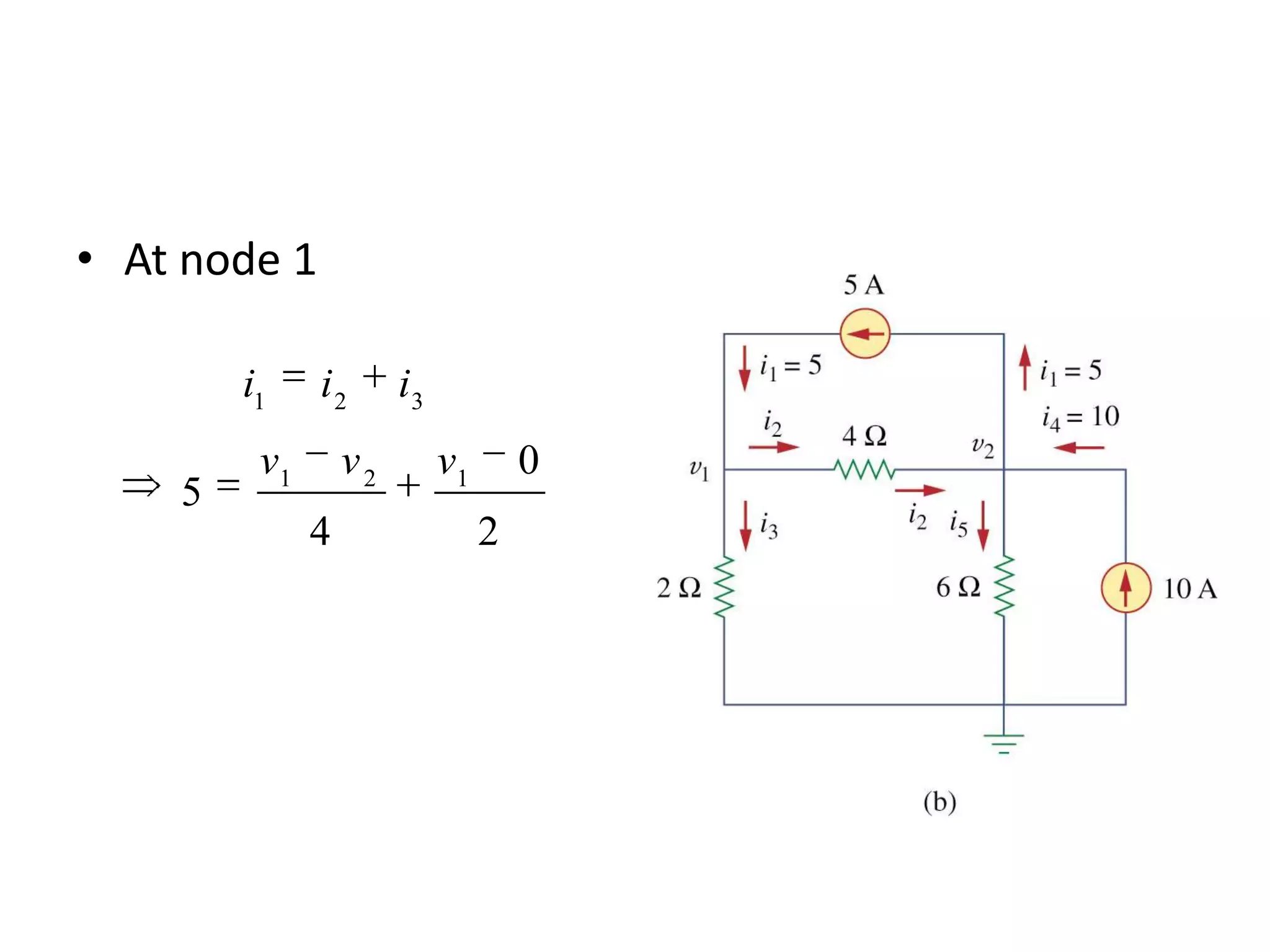
• At node 1
2
0
4
5 121
321
vvv
iii
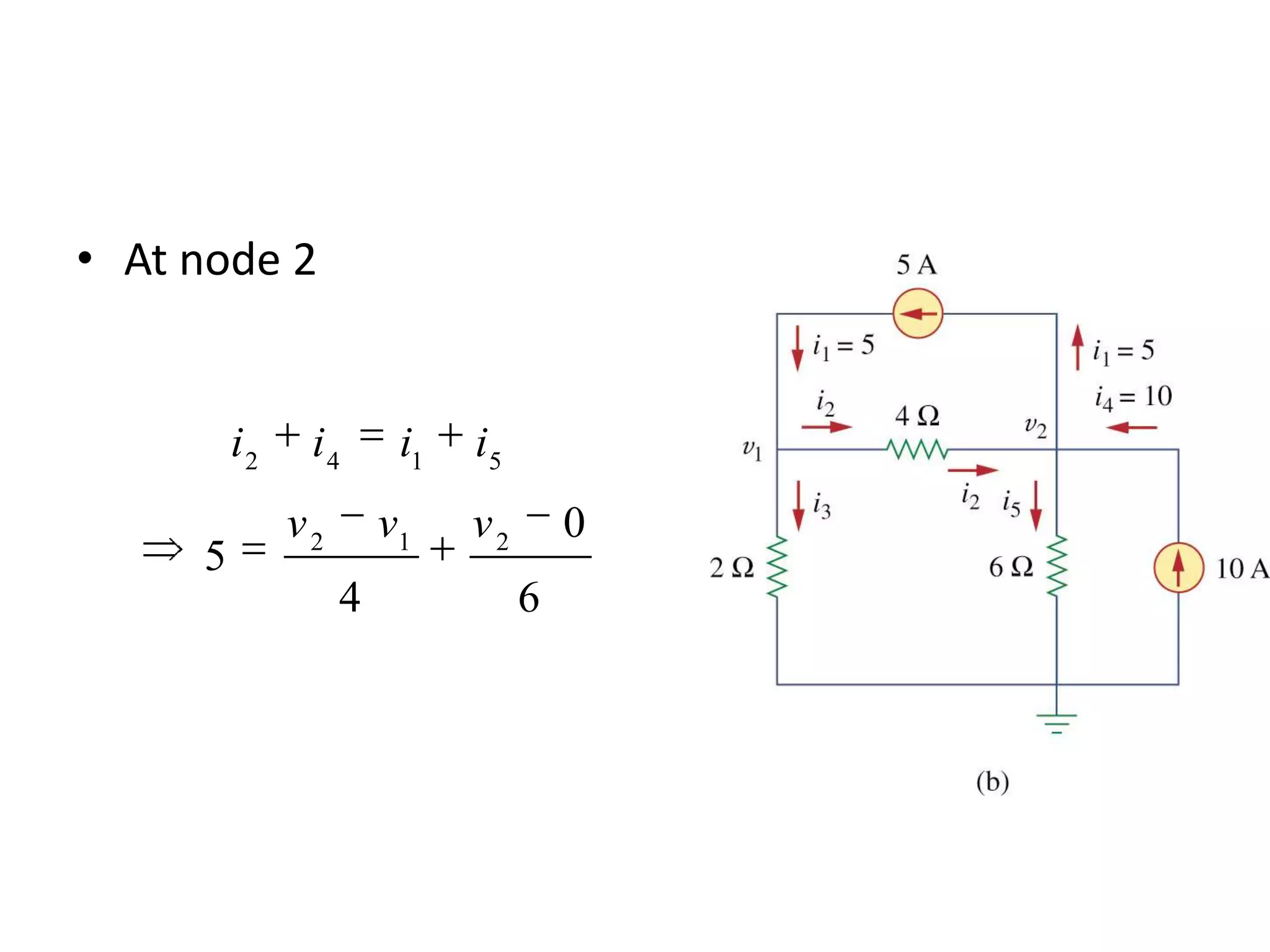
• At node 2
6
0
4
5 212
5142
vvv
iiii
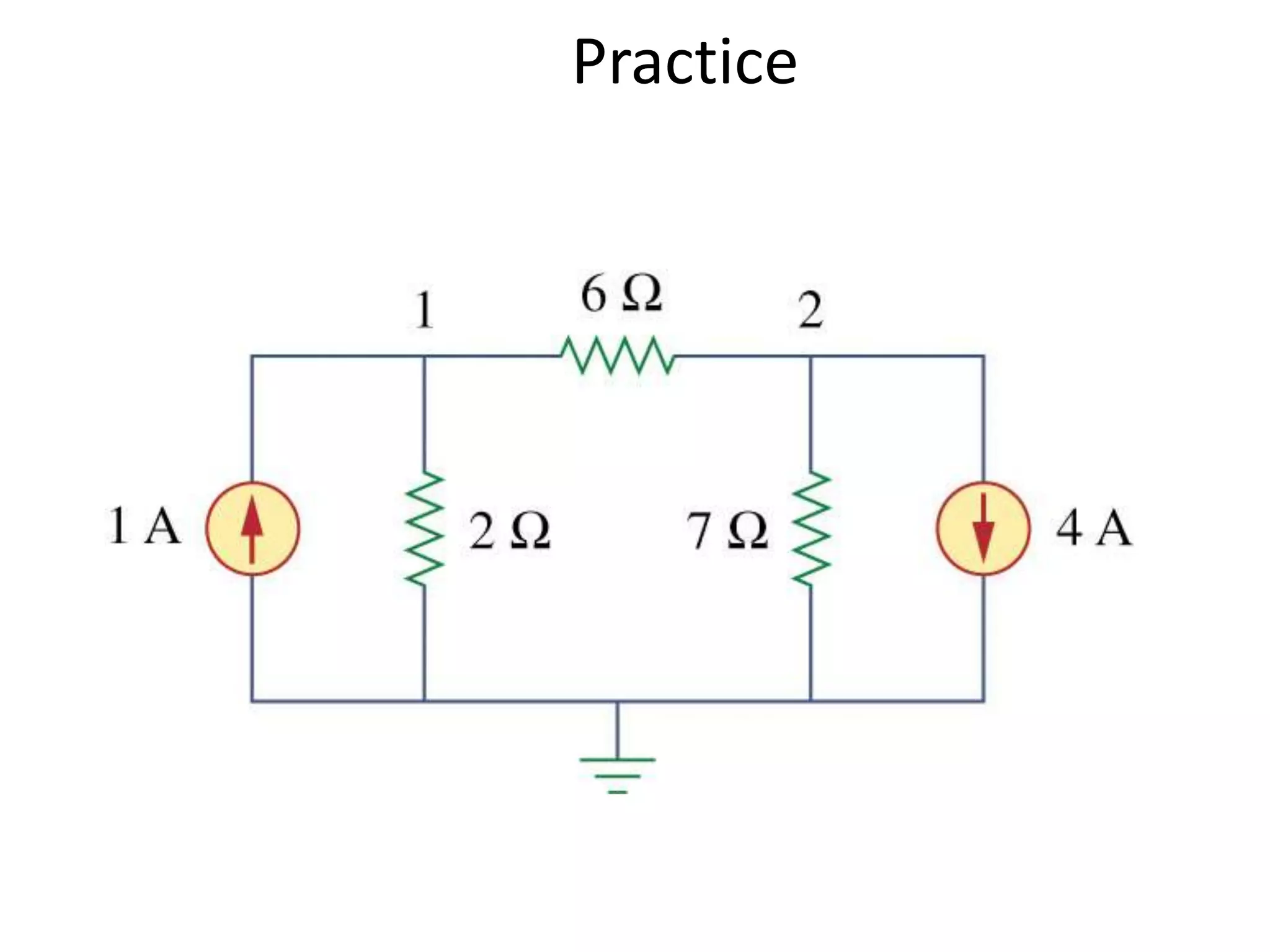
Practice
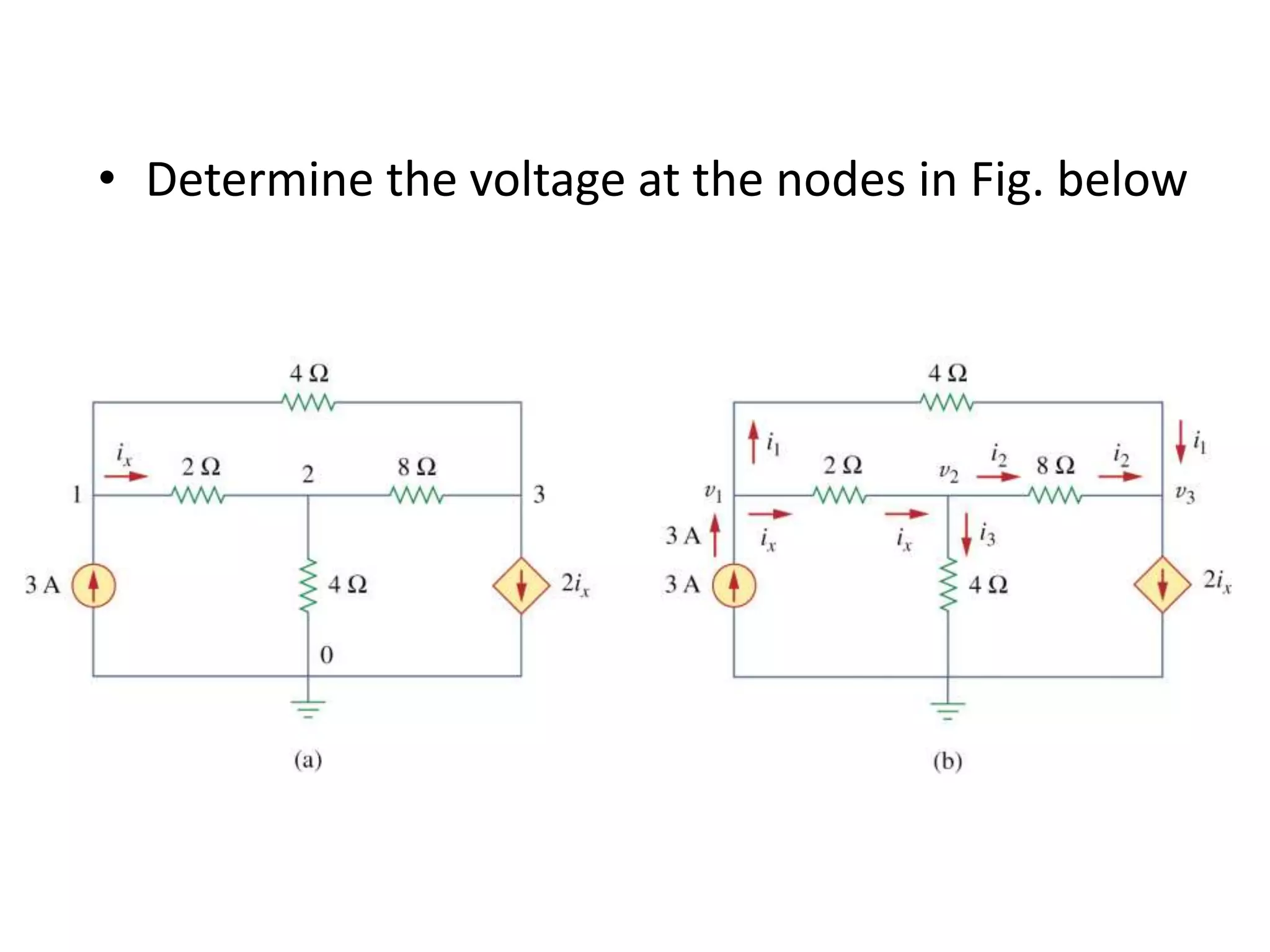
• Determine the voltage at the nodes in Fig. below
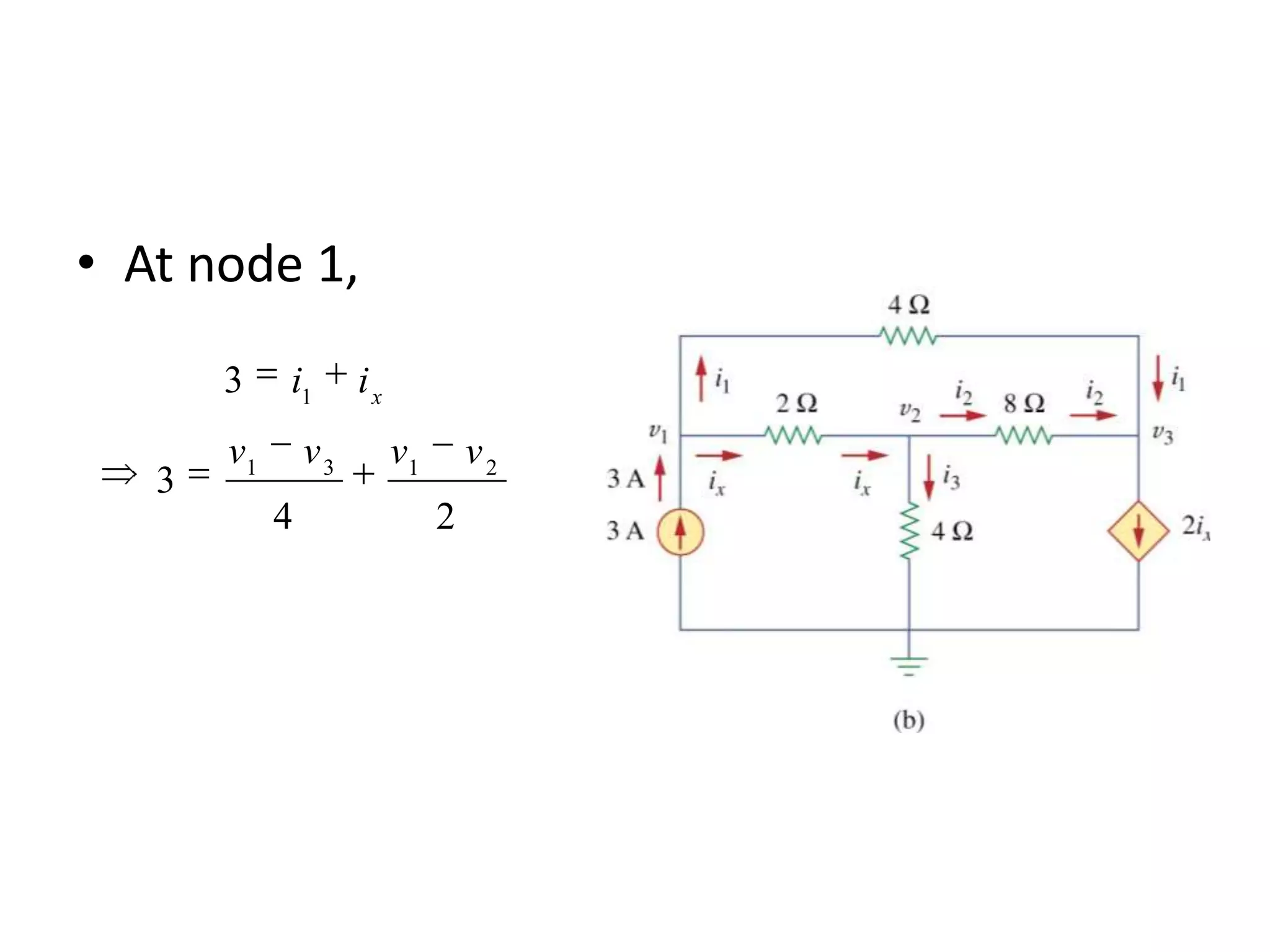
• At node 1,
24
3
3
2131
1
vvvv
ii x
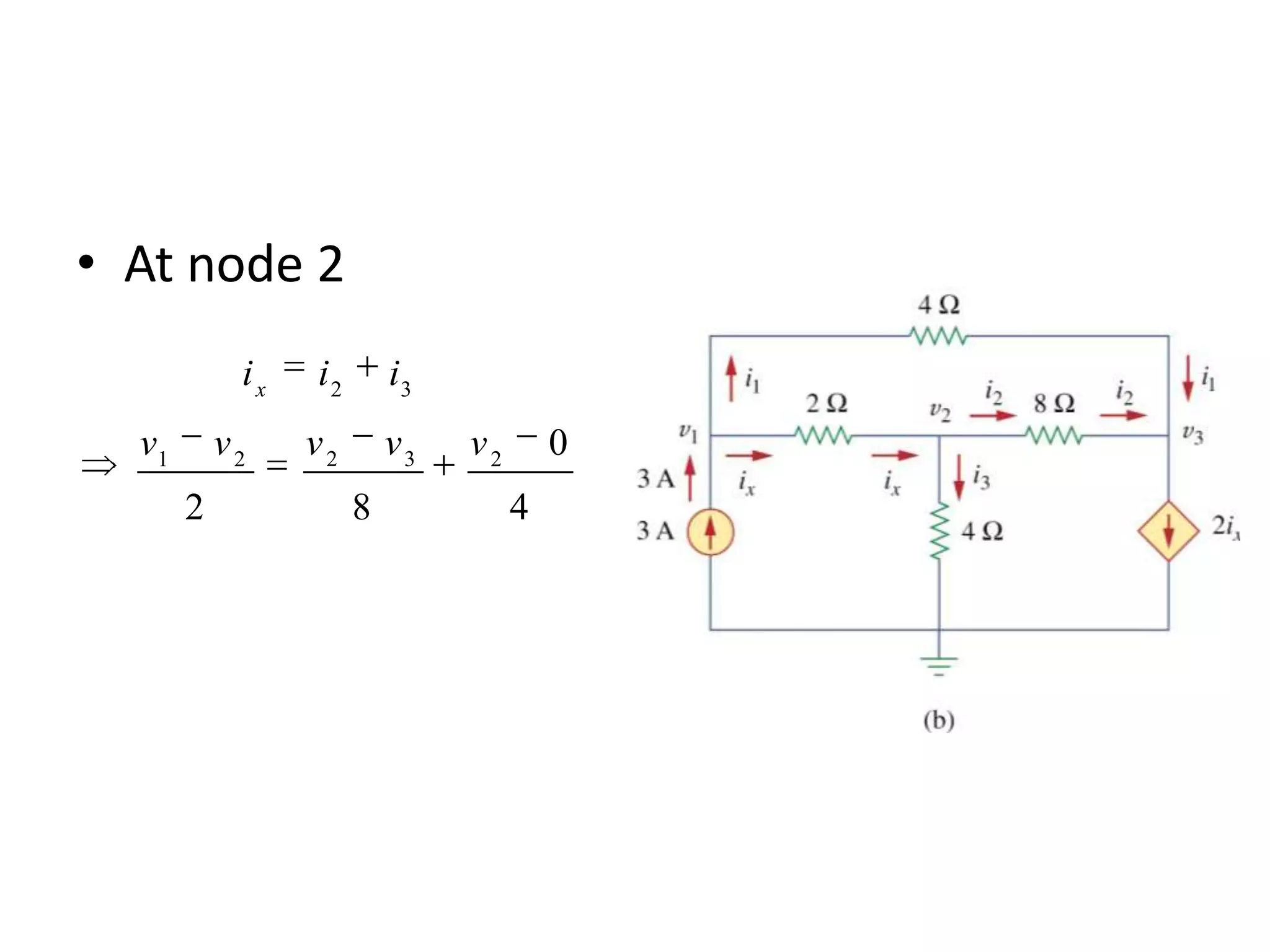
• At node 2
4
0
82
23221
32
vvvvv
iiix
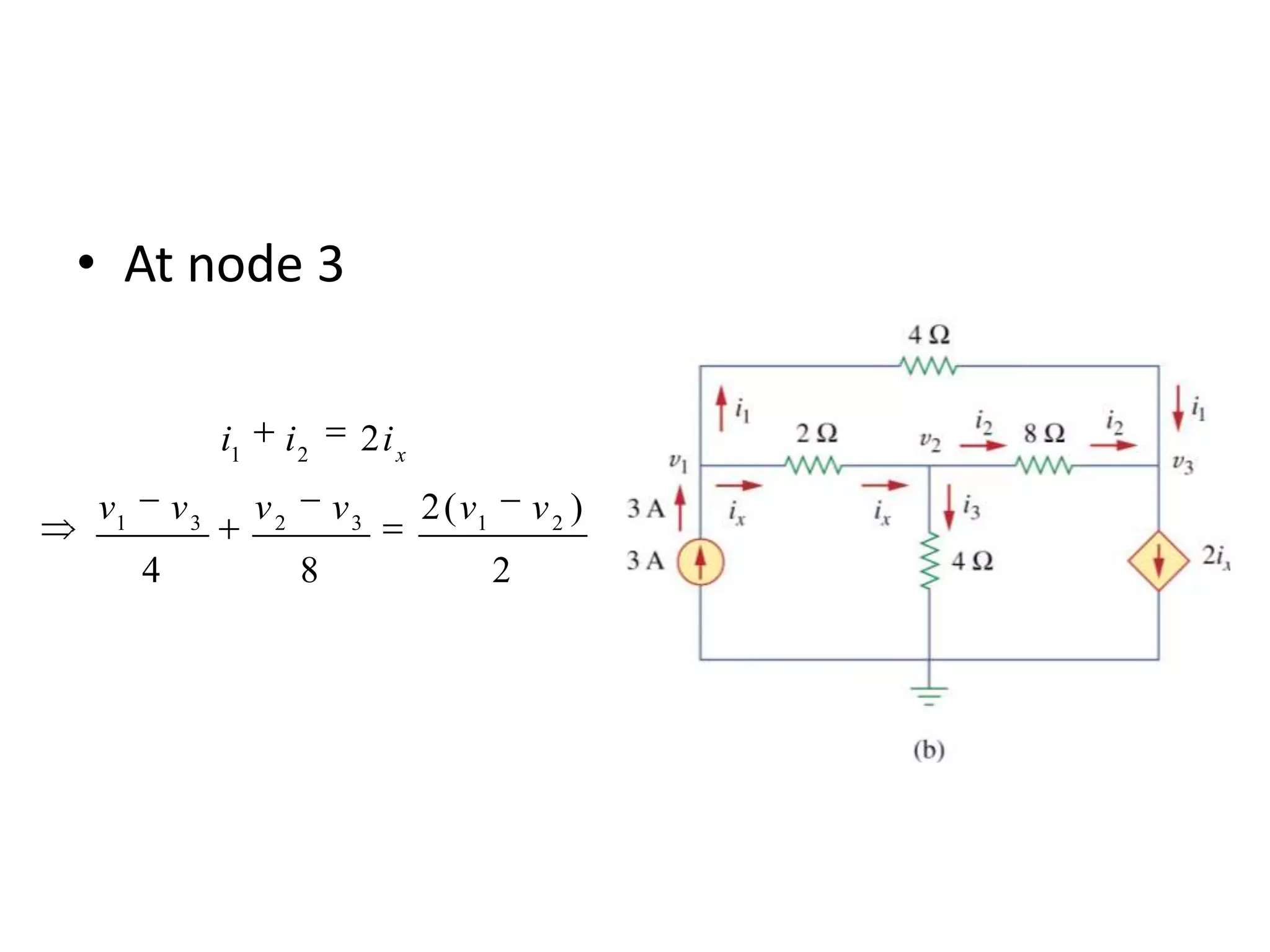
• At node 3
2
)(2
84
2
213231
21
vvvvvv
iii x
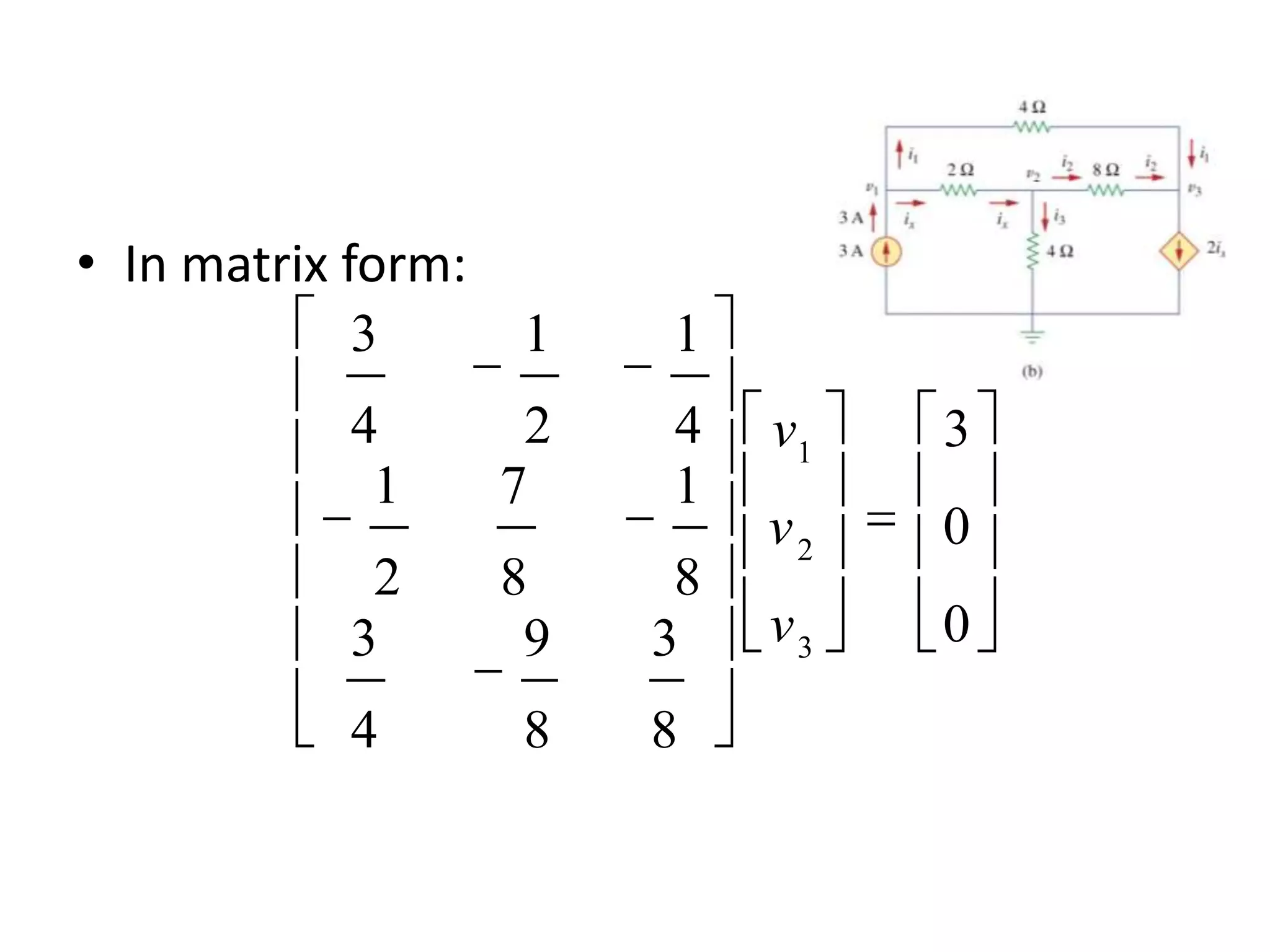
• In matrix form:
0
0
3
8
3
8
9
4
3
8
1
8
7
2
1
4
1
2
1
4
3
3
2
1
v
v
v
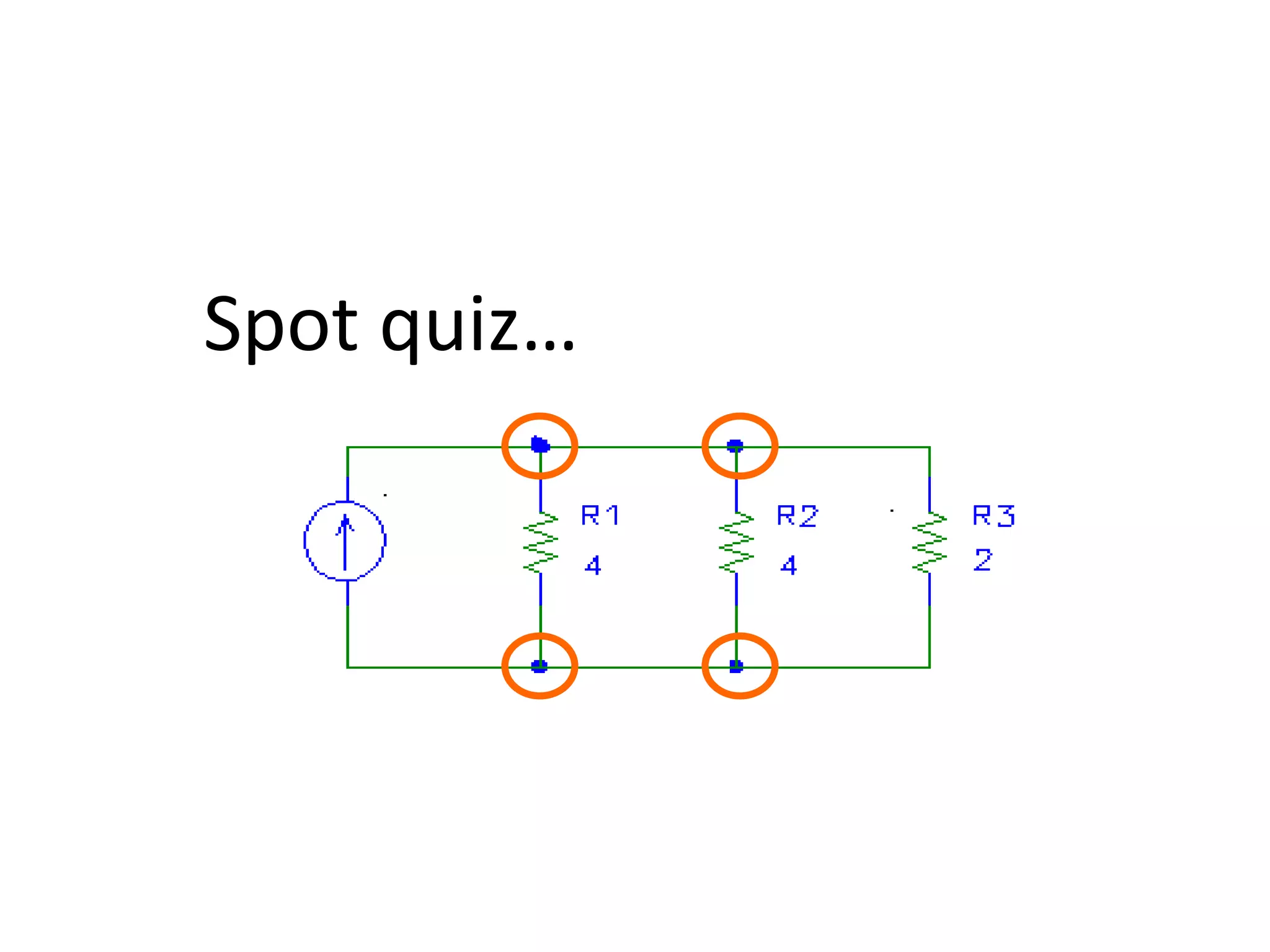
Spot quiz…
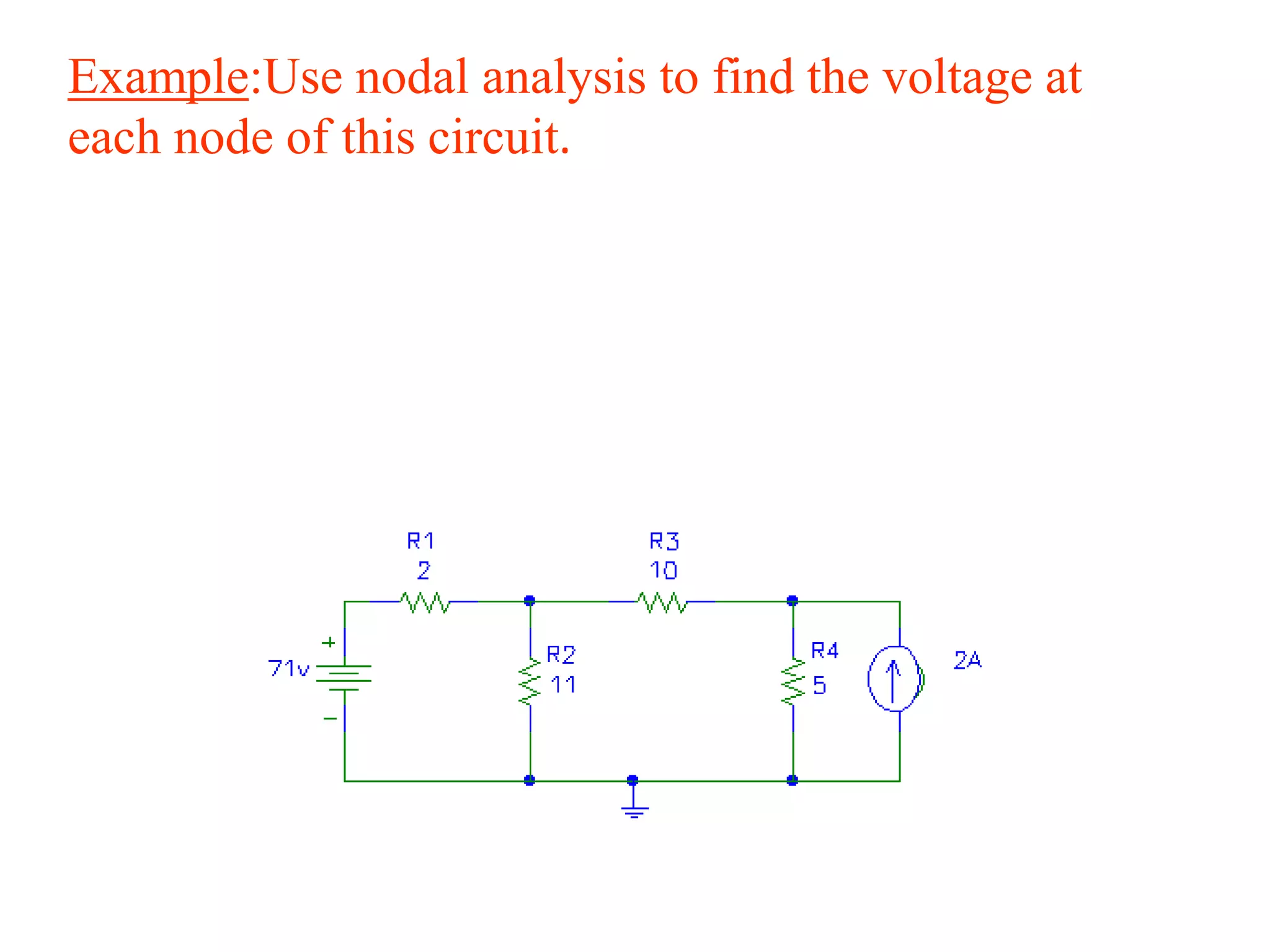
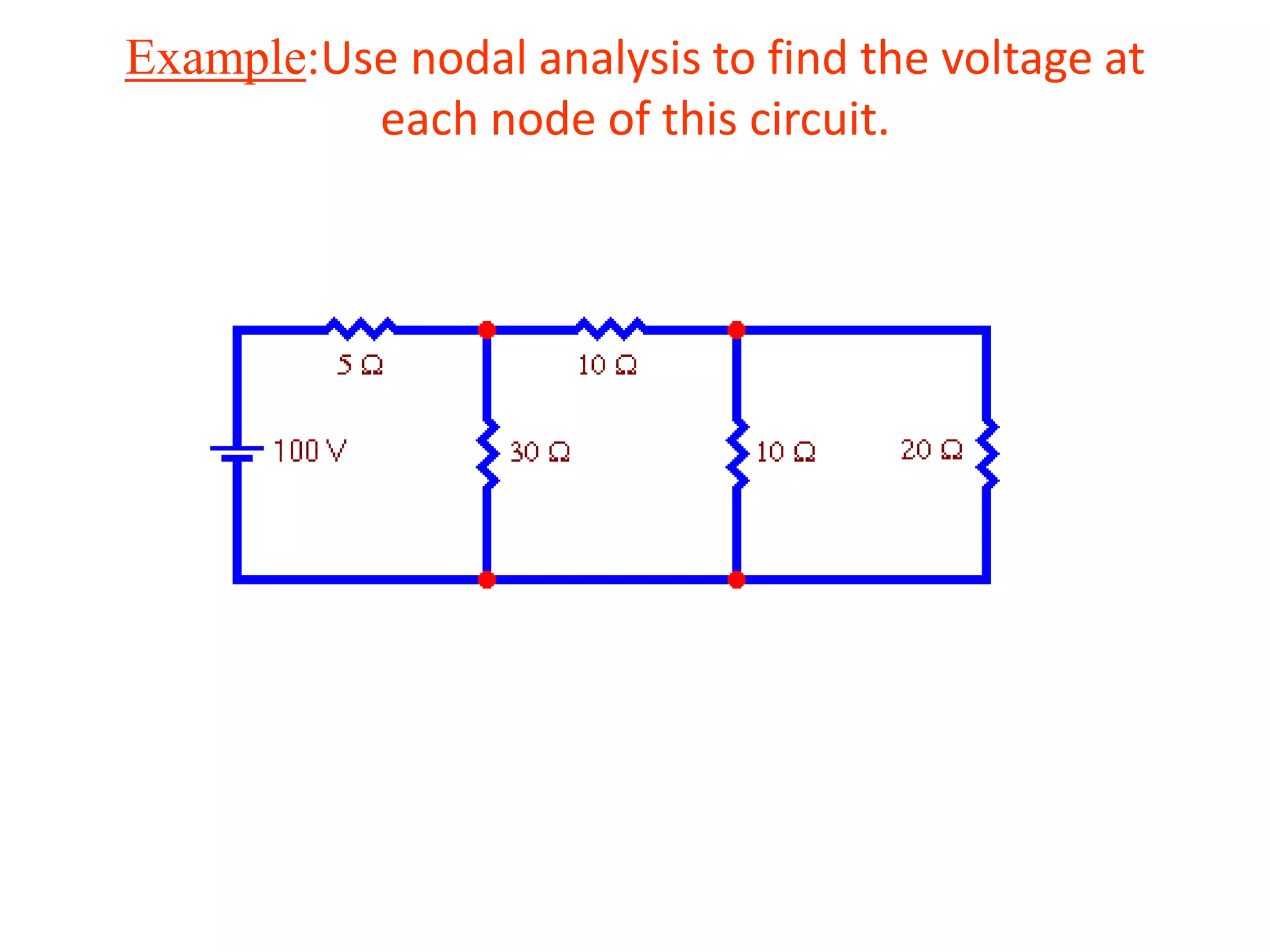
Example:Use nodal analysis to find the voltage at
each node of this circuit.
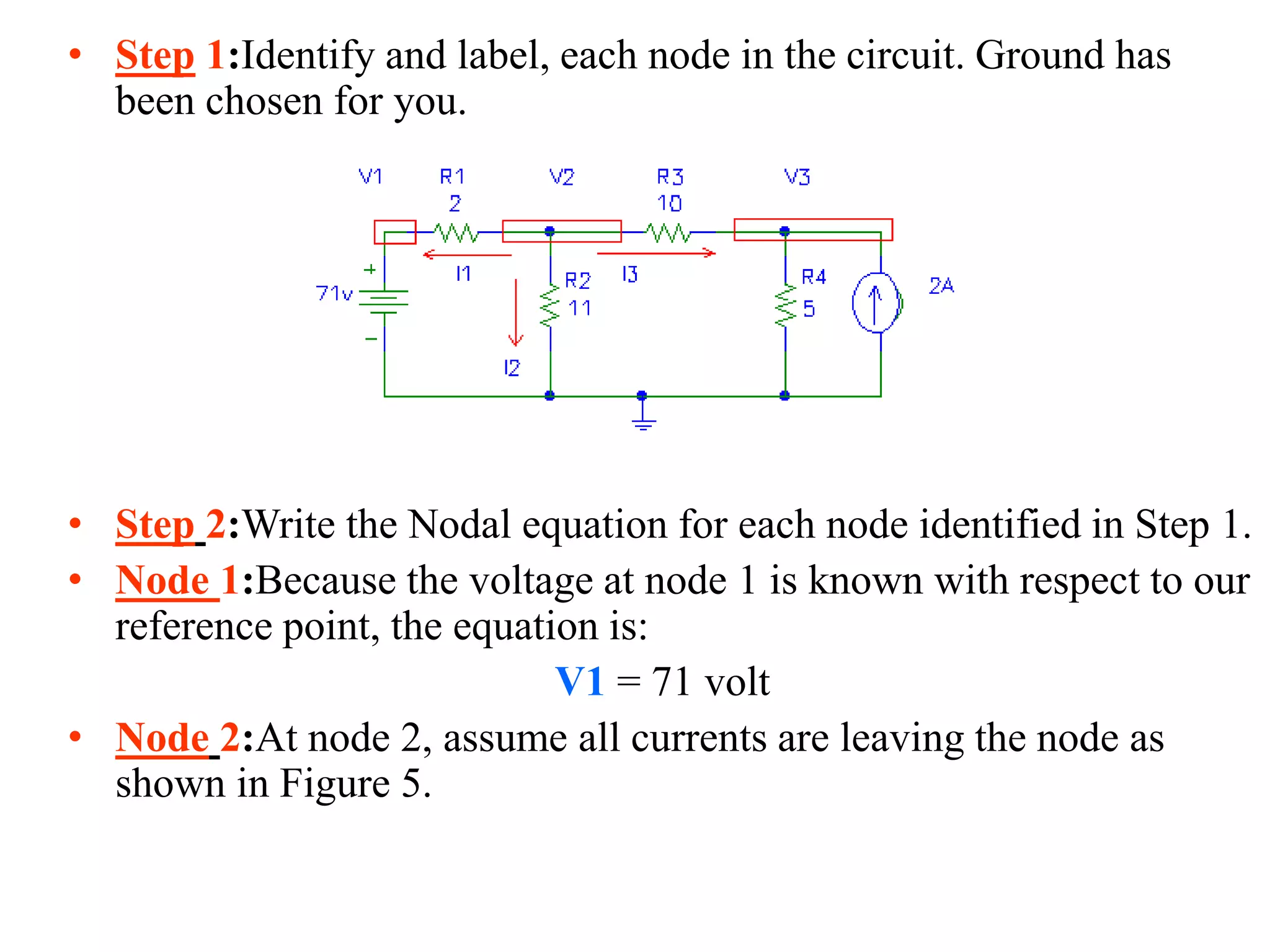
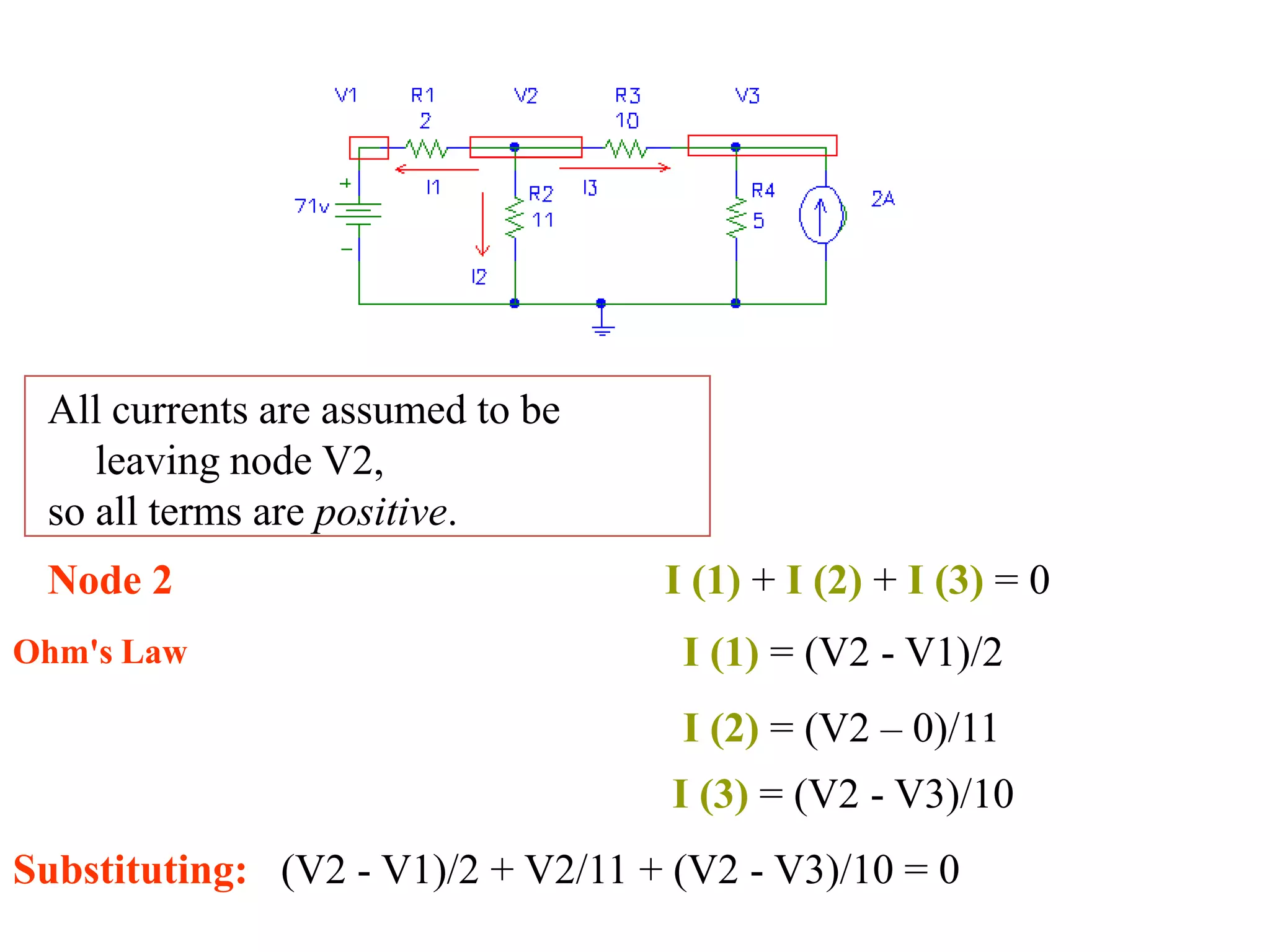
• Step 1:Identify and label, each node in the circuit. Ground has
been chosen for you.
• Step 2:Write the Nodal equation for each node identified in Step 1.
• Node 1:Because the voltage at node 1 is known with respect to our
reference point, the equation is:
V1 = 71 volt
• Node 2:At node 2, assume all currents are leaving the node as
shown in Figure 5.
All currents are assumed to be
leaving node V2,
so all terms are positive.
Node 2 I (1) + I (2) + I (3) = 0
Ohm's Law I (1) = (V2 - V1)/2
I (2) = (V2 – 0)/11
I (3) = (V2 - V3)/10
Substituting: (V2 - V1)/2 + V2/11 + (V2 - V3)/10 = 0
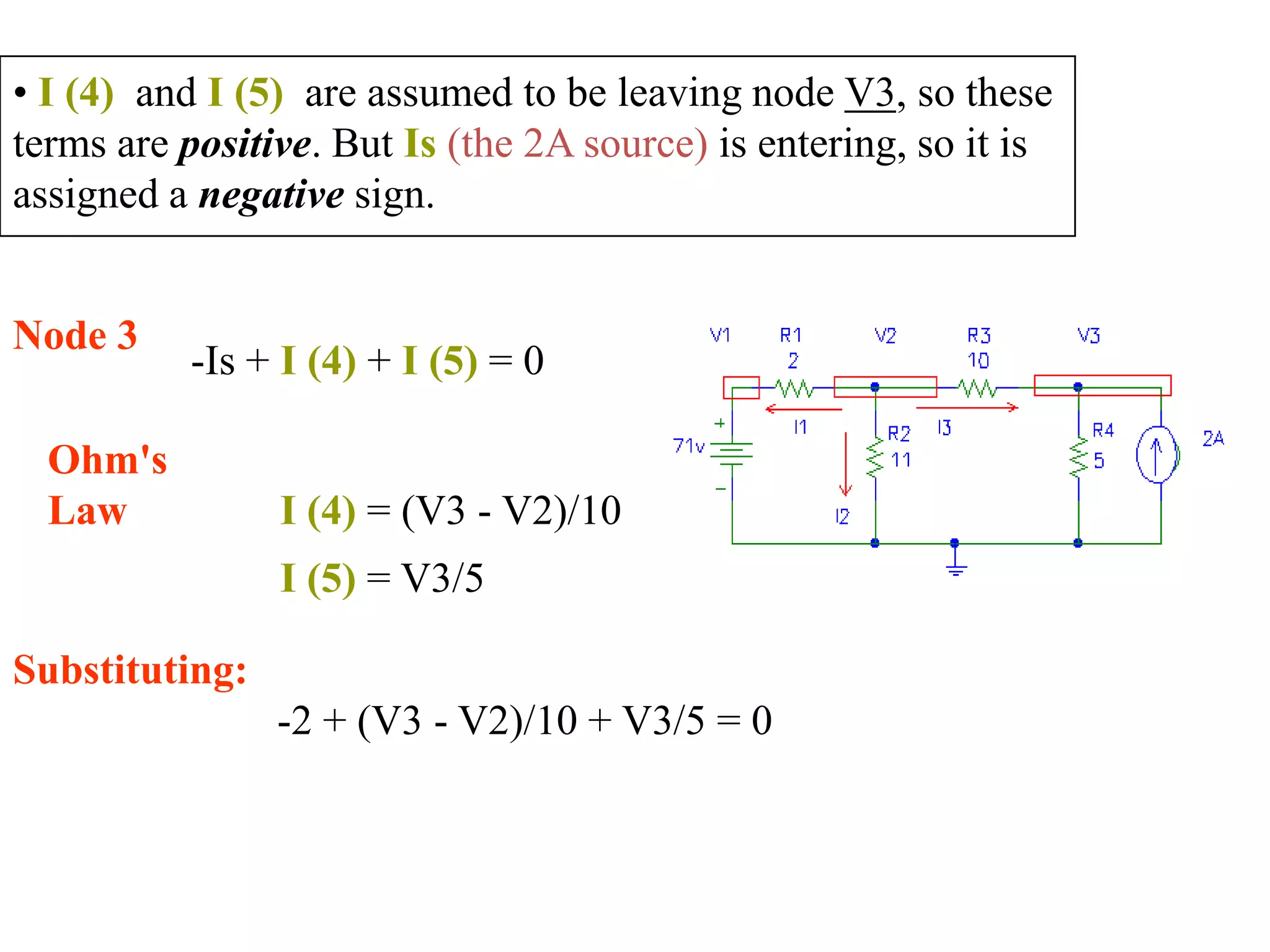
• I (4) and I (5) are assumed to be leaving node V3, so these
terms are positive. But Is (the 2A source) is entering, so it is
assigned a negative sign.
Node 3
-Is + I (4) + I (5) = 0
Ohm's
Law I (4) = (V3 - V2)/10
I (5) = V3/5
Substituting:
-2 + (V3 - V2)/10 + V3/5 = 0
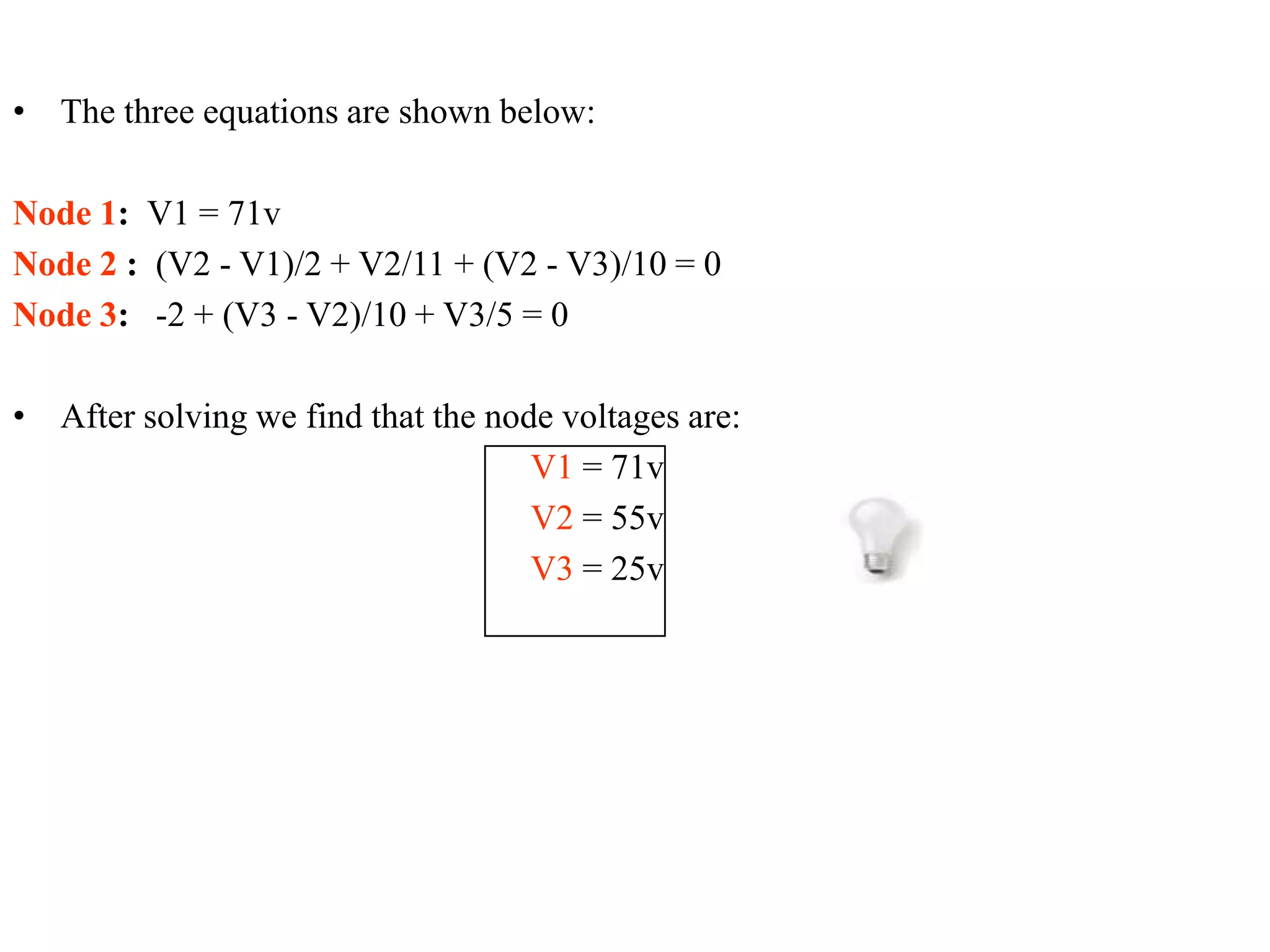
• The three equations are shown below:
Node 1: V1 = 71v
Node 2 : (V2 - V1)/2 + V2/11 + (V2 - V3)/10 = 0
Node 3: -2 + (V3 - V2)/10 + V3/5 = 0
• After solving we find that the node voltages are:
V1 = 71v
V2 = 55v
V3 = 25v
Example:Use nodal analysis to find the voltage at
each node of this circuit.

Electric Circuit - Lecture 04

  • 1.
    Electric Circuit Analysis Lec4:Nodal analysis Ahsan Khawaja Ahsan_khawaja@comsats.edu.pk Lecturer Room 102 Department of Electrical Engineering
  • 2.
    Steps of NodalAnalysis 1. Choose a reference (ground) node. 2. Assign node voltages to the other nodes. 3. Apply KCL to each node other than the reference node; express currents in terms of node voltages. 4. Solve the resulting system of linear equations for the nodal voltages.
  • 3.
    Common symbols forindicating a reference node, (a) common ground, (b) ground, (c) chassis.
  • 4.
    1. Reference Node Thereference node is called the ground node where V = 0 + – V 500 500 1k 500 500 I1 I2
  • 5.
    Steps of NodalAnalysis 1. Choose a reference (ground) node. 2. Assign node voltages to the other nodes. 3. Apply KCL to each node other than the reference node; express currents in terms of node voltages. 4. Solve the resulting system of linear equations for the nodal voltages.
  • 6.
    2. Node Voltages V1,V2, and V3 are unknowns for which we solve using KCL 500 500 1k 500 500 I1 I2 1 2 3 V1 V2 V3
  • 7.
    Steps of NodalAnalysis 1. Choose a reference (ground) node. 2. Assign node voltages to the other nodes. 3. Apply KCL to each node other than the reference node; express currents in terms of node voltages. 4. Solve the resulting system of linear equations for the nodal voltages.
  • 8.
    Currents and NodeVoltages 500 V1 500V1 V2 500 21 VV 500 1 V
  • 9.
    3. KCL atNode 1 500 500 I1 V1 V2 500500 121 1 VVV I
  • 10.
    3. KCL atNode 2 500 1k 500 V2 V3V1 0 500k1500 32212 VVVVV
  • 11.
    3. KCL atNode 3 2 323 500500 I VVV500 500 I2 V2 V3
  • 12.
    Steps of NodalAnalysis 1. Choose a reference (ground) node. 2. Assign node voltages to the other nodes. 3. Apply KCL to each node other than the reference node; express currents in terms of node voltages. 4. Solve the resulting system of linear equations for the nodal voltages.
  • 13.
    Typical circuit fornodal analysis
  • 14.
    • Find thenode voltages in the circuit shown below.
  • 15.
    • At node1 2 0 4 5 121 321 vvv iii
  • 16.
    • At node2 6 0 4 5 212 5142 vvv iiii
  • 17.
  • 18.
    • Determine thevoltage at the nodes in Fig. below
  • 19.
    • At node1, 24 3 3 2131 1 vvvv ii x
  • 20.
    • At node2 4 0 82 23221 32 vvvvv iiix
  • 21.
    • At node3 2 )(2 84 2 213231 21 vvvvvv iii x
  • 22.
    • In matrixform: 0 0 3 8 3 8 9 4 3 8 1 8 7 2 1 4 1 2 1 4 3 3 2 1 v v v
  • 23.
  • 24.
    Example:Use nodal analysisto find the voltage at each node of this circuit.
  • 25.
    • Step 1:Identifyand label, each node in the circuit. Ground has been chosen for you. • Step 2:Write the Nodal equation for each node identified in Step 1. • Node 1:Because the voltage at node 1 is known with respect to our reference point, the equation is: V1 = 71 volt • Node 2:At node 2, assume all currents are leaving the node as shown in Figure 5.
  • 26.
    All currents areassumed to be leaving node V2, so all terms are positive. Node 2 I (1) + I (2) + I (3) = 0 Ohm's Law I (1) = (V2 - V1)/2 I (2) = (V2 – 0)/11 I (3) = (V2 - V3)/10 Substituting: (V2 - V1)/2 + V2/11 + (V2 - V3)/10 = 0
  • 27.
    • I (4)and I (5) are assumed to be leaving node V3, so these terms are positive. But Is (the 2A source) is entering, so it is assigned a negative sign. Node 3 -Is + I (4) + I (5) = 0 Ohm's Law I (4) = (V3 - V2)/10 I (5) = V3/5 Substituting: -2 + (V3 - V2)/10 + V3/5 = 0
  • 28.
    • The threeequations are shown below: Node 1: V1 = 71v Node 2 : (V2 - V1)/2 + V2/11 + (V2 - V3)/10 = 0 Node 3: -2 + (V3 - V2)/10 + V3/5 = 0 • After solving we find that the node voltages are: V1 = 71v V2 = 55v V3 = 25v
  • 29.
    Example:Use nodal analysisto find the voltage at each node of this circuit.