NATURE OF PERCEPTION
FACTORS OF PERCEPTION
KINDS OF PERCEPTION
PERCEPTION
“ WE DON’T SEE THINGS AS THEY
ARE, WE SEE THINGS AS WE ARE.”
NATURE OF PERCEPTION
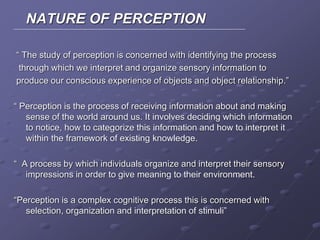
“ The study of perception is concerned with identifying the process
through which we interpret and organize sensory information to
produce our conscious experience of objects and object relationship.”
“ Perception is the process of receiving information about and making
sense of the world around us. It involves deciding which information
to notice, how to categorize this information and how to interpret it
within the framework of existing knowledge.
“ A process by which individuals organize and interpret their sensory
impressions in order to give meaning to their environment.
“Perception is a complex cognitive process this is concerned with
selection, organization and interpretation of stimuli”
The Perceptual Process
1.Sensation
 An individual’s ability to
detect stimuli in the
immediate
environment.
2.Selection
 The process a person
uses to eliminate some
of the stimuli that have
been sensed and to
retain others for further
processing.
3.Organization
 The process of placing
selected perceptual
stimuli into a
framework for
“storage.”
4.Translation
 The stage of the
perceptual process at
which stimuli are
interpreted and given
meaning.
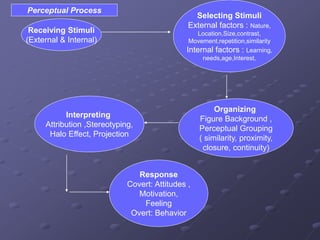
Receiving Stimuli
(External & Internal)
Selecting Stimuli
External factors : Nature,
Location,Size,contrast,
Movement,repetition,similarity
Internal factors : Learning,
needs,age,Interest,
Organizing
Figure Background ,
Perceptual Grouping
( similarity, proximity,
closure, continuity)
Response
Covert: Attitudes ,
Motivation,
Feeling
Overt: Behavior
Perceptual Process
Interpreting
Attribution ,Stereotyping,
Halo Effect, Projection
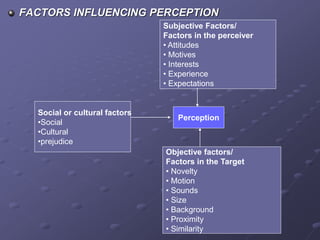
FACTORS INFLUENCING PERCEPTION
Subjective Factors/
Factors in the perceiver
• Attitudes
• Motives
• Interests
• Experience
• Expectations
Perception
Objective factors/
Factors in the Target
• Novelty
• Motion
• Sounds
• Size
• Background
• Proximity
• Similarity
Social or cultural factors
•Social
•Cultural
•prejudice
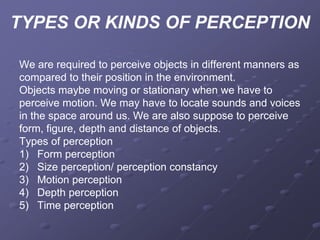
We are required to perceive objects in different manners as
compared to their position in the environment.
Objects maybe moving or stationary when we have to
perceive motion. We may have to locate sounds and voices
in the space around us. We are also suppose to perceive
form, figure, depth and distance of objects.
Types of perception
1) Form perception
2) Size perception/ perception constancy
3) Motion perception
4) Depth perception
5) Time perception
TYPES OR KINDS OF PERCEPTION
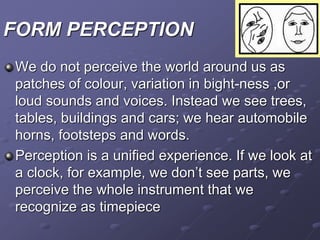
FORM PERCEPTION
We do not perceive the world around us as
patches of colour, variation in bight-ness ,or
loud sounds and voices. Instead we see trees,
tables, buildings and cars; we hear automobile
horns, footsteps and words.
Perception is a unified experience. If we look at
a clock, for example, we don’t see parts, we
perceive the whole instrument that we
recognize as timepiece
TIME PERCEPTION
We often perceive time in our normal daily life. Perception of time is
less in children than in elders.
Time perception is a field of study
within psychology and neuroscience that refers to the subjective
experience of time, which is measured by someone's own
perception of the duration of the indefinite and continuous
unfolding of events. The perceived time interval between two
successive events is referred to as perceived duration. Another
person's perception of time cannot be directly experienced or
understood, but it can be objectively studied and inferred through a
number of scientific experiments.
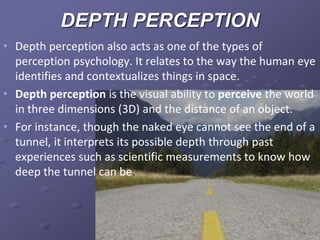
DEPTH PERCEPTION
• Depth perception also acts as one of the types of
perception psychology. It relates to the way the human eye
identifies and contextualizes things in space.
• Depth perception is the visual ability to perceive the world
in three dimensions (3D) and the distance of an object.
• For instance, though the naked eye cannot see the end of a
tunnel, it interprets its possible depth through past
experiences such as scientific measurements to know how
deep the tunnel can be.

Perception

  • 1.
    NATURE OF PERCEPTION FACTORSOF PERCEPTION KINDS OF PERCEPTION PERCEPTION
  • 2.
    “ WE DON’TSEE THINGS AS THEY ARE, WE SEE THINGS AS WE ARE.”
  • 3.
    NATURE OF PERCEPTION “The study of perception is concerned with identifying the process through which we interpret and organize sensory information to produce our conscious experience of objects and object relationship.” “ Perception is the process of receiving information about and making sense of the world around us. It involves deciding which information to notice, how to categorize this information and how to interpret it within the framework of existing knowledge. “ A process by which individuals organize and interpret their sensory impressions in order to give meaning to their environment. “Perception is a complex cognitive process this is concerned with selection, organization and interpretation of stimuli”
  • 4.
    The Perceptual Process 1.Sensation An individual’s ability to detect stimuli in the immediate environment. 2.Selection  The process a person uses to eliminate some of the stimuli that have been sensed and to retain others for further processing. 3.Organization  The process of placing selected perceptual stimuli into a framework for “storage.” 4.Translation  The stage of the perceptual process at which stimuli are interpreted and given meaning.
  • 5.
    Receiving Stimuli (External &Internal) Selecting Stimuli External factors : Nature, Location,Size,contrast, Movement,repetition,similarity Internal factors : Learning, needs,age,Interest, Organizing Figure Background , Perceptual Grouping ( similarity, proximity, closure, continuity) Response Covert: Attitudes , Motivation, Feeling Overt: Behavior Perceptual Process Interpreting Attribution ,Stereotyping, Halo Effect, Projection
  • 6.
    FACTORS INFLUENCING PERCEPTION SubjectiveFactors/ Factors in the perceiver • Attitudes • Motives • Interests • Experience • Expectations Perception Objective factors/ Factors in the Target • Novelty • Motion • Sounds • Size • Background • Proximity • Similarity Social or cultural factors •Social •Cultural •prejudice
  • 7.
    We are requiredto perceive objects in different manners as compared to their position in the environment. Objects maybe moving or stationary when we have to perceive motion. We may have to locate sounds and voices in the space around us. We are also suppose to perceive form, figure, depth and distance of objects. Types of perception 1) Form perception 2) Size perception/ perception constancy 3) Motion perception 4) Depth perception 5) Time perception TYPES OR KINDS OF PERCEPTION
  • 8.
    FORM PERCEPTION We donot perceive the world around us as patches of colour, variation in bight-ness ,or loud sounds and voices. Instead we see trees, tables, buildings and cars; we hear automobile horns, footsteps and words. Perception is a unified experience. If we look at a clock, for example, we don’t see parts, we perceive the whole instrument that we recognize as timepiece
  • 9.
    TIME PERCEPTION We oftenperceive time in our normal daily life. Perception of time is less in children than in elders. Time perception is a field of study within psychology and neuroscience that refers to the subjective experience of time, which is measured by someone's own perception of the duration of the indefinite and continuous unfolding of events. The perceived time interval between two successive events is referred to as perceived duration. Another person's perception of time cannot be directly experienced or understood, but it can be objectively studied and inferred through a number of scientific experiments.
  • 10.
    DEPTH PERCEPTION • Depthperception also acts as one of the types of perception psychology. It relates to the way the human eye identifies and contextualizes things in space. • Depth perception is the visual ability to perceive the world in three dimensions (3D) and the distance of an object. • For instance, though the naked eye cannot see the end of a tunnel, it interprets its possible depth through past experiences such as scientific measurements to know how deep the tunnel can be.