Perception
Lecture 8
Introduction
to Psychology (PSY-101)
Instructor: Raisa Munir
Perception
• Perception; is a complex cognitive process that is
concerned with selection, organization and
interpretation of stimuli.
• Perception involves cognitive process like thinking,
memory and ability to form meaning through the
sense processes.
• Perception is an active process in which sensory
experience is carried through the nervous system to
the brain and interpreted.
Difference between Sensation &
Perception
• Psychologists tend to view sensation as biological
process and perception as cognitive process.
• Both are interrelated .
• Sensation; refers to the process by which the sense
organ gathers information about the environment.
• Perception; is the process by which the brain organizes
and interprets sensations.
Factors of Perception
 There are two types of factors that affecting perception
1. Objective / external Factors
2. Subjective / internal Factors
Objective Factors
 There are a number of characteristics of stimuli
that influence our perception.
1. Intensity
2. Size
3. Distinct & Striking
4. Movement
5. Novelty
6. Duration
7. Repetition
8. Abrupt Change
Objective factors
• Intensity; The intensity of an external stimulus
determines its probability to being perceived.
louder a sound , the more likely a person is to
perceive it. The brighter a light ,the more likely
it is to be in the focus of perception.
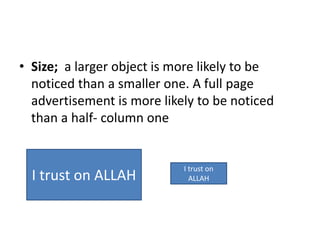
• Size; a larger object is more likely to be
noticed than a smaller one. A full page
advertisement is more likely to be noticed
than a half- column one
I trust on ALLAH
I trust on
ALLAH
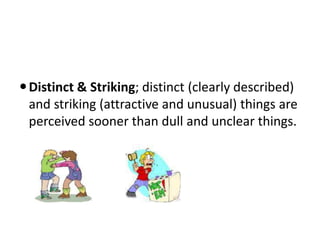
Distinct & Striking; distinct (clearly described)
and striking (attractive and unusual) things are
perceived sooner than dull and unclear things.
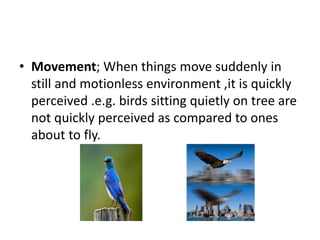
• Movement; When things move suddenly in
still and motionless environment ,it is quickly
perceived .e.g. birds sitting quietly on tree are
not quickly perceived as compared to ones
about to fly.
• Repetition; The more number of a time the
stimulus is repeated, the more it is likely to be
noticed. Repetition is one of the most
frequently used techniques in advertising and
is the most common way of attracting the
people’s attention. Frequency results in
making people aware of the stimulus.
• Duration; Television and radio advertisements
of long duration are attended to more than
those of short duration.
• Novelty; new object in a familiar situation
draw the perceiver’s attention. A new and
novel thing is perceived sooner than old and
used thing.
• Abrupt Change; Any change in stimulus
conditions, such as increase in noise , often
attracts attention.
Subjective Factors
 Sometimes, perception is determined not only by
the physical characteristics of stimuli but by the
characteristics of the perceiver. These are
1. Motives or needs
2. Interests & values
3. Past experience
4. Age
5. Preparatory set
6. Social & cultural factors
1. Motives or Needs; when people are motivated
,they tend to see and hear what they want to hear.
In other words, we may be set to perceive the world
in ways that agree with our motives and match our
goals.
People at different levels of needs and desire
perceive the same thing differently. Power
seekers are more likely to notice power related
stimuli. That is to say expectancy, motives or interest
also affect people perception.
Subjective Factors
2. Interests & Values; we attend to those aspects of
world that relate to our interest.
3.Past Experience; Experience and knowledge have
a constant bearing on perception. Successful
experiences enhance and boost the perceptive
abilities and lead to accuracy in perception of a
person. Much of our daily activity is dependent
upon past experience. we have learned to react to
cues & symbols. E.g., on seeing a moving line on
the sky, we guess it to be an airplane.
Subjective Factors
4. Age; Age brings a change in perception as
well. A child perceives things in different
way as compared to a young person.
5.Preparatory Set; This refers to a person’s
readiness to respond to one kind of sensory
input, but not to other kinds.
6.Social & Cultural Influences ; The normal
perceptual experiences of a culture may
lead its members to develop perceptual
biases, suggestions and prejudices.
Kinds/Types of Perception
 We perceive objects in different manners as
compared to their position in the environment.
Objects may be moving or static, when we have to
perceive motion. We may have to locate sounds
and voices in the space around us. Lets look at:
1. Form Perception
2. Size Perception/ Perceptual Constancy
3. Motion Perception
4. Depth Perception
5. Time Perception
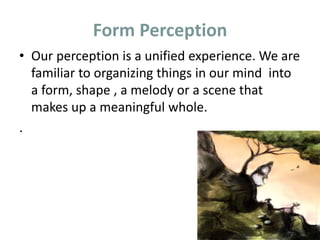
Form Perception
• Our perception is a unified experience. We are
familiar to organizing things in our mind into
a form, shape , a melody or a scene that
makes up a meaningful whole.
.
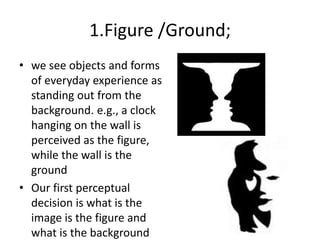
1.Figure /Ground;
• we see objects and forms
of everyday experience as
standing out from the
background. e.g., a clock
hanging on the wall is
perceived as the figure,
while the wall is the
ground
• Our first perceptual
decision is what is the
image is the figure and
what is the background
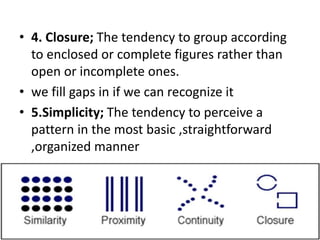
• 2.Similarity; the tendency to group together
those elements that are similar in appearance.
• objects similar in appearance are perceived as
being part of same group
• 3.Proximity; The tendency to group together
those elements that are near to each other in
appearance.
• group objects that are close together as being
part of same group
• 4. Closure; The tendency to group according
to enclosed or complete figures rather than
open or incomplete ones.
• we fill gaps in if we can recognize it
• 5.Simplicity; The tendency to perceive a
pattern in the most basic ,straightforward
,organized manner
Size Perception/Perceptual Constancy
Size perception ; Size perception is the tendency to
perceive objects in a consistent manner despite the
changing sensations that are received by our senses.
visual constancy plays an important role in helping us
adapt to our environment successfully.
Learning plays an important role in the development of
constancy. Once we know that certain objects in our
environment have certain characteristics ,we tend to
perceive them in the same way, regardless of the
conditions under which they are perceived.
Size Perception
Three types of constancy are explained briefly
here:
1. Size Constancy
2. Shape Constancy
3. Color Constancy
Size Perception
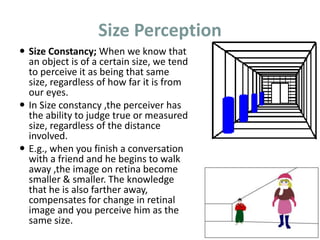
 Size Constancy; When we know that
an object is of a certain size, we tend
to perceive it as being that same
size, regardless of how far it is from
our eyes.
 In Size constancy ,the perceiver has
the ability to judge true or measured
size, regardless of the distance
involved.
 E.g., when you finish a conversation
with a friend and he begins to walk
away ,the image on retina become
smaller & smaller. The knowledge
that he is also farther away,
compensates for change in retinal
image and you perceive him as the
same size.
Size Perception
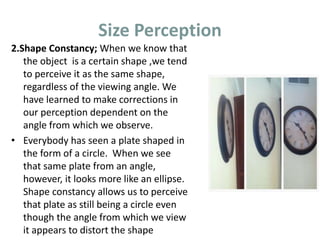
2.Shape Constancy; When we know that
the object is a certain shape ,we tend
to perceive it as the same shape,
regardless of the viewing angle. We
have learned to make corrections in
our perception dependent on the
angle from which we observe.
• Everybody has seen a plate shaped in
the form of a circle. When we see
that same plate from an angle,
however, it looks more like an ellipse.
Shape constancy allows us to perceive
that plate as still being a circle even
though the angle from which we view
it appears to distort the shape
Size Perception
• 3.Color Constancy; Colors of
objects tend to remain
constant in perception when
we know their true color.
• refers to our ability to
recognize that color remains
the same regardless of how it
looks under different levels of
light. That deep blue shirt you
wore to the beach suddenly
looks black when you walk
indoors.
Motion Perception
 Motion Perception; Motion is perceived by
following the progressive change of an object’s
position in space with time. It has two types
1. Real Motion; The perception of the actual
movement of objects in the world is termed as
“real motion perception”.
• watching a ball thrown across your
field of view, you can easily perceive
that the ball is moving relative to the
world
2: Apparent Motion; It is movement perceived
in the absence of physical movement of an
image across the retina
• looking at a neon street sign, where a series
of lights flash one after another, it appears to
move
Types of apparent motion
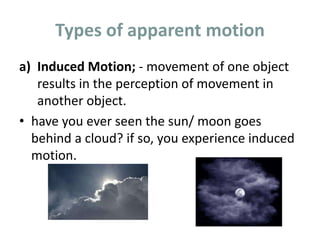
a) Induced Motion; - movement of one object
results in the perception of movement in
another object.
• have you ever seen the sun/ moon goes
behind a cloud? if so, you experience induced
motion.
• b). Phi Phenomenon; perceiving continuous
motion between separate objects viewed
rapidly in succession
• a string of lights across a house appear to
"run" even though you know it's just one light
turning off and the one next to it turning on
and so on down the line.
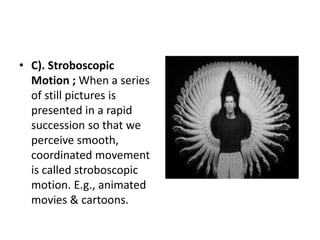
• C). Stroboscopic
Motion ; When a series
of still pictures is
presented in a rapid
succession so that we
perceive smooth,
coordinated movement
is called stroboscopic
motion. E.g., animated
movies & cartoons.
Motion Perception
d) Auto kinetic Motion; If we stare at a small
spot of light in a dark room for a few minutes,
it will appear to begin to move around
although the light is stationary; we see it
move randomly back and forth in the
darkness. While we don’t know the reason for
this positively, the auto kinetic effect may be
caused by the eye muscles moving to keep the
eye moist.
Depth Perception
Depth Perception ; the ability to judge the
distance of objects and the spatial relationship
of objects at different distances
There is a distance between the eyes so both eyes
receive different image on retina and the brain
integrates them into composite view.
Depth Perception
lets examine some of the cues we employ in
depth perception.
 Monocular Cues
 Binocular Cues
1.Monocular Cues; Cues that can operate when
only one eye is looking.
Depth Perception
2. Binocular Cues; Many of the cues for depth
require only one eye. In fact, one-eyed people,
under most conditions, have quite adequate
depth perception. Most of us look out at the
world with both eyes simultaneously and we
are thus able to add the binocular cues for
depth perception to the monocular ones.
Depth Perception
1.Retinal Disparity; When look at a particular
object, the two eyes do not receive exactly the
same image. The difference in the images in
the two eyes is called “ Retinal Disparity”.
2. Convergence; The eyes turn inward or
converge when we look at nearby objects. As
we fixate objects further away, the lines of
vision of the eyes tend to be almost parallel.
Time Perception
• We take time in seconds, minutes and hours which
pass into days, weeks, months , years and even
centuries. Time is also perceived in terms of past,
present and future.
• It refers to the subjective experience of time, which
is measured by someone's own perception of the
duration of the indefinite and continuous unfolding
of events. Another person's perception of time
cannot be directly experienced or understood, but
it can be objectively studied and understood
through a number of scientific experiments

8 lec 8 perception.ppt

  • 1.
    Perception Lecture 8 Introduction to Psychology(PSY-101) Instructor: Raisa Munir
  • 3.
    Perception • Perception; isa complex cognitive process that is concerned with selection, organization and interpretation of stimuli. • Perception involves cognitive process like thinking, memory and ability to form meaning through the sense processes. • Perception is an active process in which sensory experience is carried through the nervous system to the brain and interpreted.
  • 4.
    Difference between Sensation& Perception • Psychologists tend to view sensation as biological process and perception as cognitive process. • Both are interrelated . • Sensation; refers to the process by which the sense organ gathers information about the environment. • Perception; is the process by which the brain organizes and interprets sensations.
  • 5.
    Factors of Perception There are two types of factors that affecting perception 1. Objective / external Factors 2. Subjective / internal Factors
  • 6.
    Objective Factors  Thereare a number of characteristics of stimuli that influence our perception. 1. Intensity 2. Size 3. Distinct & Striking 4. Movement 5. Novelty 6. Duration 7. Repetition 8. Abrupt Change
  • 7.
    Objective factors • Intensity;The intensity of an external stimulus determines its probability to being perceived. louder a sound , the more likely a person is to perceive it. The brighter a light ,the more likely it is to be in the focus of perception.
  • 8.
    • Size; alarger object is more likely to be noticed than a smaller one. A full page advertisement is more likely to be noticed than a half- column one I trust on ALLAH I trust on ALLAH
  • 9.
    Distinct & Striking;distinct (clearly described) and striking (attractive and unusual) things are perceived sooner than dull and unclear things.
  • 10.
    • Movement; Whenthings move suddenly in still and motionless environment ,it is quickly perceived .e.g. birds sitting quietly on tree are not quickly perceived as compared to ones about to fly.
  • 11.
    • Repetition; Themore number of a time the stimulus is repeated, the more it is likely to be noticed. Repetition is one of the most frequently used techniques in advertising and is the most common way of attracting the people’s attention. Frequency results in making people aware of the stimulus. • Duration; Television and radio advertisements of long duration are attended to more than those of short duration.
  • 12.
    • Novelty; newobject in a familiar situation draw the perceiver’s attention. A new and novel thing is perceived sooner than old and used thing. • Abrupt Change; Any change in stimulus conditions, such as increase in noise , often attracts attention.
  • 13.
    Subjective Factors  Sometimes,perception is determined not only by the physical characteristics of stimuli but by the characteristics of the perceiver. These are 1. Motives or needs 2. Interests & values 3. Past experience 4. Age 5. Preparatory set 6. Social & cultural factors
  • 14.
    1. Motives orNeeds; when people are motivated ,they tend to see and hear what they want to hear. In other words, we may be set to perceive the world in ways that agree with our motives and match our goals. People at different levels of needs and desire perceive the same thing differently. Power seekers are more likely to notice power related stimuli. That is to say expectancy, motives or interest also affect people perception.
  • 15.
    Subjective Factors 2. Interests& Values; we attend to those aspects of world that relate to our interest. 3.Past Experience; Experience and knowledge have a constant bearing on perception. Successful experiences enhance and boost the perceptive abilities and lead to accuracy in perception of a person. Much of our daily activity is dependent upon past experience. we have learned to react to cues & symbols. E.g., on seeing a moving line on the sky, we guess it to be an airplane.
  • 16.
    Subjective Factors 4. Age;Age brings a change in perception as well. A child perceives things in different way as compared to a young person. 5.Preparatory Set; This refers to a person’s readiness to respond to one kind of sensory input, but not to other kinds. 6.Social & Cultural Influences ; The normal perceptual experiences of a culture may lead its members to develop perceptual biases, suggestions and prejudices.
  • 17.
    Kinds/Types of Perception We perceive objects in different manners as compared to their position in the environment. Objects may be moving or static, when we have to perceive motion. We may have to locate sounds and voices in the space around us. Lets look at: 1. Form Perception 2. Size Perception/ Perceptual Constancy 3. Motion Perception 4. Depth Perception 5. Time Perception
  • 18.
    Form Perception • Ourperception is a unified experience. We are familiar to organizing things in our mind into a form, shape , a melody or a scene that makes up a meaningful whole. .
  • 19.
    1.Figure /Ground; • wesee objects and forms of everyday experience as standing out from the background. e.g., a clock hanging on the wall is perceived as the figure, while the wall is the ground • Our first perceptual decision is what is the image is the figure and what is the background
  • 20.
    • 2.Similarity; thetendency to group together those elements that are similar in appearance. • objects similar in appearance are perceived as being part of same group • 3.Proximity; The tendency to group together those elements that are near to each other in appearance. • group objects that are close together as being part of same group
  • 21.
    • 4. Closure;The tendency to group according to enclosed or complete figures rather than open or incomplete ones. • we fill gaps in if we can recognize it • 5.Simplicity; The tendency to perceive a pattern in the most basic ,straightforward ,organized manner
  • 22.
    Size Perception/Perceptual Constancy Sizeperception ; Size perception is the tendency to perceive objects in a consistent manner despite the changing sensations that are received by our senses. visual constancy plays an important role in helping us adapt to our environment successfully. Learning plays an important role in the development of constancy. Once we know that certain objects in our environment have certain characteristics ,we tend to perceive them in the same way, regardless of the conditions under which they are perceived.
  • 23.
    Size Perception Three typesof constancy are explained briefly here: 1. Size Constancy 2. Shape Constancy 3. Color Constancy
  • 24.
    Size Perception  SizeConstancy; When we know that an object is of a certain size, we tend to perceive it as being that same size, regardless of how far it is from our eyes.  In Size constancy ,the perceiver has the ability to judge true or measured size, regardless of the distance involved.  E.g., when you finish a conversation with a friend and he begins to walk away ,the image on retina become smaller & smaller. The knowledge that he is also farther away, compensates for change in retinal image and you perceive him as the same size.
  • 25.
    Size Perception 2.Shape Constancy;When we know that the object is a certain shape ,we tend to perceive it as the same shape, regardless of the viewing angle. We have learned to make corrections in our perception dependent on the angle from which we observe. • Everybody has seen a plate shaped in the form of a circle. When we see that same plate from an angle, however, it looks more like an ellipse. Shape constancy allows us to perceive that plate as still being a circle even though the angle from which we view it appears to distort the shape
  • 26.
    Size Perception • 3.ColorConstancy; Colors of objects tend to remain constant in perception when we know their true color. • refers to our ability to recognize that color remains the same regardless of how it looks under different levels of light. That deep blue shirt you wore to the beach suddenly looks black when you walk indoors.
  • 27.
    Motion Perception  MotionPerception; Motion is perceived by following the progressive change of an object’s position in space with time. It has two types 1. Real Motion; The perception of the actual movement of objects in the world is termed as “real motion perception”. • watching a ball thrown across your field of view, you can easily perceive that the ball is moving relative to the world
  • 28.
    2: Apparent Motion;It is movement perceived in the absence of physical movement of an image across the retina • looking at a neon street sign, where a series of lights flash one after another, it appears to move
  • 29.
    Types of apparentmotion a) Induced Motion; - movement of one object results in the perception of movement in another object. • have you ever seen the sun/ moon goes behind a cloud? if so, you experience induced motion.
  • 30.
    • b). PhiPhenomenon; perceiving continuous motion between separate objects viewed rapidly in succession • a string of lights across a house appear to "run" even though you know it's just one light turning off and the one next to it turning on and so on down the line.
  • 31.
    • C). Stroboscopic Motion; When a series of still pictures is presented in a rapid succession so that we perceive smooth, coordinated movement is called stroboscopic motion. E.g., animated movies & cartoons.
  • 32.
    Motion Perception d) Autokinetic Motion; If we stare at a small spot of light in a dark room for a few minutes, it will appear to begin to move around although the light is stationary; we see it move randomly back and forth in the darkness. While we don’t know the reason for this positively, the auto kinetic effect may be caused by the eye muscles moving to keep the eye moist.
  • 33.
    Depth Perception Depth Perception; the ability to judge the distance of objects and the spatial relationship of objects at different distances There is a distance between the eyes so both eyes receive different image on retina and the brain integrates them into composite view.
  • 34.
    Depth Perception lets examinesome of the cues we employ in depth perception.  Monocular Cues  Binocular Cues 1.Monocular Cues; Cues that can operate when only one eye is looking.
  • 35.
    Depth Perception 2. BinocularCues; Many of the cues for depth require only one eye. In fact, one-eyed people, under most conditions, have quite adequate depth perception. Most of us look out at the world with both eyes simultaneously and we are thus able to add the binocular cues for depth perception to the monocular ones.
  • 36.
    Depth Perception 1.Retinal Disparity;When look at a particular object, the two eyes do not receive exactly the same image. The difference in the images in the two eyes is called “ Retinal Disparity”. 2. Convergence; The eyes turn inward or converge when we look at nearby objects. As we fixate objects further away, the lines of vision of the eyes tend to be almost parallel.
  • 37.
    Time Perception • Wetake time in seconds, minutes and hours which pass into days, weeks, months , years and even centuries. Time is also perceived in terms of past, present and future. • It refers to the subjective experience of time, which is measured by someone's own perception of the duration of the indefinite and continuous unfolding of events. Another person's perception of time cannot be directly experienced or understood, but it can be objectively studied and understood through a number of scientific experiments