UNDERSTANDING THE
PERCEPTUAL PROCESS
A Designer’s perspective
Perception and sensation
• What is Sensation?
• What is perception?
Sensation
• Refers to the immediate, relatively
unprocessed result of stimulation of
sensory receptors in the eyes, ears, nose,
tongue, or skin.
Perception
• A process by which organisms interpret
and organize sensation to produce a
meaningful experience of the world.
• Better describes one’s ultimate experience
of the world and typically involves further
processing of sensory input.
Perception
• In practice, sensation and perception are
virtually impossible to separate, because
they are part of one continuous process.
How do we perceive?
• Organizing raw sensory stimuli into
meaningful experiences involves
cognition, a set of mental activities that
includes thinking, knowing, and
remembering.
• Knowledge + experience
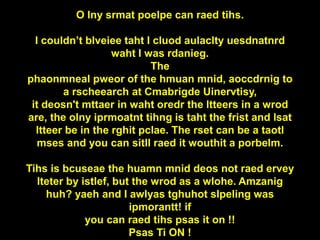
O lny srmat poelpe can raed tihs.
I couldn’t blveiee taht I cluod aulaclty uesdnatnrd
waht I was rdanieg.
The
phaonmneal pweor of the hmuan mnid, aoccdrnig to
a rscheearch at Cmabrigde Uinervtisy,
it deosn't mttaer in waht oredr the ltteers in a wrod
are, the olny iprmoatnt tihng is taht the frist and lsat
ltteer be in the rghit pclae. The rset can be a taotl
mses and you can sitll raed it wouthit a porbelm.
Tihs is bcuseae the huamn mnid deos not raed ervey
lteter by istlef, but the wrod as a wlohe. Amzanig
huh? yaeh and I awlyas tghuhot slpeling was
ipmorantt! if
you can raed tihs psas it on !!
Psas Ti ON !
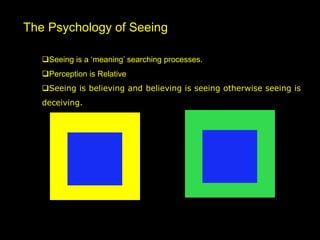
The Psychology of Seeing
Seeing is a ‘meaning’ searching processes.
Perception is Relative
Seeing is believing and believing is seeing otherwise seeing is
deceiving.
The Psychology of Seeing
Seeing involves simplification and categorization of information
How do we perceive?
• Figure and ground
• Gestalt laws of grouping
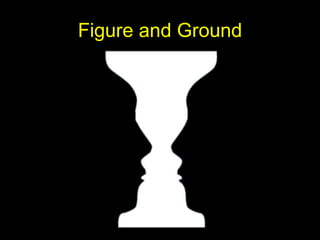
Figure and Ground
Figure and Ground
• What we visually attend to at any time is
called figure, and it is always against some
kind of background.
• Not only does perception involve
organization and grouping, it also involves
distinguishing an object from its
surroundings.
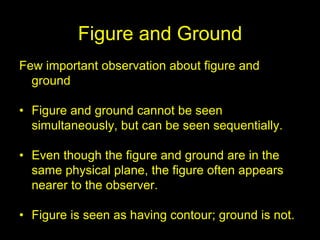
Figure and Ground
Few important observation about figure and
ground
• Figure and ground cannot be seen
simultaneously, but can be seen sequentially.
• Even though the figure and ground are in the
same physical plane, the figure often appears
nearer to the observer.
• Figure is seen as having contour; ground is not.
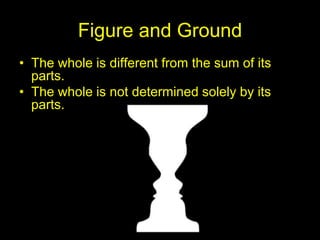
Figure and Ground
• The whole is different from the sum of its
parts.
• The whole is not determined solely by its
parts.
Gestalt laws of grouping
• Proximity
• Similarity
• Continuity
• Closure
• Common Fate
• Simplicity
Proximity
• The closer objects are to one another, the
more likely we are to mentally group them
together
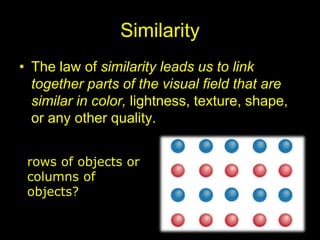
Similarity
• The law of similarity leads us to link
together parts of the visual field that are
similar in color, lightness, texture, shape,
or any other quality.
rows of objects or
columns of
objects?
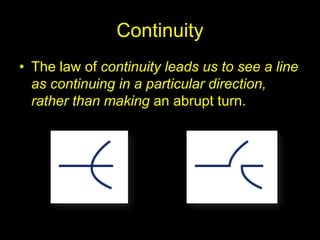
Continuity
• The law of continuity leads us to see a line
as continuing in a particular direction,
rather than making an abrupt turn.
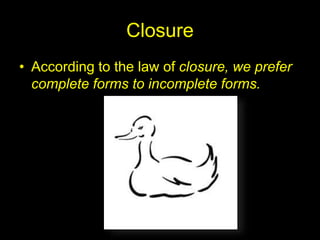
Closure
• According to the law of closure, we prefer
complete forms to incomplete forms.
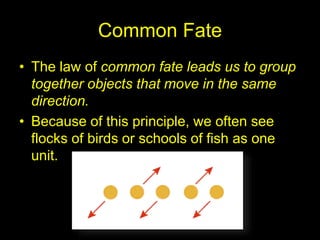
Common Fate
• The law of common fate leads us to group
together objects that move in the same
direction.
• Because of this principle, we often see
flocks of birds or schools of fish as one
unit.
Common Fate
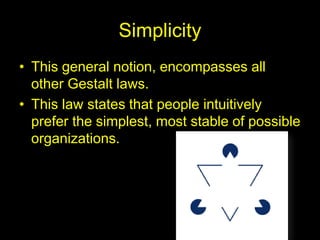
Simplicity
• This general notion, encompasses all
other Gestalt laws.
• This law states that people intuitively
prefer the simplest, most stable of possible
organizations.
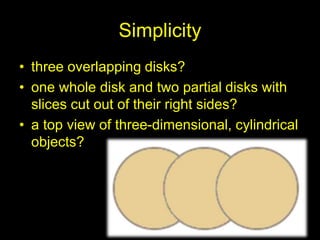
Simplicity
• three overlapping disks?
• one whole disk and two partial disks with
slices cut out of their right sides?
• a top view of three-dimensional, cylindrical
objects?
THE ROLE OF CONTEXT
• The context in which an object appears
influences our perception of it.
• Visual experience is useful because it
creates memories of past stimuli that can
later serve as a context for perceiving new
stimuli.
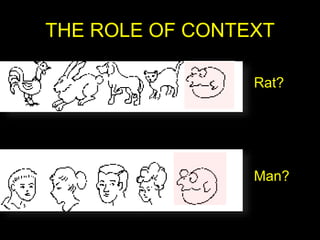
THE ROLE OF CONTEXT
Rat?
Man?
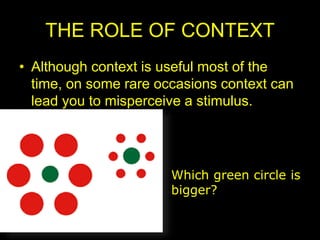
THE ROLE OF CONTEXT
• Although context is useful most of the
time, on some rare occasions context can
lead you to misperceive a stimulus.
Which green circle is
bigger?
VISUAL ILLUSIONS
• Illusion, a mistake in the perception of a
sensory experience.
• A visual illusion occurs when our
perceptual experience of a stimulus is
substantially different from the actual
stimulus we are viewing.
• Errors in perception are only considered
illusions if they are experienced by a large
number of people.
ILLUSIONS OF LENGTH
• Which line is longer
ILLUSIONS OF SHAPE
• What shape do you see?
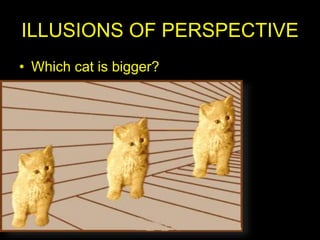
ILLUSIONS OF PERSPECTIVE
• Which cat is bigger?
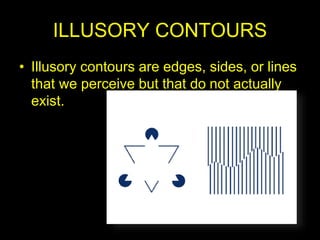
ILLUSORY CONTOURS
• Illusory contours are edges, sides, or lines
that we perceive but that do not actually
exist.
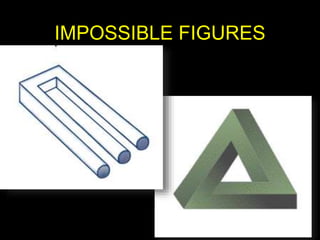
IMPOSSIBLE FIGURES
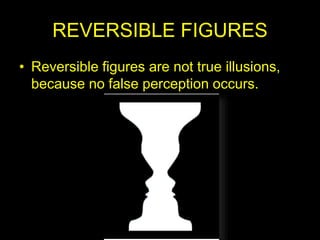
REVERSIBLE FIGURES
• Reversible figures are not true illusions,
because no false perception occurs.
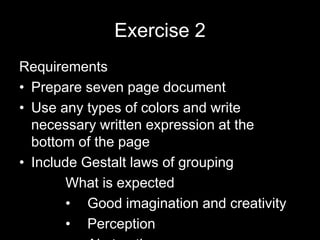
Exercise 2
Requirements
• Prepare seven page document
• Use any types of colors and write
necessary written expression at the
bottom of the page
• Include Gestalt laws of grouping
What is expected
• Good imagination and creativity
• Perception
“collect linking elements to recreate
a new and improved observation
creation of a new perceptions of
reality found in the chaotic world. ”
Polk (landscape architect)

UNDERSTANDING THE PERCEPTUAL PROCESS.pptx

  • 1.
  • 2.
    Perception and sensation •What is Sensation? • What is perception?
  • 3.
    Sensation • Refers tothe immediate, relatively unprocessed result of stimulation of sensory receptors in the eyes, ears, nose, tongue, or skin.
  • 4.
    Perception • A processby which organisms interpret and organize sensation to produce a meaningful experience of the world. • Better describes one’s ultimate experience of the world and typically involves further processing of sensory input.
  • 5.
    Perception • In practice,sensation and perception are virtually impossible to separate, because they are part of one continuous process.
  • 6.
    How do weperceive? • Organizing raw sensory stimuli into meaningful experiences involves cognition, a set of mental activities that includes thinking, knowing, and remembering. • Knowledge + experience
  • 7.
    O lny srmatpoelpe can raed tihs. I couldn’t blveiee taht I cluod aulaclty uesdnatnrd waht I was rdanieg. The phaonmneal pweor of the hmuan mnid, aoccdrnig to a rscheearch at Cmabrigde Uinervtisy, it deosn't mttaer in waht oredr the ltteers in a wrod are, the olny iprmoatnt tihng is taht the frist and lsat ltteer be in the rghit pclae. The rset can be a taotl mses and you can sitll raed it wouthit a porbelm. Tihs is bcuseae the huamn mnid deos not raed ervey lteter by istlef, but the wrod as a wlohe. Amzanig huh? yaeh and I awlyas tghuhot slpeling was ipmorantt! if you can raed tihs psas it on !! Psas Ti ON !
  • 8.
    The Psychology ofSeeing Seeing is a ‘meaning’ searching processes. Perception is Relative Seeing is believing and believing is seeing otherwise seeing is deceiving.
  • 9.
    The Psychology ofSeeing Seeing involves simplification and categorization of information
  • 10.
    How do weperceive? • Figure and ground • Gestalt laws of grouping
  • 11.
  • 12.
    Figure and Ground •What we visually attend to at any time is called figure, and it is always against some kind of background. • Not only does perception involve organization and grouping, it also involves distinguishing an object from its surroundings.
  • 13.
    Figure and Ground Fewimportant observation about figure and ground • Figure and ground cannot be seen simultaneously, but can be seen sequentially. • Even though the figure and ground are in the same physical plane, the figure often appears nearer to the observer. • Figure is seen as having contour; ground is not.
  • 14.
    Figure and Ground •The whole is different from the sum of its parts. • The whole is not determined solely by its parts.
  • 15.
    Gestalt laws ofgrouping • Proximity • Similarity • Continuity • Closure • Common Fate • Simplicity
  • 16.
    Proximity • The closerobjects are to one another, the more likely we are to mentally group them together
  • 17.
    Similarity • The lawof similarity leads us to link together parts of the visual field that are similar in color, lightness, texture, shape, or any other quality. rows of objects or columns of objects?
  • 18.
    Continuity • The lawof continuity leads us to see a line as continuing in a particular direction, rather than making an abrupt turn.
  • 19.
    Closure • According tothe law of closure, we prefer complete forms to incomplete forms.
  • 20.
    Common Fate • Thelaw of common fate leads us to group together objects that move in the same direction. • Because of this principle, we often see flocks of birds or schools of fish as one unit.
  • 21.
  • 22.
    Simplicity • This generalnotion, encompasses all other Gestalt laws. • This law states that people intuitively prefer the simplest, most stable of possible organizations.
  • 23.
    Simplicity • three overlappingdisks? • one whole disk and two partial disks with slices cut out of their right sides? • a top view of three-dimensional, cylindrical objects?
  • 24.
    THE ROLE OFCONTEXT • The context in which an object appears influences our perception of it. • Visual experience is useful because it creates memories of past stimuli that can later serve as a context for perceiving new stimuli.
  • 25.
    THE ROLE OFCONTEXT Rat? Man?
  • 26.
    THE ROLE OFCONTEXT • Although context is useful most of the time, on some rare occasions context can lead you to misperceive a stimulus. Which green circle is bigger?
  • 27.
    VISUAL ILLUSIONS • Illusion,a mistake in the perception of a sensory experience. • A visual illusion occurs when our perceptual experience of a stimulus is substantially different from the actual stimulus we are viewing. • Errors in perception are only considered illusions if they are experienced by a large number of people.
  • 28.
    ILLUSIONS OF LENGTH •Which line is longer
  • 29.
    ILLUSIONS OF SHAPE •What shape do you see?
  • 30.
    ILLUSIONS OF PERSPECTIVE •Which cat is bigger?
  • 31.
    ILLUSORY CONTOURS • Illusorycontours are edges, sides, or lines that we perceive but that do not actually exist.
  • 32.
  • 34.
    REVERSIBLE FIGURES • Reversiblefigures are not true illusions, because no false perception occurs.
  • 36.
    Exercise 2 Requirements • Prepareseven page document • Use any types of colors and write necessary written expression at the bottom of the page • Include Gestalt laws of grouping What is expected • Good imagination and creativity • Perception
  • 37.
    “collect linking elementsto recreate a new and improved observation creation of a new perceptions of reality found in the chaotic world. ” Polk (landscape architect)