KESELAMATAN DAN KESIHATAN PEKERJAAN (KAS3501)
Semester II 2014/2015
Group 7
Presentation date : 1 april 2015
NO.MATRI
C
NAME
UK29510 MASITAH BINTI RANI
UK29551 LIM XIN YI
UK29512 ILANI BINTI ZAMRI
UK29526 ZULFUAZ BINTI RAMSAH
UK29514 NUR SAADIAH BINTI ZAINI
Hazard and Operability Studies
(HAZOP)
What is HAZOP??
 A formal procedure to identify hazards
in a chemical process facility.
 Systematic, comprehensive, effective,
flexible and well accepted.
 Identify all the possibilities where
processes and operation can go
wrong.
 For large process, the studies could
take months of biweekly meetings to
complete.
Purpose and objective of HAZOP
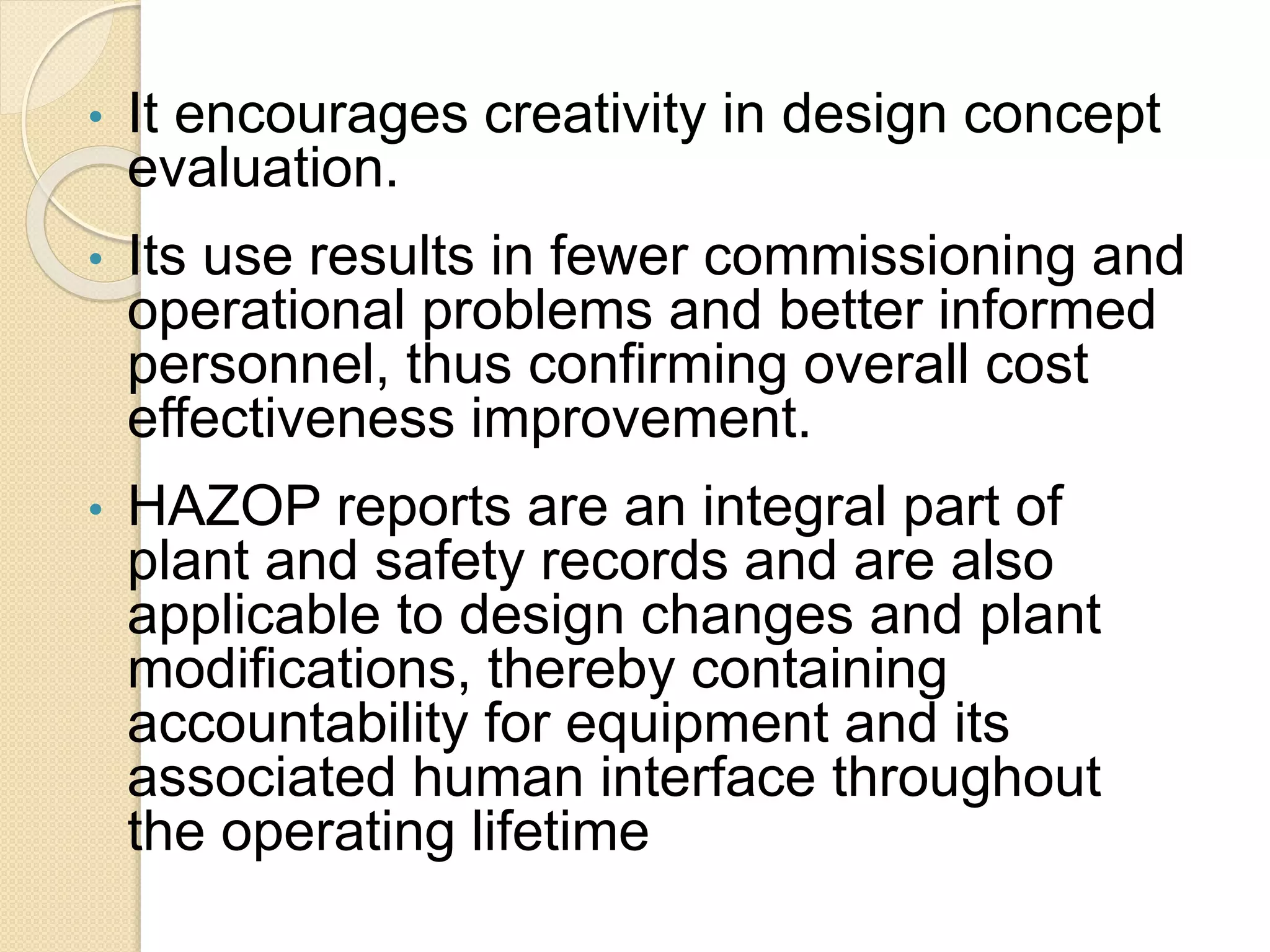
• HAZOP identifies potential hazards ,
failures and operability problems.
• Its use is recommended as a principal
method by professional institutions
and legislators on the basis of proven
capabilities for over 40 years.
• It is most effective as a team effort
consists of plant and prices designers,
operating personnel, control and
instrumentation engineer etc.
• It encourages creativity in design concept
evaluation.
• Its use results in fewer commissioning and
operational problems and better informed
personnel, thus confirming overall cost
effectiveness improvement.
• HAZOP reports are an integral part of
plant and safety records and are also
applicable to design changes and plant
modifications, thereby containing
accountability for equipment and its
associated human interface throughout
the operating lifetime
• Necessary changes to a system for
eliminating or reducing the probability of
operating deviations are suggested by the
analytical procedure.
• HAZOP provides a necessary
management tool and bonus in so far that
it demonstrates to insurers and inspectors
evidence of comprehensive thoroughness.
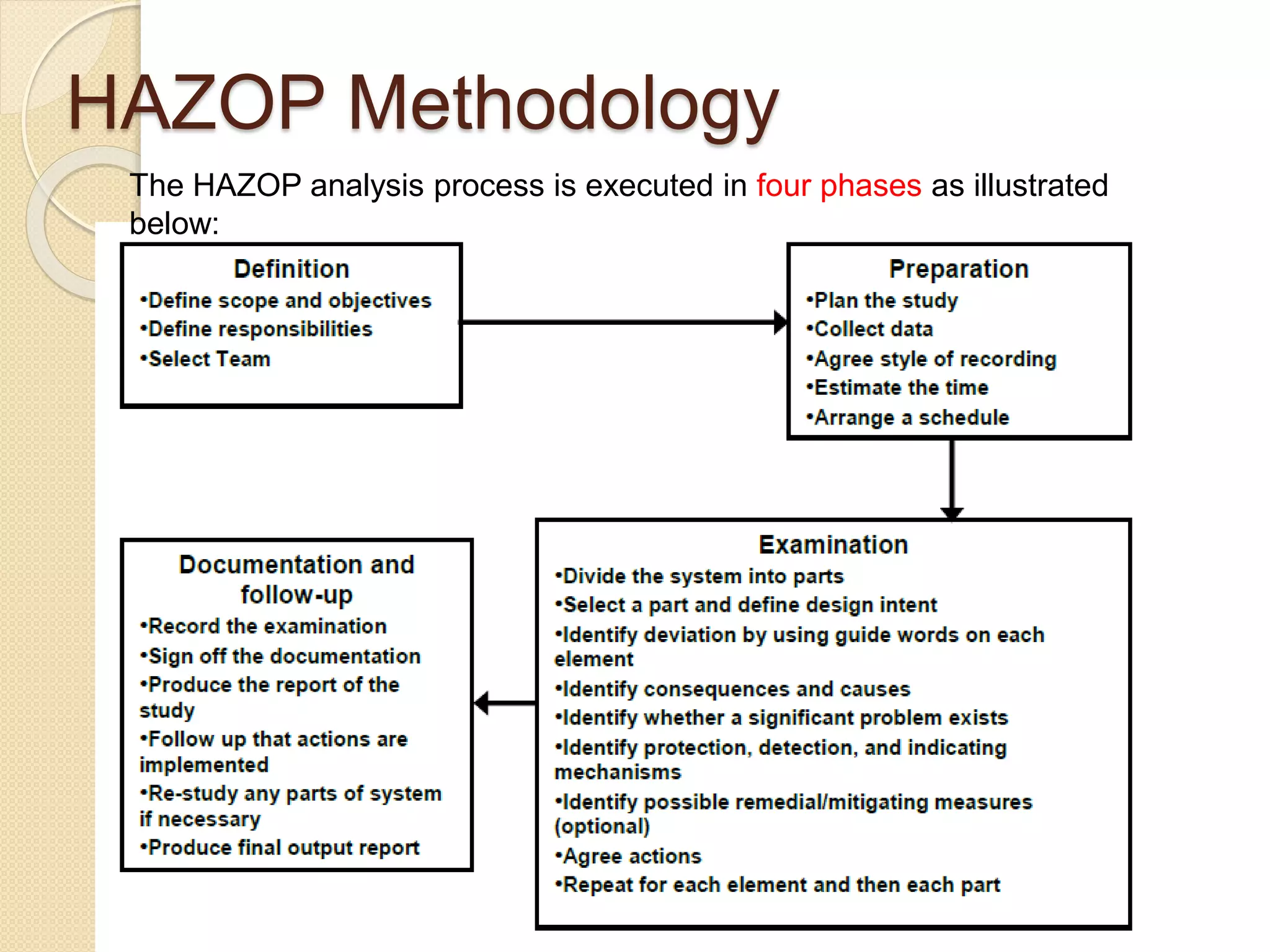
HAZOP Methodology
The HAZOP analysis process is executed in four phases as illustrated
below:
Definition Phase
 Begins with preliminary identification of risk assessment team
members.
 HAZOP is intended to be a cross-functional team effort and
relies on specialists (SMEs) from various disciplines with
appropriate skills and
experience who display intuition and good judgment.
 HAZOP should always be carried out in a climate of positive
thinking and frank discussion.
 The risk assessment team must identify the assessment
scope carefully in order to focus effort.
HAZOP Team Composition
 A Leader (Chairman) - the person who leads and
facilitates the HAZOP study by asking questions of the
team and encourage team to draw conclusion.
 Secretary (Recorder) - the person who records the
discussions (worksheet) and produce final report.
• Team members - who represent of each of the key
disciplines involved in the facility such as Process
design, Operations, Control & Instrument, Safety, etc.
Team members provide essential inputs and discussions
to HAZOP study as per their knowledge and experience
of the process under study
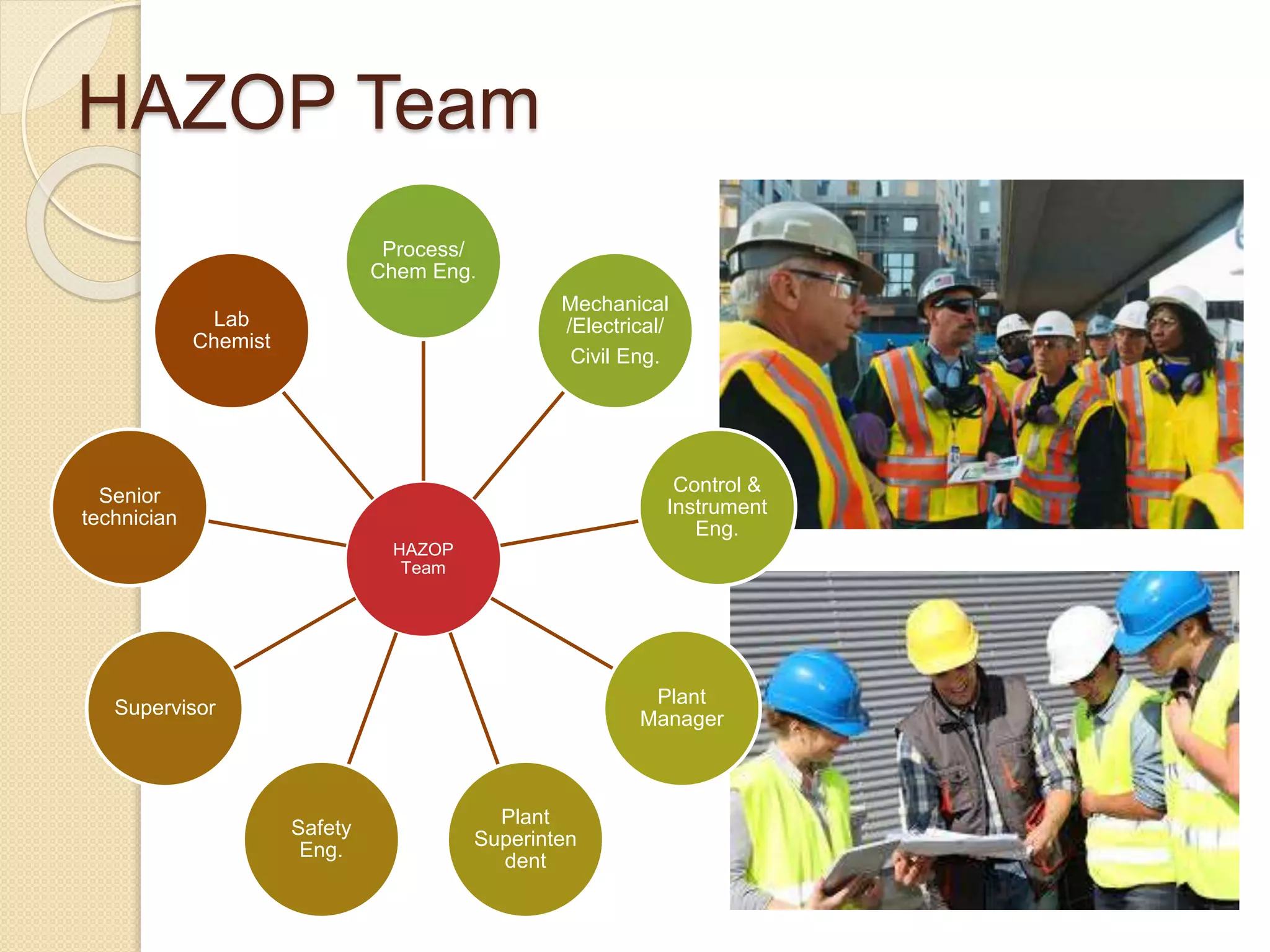
HAZOP Team
HAZOP
Team
Process/
Chem Eng.
Mechanical
/Electrical/
Civil Eng.
Control &
Instrument
Eng.
Plant
Manager
Plant
Superinten
dent
Safety
Eng.
Supervisor
Senior
technician
Lab
Chemist
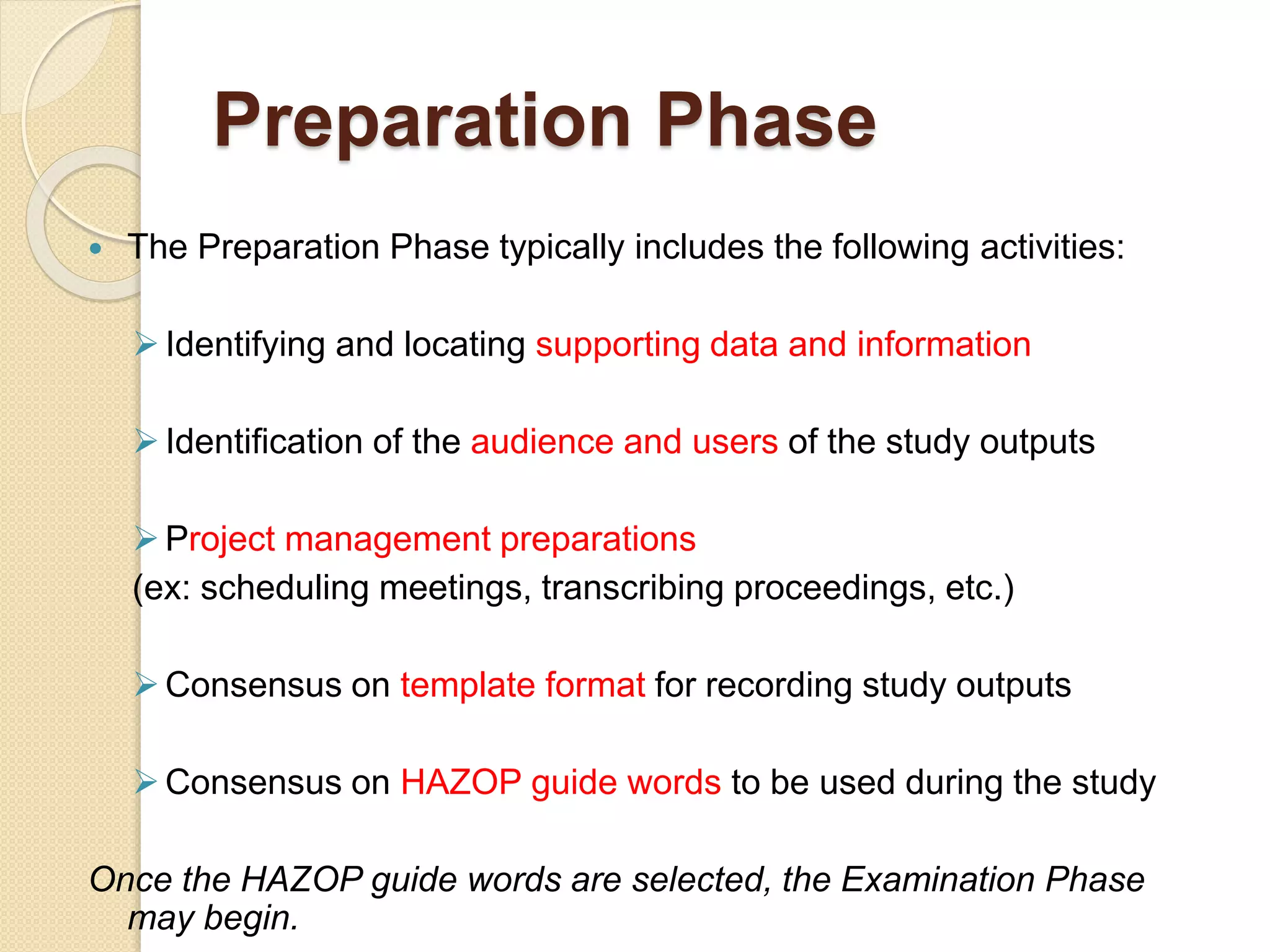
Preparation Phase
 The Preparation Phase typically includes the following activities:
Identifying and locating supporting data and information
Identification of the audience and users of the study outputs
Project management preparations
(ex: scheduling meetings, transcribing proceedings, etc.)
Consensus on template format for recording study outputs
Consensus on HAZOP guide words to be used during the study
Once the HAZOP guide words are selected, the Examination Phase
may begin.
Documents Needed for HAZOP
Study
 For Preliminary HAZOP
 Process Flow Sheet ( PFS or PFD )
 Description of the Process
 For Detailed HAZOP
 Piping and Instrumentation Diagram ( P & ID )
 Process Calculations
 Process Data Sheets
 Instrument Data Sheets
 Interlock Schedules (Cause and Effect Chart)
 Layout Requirements
 Hazardous Area Classification
 Description of the Process
 Incident Records (for existing plant HAZOP)
 Modification Records (for existing plant HAZOP)
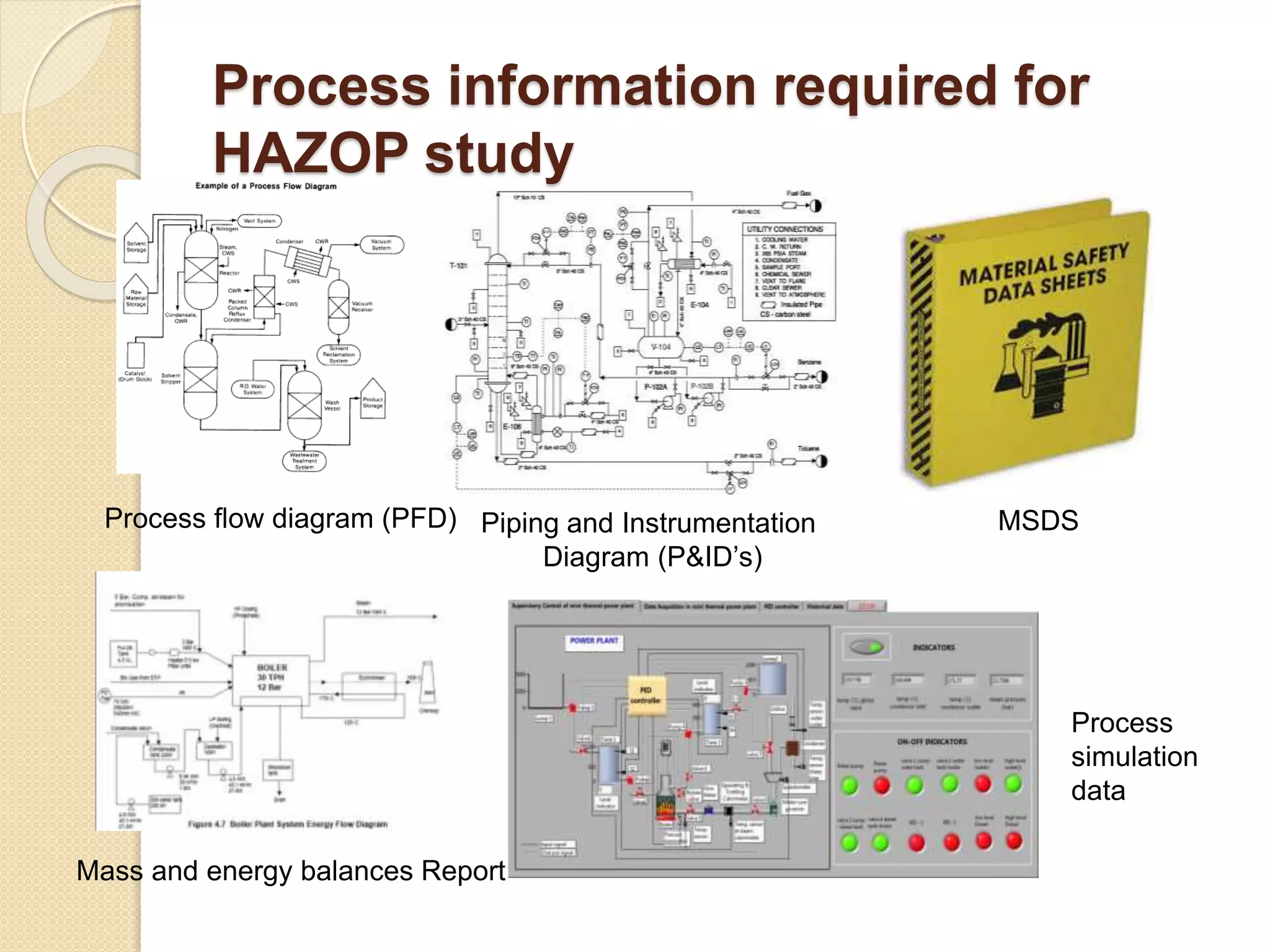
Process information required for
HAZOP study
Process flow diagram (PFD) Piping and Instrumentation
Diagram (P&ID’s)
MSDS
Mass and energy balances Report
Process
simulation
data
Examination Phase
 The Examination Phase begins with identification of all
elements (parts or steps) of the system or process to be
examined.
For example:
Physical systems may be broken down into smaller parts as
necessary
Processes may be broken down into discrete steps or
phases
Similar parts or steps may be grouped together to facilitate
assessment
 The HAZOP guide words are then applied to each of the
elements. (not all combinations of guide words and elements
are expected to yield sensible or credible deviation
possibilities)
Documentation & Follow-up
Phase
 The documentation of HAZOP analyses is often facilitated by
utilizing a template recording form as detailed in IEC Standard
61882.
 Risk assessment teams may modify the template as necessary
based on factors such as:
Regulatory requirements
Need for more explicit risk rating or prioritization
Company documentation policies
Needs for traceability or audit readiness
Other factors
 A typical HAZOP recording template is shown on the following slide
HAZOP Recording Template
Example
HAZOP
PROCEDURE
Start
Divide the plant
into various study
nodes or units
Take one
unit or study
node at a
moment
Compare the study
node with the unit
of Information
Base
Expert
INFORMATION
BASE
Is unit
matching
?
Yes
Apply guide
words
Analyze the causes
and consequences
of the deviation
drawn from the
INFORMATION
BASE
Add or remove
causes and
consequences due
to special behavior
of unit
Are all
deviation
s over?
No
No
Yes
Are all
study
nodes
over?
No
Yes
Prepare HAZOP
report
Stop
HAZOP PROCEDURE
1. Begin with
detailed and up
to date process
info.
2. Divide into
separate units
and perform the
HAZOP study
for each unit.
3. Choose a
study node for
the selected
unit.
4. Provide brief
description of
the
function/design
intention of the
study node.
5. Pick a
process
parameter.
HAZOP Procedure
cont’..
6. Apply guide
words/deviations
to the process
parameter to
suggest possible
deviations.
7. For each
deviations,
determine
possible causes
and note any
protective
systems.
8. Evaluate the
consequences of
the deviations (if
any).
9. Recommend
action.
10. Record all
information (in
HAZOP form).
HAZOP Procedure cont’..
11. Repeat step
5 through 9 until
all applicable
guide words
have been
applied on the
chosen process
parameter.
12. Repeat step
4 through 11
until all
applicable
process
parameters
have been
considered for
the given study
node
13. Repeat steps
2 through 12
until all study
nodes have
been
considered for
the given
section
14. Process to
the next section
and repeat
steps 2 through
13 until all
sections have
been
considered for
the process
plant.
15. HAZOP
study complete.
A P&ID for Phosgene
reactor
A reactor
as the unit
What is unit?
What is node?
NODE: Concentrate on one location in
the process
Coolin
g coils
as
node 1
Stirrer
as
node 2
Function of the study node
Study node
• Cooling coils
• stirrer
Function/design
intention
• To remove
excessive
energy of
reaction
• To promote
mixing of
reactants
Process
parameter
• Flow
• Temperature
• Agitation
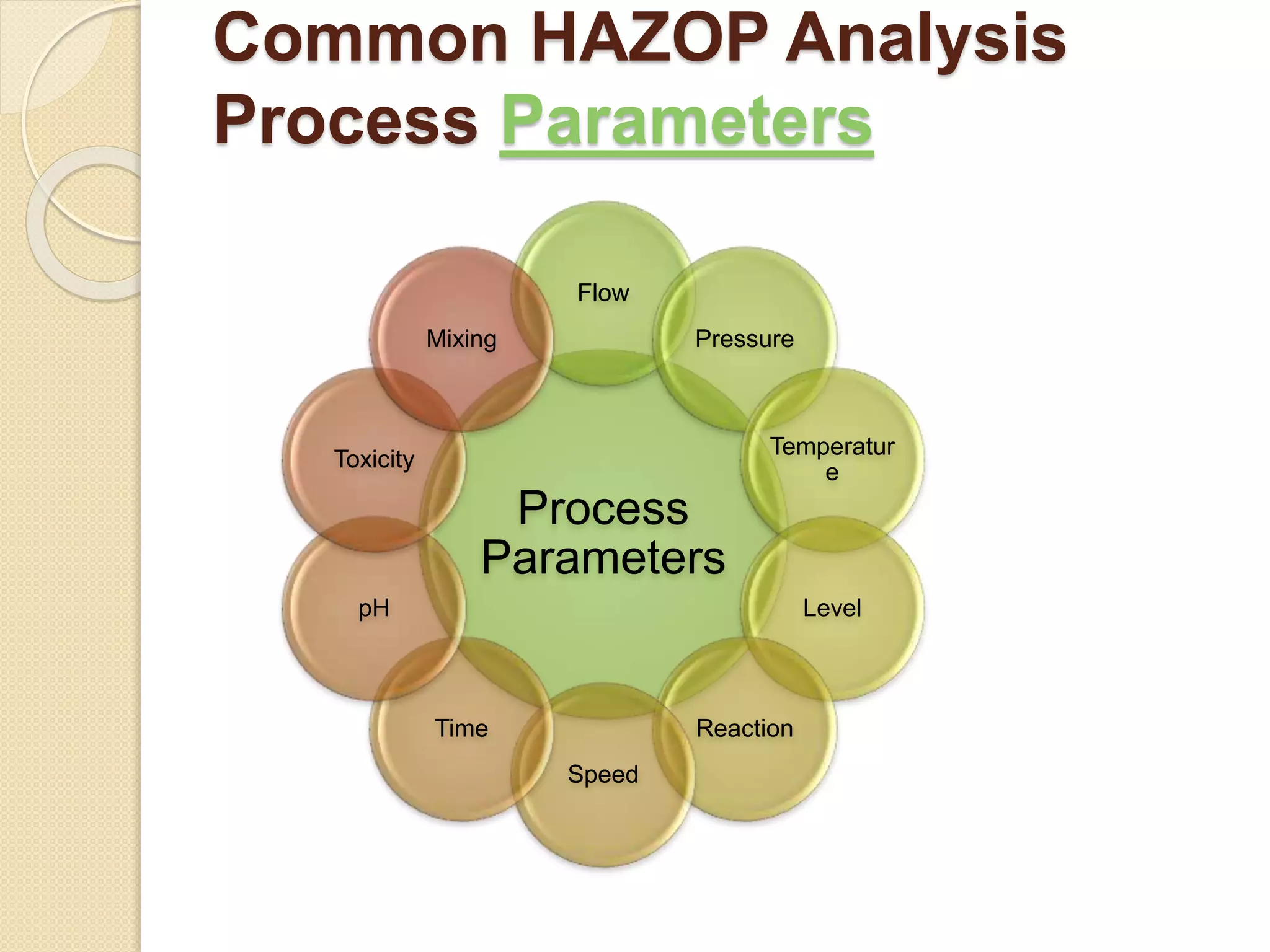
Common HAZOP Analysis
Process Parameters
Process
Parameters
Flow
Pressure
Temperatur
e
Level
Reaction
Speed
Time
pH
Toxicity
Mixing
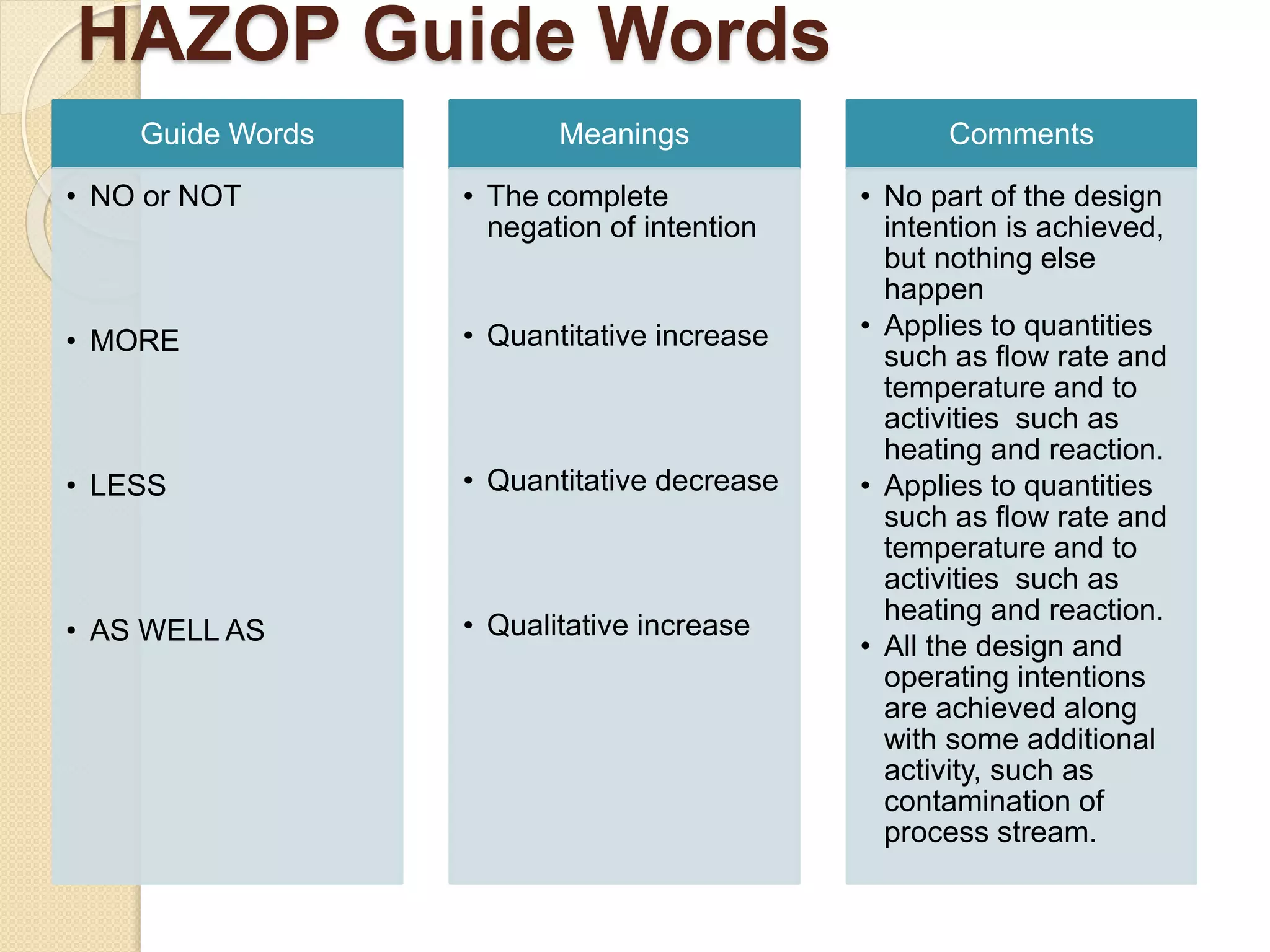
HAZOP Guide Words
Guide Words
• NO or NOT
• MORE
• LESS
• AS WELL AS
Meanings
• The complete
negation of intention
• Quantitative increase
• Quantitative decrease
• Qualitative increase
Comments
• No part of the design
intention is achieved,
but nothing else
happen
• Applies to quantities
such as flow rate and
temperature and to
activities such as
heating and reaction.
• Applies to quantities
such as flow rate and
temperature and to
activities such as
heating and reaction.
• All the design and
operating intentions
are achieved along
with some additional
activity, such as
contamination of
process stream.
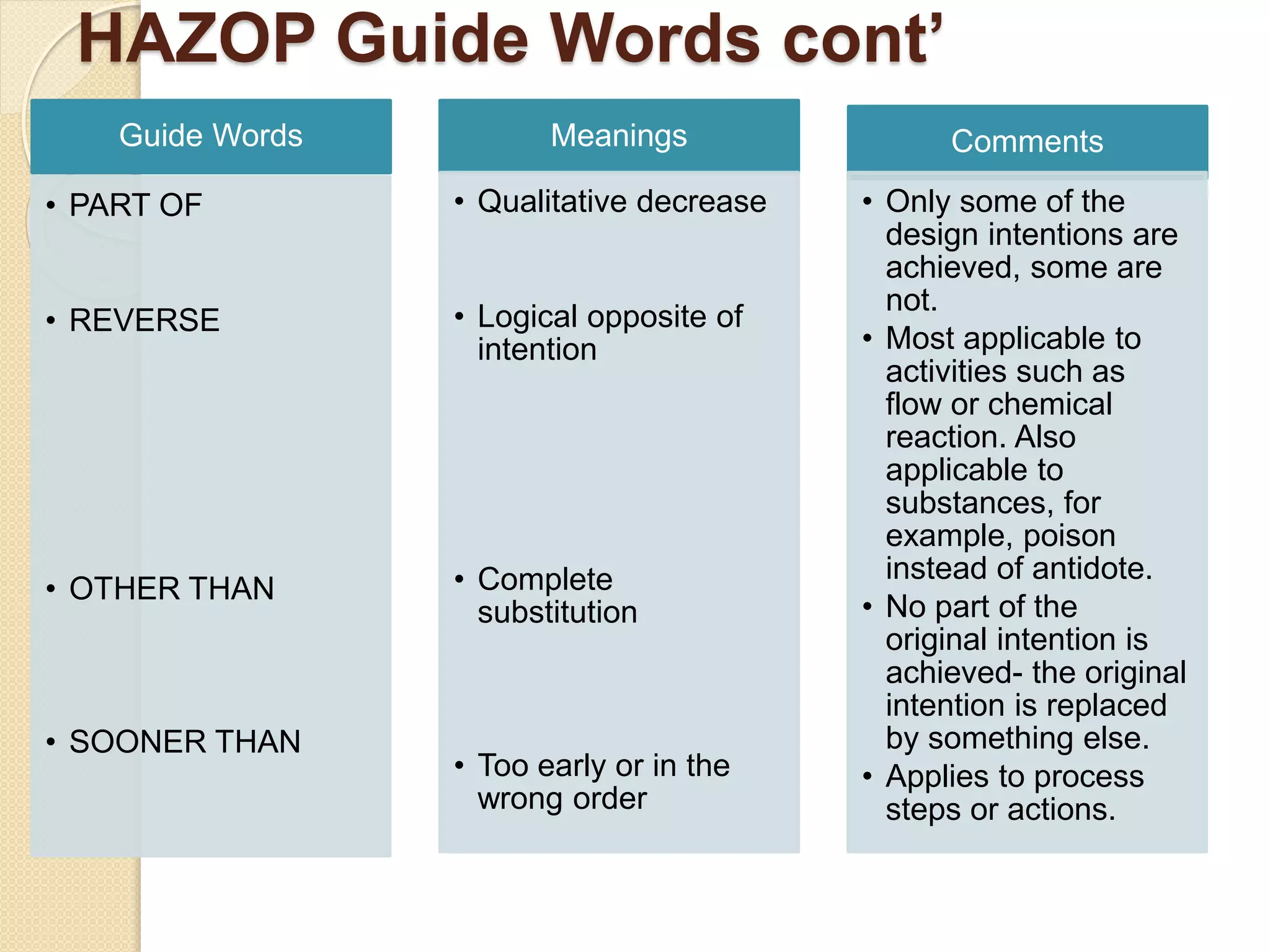
HAZOP Guide Words cont’
Guide Words
• PART OF
• REVERSE
• OTHER THAN
• SOONER THAN
Meanings
• Qualitative decrease
• Logical opposite of
intention
• Complete
substitution
• Too early or in the
wrong order
Comments
• Only some of the
design intentions are
achieved, some are
not.
• Most applicable to
activities such as
flow or chemical
reaction. Also
applicable to
substances, for
example, poison
instead of antidote.
• No part of the
original intention is
achieved- the original
intention is replaced
by something else.
• Applies to process
steps or actions.
HAZOP Guide Words cont’
Guide Words
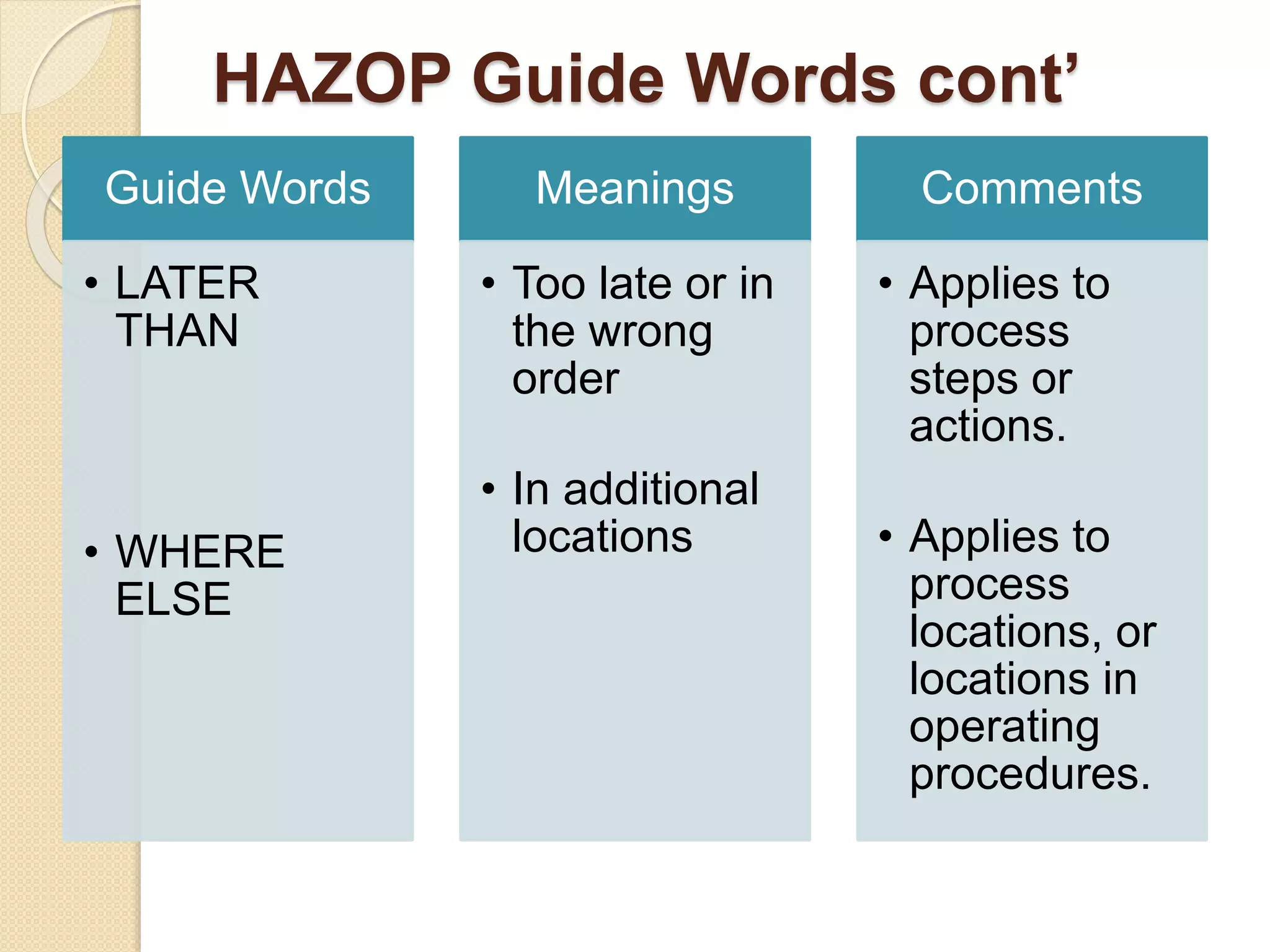
• LATER
THAN
• WHERE
ELSE
Meanings
• Too late or in
the wrong
order
• In additional
locations
Comments
• Applies to
process
steps or
actions.
• Applies to
process
locations, or
locations in
operating
procedures.
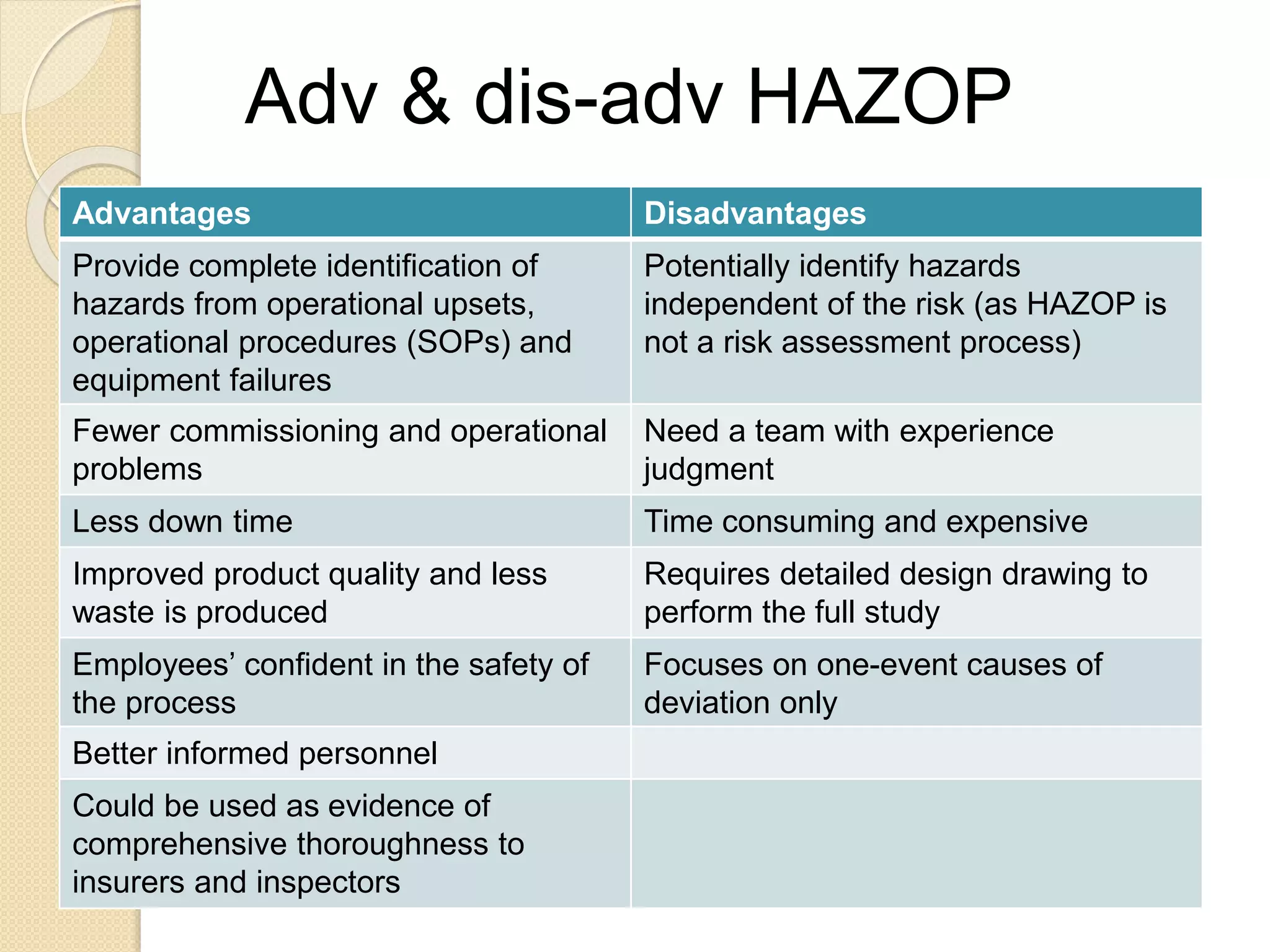
Advantages Disadvantages
Provide complete identification of
hazards from operational upsets,
operational procedures (SOPs) and
equipment failures
Potentially identify hazards
independent of the risk (as HAZOP is
not a risk assessment process)
Fewer commissioning and operational
problems
Need a team with experience
judgment
Less down time Time consuming and expensive
Improved product quality and less
waste is produced
Requires detailed design drawing to
perform the full study
Employees’ confident in the safety of
the process
Focuses on one-event causes of
deviation only
Better informed personnel
Could be used as evidence of
comprehensive thoroughness to
insurers and inspectors
Adv & dis-adv HAZOP
References
1. Guides, R. M. (n.d.). Manufacturing Technology Committee – Risk
Management Working Group. Retrieved March 26, 2015, from Risk
Management Training
Guides:http://images.alfresco.advanstar.com/alfresco_images/phar
ma/2014/08/21/347197a7-b965-45fe-ac72-daeeb77baa21/article-
727769.pdf
2. LABORATORY, H. A. (2000). REVIEW OF HAZARD
IDENTIFICATION. Retrieved March 26, 2015 , from HEALTH AND
SAFETY
LABORATORY:http://www.hse.gov.uk/research/hsl_pdf/2005/hsl05
58.pdf
3. Planning, N. G. (2008, July). Hazardous Industry Planning.
Retrieved March 26, 2015, from
http://www.planning.nsw.gov.au/plansforaction/pdf/hazards/haz_hip
ap8_rev2008.pdf

Hazop group 7

  • 1.
    KESELAMATAN DAN KESIHATANPEKERJAAN (KAS3501) Semester II 2014/2015 Group 7 Presentation date : 1 april 2015 NO.MATRI C NAME UK29510 MASITAH BINTI RANI UK29551 LIM XIN YI UK29512 ILANI BINTI ZAMRI UK29526 ZULFUAZ BINTI RAMSAH UK29514 NUR SAADIAH BINTI ZAINI
  • 2.
    Hazard and OperabilityStudies (HAZOP)
  • 3.
    What is HAZOP?? A formal procedure to identify hazards in a chemical process facility.  Systematic, comprehensive, effective, flexible and well accepted.  Identify all the possibilities where processes and operation can go wrong.  For large process, the studies could take months of biweekly meetings to complete.
  • 4.
    Purpose and objectiveof HAZOP • HAZOP identifies potential hazards , failures and operability problems. • Its use is recommended as a principal method by professional institutions and legislators on the basis of proven capabilities for over 40 years. • It is most effective as a team effort consists of plant and prices designers, operating personnel, control and instrumentation engineer etc.
  • 5.
    • It encouragescreativity in design concept evaluation. • Its use results in fewer commissioning and operational problems and better informed personnel, thus confirming overall cost effectiveness improvement. • HAZOP reports are an integral part of plant and safety records and are also applicable to design changes and plant modifications, thereby containing accountability for equipment and its associated human interface throughout the operating lifetime
  • 6.
    • Necessary changesto a system for eliminating or reducing the probability of operating deviations are suggested by the analytical procedure. • HAZOP provides a necessary management tool and bonus in so far that it demonstrates to insurers and inspectors evidence of comprehensive thoroughness.
  • 7.
    HAZOP Methodology The HAZOPanalysis process is executed in four phases as illustrated below:
  • 8.
    Definition Phase  Beginswith preliminary identification of risk assessment team members.  HAZOP is intended to be a cross-functional team effort and relies on specialists (SMEs) from various disciplines with appropriate skills and experience who display intuition and good judgment.  HAZOP should always be carried out in a climate of positive thinking and frank discussion.  The risk assessment team must identify the assessment scope carefully in order to focus effort.
  • 9.
    HAZOP Team Composition A Leader (Chairman) - the person who leads and facilitates the HAZOP study by asking questions of the team and encourage team to draw conclusion.  Secretary (Recorder) - the person who records the discussions (worksheet) and produce final report. • Team members - who represent of each of the key disciplines involved in the facility such as Process design, Operations, Control & Instrument, Safety, etc. Team members provide essential inputs and discussions to HAZOP study as per their knowledge and experience of the process under study
  • 10.
    HAZOP Team HAZOP Team Process/ Chem Eng. Mechanical /Electrical/ CivilEng. Control & Instrument Eng. Plant Manager Plant Superinten dent Safety Eng. Supervisor Senior technician Lab Chemist
  • 11.
    Preparation Phase  ThePreparation Phase typically includes the following activities: Identifying and locating supporting data and information Identification of the audience and users of the study outputs Project management preparations (ex: scheduling meetings, transcribing proceedings, etc.) Consensus on template format for recording study outputs Consensus on HAZOP guide words to be used during the study Once the HAZOP guide words are selected, the Examination Phase may begin.
  • 12.
    Documents Needed forHAZOP Study  For Preliminary HAZOP  Process Flow Sheet ( PFS or PFD )  Description of the Process  For Detailed HAZOP  Piping and Instrumentation Diagram ( P & ID )  Process Calculations  Process Data Sheets  Instrument Data Sheets  Interlock Schedules (Cause and Effect Chart)  Layout Requirements  Hazardous Area Classification  Description of the Process  Incident Records (for existing plant HAZOP)  Modification Records (for existing plant HAZOP)
  • 13.
    Process information requiredfor HAZOP study Process flow diagram (PFD) Piping and Instrumentation Diagram (P&ID’s) MSDS Mass and energy balances Report Process simulation data
  • 14.
    Examination Phase  TheExamination Phase begins with identification of all elements (parts or steps) of the system or process to be examined. For example: Physical systems may be broken down into smaller parts as necessary Processes may be broken down into discrete steps or phases Similar parts or steps may be grouped together to facilitate assessment  The HAZOP guide words are then applied to each of the elements. (not all combinations of guide words and elements are expected to yield sensible or credible deviation possibilities)
  • 15.
    Documentation & Follow-up Phase The documentation of HAZOP analyses is often facilitated by utilizing a template recording form as detailed in IEC Standard 61882.  Risk assessment teams may modify the template as necessary based on factors such as: Regulatory requirements Need for more explicit risk rating or prioritization Company documentation policies Needs for traceability or audit readiness Other factors  A typical HAZOP recording template is shown on the following slide
  • 16.
  • 17.
  • 18.
    HAZOP PROCEDURE Start Divide the plant intovarious study nodes or units Take one unit or study node at a moment Compare the study node with the unit of Information Base Expert INFORMATION BASE Is unit matching ? Yes Apply guide words Analyze the causes and consequences of the deviation drawn from the INFORMATION BASE Add or remove causes and consequences due to special behavior of unit Are all deviation s over? No No Yes Are all study nodes over? No Yes Prepare HAZOP report Stop
  • 19.
    HAZOP PROCEDURE 1. Beginwith detailed and up to date process info. 2. Divide into separate units and perform the HAZOP study for each unit. 3. Choose a study node for the selected unit. 4. Provide brief description of the function/design intention of the study node. 5. Pick a process parameter.
  • 20.
    HAZOP Procedure cont’.. 6. Applyguide words/deviations to the process parameter to suggest possible deviations. 7. For each deviations, determine possible causes and note any protective systems. 8. Evaluate the consequences of the deviations (if any). 9. Recommend action. 10. Record all information (in HAZOP form).
  • 21.
    HAZOP Procedure cont’.. 11.Repeat step 5 through 9 until all applicable guide words have been applied on the chosen process parameter. 12. Repeat step 4 through 11 until all applicable process parameters have been considered for the given study node 13. Repeat steps 2 through 12 until all study nodes have been considered for the given section 14. Process to the next section and repeat steps 2 through 13 until all sections have been considered for the process plant. 15. HAZOP study complete.
  • 22.
    A P&ID forPhosgene reactor A reactor as the unit What is unit?
  • 23.
    What is node? NODE:Concentrate on one location in the process Coolin g coils as node 1 Stirrer as node 2
  • 24.
    Function of thestudy node Study node • Cooling coils • stirrer Function/design intention • To remove excessive energy of reaction • To promote mixing of reactants Process parameter • Flow • Temperature • Agitation
  • 25.
    Common HAZOP Analysis ProcessParameters Process Parameters Flow Pressure Temperatur e Level Reaction Speed Time pH Toxicity Mixing
  • 26.
    HAZOP Guide Words GuideWords • NO or NOT • MORE • LESS • AS WELL AS Meanings • The complete negation of intention • Quantitative increase • Quantitative decrease • Qualitative increase Comments • No part of the design intention is achieved, but nothing else happen • Applies to quantities such as flow rate and temperature and to activities such as heating and reaction. • Applies to quantities such as flow rate and temperature and to activities such as heating and reaction. • All the design and operating intentions are achieved along with some additional activity, such as contamination of process stream.
  • 27.
    HAZOP Guide Wordscont’ Guide Words • PART OF • REVERSE • OTHER THAN • SOONER THAN Meanings • Qualitative decrease • Logical opposite of intention • Complete substitution • Too early or in the wrong order Comments • Only some of the design intentions are achieved, some are not. • Most applicable to activities such as flow or chemical reaction. Also applicable to substances, for example, poison instead of antidote. • No part of the original intention is achieved- the original intention is replaced by something else. • Applies to process steps or actions.
  • 28.
    HAZOP Guide Wordscont’ Guide Words • LATER THAN • WHERE ELSE Meanings • Too late or in the wrong order • In additional locations Comments • Applies to process steps or actions. • Applies to process locations, or locations in operating procedures.
  • 29.
    Advantages Disadvantages Provide completeidentification of hazards from operational upsets, operational procedures (SOPs) and equipment failures Potentially identify hazards independent of the risk (as HAZOP is not a risk assessment process) Fewer commissioning and operational problems Need a team with experience judgment Less down time Time consuming and expensive Improved product quality and less waste is produced Requires detailed design drawing to perform the full study Employees’ confident in the safety of the process Focuses on one-event causes of deviation only Better informed personnel Could be used as evidence of comprehensive thoroughness to insurers and inspectors Adv & dis-adv HAZOP
  • 30.
    References 1. Guides, R.M. (n.d.). Manufacturing Technology Committee – Risk Management Working Group. Retrieved March 26, 2015, from Risk Management Training Guides:http://images.alfresco.advanstar.com/alfresco_images/phar ma/2014/08/21/347197a7-b965-45fe-ac72-daeeb77baa21/article- 727769.pdf 2. LABORATORY, H. A. (2000). REVIEW OF HAZARD IDENTIFICATION. Retrieved March 26, 2015 , from HEALTH AND SAFETY LABORATORY:http://www.hse.gov.uk/research/hsl_pdf/2005/hsl05 58.pdf 3. Planning, N. G. (2008, July). Hazardous Industry Planning. Retrieved March 26, 2015, from http://www.planning.nsw.gov.au/plansforaction/pdf/hazards/haz_hip ap8_rev2008.pdf

Editor's Notes

  • #16 IEC Standard The International Electrotechnical Commission is a non-profit, non-governmental international standards organization that prepares and publishes International Standards for all electrical, electronic and related technologies