HAFIZ MUHAMMAD ATIF
Module: Problem Solving
Course: MSc Asset Integrity Management
Robert Gordon University, UK
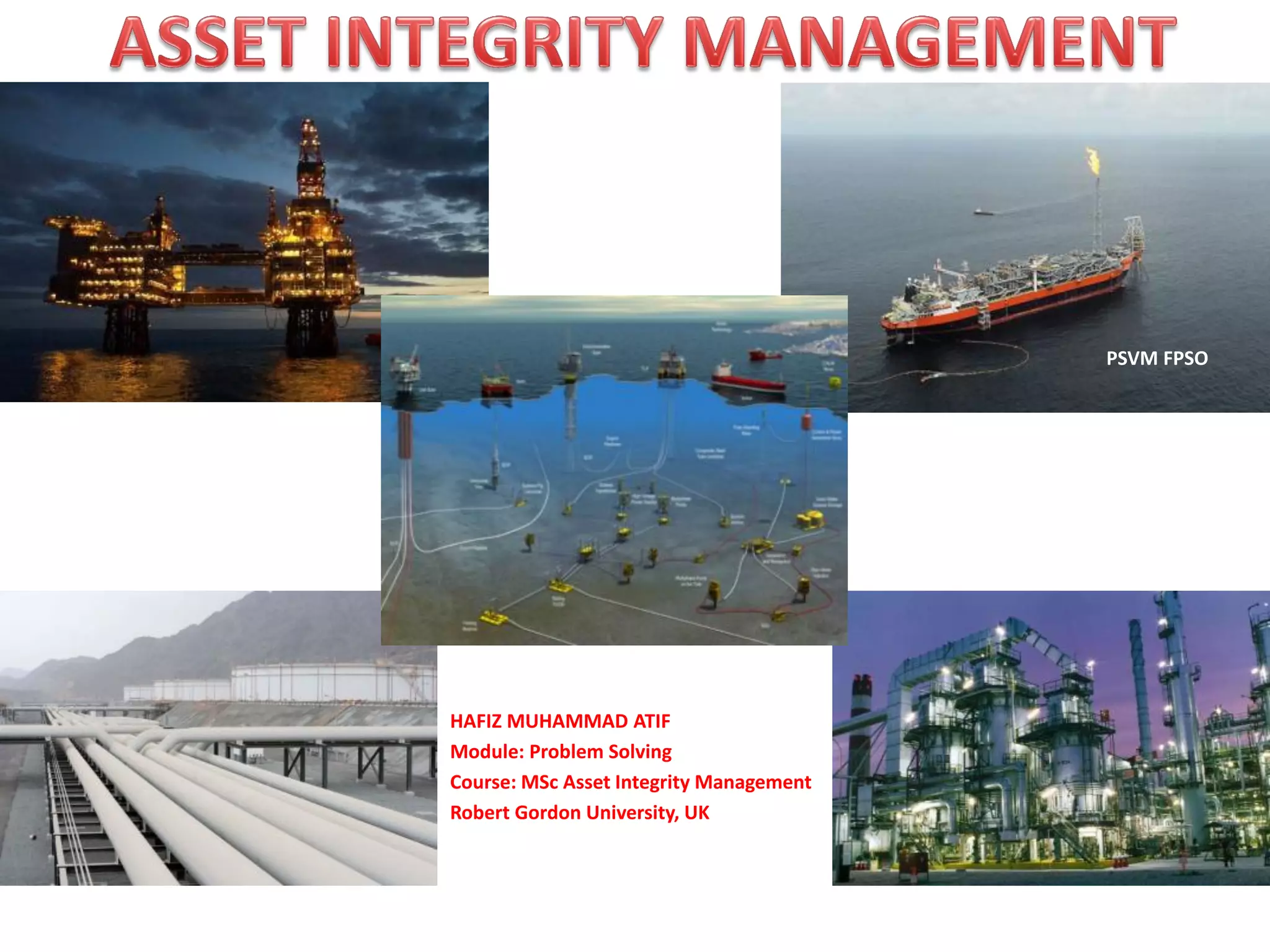
PSVM FPSO
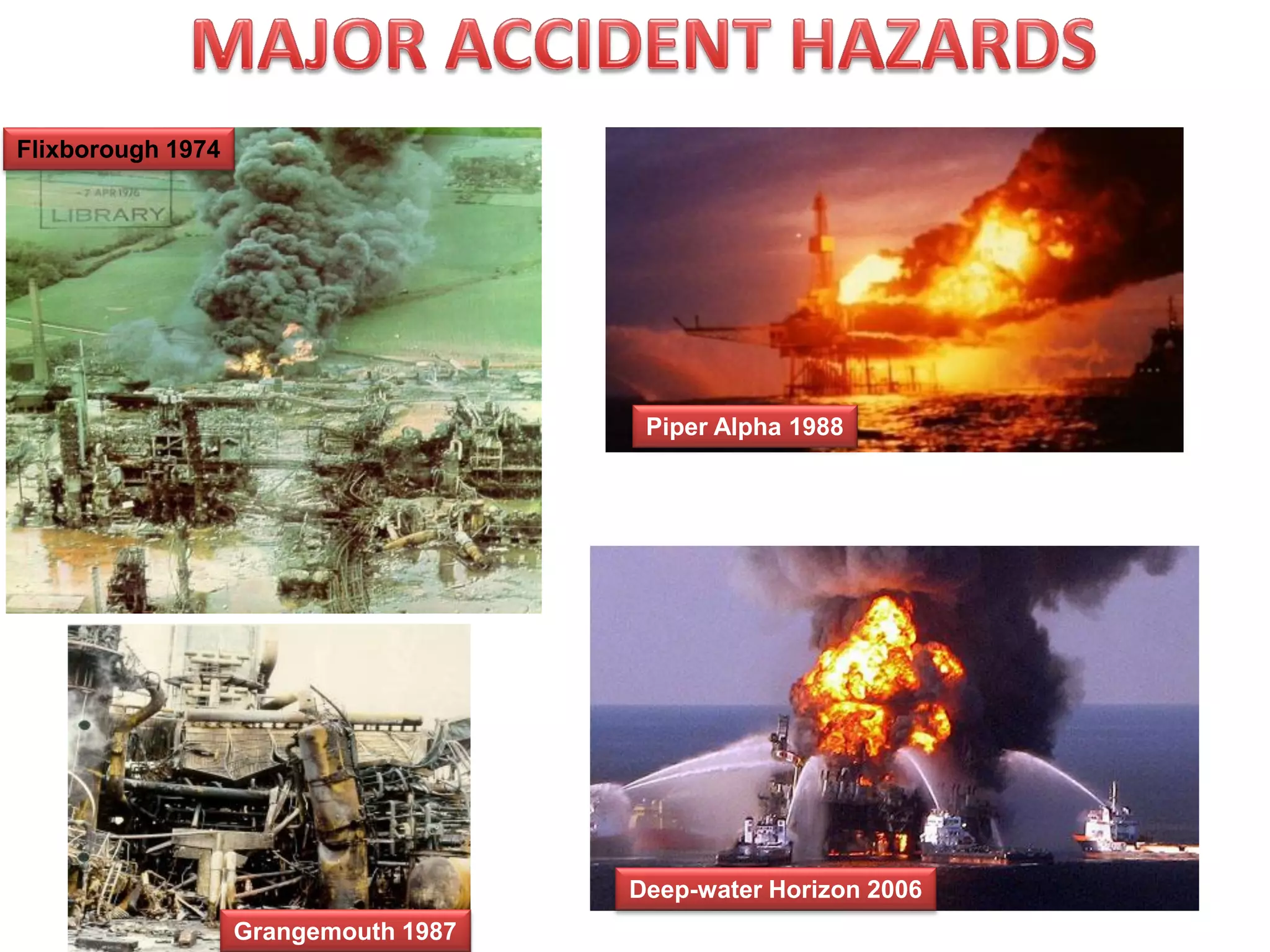
Flixborough 1974
Grangemouth 1987
Piper Alpha 1988
Deep-water Horizon 2006
 Incompetency
 Inappropriate Design
 No Identification of Barriers
 Absence of Process and Safety Management
 Absence of Integrity Management Strategy
 Absence of MOC process
 Operation outside the limits
 Absence of Reporting, Communication and Information Management
Asset Management
Systematic and Synchronized activities through which
organizations manage their assets optimal and sustainable over
their life cycle to accomplish organizations strategic plans
Asset Integrity Management
To manage the integrity over the life cycle of an asset.
Asset Integrity
Ability of an asset to perform its function effectively and
efficiently though protection the health, safety and
environment.
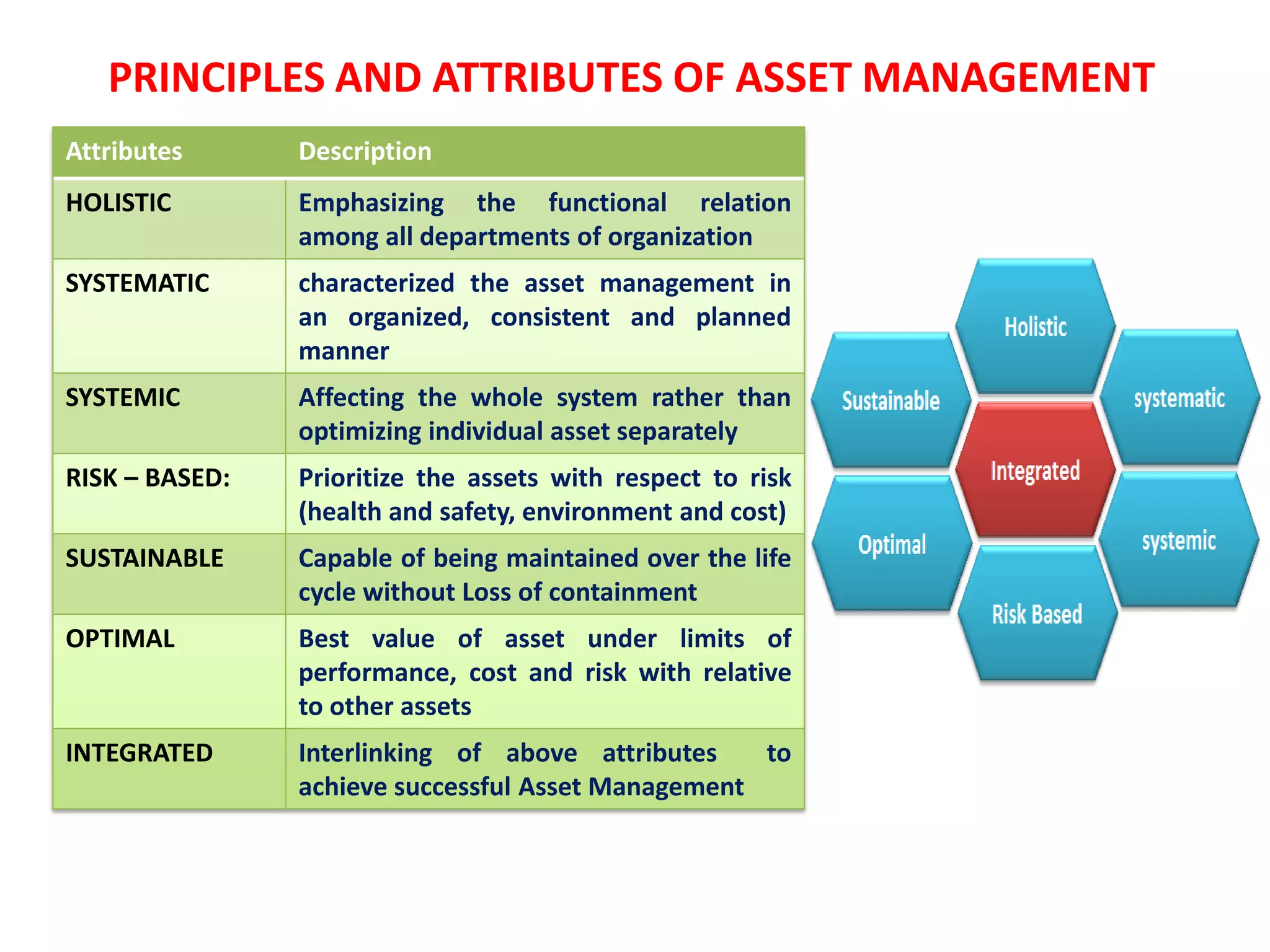
PRINCIPLES AND ATTRIBUTES OF ASSET MANAGEMENT
Attributes Description
HOLISTIC Emphasizing the functional relation
among all departments of organization
SYSTEMATIC characterized the asset management in
an organized, consistent and planned
manner
SYSTEMIC Affecting the whole system rather than
optimizing individual asset separately
RISK – BASED: Prioritize the assets with respect to risk
(health and safety, environment and cost)
SUSTAINABLE Capable of being maintained over the life
cycle without Loss of containment
OPTIMAL Best value of asset under limits of
performance, cost and risk with relative
to other assets
INTEGRATED Interlinking of above attributes to
achieve successful Asset Management
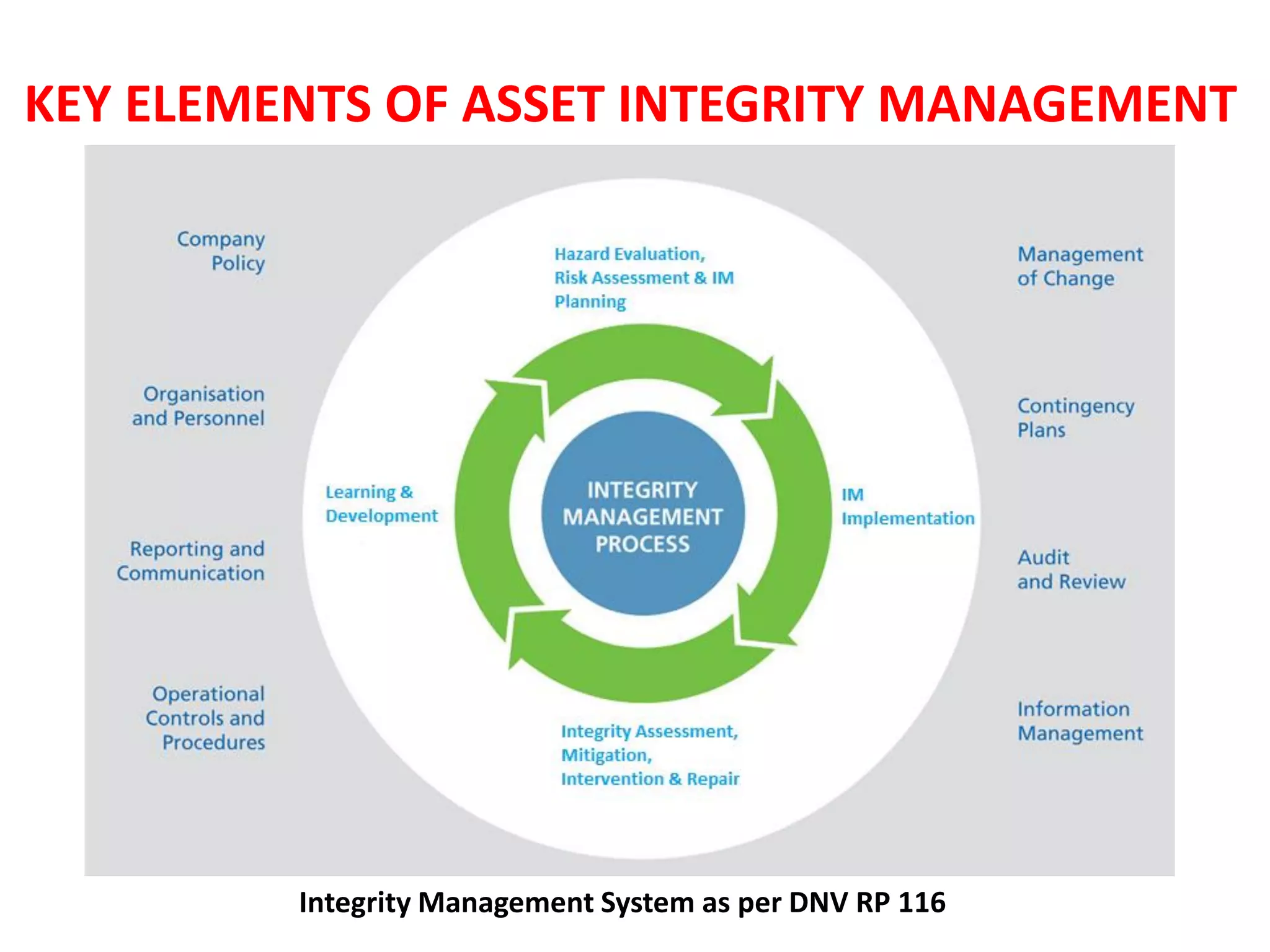
KEY ELEMENTS OF ASSET INTEGRITY MANAGEMENT
Integrity Management System as per DNV RP 116
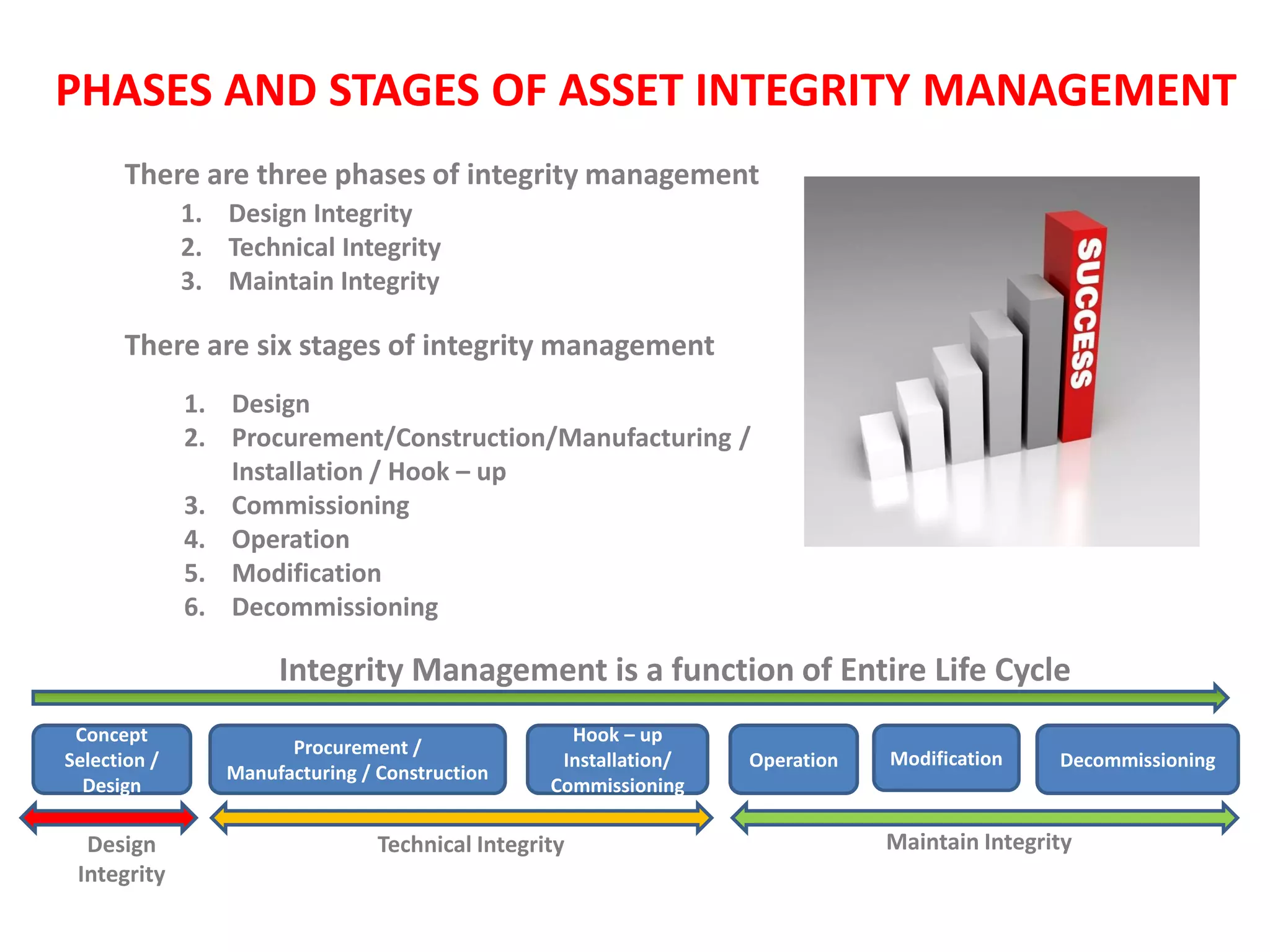
Concept
Selection /
Design
DecommissioningOperation
Hook – up
Installation/
Commissioning
Procurement /
Manufacturing / Construction
Integrity Management is a function of Entire Life Cycle
Maintain IntegrityDesign
Integrity
Technical Integrity
PHASES AND STAGES OF ASSET INTEGRITY MANAGEMENT
There are three phases of integrity management
1. Design Integrity
2. Technical Integrity
3. Maintain Integrity
1. Design
2. Procurement/Construction/Manufacturing /
Installation / Hook – up
3. Commissioning
4. Operation
5. Modification
6. Decommissioning
There are six stages of integrity management
Modification
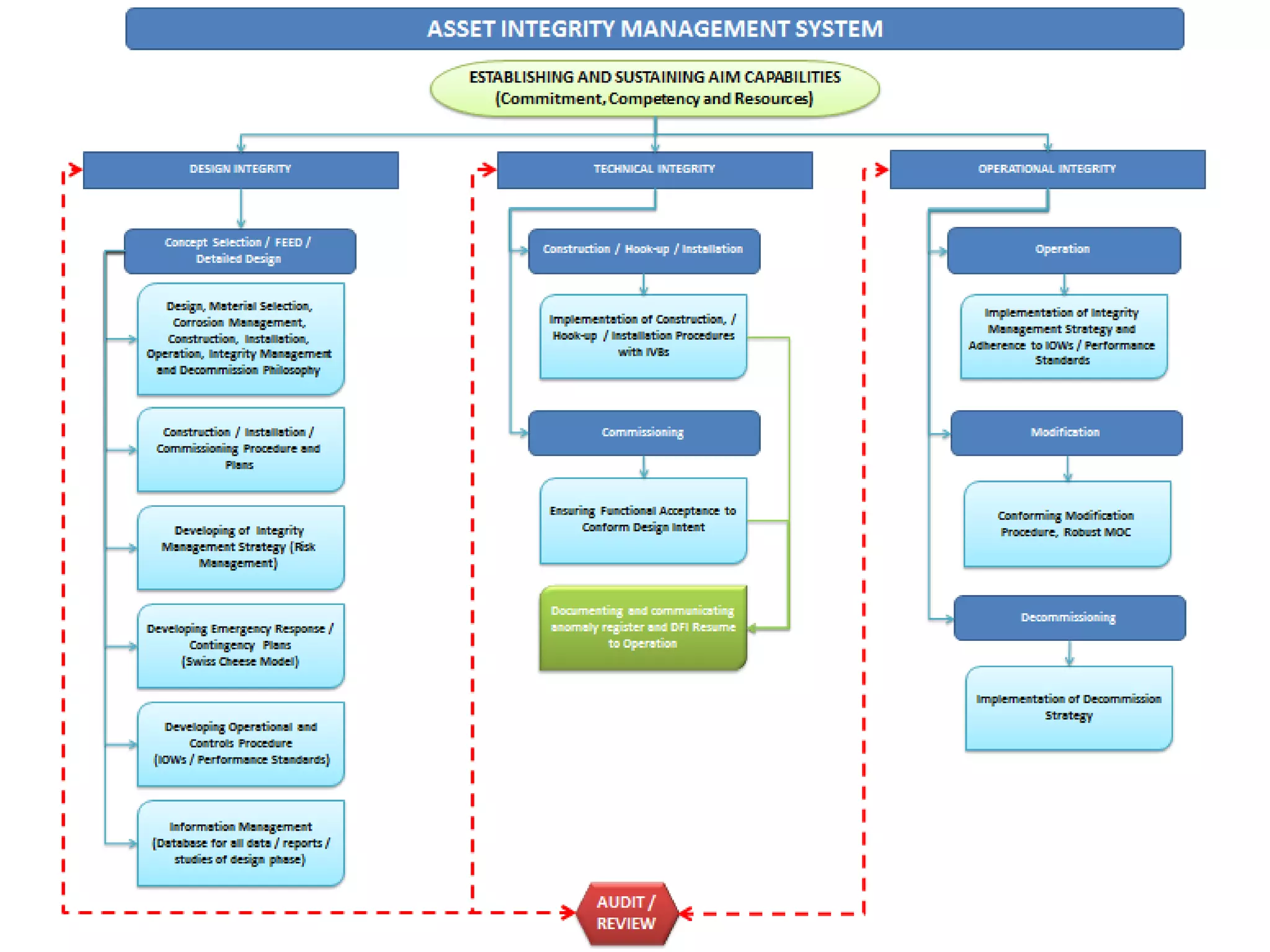
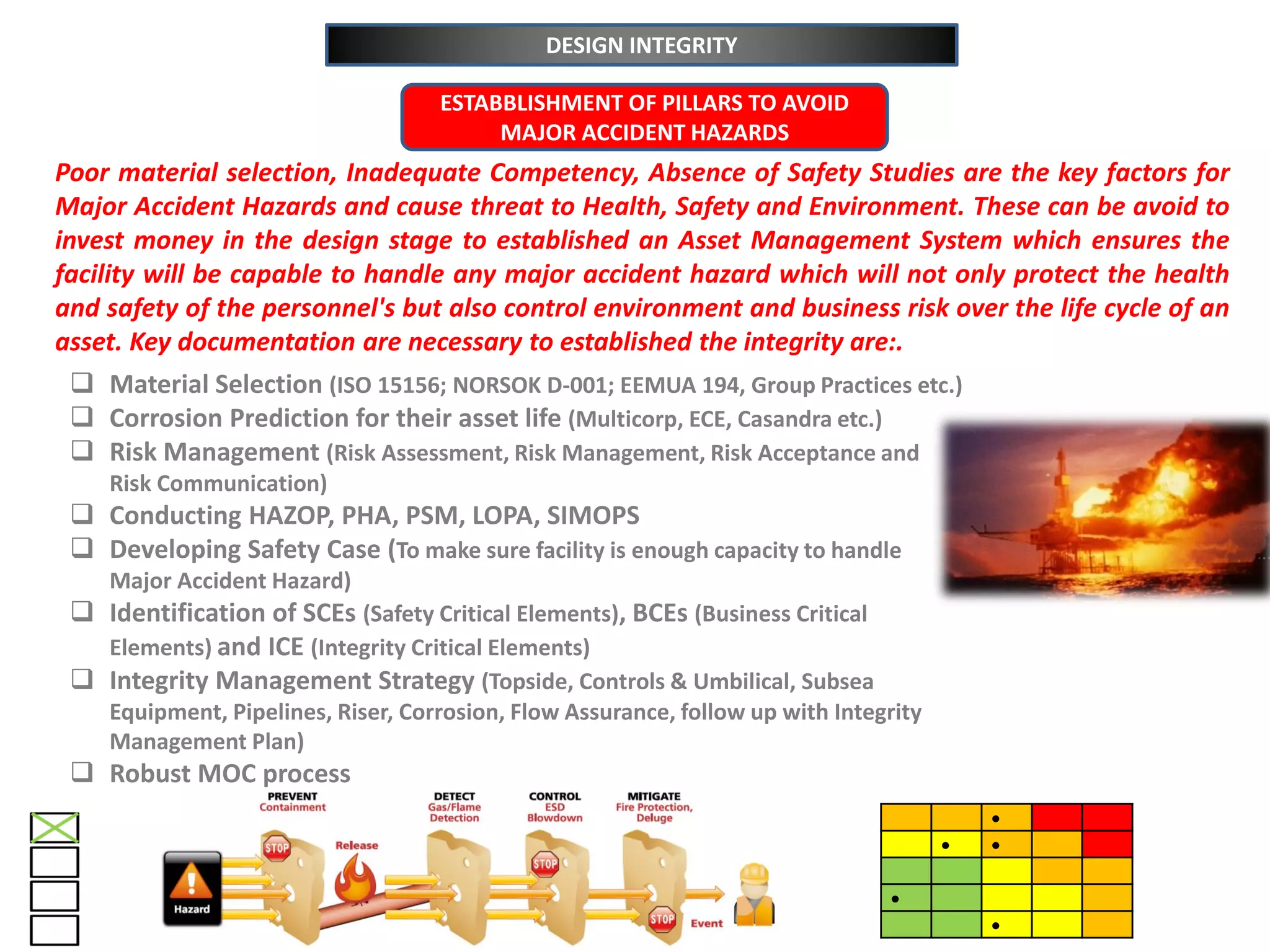
DESIGN INTEGRITY
ESTABBLISHMENT OF PILLARS TO AVOID
MAJOR ACCIDENT HAZARDS

 


Poor material selection, Inadequate Competency, Absence of Safety Studies are the key factors for
Major Accident Hazards and cause threat to Health, Safety and Environment. These can be avoid to
invest money in the design stage to established an Asset Management System which ensures the
facility will be capable to handle any major accident hazard which will not only protect the health
and safety of the personnel's but also control environment and business risk over the life cycle of an
asset. Key documentation are necessary to established the integrity are:.
 Material Selection (ISO 15156; NORSOK D-001; EEMUA 194, Group Practices etc.)
 Corrosion Prediction for their asset life (Multicorp, ECE, Casandra etc.)
 Risk Management (Risk Assessment, Risk Management, Risk Acceptance and
Risk Communication)
 Conducting HAZOP, PHA, PSM, LOPA, SIMOPS
 Developing Safety Case (To make sure facility is enough capacity to handle
Major Accident Hazard)
 Identification of SCEs (Safety Critical Elements), BCEs (Business Critical
Elements) and ICE (Integrity Critical Elements)
 Integrity Management Strategy (Topside, Controls & Umbilical, Subsea
Equipment, Pipelines, Riser, Corrosion, Flow Assurance, follow up with Integrity
Management Plan)
 Robust MOC process
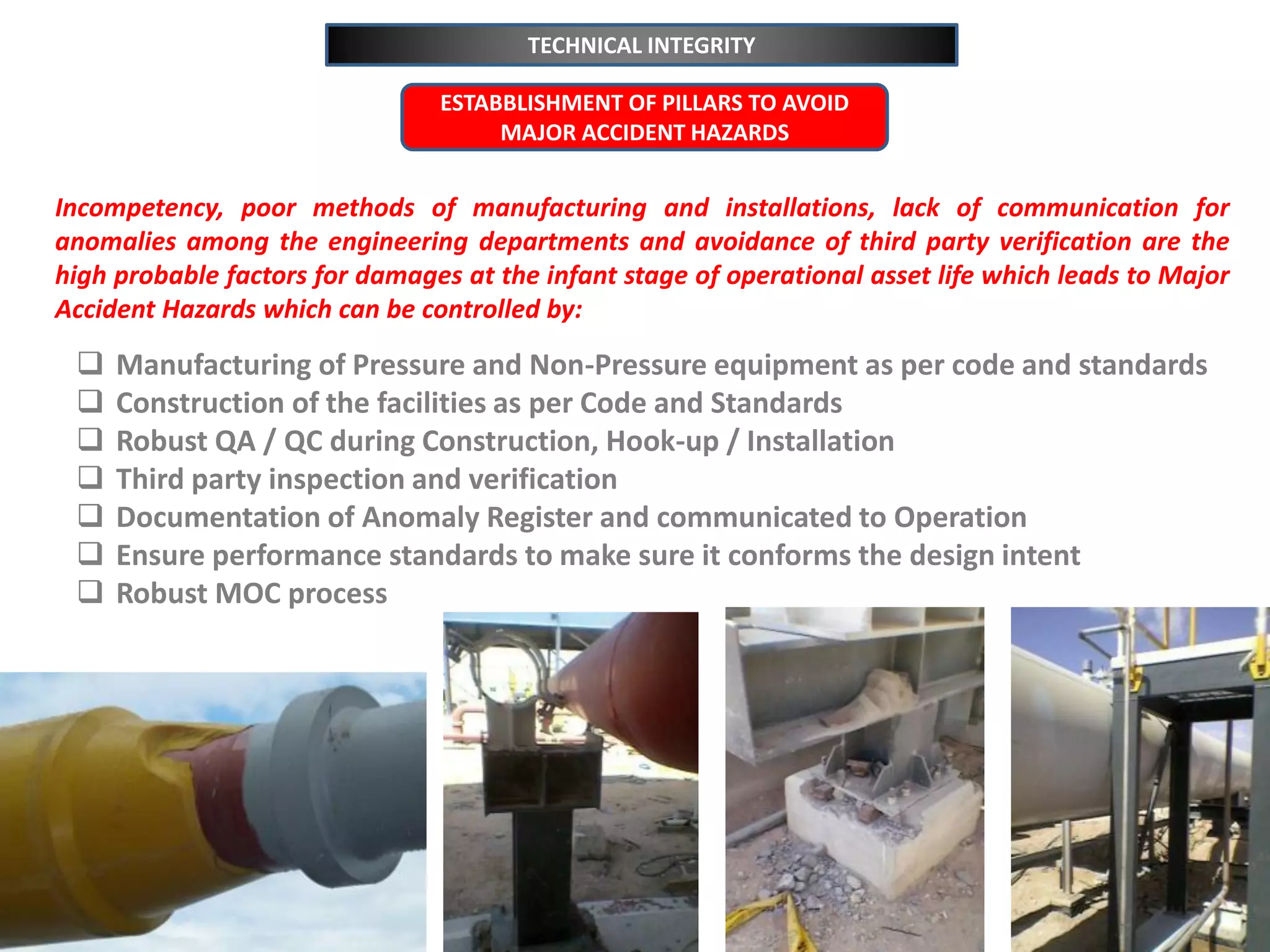
TECHNICAL INTEGRITY
 Manufacturing of Pressure and Non-Pressure equipment as per code and standards
 Construction of the facilities as per Code and Standards
 Robust QA / QC during Construction, Hook-up / Installation
 Third party inspection and verification
 Documentation of Anomaly Register and communicated to Operation
 Ensure performance standards to make sure it conforms the design intent
 Robust MOC process
ESTABBLISHMENT OF PILLARS TO AVOID
MAJOR ACCIDENT HAZARDS
Incompetency, poor methods of manufacturing and installations, lack of communication for
anomalies among the engineering departments and avoidance of third party verification are the
high probable factors for damages at the infant stage of operational asset life which leads to Major
Accident Hazards which can be controlled by:
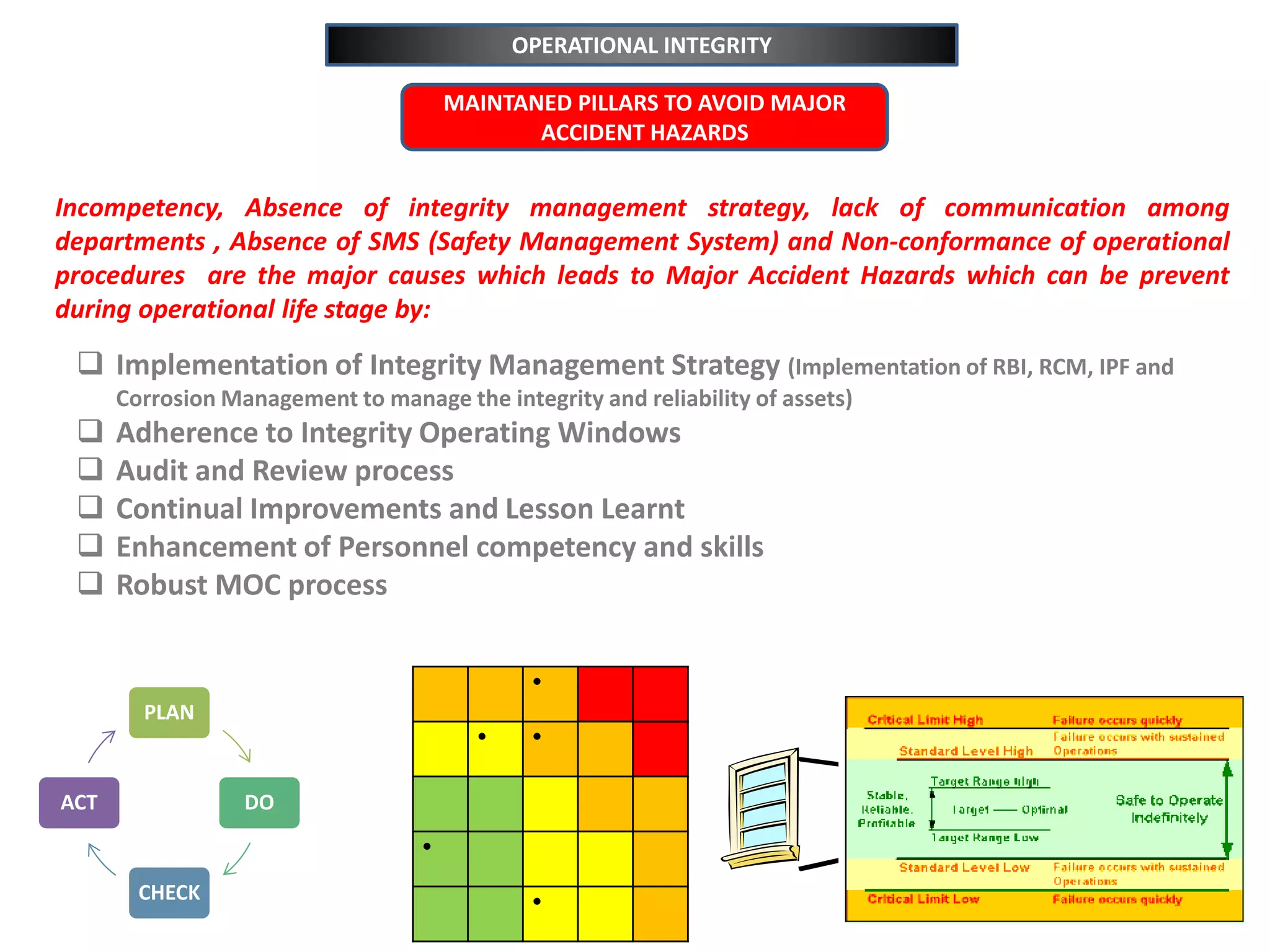
OPERATIONAL INTEGRITY
 Implementation of Integrity Management Strategy (Implementation of RBI, RCM, IPF and
Corrosion Management to manage the integrity and reliability of assets)
 Adherence to Integrity Operating Windows
 Audit and Review process
 Continual Improvements and Lesson Learnt
 Enhancement of Personnel competency and skills
 Robust MOC process
MAINTANED PILLARS TO AVOID MAJOR
ACCIDENT HAZARDS
Incompetency, Absence of integrity management strategy, lack of communication among
departments , Absence of SMS (Safety Management System) and Non-conformance of operational
procedures are the major causes which leads to Major Accident Hazards which can be prevent
during operational life stage by:

 


PLAN
DO
CHECK
ACT
CONCLUSION
Organization can prevent the Piper Alpha and Deep-water Horizon GoM by establishing
and maintaining the integrity over life cycle of an asset with Organization Commitment,
Organizational Strategic Plans and Robust Asset Management System.
 PAS 55 – 1: 2008, Asset Management, Specification for the optimized
management of physical assets
 PAS 55 – 2: 2008, Asset Management, Guidelines for the application of PAS 55 - 1
 DNV RP F – 116, Integrity Management of Submarine Pipeline System
 Asset Integrity Toolkit, UKOOA
 OGP Asset Integrity – the key to managing major accident risks
 Overview of Asset Integrity Management, Robert Gordon University Document
 Presentation by John Reynolds, Establishing IOWs, Shell Global Solutions, IPEIA
Conference February 2, 2006, Banff, Alberta
 Presentation by Racehl Horne, BP, Integrity Management, Project Awareness and
Basic Application, Angola Development Program
 Slide Images:
1. http://www.bbc.co.uk/news/uk-scotland-22840445
2. http://www.growthaccelerator.com/wp-content/uploads/2013/03/Winning.jpg
3. http://www.chanhassenfitnessrevolution.com/wp-content/uploads/2012/07/6-Steps-to-
Success-Chanhassen-Fitness-Revolution.jpg
4. http://www.alstern-technologies.com/main_images/PLANT_2.jpg
5. http://www.seaphantom.com/images2/Offshore_platform_in_night.jpg
6. http://www.offshore-technology.com/projects/8133/images/199971/large/1l-image.jpg
7. http://static.guim.co.uk/sys-
images/Business/Pix/pictures/2010/10/19/1287476298203/Deepwater-Horizon-006.jpg
8. http://www.genesisoilandgas.com/Pages/default.aspx
REFERENCES

Asset Integrity Management

  • 1.
    HAFIZ MUHAMMAD ATIF Module:Problem Solving Course: MSc Asset Integrity Management Robert Gordon University, UK PSVM FPSO
  • 2.
    Flixborough 1974 Grangemouth 1987 PiperAlpha 1988 Deep-water Horizon 2006
  • 3.
     Incompetency  InappropriateDesign  No Identification of Barriers  Absence of Process and Safety Management  Absence of Integrity Management Strategy  Absence of MOC process  Operation outside the limits  Absence of Reporting, Communication and Information Management
  • 4.
    Asset Management Systematic andSynchronized activities through which organizations manage their assets optimal and sustainable over their life cycle to accomplish organizations strategic plans Asset Integrity Management To manage the integrity over the life cycle of an asset. Asset Integrity Ability of an asset to perform its function effectively and efficiently though protection the health, safety and environment.
  • 5.
    PRINCIPLES AND ATTRIBUTESOF ASSET MANAGEMENT Attributes Description HOLISTIC Emphasizing the functional relation among all departments of organization SYSTEMATIC characterized the asset management in an organized, consistent and planned manner SYSTEMIC Affecting the whole system rather than optimizing individual asset separately RISK – BASED: Prioritize the assets with respect to risk (health and safety, environment and cost) SUSTAINABLE Capable of being maintained over the life cycle without Loss of containment OPTIMAL Best value of asset under limits of performance, cost and risk with relative to other assets INTEGRATED Interlinking of above attributes to achieve successful Asset Management
  • 6.
    KEY ELEMENTS OFASSET INTEGRITY MANAGEMENT Integrity Management System as per DNV RP 116
  • 7.
    Concept Selection / Design DecommissioningOperation Hook –up Installation/ Commissioning Procurement / Manufacturing / Construction Integrity Management is a function of Entire Life Cycle Maintain IntegrityDesign Integrity Technical Integrity PHASES AND STAGES OF ASSET INTEGRITY MANAGEMENT There are three phases of integrity management 1. Design Integrity 2. Technical Integrity 3. Maintain Integrity 1. Design 2. Procurement/Construction/Manufacturing / Installation / Hook – up 3. Commissioning 4. Operation 5. Modification 6. Decommissioning There are six stages of integrity management Modification
  • 9.
    DESIGN INTEGRITY ESTABBLISHMENT OFPILLARS TO AVOID MAJOR ACCIDENT HAZARDS      Poor material selection, Inadequate Competency, Absence of Safety Studies are the key factors for Major Accident Hazards and cause threat to Health, Safety and Environment. These can be avoid to invest money in the design stage to established an Asset Management System which ensures the facility will be capable to handle any major accident hazard which will not only protect the health and safety of the personnel's but also control environment and business risk over the life cycle of an asset. Key documentation are necessary to established the integrity are:.  Material Selection (ISO 15156; NORSOK D-001; EEMUA 194, Group Practices etc.)  Corrosion Prediction for their asset life (Multicorp, ECE, Casandra etc.)  Risk Management (Risk Assessment, Risk Management, Risk Acceptance and Risk Communication)  Conducting HAZOP, PHA, PSM, LOPA, SIMOPS  Developing Safety Case (To make sure facility is enough capacity to handle Major Accident Hazard)  Identification of SCEs (Safety Critical Elements), BCEs (Business Critical Elements) and ICE (Integrity Critical Elements)  Integrity Management Strategy (Topside, Controls & Umbilical, Subsea Equipment, Pipelines, Riser, Corrosion, Flow Assurance, follow up with Integrity Management Plan)  Robust MOC process
  • 10.
    TECHNICAL INTEGRITY  Manufacturingof Pressure and Non-Pressure equipment as per code and standards  Construction of the facilities as per Code and Standards  Robust QA / QC during Construction, Hook-up / Installation  Third party inspection and verification  Documentation of Anomaly Register and communicated to Operation  Ensure performance standards to make sure it conforms the design intent  Robust MOC process ESTABBLISHMENT OF PILLARS TO AVOID MAJOR ACCIDENT HAZARDS Incompetency, poor methods of manufacturing and installations, lack of communication for anomalies among the engineering departments and avoidance of third party verification are the high probable factors for damages at the infant stage of operational asset life which leads to Major Accident Hazards which can be controlled by:
  • 11.
    OPERATIONAL INTEGRITY  Implementationof Integrity Management Strategy (Implementation of RBI, RCM, IPF and Corrosion Management to manage the integrity and reliability of assets)  Adherence to Integrity Operating Windows  Audit and Review process  Continual Improvements and Lesson Learnt  Enhancement of Personnel competency and skills  Robust MOC process MAINTANED PILLARS TO AVOID MAJOR ACCIDENT HAZARDS Incompetency, Absence of integrity management strategy, lack of communication among departments , Absence of SMS (Safety Management System) and Non-conformance of operational procedures are the major causes which leads to Major Accident Hazards which can be prevent during operational life stage by:      PLAN DO CHECK ACT
  • 12.
    CONCLUSION Organization can preventthe Piper Alpha and Deep-water Horizon GoM by establishing and maintaining the integrity over life cycle of an asset with Organization Commitment, Organizational Strategic Plans and Robust Asset Management System.
  • 13.
     PAS 55– 1: 2008, Asset Management, Specification for the optimized management of physical assets  PAS 55 – 2: 2008, Asset Management, Guidelines for the application of PAS 55 - 1  DNV RP F – 116, Integrity Management of Submarine Pipeline System  Asset Integrity Toolkit, UKOOA  OGP Asset Integrity – the key to managing major accident risks  Overview of Asset Integrity Management, Robert Gordon University Document  Presentation by John Reynolds, Establishing IOWs, Shell Global Solutions, IPEIA Conference February 2, 2006, Banff, Alberta  Presentation by Racehl Horne, BP, Integrity Management, Project Awareness and Basic Application, Angola Development Program  Slide Images: 1. http://www.bbc.co.uk/news/uk-scotland-22840445 2. http://www.growthaccelerator.com/wp-content/uploads/2013/03/Winning.jpg 3. http://www.chanhassenfitnessrevolution.com/wp-content/uploads/2012/07/6-Steps-to- Success-Chanhassen-Fitness-Revolution.jpg 4. http://www.alstern-technologies.com/main_images/PLANT_2.jpg 5. http://www.seaphantom.com/images2/Offshore_platform_in_night.jpg 6. http://www.offshore-technology.com/projects/8133/images/199971/large/1l-image.jpg 7. http://static.guim.co.uk/sys- images/Business/Pix/pictures/2010/10/19/1287476298203/Deepwater-Horizon-006.jpg 8. http://www.genesisoilandgas.com/Pages/default.aspx REFERENCES