Effective & Sustainable Improvement Actions on Recurring Problems
CORRECTIVE
& PREVENTIVE ACTION
BY
PRANEET SURTI
BLUE STEEL MANAGEMENT CONSULTANTS
KICK-OFF
The measure of success is not
whether you have a tough
problem to deal with, but
whether it is the same problem
you had last year.
— John Foster Dulles
CAPA REQUIREMENT
The requirement for CAPA is stated in ISO 9001:2015
Clause 10.2.1 When a nonconformity occurs, including any arising from complaints, the organization shall:
a) react to the nonconformity and, as applicable: [Correction]
b) take action to control and correct it;
c) deal with the consequences; [NC can be anything deviating from the standard requirements]
d) evaluate the need for action to eliminate the cause(s) of the nonconformity, in order that it does not recur
[Corrective Action] or occur [Preventive Action] elsewhere, by:
e) reviewing and analyzing the nonconformity; [Description of NC]
f) determining the causes of the nonconformity; [RCA of NC]
g) determining if similar non conformities exist, or could potentially occur; [Platforms at Risk]
h) implement any action needed; [Correction]
i) review the effectiveness of any corrective action taken; [Effectiveness Measure]
j) update risks and opportunities determined during planning, if necessary; [Update Risk Documented Information]
k) Make changes to the quality management system, if necessary. [Update Changes in the Documented Information]
l) Corrective actions shall be appropriate to the effects of the nonconformities encountered. [Effectiveness Measure]
Clause 10.2.2 The organization shall retain documented information as evidence of:
a) the nature of the nonconformities and any subsequent actions taken;
b) the results of any corrective action.
CAPA INSIGHT
Corrective & Preventive Actions [a.k.a CAPA] is a structured, formalized way to
investigate Non-Conformities and determine appropriate Corrections, Corrective
Actions and Preventative Actions and measure their effectiveness. (With Records)
Serve as a useful tool for analyzing past events, correcting existing non
conformities and preventing future events.
Goes beyond regulatory compliance to positively impact the customers by
increasing the value of our products and services.
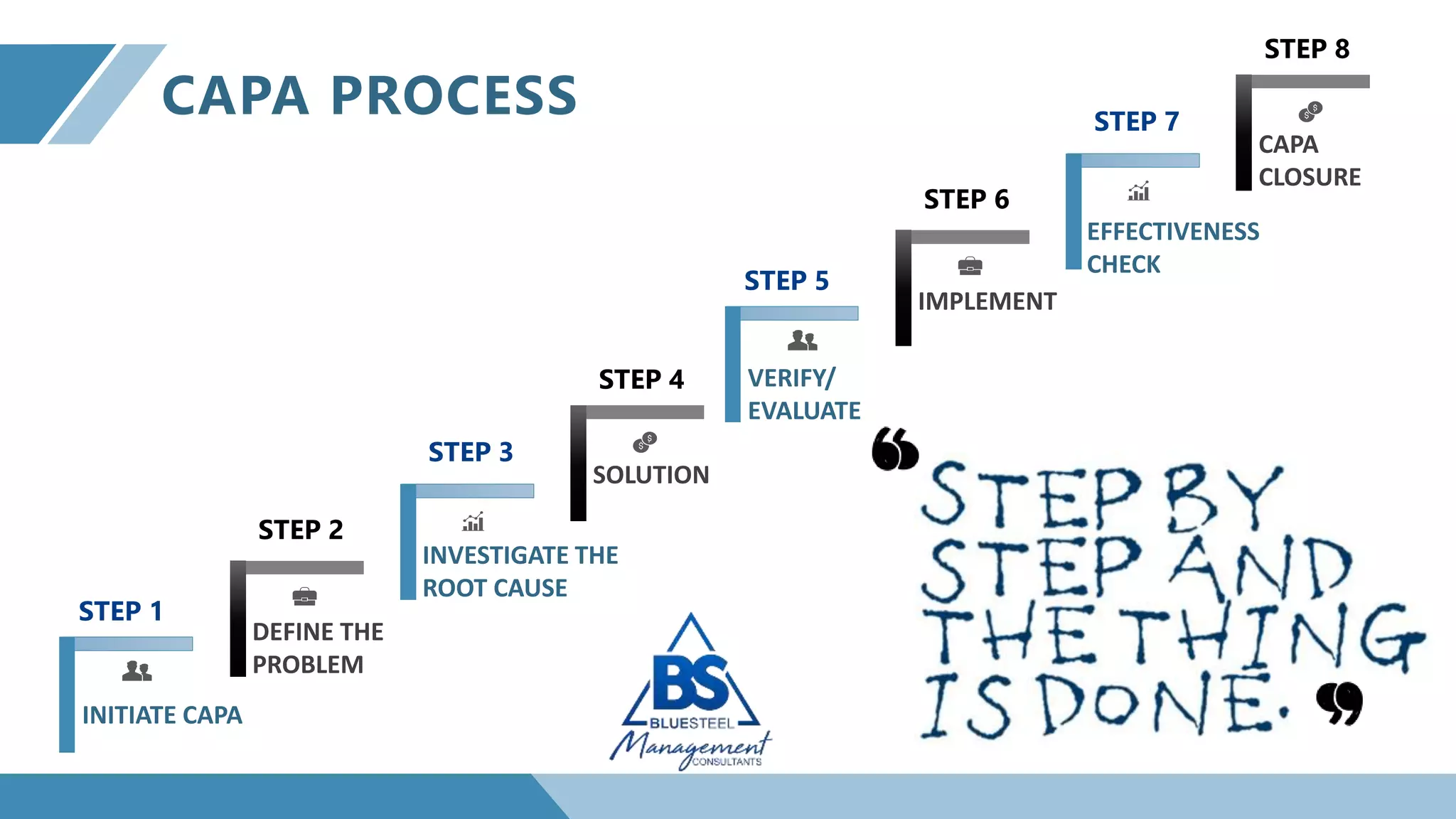
CAPA PROCESS
INITIATE CAPA
STEP 1
DEFINE THE
PROBLEM
STEP 2
INVESTIGATE THE
ROOT CAUSE
STEP 3
SOLUTION
STEP 4 VERIFY/
EVALUATE
STEP 5
IMPLEMENT
STEP 6
EFFECTIVENESS
CHECK
STEP 7
CAPA
CLOSURE
STEP 8
INITIATE CAPA
Elements of Inception
NON CONFORMITY
Non-fulfillment of a Standard
Requirement
6
DEFECT
An attribute of a product or service that
has failed to meet one of the desired
specifications.
1
WASTE
The Seven Manufacturing
Wastes TIMWOOD
4
ACCIDENT
An unfortunate incident that happens
unexpectedly and unintentionally, typically
resulting in damage or injury
3
DELAY
Difference in the occurrence of two
events w.r.t to its Standard Lead Time
2
MISTAKE
An act or judgement that is
misguided or wrong
5
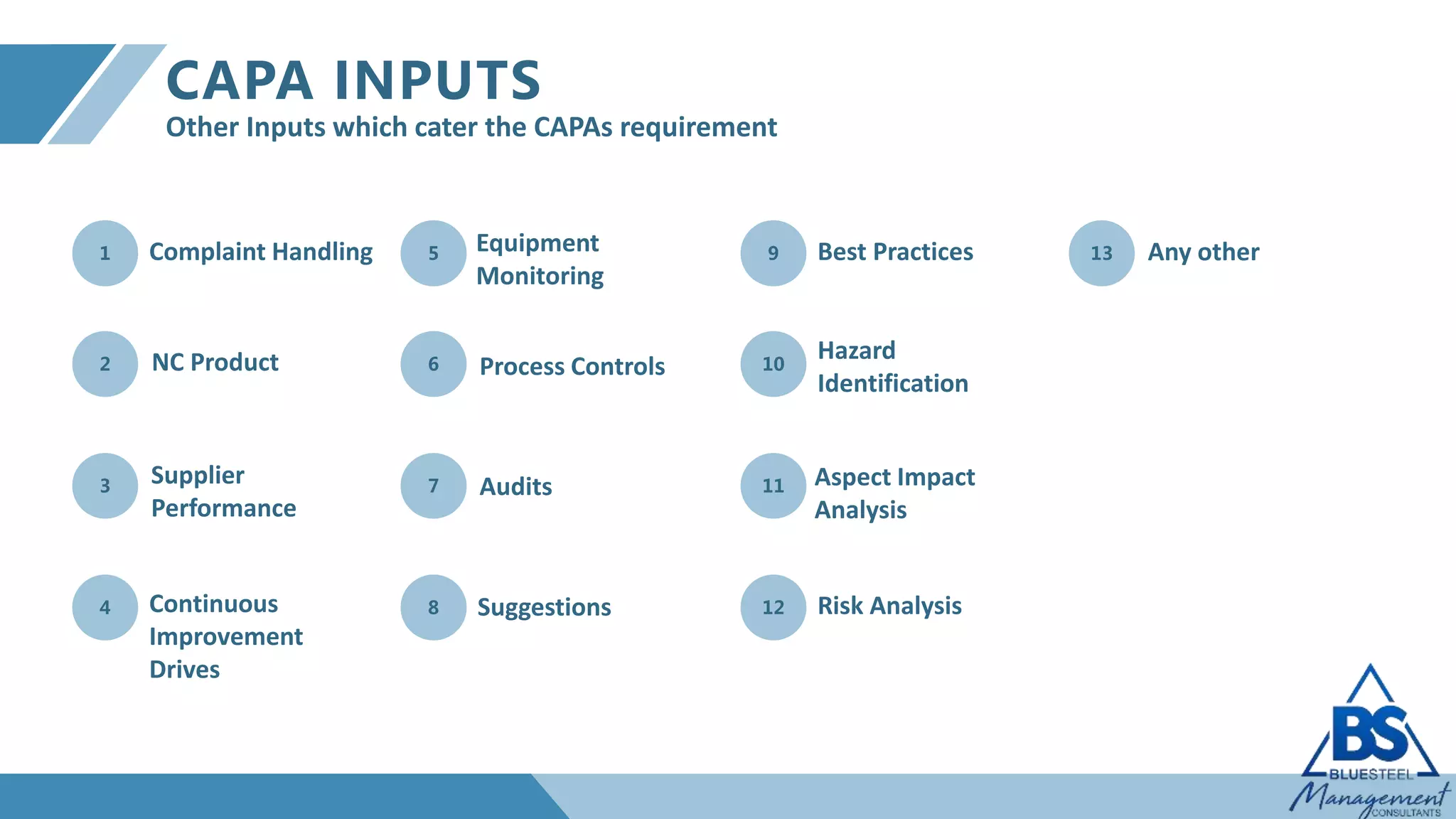
CAPA INPUTS
Other Inputs which cater the CAPAs requirement
10
Hazard
Identification
11 Aspect Impact
Analysis
12 Risk Analysis
2 NC Product
3 Supplier
Performance
4 Continuous
Improvement
Drives
6 Process Controls
7 Audits
8 Suggestions
9 Best Practices 13 Any other1 Complaint Handling 5 Equipment
Monitoring
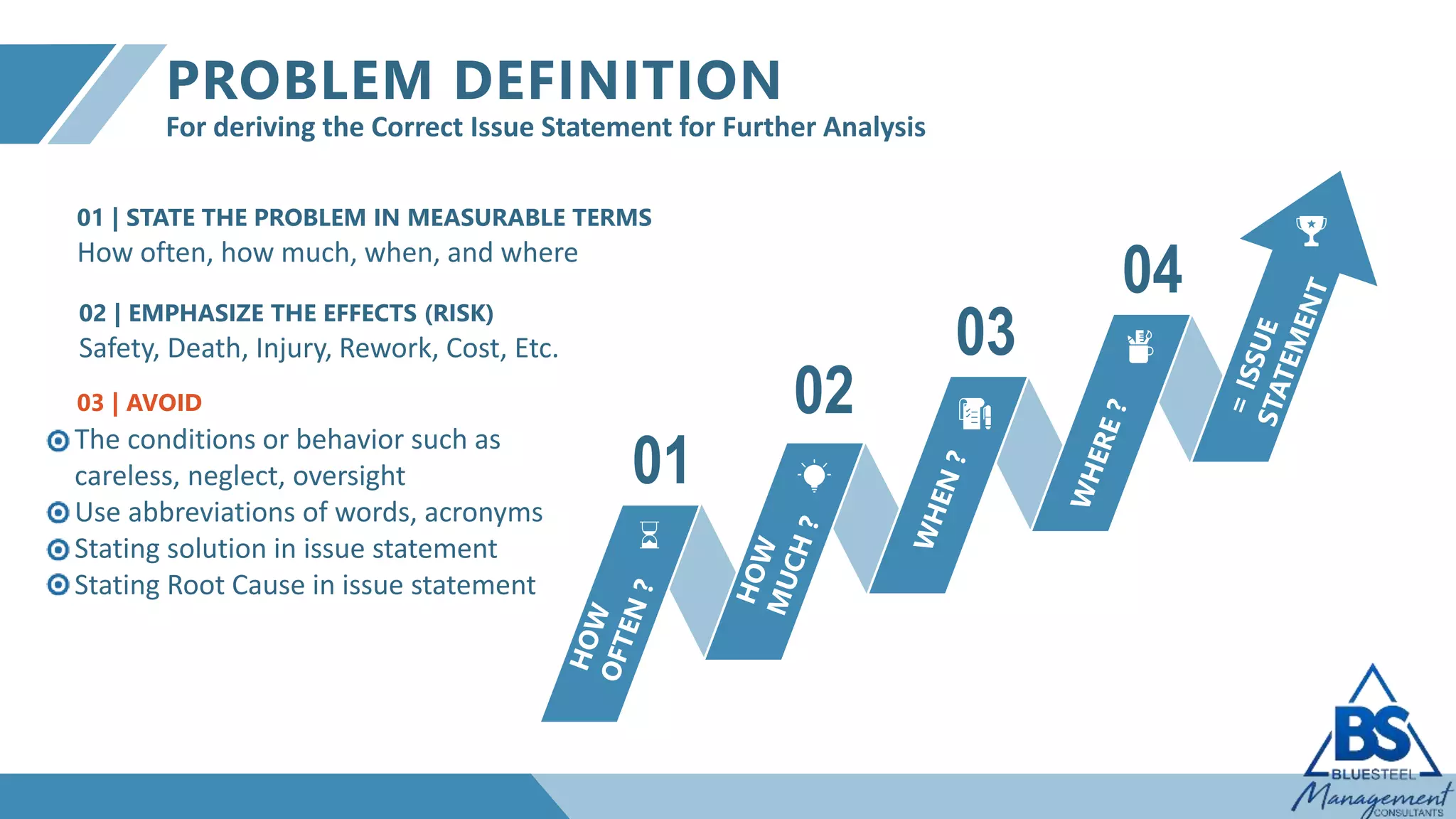
01
02
03
04How often, how much, when, and where
01 | STATE THE PROBLEM IN MEASURABLE TERMS
Safety, Death, Injury, Rework, Cost, Etc.
02 | EMPHASIZE THE EFFECTS (RISK)
The conditions or behavior such as
careless, neglect, oversight
Use abbreviations of words, acronyms
Stating solution in issue statement
Stating Root Cause in issue statement
03 | AVOID
PROBLEM DEFINITION
For deriving the Correct Issue Statement for Further Analysis
ROOT CAUSE
Concept & Tool
A root cause is the reason for a condition or an action at its origin or
source.
In the context of problem solving, a root cause is one considered to be
far enough into the sequence of causes and effects, that removing it
will eliminate the effect completely and permanently.
ROOT CAUSE
Tools
• Asking Why ?
To the problem statement
for 5 times so as to derive
the Root Cause
5 WHYS
• Finding the
underlying Causes
by asking Question
such as
• WHAT – IS/NOT
• WHEN – IS/NOT
• WHERE – IS/NOT
• EXTENT – IS/NOT
IS/ IS NOT • The Eight Disciplines of
Problem Solving (8D)
1) Team Formation
2) Problem Description
3) Implementing Interim
Containment Actions
4) Defining Problem Root
Causes
5) Developing Permanent
Corrective Actions
6) Implementing Permanent
Corrective Actions
7) Preventing Reoccurrences
8) Team Recognition
8D
CAUSE & EFFECT
• Finding the underlying
Causes from the Effect
[Problem]
• MAN
• MATERIAL
• MACHINE
• METHOD
• ENVIRONMENT
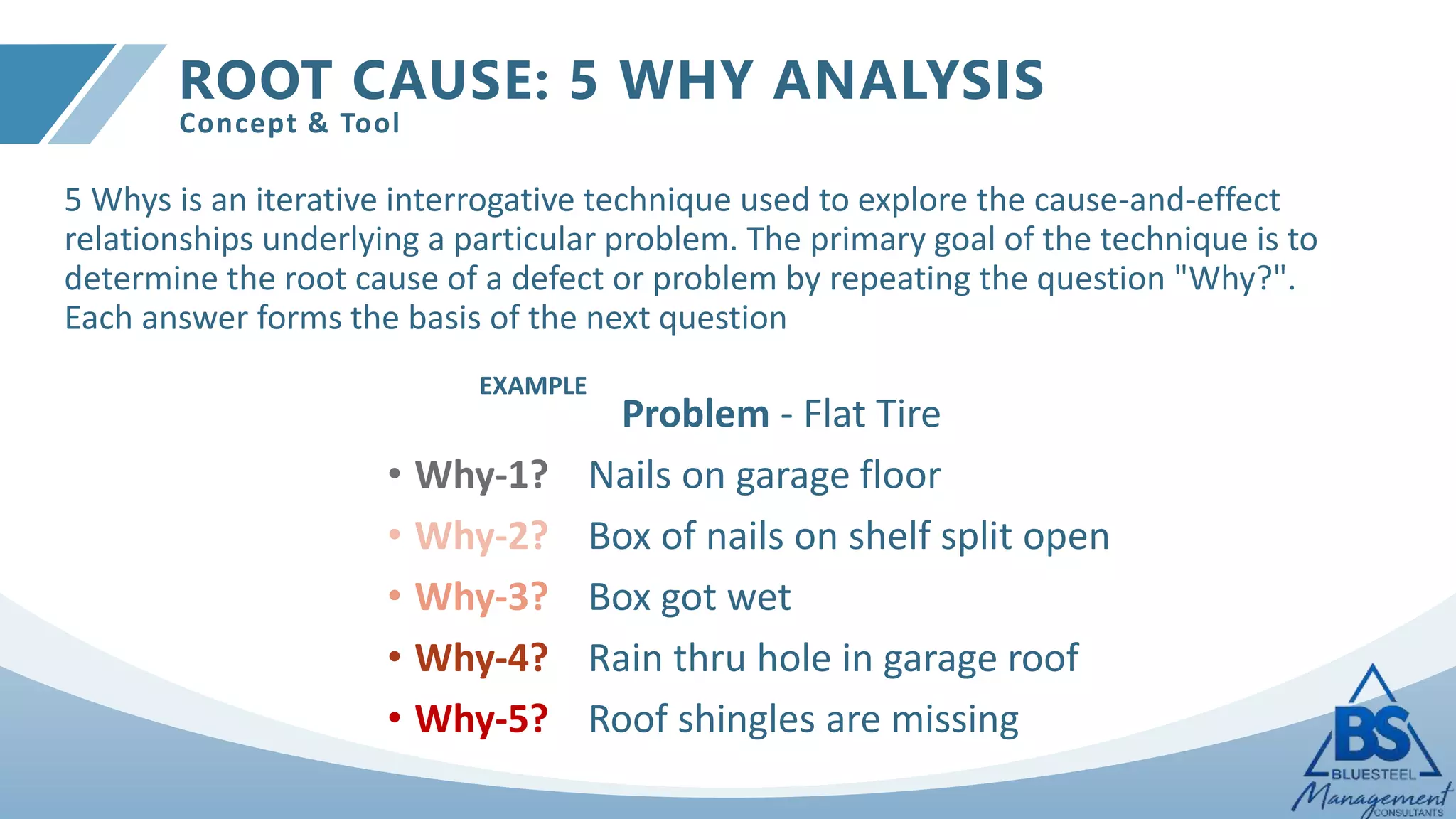
ROOT CAUSE: 5 WHY ANALYSIS
Concept & Tool
5 Whys is an iterative interrogative technique used to explore the cause-and-effect
relationships underlying a particular problem. The primary goal of the technique is to
determine the root cause of a defect or problem by repeating the question "Why?".
Each answer forms the basis of the next question
Problem - Flat Tire
• Why-1? Nails on garage floor
• Why-2? Box of nails on shelf split open
• Why-3? Box got wet
• Why-4? Rain thru hole in garage roof
• Why-5? Roof shingles are missing
EXAMPLE
ROOT CAUSE: CAUSE & EFFECT ANALYSIS
FISHBONE DIAGRAM I ISHIKAWA DIAGRAM
CAUSE EFFECT
MAN
MATERIAL
MACHINE
METHOD
ENVIRONMENT
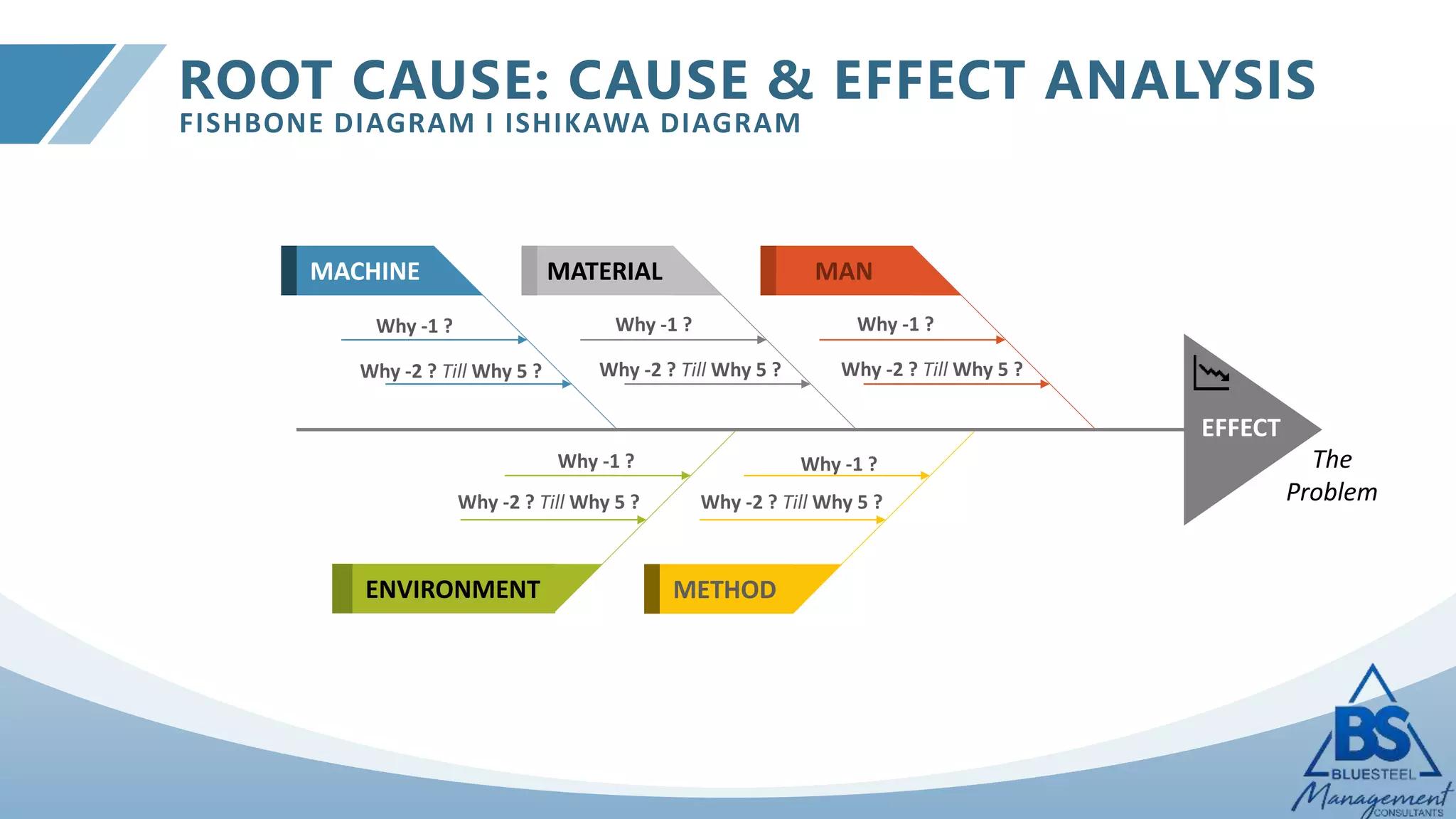
ROOT CAUSE: CAUSE & EFFECT ANALYSIS
FISHBONE DIAGRAM I ISHIKAWA DIAGRAM
Why -1 ?
Why -2 ? Till Why 5 ?
MACHINE MATERIAL MAN
ENVIRONMENT METHOD
Why -1 ?
Why -2 ? Till Why 5 ?
Why -1 ?
Why -2 ? Till Why 5 ?
Why -1 ?
Why -2 ? Till Why 5 ?
Why -1 ?
Why -2 ? Till Why 5 ?
EFFECT
The
Problem
ROOT CAUSE: IS/ IS NOT ANALYSIS
Concept & Tool
IS IS NOT
WHAT
• What object has the problem?
• What is the defect?
• What similar object could have the problem but does
not?
• What defect could the object have but does not?
WHERE
• Where is the object located geographically when the defect
is noticed?
• Where is the defect located on the object?
• Where could the object be located but it is not?
• Where could the defect be located but it is not?
WHEN
• When was the defective object first noticed? When has it
been observed since?
• What is the timing pattern (continuous, random, or cyclical)
and trend?
• When could the defective object been noticed, but was
not?
• What could the timing pattern and trend be but is not?
EXTENT
• How many objects have the defect?
• How extensive is the defect?
• How many objects could have the defect but do not?
• How extensive could the defect be but is not?
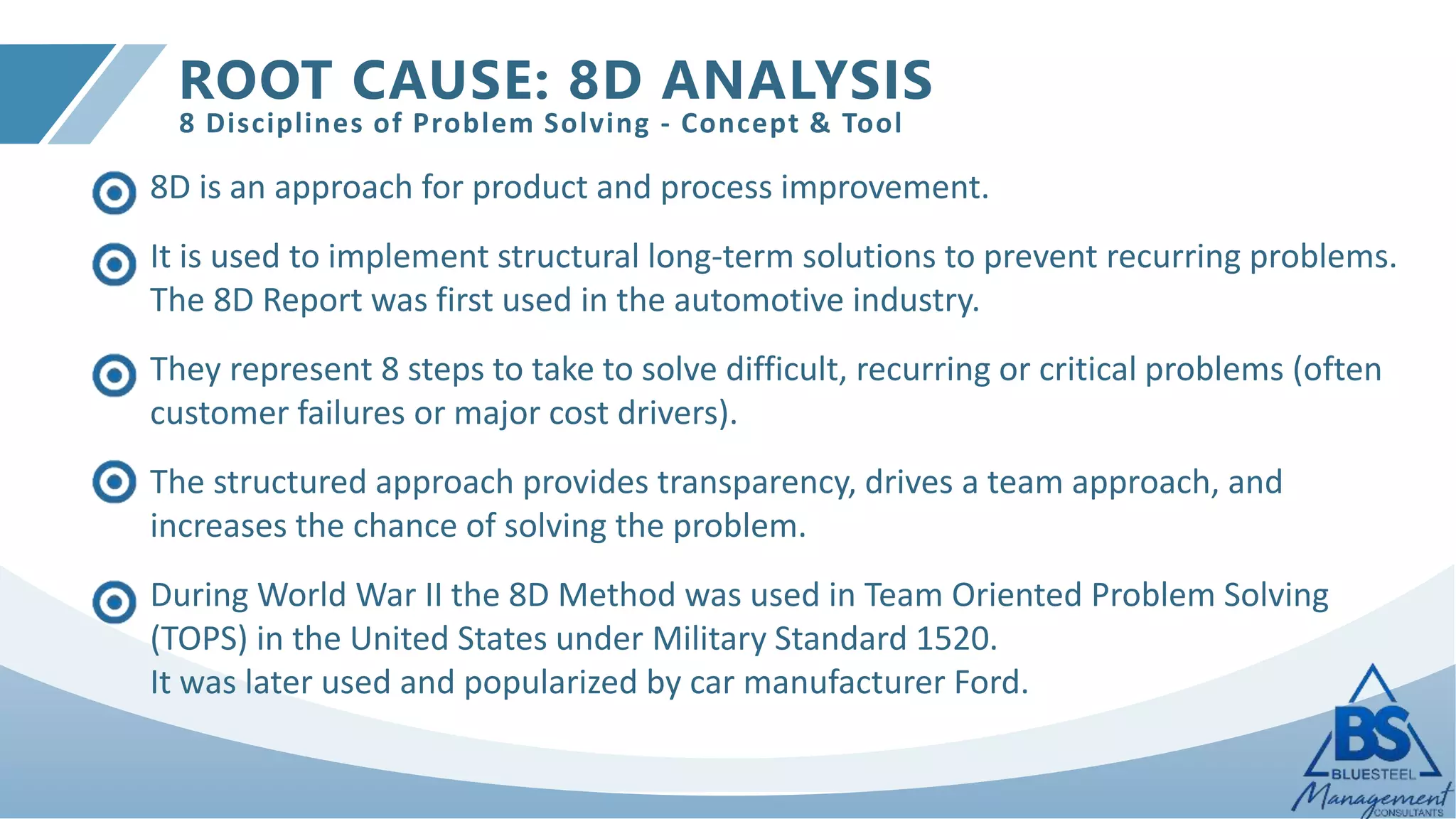
ROOT CAUSE: 8D ANALYSIS
8 Disciplines of Problem Solving - Concept & Tool
8D is an approach for product and process improvement.
It is used to implement structural long-term solutions to prevent recurring problems.
The 8D Report was first used in the automotive industry.
They represent 8 steps to take to solve difficult, recurring or critical problems (often
customer failures or major cost drivers).
The structured approach provides transparency, drives a team approach, and
increases the chance of solving the problem.
During World War II the 8D Method was used in Team Oriented Problem Solving
(TOPS) in the United States under Military Standard 1520.
It was later used and popularized by car manufacturer Ford.
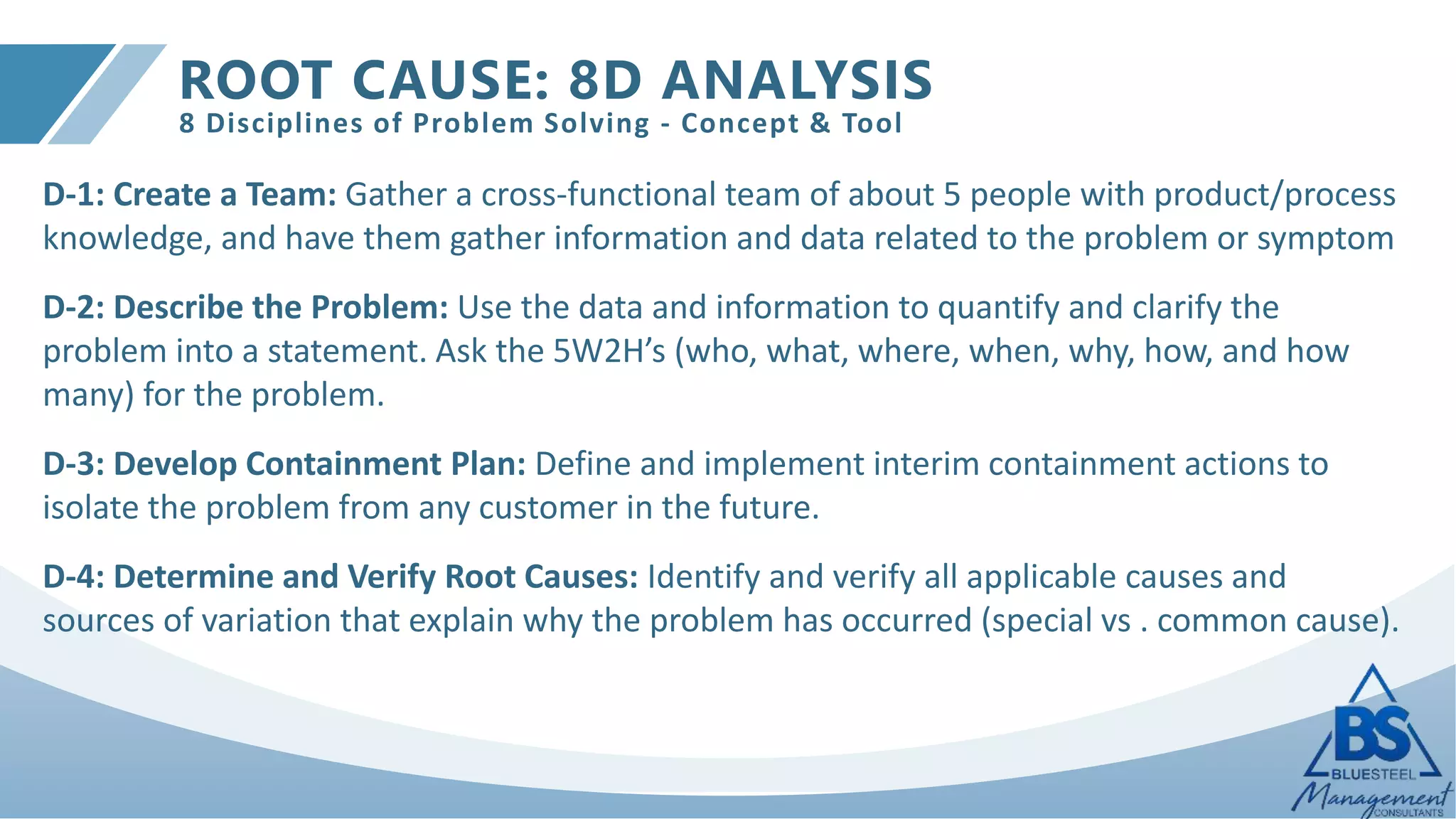
ROOT CAUSE: 8D ANALYSIS
8 Disciplines of Problem Solving - Concept & Tool
D-1: Create a Team: Gather a cross-functional team of about 5 people with product/process
knowledge, and have them gather information and data related to the problem or symptom
D-2: Describe the Problem: Use the data and information to quantify and clarify the
problem into a statement. Ask the 5W2H’s (who, what, where, when, why, how, and how
many) for the problem.
D-3: Develop Containment Plan: Define and implement interim containment actions to
isolate the problem from any customer in the future.
D-4: Determine and Verify Root Causes: Identify and verify all applicable causes and
sources of variation that explain why the problem has occurred (special vs . common cause).
ROOT CAUSE: 8D ANALYSIS
8 Disciplines of Problem Solving - Concept & Tool
D-5: Verify Permanent Solutions: Collect data to confirm that the possible solutions will
actually resolve the problem. Perform on a small-scale or “pilot” project first.
D-6: Define and Implement Corrective Actions: Discuss and review results, and develop
plan to implement best solutions or countermeasure.
D-7: Prevention: Modify the management systems, operation systems, procedures and
practices to prevent recurrence of this and similar problems.
D-8: Congratulate the team: Formally thank team members for their involvement. Use
approaches that appeal to each individual member, as not everyone wants to be rewarded
the same way.
INVESTIGATING CAUSE
FACT FINDING Vs. FAULT FINDING
The Problem Statement is the difference between WHAT IS and WHAT SHOULD BE
 Focus on
 Facts finding, not fault finding !
 What is wrong, not why it’s wrong ?
"Again and again, the impossible decision is solved when we see that the
problem is only a tough decision waiting to be made."
— Dr. Robert Schuller
SOLUTION/ ACTION PLAN
FACT FINDING Vs. FAULT FINDING
Implement a Solution to address the CAUSE not the SYMPTOM
 Lists Corrective and Preventive actions
 Clearly addresses root causes
 Commensurate with the Risk of the issue
 Identification of Task Owners and Task Due Dates
 Implementation of Solution
 CAPA Monitoring
 Retaining Records
"The most serious mistakes are not being made as a result of wrong answers. The truly dangerous thing is asking
the wrong questions." — Peter Drucker
SOLUTION/ ACTION PLAN
CORRECTION
CORRECTIVE ACTION
& PREVENTIVE ACTION
CORRECTION
Temporary action taken to eliminate a
dectcted non-conformance [Rework, Sorting,
Scrap, Repair]
E.g: Replace Part
CORRECTIVE
ACTION
CORRECTIVE ACTION
Action taken to eliminate the underlying Root
Cause of the problem in order to prevent its
RECURRENCE
E.g: By RCA Approach
PREVENTIVE ACTION
Action taken to eliminate the
underlying Root Cause of a
potential problem in order to
prevent its occurance
OCCURRENCE
E.g: By RCA Approach, Can be
horizontal deployment of
Corrective Action
IMPLEMENT
 Implementing the Corrective Actions
 Testing during formation of Action Plan
 Validate
 Tracking (Where, How Many, Who)
 Retaining Documented Information
After Successful Implementation of Corrective Action
 Implementing the Preventive Actions
EFFECTIVENESS
CAPA is useful only when the implemented action plan is effective, so before
concluding the CAPA, The effectiveness of the implemented plan is measured.
What to do when a effectiveness check fails, and what are the consequences?
• Close the CAPA and open a new one?
• Get an extension?
• Leave the CAPA open and investigate why?
EFFECTIVENESS
MEASURE
 Monitor Performance Indicators and compare “Before” and “After” by assigning a
particular time frame
 Achieve Specific Targets - achieving a pre-determined level
 Statistical Data Analysis-Performance must lie within a set of statistically derived
control limits
 Emphasis should primarily be on identifying the most effective fix
SYMPTOMS OF A
NON-EFFECTIVE CAPA
• Recurring Issues
• Resources are spent on “handling” failure rather than learning from it and
preventing “more of the same”
• Field Issues
CAPA CLOSURE
• CAPA will be closed after measuring the effectiveness set at the particular value.
• The effectiveness of CAPA with be discussed with all personnel in team meetings
organized monthly.
BENEFITS OF SUCESSFULLY
IMPLEMENTED CAPA
• Reduction in Quality Issues
• A reduction in the severity of issues
• Better designed products/processes
• Improved Customer Satisfaction
• Better Business Results
CAPA is useful only when the implemented action plan is effective, so before
concluding the CAPA, The effectiveness of the implemented plan is measured.
"Again and again, the impossible decision is solved when we see that the problem is only a
tough decision waiting to be made."
— Dr. Robert Schuller
CORRECTIVE
& PREVENTIVE ACTION
About the Trainer
PRANEET SURTI
Management Consultant
[Lead Auditor ISO 9001:2015, B.E Mechanical Engineering]
BLUE STEEL MANAGEMENT CONSULTANTS
Cell : +918347008127; +91 8109773774
Email: praneetsurti20@gmail.com
LinkedIn: http://in.linkedin.com/in/praneetsurti
Diversified Consulting Solutions, Unvarying Sustainable Quality
"In times like these it is good to remember that
there have always been times like these."
— Paul Harvey

Corrective & Preventive Action

  • 1.
    Effective & SustainableImprovement Actions on Recurring Problems CORRECTIVE & PREVENTIVE ACTION BY PRANEET SURTI BLUE STEEL MANAGEMENT CONSULTANTS
  • 2.
    KICK-OFF The measure ofsuccess is not whether you have a tough problem to deal with, but whether it is the same problem you had last year. — John Foster Dulles
  • 3.
    CAPA REQUIREMENT The requirementfor CAPA is stated in ISO 9001:2015 Clause 10.2.1 When a nonconformity occurs, including any arising from complaints, the organization shall: a) react to the nonconformity and, as applicable: [Correction] b) take action to control and correct it; c) deal with the consequences; [NC can be anything deviating from the standard requirements] d) evaluate the need for action to eliminate the cause(s) of the nonconformity, in order that it does not recur [Corrective Action] or occur [Preventive Action] elsewhere, by: e) reviewing and analyzing the nonconformity; [Description of NC] f) determining the causes of the nonconformity; [RCA of NC] g) determining if similar non conformities exist, or could potentially occur; [Platforms at Risk] h) implement any action needed; [Correction] i) review the effectiveness of any corrective action taken; [Effectiveness Measure] j) update risks and opportunities determined during planning, if necessary; [Update Risk Documented Information] k) Make changes to the quality management system, if necessary. [Update Changes in the Documented Information] l) Corrective actions shall be appropriate to the effects of the nonconformities encountered. [Effectiveness Measure] Clause 10.2.2 The organization shall retain documented information as evidence of: a) the nature of the nonconformities and any subsequent actions taken; b) the results of any corrective action.
  • 4.
    CAPA INSIGHT Corrective &Preventive Actions [a.k.a CAPA] is a structured, formalized way to investigate Non-Conformities and determine appropriate Corrections, Corrective Actions and Preventative Actions and measure their effectiveness. (With Records) Serve as a useful tool for analyzing past events, correcting existing non conformities and preventing future events. Goes beyond regulatory compliance to positively impact the customers by increasing the value of our products and services.
  • 5.
    CAPA PROCESS INITIATE CAPA STEP1 DEFINE THE PROBLEM STEP 2 INVESTIGATE THE ROOT CAUSE STEP 3 SOLUTION STEP 4 VERIFY/ EVALUATE STEP 5 IMPLEMENT STEP 6 EFFECTIVENESS CHECK STEP 7 CAPA CLOSURE STEP 8
  • 6.
    INITIATE CAPA Elements ofInception NON CONFORMITY Non-fulfillment of a Standard Requirement 6 DEFECT An attribute of a product or service that has failed to meet one of the desired specifications. 1 WASTE The Seven Manufacturing Wastes TIMWOOD 4 ACCIDENT An unfortunate incident that happens unexpectedly and unintentionally, typically resulting in damage or injury 3 DELAY Difference in the occurrence of two events w.r.t to its Standard Lead Time 2 MISTAKE An act or judgement that is misguided or wrong 5
  • 7.
    CAPA INPUTS Other Inputswhich cater the CAPAs requirement 10 Hazard Identification 11 Aspect Impact Analysis 12 Risk Analysis 2 NC Product 3 Supplier Performance 4 Continuous Improvement Drives 6 Process Controls 7 Audits 8 Suggestions 9 Best Practices 13 Any other1 Complaint Handling 5 Equipment Monitoring
  • 8.
    01 02 03 04How often, howmuch, when, and where 01 | STATE THE PROBLEM IN MEASURABLE TERMS Safety, Death, Injury, Rework, Cost, Etc. 02 | EMPHASIZE THE EFFECTS (RISK) The conditions or behavior such as careless, neglect, oversight Use abbreviations of words, acronyms Stating solution in issue statement Stating Root Cause in issue statement 03 | AVOID PROBLEM DEFINITION For deriving the Correct Issue Statement for Further Analysis
  • 9.
    ROOT CAUSE Concept &Tool A root cause is the reason for a condition or an action at its origin or source. In the context of problem solving, a root cause is one considered to be far enough into the sequence of causes and effects, that removing it will eliminate the effect completely and permanently.
  • 10.
    ROOT CAUSE Tools • AskingWhy ? To the problem statement for 5 times so as to derive the Root Cause 5 WHYS • Finding the underlying Causes by asking Question such as • WHAT – IS/NOT • WHEN – IS/NOT • WHERE – IS/NOT • EXTENT – IS/NOT IS/ IS NOT • The Eight Disciplines of Problem Solving (8D) 1) Team Formation 2) Problem Description 3) Implementing Interim Containment Actions 4) Defining Problem Root Causes 5) Developing Permanent Corrective Actions 6) Implementing Permanent Corrective Actions 7) Preventing Reoccurrences 8) Team Recognition 8D CAUSE & EFFECT • Finding the underlying Causes from the Effect [Problem] • MAN • MATERIAL • MACHINE • METHOD • ENVIRONMENT
  • 11.
    ROOT CAUSE: 5WHY ANALYSIS Concept & Tool 5 Whys is an iterative interrogative technique used to explore the cause-and-effect relationships underlying a particular problem. The primary goal of the technique is to determine the root cause of a defect or problem by repeating the question "Why?". Each answer forms the basis of the next question Problem - Flat Tire • Why-1? Nails on garage floor • Why-2? Box of nails on shelf split open • Why-3? Box got wet • Why-4? Rain thru hole in garage roof • Why-5? Roof shingles are missing EXAMPLE
  • 12.
    ROOT CAUSE: CAUSE& EFFECT ANALYSIS FISHBONE DIAGRAM I ISHIKAWA DIAGRAM CAUSE EFFECT MAN MATERIAL MACHINE METHOD ENVIRONMENT
  • 13.
    ROOT CAUSE: CAUSE& EFFECT ANALYSIS FISHBONE DIAGRAM I ISHIKAWA DIAGRAM Why -1 ? Why -2 ? Till Why 5 ? MACHINE MATERIAL MAN ENVIRONMENT METHOD Why -1 ? Why -2 ? Till Why 5 ? Why -1 ? Why -2 ? Till Why 5 ? Why -1 ? Why -2 ? Till Why 5 ? Why -1 ? Why -2 ? Till Why 5 ? EFFECT The Problem
  • 14.
    ROOT CAUSE: IS/IS NOT ANALYSIS Concept & Tool IS IS NOT WHAT • What object has the problem? • What is the defect? • What similar object could have the problem but does not? • What defect could the object have but does not? WHERE • Where is the object located geographically when the defect is noticed? • Where is the defect located on the object? • Where could the object be located but it is not? • Where could the defect be located but it is not? WHEN • When was the defective object first noticed? When has it been observed since? • What is the timing pattern (continuous, random, or cyclical) and trend? • When could the defective object been noticed, but was not? • What could the timing pattern and trend be but is not? EXTENT • How many objects have the defect? • How extensive is the defect? • How many objects could have the defect but do not? • How extensive could the defect be but is not?
  • 15.
    ROOT CAUSE: 8DANALYSIS 8 Disciplines of Problem Solving - Concept & Tool 8D is an approach for product and process improvement. It is used to implement structural long-term solutions to prevent recurring problems. The 8D Report was first used in the automotive industry. They represent 8 steps to take to solve difficult, recurring or critical problems (often customer failures or major cost drivers). The structured approach provides transparency, drives a team approach, and increases the chance of solving the problem. During World War II the 8D Method was used in Team Oriented Problem Solving (TOPS) in the United States under Military Standard 1520. It was later used and popularized by car manufacturer Ford.
  • 16.
    ROOT CAUSE: 8DANALYSIS 8 Disciplines of Problem Solving - Concept & Tool D-1: Create a Team: Gather a cross-functional team of about 5 people with product/process knowledge, and have them gather information and data related to the problem or symptom D-2: Describe the Problem: Use the data and information to quantify and clarify the problem into a statement. Ask the 5W2H’s (who, what, where, when, why, how, and how many) for the problem. D-3: Develop Containment Plan: Define and implement interim containment actions to isolate the problem from any customer in the future. D-4: Determine and Verify Root Causes: Identify and verify all applicable causes and sources of variation that explain why the problem has occurred (special vs . common cause).
  • 17.
    ROOT CAUSE: 8DANALYSIS 8 Disciplines of Problem Solving - Concept & Tool D-5: Verify Permanent Solutions: Collect data to confirm that the possible solutions will actually resolve the problem. Perform on a small-scale or “pilot” project first. D-6: Define and Implement Corrective Actions: Discuss and review results, and develop plan to implement best solutions or countermeasure. D-7: Prevention: Modify the management systems, operation systems, procedures and practices to prevent recurrence of this and similar problems. D-8: Congratulate the team: Formally thank team members for their involvement. Use approaches that appeal to each individual member, as not everyone wants to be rewarded the same way.
  • 18.
    INVESTIGATING CAUSE FACT FINDINGVs. FAULT FINDING The Problem Statement is the difference between WHAT IS and WHAT SHOULD BE  Focus on  Facts finding, not fault finding !  What is wrong, not why it’s wrong ? "Again and again, the impossible decision is solved when we see that the problem is only a tough decision waiting to be made." — Dr. Robert Schuller
  • 19.
    SOLUTION/ ACTION PLAN FACTFINDING Vs. FAULT FINDING Implement a Solution to address the CAUSE not the SYMPTOM  Lists Corrective and Preventive actions  Clearly addresses root causes  Commensurate with the Risk of the issue  Identification of Task Owners and Task Due Dates  Implementation of Solution  CAPA Monitoring  Retaining Records "The most serious mistakes are not being made as a result of wrong answers. The truly dangerous thing is asking the wrong questions." — Peter Drucker
  • 20.
  • 21.
    CORRECTION CORRECTIVE ACTION & PREVENTIVEACTION CORRECTION Temporary action taken to eliminate a dectcted non-conformance [Rework, Sorting, Scrap, Repair] E.g: Replace Part CORRECTIVE ACTION CORRECTIVE ACTION Action taken to eliminate the underlying Root Cause of the problem in order to prevent its RECURRENCE E.g: By RCA Approach PREVENTIVE ACTION Action taken to eliminate the underlying Root Cause of a potential problem in order to prevent its occurance OCCURRENCE E.g: By RCA Approach, Can be horizontal deployment of Corrective Action
  • 22.
    IMPLEMENT  Implementing theCorrective Actions  Testing during formation of Action Plan  Validate  Tracking (Where, How Many, Who)  Retaining Documented Information After Successful Implementation of Corrective Action  Implementing the Preventive Actions
  • 23.
    EFFECTIVENESS CAPA is usefulonly when the implemented action plan is effective, so before concluding the CAPA, The effectiveness of the implemented plan is measured. What to do when a effectiveness check fails, and what are the consequences? • Close the CAPA and open a new one? • Get an extension? • Leave the CAPA open and investigate why?
  • 24.
    EFFECTIVENESS MEASURE  Monitor PerformanceIndicators and compare “Before” and “After” by assigning a particular time frame  Achieve Specific Targets - achieving a pre-determined level  Statistical Data Analysis-Performance must lie within a set of statistically derived control limits  Emphasis should primarily be on identifying the most effective fix
  • 25.
    SYMPTOMS OF A NON-EFFECTIVECAPA • Recurring Issues • Resources are spent on “handling” failure rather than learning from it and preventing “more of the same” • Field Issues
  • 26.
    CAPA CLOSURE • CAPAwill be closed after measuring the effectiveness set at the particular value. • The effectiveness of CAPA with be discussed with all personnel in team meetings organized monthly.
  • 27.
    BENEFITS OF SUCESSFULLY IMPLEMENTEDCAPA • Reduction in Quality Issues • A reduction in the severity of issues • Better designed products/processes • Improved Customer Satisfaction • Better Business Results
  • 28.
    CAPA is usefulonly when the implemented action plan is effective, so before concluding the CAPA, The effectiveness of the implemented plan is measured.
  • 29.
    "Again and again,the impossible decision is solved when we see that the problem is only a tough decision waiting to be made." — Dr. Robert Schuller
  • 30.
    CORRECTIVE & PREVENTIVE ACTION Aboutthe Trainer PRANEET SURTI Management Consultant [Lead Auditor ISO 9001:2015, B.E Mechanical Engineering] BLUE STEEL MANAGEMENT CONSULTANTS Cell : +918347008127; +91 8109773774 Email: praneetsurti20@gmail.com LinkedIn: http://in.linkedin.com/in/praneetsurti Diversified Consulting Solutions, Unvarying Sustainable Quality "In times like these it is good to remember that there have always been times like these." — Paul Harvey