HAZOP ANALYSIS
HAZOP ANALYSIS
Indrajit Das
Roll No.10RE60R05
M-Tech; 1st
Year;1st
Sem.
Reliability Engg. Center, IIT-KGP
What is HAZOP?
A Hazard and Operability (HAZOP) study is a
structured and systematic examination of a planned or
existing process or operation in order to identify and
evaluate problems that may represent risks to personnel
or equipment, or prevent efficient operation. A HAZOP is
a qualitative technique based on guide-words and is
carried out by a HAZOP team during a set of meetings.
Indrajit
Das;REC;IIT-
KGP
2
BACK GROUND
 The HAZOP technique was initially developed to analyze chemical
process systems, but has later been extended to other types of
systems.
 First main textbook: Kletz, T. A.: “Hazop and Hazan -Identifying and
Assessing Process Industry Hazards”, Institution of Chemical
Engineers.
Indrajit
Das;REC;IIT-KGP
3
When to perform a HAZOP?
he HAZOP study should preferably be carried out as early in the
design phase as possible - to have influence on the design.
hen the final P&ID are available.
uring construction and installation to ensure that
recommendations are implemented.
Indrajit
Das;REC;IIT-KGP
4
HAZOP team and
HAZOP team and
meetings
meetings
5
Indrajit
Das;REC;IIT-KGP
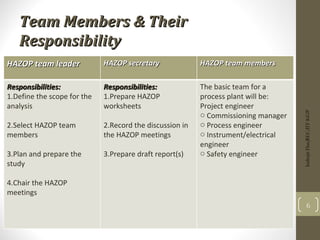
Team Members & Their
Responsibility
Responsibility
HAZOP team leader
HAZOP team leader HAZOP secretary
HAZOP secretary HAZOP team members
HAZOP team members
Responsibilities:
Responsibilities:
1.Define the scope for the
analysis
2.Select HAZOP team
members
3.Plan and prepare the
study
4.Chair the HAZOP
meetings
Responsibilities:
Responsibilities:
1.Prepare HAZOP
worksheets
2.Record the discussion in
the HAZOP meetings
3.Prepare draft report(s)
The basic team for a
process plant will be:
Project engineer
o Commissioning manager
o Process engineer
o Instrument/electrical
engineer
o Safety engineer
6
Indrajit
Das;REC;IIT-KGP
HAZOP meeting
Proposed agenda:
Proposed agenda:
1. Introduction and presentation of participants.
2. Overall presentation of the system/operation to be analysed.
3. Description of the HAZOP approach.
4. Presentation of the first node or logical part of the operation.
5. Analyse the first node/part using the guide-words and
parameters.
6. Continue presentation and analysis (steps 4 and 5)
7. Coarse summary of findings.
Focus should be on potential hazards as well as potential
operational problems.
Each session of the HAZOP meeting should not exceed two
hours.
7
Indrajit
Das;REC;IIT-KGP
Types of HAZOP
 Process HAZOP:
 Human HAZOP :
 Procedure HAZOP:
 Software HAZOP:
Indrajit
Das;REC;IIT-KGP
8
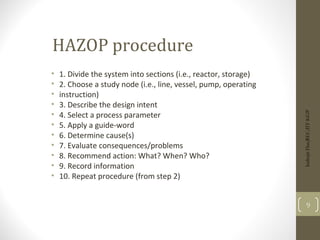
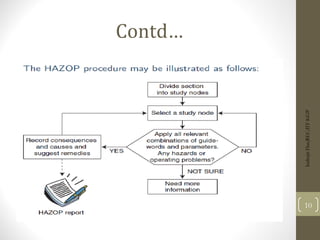
HAZOP procedure
• 1. Divide the system into sections (i.e., reactor, storage)
• 2. Choose a study node (i.e., line, vessel, pump, operating
• instruction)
• 3. Describe the design intent
• 4. Select a process parameter
• 5. Apply a guide-word
• 6. Determine cause(s)
• 7. Evaluate consequences/problems
• 8. Recommend action: What? When? Who?
• 9. Record information
• 10. Repeat procedure (from step 2)
Indrajit
Das;REC;IIT-KGP
9
Contd…
Indrajit
Das;REC;IIT-KGP
10
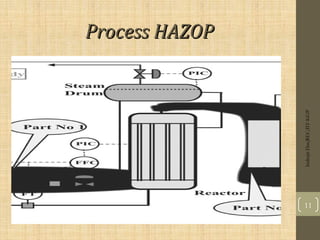
Process HAZOP
Process HAZOP
11
Indrajit
Das;REC;IIT-KGP
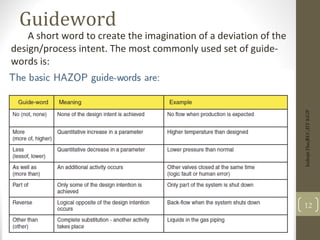
Guideword
A short word to create the imagination of a deviation of the
design/process intent. The most commonly used set of guide-
words is:
Indrajit
Das;REC;IIT-KGP
12
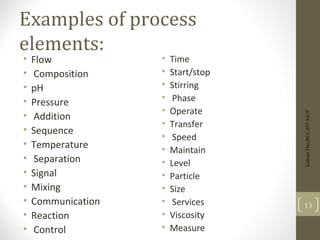
Examples of process
elements:
• Flow
• Composition
• pH
• Pressure
• Addition
• Sequence
• Temperature
• Separation
• Signal
• Mixing
• Communication
• Reaction
• Control
• Time
• Start/stop
• Stirring
• Phase
• Operate
• Transfer
• Speed
• Maintain
• Level
• Particle
• Size
• Services
• Viscosity
• Measure
Indrajit
Das;REC;IIT-KGP
13
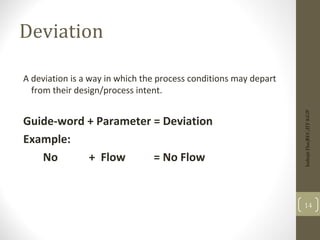
Deviation
A deviation is a way in which the process conditions may depart
from their design/process intent.
Guide-word + Parameter = Deviation
Example:
No + Flow = No Flow
Indrajit
Das;REC;IIT-KGP
14
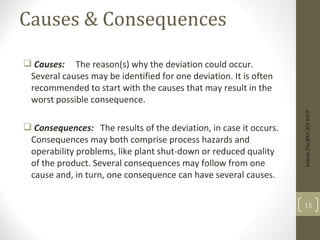
Causes & Consequences
 Causes: The reason(s) why the deviation could occur.
Several causes may be identified for one deviation. It is often
recommended to start with the causes that may result in the
worst possible consequence.
 Consequences: The results of the deviation, in case it occurs.
Consequences may both comprise process hazards and
operability problems, like plant shut-down or reduced quality
of the product. Several consequences may follow from one
cause and, in turn, one consequence can have several causes.
Indrajit
Das;REC;IIT-KGP
15
Safeguards
Facilities that help to reduce the occurrence frequency
of the deviation or to mitigate its consequences. There are five
types of safeguards that:
1. Identify the deviation:
2. Compensate for the deviation:
3. Prevent the deviation from occurring:
4. Prevent further escalation of the deviation:
5. Relieve the process from the hazardous
deviation.
Indrajit
Das;REC;IIT-KGP
16
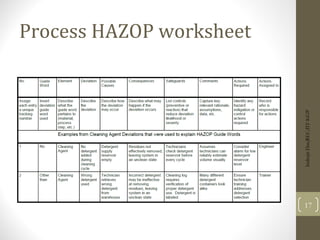
Process HAZOP worksheet
Indrajit
Das;REC;IIT-KGP
17
Procedure HAZOP
Procedure HAZOP
18
Indrajit
Das;REC;IIT-KGP
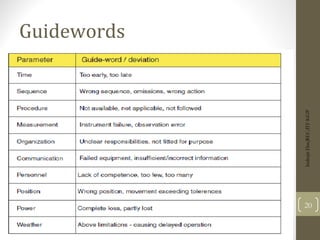
What is a procedure HAZOP?
A procedure HAZOP is an examination of an existing or
planned operation (work) procedure to identify hazards and
causes for operational problems, quality problems, and delays.
 Can be applied to all sequences of operations.
 Focus on both human errors and failures of technical systems.
 Best suited for detailed assessments.
 Flexible approach with respect to use of guide-words.
19
Indrajit
Das;REC;IIT-KGP
Guidewords
20
Indrajit
Das;REC;IIT-KGP
Reporting and review
21
Indrajit
Das;REC;IIT-KGP
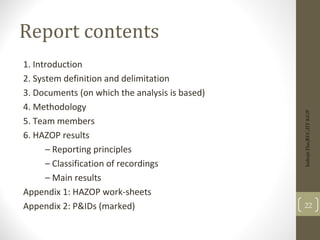
Report contents
1. Introduction
2. System definition and delimitation
3. Documents (on which the analysis is based)
4. Methodology
5. Team members
6. HAZOP results
– Reporting principles
– Classification of recordings
– Main results
Appendix 1: HAZOP work-sheets
Appendix 2: P&IDs (marked) 22
Indrajit
Das;REC;IIT-KGP
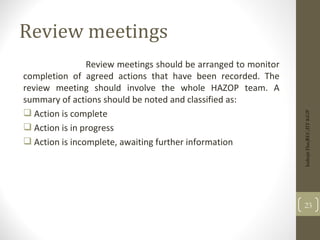
Review meetings
Review meetings should be arranged to monitor
completion of agreed actions that have been recorded. The
review meeting should involve the whole HAZOP team. A
summary of actions should be noted and classified as:
 Action is complete
 Action is in progress
 Action is incomplete, awaiting further information
23
Indrajit
Das;REC;IIT-KGP
Conclusion
Conclusion
24
Indrajit
Das;REC;IIT-KGP
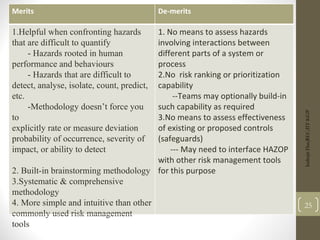
Merits De-merits
1.Helpful when confronting hazards
that are difficult to quantify
- Hazards rooted in human
performance and behaviours
- Hazards that are difficult to
detect, analyse, isolate, count, predict,
etc.
-Methodology doesn’t force you
to
explicitly rate or measure deviation
probability of occurrence, severity of
impact, or ability to detect
2. Built-in brainstorming methodology
3.Systematic & comprehensive
methodology
4. More simple and intuitive than other
commonly used risk management
tools
1. No means to assess hazards
involving interactions between
different parts of a system or
process
2.No risk ranking or prioritization
capability
--Teams may optionally build-in
such capability as required
3.No means to assess effectiveness
of existing or proposed controls
(safeguards)
--- May need to interface HAZOP
with other risk management tools
for this purpose
25
Indrajit
Das;REC;IIT-KGP
BIBLIOGRAPHY
BIBLIOGRAPHY
1.
1. Professor Marvin Rausand
Department of Production and Quality Engineering
Norwegian University of Science and Technology
2.
2. Manufacturing Technology Committee – Risk
Management Working Group-
Risk Management Training Guides.
3. AcuTech Process Risk Management..
4.
4. Professor N. K. Goyel
Reliability Engg. Center;
Indian Institute Of Technology-Kharagpur . 26
Indrajit
Das;REC;IIT-KGP
Thank You…
Thank You…
27
Indrajit
Das;REC;IIT-KGP

hazopanalysis-.pdf

  • 1.
    HAZOP ANALYSIS HAZOP ANALYSIS IndrajitDas Roll No.10RE60R05 M-Tech; 1st Year;1st Sem. Reliability Engg. Center, IIT-KGP
  • 2.
    What is HAZOP? AHazard and Operability (HAZOP) study is a structured and systematic examination of a planned or existing process or operation in order to identify and evaluate problems that may represent risks to personnel or equipment, or prevent efficient operation. A HAZOP is a qualitative technique based on guide-words and is carried out by a HAZOP team during a set of meetings. Indrajit Das;REC;IIT- KGP 2
  • 3.
    BACK GROUND  TheHAZOP technique was initially developed to analyze chemical process systems, but has later been extended to other types of systems.  First main textbook: Kletz, T. A.: “Hazop and Hazan -Identifying and Assessing Process Industry Hazards”, Institution of Chemical Engineers. Indrajit Das;REC;IIT-KGP 3
  • 4.
    When to performa HAZOP? he HAZOP study should preferably be carried out as early in the design phase as possible - to have influence on the design. hen the final P&ID are available. uring construction and installation to ensure that recommendations are implemented. Indrajit Das;REC;IIT-KGP 4
  • 5.
    HAZOP team and HAZOPteam and meetings meetings 5 Indrajit Das;REC;IIT-KGP
  • 6.
    Team Members &Their Team Members & Their Responsibility Responsibility HAZOP team leader HAZOP team leader HAZOP secretary HAZOP secretary HAZOP team members HAZOP team members Responsibilities: Responsibilities: 1.Define the scope for the analysis 2.Select HAZOP team members 3.Plan and prepare the study 4.Chair the HAZOP meetings Responsibilities: Responsibilities: 1.Prepare HAZOP worksheets 2.Record the discussion in the HAZOP meetings 3.Prepare draft report(s) The basic team for a process plant will be: Project engineer o Commissioning manager o Process engineer o Instrument/electrical engineer o Safety engineer 6 Indrajit Das;REC;IIT-KGP
  • 7.
    HAZOP meeting Proposed agenda: Proposedagenda: 1. Introduction and presentation of participants. 2. Overall presentation of the system/operation to be analysed. 3. Description of the HAZOP approach. 4. Presentation of the first node or logical part of the operation. 5. Analyse the first node/part using the guide-words and parameters. 6. Continue presentation and analysis (steps 4 and 5) 7. Coarse summary of findings. Focus should be on potential hazards as well as potential operational problems. Each session of the HAZOP meeting should not exceed two hours. 7 Indrajit Das;REC;IIT-KGP
  • 8.
    Types of HAZOP Process HAZOP:  Human HAZOP :  Procedure HAZOP:  Software HAZOP: Indrajit Das;REC;IIT-KGP 8
  • 9.
    HAZOP procedure • 1.Divide the system into sections (i.e., reactor, storage) • 2. Choose a study node (i.e., line, vessel, pump, operating • instruction) • 3. Describe the design intent • 4. Select a process parameter • 5. Apply a guide-word • 6. Determine cause(s) • 7. Evaluate consequences/problems • 8. Recommend action: What? When? Who? • 9. Record information • 10. Repeat procedure (from step 2) Indrajit Das;REC;IIT-KGP 9
  • 10.
  • 11.
  • 12.
    Guideword A short wordto create the imagination of a deviation of the design/process intent. The most commonly used set of guide- words is: Indrajit Das;REC;IIT-KGP 12
  • 13.
    Examples of process elements: •Flow • Composition • pH • Pressure • Addition • Sequence • Temperature • Separation • Signal • Mixing • Communication • Reaction • Control • Time • Start/stop • Stirring • Phase • Operate • Transfer • Speed • Maintain • Level • Particle • Size • Services • Viscosity • Measure Indrajit Das;REC;IIT-KGP 13
  • 14.
    Deviation A deviation isa way in which the process conditions may depart from their design/process intent. Guide-word + Parameter = Deviation Example: No + Flow = No Flow Indrajit Das;REC;IIT-KGP 14
  • 15.
    Causes & Consequences Causes: The reason(s) why the deviation could occur. Several causes may be identified for one deviation. It is often recommended to start with the causes that may result in the worst possible consequence.  Consequences: The results of the deviation, in case it occurs. Consequences may both comprise process hazards and operability problems, like plant shut-down or reduced quality of the product. Several consequences may follow from one cause and, in turn, one consequence can have several causes. Indrajit Das;REC;IIT-KGP 15
  • 16.
    Safeguards Facilities that helpto reduce the occurrence frequency of the deviation or to mitigate its consequences. There are five types of safeguards that: 1. Identify the deviation: 2. Compensate for the deviation: 3. Prevent the deviation from occurring: 4. Prevent further escalation of the deviation: 5. Relieve the process from the hazardous deviation. Indrajit Das;REC;IIT-KGP 16
  • 17.
  • 18.
  • 19.
    What is aprocedure HAZOP? A procedure HAZOP is an examination of an existing or planned operation (work) procedure to identify hazards and causes for operational problems, quality problems, and delays.  Can be applied to all sequences of operations.  Focus on both human errors and failures of technical systems.  Best suited for detailed assessments.  Flexible approach with respect to use of guide-words. 19 Indrajit Das;REC;IIT-KGP
  • 20.
  • 21.
    Reporting and review Reportingand review 21 Indrajit Das;REC;IIT-KGP
  • 22.
    Report contents 1. Introduction 2.System definition and delimitation 3. Documents (on which the analysis is based) 4. Methodology 5. Team members 6. HAZOP results – Reporting principles – Classification of recordings – Main results Appendix 1: HAZOP work-sheets Appendix 2: P&IDs (marked) 22 Indrajit Das;REC;IIT-KGP
  • 23.
    Review meetings Review meetingsshould be arranged to monitor completion of agreed actions that have been recorded. The review meeting should involve the whole HAZOP team. A summary of actions should be noted and classified as:  Action is complete  Action is in progress  Action is incomplete, awaiting further information 23 Indrajit Das;REC;IIT-KGP
  • 24.
  • 25.
    Merits De-merits 1.Helpful whenconfronting hazards that are difficult to quantify - Hazards rooted in human performance and behaviours - Hazards that are difficult to detect, analyse, isolate, count, predict, etc. -Methodology doesn’t force you to explicitly rate or measure deviation probability of occurrence, severity of impact, or ability to detect 2. Built-in brainstorming methodology 3.Systematic & comprehensive methodology 4. More simple and intuitive than other commonly used risk management tools 1. No means to assess hazards involving interactions between different parts of a system or process 2.No risk ranking or prioritization capability --Teams may optionally build-in such capability as required 3.No means to assess effectiveness of existing or proposed controls (safeguards) --- May need to interface HAZOP with other risk management tools for this purpose 25 Indrajit Das;REC;IIT-KGP
  • 26.
    BIBLIOGRAPHY BIBLIOGRAPHY 1. 1. Professor MarvinRausand Department of Production and Quality Engineering Norwegian University of Science and Technology 2. 2. Manufacturing Technology Committee – Risk Management Working Group- Risk Management Training Guides. 3. AcuTech Process Risk Management.. 4. 4. Professor N. K. Goyel Reliability Engg. Center; Indian Institute Of Technology-Kharagpur . 26 Indrajit Das;REC;IIT-KGP
  • 27.