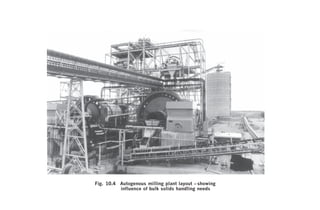
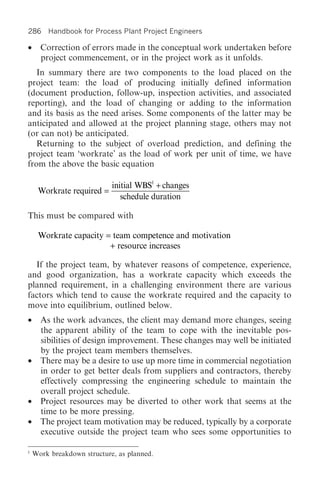
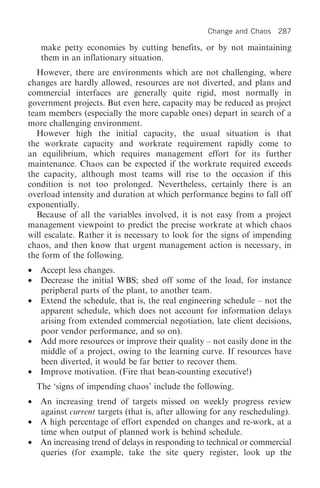
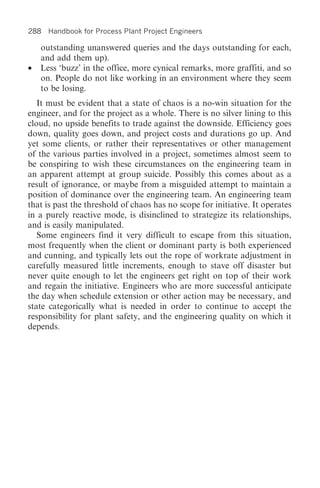
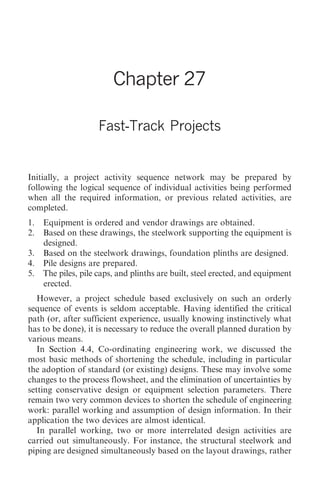
This page intentionally left blank
Contents                      i


Handbook for Process Plant
    Project Engineers


                  by

         Peter Watermeyer


Professional Engineering Publishing Limited
     London and Bury St Edmunds, UK
ii                                 Contents
                            First published 2002

This publication is copyright under the Berne Convention and the
International Copyright Convention. All rights reserved. Apart from any fair
dealing for the purpose of private study, research, criticism, or review, as
permitted under the Copyright Designs and Patents Act 1988, no part may be
reproduced, stored in a retrieval system, or transmitted in any form or by any
means, electronic, electrical, chemical, mechanical, photocopying, recording
or otherwise, without the prior permission of the copyright owners.
Unlicensed multiple copying of this publication is illegal. Inquiries should be
addressed to: The Publishing Editor, Professional Engineering Publishing
Limited, Northgate Avenue, Bury St Edmunds, Suffolk, IP32 6BW, UK.

                              © P Watermeyer


                            ISBN 1 86058 370 9


A CIP catalogue record for this book is available from the British Library.


The publishers are not responsible for any statement made in this
publication. Data, discussion, and conclusions developed by the Author
are for information only and are not intended for use without
independent substantiating investigation on the part of the potential
users. Opinions expressed are those of the Author and are not necessarily
those of the Institution of Mechanical Engineers or its publishers.


         Printed by Cromwell Press, Trowbridge, Wiltshire, UK
This page intentionally left blank
Contents                      iii
                           Contents

Foreword                                                   ix
Acknowledgements                                            x
Chapter 1 Introduction                                      1
1.1 What’s so special about process plant projects?         1
1.2 The structure and components of this book               3
1.3 Methodology of presentation                             5
1.4 Getting it right                                        7
             First Cycle – A Process Plant and a Project
Chapter 2 A Process Plant                                  13
2.1 Basic process design elements                          13
2.2 The processed materials and the process                18
2.3 The process design/detail design interface             20
Chapter 3 A Project and its Management: A Brief Overview   23
3.1 The project                                            23
3.2 Starting the project                                   25
3.3 Managing the project                                   27
Chapter 4 The Engineering Work and Its Management          31
4.1 Planning the engineering work                          31
4.2 Doing the engineering work                             40
4.3 Managing schedule, cost, and quality                   41
4.4 Co-ordinating engineering work                         44
4.5 Management of engineering resources                    46
                     Second Cycle – Environment
Chapter 5 The Project’s Industrial Environment             51
5.1 The industry and the client                            51
5.2 The client and the project management                  55
5.3 The process plant project industry:
    the ‘indirect cost’ of a plant                         56
Chapter 6 The Commercial Environment                       59
6.1 Principles of procurement and contract                 59
Chapter 7 The Contracting Environment                      65
7.1 Ways of building a plant                               65
7.2 The engineering contractor                             70
7.3 The project engineer                                   72
7.4 Conclusion                                             75
iv                             Contents

Chapter 8 The Economic Environment                                77
8.1 Plant profitability                                           77
8.2 Lifecycle considerations and ‘trade-off’ studies              78
8.3 The real world of costs and values                            82
8.4 Project engineering and management work                       83
                Third Cycle – Conceptual Development
Chapter 9 Studies and Proposals                                   91
9.1 Feasibility studies                                           91
9.2 Proposals                                                     94
9.3 Estimating project costs                                      94
9.4 Risk                                                          97
9.5 Accuracy                                                      99
9.6 Contingency                                                  101
Chapter 10 Plant Layout and Modelling                            105
10.1 Layout                                                      105
10.2 Design presentation and modelling                           112
Chapter 11 Value Engineering and Plant Optimization              117
11.1 Value engineering                                           118
11.2 Plant optimization models                                   120
Chapter 12 Hazards, Loss, and Safety                             123
12.1 Hazard identification                                       124
12.2 Designing for safety                                        127
12.3 Commissioning                                               131
12.4 Plant modifications                                         132
         Fourth Cycle – Engineering Development and Detail
Chapter 13 Specification, Selection, and Purchase                135
13.1 Procurement                                                 135
13.2 Specification                                               138
      13.2.1 Specification as a document for bidding             138
      13.2.2 Specification as a reference for work performance   141
13.3 The selection of equipment                                  141
13.4 Technical appraisal of equipment bids                       143
13.5 Inspection and quality control                              145
13.6 Planning inspection work                                    148
13.7 Expediting                                                  150
Chapter 14 Fluid Transport                                       153
14.1 A brief note on liquid-pumping systems design               153
14.2 Gases                                                       162
Contents                     v

14.3   Piping engineering and its management              167
14.4   Some concluding comments on piping layout for
       pumps and compressors                              170
Chapter 15 Bulk Solids Transport                          173
15.1 Bulk solids flow                                     173
15.2 Conveyors                                            175
15.3 Feeders                                              181
15.4 Safety and environmental health                      183
Chapter 16 Slurries and Two-Phase Transport               185
16.1 Slurry transport                                     185
16.2 Piping design                                        188
16.3 Tanks and agitation                                  189
16.4 Pneumatic conveying                                  191
16.5 Pipework reactions                                   192
Chapter 17 Hydraulic Design and Plant Drainage            195
17.1 Hydraulic design                                     195
17.2 Plant drainage                                       201
Chapter 18 Observations on Multi-Discipline Engineering   203
18.1 Structural design considerations                     203
18.2 Plant and equipment loads                            205
18.3 Civil engineering                                    207
18.4 Electrical engineering                               209
18.5 Instrumentation and control                          212
Chapter 19 Detail Design and Drafting                     217
19.1 Structures                                           218
19.2 Piping                                               221
19.3 Vessels                                              227
19.4 Chutes, bins, and hoppers                            229
19.5 Civil design                                         230
19.6 Instrumentation and control                          233
19.7 Electrical design                                    236
19.8 Other technical specialities and consultants         238
19.9 Overview of the design process                       239
19.10 General arrangement drawings and models             240
Chapter 20   Traditional Documentation Control            243
               Fifth Cycle – More on Management
Chapter 21 The Organization of Work                       249
21.1 Packaging work                                       249
vi                             Contents

21.2   Procedures                                          254
Chapter 22 Construction                                    257
22.1 Survey and setout                                     258
22.2 Site management                                       258
22.3 Technical information for construction                259
22.4 Site materials management                             260
22.5 Heavy lifts                                           261
22.6 The ‘site and office’ relationship                    262
Chapter 23 Construction Contracts                          265
23.1 Structuring contracts                                 265
23.2 Structuring payment to contractors                    269
23.3 Claims                                                270
Chapter 24 Commissioning                                   273
24.1 Safety during commissioning                           276
Chapter 25 Communication                                   277
Chapter 26 Change and Chaos                                281
26.1 Change                                                281
26.2 Chaos                                                 283
Chapter 27 Fast-Track Projects                             289
27.1 Case study A: Fabulous Fertilizers’ new plant         292
27.2 Case study B: Magnificent Metals’ new gold plant      293
Chapter 28 Advanced Information Management Systems         297
                 Final Cycle – Strategies for Success
Chapter 29 Project Strategy Development                    305
29.1 Is the target correct?                                307
29.2 How do we get there?                                  308
29.3 What are the major problems?                          309
Chapter 30 Key Issues Summary                              311
30.1 Key project or study issues at the conceptual stage   311
30.2 Key issues at the project execution phase             311
30.3 Key issues for the conduct of the individual
     engineer or engineering business unit                 313
30.4 General business issues                               313
Appendix 1 Jargon                                          315
A1.1 Definition of design parameters                       316
Contents              vii

Appendix 2 Design Criteria Checklist              317
A2.1 Plant performance                            319
A2.2 Plant site                                   319
A2.3 The process                                  319
A2.4 Basic plant design features                  320
A2.5 Design features for equipment (mechanical,
      instrumentation, and electrical)            320
A2.6 Design methodology and standardization       320
A2.7 Design verification and approval plan        321
A2.8 Design and plant documentation for client    321
Index                                             323
This page intentionally left blank
viii                        Contents
                       Related Titles

How Did That Happen –                 W Wong               1 86058 359 8
Engineering Safety and Reliability

IMechE Engineers’ Data Book           C Matthews           1 86058 248 6
(Second Edition)

Improving Maintainability and         G Thompson           1 86058 135 8
Reliability through Design

A Practical Guide to Engineering      C Matthews           1 86058 086 6
Failure Investigation

Process Machinery – Safety and        W Wong (Ed.)         1 86058 046 7
Reliability

Plant Monitoring and Maintenance                           1 86058 087 4
Routines (IMechE Seminar)


               For the full range of titles published by
             Professional Engineering Publishing contact:
                       Marketing Department
             Professional Engineering Publishing Limited
                          Northgate Avenue
                          Bury St Edmunds
                               Suffolk
                             IP32 6BW
                                 UK
                       Tel: +44 (0)1284 724384
                      Fax: +44 (0)1284 718692
                   Website: www.pepublishing.com
Contents                                    ix
                             Foreword

Project engineering comprises the orchestrated integration of all
engineering disciplines to achieve a commercially defined project
objective. The quality and effectiveness of project engineering are key
components of process plant design and construction, a business which
invariably requires complex multi-disciplinary design input and focused
customer and commercial awareness.
   Courses in the individual disciplines such as civil, mechanical, and
chemical engineering are offered by many universities and other
institutions. By contrast, the art of project engineering is usually
acquired the hard way, through practical involvement in project
execution. Unfortunately, much of the necessary experience is too often
painfully gained by learning from expensive mistakes.
   Peter Watermeyer has a keen interest in analysing the causes of
success, failure, mediocrity, and excellence in project execution. He sees
these as a function of not only the performance and management of the
engineering work, but also of the way that work and project teams are
structured and orientated in relationship to their whole environment.
Peter has a wealth of practical experience in the industry. He spent 15
years in the power, hydrocarbons, and process machinery industries
before joining Bateman, where he has spent over 20 years in the
engineering and management of process plant projects, mainly in the
international mining and petroleum industries.
   This book, which is based on the knowledge, skill, and diverse
experience of a master of the art will, I believe, prove to be of great value
in guiding aspiring and less experienced project engineers towards
achieving full professional competence in this challenging arena.

      Dr John P Herselman, DrIng, Dipl-Ing, BSc (Chem Eng), FIOD
                                  Executive Chairman, Bateman BV
This page intentionally left blank
Acknowledgements
                         Contents                                        xi


The illustrations in this book are by Natalie Watermeyer and the
photographs and drawings are reproduced with permission from
Bateman Projects Ltd.
   I am grateful to Phillip Ashworth, for his review and guidance on
the revision to the original text. I would also like to thank the editorial
staff of Professional Engineering Publishing, and in particular the
commissioning editor Sheril Leich and the co-ordinating editor Mandy
Kingsmill, for their very professional work.
This page intentionally left blank
Introduction 1


                          Chapter 1

                           Introduction


This book is intended to assist people who design and build process
plant, and people who participate in multi-disciplinary engineering
projects in general. The book is aimed in particular at the project engineer,
or team of lead engineers, who inevitably hold such projects together,
being at the heart of the information generation system which shapes
and guides the project.
   The design and construction of process plant covers an exceedingly
wide field of performance and knowledge. Considering engineering
topics alone, those which impact process plant design include the work
of very many specialist technical branches. But this is only part of what
has to be considered in successful project engineering. Interwoven with
the engineering and design of the plant are many commercial, construc-
tional, financial, and social considerations. It may be satisfying for the
technical purist to focus exclusively on engineering issues, but the
engineer who does so is likely either to be limited to a subordinate role,
or to be part of an unsuccessful enterprise – engineering considered on
its own becomes an academic pastime.
   The content of the book is therefore intended to address that mixed
bag of technical, commercial, managerial, and behavioural issues which
constitute the actual job content of the practising engineer, and are
peculiar to this industry.


1.1 What’s so special about process plant projects?
In some cases – nothing! A relatively small and simple project can
usually be executed by a single experienced engineer with a minimum of
fuss, and without complex procedures or strategy. This is especially the
2   Handbook for Process Plant Project Engineers

case for plants which are very similar to existing units. Within the
following text may be found some helpful aspects of technical advice
for such projects, but the work must not be over-complicated. Any
higher-level issues of strategy and management are best addressed
(if at all) at the level of organization which encompasses the small
project, for example the corporation which requires the project, or a
contracting organization which delivers such projects. The following
text is primarily addressed at relatively large and complex projects,
requiring the interaction of a number of skills – technical, commercial,
and constructional.
   Compared to the general field of engineering design and construction,
the main differentiating factors which have to be addressed in these
projects are the following.
•   The unique design of each plant is the inevitable consequence of the
    need to optimize each application to its unique circumstances of
    feedstock, product, capacity, and environment.
•   Plants are built around hundreds of items of proprietary processing
    equipment. The plant design must interface exactly with the
    operational characteristics and dimensions of these individual items.
    The interface information can only be finalized when the commercial
    agreements with equipment suppliers have been concluded.1
•   Both the plant design and its construction employ many types of
    specialist, who must interact at thousands of interfaces (and often
    work simultaneously in the same plant space envelope) to produce a
    co-ordinated product.
•   Plant operation can be hazardous. The elimination or control of
    hazards, and the establishment of safe operating practices, are
    prerequisites of plant operation, requiring priority attention during
    plant design. Environmental impact is also invariably an issue.
•   Technology development is rapid and continuous. This greatly
    impacts on the uniqueness of process and plant design (the first item
    above), but also often impacts on project execution – there is often a
    desire to accommodate changes while design and construction are in
    progress.

1
  This is at least the common practice in free-market economies. In communist countries,
it was (and still is) often the practice to ‘centralize’ equipment designs, so that the plant
designer can simply choose a completely detail-designed equipment item from a
catalogue. This simplifies the plant designer’s job,but often at great cost at the construction
stage, when there is no commitment from a supplier to match the project programme or
budget. Also, it shifts responsibility for ‘fitness for purpose’ of the item.
Introduction 3

•   The project schedule cannot be generated in any mechanistic
    fashion. Invariably, the critical path can be shortened almost ad
    infinitum by taking various shortcuts (in other words, by changing
    the schedule logic – not just by employing more resources or working
    faster). These possible shortcuts come at a cost or risk, which must
    be balanced against the benefits.
•   The nature of the industry served by process plant usually puts a
    high premium on early plant completion and operation.
•   The plant has to be constructed on site, to suit its site, wherever that
    may be.
The degree to which these and other features are present, together with
the more obvious comparisons of size, cost, and complexity, dictate the
intensity of the challenge to the project team. All of these features have
to be addressed during the plant engineering and its follow-up.


1.2 The structure and components of this book
The main objective of this book is to give guidance on how the project
engineer’s work is carried out in practice. We have therefore to consider
how all items of information interact, and how they are brought
together in each practical situation. This is a distinctly different objective
from that of a technical reference book, such as Perry’s Chemical
Engineer’s Handbook. This is a recommended reference for any engineer
in the process plant field, and contains a wealth of information, but it is
targeted and indexed by technical subject. We need a different structure
here, in which the sequence of information is important and is project-
related. It is convenient to address the structure at four levels.
   In defining these levels, an immediate pitfall can be identified and
should be avoided. In organizational and management terminology,
invariably there is a high and a low level. This should not be confused
with relative importance – all of the organization components are
important. Within each level, there are likely to be relatively less and
more important functions for a given project, but a project can be
jeopardized just as easily by poor detail design as by poor management.
   Subject to this qualification, the base tier, level one, consists of the
activities of detailed design, procurement of parts, delivery to site,
construction, and commissioning, and all of these will be addressed.
Inevitably in an integrating text such as this, most topics have to be
discussed at a relatively superficial level, concentrating on those facets
which are more essential, either to the interactions with the whole, or
because of relatively high individual impact to the project and the plant.
4   Handbook for Process Plant Project Engineers

   At the level above, level two, reside the technical focus and project
control, which give direction to all the detailed work. The centrepiece
of this is the process technology package. The technological content
of such packages is outside the scope of this book – it is the domain
of many experts and organizations, embracing diverse fields of technical
specialization such as catalytic conversion and hydro-metallurgy, and
niches within these fields which yet consume entire careers. We will
rather (and briefly) address the generalized make-up of such packages,
of how they relate to the plant to be built and to the project around
them. In addition, we will discuss the system of engineering and infor-
mation management (also at level two), which governs the performance
of level one activities.
   Not particularly addressed at level two, because of the focus of this
book, are the methodologies of managing procurement, logistics,
contracts, finance, and construction. The reader with greater project
management aspirations is advised to refer to specialized texts on these
subjects. We will, however, discuss the principal interfaces with
engineering work and its management.
   At level three, we have a management system for the entire project.
This is conventionally broken down into three or four components,
namely management of scope, quality, cost, and schedule. (Scope and
quality may be regarded as a single issue, a practice not recommended
by the author.) Health and safety considerations may properly also be
managed at this overview level, and must be included in any such text.
   At level four, there is only one item, project strategy. This has to
ensure that the project is correctly conceived (technically, commercially,
economically, socially) and embodies the skeleton of the over-arching
plan which will ensure that the goods are delivered in the optimum
fashion. Inevitably the strategy must deal with the issues of relationship
management between the principal stakeholders, for example the plant
owner (usually, a complexity of people and interests) and contractors,
including possibly a single lump sum or managing contractor, and a
variety of sub-contractors and suppliers. The strategies are bound to be
different for each stakeholder, reflecting the basic question of ‘What do
I want out of this project?’
   There is a significant body of professional opinion that such con-
siderations of strategy are not appropriate in the context of what should
be the technical field of engineering. (In the author’s experience, there
are also several senior executives who are relatively ignorant of the links
between engineering and strategy, and feel quite threatened!) There are
those who argue that management of large projects, whether or not
Introduction 5

centred on multi-disciplinary engineering, is primarily a matter of
project management practice, and can be quite separately treated as
such. Both of these views can be dangerous. From level one to level
four, there are common threads, mainly of engineering information and
its development, which have to be taken into account when making
management decisions. The understanding and maintenance of these
threads, many of whose origins are at the detail level, are the essence of
the discipline of project engineering.
   The interaction between project strategy and engineering execution
operates in two directions. It will be seen within this text that the adoption
of project strategy – including for instance the structure of the relationship
between client and contractor – has major implications for the way in
which engineering is optimally conducted. In reverse, the best project
strategy (for each party) is likely to depend on some of the engineering
realities.
   The technical content of this book posed a particular challenge of
selection and condensation. Nearly every topic could be expanded into
several volumes, and must in practice be covered by specialist engineers
with far more knowledge than is presented. The intentions behind the
information presented are twofold. Firstly, to include just sufficient
information for a generalist (the project engineer) to manage the specialists,
or to assist the specialists to co-ordinate with each other and find the
best compromises. Secondly, to include some of the author’s own
experience (spanning some 30 years) of simple but important items
which do not seem to be conveniently presented in textbooks or standards,
but which can prove important and costly.


1.3 Methodology of presentation
Project engineers have traditionally learnt much of their job-knowledge
by experience. The mainly technical aspects can be taught in isolation as
an academic subject, but even these have to be tempered by experience,
to match theory to application. The behavioural and management
aspects of job performance are even more dependent on the acquisition
of relevant experience. Through a few project cycles in relatively junior
roles, engineers have gradually broadened their skills and their under-
standing of what is going on, inside and outside of the project team, and
become aware of the consequences of design decisions and of the way
actions and events interact. They have learned to recognize problems,
and learned some standard solutions and how to choose the best
6   Handbook for Process Plant Project Engineers

solution for the circumstances. They have also absorbed something of
the culture of their industry, and learnt how to behave and influence
others, to make the best of their working relationships. They have
become ready for a leading or management role.
    It is our objective here to produce a text which accelerates this process
of learning, and enhances it by trying to transfer some of the author’s own
experience and retrospective analysis of successes and failures. Surely the
process of learning by experience can be accelerated, and some of the pain
reduced.
    A limitation of trying to synthesize such a learning process is that a
balanced progression must be achieved, in which all the interacting
subjects are advanced more or less in parallel. It is no good giving a
dissertation on the merits and techniques of compressing project schedules
unless the more normal schedule practice and its logic are understood. It
is equally fruitless (and boring, and unlikely to be absorbed) to discuss the
finer points of project management, let alone strategy development, until
it is understood what are the work components (and their characteristics)
which have to be managed and optimized.
    The book has therefore been set out into six cycles, each targeted at a
different and progressive stage of development. The first cycle consists of
an overview of a process plant, the process technology package, a very
brief outline of the management of a project to build a plant, and a brief
description of the engineering work and its management. The second
cycle looks at the project environment, in particular some non-engineering
factors which influence the work of the project. The third cycle is about
project initiation and conceptual development. This becomes possible
when the nature of the project and its environment are understood. We
have also chosen to address the subject of hazards and safety at this point.
The fourth cycle addresses plant engineering technical issues, at a more
detailed level, and is the largest component of the book. The fifth cycle is
concerned with project engineering and management issues which need
a particular emphasis in this industry, leading up to a final cycle which
discusses strategy development.
    It may be noticed that the two structures, of level and of cyclical develop-
ment, are not strictly parallel, but compare more like a traditional four-
cylinder engine firing cycle of 2-1-3-4. Even this analogy is somewhat
misleading. There is no single direction leading to strategic understanding,
but rather a matrix where every part depends more or less on every other
part, and the strategy requires a knowledge of all the parts. Strategic
performance, without detailed performance, is of no value whatever, and
both continue to evolve and require a continuous learning process.
Introduction 7

  Turning to the basics of the format of presentation, in an endeavour
to provide a text that can be useful for on-the-job reference, the general
mechanism employed is the checklist. Wherever possible, the text has
been formatted into bullets, which are intended to provide a structured
approach to the common practical situations, by helping the engineer
both to plan his2 approach and to check that he is addressing all essential
facets.


1.4 Getting it right
The basic project methodology advocated in this book is to start a
project by looking as widely as possible at the choices presented, evaluate
the full consequences of those choices, and then develop a strategy to
make the best of the opportunities and eliminate the risks. The strategy
is further developed in a structured fashion, leading to detailed plans
and methodologies, which are based on solid experience that has been
proven to give manageably acceptable results.
   It all sounds very simple. And yet, so many individual engineers, and
organizations of engineers, fail to produce acceptable results. Individual
intelligent and well-educated engineers fail to rise above mediocrity, and
whole engineering organizations become obsolete and disappear. Others
prosper: some seemingly by sheer luck, by being in the right place at the
right time, but mostly by getting the right balance between having a
good strategy, based on recognition of personal objectives, and the
diligent deployment of sound skills.
   There really is not much more to be said about the path to success,
but it is quite easy to comment on the failures. A few main categories
are worth mentioning.
•   Bad luck. As real calamities such as political risk or natural disaster
    can and should be insured against, this should rather be described as
    the occasional, unfortunate consequence of excessive risk. Some
    degree of technical risk is inevitable for developing technologies,
    without which a technically based enterprise is anyway unlikely to
    flourish. The same goes for commercial risk, which is necessary to
    seize opportunities. The key is to have a considered risk management


2
 Throughout the text, the male gender is intended to include the female. This is done
purely for the purposes of simplification.
8   Handbook for Process Plant Project Engineers


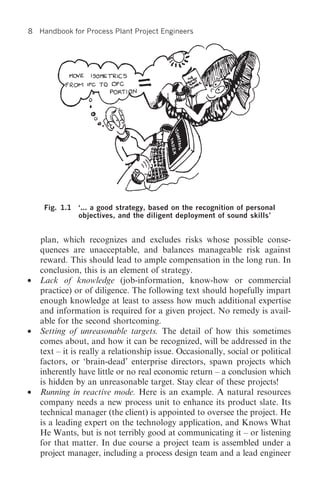
     Fig. 1.1 ‘... a good strategy, based on the recognition of personal
              objectives, and the diligent deployment of sound skills’


    plan, which recognizes and excludes risks whose possible conse-
    quences are unacceptable, and balances manageable risk against
    reward. This should lead to ample compensation in the long run. In
    conclusion, this is an element of strategy.
•   Lack of knowledge (job-information, know-how or commercial
    practice) or of diligence. The following text should hopefully impart
    enough knowledge at least to assess how much additional expertise
    and information is required for a given project. No remedy is avail-
    able for the second shortcoming.
•   Setting of unreasonable targets. The detail of how this sometimes
    comes about, and how it can be recognized, will be addressed in the
    text – it is really a relationship issue. Occasionally, social or political
    factors, or ‘brain-dead’ enterprise directors, spawn projects which
    inherently have little or no real economic return – a conclusion which
    is hidden by an unreasonable target. Stay clear of these projects!
•   Running in reactive mode. Here is an example. A natural resources
    company needs a new process unit to enhance its product slate. Its
    technical manager (the client) is appointed to oversee the project. He
    is a leading expert on the technology application, and Knows What
    He Wants, but is not terribly good at communicating it – or listening
    for that matter. In due course a project team is assembled under a
    project manager, including a process design team and a lead engineer
Introduction 9

   for each discipline. A planner is recruited. He loses no time in getting
   plans from each discipline, and putting them together into an overall
   network. Unfortunately, he does not fully understand the interaction
   between disciplines of detailed engineering information, the potential
   conflicts, or how they may be resolved. The client dictates that the
   project schedule must be 16 months to commissioning, because he
   heard that was achieved somewhere else, and the planner duly jockeys
   the project schedule around to reflect this. The client also dictates the
   project budget. This includes no contingency, because he Knows
   What He Wants, and contingencies will only encourage the project
   team to believe that error and waste are acceptable.
   As time goes on:
     – Engineering gets further and further behind schedule, as each
       discipline in turn is unable to start or complete jobs because of
       the unavailability of information from equipment vendors and
       other disciplines.
     – Design and procurement decisions are endlessly delayed,
       because the client is not offered what he Wants, and expects the
       project team simply to make up the delays. They do not.
     – Many of the project drawings become full of revisions, holds,
       and – inevitably – interface errors, because the wrong revisions
       of input information were used, or assumptions were made but
       not verified and corrected.
     – In the struggle to catch up, quality functions, such as layout
       design reviews and equipment and fabrication inspections, are
       skimped.
     – The project manager loses control of the project – in fact, he
       spends most of his time arguing with the client, usually to try to
       stop process and layout changes being made. (‘These aren’t
       changes’, the client would say. ‘They are corrections of error.
       You failed to design what I Wanted.’)
     – The construction site degenerates into chaos. The construction
       management are unable to handle all the late drawings, design
       errors, late deliveries, flawed materials, and acceleration demands.
     – Both schedule and budget are grossly overrun, and the
       construction contractors make a fortune out of claims, especially
       for extended site establishment. And the plant is not What The
       Client Wanted.
If none of this seems familiar – you are new to process plant work. But
it is all quite unnecessary.
This page intentionally left blank
A Process Plant   11


         First Cycle
A Process Plant and a Project
This page intentionally left blank
A Process Plant   13


                         Chapter 2

                       A Process Plant


2.1 Basic process design elements

A process plant is a classification of factory which transforms materials
in bulk. The feedstock and products may be transported by pipeline or
conveyor, or in discrete quantities such as truckloads or bags, but they
are recognized by their bulk properties. Examples of process plants are
oil refineries, sugar mills, metallurgical extraction plants, coal washing
plants, and fertilizer factories. The products are commodities rather
than articles.
   The plant consists of a number of the following.
• ‘Process equipment’ items, in which material is transformed physi-
   cally or chemically, for example crushers, reactors, screens, heaters,
   and heat exchangers. The process equipment is required to effect the
   physical and chemical changes and separations necessary to produce
   the desired products, and also to deal with any unwanted by-products,
   including waste, spillage, dust, and smoke.
• Materials transport and handling devices, by which the processed
   materials and effluents are transferred between the process equipment
   items, and in and out of the plant and any intermediate storage, and
   by which solid products and wastes are handled.
• Materials storage facilities, which may be required to provide
   balancing capacity for feedstock, products, or between process
   stages.
• ‘Process utilities’ (or simply ‘utilities’), which are systems to provide
   and reticulate fluids such as compressed air, steam, water, and
   nitrogen, which may be required at various parts of the plant
   for purposes such as powering pneumatic actuators, heating,
14   Handbook for Process Plant Project Engineers

   cooling, and providing inert blanketing. Systems to provide process
   reagents and catalysts may be included as utilities, or as part of the
   process.
(Note: All of the above four categories include items of mechanical
equipment, namely machinery, tanks, pumps, conveyors, etc.)
• Electric power reticulation, for driving process machinery, for
   performing process functions such as electrolysis, for lighting,
   for powering of instrumentation and controls, and as a general
   utility.
• Instrumentation, to provide information on the state of the process
   and the plant, and, usually closely integrated to the instrumentation,
   control systems.
• Structures (made of various materials, including steel and concrete),
   which support the plant and equipment in the required configuration,
   enclose the plant if needed, and provide access for operation and
   maintenance.
• Foundations, which support the structures and some plant items
   directly, and various civil works for plant access, enclosure, product
   storage, and drainage.
• Plant buildings such as control rooms, substations, laboratories,
   operation and maintenance facilities, and administration offices.
  In addition there are inevitably ‘offsite’ facilities such as access roads,
bulk power and water supplies, security installations, offices not directly
associated with the plant, and employee housing; these are not considered
to be part of the process plant.
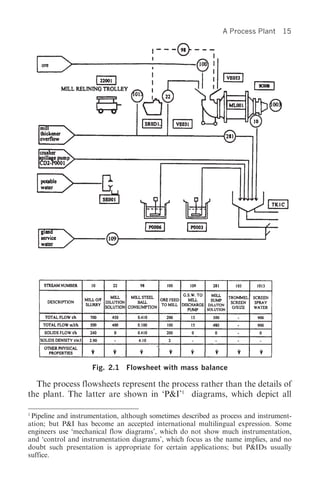
  A process plant is fundamentally represented by a process flowsheet.
This sets out all the process stages (essentially discrete pieces of process
equipment) and material storage points, and the material flows between
them, and gives corresponding information on the flowrates and material
conditions (chemical and physical). This information is usually provided
for:
• the mass balance case, in which the mass flows will balance
  algebraically;
• a maximum case, corresponding to individual equipment or material
  transport maxima for design purposes (these flows are unlikely to
  balance); and
• sometimes, by cases for other plant operating conditions.
  For thermal processes, the mass balance may be supplemented by a
heat and/or energy balance.
A Process Plant     15


                     Fig. 2.1 Flowsheet with mass balance

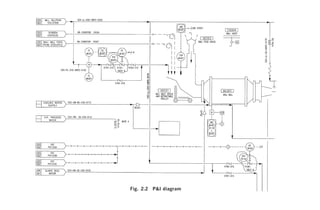
  The process flowsheets represent the process rather than the details of
the plant. The latter are shown in ‘P&I’1 diagrams, which depict all

1
  Pipeline and instrumentation, although sometimes described as process and instrument-
ation; but P&I has become an accepted international multilingual expression. Some
engineers use ‘mechanical flow diagrams’, which do not show much instrumentation,
and ‘control and instrumentation diagrams’, which focus as the name implies, and no
doubt such presentation is appropriate for certain applications; but P&IDs usually
suffice.
16   Handbook for Process Plant Project Engineers

plant equipment items, including their drive motors, all pipelines and
valves (including their sizes), and all instruments and control loops.
   Utility flowsheets and diagrams are often presented separately.
   Plants may operate by batch production, in which the plant processes
a quantum of feed per cycle, and stops at the end of each cycle for
removal of the product and replacement of the feed. Alternatively,
plants may operate continuously, 24 h per day, without stopping; and
there are hybrid plants, or hybrid unit operations within plants, which
are described as semi-continuous, in that the internal operation is cyclical
but the cycles follow continuously, one after the other, with little operator
intervention.
   The critical performance factors for a process plant – the factors
which determine its fitness for purpose and its effectiveness (and against
which its designers’ performance is measured) – include the following.
• Feedstock transformation as specified. Product characteristics
  should be within a specified range corresponding to feedstock
  characteristics within a specified range, and capacity (throughput)
  should be within the range required for feed and for product. From
  the feed and product capacity may be derived the recovery, or yield
  of product per unit feed. Alternatively, the recovery and input or
  output may be stated, and the output or input respectively may be
  derived.2
• Cost of production, often expressed per unit of feed or product. The
  cost components include capital amortization and interest, plant
  operators’ salaries, maintenance materials and labour, purchased
  utilities, process reagents, insurance, etc. There may also be fees
  payable to process technology licensors. The capital cost component
  is often quoted separately as a stand-alone criterion.
• Plant reliability and availability. Reliability is the predictability of
  plant operation as planned, whereas availability is the proportion
  of time for which the plant is in a condition whereby operation
  (to acceptable standards) is possible. Availability may be less
  than 100 per cent because of planned outages for maintenance,
  for example one 3-week shutdown per 2-year cycle, or because of
  shutdowns caused by lack of reliability, or (invariably to some
  degree) both.
• Safety of construction and operation. This is assessed at the design
  stage by formalized hazard analysis for the process and by hazard
2
 For some plants, there may also be a specification linking the feedstock or product
specification (or grade) to the capacity and/or the recovery.
A Process Plant
                       17
Fig. 2.2 P&I diagram
18   Handbook for Process Plant Project Engineers

     and operability (Hazop) study of the plant design. It is assessed during
     construction and operation by audit of the presence and efficacy of
     various safety features and constructional and operational practices,
     and it is reported historically by accident and loss statistics.
•    Environmental impact, and its acceptability by legal, social, and
     ecological consideration.
•    The plant life. Plant maintenance practices and costs are presumed
     for the purposes of economic analysis, and hopefully in practice, to
     be such as to keep the plant operational within specified performance
     levels over the intended life of the plant.
   The last four factors clearly have an effect on, and their economic
impact should be included in, the cost of production. However, they are
important design and evaluation factors on their own, and may also
have an effect on product marketability, or in some cases whether the
plant is permitted to operate at all.
   The time taken to build and commission the plant, and get it into full
commercial operation, is equally a factor which significantly impacts on
the planned and actual cost of production over the plant life. It may
also have an important effect on the marketing, and hence economic
value, of the product.


2.2 The processed materials and the process
For the purpose of classifying types of plant in order to observe some of
the principal features of each type, the first differentiating features are
the nature of the materials to be processed, and the usage of the
product. The processed materials may be principally classified as fluids
or solids, hazardous or non-hazardous, and minerals, bio-matter or
water. The main types of product addressed are fuels, chemicals, metals,
precious minerals, and foods. Usually, each feedstock is primarily
associated with a certain product, for example crude oil with fuels,
and bio-matter with foods and pulp products. Of course, there are
combinations of these groups, such as:
•    processed materials which begin in a predominantly solid phase and
     end in fluid phase;
•    processed materials which become hazardous during the course of
     processing, such as explosives;
•    foods (such as table salt) which are minerals;
•    fuels extracted from bio-matter; and
A Process Plant   19

•   materials, such as methanol, which may be of mineral or vegetable
    origin, and hopefully not regarded as a food.
   Many materials and products, such as pharmaceuticals, will not be
addressed specifically in this book, being too specialized in nature, and
the reader interested in such processes will have to draw his own conclu-
sions as to the relevance of these contents.
   Processes may be classified according to:
•   the complexity (usually quantified by the number of items of process
    equipment);
•   the severity of the associated physical conditions (including pressure,
    temperature, and corrosiveness – clearly, in conjunction with the
    processed material characteristics and toxicity, these impact on the
    degree of hazard);
•   whether there is a continuous or batch process; or
•   the state of evolution of the technology employed.
   Some processes have very critical product specifications, especially as
regards the permissibility of contaminants, and an understanding of
how to manage the production process accordingly is essential to
success in designing and building such a plant. A plant which is
designed to produce salt as a food requires different considerations from
a plant which produces salt as an industrial chemical.
   There is a particular purpose to the foregoing, and that is to alert the
reader that both the feedstock and the utilization of the product are
critical to choice of process and plant design. Industries tend to develop
a processing methodology and design practice which is appropriate for
their normal feedstock and product utilization. If either is changed,
both the process and plant design practice must be critically examined,
although the client may be unaware of the need (taking it for granted
that the requirements are known).
   Some processes are simple enough in concept and easily managed in
practice, and the criteria for building the corresponding plant are too
obvious to need much elaboration. However, in general, the plant
design needs to embody much more information than is contained in the
flowsheets and the P&I diagrams. The actual additional information
required is peculiar to each process, and it should be understood that no
list of such information headings can be comprehensive. For instance, it
is sometimes found that a relatively small equipment detail, such as a
sealing device, or a feature that avoids the accumulation of material
build-up, is critical to the operation of a whole plant, and is central to
the initial development of the process as a commercial enterprise.
20    Handbook for Process Plant Project Engineers

  The following are some general process information requirements,
in addition to plant performance specifications, flowsheets, and P&I
diagrams, for designing a plant.
•    Data sheets for each item of equipment (including instruments),
     detailing the performance requirements, the environment (including
     the range of process materials and physical conditions encountered,
     with emphasis on harmful conditions such as corrosion, abrasion, or
     vibration), the materials of construction, and any special design
     features required.
•    General specifications for the plant and its components, embodying
     the particular requirements for the process (such as corrosion
     resistance, hazard containment, or features to promote reliability),
     and including material and valve specifications for piping systems,
     and specific instrumentation details.
•    A description of the method of plant operation, including start-up,
     shutdown, management of predictable plant operational problems,
     and emergency shutdown if applicable.
•    A description of the hazards inherent in the process and plant operation,
     and the safety features and precautions to be taken to overcome them.
     This may include the classification of hazardous areas.
•    A narrative supplementing the P&I diagrams to describe the method
     of controlling the process and the plant, and the instrumentation and
     control system architecture, usually known as the ‘control philosophy’.
•    In the case of products such as foods, reference to the regulations
     and requirements of the appropriate food and drug administrations,
     and the detailed processing features required to meet them.
•    Usually, a basic layout of the plant. This becomes essential if some
     of the layout features, for instance minimization of certain materials
     transport routes or maintenance of minimum clearances around
     certain items of equipment, are critical to plant operation or safety.


2.3 The process design/detail design interface
Quite commonly, the information described above is collectively
referred to as the ‘process package’. It may indeed be presented as such
(for a suitable fee!), appropriately bound and decorated. We will discuss
later the various facets of work organization which determine how
work is packaged and how the process technology input can relate
to the balance of engineering work, but for the moment, it should be
A Process Plant     21

appreciated that the engineering of the plant can be separated into two
parts. The first part is the process technology which would be applicable
to a plant built on any site,3 and in general utilizing any combination
of appropriate equipment vendors. The second part is the complete
engineering design of the plant, incorporating actual proprietary
equipment designs, locally available construction materials, local design
practices and regulations, customized design features required by the
particular client and his operation and maintenance staff, and layout
and other design features necessary for the plant site. The second part is
often referred to as the ‘detailed engineering’. There is an area of potential
overlap between the two; in particular, the process package can be
expanded to a ‘basic engineering’ package, which includes the essence
of detailed engineering (such as well-developed plant layouts and
equipment lists) as well as the process package.
   It needs to be understood that it is difficult to include all the required
knowledge of a particular type of process into a stand-alone package. It
is even more difficult in the case of complex processes or newly devel-
oped processes. In practice, when the process technology provider (or
licensor) is separate from the detailed engineering organization, it is
necessary to have most of the important design details reviewed and
approved by the technology provider, to ensure that the process require-
ments have been correctly interpreted. Further process technology input
is also needed in the preparation of detailed plant operation manuals
and plant commissioning, and sometimes into the plant construction.


3
 This is an over-simplification. In practice, the process design package usually has to be
customized to take into account local factors which affect the process, such as ambient
conditions, feedstock and reagent variations, and properties of available utilities.
This page intentionally left blank
A Project and its Management: A Brief Overview   23


                          Chapter 3

         A Project and its Management:
                 A Brief Overview


The purpose of this chapter is to look briefly at all the components of a
process plant construction project and its management, before focusing
on the engineering work.


3.1 The project
We shall define a process plant project as: the execution of a plan to
build or modify a process plant, within stated parameters of workscope,
plant performance, cost, and time. This is not a universally accepted
definition, but it does focus on the work with which the project engineer
is principally engaged. Pre-project work will be described as a study or
proposal.
   Some project practitioners refer to the concept of a ‘project lifecycle’,
which includes the initiation of a project, its technical and economic
evaluation, funding and authorization, design and construction, plant
operation, maintenance and further development, and finally plant
decommissioning. We would rather call this a ‘plant lifecycle’, but the
difference is mainly semantic: the various stages all have to be taken
into consideration when designing and building the plant, which is our
main concern and regarded here as being ‘the project’.
   Following on from the lifecycle concept, there is no clear-cut require-
ment on where we should begin our description of project work. The
design of the plant depends inter alia on how it will be operated, the
operation on how it was designed. The cost of the plant depends on how
it is designed, the design depends on how much money is available to
build it. The feasibility study has to anticipate the project outcome, the
24   Handbook for Process Plant Project Engineers

project is initiated with parameters set by the study. Because our focus is
on the design and construction of the plant, we shall give minimal attention
here to the work done prior to the decision to go ahead. These aspects
are given more detailed review in Chapter 9, Studies and Proposals.
   A project may be a major new enterprise such as an oil refinery, or a
small modification to an existing plant. For the latter case, it is evident
that the desired objective can be achieved quickly and informally
without elaborate procedures. As the size and complexity increase, the
need for a more formal approach becomes apparent, for many reasons.
More people are involved, more interacting components have to be
co-ordinated, and the investors demand more detailed reporting. The
size of project at which more formalized procedures become necessary
depends very much on the ability and skills of the project manager and
the demands of the client. In general we will be addressing the needs of
the large project, on the basis that engineers who are experienced in the
bigger picture will understand what shortcuts and simplifications are
reasonable on smaller projects.
   Pre-project work starts with an idea or concept which the client has
decided to develop. The concept and design of the final process plant
progresses in cycles of increasing definition. Initially a study is made, in
which the concept is technically developed, optimized, and analysed as a
business proposition; the analysis includes considerations of technical
and commercial risk, capital and operational cost, product value, and
return on investment. A report is prepared; if the conclusions are
acceptable to the client, he may authorize the implementation of the
project. Alternatively, he may authorize more funds for further conceptual
development, or, of course, abandon the concept. Authorization of the
implementation of the project invariably implies the expectation of a
plant which will perform within specified limits, and be built in accordance
with certain standards, within a promised budget and schedule.
   There is clearly an amount of pre-project engineering work necessary
to achieve the required degree of technical definition, costing, and
schedule analysis required for authorization. Prior to the decision to
implement the project, there is a natural reluctance to spend any more
funds than are absolutely necessary to complete the feasibility study, as
there may be no project. This reluctance is tempered by the need for
accuracy evidently, the further the engineering of the plant is developed,
the greater the confidence in the accuracy of the study report. In addition,
if the client is confident that the study will lead to a project without much
further conceptual design development, he may be willing to commit
more funds prior to final authorization, in order to expedite the project.
A Project and its Management: A Brief Overview         25

  In the review on engineering work which follows in the next chapter,
for most activities we will approach the project work as though there
were no preceding study, so that nothing is left out. In practice, a
project invariably commences with a process of assembly and critical
scrutiny of the preceding documentation. If the project team doubts the
viability of the commitments made in the study, there may be some
‘debate and compromise’. (This may be an understatement!)


3.2 Starting the project
We have established that a project commences with defined goals and a
defined and accepted concept for achieving them. A project is not a
process of innovation; the innovative work necessarily precedes the
project, enabling the designs therefrom to be evaluated and costed. It
may be found at the project commencement that the conceptual design
is incomplete or unsatisfactory, that innovation is needed, or that plans
or estimates are questionable. This is usually the case, to some degree. It
is important to complete or rectify this work in an initial baseline-
development phase, which on completion will permit the establishment
of a detailed master plan of all project activities and cost elements, to be
used as the basis of schedule and cost management. Without a fully
developed baseline built on approved conceptual designs, the project
manager can do no better to manage the project than a team can play
competitive football without designated field markings and goals.1
   Opportunities for improvement by innovation or by changing concepts
may emerge during the project work, and if changes are made as a
result, they have to be very carefully controlled if chaos is to be averted,
though it is seldom acceptable to ignore such opportunities on principle.
But these are exceptions: the objective for project work is to achieve the
targets set out in advance. In proportion to the scale and complexity of
the project, and therefore the number of different entities whose work
has to be co-ordinated, is the need for detailed planning and control of
the work done. This is succinctly expressed by American engineers as
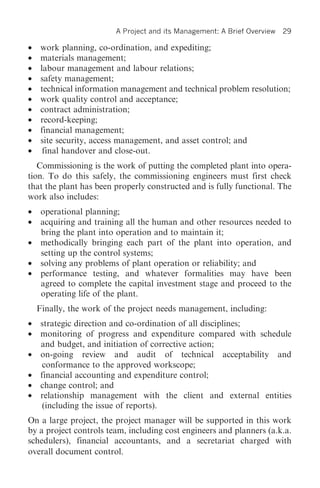
‘plan the work then work the plan’.
   ‘Plan’ is used here in the widest sense, embracing not just the development
of activity sequences and durations, but also the full evaluation of

1
 To be more accurate, it is not possible for the type of project work envisaged here,
where a defined amount of work is required to be performed for a pre-determined cost.
It is of course possible to carry out elastic-scope and undefined cost or schedule work
without much of a baseline.
26   Handbook for Process Plant Project Engineers


                Fig. 3.1 ‘Plan the work then work the plan’

objectives and circumstances, potential problems, options, and methods
available before undertaking any task. The plan must be verified to
meet the project requirements before commencing the planned activities.
  So we start the project with the preparation of a master plan that is
verified to meet the project requirements, and is preferably formally
approved by the client. If the client’s exact requirements are already set
out in a contract, as for a turnkey plant, the plan should be checked
against the contract specification.
  The plan includes the following.
•    A clear definition of the project’s end-product and of how its
     acceptability is decided, including:
         the physical plant and its performance;
         construction specifications and facilities;
         documents required to operate and maintain the plant;
         close-out reports and financial accounts;
         services such as commissioning and training; and
         a statement of any other client requirements to be met in the
         course of achieving the end-product, such as the format and
         content of construction documentation, progress reports, statu-
         tory and client approvals to be obtained, minimum local content
A Project and its Management: A Brief Overview   27

         to be utilized, environmental restrictions on construction work,
         and quality management standards.
    The end-product and incidental requirements are collectively
    referred to as the project scope.
•   Organization of the project team roles by allocation of individual
    responsibility, ensuring that the complete scope is covered.
•   For each team member or discipline, preparation of an operating
    plan outlining how the individual part of the project scope will be
    achieved. Arising from these plans, an integrated plan and a
    breakdown of the project work into defined packages sufficiently
    small for management purposes (discussed below).
•   The project budget, broken down into elements identical to or
    compatible with the work breakdown structure.
•   The project time schedule, in similar detail. The development of this
    schedule requires the development of the work breakdown structure
    into a network of sequenced activities.
•   A system for controlling the project; that is, the means to be
    employed for measuring the technical quality of the product
    development, for measuring the cost and making cost projections,
    and for measuring progress, and comparing these with the planned
    values to alert management of need for corrective action. Usually,
    the control system will dictate the format and element size of the
    work breakdown structure, budget, and time schedule. Clearly, the
    control system and work element breakdown must facilitate progress
    reporting within a sufficiently short period to allow corrective action
    within an acceptable period, usually a week or two.
•   A resource plan, identifying the human and other resources required
    for the project, and their source, timing, and cost, compatible with
    the project budget and schedule.
  We will not elaborate further on the planning process, because this
will be further developed in the discussion of the engineering work
which follows.


3.3 Managing the project
The project team organization, referred to in item 2 of the plan, varies
according to the size, complexity, and scope of the project. Smaller
projects are best handled by a small team of all-rounders working full-time,
rather than a multitude of part-time specialists: less communication
and better teamwork more than compensate for any lack of more
28   Handbook for Process Plant Project Engineers

specialized skills, which can be obtained from a consultant if needed.
Large projects can employ specialists to perform a single discipline of
activities on a full-time basis. We will discuss the breakdown and perform-
ance of the work by discipline, according to the customary organization
of a large project. This is not intended to imply that a single individual
could not or should not perform a multiplicity of discipline functions.
  The main groups of operational activities are engineering,
procurement, construction, and commissioning.
  Engineering includes:
•    the design of the plant;
•    specification of its component parts for procurement;
•    preparation of technical documentation to guide and facilitate
     construction; and
•    production of all other technical documentation needed.
The engineers also follow up on their work by provision of technical
guidance, ensuring that the plant is procured, manufactured, and
erected according to the design requirements.
  Procurement includes the work of:
•    finding suppliers or contractors willing and able to provide the
      goods and services required for the project;
•    preparing commercial bid documents in collaboration with the
      engineers who prepare the technical specifications;
•    getting competitive offers; and
•    managing the process of deciding on the best offer for each bid, and
      carrying out negotiations to finalize purchase agreements or
      contracts.
The responsibility of procurement then extends to include follow-up
activities required to manage the performance and administration of
orders and contracts       manufacturing surveillance and expediting,
correspondence and records management, management of delivery to site,
payment management, disputes resolution, and order or contract close-out.
  Construction includes all the work needed to build the plant on site.
This can be organized in a variety of ways. A typical large project
scenario is to appoint a construction management team led by a resident
construction manager (RCM), and appoint one or more contractors to
carry out the work. The various forms of contract and their implications
will be addressed later. Whatever the system by which the work is
performed and the contractual arrangements organized, the issues
which have to be addressed include:
A Project and its Management: A Brief Overview   29

•    work planning, co-ordination, and expediting;
•    materials management;
•    labour management and labour relations;
•    safety management;
•    technical information management and technical problem resolution;
•    work quality control and acceptance;
•    contract administration;
•    record-keeping;
•    financial management;
•    site security, access management, and asset control; and
•     final handover and close-out.
   Commissioning is the work of putting the completed plant into opera-
tion. To do this safely, the commissioning engineers must first check
that the plant has been properly constructed and is fully functional. The
work also includes:
•    operational planning;
•    acquiring and training all the human and other resources needed to
     bring the plant into operation and to maintain it;
•    methodically bringing each part of the plant into operation, and
     setting up the control systems;
•    solving any problems of plant operation or reliability; and
•    performance testing, and whatever formalities may have been
     agreed to complete the capital investment stage and proceed to the
     operating life of the plant.
    Finally, the work of the project needs management, including:
•    strategic direction and co-ordination of all disciplines;
•    monitoring of progress and expenditure compared with schedule
     and budget, and initiation of corrective action;
•    on-going review and audit of technical acceptability and
      conformance to the approved workscope;
•    financial accounting and expenditure control;
•    change control; and
•    relationship management with the client and external entities
      (including the issue of reports).
On a large project, the project manager will be supported in this work
by a project controls team, including cost engineers and planners (a.k.a.
schedulers), financial accountants, and a secretariat charged with
overall document control.
This page intentionally left blank
The Engineering Work and Its Management     31


                          Chapter 4

             The Engineering Work and
                 Its Management


4.1 Planning the engineering work
The stages of project engineering may be described as:
1. Define the objectives, i.e. the end product of the project.
2. Decide how the objectives will be achieved – what methods will be
   employed.
3. Plan in detail each item of work (‘work package’) and schedule the
   performance of the packages in a logical sequence.
4. Do the engineering work and check that it is correct.
5. Ensure that the engineering designs and specifications are acceptably
   implemented in plant procurement, manufacture, and construction.
6. Commission the plant and finalize all technical documentation needed
   for operation and maintenance.
   Items 1, 2, and 3 define the engineering scope of work in progressively
increasing detail. Item 3, the detailed planning, cannot be completed
until the conceptual design of the plant has been finalized (‘frozen’).
Thus, unless the project starts with a frozen conceptual design, there
will be some overlap between the planning stage and the following
engineering stage, and this is usually the case. In the following narrative,
as was stated when discussing project initiation, we will address some
activities as new subjects, although in practice some or all of the work
should have been carried out during the study which preceded the
project.
   Definition of the project objectives starts with the development of a
clear understanding of:
32   Handbook for Process Plant Project Engineers

•    the performance of the plant (what must the plant produce, and from
     what input resources, when, and how?);
•    the processes by which the plant will function;
•    all the special or local circumstances which will affect the construction
     or function of the plant; and
•    any other specific requirements of the client.
To make sure that this ‘clear understanding’ is correct, is comprehensive,
and describes exactly ‘what the customer wants’, the obvious procedure
is to write it down as concisely as possible, review it thoroughly with the
plant owner and operator, and get it formally approved before proceeding
with design work.
   In addition to the essential requirements mentioned in the previous
paragraph, the engineer is confronted with choices of methodology
during the design development, for instance which design codes to use,
if this has not been specified by the client. The potential impact of
choice of methods and codes must be considered. Often, there is little to
differentiate between the possibilities other than the engineer’s familiarity,
but a choice must be made: a design based on a hotch-potch of codes is
a recipe for disaster.
   Because the procedure of developing this ‘clear understanding’ and
choice of design methodology determines the entire design and con-
struction of the plant, it is obviously of prime importance and deserves
corresponding priority and effort. The performance and constructional
standards which define the plant with ‘clear understanding’, and the
design methods to be employed, will be termed the ‘plant (or project)
design criteria’. The documents and models subsequently produced to
facilitate purchase and construction (in accordance with the plant design
criteria) will be termed the ‘design documentation’.
   For the development of the design criteria, two scenarios need to be
considered (there are many hybrids in practice). Firstly, the client may
not know in detail what he wants, or he may know what is required but
not have fully thought it out and written it down. For this first case it is
the project engineer’s job to establish the design criteria in conjunction
with the client, generally by a process of reviewing the choices available
and making recommendations, and to get the client’s approval. If he
does not do a thorough job of this, he risks at least wasted effort and
delay in the design process, when fully developed designs are rejected on
conceptual grounds, or at worst a final plant which is not what the
client wanted.
   In the second scenario, the client defines what he wants in a detailed
The Engineering Work and Its Management    33

specification. This is a prerequisite for purchasing a plant on a lump
sum basis; without a detailed specification, the price is meaningless.
However, the project engineer must still carefully review the scope
definition before commencing the design process, clarify any ambiguities,
and where choices exist, try to resolve them, before expending detail
design manhours. Some choices may have to be deferred to a later stage,
when further information is available, but he should at least define the
basis on which the choices will be made.
  A detailed checklist for the plant design criteria can run to 50 pages
or more and varies with the type of process; most organizations that
deal with plant construction or design have their own checklist. The
essentials of a checklist (a checklist checklist!) have been included as
Appendix 2.
  Before moving on from the design criteria to the detailed planning of
engineering work, there are several project management systems and
procedures which need to be in existence. These are simply standardized
methods of working, which are indispensable in a team operation to
promote efficiency and avoid omission, duplication, and confusion. The
following are part of the basic framework.
•   A document control system, including standard practices for
    numbering documents, their filing, the system of document approval
    and authorization of issue, distribution control, revision control,
    and archiving.
•   The procurement interface. How will engineering co-ordinate with
    the procurement function? Or will procurement simply be the
    responsibility of the engineers? The answer to the questions
    determines the scope and format of much of the engineering work.
    Agreed systems and interfaces also need to be in place for the
    procurement-related functions of materials control, workshop
    inspection, quantity surveying, and logistics in general.
•   The construction interface. Inevitably this starts with the engineering
    definition of what construction work is required, to what standards,
    and how the work will be packaged. This leads to a follow-up stage
    in which construction information is issued, mainly in the form
    of drawings, and technical problems are resolved (requiring a site
    interface).
•   The cost control system. This requires an understanding of the level
    of control – the breakdown of expenditure items (purchased items
    and engineering and management activities) by which costs will be
    authorized, reported, and controlled. There inevitably follows a need
34   Handbook for Process Plant Project Engineers

     for a consistent numbering system by which each item is recognized,
     usually called the code of accounts.
•    The project time schedule control (or planning) system. Generally the
     same remarks apply as for cost control. Numbering needs are less
     exacting than for cost control, because ‘roll-ups’ of like items are
     not applicable. Generally the numbering systems employed for
     equipment and documentation are adequate.
•    A quality assurance system and its implementation on the project.
     This is already partly implied, as we have listed ‘checking of the
     engineering work’ as part of the work. However, this may be a
     timely reminder that the checking and verification of work needs to
     be organized into a cohesive whole which will ensure that no critical
     aspect is left to chance, and that the overall standards of surveillance
     are adequate.
   Advancing to the detailed planning of engineering work, we begin by
grouping work into different categories. Most engineering work
activities are associated with documents,1 which are the product of the
individual activities. Verbal communication is seldom acceptable, so
each activity culminates in a document which is the essence of the work
done or value added. The change of status of a document, for example
from ‘drawn’ to ‘checked’ to ‘issued for construction’, is likewise
associated with an amount of work and progress. Most engineering
work is therefore conveniently identified for planning and control
purposes by the associated document and its status. To quantify the
work and break it down into manageable elements, it is only necessary
to produce a list of documents, principally:
• design criteria;
• work plans, including work breakdown and work schedules;
• drawings (including vendor and third-party drawings to be reviewed
   and approved) and models;
• calculations;
• specifications and data sheets;
• procurement documents (requisitions, bid analyses, negotiation
   protocols, etc.);
• technical schedules, including the need for their ongoing update
   (equipment lists, cable schedules, etc.);

1
 A ‘document’ is a piece of recorded in formation of any type (hard copy, electronic,
physical model). This subject is further developed in Chapter 20, Traditional
Documentation Control.
The Engineering Work and Its Management   35

• reports (technical, progress, inspection, site visit, meeting, etc.); and
• plant operation and maintenance manuals to be produced, and spare
  parts data.
     Work not usually associated with specific documents may include:
• planned communication activities;2
• general management administration duties (work planning and
  work control schedule updates, informal communication, personnel
  administration, etc.); and
• follow-up of technical issues (including pro-active surveillance and
  response to questions and requests for assistance).
   It is also possible to categorize many of these activities by associated
documents, and to require documents as a report of the activity. To
some degree such documents are necessary. For instance, a meeting
requires a report. An instruction arising from a follow-up activity
should be in writing, and the discovery of a serious discrepancy or
failure should clearly trigger a management report, as well as corrective
action. However, if this process is taken too far in relation to the real
need for precise record, the excess of bureaucracy will become apparent
to all, with the usual negative effect on attitudes.
   For document-related work, engineering manhours are estimated by
allocating budget hours to each document. For this purpose each docu-
ment type is usually divided into a few sizes, each having a standard
budget. Drawings are grouped by subject and size (A0, A1, etc.),
procurement documentation by value and complexity, etc.
   Non-document-related work may be estimated by adding a percentage
to the document-related work, or by allowing a fixed time allowance per
week, or by allowing a time package per followed-up item, for example
purchase order. In the latter case, the final overall plan must be verified
to ensure that adequate resources are available for reactive follow-up, in
other words that there are enough engineers who serve by standing and
waiting – in plan, anyway. Some unplanned work will inevitably materi-
alize, and need to be done immediately. When no work demands arise,
additional checking and surveillance activities may usefully be performed.
   Sequence planning or scheduling of engineering work can be quite
simple or very complex, depending on the project. For a simple project,
where there is enough time to carry out activities in a logical sequence,
and to commence individual activities when the required input information

2
    This subject is discussed in Chapter 25, Communication.
36   Handbook for Process Plant Project Engineers

is available, the sequence may be as follows (obviously the type of plant
and scope of project may change the picture).
1. Design criteria are prepared, and work is planned as outlined above.
2. The basic process design work is developed, culminating in process
    flowsheets and process data sheets for plant equipment items.
3. As process equipment data sheets become available, equipment
    specifications and procurement documents are written, enquiries are
    issued, and equipment is selected and purchased.
4. As purchased equipment information becomes available (including
    outline drawings, and access and maintenance needs) the plant
    layout drawings are developed (these are conceptual drawings with
    principal dimensions only) and maybe plant models are built. In
    this process, designs of the materials transport systems and plant
    structures and enclosures are developed.
5. Control philosophy and P&I diagrams are prepared. (This work
    may also be done in parallel with, or ahead of, the layout
    development, depending on the relative dependence on materials
    transport system design).
6. Based on the conceptual layout drawings and selected equipment
    masses and dynamic loads, equipment support and access steelwork,
    foundations, and enclosures are designed.
7. Also, as purchased equipment information becomes available, the
    electrical power supply system and switchgear are designed and
    procured, and plant instrumentation and control systems are
    finalized and procured.
8. The conceptual layout drawings are upgraded to general arrangement
    drawings, which reflect the detail steelwork and civil designs as well
    as actual equipment dimensions, and are dimensioned to co-ordinate
    interfaces.
9. Detail designs are prepared for vessels, chutes and other platework,
    piping and ducting, and electrical and instrumentation equipment
    and cables.
10. Technical packages are prepared for purchase of bulk materials and
    plant construction, including work description, bills of quantities,
    drawing lists, and construction specifications.
11. Technical documentation is prepared for plant commissioning,
    operation, and maintenance (including purchase of spare parts).
  The corresponding flowchart is presented as Fig. 4.1. In this figure,
‘design’ has been used to describe activities whose main outputs are
descriptions, calculations, and item sketches, whereas ‘draw’ describes
The Engineering Work and Its Management   37


Fig. 4.1 Simplified engineering work sequence
38   Handbook for Process Plant Project Engineers

activities which are centred on the arrangement of components within
space, and the outputs are drawings or models. This distinction is
artificial and is not so clear-cut in practice, nor can it be.
   Usually, front-end engineering activities are performed in a prelimi-
nary pre-project or study stage, in which the conceptual designs and
project baseline are developed. In the initial stage, no procurement
commitments can be made, and the equipment data are not final. This
brings about a separation of activities, which is presented as Fig. 4.2.
   If the project baseline is not fully developed in the study stage (always
the case, to some extent), then the project work sequence is something of
a hybrid between Figs 4.1 and 4.2. In the most common hybrid, the final
procurement of certain equipment items that are recognized as being
critical to the schedule will proceed quickly after project authorization,
while less critical items are deferred until the overall conceptual design
and baseline have been reworked as in Fig. 4.2.
   Even in these simplified examples, where activities follow a logical
sequence of information flow, there is an amount of iteration. The
layout drawings have to be available for structural design, but they are
revised as a consequence of the design. When the connecting chutes,
pipework, cables, etc. are added to the design, there are liable to be
problems in fitting them in and supporting them, and plant access or
maintainability may be compromised. Thus some revisions to the
steelwork design and layout will usually be necessary. And so on for
most activities, but the iterations are kept to a minimum.
   The limitations of the project schedule, and the drive for reduction of
project engineering and management manhours, seldom permit a
completely sequential information flow. Usually, the design schedule
has to be shortened. We should remember that the design process is not
an end in itself – it is the servant of the project. Its various outputs have
to be available according to a schedule that is co-ordinated with the
procurement and construction needs. As a result there are demands
for the early ordering of long-delivery equipment, the commencement
of site construction work before design work is completed, and the
ordering of bulk materials such as piping components before the
design is completed (and sometimes when detailed design has hardly
started). Simply putting more people on the job or working longer
hours is not necessarily a practical method of acceleration, it is liable
to cause a reduction in efficiency and increased errors. Besides,
the schedule may be dependent on receipt of design information from
relatively inflexible third parties. In practice the two most common
devices to shorten the schedule are parallel working and assumption
The Engineering Work and Its Management   39


Fig. 4.2 Conceptual stage followed by project stage
40   Handbook for Process Plant Project Engineers

of design information. In their application the two devices are almost
identical.3
   In conclusion, it should be apparent that a flowsheet or activity
network can only provide an indication of workflow. It cannot provide
a rigid definition of what tasks can be performed at what stage. There is
an inherent flexibility to commence tasks without 100 per cent of the
required information – at a price. It is the use of this facility, and
the resulting challenges in terms of the judgement to be exercised and
the teamwork needed to retain control of the work, that are some of the
major differentiators of performance. The flexible approach is one of
the factors which separate the ‘can’t-do’ plodders from the achievers,
although being too ambitious in this regard can result in chaos.


4.2 Doing the engineering work
In this section, we will review the management of the engineering work
which has been planned, and enlarge on the execution of certain of the
activities. It is not the intent to focus on specific engineering discipline
methodologies and practice: we are concerned with the adaption of the
discipline performance to the requirements of the process plant project.
  Engineering management functions include:
•    planning the work;
•    monitoring the performance of the work (scope, quality, cost, time),
     comparing it with the plan, and taking corrective action as needed;
•    co-ordinating the work of different disciplines and resolving any
     problems arising;
•    managing changes (which has special relevance to co-ordination);
•    managing resources; and
•    managing engineering relationships with parties and functions
     outside the engineering team, for example client, procurement, and
     construction.
  The management techniques of monitoring the performance of the
work are dependent on how well the work has been planned, in the
fullest sense of the word. The plan must include all elements required to
ensure that all project objectives are met. All innovation and conceptual

3
 The making and control of assumptions, in order to expedite engineering, is one of the
key issues of project engineering in a competitive environment. This is discussed in
Chapter 27, Fast-Track Projects.
The Engineering Work and Its Management      41

development should be completed at the planning stage, and, if not, a
major crisis should be acknowledged. The successfully planned project
should aim to be deadly dull in execution, a steady turning of the
information development handle, with no surprises emerging.


4.3 Managing schedule, cost, and quality
There are many software packages and manual systems available to give
accurate feedback on schedule performance, provided that adequate
planning has been done and accurate reporting on task completion is
available. But this feedback, although necessary, is historical; the art of
engineering schedule management depends on anticipating the ‘glitches’.
Given that engineering at this stage of the project is fundamentally a job
of information processing, the greatest care must be exercised in looking
ahead to the next few weeks’ information outputs, and understanding
what inputs will be needed, especially between disciplines and across
external interfaces such as procurement.
   As is the case of schedule management, there are any number of
software packages and systems to provide management reporting for
cost control, and since this is regarded as a discipline in itself the subject
will not be pursued in depth. The essence of any system is the break-
down of the project expenditure into a sufficient and appropriate
number of components, which are tailored to enable the manager to get
information on cost trends in time to take corrective action.
   Engineering plays the major part in determining the cost of the
project, firstly by determining the design and specification, secondly by
deciding on the technical acceptability of purchased goods and services,
and thirdly by re-engineering and technical compromise when cost
trends are unacceptable. In this process, it is seldom possible for any
cost reporting system to give timely management cost information, if
the system is wholly dependent on actual prices and costs from suppliers
and contractors. By the time such information is available, the effect on
schedule and other consequences of modifying the design is likely to be
severe or unacceptable. Therefore good cost management in engineering
requires an awareness of the cost consequences of every design feature,
at the time that each item is designed. As part of this process, all designs
should be promptly checked for conformance to the conceptual designs
and quantities on which the project budget was based.
   There is another aspect of engineering cost management, which is the
cost of the engineering itself. The control system is the same as for
42   Handbook for Process Plant Project Engineers


               Fig. 4.3   ‘Engineering plays the major role in
                          determining the cost of the project ...’


purchased items, namely, the engineering activities are monitored
against an itemized budget (usually of manhours). However, as
engineering decisions and designs impact the direct field costs, there
may be opportunities to reduce the overall project cost by increased
expenditure on engineering, or, conversely, to save on engineering by
spending a little extra money on equipment suppliers or construction
contractors that then need less engineering input.
  Last but not least of the management fundamentals is engineering
quality management.
  In the following chapters on the project environment, we will see that
there is no absolute dictate on the quantity of engineering work that
goes into a plant. For instance, the quality of work can always be
improved by carrying out more checks and re-work, but this is not
necessarily justified when any errors can be readily fixed up in the
workshop or on site. There are some activities which are usually
excluded from any quality compromise, including those related to the
plant’s structural integrity and safety of operation. So before planning
the quality management work, the underlying quality policy issues need
to be clearly exposed and agreed, for which purpose the consequences of
possible engineering shortcomings need to be evaluated. Actions
necessary to ensure the correct engineering of critical items may then be
The Engineering Work and Its Management    43

planned. For non-critical items, economically based quality assurance
procedures may be drawn up, and a reasonable contingency may be
included for remedial action in the field or workshop.
  The detailed planning of engineering quality management is a matter
of procedures: deciding what checks, reviews, and audits will be made,
how they will be made, and when they will be made. The quality system
may have to comply with the requirements of standards such as the
ISO9000 series, or the plant owner’s stipulations. A few general
principles to bear in mind are the following.
•   The quality of engineering work is generally assured by the
    acceptance of responsibility by individuals, who sign their names to
    a document. Process plant engineering is a team effort, therefore the
    signatures may not reflect total responsibility for the work represented
    on the document; rather each signature reflects that certain activities
    impacting the document have been performed correctly. The quality
    management process is undermined unless it is clear what those
    activities are and how they must be performed. Procedures, job
    descriptions, and checklists have to make it clear. Ideally, when a
    document is signed as checked or reviewed, the checker/reviewer
    should add the reference number of the checklist or procedure that
    he has followed. As a general rule, quality assurance depends on the
    correct definition and understanding of responsibility.
•   An audit trail for design information, detailing the source document
    and its revision status/date, is an indispensable quality tool. This can
    also be effective when used in reverse in controlling design changes,
    when the omission to revise all consequential changes is a frequent
    problem.
•   Because of revisions – engineering is an iterative process – a
    signature always needs a corresponding date.
   It may be noted that all of the comments on engineering quality relate
to ensuring that the planned objectives are met – none relate to ‘engi-
neering excellence’. This should not be taken to imply that engineering
is just a matter of doing what has been planned – excellent engineers
have plenty of scope for ‘making the difference’ in the conceptual stage,
for developing the most effective design details and, all too frequently,
for producing solutions to unanticipated problems. The subject pres-
ently discussed is quality management rather than quality itself, and it
needs to be stressed that even with a team of brilliant engineers
(especially in this case, possibly), quality lies not just in individual
brilliance, but probably more in meticulous attention to detail.
44     Handbook for Process Plant Project Engineers

4.4 Co-ordinating engineering work
In general a process plant is engineered by a multi-disciplinary team,
and the work is further divided into drawing-related activities and other
engineering activities such as design calculations, specifications, and
equipment purchase. The work of the various engineering disciplines and
their members has to be co-ordinated in terms of:
• function (for example, gravity flows require appropriate elevation
  differences, the electrical supply and motors have to be matched to
  the driven machinery, etc.);
• structural loading (which is greatly dependent on process and
  equipment information);
• the occupation of space, including physical interfaces and the provision
  of access for construction, plant operation, and maintenance; and
• the sequence and timing of information flow.
   Each discipline has to check and approve the documentation of others,
where there is an interface or possible clash due to occupation of the
same plant-space. There is no substitute for this process if the individual
accountability of each discipline is to be maintained.
   In our discussion of planning and schedule management, we discussed
how individual activities were tied together by the logic of information
flow. We noted that, even for the sequential performance of engineering,
there were inevitable iterations as different disciplines’ work impacted
on one another, and that more such iterations were needed for the usual
circumstances when sequential working is compromised to shorten the
schedule.
   Engineering work co-ordination centres on improving the inter-
discipline information flow in order to shorten the periods of iterations
and reduce their number, thereby shortening the schedule (while
maintaining the quality of the end-product). It aims to mitigate the
consequences of out-of-sequence design development.
   As for other activities, efficient co-ordination starts with a good plan.
The plan should be drawn up on a needs-driven basis, and include a list
of discipline interface information requirements, specifying what is
required, and by what date, and who is responsible. It is also necessary
to draw up a matrix of review-and-approval requirements, specifying
type of engineering document on one axis, and the disciplines concerned
on the other.4

4
    This is developed further in Chapter 25, Communication.
The Engineering Work and Its Management     45

  Careful review of the initial plan by the design team leaders shows up
where special steps need to be taken to reduce iterations or information
delays, and to modify the plan accordingly. Such steps typically include
the following.
•   Adoption of conservative design parameters, which will not usually
    be changed if subsequently proved to be over-conservative. Exam-
    ples are: allow greater clearances within a structure, allow for
    higher structural loads, and allow for higher driven machine power
    requirements. Clearly the benefits of such actions have to be balanced
    against the cost implications.
•   More conceptual work to eliminate uncertainties, which may
    otherwise result in design reiteration.
•   Changing the design to a more standard or better-proven design.
    This may include the purchase of a proprietary item or package, in
    place of a customized project design.
•   Looking for previous similar project experience, or a suitably
    experienced consultant.
•   Where uncertainties arise out of future procurement decisions,
    changing the procurement policy. For example, by negotiation with
    a selected supplier rather than competitive purchase, or, less radically,
    by specification of design features which otherwise would be
    determined by competition. The cost and commercial implications
    obviously have to be evaluated.
During implementation of the engineering work, a similar range of
remedial steps may be considered if it becomes necessary to bring the
work back on schedule.
  The greatest challenge to co-ordination usually lies in the drawing office.
The challenge is best illustrated by some of the problems to be avoided.
•   Drawings chronically late for construction needs while design
    problems are resolved.
•   Support structures which do not fit the supported equipment.
•   Clashes between piping and steelwork.
•   Items which cannot be erected on site without being cut into pieces.
•   Process equipment at the wrong elevation for flow of process materials.
•   Inadequate plant access and maintainability.
In order to identify the actions needed to avoid such problems, we will
consider the causes.
•   The first and probably most frequent cause lies in the drafting
    process, or process by which the plant is modelled. The possible
46   Handbook for Process Plant Project Engineers

     ingredients here are drawings which have inherent errors, drawings
     which are difficult to interpret, and drawings which are inadequately
     reviewed or checked by other disciplines, and therefore clash with
     other disciplines’ or overall needs. Apart from the obvious remedies
     of more skilful and better-trained people producing and reviewing
     the drawings, and more thorough co-ordination procedures, there
     are many systems and software available to improve drafting
     co-ordination and the visualization of the design. These will be
     discussed in Chapters 10 and 28.
•    A fundamental cause, which often underlies drafting problems, is
     inadequate initial engineering or forethought. Error and iteration
     are reduced, and the burden on the draughtsman is reduced, if drawings
     and the inherent problems to be overcome are thought out clearly by
     all the disciplines involved, at the conceptual design stage and before
     detail design commences. An essential ingredient of this forethought
     is a library of design standards and standard designs for common
     plant items, which will be considered at some length in Chapter 19.
•    Process plants are configured around process equipment, which is
     for the most part built to proprietary (‘vendor’) designs. The quality
     and timing of receipt of the vendor drawings, and of information
     such as structural loadings and electric motor sizes (‘vendor data’),
     are critical to the plant design effort. The provision of adequate and
     timely vendor information must be a prime objective of equipment
     procurement procedures, by specification, commercial terms, and by
     follow-up.
•    Finally, changes can disrupt the design process far more than is
     expected by the people initiating the changes, resulting in errors and
     delays. Some changes are of course inevitable, for instance if the
     plant functionality or safety is found to be questionable. Change
     management requires careful attention in order to implement
     accepted changes, to be able to argue against changes whose real
     cost is unacceptable, and perhaps most important of all, to stop
     unapproved and therefore unco-ordinated changes from being
     made.


4.5 Management of engineering resources
In our review of the planning of engineering work, we addressed the
quantification of manhours and the sequencing of work without really
addressing the availability of resources, that is, the human resources, the
The Engineering Work and Its Management    47

tools such as computers, and the facilities needed. From the detailed
work breakdown, which includes the resource type and hours needed for
each activity (or document), and from the required work completion
schedule, it is a simple matter to plot out the input hours required of
each resource category against time. There will inevitably be periods of
unacceptably high or low resource utilization, which are incompatible
with reasonable standards of work continuity, team-building, and resource
availability. The schedule usually has to be ‘smoothed’ by a process of
compromise to yield a schedule which can be resourced with reasonable
confidence and is considered to be optimal. The process of compromise
is made more difficult and challenging by the fact that the schedule
sequence logic is also subject to compromise if necessary, as discussed
previously, and in fact both aspects must be considered together.
   The management of process plant engineering resource costs and
schedule durations is frequently problematical and occasionally
disastrous. Often the problems stem from a technical error, or series of
errors, which are discovered too late and require remedial action.
Equally often, however, the problems stem from management failure,
that is, from failure to plan the work and control its execution according
to the plan. The plan may be unachievable because the project team is
not sufficiently competent to meet the challenge, or because irresistible
(or insufficiently resisted) external factors dictated an over-optimistic
commitment.
   Really disastrous overruns may occur if not only the work performance
but also the monitoring of progress against the plan is faulty, so that the
project manager has insufficient time to take appropriate measures. This
can be caused by simply leaving items of work off the plan; usually the
quality-related items such as layout reviews and corresponding re-work
allowances. Flawed designs go undetected, and remedial work is
deferred until the consequences of omission come home to roost.
Another frequent cause of over-optimistic progress reporting is failure
to measure accurately what work has been completed and what is
outstanding, because documents are regarded as complete when they are
subject to change (the consequences of which are routinely underesti-
mated). The experienced project engineer learns to ensure personally
that the plan and its monitoring retain their integrity in all these
regards, because a third-party planner (or scheduler), however well
trained, may have insufficient ‘feel’ for these and similar aspects.
This page intentionally left blank
The Project’s Industrial Environment   49


Second Cycle
Environment
This page intentionally left blank
The Project’s Industrial Environment   51


                         Chapter 5

              The Project’s Industrial
                   Environment


5.1 The industry and the client
‘The industry’, which is our subject, is the industry of designing and
building process plant. This is obviously peripheral to another industry,
which is that of utilizing process plant in order to convert feedstock to
more valuable products – the ‘client’ industry. We will begin by discussing
some characteristics of the client industry, before going on to discuss the
industry whose purpose is to satisfy the client’s needs for new plant, for
plant upgrades, and for associated services. In general we will discuss
projects for the provision of complete process units, rather than
other types of project and work which are essentially similar to, or a
fragmentation of, the work of building a complete new unit or
combinations of units. Our aim here is to identify some of the aspects of
the industrial environment which have a major influence on the way
that project work is done.
   In the process plant industry, even for superficially similar applica-
tions, there are many plant design variations and client expectations
to be considered. The first design rule is possibly to take nothing for
granted about the needs of the client or the market, but to methodically
examine the characteristics of each project or prospective project,
starting with as much lateral vision as possible.
   Considering the characteristics of the client and of the plant, we will
note in particular the following aspects: feedstock, product and process
(classified as discussed in Chapter 2), scale of operation, plant owners’
and operators’ behaviour, financial and strategic influences, and
environmental considerations. Several of these parameters appear in
52   Handbook for Process Plant Project Engineers

fact to be interdependent, but they all need to be taken into account as
part of the exercise of understanding what differentiating practices and
expectations are associated with a particular field of project work.
The generalizations that can be made are illustrative of attitudes and
behaviour, and of course there are plenty of exceptions.
   The hydrocarbon processing industry deals with feedstock and
product which are minerals of moderate unit value, moderately hazard-
ous (mainly due to fire and explosion risk), and are almost invariably
processed in the fluid state. The attitudes of the industry seem to be
influenced mainly by the vast quantities of materials and finance
involved, and the inelastic market demand. Economies of scale for both
production and distribution have led to an industry dominated by very
large, vertically integrated global companies, and the process industry
within this framework has tended to be organized accordingly, with
highly standardized views on how a plant should be designed and how a
project should be structured. From the American Petroleum Institute
there is a formidable body of standards and standard practices, and
most national standards institutes have many relevant standards and
practices of their own.
   The typical hydrocarbon processing client therefore expects a highly
standardized approach to design, with emphasis on thoroughness and
use of the most experienced equipment vendors rather than any innovation.
This design approach greatly facilitates the management of projects in a
well-organized way, well-controlled from start to finish, even when there
are very tight time schedules. (The less organized project teams are still
capable of making a mess of the job!)
   The metallurgical industry does not enjoy a similar degree of
standardization. The processed materials are rocks of varied form and
substance at the front end of the plant, and the products are also solids.
There are many very different types of ore to be handled, and a wide
variety of processes and products. Solid-phase materials transportation
means that plants and their layouts tend to be customized, with scope
for innovative solutions. Most ores are mainly waste which would be
expensive to ship, so at least the front end of the plant has to be built at
the mine, and be designed to suit the topography. The processed
materials are for the most part relatively non-hazardous. When, as in
the case of the platinum industry, highly toxic processes are necessary
for the refining of the product, the refinery is usually built and operated
as a separate entity from the concentrator and smelter, requiring a
different approach and different behaviour. For the majority of
low-inherent-hazard processes, the lesser inherent risks facilitate
The Project’s Industrial Environment   53


         Fig. 5.1 Platinum group metal refining unit – closer to a
                  petrochemical plant than to an ore processing plant

innovation without compromising safety. (The less careful project teams
are still capable of designing a dangerous plant!)
   The characteristics of the chemical plant industry tend to lie between
those of hydrocarbon processing and metallurgical extraction, being
more similar to hydrocarbon processing plant when the feedstock is
fluid and hazardous, and more similar to metallurgical plant when the
feedstock is solid and non-hazardous.
   There are of course many types of plant which process materials that
are toxic, such as poisonous or radioactive substances, and corrosive
fluids. Such types of plant invariably have a technology of their own,
developed and proven to be adequate for the hazards involved, and any
deviation from established plant designs or standard operating practices
requires careful consideration, and possibly third-party or regulatory
examination and approval.
   Plants for processing water, either to produce potable water or to
treat effluent, generally involve neither hazard nor the transport of solids
54   Handbook for Process Plant Project Engineers

other than sewage or minor detritus in slurry form (the most transport-
able slurry of all). The main emphasis when building such plants is on
reducing capital costs to a minimum, while remaining (just) within
whatever standards of product quality and construction are specified.
Innovation by technology advance (however minor), by structural
optimization, or by contracting method, is at a premium, with minimal
down-side potential (but some contractors still lose their shirts!).
   Power plants, for the generation of electricity, are not normally
included under the definition of process plant. Certainly, when the
prime mover is a diesel engine, water turbine, or simple-cycle gas
turbine, the plant’s characteristics more closely resemble those of a
single piece of equipment than those of a process unit. However, a
major coal-fired power station, and the project to build it, have much in
common with process plant work: the system is built around a flowsheet
with many participating items of equipment and connecting pipework
and materials handling devices. In this case, the most important
differentiating characteristic is that the product – the kWh – is of
relatively low individual value, is required in massive and predictable
quantities over the future life of the plant, and cannot economically be
stored. As a consequence, there is a major emphasis on overall energy
efficiency and the factors which contribute towards it, and usually a
willingness to pay more in capital to achieve this goal. Capital is
relatively cheaply available for the perceived low risks involved. These
factors also contribute to a relative willingness to accept longer project
completion schedules, provided that some cost reduction is thereby
obtained, and also assuming that generation capacity growth has kept
up with the demand.
   The comments above are of course highly superficial in relation to
industries which have developed technologies that people spend their
careers in acquiring. Our purpose here is not to discuss technology, but
its project application, and the main point to be made is that each type
of plant industry has developed in a way that has been driven by
characteristics related to the nature of the process and processed materials
and the scale of operation. The consequences of this development are
not restricted to technology, which may be presented in a package, but
extend to the attitudes and general behaviour of the people involved in
the client industry, in particular, their attitudes to innovation, work
standards, and cost reduction. These attitudes need to be understood for
successful project work. It also needs to be understood that there are
many anomalies; for example, petroleum companies that have acquired
mining interests may attempt to organize metallurgical plant projects
The Project’s Industrial Environment       55

with the same attitudes as for hydrocarbon processing plant, often to
the detriment of the project and the contractors involved.


5.2 The client and the project management
The relationship between the client and the project manager and project
team is likely to have a major influence on the way in which the project
is managed. The project manager may be a senior executive within the
client organization, and he may have total authority to fulfil the mission
up to the point of handover to an operating entity. Or he may be a rela-
tively junior member of a large organization, with imited authority to
co-ordinate the work of specialist departments. The process plant owner
may directly employ the project manager and team, or the owner may
buy a turnkey plant for a lump sum from an independent contractor, or
he may employ a company as managing contractor, headed by a project
manager, to design the plant and manage its construction. And of
course there are many variations and combinations between these cases.
In order to make progress with the analysis of the relationship between
the client and the project manager, let us consider two extremes: the
turnkey plant option, and in-house management by a senior executive of
the owner’s organization.
   For a turnkey plant to be built, there has to be first a process of
plant specification and competitive bidding, to establish who is the
contractor, what will be delivered, when, and at what price.1 Thus at
the outset of the turnkey plant project, the project objectives ought
to have been clearly set out, with little room for cost increase to the
client, or for uncertainty about the scope of supply.
   In the case of in-house management, and especially so when the
responsible executive is very senior in the company hierarchy, he can be
expected to ensure that the project will be seen to be successful, and in
particular be completed within the authorized budget. There are many
ways for the executive to do this, including the setting of targets that are
easy to meet, without the problem of competition. As corporate financial
controls normally require a fixed project budget, one of the methods
more often employed to ensure the financial success of the project is to
allow some flexibility in the scope of work. For instance, the executive
may decide, when the project is at an advanced stage and cost trends are
clear, whether to provide a fully equipped plant maintenance workshop,
1
  There are a number of variations to this theme, which will be explored in Chapter 7,
The Contracting Environment.
56   Handbook for Process Plant Project Engineers

or whether to save the associated capital cost increase and rely on external
contract maintenance. In other words, shift the cost of this service from
capital cost to operating cost. Similar scope variations are possible with
many nice-to-have items, such as standby equipment or maintenance-
saving features. If these practices are permitted, the cost estimate and
cost budget for the plant become simply self-fulfilling prophesies, and
the pressures of budget compliance are not nearly as great as in a
turnkey environment.
   Aspects of such management practices are likely to appear in all
vertical relationships in the project hierarchy, from the chief executive
of the corporation that owns the plant down through the project team
and sub-contractors. A responsible party tends to hold those reporting
or sub-contracting to him accountable in detail, while attempting to
preserve the maximum of flexibility of performance target for himself.2
   In the following pages we will in general assume that there is a
competitive environment, and that projects have to be completed in
accordance with technical and scope specifications, on time and within
budget. Those project practitioners who operate in less demanding
circumstances should quietly enjoy their good fortune.


5.3 The process plant project industry:
    the ‘indirect cost’ of a plant
A process plant project embraces several distinct types of work, which
are customarily carried out by different industrial groupings. Work
components include:
•    the underlying process technology, briefly addressed in Chapter 2;
•    the design and manufacture of plant equipment items;
•    the manufacture of bulk components such as structural steel, pipes,
     and electric cables;
•    structural steelwork, piping, and vessel fabrication in accordance
     with project-specific drawings; and
•    site construction to bring the components together into a working
     plant.
These individual project work components have to be defined,
procured, co-ordinated, and controlled by a project engineering and
management effort, which is the subject of this book.
2
  This aspect of human nature bedevils the use of performance statistics for project risk
analysis, and for the setting of contingency allowances for project budget and schedule.
The subject is further discussed in Chapter 9, Studies and Proposals.
The Project’s Industrial Environment   57

   To understand those facets of the plant design and construction
industry which most affect the lives of people who design and manage
such works, it is illuminating to start by asking the question ‘Why do we
need such people at all?’ The question can usefully be answered by
dividing their work into two parts. There is a minimum engineering and
management portion without which the project cannot be executed at
all. This work will be more in plants of original design, and less where
previous designs can be utilized, but the work cannot be dispensed with
altogether, otherwise there will be no instructions to purchase or build,
no basis to set out the site, and no plant configuration. This part of the
engineering and management work is almost like any of the plant
physical components, an indispensable part of the plant. The remaining
engineering and management work inputs are characterized by ‘added
value’, that is to say that their execution and cost have to be justified by
comparison to the added benefits or reduced overall costs arising from
each item of work.
   As an example, it is possible to get the plant constructed by simply
appointing a chosen contractor to do the construction work at whatever
hourly rates may be agreed by negotiation. But it is usually more
effective to spend money on the engineering and management work
of drawing up a specification and contract for the construction work,
and soliciting competitive bids, thereby gaining the services of a more
target-orientated and less costly construction company. The incremental
engineering and management costs are lower than the value of the
resulting benefits.
   We will examine the quantitative relationship between engineering
and management work (broadly described as indirect costs) and
hardware and construction costs (direct costs) in Chapter 8; the present
discussion is restricted to qualitative aspects. The division of project
costs into direct and indirect components is widely practised, and has
very important implications, but it is often little understood. What
seems to escape many is that it is a purely artificial distinction.
   There are clients who value the outputs which incur direct costs – in
particular, hardware – far more than the outputs which incur indirect
costs, because the direct cost items are tangible. In the value system of
these clients, a project with a low ratio of indirect costs is evidence of
efficiency and good value for money. In fact, if any single item of ‘direct
cost’ is examined, it can be seen itself to be separable into a direct and
indirect cost component. For instance, a contract to provide pipework
may be seen (and reported) as a single direct cost item. As far as the
piping contractor is concerned, however, there are direct costs such as
58   Handbook for Process Plant Project Engineers

the materials purchased and the labour hired for the job, and indirects
such as the costs of his own detailed engineering for the job and his own
contract management and overheads. In the case of a piece of equip-
ment such as a pump, the supplier’s costs may be broken down into the
directs of labour, material, and component costs on the one hand, and
the indirects of customized engineering, sales, factory overheads, and
order management costs on the other. The ‘direct’ costs can be further
broken down by investigating sub-contractors and component suppliers,
ad infinitum!
   By carrying out such further breakdown, it is easy to reduce the aver-
age plant project direct cost proportion to below 50 per cent, with scope
for even further reduction for those interested in futile intellectual
exercises.
   Defining what may be classed as an indirect cost is not just a question
of terminology. The actual work performance of many indirect cost
items may be moved between the project engineering and management
team and the fabrication and construction contractors, depending on
how the contractors’ workscopes are defined. In particular, this can be
done by purchasing either large, all-inclusive packages, or many small
items.
   More cost-effective plant design may make certain pieces of equipment
redundant, leading to reduced direct costs as a result of improved
performance in the indirect cost sector. The reverse process, of performing
substandard engineering and management work and causing an increase
of direct costs, is also a frequent occurrence!
   For many clients, and indeed for many project practitioners, the
problems of distinction between indirect and direct costs discussed
above are academic and irrelevant. To these people, the understanding
of what work is to be done for a given project, and how it is to be done,
is clear and unvarying. Any questioning on how the work can be broken
down between direct and indirect, and what constitutes an appropriate
proportion of indirect costs, is likely to be taken as an attempt to
disguise inefficiency. (‘We know that 16 per cent indirects is the right
figure for this type of plant.’) The issues surrounding indirect cost ratio
will be further debated at some length in the later pages, as they have an
important influence on how work is done. We will hope to convince the
reader that the reality is not as simple as the 16-per-centers would
have it, and that those who are prepared to acknowledge and study
the reality have scope for better performance than their more myopic
competitors.
The Commercial Environment 59


                          Chapter 6

       The Commercial Environment


6.1 Principles of procurement and contract
The cost of engineering is a relatively small part of the cost of a process
plant, say 5–15 per cent, depending not only on the complexity of the
plant but also on what activities are included within ‘engineering’ or are
included in procured item packages and construction contracts. Most
of the cost of the plant, the direct field cost or DFC, is expended on
purchasing equipment, materials, and construction. In designing the
plant, a lot of effort and skill goes into producing economic and
cost-effective designs which are aimed at minimizing the DFC while
maintaining functionality and technical standards. Just as much effort
and skill need to go into maintaining the interface with suppliers and
contractors in the best way, commercially. Arguably, more money is
wasted, and more opportunities are lost, by poor technical/commercial
interface than by poor design.
   The ‘interface’ with a supplier or contractor is governed by a purchase
order or a contract, respectively. Although purchase orders and contracts
have differences in format and content, they are essentially the same, in
that they are both a form of contract which is arrived at by a process of
offer and acceptance. The two-sided nature of a contract is often insuffi-
ciently understood by engineers – both sides have obligations and can
expect to be penalized for non-performance. Even the fundamental
process of offer and acceptance is subject to reversal. If an offer is
accepted subject to certain conditions or changes, the conditional accept-
ance effectively becomes a counter-offer and the roles are reversed. In fact
as suppliers’ bids are seldom accepted without qualification, the purchase
order or contract issued by the project manager is usually the final offer,
and is not binding unless accepted by the supplier or contractor.
60   Handbook for Process Plant Project Engineers

  The fundamental principle of procurement in a market economy is of
course that the best prices are obtained by competition. Competition
can be effected in several ways, the most usual (which we will assume as
a default case) being that the goods and services to be procured are
defined, and competitive bids are solicited.
  Alternatively, competitive circumstances can be introduced indirectly, by:
• negotiating with a single supplier, under threat of going to competitive
  bid if an acceptable deal is not offered;
• agreeing on a price which has already been established by the
  market; or
• a process of genuine1 partnership in which participants, who would
  otherwise relate as suppliers or sub-contractors, share in the overall
  competitive forces and profitability to which the end product, the
  process plant, is subject.
However, the development of a commercial relationship or business
deals by any means other than fair and open competition is susceptible
to corruption, or even the perception of corruption, which can be
equally damaging.
   One of the basic problems confronting the project manager, since the
beginning of the history of projects, has been that of maintaining
commercial integrity, to which there are several aspects. The concepts of
commercial integrity are based on the cultural values of a particular
society and are therefore variable in place and time. The project
manager and his team are responsible and accountable for spending
large sums of money, and need to understand what practices are
expected and what are acceptable in the circumstances, at the risk of
being considered guilty of corrupt practice (assuming that is not the
project manager’s actual intention!). Procurement procedures therefore
tend to be elaborate and subject to external audit and supervision. This
is as much in the project team’s defence as it may be a burden, given the
tendencies of even some of the most unexpected people and organiza-
tions to line their pockets or employ corrupt practices when the oppor-
tunity arises. These procedures need to follow the needs of the country
and the client, considering that what is regarded as corrupt practice in
one society may be acceptable behaviour in another.
   How the engineering–commercial interfaces are set up is evidently
critical for the planning of the project. The interfaces effectively define

1
 This adjective is intended to imply that sham partnership arrangements are common in
practice.
The Commercial Environment 61

the format of much of the outputs of engineering work, the documenta-
tion created for purchase. The content and timing of this documentation
must reflect a balance between technical and commercial priorities. For
example, it is counter-productive to conduct lengthy engineering studies
to minimize the steel tonnage of a structure, when as a result there is so
little time for procurement that competitive prices are not obtainable
without delaying the construction schedule. The financial gains of
reduced mass are likely to be far outweighed by higher unit prices.
   It is also counter-productive to technically format a construction bid
in a way which is unacceptable to the target market. This can happen,
for instance, if lump sums are invited for work which is regarded by the
bidders as unquantifiable, which may result in high bid prices because
the vendors include high contingencies, or because few bids are submitted.
The engineering costs saved by the simple bid format may be much less
than the increase in the direct construction costs.
   Before finalizing the engineering plan, it is necessary to agree a
procurement plan in which the commercial policies and procedures are
recognized, and are given due weighting in relation to their implications.
It is also vital to agree the format of purchase orders and contracts, and
to decide on basic contracting relationships, such as whether specific
items of construction work will be handled by lump-sum contracts, by
rates-based contracts, by direct labour hire, or by the client’s own
resources. Such decisions (which will be discussed in Chapter 23) have
fundamental implications, such as the way in which site work may be
related in sequence to the finalization of design. Failure to do this
planning properly – a frequent shortcoming – can result in ten times the
amount saved on engineering being lost in procurement and construction.
   For a competitive bidding process to be effective, not only must the
format and content of the bids be appropriate to the market but also the
goods and services purchased have to be accurately defined to make
the competition meaningful and the contracts enforceable. Further-
more, the purchaser – and that mainly means the engineer – must fully
understand his side of the two-way contract, and be ready to fulfil those
obligations (in addition to payment) on time, or risk having to settle
claims that may nullify the benefits of competition. The obligations in
question may include the provision of information (usually drawings),
approvals, materials, site access, or third-party activities.
   The education of an engineer centres on the understanding and
logical application of scientific principles and technology, and inculcates
a set of values based on the inherent worth of what is produced.
The thinking and behaviour which appears to be most successful in
62   Handbook for Process Plant Project Engineers

commercial dealings or negotiations is radically different, and this
needs to be understood by the engineer. Some people or cultures seem to
have this commercial ability by intuition. Others never understand it
and it costs them dearly: they will never get the best bargain, and they
may be ‘robbed blind’. The basis of this ability is possibly manipulative
thinking: the ability and the intention to influence people by means
other than logical argument or force (both of which are readily under-
stood by most engineers). This is supplemented by a mindset in which
gain is made by smart trading, or negotiation, rather than by value
added inherently – scheming, devious behaviour, or great commercial
insight, depending on your point of view. Successful commercial
negotiation skills are as essential as engineering skills to the outcome of
the project, and much more important in some environments.
   The art of negotiation can be learnt. In general, the objectives are to
explore matters of common interest between the negotiating parties,
identify the basis for agreements which can be beneficial to both parties,
and reach actual agreements. Usually, there is an overlap between
the minimum terms acceptable to one party and the maximum that the
other party would be prepared to concede to reach an agreement. The
art to be exercised by the individual negotiator is to recognize and
quantify the range of overlap of possible agreement, and ensure that the
eventual agreement reflects the best deal for his principals, within the
achievable range.
   More specifically, if you are buying something, the maximum price
that you are prepared to pay (influenced by what you can afford, and
what you can get from other sources) is often greater than the minimum
price for which the vendor may be willing to sell. Your negotiating aim
is to settle on the minimum price.2 To do so, you need to know or guess
what the vendor’s minimum terms are, and you need to ensure that he
does not know your maximum. You may manipulate him, for instance,
by frightening him that he may lose the business altogether, and there
are various obvious and subtle ways of doing this. The subtle methods
are more effective, especially if the vendor does not realize that he is
being manipulated. Keeping your own position secure is often a
challenge, especially if some witless young engineer – who possibly


2
 Originally, the text here was ‘... and pocket the difference.’ This has been amended, on
review, to clarify that the author is not advocating the practice (common in certain
environments) summarized by ‘5 per cent into my offshore bank account, and the order
is yours’.
The Commercial Environment 63

thinks technology is everything, and negotiating is unfair – passes too
much information to the vendor.3
   Like so many subjects touched on in this book, negotiation is an art
in itself on which several excellent manuals exist. A more detailed discus-
sion is beyond our scope, but it is relevant to discuss one aspect, which is
that negotiation is ineffective unless the agreement reached is comprehensive
of all aspects of the proposed co-operation, for example the full terms of
the purchase order and the specification of the goods purchased. Little
is likely to be gained if, when agreement is reached on what seems to
be a bargain price, there remain other necessary aspects of agreement to
be reached, such as technical details. Once the vendor has secured a
commitment, there is clearly no further threat of losing the order. Ground
lost in the preceding negotiation may well be made up in the addenda!
   The ‘price’ of a proposed order or contract is not usually a clear-cut
matter. The real cost to the purchaser may be affected by variations in
terms of payment, provision for taxes and duties, terms of exchange rate
variation, or any one of the myriads of conditions of purchase. The
price may also be affected by variations in the scope of supply or
in quality requirements. Quite frequently, a vendor will deliberately
introduce some vagueness into his offer in order to leave room for
negotiation. On the other side of the deal, purchasers may claim to have
fixed tendering procedures which allow for no price changes or price
negotiations after the submission of bids, but in practice they may
effectively negate these stipulations. They may keep the price intact, but
negotiate conditions which would affect the price, such as the terms of
payment, the technical specification or scope of supply. In order to gain
the full benefits of negotiation, all technical and commercial matters,
including the handling of anticipated future changes and additions,
must be settled before reaching final agreement.
   Unless it is ordained in the persons of a separate procurement depart-
ment, engineers lacking negotiation skills are well advised to ensure that
they receive appropriate help in this regard, or they may well end up being
totally outmanoeuvred by somebody who does not know one end of the
plant from the other. It is also appropriate to note that as the relationship
of contract is fundamentally a legal one and subject ultimately to legal
interpretation, professional legal input is necessary in the drawing up
and management of contracts. This may be limited to a consultancy role
if sufficiently knowledgeable procurement professionals are employed.

3
  Possibly over cocktails ... and possibly while our young engineer is being told that he’s
‘the only real engineer in the office’. Manipulation is a two-way process!
This page intentionally left blank
The Commercial Environment 65


                          Chapter 7

           The Contracting Environment


7.1 Ways of building a plant
We will discuss purchase and contract, in so far as they are part of the
project’s execution, in more detail in subsequent cycles, concentrating
on the engineering implications and interface. In what follows we will
discuss the contractual aspects of setting up a project organization,
namely the contract environment in which the project engineer himself
must work.
   To set the scene, we will first discuss the options available to an
investor or potential investor, ‘the client’, in a process plant project. His
fundamental choices are either to do the work with his own resources,
‘in-house’, or to get an engineering company or consultant to do the
work, or at least to manage it.
   Disadvantages of doing the work in-house include the following.
•   Loss of the benefits of focus: most clients’ core business is the
    manufacture and marketing of product. The engineering and
    management of major plant construction projects is often not
    considered to be a core activity.
•   In the case of projects which are large in comparison with the
    client’s in-house resources, all the problems of hire-and-fire to cope
    with uneven workload, or alternatively the debilitating effects of
    hire-and-don’t-fire in such circumstances.
•   Loss of competition, from which the in-house workforce is inevitably
    sheltered, potentially resulting in unimaginative, inefficient perform-
    ance and sub-optimal designs based on individual preference (for
    example ‘gold-plated plant’).
•   No opportunities for risk-sharing if the project outcome does not
    match up to expectations.
66   Handbook for Process Plant Project Engineers

   Advantages of working in-house include better ability to retain and
develop key technologies and key staff, and the ability to exert greater
control over the details of project execution, without the limitations
which may be imposed by a contractual arrangement, for instance the
need to negotiate changes rather than to impose them.
   There may be a perception that in-house work is either more or less
costly than work which is contracted out. Such perceptions, whatever
they are, may not really be warranted because of the fundamental
difficulties of comparing engineering cost-effectiveness, a subject to
which we will return.
   If the client does not have the in-house choice due to lack of own
resources, or makes the alternative choice anyway, there are still
several options. Whichever option he chooses, he will have to retain
some in-house (that is, directly employed) resources to manage the
contracting-out of the work, and eventually accept the completed
project.
   If the client wishes to promote competition by making the entire
project – the provision of a ‘turnkey’ plant – the subject of a lump-sum
bidding process, he has the task of defining the project work in a
suitable way for competitive bidding. For plant of a standardized
nature, for example the more standard water treatment, oil refinery,
food, or chemical processes, this is a relatively straightforward
procedure, and often the preferred option. It is no easy task for a
complex non-standard plant – much engineering is needed to develop
the conceptual designs and specifications required to define the project
work, and there is the inherent problem that in the process of definition,
opportunities for innovation and other improvements may be lost.
   Some plant owners try to overcome this problem by specifying in
detail the plant and services required for purposes of comparative
bidding, and allowing bidders who submit compliant offers to submit
alternative offers which will not however be the basis for bid compari-
son. This is indeed either an intellectually shabby concept – why should
the bidder submit the products of his ingenuity and competitive
technical advantage, if it is not taken into competitive account? – or a
commercial charade, if the client does in fact take the more attractive
alternative into account, or as sometimes happens invite the lower-
priced bidders to re-bid on the basis of attractive technical alternatives
submitted by others. These possibilities are easily perceived by the
bidders, who can be expected to respond by unimaginative bidding, by
various subterfuges (including deliberately ambiguous bids or collusion
with their competitors), or by not bidding at all.
The Commercial Environment 67

   Alternatively, the client may foster competition by restricting the
plant and services specification to the minimum necessary to define
plant performance. This introduces into the bid adjudication process the
task of determining how multitudes of plant features will affect the
plant’s long-term performance, and in particular its reliability and
maintenance costs. There is also the risk that this task of evaluation may
not be carried out successfully, with the consequence of long-term costs
exceeding the short-term savings, or even a plant whose performance or
maintainability is unacceptable. Many clients therefore consider this to
be an unattractive route, except for simple and relatively standard plant.
   The client may try to overcome the problem of long-term performance
by purchasing plant on an own-and-operate basis, in which the contractor
is responsible for both building and operating the plant, and is paid
according to plant output. Lack of competition to provide such a
facility (unattractive to contractors because it ties up capital in non-core
business) may offset any foreseen gains and, besides, the client may
be breeding his own competition to his core business. There are hybrids
to these practices in the form of plants purchased with long-term
guarantees, but these carry complications of their own, in particular
to the management of maintenance and plant improvement without
voiding the guarantees.
   Another problem with the concept of getting competitive bids for
complex non-standard process plants is that considerable time and
expense is involved in preparing a bid. The plant must be designed, and
the components and their on-site construction priced, in order to submit
a bid. To do this properly and accurately may cost each bidder as much
as 2 per cent of the plant value, in a business where profits for a successful
project may be as low as 5 per cent. Or the bidders may reduce their
tendering costs by abbreviating the work and adding a contingency to
their price. In the long term, the client can expect to pay these costs and,
besides, the whole bidding and bid evaluation process may represent an
unacceptable delay to his eventual plant commissioning date.
   Why are these problems peculiar to the process plant construction
industry, more so than for other types of major investment? The answers
lie in:
•   the diversity of plant design, including the utilization of many different
    equipment items of proprietary design;
•   the lack of standardization which often is a feature of the optimal
    design for a given application;
•   the complexity of plant operation and maintenance with variable
68   Handbook for Process Plant Project Engineers

     feedstock and product slate, which often makes it difficult to prove
     or disprove performance standards;
•    the impact of geographical and topographical location, especially for
     metallurgical plant; and
•    the tight project schedule customarily required to suit a changing
     product market.
   Considering some of the issues raised, there are several other
contracting structures and hybrids available to the client by which he
may seek to balance the conflicting needs of getting competitive bids,
getting the best technical solution, and getting his plant built quickly.
Essentially, the activities that go into plant design, the purchase of plant
equipment and component parts, the construction, and the project
management are subject to fragmentation and may be paid for in
different ways.
   The basic process design – essentially the process technology package
as previously discussed, plus follow-through activities to assist and
confirm its implementation – may be carried out by the client, or may be
obtained from a third party.
   If the process technology is not provided by the client, it may be
provided together with the detailed engineering and management
services, or as a separate entity. We will generally assume only the latter
case, as the consequences of combination are fairly obvious. The quality
of the process technology is crucial: the whole plant is based on it, and
any fundamental error may mean that the whole plant is scrap or
uncompetitive in operation. The client therefore needs the most
committed participation, and stringent guarantees, that he can get from
the technology supplier, and still has to exercise utmost care in ensuring
that the technology is based on adequate relevant experience and/or
pilot plant tests. The technology supplier’s guarantee obligations seldom
cover more than a fraction of the plant cost.
   By its nature, then, a process technology package usually has to be
negotiated as a specific item with appropriate guarantees, and possibly a
form of royalty, which will give the supplier some performance incentive.
   Engineering, procurement, and construction management may be
structured as a separate contract (‘EPCM services’ or ‘management
contract’). The contractor’s task is the engineering and management of
the project and in the process competitively procuring the direct field
cost (DFC) elements, that is, all the physical plant and its construction,
on behalf of the client or on a reimbursable basis. The 80-or-so per cent
of the plant costs composing the DFC are thus subject to competitive
The Commercial Environment 69

purchase, which can be under client surveillance and direction, and only
the EPCM services costs need further attention as to how they will be
competitively obtained.
  These services can be (and are) structured and paid for in a number of
ways:
•   by the ‘manhour’ (still usually described as such at the time of writing,
    but surely under threat of conversion to ‘personhour’?);
•   by lump sum;
•   by percentage of the constructed value of the plant;
•   with bonus for good performance, and penalty for poor performance.
   There are many variations; we will consider only the major factors
which influence the choice.
   The performance of the EPCM services impacts directly on the DFC,
which is much greater. It is not in the client’s interests to save a relatively
small amount on the EPCM cost, and lose a larger amount on DFC
and plant performance as a result. This is the principal argument for
contracting on a manhour basis: there is no disincentive to the EPCM
contractor to spend more manhours when justified. Correspondingly
there is no incentive for efficiency, and while various ingenious formulae
have been drawn up to give such an incentive, it is difficult to overcome
the fundamental antithesis between restricting EPCM costs on the one
hand, and ensuring adequate work to get best value out of direct field
costs on the other. Another problem is that it is very difficult for the
client to compare contractors’ bids. In an hour’s worth of ‘manhour’,
how much is included of dedication, of efficient methodology, of truly
relevant experience, of real value?
   An EPCM contract on a lump sum basis does not solve the problem
of antithesis – there is now every incentive for the contractor to mini-
mize the EPCM input, but none to promote better EPCM performance.
This goes even further in the contract, where the EPCM contractor is
reimbursed by a percentage of DFC; there is now a positive incentive to
raise the DFC. If this can be done in ways which reduce the EPCM
input, for instance by purchasing large packages or choosing more
expensive suppliers and contractors who require less surveillance or
expediting, the EPCM contractor scores twice.
   One of the most common systems to seek a balance between the
conflicting needs is to split the EPCM work into two stages: the feasibility
study and the project. For the study work, the contractor is primarily
motivated by the need to secure the project work, which will follow the
study. Following the execution of the study, the project work should be
70   Handbook for Process Plant Project Engineers

sufficiently defined to permit its execution on a realistically motivated
basis. There is now a definition of the plant which can be used as a basis
for a turnkey contract, and an established project budget which can be
used to set up a realistic bonus/penalty incentive for an EPCM contract.
This system also has its weaknesses from the client’s viewpoint. Other
than the lure of the eventual project work, there is no inherent incentive
to the study contractor to set the most challenging project budgets and
schedules. The contractor who does the study work has a considerable
advantage over any potential competitors for the project work. He
has gained familiarity with the project, and has participated in
the compromises and decisions made in terms of the plant design,
pricing, and construction schedule; competitors for the project work,
if successful, may be expected to challenge the work done and invalidate
the commitments.
   It should be no surprise that many engineering contractors are
prepared to do study work at bargain basement prices! Clients therefore
have to exercise great care that the study is conducted competently, that
project cost estimates do not include excessive contingencies or leeway
for scope reduction, and above all that the best quality of conceptual
design and innovation is obtained. This is not consistent with getting the
work done cheaply.


7.2 The engineering contractor
We now swap over from the client’s viewpoint to the engineering
contractor’s. The contractor’s first priority, in the long run, must be to
get new business. Marketing is obviously pivotal to any business, but
the challenge is accentuated when dealing with project work because of
lack of continuity – projects by definition come to an end. The larger
the projects, the greater the problem of dealing with uneven workload
without breaking up teams and developed relationships, and losing the
associated benefits of efficient teamwork and predictable performance.
   One of the fundamental needs of marketing is to understand and
define the product before developing appropriate strategies. For simple
and standardized plant, definition of the engineering contractor’s
product is relatively straightforward, directly corresponding to the
client’s ability to specify or agree on exactly what he wants. Such plant
is usually purchased as a lump-sum turnkey package, built according
to specifications and performance requirements based on existing
tried-and-tested models. We will not dwell on this end of the market,
The Commercial Environment 71

save to mention that the considerations applicable to more complex
plant generally exist at lower intensity: the concept of a standard plant is
remarkably elusive in practice!
   For more complex and non-standard plant, which for reasons
outlined in the previous section is not purchased on a lump-sum basis,
the engineering contractor’s product is the provision of services; his
problem is to define the services in a way in which he can demonstrate
their relative value. The principal challenge in defining the comparative
value of the product arises because there is no exact reference plant and
project. Even when several rather similar plants exist, the project
circumstances generally differ greatly, in ways which mitigate against
design standardization and which present entirely different challenges to
the contractor. Differentiating factors which affect the magnitude of the
challenge facing the project team include:
•   how well and how extensively the pre-project work was performed;
•   project-specific technical considerations, such as country-specific
    standards and regulations, and local choices of construction
    materials and methods;
•   site access and logistics;
•   availability and quality of construction workers, and possible restrictions
    on expatriate workers;
•   environmental limitations;
•   the need to use different sources of process equipment; and
•   fundamental differences in the attitudes of different clients – some
    may be impossible to work with, some a pleasure.
   There are also challenges that may be presented by the project budget
and schedule which affect every project task and make the difference
between an easy project and a near-impossible one.
   When no real reference plants exist, because new technology is being
applied, the engineering contractor is usually faced with another
differentiating challenge: the need to accommodate a high number of
process changes during the plant design and construction. Inevitably,
the technology will continue to develop, and changes will be required as
the impact of detail design decisions becomes apparent to the process
engineers.
   The major differences between the challenges faced by contractors on
different projects make it difficult to compare performance in absolute
terms – by reference only to the end technical quality, cost, and
completion schedule of the plant. Couple this to the inherent problems
of marketing something which does not yet exist, a plant which will
72      Handbook for Process Plant Project Engineers

be built at some time in the future, and the associated (intangible)
engineering and construction services, and you have the inevitable
consequence of marketing by image rather than by reality. The bidders
are drawn into a process of competitive exaggeration,1 noise rather than
logical argument, pretence and charade rather than truth and simplicity.
   These aspects can be severely compounded by features of a major
investment scenario. The magnitude of the proposed project budget
or the length of the completion schedule (or in the worst case, both)
may have a critical bearing on the project’s viability, on whether it
goes ahead or not, and on the futures of the people and organizations
involved. There may be intense pressure among all interested parties
to accept over-optimistic estimates and commitments. The same circum-
stances may apply to the adoption of relatively unproven process
technology, or construction at a problematic site in a politically
unstable region, or any other risks. The client may be looking, con-
sciously or not, for a contractor who, consciously or not, overlooks
the difficulties, the risks, and the budget and schedule restraints.
The contractors bidding for the work may well be aware of all of this,
but may feel that their organization’s future depends on presenting
to the client the competitive exaggeration that will win the job.
This attitude will be even more likely if the contract entered into has
potential loopholes to mitigate any penalties for not meeting improbable
targets, or if the contractor is paid for his costs irrespective of the
project outcome.
   The problems outlined above are generally well understood by major
clients and contractors. Many clients are content to accept that competitive
procurement is not the best method of selecting an engineering contractor,
and seek to develop instead a relationship of trust, similar to the basis of
a consultancy agreement. Such relationships are, however, subject to
abuse and suspicion, and have most of the disadvantages listed for
in-house work. In the long run, alternative contractors are likely to be
sought, and the process of competitive exaggeration is repeated.


7.3 The project engineer
In the following chapter, which takes the viewpoint of economic analysis,
we will outline some of the difficulties faced by the project engineer in
quantifying the value and efficiency of his contribution to the project.

1
    Colloquially described as ‘bullshit’ in the industrial environment!
The Commercial Environment 73

Irrespective of the difficulties, they are part of the context in which he
must live and be able to demonstrate his competitive value. The first
problem of so doing is to establish the goals in relation to which his
performance will be measured.
   Given the occasional inevitability of unrealistically marketed projects,
the project engineer is likely to face, sooner or later in his career, the
challenge of unreasonable goals (following, if you like, the process
described above). Maybe he and his team can rise to the challenge
with a superhuman performance, but even if this is the case, how
demotivating to have such a performance graded as standard, as just
meeting the goals!
   The key to survival, and the retention of sanity, in these circum-
stances lies in being able to reduce the work definition, the technical
issues, the budget, and the schedule into a breakdown and plan whose
logic is incontestable. This is not meant to imply, for instance in the
issue of engineering costs, that there is a magic figure which is the
‘correct’ cost of engineering, arrived at as a universal truth. It means
that the underlying issues can be exposed and the potential implications
of either more or less engineering input can be demonstrated.
Ultimately, there will always be the possibility that a given task can be
done more or less efficiently, but it is only by breakdown to a low level
of task, for example the document level, that true comparison can be
made. Otherwise, there is always the danger of simply eliminating inputs
and thereby creating adverse consequences to another part of the
project, for instance the DFCs or plant maintainability. And if it arises
that the ‘goals’, the project budget and schedule, have been arrived at
without any such low-level breakdown, then it can be surmised that the
commitment is purely a gamble.
   We will discuss three basic forms of contract under which the
engineer may work, and some of the consequences in terms of how work
should be conducted and its effectiveness judged. The first is the lump-
sum turnkey job, in which the contractor has total responsibility to
build a plant that complies with a specification, within an agreed time-
frame. This is in many ways the least frustrating way to work, because
the contractor is free to choose his approach to the work, and how to
structure and optimize his inputs to arrive at the most economic end
result, consistent with technical acceptability and completion schedule.
   An essential challenge in controlling the work is to maintain absolute
clarity about the scope of work and the plant specification. It is not
uncommon for clients to want the best of both worlds, to want to
control the engineering of the plant in accordance with their ongoing
74   Handbook for Process Plant Project Engineers

preferences, but to maintain a fixed price and schedule. This is obvi-
ously a nonsense: a fixed price for an unspecified product. The most
common device for clients to attain this end is to specify that project
work shall be ‘subject to approval’, either without further qualification,
or more usually with reference to cover-all phrases such as ‘good
engineering practice’ or ‘state-of-the-art design’.
  Clearly any project engineer who wishes to avoid a sticky end must
insist on clarification of such open-ended terms, before advancing too
far into the work. Failure to do so is no different in principle from
advancing into detail engineering without freezing the conceptual
design. There is no knowing the outcome. Despite the possible negative
perception by the client, it is essential to agree a fair definition of the
basis for approval, and this is always easier to achieve prior to the
arrival of a contentious issue. A fair basis is not baskets of specifications
such as ‘all relevant national and international standards’, but one in
which approval is based on stated parameters and specifications without
the imposition of arbitrary preference, which, if required by the client,
should be the subject of provisional pricing or change orders.
  The second contracting mode is the hourly paid EPCM contract.
Here the potential for conflict between contractor and client is
minimized, and the contractor’s job is simply to perform professionally.
There is generally correspondingly little incentive for the contractor to
perform above expectations, and there may be strong pressure to
minimize the input costs per manhour by minimizing staff costs – not a
happy position for the manager charged with maintaining quality.
There is little scope for manoeuvre in this situation other than the
negotiation of a bonus according to comprehensive performance
targets, which effectively hybridizes the contract with the next type to be
considered.
  Finally, there is the lump-sum EPCM contract, arguably the most
challenging in that there is a fundamental adversity between client and
contractor. Once the lump sum has been agreed, there is no financial
brake on the client’s aspiration to reduce DFC and make ongoing
improvements to plant design by demanding additional work by the
EPCM contractor. It is just as important to maintain a rigorous control
of workscope as for turnkey work, but it is more difficult because the
product is less tangible. To control the engineering workscope, both the
activities (and, by inference, the number and type of documents) and
the definition of work acceptability have to be rigorously controlled.
This involves the strict application of the precepts outlined for planning
engineering work, in Chapter 4, and in particular the following.
The Commercial Environment 75

•   Develop and obtain client approval for comprehensive design criteria
    and design approval checklists before doing any other work. Try to
    ensure that design criteria and checklists contain only clear requirements
    and no debatable issues, that is, no words such as ‘best practice’,
    ‘optimum’, or ‘vibration-free’, which are likely to lead to controversy
    through lack of quantifiability.
•   Work by increments: do not commence with detail designs until
    conceptual designs and layouts are approved.
•   Strive to maintain a regime under which any proposed design change
    is regarded as a change to the scope of the contract, unless the
    change is necessary for plant performance as specified, or needed to
    satisfy safety criteria.


7.4 Conclusion
Some of the views, concerns, and practices which have been discussed
may be regarded as confrontational and unnecessarily pessimistic of
human nature. In many situations this may be the case: engineering
work may be conducted in a harmonious and professional manner
without any client/contractor conflict; relationships of trust may be
developed without any abuse or loss of competitive performance.
However, the project engineer must be aware of the full range of
working relationships and their consequences, if only to reinforce his
determination to maintain the status quo of an existing relationship.
  On the other hand, it is entirely possible for an engineer to find
himself in a situation which cannot be managed in terms of the logical
methodology discussed. For instance, to be locked into a contract with a
defined price, defined project schedule, undefined scope of work, and an
unreasonable client. The only response to this situation is firstly to
analyse and expose the basic unmanageability of the task, and then to
negotiate, preferably before doing too much work.
This page intentionally left blank
The Economic Environment          77


                               Chapter 8

               The Economic Environment


In this chapter, we will further address and quantify some of the ‘project
environment’ issues raised in preceding chapters. They essentially relate
to two aspects of project work, firstly plant capital and operating costs,
and secondly the costs of project engineering and management work.


8.1 Plant profitability
One of the main objectives of a plant feasibility study is to assess the
commercial viability of the proposed plant. The essential parameters of
this calculation are the capital cost and cost of debt, the operating costs,
the revenue on operation, and the plant life. It is also necessary to
evaluate the risk that the values of these parameters may change.
   The parameters of initial cost, operating cost/revenue, and plant
life can be brought together in many ways. One method is to
determine an annual amortization cost corresponding to the initial
plant capital cost such that the capital and interest1 will be repaid
over the operating life, considering also any decommissioning costs
and final plant disposal value. When this annualized cost is added to
the direct2 operating costs, the total may be subtracted from the

1
  The interest can be calculated in different ways which are equally valid, provided
that the users of the calculated values understand the significance of the different calcu-
lation methods. One way is to use the interest corresponding to the cost of debt capital
to the client organization. Another way is to use the rate of return expected for equity
shareholders; another is to use the opportunity rate, the rate of return which may be
expected from alternative investment possibilities.
2
 ‘Direct’ in this context means all costs other than those arising from the capital cost
and associated interest.
78      Handbook for Process Plant Project Engineers

operating revenue to yield the net annual profit expected from the plant
venture.
   Another method of analysis is to compute the net present value
(NPV) of the future plant operating margins (that is, product revenue
less direct operating cost), by discounting future earnings at an appro-
priate interest rate,3 and comparing the NPV with the estimated capital
cost. It is a simple mathematical exercise to demonstrate that the two
approaches are merely different presentations of the same information.
In the following, we will use the NPV approach, because it is easier to
utilize when making decisions on different plant features which have
capital/operating cost implications.


8.2 Lifecycle considerations and ‘trade-off’ studies
In the overview on project management, we referred to the concept of a
plant lifecycle, of which the project is a part. In the following, we will
discuss some of the ‘lifecycle’ aspects which have to be considered when
conducting a study and building a plant.
   Project design criteria include the need to consider plant operability,
maintainability, corrosion protection, and various other features which
improve plant operation, operational safety, availability, and life.
Typically, these features have a minimum level of implementation that
is mandatory, below which plant operation is unworkable or unsafe or
even illegal. On top of this minimum, there is a level of ‘reasonably
expected’ performance – for example, the life of components before
failure – for which the engineer may be held to be negligent if the
performance level is not achieved, through no fault of the operators.
These ‘reasonable expectations’ may be governed by the client’s specifi-
cations, industry practice, the reputation of the engineering organization,
or common-law interpretation, and should be understood and considered
(and qualified if necessary) when drawing up design criteria.
   Further operational performance enhancements are generally a matter
of balancing the capital cost of the enhancement against future
operational cost savings.4 Of course, these enhancements (or the plant
features which secure them) may be specified by the client, in which case

3
    The same considerations about the rate apply.
4
 Or increased revenue arising from more, or improved, product. If revenue is regarded
as a negative cost, the treatment is identical.
The Economic Environment   79

there is no need for further discussion. But typically at the study stage, it
will be the engineers’ responsibility to determine the correct balance.
Theoretically, this may be established by calculating the net present
value of a future-cost-saving option, allowing for the fact that the future
savings have to be discounted by a rate corresponding to the effective
interest rate, which is the cost to the investor of financing the option.
For large sums, arriving at the effective rate and making the decision is
often no simple matter; it may depend on the availability of venture
capital and, indeed, the additional finance may not be available whatever
the return. For smaller sums, it is usually possible to obtain a suitable
rate for the purposes of decision-making, and it is a simple matter to
compute the net present value according to the discounted returns over
the life of the plant.
   For everyday decision-making, it is convenient to express the result in
terms of a time pay-back period by which to ratio annual cost-savings
to arrive at the discounted total of future savings. Having evaluated this
figure once for the project, it becomes a criterion which can quickly be
applied to each application.
   As an example (there are variations according to the financial
presentation required), if
  P = net present value of total future savings
  S = net cost-saving per year
  n = plant life (years)
  i % = annual ‘effective interest rate’ (or discount rate)
Then if we define d by

       100 - i
  d=
        100

  P = S (1 + d + d 2 + d 3 +        + d n -1 )

Multiplying by d and subtracting to sum the progression
  Pd = S (d + d 2 +       + d n -1 + d n )

  P - Pd = S (1 - d n )
Therefore
         1 - dn
  P=S
         1- d
80    Handbook for Process Plant Project Engineers

     P 1 - dn
      =       years
     S 1- d

For instance, if the annual discount rate is 20 per cent (d = 0.8) and n is
15 years

     P 1 - 0.815
       =         = 4.82 years
     S   1 - 0.8

   In the above, we have assumed that the benefits of ‘the feature’ are
available over the life of the plant, which implies that any additional
maintenance or periodic replacement costs to keep the feature effective
have been deducted in calculating the annual cost savings. Alternatively,
of course, if the proposed feature has a life of say 4 years, then one can
simply put n equal to 4 to evaluate the proposal. It is also a simple
matter to revise the algebra and series summation above to reflect a
different incidence of cash flow, for example reflecting commencement
of repayment in the second year after the capital outlay

           d - dn
     P=S
            1- d

In the general case, if cash flow arising from the investment expenditure
commences a years after paying for it, (a may be zero or one as above,
and need not be an integer)

     P da - dn
       =
     S   1- d

  In practice, the accountants may further complicate the exercise to
justify their existence, but the same principles apply. (This statement is
of course unfair to the accountants! They are obliged to make the
analysis follow the dictates of various wretched taxation authorities and
bankers, on which there is further discussion below.)
  However, the financial analysis is simpler than the actual application.
The problem is to establish the annual savings accurately and meaning-
fully, and plant operators are, out of experience, inclined to be sceptical
about claimed savings – in effect, to apply a further discount to them.
  For instance, the engineer may be confronted with a choice of two
pumps, one with better efficiency than the other, leading to an apparent
The Economic Environment     81

power saving of 10 kW at 8c/kWh, the benefits of which saving
commence immediately after the capital outlay.
  It is superficially easy to say:
  Plant utilization factor = 0.95
  Value of power saved per annum = 0.95 × 365 × 24 × $0.80/h = $6658
  Pay-off ratio (as per example above) = 4.82 years
  Maximum justified capital cost increase = $6658 × 4.82 = $32 090
    (which may well exceed the cost of both pumps!)
    In practice, there are reasons to doubt whether this is realistic. The
pump vendor may be over-optimistic in his efficiency statement, knowing
that the efficiency claim is unlikely to be closely verified. Accurate
performance testing in the shop is an expensive addition, and there is
always a testing ‘tolerance’; it is even more expensive and inconvenient
to carry out individual pump performance testing when the plant is
operating. The actual service duty (head, flowrate, specific gravity, etc.)
of the pump is likely to differ from the design case, and the performance
will vary accordingly. (The specified performance invariably includes
margins which are not completely utilized; the plant operators may
decide that the plant operation is more stable at different conditions,
etc.) Wear, corrosion, and maintenance practices may have an even
greater effect on power efficiency, for example by increasing the clear-
ance between the impeller and casing wear rings. Such considerations
make it more effective to evaluate possible cost-reduction modifications
once the plant is fully operational, and its performance has been
evaluated and optimized.
    This certainly does not mean that the process outlined above is
unnecessary at the initial design stage; the ‘other side of the coin’ is that
it is more economical to make changes in the initial construction than to
retrofit. The intention is to caution that it may be advisable to take a
jaundiced view of potential savings, for example by applying an increased
discount rate, and to be circumspect in evaluating cost savings due to
better performance unless the savings are rigorously demonstrated by
testing. In any event, the approach to be taken should be clearly agreed
with the plant owner at the stage of design criteria development.
    Evaluation of future maintenance and replacement costs of equip-
ment tends to be even more debatable than evaluating increased
efficiency. Once again, equipment suppliers may be expected to make
exaggerated claims for their product in a competitive market, but here
the actual performance is even more difficult to confirm. The quality of
plant operation and maintenance and the possibility of unrecorded or
82   Handbook for Process Plant Project Engineers

undetected abuse, as well as deviations between specified and actual
operation, make it rather difficult to apportion responsibility for
equipment maintenance costs and indeed failure, over the longer term.
It is too easy for the equipment supplier to blame the operational
environment for poor performance, and it is no wonder that equipment
is usually purchased on a 1-year guarantee period, even though the life
expectancy may be 15 years. Consequently, it is more normal to specify
equipment features which should result in increased reliability and
longer life, rather than leave the emergence of such features to the
competitive purchasing process. In fact, the nature of a process plant is
such that potential causes of accelerated failure and high maintenance
simply cannot be tolerated. It is customary in the equipment selection
process simply to eliminate options which are less desirable on these
grounds rather than try to evaluate the cost–benefit trade-off.
   Not that the maintenance costs can simply be overlooked in equipment
selection. In particular, the cost of spare parts, and as far as practicable
the equipment supplier’s policy and reputation in regard to spares and
maintenance costs, need to be considered. Several manufacturers aim to
make all their profit on spares and none on the original equipment.
   For study purposes, it is of course necessary to estimate plant mainte-
nance and periodic component replacement costs for the overall plant
economic evaluation. This is usually made on a basis of experience of
similar plant and environments, for example 4 per cent of total plant
capital cost per year. Estimates made on the basis of detailed build-up
are inclined to be too optimistic and not worth the trouble of the
exercise. This may not be the case for single pieces of large equipment,
or plant which is centred on relatively few major equipment packages,
as for power generation.
   Decommissioning costs may also be a factor to be considered in
economic evaluation, but deferred cash flow discounting usually greatly
reduces the significance. An exception may be plants which create
lasting pollution, but such plants are increasingly unlikely to be licensed
for operation in the first place.


8.3 The real world of costs and values
We touched above on the impact of fiscal authorities and capital sources
on the economic trade-off which determines the optimum choice of
many plant design features. Their impact is such that they are worthy of
further elaboration.
The Economic Environment         83

   Taxation rules that affect plant finance are many. The most important
factor is usually the treatment of depreciation, which is frequently used
as an investment incentive by allowing the capital cost to be written off
against operating costs over an unrealistically short period, for example
3 years (notwithstanding that maintenance policies are usually to
maintain or enhance plant value in the first years of operation). The
effect of this is to make capital cheaper, by an amount which depends
on the discounted value of the tax saving.5 On the other hand, there
may be a tax ‘holiday’ over the period of initial operation, effectively
nullifying the benefits of depreciation. The taxation treatment of items
of operating expense and revenue may likewise have an effect on the
optimum plant configuration and design.
   Low-interest finance packages, such as export incentives, may also
have a major effect on the cost of capital, and influence the design more
directly by restricting the sources of supply. Thus in the real world,
it is usually necessary to work out each year’s cash flow in detail, and
to apply actual taxation and item-specific capital interest, to reach the
correct trade-off for individual item design optimization. Failure to
ascertain the real impact of the fiscal and investment environment can
lead to quite uncompetitive designs.
   There are some factors that affect the capital/operating cost dynamics
which are best left to the plant owner. One is the assessment of uninsur-
able risk, related to the possible effects of changes of cost inflation and
changes of the market for the plant’s product. The second is that in the
wider field of the client’s operations, especially for global companies, it
may be expeditious to incur apparently sub-optimal costs and profits at
isolated parts of the overall operation, in order to centralize profits in
one place rather than another, and thereby make significant tax gains.
   However, if the correct attention and consultation is given at the
outset of the project or study, it is usually possible to arrive at a simple
set of rules, expressed in pay-off time, that makes financial analysis
relatively simple. (The reservations expressed above on the credibility of
certain technical aspects of the analysis remain.)


8.4      Project engineering and management work
For the economic analysis of engineering and management work, it is
first necessary to recall the observations made in Chapter 5, The

5
 There is occasionally a sting in the tail here; if the plant performs subnormally in its
initial years, there may be no profits on which to reduce the tax.
84   Handbook for Process Plant Project Engineers

Project’s Industrial Environment. In particular, that the work of the
project engineering and management team (costed as indirect field
costs or IFCs) may be segregated into a core of essential activities and a
variable amount of work which can only be justified if the benefits of
the work exceed the costs.
   Much engineering work is an iterative process, in which designs
are conceptualized, developed and presented in a comprehensible
format such as a drawing or model, reviewed, and then re-worked until
approved. There is no inherent limit to the number of iterations of
review and re-work. As projects become larger and more complex,
with the participation of a greater number of disciplines carrying out
interrelated activities, the need for correspondingly more review and
consequential re-work becomes apparent. Failure to do so results in
construction clashes, interface errors, and equipment accessibility
problems. The costs of review may be reflected in additional manhours,
or in additional activities of physical and computer modelling, process
simulation and testing, and also in the cost of schedule delays while
additional engineering work is done as a consequence of the review.
   By economic consideration, the optimum amount of review and
re-work, and hence the optimum amount of engineering, has been
performed when a trade-off is reached between the benefit of review and
the associated costs. The benefit, for this purpose, is the added value in
terms of improved plant design and reduced construction cost with
reduced error rectification.
   The trade-off analysis can be expressed formally by the standard
elementary economic theory of diminishing returns. It is illustrated
in Fig 8.1 which shows the curve of direct field cost (DFC) against
engineering cost (EC). ‘Diminishing returns’ says that the curve
has a negative slope which is constantly increasing, asymptotically,
to zero slope. The line of engineering cost against engineering cost
is obviously a straight line with slope +1; adding the two curves
yields the total cost (TC) of the engineered plant. By inspection
or by differentiation, there is a minimum total cost when the rate
of increase of DFC with respect to engineering cost is equal to –1, in
other words, the incremental cost of engineering equals the associated
decrease of DFC.
   Care needs to be exercised when making historical comparisons of the
engineering costs of projects on what was the engineering workscope on
the job in question. As we have previously seen, the engineering and
management scope can be shifted between the project engineering team,
the equipment suppliers, the fabrication and construction contractors,
The Economic Environment    85


               Fig. 8.1 Optimization of engineering inputs
                        (The same logic applies to all management inputs)


outside consultants, and the plant owner’s team. More specific examples
of this practice include:
• the purchase of integrated packages of equipment rather than
  individual items;
• omission of drawings, such as piping isometrics or as-builts, which
  become the responsibility of the fabricator;
• using lump-sum rather than per-item contracts for construction;
• imposing field measurement checking responsibility on the contractor;
  and
• reducing office checks.
  The list above is potentially endless. The same overall engineering
work is done, but the work is shifted to the direct field cost report.
  Extra engineering work can be created by imposition of exacting design
and documentation standards, and reduced by the acceptance of previous
86     Handbook for Process Plant Project Engineers

project or standard designs. Procurement policies can have a major
effect on the engineering work required for an order. The engineering
work of construction support, manufacturing follow-up, and commis-
sioning activities can be defined and reported in different ways, all of
which will impact on the perceived engineering workscope.
   Work can also be shifted between the study which precedes the
project and the project itself. The owner/investor can decide as a matter
of principle that the design basis produced for the study is frozen at the
outset of the project, or that it must be re-worked completely as part of
the project work.
   It should be noted that the various ways of carrying out the project,
and their impact on apparent engineering costs, are not just crafty
devices for reducing or increasing engineering costs (although that may
be the intention!). The best option may be different on different projects
or for different contractors. There is no golden rule as to what is optimal.
   Assessing engineering work as a percentage of plant capital cost can
be misleading in other ways. If the design capacity of a plant is doubled,
without any change to the complexity,6 there may be little or no change
to the quantity of engineering work – the same number of documents
have to be produced, with the same number of information items. But
the capital cost of the plant can be expected to increase by a ratio of
something like 22/3 (or 60 per cent). On this basis, the curve of engineering-
cost/plant-cost ratio versus plant capacity will feature a continuously
decreasing ratio as capacity increases. However, the concept of such a
curve is more likely to be misleading in practice, because the process of
trade-off (if allowed to take place) will dictate that extra engineering
activities are economically justifiable on the larger plant. It is worth
spending more time making improvements.
   In conclusion, it can be very misleading to set standards or draw
statistical comparisons on what should be the ‘correct’ number of
manhours or engineering cost for a given project. There can of course be
large differences in performance between different engineering teams.
Engineering performance is affected not just by the manhour input,
but also by all the usual factors of skill, training, effort, use of advanced
systems and software, availability of previous usable designs, and good
management. One would expect a good return from better engineering,
and arguably this can only be gauged from an expert assessment of how
the work is done in relation to the challenges of a particular project,
rather than by drawing up statistics on cost percentages.
6
    Complexity is usually assessed by the number of mechanical equipment items.
The Economic Environment    87

  The general observation about increased engineering work providing
diminishing returns, and thus leading to an optimum at which the overall
project costs are minimized, is in fact general to all project management
activities. There is an optimum value for the intensity of each activity at
which the marginal cost benefits become less than the cost of the input.
As the way in which each cost element responds to management input
varies according to the circumstances of each project, and can even
change from day to day (for example, as extra project management and
engineering input are needed to solve supply problems), there is clearly
no unique overall optimum value – ‘the right cost for project manage-
ment for this type of project’ – except perhaps in cloud-cuckoo-land.
This page intentionally left blank
Studies and Proposals   89


     Third Cycle
Conceptual Development
This page intentionally left blank
Studies and Proposals   91


                         Chapter 9

                 Studies and Proposals


9.1 Feasibility studies
In the preceding brief overview of project management, we chose to
address the workings of a project as a task with defined goals and a
defined and accepted concept for achieving them, with only the most
cursory mention of the work necessary to get to that point, referred to
as ‘the study’. Now we will address the means of getting to that point.
There are a few reasons for moving in this apparently bizarre fashion.
The ultimate objective of the study is the project, and it is easier to
comprehend many of the study activities if we start by understanding
the objective. Much (but not all) of the work executed in the study is in
fact an abbreviation of the more detailed work carried out at the project
stage, when physical commitments are produced rather than paper
abstractions; it is difficult to properly describe an abbreviation without
first describing the full process. Competent study practitioners have first
to become competent project practitioners, although the full learning
experience seems to be a number of cycles of both.
   We will begin from the point when a management or an investor
takes a decision to expend resources to examine the business potential of
an idea, in other words, commissions a study. This is at any rate the
starting point for the purposes of this book; it would be possible to
digress at great length on both technical and business research processes
leading up to the production of worthwhile ideas.
   The study invariably includes the following.
1.   Defining the idea.
2.   Developing the process application of the idea. The work to be done
     obviously depends on what has gone before. It may be necessary to
92   Handbook for Process Plant Project Engineers

   commence with laboratory research and bench-scale testing of
   processes, and with geological exploration and widespread sampling
   of raw materials. Proving the reserves of acceptable plant feedstock
   is often a major part of a study, but it is not addressed here because
   our interest is in the process plant.
      In general, it is necessary to obtain sufficient data on the materials
   to be processed, consider the available process options, carry out
   any process testwork that may be required to demonstrate workable
   process routes, and prepare flowsheets based on the applicable
   processes.
3. Evaluating the process proposals technically and economically. The
   technical evaluation may involve further testwork, and possibly the
   construction of a pilot plant. It may be possible to observe similar
   existing plants, where the performance of the process can be
   demonstrated under industrial conditions. The economic evaluation
   implies estimating the capital and operating costs of the plant, and
   for this it is necessary to prepare at least an outline design of the
   plant. The economic evaluation may also involve product marketing
   surveys and similar activities beyond our scope.
4. Reviewing, testing, redesigning, optimizing, and re-evaluating the
   various possibilities; selection of the most attractive proposals,
   and presentation of the corresponding technical and economic
   evaluation.

   Usually before a project goes ahead, investors demand a level of
confidence in its technical and economic viability, in keeping with the
value of the investment. Before a major project is authorized, it is not
unusual to go through years of technology search and negotiation,
laboratory and pilot plant tests, plant design and costing exercises,
hazard and risk analysis, environmental impact studies, market studies,
and financial analysis. There may also be negotiations with statutory
and government bodies, trades unions, buyers of the product, and other
interested parties.
   As our focus is on project engineering, we will direct our attention
to those parts of the study with which the project engineer is most
concerned, beginning with the evaluation of the process and the process
design information. Firstly we need to know that we have a process
which works, and can be operated in an industrial environment. For all
but the simplest processes there are only two ways to do this: preferably,
by ensuring similarity to existing successfully operating plants, or failing
that, by operation of a pilot plant. The challenge here lies in the
Studies and Proposals   93

word ‘similar’. To know what constitutes similarity, and to be able to
recognize any small difference which may have a critical effect, requires
an expert knowledge of the process in question. Thus it is necessary
to have both reference and/or pilot plants and an expert opinion on
their relevance to assume any level of confidence in an application
of process technology.
   To design a plant, which can be expected to work as well as the
existing plants on which the design is based, usually requires an
understanding of several special engineering features which may not be
readily apparent. Such features may include, say, special materials of
construction, small equipment-design changes, and specific maintenance
features, which are the product of the process development, often
arrived at through expensive trial and error. We need to have the
leading participation of the process technologist in the development of
the full plant design criteria.
   The development of appropriate process flowsheets and basic process
engineering is also outside the scope of this book. We will begin at the
point of developing the process designs into actual plant designs, which
can be assessed technically and costed. In principle, the work that has
to be done is the same as the initial work already described for the
engineering of projects:
• comprehensive design criteria are prepared;
• process equipment bids are solicited;
• equipment selections are made for purposes of plant design and costing,
  but without any commitment;
• plant layouts are developed in conjunction with appropriate materials
  transport system design; and
• structures, civil works, electrical and instrumentation systems,
  piping, and any other utilities and facilities are designed and costed.
  However, unlike project work, studies are usually commenced
without a definite plant design concept and construction plan; these are
subject to change, and the essential requirement is to find the most
suitable concepts and plans which will become the basis for the detailed
project designs, budgets, and schedules. Inevitably the plant design is
developed in a series of iterations. Initially, relatively broad concepts are
explored, and possible innovations are introduced. Some concepts, for
example materials handling system, layout, or site location, may be
quickly rejected, while others may need more detailed comparison to
arrive at the best choice. The phases of initial conceptual development,
and of more detailed design and evaluation, are often formally split into
94   Handbook for Process Plant Project Engineers

two parts: a pre-feasibility study with an accuracy1 of say ±20 per cent,
and a feasibility study with an accuracy of say ±10 per cent. This gives
the investor an opportunity to abort the study work or change direction
before too much money is spent.
   The development of cost-effective designs is discussed in Chapter 11,
Value Engineering and Plant Optimization. Cost estimating is clearly at
the heart of study work; it is one of the investor’s main concerns. In
keeping with the need to carry out initial study work comparatively
quickly and less accurately, there are a variety of estimating techniques
available to estimate plant costs without doing too much design work.
Ultimately, however, an accurate estimate must be based on the submis-
sion of competitive bids for all items, and the bids must be based on the
adequate specification of equipment items, and adequate quantification
of sufficiently developed designs of other items.


9.2 Proposals
Studies may be regarded as a type of proposal, in that they relate to the
proposed construction of a process plant. However, we will restrict the
use of the term ‘proposal’ to that of an offer, namely an offer to build a
specified process plant at a certain price or price basis, a commitment
rather than an estimate. ‘Study’ will be used when an estimate of plant
costs, rather than a commitment, is submitted. The essential content of
a process plant project engineer’s work is the same for both, but there is
a fundamental difference in how the end product is used, in that the
relationship with the client is different. There is a corresponding
difference in the assessment of risk.


9.3 Estimating project costs
Certain cost estimating techniques are relevant to pre-feasibility studies
only, and will therefore be addressed first. There are various techniques
for making rough or preliminary estimates of plant cost which are
particularly useful for pre-feasibility studies. The most elementary of

1
 ‘Accuracy’ is a word which is customarily used in this context, but the understanding
of what is meant varies quite widely; in fact the word is often used without any
understanding of its implications, such that the value of the quoted accuracy is
meaningless. The suggested usage is discussed in Section 9.3.
Studies and Proposals   95

these is the ‘curve price’, in which the entire plant cost is interpolated or
extrapolated from data on previous projects to construct similar plant,
the ‘curve’ in question being a graph of plant cost against capacity. Due
to limitations on similarity, it is seldom possible to assign an accuracy of
better than ±30 per cent to such an estimate.
  The more developed techniques for preliminary estimates are based
on factorization. The basis for factorization is the observation that the
costs of component parts of process plants bear similar ratios to each
other in different plants.
  Consider for instance the breakdown of the plant capital cost into the
following (all components include the associated site construction and
painting costs):
•   civil works
•   structural steelwork
•   mechanical equipment
•   electrical equipment and reticulation
•   instrumentation and control gear
•   piping
•   transport to site
•   indirect costs (engineering and management, insurance, etc.).
This breakdown includes all elements of the plant, that is to say that
possible other elements of breakdown (such as platework and valves)
are included in the above headings (for example mechanical equipment
and piping respectively).
   Now the largest of these components is invariably the mechanical
equipment, and it is also the most fundamental component, being
arrived at directly from the process flowsheets and process requirements.
The other plant items follow from the mechanical equipment needs. So
in the simplest factorization technique, the plant cost is factorized from
the mechanical equipment cost, which is generally in the range of 30–45
per cent of the direct field cost, or 25–40 per cent of total cost, including
indirects.
   There are many possibilities for improving the accuracy by designing
and estimating more of the other plant components, and factorizing
only the most intractable, say piping. The technique is also refined
by developing ratios of plant costs corresponding to each type
of mechanical equipment, for example the ratio of the cost of a
centrifugal pump to the cost of the associated civils, structurals, piping,
electrical, and instrumentation. An appropriate factor is developed
for each mechanical equipment type; the plant cost is the sum of
96   Handbook for Process Plant Project Engineers

the individual mechanical equipment costs, each augmented in its
appropriate ratio.
   It will be evident that the accuracy of factorization techniques
depends on the similarity of the type of plant, and also the consistent
grouping of cost elements into the factorized components. A plant
which is intensive in bulk solids handling is not comparable to an oil
refinery. If the cost database is inconsistent as to whether, say, thermal
insulation costs are included under piping on one project and under
mechanical equipment on another, accuracy will be reduced. When
there is a reasonably consistent database of reasonably similar plant,
factorization of the mechanical equipment total may yield an estimate
for which an accuracy of ±25 per cent can be claimed. This could be
narrowed to say ±20 per cent if the more advanced factorization
techniques are used, but hardly better unless there is extreme confidence
in a recent database of very similar plant.
   For most clients and circumstances, the level of confidence required,
before the project is authorized, dictates that the plant is designed and
costed in detail. Therefore factorization-estimating methods are usually
restricted to pre-feasibility work or comparison of plant alternatives.
   ‘Costed’ means that costs are estimated in a way that should correspond
to the agreements that will eventually be struck with suppliers and
contractors when the project goes ahead. The most obvious way to arrive
at such prices is to solicit bids based on appropriate specifications, and
to review the bids technically and commercially as carefully as for an
actual project.
   The knowledge that costs are based on actual bid prices is one
of the principal sources of confidence in the estimate. However,
there are limitations to this practice. Suppliers may object to being
used in this fashion, when no immediate or perhaps any potential
business can arise from their effort, so they may decline to bid or
submit uncompetitive offers. The work of specification, enquiry
preparation, and bid analysis may overload the study/proposal
budget and time schedule. Cost-estimation techniques, databases, and
experienced judgement are therefore essential supplements to direct
market information.
   Apart from the need for job estimates, individual engineering
disciplines have to develop and maintain current databases and methods
for costing plant design alternatives in order to select the best designs.
This process has to be carried out so frequently and rapidly that it is not
practicable to be wholly dependent on solicitation of market prices
whenever data are required. In fact, an engineering organization where
Studies and Proposals       97

the individual engineers have little relevant cost data or cost-estimation
techniques is invariably not a cost-conscious organization, but rather an
uncompetitive monolith.
   It is clear therefore that a good knowledge of cost-estimating tech-
niques, and maintenance of a relevant database, are an essential part of
the project engineer’s armoury. There is no lack of publications on the
subject; for instance, the guide produced by the Institution of Chemical
Engineers and the Association of Cost Engineers is a useful introduction.2
However, at the overall project or organizational level, there is no
substitute for the employment of experienced professionals for this
function.


9.4 Risk
The engineering and estimating work of a study or proposal is not
complete until its accuracy has been established. For pre-feasibility-type
work, where the level of commitment is relatively low at most leading
to a decision to finance a full feasibility study it is usually considered
acceptable to presume an accuracy based on experience; that is, based
on previous validated experience that enough design and costing work
has been done to justify the accuracy quoted, which is unlikely to be
better than ±20 per cent. It is also expected that any significant
uncertainties and hazards will be summarised in the pre-feasibility study
report, for detailed attention during the feasibility study.
   However, when a firm commitment to build a plant is under consid-
eration, detailed assessment is normally required of all cost elements
and of everything that can go wrong and affect the viability of the
proposed commitment. The process is described as risk analysis. Many
treatises and methodologies are available, as befits the gravity of a
subject which can seriously affect the fortunes of major enterprises. We
will address the fundamental aspects.
   A risk is defined as a possibility that a project outcome may differ
from the planned outcome.3 Risk can be quantified as a probability. The

2
 Institution of Chemical Engineers and Association of Cost Engineers (UK): Guide to
Capital Cost Estimating, 2001.
3
 There are other definitions, for example ‘the likelihood that an accident or damage will
occur’, which is more appropriate in a safety context. In the commercial context, there
is also risk of a better outcome (lower price, better performance), which must be
considered in quantitative decision-making.
98   Handbook for Process Plant Project Engineers

principal project outcome is financial, and the consequences of many
other unsatisfactory outcomes late completion, unreliable operation,
unsatisfactory process performance           can be expressed in financial
terms, either as cost of rectification or reduction of plant profitability.
Some possible outcomes may be unacceptable in their consequences,
and it will be necessary to take action to avoid, manage, and mitigate
the risks.
   The first step in the process is risk identification, which is accom-
plished by review of the proposal/study by suitably experienced experts
using well-considered checklists. These must embrace all facets which
may affect the project outcome, such as plant feedstock quality, process
reliability, mechanical reliability, potential foundation problems, opera-
tional hazards, environmental impact, equipment costs, construction
costing and labour, statutory requirements, contractual and legal
problems peculiar to the country of construction, eventual decommis-
sioning costs, and so on. Risks due to operational hazard are generally
treated separately from commercial risk, and will be discussed in Chapter
12, but they are obviously an essential part of the overall process.
   As risks are identified, the potential impact is assessed, and if considered
significant, risk management action is decided. This could be the com-
missioning of additional testwork, hiring of appropriate experts, sharing
of risks by contractual arrangement, introduction of more conservative
designs, taking out of insurance there are usually many possibilities.
Most risk management actions simply become another project activity,
with an additional cost component in the proposed project budget.
   Quite apart from the significant identified risks, there is always the
possibility of unidentified risk, and there is always a risk that individual
cost components within the project cost estimate may eventually prove
to be incorrect. Design development, inflation, changes in the suppliers’
marketplace, and the difficulty in making firm supply and sub-contract
commitments at the time of estimating mean that most items have to be
repriced at the project stage. This is not a one-way process; often there is
more intense competition, and lower prices are available. These pricing
uncertainties, and the variation of possible cost impacts arising out of
the risk assessment, have to be addressed by experienced judgement
(possibly aided by statistical analysis) to arrive at an appropriate
contingency; this is discussed in Section 9 below.
   At the conclusion of the process there will be a report on risks
identified, potential impact, management action considered to be appro-
priate, and an evaluation of whether the acceptance of the managed risk
is considered to be ‘reasonable’. This is about as far as the risk analysis
Studies and Proposals   99

and management process can go, unless there is an overall statutory or
corporate dictum that certain risks are not considered to be tolerable.
Ultimately, a risk-taking executive, body, or board has to make an
informed decision on whether to accept the risk, in the light of the
rewards for adopting it or the cost of the opportunities lost.
   As a final note, project engineers need to bear in mind that a legal risk
is inherent in any of their work. The more obvious obligations to
exercise reasonable care and diligence in producing designs which are
safe to build and operate probably require no emphasis. However, in
making a recommendation to an investor (even indirectly), there is an
obligation to exercise care and diligence, which can attract very substan-
tial civil liability. Depending on the country of investment, and possibly
any other countries in which investors may be affected, the obligations
may be quite unreasonable in relationship to the engineer’s fee and
scope of work. Legal advice, qualification of responsibility, limitation
of liability, and insurance should be considered before making any
commitment or submitting a report.


9.5 Accuracy
The ‘accuracy’ of an estimate is a widely misused and misunderstood
term. Mathematically, accuracy can be expressed by the limits of
a range of values within which the correct figure lies. If the only possible
solutions to a problem lie within the range 6–8, then the answer
may be expressed as 7 ± 1. However, life is not so simple for the plant
cost-estimator. His estimate is made up of a large number of cost
elements, none of which is certain, even as to the absolute limit of the
range of possible cost. There is no certainty in his life, only probability
and confidence. Certainty only exists when the project is over!
   In fact, the estimate can best be presented as a probability curve, a
plot of estimated cost (x-axis) against the probability that the actual
cost will fall within a defined band (say ±2 per cent) of the estimated
cost (y-axis), which is shown in Fig. 9.1. The curve will clearly feature a
maximum value at the most probable cost, or the cost considered to be
most probable, and slope downwards on each side of the maximum.
That is about all that is known about the shape of the curve. Many
models (normal, skewed, Poisson, geometric distribution, etc.) are
assumed and used in practice.
   Because it is a probability curve, sloping away on each side to
diminishing but never-zero values, it is only possible to assign limits
100 Handbook for Process Plant Project Engineers


                            Fig. 9.1 Plant cost probability

of accuracy in association with defined probability or confidence
levels. Thus to claim a plant cost estimate is accurate to ±10 per cent
is meaningless in itself, unless a confidence level is assigned to the limits.
It is, for instance, meaningful to claim that the estimate is accurate to
±10 per cent with 90 per cent confidence that the estimate will fall within
these limits, or to quote a maximum value of plant cost which the
estimator has 90 per cent (or 95 per cent, or whatever) confidence of not
being exceeded.
   Simply considering the shape of any probability curve makes it clear
that different limits of accuracy are applicable for different confidence
levels. And yet investors (clients) do persist in demanding that estimates
(and therefore all the work of a study) be carried out to specified levels
of accuracy without specified confidence levels.
   Except for pre-feasibility work, the engineer is advised to submit
his estimate with stated confidence levels corresponding to the stated
accuracy limits, based on at least a rudimentary statistical analysis of
element cost variation.4 If project costs eventually fall outside the
4
    There are standard and easily applied software packages available, for example @Risk.
Studies and Proposals 101

quoted limits, he can at least be justified in saying: ‘Oh well, that was
the 5 per cent possibility’!5


9.6 Contingency
Here is another loosely used term. A recommended definition of
contingency, which comes from the American Association of Cost
Engineers, is:
  A cost element of an estimate to cover a statistical probability of the
occurrence of unforeseeable elements of cost within the defined project
scope due to a combination of uncertainties, intangibles, and unfore-
seen/highly unlikely occurrences of future events, based on management
decision to assume certain risks (for the occurrence of those events).
   This definition is rather a mouthful, and needs to be thought out
quite carefully. It may be easier to visualize in terms of the probability
curve mentioned above. A contingency is an amount to be added to the
estimated cost (assumed here to be the most probable cost, corresponding
to the top of the curve, but not necessarily so) to increase the confidence
level to an acceptable probability (say 90 per cent) of a cost that will not
be exceeded. In this definition, it is implied that a project has a fixed
scope, and any elements of approved scope change will be handled as
approved variations to the project budget.
   This definition is not the universal usage of the word. In some quarters,
the ‘contingency’ is an amount included in the authorized project
budget to allow for any variations in scope or any lack of forethought
(or whatever) to ensure that the project budget is not exceeded; practi-
cally, a margin for error and for future changes        extra money in the
bank. This concept has in the past been taken to an extreme in certain
plush institutions, where quite large contingencies, even up to 20 per
cent, were routinely included in the budget of an authorized project by
the executive responsible. This contingency was not passed on to the
next level of authority say the poor old project manager thus it was
possible for the lower level to produce a mediocre performance in terms
of budget, while the upper level was a star. This is nice work if you can
get it at the upper level!


5
  OK, that is the second thing he will say, after the inevitable condemnation of the
project manager!
102 Handbook for Process Plant Project Engineers

   The extreme example quoted is reflected to some extent in general
behaviour. All project managers (and other performers) like to have
some extra contingency, often hidden in various innocent-looking
expenditure items. Clients and managements are wise to this, and try to
eliminate such items from the budget or reduce their value, and as a
result the person immediately lower down in the hierarchy finds it
harder to demonstrate adequate performance. This is a valid and
necessary aspect of management, of promoting efficiency, but the
person ‘one down in the heap’ is well advised to be on the look-out for
abuse, the most frequent form of which is a sloppy and potentially
one-sided definition of contingency. Most frequently, one-sided
practitioners of unreasonable estimate reduction wish to:
•   remove from the estimate items which are likely to be needed but are
    not yet properly defined, and seek to cover these items by minimal
    allowances labelled as contingency.
•   exclude from the contingency any allowance required (by statistical
    analysis or ‘gut feeling’), to change a 50 per cent probability to (say)
    a 90 per cent probability.6
   Ultimately, this is a game which is as old as projects, and the project
performers have to understand at each level whether they are in a
game-playing relationship, and if so how to play it. There are no rules to
the game but there is a basic rule for survival of the project performer
whose contingency is under attack, which is to avoid sloppy definition
of cost components. He should carefully identify all foreseeable cost
components and allot appropriate individual allowances, and avoid
rolling any such allowances into the contingency. This should be
reserved and maintained for unforeseen risks, and for decreasing the
probability of overrunning the budget, by increasing confidence levels in
a statistically defensible fashion. Such a contingency may be determined
by evaluating the possible variation of cost for each component of the
estimate, and performing a statistical analysis as outlined in Section 9.5,
Accuracy.
   As a rule of thumb, to arrive at an estimate which has 90–95 per
cent probability of not being exceeded, a contingency of 1.5 times the


6
 Contingency calculation and management are often an exercise of power, rather than
mathematics. Some executives use the above techniques to eliminate all real contingency,
and then indulge in further power-play by requiring special authorization to access even
this bogus contingency.
Studies and Proposals 103

standard deviation should be added. A standard deviation of about 3
per cent should be achievable for a good estimate, based on:
•   well-developed P&I diagrams;
•   properly reviewed plant layouts;
•   comprehensive equipment data;
•   conceptual designs for each discipline;
•   individual discipline quantity take-off, including adequate growth
    allowances; and
•   competitive pricing of at least 90 per cent of the cost items by value.
So 4–5 per cent contingency would be required to establish a figure
which has a 90–95 per cent confidence level of not being exceeded.
   We must emphasize again that this contingency is applicable to a
project having exactly defined overall scope. As scope variation is
frequently required after project authorization, organizations investing
in process plant seldom admit that a plant cost can be evaluated to
much better than limits of ±10 per cent until the project is well under
way and all designs have been frozen. Put another way, a contingency
evaluated as above may be appropriate for a contracting company
which is committing to a fixed price for the plant, but the client’s project
manager probably needs a contingency of another 5 per cent or so to
allow for scope variations.
This page intentionally left blank
Plant Layout and Modelling 105


                        Chapter 10

            Plant Layout and Modelling


10.1 Layout
Plant layout is the fundamental conceptual design activity which follows
on from the definition of the process and the mechanical equipment. It
was noted in the previous chapter, in Section 9.3, Estimating project
costs, that a preliminary plant cost could be factorized from mechanical
equipment costs with an accuracy expectation of ±25 per cent. Any
increased accuracy of costing depends primarily on determination of the
plant layout. Of course this may not have to be designed specifically;
but the applicability of similar plant layout designs, at least, needs to be
decided. The relevance of quoting the order of magnitude of costing
confidence is that it gives some idea of the influence of layout design on
plant cost.
   Following on from the flowsheet, which determines the mechanical
equipment requirements, the layout reflects and determines most other
plant cost components, and its optimization is obviously critical to the
development of a cost-effective plant. It is equally critical to the
development of a functional and maintainable plant that is safe and
ergonomically acceptable, and can profoundly affect operating costs.
   The terminology we are using is that, as was described in the basic
sequence planning of engineering work, ‘layout’ drawings are those
which are produced prior to the stage of receiving final equipment
details and structural design. The layouts therefore include overall or
critical dimensions only, whereas the final ‘general arrangements’ are
those used for controlling and verifying plant construction details.
Layouts are intermediate, not construction, drawings. This terminology
is not uniformly adopted in the process industry.
   Layouts are developed by review and progressive refinement, often
considering many alternatives as befits their importance. There is no
106 Handbook for Process Plant Project Engineers

limit to the number of iterations which may be demanded, so the
amount of work to be carried out is often the subject of argument,
especially by a demanding client who is paying a lump sum for the
work. Layout development belongs squarely in the conceptual phase of
the project (or study). If the layouts are not frozen, the project budget
and schedule cannot be considered to be final, though obviously there is
some scope for debate on what ‘frozen’ means and what level of detail is
included in the freeze.
   It is obviously critical that final (frozen) layouts are able to accommo-
date any variations in equipment size, piping design, etc. that may
be required by final detail design. Otherwise there may be at least a
major disruption to the design process and schedule while the layout is
adjusted, or an unwanted compromise (it may be described more
harshly!) in the final plant configuration.
   In practice, plant layout development is dependent on experience
and design insight, and there is no substitute for having the most
experienced practitioners for the job. The following outline is aimed at
recognizing the information necessary to advance the layout work, and
at reviewing the end result.
   Important factors affecting the layout are included within the overall
design criteria, including the process design criteria, Appendix 2; the
prime importance of these requirements should not be forgotten, even
where they are not further elaborated here. The three fundamental
considerations of layout are the mechanical equipment, the materials
transport systems, and the plant structures, which are mainly designed
to suit the first two.
   Layout considerations arising from the mechanical equipment, and
dependent on the design and operation of the equipment, include the
following.
• The method of feeding the equipment and removing product
  (particularly important for bulk solids processors).
• Equipment access requirements for operation and routine maintenance:
      starting and stopping
      observation of operation and of local instruments
      product inspection and sampling
      equipment inspection and adjustment
      lubrication and cleaning
      catalyst or internals replacement
      emptying, draining, flushing, venting, making ready for
     maintenance.
Plant Layout and Modelling 107

• The means of spillage removal (mainly for plants handling bulk solids).
• Facilities and access for major maintenance, including equipment
  removal and replacement. These may include permanently installed
  lifting devices (cranes, hoists, lifting beams, trolleys, etc.) and the
  suitable configuration of surrounding plant and structures, for
  example the provision of removable floor and roof sections, and
  additional flanged connections in surrounding ducts.1
• Clearances and special requirements for operational hazards,
  fire-fighting, and safety requirements.
• Unusual static and dynamic loads, and consequent structural
  support requirements or isolation of vibrations.
• Noise attenuation.
• Any other requirements or advice from proprietary equipment
  manufacturers, where applicable. (They should be a prime source of
  information, comment, and eventual approval, although unfortunately
  they cannot always be relied on to have good representation.)
It is necessary to check through the above list, at the very least, to
ensure that a proposed layout is appropriate for each piece of equipment.
   In processes where materials are transported mainly in the fluid
phase, such as most oil refinery units, the piping design considerations
tend to dictate the layout, whereas for plants processing solids, such as
metallurgical reduction plants, the bulk solids handling design is the
major consideration.
   The engineering of fluid handling systems, including piping and
ducting, and their influence on layout, is addressed in Chapter 14.
Piping considerations at the layout stage include not only the routing
(without creating plant access problems) but also support of the pipes,
access to valves, and provision for major expansion loops. Ducting,
particularly large diameter duct systems tied into a common stack, can
have a crucial influence on layout.
   Bulk solids handling is addressed in Chapter 15. Some consideration
also needs to be given to the intermediate case of two-phase flow and
especially slurry transportation, and this is described in Chapter 16.
Bulk solids handling is inherently more complex and less flexible than
fluids handling, and has a correspondingly greater impact on layout
options. Conceptual engineering of the conveyors and gravity flow

1
  It is easy to go too far with this, for example spending money on bolted connections,
which will hardly be used in practice (the ‘Meccano mentality’), when cutting and welding
may be acceptable.
108 Handbook for Process Plant Project Engineers

systems (and their elevations) is an inseparable part of layout develop-
ment, whereas for fluid flow systems there is more scope for employing
standardized and modular designs.
   The first plant layout operation is to understand and develop the
plant arrangements around major pieces of equipment and sub-units
of process plant, with particular attention to the shape and size of
‘footprint’ and the relative positions of main interfaces, especially
points at which process materials enter and leave. These sub-units
are then combined into an overall block plan development, and when
this is acceptable the whole may be further developed into more detailed
layouts. Figures 10.1 and 10.2 are examples of finally developed block
plan and layout.
   During this process, attention is given to the following.
• Reduction of materials transport routes (including those involving
  major utilities).
• Eliminating or minimizing hazards (for example, avoid proximity of
  fired heaters to potential sources of LPG leakage, close off areas
  where rocks may fall, and so on) and allowing adequate fire-fighting
  access.
• Ergonomics of operation, in particular, adequate operator access.
• The overall site topography with respect to:
       plant feed source, including major utilities or reagents source
       where applicable;
       product destination;
       location of any intermediate storage;
       effluent disposal and drainage;
       existing adjacent plant and facility interfaces;
       proximity of neighbouring dwellings or places which may be
       exposed to hazard or suffer nuisance from the plant operation;
       the prevailing wind direction;
       utilization of existing site contours to reduce materials handling
       costs;
       reduction of excavation and site development costs;
       overall site access, and construction access and lay-down areas;
       provision of appropriately positioned space for future plant
       expansion.
• Plant enclosure standards (roofs, walls, etc.) heating and ventilation,
  and the impact of environmental conditions.
• Provision and appropriate location of plant service buildings,
  such as control rooms, operator facilities, laboratories, electrical
Plant Layout and Modelling 109
                           Block plan
                           Fig. 10.1
110 Handbook for Process Plant Project Engineers
                                                   Fig. 10.2 Layout drawing
Plant Layout and Modelling 111

      switchrooms and transformer yards, workshops, and warehouses.
•     Internal plant road and access design, and the overall drainage system.
•     Routing of piperacks and major ducts, and routing and support of
      major cableracks.
•     Evaluating the possible impact of structural/foundation design criteria
      and seismic conditions on the proximity of equipment and structures.
•     When required, separation of distinct process areas to facilitate shutdown
      and isolation of each area for maintenance or revamp and, sometimes,
      to facilitate independent design and construction of those areas.2
•     Site security.
•     Ensuring that adequate space is allowed for design changes that may
      become necessary as detail design develops.
•     Architectural and social requirements relating to plant appearance,
      and its acceptability to statutory planning authorities.
  The plant layout development normally entails an iterative procedure
review and redevelopment of the individual plant area designs and
footprints until a satisfactorily balanced overall design is achieved.
There may be a few major layout options to consider. Selection of the
preferred choice includes attention to:
•      capital and operational cost;
•      overall ergonomics and safety of operation and maintenance;
•      constructability and possible modulization to simplify design and
       construction; and
•      space utilization.
  It is always of great assistance to visit and review the designs of
existing reference plants, both before beginning layout work and when
reviewing conceptual layouts. Obviously, such visits are greatly en-
hanced if operational and maintenance feedback is obtained.
  It is vital to check and review layouts rigorously with the use of a
formal checklist; the essence of such a list is included above, but this has
to be supplemented for the particular processes involved, based on
previous experience. Insufficiently comprehensive layout review has
resulted in countless cases of inferior or unacceptable plant design.
  Once a layout has been approved by all disciplines (including Hazop
review where applicable) and frozen, its integrity has to be maintained
through the following detail design stages to prevent unauthorized
encroachment on discipline space and the compromising of access ways.

2
    This subject is discussed further in Chapter 21, The Organization of Work.
112 Handbook for Process Plant Project Engineers

This is no easy task, and is exacerbated when design changes especially
process design changes are made. The use of three-dimensional model-
ling in such circumstances is strongly recommended.
   Apart from individual access points, as the design develops the
connectivity of access ways must constantly be reviewed. Ensure that
the overall system of access is convenient for plant operation, and that
the operators and maintenance personnel are not expected to travel a
long way round between adjacent structures.


10.2 Design presentation and modelling
Before going on to the basic materials transport systems design and its
layout influence, it is appropriate to enlarge on item 6 (design method-
ology and standardization) of the project design criteria, presented in
Appendix 2, with particular reference to drafting. The objectives of
‘drafting’ can be met in a number of ways, employing paper drawings,
physical models, computer programs, and so on. In order to concentrate
on the function rather than the method, we will employ ‘drafting’ to
describe any such process whose objectives are:
• to present a model of the plant and its components in order to facilitate
  the design and its co-ordination, and to make it possible to judge the
  acceptability of the design;
• to record the plant design and dimensions; and
• to communicate the design to third parties (that is, outside the
  design team) for a variety of purposes, such as approval, purchase,
  construction, or repair.
   In this definition, we have separated the drafting function from
the design function, which becomes the process of deciding on the
plant’s configuration, dimensions, manufacture all its attributes. The
draughtsman may be very offended by a supposed implication that all
design decisions are made by others (the engineers?) when he knows
very well that every time he puts pencil to paper (or clicks the mouse) he
makes a decision. He may even feel that his function is to design the

plant, while the engineer’s function is to take the credit! So let us quickly
acknowledge that many, even most, detail design decisions are made by
the draughtsman; we are simply splitting the functions of that person
into those of design (making design decisions) and drafting (representing
those decisions).
   The drafting process produces a model (a physical model, a number
of drawings, or a computer model) which aids and represents the design,
Plant Layout and Modelling 113

and a communication, which may be the model itself, the model with
notes added, drawings, or simply a set of instructions. It should be
noted that the communication aspect is an important criterion of
acceptability in its own right, and has to take into account the character
and needs of the people building the plant.
   In Chapter 4, in the discussion on engineering co-ordination, we
highlighted the critical importance of the plant model as the instrument
by which co-ordination in space is maintained. A model which is clearly
and quickly understood by all disciplines (and by other reviewers, such
as the client) greatly improves design quality. There is nothing to beat
the ease of visualization of a physical model, but unfortunately it is rela-
tively expensive and slows down the design process. Advances made in
computer modelling in the last 30 years have taken us to the point where
the hardware and software has become almost as economical and effective
as the visionaries expected,3 and most design offices now utilize such
systems. If used by adequately skilled staff, they facilitate a process of
model creation which matches and becomes the layout, general arrange-
ment, and detail design process (see Fig. 10.3). Mutually consistent
drawings are automatically generated. There are also, of course, many
ranges of design and analysis software which integrate directly to the
modelling software. The trend of integrating associated design and
management software has continued to the point where integrated
software suites cover almost the entire engineering and management
development of a project.4
   The further development and application of integrated computer-
assisted design and drafting is the way ahead, but the choices of
methodology to be made for a real, present-day project have to be
carefully considered, in particular the need and availability of suitably
qualified staff to handle the project’s peak load requirement.
   Even with the clearest model presentation, there is a need for the
ongoing model development to be supervised by dedicated design
co-ordinators. The modelling software usually includes clash detection
and notification, but it is still necessary to ensure that in conflicts
the most important needs prevail and to maintain the integrity of
operational and maintenance access and ergonomics. There is also
frequently a need for ongoing independent review of the drawings or
output communication, from the point of view of their users.
3
    Unfortunately, most of the visionary users lost their shirts in the process.
4
 Creating more opportunities for visionary users to lose their shirts in the process! The
subject is discussed further in Chapter 28.
114 Handbook for Process Plant Project Engineers
Fig. 10.3   Virtual three-dimensioual model of plant
Plant Layout and Modelling 115
Fig. 10.4   Autogenous milling plant layout – showing
            influence of bulk solids handling needs
This page intentionally left blank
Value Engineering and Plant Optimization   117


                        Chapter 11

           Value Engineering and Plant
                  Optimization


Undoubtedly one of the most critical phases of a project or proposed
project, the part which can make it be regarded as a star or a
mediocrity, a winner or a loser or a non-event, is the creative phase
when conceptual designs are developed. There are a few facets to this
phase. We have already remarked on the iterative nature of the work
done, of successive development, exposition of designs, critical review,
and re-work, in search of optimal designs. It is the creative input and
innovative thinking that make this process meaningful. In the process
plant field, with its heavy dependence on individual plant component
reliability, most innovation comes from the use of proven techniques
or devices in a different application, rather than the employment
of untested new devices. The leading innovators are often people
who have a wide knowledge of general industry practice, as well
as being innovators by nature. There is still of course room for
brainstorming and for the employment of revolutionary thinkers, but
since the latter are born rather than made, there is not much to be said
about them here.
   In the fields of management consultancy and business development,
several methods have been proposed to supplement individual experi-
ence and brilliance by the use of formalized techniques, whose applica-
tion is not limited to process plant design. Different systems to promote
creative thinking are effective in the cultures of different organizations:
each one has to find ‘what works for us’. The only general rule is that
any design organization that does not promote creative thinking in the
appropriate context, is obsolescent.
118 Handbook for Process Plant Project Engineers

11.1 Value engineering
One system of analysis topromote creative thinking, value engineering,
requires special mention. It is often specifically required by clients. We
will discuss it briefly, but this should in no way be interpreted as
adequate cover of a well-developed subject with ample literature. In
its application to the design of process plants, value engineering is
essentially the analysis of design by function and utility, to arrive at
the most cost-effective design. The analysis requires that a starting-
point design exists. The analysis begins with the flowsheet, followed by
all facets of the design and its documentation. The questions to ask of
each item which incurs a cost or affects costs are:
•   What is its function?
•   What does it contribute to the performance of the plant and the
    project as a whole?
•   What minimum function and performance are actually necessary?
    Are there other ways of doing this more cost-effectively?
   Evidently, the questions cannot properly be answered without an
initial understanding of the plant design criteria in terms of specified
overall performance requirements but, aside from these, the content of
the plant design criteria should itself be a subject for value engineering
to gain the maximum benefits.
   One of the prime objectives of value engineering is the elimination of
plant features, to arrive at a design where there is ‘nothing left to take
out’. This obviously has to be tempered against a realistic view of retain-
ing features required for operational contingencies and flexibility
of operation, and may make the outcome somewhat subjective and
arguable, but there is no substitute for attempting to resolve such issues
by quantification. Any facility not strictly required for plant operation
should have a quantifiable value, even if the value cannot readily be
expressed in cash terms, as may be the case for some considerations of
safety (and even this is arguable, as will be discussed in the next chapter).
   By the nature of the process, it is apparent that there is no end to
the amount of value engineering that can go into a plant design, given
that time and resources are available. An engineer who finds himself
contracted to ‘fully value-engineer’ a plant design, within the ambit of a
limited budget or schedule, may be in for a sticky time indeed.1 It is also

1
 If value engineering is required within a fixed-price framework, draw up a procedure of
how it will be done and specify what items and documents will be value-engineered, with
a specimen output report.
Value Engineering and Plant Optimization   119

apparent that this process belongs firmly in the conceptual-development
phase of a study/project, that is, before the detail design commences.
  The following are examples of the application of value engineering
and the corresponding benefits.

•   Combine separate plant control rooms, and save on both capital
    and operational costs.
•   Eliminate boilers by importing steam from another enterprise that
    has a surplus.
•   Modify process design requirements such that cheaper standard
    equipment or vessel designs can be utilized.
•   Eliminate a storage silo in favour of an open stockpile with tunnel
    reclamation, the special advantages of silos (protection of material
    from rain, elimination of dead material, containment of dust, and
    increased security) being in this case not worth the extra cost.
•   Eliminate the agitator from a tank containing slurry; size the tank to
    be sufficiently agitated by incoming slurry.
•   Eliminate pumps; use gravity flow.
•   Use a more cost-effective materials transport system; for example,
    pump solid material as a slurry instead of handling it dry with a
    succession of belt conveyors when the material is slurried (‘re-pulped’)
    anyway at its destination.
•   Change a uniquely water-cooled item of equipment to being air-cooled,
    thereby doing away with the entire plant cooling-water system.
•   Eliminate the building enclosing a plant, complete with its overhead
    cranes, etc.; design the plant for all-weather operation and maintenance
    by mobile cranes.
•   Substitute a control loop for maintaining the level in a fluid circuit
    by a tank overflow.
•   Replace a pressure reduction station (on process fluid or steam) by a
    turbine which drives an equipment item or generates power, saving
    more in discounted operating cost than the capital cost.
•   Eliminate access platforms and stairs by relocating equipment or a
    feature that requires access.

   Value engineering is more likely to be effective if conducted on an
absolutely methodical basis, including at least all of the process
flowsheets, plant design criteria, layouts, and cost estimates, obviously
skipping over the duplicated items when they come up again. Many of
the outputs will seem obvious, once recognized, but may be missed
without going through each item on an almost mechanistic basis.
120 Handbook for Process Plant Project Engineers

11.2 Plant optimization models
Another important tool for plant optimization is computer modelling
of the economic consequences of process configuration and operation
alternatives. The systems of analysis which may bear fruit include the
following.
• A basic plant flowsheet-linked economic model, which simulates the
  process and calculates both capital and operating cost/revenue
  implications of different process configurations, capacities, feed-
  stock, product slate, etc. as may be required. Such models are
  commercially available for plants employing more standardized
  unit-processes built in high numbers, such as oil refineries, but can
  of course be built up for any plant.
• Reliability and maintainability analysis, based on breakdown, repair,
  and periodic maintenance statistics obtained for each plant item (or
  even on sensible guesses from experienced people). In conjunction
  with economic data, the model is used to predict plant availability
  and economic performance while taking into account the probability
  of failure of individual components and the repair time. The model
  may be used to make optimum choices on the provision of standby
  equipment, equipment enhancement, operational flexibility enhance-
  ment (including optimizing the period between overhauls), main-
  tenance facilities, intermediate tankage or stockpile capacity, and
  capacity margins for individual equipment items.
• Economic analysis of plant control options. This models the dynamic
  actions of the plant control systems within the overall flowsheet,
  and evaluates the economic consequences of the design margins
  employed. Plant design parameters such as pump or conveyor
  capacities, pressure and temperature ratings, and vessel capacities
  usually incorporate a design margin to accommodate operational
  control bands and upset conditions. As a result, the economic
  optimum design margins can be evaluated. More usually, this analysis
  is employed to optimize the performance of an existing plant or
  design, and quite significant capacity increases or overall economic
  performance enhancement can sometimes be achieved by inexpensive
  means, for example changing a controller or control setting.
  There are a growing number of commercially available software
packages for the above, and of course consultants for application and
customization. Significant benefits can be achieved but the costs can be
high, as can the time required. Many such programs are well-suited for
Value Engineering and Plant Optimization   121

ongoing use as, or within, enterprise management systems and day-
to-day plant management tools, and can deliver significant benefits in
this capacity. Increasingly, plant owners are realizing that an integrated
plan for process and economic modelling, which addresses the whole
project and plant lifecycle, should be considered at the stage of project
conceptualization and be part of an overall information management
policy.
This page intentionally left blank
Hazards, Loss, and Safety   123


                        Chapter 12

             Hazards, Loss, and Safety


Hazard and risk identification and management have to be addressed
throughout the project, but one of the most important times to take
stock is before making the decision to go ahead with the project. Social
and legal considerations dictate that there are effectively two regimes for
addressing risk and hazard: those which should have mainly financial
consequences, which we have discussed in Section 9.4, Risk, and those
which can result in health impairment, injury, or death, which will be
addressed in Section 12.2, Designing for safety. Exposure to commercial
risk is regarded as acceptable, and often necessary, as long as the magni-
tude of risk is regarded as ‘reasonable’, meaning that the balance of risk
and reward is appropriate. Taking chances with safety             including
failure to diligently establish whether there are safety hazards may be
regarded as unacceptable and unlawful, but this statement is, as we will
see, something of an over-simplification. It begs questions such as
‘What is meant by taking a chance?’ or ‘How safe is “safe”?’
   Of course, there is a wide overlap between financial risk management
and safety management. Many causes and events impact both, and
consequently the systems for problem identification impact both. At a
plant operational level, it is convenient to combine the management
systems as loss management. With this comes the useful knowledge that
an operation which sustains unexpected financial losses is also likely to
be unsafe unless corrective action is taken. The incidents that cause
financial loss are, at the least, evidence of an uncontrolled environment,
and are often mishaps where injury was avoided only by luck. Meticulous
investigation of incidents of financial loss often results in corrective
action leading to a safer working environment. What follows therefore
addresses both financial loss arising out of unwanted incidents and the
possibility of injury and damage to health and to the environment.
124 Handbook for Process Plant Project Engineers

    The project engineer’s main responsibilities are the following.
• The identification of hazards, and their possible consequences.
• Designing to eliminate hazards or reduce (mitigate) their consequences
  to an acceptable level.
• Exercising care in those activities where the engineering team is
  directly involved in operational activities, which effectively means
  commissioning.
• Ensuring that the plant operators are warned of the remaining hazards
  that are inherent in plant operation, and are briefed on how to manage
  them.
• Addressing hazards caused by engineering project and design activities
  within operating plants.
Safety during plant construction is an important topic to the project
industry, but is outside our present scope.


12.1 Hazard identification
Hazard and operability studies (Hazops) have become the industry
norm for process plants of all but relatively simple design, and are
generally accepted as being mandatory when there is an inherent process
hazard, for instance when the process materials are flammable or toxic.
The terminology and methodology were mainly developed within a
single industrial organization, ICI. The essence of the technique is that
the entire plant design is surveyed systematically, in detail, because it is
in the detail that so many hazards lie. Inevitably, this means that the
plant design cannot properly be Hazop-ed until the design is practically
complete. The reason for discussing the topic at this conceptual stage is
to avoid fragmenting it. In fact, it is the perfect example that project
engineering has to be learnt and practised in cycles. You cannot properly
address the subject of Hazops until you have advanced to a certain
degree of definition of plant design, but you constantly need to bear
in mind hazard identification and management while the plant is
designed. If hazard identification and management is deferred until
too late in the design process     a mistake too often made       then the
following may arise.
•    The impact is likely to be extremely costly as designs and plant
     already under construction have to be modified, resulting in chaos
     and delays.
Hazards, Loss, and Safety   125

•   The Hazop process itself is likely to be compromised. If it is
    swamped under the volume of problems which surface, the chances
    of picking up all the problems are significantly decreased. This is
    analogous to one of the scenarios that a Hazop should bring to light:
    if a safety device, such as a safety valve, can be used by the plant
    operators in normal plant operation (rather than taking direct action
    to prevent an over-pressure), the reliability of the safety system will
    be unacceptably reduced. In fact, if the Hazop comes up with too
    many problems, it must be repeated after the modifications have
    been made.
•   The pressure on the project team to gloss over hazards may lead to
    inadequately safe designs.
So in this chapter, we are dealing with a mindset that must permeate the
whole design process not just a procedure that takes place at the end
of the design process.
   To carry out a Hazop study, the P&IDs and the plant layout must be
available and must have been frozen, that is to say that any future
changes must be the subject of a formalized change-control system.
Hazop is conducted as a team operation, usually involving at least the
process engineer, mechanical engineer, and instrumentation engineer. It
is common practice to have Hazop chaired by an expert facilitator from
outside the plant design team, and in the case of a project within an
existing plant it is essential to include operational people, such as the
plant operating supervisor and maintenance engineer. The Hazop is
entirely dependent on the knowledge and experience of the participants,
and if these are in any way inadequate then suitable consultants must be
added to the team.
   The essence of the technique is to review every single pipeline, item of
plant equipment, and device, and address it with guidewords which
usually include:
•   None
•   More of
•   Less of
•   Part of
•   More than
•   Other than
•   Reverse.
   The possible causes and consequences of the perceived deviations
from normal or intended operation are then evaluated and recorded,
together with recommended actions to rectify unwanted consequences.
126 Handbook for Process Plant Project Engineers

The actions are likely to include both design changes and operational
practices, which must be included in plant operation and maintenance
manuals, and operator training. A few examples follow.
•   ‘None’ may bring up the possibility that a pump suction may run
    dry, damaging the pump, and the recommended action may be to
    install a low-level trip or alarm (or both) on the vessel from which
    suction is drawn.
•   ‘More of’ relates to quantities or properties of process substances,
    and leads to consideration of excessive flow, over-pressure,
    excessive temperature, oversized rocks, etc. with usually fairly clear
    consequences and preventive action possibilities.
•   ‘Less of’ could lead to recognizing the possibility of inadequate cooling
    water flowrate to part of the plant when the flow is increased else-
    where, with consequent damage to machinery; the solution could be
    to install a flow-limitation device on the alternative user, or an alarm.
•   ‘Part of’ is meant to include the possibility that the composition of a
    material stream may vary, for instance that solids may settle out in
    a pipeline that has a ‘dead leg’ under certain operating conditions,
    with the consequence of blockage and unavailability of that part of
    the line when it is needed. The recommended actions may include
    the elimination of the dead leg by employing a recirculation system,
    redesigning the dead leg to be entirely vertical so that settlement may
    not occur, or simply prohibiting the operational mode in which the
    problem can occur.
•   ‘More than’ means more components are present in the system
    than there should be, for instance the possibility that water may
    be present in oil introduced into a hot vessel, with the consequence
    of explosion. The recommended action may be to eliminate the
    possibility of contamination by water at source, or to detect its
    presence and initiate a shutdown system, or both.
•   ‘Reverse’ means the opposite of the intended operation, for instance
    reverse flow.
•   ‘Other than’ looks for any abnormal operating conditions, other
    than those already prompted.
   We said above that it is necessary to look at every single pipeline,
item of plant, and device, and herein lies one of the sources of
potentially important omission. The definition of ‘device’ must
include anything that can affect the operation of the plant, including
power supplies and computers, and evaluating their participation and
response in operating deviations.
Hazards, Loss, and Safety   127

   In conclusion, Hazops take a long time to carry out – at least one
hour per mechanical equipment item on the P&I diagram, much more
for an inherently hazardous plant – and will result in a number of design
modifications. The number of eventual modifications can only be
estimated by previous experience, but it should be diminished if the
design engineers are experienced, if the plant is similar to a previous
construction, and if coarse-scale or checklist-based reviews are made
regularly while design progresses. If the project budget and schedule do
not include adequate allowance for both the Hazops themselves and the
consequent modifications, then the project team is on the first step of a
slippery slope which will inevitably result in pressure to skimp on the
Hazops and refrain from necessary modifications.


12.2 Designing for safety
Many of the requirements of safety in design should flow naturally from
the requirement to design something that is fit for purpose, and checking
that the plant will operate as intended under all conditions, as in the
Hazop process. There are few, if any, countries that do not have statutory
regulations which govern the design, manufacture, and use of some of
the common items of plant hazard, for example pressure vessels, structures
under load, electrical equipment, and lifting devices, and no attempt will
be made to catalogue them here. They are individual to the country of
application and, besides, are liable to change. The engineer must simply
obtain a copy of the current regulations, and design accordingly.
   However, anyone involved with actual design work soon realizes that
there are in fact many choices to be made in arriving at a ‘safe’ design,
and that in reality nothing is 100 per cent safe – not even total inactivity,
of whose harmful consequences we are all aware! The safety implica-
tions of plant design choices are, in principle, quantifiable. The techniques
for doing this are usually described as hazard analysis (Hazan).
   Hazan seeks to evaluate the probability that an unwanted incident
will occur, and the consequences if it does happen. Hazan can only be
carried out for identified hazards – it is no substitute for a Hazop, or
even for evaluating plant against a checklist of possible problems.
Typical failure possibilities that are considered are:
•   failure of one or more safety devices;
•   operator error in a foreseeable manner, for example failure to
    respond to an alarm or failure to close a valve;
128 Handbook for Process Plant Project Engineers


           Fig. 12.1   Operator error in a (?) foreseeable manner

•   simultaneous loss of multiple power sources; or
•   simultaneous loss of firewater and occurrence of a fire.
  History of the operation of certain types of plant, and devices within
plants, is clearly the best source of statistical failure information, when
available. Sometimes it may be necessary to make an experienced guess
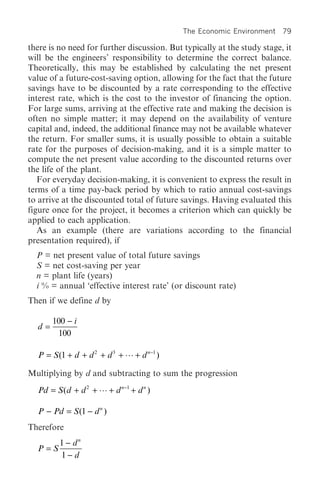
or, better, a guess of the upper and lower limits of a figure and consider
the consequences of both. For an unwanted incident to take place,
usually a number of things have to happen simultaneously.
  Firstly, the plant operation has to deviate from the design operational
mode, for example the pressure must increase above the intended value,
say because of the failure of a pressure controller or because the operator
omitted to close a bypass valve. And then, at least one protective device
has to fail simultaneously. We can quantify these as follows.
•   The demand rate, D, is the frequency at which the hazardous condition
    (say, the over-pressurization of a pressure vessel) is likely to occur,
    measured in events/year.
•   The fractional dead time, fdt, which is the percentage of time when
    the protective device (for example safety valve) does not operate
    effectively. This is made up of at least two components:
     – the failure rate, F, of the protective device (the number of times
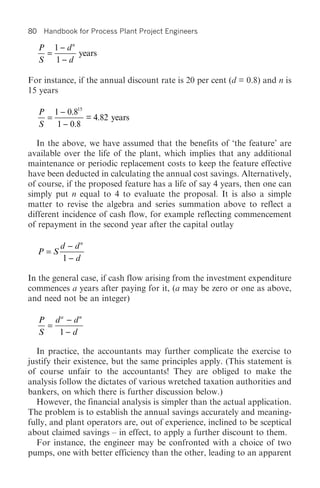
        that it becomes ineffective) in events per unit time, say once in a
        hundred years; and
     – the test or verification interval, T, which could be 2 years for a
        plant which has a turnaround every 2 years when all safety valves
        are tested.
  If we assume that a failure of the safety valve is equally likely at any
time in the 2-year period, then on average the protective device will be
dead for 1 year following failure. In general
Hazards, Loss, and Safety    129

               T
   fdt = F ¥
               2
   Given the above, the probability of the unwanted incident occurring
will be D      fdt events per year. The probability can be reduced by
installing additional safety devices, say a second safety valve or a pressure
switch which deactivates the source of pressure, but each of these will
have a fractional dead time, and the incident rate will be reduced to

   D ¥ ( fdt )1 ¥ ( fdt )2 ¥

But it will never be zero. And with each extra safety device comes the
possibility of spurious action, upsetting plant operation when nothing is
wrong.
   The second stage of Hazan is to evaluate the probable consequences
of the incident. Usually, these are related to the severity of the incident
(in the example of the pressure vessel, the maximum pressure experienced
in the over-pressure incident). The value chosen may influence both the
demand rate and the fractional dead time, so there may be some iteration
here. If we continue with the example of the pressure vessel, it is most
unlikely that it will explode if subjected to 25 per cent over-pressure
most codes require a hydrostatic test at around 50 per cent over-pressure.
There are all sorts of safety margins introduced into the various details
of the design but, then again, these are done for reasons which include
manufacturing uncertainty and service uncertainty (say, the inclusion of
a corrosion allowance). It becomes clear that the pressure at which a
vessel will fail is itself a matter of statistical probability. In practice, it is
frequently the case that an over-pressurized vessel or pipe fails at a
flanged joint, and the consequences (to people) are not so severe unless
the contents are flammable or toxic. For the given example, let us suppose
that we can expect the vessel to fail at a pressure of 170 per cent of the
rated pressure, that we have used this pressure in evaluating the demand
rate, and that a similar failure in the past has resulted in two fatalities.
   Having done our best to quantify that there is, say, a 0.1 per cent
chance that a failure will occur in 100 years, and as a result an average
of two fatalities may arise in the ensuing explosion and fire, we come to
the final stage of evaluation, which is to decide whether that is accept-
able. This is commonly done by comparison with statistics that relate
to normal hazardous activities that most people are prepared to engage
in, like road or air travel. The designer may be able to demonstrate by
this means that the various features of hazard around a plant create an
130 Handbook for Process Plant Project Engineers

environment where persons may be exposed to (say) less than a tenth of
the probability of injury than when travelling by road. It may be argued
by such means that the standard of safety is adequate (or, of course,
inadequate if the results come out worse than road travel).
   It has to be stressed that, in the event of an accident, there is no guar-
antee that such quantified evaluation of hazard has a certainty of being
accepted as proof of reasonable behaviour by the plant designer. In
practice, it is nearly always possible to make design decisions and
choices by adopting a suitable design code that obviate the need for
hazard analysis unless that is specifically required by regulators (invariably,
in addition to the adoption of proven design codes of practice).
   However, the practice of performing hazard analysis is most enlight-
ening for the plant designer, if only to enhance the understanding of
practical reality, which does not easily flow from blind obedience to
codes.
   On the general subject of conducting Hazops and identifying and
quantifying hazards, the reader is referred to the text Hazop and Hazan
– Identifying and Assessing Process Industry Hazards, by Trevor Kletz,
published by the Institution of Chemical Engineers. This is a very
readable further introduction to the subject. More comprehensively,
the website of the Institution of Chemical Engineers, www.icheme.org,
lists at least 50 (mainly specialist) publications on the subject.
   In conclusion, to design a safe plant the following are required.
•   Ascertain and incorporate the relevant requirements and regulations
    of the Health and Safety Executive and other statutory bodies within
    the country of the plant site.
•   Check for regulations or permitting requirements concerning emis-
    sions and waste disposal. An environmental impact study/plan is
    normally required, and is likely to include some recommendations
    which will affect the design. Do not omit to contact and ascertain
    the requirements of the local fire office. Check also whether there
    are, or are likely to be, any design requirements from the owner’s
    fire and other hazard insurers, in case the owner has omitted to
    mention them.
•   Adopt industry codes of practice for the plant as a whole, where
    these are available. The ‘process design package’ mentioned in
    Chapter 2 ought to have a comprehensive reference to applicable
    codes of practice and design requirements that are appropriate to
    the process, and, if not, these should be demanded. The subjects
    addressed should include:
Hazards, Loss, and Safety   131

     – the sizing and design of pressure-relief systems;
     – requirements for redundancy of safety devices and for fail-safe
       systems;
     – requirements for on- and off-line testing of safety devices;
     – requirements for and frequency of plant equipment inspection;
     – design for safe entry into enclosed spaces;
     – the classification of hazardous areas;
     – fire prevention and protection;
     – plant layout for safety, including minimum clearances between
       adjacent units, and proximity to places of public access and
       dwellings.
    Further information on appropriate codes of practice (and good
practice in general) can be obtained from the Institution of Chemical
Engineers website mentioned above, including the comprehensive
Guidelines for Engineering Design for Process Safety. For hydrocarbons
work, visit the website of the American Petroleum Institute or, more
easily, download their publications catalogues.
•   The project design criteria (see Appendix 2) should include at least
    the design codes to be employed for (where applicable):
     – vessels under pressure (including plastic vessels, if utilized);
     – pressure pipework;
     – fired heaters and boilers;
     – non-pressure vessels which contain hazardous substances;
     – safety of mechanical handling devices and guarding of machinery
        (see also the final section of Chapter 15, Bulk Solids Transport);
     – electrical safety, including identification of hazardous areas;
     – lifting devices (including elevators).
•   Hazops are required, as outlined above.
•   The plant layout must be comprehensively reviewed – this can be
    incorporated in the Hazop – to ensure that the design is ergonomically
    friendly and that adequate escape routes are provided.
•   All hazards must be described in plant operation and maintenance
    manuals, together with the correct operational practices to overcome
    them and keep the plant safe.


12.3 Commissioning
Refer to the notes included at the end of Chapter 24, Commissioning.
132 Handbook for Process Plant Project Engineers

12.4 Plant modifications
Making modifications or additions to existing plant requires special
safety considerations. One of the most infamous process industry
accidents of the twentieth century, the Flixborough disaster at a
plant in England, was caused by an insufficiently analysed modification
to an existing plant. Any engineer who works in an oil refinery or
petrochemical plant is very quickly made aware that any plant
modification whatsoever is regarded with great suspicion. In most such
environments, a regime is maintained under which any change whatever
   even, say, a different type of gasket, because the usual gasket is
not available    requires special authorization. A bureaucracy is set up
with the intention of forcing people to think critically, and ensuring that
changes are reviewed from all operational and engineering viewpoints.
  Here are some points to bear in mind, for the uninitiated engineer
working in such plants.
• Hazop is required for all but the most minor plant alterations and
  additions certainly any work that affects the connectivity of process
  flows (‘jumpovers’) or affects the operation of a safety device.
• Permits-to-work must be obtained from the operation supervisor for
  any work in areas within, connected to, or adjacent to existing plant
  (including decommissioned plant). The permit must specify at least:
    – what work may be done (generally divided into hot or cold
      work, depending on whether it is permissible to introduce
      sources of ignition, such as welding);
    – when and where the work may be done;
    – what precautions must be taken for (where applicable) the detection
      and elimination of harmful or flammable substances, making
      safe the operational plant, isolation of pipelines and power supplies,
      access to enclosed spaces, fire-fighting, and gas inhalation;
    – any other requirements for safety, including personal protective
      equipment; (normally, these will be covered by mandatory plant
      safety regulations);
    – what operational supervision is required;
    – the duration and renewal requirements for the permit.
     When work has been completed, there needs to be a formal check
  and acceptance of the work by the plant operators, and the permits
  must be cancelled.
• Underground services, and in particular buried electrical cables,
  must be identified before any excavation is made.
Specification, Selection, and Purchase   133


     Fourth Cycle
Engineering Development
      and Detail
This page intentionally left blank
Specification, Selection, and Purchase   135


                       Chapter 13

    Specification, Selection, and Purchase


13.1 Procurement
As we have seen from the sequential planning of engineering work,
not only are the project designs and their practical implementation
connected through the process of procurement, but also the flow of
information (both technical and commercial) back from vendors is
essential to keep the design process on track. There can be no possibility
of a successful project engineering effort without an equally successful
procurement effort; the two functions must be integrated from the basic
planning stage through to project completion. In Chapter 6 we
discussed some of the broad issues of procurement, in the following the
subject will be addressed at an operational level.
   The engineering task that initiates the procurement process is the
defining of what has to be procured, by means of specifications, data
sheets, drawings, and work-execution plans, and this definition has
to be geared towards the capabilities of the suppliers, based on a
considered strategy and a knowledge of the marketplace. There remains
the work of:
•   drawing up conditions of purchase and contract;
•   packaging the commercial and technical content, and ensuring that
    all aspects of the proposed agreements are covered;
•   soliciting bids;
•   receiving the bids systematically, and assessing them technically and
    commercially;
•   negotiating and finalizing agreements with selected bidders; and
•   following up to ensure that the correct goods and services are
    provided according to schedule, and that payment is made as
    agreed.
136 Handbook for Process Plant Project Engineers

Invariably in large projects and organizations, the part of the work
listed above (except for the technical content) is performed by commercially
trained staff under separate management, thus providing appropriate
skills and focus to the tasks. The separation of functions creates an
important interface, and the following discussion relates mainly to its
management.
   For successful teamwork, it needs to be understood that the separation
of roles is artificial: every important procurement document, decision,
and priority is shared between the engineering and commercial
functions. If the two functions are too far separated, topographically, by
over-formal communication or by over-rigid interface procedures, there
will be a price to pay in terms of efficiency and speed. However,
interfacing is improved by using well-thought-out procedures, as long
as it is understood that these are a tool to promote teamwork and not
a substitute for it.
   The first mutual need is to plan the work (and the procedures to do
the work) in a way which provides the best balance between technical
and commercial issues, as discussed in Chapter 6. The following are
some of the points to be resolved:
1. Identification of the orders and contracts to be placed. The lists of
   equipment and bulk materials to be purchased and erected on site
   are obviously the basic starting point, but it has to be decided how
   these will be ‘packaged’ into orders and contracts. The following
   objectives need to be considered in reaching the best compromise.
   • Best commercial policy. Usually, the combination of items
       within a package which is judged to be most appealing to the
       marketplace: large enough to be attractive but not too large
       for the capacity of target suppliers; not so small that procure-
       ment management costs become excessive; structured to include
       mainly goods and services within the product range of individual
       suppliers.
   • Technical standardization. All like items of proprietary design
       should come from a single supplier if possible (and if a good
       commercial deal can be struck), both for ease of project execution
       and to facilitate plant maintenance.
   • Schedule needs. Three aspects need to be considered for each
       item in a package: when is information available to purchase it,
       when is the item required on site, and, in the case of items of
       proprietary design, when are the vendor drawings and other
       interface information needed?
Specification, Selection, and Purchase         137

     •   In the case of site services, such as site erection: the overall
         project construction strategy, including manageability of
         contractors, access, desirability of maintaining competition for
         extra work, and infrastructural limitations.
2.   The format of commercial documents, such as enquiries, orders,
     and contracts; and, arising from that, how the technical docu-
     ments, such as specifications and schedules, will dovetail into
     the commercial documentation, such as conditions of purchase
     and forms of tender, without any conflict and without the need for
     revision. Subjects which need to be interfaced include:
     • vendor document requirements,1 both with bids and during the
         execution of orders, including their quantity, format, quality,
         timing, and the structuring of sanctions in the case of late or
         inadequate information;
     • inspection procedures;
     • concession procedures;2
     • packaging, marking, and forwarding requirements, including
         definition of point of delivery;
     • commercial conditions corresponding to performance testing
         and inadequate performance;
     • requirements (operational and commercial) regarding site
         attendance by equipment vendors;
     • spare parts ordering system, including commissioning spares;
         and
     • procedure for project communication with vendor (two-way: the
         main need is to promote quick technical communication, while
         creating adequate records and maintaining the commercial
         controls).
3.   Identification of which items will be handled as purchase orders,
     and which as contracts. This chapter is aimed more at purchase
     orders than at contracts, for which some additional considerations
     apply; these are addressed in Chapter 23.
1
  Checklist: drawings (preliminary, for comment and approval, certified for construc-
tion); technical data, including all interfacing data, such as structural loading, electric
motor details, and instrumentation signals and connections; manufacturing schedule;
inspection and test certificates; installation, operating, and maintenance manuals;
lubrication schedules; spare parts guides and price lists; and packing lists.
2
  That is to say, requests for a relaxation from specification or approved vendor
drawing/data detail, arising because of a manufacturing or sub-supplier problem.
138 Handbook for Process Plant Project Engineers

4. The time schedule for interfacing of activities.
  Organizations which have a responsibility split between engineering
and procurement invariably need to use a formal interface document,
the requisition, that is effectively an instruction to purchase which
provides the relevant technical information. Like all forms, the
requisition form is essentially a checklist, and its format conforms to
the interface agreement reached in accordance with the above.


13.2 Specification
The word ‘specification’ has different meanings in different contexts,
especially in legal and patent usage. In engineering projects it means a
detailed description of the design and/or construction and/or perform-
ance of an item. The item can be an entire process plant, or one or a
group of pieces of equipment, activities, designs, or bulk commodities.
The usage of specifications is as old as the performance of projects, and
is the epitome of the statement made in the preceding review on project
management, Chapter 3, ‘Plan the work then work the plan’. First, you
decide exactly what you want (the specification), then you do it or get it.
   The project design criteria document is thus the most basic of the
project specifications and, below that, any individual discipline detailed
design criteria and working practices, developed to guide the work of
the project in a manner acceptable to the overall objectives and/or the
client. There is some overlap in the meanings of ‘specification’ and
‘procedure’. Generally, ‘specification’ defines the product of an activity,
whereas ‘procedure’ defines how to get there. A procedure may be part
of a specification, and vice versa.
   Here we are discussing procurement, and the specifications therefore
address the interface between the project organization and the supplier/
sub-contractor, in order to describe exactly what is required. In the
course of procurement, the specification is used in two contexts: firstly,
as the document which makes a competitive bidding process possible
and, secondly, as a reference for the work performance, describing
the products or services that are to be provided, and the standards of
acceptability.

13.2.1 Specification as a document for bidding
Looking at the first context, in a competitive procurement environment
our objective is normally to procure the most cost-effective product, that
Specification, Selection, and Purchase   139

is, the product that fulfils the required functions, with the required
reliability and durability, and at the minimum cost. The latter may be
adjusted to reflect the evaluated worth of performance-related features,
such as power consumption or maintenance costs, as discussed in
Chapter 8.
   In order to obtain the best value, it seems sensible to produce a speci-
fication which reflects the minimum requirements that are acceptable,
thus enabling maximum competition and possibly innovative solutions.
In effect, this is a value-engineering approach. The specification is
aimed at identification of the essential requirements for performance
of the item, ‘performance’ meaning the definition of function and
how well, how economically, and how reliably the function must be
performed. Any non-essential requirements are identified and deleted.
   This is one of the basic tenets of writing specifications, but limitations
to the practice include the following.
•   If basic design choices are not made when detailed engineering is in
    progress, it becomes impossible to complete the work. For instance,
    with regard to equipment selection, once the layout has been frozen
    (based on certain equipment types) it usually causes a lot of
    disruption to change to other equipment types. The effect on the
    layout, the occupation of space, the supporting steelwork design,
    and on other disciplines just becomes too great and the potential
    benefits are far outweighed by the cost of change.
•   As regards bulk items (such as pipe fittings), standardization and all
    the associated benefits will be lost if only functional requirements
    are considered each time an order is made.
•   Referring back to the discussion in Section 8.2 on lifecycle
    considerations, we remarked on the difficulty of confirming maint-
    enance cost and reliability claims made by equipment suppliers. We
    concluded that it was often preferable to specify features which were
    known to offer enhanced performance in these respects rather than
    rely on competitive bidding to produce an optimal design.
  The preparation of specifications is therefore a compromise between
getting the best value by restricting the requirements to the essential
performance of the item, and the sometimes conflicting needs of design
convergence, standardization, and inclusion of proven essential features.
All of these factors are important.
  To some degree the compromise can be reached by using two stages
of specification. In the initial or study stage the specifications may be
almost exclusively performance-based, and serve to establish the basic
140 Handbook for Process Plant Project Engineers

equipment choices, standards, and essential features. In the second (or
project) stage, the permissible variations may be limited in accordance
with the choices made in the first stage. In practice, the stages are
seldom completely separated, and the engineer is left with some
continuing need to compromise; however, the performance of the work
is enhanced if the two-stage separation, the process of design conver-
gence, is seen as an objective.
   The commercial goals of getting the best value, and of encouraging
competition, are enhanced by specifying items available from existing
standard products rather than special-purpose items. The definition
of performance and any other features should as far as possible
be referenced to national or international standards that are familiar
in the suppliers’ market. Similarly, and especially for lower-value
items, the specification should be as simple to read and interpret as
possible. Length, complexity, and non-standard requirements are all
features which can be expected to cause less competition and higher
prices.
   Standardization within the project, ease of reference to the user, and
economy of engineering time are all assisted by making up specification
appendices for standard project information rather than repeating these
in the body of each specification. There may be a number of appendices,
for example:
•   site conditions (location, weather, altitude, atmospheric corrosion,
    seismic design), utilities availability, and the applicable utility design
    parameters (such as cooling water temperature and pressure
    range, instrumentation and control interfaces, power supply, and
    compressed air details);
•   basic requirements for proprietary equipment – engineering standards
    such as system of dimensions, design life of machines and compo-
    nents, language to be used in nameplates and manuals, equipment
    tagging instructions, and site lubricant standards;
•   for each discipline: component standardization such as types of nuts
    and bolts, seal, grease-nipple, and switchgear;
•   vendor documentation requirements;
•   shop inspection, packaging, and despatch;
•   painting and protective coatings.
   The body of the specification is then confined to information which is
peculiar to the item in question. The use of such appendices has to be
limited to procured items of appropriate size, otherwise it is found that
relatively minor items may end up with several appendices which are for
Specification, Selection, and Purchase   141

the most part irrelevant, thus defeating the objectives of the previous
paragraph.

13.2.2 Specification as a reference for work performance
The second stage of the utilization of specifications is as a reference for
work performance and acceptability. It is usually the case that, either in
his bid or in subsequent negotiations, the supplier offers various desirable
features which were not specified, or features which differ from the
specification but are considered acceptable. For the second use of the
specification, as a reference document for the acceptability of the item
and its manufacture, it is necessary to update the specification accord-
ingly ‘for purchase’. It should be noted that at this stage there is no
longer any value-engineering purpose served by seeking to focus on
functional needs – it is a matter of ensuring that what is delivered is
what has been agreed on.
   When updating the specification, it is recommended that the engineer
use wording which reflects responsibility for the features proposed by
the supplier, the point being that if the supplier in his offer warrants the
acceptability of these features, he should retain responsibility for his
claims. In the event that his claims prove to be false, he should be held
accountable. This is easily achieved by modifying the specification for
purchase, where appropriate, by using wording such as ‘features offered
with supplier’ or, in the case of a performance data sheet, by clearly
noting on the form which entries are the supplier’s. What should be
avoided at all costs is to substitute the performance-based specification
with details of the supplier’s offer, unless the engineer is consciously
taking full responsibility for ensuring that what is offered will perform
acceptably.


13.3 The selection of equipment
‘Equipment’ is almost invariably purchased from suppliers who provide
their own designs of items to fulfil a specified duty. Thus the project
engineer’s role is to specify and select, rather than to design, as is usually
the case for structural steelwork, civils, and piping. Consequently there
are some special considerations to be discussed.
  In general, equipment is developed, rather than designed, for an
application. That is to say, designs for a new device ‘off the drawing
board’ are seldom suitable for incorporation within a plant without
142 Handbook for Process Plant Project Engineers

field-testing, during the course of which unexpected problems arise
and modifications are found to be necessary; or, of course, the design
may be found to be unsuitable. The duration of ‘field-testing’ must
ultimately be compatible with the length of service and reliability
expected of the project application, usually a matter of years.
   It logically follows that, except for rather simple applications, no
engineer can be expected to pronounce an equipment design as being fit
for purpose simply by studying drawings and data, even a non-working
model. The reviewing engineer is in no better position than (and usually
at a considerable disadvantage to) the original designer producing an
untested design. So, even with the most thorough design review by
the most experienced engineers, it is usually unacceptable to select
equipment merely on the basis of its design; the track record for the
application also has to be validated.
   Engineers tend to be constructively minded people who want to build
something new, and want to do it themselves. The optimal behaviour in
the task of equipment procurement therefore goes against the grain for
many engineers; they want to take over some of the functions and
responsibilities of the equipment vendor, and this is especially the
case for younger engineers. Here are some suggested guidelines for
novices approaching this task; they may be ‘obvious’ to more exper-
ienced engineers, but are too important to risk omission.
•   Both commercial and technical needs demand a clear distinction of
    technical responsibility between the purchaser and the vendor.
    Commercially, the precise definition of the vendor’s responsibility
    assists the comparison of offers and the manageability of contracts,
    and is appreciated by vendors who wish to market quality.
    Definition of responsibility is always fundamental to quality
    management.
•   Unless there are overriding factors of specific technical experience
    on the part of the purchaser, the best split of responsibilities (which
    should be regarded as the ‘default’ case) is that the purchaser is
    responsible for:
     – describing the application (including the process and local
        environment);
     – defining the performance; and
     – stating minimum3 constructional requirements (over which the

3
 Minimum implies that the vendor is still responsible for the actual features employed,
provided that they are equal to or better than the minimum.
Specification, Selection, and Purchase   143

        performance requirements take precedence in the event of
        conflict).
    The responsibility of the vendor is to design and manufacture
    equipment which complies with the specification and is fit for the
    purpose and environment, as described, and as known by the vendor
    in terms of his previous experience.
•   When dealing with the ‘approval’ of the designs and data submitted
    by vendors, it is necessary to maintain the responsibilities of
    each party. The prime responsibility of the purchasing engineer
    is to satisfy himself as well as he can that the equipment offered
    complies with the specification. This is best handled by asking
    questions, if necessary ad nauseam, until satisfactory responses are
    obtained; or, if satisfactory responses cannot be obtained, by
    rejecting the equipment. Any design modification or detail proposed
    by the purchasing engineer is a suggestion, not a request or a
    requirement.
   Most standard commercial conditions are based on similar precepts
to the above. Some practitioners take the role definition a step further
by avoiding use of the word ‘approval’ altogether, and using ‘review’, so
as to emphasize that there is no responsibility shift. Others argue that
this is going too far     that the implied responsibilities can be made
quite clear by the conditions of purchase, and that the right of approval
is essential.


13.4 Technical appraisal of equipment bids
Following the issue of specifications, the second major responsibility of
the project engineer is the technical appraisal of bids for the equipment
item. The objectives of this process are the following.
•   To check for compliance with the specification.
•   To evaluate the relative worth of features which will impact on plant
    operational costs, specifically:
     – energy and utilities consumption cost;
     – operator attendance cost;
     – maintenance costs (over the life of the plant, including eventual
       replacement costs if required); and
     – costs arising out of scheduled and unscheduled item unavaila-
       bility during repair and maintenance; this includes the
       consequential cost of equipment failure.
144 Handbook for Process Plant Project Engineers

    Needless to say, the value of these features has to be discounted,
    as outlined in Chapter 8; and as mentioned in that chapter, concerns
    raised about reliability are liable to result in rejection rather than
    evaluation of associated costs.
•   To evaluate the relative worth of any capital cost impacts which do
    not show up in the item prices. These may for instance include
    costs of transport, erection and commissioning, associated founda-
    tions, electrical reticulation, instrumentation and control gear, and
    pipework. Normally the parallel commercial appraisal, excluded
    from this scope, will include such factors as impact of terms of payment,
    duties and taxes, foreign exchange, import/export permit availability,
    and terms of contract. The interface between the engineering and
    commercial appraisals needs to be co-ordinated.
•   To evaluate the worth of any other features offered by the vendor,
    over and above those specified, such as ability to exceed the specified
    performance.
   The appraisal is customarily presented in columns of comparison of
corresponding features. The work of preparing this presentation is very
significantly simplified if the tabulation format is thought out in
advance and presented with the enquiry as a requirement for bidders to
complete.
   Some bidders may be found to submit only partial information by
oversight or confusion, or due to genuine lack of time, and there is
usually a commercial process to permit the provision of additional
technical information after bid submission. Other bidders may however
submit inadequate technical information as a matter of policy, their
aim being to promote their ability to negotiate and to vary technical
details (and the associated costs) according to their subsequent assess-
ment of their negotiating position. As a general rule, project engineers
are advised simply to reject bids with inadequate or contradictory
information, provided of course that they are in a position to do so in
terms of the adequacy of competing offers. Failure to do so often leads
to a drawn-out bid appraisal process which is highly damaging to the
project schedule, besides being unfair to the other bidders, who may be
expected to respond negatively in the future.
   The first appraisal criterion listed above (compliance with specifica-
tion) should be self-explanatory. The second group (operational costs)
was discussed in Chapter 8; the most difficult aspect to assess is usually
reliability and its impact, followed by maintenance costs. Sometimes,
the only way to approach these subjects is to take the view that the vendor
Specification, Selection, and Purchase   145

is offering a pile of junk, unless he can prove otherwise by evidence
of direct and comparable experience and reputation. The experienced
appraising engineer is usually able to differentiate features associated
with ‘ruggedness’ an ability to withstand a certain amount of abuse
which is essential in many applications.
   As regards the third group (impact on other capital cost components),
there are a couple of aspects which are worthy of elaboration. The items
appear on this list because they represent activities and costs for the
purchaser which are affected by design decisions and information
provided by the vendor. Some of the items listed             foundations,
erection, commissioning procedures may be made to be unnecessarily
expensive by vendor design decisions, for example by the imposition of
relatively demanding tolerances on foundation interfaces. It may be
that certain vendors require unachievable tolerances in erection, and
unreasonable maintenance practices, as a means of pre-empting the
enforcement of guarantee obligations, or even as a means of gaining
extra income from the prolonged site presence of very expensive
vendor technicians. User-friendly features, such as adjustment facilities
within intermediate soleplates, or shaft-coupling arrangements which
facilitate alignment, may be of significant value when constructing (and
maintaining) machinery.


13.5 Inspection and quality control
‘Inspection’ and ‘quality control’ are two overlapping activities. In a
general engineering context, ‘inspection’ includes both quality and
quantity examination and verification, and indeed the exercise of due dili-
gence in examining anything of importance, which in the case of a project
may include the site conditions or the wording of a contract. ‘Quality
control’ includes observation and record of product quality, analysis and
observation of the production process (including all aspects of engineer-
ing and management), surveillance of the actions taken to maintain
quality within acceptable limits, and rejection of non-conforming work.
   The stages of quality control prior to commissioning can be divided
into three: engineering, procured items, and fabrication and construc-
tion work. Engineering quality control has been addressed in previous
chapters. In the following, our focus is on procured items and shop
fabrication, and we will in general use the term ‘inspection’ loosely
to embrace both activities of inspection and quality control, i.e. the
observation and the feedback loop.
146 Handbook for Process Plant Project Engineers

   In the pursuit of providing a quality product (that is, a product
having any specified quality level), inspection is arguably just as impor-
tant as design and production. There is no gain in designing features
which do not materialize in practice. Product inspection, in all its forms
of quality, quantity, and general conformance checking, has long been
recognized as an integral part of any productive activity or commercial
transaction. One of the fundamental laws of purchase of goods that
already exist, caveat emptor, ‘let the buyer beware’, stresses the
presumed negligence and lack of recourse of the buyer who fails
adequately to inspect.4 The tradition in engineering is generally to
assume that errors and unacceptable work will inevitably follow poor
quality control, both in design and construction. All important work
must be checked, and corrected if necessary.
   In the present limited context, our aim is to establish what inspection,
and how much inspection, is required when procuring items for a
process plant. Evidently this is very similar to the question of how much
engineering work to do; too little inspection is likely to result in
unacceptable quality, while increasing the inspection expenditure
will ultimately become uneconomic as the costs exceed the benefits.
Theoretically, the optimum is reached when the marginal increase of
inspection costs equals the marginal decrease in direct field costs and
other savings arising out of the additional inspection. ‘Other savings’
may flow from reduced site erection problems, reduced commissioning
time, increased plant availability, reduced maintenance costs, and so
on. Clearly, the optimum amount of inspection for an item is influenced
by the quality of the system by which it is produced, and by the
consequences of a flawed product being accepted.
   Some possible consequences of poor product quality are unaccept-
able, and the corresponding items should be identified by review
of criticality if they have not already been identified by the process
technology package or by statutory regulations. Clearly these items
must be inspected to certain standards, and the engineers should ensure
that the items are known and the standards are defined. Pressure vessels
are an example.
   A process plant is finally inspected when it is handed over as a
complete entity, usually prior to commissioning. However, this is not a
practical nor an economic time to concentrate inspection activities;

4
  This is not universally applicable; not for instance when there are other overriding
laws, or when the purchaser has ‘qualified-out’ his obligation to inspect, or where there
is a warranty from the seller.
Specification, Selection, and Purchase   147

impractical because most of the critical features become inaccessible
during construction, and uneconomic because of the cost of delays and
of dismantling to carry out rectification. Activities and components
have to be inspected before their incorporation into the plant, so that
ideally the final inspection should be a verification that all of the
planned, preceding inspections have been completed and deficiencies
remedied.
   Inspection can be classified according to who is responsible for the
activity; there are usually many levels to this chain. Typically, there may
be the inspectors of the project management and engineering team, the
quality department of the procured item suppliers and contractors (and,
separately, their factory production workers, using inspection as
a production control tool), and a chain of sub-component and raw
material suppliers and their quality departments.
   There may also be superimposed inspection from the plant owner or
third-party bodies, sometimes acting within statutory or licensing
agency authority. We will disregard the latter as there is usually little
choice to be exercised in how their input is applied, and because
they relieve the project team of no responsibility. There is however
an additional burden in managing the interface with such agencies
and of ensuring that documentation and work practices follow their
requirements, which should not be omitted when drawing up inspection
budgets.
   For most project inspection activities, the interests of economy and
efficiency are best served by utilizing the internal quality control systems
of the suppliers/contractors, and monitoring the control system rather
than the end product. Thus standard conditions of purchase should
specify the quality management systems required of suppliers/contrac-
tors, and the facilities for surveillance of the systems. End-product
inspection, if carried out by the project team inspectors, should essentially
be regarded as a tool for monitoring the effectiveness of the quality
control system, and if failures are detected both the system and the end
product have to be upgraded. For instance, it is common practice, when
specifying sample radiometric inspection of welding work, to require
that if detected flaws exceed a certain percentage of samples inspected,
the percentage of welds to be inspected, both retroactively and in the
future, increases to perhaps 100 per cent. This may continue until such
time that the pass rate improves sufficiently, and is all at the contractor’s
expense.
   The practice of purchasing according to specification, which the
supplier is responsible for meeting, allows the buyer to escape the
148 Handbook for Process Plant Project Engineers

responsibilities of caveat emptor.5 The buyer’s inspector must be careful
to assume no responsibility by the act of inspection, exactly according to
the reservations of the buyer’s engineer in the case of design approval.
  There is a simple saying, ‘You cannot inspect quality into a product’,
which is in fact a half-truth that causes some misconceptions. The intent
of the saying is that the quality of a product is primarily a result of the
production process. There are several ways that inspection augments
quality or, conversely, that inadequate inspection leads to quality
deterioration.
• At the most fundamental level, any form of quality control is impossible
  without inspection. Control of any form depends on a closed loop of
  inspection and correction.
• As in quantum physics, observing a process changes the process. The
  performer who is watched jacks up his act, and if he gets into a
  situation where he cannot cope, any part of his workload which is
  not subject to inspection tends to suffer first.
• In the case of 100 per cent-inspected product, once all the rejects
  have been separated the increase in quality rating of the remainder is
  obvious. Even the rejects can be increased in quality by assigning a
  new or restricted duty to their usage, and for this revised application
  the quality may be regarded as adequate.
• In conjunction with adequate record-keeping, inspection facilitates
  the identification and rectification of problems which may occur
  over the lifetime service of a component or group of components.
  This is especially the case where such problems may arise out of
  design or specification inadequacy – the existence of the inspection
  and test documentation has ongoing potential value, rated as
  essential where the consequences of failure are severe.


13.6 Planning inspection work
Enough of generalities; how do we plan our inspection work on a real
project? Inspection activities should be classified according to the aims

5
  We have not discussed the use of second-hand equipment, which is sometimes the key
to project viability. One of the main consequences of buying used equipment is that the
vendor cannot easily give a serious guarantee, except by completely stripping and refur-
bishing the equipment at substantial cost (which is not known in advance). Thus the
onus of establishing fitness for purpose falls partially or wholly on the buyer, who must
tread warily. The situation is better if the used equipment belongs to the plant owner,
who is able to confirm its operational and maintenance history.
Specification, Selection, and Purchase   149

and needs relating to groups of items. There are many ways in which
this is practised; here is one example.
Group 1. These are critical items where the consequences of failure are
  severe. An exercise of due diligence is necessary; that is, the intensity
  of inspection should at least equal customary practice for comparable
  work. Typically, all work should be carried out in accordance with an
  appropriate code or standard, with an independent inspector to certify
  compliance in accordance with an individual quality plan per item.
Group 2. These are items where compliance is required by statute,
  for example pressure vessels. The applicable regulations dictate the
  minimum requirements. If these items are also group 1 items, above-
  statutory-minimum requirements may be needed.
Group 3. These are items where conditions of contract or commercial
  policy dictate the levels of inspection, for example, in case the inspection
  is linked to a final payment. There are no short-cuts here.
Group 4. These are the remaining items, where inspection is carried out
  on a basis of economic evaluation,6 considering the selected supplier’s
  reputation and facilities, the availability and credibility of conformance
  certificates, the consequences of accepting non-compliant items, and
  the cost of inspection.
For management purposes, the decisions on inspection intensity may be
classified into a few standard ‘levels’, for example no shop inspection,
random inspection of end product, and individual item quality plan.
   Notwithstanding the above, most project inspection budgets are
under severe pressure, as rather a cynical view is taken on the value of
inspection, generally the result of unthinking criticism when defective
products pass inspection, without any understanding of the economic
impossibility of 100 per cent inspection. Possibly the most effective
countermeasure to the tendency to slash inspection budgets is to work
into conditions of purchase the requirement that suppliers and contractors
are obliged to pay for appropriate levels of additional inspection (by
third parties) in the case of failure of sample inspections. This may also
be the fairest and most effective option. Too often, in modern practice,
the quality supplier loses on price to those whose quality control is
purely cosmetic, and who ultimately (when quality failures are noticed,
too late) inflate the purchaser’s inspection costs while destroying his
inspector’s reputation.

6
  In other words, the optimum input should be determined on the basis of
diminishing-return theory, as in Chapter 8 and Fig 8.1.
150 Handbook for Process Plant Project Engineers

13.7 Expediting
Project controls – the feedback loops of measurement and remedial
action to control performance according to plan – are customarily split
into cost, time, and quality functions. The time control system related to
procurement is customarily referred to as ‘expediting’, although the
term could be and sometimes is applied to any project activity (or the
perceived lack thereof), including engineering.
   Inevitably, any activities directed towards the expediting of vendor
activities have an interface with other project activities which are related
by physical sequence or information flow – expediting is a two-way
activity. For instance, as regards the procurement of equipment, it is
also necessary to expedite:
• delivery to the vendor of any outstanding design information;
• approval, by the project team, of vendor drawings before manufacture
  commences;
• concession requests (for deviation from the specification or from
  approved drawings) as manufacturing difficulties arise;
• queries on the interpretation of drawings; and
• third-party inspection and witnessing of tests.
It is just as important to expedite the flow of information from the
project team to the vendor as it is to expedite the vendor’s own activities.
   Many quality authorities argue that expediting must be separated
from inspection, in both line management and execution. No
one person should share both responsibilities and be exposed to the
ensuing conflict of objectives. Besides, the respective roles tend to
require different skills and personalities – the quintessential inspector
being a skilled and meticulous technician, while the expeditor may
be perceived as a bully who will accept no delays on any account.
Needless to say, this is an over-simplification which grossly undervalues
the maturity of some of the professionals involved. While the ideals
of role separation may be preserved with regard to more critical
items, the dictates of economy make it inevitable that there is a level
of criticality below which the roles of expediting and inspection are
combined.
   For the most part, observations made in the preceding section about
the planning of inspection, may be considered interchangeable with
those on expediting, provided that quality is substituted by time. Both
functions require a plan as a basis of control, and a plan of execution
based on the criteria of criticality and limiting returns. And both
Specification, Selection, and Purchase   151

functions are worthless without remedial or preventive action based
on the observations made, the facility for which must be incorporated
into the agreement of purchase.
   A standard purchase-order expediting report needs to reflect the
status of:
•   finalization of the purchase order and amendments;
•   information flow between the vendor and the project organization as
    listed above;
•   delivery to the vendor of ‘free issue’ parts;
•   progress of the actual work being done by the vendor, and his plans;
•   orders on sub-suppliers; and
•   formal inspections, acceptances, and rejections.
The report should also list the original planned date for completion of
each milestone, the current prediction, and the corrective action.
This page intentionally left blank
Fluid Transport 153


                        Chapter 14

                        Fluid Transport


In the following three chapters on materials transport systems, we will
outline some of the basic concepts and their application to a process
plant project. It is of course impossible to go into much depth in a few
pages. We aim to establish an idea of the discipline scope to be incorpo-
rated within a well-engineered project, and provide some references by
which a potential engineering all-rounder may develop his capabilities
for use in situations where specialized knowledge is less important than
rapid and inexpensive conclusion.
   Here we will address contained fluid handling systems; the open-
channel flow of fluids is included in Chapter 17, together with plant
drainage. We will begin by addressing the transport of liquids in pipes.
The transport of liquids in containers may be important outside plant
limits, but it has little place in a continuous process plant and will not be
discussed.
   The essential elements of liquid-handling systems are vessels (which
are referred to as tanks when open to the atmosphere, and pressure
vessels when the liquid surface is under pressure or vacuum), pumps,
piping systems, and valves.


14.1      A brief note on liquid-pumping systems
          design
For process plant design, it is convenient to calculate pumping perform-
ance in terms of head of liquid rather than by pressure. The head (h) is
the height of the vertical column of liquid which its pressure (p) will
sustain, and the two are related by
154 Handbook for Process Plant Project Engineers

          p
    h=
         rg

where r is the fluid density and g is the acceleration due to gravity.1
   Except for the influence of viscosity variation (which is not very
important in many in-plant pumping systems), the head required to
pump a given volumetric flowrate of liquid (Q) through a piping system
is independent of the fluid pumped, and in particular its density, as is
the head generated by a centrifugal pump. Hence for such systems the
head/flow characteristics are practically independent of the composition
of the fluid pumped.
   The single-stage or two-stage centrifugal pump is usually the
preferred pump type in process plants, when the performance
range of such pumps is suitable. The advantages include high
reliability and ease of maintenance, which arise out of simplicity
of design and lack of internal rubbing parts, and flexible performance
characteristic over varying flowrate. A good understanding of the
features of this class of equipment is a sound investment for process
plant engineers.2
   Positive displacement pumps are used when the head required is
relatively high and the flow is relatively low. Multi-stage and high-speed
centrifugal pumps also compete for duties within this range, and are
often preferred, but their ruggedness and simplicity are diminished
by such features as inter-stage bushings and gearboxes. Positive
displacement pumps have other characteristics which make them
useful for special duties, for example their essentially constant flow
characteristic under varying discharge head is useful in metering appli-
cations. It is usual that a certain pump type becomes the established
choice for a given process duty. The single-stage centrifugal pump is the
default type.
   The centrifugal pump consists of an impeller, which transmits energy
to the fluid (both by imparting velocity to the fluid and by the passage
of the fluid through a centrifugal force field), and a stator or volute –
the pump casing – in which kinetic energy is transformed into pressure
energy or head. The head imparted (h) is proportional to the square of

1
 Any consistent units may be used; for example, in this case h is in metres, p is in
Pascals (N/m2), r is in kg/m3, and g is in m/s2.
2
  A classic reference is A. J. Stepanoff, Centrifugal and Axial Flow Pumps: Theory, Design
and Application, 1992.
Fluid Transport 155

the impeller tip speed ( ), which is in turn proportional to the product of
impeller diameter (D) and rotational speed (n). Summarizing these basic
relationships:

  h = k1 2 = k1π2 n2 D2

where k1 is a number which is approximately constant for a given flow
pattern in the pump, or ratio of flowrate to tip speed for a given
impeller shape. Most pump models can employ a range of impeller
diameters, with variation of performance generally as indicated by the
equation.
   An important characteristic of the impeller is the angle of its vanes to
the tangent. If the angle at outlet is 90°, that is, the vanes are radial,
then the velocity imparted to the fluid by the impeller is substantially
independent of the flowrate, and the pump’s performance curve of head
against flowrate is essentially horizontal, although curving downwards
at flowrates above and below the design flowrate, due to inefficiencies.
If the vanes are swept back, the fluid exit velocity has a tangential
component which is proportional to the flowrate; as this component
reduces the net fluid velocity, the head generated is correspondingly
lower. Thus the performance curve is sloped downwards at increasing
flow, at an angle which reflects the vane angle. It is also possible to
build impellers with forward-sloped vanes to give a rising head–flow
curve, but the performance is relatively unstable and inefficient, and
such impellers are not used in practice. Radial-vaned (or nearly
radial-vaned) pumps inherently develop higher heads than with
back-sloping vanes (for a given tip speed), and are often employed on
high-head duties.
   The constant k1 can be theoretically evaluated under ideal conditions
by Euler’s analysis, resulting in the conclusion that

         φ
  k1 =
         g

where w, the head coefficient, is 0.5–1.0 depending on the vane
angle and flow conditions. Losses in the actual case result in a lower
coefficient. For a normal back-swept impeller, the value of w at the
best-efficiency flowrate could typically be in the region of 0.4–0.6. It
is thus very easy to get a rough idea of the relationship between impeller
tip speed and head under design operating conditions.
   The power (P) drawn by the pump is given by
156 Handbook for Process Plant Project Engineers


                  Fig. 14.1   Typical performance curves


       Qp Qhrg hmg
  P=     =    =
       E   E    E
where E is the efficiency of the pump, and m is the mass flowrate. The
efficiency versus flowrate curve generally has a maximum at the pump
design flowrate, and curves downwards at lesser and higher flowrates.
   The power-versus-flowrate curve can be deduced from the head-
versus-flowrate and efficiency-versus-flowrate curves for a given fluid
density, using the equation above. It is found that the power curve tends
to rise continuously as flowrate increases for a radially vaned impeller,
while for a backward-sloped impeller the power rises less steeply (due to
the head decrease) and may reach a maximum value and then decrease,
which is described as a ‘non-overloading’ characteristic. The curve
shapes are summarized in Fig. 14.1.
   We will turn now to the piping system. Pipelines should theoretically
be sized by a process of economic optimization, balancing the increased
capital costs of greater pipe diameter against the increased pumping
costs of reduced diameter and consequently higher head. Considerations
of heat loss, abrasion, and pump cavitation may sometimes also affect
the optimization process. In practice, it is usual to select as design basis
a range of standard pipeline velocities, for example 1.0–2.0 m/s for
Fluid Transport 157

pump discharge lines of increasing diameter, and 0.5–1.0 m/s for suction
lines. The economics of such design criteria should be reviewed
for the circumstances of individual major projects, especially where
construction materials or power costs are unusually high or low, and
where individual lines are very long or expensive. The design basis
should be qualified in terms of whether the flowrate used is the normal
or maximum value, and the implications taken into account when
setting up the standards for the project. We will assume in the following
that the design is based on maximum flowrate.
   The dynamic (or frictional) head loss hf may be calculated from

               V2 l
  hf = 2 f ¥      ¥
                g   d

where f is the Fanning friction factor for the Reynolds number and the
pipewall roughness, from standard hydraulic charts (for example from
Perry’s Chemical Engineer’s Handbook). (Note: we are using the
Fanning factor because we have quoted Perry as a reference manual. Be
careful: Darcy’s factor is also commonly used – this is four times the
Fanning factor, so the formula must be adjusted accordingly). V is the
mean fluid velocity in the pipe of length l and diameter d. For a given
flowrate, V is inversely proportional to the square of the pipe diameter.
Allowing for the decrease in friction factor as the pipe diameter
increases, approximately

         k2
  hf =
         d5
Given this exponential relationship between head loss and diameter, the
advantages of rounding up to the next pipe size when in doubt should
be obvious, as well as the severe penalty of undersizing the pipe.
   The majority of process plant pipelines operate at moderate pressures,
say less than 10 bar. Consequently, as can be verified by simple
hoop-stress calculations, for steel pipes the pressure-induced stresses are
fairly nominal in relation to the material strength, and it is not necessary
to increase the thickness much as pipe diameters increase. Pipe wall
thickness is selected to provide adequate corrosion allowance and
mechanical strength and rigidity, particularly in bending. This is not the
case for plastic pipes, where more care must be taken to avoid pressure-
induced failure, and it becomes more important to understand system
characteristics by which over-pressure may arise.
158 Handbook for Process Plant Project Engineers

   Pipe support configurations are an important facet of design. A small
increase in diameter greatly increases the flexural rigidity of a pipe span,
which is proportional to d 4, and therefore increases the permissible
support spacing (the load of the fluid content increases only as d 2).
Support considerations are rather different in the case of plastic pipes,
which often need full-length support in the smaller sizes to avoid
excessive deflection and bending stresses.
   Process plant pipelines are invariably built according to a number of
standard material specification systems drawn up for each plant. The
material specification for each category of pipeline establishes both the
materials of construction and the purchase specifications of the building
blocks of pipe, fittings (flanges, bends, tees, etc.), and valves. There are
usually also some specific design or test and inspection details, for
example special bend radii, radiographic inspection, or hydro-test.
Material specifications are compiled for different ranges of pressure and
temperature, usually on the basis of the pressure temperature rating of
standard flanges, for example ASME Standard B16.5. There are also
different specifications for different process fluids, requiring special
materials or coatings to resist corrosion and possibly wear. The library
of specifications for a plant or project is drawn up fundamentally by
economic optimization. Too few specifications will result in unnecessary
expenditure on lines which are overdesigned, because their duties fall
into the less severe end of a wide duty range, while the use of too
many specifications over-complicates construction and maintenance,
and diminishes economies of scale. The pipeline sizes and material
specifications are both indicated on P&I diagrams.
   Having established the basics of pipeline diameter and piping specifi-
cation, we can progress to the performance of the combined pipe/pump
system. The head required is calculated from its static (hs) and dynamic
(hd) components.

  h = hs + hd

   To calculate h, firstly the pipeline configuration is established, from
suction vessel to discharge vessel or outlet fitting. Usually this is carried
out in sketch form, based on the initial layout, because the information
is required to order the pumps so that the final piping arrangement can
be drawn up incorporating the actual pump details. There is usually a
degree of iteration here, because the pump selection must ultimately be
checked against the final piping design.
   hs is calculated from the relative liquid levels and pressures of the
Fluid Transport 159

suction and discharge vessels. Usually there is a range of values, depend-
ing on the possible variation of level and pressure. hd is calculated by
adding to hf an allowance for the pressure loss in fittings, valves, heat
exchangers, etc. in terms of data available for these items (refer to Perry
for standard coefficients for fittings), which may be expressed in
equivalents of length of straight pipe or as a multiple of the velocity
head V 2/(2g).
   To check the performance of a pump over a range of anticipated
conditions, it is usually acceptably accurate to use the approximate
relationship

  hd = k3Q2
where k3 is established from the dynamic head calculated for the
flowrate for the defined normal duty.
   The system head envelope for different static heads (and, if required,
different control valve settings) can now be plotted against the flowrate,


     Fig. 14.2 Pump performance and system resistance for varying
               static head (hs ) and impeller tip speed (nD
                            h                            nD)
                                                         nD
160 Handbook for Process Plant Project Engineers

and the pump performance envelope for different impeller diameters
and speeds can be superposed, Fig. 14.2. The intersection of the curves
obviously gives the flowrate for a given pump and flow system, and
gives the corresponding head and power draw. Utilizing the curves, it is
possible to evaluate the pump suitability over various process conditions
and the flow controls that may be required. Control, if necessary, may
be achieved by using a control valve, or by pump speed variation by a
device such as a variable frequency drive, which saves power but is
usually more expensive to install.
   The pump driver has to be rated for the maximum possible power
draw. In the case of an electric motor (by far the most common choice),
its protection will cause it to trip if overloaded, upsetting the process
operation. Thus a pump with a non-overloading characteristic (and
therefore downward sloping head curve) may be preferred for duties
where the maximum flow is not easily limited, in order to lower the
necessary drive motor rating.
   It is also necessary to have an adequately downward-sloping curve to
control load-sharing when pumps operate in parallel, and in order to
maintain stability when pumping against a static head with very little
frictional head. However, for most process duties a relatively flat curve
is tolerable, with the advantage of relatively high head per pumping
stage.
   Positive-displacement pumps have an almost vertical head flowrate
curve; the decline in capacity at increased pressure results mainly from
increased internal leakage, a relatively small quantity in an efficient
pump. It is not, however, normal to present the performance of a
positive-displacement pump on a head flowrate basis; it is essentially a
constant flowrate device (for constant speed), where the discharge
pressure is determined by the discharge system only. Such pumps
usually require a relief valve as protection against overpressure in the
event of flow restriction (typically, a closed valve), and capacity is
controlled by a bypass flow rather than by a series control valve.

Visualizing heads
The calculation of fluid flow and pump performance is usually carried
out in modern design offices with a computer, and many programs of
varied sophistication are available. However, reliance on computers
may be accompanied by a lack of understanding of what is really going
on, and with this lack of understanding, intuitive knowledge on system
design may also be lost. It also becomes more possible to make an
order-of-magnitude error, if computer input is incorrect!
Fluid Transport 161

   For the uninitiated reader, it is worthwhile performing a few exercises
in pump head calculation and pump performance to develop a feel for
what is going on in a pumping circuit.
   As a simple example, consider a pipe of nominal bore 250 mm, con-
taining a fluid with mean flow velocity 2 m/s (which as we remarked is
towards the upper end of commonly applied in-plant flow velocities for
clear fluids). The velocity head

  hv = V 2 2 g = 22 2 ¥ 9.81      0.20 metres
and this is the minimum head needed to get the fluid moving out of the
suction vessel.
   To estimate the frictional head loss in the pipe hf , note that the Fan-
ning friction coefficient f, for typical non-viscous applications, is usually
in the range 0.004–0.008, so if we take it as 0.006:

  hf = 2 f ¥ (V 2 g ) ¥ ( L d )
     = 2 ¥ 0.006 ¥ (22 9.81) ¥ ( L 0.25)    0.02 ¥ L

This may be expressed as 2 per cent of the pipe length.
   Now consider the pipe fittings, if they are clear bore items such as
elbows or gate valves, one would surely expect the associated head loss
to be a fraction of one velocity head per fitting. Little of the velocity
energy is lost through such fittings, provided that a minimum of eddies
and suchlike turbulence is created. The ‘loss tables’ for various types
and dimension of fitting confirm this, refer to Perry’s Chemical
Engineer’s Handbook or other tables for typical loss values as a ratio of
velocity head. The tables also show significantly higher loss values for
items such as tees and globe valves, up to a few times the value of the
velocity head, as one would expect. However, for an ‘average’ in-plant
case, one can expect the losses through the fittings and pipe-entry,
assuming that there is no control valve, to be of the same order of mag-
nitude as the frictional loss, i.e. another 2 per cent or so of pipe length.
   Turning now to the pump, if this is a single stage centrifugal pump,
we can derive the head from
        φ
   h=     ¥ ( πnD )2
        g
We expect w to be in the range 0.3–0.7. If we take it as 0.5 and assume a
pump of impeller diameter 300 mm rotating at 25 rev/s (4-pole speed in
a 50 Hz system), we have:
162 Handbook for Process Plant Project Engineers


  h = 0.5 9.81 ¥ ( π ¥ 25 ¥ 0.3)2   28 metres

If the static head is 20 metres, and the pipeline is 100 metres long, one
would expect a total system head requirement in the order of 25 metres,
so this should be well within the range of available centrifugal pumps,
without resorting to 2-pole speed.


14.2 Gases
For the most part, the design of gas transport systems follows the same
lines as for liquids, except for the phenomenon of compressibility and
consequent density variation. System performance is presented on a
head basis in the case of turbo-compressors or fans, which corresponds
to centrifugal and axial flow pumps, in the same way as for pumps.
There are applications, such as most flue gas or ventilation systems,
where the density variation is slight, and the same equations and design
systems can be used as for liquids, except that economical pipeline
design velocities are usually in the range of 10–30 m/s, the higher values
being for higher diameters and lower gas densities.
   When the effects of density variation cannot be ignored, for example
with pressure ratios (maximum to minimum within the system) of
greater than 1.2:1, calculation of the head requires the assumption of a
relationship between the pressure and density (or its inverse, specific
volume ) of the gas. The two most widely used expressions are the
‘polytropic’ relationship

   p   n
           = constant

and the ‘adiabatic’ relationship
       γ
   p       = constant

The polytropic exponent corresponds to the actual relationship for the
particular compressor in question, and varies (for a given gas) depending
on the efficiency of the compressor. The adiabatic relationship (in which
c is the specific heat ratio for the gas) is independent of the compressor
performance and thus a little less accurate, but is useful in practice owing
to simplicity.
   The polytropic head is given by
Fluid Transport 163

                       n -1
                È              ˘
    Ê n ˆ       ÍÊ p2 ˆ n
  h=Á        RT1 Á ˜        - 1˙
    Ë n - 1˜
           ¯    ÍË p ¯         ˙
                Í 1
                Î              ˙
                               ˚

where h is the head, R is the gas constant, T is absolute temperature, p
is absolute pressure, and subscripts 1 and 2 denote suction and dis-
charge. The adiabatic head may be calculated by substituting n by c.
h may be expressed conveniently in energy per unit mass, which
corresponds to the equation above. If R is expressed in kJ/kg °C, T must
be in K and h will be in kJ/kg.
   h may be expressed in metres (as is usual for pumps) by dividing the
J/kg by g

                      h( J / kg )
  h( metres ) =                         100h(kJ / kg )
                  9.81( metres / s2 )

The power absorbed is given by the same expression as for a pump

       h( metres )mg h( J / kg )m
  P=                =
             E             E
where P is the power, m is the mass flowrate, g is the acceleration due to
gravity, and E is the efficiency.
  A further useful relationship is

   n - 1 (γ - 1)
        =
     n     γE

from which it is seen that n and c are equal when the efficiency is unity,
as one would expect. The head equation is in fact not very sensitive to
the value of n. When calculating the head required for a typical process
application, it usually suffices to take E as 0.7, at least for a first itera-
tion, unless there is better knowledge of the efficiency of the intended
compressor.
Example
For an air compressor, the operating conditions are
  Inlet pressure = 1 bar absolute
  Discharge pressure = 8 bar absolute
  Inlet temperature = 20 °C = 293 K
  Flowrate = 300 Nm3/h ≈ 360 kg/h = 0.1 kg/s
164 Handbook for Process Plant Project Engineers

Evaluate the polytropic head and power absorption, assuming that the
polytropic efficiency is 70 per cent.
Solution: for air, R = 0.29 kJ/kg K and c = 1.4, so

  Ê n - 1ˆ Ê (γ - 1) ˆ Ê 1.4 - 1 ˆ
  Á n ˜ = Á γ E ˜ = Á 1.4 ¥ 0.7 ˜ = 0.4
  Ë      ¯ Ë         ¯ Ë         ¯
                             0.4
         0.29 ¥ 293 ÈÊ 8 ˆ            ˘
  h=                ÍÁ ˜           - 1˙ = 276 kJ / kg (or 27 600 m)
                    ÎË ¯
             0.4    Í 1               ˙
                                      ˚
                 276 ¥ 0.1
  Power, P =               = 40 kW
                    0.7

   This is not a practical case! Intercooling would normally be used. If
we consider for instance a centrifugal plant-air compressor, three stages
may be employed. If we ignore the pressure drop through the intercoolers,
and assume that they can return the air temperature to 20 °C, the pressure
ratio per stage would be 3/8 =2. Reworking the expression above yields
a head per stage of 68 kJ/kg and 204 kJ/kg in all. The absorbed power
becomes 29 kW.
   Although a head/stage of 68 kJ/kg can be attained by the geared
high-speed units employed in packaged air-compressors, for normal
process purposes a figure of around 30 kJ/kg (3000 m, or 10 000 ft)
is about the maximum head per stage, and is recommended for
preliminary purposes, for example when deciding whether to employ
a single-stage centrifugal blower or a positive-displacement blower.
   Euler’s analysis and the resulting flow coefficient is essentially the
same as for a pump, and on the same basis we could expect that for a
stage polytropic head of 3000 m, we would be looking at an impeller tip
speed of something like

            gh       9.81 ¥ 3000
     =   / 0.5 = /       0.5
                                 = 250 m / s

  The analysis presented above is rather crude, and to be used for
order-of-magnitude purposes. For gases which behave less like ideal
gases, it is necessary to compute the head as a change of specific
enthalpy and make allowance for compressibility, rather than use the
formula above.
  As in the case of pumps, centrifugal (and for lower heads with higher
Fluid Transport 165


Fig. 14.3 Centrifugal compressor installation. Note that the designer has
          chosen to locate the connecting piperack on a level above the
          compressor; this provides the facility to anchor the piping loads
          caused by thermal expansion, and also maximizes access to
          the compressor (while minimizing the elevation). Note also the
          bypass control valve for surge protection

flowrates, axial flow) turbo-compressors tend to be preferred within the
range where they are effective. For higher heads or compression ratios,
positive-displacement compressors are required. As for pumps, the
virtues of certain types of compressor have come to be recognized for
certain process duties, and experience must be considered when making
a choice. For the most widely required application the production of
plant utility compressed air fundamentally different types of compres-
sor, including geared-up centrifugal machines, screw-type machines, and
reciprocating machines, are able to compete. Each type has a preferred
niche within its most effective flow–pressure envelope, or for other
considerations such as oil-free air requirement.
   A special word of caution is required in relation to the application of
turbo-compressors. Although the same general considerations apply as
for pump curves of head against pressure, the compressor curve almost
invariably exhibits a reduction in head at low flows. In this region, flow
166 Handbook for Process Plant Project Engineers

is unstable and surging will be experienced, that is, periodic flow oscilla-
tions. These are liable to cause stress and overheating, which the
compressor may not be able to withstand, and which are anyway not
usually tolerable for process performance. It is essential to check that
the minimum flow requirement of such machines does not overlap the
range of process operation. It is possible to protect the machines by
installing bypass systems coupled to minimum flow detectors           these
often come as part of the package but the protection systems may be
relatively expensive, and should be taken into consideration at the time
of purchase (not when the compressor has been reduced to a pile of
scrap!).
   In general, suitable experience should be brought to bear when
ordering compressors and pumps, especially for expensive applications.
Considerations should include the following.
•   Suitability for the full range of process duties. This includes staying
    clear of compressor surge, as mentioned above, and also rotational
    speeds which are too close to critical values.3
•   Potential start-up and shutdown problems.
•   Efficiency and power cost, at normal duty and other required duties.
•   Adequacy of shaft sealing arrangement and other rubbing seals where
    applicable.
•   Facilities required and available for cooling.
•   Capacity control.
•   Adequacy of instrumentation and protective devices.
•   General maintenance requirements and reliability in relation to process
    duty; possible need for an installed standby unit.
•   Availability and cost of spare parts and service.
•   Standardization, where possible, of components such as shaft
    couplings, bearings instrumentation, and seals. (Shaft seals are the
    most frequent maintenance item on a pump.)
•   Above all, the track record of the application of similar machines to
    the process duty in question, and the track record of the machine
    vendor under consideration.
   API (American Petroleum Institute) standards are commonly
referenced for the purchase of compressors and pumps for oil refineries


3
 In the author’s experience, failure by process technologists to specify the full range of
operation is the most frequent cause of the selection of inappropriate equipment,
especially for turbo-compressors. The duty specifications should be proactively cross-
examined.
Fluid Transport 167

and demanding process duties. However, these standards are often too
demanding for light-duty applications, such as pumping water or
compressing air, and non-continuous duty. There are many national
industrial standards applicable to ‘chemical’, water, and air or flue-gas
duties. Engineers unfamiliar with these may be better advised to adopt
simple functional specifications, coupled with the input of adequate and
relevant experience, to evaluate what is offered. API standards are not
at all applicable to most metallurgical applications, which centre on
slurry pumping, and for which vendor standards often suffice.


14.3 Piping engineering and its management
Having given some consideration to the sizing of pipelines and specifi-
cation of appropriate pipeline materials systems, we will return to
the subject of piping engineering. While this at first seems to be a
relatively unchallenging subject, especially for low-pressure and
ambient-temperature applications, it is actually the most frequent cause
of cost and time overrun, disappointed clients, and bankrupt contractors.
The challenge set by piping is not so much technological – for the vast
majority of lines, tried, tested, and well-documented design systems are
employed – but rather the vast amount of detail. This work is routinely
underestimated, with ensuing chaos as attempts are made to perform
the work within schedule, both in the design office and on site. Piping
engineering is above all a management task. The importance of
planning in detail and working to plan, with attention to detail, cannot
be over-emphasized.
   The starting point for piping design, as for all disciplines, is the
development of design criteria. The essence of these is the system
of materials specifications, as previously discussed, but several
other aspects must be addressed. Previous project design criteria are
invaluable as a starting point; the following are a few of the more im-
portant contents.
•   A basic standard for piping engineering, for instance ASME Standard
    B31.3 for process piping is commonly employed. This addresses
    subjects such as the calculation methods to be employed for design
    and stress analysis, the treatment of thermal expansion, and the
    permissible stresses for various materials and temperatures.
•   Standards of pipework fabrication, welding, marking, erection,
    testing, painting, and cleaning, in complement to the design
    standard employed.
168 Handbook for Process Plant Project Engineers

• Specification of the preferred or required means to allow for thermal
  expansion. Often expansion joints or bellows are considered imper-
  missible on grounds of reliability, and the provision of inherently
  flexible piping design (incorporating sufficient bends) is specified.
• Any detailed requirements of valves needed to supplement the materials
  specification data, and similar supplementary data and standard
  specification cross-references for pipe and fitting materials.
• Standard and special dimensions and designs to be employed, for
  example for clearance under walkways, arrangement of expansion
  loops, installation of insulation, and pipe supports. Special process
  requirements must be considered in this context, for instance if there
  is a need for avoidance of pockets of stagnating process material,
  and consequent orientation of branch connections, etc., or piping
  that is rapidly demountable for cleaning.

   The design of process pipework has to be co-ordinated with the
construction methodology and organization. A large number of
components, pipes, fittings, valves, etc. have to be ordered and stored.
The fabrication and on-site construction of each line have to be
controlled, sometimes with stringent quality specifications requiring the
identification, approval, and traceability of each component and weld.
The management of these tasks is most often handled by providing an
individual isometric drawing for each line, which includes the full
detailed material list and can readily be used as a control document for
materials, work progress, and inspection. Constraint of time and control
of detail usually dictate that the isometrics should be produced by the
piping design office, in conjunction with the general arrangement
drawings, rather than by the construction organization. This need not
always be the case. Production of isometric drawings is often the most
manhour-intensive project design activity, and one way to reduce the
apparent cost of engineering is to leave the production of isometrics (or
whatever rough sketches or lists will suffice) to the piping fabrication
and erection contractor. This has the added benefit that it obviates
claims and disputes between the designer and constructor over the
consequences of errors in the isometrics.
   Ducts – systems of pipes (usually made from thin rolled plate) operat-
ing at near-atmospheric conditions are worthy of a special mention as
being the cause of unnecessary problems. Some design offices regard
these items as ‘piping’ and some do not, with the result that initially
they may receive insufficient attention, being no-one’s responsibility!
However, the diameters may be large, requiring special attention at the
Fluid Transport 169

plant layout stage, and resulting in horrible consequences if this is
delayed owing to oversight. Large diameter ducts in hot applications
usually require expansion joints, as expansion loops are too cumber-
some, and these joints need special attention, both in their detailed
design and with regard to duct support. Comparatively modest
pressures or vacuums in large ducts can result in formidable loads being
imposed on supports, because of the reaction caused by unbalanced
pressures at uncompensated expansion joints.
   The fundamental tool for the management of piping work is the
pipeline (or line) list. This lists each pipeline and usually includes its
number, process service and material specification (possibly included in
the numbering system), origin and destination, diameter, and process
conditions of pressure and temperature. Test pressure and requirement
for insulation may also be shown, if not considered obvious from the
design pressure and the material specification system, and there may be
a requirement for special remarks, such as the need for pickling the line.
   Problems sometimes encountered in the preparation of this list
include the following.
•   Omission of lines, usually as a result of omitting the lines from the
    P&I diagrams on which the list is based. In estimates and the initial
    stages of the project, by far the major cause of omission is
    incomplete process design work, such as systems whose control or
    pressure-relief requirements have not been fully worked out under
    all process conditions, and insufficient attention to utility require-
    ments. For correct cost-estimating and work planning, it is impera-
    tive to make adequate allowance for this by painstaking review of
    the process design and by drawing on previous experience. In
    the later project stages, common problems are interfaces with
    proprietary equipment (say, cooling water manifolds), temporary
    lines needed for commissioning, and piping items around vessels
    (‘vessel trim’).
•   Incorrect statement of pipeline design conditions as a result of lack
    of consistency between the process engineers’ practice and the
    requirements of the piping design code.4
•   Specification changes within pipelines. It is advisable to create a new
    line number if a specification change is necessary, and anyway the
    means of making the specification break and the consequences (for
    example to hydraulic testing) need careful attention.
4
 The piping engineer is strongly advised to check that the process engineers understand
the piping code definitions and usage of these parameters.
170 Handbook for Process Plant Project Engineers

   Once an accurate line list is established, progress and cost are
controlled by estimating and continuously updating the drawing
production, the materials required/ordered/issued per line, the fabrication
and erection, and the cost of each line, and continually summarizing the
quantities from the list. This sounds simple enough, but requires a
lot of effort and perseverance. It is in the failure to maintain and
manage this continuing detailed effort that control is often lost. If this
happens, it often comes about because the initial piping budget was
based on bulk quantities without a breakdown per line, which does
not fully exist until the last isometric is drawn. There can be no reliable
control of progress, materials, and cost except on the basis of a
comprehensive line list backed up by a budgeted take-off per line,
updated as design progresses.


14.4 Some concluding comments on piping layout
     for pumps and compressors
The design of the piping to the suction of a pump is generally more
critical than the discharge piping, and this is also the case for compressors
drawing from a relatively low-pressure source. Pumps have to operate
above the NPSH (net positive suction head) required, which is a meas-
urable characteristic of the pump model for a given flowrate and pump
speed. The NPSH available is the difference between the absolute
pressure at pump suction and the vapour pressure of the liquid,
expressed in terms of head. Effectively, it is the head available to
accelerate the liquid into the pump impeller without causing vaporization,
which is damaging to the pump performance and the pump itself. In the
case of a tank having a 3 m liquid level above pump centreline, with
cold water at sea level (vapour pressure negligibly small, atmospheric
pressure = 10 m of water), the NPSH available is 3 m + 10 m = 13 m,
minus the frictional head loss in the suction line. If for instance the
NPSH required by the pump at maximum flowrate is 9 m, the suction
line losses must not exceed 4 m, and it would be prudent not to
approach this value.
   Irrespective of considerations of NPSH, the pump suction line should
direct the liquid smoothly into the pump suction without any bends or
flow disturbances close to the pump, and without pockets where
vapours or air can be trapped, eventually to be sucked into (and cause
damage to) the pump. Very long suction lines should be avoided,
Fluid Transport 171

irrespective of the apparent adequacy of NPSH as calculated above,
because there are liable to be cyclical pressure waves between the pump
and suction tank at start-up which can cause damage (or seizure, in the
case of non-lubricating fluid such as kerosene). The same problem is
found under normal running conditions for positive-displacement
pumps without suction pulsation dampeners: the solution is to keep the
suction line short.
   In the case of compressors, the fundamental performance parameter
is pressure ratio, which has a direct relationship to the head. A compressor
of any type tends to be rated to achieve a certain pressure ratio for a
given flowrate. A restriction in the suction system is more detrimental to
performance than a restriction in the discharge. If a compressor is
rated to compress a gas from 1 bar absolute to 10 bar absolute, it will
be able to maintain a pressure ratio of 10 under varying suction pressure.
The temperature ratio (often the limiting machine characteristic)
corresponds to the pressure ratio.5 Thus a pressure loss of 0.2 bar in the
suction line will result in a pressure of only (1.0 – 0.2) 10 = 8 bar in
the discharge for the same flow, or for the same temperature rise per
stage.
   As vapour bubbles tend to damage pumps, so do liquid inclusions
tend to damage compressors: suction systems must avoid any possibility
of liquid build-up or carry-over.


5
    The polytropic relationship is T2 /T1 = (p2/p1)(n   1/n)
                                                           .
This page intentionally left blank
Bulk Solids Transport   173


                        Chapter 15

                  Bulk Solids Transport


‘Bulk solids transport’ comprises not only several fields of specialized
technical expertise but also a major industry whose manufacturers have
developed countless proprietary designs for various applications. This is
a very brief overview, focusing on the project engineering and layout
interface.
   The movement of bulk solids can initially be split into two categories:
firstly the flow of solids under the influence of gravity (bulk solids flow),
and secondly the transport of solids by conveyor or moving container.
Usually the two transport modes are combined in series, for example
with a chute feeding onto a conveyor. Solids are also transported
in a fluid medium by slurry or pneumatic transportation, which is
considered separately in the next chapter.


15.1 Bulk solids flow
Factors which influence the flow of bulk solids include:
•   the composition and physical properties of the material, in particular
    its density;
•   the size, size distribution, shape and surface condition of the material
    particles;
•   the amount of moisture or other lubricating (or fluidizing) medium
    present; and
•   the shape and surface properties of the interfacing stationary surfaces
    (for example the chute).
  Solid materials dropped onto a heap form a pile with a characteristic
angle of repose which gives an indication of fluidity. It is generally lower
174 Handbook for Process Plant Project Engineers

for round or granular particles. The effect of moisture varies, depending
on the amount of moisture and the composition of the material. A relatively
small amount of moisture can have a binding effect and restrict the
flow of solids, especially fines, whereas a large amount of moisture
invariably promotes fluidity and may ultimately destabilize a fines
stockpile.
   Basic considerations which govern the design of solids-flow devices
(chutes, hoppers, silos, etc.) within a process plant are the following.
• The height of drop in relation to a given flowpath, or steepness in
  relation to an inclined plane path.
• The need to avoid blockage, which will arise if the drop-height or
  steepness is insufficient, or if flow is unacceptably restricted.
• The need to avoid the potentially adverse effects of material-on-material
  or material-on-fixed-surface interaction, promoted by excessive
  velocities or impacts. The effects include wear, structural damage to
  the containment, material particle size degradation, dust emission,
  vibration, and noise.
   The primary objective of design is normally to produce a solids
flowpath which minimizes the drop-height (and therefore also the cost
of the associated structure, and solids-interaction effects), while maintaining
adequate and reliable flow conditions required for process operation
and control. There is always some degree of wear at the flow boundary,
and minimizing the wear and repair costs (which usually include
consequential plant shutdown costs and loss of operating income) is also
an important consideration. Wear of stationary surfaces is minimized by
employing dead-boxes, in which the flowing material is retained (thus
substituting material-on-material interaction for friction against the
retaining surface or chute), and by employing replaceable abrasion-
resistant chute and bin liners. The choice of liners ranges from hard
metals to ceramic tiles, rubber, and plastics; chutes consisting only of a
flexible rubber-type material such as a tube can also be very effective in
the appropriate application. The composition and surface properties of
the stationary surface or liner also have a major influence on surface
friction and hence the required drop-height.
    For most plants, the consequences of chute blockage are far more
damaging than wear and other negative effects of excessive drop-height.
Besides, once a plant has been built incorporating inadequate
drop-heights, it is usually very difficult and expensive to increase them,
whereas it is comparatively cheap and quick to change the chute
configuration to slow down the material if the drop-height is found in
Bulk Solids Transport   175

operation to be excessive. It pays to be conservative by designing
drop-heights at the top end of any range of uncertainty.
  In any enclosed flowpath, chute, or silo the width of the flowpath has
to be adequate, compared with the material lump size, to avoid blockage
by arch formation – as a rule of thumb, a minimum of three times the
maximum lump size.


15.2 Conveyors
Devices which move bulk solids may be roughly classified into two
groups: those which transport material in discrete quantities by
independently moveable containers, and those which convey a continu-
ous stream of material. In general the first class is appropriate for lower
capacities and higher material lump sizes, whereas the second class is
preferred, wherever reasonably possible, for process plant applications
because of compatibility with a continuous process.
   We will therefore not dwell on containerized transport devices.
The equipment types include wheelbarrows, skips, ladles, railtrucks,
roadtrucks, overhead cableways, etc., and their usage is more often at
the feed or product end of the process plant, or for collecting spillage.
   The most widely preferred device for continuous material conveying
is the troughed belt conveyor, its advantages being reliability, ease of
maintenance, high energy efficiency, and, except for very short distances
(say, less than 15 m), relative economy. There is a correspondingly
voluminous quantity of literature available on its design and application.
The Conveyor Equipment Manufacturers’ Association of USA (CEMA)
guides are recommended for general reference, being generally available,
widely used, and well presented.
   The CEMA guides can readily be used to establish the design parameters
of most in-plant conveyors, and conveyor belt suppliers are usually
happy to check and comment on the calculations, as a service. Longer
or higher-power-draw conveyors, for example over 1 km or 250 kW,
may require more specialist design attention because of dynamic effects
relating to the elasticity of the belt.
     The basic methodology for conveyor design follows.
1. Select the belt width and load cross-section formed by the troughing
   idlers. This choice is based on the characteristics of the material
   conveyed, the required maximum capacity, and the belt speed.
2. Calculate the power absorbed, this being the sum of power to elevate
176 Handbook for Process Plant Project Engineers

   the load, and various frictional losses, including hysteresis losses
   within the belt.
3. Calculate the belt tensions. The tension difference Teffective required
   to move the belt is found by dividing the power absorbed by the belt
   speed. The maximum permissible ratio of tensions around the drive
   pulley is given by the frictional characteristics of the belt–pulley
   interface and the angle of wrap; it is typically around 2.5:1 for a
   single drive pulley. Considering the overall geometry and static
   calculation, the minimum slack-side tension to be induced by
   counterweight (or screw take-up on a short conveyor) and the
   tensions at all positions of the belt may be calculated.
4. Select a suitable belt carcass in accordance with the maximum belt
   tension, with rubber (or other elastomer) covering according to
   service requirements.
  A few important points relating to the application (rather than
the detail design) of belt conveyors will be addressed here. (Refer to
Fig. 15.1.)
1. The design of the feed and discharge interfaces of a conveyor are
   critical to its performance. The best feed chute design will project
   the material onto the conveyor in a symmetrical stream at the velocity
   of the belt in the strict vector sense (magnitude and direction),
   minimizing wear, spillage, and dust. A poorly designed chute may
   load the belt asymmetrically (maybe more so at part load), resulting
   in material spillage and belt-rim wear along the length of the
   conveyor as the belt tracks off centre. It may cause excessive belt
   and chute liner wear by impact and abrasion, and spillage and dust


      Fig. 15.1 Some important aspects relating to belt conveyors
Bulk Solids Transport   177

   due to turbulence and inefficient containment. It may block because
   of inadequate flowpath width or insufficient drop-height (especially
   in conjunction with change in flow direction).
      The discharge chute design is less critical to the conveyor because
   the material flow on the belt is no longer influenced; the main
   consideration is to the next material destination, especially if it is
   another belt conveyor. However, there is a problem of containment,
   particularly for sticky materials and high belt speeds. One of the
   most problematic features of a belt conveyor is the belt cleaner,
   usually a scraping device. If this is inefficient and the material is
   even slightly sticky, tons of material per hour can go past the
   cleaner, and build up on the return idlers or fall below the conveyor.
   The chute must contain both the conveyor discharge and the
   ‘dribble’ falling off the belt cleaner, which is usually situated
   between the head pulley and the snub pulley (sometimes there are
   two cleaners in series, the first usually directly on the head pulley).
   The chute must also allow adequate access for maintaining the belt
   cleaner, which needs frequent attention.
     A chute application requiring special attention is one between two
   belt conveyors in series and at an angle to each other. To ensure hat
   material is centrally, symmetrically loaded onto the second conveyor
   at all material flowrates, the reliable solution is to direct the first
   conveyor’s discharge into an even, vertical stream whose centreline
   intersects the following conveyor’s belt line, and then to present that
   stream to the following conveyor via a symmetric chute. This can
   require several metres of drop-height, depending on the acuteness of
   the angle between the conveyors, but any compromise may lead to
   uneven loading of the second conveyor and spillage.
     It will be noted that although increase of belt speed proportionately
   increases the capacity, or decreases the width of a conveyor with the
   same capacity, high belt speeds are disadvantageous to the feed and
   discharge chute design and performance. In general, therefore, belt
   speeds above 2 m/s are seldom considered acceptable for the
   relatively short conveyors within plant confines.
2. The maximum permissible angle of belt inclination to avoid spillage
   is about 18°, less for many materials; tables for most applications
   are available in the CEMA guides.
3. Within a plant, belt conveyors invariably travel in a straight line as
   projected onto the horizontal plane. It is possible to introduce
   horizontal curves to the belt line by tilting the idlers away from the
   centre of curvature to oppose the belt tension, but the comparatively
178 Handbook for Process Plant Project Engineers

   large radii of curvature which are required are seldom appropriate
   within a plant. Curves in the belt line are frequently introduced in
   the vertical plane. Equilibrium of forces on the belt shows that a
   convex curve – such as from upwards-inclined to flat – can be built
   at a comparatively small radius, say 20 m; the force to oppose the
   belt tension is transmitted through the idlers, the spacing of which
   may be reduced to prevent any overload. A concave curve – such as
   from flat to upwards-inclined – requires a substantially greater
   radius, say 300 m, to prevent the belt from being lifted off the idlers.
   The consequences of this may include loss of alignment and spillage
   of material, a situation which is at its worst on start-up, with
   increased belt tension during acceleration, and when only the feed
   end of the belt is loaded with material. The minimum radius R to
   avoid belt lift is given by R = T/mg, where T is belt tension and mg
   is the belt weight per unit length.
4. The most expensive wearing item of the conveyor is the belt, which
   is subject to the most wear at the point of feed as the material is
   accelerated and stabilized. Wear and instability are promoted if the
   conveyor is fed where the belt is inclined, especially in the case of
   large, round rocks which may be induced to roll backwards.
   Particularly in the case of higher belt speeds, large rounded lumps,
   abrasive materials, and high material-impact energy at the feed
   point, it may be necessary to load at minimal if any inclination to
   the horizontal. When a belt conveyor’s duty is to elevate the
   material with minimum horizontal displacement (a frequent
   requirement), deciding on the maximum acceptable inclination at
   the feed point requires careful consideration and compromise.
   (There is some guidance given in CEMA publications.) If in doubt,
   allow no inclination at all.
5. Given the angle of inclination (if any) at the loading point, the minimum
   concave radius, and the maximum inclination, it is now possible to
   set out the minimum length of conveyor for a required elevating
   height, for layout purposes.
6. Not all materials are suitable for transport on belt conveyors.
     – Wet materials with too-high fluids content may be difficult or
        impossible to handle owing to fluidization; the same sometimes
        applies to materials containing a lot of dry fines.
     – Sticky materials may be impossible to clean off the belt
        properly; installation of a belt washing station behind the head
        pulley is sometimes an effective though expensive solution, but
        raises additional complications of maintenance and disposal of
Bulk Solids Transport   179

        the washed product. Sticky materials may also be impossible to
        handle in chutes and bins.
      – Big, round lumps tend to rotate and fall off inclined belts, causing
        a major safety hazard.
      – Materials that are too hot will damage rubber belts, although by
        using neoprene or similar belt material, the permissible operating
        temperatures can be extended up to the range of 150 °C or so.
  The issues listed above are some of the important considerations
when laying out a plant incorporating belt conveyors, or in deciding
whether a belt conveyor or system of conveyors is the best solution for a
given application of bulk solids transport. The following alternative
devices are often worthy of consideration.
•   Belt conveyors having pockets or flexible slats (and possibly side
    walls), for increased angle of elevation without spillage. The disad-
    vantages include more expensive and non-standard belting, and
    more difficulty in cleaning the belt. The higher-capacity, higher-
    elevation-angle arrangements, with flexible side walls, are much
    more expensive per metre than a standard troughed belt conveyor.
•   Pipe-belt conveyors, in which the belt is wrapped completely around
    the material by rings of idler rolls (away from the feed and discharge
    points). Advantages include allowing the adoption of significantly
    steeper inclines than a troughed belt, and the ability to incorporate
    comparatively small-radius horizontal curves, thereby eliminating
    series conveyors and the associated transfer points. Disadvantages
    include more intensive maintenance requirements and the use of
    non-standard belts.
•   Bucket elevators, which are a very economical option where straight
    elevation without horizontal displacement is required; they completely
    enclose the conveyed material and therefore eliminate dust emissions.
    They are relatively high-maintenance items, and are not suitable for
    use with very abrasive materials or large lumps.
•   Chain conveyors, which have similar advantages and disadvantages
    to bucket elevators, except that horizontal translation and a path
    curved in the vertical plane are possible.
•   Vibrating conveyors, which obviously have limitations on upward
    inclination, but can also fully enclose material. A succession of such
    conveyors is sometimes an economic choice to convey dry fines over
    moderate distances.
•   Air slides, for fines, in which a comparatively low slope-angle is used
    in conjunction with fluidization by air.
180 Handbook for Process Plant Project Engineers

  There are several other types of conveyor, many of which have been
found to satisfy a particular niche, and are often incorporated in a
particular process technology package. There is one other type, the
screw conveyor, which requires special mention because of widespread
and traditional usage. Advantages of screw conveyors include:
• relative simplicity of design, manufacture, and maintenance;
• ease of dust-tight enclosure;
• facility to integrally include a feed extraction facility at the back end
  of the conveying section;
• possibility of providing multiple feed and discharge points on one
  conveyor; and
• The availability of ample information on many types of application,
  and the corresponding recommended design variations.
Features whose design may be varied to suit the application include the
flight construction, percentage fill, speed, and design of intermediate
hanger bearings (whose need may also be eliminated by appropriate
shaft diameter and length).
   There is a CEMA guide for screw conveyors, and much other useful
literature, especially from manufacturers. A cautionary note is appro-
priate: whereas screw conveyors have been found to be the preferred
choice for many applications, their choice has also been the downfall of
several plants. Typical problems include the following.
• Application on an unsuitable material. For example: too sticky,
  or building up on the flights and shaft rather than flowing over
  them; too abrasive; or too lumpy, jamming between flights and
  trough.
• Failure to adequately de-rate the capacity and increase the power
  for upward inclination. The basic flow mechanism within a screw
  conveyor is that of material sliding down an advancing inclined
  plane; therefore it can be appreciated that the capacity decreases
  asymptotically as the inclination approaches the helix angle.
  (It is possible to improve the performance at upward inclination,
  including vertically up, by designing the conveyor as a fully flooded
  Archimedean screw, but the design basis is different and the power
  draw higher).
• Use of unsuitable intermediate (hanger) bearings in an abrasive
  application.
• Underestimation of the power requirement of the feeder section; this
  is addressed below.
Bulk Solids Transport    181

15.3 Feeders
Feeders interface to the gravity flow of hoppers and silos, and promote
and control the passage of materials onto conveyors and containers or
into process equipment. There are very many types which have found
application for different materials, material lump sizes, capacities,
control requirements, and hopper or silo configuration. The most
popular types include vibrating feeders, belt feeders, screw feeders,
apron feeders, and rotary or star feeders. It is usually of critical
importance to ensure that the type of feeder selected has a proven
history of suitability for the application.
    We will not consider the merits and details of various feeder designs:
we will rather address the nature of the interface between the feeder and
the bin of material above it, which impacts on the selection and design
of the feeder, and is too frequently the cause of design error.
    The feeder has to function with a volume of material in the bin above
it. Obviously, if there is not always a positive volume of material it cannot
produce a controlled output, and it is therefore not a feeder. Usually,
the bin has a converging flowpath, say a cone, where it joins onto the
feeder. The geometry, construction, and surface roughness of this
flowpath affects the rate at which material can flow into the feeder, the
vertical load transmitted onto the feeder, and the power required to
drive the feeder. In the converging flowpath, frictional forces oppose the
oncoming load of material, relieving the pressure applied onto the feeder.
    The bin, or equally the flowpath down into the extraction point below
a stockpile, must be designed to provide the required amount of ‘live’
(that is, accessible) stored material, without blockage. It is obviously
unacceptable, and yet not unknown, for large silos or stockpile systems
involving substantial investment to be useless due to susceptibility to
blocking. Blockage is invariably associated with the design of the bin
bottom and outlet. Obviously the outlet has to be large enough in
relation to the material lump size, for example at least three times the
greatest linear dimension. Equally, the slope towards the outlet must be
sufficient to induce flow, although this may be promoted by the use of
low-friction liners, vibrators,1 fluidizing air (for fine materials), or
airblast devices. A high slope-angle, say 70° or greater, may ensure the
flow of all but the stickiest materials, but has expensive consequences to
the cost of the retaining structure per unit volume of stored material: it

1
  Caution: in an unsuitable application (generally, with fines), vibrators may cause
consolidation of the material, leading to blockage.
182 Handbook for Process Plant Project Engineers

pushes up the height. An angle which is too low will result at least in
dead material at the bottom of the bin, in a funnel-flow pattern which
restricts the maximum withdrawal rate; it may also lead to the forma-
tion of a stable ‘rathole’ above the outlet, effectively blocking it.
   Several practising bulk solids flow consultants have evolved systems
to calculate appropriate bin and flowpath geometry, and selection
of liner material, based on the measured properties of samples of the
material handled (in particular the angles of internal and external
friction). Such rationally designed systems also embrace the feeder
interface, and generate design parameters which permit the confident
selection of the right feeder. The accuracy of the calculations performed
is obviously no better than the degree to which the samples tested
are representative of eventual service conditions. The possibilities of
variable material and moisture conditions, material consolidation over
time, and service deterioration of liners must be considered.
   In the case of major storage facilities, it is generally agreed that the
capital expenditure involved warrants the cost of substantial testwork
and consulting fees. For smaller installations, for example, hoppers
containing say 20 m3 of stored material, it is common practice for the
experienced engineer to design the bin outlet geometry on rules of
thumb related to previous experience with similar material. For
instance, the following may be considered appropriate as a design basis
when a similar reference application exists to verify it.
1. Minimum bin opening (width of slot) = the greater of 3 maximum
   lump size (3 50 = 150 mm in this case) or the minimum successfully
   proven previously, which is 250 mm in this case.
2. Minimum valley angle in convergent section = 60°. Note: the valley
   angle is the true angle to the vertical of the line of intersection
   between two adjacent sides.
3. Assume that the downward load onto the feeder is equivalent to the
   weight of a volume of material equal to the area of the bin opening
      the width of the feeder inlet slot (250 mm). This implies that the
   effective height of material equals the slot width: although there
   may be, say, 6 m of material above the opening, the load has been
   greatly reduced by the converging flowpath. This is a conservative
   value the actual load is usually lower.
4. Assume that the maximum force to shear the material at the feeder
   interface equals the load due to material weight as calculated in
   point 3. (In other words, the equivalent coefficient of internal friction
   is 1, which is a conservative value that may be required at start-up;
   the actual running value should be lower.) This is the effective belt
Bulk Solids Transport   183

    tension in the case of a belt feeder, provided that it is correctly
    designed. In particular, the feed chute onto the belt must incorporate
    no converging material flowpaths; on the contrary, it must be relieved
    in the direction of flow by a few degrees, both in its width and in the
    elevation of the lower rim (loading shoe) relative to the belt. This
    permits material to be drawn down over the full length of the slot.
        In the case of a screw-feeder, there is clearly a very complex
    variation of material pressure both over the height of the screw and
    in the space between the flights. It is possible to go to great lengths
    to compute the required torque, based on assumed variations of
    pressure – the following simplified method is probably as good as
    any. Compute the material pressure at the interface as outlined
    above, and apply this pressure over the total forward-directed area
    of screw flight in the feed area, to arrive at the thrust load. Apply a
    coefficlent of 0.3 to obtain a tangential force on the flights (allow-
    ing for both friction and the component of direct load). To calcu-
    late the torque required, the tangential force can be assumed to
    act at say 0.8 of the flight outside radius, depending on the shaft
    diameter. If the shaft diameter is large compared with the flight
    diameter, say over a half, then the circumferential frictional force
    and torque acting on the upper half of the shaft should be added.
    Note that the feeder section of the screw must also be designed for
    an increasing flow area along its length, by increasing the flight
    pitch along the length or by tapering the shaft diameter, or both.
   It should be noted that filling the bin from near-empty while not
extracting feed can result in abnormally high starting loads. These may
be reduced by providing feeder supports which are relatively flexible,
thereby inducing some movement of material relative to the bin as it is
filled.
   As a final note on feeders, in line with the comments made above:
when feeders are purchased as an equipment item of proprietary design,
the purchase specification should clearly include full details of the
design of the bin above the feeder, as well as the properties of the bulk
material.

15.4 Safety and environmental health
In conclusion to this section, the project engineer is reminded that the
handling of solid materials can present major hazards to process plant
operators. Reference should be made to BS5667, the equivalent
184 Handbook for Process Plant Project Engineers

of ISO1819, Continuous Mechanical Handling Equipment – Safety
Requirements, which can be used as a reference specification when
designing or purchasing a conveying system. BS5667 contains both
design and operational requirements, and at least Part 1 should be
thoroughly applied before authorizing a design for construction. An
appendix to the standard lists the statutory regulations which are in
force in various countries, and to which the designer must obviously
adhere in that particular location.
  The following are some of the aspects that need review and attention
by the prudent designer.
•   Exposed moving parts are hazardous, and there are always plenty of
    them around materials handling facilities. Belt conveyors, with the
    associated risk of pinching between the belt, rolling parts, and
    stationary parts, have always been potential killers and probably
    always will be, given the impracticality of complete enclosure.
    Guarding is necessary for all potential ‘pinch points’ (satisfying the
    parameters of BS5667 and national regulations). Pullwire stops are
    required for the length of the conveyor. Note that the guarding of
    conveyors can consume a significant number of design hours, and
    standard designs should be used wherever possible. The guards must
    be suitable for routine maintenance access to the conveyor for
    cleaning, adjustment, and greasing.
•   In the case of accessible moving equipment parts that are started
    remotely, automatic audible alarms are needed before start-up.
•   Pneumatic actuators moving accessible parts require special
    attention – they can stick and then jump.
•   Consider dangers due to rocks falling off overloaded bins or open
    belts, and the containment of overflows in general.
•   Provide safe access and a safe place to stand at potential blockage
    clearance and spillage removal points, and for all routine
    maintenance requirements such as belt cleaner adjustment.
•   Dust is a hazard; it tends to be generated by dry materials at all open
    transfer points, which must usually be safeguarded either by the
    provision of dust extraction systems, or by wetting the material.
    Combustible dust (coke, feed-grain) may be an explosion hazard.
•   Any high stacking of material requires care, owing to high loads and
    high potential energy. Vertical loading can cause foundation
    settlement, horizontal loading can cause collapse of abutting
    structures. Fine materials stacked high can generate a lethal
    mudrush when fluidized by water.
Slurries and Two-Phase Transport 185


                        Chapter 16

      Slurries and Two-Phase Transport


16.1 Slurry transport
Transportation of solids as a slurry in a carrying medium is widely
practised in the minerals production industry, especially for hydro-
metallurgical plant, where whole proses take place with fine solids
suspended in water. It is not an economl transportation method when
the water is simply added as a carrying medium that has to be separated
from the solids at their destination, except for very long pipelines or
for carrying solids which are in the first place too moist for handling by
mechanical conveyors. Dry transport of solids, having appropriately
fine grain size in relation to density, is routinely accomplished with air as
the carrier in pneumatic transport systems. Separating the air from the
dust at the destination can also be a relatively expensive complication,
and pneumatic transport systems are therefore most competitive when
the air is required as part of the process, as in pulverized coal burners fed
by pneumatic transport systems, and in applications where air classifica-
tion of the solids is required.
   Systems for pumping slurries around a process plant are similar to
systems for pumping liquids, in regard to the calculation of performance
on a basis of head. The slurry can be regarded as a fluid having a
density computed from the ratio of solids to liquid (usually water) and
the respective densities of the two phases. If the slurry composition is
stated on a mass basis, the slurry density is calculated by calculating the
volumes of each component of mass, and dividing the sum of the masses
by the sum of the volumes.
   When pumping a slurry, the head generated by a centrifugal pump
and the head corresponding to system resistance, are substantially
unchanged from the values for water or any other low-viscosity liquid.
186 Handbook for Process Plant Project Engineers

There is an increase in the apparent viscosity when there is a significant
concentration of very fine solids in suspension, but for many
applications the effect is negligible. Usually for in-plant applications,
most of the system resistance is required to overcome static, rather than
frictional, head.
   System performance and power requirement are therefore normally
graphically presented and calculated in the same way as for clear
liquids. Subject to some minor corrections, a centrifugal pump will
pump the same volumetric flowrate of slurry as for water through a
given flow system. The pump discharge pressure and its power draw will
be increased in proportion to the slurry specific gravity, as for any clear
fluid of increased density.
    One fundamental difference between the design of liquid-pumping
systems and those for slurries is the need in the latter case to keep solids
in suspension. Failure to do so leads to blockage and plant shutdown.
There is a critical pipeline velocity for each slurry application, depending
on the solids characteristics (in particular the density, size, and shape of
the particles), on the liquid properties (we will assume it is water in all
the following), on the solids/water ratio, and on the pipe diameter.
Below the critical velocity the solids are liable to settle out, with an
intermediate flow pattern known as ‘saltation’ at velocities just below
critical. If settlement occurs, quite often it is difficult to re-establish
flow, and there is an ‘ageing’ process which makes matters worse. The
solids may simply have to be dug out, by dismantling the pipeline and/or
using high-pressure flushing pumps. Onset of settlement is not only
promoted by low velocity – turbulence caused by sharp bends, too many
bends, other flow obstructions can be equally damaging.
  In fact, particular slurries tend to have particular characteristics; these
are not easily predicted theoretically, and only come to be known in
practice. Some slurries are relatively easy to handle and, provided that
the critical velocity is maintained, are unlikely to settle even with a
convoluted flowpath, while other slurries will settle and block the line if
only a few long-radius bends are present.
   Another important factor is abrasion of the pipeline; corresponding
fracture of the solid particles may also be an issue, when particle sizes
need to be maintained. Abrasion obviously gets worse at higher velocities,
in fact exponentially, so the slurry transport system designer cannot
be too liberal in using higher velocities to avoid settlement, even if the
necessary higher pump heads and power consumption are tolerable.
Abrasion may be reduced by using appropriate pipe liners. For example,
rubber is a very common and effective choice: the solid particles (up to a
Slurries and Two-Phase Transport 187

certain size, shape, and velocity) seem to bounce off it. However, larger
and sharper particles may quickly tear and destroy the rubber. Quartz
and metallurgical ores tend to be highly abrasive, while many chemical
crystals are relatively unabrasive and can be conveyed at velocities
where no liner is required.
   Abrasion is usually a major consideration in pump selection. Except
for the mild chemical-type duties already referred to, slurry pumps are
of special construction, essentially to resist abrasion to the pump and its
shaft seals but often also to permit fast maintenance and liner or com-
ponent replacement for very abrasive duties. Generally either replaceable
rubber lining or specially hard abrasion-resistant alloys are used; shaft
seals are of special design, and are usually continually flushed with
clean water. Impeller tip velocities are kept within proven limits for the
application. Power transmission is often through V-belts rather than
direct-drive couplings, to permit exactly the required speed to be obtained
(rather than synchronous speeds) and to permit speed optimization in
service (varying the impeller diameter is not so convenient).
   There is a large volume of literature available on slurry system design,
including formulae for critical velocity (the most popular is the Durand
equation; refer to Perry, for details see p. 157) and for more precise flow
resistance determination. These have their limitations however: design
is best when based on experience of the duty. Much information can be
obtained from the major slurry pump manufacturers, including
Envirotech (Ash Pumps) and Warman. For critical applications,
for example long tailings lines, it is wise to arrange for tests to be carried
out on samples of the actual slurry, ultimately in closed circuit
pumping loops, with interpretation and system design by an experienced
consultant.
   We stated above that for most applications the slurry behaves as a
fluid of modified density, and that viscosity effects can usually be
neglected. However, there is a limit to the permissible solids concentra-
tion. Relatively coarse solids can simply not be carried in suspension
above a certain solids concentration for the particular slurry, say 40 per
cent by mass. In the case of very fine solids, a ‘thixotropic’ mixture is
reached at higher solids concentration, in which the solid particles stay
in suspension but the slurry viscosity is markedly increased. In fact
the viscosity no longer exhibits a Newtonian relationship of direct
proportionality between shear stress and velocity gradient. This is an
area to keep away from in normal plant design, but for special applica-
tions like mine backfill plants, when high solids concentration is critical,
it may be desirable to commission a special design based on materials
188 Handbook for Process Plant Project Engineers

tests. It is also possible for special applications to employ a thixotropic
(or at least enhanced-viscosity) carrying medium, obtained by high fines
concentration, to carry coarse particles at relatively low velocities
without settlement.
   For most applications, in-plant slurry piping systems can be designed
without any specialist technology by:
•   ascertaining existing practice for the slurry composition in question;
•   establishing the maximum value of workable slurry concentration
    (say 30 per cent solids on a mass basis);
•   establishing the minimum allowable velocity (usually in excess of
    2 m/s); and
•   calculating performance as for water with increased density.
It is wise to allow for pump head and efficiency deterioration, relative to
its water performance, of a few per cent, based on the pump supplier’s
data and according to the slurry properties. Indeed, the suppliers of
specialist slurry pumps will usually assist in the overall system design. It
is also wise to allow a margin of 15–25 per cent of maximum calculated
absorbed power when sizing the driver, to provide flexibility for operation
at increased densities and pump speeds.


16.2 Piping design
Piping design for in-plant slurry transportation is different from plain
liquid piping in two important respects: the materials and components
of construction, and the routing. Rubber-lined pipe is very popular, and
requires that the pipes be assembled in flanged lengths of 6 m or so, with
bends made as separate flanged items. High-density polyethylene is also
popular; it is available in various grades, some marketed as ultra-
high-molecular-weight polyethylene etc., with various claims made of
superior abrasion resistance. Polyethylene and plastics generally are
much weaker than steel and need more closely spaced and expensive
supporting arrangements, and need to be supported continuously
in smaller diameters. In less abrasive applications it is often more
economic to install unlined mild steel pipe, and accept its replacement
from time to time. Such practice should particularly be considered in
conjunction with standby pumps installed with their individual, separate
standby pipeline; keeping standby pumps with shared lines from
blocking at the isolation valve is often problematical. The second line
also confers other advantages of operational flexibility.
Slurries and Two-Phase Transport 189

   Valves for slurry duties are of special design. Control valves and
check valves are not normally used, although some special valves (such
as pinch valves) are available. Isolation valves have to be designed to
avoid build-up of solids. Knife gate valves (in which the gate is designed
to cut through solids), rubber diaphragm valves, ball valves, and plug
valves are commonly employed; it is necessary for the engineer to verify
the valve’s application by relevant experience, just as when purchasing
process machinery.
   If a slurry stream flowrate has to be controlled, an attractive method
is to use a variable speed pump. If the flow has to be divided the most
usual system is to employ an elevated tank for the purpose, and control
the divided flows with variable overflow weirs.
   Returning to the subject of pipeline routing, we have observed that
some slurries are more forgiving than others when subjected to a
convoluted flowpath. It is essential to have a good understanding of
these characteristics when laying out the pipelines. If in any doubt,
assume that it is necessary to restrict the number of bends to a
minimum, and keep their spacing far apart. Bends are subject to extra
abrasion, apart from causing plugging of the line. In any event, long-
radius bends should be used, and 45° entries should be used where flows
converge.
   It may not be easy to comply with the need for elimination of bends
without creating serious access obstructions within the plant. When
laying out a plant employing slurry transportation it is advisable to
include the routing of the slurry lines, and certainly the more important
lines, as part of the conceptual design. Verifying that these lines are as
short and straight as possible should be a prerequisite to acceptance of
the overall layout for detailed design. These lines may in practice be the
most significant aspect of plant reliability.
   Flushing facilities, for use when closing lines down and for blockage
removal, are required for all slurry systems. Stagnant areas and unne-
cessary turbulence must be avoided. Pump suction lines require special
care, in order to be kept as short and straight as possible and without
excessive diameter.


16.3 Tanks and agitation
For systems handling slurries, special consideration has to be given to
tank design to maintain the slurry in suspension. Usually an agitator is
employed for this purpose. Quite often the tank is not just a holding
190 Handbook for Process Plant Project Engineers

vessel for materials handling purposes, it is part of the process, in which
chemical action or crystallization takes place. There are several designs
for the various applications, the most common being a round tank with
diameter equal to liquid height, a central agitator consisting of an
impeller pumping the fluid up or down (usually up), and four or more
vertical baffles at the periphery to oppose fluid rotation. Another
common design is the draft-tube type, in which there is a central vertical
tube in which the impeller is housed; the liquid circulates up through the
tube and back down the tank outside the tube.
   Agitators are rated in terms of the process, as to whether heavy
shearing is required for mixing or solid material attrition, or whether
only maintenance of suspension is required. Scores of articles have been
published on agitator design but there is no consensus on design
method, at least as regards the sizing and hydrodynamic design. The
engineer seeking bids on a basis of duty specification often receives,
from experienced vendors, a wide range of basic designs (power input,
rotational speed, pumping flowrate, impeller configuration, etc.) for the
same duty. The amount of variation in designs offered is matched all
too often by the number of unsatisfactory applications. Care is required
in selection; this is an area where commercially competitive buying is a
source of potential problems, in truth because it is not usually easy to be
sure of the amount of agitation needed, and because the competition
drives vendors to remove margins of safety.
   Where possible it is highly desirable to develop basic design para-
meters from similar existing and performing applications, and use these
as specified minimum design parameters (or at least as evaluations of the
adequacy of equipment offered by vendors), together with the mechanical
features offered. The most significant performance aspects are:
•   the power input per unit tank volume (or mass of slurry);
•   the pumping rate (on a basis of fluid velocity); and
•   the ratio of impeller diameter to tank diameter.
The impeller design, dimensions, and speed should be compared for
consistency with the claimed pumping rate.
  As regards the mechanical features, the most significant are the
following.
•   The design, service factor, and application track record of the
    drive-gear. Agitator drive-gears are custom-designed for accepting
    the shaft thrust and bending moment, for ease of gear ratio change
    and for avoidance of possible lubricant leakage into the tank below.
Slurries and Two-Phase Transport 191

•   The adequacy of the vertical shaft diameter. This depends not only
    on the torque, which is easily calculated, but also on the required
    bending moment, which is not. The bending moment is caused by
    eddying and unstable flow within the tank; thus it can be promoted
    by insufficient size or number of baffles. Research articles have been
    published on the subject, but it is more practical to be guided by
    relevant experience.
•   The impeller mounting and maintainability.
•   The materials selection and corrosion and/or abrasion protection of
    wetted parts.
   We stated above that ‘usually’ an agitator is used for maintaining
slurries in suspension, but this is not always the case. Agitators can
sometimes be eliminated by careful tank design in relation to the
flowrate, and it is always desirable to eliminate equipment items when
possible; this is not just to save initial cost – if the item does not exist it
will not fail. Typically, pump suction tanks (‘sumps’) are sized to avoid
the use of agitators, making use of tank bottoms acutely sloping
towards the outlet. The size and design of these has to be carefully
judged against previous applications for the particular slurry and
comparable minimum flowrate. It is also often possible, with similar
care, to design collecting and transfer tanks to function without
agitators. If in doubt about the application, it may be instructive to
compute the power input P to the tank in terms of the fluid head

         V2
    P=      Qr + hgQr
          2
where V is the fluid velocity in the pipeline, h is the fluid impact height
(that is, the height of the pipe centreline above the surface in the tank),
Q is the slurry flowrate, and r its density. The resulting power input, per
unit volume, may be compared with the corresponding figure based on
absorbed shaft power per unit volume for similar successful agitated
tank applications. The energy of the incoming slurry is not as well
utilized as in the case of an agitator, so it is wise to look for about
double the latter figure to compensate. A worked example is included in
the next chapter.


16.4 Pneumatic conveying
In-plant slurry conveying systems are usually designed by the plant
designer (or perhaps a consultant drafted into the team), while the
192 Handbook for Process Plant Project Engineers

components are purchased as discrete items. Pneumatic conveying
systems are more customarily purchased as complete units against a
functional specification, or at least the complete system design is
entrusted to a vendor who also supplies the principal components. Thus
for the purposes of this book, a pneumatic conveying system is regarded
as a purchased item, whose acquisition we discussed in Chapter 13. We
will not go into much design detail. As for any other purchased item of
equipment, the project engineer must verify the available experience of
the application, and the specific experience of proposed vendors. In
selecting a suitable system and overviewing its application, attention
must be paid to:
•   all required operating conditions, including the variations of material
    size distribution and moisture content;
•   abrasion of components and pipelines, especially at bends;
•   power requirement, which may be unacceptably high to make
    pneumatic conveying an option; and
•   understanding of how the pipelines may become blocked, for
    example as a result of maloperation, component failure, power
    failure, and how they will be safely cleared.
As for slurry lines, the line routes should be reviewed at plant layout to
minimize the route length and the number of bends.


16.5 Pipework reactions
Experience indicates that a special word of warning is needed on the
subject of pipework reactions for two-phase (or three-phase) flow when
one of the phases is gas. It is possible to estimate theoretically the
reaction on the pipe supports at a bend when a slug of solid or liquid of
given size traverses the bend, or alternatively a vapour bubble (a
negative mass of displaced liquid) traverses the bends.
   Consider for instance a slug of solids of mean density r (= 500) kg/m3
and length l m, travelling at V (= 20) m/s in a pipe of diameter d (= 0.2) m,
traversing a 90° bend which has a radius of 1.5d. One can make a rough
estimate of the reaction on the pipe by postulating that
    Force = change of momentum/time for change
                                                         π 2
    Change of momentum = mass × velocity change =          d l rV
                                                         4
Slurries and Two-Phase Transport 193

                                                           π
    Time taken for change = distance traversed/speed =       (3d ) /V
                                                           4
Dividing and simplifying
                                        1
    Force = momentum change/time =        dl rV 2
                                        3
                                                        π
This will clearly not hold for l > length of the bend     (3d ), so if we take
                                                        4
         π
    l=     (3 ¥ 0.2) = 0.47 m
         4
              1                       kg      m2
    Force =     ¥ 0.2 m ¥ 0.47 m ¥ 500 3 ¥ 202 2 = 6 kN
              3                       m        s
  The author’s belief, based on observation of some failures, is that in
fact even greater forces can be generated. Factors which may magnify
the reactions include:
•    pressure pulsations in the pipeline;
•    velocity pulsations; and
•    dynamic response of the pipe and support structure to impact
     loading and periodic oscillation.
   It may be advisable (especially for pneumatic conveying) to design for
a support reaction equal to the product of the cross-sectional area of the
pipe and the maximum pressure. For instance, in the case of the 200 mm
line above, if the initial pressure of the motive air is 2 bar gauge
(200 kN/m2), the force is

    π
      ¥ 0.22 ¥ 200 = 6.3 kN
    4

  One would expect that an experienced supplier of pneumatic
conveying equipment would have more experience-based knowledge on
which to design the pipe supports, but that expectation has on occasion
proved to be over-optimistic. A prudent engineer would do well to take
the highest of any of the values calculated above or stated by the
supplier, and allow a safety factor of at least 3.0 to allow for dynamic
magnification of the load.
  Apart from pneumatic conveying, these pipe-bend reaction problems
can be of great concern in oil refineries, especially at the outlet of
heaters, in particular distillation-unit charge furnaces, where there is
194 Handbook for Process Plant Project Engineers

always a two-phase flow. The velocities are kept much lower than for
pneumatic conveying, but the forces can still be large enough to cause
significant oscillations in the furnace outlet bends. The piping here is
invariably designed to be rather flexible (and therefore comparatively
flimsy) to accommodate expansion. In this case robustly designed
dampers may be considered, to allow expansion but prevent oscillation
of the pipes. Pipe flanges, which are usually a necessity for equipment
isolation, should be located in a position to minimize the bending
moment that will be experienced if the pipe oscillates. Usually, the best
position is close to the bend.
Hydraulic Design and Plant Drainage 195


                          Chapter 17

   Hydraulic Design and Plant Drainage


17.1 Hydraulic design
For transport around a process plant, gravity flow, rather than pumping
of fluids, is an attractive option. There is no pump to fail. There are
some very simple options for control, for example by regulated overflow
over an adjustable weir – an attractive control option in the case of very
abrasive slurries.
   We have to repeat the refrain that this text does not set out to be a
comprehensive guide to specialist subjects, in this case open-channel (or
part-filled closed-channel) flow, but the following notes may assist the
generalist to avoid some of the worst disasters, in particular, inadequate
elevation. Especially in the case of slurry systems, any calculation
methods and designs should be backed and supplemented by observa-
tion of whatever industry practice is available for the slurry under
consideration.
   For standard flow calculations in open channels or partially filled
pipes, we need to define an equivalent to pipe diameter for the case of a
full pipe. There is approximate equivalence of flow conditions if the
ratio of wetted perimeter to fluid cross-sectional area is the same, as
flow is only opposed by shear at the enclosing wall. The hydraulic
radius R is defined as

          flow area
  R=
       wetted perimeter

which in the case of a full circular pipe of diameter d yields R = d/4. R
must not be confused with the actual pipe radius, as it is half the value
(in the case of a full pipe).
196 Handbook for Process Plant Project Engineers

   Turbulent flow in open channels (or part-filled pipes) behaves
approximately as flow in full, circular pipe flow of the same hydraulic
radius. On this basis we can rearrange the Fanning friction formula (see
p. 157) into the format of the Chezy formula

          gdh         gds       2Rgs
  V =   /2f l = /2f = /          2f
where
  V   mean flow velocity
  f   Fanning friction factor (1/4 of the Darcy factor)
  d   diameter of the full, circular pipe equivalent to the channel
      of wetted perimeter R
  s ( h/l) slope of the channel which drops distance h over
             distance l
  For example, consider the case of a launder 1.0 m wide, running
0.5 m deep, with a water-borne slurry whose velocity V is 2.5 m/s. The
equivalent full-flow pipe diameter de is given by

                 4 ¥ ( flow area )   4 ¥ 1 ¥ 0.5
  de = 4R =                        =             = 1.0 m
                wetted perimeter 1 + 2 ¥ 0.5

The Reynolds number Re, for the minimum velocity, and based on
kinematic viscosity v of 1.0 × 10 6 m2/s is

         Vde 2.5 ¥ 1.0
  Re =      =          = 2.5 ¥ 10- 6
          v    10- 6
From friction-factor charts, using a pipewall roughness ratio of 0.0005,
the Fanning friction factor

                  1 Ê h ˆ gde
   f = 0.004 =      Á ˜
                  2Ë l ¯ V2

   h     2 f V 2 2 ¥ 0.004 ¥ 2.52
     =s=        =                 = 0.005
   l      gde       9.81 ¥ 1.0

So s, the required slope, is 0.5 per cent.
   This rather cumbersome procedure can be greatly simplified when the
liquid is water or a water-borne slurry, provided that the slurry does not
Hydraulic Design and Plant Drainage 197

contain such a high fines content as to modify its viscosity. In this case
the usual practice is to use the Manning formula
         2 1

  V = 1 R3 s2
      n
  or
       2 2
  s = nV4

       R3
  The Manning formula can be derived from the Chezy formula by
                                               1
assuming that f is inversely proportional to R 3 . The roughness factor n
can be taken as 0.012 for reasonably smooth steel pipes when SI units
are used. For the case above

       0.0122 ¥ 2.52
  s=                 = 0.56 %
          0.251.33
  Note that in units of feet and seconds, the Manning formula is
expressed as
                2   1

      1.486R 3 s 2
  V =
          n
in which case n is the same as in SI units. However, some textbooks
incorporate the constant 1.486 into n, in which case n is different by this
ratio. (1.486 is the cube root of the number of feet in a meter.) Clearly,
one has to be careful when using tables for n. In any event, the values of
n and f (or the roughness ratio from which f is selected) are not very
accurately known for most practical cases.
   We will now concentrate our attention on water-borne slurry applica-
tions; single-phase gravity flow applications are relatively simple to
design, and seldom cause problems that are not fairly obvious by
application of common sense. The challenge in the case of slurry
applications is to avoid blockage by settlement of the solids (calling for
high enough velocities), and to minimize abrasion and spillage (calling
for low velocities). All of these concerns are assisted by employing
relatively straight flowpaths with minimal obstruction.
   Often, the design of a plant utilizing slurry-phase transport is based
on compromise between, on the one hand, building process stages at
198 Handbook for Process Plant Project Engineers

successively lower levels and using gravity transport (thereby minimizing
the number of pump systems), and, on the other hand, incorporating
pumping systems to reduce the overall structure height. As in the case of
the design of plants with bulk solids flow, it is essential to ensure that
there is adequate height incorporated into the initial design to allow for
future changes for whatever reason, including project design iterations.
To go with each layout development a hydraulic diagram should be
produced, showing the head available and the loss at each flow feature
(for example tank outlet, length of launder, inlet to next tank, etc.) in
the context of relative elevation.
   There are two basic (and interrelated) useful parameters for an
open-channel slurry system design: the minimum slope (to maintain
slurry suspension) of straight lengths of launder, smin (usually expressed
as a percentage), and the velocity head corresponding to the minimum
slurry velocity, hv (expressed in metres). smin is often quoted as part of
process technology, and may be arrived at directly by practical
experience, whereas hv is usually derived. The parameters have an
approximate theoretical relationship, and the minimum slurry velocity
Vmin is essentially the same as the minimum velocity to avoid settlement
in full-flow pipes of comparable diameter, in terms of wetted perimeter.
   If the minimum slurry velocity is 2.5 m/s,1
             2
           Vmin     2.52
    hv =        =          = 0.32 m
            2g    2 ¥ 9.81

   The Manning formula shows that hv is proportional to smin for the
same hydraulic radius. hv is the minimum head required to accelerate the
fluid out of a tank or overflow box and into a launder where its required
velocity is V. A greater head is required, in practice, to allow for the exit
loss. Depending on the detail design of the flowpath, hv must be
multiplied by an appropriate factor. The factor is influenced by features
such as sharp corners at the exit from a tank; where practical, it is worth
installing half-rounds of pipe inside the tank at a rectangular tank exit,
in order to provide a bellmouth effect, or a reducer adjoining the tank at
a round exit. The factor required varies from 1.1 for a smooth transition
to 1.6 for a sharp-edged exit from tank to launder. (The theoretical
values are 1.0 and 1.5.)

1
 This would be for a duty such as flow of crystals within a mother-liquor in a chemical
plant. Applications such as metallurgical plant slurries tend to require higher velocities
because of higher specific gravity difference between the solids and the liquid.
Hydraulic Design and Plant Drainage 199

   Reverting to the calculation of slope above, a slope of 0.5 per cent is
most unlikely to be considered as adequate to prevent deposition of any
slurry in practice, because of partial flow conditions. If the flowrate is
halved, the hydraulic radius R reduces to

           1 ¥ 0.25
   R=                  = 0.167 m
        1.0 + 2 ¥ 0.25

and the value of s calculated from Manning’s formula increases to 0.82
per cent. For such considerations, and to make construction tolerances
less critical, it is unusual to see a slope of less than 1 per cent in practice;
2 per cent is a more common specified minimum figure. With this comes
the consequence that at full flow the velocity V will be much greater, as
it varies as /s . Not only does the greater V cause increased abrasion, but
in the case of an open launder it becomes extremely difficult to prevent
spillage at bends, even at very-large-radius bends.
   Even for lower velocities, it is very important to take every measure to
keep flows straight and to smooth out discontinuities that can cause
turbulence. Apart from abrasion, solids are likely to be deposited where
there are eddies and can build up to cause blockage or, more usually in
an open channel, local overflows.
   As an example of the above, and the work of the previous chapter, let
us consider a fairly normal plant problem: the design of a splitter box to
evenly distribute a single flow into a number of flows going to
individual pieces of process equipment. We do this by dividing the flow
over a number of identical weirs, see Fig. 17.1. Also included here is an
arrangement to keep the slurry in suspension without agitation. For this


                            Fig. 17.1 Splitter box
200 Handbook for Process Plant Project Engineers

purpose we have noted that in a similar application the slurry was kept
in suspension in a box of 4 m3 volume, with a hydraulic input power of
2.2 kW. In this case the process parameters we will use are: velocity V at
pipe outlet = 3 m/s, minimum flowrate Q = 0.25 m3/s, and slurry density
r = 1500 kg/m3, and we have guessed that the pipe outlet may be a
distance of 1.0 m above the splitter box water level. Using the formula
from p. 191, we see that the hydraulic power input

       V2             32
  P=      Qr + hgQr =    ¥ 0.25 ¥ 1500 + 1.0 ¥ 9.81 ¥ 0.25 ¥ 1500
        2             2
     = 4500 W = 4.5 kW

As our Fig. 17.1 splitter box has a diameter D of 2.0 m and the height to
the water level h is the same, the contained volume is 6.3 m3 and the
power per cubic metre is 4.5/6.3 = 0.7 kW. This exceeds the value of
0.55 kW for the existing tank, so there should be no settlement, and the
margin of excess is not too great, so there should not be excessive
splashing. We include also the part of the plant hydraulic diagram for
this section in Fig. 17.2. (Note: these diagrams can be and are presented


                      Fig. 17.2 Hydraulic diagram
Hydraulic Design and Plant Drainage 201

in a number of ways, depending on the application – the format shown
is the author’s preference.)
   The hydraulic diagram should be fairly self-explanatory in terms of
the previous calculations and the resulting plant elevations. Note that at
the splitter box outlet, we have used a factor of 2.0 to calculate b. No
factor is available from a documented source for this particular overflow
box; this comes purely from observations of the existing plant, but one
could easily guess such a value by comparison with the theoretical value
of 1.5 for a simple abrupt outlet. Note that in these calculations, we
have relied where possible on the practice in a similar plant with a
similar slurry in order to arrive at a design, which is always the preferred
option.


17.2 Plant drainage
Plant drainage is an open-channel flow problem, but not one restricted
to slurries. For all too many plant designs, drainage was a matter that
received insufficient attention until too late, and consequently it has
been one of the hardest problems to rectify. The result is plants with
stagnant pools at various places, with the associated safety and
corrosion problems and extra labour costs.
   Possibly the entire drainage concept of a plant should be included on
all P&I diagrams to create the correct mindset, but it is usual to indicate
only process drainage (and even that is sometimes omitted). Irrespective
of whether it is fully addressed in the P&I diagrams, all sources of process
liquid effluent, spillage, and stormwater need to be identified and
quantified, and dealt with just as if they were part of the process. A
design is required to get each stream to the right place. Where there is
a risk of contamination by process substances, there is a requirement
for separation of streams, containment of any pollution, and efflu-
ent treatment. Typically, a hydrocarbon-processing or chemical plant
will have at least three effluent drainage systems: process effluent,
contaminated stormwater (stormwater falling inside bunded process
areas), and clean stormwater. Drainage of firewater may also be an
issue, and should be considered.
   The design issues for floor drainage and underground sewers are in
fact exactly the same as for in-plant open-channel flow. Settlement of
solids may be an issue if these are present in the process. The equations
above indicate that, in the case of a floor, because the effective flow area
is low in relation to wetted perimeter, a high slope is required and
202 Handbook for Process Plant Project Engineers

deposition is inevitable at low flowrates. It is usual practice to provide a
slope of say 2 per cent, and promote the movement of any deposited
materials with hosepipes from time to time.
   The same sort of hydraulic diagram as for process streams is recom-
mended, in order to establish inter alia the datum of ground elevation
for each part of the plant buildings, roads, and surrounding drainage
destinations. The drainage diagram should be maintained as a basic
plant design co-ordination criterion, and should be reviewed together
with the corresponding layout and Hazops.
Observations on Multi-Discipline Engineering   203


                       Chapter 18

        Observations on Multi-Discipline
                  Engineering


In the previous chapters, we have mainly discussed work that falls
within the responsibility of the process, mechanical, and piping
engineers. Before proceeding to a review of the more detailed design
procedures which follow on from overall layout development, we will
address some of the major responsibilities and concerns of the other
engineering disciplines. In particular, we will address some of the issues
concerning the overall discipline interfaces, information flow, and
planning of work.


18.1 Structural design considerations
A structure is here considered as any assembly of components which
supports loads in any direction. We will give consideration to several
types of structure, but the most important are the buildings, frames, and
foundations which support the plant.
   There is a significant advantage brought to a process plant team by
a structural engineer who has specific process plant experience over
one who has not. The difference includes knowledge of what special
problems to anticipate (especially of loading and space occupation),
and therefore the ability to ensure that the structural consequences
of design decisions are understood by the whole design team, especially
process, mechanical, and piping engineers. The anticipated problems
must be communicated before it is too late to make changes, that is,
at the conceptual stage. An absence of this ability may result in
structures which do not properly accommodate the equipment or, more
usually, pipes and ducting, and which have braces and strengthening
204 Handbook for Process Plant Project Engineers

devices that obstruct access and look exceedingly ugly.
  Structural design criteria will establish the following.
• Design codes which are statutorily and industrially acceptable.
• Foundation treatment, in terms of a soils report with
  recommendations.
• Environmental conditions and loads including wind, dust, snow, and
  seismic design parameters.
• Loading criteria of a general nature, such as superficial loading
  on flooring and the basis for calculation of frictional reactions at
  standard expansion joints.
• Standardized components, materials of construction, and systems
  of corrosion protection appropriate for the project and site
  circumstances. These must address all the standard components, for
  example main structural members, fasteners, flooring, cladding and
  roof systems, stairs, handrails, doors, etc. In addition to structural
  engineering practice and economic considerations, these choices
  should be made with the guidance of the process engineers, based on
  previous plant experience. The choices should take into account
  corrosion due to process vapours and spillage, and the need for
  protection against fire and process hazards such as explosions or
  electrical potentials.
     Corrosion protection considerations should address not only basic
  material choices and protective coatings but also design details such
  as avoidance of crevices, and use of electrically insulated connections
  where required. Special protection should be given where process
  wastes may build up, say at column bases, where suitable plinths are
  usually needed.
     The detail design and construction implications of alternative
  building systems must be considered. For instance, plant build-
  ings made from reinforced concrete frames may appear to be a
  superficially attractive choice for both economy and corrosion
  resistance, but the consequences, in terms of longer on-site
  construction times and relative inflexibility to accept design
  modification, usually militate in favour of structural steel frames.
• A system to employ standardized design details wherever possible,
  for example for steelwork connections, expansion joints, cranerail
  support, column bases, ladders, stairwells, tank platforms, and
  miscellaneous pipe supports.
  Moving on from general criteria to specific structures, the structural
engineer must review the basic plant layout, type of structure for
Observations on Multi-Discipline Engineering   205

each application, and the basic pattern of column spacings and floor
elevations adopted (in conjunction with the layout designer). At this
stage there must be a critical review of design for horizontal stability.
The most economic steel frame design invariably incorporates many
braces, but these obstruct the placement of large ducts and pipes and
do not accommodate the passage of cranes and plant operators. It is
critical to develop basic rules in each building, at the conceptual design
stage, as to which bays may accommodate what type of bracing, in
accordance with the needs of:
•   plant access and maintainability;
•   constructability; and
•   space needed for ducts, pipelines, and cableracks.
Space reserved for bracing should be shown clearly on conceptual
drawings. Portalized structures should be considered when there is
doubt about conflicting plant space requirements, or they may be
dictated by crane travel path.
   When it is decided to enclose any space, the basic concept for the
ventilation system must be determined in so far as it affects the
structural design (usually, the type of roof). Note that the ventilation
requirements are very much process-related.


18.2 Plant and equipment loads
It is possible to take the view that the loads to be supported, when not
dictated by the basic structural design codes and building regulations,
will be advised to the structural engineer by the suppliers or designers of
the supported equipment. It should certainly be the structural engineer’s
intention to obtain the vendors’ certified loading information in every
case. However, it is also necessary to check very critically this information,
and ask the right questions. Some of the problems typically encountered
include the following.
•   Rotating or reciprocating equipment, such as fans, vibrating screens,
    and centrifuges. These of course have to be assigned a dynamic as
    well as a static load, and the structure must be designed to avoid any
    natural frequencies near the operating frequencies. Possible loading
    at start-up, shutdown, and fault conditions should be ascertained.
       Inherently unbalanced equipment mounted on flexible supports,
    such as vibrating screens mounted on springs, often operate at above
206 Handbook for Process Plant Project Engineers

    their critical frequency. The dynamic load transmitted to the
    supporting steel when passing through this frequency will be much
    greater than under normal operating conditions. Usually – but check
    with the vendor – this has little effect when accelerating quickly
    up to speed, but there may be a much greater problem when
    stopping by disconnecting the power supply. Insist on receiving full
    information, and check whether brakes are necessary.
       High-speed equipment, such as fans, may develop high,
    unbalanced loads in the ‘dirty’ condition (when process material
    builds up on the impeller). There should be a clear understanding of
    how this will be limited, for example by the provision of a vibration
    sensor coupled to an alarm or cutout device. Alternatively, it may be
    better to put the equipment at ground level – a decision which
    should obviously be taken at the conceptual design stage.
       Special care is needed to deal with equipment in which the
    driver and driven equipment are separately mounted. Usually the
    relative alignment must be critically maintained; a ‘flexible’ coupling
    sometimes accommodates only fractions of a millimetre without
    unacceptable wear. A standard electric motor will develop more
    than double its full-load torque at start-up, and this is usually a
    suddenly applied load, requiring an impact factor.
•   Belt conveyors. The belt tensions must somehow be accommodated
    by the structure, and can either be taken through the conveyor
    gantry or be taken out at the headframe. The design to accom-
    modate belt tension must be integrated with the design of the
    expansion joints to accommodate thermal expansion. Design belt
    tensions should be based not just on the normal operating condition
    but also on drive motor size and maximum torque at start-up,
    or under a possibly worse condition a following a motor trip under
    maximum load, and operation of the holdback. It should be possible
    to obtain figures for each scenario from the manufacturers of the
    motor and holdback respectively.
•   All space-containing equipment, vessels, pipes ducts, or even floors
    which normally contain fresh air, gas, or light liquid, may at some
    time or other be full of water or solids. The situations particularly
    to watch out for include hydraulic test, precipitation of dust and
    process solids, blockage of chutes, overflow of vessels and bins, and
    spillage from belt conveyors. Such situations have to be discussed
    with the mechanical and process engineers to arrive at appropriate
    design criteria. It may be uneconomical to design for the worst case.
    For instance, in many plants it is considered acceptable to design
Observations on Multi-Discipline Engineering   207

    dust-extraction ducts for a maximum of 30 per cent volume of
    settled dust; such criteria may become plant operational parameters,
    and should certainly be communicated to plant operators.
•   Normal piping and ducting expansion joints transmit no axial loads.
    Thus if there is pressure (or vacuum) in the pipe the ends will be
    forced apart (together) and these forces have to be accommodated
    by the supporting structure.
•   When overhead travelling cranes are installed in a building, special
    standards of alignment and rigidity are required. These should be
    specified by the mechanical engineer in conjunction with the crane
    specification, or specified by the crane supplier.


18.3 Civil engineering
The civil works associated with a major process plant often represent
a challenge which differentiates this work from other civil engineering
applications, especially in the case of solids-handling plants, which tend
to be individual in layout, non-modular in design, and include many
special foundations. Information flow is the essence of the management
of engineering, and much of the discipline design information is
available last (being dependent on layout and design development for
the supported process equipment and structures). And yet, by the
sdictates of gravity the civil construction must be completed first.
  This ‘pinch’ position within the project schedule inevitably means
that there is great pressure to bypass the logic of the critical path by
whatever short-cut means are available (as discussed in Chapter 27),
which means working under enhanced levels of uncertainty, change,
and therefore stress. It also dictates that a high level of management
skill and cool judgement under stress are needed for the leadership of
this discipline, the lack of which can ruin a project as effectively as any
shortcoming in the core process skills. Needless to say, meticulous
planning of work is essential.
  There is clearly an overlap between civil and structural engineering,
certainly so in terms of the definition of a structure quoted above
(Section 18.1, p. 203), which embraces all load-bearing constructions.
How these two disciplines are integrated or co-ordinated depends on the
skills and inclinations of the project team. For the purposes of this book
(and in many project teams) there is no real separation, and parts of
what is quoted under one heading are applicable under the other. As a
generalization, the ‘structural’ engineer deals with steel structures which
208 Handbook for Process Plant Project Engineers

are usually shop-fabricated and require only assembly on site, whereas
‘civil’ works are practically all performed on site and include reinforced
concrete structures.
   Front-end civil activities include those associated with site selection:
survey, gathering of sub-surface information and hydrological data,
and analysis of their effects on the comparative suitability of available
site options. This is likely to be combined with infrastructural and envi-
ronmental studies beyond our scope. Arising out of these considerations
will be a decision on site selection corresponding to a basic plant layout,
with an understanding of the basic site topography, soil conditions and
foundation treatment required, and the way to develop the site in terms
of terrace levels, access roads, and drainage. Impacting as it does on the
construction estimate, this work will normally be concluded before the
decision for project implementation, but the conclusions may have to be
refined as part of the initial project implementation work. Usually there
is very little time for this, as the civil engineer is quickly under pressure
to release the information that will facilitate the planning and contracting
of site clearance, bulk earthworks construction, and the setting out of
construction facilities.
   Re-emphasizing the commentary made in Chapter 17 on the subject
of plant drainage, it is essential (before releasing bulk earthworks and
plant infrastructural designs for construction) to ensure that the layout
and elevations employed correspond to a comprehensive and acceptable
plant drainage design.
   Civil works are a significant part of both the cost and construction
time of a plant, and consequences to the civil work must be adequately
considered during preceding engineering work by other disciplines,
in particular, during layout and when purchasing large equipment
items. The designs of foundations and bases for large machines usually
incorporate features and dimensions which are dictated by the machine
vendor. Sometimes the complete detailed design is obtained from the
vendor, but usually the construction of the foundations is not a vendor
responsibility, as it is not considered economic to fragment the site civil
construction work.
   Whether the machine foundations are designed by the vendor or by
the project civil engineer in accordance with the vendor’s requirements,
there may be features, details, and tolerances requested which are
difficult to achieve, expensive, and unnecessary. These circumstances
are apt to come about as a consequence of the way the machines
are procured; the machine supplier may have little incentive to concern
himself with the problems of foundation construction – on the contrary,
Observations on Multi-Discipline Engineering   209

he may find it quite convenient to demand what can hardly be achieved.
Such possibilities are easily minimized, once they are recognized, by
including adequate requirements within the purchase specifications for
the machines. For instance, require that the machines are constructed
to accommodate specified foundation tolerances, because it is usually
possible to provide for greater adjustment within machine baseplate
design when there is a demand. If typical foundation details are
available for review by the civil engineer before ordering such machines,
so much the better.
   Following on from the usual decision to go ahead with civil works
before the completion of all other discipline designs that affect the work,
there are invariably a number of ‘miscellaneous support plinths’ which
become necessary after civil work in the corresponding plant areas
is complete. These may be for pipe supports, miscellaneous electrical
panels, additional access structures, small machine auxiliaries, and
so on. There may also be changes to floor slabs and drainage details to
allow for plant access once the small details of plant configuration have
been finalized. At the conceptual design stage every effort should be
made to minimize the disruption and unplanned work caused by such
additions by the other disciplines involved; however, the need can
seldom be eliminated, and will be greater in the case of shortened
project schedules. An idea of the quantity of such additions should be
possible from previous experience, and even if the quantity is a complete
guess, it pays handsome dividends to plan for this eventuality. Draw up
‘standard designs and methods’ for such retrofit work, and include (on a
provisional basis) a quantity of such work in bills of quantities and
work budgets and schedules. The impact can be quite considerable, but
if the work is officially planned it is better accepted.


18.4 Electrical engineering
Process plants are for the most part dependent on electric power for
motive purposes, to drive the process equipment and the materials
transport systems. Other types of driver, in particular the steam turbine,
have sometimes been employed, especially for major drives such
as turbo-compressors (with which a turbine driver has a natural
compatibility in terms of speed and speed variation), and in plants
where steam is generated for process consumption or as a by-product in
waste-heat boilers. Gas engine drivers (for reciprocating compressors)
and gas turbines (for turbo-compressors) are also often employed for
210 Handbook for Process Plant Project Engineers

oil-or gas-field work. Since the introduction of programmable logic
controllers and computerized plant control, and the advances made in
variable-speed AC drive technology, the use of electric motors for all
drives has become increasingly attractive. Any available steam is more
likely to be used to generate power than to drive machines directly,
except perhaps for large turbo-compressors, and the use of gas turbine
drivers is likely to be confined to the more remote fields.
   Electric power reticulation is one of the vital systems of the plant,
but (with important exceptions which will be addressed later) does not
interface directly with the process as does for instance the mechanical
equipment, the instrumentation, or the piping. The power reticulation
serves the equipment, which serves the process. Electrical engineering
work is usually the responsibility of a separate person, a project
electrical engineer, and this relative distancing from the process has
to be borne in mind as a possible source of miscommunication and sub-
optimal design or error. Like every other part of the plant, there are
aspects of the electrical design which must closely match process
requirements and must also allow flexibility for changes, which may
appear as part of the iterative design process and as post-commissioning
development. We will address in particular these interface aspects
of electrical engineering; subjects such as the design of high-voltage
systems are not within our scope.
   The start-point for electrical design is the electric motor and other
consumers list. This list is typically drawn up by process and mechanical
engineers involved in the selection of the driven equipment. The electrical
engineer needs to probe this data and understand how it was drawn
up, with special reference to the expected load factors (namely, ratio of
actual kW or kVA to the value used as design basis). Rarely, drive sizes
are underestimated. More usually, they are consistently overestimated
as a result of the practice of putting ‘factors on factors’. There may be a
factor of conservatism for increased process performance requirements,
a factor for driven-machine performance tolerances and deterioration of
efficiency, and then perhaps a factor to allow for uncertainty, and, then
again, rounding up to the nearest standard motor size.
   Whereas individual motors tend to be oversized rather than under-
sized, it is more common to make insufficient allowance for increased
numbers of drives, both as project designs develop and for the future.
When deciding on criteria for future additional drives, it is often more
illuminating to review past experience of project design and plant
development than to rely exclusively on the process technologist.
   Sometimes the detailed electrical design commencement is attempted
Observations on Multi-Discipline Engineering   211

too early, when it is simply a waste of effort in terms of ever-changing
drive requirements, and maybe only the essential longer delivery
items, say the main transformers, should be committed for early pur-
chase. This of course implies that the transformers may be oversized;
few engineers would risk undersizing them. However, the margin of
uncertainty and therefore additional rating should be less than that
which may be applied to individual drives, because an averaging factor
can be applied to the potential growth of the various individual drives.
Also, spare transformer capacity is anyway needed for future additional
drives; it is not as detrimental to cost, power factor, and efficiency as the
consistent oversizing of individual motors.
   Included on the motor list are likely to be some frequency-controlled
variable-speed drives. Starting and operational torque–speed charac-
teristics of these drives must be understood, and the adequacy of both
the drive motors (whose cooling at low speeds may be a problem) and
the control gear characteristics should be verified for the service
demands. There is more normally a problem for drives with constant
torque characteristics, such as feeders and positive-displacement pumps
and compressors, unless the latter are equipped with unloaders for
reduced-torque starting. High-inertia loads – big fans and centrifuges
are normally the worst – must also be identified, and starting methods
must be designed in accordance with the electrical system characteristics.
In addition, it may be decided to employ electrical ‘soft-start’ facilities
on certain drives that are subject to prolonged start or operational stall
conditions, rather than employ a mechanical device such as a fluid
coupling.
   The next fundamental design document for plant electrical engineer-
ing is the single line diagram, very much the electrical equivalent of the
flowsheet. This document is not the exclusive preserve of the electrical
engineer; it requires the input of the process and mechanical engineers.
Its format is dependent on the following.
•   The layout – especially as regards the configuration of satellite
    substations.
•   Prioritization of power, securing supplies to important consumers
    under fault conditions, and emergency power supplies to critical
    users, for example by provision of standby generating capacity.
•   Possible future changes, in particular future plant development
    requirements, and uncertainties current at the design stage.
  The routing and support of electrical cables and cable-trays, and the
location of miscellaneous electrical items within the plant, are important
212 Handbook for Process Plant Project Engineers

interface issues. Plant design criteria must include the establishment of
basic practices of how cables and cableracks will be run, for example,
underground or mounted on structural steelwork, with racks in the
horizontal or vertical plane. Basic sizing and routing of cableracks
should be included in the plant layout before freezing it, and further
development of cable and cablerack design should be closely integrated
with piping design, often with a common structural support system.
Instrumentation cable and cablerack location should be co-ordinated
with the electrical work.
   The interface between the plant electrical system and the control
system varies between plants and has to be defined. Sometimes the
interface corresponds to the owner’s plant maintenance practices, in
respect of which maintenance trade has responsibility for and access to
which equipment, for instance programmable logic controllers (PLCs).
An important aspect of this interface is the facility for emergency
stopping of machinery. It is possible to mis-design the relationship
between the control and electrical systems such that a computer failure
can disable the local emergency stopping facilities – not a happy
prospect. There have also been instances where the ‘scan’ time of the
PLC exceeded the contact period of an emergency stop button. If there
is any doubt whatever, emergency stop devices should be hard-wired.
   Finally, there are sometimes aspects of plant electrical engineering
in which the electrical design will interface directly to the process,
most commonly in electrolytic processes. Here there is no mechanical
equipment intervening between the process and the electrical supply.
The flow of information within the project team is different. This must
not be allowed to be the cause of error or omission, such as failure
to completely specify the electrical characteristics of the cells, the
back e.m.f. and its significance under shutdown conditions, and the
insulation requirements for busbars and potentially energized and
accessible equipment.


18.5 Instrumentation and control
Instrumentation, and more particularly the associated methods of
information presentation and processing and plant control, have
probably developed more rapidly than any other facet of plant engineer-
ing in the latter part of the twentieth century. At the time of writing
there seems to be just as much scope for rapid future development, with
particular regard to increased electronic intelligence. And yet many of
Observations on Multi-Discipline Engineering   213

the points of issue within a process plant design remain the same; we
will try to summarize the most persistent of these, most of which relate
to inter-disciplinary information flow and co-ordination.
   The plant instrumentation and control requirements are directly
linked to the process design as portrayed on the P&I diagrams. There
is therefore a natural direct route of communication between the
process engineers and the instrument engineers regarding the overall
measurement and control system functional design (the ‘control
philosophy’) and the individual instrument data sheets describing the
process conditions and measurement range and accuracy required.
However, the instrumentation and control systems also serve mechanical
equipment in non-process-related functions, such as machine protection
and control of machine auxiliary services. This latter requirement,
dependent for the most part on information from mechanical engineers
and machine suppliers, must also receive adequate attention when
scoping instrumentation and control work and devising co-ordination
procedures.
   The instrument/mechanical interface is not just a matter of ensuring
that machine instrumentation is accommodated within the overall
control system. It is necessary to work in the opposite direction, to
ensure that all instrumentation and control features of machinery
are fully compatible with the overall plant systems, including their
functionality, interface parameters (such as signal and electric power
characteristics), and component standardization. This requires a direct
participation of the instrument engineer in the specification and
selection of most mechanical equipment packages. The instrument
engineer must develop a complete understanding of the functioning
of the mechanical plant and its critical needs, for example, signals
which are essential to plant safety and must be configured in a ‘fail-safe’
manner.
   We previously mentioned the importance of co-ordination of cable
and cablerack design with electrical piping and structural design, with
the main objectives of preservation of plant access, avoidance of clashes,
and the integrated design of supports. ‘Clashes’ in the instrumentation
context should include any possible electromagnetic interference due
to the proximity of high-current cables and magnetic fields. It is also
important to identify the space, support, and access needs for local
instrument panels, marshalling boxes, and the like, and include them in
integrated layout development work just like an item of mechanical
equipment. Failure to give these items adequate attention frequently
results in a ‘retrofit’ design, whereby instrument panels obstruct access
214 Handbook for Process Plant Project Engineers

or are located where damage from moisture, vibration, or maintenance
activities can be expected. Design co-ordination in this regard can be
facilitated by drawing up appropriate layout standards to be utilized at
the overall plant layout development stage.
   The installation of each instrument constitutes a design interface
and, again, simply retrofitting the instrument installation to a finalized
vessel or piping design is not good practice. Standards or special
designs need to be developed and be available before detailed vessel or
piping design is commenced, including recognition of the hardware
such as connecting flanges, dip-pipes, and instrument-isolating valves,
and whether these items are the responsibility of the instrumentation or
interfacing discipline. Mostly, this information can be shown as typical
details at P&ID level.
   There are also important discipline interfaces in the case of control
valves, motorized control devices (such as electrically actuated
valves), and safety and relief valves. The interface is easily managed
if appropriate procedures are available from the start as to which
discipline will be responsible for what.
   Some instruments have layout implications that have to be recognized
at an early stage: flow-measurement devices usually require straight
lengths of associated piping; analysers of various kinds may require
quite elaborate interfacing to get a representative sample of process
fluid, and to dispose of the sample and any associated waste.
The spatial consequences of the design interface, and recognition of all
the components, need to be clarified at the conceptual design stage.
The best way to notify this information to all disciplines is on the P&I
diagrams and layouts.
   It is possible that the multi-discipline implications and costs of
installing a particular type of instrument – if properly appreciated at
the time of developing the control philosophy – should result in other
solutions being sought. There was for instance the case of a radiometric
analyser which appeared as an innocent little symbol on a plant P&ID.
When the item was purchased, along came the information that it
must be surrounded by a 1 m radius of representative sample of (solid)
process material. In consequence, the innocent little P&ID symbol
ended up as including a large bin with hydraulically operated extraction
devices to maintain an acceptable level, all occupying two additional
floors of process plant building. The instrument engineer was not
popular.
   Instrument access requirements for maintenance and calibration have
implications which can also be far-reaching and must be appreciated at
Observations on Multi-Discipline Engineering   215


              Fig. 18.1   The instrument that grew to occupy
                          three floors of a process building


the plant layout stage. Generally it is not acceptable to rely on access by
mobile ladder or scaffold, and it is a question of whether access by
cat ladder or stairs is needed and how the fixed platform may relate
spatially to the instrument. Instruments whose measurements impact on
product sales, such as petroleum product flowmeters, can require plant
additions such as calibration pipe loops, which take up significant
space.
   Many instrumentation systems and control devices require power
sources, electrical or pneumatic, which have to be reticulated around the
plant. The cost of ‘instrument air’ is routinely underestimated, mainly
because the associated piping costs are not appreciated when the P&I
diagrams are drawn up, but also because of a disinclination on the
part of the instrument system designers to make any compromise on
air-quality requirements. Even a few parts-per-million of oil may be
regarded as unacceptable, with consequent cost increase to the air
compressor. Both instrument power supplies and instrument air have
to be provided in an adequately secure fashion in relation to the
consequences of their failure.
   Instrumentation is generally the most sensitive part of a process
plant, and may require special enclosures (which can be demanding on
216 Handbook for Process Plant Project Engineers

plant-space and restrictive to access) and air-conditioning, both factors
which need to be evaluated at the plant conceptual design stage.
   In consideration of some of the issues raised above, it should be noted
that the decision to incorporate each instrument in the plant design can
have far-reaching implications for the performance of other disciplines.
It is easy to grossly underestimate the cost of an instrument, because
so many of the cost implications – access platforms, air-piping and
compressors, vibration-free mounting, etc. – show up in other
disciplines. This is the case even without going to the extreme of the
miserable radiometric analyser that doubled the size and cost of a plant
building! The accuracy required of a process measurement can have
equally far-reaching effects. For example, a high accuracy requirement
may dictate that the weight of a bin’s contents must be measured by a
load-cell system rather than by strain-gauges on the support structure,
requiring a much more costly structural design concept. Or high
accuracy may dictate that a weigh-flask system must be used rather than
a belt weightometer, with major layout and cost implications.
   In conclusion then, it is important at the conceptual design phase to
critically review the proposed plant instrumentation, ensure that the
multi-disciplinary consequences have been considered, and (in this
light), concerning expensive items, ask the following questions.
•   Is the instrument worth its total cost?
•   Are there cheaper acceptable ways of achieving the required
    measurement or control?
•   Does the measurement need to be as accurate as specified? (When
    this has important cost consequences.)
•   Can the instrument be more economically relocated?
  Finally, there are a few instrumentation-related items which tend to
be omitted from scoping studies by default of ‘discipline ownership’ and
are therefore worthy of mention. These are:
•   plant fire detection systems (sometimes omitted because they are not
    directly process-related and are therefore omitted from P&IDs);
•   plant information management needs which are not directly process-
    related, such as those for maintenance;
•   communication systems; and
•   sampling systems, which can have major layout and cost
    implications, and can easily become whole buildings.
Detail Design and Drafting   217


                        Chapter 19

             Detail Design and Drafting


In the discussion on layout development, we necessarily started with
some of the broader aspects of plant design and drafting, and in the
commentaries of various aspects of engineering, we concentrated on
some broad issues. In the following, as we proceed to more of the detail,
it will be seen that the details and, surrounding them, the systems and
standards which govern the development of details, are in fact an
inseparable part of the higher-level designs and design procedures.
The way in which the more critical details are to be designed requires
attention at the layout stage (usually prompted by the overall design
criteria), and, for a well-engineered project, the details link inseparably
to the way in which equipment is purchased and construction is
managed. In other words, consideration of the design details cannot be
an afterthought; they have to be anticipated in the sense that they must
fit into a system of fundamental order.
   There is no such thing as an unimportant detail in process plant
design. The chain-like nature of a continuous process means that
the failure of one individual item often leads to the failure of the
whole process. This may at first seem to be a contradiction of earlier
statements about the importance of recognizing and concentrating
attention on critical items, and applying limiting return theory to the
rest. This is not the case if it is understood that the non-critical design
items are only non-critical because it is relatively easy to get them right,
and they will be right if developed within a suitable system. The system
of design is therefore always itself a critical item.
   We will begin by considering some of the more narrow discipline
issues, in order to build a base from which an overview is possible.
The details are addressed mainly to promote an understanding of the
methodology of design system development.
218 Handbook for Process Plant Project Engineers

19.1 Structures
As stated in the previous chapter, it is preferable to design all elevated
equipment supports, plant enclosures, access platforms, piperacks, and
pipe and cablerack supports as steel structures. Exceptions typically
include:
• supports for major machinery items, where heavy dynamic loads
  make it advantageous to mount the items on elevated, heavy
  concrete structures or blocks integral with the foundations;
• areas where the need for fireproofing makes steel structures less
  attractive;
• areas where elevated concrete flooring is needed for collection and
  disposal of liquid and solid spillage, or for protection from fires
  beneath;
• areas where reinforced concrete is preferred for corrosion resistance
  (sometimes unjustifiably!); and
• areas, such as electrolysis houses, where some degree of electrical
  isolation is required.
   For the rest, even where reinforced concrete construction may at first
appear to be a more economical option, it is usually avoided because of
the relative difficulty of modifications and the increased quantity of site
work: steelwork fabrication can proceed in the shop while foundations
are constructed.
   Steelwork is designed in the format of line diagrams, based on the
layout drawings and equipment loadings. From these, steelwork
arrangement and detail drawings are prepared, showing also the detailed
connections to adjoining parts (column bases, supported equipment,
etc.); the arrangement of flooring, handrails, kickflats, stairs, building
cladding, and the associated purlins, and architectural details. At this
point the drawings are typically passed to a steel detailer who is
employed by the steelwork fabricator. The detailer designs individual
connections, for example welded gussets and bolted joints, and produces
detailed manufacturing drawings for each steel member, bulk material
cutting lists and diagrams, and a corresponding numbered assembly
drawing to facilitate manufacturing control and erection. The responsible
structural engineer checks that the details are structurally acceptable;
invariably they have to conform to pre-ordained typical details.
   Sometimes the workshop detailing is carried out by the project
steelwork design team or a separate sub-contractor, either because such
a work breakdown is preferred or because the steelwork fabricator does
Detail Design and Drafting   219

not have, or is adjudged not to have, adequate detailing competence.
This arrangement has the advantage that steel detailing can commence
before the award of the structural steelwork contract, but has the
disadvantages that:
•   the detailing may vary from the customary workshop practice
    employed;
•   there may be some duplication of work, especially if the steel details
    have to be linked to numerically controlled machinery inputs; and
    of course
•   the IFC component of project cost increases.
   There are software packages available that embrace the structural
design, arrangement, and shop detailing of steelwork. As for all
software, the potential user has to assess carefully whether its employ-
ment is really justified, considering not only the cost of software and
its obsolescence but also availability of trained users and possible
consequences (such as difficulty in making changes). For example, the
program may deal with the entire structure as a monolith, such that
changing one member may result in unnecessary changes to all the other
member drawings.
   Detailed steelwork design, and its effect on access and relationship to
connected items, can be some of the most challenging aspects of plant
design, in particular for solids handling plants, which sometimes need
complex and non-perpendicular connections between conveyors, chutes,
and supports. Information flow is often problematic: steelwork connects
to, and supports, most other discipline items. Especially on a fast-track
project there may be a need for many site modifications, and still there
may remain some unsatisfactory compromises.
   The draughtsman’s task may be greatly eased, and the amount of
errors reduced, by using the maximum amount of standardized designs
and systems of design. This practice also enhances constructability and
plant appearance. Standardized designs should include:
•   steel connection details;
•   all flooring systems employed, including sizes of panels, intermediate
    support systems and details, cutouts around equipment and vertical
    pipes and cableracks, proprietary details (say for grating and its
    securing clamps), arrangement and details of handrails, stanchions,
    and kickflats, and connections to main structural members;
•   similar details for roofing, side-sheeting, doors, windows and
    translucent panels, and ventilators;
220 Handbook for Process Plant Project Engineers

• stairways, ladders, and platforms;
• crane girders and their connections to columns and to the cranerails,
  and other lifting beams and devices (davits, trolleys, etc.);
• column bases which should preferably be symmetrical wherever
  possible (otherwise a certain percentage invariably has to be cut on
  site and rotated 90 degrees to suit the foundation bolts);
• bracing systems, including a few choices to suit enhanced passage of
  pipework and personnel; and
• steelwork expansion joints and sliding supports, for various
  applications and loading situations.
  In conjunction with the interfacing disciplines, standard arrangements
and details are needed for:
•   equipment and vessel supports and holding-down bolts;
•   piperacks, and the configuration of piperack junctions, road cros-
    sings, and piperack/building interfaces;
•   miscellaneous pipe, duct, and cablerack supports, plus supports for
    instrument panels, motor starters, and so on; and
•   access platforms, per type of equipment, vessel, instrument, or
    grouping of valves. (Standard support steelwork and access platform
    arrangements should be worked out for commonly encountered
    applications, such as tank agitators, for which the equipment access
    and maintenance is important.)
   General plant design practice is to lay everything out within a perpen-
dicular grid system, avoiding oblique interfaces. This practice is
sometimes sub-optimal in the case of solids handling, but then special
care is needed when designing the non-perpendicular interfaces to
reduce the possibility of error. A general principle to facilitate design
in such situations is that there should be no more than one non-
perpendicularity per interface. Interfaces which have attributes that are
non-perpendicular in both plan and elevation should be avoided.
   This is best illustrated by the case of an elevating belt conveyor
interfacing with a building to which it is not perpendicular in plan. It is
generally a false economy to try to interface the conveyor gantry and
headframe directly to the building. Better practice is to mount on
the building an intermediate frame parallel or perpendicular to the
conveyor, and design the conveyor headframe, gantry, drive platform,
etc. as a separate structure. This may be mounted on the intermediate
frame by sliding supports if needed, but in any case can be adjusted
to fit along its length without the complication of corresponding lateral
Detail Design and Drafting   221

adjustment. The end result may look as if the intermediate frame could
have been designed as part of the conveyor headframe, but the
mental liberation provided by regarding the intermediate frame as
a separate entity seems to have a positive benefit for both design and
construction.


19.2 Piping
In Chapter 14 we dealt with the fundamental aspects of piping
engineering, by which are set up a system of pipework specifications
which identify all the components (pipe, fittings, valves) within
each pipeline. We also discussed the need for basic design criteria
which included the means of dealing with thermal expansion, the
codes for determining the acceptability of stresses, and the need for
development of standard piping configurations appropriate to the
process. We will now develop these issues further into their practical
application.
  Firstly, here is a checklist of the basic requirements that should be in
place before starting detailed piping design.
•   P&I diagrams (certainly finalized to the point of including all but
    a few small-bore lines) and the corresponding line list information.
•   Piping design criteria, including a library of pipeline material specifi-
    cations, and the minimum contents outlined in Chapter 14.
•   Plant layout drawings. There is an overlap in the following text
    between layout drawings and the detail work, because the layouts
    have to anticipate some of the details now discussed.
•   Drafting system (part of overall design criteria).
•   Piping materials management system, including a fully developed
    interface governing the catalogue of piping components, and the
    system for take-off of parts and their roll-up and communication for
    purchase and construction.
  Nine basic observations on the design of individual pipelines follow.
• The pipes must fulfil the requirements of the process, in particular,
   the slope, drainage, and venting arrangements must be acceptable.
   The piping must be correctly configured for in-line instrumentation
   and sampling devices.
• Most piperuns are horizontal, or at a small inclination to the
   horizontal as required for drainage. By their nature, therefore,
   pipelines tend to block off plant access, and putting the pipes in a
222 Handbook for Process Plant Project Engineers

  position where they do not obstruct access is the main challenge to
  the piping designer.
• Suitable facilities must be provided, if required, for routine
  maintenance (for example flanges for dismantling).
• Suction lines must be configured correctly (see Chapter 14).
• In the case of slurry lines, the requirements outlined in Chapter 15
  must be observed.
• The pipes must be adequately supported by a system of supports
  which itself poses minimal access obstruction.
• The pipelines must be configured such that neither stresses nor
  movements caused by thermal expansion exceed the allowable
  values, and that consequent loads on supports or connected equip-
  ment do not exceed allowable values. If expansion joints are used,
  any unbalanced pressure loads must be acceptably absorbed.
• Access must be provided to valves and in-line instruments,
  preferably at ground level or from existing operating floors, or
  otherwise from special platforms which do not themselves become a
  source of access restriction.
• The pipelines must be kept as short and straight as possible, while
  fulfilling the other needs.
   Arguably the most important consideration when laying out the route
of a pipeline is its support (except for slurry duties, where directness
and elimination of bends often takes priority). Supports must be spaced
at adequate intervals to prevent the pipe being over-stressed in bending
or deflecting excessively and allowing stagnant pockets to form. Systems
of design should include standard tables for minimum support spacing
as a function of pipe dimensions and fluid. Special care is required in
the case of plastic pipes, as previously stated; there is often a vendor
standard for these. It is essential to think out the support system when
designing the line, and not leave it until later. Failure to do so usually
results in some inadequate supporting, or supports which are an
unacceptable obstruction or are very complicated and expensive.
   Considering the difficulties of co-ordination faced by a multi-
disciplinary design team, and the need to minimize design iterations by
foreseeing the whole eventual plant when preparing initial layouts,
pipe support systems should be substantially set out for batches of
lines from the outset; for example, pipes should be run on racks
whenever possible.
   Moving on to the adoption of procedures and standard designs by
which the objectives set out above are facilitated, we start with the
Detail Design and Drafting   223

perspective of the whole plant, which may be divided into process areas
(or units), in-between-process areas, and offsite areas. The most
common solution to running pipework between process areas is to
mount it on elevated piperacks, permitting access underneath. Offsite, it
is normally acceptable to run the pipes on sleepers or low supports at
ground level, and make appropriate arrangements (road bridges or
conduits) for crossing roads. Such arrangements may also be acceptable
in certain cases between process areas. The configuration in plan of the
piperacks and sleeper racks (to minimize their length), is a fundamental
layout issue which we will not revisit here; we will move on to addressing
the vertical planes.
   Basic layout considerations will have established which pipes run on
which piperacks, and to these should be added an allowance for future
development and an understanding of what other services may run
along the piperacks, for example cableracks. The next step is to establish
the sectional arrangement of the piperacks and their contents, noting
the following piping groups which must be especially catered for:
1. pipes which must slope;
2. hot pipes, which require insulation and provision for thermal
   expansion;
3. pipes which require access for cleaning or occasional dismantling,
   including ducts which require entry for cleaning or refractory main-
   tenance, and high-maintenance lines (such as slurry lines) requiring
   occasional replacement;
4. plastic and small-bore pipes, which require special supporting
   arrangements.
   The first group is the most difficult. It is seldom a viable proposition
to slope the whole piperack. If there are only a few pipes that slope, it is
sometimes possible to run them on the outside of the piperack. The
more usual solution is to suspend them by hangers of appropriately
varying length. If the runs are too long it may be necessary to make
arrangements for one or two intermediate drainage points, and corres-
ponding reverse slopes or risers, to avoid the pipes from becoming too
low (or starting too high). In any event, these issues must be addressed
at the outset of piperack layout.
   We will assume in the following that thermal expansion must be
accommodated by designing sufficiently flexible pipe configurations –
expansion joints are usually not permissible because of reliability
concerns, deposition of process materials in the pockets of the joints,
and the difficulty of catering for the end-thrusts created.
224 Handbook for Process Plant Project Engineers

   All drawing offices involved in the design of hot piping need to have
tables of standard configurations of pipe loops and bends, and perhaps
a few more complex shapes. The tables should contain formulae or
graphs to determine the values and acceptability of the movements,
stresses, and anchor loads, depending on the temperatures, materials,
and pipe-sizes employed. These are all that are needed to design most
hot piperuns, dividing the pipelines up into sensible sections which give
attention to anchoring, guides, sliding supports or shoes, and adequate
end-clearances, all of which should be covered by drawing office
standards. Code requirements or common sense may dictate that
the designs should be subsequently analysed by formal flexibility
calculation and stress analysis (invariably now by the use of proprietary
computer programs), but except for the more intractable applications,
this exercise should be a confirmation of what has been adequately
designed in the drawing office.
   The above process will yield a sensible system of configuring
the pipelines into bends and loops that are sufficiently flexible. The
ensuing preliminary pipeline designs must then be married to the
piperack layout.
   Junctions between piperacks, and external connections to piperacks,
are facilitated by a change of elevation. Where there are a number of
pipes lying alongside on the rack, clearly only the outermost pipe can
receive a horizontal connection without obstructing the other piperuns.
It may pay to put a large commonly intersected line (such as a cooling
water header or common vent or flare line) on the outside for this
purpose, but in general, it is convenient to intersect lines vertically,
and therefore to intersect piperacks at different elevations, to prevent
obstruction (see Fig. 19.1).
   In the case of pipe loops it is sometimes possible to arrange
all the hot pipes on one side of the rack, and to accept that all the
hot pipes will be looped at the same point along the piperack, in which
case the loop may be in the same plane as the rack pipes. Otherwise,
and if there is any doubt about possibly conflicting design develop-
ment or future needs, the loops should be stationed in a horizontal
plane above the rack pipes, and the pipes connected vertically to the
loops.
   Moving on to the next two pipe groupings, the arrangement of access
when required for cleaning or dismantling should need no elaboration.
Plastic and small-bore pipes require an intermediate support system.
One design solution is the use of cable trays to support the pipes along
their length.
Detail Design and Drafting   225


                      Fig. 19.1   Piperack junction

   Finally, it is necessary to provide ergonomically positioned stations
for valves (including relief valves) and instruments, together with the
associated access platforms. Isolation valves in piperacks are usually
best situated at individual process unit battery limits, such that during
unit shutdowns all lines to a unit may be isolated all in one place.
Attention should also be given to the positioning of break flanges
(where disconnection or the installation of spades may be required)
and to the permanent installation of spectacle blinds, but the design
criteria may allow these to be accessed when needed by temporary
scaffolds.
   Following the steps outlined, the best overall three-dimensional
piperack layout can be chosen, followed by detail design of the steelwork
and the pipework.
226 Handbook for Process Plant Project Engineers

   Piping design within process areas is inevitably equipment-centred
and, in the case of a predominantly fluid state process, largely
determines how the equipment items are orientated to each other. A
basic layout study needs to be made for each equipment item, and
standard layouts should be available for most common equipment
items, including each type of pump and compressor, and banks of heat
exchangers. To some degree it may be possible to purchase equipment –
especially pumps and compressors – such that the piping connections
are suited to the required piping layout, and this should be considered
before finalizing the appropriate equipment data sheets.
   In any event, the piping arrangements around individual equipment
items should be verified against the constructional, operational, and
maintenance needs, many of which may not, or not yet, appear in the
P&I diagrams. This is especially the case for those features which arise
out of the equipment vendor’s information. Examples of such special
needs include:
•   the provision of isolation flanges (usually with sufficient flexibility
    for the installation of spades), spectacle blinds, or removable
    pipe spools in order to facilitate equipment inspection, cleaning,
    maintenance, hydro-test, and removal;
•   the provision of special supports to support the piping during
    disconnection for maintenance or for the insertion of spades;
•   installation of temporary strainers for flushing during plant
    precommissioning; and
•   the provision of equipment venting and draining facilities.
Most of these requirements should appear on the equipment vendor’s
drawings, but there should also be a design review by the mechanical
and process engineers (and possibly by the vendor), especially for the
more complex pieces of machinery.
   The detail design of vessels, including tanks, columns, reactors, and
general pressure vessels, is invariably arranged to suit piping layout
requirements. A fractionation column or a large reactor has to be
designed integrally with the associated pipelines, instrumentation, and
access platforms. Often the vessel is heat-treated after welding, and it
is essential to provide the necessary pads and connecting lugs for pipe
and platform supports prior to this operation.
   Having decided on the layout of piping relative to individual
equipment items or groups of items, it is necessary to devise a system of
pipe routing between equipment items and to the piperack (for which
refer to the nine basic criteria listed above). Where possible, routes
Detail Design and Drafting   227

should be combined to allow for the use of common supports and a
less cluttered plant area. As in the case of piperack work, it should
usually be possible to arrive at acceptable configurations for hot pipes
by the use of standard tables, and flexibility analysis should be a formal
confirmation that the design is acceptable. Loads placed on equipment,
especially on sensitive items such as rotating machinery, should be
checked for acceptability.


19.3 Vessels
Unlike the connective items of steelwork and pipework, vessels are
essentially equipment items, and are therefore of less significance
in a text principally aimed at overall engineering rather than
discipline specialization. Vessels may well be purchased in the same
way as an equipment item, by the issue of a specification and a data
sheet giving the required dimensional outlines and process conditions.
This is particularly advantageous for pressure vessels, which are
invariably subject to a design code which embraces both design and
manufacture. These are interrelated, and it is not a good idea to split
the final design and manufacturing responsibility. By ‘final design’
is meant the detail design of a vessel for which the purchaser has
specified the following.
•   The service conditions for which the vessel must be suitable. These
    inevitably include ‘normal’ and ‘design’ figures, to allow for process
    fluctuations. The ‘design’ pressure allows for the operation of safety
    devices in a way that is prescribed by the code.
•   The materials of construction and corrosion allowance. Normally the
    purchaser (and ultimately the party responsible for process technology)
    is expected to be more knowledgeable than the vessel vendor about how
    to combat corrosion in the service environment, and takes responsibility
    for this aspect. This can also be achieved by the specification of generic
    types of materials which are acceptable (for example low-carbon steel),
    leaving the vendor to decide within this envelope on the most cost-
    effective solution for the service conditions stated, subject to the final
    approval of the purchaser.
•   The functional requirements of the vessel: capacity, general shape
    and dimensions, internals, type and overall dimensions of support,
    piping and instrumentation connections and access openings, lifting
    lugs, and positions of pads and brackets for miscellaneous steelwork
    connections.
•   The code(s) of construction or list of acceptable codes.
228 Handbook for Process Plant Project Engineers

•   Supplementary specification (over which any conflicting code
    requirements take precedence) covering such items as material and
    component standardization, corrosion protection, standard of
    finish, inspection, and quality records.
•   Reference to the statutory requirements in the country of service.
   Large tanks are usually purchased in the same way, for example
subject to API Standard 650. Small atmospheric vessels may be treated
similarly, but may also be built without reference to any code if in a
non-critical service (for instance water).
   Below a certain size of vessel, it becomes apparent that the design
effort is excessive in relation to the overall cost of the vessel, more so
when the need for individual foundation designs is considered. It
becomes economical to standardize, and it is reasonable to expect that a
number of standard designs should be available for most applications.
This is often particularly important for fibre-reinforced plastic vessels,
where special tooling may be obviated. Often this is inadvertently
thwarted by the process designers, who size vessels by standard
formulae, usually based on residence time. This can be remedied by
communication and consultation at an early stage of design.
   Repeating and developing some of the remarks made in previous
chapters, it is essential that the design of vessels be the subject of
inter-disciplinary input and review, including the following.
•   Process. Function: fulfils process and process control needs;
    minimizes corrosion and wear; ergonomically suitable for operators.
    Safety: adequacy of vents or relief devices; adequate containment of
    harmful fluids.
•   Piping. Suits piping layout; nozzles correctly dimensioned; allowable
    nozzle loadings co-ordinated with loads from piping; pipe support
    brackets provided where needed.
•   Instrumentation. Correctly positioned and accessible connections,
    dip pipes, etc. where needed; clear understanding on limits of
    vessel/instrumentation interface and supply responsibility.
•   Mechanical. Manholes, isolation facilities, vents, drains, cleanout/
    steamout facilities, and access all acceptable for entry and main-
    tenance; correct interface for agitators, etc.; correct shape and
    finish for internal lining system (if any); correct configuration and
    types of clip for refractory and insulation (for all vessels requiring
    them, but especially for heat-treated vessels); provision for in-line
    inspection (tell-tales, underfloor drainage) when needed; transport
Detail Design and Drafting   229

    and erection procedure properly thought out; suitable lifting lugs
    included; partial shipment and site assembly specified if needed.
•   Structural. Ladders, platforms, and agitator supports correctly
    designed; clear understanding of vessel/structural supply interface;
    steelwork connection pads and brackets included where needed.
•   Civil foundations (or supporting steelwork). Conform to code
    requirements or code advice (for instance, consult API 650 for
    tanks); position and size of holding-down bolts (are they really
    needed?); provision for thermal expansion between vessel and
    support, if needed.
•   Electrical. Position and detail of earthing boss: try to find a way to
    standardize on this, without having the electrical engineer review
    every drawing!
  All of the above are equally applicable to fibre-reinforced and other
plastic vessels, which in particular are best ordered as equipment items,
with final design by the supplier. Plastic vessels are in general less robust
and shorter-lived than steel vessels. Care needs to be taken to:
•   provide for ease of removal and replacement of the complete vessel
    in a maintenance context without cutting too many cables,
    platforms, pipes, etc.;
•   ensure adequate reinforcement and/or gussets for all external-
    load-bearing or potentially breakable members, for example pipe
    nozzles (especially small ones);
•   ensure that the vessel base or support details meet code requirements,
    and are agreed with the vessel supplier; and
•   provide adequate fire protection and retardant in the resins.


19.4 Chutes, bins, and hoppers
The layout of chutes, in other words their functional design, has been
touched on in Chapter 16. This is a specialist subject which will not
be developed further; a design office seriously engaged in this type
of work should be expected to have a library of chute designs for
various applications to cater for variations of geometry (including
material trajectory), capacity, material characteristics, and lump
size. Except for mildly abrasive applications, the chute layout has
to correspond to a system of liners covering all abraded surfaces or
lips (in the case of dead-boxes). The following design standards and
preliminary work should be in place before proceeding with detailed
chute design.
230 Handbook for Process Plant Project Engineers

• The liner system, including standard shapes where applicable, the
  liner attachment system and corresponding seals, and an under-
  standing of access requirements (if any) for liner replacement, which
  should be considered together with the access requirements for
  removal of blockage.
• The design requirements for dust containment and extraction, where
  applicable, including proprietary or other standard designs for dust
  containment skirts and skirting boards. (These should not be used to
  contain the main flow of material).
• For conveyor head chutes, studies of: the material trajectory and
  flow; the belt cleaner installation; access requirements for its adjust-
  ment and replacement; and the method of collecting dribble (and
  washwater, if used).
• The scheme for the breakdown of chutework for installation and
  removal and, in association with that, its supports.
• For chutes from bins, the design of spile-bar or other cut-off devices,
  if required.
   Care should be taken to ensure that chutes handling large rocks are
strong enough by comparing the proposed design with successful instal-
lations, on the basis that the impact energy is proportional to the
drop-height and to the cube of the maximum lump size. For mining
applications it seems to be inevitable that whatever the upstream
size-grading equipment, the miners will occasionally find a way of
loading conveyors with the maximum lump size that can be conveyed.
This is probably about half the belt width of the conveyor, and it is
wise to design for this value.
   There is nothing to be added about the designs of bins and hoppers,
except to reiterate the remarks made in Chapter 16 on design for
materials flow, and to caution that for large bins or silos special
consideration must be given to structural loads arising from mass-flow
reactions (particularly in the region of flow convergence) and from
uneven material distribution.


19.5 Civil design
The major components of civil design are:
•   foundations and associated plinths and equipment bases;
•   buildings;
•   drainage;
Detail Design and Drafting   231

•   containment structures for process and utility substances (fluid
    and solid); concrete and masonry stacks and ducts for exhaust gases
    may also be considered under this heading when needed;
•   concrete floor-slabs and associated bunds and drainage sumps;
•   general site infrastructure, including roads, fences, and civil works
    such as dams, settlers, and evaporation ponds, when needed.
  Some of the needs of civil design have to be anticipated before finaliz-
ing the plant layout, in particular the terracing and drainage systems, as
discussed in previous chapters. It is also necessary to ensure that the
plant configuration is not so confined that there remains inadequate
space for foundations, whose footage area often exceeds that of the
supported item, and for underground services. The architectural design
of buildings is usually one of the final issues of layout development once
the functional needs have been defined, and it is inevitable that architec-
tural considerations may lead to review of the functional design and
some iteration.
  We will concentrate in the following on the design of foundations and
equipment support blocks, since these are the civil items which are the
most closely integrated with the overall plant design. Foundation design
follows at its upper end from the plant layout and the loads and details
of supported equipment and steelwork, and at the lower end from the
design criteria produced by the geophysical consultant.
  For proprietary equipment, a concrete base can be designed either
by the project design team to suit the ‘certified’ vendor drawings of
the equipment or, preferably, by adding details to the ‘foundation
outlines’ supplied by the vendor as part of his supply obligations. In
fact, the more complex the equipment, the more desirable it is for
the vendor to participate in the foundation design or to supply the
design. The foundations have not only to support loads, but also to
maintain relative position of the supported equipment. The foundation
designer must understand what movements can be accommodated, and
design accordingly. For the more complex structures, it is often
necessary to integrate foundation design with the detailed design of the
equipment supported. The objective is to obtain the best compromise
for a foundation system which can be expected to sustain limited
deflections in the short and long term, and supported structures
and equipment which can accommodate the predicted movement.
Sometimes the solution to the compromise may involve the use of
systems for ongoing measurement of foundation movement and for
compensation by jacking and similar devices.
232 Handbook for Process Plant Project Engineers

   Support base design must also facilitate the initial positioning of the
supported equipment, which may be problematic if for instance cast-in
foundation bolts are employed. The designer should ensure that the
system of dimensional tolerancing matches the needs of the supported
equipment. For example, if two related machinery items have a
small specified tolerance on their relative positions, the feature of the
foundation design that limits the machinery positions, say the spacing
of the cast-in foundation bolts, should be directly dimensioned one to
another. If the relative positions are determined by dimensioning
each set of bolts from an individual machine centreline, the possible
cumulative tolerance error is tripled.
   Where the dimensional tolerances of support bases appear to require
the use of special construction methods or templates, it does no harm to
call for that on the drawing. If the contractor comes up with a better
method it will surely be agreed on site, while if no special notes are
made the contractor may simply fail to meet tolerances which are
considered to be over-demanding.
   A design practice is necessary for foundations subject to vibrating
loads. Usually the concern is simply to ensure that natural frequencies
of the supported system are well away from the operating frequencies.
Various design packages are available for such checks, but the inherent
variability of soil properties (initially, as well as over time) detracts
from the precision that can be offered by analysis. For many cases it
is possible to rely on design practices by which rocking motion will
be minimized, in particular to design foundations and bases which
have a low ratio of height to width in the plane of excitation. For more
critical applications, the involvement of the equipment vendor should be
secured as part of his contractual responsibility.
   Transmission of vibration to other structures can be a problem. Even
on relatively simple applications, such as centrifugal pump bases, it
is necessary to minimize the transmission of vibrations (usually by
providing separate bases), otherwise standby machinery may be subject
to bearing damage. In the case of control rooms, any noticeable
transmitted vibrations are likely to be cause for complaint. Even when
environmental standards concerning permissible control room vibration
levels exist, and may seem attainable without special construction, it
is advisable where possible to be conservative. Positively isolate the
foundations and employ brick or concrete building methods if there
is any vibration source in the vicinity, especially for low-frequency
vibration exciters such as crushers and mills.
   Most civil items within a process plant should be the subject of
Detail Design and Drafting   233

standardized design procedures and designs that require relatively minor
development for specific applications – except for the designer looking
for more work! Much of the actual design effort should go into ensuring
the correct compatibility of the designs with equipment and structural
interfaces, drainage, and access ways, and their correspondence to
required plant layout and levels.
   It is in the civil construction that relative positioning of the plant
is largely determined. Cumulative tolerance errors should be avoided
when addressing the plant as a whole. For large or complex plants,
the person responsible for overall construction survey and setout
should have the opportunity to discuss critical dimensions with the
plant designer; this may result in a more appropriate system of overall
dimensions.
   The following is a list of some of the standard designs or design
procedures which a process plant civil engineering team should possess.
•   Bases for columns, pumps, vessels, and miscellaneous plinths.
•   Bases for tanks: refer where applicable to the requirements of the
    standard to which the tank was constructed, especially for large steel
    tanks and all plastic vessels.
•   Floor-slabs, including associated kerb, bund, drainage, and sump
    details.
•   Expansion joint details to suit various environments.
•   Drainage and sewer system details suitable for water and process
    fluids, including flammable and potentially explosive environments,
    and toxic substances where applicable.
•   Acid-proofing details.
•   Roads, kerbs, and associated drainage details.
•   Electrical substations and control rooms.
•   Standard architectural details.


19.6      Instrumentation and control
Detailed instrumentation and control design may be grouped in the
following series of activities.
•   Process control systems and the corresponding logic diagrams,
    software, and mimics.
•   Field instrumentation and control device specification and selection,
    and the corresponding loop and schematic diagrams.
•   Wiring diagrams, input/output diagrams, and interconnection
234 Handbook for Process Plant Project Engineers

    diagrams: whatever is required to indicate the physical interconnections
    of the component parts for construction.
•   Instrumentation field installation drawings; control room layouts
    and the associated hardware configuration; panel construction
    drawings; cable and cablerack routing drawings; and the associated
    material take-off and cable schedules. In other words, the realization
    of the diagrams in space.
   Process control system hardware and software is clearly a specialist
subject which continues to evolve at a rapid rate. A control system
comprises an information processing system, an operator interface, and
a process interface. The information processing system may output
process information to which the operator responds via a control
instruction, or it may be configured to respond directly to sensed
information, including cascades of directly interfacing higher-and
lower-level information processors, not necessarily on the same site. The
response may be programmed according to complex relationships
and calculations, with the possibility of embellishments such as self-
optimization via a neural network system. For the present purposes, the
information processing system can be regarded as just another piece
of proprietary process equipment, which has to be specified and
purchased. The specified performance must include the following.
• The description and numbering of field devices (instruments,
  controllers, and sub-processors) and the corresponding I/O (inputs
  and outputs).
• The operator interface. The principal interface is usually a mimic
  displayed on a video screen, and the associated programming is
  performed together with the information processing program. Other
  interfaces may include data-loggers, audible alarms, and a computer
  station for program alterations, fault-finding, and general system
  maintenance.
• The logic by which the inputs and outputs are to be related (or for
  initial purchasing requirement, the processing and programming
  capability).
• The required flexibility for future modification and expansion; a
  substantial reserve I/O and processing capacity are usually needed
  eventually.
  The task of preparing logic diagrams, specifying and selecting the
processors and associated hardware, and of programming, calls for
much inter-discipline involvement. This must include the process
Detail Design and Drafting   235

engineers ultimately responsible for designing an operable plant, the
mechanical engineers procuring equipment packages which incorporate
various instruments and controls and the electrical engineers
configuring the switchgear, motor controls, and miscellaneous power
supplies. Ultimately, there is also inevitably a heavy commissioning
involvement, in program installation, debugging, and optimization. In
resource planning for this element of project work, it is advisable to
ensure the continuity of personnel from the software design team
through to commissioning.
   One other aspect of the work of overall control system design is the
need to ensure stability. Possible causes of instability may already be
seen from the P&I diagrams, if individual control loops separately
control interacting process functions. Further instabilities may be
introduced by the control logic. There may also be areas in which
the need of experimental optimization of the control system may be
foreseen. To address these concerns, it is necessary to look at the control
system as a whole, rather than as strings of individual cause and effect.
For complex control systems, to minimize the commissioning duration
it may be worthwhile to carry out a simulation. This can be carried
out on at least two levels: by building a computerized dynamic model,
and by shop-testing the completed control hardware system, fully
programmed, in much the same way as carrying out shop tests on a
piece of equipment.
   Field instrumentation design is a more self-contained and standard-
ized activity, aside from the physical plant interface, which we discussed
in the previous chapter. The input information from P&I diagrams and
individual instrument data sheets requires little interaction other than
the need to challenge whether the accuracies and specified details are
really necessary, considering the costs and other consequences of which
the specifying process engineer may not be aware.
   Most instruments and control devices are of a standardized off-
the-shelf design, which complies with one or more national standards.
In certain cases, for instance flow measurement orifice plates or control
valves, application calculations are necessary, but these are in general in
a standardized format. Loop diagrams also tend to follow various
standard formats, according to application. In summary, most of this
work can be handled in a systematic way, leaning heavily on databanks
of item design data and application software.
   The same remark applies to the remainder of the instrumentation
and control work. Wiring and interconnection diagrams can be
produced in a fairly mechanized fashion once the connecting hardware
236 Handbook for Process Plant Project Engineers

details are known and a system of panels and marshalling boxes
has been set up, appropriate for the plant layout. The individual
instrument installation details should mostly be in a standardized
format corresponding to instrument type. The actual physical plant
interface has to be carefully co-ordinated with the interfacing disci-
plines, in some cases at the conceptual design stage, as mentioned in the
previous chapter; but once this has been done there is seldom any need
for iteration. The cable and cablerack runs can usually be designed
(without much need for iteration) after the piping and electrical
rack designs have been finalized, because the space requirements are
comparatively modest and positioning requirements are comparatively
flexible.


19.7 Electrical design
The work structure of electrical design is similar to that of instrumenta-
tion, the tiers being single-line diagrams, schematics, wiring diagrams,
and cable/cablerack routings, together with associated schedules of
quantities. There are also various electrical field devices, such as
pull-wire switches on conveyors and electrical actuators, which from the
design management perspective, can be treated much the same as field
instruments (see Fig. 19.2).
   Electrical switchgear panels are invariably detail-designed by
switchgear vendors; a single-line diagram, specification, and schematic
diagram for each motor or consumer circuit (or typical diagram for each
type of motor/consumer) are sufficient information for purchase. An
important (and sometimes schedule-critical) part of electrical design
work is the layout, for further development by the civil designers, of
motor control centre buildings and electrical substations generally.
   A competent design office should have available standard designs and
design systems for these buildings, incorporating appropriate spacing
and floor cutouts to accommodate vendor-designed panels. Planning
of equipment purchase and building design should be structured to
eliminate possible delays to the buildings’ construction while small
details of switchgear design are finalized.
   Electrical rooms and transformer yards require special fire protection,
which should also be the subject of standard design systems, although
usually sub-contracted to specialist vendors. The layout of cables,
cabletrenches, and cableracks needs no particular elaboration other
than the obvious need for close co-ordination with other disciplines to
eliminate clashes and preserve access.
Detail Design and Drafting
Fig. 19.2 Piperack/cablerack junction with valve access station – requires


                                                                             237
          forethought and planning
238 Handbook for Process Plant Project Engineers

19.8 Other technical specialities and consultants
Most project design teams include the disciplines addressed above, but it
is seldom possible or economic to cover the full field of design expertise
required for every project without the assistance of some consultants,
design sub-contractors, or part-time specialists. The possible need for
such assistance should be considered at the engineering planning stage,
as part of the overall resourcing plan.
   When using specialists, it is desirable to obtain the maximum benefit
by getting the specialist’s input at the earliest possible stage, before
design criteria, layouts, and work-plans have been finalized. There needs
to be some flexibility to agree the scope of the specialist’s work, rather
than dictating it, otherwise it is possible to employ a specialist merely to
be told that the overall plant design, as configured, is not suitable.
   It is of course possible to take the desire for specialist input too far,
and end up with a project team who refer every important decision to
an external consultant and take rather little responsibility themselves.
Not surprisingly, such views may be strongly supported by the special-
ists! Many consultants have well-developed techniques for expanding
their work on a project, usually by generating uncertainty either in the
project team or through to the ultimate client and outside environment.
Certainly, no consultant has any interest in abbreviating his work,
and possibly putting his reputation at risk, while being paid less. The
project engineer has an inevitable duty to resist such pressures and
achieve a realistic balance. As for so many other issues, this is facilitated
by planning ahead, by realizing the potentially manipulative nature of
the relationship, and by ensuring that before the consultant is engaged
he has made an informed commitment that includes a definition of
responsibility, a scope of work, and a budget.
   The following is a checklist of some of the specialties that may be
needed.
• Geophysical consultants, to conduct site soil surveys and make
    appropriate recommendations on foundation treatment. (Note:
    do not allow these consultants to get away with a discussion
    on alternative possibilities; insist on explicit, quantified recommen-
    dations).
• Refractory design engineers. For many plants employing thermal
    processes, the performance of refractory linings is the most critical
    factor determining plant reliability and the need for shutting the
    plant down for repair. Refractory design work often includes the
    testing and inspection of raw materials, which tend to have variable
Detail Design and Drafting   239

    properties depending on their source, and may react with the process
    materials. Special attention may be needed to follow up from the
    design to the refractory installation, which is an art rather than a
    science.
•   Heating, ventilation, and air conditioning.
•   The design of systems for fire prevention, detection, and extinguishing.
•   Corrosion, and corresponding metallurgical and corrosion-
    protection issues.
•   Noise control.
•   Hazard analysis and mitigation.
•   Statutory compliance.
•   Pressure vessels – possibly a code requirement.
In general these needs should become apparent from an appraisal of
the critical aspects of plant design, and of the resources available.


19.9 Overview of the design process
A design operation consists of a number of decisions on how something
is to be configured. These decisions are taken by a designer who has a
certain ‘window’ on the relationship between what he is designing and
the plant as a whole. His window is likely to be influenced by how his
work is grouped. For instance, if all he does is design chutes, although
he may become a very good chute designer, he may not be well-
positioned to develop chute designs that take into full account
the implications of different plant environments. He may design a
functionally excellent chute, but without any thought to the load
transmitted to adjacent structures, the best way of configuring chute
supports for load compatibility and ease of erection, the access for liner
replacement, and so on. Design review and checking therefore has to be
conducted through a sufficient number of windows to include all
possible consequences to acceptability.
   Considering the most general form of checklist, each item design has
to be correct or acceptable in a number of regards.
•   The item has to fulfil an individual function efficiently, safely,
    reliably, conveniently for operators, and for an acceptable duration.
    For these purposes, the item design can normally be configured by
    reference to plant performance requirements, previous successful
    designs, and the application of design codes and standards.
    Example: A pump. The functional requirements are normally set out
240 Handbook for Process Plant Project Engineers

  on a sheet of data which includes the performance and the design
  code, for instance API Standard 610.
• The item has to interface to the rest of the plant (a) functionally, (b)
  by structural loading, and (c) by orderly occupation of plant-space.
  Example:
  (a) The pump has to be mounted, relative to the liquid source
       vessel, such that suction is maintained, NPSH is acceptable,
       and the suction line is reasonably short.
  (b) The pump support must be adequate for its service mass, and
       the pump nozzles must match the loads imposed by pipe
       connections.
  (c) The pump must be accessible for operation and maintenance.
• The item design must be acceptable and economic for manufacture,
  erection, and maintenance purposes, which may involve the need for
  standardization. (This is addressed in the specification and selection
  of the pump; see Chapter 13.)
• The design has to be represented in a way that facilitates its
  manufacture, erection, and maintenance, according to a system of
  order that best suits the overall project. (The pump data sheet
  and specification are configured according to API 610, a standard
  with which the target suppliers are familiar.)
• The item design may have to comply with other requirements
  specified by the client or locally applicable regulations.
  Example: Use of cast-iron pumps may be prohibited for flammable
  fluids, due to risk of casing failure when extinguishing a fire.
  The design process is facilitated, and its accuracy and economy
are improved, by utilizing standardized and previous project designs
and design systems as a base as much as possible. The existence and
availability of such designs and systems/checklists are measures of the
acceptability of a design office engaged in this work, and the minimum
requirements mentioned above may be used to check this. Design
co-ordination and interface suitability are as important as the design
functionality of individual items.


19.10 General arrangement drawings and models
When outlining the simplified sequence of engineering work in Fig. 4.1,
we showed the production of general arrangement (GA) drawings as an
intermediate step between the layout development and the production
of drawings for pipework, platework, etc. The general arrangement
drawings can in fact be used in three ways:
Detail Design and Drafting   241

•   as a means of establishing precise interfacing dimensions against
    which the piping and other items will match (before their detail
    design);
•   as a means of verifying the match and the conformity to spatial
    requirements of the detail designs, drawn up directly (without the
    intermediate GA stage) from the layout drawings, as were the
    ‘sketch’ designs of Fig. 4.2; or
•   as a combination of the previous two, generally in parallel with
    detail design development.
  General arrangement drawings are essentially a scale model which
facilitates design co-ordination, although they also aid construction.
Physical or virtual models fulfil exactly the same purpose. However, it is
possible to build a plant without such drawings or models: especially
with computerized or other design overlay techniques, skilled draughts-
men may pride themselves on their ability to do this without interface
error, and this is one of the techniques commonly employed for
engineering schedule compression (discussed in Chapter 27). It is
invariably found that this practice carries with it a cost in terms
of design error, in particular at the interfaces, and that the frequency
of error rapidly escalates to an unacceptable level for larger or more
complex plant, which has more interfaces.
  The strictly logical procedure of drawing the general arrangements
before the details is the same as the technique of developing a complete
computer model and then deriving all the individual details from the
model database. The two have the same limitations.
•   The detail drawings cannot in general begin to be released for
    manufacture until each reasonably self-contained section of the
    model is complete.
•   The larger the individual sections of the model, the greater the delay
    in completing the model. (It is not efficient to have too many
    resources inputting simultaneously to the same section.) But the
    smaller the sections, the greater the number of interfaces created
    and problems arising, unless the section boundaries can be and are
    carefully selected to minimize these problems.
  In conclusion, there is quite a complex system of information flow
involved in design co-ordination. Its mastery for large and complex
projects is a matter of developed teamwork, often supported by
advanced software systems, but in any event greatly facilitated by
careful planning and work breakdown.
This page intentionally left blank
Traditional Documentation Control   243


                       Chapter 20

      Traditional Documentation Control


A ‘document’ is the name given to any piece of recorded information, be
it a drawing or a computer file. From the preceding chapters on project
and engineering management, the paramount importance of documen-
tation control for the project in general, and for the engineering work in
particular, must be apparent. The product of engineering is information.
Project management is the orderly and logical flow of information.
Destroy the system of order within which information is presented, and
it becomes worthless.
   The central requirement of documentation control is a filing system,
which has to provide the following functions.
• Document registration and indexing.
• Record and control of document revision (for instance Rev A, B,
  C...) and status (for example, preliminary, approved for purchase,
  approved for construction, etc.).
• Issue and receipt of documents, and corresponding record and
  control. Circulation of documents for comment and approval, and
  their tracking during this process, may be included under this
  heading or as a separate function; either way it is a labour-intensive
  but essential operation.
• Safe-keeping and archiving of documents.
  The amount of work needed to do this properly is too often
underestimated, with consequential overload and inefficiency. The
document control system is the nervous system of the project, overseeing
the transmission of information. Both order and speed are essential.
This means that the resources available for this operation must exceed
the average need, or there will be delays during peak loads.
  It usually pays handsome dividends to employ at least one technically
244 Handbook for Process Plant Project Engineers

knowledgeable person in this function, thereby promoting quick action
in the case of documentation, and especially vendor documentation,
which is unacceptable due to inadequate content or incorrect format.
   The nature of the work is repetitive and easily codified in a procedure.
The number of documents to be processed is predictable,1 and the
timing is more or less predictable. The work can and must be planned,
and adequate resources made available, on pain of losing control of the
project when, for instance, it takes a week to circulate a batch of vendor
drawings because they must first be renumbered in the project system,
but the document controller is overloaded. And the delay may only be
recognized when the time has been irretrievably lost.
     Document indexes are usually based on classification by type of
document, serial number, date, and revision. They can also be classified
by subject, size, source, and sometimes by destination. There are also
very many cross-references which can be useful: purchase order number,
responsible project co-ordinator, etc. There are many possible schemes
for numbering systems.
     As we have already remarked under the heading of planning of
engineering work, the work is planned and controlled by identifying
each item of work by the associated document; hence the document
numbering system should be compatible with the system for engineering
work classification. Apart from documents, there are all sorts of other
numbers with which work is planned: equipment numbers, plant areas,
purchase order numbers, contract numbers, and so on. There are
obvious advantages for a document numbering system which is
compatible with other numbering systems, which together address the
needs of the project as a whole.
    The document and other item numbers may have to conform to
client requirements for project tracking and audit, and much of the
documentation and its indexing remain important for plant operation,
maintenance, and financial control. The client use of project documen-
tation is an inevitable aspect of any project numbering system. Even if
the solution adopted is merely a duplicate set of numbers for post-
project use, this can consume a lot of effort; this is minimized if the
duplicate numbering is planned from the outset.
   Issue and usage of a document, and change control, are all facilitated

1
  Predictable, with experience. The number of internally generated documents should
include a growth provision (mainly for extra small purchase orders and contracts), but
the major underestimation is usually in vendor data (drawings, manuals, etc.); if in
doubt, refer to similar previous work to estimate these.
Traditional Documentation Control   245

and indexed by reference to the document number. Nothing can cause
greater confusion than a change to the document number itself; in fact
usually the only way to handle this is by cancelling the document and
creating another.
    Aside from the filing-system aspects of document control, there is a
need for standardization on the contents of documents in order to make
the information contained accessible, and to make it possible to know
what information is to be found within which document: an information
filing system within individual documents.
   In conclusion then, at the outset of a project it is essential to have a
well-thought-out document control procedure and numbering system
that meets the needs of all users before and after project completion,
and obviates any subsequent need for renumbering.
This page intentionally left blank
The Organization of Work 247


    Fifth Cycle
More on Management
This page intentionally left blank
The Organization of Work 249


                       Chapter 21

              The Organization of Work


21.1 Packaging work
The organization of project work is one of the principal issues of this
book. In Chapter 7 we discussed various ways in which a client could set
up a project, and the implications of each choice, but we did not go very
far with the organizational breakdown of the project work other than to
recognize that the need to create competitive inputs may result in the
fragmentation of the work. We have for the most part discussed the
functions and work performed by the project team and their technical
co-ordination rather than the different ways in which the project work
components can be organized as a business.
   Several conclusions relating to work organization may have been
drawn.
•   Smaller plants are much easier to design (smaller in the context
    of number of components rather than physical size or capacity),
    accurately and quickly, than larger plants, evidently because
    there are fewer internal interfaces, and therefore design iterations
    and interface errors are reduced. Construction organization may be
    simplified and site interfaces reduced, bringing benefits such as
    reduced interference between different contractors and more com-
    petition between smaller, more focused construction organizations.
•   Breaking larger plants down into packages, configured such that
    each package has the minimum number of external interfaces,
    should therefore also offer the benefits of smaller plants.
•   Better-value designs and project performance are promoted by
    specifying and paying for required output performance, rather than
    inputs or any intermediate functions or activities which are not part
    of the end product. Work paid by the hour always consumes more
    hours than work paid by the product item, and there are plenty of
250 Handbook for Process Plant Project Engineers

    hours of the day or weekend into which to expand the work. Paying
    for work by the month, and then paying overtime or other benefits
    for overtime, is the same as paying by the hour.
•   Performance of all activities is enhanced by competition, provided
    that workscope is clearly defined and product quality is adequately
    maintained by setting acceptability criteria and by inspection.
•   Working efficiency is improved, and errors are reduced, by adopting
    standardized designs and working procedures.
   These observations are surely what common sense would predict, and
yet in many instances plant owners and project managers continue to
believe that value may be obtained otherwise. For instance, they may
blindly put their faith in professional people paid by the hour, and be
surprised when the work difficulty increases and it has to be performed
at a rate of 70 h per week or more. Or lump-sum contracts may be
awarded on a highly competitive basis, without in-depth surveillance
and inspection of the work, with the result that all the gains of low
price are lost in poor performance and poor quality. The delivery of
inherently poor quality, even if not discovered until after payment has
been made, may seem to be a simple problem to rectify legally, but
in practice it is usually accompanied by incessant argument and
obfuscation. Quite often, a poor-quality supplier or contractor concen-
trates his attention on surviving in the relationship long enough until
any move to transfer the work to a competitor would be intolerably
disruptive to the project. He then utilizes this position to negotiate
better terms, failing which work performance will further deteriorate
or stop. Here is a dilemma for the project manager: how does he get
the best prices for his DFC components, without having to spend,
what was thereby saved on increased surveillance, inspection, and
contractor substitution costs, and increasing the IFC cost component?
He must find the best balance, which will not be the same in different
circumstances.
   In the light of the above, let us now examine some of the issues which
may arise from the way in which the performance of work is organized
for major projects. The classic system of organization is based on the
employment of an overall ‘owner’s engineer’, which/who may be part of
the owner’s organization, or a consultant or possibly an engineering
company. This is the contractual engineer who is charged with:
•   the conceptual design and control estimate;
•   the definition of packages of work, which together fulfil the project
    objectives (or of a single turnkey package);
The Organization of Work 251

•   supervision of the process of contract award; and
•   integration and control of the contractors’ work.
   This is of course similar in principle to what any engineer ends up
doing at a lower level of a project. The important difference lies in the
relationship with the owner, which has to be to some degree one of
trust, in that the work to be done by the engineer (as for the project
itself) is not yet defined. Thus the price for the work cannot realistically
be set by a competitive process. The world of consulting engineers has
many formulae to deal with this situation, but the basic alternatives are:
•   payment by the hour, with the difficulty of adequately defining what
    an hour’s worth of input should constitute and achieve, and the
    inevitable pressure to expand the number of hours; and
•   payment of a percentage of the constructed cost of the project,
    leading to the absurd situation in which the engineer is expected to
    diligently pursue project economies in order to be rewarded by a
    reduced fee. (By inference, this work structure can be expected to
    lose potential economies of the DFC component.)
   Evidently then, a realistic plant owner will seek to motivate his
consultant1 by means other than cash (although the cash component
is of course essential), in particular by the benefit of an ongoing
srelationship in which recognition is given to the established value of
past performance. And recognizing that this type of relationship is not
the most effective for getting the best results economically, the scope of
work of the consultant should be limited to the minimum, which is to
conceptualize, define, integrate, and control the minimum number of
packages – preferably only one, if there is adequate competition on that
basis, thus limiting the work of integration.
   What is true for the project as a whole should be true for individual
components of the project – and it is – but there are other factors to be
taken into account. Firstly, at the lower level the component packages
should be better defined, and a budget (or performance target) should
already exist for each in order for a budget to have been set for the
whole. Secondly, as the number of package components increases –
which it has to, working down the organizational pyramid to eventually
cover all the engineers, designers, and activity managers required for the
whole plant – the quality of communication between groups working in

1
  ‘Consultant’ in this context may be an in-house role: whoever has the technical ability
to, and is charged with, appointing one or more contractors to carry out the project
work, or indeed, setting up an in-house team for the purpose.
252 Handbook for Process Plant Project Engineers

parallel becomes increasingly more critical. Rather than studying the
increasing influence of these factors as we address lower levels of the
organizational tree, let us proceed to the lowest levels – the groups who
actually produce the drawings, procurement information, and other
outputs which directly configure the project hardware.
   If a designer (or a group of designers) is working on a subject where
there is a constant interchange of information with others outside
his control, it is not realistic to hold him solely responsible for his
efficiency. Certainly, performance indicators such as hours and
errors per drawing can and should be trended, and some general
conclusions on relative efficiency deduced, but it will have to be
accepted that there will be many explainable performance deviations,
and that is how most design offices control their work. It is possible to
work on the basis of a lump-sum price per drawing, or group of
drawings and/or other tasks, but only if virtually all the relevant
information can be assembled before starting the task. This is usually
very difficult, due to time-schedule constraints and iterations necessary
for co-ordination with other disciplines. Where it is decided to work in
this way, reference should be made to Chapter 19, Detail Design and
Drafting, which should assist in determining which parts of detail design
work can be split away as packages, and which parts have too much
conceptual development content or too many interfaces to make a lump
sum realistic.
   On large enough projects, between the organizational level of
groups of single-discipline drawings and the level of overall project
management, it should be possible to structure groups of activities,
where the majority of information interchange is internal to the group.
The group of activities can be handled as a single performance area – a
project within a project – which is paid as a lump sum. The objective
here must be to arrive at a relationship where both the employer and the
employed have the opportunity to benefit from improved performance,
without losing the benefits because of the increased efforts of managing
the arrangement.
   Grouping work-teams on the basis of individual process units (or
sub-units) within the plant is clearly the most effective arrangement
for the latter purpose. If these can be organized as individual turnkey
packages, there is the added incentive that decisions in one discipline
have to directly consider consequential costs in other disciplines, for
example, the additional foundation costs incurred by a particular
machine design reflect in full on the costs incurred for the package.
This grouping also lends itself to a clear recognition of the technical
The Organization of Work 253

acceptability of the overall design: if a plant unit performs poorly, or if
it is inaccessible to operate or maintain, there should be little doubt as
to where the responsibility lies.
   However, there are disadvantages in trying to set up individually
accountable work-groups; these include the following.
•   The time and effort required to set up the arrangements.
•   The relative inflexibility in manpower allocation and work transfer
    between groups.
•   The myopic vision that must be expected (and compensated for by
    appropriate surveillance) when relatively narrow responsibilities are
    allocated.
•   A lump-sum payment system is not suitable for cases when
    the organization has to be set up before the conceptual design is
    finalized.
•   For projects where lack of work definition has compelled the client
    to pay for the overall project by the manhour, it is invariably
    impractical to develop any other arrangement for lower levels of
    work-group. That is to say, if a work-package manager is paid
    according to the hours of input by each member of his team, it
    becomes impractical for him to pay the team members themselves a
    lump-sum basis per output. It is unmanageable.
   Many different work structures are common in practice, depending
on the circumstances of the project and the culture of the work-force.
Whatever is contemplated requires analysis of its advantages and
disadvantages, and planning of how to compensate for the foreseen
drawbacks. There follows a brief checklist of features to consider when
analysing a given proposed structure and asking the question of how the
structure deals with each issue. Many of these features impact on each
other, but they still need individual consideration.
•   Accountability:
     – Are the objectives and workscope of each work-group clearly
       defined?
     – Is performance (in terms of quality, DFC, IFC or own cost, and
       time schedule) of each work-group measurable and adequately
       reported?
     – Is there an adequate mechanism to hold each work-group
       accountable for the ‘knock-on’ effects of their work on other
       work-groups? Knock-on effects include increased DFC,
       increased IFC, delayed or incorrect or inadequate information,
       and disruption due to changes.
254 Handbook for Process Plant Project Engineers

•   Motivation:
     – Are the conditions of employment directed to motivate the
       work-groups to meet all the project objectives?
     – Are there any additional low-cost benefits which may signifi-
       cantly promote productivity and quality?
•   Communication:
     – Are important interfaces connected by direct communication?
•   Standardization:
     – Are work practices, documentation and numbering systems, and
       design features standardized as much as possible across the
       work-groups?
•   Duplication and omission:
     – Are any functions duplicated?
     – Are any requirements of the overall project objectives and
       workscope omitted?
•   Organizational hygiene:
     – Is the proposed overall administration system likely to cause any
       unnecessary frustrations?
•   Management complexity:
     – Has there been a detailed evaluation of the full extent of overall
       management work and manhours to adequately manage the
       proposed work structure?
     – Is the cost and effort justified by the benefits of the proposed
       organization?


21.2 Procedures
‘Procedures’ is a surprisingly controversial subject, in that one
encounters quite a few apparently competent people who are quite
antagonistic to any form of written procedure, and use words like
‘red tape’ to describe them. And yet a procedure is just a way of doing
something, no more and no less. As there are inevitably good, bad,
and unacceptable (even dangerous) ways to perform project activities,
developing and using sound procedures is an inevitable necessity.
Furthermore, to work in a team where efficient communication and
co-operation are essential, and where work is planned and controlled,
procedures need to be uniform.
   Undoubtedly the reason for widespread apathy and occasional
antagonism on this subject is that, so often, procedures contain
unnecessary verbiage and unnecessary activities, and generally over-
complicate the work. And if this is the reason why work is often poorly
The Organization of Work 255

or wrongly performed, when observance of available procedures would
have improved the outcome, then it must be a major issue. Perhaps the
problem may also be that the preparation of procedures to do a job
properly is regarded as unproductive use of time; the old syndrome that
there’s never enough time to do a job properly, but always enough time
to do it twice.
  So the subject here is the preparation of user-friendly procedures.
And just by using that last adjective, and noting its prime importance,
perhaps some improvement is already possible. Here are a few pointers
to assist in the production of user-friendly procedures.
•   A procedure should be clearly divided into that which is mandatory
    or essential, and that which is optional, guidance, advice, example,
    and so on. The mandatory/essential should be kept as brief and
    concise as possible. No requirement should be mandatory unless it
    is essential. Nice-to-dos, guidance, etc. should be cross-referenced
    and relegated to non-mandatory appendices.
•   Where possible, use standard well-thought-out forms, and simply
    refer in the procedural text to ‘Complete form B’. It is advisable to
    format forms, when applicable, so that it is clear what is mandatory
    and what is optional.
•   Make maximum use of workflow charts, which include in every
    activity box the person, who is responsible for the activity.
    Do not provide a commentary that duplicates the information
    in the workflow chart. If explanation is required, put it in a non-
    mandatory appendix.
•   Every procedure should include an authority designation, which
    may agree to modifications to part or all of the procedures where
    circumstances require it. The authority level should be as low as the
    organization can tolerate, depending on the subject.
   This last point touches on another facet of possible antagonism
to procedures, which is that of ownership. When someone describes a
procedure in terms of ‘red tape’, he is implying that it not his procedure,
it does nothing for him in the pursuance of his prime objectives – it is a
burden placed on him. This may be a very important motivational issue,
especially for very demanding projects where the apparently impossible
is demanded. The attitude of the individual may be ‘I’m supposed to do
the impossible, with one hand tied behind my back.’ And there is
another slant to this, which is that enforcement of unwanted procedures
can breed an unproductive attitude, which does not help performance
improvement: ‘If that’s what you want, that’s what you get’.
256 Handbook for Process Plant Project Engineers

   Evidently, if they are working in a productive environment and
initiative is expected, the project performers must have some leeway.
That is not to say that all procedures should be optional: this has
been tried often enough – it is risky on small projects and disastrous
on large ones. The ideal is possibly to have two sets of procedures, the
first of which is mandatory to the project team, and the second of
which will be developed by team members who are as close to the level
of performance as possible, subject to whatever approval seems sensible.
It is important of course to ensure that individual accountability and
measurability of performance are retained. The first set of procedures
may include matters such as documentation control, financial account-
ing practice, progress and cost reporting systems, and requirements for
engaging in contracts; namely those practices that make project work
auditable and comprehensible to others. The second set may simply be a
list of other procedures which are usually found to be necessary, backed
up by examples found to be acceptable in the past.
   Of course, all that has been mentioned in the last two paragraphs
is simply an enlargement of what was stated in the fourth item above:
there need to be authority levels, as low as possible, for approval of
modification to procedures. Mandatory content decreases as authority
level increases; the trick is to keep the mandatory element to the
minimum at each level.
   Procedures, like plant designs, need iterative review and improvement
to reach an acceptable standard – when there is nothing left to take out.
Construction 257


                       Chapter 22

                         Construction


The following is a brief review of some of the more important construc-
tion management topics, with special emphasis on the engineering
interface and the peculiarities of process plant work.
   As for other project activities, there are two basic ways to procure
site construction: either to have the work performed on a product
basis, by which one or more parties contract to perform parcels of
work at a price per item, or to have the work performed on an input
basis. For the latter, the project manager hires the construction labour
and supervisors on a time basis, either directly or through a contractor,
and also hires or buys all the other resources of construction plant,
tools, temporary facilities, and consumable materials. There are many
pros and cons of each alternative, including the availability and
competitiveness of potential contractors, and the need for flexibility
in control of site activities, which may be necessary in the case of
unpredictable site delivery dates for materials and a likelihood of late
design changes.
   The basic way in which construction work is organized obviously
affects the way in which the various parties involved relate to
each other, and to the way that workers are motivated. However,
the essential work content and management needs remain the
same. As for other project management work, there is plenty of
scope for moving work content between the ‘indirect’ costs of
project management and the ‘direct’ costs of contractors. In the
following we will ignore the differences arising out of the way that
the work performance is contracted, and instead concentrate on
the essential technical and management activities that have to be
performed.
258 Handbook for Process Plant Project Engineers

22.1 Survey and setout
The first site-related activities are invariably pre-project requirements,
including the identification of the site and verification of its suitability,
or possibly the survey and comparison of several sites followed by the
choice of the best site. The aspects of ‘survey’ to be addressed are all
those factors which may affect the operation and construction of the
plant, such as accessibility, contours, sub-surface conditions, existing
structures and facilities, and availability of labour and utilities, as well
as simply observing and recording the topographical co-ordinates.1
Arising from these activities is a site plan, which is based on a system of
co-ordinates related to physical beacons and benchmarks, used for setting
out the site works and controlling spatial relationships in construction.
Needless to say, the quality of the survey work by which these functions
are performed must be impeccable if costly errors involving the lack of
fit of adjoining structures are to be avoided. A corresponding degree of
care should be taken in the specification for survey work, the format
and content of survey reports, and the selection of the surveyor.


22.2 Site management
The essential elements of site management are the following.
• General management and administration, including financial control,
  personnel management for directly hired staff and labour, asset man-
  agement, site security, and standard office administration functions.
• Management of site construction work in terms of progress control
  against schedule and resolution of all the associated co-ordination
  and planning problems; cost control and management of cost
  variations arising out of changes and contractors’ claims; and
  quality control, including acceptance of completed work.
• Management of technical information required for construction and
  technical records arising out of construction, and the generation or
  acquisition of any additional technical information needed for
  construction (in other words, problem-solving).
• Management of materials used in construction, including all items
  sent to site for incorporation in the plant and surplus (or spare parts)
  to be handed over for plant operation.

1
 Factors such as environmental impact are considered here to be the responsibility of
another specialist consultant.
Construction 259

•     Contract management and administration for all contracts involving
      work on the site.
•     Safety management, usually retained as a distinct function to
      provide focus, although it is an essential component of the work of
      each supervisor.
   Additional management may be required for specialist functions
such as labour relations, the control and maintenance of construction
equipment, and the supervision of rigging and welding, or these may
be part of the overhead structure of contractors. And as for any other
aspect of project management, the theory of limiting returns is applicable
in determining the optimum input.
   In the following, we will focus on some of the activities that are
directly related to project engineering, or that require anticipation
during the engineering phase.


22.3 Technical information for construction
Technical information that is necessary for construction includes
copies of drawings, specifications, purchase orders, contracts, shop
inspection reports, non-conformance concessions, packing lists,
equipment vendor instructions, general plant installation data, and
briefs2 from engineering to construction management. Equally
important are the registers: equipment lists, pipeline lists, drawing
registers, and file indexes, by which the information is accessed and
its status verified.
   The timely provision of adequate technical information to site is as
important as the timely provision of construction materials, but it is too
often neglected by comparison. The competent project engineer will
plan the system of information at the beginning of the project, follow up
to ensure an orderly flow of information, and check that it is available
on site and is utilized as intended.
   Information in general, and drawings in particular, are subject to
revision. Documentation control procedures must therefore include a
routine for withdrawing outdated revisions, and since this never seems
to be done perfectly, a routine is needed for immediate update of the
registers by which document users are obliged to check the revision
status before using the document.

2
    This subject is discussed in Chapter 25, Communication.
260 Handbook for Process Plant Project Engineers

   Information systems inevitably require a two-way loop, incorporating
the return of comments and questions on information which appears to
be wrong or inadequate. Considering the real-time needs of construc-
tion, the structure and performance of this loop is usually critical. A few
ways of improving performance are outlined here.
• By setting up a clear procedure for dealing with ‘site queries’ which
  facilitates their record, transmission, and prioritization, and by
  ensuring that adequate engineering staff are available to deal with
  them. This may be a major problem if the engineering budget is low
  and has been expended by the time that the bulk of site queries arise.
• By empowering site engineers to deal with certain queries directly,
  without recourse to the original design team. This is not favoured
  for quality management, as the continuity of technical responsibility
  is lost, and it is probable that site engineers may be unaware of some
  important technical factors. More appropriately, the site engineers
  may make quick decisions which are later reviewed by the original
  design engineers, who can initiate the rectification of any unacceptable
  decisions. Experience here shows that it may be necessary to restrain
  the design engineers from letting their egos get in the way of their
  critical faculties!
• By moving the leaders of the design team to site. This is the best but
  most expensive option and often it is not possible until too late in
  the project, owing to ongoing office engineering needs.
   In practice, a combination of these methods is normally needed. Too
often there is a tendency to under-resource the site queries resolution
function, especially on fast-track projects where many design assump-
tions are made, and a high number of discrepancies have to be resolved
on site (a fairly predictable outcome). There may also be an attitude by
the plant owner or project manager that this concentration of resources
‘should not be necessary’ if the engineering work is performed properly
in the first place, even though half the problems are usually generated
by manufacturing or construction error. Whatever the cause, false
economies should be avoided.


22.4 Site materials management
Although at first sight this may appear to be a purely construction
management issue, in fact materials management cannot be adequately
performed unless the materials control system has been adequately
engineered; this is especially true for bulk materials.
Construction 261

   When construction work is performed on a contract basis, there are
several advantages in including the procurement and management
of bulk materials within the contractor’s responsibility. Firstly, the
corresponding engineering and management workload is shifted from
the indirect to the direct cost report, if this an issue; secondly, the
contractor is more in control of his work; while thirdly, a whole field of
potential claims by the contractor – that of ‘waiting for materials’ –
disappears. There are also disadvantages, in particular that material
cannot be ordered until the construction contract has been awarded and
its management commenced.3 Much flexibility is lost in the ability to
move work between contractors in accordance with their performance,
and it is more difficult to provide for reserves of material for design
changes. Overall it should be more efficient in terms of manhours for
the project engineers to order the material, as they should be better able
to utilize single-entry software, by which procurement information is
electronically generated from the design drawings.
   Whatever the reason, it seems to be preferred on larger process plant
projects for most bulk piping, electrical, and instrumentation materials
(except for smaller off-the-shelf items) to be ordered by the project
engineers, who need systems to make and update take-offs, generate
procurement information, facilitate tracking, and exercise cost control.
The site materials control system has to be a part of these systems or
fully integrated with them, using common commodity codes, take-off
data, and ordering information, and feeding back information on
materials shortages and materials consumed for site modifications and
losses. Thus it is normally necessary for the project engineering function
to devise and maintain an adequate, overall materials management
system that is structured to be usable by site storemen, that is,
user-friendly and not over-elaborate.


22.5 Heavy lifts
Equipment or structures that require special lifting gear or clearances
have to receive attention from the design criteria development stage.
Heavy lifts need to have a methodology developed at the conceptual

3
  It is possible for the project engineers to order long-lead bulk items (particularly
valves, which can be ordered early from P&ID information), and hand them over to the
construction contractor, who must procure the balance of items. This is indeed sometimes
practised, but it brings problems of its own, in particular a duplication of systems.
262 Handbook for Process Plant Project Engineers

design stage, and the practicality of these plans needs to be verified
periodically as the project develops and before making construction
commitments. If large and expensive mobile cranes are involved,
especially on remote sites, the planning and cost control of this element
of the project become just as important as the design and procurement
work for major pieces of plant equipment, and consequently need to
receive similar focus. The engineering responsibilities must include an
understanding of acceptable rigging methods, the provision of appropri-
ate lifting lugs, and schemes for disassembly for transport. If it is
possible to second an ‘early starter’ from the construction management
team to assist the engineers with this work, it should benefit from
specialized knowledge, focus, and improved communication.


22.6 The ‘site and office’ relationship
A rather obvious statement, but one from which we have to commence
here, is that the final objective of the project is the construction and
commissioning of the plant on site. Ultimately all parts of the plant
have to be integrated and to be simultaneously functional. To achieve
this objective requires a planned and controlled effort of bringing
together design information, materials and equipment, and construction
workers and their equipment. Most of the site work has to be carried
out in a certain sequence, starting with site clearance, then earthworks,
foundations, erection of structures, and installation of mechanical
equipment, followed by the interconnecting pipework, cables, and
auxiliary items. Although the preceding project activities of design and
procurement have a sequential logic of their own, and can be planned
accordingly, inevitably the overall plan has to be construction-
orientated, effectively working backwards from the overall plant
completion. The backwards-looking plan almost invariably results in
changes to the engineering and procurement plan by prioritization of
critical items.
   Whatever the starting point of the development of the project
schedule, it must co-ordinate with the construction plan, the completion
of individual design activities, and the delivery to site of materials
and equipment. This is a statement of the obvious. An equally obvious
statement, which however sometimes seems to be overlooked, is that in
a project of any significant size, some of the activities or products which
precede construction will be completed late. It is therefore an integral
and fundamental part of the construction management function to
Construction 263

make whatever arrangements are necessary to get the project back
on track – it is a part of the job. The inevitable outcome is that
construction management bear the brunt of engineering or supply
shortcomings, and this can make for a difficult and counter-productive
relationship unless managed wisely.
   This relationship can be especially taxing in the case of projects that
are fast-tracked, with many design assumptions made and, in the case of
new process technology, with many process changes. As we have seen in
the discussion on engineering and management optimization, there is
no such thing as a perfect job – something which is an uneconomic
proposition for those areas of work not identified as critical. Some
errors and imperfect design and manufacturing outputs are inevitable.
Of course, poor work can also be a product of a poor engineering effort,
which this text does not condone; however, there is often a tendency
by construction staff to regard all errors or imperfections as evidence
of the incompetence and carelessness of the ‘office’ staff. This can be
exacerbated by the attitude of an unknowledgeable client who of course
wants perfection, provided that it costs no more, and often develops
(when their by-product surfaces on site) a peculiar amnesia about the
compromises and changes made earlier in the project.
   The management relationship between construction work and the
preceding work must be structured to accommodate the necessary
flexibility. This is not the case if, for instance, the construction manage-
ment operates as a separate entity with self-contained incentives, and
any necessary adjustments to the work-plan are regarded as extra work,
requiring additional incentive.
   The latter situation is all too commonly arrived at either by
inappropriate selection of construction management personnel or by
contractually separating engineering and construction management.
The engineering, procurement, and construction management functions
can only perform optimally as an interdependent partnership, and any
client or project manager who permits any one of the three to assume a
privileged position has only himself to blame for a substandard project.
   The project engineer who finds himself in a one-sided relationship
with construction management may regain the initiative by taking a
similarly one-sided attitude to technical failures in construction, namely,
by instigating over-stringent inspection (say of non-critical welding) and
by being slow and uncompromising in the issue of concessions. As in the
case of the work which precedes construction, there is no such thing as a
perfect construction job. The facility to take such balancing action
against construction management (or indeed the client) may be
264 Handbook for Process Plant Project Engineers

enhanced, if the engineer perceives in advance that he is working on
a ‘political’ job, by developing suitable defensive strategies. Typical
examples are to plant some minefields in the specifications and
contracts, even in the issue of concessions and tolerancing of drawings,
which will be likely to require his assistance on site. Another technique
is to hold back on information that is explanatory but not strictly
essential, and to bury critical information among a mass of irrelevant
data, enabling the engineer to gain the upper hand by exposing site
incompetence. Of course, these games do nothing whatever for the
project overall, but in a situation of manipulation backed by a client or
project manager with limited vision or a hidden agenda, the choice is to
be a victim or a player.
   In the case of dealing with a lump-sum construction contractor
rather than a construction management team, the same considerations
generally apply and indeed may be even stronger. The contractor has a
clear incentive for financial gain by over-emphasizing the consequences
of delayed or flawed materials and information. In addition to the
forms of counter-attack mentioned above (for use when needed to
attain a balanced relationship), a common practice is to induce the
construction contractor to enter into commitments based on inadequate
data but subject to the contractor’s prior responsibility to ‘inform
himself fully’, such that he has no recourse when the need for unforeseen
extra work arises. However, here we are touching on issues which form
a field of (mainly legal) expertise beyond the scope of this book.4
   In conclusion, the essence of the above is that in real-life situations,
successful competitors sooner or later need to defend their positions in a
process of negotiation. Those who keep their eyes open, think ahead,
and build appropriate strategies are at a considerable advantage.


4
 Over the ages many consulting engineers, in particular, have made an art form of such
contract clauses, tested in court following legal dispute and found to be effective.
Construction Contracts   265


                        Chapter 23

                 Construction Contracts


23.1      Structuring contracts
The preparation and award of contracts, especially those for site work,
is one of the most critical aspects which can affect the performance of a
project. Arguably the best approach is to deal only with experienced
contractors who are in business to stay, and have a record of sound
performance rather than of claims and litigation. However, there will
always be degrees of contractors’ experience, graduations of their
perceived ethics, pressures to accept lower prices from less desirable
contractors, and situations where little choice is available. It is necessary
to prepare for the worst, and professional drafters of contracts are
expected to make provision to deal with rapacious and incompetent
performers. Some of the following observations will follow a similar
defensive line, which is not applicable to the happy case of a contractor
who delivers a fair job of work for a fair payment, without whining and
trying to improve on the agreed conditions.
   The foundation of a construction or shop fabrication contract is
inevitably a set of general contract conditions, couched in appropriate
‘legalese’, which has been developed and proved to stand up in court for
typical areas of dispute. The essential input from the engineer into
the contract documentation is the description of what work has to be
done, and how the payment will be structured in relation to the work.
(The latter is essential because it directly relates to the way in which
work quantity schedules are prepared.) The engineer’s input must be
consistent with the wording and intent of the conditions of contract,
with which he must therefore be familiar. Most organizations provide
the services of a legal/commercial specialist or a professional quantity
surveyor for putting the final document together and ensuring that there
266 Handbook for Process Plant Project Engineers

are no loopholes or ambiguities. However, this specialist is unlikely
to have the engineer’s knowledge of information that determines the
strategies to be adopted in a given instance, on which we will focus.
   To be meaningful, the description of work for a contract must
encompass:
•   the technical specifications defining the standard and acceptability
    of the work;
•   the quantification of the work;
•   the description of circumstances which may affect the performance
    of the work; and
•   the time schedules within which the work may, and must, be done.
It is usual to precede these specifics with a general description of the
work.
   Many of the remarks made about technical specifications in
Chapter 13, Specification, Selection, and Purchase, are applicable for
construction contract specifications. In particular, standard national
and international specifications should be utilized as much as possible
in the interests of contractor familiarity and of benefiting from the
experience that goes into such documents. In the case of the erection
of proprietary-design equipment, the specification should logically
include the vendor installation instructions, drawings, and details of
disassembly for shipping although, remarkably, many construction
contractors are willing to quote a firm price for the work without sight
of the latter.1 The observations previously made on the planning and
costs of inspection are also applicable.
   The quantification of the work may be regarded as the preserve of a
separate profession, the quantity surveyor, but many practitioners in the
process plant field operate quite satisfactorily without such assistance.
   For civil works, most countries have a standard defining breakdown
and nomenclature of work operations for the purpose of defining
schedules of quantities and rates.
   Steelwork and platework are easily handled on a tonnage basis,
provided that there is adequate definition of how the tonnage will be
measured (preferably from the approved drawings rather than the

1
  This and similar observations have often led the author to wonder whether the whole
process of bidding for lump-sump or rates-based work of this type is not really a
complete farce. Perhaps both parties know (but will never admit) that there are so many
intangible and unquantifiable factors affecting work performance that the end price will
be fixed by negotiation, on a basis of what is ‘reasonable’. If so, the observations made
in the previous discussion on relationships are reinforced.
Construction Contracts       267

weighbridge), and of how bolt-sets and painting will be handled. It is of
course necessary to provide typical drawings indicating the type and
complexity of the work, and there may be arguments if the drawings
available at the time of bidding are significantly different from the final
drawings. Such arguments should be anticipated at the time of issue of
the differing drawings, and resolved before the work is done.
  Piping, instrumentation and electrical installation, and mechanical
equipment erection are best handled by tying the construction work
quantification to the quantities of material and lists of equipment to be
installed.
  For all of these work quantity definitions, there are schools of
thought which believe that greater and greater breakdown of work
input definition leads to more accurate, and therefore more competitive,
pricing because there ‘should be less contingency for the unknown’. For
instance, in the case of piping, instead of relying on rates determined by
an averaging factor which the contractor has to determine from
the drawings presented to him, the piping work schedules may be
segregated into:
•   quantities of piping on piperacks at various levels, on sleepers, and
    at various levels around process equipment, with rates to be offered
    for each situation;
•   each and every item of work that goes into the job, such as cutting a
    pipe, a weld-preparation, erecting a pipe or a fitting into position, a
    carbon-steel weld, an alloy weld, an alloy socketweld, a hydro-test,
    etc. – with a rate for each activity, per size and schedule of pipe.
  Each combination of the two classifications above can be the
subject of a specific rate.2 Needless to say, the complications of
calculating and verifying prices and contractors’ invoices on this basis
can be enormous, and it becomes apparent that the optimum degree
of price breakdown is a matter of limiting returns. And one of the
concerns of engaging specialized quantity surveyors for the job is that
the tendency may be to spend too much money on excessively itemized
price structures.
  Paying for more itemized breakdown of unit operations can also lead
to direct cost increases. For example, a job for which scaffolding is paid
as a separate item (even under a separate contract) invariably seems

2
 Or a multiplier based on standard ratios of artisan’s time per operation: this simplifies
the number of different rates to be determined, but not the surveyor’s work in determining
the quantities.
268 Handbook for Process Plant Project Engineers

to require twice as much scaffolding for twice as long, as when the
provision of scaffolding is included in the end-product rates.3
  The ‘description of circumstances which may affect the performance
of the work’ (p. 266, bullet point 3) includes:
• the conditions on site, traditionally handled by a site visit (but ambient
  factors such as weather extremes, other hazards, description of site
  facilities, and regulations for safety, security, and for environmental
  protection require specific record);
• obligations of co-operation with other contractors;
• reporting, communication, and general work inspection and
  acceptance requirements; and
• special site facilities, such as potable water, power, etc., and their
  limitations.
   The above are general to all contractors on a site, and best handled by
a standard construction document, drawn up with due regard to the
general conditions of contract applicable. In addition, there are some
items which are specific to each contract:
•   restrictions on access to specific work-areas at specific times;
•   the definition of technical information to be supplied to the
    contractor; and
•   the definition of free-issue equipment and materials.
   The time schedule for the contract, to be meaningful, has to include
not only the dates by which various parts of the work will be completed
but also the dates by which the contractor will receive any outstanding
technical information, equipment, materials, and access. These become
obligations on the part of the project managers. Little purpose is served
by omitting these dates with the objective of creating a one-sided
contract, other than the probability of eventual dispute. Rather, quote
dates which there is a commitment to meet and, if there is any possibil-
ity of not meeting them, the actions expected from the contractor in that
event. Be prepared to deal with the situation.


3
  The moral of this is that separate payments should not be made for any activities,
tools, or incidentals which are not a part of the end product: pay for the end product,
not the means of getting there. It may be necessary to ensure by specification and
by supervision that no unacceptable short-cuts are taken as a result, for example, that
scaffolding is adequate for safety. If scaffolding is needed in the same place by more
than two contractors, let them strike a deal between themselves.
Construction Contracts       269

23.2 Structuring payment to contractors
The basic forms of contract to consider are lump-sum, remeasurable,
and reimbursable. In reimbursable contracts, payment is based on the
contractor’s inputs, essentially independent from any measure of the
work output. The inputs may be based on a measure of actual costs
(always rather hard to determine in the case of overheads) or on
contract rates per category of input, such as per manhour for various
skills and per week for construction equipment, with perhaps a separate
overhead percentage. Clearly there is not much incentive for efficiency
here, although bonus payments based on performance can be offered
(with substantial complications). It is difficult to choose the most
cost-effective contractor, and to understand what unit of output will
correspond to a unit of input and how much effort will be made to
complete the work on schedule. This contract basis is therefore normally
reserved for small works, where the contractor can be replaced if
ineffective, or for when the nature of the project makes it difficult to
define sufficiently accurately the work description at the time that the
work must be contracted.
   The opposite extreme is the lump-sum contract, when a single price is
quoted for the complete job, inevitably with provision for penalties or
damages on late completion. Clearly, such a contract basis requires a
precise statement of the work description, including all the factors listed
above. Such contracts are rare in process plant work, but have their
particular application and effectiveness in the case of repeat or modular
plants, where the complete design is available before construction is
commenced. It becomes possible to do away with all management and
engineering costs related to item breakdown, quantity take-off, and
detailed work measurement.4
   The most frequently employed form of contract is based on item
prices for erection of equipment, and the structure of unit rates for
fabrication and construction of bulk items. This provides flexibility for
calculating contract price adjustments to cater for quantity changes, and
for a cost breakdown which facilitates price negotiation in the event of
other changes.
   We will not enlarge further on the structuring of rates, but will restrict

4
  At least at the project management level. The individual contractor will still require,
for his own management purposes, documents such as quantity schedules for ordering
materials and controlling work. He will have to generate these documents, which would
otherwise be prepared by the engineer. Failure to recognize this can cause both dispute
and substandard work performance due to working without proper controls.
270 Handbook for Process Plant Project Engineers

further discussion to their possible manipulation. It is customary to
provide (in addition to the payment of rates for measurable items of
work) for the payment of ‘P&G’ costs. This is the standard term for
time-based costs which compensate for the contractor’s site establish-
ment, including site offices, construction equipment and some overhead
functions, and the set-up and removal of these items. Construction
contractors often try to include as much of their costs under P&G as
possible on the basis that the period on site will be extended for causes
beyond their control, and their claim for extension-of-time costs will
be inflated accordingly. In defence against this practice, a realistic
allowance for time-extension costs should be allowed when comparing
bids, and P&G costs should be itemized as much as possible, to obviate
paying for items (such as heavy equipment hire) out of context.
   Individual item rates should be scrutinized for consistency before
comparing contractors’ offers. Experienced contractors are often able to
spot, in a pricing schedule, items whose quantities are likely to increase
(which they load) and those which should decrease (which they lighten),
thereby securing a higher payment than the summation of their bid for
comparative purposes would indicate. Items such as ‘dayworks’ rates
need a particularly jaundiced eye.


23.3 Claims
The settlement of contractors’ claims can be a nightmare which turns
an apparently successfully completed project into a disaster. Claims
settlement is one of the most frequent causes of major cost overrun.
Even if the claims are disputed and eventually legally rejected, the
length of time taken and the effort involved can leave, over an otherwise
successful project, a cloud of uncertainty that remains until long after
the project achievements have been forgotten.
   There is not much defence against the institution of unreasonable
claims, other than the avoidance of litigious contractors. But such
claims are likely to be seen for what they are, and are unlikely to be the
subject of reservations as to the project outcome.
   Evidently the subject of claims management is an important one,
worthy of specialized input which is beyond our present scope. For most
purposes, project engineers concentrate their attention on rapidly and
reasonably settling any problems which may otherwise escalate into a
contractual dispute, and above all on eliminating the causes of such
problems.
Construction Contracts   271

  The main causes over which the engineer can exercise some control
are the following.
•   Unclear and possibly inadequate work description (for example,
    of any of the elements listed above). Work should be described
    inclusively, that is to say that all aspects not specifically excluded are
    included. Let the bidders qualify their offers if they are in doubt.
•   Late provision to the contractor of information, materials, facilities,
    or access (including access to work which first has to be completed
    by others).
•   Changes or faults in information and materials supplied.
   We will not dwell further on the subject of work description, but
rather concentrate on the factors of lateness and error. These are in
practice quite closely linked: working under pressure of time results
in increased error. Obviously, one way to minimize potential claims
from this source is to delay construction work until engineering work is
complete and all materials and equipment are available. This generally
is not an acceptable alternative, because of both the extra cost of
financing an extended project, and delays in product availability. On the
contrary, it is standard practice to appoint a construction manager very
early in the project, even at the outset. This person will want to get on
with the job, and be almost guaranteed to create the maximum pressure
to get contractors on site and commence construction work.
   If a project deteriorates to the point where both the quality and the
timing of information and materials sent to site are inadequate, it can
and usually does deteriorate in exponential style as more resources are
diverted to the solution of problems and less are available for the
advancement of work which is already behind schedule. In this context,
construction claims and costs are bound to soar owing to the combined
effects of disruption and extended site establishment.
   The consequences of allowing the provision of materials and
information to site to get out of hand in this fashion are usually far
more severe than the consequences of initiating a controlled schedule
delay. Unfortunately this is not readily perceived early enough, possibly
out of optimism, more probably from collective behaviour in a climate
where the acknowledgement of bad news is regarded as defeatism.
   There can be many causes of unforeseen schedule delays, ranging
from lack of competence of the engineering and management team to
supply and shipping problems and unrealistic schedules in the first
place. Another frequent cause is the acceptance of too many changes in
plan, especially of design changes after detailed design has commenced.
272 Handbook for Process Plant Project Engineers

We will defer discussion of ways of controlling changes and recognizing
the point of spiralling deterioration until Chapter 26. The point to be
made now is that the best way of minimizing claims for these reasons is
usually to make managed schedule changes (not necessarily including
the end-date) as soon as the problems can be foreseen, and if possible
before making the corresponding contract commitment.
Commissioning 273


                       Chapter 24

                       Commissioning


Plant commissioning consists of the following activities.
• Checking that the plant construction is complete and complies with
  the documented design or acceptable (authorized and recorded)
  design changes.
• Carrying out preparatory activities such as cleaning, flushing,
  lubrication, testing of electrical circuits and instrumentation loops,
  and set-up of control software. These activities are generally known
  as pre-commissioning work.
• Energizing power systems, operational testing of plant equipment,
  calibration of instrumentation, testing of the control systems, and
  verification of the operation of all interlocks and other safety
  devices, without yet introducing process materials. These activities
  are usually described as ‘cold commissioning’. In parallel, it is
  usually necessary to commission the plant utilities, such as cooling
  water and compressed air systems, in order to enable equipment
  operation.
• For some fluid processes, ‘wet commissioning’ by operation with
  water, before introducing process materials. Often the pre-
  commissioning activity of plant flushing is combined with this for
  reasons of economy. Plants where the introduction of water is
  undesirable or hazardous may avoid this operation, incorporate a
  drying procedure, or utilize an inert fluid.
• Finally, introducing process materials to the plant, and building up
  to full commercial operation.
  Commissioning requires a team of people with a background of plant
design, plant operation, and plant maintenance. Quite often the con-
sequence is that most of the construction engineers are not well suited to
274 Handbook for Process Plant Project Engineers

the task, and the plant design engineers are given this responsibility,
which has a logical overlap. Some organizations employ specialized
commissioning engineers, at least to lead the commissioning effort.
This can be a very good investment, especially for a large plant where
by providing for dedicated responsibility and focus, significant improve-
ment on schedule and avoidance of negative start-up incidents may be
achieved. A day extra taken up during commissioning is the same to the
plant owner as a day extra taken up during design or construction; in
fact it is likely to cost more, as the plant owner’s commitments in terms
of product marketing and operational costs are likely to be higher.
   Because commissioning comes at the back end of the project there is a
danger that the work may be under-resourced, because the funds have
been pilfered to pay for budget overruns. It is essential to comprehend
the scope and length of commissioning activities and include them in
the initial project plan and budget allocations, and ensure that this
commitment is maintained.
   Detailed planning of commissioning and plant handover is as essen-
tial a component of the overall project plan and schedule as any other
grouping of activities. Inevitably, some part of the critical path goes
through commissioning up to handover. Like all planning, it is reliant
on determining the methodology and procedures to be utilized, as well
as the work breakdown, the activity durations, and the sequence logic
which arise. These issues must be developed and agreed before it is
possible to have confidence in the schedule leading up to plant operation.
   When drawing up detailed commissioning plans and checklists, there
are two important sources apart from previous experience:1 firstly the
process technology, and secondly the equipment vendors. With regard
to the latter, it is necessary to review in detail the instructions provided
in the operating and maintenance manuals, which must therefore be
available well before the time of commissioning. The actual work of
reviewing the manuals, clarifying any problems, and drawing up appro-
priate plans and checklists can consume many hours, but it must be
done properly. Especially for high-cost plant items, it is often considered
to be worthwhile to bring vendor commissioning engineers to site,
thereby introducing an experienced specialist and reducing the load on
the project commissioning team. Responsibility should be given to the
vendor for ensuring that the equipment has been properly installed, thus


1
 Previous experience may be supplemented by industry literature such as the relevant
API standards.
Commissioning 275

minimizing the possibilities that any future guarantee claims may be
contested on these grounds. However, this can be a very expensive
option. If the advantages are considered to warrant the expenditure,
the requirement and associated service conditions should be included
in the relevant equipment purchase enquiry, bid comparisons, and
negotiations. If requested later, these services might be even more
expensive, and the willingness to take responsibility as required tends to
be remarkably diminished! Once again, advance planning is needed.
   For the purposes of ‘hot’ commissioning, plants of all but minimal
complexity have to be broken down into individual units or modules,
which are commissioned in a sequence determined by the logic of
operation and the need to build up intermediate material inventories.
This logic in turn determines the availability required of process
feedstocks, reagents, catalysts, utilities, and support services. As the
whole commissioning sequence can occupy a number of months, it is
obviously a matter of importance that the whole project schedule,
working back into design and procurement activities, should follow the
eventual commissioning priorities and that the corresponding plant
groupings of modules and services should be understood.
   Up to and including cold commissioning, and possibly wet commis-
sioning, the activities are mainly those of discipline or equipment
specialists, whereas the sequence and execution of hot commissioning is
a process activity which is usually part of the process technology. As
such, the work may be the responsibility of a technology provider,
which is a separate entity from the rest of the project team. Any such
split should not be allowed to result in separation of planning activities,
unless the overall schedule duration is unimportant.
   Since commissioning usually marks the handover of the plant to an
operational organization, the formalities of acceptance and transfer
(which may be quite onerous and time-consuming) have to be deter-
mined, and included in the plan. Other matters to be agreed at the
project/plant-operation interface include:

•   provision of operational and maintenance personnel and services
    during commissioning;
•   provision of utilities, including electrical power and the associated
    interface organization;
•   provision of reagents and lubricants; and
•   determination of precise responsibility at any point in time for plant
    custody, operation, and maintenance (inevitably including various
    aspects of safety).
276 Handbook for Process Plant Project Engineers

24.1 Safety during commissioning
Because commissioning is an engineering responsibility, and several
specific precautions are necessary, it may be worthwhile to review a few
issues which affect the safety of the operation. Competence is the first
fundamental of safety. This implies that:
•   work is properly planned, and
•   everyone engaged in commissioning has clear responsibilities and
    has adequate competence and training to carry them out.
Following this generalization, there is a checklist of items which should
be addressed in planning work and in work procedures.
• Communication must be adequate for the task to be performed and
  to cover any contingency that might go wrong. ‘Communication’
  includes communication devices (radios, telephones, loudspeakers,
  etc.), signs (‘Keep Out’, ‘Energized’, ‘Lubricated’, ‘Accepted for
  Operation’, ‘Do Not Start’, etc.), written procedures, and
  vocabulary. It also includes frequent briefings as to what activities
  are planned, and their consequences, for those people involved,
  those affected (in particular construction workers), and those who
  might be exposed to hazards.
• There must be safe access to, and at least two exits from, any
  equipment item or plant area being commissioned.
• All safety devices and safety interlocks pertaining to a plant item
  should be made operational, calibrated, and proved before starting
  it. If this is not fully possible, say in the case of a turbine overspeed
  trip, then proving the device under controlled no-load conditions
  should be the first operation after starting. A witnessed checklist
  should be utilized for recording the proof of safety device and
  interlock operation.
• A switchgear lockout procedure, and the associated locks and
  keys, are required to ensure that an equipment item released for
  maintenance or modification is not started without the agreement of
  the person to whom it was released, and to confirm that the item is
  ready for operation.
• A procedure is required to formally record who has authority and
  responsibility for plant custody, operation, and maintenance at any
  time, as discussed above.
Communication 277


                         Chapter 25

                        Communication


It is evident that the quality of communication within a project is
critical. The work is a team effort. One discipline’s output is another
discipline’s input. The information transfer has to be co-ordinated in
time and co-ordinated in content (to ensure that it is appropriate and
comprehensive), and there has to be an effective feedback loop to ensure
that information is understood and that perceived problems and
conflicts are properly handled. Outputs of one discipline often affect
the work, completed or still to be done, of other disciplines, in ways not
identified or planned as prime input information. (For example, conse-
quences of instrumentation design, see Section 18.5) At management
level, a balance constantly has to be struck between the often-conflicting
demands of time, cost, quality, and scope; for correct compromises,
comprehensive information is essential. The larger the project or the
more ambitious the time schedule, the greater the need for quick and
appropriate communication.
   Communication is thus an important project activity in its own right,
and must be planned, resourced, and managed just as for any other
activity. Communication is customarily planned by the following.
•   Circulation of documents. All project documents should be included
    in a circulation matrix, in which each type of document (general
    design criteria, type of contract, type of drawing, specification,
    client report, etc.) appears on one axis, and each project discipline
    (lead engineer, expediting manager, chief field engineer, etc.)
    appears on the other. The nature of communication (if any) is
    detailed at the intersections. The ‘nature’ code may be: ‘i’ for ‘copy for
    information’, ‘r’ for ‘copy to be circulated and returned with review
    comments’, ‘a’ for ‘for approval’, ‘c’ for ‘for construction’, and so
    on. Communication matrix charts are a live procedure, updated in
278 Handbook for Process Plant Project Engineers

  response to the needs of the team. They may be wasted unless there
  is a dedicated responsibility to ensure that documents go back and
  forth as ordained.
• Control of external correspondence, and specific procedures for
  specific types of communication. All external communication,
  particularly communication with the client, vendors, and contractors,
  needs to be the subject of procedures controlling formulation,
  authorization, record, and (where required), proof of transmission
  and prompt for follow-up.
• Meetings, generally scheduled weekly and monthly: a heavy but
  necessary drain on management time.
• Reports, concerning in particular: meetings; activities such as
  inspection, expediting and site visits; project controls such as cost
  reports; and project progress reports to the client.
• Documentation indexes and project component registers. The
  indexes enable users to know what documentation exists, and to
  access it. Registers are indexes to information which is not the
  subject of a specific document (such as equipment lists), but the
  nomenclature is not standardized: it is quite common to use
  ‘register’ and ‘index’ interchangeably. Equipment registers or lists,
  giving a summary of the main characteristics such as mass or power
  rating, are essential control documents referenced by all disciplines.
• Briefs, discussed below.
   A brief is essentially an aid to planning an activity, and as such it is
part of the basic project execution philosophy of ‘Plan the work then
work the plan’. Its objective is to ensure that all important aspects of a
job are understood and communicated before the job is performed.
   The effectiveness of briefs is enhanced by the use of checklists, which
serve not only to remind the author of the brief’s essential contents, but
also to prompt him to ensure that he has himself completed all the nec-
essary preceding activities. Here is a general form of checklist.
•   Description of activities to which the brief refers.
•   List of reference documentation (relevant information and data,
    work instructions and applicable standards, and acceptability cri-
    teria) needed for the task.
•   Any special materials, equipment, skills, or methods to be employed
    when carrying out the activity.
•   Any special hazards or safety precautions.
•   Note of critical aspects of the activity.
•   Note on interaction with other activities.
Communication 279

• Note on budget constraints, cost allowances, and schedule implications
  of the activity.
• Reports, notifications, and approvals required during the course of,
  or on completion of, the activity.
   It has to be emphasized that a brief is a cover document rather than
an instruction, its intention being to bring together information and
advice which already exists in less focused form. Internal project
instructions are made and issued in the form of project strategies, design
criteria, procedures, specifications, requisitions, and so on; external
instructions are made in the form of purchase orders, contracts, and
formalized work orders and amendments issued in terms of the orders
and contracts. It is not wise to have any parallel system by which
instructions may be given. At the least, this can disrupt management
and cost control, but it can also generate serious confusion.
   For groups of tasks, such as the commencement of a site construction
contract, the brief is in effect the agenda for the ‘kick-off’, and should
have as many parts as there are contributing authors to the contract,
usually at least two (technical and commercial).
   By the nature of a brief, it is a very useful document when checking
the performance of an activity, and thus a formalized brief document is
a useful quality assurance tool. The following is a list of activities for
which formalized briefs should be considered, including some specific
checklist items for the activity.
•   Drawings:
     – existing standard designs and previous project designs, on which
       the design may be based;
     – relevant specifications and engineering calculations and sketches;
     – equipment vendor data and drawings;
     – impacting activities of other disciplines.
•   Inspection activities:
     – critical features, dimensions, and other acceptance criteria;
     – use of templates for testing match of separately manufactured
       parts;
     – concerns relevant to the particular manufacturer;
     – assembly or disassembly and protection for shipment.
•   Field erection of item:
     – state of assembly or disassembly for shipment;
     – size and mass of major assemblies;
     – special lifting instructions;
     – site storage instructions;
280 Handbook for Process Plant Project Engineers

     – special erection equipment and tools;
     – ‘consumable’ items such as packers, bolts, special lubricants, and
       cable glands to be supplied by others;
     – vendor installation manual;
     – site attendance of vendor specialist;
     – special installation instructions;
     – sequence-of-erection constraints.
•   Commissioning of item:
     – checklists for acceptance of erection and for pre-commissioning
       functional tests;
     – instructions for cleaning and flushing;
     – vendor manual, including operating and commissioning instruc-
       tions;
     – lubrication schedule;
     – spare parts ordered for commissioning and operation;
     – safety considerations and hazards;
     – performance tests and measurements required;
     – vendor telephone number.
Change and Chaos    281


                        Chapter 26

                    Change and Chaos


26.1 Change
We started our review of project management, in Chapter 3, by stressing
the fundamental need of planning and working to plan. Inevitably there
will be a need to change the plan. It is unlikely that every event will
materialize as foreseen, or that arising from the unforeseen, there will be
no previous decisions or designs that subsequently are seen to be wrong
or sub-optimal.
  As we have seen, there are indeed bound to be many assumptions
made during planning that will inevitably lead to some measure of
revision and re-work. The issue is not therefore whether to permit any
changes, but how to control them so that they do not destroy the
manageability of the project.
  Change control has a few components: change recognition, change
evaluation, change approval or rejection, and change implementation,
including the consequent revision to plan. These are discussed below.
•   Change recognition may sound an odd subject to the uninitiated,
    but it is a fact that changes are too often made inadvertently or
    surreptitiously, with damaging consequences. An error is in general
    a form of inadvertent change from what was intended. Once an error
    has been made, it may be discovered and consequently the relevant
    work may be surreptitiously changed, with unforeseen repercussions.
       Process plant design and construction is such a heavily interlinked
    exercise of different activities and disciplines, that the consequences
    of change are very easy to underestimate. In fact ‘change’ is
    invariably one of the most emotive issues in the business.
       Change recognition is mainly dependent on the training and
    conscientiousness of the work performers and their supervisors. It is
282 Handbook for Process Plant Project Engineers

    essential to have a climate in which it is unacceptable to carry out
    changes without formal notification to the other team members,
    or without approval subject to agreed procedures. Of course, a
    draughtsman or engineer is still entitled to use his eraser (or delete-
    key), and that does not automatically constitute a change as
    envisaged. It is only a project change if the document has already
    been communicated to someone else, and this distinction must be
    emphasized. The prevention of issue of drawings, or indeed any
    documents incorporating revisions, without any change to the revision
    status is one of the perennial management ‘change-recognition’
    concerns. Appropriate programming of computerized document
    control systems can be very effective in overcoming the problem.
•   Change evaluation is the process of communicating the proposed
    change to all disciplines that may be affected, getting their feedback,
    and evaluating the full technical, schedule, and cost impact of
    the change. There is some skill and experience involved in ensuring
    that all affected parties and work are included. This process may
    be greatly improved by the meticulous record and recall of
    information use, but this ideal seems to be quite difficult to maintain
    in practice – much information is passed on informally.
       Following the receipt of feedback comes a process which may
    demand as much engineering knowledge and ingenuity as the
    original plant design: the development of ways of implementing the
    change and overcoming negative consequences. Once these are
    understood, there is a process of evaluation and optimization
    leading to a decision on the best way of handling the change, and an
    estimate of the associated costs and schedule implications.
       The implications of a change to all facets of the project work are
    usually called the ‘impact’. It has long been realized that the impact
    is much heavier in the middle of the design process than at the
    beginning or end. At the beginning, when designs are conceptual
    rather than detailed, not much other work is likely to be affected,
    and users of information understand that it is provisional and
    subject to confirmation. At the end, the implications of change
    are much clearer and work currently in progress is not affected.
    As a result, when estimating the consequences of change, several
    organizations apply an ‘impact factor’ (ranging from 1 to as much as
    4) to the first estimate of additional manhours, depending on the
    stage of the project.
•   Change approval or rejection is a management or client decision
    based on the change evaluation and consequent recommendation.
Change and Chaos    283

     At this stage there may be disputes about whether a change is
     a ‘change’ for which the client bears responsibility, or an ‘error
     correction’ for which the project team bears responsibility, and a
     dispute resolution procedure may be required. The project engineer’s
     attention is drawn to the strategic precepts outlined in Chapter 7
     on how best to handle such situations, the most important of which
     is to be well-positioned before the conflict arises by meticulous
     project scope control and the elimination of ‘weasel words’ in design
     criteria.
•    Change implementation has to be rigidly controlled and followed
     up. The follow-up system has to ensure not only that all relevant
     project work is revised accordingly but also that all consequent
     document revisions are received and utilized by all who had the
     previous revision, which must be destroyed or visibly cancelled.
   Change on a project of significant size cannot possibly be managed
without adequate procedures that embrace change recognition, change
proposal notification, change evaluation, change approval, change
implementation, and document revision. As part of these procedures
it is inevitably necessary to maintain numbered registers of
change proposals, change notices (which record the evaluation and
recommendations), and change orders.
   The work of evaluating a proposed change can be extensive and can
impact heavily on scheduled work performance. And yet anything to do
with a change has to receive priority: delays tend to greatly increase the
impact of implementation – more work has been done that has to be
changed. It is therefore customary to follow a two- or even three-part
procedure for change control (whereby quick decisions can be made as
to whether to proceed with more formalized evaluation or whether to
drop the proposal) and to allow certain categories of minor change to be
processed informally, subject to appropriate authority level.


26.2 Chaos
The following message may be found displayed at the workstations of
many process plant project engineers:
    ‘From out of the chaos, a small voice spoke to me and said Relax and
    be happy, things could be worse. So I relaxed and was happy … and
    things got worse.’
284 Handbook for Process Plant Project Engineers

   The fight against chaos is a subject of constant awareness by even the
most methodical of process plant engineers, however good the systems
employed and however well-drilled the project team. Chaos takes many
forms, but the general result is an unpredictable working environment:
documents not available on time, suppliers and contractors kept waiting
for replies, wrong and contradictory information circulated, and so on.
The cause is clearly that the project team has become overloaded in its
capacity to deliver the right goods at the right time. The effect inevitably
includes not only reduction of quality, which in the case of engineering
essentially means too many mistakes or omissions in the information
issued, but also failure to meet schedule commitments. There also
inescapably follows an overrun in both direct field costs and the
duration and cost of engineering itself, as efficiency levels deteriorate. In
fact as the effects build up on each other, it is easily possible for the
project to spiral out of control unless firm management action is taken.


                             Fig. 26.1   Chaos
Change and Chaos    285

   Project teams can be chaotic from the start, almost irrespective of
the load placed on them, through failure to properly plan and organize
their work, for example because the complexity of the project is
underestimated, because concepts are not frozen before commencing
detail work, or because of inadequate competence. The ability of a
project team to deal with complex tasks when stretched to their limit is a
quantitative matter. On a scale 0–100, for different teams there will be
different scores, depending on the teams’ training, individual skills,
systems employed, and quality of management.
   The load placed on a project engineering team is the demand made on
the team to produce quality information on time. As we have observed
in Chapter 7, The Contracting Environment, various circumstances
surrounding the creation of a project, and in particular a competitive
environment, may combine to set the project team a challenge – a load –
which even at the outset may be at or beyond the limits of its capability.
On the other hand, where little competition exists, quite a pedestrian
performance may be sufficient. Some elements of the challenge may be
comparatively quantifiable, such as the manhour allowance per drawing
or purchase order of a particular type. Some are not so simple, for
instance the influence of parallel activities, assumptions and consequen-
tial re-work (which are necessitated by the schedule compression) or,
generally, the number of design iterations needed for whatever reason.
   On top of the load placed on the project team at the project set-up
stage comes an additional load placed by changes and events beyond the
control of the team. These include the following.
•   Process changes, changes to the process flowsheets, or changes
    in fundamental process information, typically made because of
    technology development, the late appreciation of better technological
    possibilities, changed site conditions (feedstock, operational needs,
    costs, etc.), or changes to the product market.
•   Other design criteria changes – usually driven by cost or time
    ‘surprises’ – when unexpected consequences of specification and
    design choices become apparent at the procurement stage, and
    changes are required in order to maintain the project budget or
    schedule, or to take advantage of opportunities for improvement.
•   Changes required to counteract the effects of poor performance by
    suppliers or contractors; for instance if an equipment supplier has to
    be replaced by another, the adoption of proprietary equipment
    designs different from those used for the design of interfacing
    structures, electrical supply, and connecting piping.
286 Handbook for Process Plant Project Engineers

•     Correction of errors made in the conceptual work undertaken before
      project commencement, or in the project work as it unfolds.
   In summary there are two components to the load placed on the
project team: the load of producing initially defined information
(document production, follow-up, inspection activities, and associated
reporting), and the load of changing or adding to the information
and its basis as the need arises. Some components of the latter may be
anticipated and allowed at the project planning stage, others may not
(or can not) be anticipated.
   Returning to the subject of overload prediction, and defining the
project team ‘workrate’ as the load of work per unit of time, we have
from the above the basic equation

                            initial WBS1 + changes
     Workrate required =
                               schedule duration

This must be compared with

     Workrate capacity = team competence and motivation
                        + resource increases

  If the project team, by whatever reasons of competence, experience,
and good organization, has a workrate capacity which exceeds the
planned requirement, in a challenging environment there are various
factors which tend to cause the workrate required and the capacity to
move into equilibrium, outlined below.
• As the work advances, the client may demand more changes, seeing
  the apparent ability of the team to cope with the inevitable pos-
  sibilities of design improvement. These changes may well be initiated
  by the project team members themselves.
• There may be a desire to use up more time in commercial negotiation
  in order to get better deals from suppliers and contractors, thereby
  effectively compressing the engineering schedule to maintain the
  overall project schedule.
• Project resources may be diverted to other work that seems at the
  time to be more pressing.
• The project team motivation may be reduced, typically by a corporate
  executive outside the project team who sees some opportunities to

1
    Work breakdown structure, as planned.
Change and Chaos    287

     make petty economies by cutting benefits, or by not maintaining
     them in an inflationary situation.
  However, there are environments which are not challenging, where
changes are hardly allowed, resources are not diverted, and plans and
commercial interfaces are generally quite rigid, most normally in
government projects. But even here, capacity may be reduced as project
team members (especially the more capable ones) depart in search of a
more challenging environment.
  However high the initial capacity, the usual situation is that
the workrate capacity and workrate requirement rapidly come to
an equilibrium, which requires management effort for its further
maintenance. Chaos can be expected if the workrate required exceeds
the capacity, although most teams will rise to the occasion if this
condition is not too prolonged. Nevertheless, certainly there is an
overload intensity and duration at which performance begins to fall off
exponentially.
  Because of all the variables involved, it is not easy from a project
management viewpoint to predict the precise workrate at which chaos
will escalate. Rather it is necessary to look for the signs of impending
chaos, and then know that urgent management action is necessary, in
the form of the following.
•    Accept less changes.
•    Decrease the initial WBS; shed off some of the load, for instance
     peripheral parts of the plant, to another team.
•    Extend the schedule, that is, the real engineering schedule – not the
     apparent schedule, which does not account for information delays
     arising from extended commercial negotiation, late client decisions,
     poor vendor performance, and so on).
•    Add more resources or improve their quality – not easily done in the
     middle of a project, owing to the learning curve. If resources have
     been diverted, it would be far better to recover them.
•    Improve motivation. (Fire that bean-counting executive!)
    The ‘signs of impending chaos’ include the following.
• An increasing trend of targets missed on weekly progress review
  against current targets (that is, after allowing for any rescheduling).
• A high percentage of effort expended on changes and re-work, at a
  time when output of planned work is behind schedule.
• An increasing trend of delays in responding to technical or commercial
  queries (for example, take the site query register, look up the
288 Handbook for Process Plant Project Engineers

    outstanding unanswered queries and the days outstanding for each,
    and add them up).
•   Less ‘buzz’ in the office, more cynical remarks, more graffiti, and so
    on. People do not like working in an environment where they seem
    to be losing.
   It must be evident that a state of chaos is a no-win situation for the
engineer, and for the project as a whole. There is no silver lining to this
cloud, no upside benefits to trade against the downside. Efficiency goes
down, quality goes down, and project costs and durations go up. And
yet some clients, or rather their representatives or other management
of the various parties involved in a project, sometimes almost seem to
be conspiring to wish these circumstances on the engineering team in
an apparent attempt at group suicide. Possibly this comes about as a
result of ignorance, or maybe from a misguided attempt to maintain a
position of dominance over the engineering team. An engineering team
that is past the threshold of chaos has no scope for initiative. It operates
in a purely reactive mode, is disinclined to strategize its relationships,
and is easily manipulated.
   Some engineers find it very difficult to escape from this situation,
most frequently when the client or dominant party is both experienced
and cunning, and typically lets out the rope of workrate adjustment in
carefully measured little increments, enough to stave off disaster but
never quite enough to let the engineers get right on top of their work
and regain the initiative. Engineers who are more successful anticipate
the day when schedule extension or other action may be necessary, and
state categorically what is needed in order to continue to accept the
responsibility for plant safety, and the engineering quality on which it
depends.
Fast-Track Projects 289


                        Chapter 27

                    Fast-Track Projects


Initially, a project activity sequence network may be prepared by
following the logical sequence of individual activities being performed
when all the required information, or previous related activities, are
completed.
1. Equipment is ordered and vendor drawings are obtained.
2. Based on these drawings, the steelwork supporting the equipment is
   designed.
3. Based on the steelwork drawings, foundation plinths are designed.
4. Pile designs are prepared.
5. The piles, pile caps, and plinths are built, steel erected, and equipment
   erected.
   However, a project schedule based exclusively on such an orderly
sequence of events is seldom acceptable. Having identified the critical
path (or, after sufficient experience, usually knowing instinctively what
has to be done), it is necessary to reduce the overall planned duration by
various means.
   In Section 4.4, Co-ordinating engineering work, we discussed the
most basic methods of shortening the schedule, including in particular
the adoption of standard (or existing) designs. These may involve some
changes to the process flowsheet, and the elimination of uncertainties by
setting conservative design or equipment selection parameters. There
remain two very common devices to shorten the schedule of engineering
work: parallel working and assumption of design information. In their
application the two devices are almost identical.
   In parallel working, two or more interrelated design activities are
carried out simultaneously. For instance, the structural steelwork and
piping are designed simultaneously based on the layout drawings, rather
290 Handbook for Process Plant Project Engineers

than the piping being designed to suit the steelwork after its structural
design, as in Fig. 4.1. The efficiency of this process is dependent on such
factors as the quality of teamwork, the design aids available to assist
co-ordination, and the success with which the layout drawings have
anticipated the final structural design.
  The practice of parallel working extends into the manufacturing and
construction phases. Examples are:
•   equipment design and manufacture commencing, while secondary
    equipment design information, such as positions of piping connections,
    is still ‘on hold’;
•   placing of contracts for construction work before the drawings to
    define the details of the work have been completed; and
•   the construction of earthworks proceeding before the plant layout
    details have been finalized.
   In the making of assumptions of design information, usually related
to information from a third party, the progress of design work is based
on the best (or sometimes most conservative) estimate of the information.
For example, structural steelwork design may be based on the anticipated
mass and dimensions of a supported equipment item for which final
vendor’s information is not yet available. Evidently the accuracy of
the assumptions, the designed-in flexibility to accommodate incorrect
assumptions, and the ability to influence the equipment item vendor to
comply with the assumptions (or the freedom to choose a compliant
vendor) will affect the efficiency of this process.
   If the assumptions to be made relate to the performance of work by
another project engineering discipline, say if the mechanical engineer
orders a pump before the process engineer finalizes the calculations
which will affect the required performance, it is clearly only a matter of
semantics whether the practice is described as an assumption or parallel
work.
   If work proceeds in parallel or by assumption, there is clearly a
possibility (for a large amount of such work, a certainty) that there will
be some errors and inconsistency. Time and resources must be allowed
to detect the problems and correct the work in the design office, redesign
the equipment being manufactured, modify the construction on site, or
a mixture of all three.
   The practices outlined above are effectively a means of breaking the
logic of schedule dependency; there are also other ways of going about
it. One method quite often practised at the civil/structural-steel interface
is to work ‘from both ends towards the middle’. For instance, there may
Fast-Track Projects 291

be a piece of process equipment to be supported; information about the
precise interface dimensions and holding-down bolt arrangement is
dependent on getting final vendor information, which is itself dependent
on a whole series of events, including order placement. On the other
hand, there is a critical requirement to commence work on the founda-
tions, which as outlined above are designed to suit the structural
steelwork, in turn designed to suit the supported equipment. The
dependency may be broken by deciding instead (if it looks to be a
reasonable technical solution) to design the structural steelwork to suit
both the foundation and the equipment. This makes it possible to get on
with the foundation design and construction without waiting for the
equipment vendor’s information.
   The last example will be seen to be one of very many possible
variations: for example, designing the steelwork and/or the foundation
in such a way that it can accommodate a sufficient range of equipment
dimensions, or arranging for the foundation/steelwork to be adapted on
site as may be required.
   In fact, on closer examination, all these methods of shortening the
schedule are seen to be one and the same action, which is to reject the
limitations of sequential activities, stipulate that certain activities will
commence at the time required to suit the schedule, and then devise a
plan to overcome the consequences. Clearly such an approach can be
taken too far, when everything is ordered and sent to site without much
design integration at all, to be ‘fixed up on site’. This is not recom-
mended; but from a philosophical point of view, in search of the best
plan, it may be just as instructive to start from this ‘ultimate disorder’
scenario as to start from the ‘logical sequence’ network.
   Summarizing the above, the sequencing and scheduling of engineering
work is rarely a simply determined process. It usually includes com-
promises to accelerate the work by reconsidering design and procurement
parameters, by parallel working, by making assumptions, and by
generally challenging the initially adopted sequence logic against the
consequences of acceleration, as reflected in increased design error and
additional site work.
   The difficulty of deciding on the best compromises with regard to
parallel working and assumptions increases exponentially with the size
and complexity of the plant being built, principally because of the
knock-on effect of design revisions and errors. The engineering manager
is well advised to be more conservative (in estimating the consequences
of engineering schedule compression) when planning larger projects.
   To illustrate, in a project and industry background, some of the
292 Handbook for Process Plant Project Engineers

problems and opportunities which can arise, here are the outlines of two
projects where a fast-track approach was adopted.


27.1 Case study A: Fabulous Fertilizers’ new plant
The client, FF, predicted that the market for its product would become
greatly improved in the next northern-hemisphere season, but to take
advantage of this opportunity, a major capacity expansion had to be
commissioned within 12 months. The last similar plant construction had
taken 16 months to complete. FF’s project engineer studied the
schedules and close-out reports for similar projects, and concluded that
he could knock 4 months off the last project schedule if the following
conditions were met.
• Procurement of the major process equipment items began immediately,
  based on extrapolation of previous project data (without waiting for
  project-specific flowsheets and mass balance to be finalized). The
  basic data for the equipment would then become requirements for
  flowsheet and data sheet preparation, rather than vice versa. Design
  details arising out of plant layout could still be accepted several
  weeks after purchase commitment.
• The longest delivery item, the reactor, was ordered from the supplier
  for a previous project at the same price per ton, thereby saving the
  time for competitive bidding.
• The plant was separated into three distinct modules, instead of the
  previous practice of a single integrated unit. This would enable him
  to concentrate his (limited) design team on the design of the reactor
  section without regard to the other two simpler modules, whose delay
  could be accommodated. The penalty for this was two additional
  piperacks, extra pipework, and a need for more ground, but there
  were also other beneficial spin-offs: separate and less expensive
  construction contractors could be used for the two smaller modules,
  and the feed preparation module could be commissioned and used to
  build up intermediate feedstock, while it was still safe to carry out
  hot work on the reactor section.
  No other short-cuts were required to FF’s normal project practice,
and the project engineer decided to maintain all his normal project
procedures rather than risk the consequences of impromptu short-cuts.
The project engineer took the trouble to discuss the whole philosophy
with FF’s commercial manager and procurement department. They
Fast-Track Projects 293

agreed with him on an absolute maximum 10-day period for the assess-
ment of equipment bids, and 1 week further for negotiation and order
placement, and also suggested that a few traditional bidders be eliminated
because of a record of tardy performance.
   FF got their plant commissioned within the 12-month period – but
not without additional, unforeseen costs and problems. Construction
plans had to be changed a few times, as insufficiently thought-out
designs had to be modified in the field, but it was no coincidence that
the errors occurred in the less critical areas where there was some
flexibility to make changes. And undoubtedly, some premium was paid
for abbreviating the procurement deliberations and for excluding
vendors and contractors who were adjudged unable to meet the schedule
(although most of them claimed otherwise). The extra costs of fast-
tracking the project were considered to be far less than the commercial
benefits of early product delivery.


27.2 Case study B: Magnificent Metals’ new gold plant
Magnificent Metals, MM, is a very big organization that owns many
gold mines, mainly designed by their own projects department, headed
by Ivan the Terrible. The projects department had become a very
expensive institution, which took a long time to deliver plants that
embodied many unnecessarily expensive features. Ivan’s new managing
director, Smart Alec, decided that MM’s new venture, Soggy Swamp,
would be designed and built by contracting organizations and not by
the projects department. Ivan’s role was restricted to that of owner’s
engineer, responsible for specifying the plant and supervising the
contractor. The shareholders were informed of the venture and its
commissioning date, set to coincide with the expected upturn in the gold
market in 3 years’ time.
  Ivan commenced the specification of the project works, but was beset
with difficulties, principally that the ore mineralogy and grade were
found to be somewhat uncertain. Ivan decided on a campaign of ore
sampling and process testwork. He had made his reputation by getting
things right – not by taking chances (he has no understanding of the
word probability) – and he took over a year to finalize the basic process
design parameters. Alec became increasingly impatient, and perceived
that he might be embarrassed by failing to meet the committed
completion date. But with only 18 months in hand, the plant was still
insufficiently specified to permit a lump-sum bidding process by the
294 Handbook for Process Plant Project Engineers

contractors – Ivan was quite adamant that only rubbish would be
delivered if this was attempted. He needed to be able to participate in
detail design decisions. It was therefore decided to engage in a competi-
tive bidding process to appoint a managing contractor, who was to
be payed a fixed price for EPCM (Engineering, Procurement, and
Construction Management) services. All direct field costs would be
reimbursed by MM.
   The winning bidder was the Always Adventurous construction
company (AA). By this time there were only 16 months left until
completion of commissioning. The project had become fast track,
something of which Ivan had no experience. ‘No problem’, said AA.
‘We have done this before – we commissioned the Desert Gold plant in
under 16 months, and look how well it functions’.
   Now we will not belabour the reader with all that went wrong with
the Soggy Swamp project. It was a disaster: never on schedule and, due
to the ensuing pressures and ill-considered short-cuts, also technically
unsatisfactory and with a cost well over budget. We will rather dwell on
the differences between Desert Gold and Soggy Swamp, as Alec and
Ivan finally recognized them in hindsight.
   The main difference was the degree to which design basics had been
finalized before the contract award. AA were awarded the contract for
Desert Gold after a detailed study characterized by the following.
• Flowsheets had been developed to a stage where the mass balance
  could be frozen for all the main process streams. Not so for Soggy – 2
  months into the project schedule, AA’s process engineers were still
  arguing the interpretation of the process testwork (not all of which
  had been divulged in the bidding process) and the consequences to
  the flowsheets.
• All the main equipment design parameters had been set, bids had
  been solicited accordingly, and vendors chosen. At the outset of
  Desert Gold, purchase orders for the main equipment items could
  immediately be negotiated with the vendors, based on the previous
  bids. Not so for Soggy: bids had to be solicited from scratch, and
  first the process data had to be finalized.
• The Desert Gold layouts had been extensively reviewed and optimized,
  and coarse-scale Hazops had been held for the more important plant
  areas. The Soggy layouts were being reconsidered well into detailed
  design, and when AA were finally compelled to carry out Hazops
  (‘Hazops for a gold plant? We’ve built ten of them without any
  problems’), Ivan’s team felt obliged to require some major re-work.
Fast-Track Projects 295

   Apart from physical differences such as starting from a different base,
there were equally important differences in personnel and human
relations. The lead engineers on Desert Gold had all been involved with
the study and got to know the owner’s supervisory team, which
consisted of only four individuals. Personality clashes and differences of
technical approach were behind them. Moreover, the Desert Gold
owner’s project director had insisted that their project manager and his
supervisory team be given significant incentives for meeting all the
project objectives. No such luck for Ivan’s 20-man team. They came
from the projects department’s rigid background and ideology, and
insisted that they must check every design detail and obtain perfection.
They received no reward for completion on time, and saw only the
probability of criticism if the design was imperfect. It may be remarked
with surprise, then, that some of the design work turned out to be very
poor. The answer is that one of the most important factors is co-ordina-
tion, and a plethora of supervisory specialists does little to help that,
and often much to hinder. Another important factor was that it became
impossible for AA to keep all their best engineers and technicians
working on the Soggy project – many resigned rather than work with
the ‘Terrible Team’.
   By Ivan’s requirement, the AA contract included rather punitive
damages for the consequences of design error. The AA team were
totally disinclined to make any assumptions that might accelerate the
project, but rather dissipated their ingenuity in writing clever letters to
their client, pointing out how the client team was alone responsible for
all the delays and re-work.
   Now, we have labelled Soggy Swamp as a disaster, but that is only
because we have information that is otherwise privy to Smart Alec,
Ivan, and the project teams. In fact Alec’s reputation could afford
no such disaster, and when (a few weeks later than the planned
commissioning date) he understood how bad the outcome was,
he initiated a public relations campaign drawing attention to the
completely unforeseen difficulties arising from the unique features of
ore mineralogy. He diverted funds from other allocations into the
project coffers, and embarked on an expensive plant upgrade (for which
AA were paid handsomely). Eight months later, he trumpeted the
success of Magnificent Metals’ experts in overcoming all the problems,
and AA had another good project reference to their name, enabling
them to win the bid for Happy Half-wits’ new process unit.
This page intentionally left blank
Advanced Information Management Systems     297


                        Chapter 28

     Advanced Information Management
                  Systems


Project engineering and management consists of a number of types of
individual activity, surrounded by a mass of information flow, which
connects the activities according to certain procedures. The scope for
enhancing project performance by utilizing advanced management
information systems has been obvious since more powerful computers
became generally available. Many such systems have been and continue
to be developed. A few of the typical features and aspirations follow.
•   All information flow may be set up within the computer network by
    paths that reflect the project procedures and workflow.
•   ‘Intelligent’ P&IDs may be set up, from which information such as
    equipment lists and pipeline and instrument data are automatically
    transferred to those disciplines. All information regarding a P&ID
    item may be accessed by clicking on the item.
•   Equipment data sheets, purchase orders, and contract schedules may
    be formatted on standard templates which reflect the ordered, single-
    entry-point information flow from one discipline to another, with
    the required approvals built in to the route of passage.
•   The information systems can be combined with advanced plant
    modelling systems, and interface to external software packages, such
    as for process modelling and pipe stress analysis.
•   Before a drawing or model is commenced, the associated input of
    specifications, calculations, preceding and other-discipline drawings,
    and equipment vendor information may be made available
    electronically to the designer without need to identify the inputs and
    collect them each time they are needed.
•   The more mechanistic drawing processes, such as electrical and
298 Handbook for Process Plant Project Engineers

    instrumentation lower-level diagrams and schedules, may be generated
    from the P&ID and engineering database without much designer input.
•   Drawings may be automatically compared with design data such as
    P&IDs.
•   Documents may be electronically circulated for review by a defined
    circulation list according to document type, and may not be issued
    or revised without the appropriate approvals.
•   Project control schedules may be automatically collated, for instance
    by electronically linking cost schedules to information in the purchase
    order.
•   Reports of all types may be formatted as the user may require. Cost
    reports may include breakdown by area, discipline, activity, or
    whatever a specialized user requires. Likewise, progress reports,
    discipline productivity reports, quality check records, and cash flow
    reports and forecasts can be generated from the same database.
•   Engineering managers may receive at the beginning of each week a
    status report on work required according to project plan, critical
    outstanding items, and changes made and under consideration – all
    quickly and automatically.
•   Design databank, standard calculation software, and back-up
    information may be made electronically available in the context in
    which they are utilized.
•   A list of affected documents may be produced automatically when a
    change is made to any project data.
•   Materials control may be initiated from the single-point entry of an
    item on a drawing or schedule, and from there automatically taken
    through the stages of roll-up, enquiry, purchase (and, maybe
    separately, addition to construction contract schedule), inspection,
    despatch, payment, site stores control, and information recall for
    maintenance purposes.
•   No paper need be utilized for any of the above, and not only the
    documents themselves but all approvals, issues, and revisions will be
    securely recorded, and will be made available in a highly organized
    and accessible form for the life of the plant.
   The most fundamental aspect of integration is the datacentric system,
which creates a single-entry database as the heart of the project’s
information. Documents are no longer data archives; they are simply a
focused extract from the database at a point in time. A general example
of the major system components and their interaction is shown in
Fig. 28.1. Software providers who have more or less developed such
Advanced Information Management Systems   299


Fig. 28.1   Datacentric information management
300 Handbook for Process Plant Project Engineers

systems (or parts of systems) include Cadcentre, Intergraph, and Rebis
and Bentley, and more information may be obtained by visiting their
websites or contacting their salespeople.
   Most organizations dealing with engineering projects have, since the
take-off of modern IT development, invested in and utilized software
which delivers some parts of the total integration, and have experienced
pressure for further integration. The potential benefits are obvious, and
the expectation from clients is inevitable. Clients and even project
managers may be profoundly impressed by the wealth of multicolour
charts generated. And yet the application remains limited in relation to
the potential, and there are many, many examples of projects and
organizations that have experienced ‘computer-assisted failure’; this is
likely to continue for as long as insufficiently critical users are to be
found. These computer systems need to be approached with the same
attitude and caution as a piece of process equipment, except even more
so: the potential consequences of failure are vast.
   Some of the common reasons for unacceptable performance are the
following.
•   Inadequate specification. A computerized information system can be
    no better than the logic and demands which it is set up to reflect.
    Despite any number of warnings, organizations will persist in
    developing programs without first developing and rigorously testing
    the underlying flow logic and the adequacy of the outputs to all
    users. This cautionary note is not restricted to custom-designed
    software but also to connections between proven proprietary packages.
•   Inadequate control of inputs and changes. It is absolutely vital to
    ensure that only the authorized personnel have access to the work
    for which they are responsible; that no unauthorized changes are
    possible; and that all changes are recorded. For example, if an
    instrumentation engineer alters the data of an instrument for which
    he is responsible, this must not make a change to the P&ID to which
    the instrument data is connected, without the authorization of the
    responsible process engineer.
•   Lack of flexibility. The reality of a project organization is that it
    does not follow strictly logical sequences of operations, but exercises
    judgement when pieces of information are missing or are not final.
    Assumptions may be made to advance the work, based on taking
    a view that there is a reasonable probability of being right and
    that there will not be too many adverse consequences from being
    wrong, etc. It is very difficult to design a system that allows such
Advanced Information Management Systems     301

    intermediate choices to permit work to go on, governed by a suitable
    level of extra surveillance and partial revision, which for instance a
    draughtsman may carry in his head as he develops a design.
       The classic example of the project organization hamstrung by
    such lack of flexibility is where every purchase order is delayed
    interminably, then issued in the form of a letter of intent (bypassing
    the computer system), because the input information is never quite
    right for the computer. Accounts are then unpaid because there is no
    purchase order, the suppliers cease to perform, and so on. The
    project team blame the computer system, the system designers blame
    the project team’s inputs, and frustration continues.
       The flexibility issue can also be severe in relation to the control
    and numbering system demands of different clients, and the
    financial auditing requirements in different countries.
•   Underestimation of data input demands. (The old saying: ‘Rubbish
    in, rubbish out’.) The more complex and far-reaching the computer
    program, the greater the demands for complexity and accuracy of
    data input. This requires training, time, and checking. The checking
    routines have to be rigorously developed and maintained, with
    systematic analysis of the probability and consequence of error.
    Otherwise the system rapidly crashes and everybody blames the
    lowest level of employee, never the system designer.
•   Unforeseen consequences of input error. Developing the previous
    theme, it is frequently experienced that certain types of input error
    have unforeseen results. For instance, a letter ‘o’ instead of a zero
    may result in a whole item of input disappearing from the system,
    which may only be realized when an entire pipeline is found to
    be non-existent during the course of pre-commissioning checks.
    Ultimately, such unforeseen problems are only eliminated by
    experience of the application.
•   Lack of training. Projects, being discontinuous phenomena, are
    naturally associated with discontinuous employment and the use of
    new staff. Training needs and the associated time-lags easily lead to
    the use of relatively untrained staff over peak periods. All project
    personnel are involved, not just data input clerks. For instance, a
    site storeman who understands neither the need for meticulous input
    nor the consequences of error – but does understand the need to
    issue materials promptly under pressure – can and will reduce a
    computerized materials management system to irreversible chaos.
•   Unreliable software support staff. Software developers may
    understand that they are well-positioned to make themselves
302 Handbook for Process Plant Project Engineers

    indispensable, and take advantage of it. Frequently they are able to
    talk their clients into financing customized developments, which are
    then owned by the software developer but on which the client that
    financed the development is reliant. The consequences may include
    extortionate rates for support services, and an arrogant attitude to
    the software users, who are usually well down the organizational
    tree from the executive who set up the deal. As a further consequence,
    the users may adopt an unconstructive attitude to ‘making the
    system work’, and on we go to chaos and disaster.
       There is another form of software disaster, in which the key soft-
    ware support staff simply become ill, meet with an accident, or
    disappear, and are found to be irreplaceable, at least within the
    needs of the project schedule.
•   Underestimation of cost and obsolescence. Looking back on history,
    it appears that rather few complex computer applications have paid
    their way in commercial enterprises until the particular development
    came into widespread use. The normal development scenario is that
    of a gross underestimation of development and application costs,
    and an overestimation of effectiveness by everybody ... especially the
    salesman. Projects, as opposed to continuous-product organizations,
    are at a natural disadvantage here. Each project has its different
    needs, and there is no time for system development on the job.
•   Insufficiently ‘robust’ software, which ‘falls down’ if an input error is
    made, an illegal operation is performed, or simply because of an
    inherent bug.
•   Inability to monitor or forecast progress adequately, because of
    changed work methods. In particular it is no longer easy to measure
    progress by documents; it is instead necessary to consider objects. In
    addition, it is, typically, easy to underestimate the ‘front end’ of
    design, when the comprehensive system of specifications is set up.
  In conclusion, the scope of what can be done for the project and engi-
neering organization by advanced computer systems is truly wonderful,
but the prudent user needs to treat all such systems critically. Utilize
only those which are rigorously specified, tested on real applications (by
real project people), not over-ambitious, and manifestly will pay their
way in terms of a conservative business plan. There are definite cut-off
points in project size and complexity below which it is not economical
to operate fully integrated systems. Systems application below this
threshold should not be attempted unless there are other non-economic
factors such as a client who requires them (usually, for interface into
overall plant information management systems).
Project Strategy Development   303


     Final Cycle
Strategies for Success
This page intentionally left blank
Project Strategy Development   305


                        Chapter 29
          Project Strategy Development


It may seem odd that this subject, which is the essence of deciding how
to go about the whole project, should be left to the end. (The final chap-
ter which follows is essentially a summary.) The reason is that it cannot
be addressed economically until all the main issues have been exposed
and discussed.
   The project strategy is the name given to the highest level of a project
plan. This word tends to be rather misused or abused in management
literature. What it has in common with the military usage, from which it
is derived, is that it addresses an entire plan of campaign (the project).
Any specific issues, such as construction or engineering, should only be
addressed in so far as they directly relate to the overall objectives and
cannot be settled in a smaller forum. The introduction of too much
detail, or too low a level of planning, inevitably detracts from focus on
the major issues.
   For instance, consider the means of addressing design criteria (the
highest level of engineering planning) during project strategy develop-
ment. With the exception of the most fundamental issue, the overall
plant performance definition, the design criteria should be addressed
as to how they will be formulated (which will be discussed below)
rather than their content. There may well be lower-level strategies than
the project strategy. For instance, it may well pay to organize a multi-
functional strategic meeting to discuss the way of formulating and
negotiating a particular construction contract within the overall project.
The usual objectives are to ensure that the important engineering,
procurement, and construction implications are understood and to derive
an appropriate overall strategy, before starting any one function or
discipline’s work. However, such supplementary strategizing is conducted
with the overall project strategy as a base; it is probably a misuse of the
word strategic, but commonly employed when one wants people to
‘think big’. ‘Big’ is of course always relative.
306 Handbook for Process Plant Project Engineers

   In the nature of organizational structure, there will be a strategy
(stated or implied) for the performance of each independent party,
and that party is unlikely to perform better than is allowed by the
constraints of his planning ability. If a project is set up as a united
owner-paid team, with a reasonable structure of partnership by which
all team members participate in the fortunes of the project, one can
expect a single strategy. In the case that the project is set up as a
lump-sum turnkey operation to be undertaken by a single overall
contractor, there must be at least two strategies: the owner needs his
strategy for setting up and awarding the contract, managing the
contractor, and getting the best out of him; the contractor needs his own
strategy for project execution, including the management of his relation-
ship with the owner, and for maximizing his returns within the scope
offered by that relationship.
   The fundamental need for strategic thinking for projects lies in the
basic modus operandi for effective project work, set out in Chapter 3:
plan the work then work the plan. Work is carried out effectively if
it follows a plan that is subject to minimal revision and minimal
questioning as work proceeds. All issues which might otherwise lead
to a change of plan need to be anticipated and dealt with ‘up front’.
   These are the essentials of strategic planning, therefore.
• Start from as broad a base as possible and deal with issues as widely
  as possible. Any issues which are important to the project, including
  opportunities outside of the defined initial objectives, need to be
  addressed.
• Make the plan clear. Clarity does not allow the ‘fudging’ of any
  issues which could not be decided. It does not include unqualified
  words like ‘best’, as in ‘best practice’, which simply puts off the
  decision in deciding what is best. So for instance, instead of
  the unacceptable ‘best engineering practice’ (weasel-words for a
  manipulative type of specification), use rather ‘engineering practice
  as determined by limiting return value analysis’, or better still,
  ‘engineering practice as per project manual No. XXX’, provided of
  course that such a narrow definition is correct at the strategic level.
  There may be a need to identify some aspects of manual No. XXX
  that have to be subjected to a process of challenge and modification
  for the project, in which case the definition of that process (but
  probably not the outcome) can go into the strategic plan.
• Make the plan inclusive. There will be many decisions that cannot
  be taken at the start of the project due to lack of information, but
Project Strategy Development   307

   there should be set into motion a process by which the necessary
   information will be defined, obtained, and a decision made within
   the strategic framework. Try to foresee major potential problems,
   and address them on this basis.
      Inclusivity does not mean that the strategic plan must be very
   detailed; it means that such details, when they become necessary,
   should fall within parameters or policies set in the strategic plan. The
   major part of the strategic plan is the definition and setting out of
   guidelines for the further, more detailed planning process. As project
   work is to the project plans, so the project plans are to the strategic
   plan.
   There are many books available on the art of strategic planning, and
no doubt the most widely read planners are at an advantage. However,
a project is possibly one of the easier environments in which to carry out
strategic planning, because by definition a project starts with defined
objectives. Feasibility studies embrace the most basic target-setting
aspects for the project. This creates a potential problem of its own: it is
important not to be seduced by the preceding study when commencing
a project. Take a second look. In conclusion, there are three major
questions to ask for the purposes of strategic analysis.


29.1 Is the target correct?
This question breaks down into two: is the target attainable, and can we
do better? We have discussed some aspects of unattainable targets in
Chapter 7, The Contracting Environment, and will not repeat them
here. If you proceed on a project knowing that the target will not be
achieved (and there can be some very cynical reasons for doing this),
you must also know that overall it will be less efficiently carried
out than if the bad news is accepted up front and realistic planning is
substituted.
   The second part of the question always has to be asked, even when
everything seems to be engraved in stone, otherwise the level of thinking
is hardly strategic. Try brainstorming if necessary. It may be that the
client has very set ideas about the target, and will not countenance any
challenge. That is fine; just ensure that the potential opportunities or
improvements, and the limitation on exploiting them, are recorded
in the best way possible with least damage to the client relationship.
Usually, any possibilities for improvement will surface again in the
308 Handbook for Process Plant Project Engineers

course of the project, and very damaging they can be at a later date.
  If the answer to the second part of the question is positive, subsequent
action is fairly obvious:
•   evaluate the opportunities fully;
•   verify that the improvements are real;
•   decide how their introduction can best be utilized for ‘our’ benefit;
•   negotiate the changes.
   In the case of the project team undertaking work in accordance with
client specifications, obviously the probing and full understanding of
the specifications/contract is an essential prerequisite to this part of the
strategic planning process.


29.2 How do we get there?
Engineering work is guided by the design criteria, which (after defining
the design objectives) outline how the design will be performed, rather
than the design itself. At the strategic level we need to ensure that the
criteria are appropriate to every important aspect of our overall project
objectives.
•   Decide whether site visits, visits to other plants, or expert assistance
    is needed before finalizing the design criteria or proceeding with any
    work.
•   Choose the design criteria checklist (for example Appendix 2).
•   Define the criteria that will influence the answers to the checklist
    questions, for instance the following.
      – Engineering is to be carried out at minimum cost, provided that
        a just-acceptable standard is maintained. (Appropriate for a
        contractor engaging in a lump-sum engineering job that will
        attract no further business.)
      – Plant costs are to be minimized, subject only to safety and
        ergonomic standards corresponding to health and safety
        regulations, regardless of any increases of operating cost. (For
        the investor who is tied to a very limited capital budget, but
        expects handsome operating profits.)
      – Plant capital and operating costs, and the cost of project
        engineering and management, are to be strictly optimized on the
        basis of 12 per cent per annum discount on future income and 5
        per cent per annum inflation of product revenue and operating
        costs, for a plant life of 30 years.
Project Strategy Development   309

  At the project strategy level there are three further questions to be
asked that heavily impact on engineering.
•   What resources are needed? Do we have the right resources? Could
    we do better?
•   What is the best way of ‘packaging’ the project work at a high level,
    for example:
     – sub-contract large design-and-construct turnkey packages,
        thereby cutting down on engineering and management costs;
     – do everything piece-small and maximize the project team’s own
        input.
    This decision will be affected strongly by the existence or otherwise
    of any restrictions or objectives as to the ratio of IFC to DFC.
•   What is the procurement strategy (including the procurement of
    construction work)? See Chapters 6 and 19.


29.3 What are the major problems?
This question, and the action plan arising, should have been addressed
during risk analysis in the feasibility study (Chapters 9 and 12), but may
need to be repeated in more depth at the project stage. The high-level
risk management plan is part of the strategic plan.
   In conclusion: already too much has probably been said about strate-
gic planning – the whole idea is to think big, and this is not necessarily
facilitated by an excess of advice.
This page intentionally left blank
Key lssues 311


                        Chapter 30

                  Key Issues Summary


This is a summary emphasizing some of the most important observa-
tions and conclusions from the preceding chapters. The issues listed here
are important generalities of approach to the job; it should not be
inferred that all potentially critical issues are covered. Rather, the list
should be customized at the outset of each project. It is intended as an
aide-mémoire for the engineer to take stock at various intervals as the
project proceeds.


30.1 Key project or study issues at the conceptual stage
• Developing an understanding of the client culture, and in particular
  his expectations in regard to design standards and innovation.
• The application of lateral thinking and value engineering. Use as
  much ingenuity as can safely be exercised, particularly by the use of
  proven techniques in new applications.
• The use of established and defensible estimating techniques.
  Specifically identify the basis for cost allowances and contingency.
  Avoid making firm commitments except on a basis of adequate
  engineering, firm prices from the market-place, and thorough risk
  analysis. Be critical in the use of data based on previous projects,
  especially those set up as self-fulfilling prophesies.


30.2 Key issues at the project execution phase
• Planning and working to plan. The most efficient performance is
  obtained by dealing with all conceptual issues up front, planning the
312 Handbook for Process Plant Project Engineers

    work in successive levels of detail, and sticking to the plans except
    for minimized and formally controlled change. Adequate planning
    includes wide-ranging strategic review, identifying critical items,
    anticipating problems, and the issue of work procedures whose
    mandatory content includes only what is really necessary. Clear
    definition and verification of project scope is an essential part of
    establishing the baseline of the plan.
•   Maintaining the right balance between time, cost and technical
    quality. Do not allow short-sighted individual aspirations (involving
    any one aspect) to predominate.
•   The making and control of assumptions. In a competitive environ-
    ment, making a certain amount of assumptions is essential to break
    the chains of unaffordable logical sequence. Exercise control by
    following through to verify the assumptions and by understanding
    and allowing for the consequences of wrong assumptions.
•   Balancing of work input and work quality. There is good engineering
    and bad engineering, but no such thing as engineering perfection.
    A minimal amount of errors entails many iterations, which
    become unaffordable. Identify the critical issues that have to be
    right, and for the rest maintain a balance between extra engineering
    cost and the consequences of error. Let neither perfectionists nor
    false economists predominate.
•   Controlling consultants and any other external experts (including
    the clients’) who participate in the design process. To do this
    properly requires a strategy for each relationship by which there is
    an advance commitment (or ‘buy-in’) to achieve mutually acceptable
    objectives.
•   Maintaining a good commercial interface. This requires a com-
    prehensive strategy linking the goals of design and procurement,
    and a system of purchasing specifications that is value- and market-
    orientated.
•   Development of sound layouts, which are exhaustively reviewed
    with the use of appropriate checklists.
•   Control of plant-space. Keep design development under constant
    review, and note how each item of space is occupied by each
    discipline. Identify operator and maintenance space up front, and
    prevent encroachment. If you are not in control of the plant-space,
    you are not in control of the project.
•   Staying in control of the project. This requires rigid document
    control, prompt dealing with problems as they arise, and
    maintaining the initiative in contractual relationships (which
Key lssues 313

     involves forethought and planning). If there are signs of impending
     chaos (loss of control), take drastic action immediately. This may
     ultimately entail renegotiating the workscope or the time-frame.
•    Plan backwards as well as forwards. Have a defined close-out plan
     from the outset, including defined close-out documentation, and
     plan backwards from this point as well as forwards from the present.


30.3 Key issues for the conduct of the individual
     engineer or engineering business unit
At the study or conceptual stage
•    Target-setting and acceptance. Do not be manipulated into accept-
     ing targets that are not both adequately defined and attainable (and
     do not include weasel-words which may hide extra work).
•    Contingency management. Do not allow certain cost items of
     presently uncertain value to be sucked into a general contingency.
     Insist that such items are included in specific ‘line-item’ allowances.
     Ensure that the actual contingency includes an allowance, based
     on experience or statistical analysis, for genuinely unforeseen items,
     and fight for as much discretionary contingency as possible while
     minimizing that of sub-contractors.
•    Do not accept liabilities which are out of proportion to the work
     performed, or inconsistent with the proposed project scenario (for
     example based on engineering perfection in a limited-cost and
     limited-time environment).
    At the project execution stage
•    If unforeseen developments make it impossible to continue the
     project without maintaining quality control that is appropriate to
     the responsibilities accepted, halt the issue of all potentially suspect
     documentation until the situation is rectified by firm management
     action. Do not be sucked into a situation of continuing chaos.
•    Keeping the initiative. Engineering, by its creative nature, creates
     opportunities for seizing the initiative; take it and hold on to it.


30.4 General business issues
• Management of important relationships (with clients, sub-contractors,
  partners, and so on). Understand what behaviour is acceptable in
314 Handbook for Process Plant Project Engineers

    the cultural climate of the project. Be observant: large project
    expenditures attract rogues with a predatory agenda concealed
    beneath an obliging exterior. Spot the rogues and develop a strategy
    to deal with them.
•   Nurturing of quality clients. Recognize the quality clients and strive
    to give them unbeatable service. Recognize unreasonable clients,
    and develop a plan to limit your services to the minimum of your
    obligations. And if your clients are all unreasonable, what are you
    doing in this business anyway?
Jargon 315


                       Appendix 1

                              Jargon


As in most industries, many of the key words used have meanings or
connotations not included in the standard dictionary. Sometimes the
special connotations are subtle; sometimes a whole world of industrial
practice is implied. An understanding of the special usage and interpre-
tation of these words is essential to communication in the industry.
   Authors of professional and technical literature, especially those
striving to promote a new discipline, frequently propose a new ‘jargon’
to name original concepts. The jargon is considered to be essential to
label some thing or activity to make it a subject for everyday usage and
recognition within that field. In the case of project management and
engineering, the jargon includes relatively few specially coined words,
but rather many standard words which in the context of the industry
have acquired special meaning and usage. In general the terminology
has evolved rather than been coined by an acknowledged author.
Although there are various institutions and bodies which aspire to
stamp some form of authority on this field, and with it standardized
terminology, there has been no general acceptance. Many words have a
usage that is generally understood, but there is also some confusion.
   Therefore it is often necessary to define words within a project
context, practically as part of the project procedures, especially when
multicultural interfaces are involved. Words which require particular
care include those used to define the performance parameters of plant
and equipment, such as ‘normal’, ‘design’, and ‘maximum’ (we will
return to this subject), and those which are involved in the relationship
with a supplier or sub-contractor, such as ‘approval’. Procure-
mentrelated vocabulary definitions are a standard part of general
conditions of purchase and contract: the project engineer should
review such definitions and their adequacy before proceeding with
316 Handbook for Process Plant Project Engineers

procurementrelated activities, such as the preparation of specifications.
Also requiring particular care are the words ‘contingency’, ‘accuracy’,
and in fact many of the words involved in defining the breakdown of a
cost estimate (see Chapter 9).
  There are some positively horrible verbal concoctions in widespread
use for process plant work, for instance ‘deliverables’, which is intended
to mean those products of engineering and management work which
can be delivered as documentation. No apology is offered for the
omission of such slaughter of the English language from these pages,
but this is a widely used term that needs to be understood.


A1.1 Definition of design parameters
There are some issues of capacity definition which are often the cause
of confusion, with regard to individual plant items as well as to the
plant as a whole. Note that individual plant items (equipment, pipes,
conveyors, etc.) usually need the facility to function at capacities higher
or lower than the theoretical normal in order to allow for surge
conditions, process variations, uncertainties, and so on. There are many
national, industry, and equipment standards (in the context of their
application) that define the usage of adjectives such as ‘normal’, ‘maxi-
mum’, ‘rated’, and ‘design’, when used to qualify performance parameters
such as capacity, pressure, and power absorption. There is no overall
standard for the process plant industry. The most frequent confusion
arises with respect to the usage of ‘design’, which can be confused as
being either ‘normal’ or ‘maximum’ (especially by an equipment vendor
explaining why his equipment has failed!).
   The project engineer must ensure that these terms are used in the
context of a standard which defines them, or that a clear definition is
given, and that there is a common understanding among the project
participants. As examples of ‘project definitions’, consider the following.
•   ‘Maximum rated’ conditions are the maxima for which continuous
    plant operation is required. All plant equipment shall be guaranteed
    for continuous operation at maximum rated capacity while subjected
    to the most severe possible combination of ambient and other
    conditions.
•   ‘Normal’ conditions are the conditions anticipated for most frequent
    operation, and for which optimum plant efficiency is needed.
•   ‘Design’ is not to be used to define specific plant operating
    conditions, except in the context of a referenced standard or code
    which defines the word.
Design Criteria Checklist   317


                        Appendix 2

               Design Criteria Checklist


A well-drafted set of design criteria will provide a balanced and compre-
hensive guide to the development of engineering work, in a way which
exactly meets the performance requirements of the plant and the
objectives of the project. The design criteria should address the plant as
a whole, such that the design stages which follow augment the detail
without the need to revisit the fundamental concepts. Thus the design
criteria should commence with the definition of plant performance
(including all the aspects of performance, such as operability and
maintainability, which may determine ‘fitness for purpose’); should
reference any special, local, or environmental features which may need
to be considered for plant design; and should determine the design
methods and standards to be employed. The following are some notes
on the essential content.


A2.1 Plant performance
•   The process plant product specification. (What comes out of the
    plant.) This must clearly include not just target values of parameters,
    but also the limiting values by which the plant product will be
    accepted or rejected. It is important to be pedantic and try to
    consider all parameters and characteristics which may possibly be
    relevant: all too many projects have failed because certain
    parameters (such as moisture content, exclusion of unacceptable
    substances, or size grading) were either overlooked or taken for
    granted.
•   The specification of the feedstock and imported utilities such as
    water, power, and chemical reagents. (What goes into the plant.)
318 Handbook for Process Plant Project Engineers

    The same care is required as in the case of the product. In the case of
    purchased utilities or reagents there may be leeway for the project
    engineers to determine the specifications, but there will inevitably
    be limitations (for example of price or source) which should be
    ascertained at the outset.
•   Limitations on plant effluent, waste disposal, and environmental
    impact.
•   The plant capacity (its rate of working). This may be defined
    in terms of quantity of product, quantities of types of product,
    quantity of feedstock, or a combination of quantities to be produced
    and processed over a period of time.
       ‘Period of time’ needs to be qualified, to take into account: the
    plant operational and maintenance requirements; whether operation
    is continuous or how many hours per week or year; and the time
    allowed for scheduled and unscheduled shutdowns for maintenance,
    inspection, and repair (collectively referred to as ‘maintenance’). The
    starting point for plant design is usually the ‘average’ capacity (over
    a long period of time which includes all shutdowns for whatever
    reason). A ‘normal’ capacity is then calculated for the time when
    the plant is in operation, allowing for shutdowns according to the
    defined plant operational mode and the time to be allowed for
    maintenance; these have a major bearing on the plant design and
    reliability requirement.
•   The required flexibility of operation. The range of capacities
    over which the plant must be operable (or the ‘turndown’) is the
    most important consideration, but all required abnormal opera-
    tion should be considered, including initial start-up, normal
    start-up, normal shutdown, emergency shutdown, and power
    failure. Sometimes a ‘maximum’ capacity may be defined to pro-
    vide an extra margin for operational contingencies; however,
    care must be exercised in the use of this term, as previously
    outlined.
•   Plant reliability, maintainability, and life requirements, consistent
    with the plant capacity calculation.
•   Requirements for the operation of the plant, limitations on
    the numbers and skills of operational personnel, degree of
    automation, and local or statutory regulations which may affect
    plant operation.
•   Special safety requirements, hazard containment, and fire prevention
    and extinguishing.
•   Plant performance testing and acceptance standards.
Design Criteria Checklist   319

A2.2      Plant site
•   The site location and document references for topographical and
    survey information, describing the land available for the plant and
    for construction facilities, adjoining plant or structures, and access.
•   Site ambient conditions (including altitude, maxima and minima of
    atmospheric conditions, atmospheric corrosion, wind, and dust).
•   ‘Battery limit’ definition and information. Location of points where
    feedstocks, utilities, reagents, etc. are received, where products are
    despatched, and up to which roads and site facilities extend.
•   Soils report for foundation design.
•   Hydrological data for stormwater run-off design.
•   Seismic design requirements.
•   Local and environmental restrictions that may affect plant
    construction.


A2.3 The process
This section may be a document of its own, for example a process tech-
nology manual or a set of instructions from a licensor. Refer to Chapter
2 for a general description of process package contents. Whereas the
Plant Performance section addressed what must be achieved, this
section addresses how the process plant will be configured to achieve
it. Apart from the choices and methodologies arising directly from the
previous section, the subjects to be addressed include:
•   calculation basis for mass and heat balance;
•   capacity and other factors to be employed to determine the required
    performance of individual plant equipment items;
•   criteria and methods to be employed for sizing static plant items
    such as vessels, stockpiles, and pipelines;
•   identification of hazards, corrosive substances, and other character-
    istics within the process for which special care is required when
    designing the plant (plus details of established practice for dealing
    with these hazards);
•   process design codes to be employed;
•   design basis for plant instrumentation and control (often referred to
    as the ‘control philosophy’).
The basis for process calculations, special requirements arising out of
process needs, and process design decisions should be listed and updated
for the duration of the project.
320 Handbook for Process Plant Project Engineers

A2.4 Basic plant design features
•   Allowance of space, plant configuration, connections, over-capacity
    of equipment, or other design features to allow for future plant
    expansion or possible modification.
•   Statutory and government authority regulations and approvals,
    insurers’ and process licensors’ requirements which may affect plant
    design.
•   Corrosion protection systems.
•   Whether plant units will be enclosed from the atmosphere and, if so,
    type of enclosure.
•   Personnel access and ergonomic standards for operation and
    maintenance. Systems and features for removal and replacement of
    equipment.
•   Size and space requirements for transport vehicles and mobile
    cranes: turning circles, clearance under structures, and so on.
•   Plant drainage system and implications for unit elevations.
•   Prevailing winds and implications for plant layout.
•   Design practice for installed standby equipment.
•   Design practice for emergency power requirements.
•   Facilities for plant operators and maintenance personnel.


A2.5 Design features for equipment (mechanical,
     instrumentation, and electrical)
•   Applicable international, national, and other standards.
•   System to ensure maximum economic commonality of spare parts.
•   Service factors to be employed, such as for sizing of electric motors
    and power transmissions.
•   Features required for plant lubrication, maintenance, and replace-
    ment, including vendor support.
•   Any other features which previous plant experience has shown to be
    desirable.


A2.6 Design methodology and standardization
•   Standard design codes, methods, software, designs, bulk material
    components, and construction materials to be employed for all
    disciplines, for example structures, piping, and buildings.
Design Criteria Checklist   321

•   System of measure, such as SI units.
•   Methodology for hazard and operational reviews, and design for
    plant safety.
•   Drafting and modelling standards and software.
•   Methodology for materials take-off, presentation of bills of
    quantities, and materials control, in so far as it affects the design
    documentation.
•   Numbering systems for documents, equipment, and code of accounts.


A2.7 Design verification and approval plan
•   Within project team.
•   By process technology supplier (if external to the team).
•   By client.
•   By external regulators.
•   Needs for each engineering discipline.


A2.8 Design and plant documentation for client
•   Language(s) to be used on official documents.
•   Client requirements for format and presentation of documents and
    computer disks.
•   Content and presentation of plant operating and maintenance
    manuals.
•   Project close-out documentation.
This page intentionally left blank
Index                                        323


                                      Index
Abrasion                           186, 187     safety during                            276
Access                                   112   Communication                         34, 277
Accuracy                     94, 97, 99, 100   Competitive bidding                    61, 67
Agitators                          189–191     Compressors                    164–167, 171
Air slides                               179    air                                 163, 164
American Petroleum Institute (API) 166          centrifugal                              164
Approval                             77, 143    gas                                      171
ASME Standard B31.3                      167    turbo-compressors                   162, 165
Assumption                 38, 289–291, 312    Computer systems                          300
Audit trail for design information        43   Computer-assisted design                  113
Authority levels                         256   Conceptual designs                         25
Availability                              16   Conceptual study diagram                   39
Average capacity                         318   Construction                 28, 33, 257, 259
                                                contract specifications             265, 266
Batch production                        16      management                               257
Belt feeder                            183     Consultants                    238, 241, 312
Bins                     181–183, 229, 230      geophysical                              238
Block plan diagrams               108, 109      bulk solids flow                         180
Brief                             278, 279     Consulting engineers                      251
Bulk solids transport        107, 173, 175     Contingency                    101–103, 311
  angle of repose                      174     Contractors                   59, 70, 72, 265
  flow                            173, 182     Contracts        59, 61, 63, 65, 68, 265, 269
                                               Control                          27, 212, 214
Cash flow                                 83    system design                   14, 233, 235
Change                 25, 46, 75, 271, 272,   Conveyor Equipment Manufacturers’
                         281, 283, 285, 286     Association of USA (CEMA)
  approval/rejection                     282                                  175, 178, 180
  control                                281   Conveyors                            175, 184
  evaluation                             282    belt                     178, 179, 184, 206
  implementation                         283    chain                                    179
  recognition                            281    pipe-belt conveyor                       179
Chaos 25, 281, 283, 284, 287, 288, 310, 313     screw                                    180
Chemical plant                            53    troughed belt                            175
Chezy formula                            196    vibrating                                179
Chutes         174, 176, 177, 183, 229, 230    Corruption                                 60
  blockage                          174, 175   Cost                                       41
Civil design                             230    capital cost                77, 78, 144, 145
Civil works                         208, 209    control                               33, 41
Claims                              270–272     direct costs                          57, 58
Client                        51, 55, 65, 72    direct field cost (DFC)                   59
Codes of practice                        131    engineering cost                      84, 86
Commercial appraisal                     144    estimation                        56, 94–97
Commercial relationship                   60    indirect costs                        56–58
Commericial policies and procedures 61          indirect field cost (IFC)                 84
Commissioning             29, 273–276, 280      maintenance cost                          82
  cold                                   274    management                                41
  hot                                    274    manipulation                             270
  plans and checklists              274, 277    operating cost              77, 78, 143, 144
324                                      Index

Cost-reduction modifications           81     Equipment                 141–143, 227
Critical issues              42, 217, 312       mechanical               14, 106, 320
Critical performance factors           16       maintenance and replacement costs 81
                                                selection                    141, 142
Data sheets                              20     support blocks                    231
Datacentric information management            Estimates                  99, 100, 311
                                        298     accuracy                      99, 100
Design               32, 130, 221, 239–241    Euler’s analysis                    155
 changes                                 43   Expediting                     150, 151
 codes                              32, 130
 criteria                  32, 75, 78, 131,   Feasibility study            23, 69, 77, 91
                         206, 305, 308, 317   Feeders                           181–183
 documentation                           32   Field erection                         279
 solids-flow devices                    174   Flowsheet and mass balance diagram 15
 parameters                         45, 316   Fluid handling systems            107, 153
 process                                239   Foundations                   14, 208, 232
 standards                               46   Fractional dead time              128, 129
Detail design                           217   Frequency-controlled variable-speed
Detailed engineering                     21     drives                               211
Documentation                   34, 35, 44,   Front-end engineering activities         38
                         137, 243, 244, 321
 control systems               33, 243–245    Gas transport                     162, 164
 indexes                                244   General arrangement drawings           36,
 numbering system                  244, 245                                     105, 240
 status                                  34   Gravity flow                           181
Drafting                  45, 112, 113, 217   Guarding                               184
Drainage                                201
Ducts                              168, 169   Hazan                         127, 129, 130
Dynamic head loss                       157   Hazards             123, 124, 130, 131, 184
Dynamic loads                           206   Hazop           18, 124–127, 130–132, 202
                                              Head                153–156, 158, 185, 188
Economic environment                    77     adiabatic head                         163
Economic model                        120      coefficient                            155
Economic trade-off                      82     loss                                   157
Electric motor and other consumers list        net positive suction head (NPSH) 170,
                                      210                                             171
Electric power                    14, 210     Heater outlets                          193
Electrical design            209–212, 236     Heavy lifts                             261
Electrical substations                236     Hoppers                       182, 229, 230
Electrical switchgear panels          236     Hydraulic design                        195
Elevators, bucket                     179     Hydraulic diagram             198, 200–202
Engineering                             28    Hydraulic radius                        195
  co-ordinating                         44    Hydrocarbon processing                   52
  excellence                            43
  front-end                             38    ICI                                  124
  interface                       60, 257     Impeller                             155
  management                       40, 42     Information management 260, 297, 302
  manhours                              35    Innovation                       25, 117
  optimum amount                        84    Inspection                  145–151, 279
  plan                                  61    Instrument
  quality                          42, 43       access                             214
  resources                             46      mechanical interface               213
  scope of work                         31      total cost                         216
  work sequence                   37, 291     Instrumentation and control    212, 213,
Environmental health             130, 183                                     233, 235
EPCM services                   68–70, 74     ISO9000                               43
Index                                         325

Isometrics                               168   Piperacks                            223–227
Iteration                    38, 44, 45, 106   Pipework reactions                         192
                                               Piping           156, 158, 168, 170, 221, 227
Jargon                                  315      hot                                      224
                                                 design                    20, 167, 188, 226
Key issues                              311      engineering                              167
                                                 layout for pumps and compressors 170
Layout                   20, 105–108, 111,     Plan                               26, 47, 313
                         214, 231, 236, 312      master plan                           25, 26
Layout drawings           36, 105, 110, 115    Planning                         25, 278, 311
Licensor                                 21      inspection                               148
Lifecycle considerations                 78      engineering work                          31
Loss management                         123    Plant
Lump-sum                             33, 66      capital cost                              95
  construction contractor               264      commissioning                            273
  contract                              269      cost                                     105
  EPCM contract                          74      design criteria              13, 32, 33, 212
  turnkey projects                   70, 73      drainage                      195, 201, 208
                                                 handover                           274, 275
Manning formula                    197, 198      layout                        105, 131, 192
Marketing                            70, 71      lifecycle                         18, 23, 77
Mass balance                             14      modelling                                 45
Materials                                        modifications                            132
 control                                298      normal capacity                          318
 specification                          158      optimization                       117, 120
 storage facilities                      13      own-and-operate                           69
 transport                           13, 36      performance                          67, 317
Metallurgical industry                   52    Plant and equipment loads                  205
Models                        112, 113, 241    Polytropic exponent                        162
                                               Power plants                                54
Negotiation                          62, 63    Pre-feasibility studies                 94, 97
Net present value (NPV)              78, 79    Pre-project engineering                     24
New technology                           71    Pressure vessels                           227
                                               Procedures        24, 136, 138, 244, 254–256
Offsite facilities                       14    Process                             18, 19, 92
Open-channel flow                  195, 198      design package                           130
Organizational structure                306      equipment                             13, 36
Overhead travelling cranes              207      flowsheet                                 14
Owner’s engineer                        250      information requirements                  20
                                                 package                              20, 319
P&I diagrams                 15, 17, 201         plant                                 13, 51
Packaging the project work           309         proposal evaluation                       92
Parallel working            38, 289–291          safety                                   131
Pay-back period                       79         technologist                              93
Permits-to-work                      132         technology                                68
Permitting                           130       Procurement 28, 33, 45, 59, 60, 63, 135,
Perry                                  3                                       136, 138, 309
Pharmaceuticals                       19       Project                                     23
Pilot plant                           92         baseline                                  38
Pipe                                 157         budget                                    27
  plastic                            157         controls team                             29
  size                               157         differentiating factors                   73
  support                       158, 222         fast-track                               289
Pipeline                        258, 189         lifecycle                                 23
  list                          169, 170         management                        27, 29, 33
  velocities               157, 186, 187         numbering system                         244
326                                       Index

Project (cont.)                                  construction procurement               257
  objective                               31     management                             258
  schedule                          289, 290     materials management                   260
  scope                                   27     selection                              208
  strategy                               305     topography                             108
  time schedule                           27   Slurries            185–189, 191, 194, 197
  end-product                             26     pneumatic conveying         185, 191–193
Proposals                                 94     pumping                                185
Pump       155, 158, 160, 164, 166, 167, 170     piping systems                         188
  centrifugal                  154, 185, 186     pumps                             187, 188
  curves                                 160     system design                          187
  performance                            160   Specification       20, 135, 138, 139–141,
  performance diagram                    159                                  143,148, 158
  positive displacement pump        154, 160   Splitter box                             199
  selection                              187   Standard designs          46, 219, 233, 250
  speeds                                 188   Standardization                     139, 140
  suction                           170, 171   Steelwork design                    218, 219
Purchase and contract conditions         135   Stockpile                                181
Purchased equipment information           36   Strategic analysis            6, 7, 306, 307
Purchasing                      59, 135, 141   Structural design        203, 204, 207, 219
Purchasing engineer                      143   Structures      14, 203, 204, 207, 208, 218
                                               Studies                70, 91–93, 294, 311
Quality assurance                   41, 43     Suction system                           171
Quality control          142, 145–149, 313     Surging                                  166
Quantity surveyor                 266, 267     Survey                                   258

Recovery                                 16    Tanks                      189–191, 228
Refractory design                      238     Targets                        307, 313
Reinforced concrete               204, 218     Technology provider          21, 68, 275
Reliability                              16    Test interval                        128
Reliability and maintainability analysis       Thixotropic                    187, 188
                                       120     Three-dimensional modelling          112
Requisition                            138     Time schedule                        268
Resource plan                            27      control                             34
Risk                            97–99, 123       planning                            34
 analysis                                97    Trade-off studies                 78, 84
 commercial                              98    Turnkey plant                 55, 56, 66
 identification                          98    Two-phase transport            185, 194
 management                        98, 309
 legal                                   99    Utilities                            13, 14

Safety      16, 123, 125, 127–132, 183, 184    Valley angle                          182
Schedule                                 41    Value engineering           117–119, 139
  shortening                   38, 289, 291    Vane angle                            155
Screw feeder                            183    Vendor            142, 143, 145, 150, 274
Semi-continuous operation                16      documents                           137
Sequence planning or scheduling          35      drawings                             46
Setout                                  258    Vessels                          226–229
Sewers                                  201    Vibrating loads                       232
Silos                              175, 181
Single line diagram                     211    Wear at the flow boundary             174
Site                                    319    Work organization       27, 249, 250, 252
  office relationship                   262    Workflow                              255
  conditions                            140    Workshop detailing                    218
This page intentionally left blank
Handbook For Process Plant Project Engineers - Peter Watermeyer

Handbook For Process Plant Project Engineers - Peter Watermeyer

  • 2.
  • 3.
    Contents i Handbook for Process Plant Project Engineers by Peter Watermeyer Professional Engineering Publishing Limited London and Bury St Edmunds, UK
  • 4.
    ii Contents First published 2002 This publication is copyright under the Berne Convention and the International Copyright Convention. All rights reserved. Apart from any fair dealing for the purpose of private study, research, criticism, or review, as permitted under the Copyright Designs and Patents Act 1988, no part may be reproduced, stored in a retrieval system, or transmitted in any form or by any means, electronic, electrical, chemical, mechanical, photocopying, recording or otherwise, without the prior permission of the copyright owners. Unlicensed multiple copying of this publication is illegal. Inquiries should be addressed to: The Publishing Editor, Professional Engineering Publishing Limited, Northgate Avenue, Bury St Edmunds, Suffolk, IP32 6BW, UK. © P Watermeyer ISBN 1 86058 370 9 A CIP catalogue record for this book is available from the British Library. The publishers are not responsible for any statement made in this publication. Data, discussion, and conclusions developed by the Author are for information only and are not intended for use without independent substantiating investigation on the part of the potential users. Opinions expressed are those of the Author and are not necessarily those of the Institution of Mechanical Engineers or its publishers. Printed by Cromwell Press, Trowbridge, Wiltshire, UK
  • 5.
  • 6.
    Contents iii Contents Foreword ix Acknowledgements x Chapter 1 Introduction 1 1.1 What’s so special about process plant projects? 1 1.2 The structure and components of this book 3 1.3 Methodology of presentation 5 1.4 Getting it right 7 First Cycle – A Process Plant and a Project Chapter 2 A Process Plant 13 2.1 Basic process design elements 13 2.2 The processed materials and the process 18 2.3 The process design/detail design interface 20 Chapter 3 A Project and its Management: A Brief Overview 23 3.1 The project 23 3.2 Starting the project 25 3.3 Managing the project 27 Chapter 4 The Engineering Work and Its Management 31 4.1 Planning the engineering work 31 4.2 Doing the engineering work 40 4.3 Managing schedule, cost, and quality 41 4.4 Co-ordinating engineering work 44 4.5 Management of engineering resources 46 Second Cycle – Environment Chapter 5 The Project’s Industrial Environment 51 5.1 The industry and the client 51 5.2 The client and the project management 55 5.3 The process plant project industry: the ‘indirect cost’ of a plant 56 Chapter 6 The Commercial Environment 59 6.1 Principles of procurement and contract 59 Chapter 7 The Contracting Environment 65 7.1 Ways of building a plant 65 7.2 The engineering contractor 70 7.3 The project engineer 72 7.4 Conclusion 75
  • 7.
    iv Contents Chapter 8 The Economic Environment 77 8.1 Plant profitability 77 8.2 Lifecycle considerations and ‘trade-off’ studies 78 8.3 The real world of costs and values 82 8.4 Project engineering and management work 83 Third Cycle – Conceptual Development Chapter 9 Studies and Proposals 91 9.1 Feasibility studies 91 9.2 Proposals 94 9.3 Estimating project costs 94 9.4 Risk 97 9.5 Accuracy 99 9.6 Contingency 101 Chapter 10 Plant Layout and Modelling 105 10.1 Layout 105 10.2 Design presentation and modelling 112 Chapter 11 Value Engineering and Plant Optimization 117 11.1 Value engineering 118 11.2 Plant optimization models 120 Chapter 12 Hazards, Loss, and Safety 123 12.1 Hazard identification 124 12.2 Designing for safety 127 12.3 Commissioning 131 12.4 Plant modifications 132 Fourth Cycle – Engineering Development and Detail Chapter 13 Specification, Selection, and Purchase 135 13.1 Procurement 135 13.2 Specification 138 13.2.1 Specification as a document for bidding 138 13.2.2 Specification as a reference for work performance 141 13.3 The selection of equipment 141 13.4 Technical appraisal of equipment bids 143 13.5 Inspection and quality control 145 13.6 Planning inspection work 148 13.7 Expediting 150 Chapter 14 Fluid Transport 153 14.1 A brief note on liquid-pumping systems design 153 14.2 Gases 162
  • 8.
    Contents v 14.3 Piping engineering and its management 167 14.4 Some concluding comments on piping layout for pumps and compressors 170 Chapter 15 Bulk Solids Transport 173 15.1 Bulk solids flow 173 15.2 Conveyors 175 15.3 Feeders 181 15.4 Safety and environmental health 183 Chapter 16 Slurries and Two-Phase Transport 185 16.1 Slurry transport 185 16.2 Piping design 188 16.3 Tanks and agitation 189 16.4 Pneumatic conveying 191 16.5 Pipework reactions 192 Chapter 17 Hydraulic Design and Plant Drainage 195 17.1 Hydraulic design 195 17.2 Plant drainage 201 Chapter 18 Observations on Multi-Discipline Engineering 203 18.1 Structural design considerations 203 18.2 Plant and equipment loads 205 18.3 Civil engineering 207 18.4 Electrical engineering 209 18.5 Instrumentation and control 212 Chapter 19 Detail Design and Drafting 217 19.1 Structures 218 19.2 Piping 221 19.3 Vessels 227 19.4 Chutes, bins, and hoppers 229 19.5 Civil design 230 19.6 Instrumentation and control 233 19.7 Electrical design 236 19.8 Other technical specialities and consultants 238 19.9 Overview of the design process 239 19.10 General arrangement drawings and models 240 Chapter 20 Traditional Documentation Control 243 Fifth Cycle – More on Management Chapter 21 The Organization of Work 249 21.1 Packaging work 249
  • 9.
    vi Contents 21.2 Procedures 254 Chapter 22 Construction 257 22.1 Survey and setout 258 22.2 Site management 258 22.3 Technical information for construction 259 22.4 Site materials management 260 22.5 Heavy lifts 261 22.6 The ‘site and office’ relationship 262 Chapter 23 Construction Contracts 265 23.1 Structuring contracts 265 23.2 Structuring payment to contractors 269 23.3 Claims 270 Chapter 24 Commissioning 273 24.1 Safety during commissioning 276 Chapter 25 Communication 277 Chapter 26 Change and Chaos 281 26.1 Change 281 26.2 Chaos 283 Chapter 27 Fast-Track Projects 289 27.1 Case study A: Fabulous Fertilizers’ new plant 292 27.2 Case study B: Magnificent Metals’ new gold plant 293 Chapter 28 Advanced Information Management Systems 297 Final Cycle – Strategies for Success Chapter 29 Project Strategy Development 305 29.1 Is the target correct? 307 29.2 How do we get there? 308 29.3 What are the major problems? 309 Chapter 30 Key Issues Summary 311 30.1 Key project or study issues at the conceptual stage 311 30.2 Key issues at the project execution phase 311 30.3 Key issues for the conduct of the individual engineer or engineering business unit 313 30.4 General business issues 313 Appendix 1 Jargon 315 A1.1 Definition of design parameters 316
  • 10.
    Contents vii Appendix 2 Design Criteria Checklist 317 A2.1 Plant performance 319 A2.2 Plant site 319 A2.3 The process 319 A2.4 Basic plant design features 320 A2.5 Design features for equipment (mechanical, instrumentation, and electrical) 320 A2.6 Design methodology and standardization 320 A2.7 Design verification and approval plan 321 A2.8 Design and plant documentation for client 321 Index 323
  • 11.
  • 12.
    viii Contents Related Titles How Did That Happen – W Wong 1 86058 359 8 Engineering Safety and Reliability IMechE Engineers’ Data Book C Matthews 1 86058 248 6 (Second Edition) Improving Maintainability and G Thompson 1 86058 135 8 Reliability through Design A Practical Guide to Engineering C Matthews 1 86058 086 6 Failure Investigation Process Machinery – Safety and W Wong (Ed.) 1 86058 046 7 Reliability Plant Monitoring and Maintenance 1 86058 087 4 Routines (IMechE Seminar) For the full range of titles published by Professional Engineering Publishing contact: Marketing Department Professional Engineering Publishing Limited Northgate Avenue Bury St Edmunds Suffolk IP32 6BW UK Tel: +44 (0)1284 724384 Fax: +44 (0)1284 718692 Website: www.pepublishing.com
  • 13.
    Contents ix Foreword Project engineering comprises the orchestrated integration of all engineering disciplines to achieve a commercially defined project objective. The quality and effectiveness of project engineering are key components of process plant design and construction, a business which invariably requires complex multi-disciplinary design input and focused customer and commercial awareness. Courses in the individual disciplines such as civil, mechanical, and chemical engineering are offered by many universities and other institutions. By contrast, the art of project engineering is usually acquired the hard way, through practical involvement in project execution. Unfortunately, much of the necessary experience is too often painfully gained by learning from expensive mistakes. Peter Watermeyer has a keen interest in analysing the causes of success, failure, mediocrity, and excellence in project execution. He sees these as a function of not only the performance and management of the engineering work, but also of the way that work and project teams are structured and orientated in relationship to their whole environment. Peter has a wealth of practical experience in the industry. He spent 15 years in the power, hydrocarbons, and process machinery industries before joining Bateman, where he has spent over 20 years in the engineering and management of process plant projects, mainly in the international mining and petroleum industries. This book, which is based on the knowledge, skill, and diverse experience of a master of the art will, I believe, prove to be of great value in guiding aspiring and less experienced project engineers towards achieving full professional competence in this challenging arena. Dr John P Herselman, DrIng, Dipl-Ing, BSc (Chem Eng), FIOD Executive Chairman, Bateman BV
  • 14.
  • 15.
    Acknowledgements Contents xi The illustrations in this book are by Natalie Watermeyer and the photographs and drawings are reproduced with permission from Bateman Projects Ltd. I am grateful to Phillip Ashworth, for his review and guidance on the revision to the original text. I would also like to thank the editorial staff of Professional Engineering Publishing, and in particular the commissioning editor Sheril Leich and the co-ordinating editor Mandy Kingsmill, for their very professional work.
  • 16.
  • 17.
    Introduction 1 Chapter 1 Introduction This book is intended to assist people who design and build process plant, and people who participate in multi-disciplinary engineering projects in general. The book is aimed in particular at the project engineer, or team of lead engineers, who inevitably hold such projects together, being at the heart of the information generation system which shapes and guides the project. The design and construction of process plant covers an exceedingly wide field of performance and knowledge. Considering engineering topics alone, those which impact process plant design include the work of very many specialist technical branches. But this is only part of what has to be considered in successful project engineering. Interwoven with the engineering and design of the plant are many commercial, construc- tional, financial, and social considerations. It may be satisfying for the technical purist to focus exclusively on engineering issues, but the engineer who does so is likely either to be limited to a subordinate role, or to be part of an unsuccessful enterprise – engineering considered on its own becomes an academic pastime. The content of the book is therefore intended to address that mixed bag of technical, commercial, managerial, and behavioural issues which constitute the actual job content of the practising engineer, and are peculiar to this industry. 1.1 What’s so special about process plant projects? In some cases – nothing! A relatively small and simple project can usually be executed by a single experienced engineer with a minimum of fuss, and without complex procedures or strategy. This is especially the
  • 18.
    2 Handbook for Process Plant Project Engineers case for plants which are very similar to existing units. Within the following text may be found some helpful aspects of technical advice for such projects, but the work must not be over-complicated. Any higher-level issues of strategy and management are best addressed (if at all) at the level of organization which encompasses the small project, for example the corporation which requires the project, or a contracting organization which delivers such projects. The following text is primarily addressed at relatively large and complex projects, requiring the interaction of a number of skills – technical, commercial, and constructional. Compared to the general field of engineering design and construction, the main differentiating factors which have to be addressed in these projects are the following. • The unique design of each plant is the inevitable consequence of the need to optimize each application to its unique circumstances of feedstock, product, capacity, and environment. • Plants are built around hundreds of items of proprietary processing equipment. The plant design must interface exactly with the operational characteristics and dimensions of these individual items. The interface information can only be finalized when the commercial agreements with equipment suppliers have been concluded.1 • Both the plant design and its construction employ many types of specialist, who must interact at thousands of interfaces (and often work simultaneously in the same plant space envelope) to produce a co-ordinated product. • Plant operation can be hazardous. The elimination or control of hazards, and the establishment of safe operating practices, are prerequisites of plant operation, requiring priority attention during plant design. Environmental impact is also invariably an issue. • Technology development is rapid and continuous. This greatly impacts on the uniqueness of process and plant design (the first item above), but also often impacts on project execution – there is often a desire to accommodate changes while design and construction are in progress. 1 This is at least the common practice in free-market economies. In communist countries, it was (and still is) often the practice to ‘centralize’ equipment designs, so that the plant designer can simply choose a completely detail-designed equipment item from a catalogue. This simplifies the plant designer’s job,but often at great cost at the construction stage, when there is no commitment from a supplier to match the project programme or budget. Also, it shifts responsibility for ‘fitness for purpose’ of the item.
  • 19.
    Introduction 3 • The project schedule cannot be generated in any mechanistic fashion. Invariably, the critical path can be shortened almost ad infinitum by taking various shortcuts (in other words, by changing the schedule logic – not just by employing more resources or working faster). These possible shortcuts come at a cost or risk, which must be balanced against the benefits. • The nature of the industry served by process plant usually puts a high premium on early plant completion and operation. • The plant has to be constructed on site, to suit its site, wherever that may be. The degree to which these and other features are present, together with the more obvious comparisons of size, cost, and complexity, dictate the intensity of the challenge to the project team. All of these features have to be addressed during the plant engineering and its follow-up. 1.2 The structure and components of this book The main objective of this book is to give guidance on how the project engineer’s work is carried out in practice. We have therefore to consider how all items of information interact, and how they are brought together in each practical situation. This is a distinctly different objective from that of a technical reference book, such as Perry’s Chemical Engineer’s Handbook. This is a recommended reference for any engineer in the process plant field, and contains a wealth of information, but it is targeted and indexed by technical subject. We need a different structure here, in which the sequence of information is important and is project- related. It is convenient to address the structure at four levels. In defining these levels, an immediate pitfall can be identified and should be avoided. In organizational and management terminology, invariably there is a high and a low level. This should not be confused with relative importance – all of the organization components are important. Within each level, there are likely to be relatively less and more important functions for a given project, but a project can be jeopardized just as easily by poor detail design as by poor management. Subject to this qualification, the base tier, level one, consists of the activities of detailed design, procurement of parts, delivery to site, construction, and commissioning, and all of these will be addressed. Inevitably in an integrating text such as this, most topics have to be discussed at a relatively superficial level, concentrating on those facets which are more essential, either to the interactions with the whole, or because of relatively high individual impact to the project and the plant.
  • 20.
    4 Handbook for Process Plant Project Engineers At the level above, level two, reside the technical focus and project control, which give direction to all the detailed work. The centrepiece of this is the process technology package. The technological content of such packages is outside the scope of this book – it is the domain of many experts and organizations, embracing diverse fields of technical specialization such as catalytic conversion and hydro-metallurgy, and niches within these fields which yet consume entire careers. We will rather (and briefly) address the generalized make-up of such packages, of how they relate to the plant to be built and to the project around them. In addition, we will discuss the system of engineering and infor- mation management (also at level two), which governs the performance of level one activities. Not particularly addressed at level two, because of the focus of this book, are the methodologies of managing procurement, logistics, contracts, finance, and construction. The reader with greater project management aspirations is advised to refer to specialized texts on these subjects. We will, however, discuss the principal interfaces with engineering work and its management. At level three, we have a management system for the entire project. This is conventionally broken down into three or four components, namely management of scope, quality, cost, and schedule. (Scope and quality may be regarded as a single issue, a practice not recommended by the author.) Health and safety considerations may properly also be managed at this overview level, and must be included in any such text. At level four, there is only one item, project strategy. This has to ensure that the project is correctly conceived (technically, commercially, economically, socially) and embodies the skeleton of the over-arching plan which will ensure that the goods are delivered in the optimum fashion. Inevitably the strategy must deal with the issues of relationship management between the principal stakeholders, for example the plant owner (usually, a complexity of people and interests) and contractors, including possibly a single lump sum or managing contractor, and a variety of sub-contractors and suppliers. The strategies are bound to be different for each stakeholder, reflecting the basic question of ‘What do I want out of this project?’ There is a significant body of professional opinion that such con- siderations of strategy are not appropriate in the context of what should be the technical field of engineering. (In the author’s experience, there are also several senior executives who are relatively ignorant of the links between engineering and strategy, and feel quite threatened!) There are those who argue that management of large projects, whether or not
  • 21.
    Introduction 5 centred onmulti-disciplinary engineering, is primarily a matter of project management practice, and can be quite separately treated as such. Both of these views can be dangerous. From level one to level four, there are common threads, mainly of engineering information and its development, which have to be taken into account when making management decisions. The understanding and maintenance of these threads, many of whose origins are at the detail level, are the essence of the discipline of project engineering. The interaction between project strategy and engineering execution operates in two directions. It will be seen within this text that the adoption of project strategy – including for instance the structure of the relationship between client and contractor – has major implications for the way in which engineering is optimally conducted. In reverse, the best project strategy (for each party) is likely to depend on some of the engineering realities. The technical content of this book posed a particular challenge of selection and condensation. Nearly every topic could be expanded into several volumes, and must in practice be covered by specialist engineers with far more knowledge than is presented. The intentions behind the information presented are twofold. Firstly, to include just sufficient information for a generalist (the project engineer) to manage the specialists, or to assist the specialists to co-ordinate with each other and find the best compromises. Secondly, to include some of the author’s own experience (spanning some 30 years) of simple but important items which do not seem to be conveniently presented in textbooks or standards, but which can prove important and costly. 1.3 Methodology of presentation Project engineers have traditionally learnt much of their job-knowledge by experience. The mainly technical aspects can be taught in isolation as an academic subject, but even these have to be tempered by experience, to match theory to application. The behavioural and management aspects of job performance are even more dependent on the acquisition of relevant experience. Through a few project cycles in relatively junior roles, engineers have gradually broadened their skills and their under- standing of what is going on, inside and outside of the project team, and become aware of the consequences of design decisions and of the way actions and events interact. They have learned to recognize problems, and learned some standard solutions and how to choose the best
  • 22.
    6 Handbook for Process Plant Project Engineers solution for the circumstances. They have also absorbed something of the culture of their industry, and learnt how to behave and influence others, to make the best of their working relationships. They have become ready for a leading or management role. It is our objective here to produce a text which accelerates this process of learning, and enhances it by trying to transfer some of the author’s own experience and retrospective analysis of successes and failures. Surely the process of learning by experience can be accelerated, and some of the pain reduced. A limitation of trying to synthesize such a learning process is that a balanced progression must be achieved, in which all the interacting subjects are advanced more or less in parallel. It is no good giving a dissertation on the merits and techniques of compressing project schedules unless the more normal schedule practice and its logic are understood. It is equally fruitless (and boring, and unlikely to be absorbed) to discuss the finer points of project management, let alone strategy development, until it is understood what are the work components (and their characteristics) which have to be managed and optimized. The book has therefore been set out into six cycles, each targeted at a different and progressive stage of development. The first cycle consists of an overview of a process plant, the process technology package, a very brief outline of the management of a project to build a plant, and a brief description of the engineering work and its management. The second cycle looks at the project environment, in particular some non-engineering factors which influence the work of the project. The third cycle is about project initiation and conceptual development. This becomes possible when the nature of the project and its environment are understood. We have also chosen to address the subject of hazards and safety at this point. The fourth cycle addresses plant engineering technical issues, at a more detailed level, and is the largest component of the book. The fifth cycle is concerned with project engineering and management issues which need a particular emphasis in this industry, leading up to a final cycle which discusses strategy development. It may be noticed that the two structures, of level and of cyclical develop- ment, are not strictly parallel, but compare more like a traditional four- cylinder engine firing cycle of 2-1-3-4. Even this analogy is somewhat misleading. There is no single direction leading to strategic understanding, but rather a matrix where every part depends more or less on every other part, and the strategy requires a knowledge of all the parts. Strategic performance, without detailed performance, is of no value whatever, and both continue to evolve and require a continuous learning process.
  • 23.
    Introduction 7 Turning to the basics of the format of presentation, in an endeavour to provide a text that can be useful for on-the-job reference, the general mechanism employed is the checklist. Wherever possible, the text has been formatted into bullets, which are intended to provide a structured approach to the common practical situations, by helping the engineer both to plan his2 approach and to check that he is addressing all essential facets. 1.4 Getting it right The basic project methodology advocated in this book is to start a project by looking as widely as possible at the choices presented, evaluate the full consequences of those choices, and then develop a strategy to make the best of the opportunities and eliminate the risks. The strategy is further developed in a structured fashion, leading to detailed plans and methodologies, which are based on solid experience that has been proven to give manageably acceptable results. It all sounds very simple. And yet, so many individual engineers, and organizations of engineers, fail to produce acceptable results. Individual intelligent and well-educated engineers fail to rise above mediocrity, and whole engineering organizations become obsolete and disappear. Others prosper: some seemingly by sheer luck, by being in the right place at the right time, but mostly by getting the right balance between having a good strategy, based on recognition of personal objectives, and the diligent deployment of sound skills. There really is not much more to be said about the path to success, but it is quite easy to comment on the failures. A few main categories are worth mentioning. • Bad luck. As real calamities such as political risk or natural disaster can and should be insured against, this should rather be described as the occasional, unfortunate consequence of excessive risk. Some degree of technical risk is inevitable for developing technologies, without which a technically based enterprise is anyway unlikely to flourish. The same goes for commercial risk, which is necessary to seize opportunities. The key is to have a considered risk management 2 Throughout the text, the male gender is intended to include the female. This is done purely for the purposes of simplification.
  • 24.
    8 Handbook for Process Plant Project Engineers Fig. 1.1 ‘... a good strategy, based on the recognition of personal objectives, and the diligent deployment of sound skills’ plan, which recognizes and excludes risks whose possible conse- quences are unacceptable, and balances manageable risk against reward. This should lead to ample compensation in the long run. In conclusion, this is an element of strategy. • Lack of knowledge (job-information, know-how or commercial practice) or of diligence. The following text should hopefully impart enough knowledge at least to assess how much additional expertise and information is required for a given project. No remedy is avail- able for the second shortcoming. • Setting of unreasonable targets. The detail of how this sometimes comes about, and how it can be recognized, will be addressed in the text – it is really a relationship issue. Occasionally, social or political factors, or ‘brain-dead’ enterprise directors, spawn projects which inherently have little or no real economic return – a conclusion which is hidden by an unreasonable target. Stay clear of these projects! • Running in reactive mode. Here is an example. A natural resources company needs a new process unit to enhance its product slate. Its technical manager (the client) is appointed to oversee the project. He is a leading expert on the technology application, and Knows What He Wants, but is not terribly good at communicating it – or listening for that matter. In due course a project team is assembled under a project manager, including a process design team and a lead engineer
  • 25.
    Introduction 9 for each discipline. A planner is recruited. He loses no time in getting plans from each discipline, and putting them together into an overall network. Unfortunately, he does not fully understand the interaction between disciplines of detailed engineering information, the potential conflicts, or how they may be resolved. The client dictates that the project schedule must be 16 months to commissioning, because he heard that was achieved somewhere else, and the planner duly jockeys the project schedule around to reflect this. The client also dictates the project budget. This includes no contingency, because he Knows What He Wants, and contingencies will only encourage the project team to believe that error and waste are acceptable. As time goes on: – Engineering gets further and further behind schedule, as each discipline in turn is unable to start or complete jobs because of the unavailability of information from equipment vendors and other disciplines. – Design and procurement decisions are endlessly delayed, because the client is not offered what he Wants, and expects the project team simply to make up the delays. They do not. – Many of the project drawings become full of revisions, holds, and – inevitably – interface errors, because the wrong revisions of input information were used, or assumptions were made but not verified and corrected. – In the struggle to catch up, quality functions, such as layout design reviews and equipment and fabrication inspections, are skimped. – The project manager loses control of the project – in fact, he spends most of his time arguing with the client, usually to try to stop process and layout changes being made. (‘These aren’t changes’, the client would say. ‘They are corrections of error. You failed to design what I Wanted.’) – The construction site degenerates into chaos. The construction management are unable to handle all the late drawings, design errors, late deliveries, flawed materials, and acceleration demands. – Both schedule and budget are grossly overrun, and the construction contractors make a fortune out of claims, especially for extended site establishment. And the plant is not What The Client Wanted. If none of this seems familiar – you are new to process plant work. But it is all quite unnecessary.
  • 26.
  • 27.
    A Process Plant 11 First Cycle A Process Plant and a Project
  • 28.
  • 29.
    A Process Plant 13 Chapter 2 A Process Plant 2.1 Basic process design elements A process plant is a classification of factory which transforms materials in bulk. The feedstock and products may be transported by pipeline or conveyor, or in discrete quantities such as truckloads or bags, but they are recognized by their bulk properties. Examples of process plants are oil refineries, sugar mills, metallurgical extraction plants, coal washing plants, and fertilizer factories. The products are commodities rather than articles. The plant consists of a number of the following. • ‘Process equipment’ items, in which material is transformed physi- cally or chemically, for example crushers, reactors, screens, heaters, and heat exchangers. The process equipment is required to effect the physical and chemical changes and separations necessary to produce the desired products, and also to deal with any unwanted by-products, including waste, spillage, dust, and smoke. • Materials transport and handling devices, by which the processed materials and effluents are transferred between the process equipment items, and in and out of the plant and any intermediate storage, and by which solid products and wastes are handled. • Materials storage facilities, which may be required to provide balancing capacity for feedstock, products, or between process stages. • ‘Process utilities’ (or simply ‘utilities’), which are systems to provide and reticulate fluids such as compressed air, steam, water, and nitrogen, which may be required at various parts of the plant for purposes such as powering pneumatic actuators, heating,
  • 30.
    14 Handbook for Process Plant Project Engineers cooling, and providing inert blanketing. Systems to provide process reagents and catalysts may be included as utilities, or as part of the process. (Note: All of the above four categories include items of mechanical equipment, namely machinery, tanks, pumps, conveyors, etc.) • Electric power reticulation, for driving process machinery, for performing process functions such as electrolysis, for lighting, for powering of instrumentation and controls, and as a general utility. • Instrumentation, to provide information on the state of the process and the plant, and, usually closely integrated to the instrumentation, control systems. • Structures (made of various materials, including steel and concrete), which support the plant and equipment in the required configuration, enclose the plant if needed, and provide access for operation and maintenance. • Foundations, which support the structures and some plant items directly, and various civil works for plant access, enclosure, product storage, and drainage. • Plant buildings such as control rooms, substations, laboratories, operation and maintenance facilities, and administration offices. In addition there are inevitably ‘offsite’ facilities such as access roads, bulk power and water supplies, security installations, offices not directly associated with the plant, and employee housing; these are not considered to be part of the process plant. A process plant is fundamentally represented by a process flowsheet. This sets out all the process stages (essentially discrete pieces of process equipment) and material storage points, and the material flows between them, and gives corresponding information on the flowrates and material conditions (chemical and physical). This information is usually provided for: • the mass balance case, in which the mass flows will balance algebraically; • a maximum case, corresponding to individual equipment or material transport maxima for design purposes (these flows are unlikely to balance); and • sometimes, by cases for other plant operating conditions. For thermal processes, the mass balance may be supplemented by a heat and/or energy balance.
  • 31.
    A Process Plant 15 Fig. 2.1 Flowsheet with mass balance The process flowsheets represent the process rather than the details of the plant. The latter are shown in ‘P&I’1 diagrams, which depict all 1 Pipeline and instrumentation, although sometimes described as process and instrument- ation; but P&I has become an accepted international multilingual expression. Some engineers use ‘mechanical flow diagrams’, which do not show much instrumentation, and ‘control and instrumentation diagrams’, which focus as the name implies, and no doubt such presentation is appropriate for certain applications; but P&IDs usually suffice.
  • 32.
    16 Handbook for Process Plant Project Engineers plant equipment items, including their drive motors, all pipelines and valves (including their sizes), and all instruments and control loops. Utility flowsheets and diagrams are often presented separately. Plants may operate by batch production, in which the plant processes a quantum of feed per cycle, and stops at the end of each cycle for removal of the product and replacement of the feed. Alternatively, plants may operate continuously, 24 h per day, without stopping; and there are hybrid plants, or hybrid unit operations within plants, which are described as semi-continuous, in that the internal operation is cyclical but the cycles follow continuously, one after the other, with little operator intervention. The critical performance factors for a process plant – the factors which determine its fitness for purpose and its effectiveness (and against which its designers’ performance is measured) – include the following. • Feedstock transformation as specified. Product characteristics should be within a specified range corresponding to feedstock characteristics within a specified range, and capacity (throughput) should be within the range required for feed and for product. From the feed and product capacity may be derived the recovery, or yield of product per unit feed. Alternatively, the recovery and input or output may be stated, and the output or input respectively may be derived.2 • Cost of production, often expressed per unit of feed or product. The cost components include capital amortization and interest, plant operators’ salaries, maintenance materials and labour, purchased utilities, process reagents, insurance, etc. There may also be fees payable to process technology licensors. The capital cost component is often quoted separately as a stand-alone criterion. • Plant reliability and availability. Reliability is the predictability of plant operation as planned, whereas availability is the proportion of time for which the plant is in a condition whereby operation (to acceptable standards) is possible. Availability may be less than 100 per cent because of planned outages for maintenance, for example one 3-week shutdown per 2-year cycle, or because of shutdowns caused by lack of reliability, or (invariably to some degree) both. • Safety of construction and operation. This is assessed at the design stage by formalized hazard analysis for the process and by hazard 2 For some plants, there may also be a specification linking the feedstock or product specification (or grade) to the capacity and/or the recovery.
  • 33.
    A Process Plant 17 Fig. 2.2 P&I diagram
  • 34.
    18 Handbook for Process Plant Project Engineers and operability (Hazop) study of the plant design. It is assessed during construction and operation by audit of the presence and efficacy of various safety features and constructional and operational practices, and it is reported historically by accident and loss statistics. • Environmental impact, and its acceptability by legal, social, and ecological consideration. • The plant life. Plant maintenance practices and costs are presumed for the purposes of economic analysis, and hopefully in practice, to be such as to keep the plant operational within specified performance levels over the intended life of the plant. The last four factors clearly have an effect on, and their economic impact should be included in, the cost of production. However, they are important design and evaluation factors on their own, and may also have an effect on product marketability, or in some cases whether the plant is permitted to operate at all. The time taken to build and commission the plant, and get it into full commercial operation, is equally a factor which significantly impacts on the planned and actual cost of production over the plant life. It may also have an important effect on the marketing, and hence economic value, of the product. 2.2 The processed materials and the process For the purpose of classifying types of plant in order to observe some of the principal features of each type, the first differentiating features are the nature of the materials to be processed, and the usage of the product. The processed materials may be principally classified as fluids or solids, hazardous or non-hazardous, and minerals, bio-matter or water. The main types of product addressed are fuels, chemicals, metals, precious minerals, and foods. Usually, each feedstock is primarily associated with a certain product, for example crude oil with fuels, and bio-matter with foods and pulp products. Of course, there are combinations of these groups, such as: • processed materials which begin in a predominantly solid phase and end in fluid phase; • processed materials which become hazardous during the course of processing, such as explosives; • foods (such as table salt) which are minerals; • fuels extracted from bio-matter; and
  • 35.
    A Process Plant 19 • materials, such as methanol, which may be of mineral or vegetable origin, and hopefully not regarded as a food. Many materials and products, such as pharmaceuticals, will not be addressed specifically in this book, being too specialized in nature, and the reader interested in such processes will have to draw his own conclu- sions as to the relevance of these contents. Processes may be classified according to: • the complexity (usually quantified by the number of items of process equipment); • the severity of the associated physical conditions (including pressure, temperature, and corrosiveness – clearly, in conjunction with the processed material characteristics and toxicity, these impact on the degree of hazard); • whether there is a continuous or batch process; or • the state of evolution of the technology employed. Some processes have very critical product specifications, especially as regards the permissibility of contaminants, and an understanding of how to manage the production process accordingly is essential to success in designing and building such a plant. A plant which is designed to produce salt as a food requires different considerations from a plant which produces salt as an industrial chemical. There is a particular purpose to the foregoing, and that is to alert the reader that both the feedstock and the utilization of the product are critical to choice of process and plant design. Industries tend to develop a processing methodology and design practice which is appropriate for their normal feedstock and product utilization. If either is changed, both the process and plant design practice must be critically examined, although the client may be unaware of the need (taking it for granted that the requirements are known). Some processes are simple enough in concept and easily managed in practice, and the criteria for building the corresponding plant are too obvious to need much elaboration. However, in general, the plant design needs to embody much more information than is contained in the flowsheets and the P&I diagrams. The actual additional information required is peculiar to each process, and it should be understood that no list of such information headings can be comprehensive. For instance, it is sometimes found that a relatively small equipment detail, such as a sealing device, or a feature that avoids the accumulation of material build-up, is critical to the operation of a whole plant, and is central to the initial development of the process as a commercial enterprise.
  • 36.
    20 Handbook for Process Plant Project Engineers The following are some general process information requirements, in addition to plant performance specifications, flowsheets, and P&I diagrams, for designing a plant. • Data sheets for each item of equipment (including instruments), detailing the performance requirements, the environment (including the range of process materials and physical conditions encountered, with emphasis on harmful conditions such as corrosion, abrasion, or vibration), the materials of construction, and any special design features required. • General specifications for the plant and its components, embodying the particular requirements for the process (such as corrosion resistance, hazard containment, or features to promote reliability), and including material and valve specifications for piping systems, and specific instrumentation details. • A description of the method of plant operation, including start-up, shutdown, management of predictable plant operational problems, and emergency shutdown if applicable. • A description of the hazards inherent in the process and plant operation, and the safety features and precautions to be taken to overcome them. This may include the classification of hazardous areas. • A narrative supplementing the P&I diagrams to describe the method of controlling the process and the plant, and the instrumentation and control system architecture, usually known as the ‘control philosophy’. • In the case of products such as foods, reference to the regulations and requirements of the appropriate food and drug administrations, and the detailed processing features required to meet them. • Usually, a basic layout of the plant. This becomes essential if some of the layout features, for instance minimization of certain materials transport routes or maintenance of minimum clearances around certain items of equipment, are critical to plant operation or safety. 2.3 The process design/detail design interface Quite commonly, the information described above is collectively referred to as the ‘process package’. It may indeed be presented as such (for a suitable fee!), appropriately bound and decorated. We will discuss later the various facets of work organization which determine how work is packaged and how the process technology input can relate to the balance of engineering work, but for the moment, it should be
  • 37.
    A Process Plant 21 appreciated that the engineering of the plant can be separated into two parts. The first part is the process technology which would be applicable to a plant built on any site,3 and in general utilizing any combination of appropriate equipment vendors. The second part is the complete engineering design of the plant, incorporating actual proprietary equipment designs, locally available construction materials, local design practices and regulations, customized design features required by the particular client and his operation and maintenance staff, and layout and other design features necessary for the plant site. The second part is often referred to as the ‘detailed engineering’. There is an area of potential overlap between the two; in particular, the process package can be expanded to a ‘basic engineering’ package, which includes the essence of detailed engineering (such as well-developed plant layouts and equipment lists) as well as the process package. It needs to be understood that it is difficult to include all the required knowledge of a particular type of process into a stand-alone package. It is even more difficult in the case of complex processes or newly devel- oped processes. In practice, when the process technology provider (or licensor) is separate from the detailed engineering organization, it is necessary to have most of the important design details reviewed and approved by the technology provider, to ensure that the process require- ments have been correctly interpreted. Further process technology input is also needed in the preparation of detailed plant operation manuals and plant commissioning, and sometimes into the plant construction. 3 This is an over-simplification. In practice, the process design package usually has to be customized to take into account local factors which affect the process, such as ambient conditions, feedstock and reagent variations, and properties of available utilities.
  • 38.
  • 39.
    A Project andits Management: A Brief Overview 23 Chapter 3 A Project and its Management: A Brief Overview The purpose of this chapter is to look briefly at all the components of a process plant construction project and its management, before focusing on the engineering work. 3.1 The project We shall define a process plant project as: the execution of a plan to build or modify a process plant, within stated parameters of workscope, plant performance, cost, and time. This is not a universally accepted definition, but it does focus on the work with which the project engineer is principally engaged. Pre-project work will be described as a study or proposal. Some project practitioners refer to the concept of a ‘project lifecycle’, which includes the initiation of a project, its technical and economic evaluation, funding and authorization, design and construction, plant operation, maintenance and further development, and finally plant decommissioning. We would rather call this a ‘plant lifecycle’, but the difference is mainly semantic: the various stages all have to be taken into consideration when designing and building the plant, which is our main concern and regarded here as being ‘the project’. Following on from the lifecycle concept, there is no clear-cut require- ment on where we should begin our description of project work. The design of the plant depends inter alia on how it will be operated, the operation on how it was designed. The cost of the plant depends on how it is designed, the design depends on how much money is available to build it. The feasibility study has to anticipate the project outcome, the
  • 40.
    24 Handbook for Process Plant Project Engineers project is initiated with parameters set by the study. Because our focus is on the design and construction of the plant, we shall give minimal attention here to the work done prior to the decision to go ahead. These aspects are given more detailed review in Chapter 9, Studies and Proposals. A project may be a major new enterprise such as an oil refinery, or a small modification to an existing plant. For the latter case, it is evident that the desired objective can be achieved quickly and informally without elaborate procedures. As the size and complexity increase, the need for a more formal approach becomes apparent, for many reasons. More people are involved, more interacting components have to be co-ordinated, and the investors demand more detailed reporting. The size of project at which more formalized procedures become necessary depends very much on the ability and skills of the project manager and the demands of the client. In general we will be addressing the needs of the large project, on the basis that engineers who are experienced in the bigger picture will understand what shortcuts and simplifications are reasonable on smaller projects. Pre-project work starts with an idea or concept which the client has decided to develop. The concept and design of the final process plant progresses in cycles of increasing definition. Initially a study is made, in which the concept is technically developed, optimized, and analysed as a business proposition; the analysis includes considerations of technical and commercial risk, capital and operational cost, product value, and return on investment. A report is prepared; if the conclusions are acceptable to the client, he may authorize the implementation of the project. Alternatively, he may authorize more funds for further conceptual development, or, of course, abandon the concept. Authorization of the implementation of the project invariably implies the expectation of a plant which will perform within specified limits, and be built in accordance with certain standards, within a promised budget and schedule. There is clearly an amount of pre-project engineering work necessary to achieve the required degree of technical definition, costing, and schedule analysis required for authorization. Prior to the decision to implement the project, there is a natural reluctance to spend any more funds than are absolutely necessary to complete the feasibility study, as there may be no project. This reluctance is tempered by the need for accuracy evidently, the further the engineering of the plant is developed, the greater the confidence in the accuracy of the study report. In addition, if the client is confident that the study will lead to a project without much further conceptual design development, he may be willing to commit more funds prior to final authorization, in order to expedite the project.
  • 41.
    A Project andits Management: A Brief Overview 25 In the review on engineering work which follows in the next chapter, for most activities we will approach the project work as though there were no preceding study, so that nothing is left out. In practice, a project invariably commences with a process of assembly and critical scrutiny of the preceding documentation. If the project team doubts the viability of the commitments made in the study, there may be some ‘debate and compromise’. (This may be an understatement!) 3.2 Starting the project We have established that a project commences with defined goals and a defined and accepted concept for achieving them. A project is not a process of innovation; the innovative work necessarily precedes the project, enabling the designs therefrom to be evaluated and costed. It may be found at the project commencement that the conceptual design is incomplete or unsatisfactory, that innovation is needed, or that plans or estimates are questionable. This is usually the case, to some degree. It is important to complete or rectify this work in an initial baseline- development phase, which on completion will permit the establishment of a detailed master plan of all project activities and cost elements, to be used as the basis of schedule and cost management. Without a fully developed baseline built on approved conceptual designs, the project manager can do no better to manage the project than a team can play competitive football without designated field markings and goals.1 Opportunities for improvement by innovation or by changing concepts may emerge during the project work, and if changes are made as a result, they have to be very carefully controlled if chaos is to be averted, though it is seldom acceptable to ignore such opportunities on principle. But these are exceptions: the objective for project work is to achieve the targets set out in advance. In proportion to the scale and complexity of the project, and therefore the number of different entities whose work has to be co-ordinated, is the need for detailed planning and control of the work done. This is succinctly expressed by American engineers as ‘plan the work then work the plan’. ‘Plan’ is used here in the widest sense, embracing not just the development of activity sequences and durations, but also the full evaluation of 1 To be more accurate, it is not possible for the type of project work envisaged here, where a defined amount of work is required to be performed for a pre-determined cost. It is of course possible to carry out elastic-scope and undefined cost or schedule work without much of a baseline.
  • 42.
    26 Handbook for Process Plant Project Engineers Fig. 3.1 ‘Plan the work then work the plan’ objectives and circumstances, potential problems, options, and methods available before undertaking any task. The plan must be verified to meet the project requirements before commencing the planned activities. So we start the project with the preparation of a master plan that is verified to meet the project requirements, and is preferably formally approved by the client. If the client’s exact requirements are already set out in a contract, as for a turnkey plant, the plan should be checked against the contract specification. The plan includes the following. • A clear definition of the project’s end-product and of how its acceptability is decided, including: the physical plant and its performance; construction specifications and facilities; documents required to operate and maintain the plant; close-out reports and financial accounts; services such as commissioning and training; and a statement of any other client requirements to be met in the course of achieving the end-product, such as the format and content of construction documentation, progress reports, statu- tory and client approvals to be obtained, minimum local content
  • 43.
    A Project andits Management: A Brief Overview 27 to be utilized, environmental restrictions on construction work, and quality management standards. The end-product and incidental requirements are collectively referred to as the project scope. • Organization of the project team roles by allocation of individual responsibility, ensuring that the complete scope is covered. • For each team member or discipline, preparation of an operating plan outlining how the individual part of the project scope will be achieved. Arising from these plans, an integrated plan and a breakdown of the project work into defined packages sufficiently small for management purposes (discussed below). • The project budget, broken down into elements identical to or compatible with the work breakdown structure. • The project time schedule, in similar detail. The development of this schedule requires the development of the work breakdown structure into a network of sequenced activities. • A system for controlling the project; that is, the means to be employed for measuring the technical quality of the product development, for measuring the cost and making cost projections, and for measuring progress, and comparing these with the planned values to alert management of need for corrective action. Usually, the control system will dictate the format and element size of the work breakdown structure, budget, and time schedule. Clearly, the control system and work element breakdown must facilitate progress reporting within a sufficiently short period to allow corrective action within an acceptable period, usually a week or two. • A resource plan, identifying the human and other resources required for the project, and their source, timing, and cost, compatible with the project budget and schedule. We will not elaborate further on the planning process, because this will be further developed in the discussion of the engineering work which follows. 3.3 Managing the project The project team organization, referred to in item 2 of the plan, varies according to the size, complexity, and scope of the project. Smaller projects are best handled by a small team of all-rounders working full-time, rather than a multitude of part-time specialists: less communication and better teamwork more than compensate for any lack of more
  • 44.
    28 Handbook for Process Plant Project Engineers specialized skills, which can be obtained from a consultant if needed. Large projects can employ specialists to perform a single discipline of activities on a full-time basis. We will discuss the breakdown and perform- ance of the work by discipline, according to the customary organization of a large project. This is not intended to imply that a single individual could not or should not perform a multiplicity of discipline functions. The main groups of operational activities are engineering, procurement, construction, and commissioning. Engineering includes: • the design of the plant; • specification of its component parts for procurement; • preparation of technical documentation to guide and facilitate construction; and • production of all other technical documentation needed. The engineers also follow up on their work by provision of technical guidance, ensuring that the plant is procured, manufactured, and erected according to the design requirements. Procurement includes the work of: • finding suppliers or contractors willing and able to provide the goods and services required for the project; • preparing commercial bid documents in collaboration with the engineers who prepare the technical specifications; • getting competitive offers; and • managing the process of deciding on the best offer for each bid, and carrying out negotiations to finalize purchase agreements or contracts. The responsibility of procurement then extends to include follow-up activities required to manage the performance and administration of orders and contracts manufacturing surveillance and expediting, correspondence and records management, management of delivery to site, payment management, disputes resolution, and order or contract close-out. Construction includes all the work needed to build the plant on site. This can be organized in a variety of ways. A typical large project scenario is to appoint a construction management team led by a resident construction manager (RCM), and appoint one or more contractors to carry out the work. The various forms of contract and their implications will be addressed later. Whatever the system by which the work is performed and the contractual arrangements organized, the issues which have to be addressed include:
  • 45.
    A Project andits Management: A Brief Overview 29 • work planning, co-ordination, and expediting; • materials management; • labour management and labour relations; • safety management; • technical information management and technical problem resolution; • work quality control and acceptance; • contract administration; • record-keeping; • financial management; • site security, access management, and asset control; and • final handover and close-out. Commissioning is the work of putting the completed plant into opera- tion. To do this safely, the commissioning engineers must first check that the plant has been properly constructed and is fully functional. The work also includes: • operational planning; • acquiring and training all the human and other resources needed to bring the plant into operation and to maintain it; • methodically bringing each part of the plant into operation, and setting up the control systems; • solving any problems of plant operation or reliability; and • performance testing, and whatever formalities may have been agreed to complete the capital investment stage and proceed to the operating life of the plant. Finally, the work of the project needs management, including: • strategic direction and co-ordination of all disciplines; • monitoring of progress and expenditure compared with schedule and budget, and initiation of corrective action; • on-going review and audit of technical acceptability and conformance to the approved workscope; • financial accounting and expenditure control; • change control; and • relationship management with the client and external entities (including the issue of reports). On a large project, the project manager will be supported in this work by a project controls team, including cost engineers and planners (a.k.a. schedulers), financial accountants, and a secretariat charged with overall document control.
  • 46.
  • 47.
    The Engineering Workand Its Management 31 Chapter 4 The Engineering Work and Its Management 4.1 Planning the engineering work The stages of project engineering may be described as: 1. Define the objectives, i.e. the end product of the project. 2. Decide how the objectives will be achieved – what methods will be employed. 3. Plan in detail each item of work (‘work package’) and schedule the performance of the packages in a logical sequence. 4. Do the engineering work and check that it is correct. 5. Ensure that the engineering designs and specifications are acceptably implemented in plant procurement, manufacture, and construction. 6. Commission the plant and finalize all technical documentation needed for operation and maintenance. Items 1, 2, and 3 define the engineering scope of work in progressively increasing detail. Item 3, the detailed planning, cannot be completed until the conceptual design of the plant has been finalized (‘frozen’). Thus, unless the project starts with a frozen conceptual design, there will be some overlap between the planning stage and the following engineering stage, and this is usually the case. In the following narrative, as was stated when discussing project initiation, we will address some activities as new subjects, although in practice some or all of the work should have been carried out during the study which preceded the project. Definition of the project objectives starts with the development of a clear understanding of:
  • 48.
    32 Handbook for Process Plant Project Engineers • the performance of the plant (what must the plant produce, and from what input resources, when, and how?); • the processes by which the plant will function; • all the special or local circumstances which will affect the construction or function of the plant; and • any other specific requirements of the client. To make sure that this ‘clear understanding’ is correct, is comprehensive, and describes exactly ‘what the customer wants’, the obvious procedure is to write it down as concisely as possible, review it thoroughly with the plant owner and operator, and get it formally approved before proceeding with design work. In addition to the essential requirements mentioned in the previous paragraph, the engineer is confronted with choices of methodology during the design development, for instance which design codes to use, if this has not been specified by the client. The potential impact of choice of methods and codes must be considered. Often, there is little to differentiate between the possibilities other than the engineer’s familiarity, but a choice must be made: a design based on a hotch-potch of codes is a recipe for disaster. Because the procedure of developing this ‘clear understanding’ and choice of design methodology determines the entire design and con- struction of the plant, it is obviously of prime importance and deserves corresponding priority and effort. The performance and constructional standards which define the plant with ‘clear understanding’, and the design methods to be employed, will be termed the ‘plant (or project) design criteria’. The documents and models subsequently produced to facilitate purchase and construction (in accordance with the plant design criteria) will be termed the ‘design documentation’. For the development of the design criteria, two scenarios need to be considered (there are many hybrids in practice). Firstly, the client may not know in detail what he wants, or he may know what is required but not have fully thought it out and written it down. For this first case it is the project engineer’s job to establish the design criteria in conjunction with the client, generally by a process of reviewing the choices available and making recommendations, and to get the client’s approval. If he does not do a thorough job of this, he risks at least wasted effort and delay in the design process, when fully developed designs are rejected on conceptual grounds, or at worst a final plant which is not what the client wanted. In the second scenario, the client defines what he wants in a detailed
  • 49.
    The Engineering Workand Its Management 33 specification. This is a prerequisite for purchasing a plant on a lump sum basis; without a detailed specification, the price is meaningless. However, the project engineer must still carefully review the scope definition before commencing the design process, clarify any ambiguities, and where choices exist, try to resolve them, before expending detail design manhours. Some choices may have to be deferred to a later stage, when further information is available, but he should at least define the basis on which the choices will be made. A detailed checklist for the plant design criteria can run to 50 pages or more and varies with the type of process; most organizations that deal with plant construction or design have their own checklist. The essentials of a checklist (a checklist checklist!) have been included as Appendix 2. Before moving on from the design criteria to the detailed planning of engineering work, there are several project management systems and procedures which need to be in existence. These are simply standardized methods of working, which are indispensable in a team operation to promote efficiency and avoid omission, duplication, and confusion. The following are part of the basic framework. • A document control system, including standard practices for numbering documents, their filing, the system of document approval and authorization of issue, distribution control, revision control, and archiving. • The procurement interface. How will engineering co-ordinate with the procurement function? Or will procurement simply be the responsibility of the engineers? The answer to the questions determines the scope and format of much of the engineering work. Agreed systems and interfaces also need to be in place for the procurement-related functions of materials control, workshop inspection, quantity surveying, and logistics in general. • The construction interface. Inevitably this starts with the engineering definition of what construction work is required, to what standards, and how the work will be packaged. This leads to a follow-up stage in which construction information is issued, mainly in the form of drawings, and technical problems are resolved (requiring a site interface). • The cost control system. This requires an understanding of the level of control – the breakdown of expenditure items (purchased items and engineering and management activities) by which costs will be authorized, reported, and controlled. There inevitably follows a need
  • 50.
    34 Handbook for Process Plant Project Engineers for a consistent numbering system by which each item is recognized, usually called the code of accounts. • The project time schedule control (or planning) system. Generally the same remarks apply as for cost control. Numbering needs are less exacting than for cost control, because ‘roll-ups’ of like items are not applicable. Generally the numbering systems employed for equipment and documentation are adequate. • A quality assurance system and its implementation on the project. This is already partly implied, as we have listed ‘checking of the engineering work’ as part of the work. However, this may be a timely reminder that the checking and verification of work needs to be organized into a cohesive whole which will ensure that no critical aspect is left to chance, and that the overall standards of surveillance are adequate. Advancing to the detailed planning of engineering work, we begin by grouping work into different categories. Most engineering work activities are associated with documents,1 which are the product of the individual activities. Verbal communication is seldom acceptable, so each activity culminates in a document which is the essence of the work done or value added. The change of status of a document, for example from ‘drawn’ to ‘checked’ to ‘issued for construction’, is likewise associated with an amount of work and progress. Most engineering work is therefore conveniently identified for planning and control purposes by the associated document and its status. To quantify the work and break it down into manageable elements, it is only necessary to produce a list of documents, principally: • design criteria; • work plans, including work breakdown and work schedules; • drawings (including vendor and third-party drawings to be reviewed and approved) and models; • calculations; • specifications and data sheets; • procurement documents (requisitions, bid analyses, negotiation protocols, etc.); • technical schedules, including the need for their ongoing update (equipment lists, cable schedules, etc.); 1 A ‘document’ is a piece of recorded in formation of any type (hard copy, electronic, physical model). This subject is further developed in Chapter 20, Traditional Documentation Control.
  • 51.
    The Engineering Workand Its Management 35 • reports (technical, progress, inspection, site visit, meeting, etc.); and • plant operation and maintenance manuals to be produced, and spare parts data. Work not usually associated with specific documents may include: • planned communication activities;2 • general management administration duties (work planning and work control schedule updates, informal communication, personnel administration, etc.); and • follow-up of technical issues (including pro-active surveillance and response to questions and requests for assistance). It is also possible to categorize many of these activities by associated documents, and to require documents as a report of the activity. To some degree such documents are necessary. For instance, a meeting requires a report. An instruction arising from a follow-up activity should be in writing, and the discovery of a serious discrepancy or failure should clearly trigger a management report, as well as corrective action. However, if this process is taken too far in relation to the real need for precise record, the excess of bureaucracy will become apparent to all, with the usual negative effect on attitudes. For document-related work, engineering manhours are estimated by allocating budget hours to each document. For this purpose each docu- ment type is usually divided into a few sizes, each having a standard budget. Drawings are grouped by subject and size (A0, A1, etc.), procurement documentation by value and complexity, etc. Non-document-related work may be estimated by adding a percentage to the document-related work, or by allowing a fixed time allowance per week, or by allowing a time package per followed-up item, for example purchase order. In the latter case, the final overall plan must be verified to ensure that adequate resources are available for reactive follow-up, in other words that there are enough engineers who serve by standing and waiting – in plan, anyway. Some unplanned work will inevitably materi- alize, and need to be done immediately. When no work demands arise, additional checking and surveillance activities may usefully be performed. Sequence planning or scheduling of engineering work can be quite simple or very complex, depending on the project. For a simple project, where there is enough time to carry out activities in a logical sequence, and to commence individual activities when the required input information 2 This subject is discussed in Chapter 25, Communication.
  • 52.
    36 Handbook for Process Plant Project Engineers is available, the sequence may be as follows (obviously the type of plant and scope of project may change the picture). 1. Design criteria are prepared, and work is planned as outlined above. 2. The basic process design work is developed, culminating in process flowsheets and process data sheets for plant equipment items. 3. As process equipment data sheets become available, equipment specifications and procurement documents are written, enquiries are issued, and equipment is selected and purchased. 4. As purchased equipment information becomes available (including outline drawings, and access and maintenance needs) the plant layout drawings are developed (these are conceptual drawings with principal dimensions only) and maybe plant models are built. In this process, designs of the materials transport systems and plant structures and enclosures are developed. 5. Control philosophy and P&I diagrams are prepared. (This work may also be done in parallel with, or ahead of, the layout development, depending on the relative dependence on materials transport system design). 6. Based on the conceptual layout drawings and selected equipment masses and dynamic loads, equipment support and access steelwork, foundations, and enclosures are designed. 7. Also, as purchased equipment information becomes available, the electrical power supply system and switchgear are designed and procured, and plant instrumentation and control systems are finalized and procured. 8. The conceptual layout drawings are upgraded to general arrangement drawings, which reflect the detail steelwork and civil designs as well as actual equipment dimensions, and are dimensioned to co-ordinate interfaces. 9. Detail designs are prepared for vessels, chutes and other platework, piping and ducting, and electrical and instrumentation equipment and cables. 10. Technical packages are prepared for purchase of bulk materials and plant construction, including work description, bills of quantities, drawing lists, and construction specifications. 11. Technical documentation is prepared for plant commissioning, operation, and maintenance (including purchase of spare parts). The corresponding flowchart is presented as Fig. 4.1. In this figure, ‘design’ has been used to describe activities whose main outputs are descriptions, calculations, and item sketches, whereas ‘draw’ describes
  • 53.
    The Engineering Workand Its Management 37 Fig. 4.1 Simplified engineering work sequence
  • 54.
    38 Handbook for Process Plant Project Engineers activities which are centred on the arrangement of components within space, and the outputs are drawings or models. This distinction is artificial and is not so clear-cut in practice, nor can it be. Usually, front-end engineering activities are performed in a prelimi- nary pre-project or study stage, in which the conceptual designs and project baseline are developed. In the initial stage, no procurement commitments can be made, and the equipment data are not final. This brings about a separation of activities, which is presented as Fig. 4.2. If the project baseline is not fully developed in the study stage (always the case, to some extent), then the project work sequence is something of a hybrid between Figs 4.1 and 4.2. In the most common hybrid, the final procurement of certain equipment items that are recognized as being critical to the schedule will proceed quickly after project authorization, while less critical items are deferred until the overall conceptual design and baseline have been reworked as in Fig. 4.2. Even in these simplified examples, where activities follow a logical sequence of information flow, there is an amount of iteration. The layout drawings have to be available for structural design, but they are revised as a consequence of the design. When the connecting chutes, pipework, cables, etc. are added to the design, there are liable to be problems in fitting them in and supporting them, and plant access or maintainability may be compromised. Thus some revisions to the steelwork design and layout will usually be necessary. And so on for most activities, but the iterations are kept to a minimum. The limitations of the project schedule, and the drive for reduction of project engineering and management manhours, seldom permit a completely sequential information flow. Usually, the design schedule has to be shortened. We should remember that the design process is not an end in itself – it is the servant of the project. Its various outputs have to be available according to a schedule that is co-ordinated with the procurement and construction needs. As a result there are demands for the early ordering of long-delivery equipment, the commencement of site construction work before design work is completed, and the ordering of bulk materials such as piping components before the design is completed (and sometimes when detailed design has hardly started). Simply putting more people on the job or working longer hours is not necessarily a practical method of acceleration, it is liable to cause a reduction in efficiency and increased errors. Besides, the schedule may be dependent on receipt of design information from relatively inflexible third parties. In practice the two most common devices to shorten the schedule are parallel working and assumption
  • 55.
    The Engineering Workand Its Management 39 Fig. 4.2 Conceptual stage followed by project stage
  • 56.
    40 Handbook for Process Plant Project Engineers of design information. In their application the two devices are almost identical.3 In conclusion, it should be apparent that a flowsheet or activity network can only provide an indication of workflow. It cannot provide a rigid definition of what tasks can be performed at what stage. There is an inherent flexibility to commence tasks without 100 per cent of the required information – at a price. It is the use of this facility, and the resulting challenges in terms of the judgement to be exercised and the teamwork needed to retain control of the work, that are some of the major differentiators of performance. The flexible approach is one of the factors which separate the ‘can’t-do’ plodders from the achievers, although being too ambitious in this regard can result in chaos. 4.2 Doing the engineering work In this section, we will review the management of the engineering work which has been planned, and enlarge on the execution of certain of the activities. It is not the intent to focus on specific engineering discipline methodologies and practice: we are concerned with the adaption of the discipline performance to the requirements of the process plant project. Engineering management functions include: • planning the work; • monitoring the performance of the work (scope, quality, cost, time), comparing it with the plan, and taking corrective action as needed; • co-ordinating the work of different disciplines and resolving any problems arising; • managing changes (which has special relevance to co-ordination); • managing resources; and • managing engineering relationships with parties and functions outside the engineering team, for example client, procurement, and construction. The management techniques of monitoring the performance of the work are dependent on how well the work has been planned, in the fullest sense of the word. The plan must include all elements required to ensure that all project objectives are met. All innovation and conceptual 3 The making and control of assumptions, in order to expedite engineering, is one of the key issues of project engineering in a competitive environment. This is discussed in Chapter 27, Fast-Track Projects.
  • 57.
    The Engineering Workand Its Management 41 development should be completed at the planning stage, and, if not, a major crisis should be acknowledged. The successfully planned project should aim to be deadly dull in execution, a steady turning of the information development handle, with no surprises emerging. 4.3 Managing schedule, cost, and quality There are many software packages and manual systems available to give accurate feedback on schedule performance, provided that adequate planning has been done and accurate reporting on task completion is available. But this feedback, although necessary, is historical; the art of engineering schedule management depends on anticipating the ‘glitches’. Given that engineering at this stage of the project is fundamentally a job of information processing, the greatest care must be exercised in looking ahead to the next few weeks’ information outputs, and understanding what inputs will be needed, especially between disciplines and across external interfaces such as procurement. As is the case of schedule management, there are any number of software packages and systems to provide management reporting for cost control, and since this is regarded as a discipline in itself the subject will not be pursued in depth. The essence of any system is the break- down of the project expenditure into a sufficient and appropriate number of components, which are tailored to enable the manager to get information on cost trends in time to take corrective action. Engineering plays the major part in determining the cost of the project, firstly by determining the design and specification, secondly by deciding on the technical acceptability of purchased goods and services, and thirdly by re-engineering and technical compromise when cost trends are unacceptable. In this process, it is seldom possible for any cost reporting system to give timely management cost information, if the system is wholly dependent on actual prices and costs from suppliers and contractors. By the time such information is available, the effect on schedule and other consequences of modifying the design is likely to be severe or unacceptable. Therefore good cost management in engineering requires an awareness of the cost consequences of every design feature, at the time that each item is designed. As part of this process, all designs should be promptly checked for conformance to the conceptual designs and quantities on which the project budget was based. There is another aspect of engineering cost management, which is the cost of the engineering itself. The control system is the same as for
  • 58.
    42 Handbook for Process Plant Project Engineers Fig. 4.3 ‘Engineering plays the major role in determining the cost of the project ...’ purchased items, namely, the engineering activities are monitored against an itemized budget (usually of manhours). However, as engineering decisions and designs impact the direct field costs, there may be opportunities to reduce the overall project cost by increased expenditure on engineering, or, conversely, to save on engineering by spending a little extra money on equipment suppliers or construction contractors that then need less engineering input. Last but not least of the management fundamentals is engineering quality management. In the following chapters on the project environment, we will see that there is no absolute dictate on the quantity of engineering work that goes into a plant. For instance, the quality of work can always be improved by carrying out more checks and re-work, but this is not necessarily justified when any errors can be readily fixed up in the workshop or on site. There are some activities which are usually excluded from any quality compromise, including those related to the plant’s structural integrity and safety of operation. So before planning the quality management work, the underlying quality policy issues need to be clearly exposed and agreed, for which purpose the consequences of possible engineering shortcomings need to be evaluated. Actions necessary to ensure the correct engineering of critical items may then be
  • 59.
    The Engineering Workand Its Management 43 planned. For non-critical items, economically based quality assurance procedures may be drawn up, and a reasonable contingency may be included for remedial action in the field or workshop. The detailed planning of engineering quality management is a matter of procedures: deciding what checks, reviews, and audits will be made, how they will be made, and when they will be made. The quality system may have to comply with the requirements of standards such as the ISO9000 series, or the plant owner’s stipulations. A few general principles to bear in mind are the following. • The quality of engineering work is generally assured by the acceptance of responsibility by individuals, who sign their names to a document. Process plant engineering is a team effort, therefore the signatures may not reflect total responsibility for the work represented on the document; rather each signature reflects that certain activities impacting the document have been performed correctly. The quality management process is undermined unless it is clear what those activities are and how they must be performed. Procedures, job descriptions, and checklists have to make it clear. Ideally, when a document is signed as checked or reviewed, the checker/reviewer should add the reference number of the checklist or procedure that he has followed. As a general rule, quality assurance depends on the correct definition and understanding of responsibility. • An audit trail for design information, detailing the source document and its revision status/date, is an indispensable quality tool. This can also be effective when used in reverse in controlling design changes, when the omission to revise all consequential changes is a frequent problem. • Because of revisions – engineering is an iterative process – a signature always needs a corresponding date. It may be noted that all of the comments on engineering quality relate to ensuring that the planned objectives are met – none relate to ‘engi- neering excellence’. This should not be taken to imply that engineering is just a matter of doing what has been planned – excellent engineers have plenty of scope for ‘making the difference’ in the conceptual stage, for developing the most effective design details and, all too frequently, for producing solutions to unanticipated problems. The subject pres- ently discussed is quality management rather than quality itself, and it needs to be stressed that even with a team of brilliant engineers (especially in this case, possibly), quality lies not just in individual brilliance, but probably more in meticulous attention to detail.
  • 60.
    44 Handbook for Process Plant Project Engineers 4.4 Co-ordinating engineering work In general a process plant is engineered by a multi-disciplinary team, and the work is further divided into drawing-related activities and other engineering activities such as design calculations, specifications, and equipment purchase. The work of the various engineering disciplines and their members has to be co-ordinated in terms of: • function (for example, gravity flows require appropriate elevation differences, the electrical supply and motors have to be matched to the driven machinery, etc.); • structural loading (which is greatly dependent on process and equipment information); • the occupation of space, including physical interfaces and the provision of access for construction, plant operation, and maintenance; and • the sequence and timing of information flow. Each discipline has to check and approve the documentation of others, where there is an interface or possible clash due to occupation of the same plant-space. There is no substitute for this process if the individual accountability of each discipline is to be maintained. In our discussion of planning and schedule management, we discussed how individual activities were tied together by the logic of information flow. We noted that, even for the sequential performance of engineering, there were inevitable iterations as different disciplines’ work impacted on one another, and that more such iterations were needed for the usual circumstances when sequential working is compromised to shorten the schedule. Engineering work co-ordination centres on improving the inter- discipline information flow in order to shorten the periods of iterations and reduce their number, thereby shortening the schedule (while maintaining the quality of the end-product). It aims to mitigate the consequences of out-of-sequence design development. As for other activities, efficient co-ordination starts with a good plan. The plan should be drawn up on a needs-driven basis, and include a list of discipline interface information requirements, specifying what is required, and by what date, and who is responsible. It is also necessary to draw up a matrix of review-and-approval requirements, specifying type of engineering document on one axis, and the disciplines concerned on the other.4 4 This is developed further in Chapter 25, Communication.
  • 61.
    The Engineering Workand Its Management 45 Careful review of the initial plan by the design team leaders shows up where special steps need to be taken to reduce iterations or information delays, and to modify the plan accordingly. Such steps typically include the following. • Adoption of conservative design parameters, which will not usually be changed if subsequently proved to be over-conservative. Exam- ples are: allow greater clearances within a structure, allow for higher structural loads, and allow for higher driven machine power requirements. Clearly the benefits of such actions have to be balanced against the cost implications. • More conceptual work to eliminate uncertainties, which may otherwise result in design reiteration. • Changing the design to a more standard or better-proven design. This may include the purchase of a proprietary item or package, in place of a customized project design. • Looking for previous similar project experience, or a suitably experienced consultant. • Where uncertainties arise out of future procurement decisions, changing the procurement policy. For example, by negotiation with a selected supplier rather than competitive purchase, or, less radically, by specification of design features which otherwise would be determined by competition. The cost and commercial implications obviously have to be evaluated. During implementation of the engineering work, a similar range of remedial steps may be considered if it becomes necessary to bring the work back on schedule. The greatest challenge to co-ordination usually lies in the drawing office. The challenge is best illustrated by some of the problems to be avoided. • Drawings chronically late for construction needs while design problems are resolved. • Support structures which do not fit the supported equipment. • Clashes between piping and steelwork. • Items which cannot be erected on site without being cut into pieces. • Process equipment at the wrong elevation for flow of process materials. • Inadequate plant access and maintainability. In order to identify the actions needed to avoid such problems, we will consider the causes. • The first and probably most frequent cause lies in the drafting process, or process by which the plant is modelled. The possible
  • 62.
    46 Handbook for Process Plant Project Engineers ingredients here are drawings which have inherent errors, drawings which are difficult to interpret, and drawings which are inadequately reviewed or checked by other disciplines, and therefore clash with other disciplines’ or overall needs. Apart from the obvious remedies of more skilful and better-trained people producing and reviewing the drawings, and more thorough co-ordination procedures, there are many systems and software available to improve drafting co-ordination and the visualization of the design. These will be discussed in Chapters 10 and 28. • A fundamental cause, which often underlies drafting problems, is inadequate initial engineering or forethought. Error and iteration are reduced, and the burden on the draughtsman is reduced, if drawings and the inherent problems to be overcome are thought out clearly by all the disciplines involved, at the conceptual design stage and before detail design commences. An essential ingredient of this forethought is a library of design standards and standard designs for common plant items, which will be considered at some length in Chapter 19. • Process plants are configured around process equipment, which is for the most part built to proprietary (‘vendor’) designs. The quality and timing of receipt of the vendor drawings, and of information such as structural loadings and electric motor sizes (‘vendor data’), are critical to the plant design effort. The provision of adequate and timely vendor information must be a prime objective of equipment procurement procedures, by specification, commercial terms, and by follow-up. • Finally, changes can disrupt the design process far more than is expected by the people initiating the changes, resulting in errors and delays. Some changes are of course inevitable, for instance if the plant functionality or safety is found to be questionable. Change management requires careful attention in order to implement accepted changes, to be able to argue against changes whose real cost is unacceptable, and perhaps most important of all, to stop unapproved and therefore unco-ordinated changes from being made. 4.5 Management of engineering resources In our review of the planning of engineering work, we addressed the quantification of manhours and the sequencing of work without really addressing the availability of resources, that is, the human resources, the
  • 63.
    The Engineering Workand Its Management 47 tools such as computers, and the facilities needed. From the detailed work breakdown, which includes the resource type and hours needed for each activity (or document), and from the required work completion schedule, it is a simple matter to plot out the input hours required of each resource category against time. There will inevitably be periods of unacceptably high or low resource utilization, which are incompatible with reasonable standards of work continuity, team-building, and resource availability. The schedule usually has to be ‘smoothed’ by a process of compromise to yield a schedule which can be resourced with reasonable confidence and is considered to be optimal. The process of compromise is made more difficult and challenging by the fact that the schedule sequence logic is also subject to compromise if necessary, as discussed previously, and in fact both aspects must be considered together. The management of process plant engineering resource costs and schedule durations is frequently problematical and occasionally disastrous. Often the problems stem from a technical error, or series of errors, which are discovered too late and require remedial action. Equally often, however, the problems stem from management failure, that is, from failure to plan the work and control its execution according to the plan. The plan may be unachievable because the project team is not sufficiently competent to meet the challenge, or because irresistible (or insufficiently resisted) external factors dictated an over-optimistic commitment. Really disastrous overruns may occur if not only the work performance but also the monitoring of progress against the plan is faulty, so that the project manager has insufficient time to take appropriate measures. This can be caused by simply leaving items of work off the plan; usually the quality-related items such as layout reviews and corresponding re-work allowances. Flawed designs go undetected, and remedial work is deferred until the consequences of omission come home to roost. Another frequent cause of over-optimistic progress reporting is failure to measure accurately what work has been completed and what is outstanding, because documents are regarded as complete when they are subject to change (the consequences of which are routinely underesti- mated). The experienced project engineer learns to ensure personally that the plan and its monitoring retain their integrity in all these regards, because a third-party planner (or scheduler), however well trained, may have insufficient ‘feel’ for these and similar aspects.
  • 64.
  • 65.
    The Project’s IndustrialEnvironment 49 Second Cycle Environment
  • 66.
  • 67.
    The Project’s IndustrialEnvironment 51 Chapter 5 The Project’s Industrial Environment 5.1 The industry and the client ‘The industry’, which is our subject, is the industry of designing and building process plant. This is obviously peripheral to another industry, which is that of utilizing process plant in order to convert feedstock to more valuable products – the ‘client’ industry. We will begin by discussing some characteristics of the client industry, before going on to discuss the industry whose purpose is to satisfy the client’s needs for new plant, for plant upgrades, and for associated services. In general we will discuss projects for the provision of complete process units, rather than other types of project and work which are essentially similar to, or a fragmentation of, the work of building a complete new unit or combinations of units. Our aim here is to identify some of the aspects of the industrial environment which have a major influence on the way that project work is done. In the process plant industry, even for superficially similar applica- tions, there are many plant design variations and client expectations to be considered. The first design rule is possibly to take nothing for granted about the needs of the client or the market, but to methodically examine the characteristics of each project or prospective project, starting with as much lateral vision as possible. Considering the characteristics of the client and of the plant, we will note in particular the following aspects: feedstock, product and process (classified as discussed in Chapter 2), scale of operation, plant owners’ and operators’ behaviour, financial and strategic influences, and environmental considerations. Several of these parameters appear in
  • 68.
    52 Handbook for Process Plant Project Engineers fact to be interdependent, but they all need to be taken into account as part of the exercise of understanding what differentiating practices and expectations are associated with a particular field of project work. The generalizations that can be made are illustrative of attitudes and behaviour, and of course there are plenty of exceptions. The hydrocarbon processing industry deals with feedstock and product which are minerals of moderate unit value, moderately hazard- ous (mainly due to fire and explosion risk), and are almost invariably processed in the fluid state. The attitudes of the industry seem to be influenced mainly by the vast quantities of materials and finance involved, and the inelastic market demand. Economies of scale for both production and distribution have led to an industry dominated by very large, vertically integrated global companies, and the process industry within this framework has tended to be organized accordingly, with highly standardized views on how a plant should be designed and how a project should be structured. From the American Petroleum Institute there is a formidable body of standards and standard practices, and most national standards institutes have many relevant standards and practices of their own. The typical hydrocarbon processing client therefore expects a highly standardized approach to design, with emphasis on thoroughness and use of the most experienced equipment vendors rather than any innovation. This design approach greatly facilitates the management of projects in a well-organized way, well-controlled from start to finish, even when there are very tight time schedules. (The less organized project teams are still capable of making a mess of the job!) The metallurgical industry does not enjoy a similar degree of standardization. The processed materials are rocks of varied form and substance at the front end of the plant, and the products are also solids. There are many very different types of ore to be handled, and a wide variety of processes and products. Solid-phase materials transportation means that plants and their layouts tend to be customized, with scope for innovative solutions. Most ores are mainly waste which would be expensive to ship, so at least the front end of the plant has to be built at the mine, and be designed to suit the topography. The processed materials are for the most part relatively non-hazardous. When, as in the case of the platinum industry, highly toxic processes are necessary for the refining of the product, the refinery is usually built and operated as a separate entity from the concentrator and smelter, requiring a different approach and different behaviour. For the majority of low-inherent-hazard processes, the lesser inherent risks facilitate
  • 69.
    The Project’s IndustrialEnvironment 53 Fig. 5.1 Platinum group metal refining unit – closer to a petrochemical plant than to an ore processing plant innovation without compromising safety. (The less careful project teams are still capable of designing a dangerous plant!) The characteristics of the chemical plant industry tend to lie between those of hydrocarbon processing and metallurgical extraction, being more similar to hydrocarbon processing plant when the feedstock is fluid and hazardous, and more similar to metallurgical plant when the feedstock is solid and non-hazardous. There are of course many types of plant which process materials that are toxic, such as poisonous or radioactive substances, and corrosive fluids. Such types of plant invariably have a technology of their own, developed and proven to be adequate for the hazards involved, and any deviation from established plant designs or standard operating practices requires careful consideration, and possibly third-party or regulatory examination and approval. Plants for processing water, either to produce potable water or to treat effluent, generally involve neither hazard nor the transport of solids
  • 70.
    54 Handbook for Process Plant Project Engineers other than sewage or minor detritus in slurry form (the most transport- able slurry of all). The main emphasis when building such plants is on reducing capital costs to a minimum, while remaining (just) within whatever standards of product quality and construction are specified. Innovation by technology advance (however minor), by structural optimization, or by contracting method, is at a premium, with minimal down-side potential (but some contractors still lose their shirts!). Power plants, for the generation of electricity, are not normally included under the definition of process plant. Certainly, when the prime mover is a diesel engine, water turbine, or simple-cycle gas turbine, the plant’s characteristics more closely resemble those of a single piece of equipment than those of a process unit. However, a major coal-fired power station, and the project to build it, have much in common with process plant work: the system is built around a flowsheet with many participating items of equipment and connecting pipework and materials handling devices. In this case, the most important differentiating characteristic is that the product – the kWh – is of relatively low individual value, is required in massive and predictable quantities over the future life of the plant, and cannot economically be stored. As a consequence, there is a major emphasis on overall energy efficiency and the factors which contribute towards it, and usually a willingness to pay more in capital to achieve this goal. Capital is relatively cheaply available for the perceived low risks involved. These factors also contribute to a relative willingness to accept longer project completion schedules, provided that some cost reduction is thereby obtained, and also assuming that generation capacity growth has kept up with the demand. The comments above are of course highly superficial in relation to industries which have developed technologies that people spend their careers in acquiring. Our purpose here is not to discuss technology, but its project application, and the main point to be made is that each type of plant industry has developed in a way that has been driven by characteristics related to the nature of the process and processed materials and the scale of operation. The consequences of this development are not restricted to technology, which may be presented in a package, but extend to the attitudes and general behaviour of the people involved in the client industry, in particular, their attitudes to innovation, work standards, and cost reduction. These attitudes need to be understood for successful project work. It also needs to be understood that there are many anomalies; for example, petroleum companies that have acquired mining interests may attempt to organize metallurgical plant projects
  • 71.
    The Project’s IndustrialEnvironment 55 with the same attitudes as for hydrocarbon processing plant, often to the detriment of the project and the contractors involved. 5.2 The client and the project management The relationship between the client and the project manager and project team is likely to have a major influence on the way in which the project is managed. The project manager may be a senior executive within the client organization, and he may have total authority to fulfil the mission up to the point of handover to an operating entity. Or he may be a rela- tively junior member of a large organization, with imited authority to co-ordinate the work of specialist departments. The process plant owner may directly employ the project manager and team, or the owner may buy a turnkey plant for a lump sum from an independent contractor, or he may employ a company as managing contractor, headed by a project manager, to design the plant and manage its construction. And of course there are many variations and combinations between these cases. In order to make progress with the analysis of the relationship between the client and the project manager, let us consider two extremes: the turnkey plant option, and in-house management by a senior executive of the owner’s organization. For a turnkey plant to be built, there has to be first a process of plant specification and competitive bidding, to establish who is the contractor, what will be delivered, when, and at what price.1 Thus at the outset of the turnkey plant project, the project objectives ought to have been clearly set out, with little room for cost increase to the client, or for uncertainty about the scope of supply. In the case of in-house management, and especially so when the responsible executive is very senior in the company hierarchy, he can be expected to ensure that the project will be seen to be successful, and in particular be completed within the authorized budget. There are many ways for the executive to do this, including the setting of targets that are easy to meet, without the problem of competition. As corporate financial controls normally require a fixed project budget, one of the methods more often employed to ensure the financial success of the project is to allow some flexibility in the scope of work. For instance, the executive may decide, when the project is at an advanced stage and cost trends are clear, whether to provide a fully equipped plant maintenance workshop, 1 There are a number of variations to this theme, which will be explored in Chapter 7, The Contracting Environment.
  • 72.
    56 Handbook for Process Plant Project Engineers or whether to save the associated capital cost increase and rely on external contract maintenance. In other words, shift the cost of this service from capital cost to operating cost. Similar scope variations are possible with many nice-to-have items, such as standby equipment or maintenance- saving features. If these practices are permitted, the cost estimate and cost budget for the plant become simply self-fulfilling prophesies, and the pressures of budget compliance are not nearly as great as in a turnkey environment. Aspects of such management practices are likely to appear in all vertical relationships in the project hierarchy, from the chief executive of the corporation that owns the plant down through the project team and sub-contractors. A responsible party tends to hold those reporting or sub-contracting to him accountable in detail, while attempting to preserve the maximum of flexibility of performance target for himself.2 In the following pages we will in general assume that there is a competitive environment, and that projects have to be completed in accordance with technical and scope specifications, on time and within budget. Those project practitioners who operate in less demanding circumstances should quietly enjoy their good fortune. 5.3 The process plant project industry: the ‘indirect cost’ of a plant A process plant project embraces several distinct types of work, which are customarily carried out by different industrial groupings. Work components include: • the underlying process technology, briefly addressed in Chapter 2; • the design and manufacture of plant equipment items; • the manufacture of bulk components such as structural steel, pipes, and electric cables; • structural steelwork, piping, and vessel fabrication in accordance with project-specific drawings; and • site construction to bring the components together into a working plant. These individual project work components have to be defined, procured, co-ordinated, and controlled by a project engineering and management effort, which is the subject of this book. 2 This aspect of human nature bedevils the use of performance statistics for project risk analysis, and for the setting of contingency allowances for project budget and schedule. The subject is further discussed in Chapter 9, Studies and Proposals.
  • 73.
    The Project’s IndustrialEnvironment 57 To understand those facets of the plant design and construction industry which most affect the lives of people who design and manage such works, it is illuminating to start by asking the question ‘Why do we need such people at all?’ The question can usefully be answered by dividing their work into two parts. There is a minimum engineering and management portion without which the project cannot be executed at all. This work will be more in plants of original design, and less where previous designs can be utilized, but the work cannot be dispensed with altogether, otherwise there will be no instructions to purchase or build, no basis to set out the site, and no plant configuration. This part of the engineering and management work is almost like any of the plant physical components, an indispensable part of the plant. The remaining engineering and management work inputs are characterized by ‘added value’, that is to say that their execution and cost have to be justified by comparison to the added benefits or reduced overall costs arising from each item of work. As an example, it is possible to get the plant constructed by simply appointing a chosen contractor to do the construction work at whatever hourly rates may be agreed by negotiation. But it is usually more effective to spend money on the engineering and management work of drawing up a specification and contract for the construction work, and soliciting competitive bids, thereby gaining the services of a more target-orientated and less costly construction company. The incremental engineering and management costs are lower than the value of the resulting benefits. We will examine the quantitative relationship between engineering and management work (broadly described as indirect costs) and hardware and construction costs (direct costs) in Chapter 8; the present discussion is restricted to qualitative aspects. The division of project costs into direct and indirect components is widely practised, and has very important implications, but it is often little understood. What seems to escape many is that it is a purely artificial distinction. There are clients who value the outputs which incur direct costs – in particular, hardware – far more than the outputs which incur indirect costs, because the direct cost items are tangible. In the value system of these clients, a project with a low ratio of indirect costs is evidence of efficiency and good value for money. In fact, if any single item of ‘direct cost’ is examined, it can be seen itself to be separable into a direct and indirect cost component. For instance, a contract to provide pipework may be seen (and reported) as a single direct cost item. As far as the piping contractor is concerned, however, there are direct costs such as
  • 74.
    58 Handbook for Process Plant Project Engineers the materials purchased and the labour hired for the job, and indirects such as the costs of his own detailed engineering for the job and his own contract management and overheads. In the case of a piece of equip- ment such as a pump, the supplier’s costs may be broken down into the directs of labour, material, and component costs on the one hand, and the indirects of customized engineering, sales, factory overheads, and order management costs on the other. The ‘direct’ costs can be further broken down by investigating sub-contractors and component suppliers, ad infinitum! By carrying out such further breakdown, it is easy to reduce the aver- age plant project direct cost proportion to below 50 per cent, with scope for even further reduction for those interested in futile intellectual exercises. Defining what may be classed as an indirect cost is not just a question of terminology. The actual work performance of many indirect cost items may be moved between the project engineering and management team and the fabrication and construction contractors, depending on how the contractors’ workscopes are defined. In particular, this can be done by purchasing either large, all-inclusive packages, or many small items. More cost-effective plant design may make certain pieces of equipment redundant, leading to reduced direct costs as a result of improved performance in the indirect cost sector. The reverse process, of performing substandard engineering and management work and causing an increase of direct costs, is also a frequent occurrence! For many clients, and indeed for many project practitioners, the problems of distinction between indirect and direct costs discussed above are academic and irrelevant. To these people, the understanding of what work is to be done for a given project, and how it is to be done, is clear and unvarying. Any questioning on how the work can be broken down between direct and indirect, and what constitutes an appropriate proportion of indirect costs, is likely to be taken as an attempt to disguise inefficiency. (‘We know that 16 per cent indirects is the right figure for this type of plant.’) The issues surrounding indirect cost ratio will be further debated at some length in the later pages, as they have an important influence on how work is done. We will hope to convince the reader that the reality is not as simple as the 16-per-centers would have it, and that those who are prepared to acknowledge and study the reality have scope for better performance than their more myopic competitors.
  • 75.
    The Commercial Environment59 Chapter 6 The Commercial Environment 6.1 Principles of procurement and contract The cost of engineering is a relatively small part of the cost of a process plant, say 5–15 per cent, depending not only on the complexity of the plant but also on what activities are included within ‘engineering’ or are included in procured item packages and construction contracts. Most of the cost of the plant, the direct field cost or DFC, is expended on purchasing equipment, materials, and construction. In designing the plant, a lot of effort and skill goes into producing economic and cost-effective designs which are aimed at minimizing the DFC while maintaining functionality and technical standards. Just as much effort and skill need to go into maintaining the interface with suppliers and contractors in the best way, commercially. Arguably, more money is wasted, and more opportunities are lost, by poor technical/commercial interface than by poor design. The ‘interface’ with a supplier or contractor is governed by a purchase order or a contract, respectively. Although purchase orders and contracts have differences in format and content, they are essentially the same, in that they are both a form of contract which is arrived at by a process of offer and acceptance. The two-sided nature of a contract is often insuffi- ciently understood by engineers – both sides have obligations and can expect to be penalized for non-performance. Even the fundamental process of offer and acceptance is subject to reversal. If an offer is accepted subject to certain conditions or changes, the conditional accept- ance effectively becomes a counter-offer and the roles are reversed. In fact as suppliers’ bids are seldom accepted without qualification, the purchase order or contract issued by the project manager is usually the final offer, and is not binding unless accepted by the supplier or contractor.
  • 76.
    60 Handbook for Process Plant Project Engineers The fundamental principle of procurement in a market economy is of course that the best prices are obtained by competition. Competition can be effected in several ways, the most usual (which we will assume as a default case) being that the goods and services to be procured are defined, and competitive bids are solicited. Alternatively, competitive circumstances can be introduced indirectly, by: • negotiating with a single supplier, under threat of going to competitive bid if an acceptable deal is not offered; • agreeing on a price which has already been established by the market; or • a process of genuine1 partnership in which participants, who would otherwise relate as suppliers or sub-contractors, share in the overall competitive forces and profitability to which the end product, the process plant, is subject. However, the development of a commercial relationship or business deals by any means other than fair and open competition is susceptible to corruption, or even the perception of corruption, which can be equally damaging. One of the basic problems confronting the project manager, since the beginning of the history of projects, has been that of maintaining commercial integrity, to which there are several aspects. The concepts of commercial integrity are based on the cultural values of a particular society and are therefore variable in place and time. The project manager and his team are responsible and accountable for spending large sums of money, and need to understand what practices are expected and what are acceptable in the circumstances, at the risk of being considered guilty of corrupt practice (assuming that is not the project manager’s actual intention!). Procurement procedures therefore tend to be elaborate and subject to external audit and supervision. This is as much in the project team’s defence as it may be a burden, given the tendencies of even some of the most unexpected people and organiza- tions to line their pockets or employ corrupt practices when the oppor- tunity arises. These procedures need to follow the needs of the country and the client, considering that what is regarded as corrupt practice in one society may be acceptable behaviour in another. How the engineering–commercial interfaces are set up is evidently critical for the planning of the project. The interfaces effectively define 1 This adjective is intended to imply that sham partnership arrangements are common in practice.
  • 77.
    The Commercial Environment61 the format of much of the outputs of engineering work, the documenta- tion created for purchase. The content and timing of this documentation must reflect a balance between technical and commercial priorities. For example, it is counter-productive to conduct lengthy engineering studies to minimize the steel tonnage of a structure, when as a result there is so little time for procurement that competitive prices are not obtainable without delaying the construction schedule. The financial gains of reduced mass are likely to be far outweighed by higher unit prices. It is also counter-productive to technically format a construction bid in a way which is unacceptable to the target market. This can happen, for instance, if lump sums are invited for work which is regarded by the bidders as unquantifiable, which may result in high bid prices because the vendors include high contingencies, or because few bids are submitted. The engineering costs saved by the simple bid format may be much less than the increase in the direct construction costs. Before finalizing the engineering plan, it is necessary to agree a procurement plan in which the commercial policies and procedures are recognized, and are given due weighting in relation to their implications. It is also vital to agree the format of purchase orders and contracts, and to decide on basic contracting relationships, such as whether specific items of construction work will be handled by lump-sum contracts, by rates-based contracts, by direct labour hire, or by the client’s own resources. Such decisions (which will be discussed in Chapter 23) have fundamental implications, such as the way in which site work may be related in sequence to the finalization of design. Failure to do this planning properly – a frequent shortcoming – can result in ten times the amount saved on engineering being lost in procurement and construction. For a competitive bidding process to be effective, not only must the format and content of the bids be appropriate to the market but also the goods and services purchased have to be accurately defined to make the competition meaningful and the contracts enforceable. Further- more, the purchaser – and that mainly means the engineer – must fully understand his side of the two-way contract, and be ready to fulfil those obligations (in addition to payment) on time, or risk having to settle claims that may nullify the benefits of competition. The obligations in question may include the provision of information (usually drawings), approvals, materials, site access, or third-party activities. The education of an engineer centres on the understanding and logical application of scientific principles and technology, and inculcates a set of values based on the inherent worth of what is produced. The thinking and behaviour which appears to be most successful in
  • 78.
    62 Handbook for Process Plant Project Engineers commercial dealings or negotiations is radically different, and this needs to be understood by the engineer. Some people or cultures seem to have this commercial ability by intuition. Others never understand it and it costs them dearly: they will never get the best bargain, and they may be ‘robbed blind’. The basis of this ability is possibly manipulative thinking: the ability and the intention to influence people by means other than logical argument or force (both of which are readily under- stood by most engineers). This is supplemented by a mindset in which gain is made by smart trading, or negotiation, rather than by value added inherently – scheming, devious behaviour, or great commercial insight, depending on your point of view. Successful commercial negotiation skills are as essential as engineering skills to the outcome of the project, and much more important in some environments. The art of negotiation can be learnt. In general, the objectives are to explore matters of common interest between the negotiating parties, identify the basis for agreements which can be beneficial to both parties, and reach actual agreements. Usually, there is an overlap between the minimum terms acceptable to one party and the maximum that the other party would be prepared to concede to reach an agreement. The art to be exercised by the individual negotiator is to recognize and quantify the range of overlap of possible agreement, and ensure that the eventual agreement reflects the best deal for his principals, within the achievable range. More specifically, if you are buying something, the maximum price that you are prepared to pay (influenced by what you can afford, and what you can get from other sources) is often greater than the minimum price for which the vendor may be willing to sell. Your negotiating aim is to settle on the minimum price.2 To do so, you need to know or guess what the vendor’s minimum terms are, and you need to ensure that he does not know your maximum. You may manipulate him, for instance, by frightening him that he may lose the business altogether, and there are various obvious and subtle ways of doing this. The subtle methods are more effective, especially if the vendor does not realize that he is being manipulated. Keeping your own position secure is often a challenge, especially if some witless young engineer – who possibly 2 Originally, the text here was ‘... and pocket the difference.’ This has been amended, on review, to clarify that the author is not advocating the practice (common in certain environments) summarized by ‘5 per cent into my offshore bank account, and the order is yours’.
  • 79.
    The Commercial Environment63 thinks technology is everything, and negotiating is unfair – passes too much information to the vendor.3 Like so many subjects touched on in this book, negotiation is an art in itself on which several excellent manuals exist. A more detailed discus- sion is beyond our scope, but it is relevant to discuss one aspect, which is that negotiation is ineffective unless the agreement reached is comprehensive of all aspects of the proposed co-operation, for example the full terms of the purchase order and the specification of the goods purchased. Little is likely to be gained if, when agreement is reached on what seems to be a bargain price, there remain other necessary aspects of agreement to be reached, such as technical details. Once the vendor has secured a commitment, there is clearly no further threat of losing the order. Ground lost in the preceding negotiation may well be made up in the addenda! The ‘price’ of a proposed order or contract is not usually a clear-cut matter. The real cost to the purchaser may be affected by variations in terms of payment, provision for taxes and duties, terms of exchange rate variation, or any one of the myriads of conditions of purchase. The price may also be affected by variations in the scope of supply or in quality requirements. Quite frequently, a vendor will deliberately introduce some vagueness into his offer in order to leave room for negotiation. On the other side of the deal, purchasers may claim to have fixed tendering procedures which allow for no price changes or price negotiations after the submission of bids, but in practice they may effectively negate these stipulations. They may keep the price intact, but negotiate conditions which would affect the price, such as the terms of payment, the technical specification or scope of supply. In order to gain the full benefits of negotiation, all technical and commercial matters, including the handling of anticipated future changes and additions, must be settled before reaching final agreement. Unless it is ordained in the persons of a separate procurement depart- ment, engineers lacking negotiation skills are well advised to ensure that they receive appropriate help in this regard, or they may well end up being totally outmanoeuvred by somebody who does not know one end of the plant from the other. It is also appropriate to note that as the relationship of contract is fundamentally a legal one and subject ultimately to legal interpretation, professional legal input is necessary in the drawing up and management of contracts. This may be limited to a consultancy role if sufficiently knowledgeable procurement professionals are employed. 3 Possibly over cocktails ... and possibly while our young engineer is being told that he’s ‘the only real engineer in the office’. Manipulation is a two-way process!
  • 80.
  • 81.
    The Commercial Environment65 Chapter 7 The Contracting Environment 7.1 Ways of building a plant We will discuss purchase and contract, in so far as they are part of the project’s execution, in more detail in subsequent cycles, concentrating on the engineering implications and interface. In what follows we will discuss the contractual aspects of setting up a project organization, namely the contract environment in which the project engineer himself must work. To set the scene, we will first discuss the options available to an investor or potential investor, ‘the client’, in a process plant project. His fundamental choices are either to do the work with his own resources, ‘in-house’, or to get an engineering company or consultant to do the work, or at least to manage it. Disadvantages of doing the work in-house include the following. • Loss of the benefits of focus: most clients’ core business is the manufacture and marketing of product. The engineering and management of major plant construction projects is often not considered to be a core activity. • In the case of projects which are large in comparison with the client’s in-house resources, all the problems of hire-and-fire to cope with uneven workload, or alternatively the debilitating effects of hire-and-don’t-fire in such circumstances. • Loss of competition, from which the in-house workforce is inevitably sheltered, potentially resulting in unimaginative, inefficient perform- ance and sub-optimal designs based on individual preference (for example ‘gold-plated plant’). • No opportunities for risk-sharing if the project outcome does not match up to expectations.
  • 82.
    66 Handbook for Process Plant Project Engineers Advantages of working in-house include better ability to retain and develop key technologies and key staff, and the ability to exert greater control over the details of project execution, without the limitations which may be imposed by a contractual arrangement, for instance the need to negotiate changes rather than to impose them. There may be a perception that in-house work is either more or less costly than work which is contracted out. Such perceptions, whatever they are, may not really be warranted because of the fundamental difficulties of comparing engineering cost-effectiveness, a subject to which we will return. If the client does not have the in-house choice due to lack of own resources, or makes the alternative choice anyway, there are still several options. Whichever option he chooses, he will have to retain some in-house (that is, directly employed) resources to manage the contracting-out of the work, and eventually accept the completed project. If the client wishes to promote competition by making the entire project – the provision of a ‘turnkey’ plant – the subject of a lump-sum bidding process, he has the task of defining the project work in a suitable way for competitive bidding. For plant of a standardized nature, for example the more standard water treatment, oil refinery, food, or chemical processes, this is a relatively straightforward procedure, and often the preferred option. It is no easy task for a complex non-standard plant – much engineering is needed to develop the conceptual designs and specifications required to define the project work, and there is the inherent problem that in the process of definition, opportunities for innovation and other improvements may be lost. Some plant owners try to overcome this problem by specifying in detail the plant and services required for purposes of comparative bidding, and allowing bidders who submit compliant offers to submit alternative offers which will not however be the basis for bid compari- son. This is indeed either an intellectually shabby concept – why should the bidder submit the products of his ingenuity and competitive technical advantage, if it is not taken into competitive account? – or a commercial charade, if the client does in fact take the more attractive alternative into account, or as sometimes happens invite the lower- priced bidders to re-bid on the basis of attractive technical alternatives submitted by others. These possibilities are easily perceived by the bidders, who can be expected to respond by unimaginative bidding, by various subterfuges (including deliberately ambiguous bids or collusion with their competitors), or by not bidding at all.
  • 83.
    The Commercial Environment67 Alternatively, the client may foster competition by restricting the plant and services specification to the minimum necessary to define plant performance. This introduces into the bid adjudication process the task of determining how multitudes of plant features will affect the plant’s long-term performance, and in particular its reliability and maintenance costs. There is also the risk that this task of evaluation may not be carried out successfully, with the consequence of long-term costs exceeding the short-term savings, or even a plant whose performance or maintainability is unacceptable. Many clients therefore consider this to be an unattractive route, except for simple and relatively standard plant. The client may try to overcome the problem of long-term performance by purchasing plant on an own-and-operate basis, in which the contractor is responsible for both building and operating the plant, and is paid according to plant output. Lack of competition to provide such a facility (unattractive to contractors because it ties up capital in non-core business) may offset any foreseen gains and, besides, the client may be breeding his own competition to his core business. There are hybrids to these practices in the form of plants purchased with long-term guarantees, but these carry complications of their own, in particular to the management of maintenance and plant improvement without voiding the guarantees. Another problem with the concept of getting competitive bids for complex non-standard process plants is that considerable time and expense is involved in preparing a bid. The plant must be designed, and the components and their on-site construction priced, in order to submit a bid. To do this properly and accurately may cost each bidder as much as 2 per cent of the plant value, in a business where profits for a successful project may be as low as 5 per cent. Or the bidders may reduce their tendering costs by abbreviating the work and adding a contingency to their price. In the long term, the client can expect to pay these costs and, besides, the whole bidding and bid evaluation process may represent an unacceptable delay to his eventual plant commissioning date. Why are these problems peculiar to the process plant construction industry, more so than for other types of major investment? The answers lie in: • the diversity of plant design, including the utilization of many different equipment items of proprietary design; • the lack of standardization which often is a feature of the optimal design for a given application; • the complexity of plant operation and maintenance with variable
  • 84.
    68 Handbook for Process Plant Project Engineers feedstock and product slate, which often makes it difficult to prove or disprove performance standards; • the impact of geographical and topographical location, especially for metallurgical plant; and • the tight project schedule customarily required to suit a changing product market. Considering some of the issues raised, there are several other contracting structures and hybrids available to the client by which he may seek to balance the conflicting needs of getting competitive bids, getting the best technical solution, and getting his plant built quickly. Essentially, the activities that go into plant design, the purchase of plant equipment and component parts, the construction, and the project management are subject to fragmentation and may be paid for in different ways. The basic process design – essentially the process technology package as previously discussed, plus follow-through activities to assist and confirm its implementation – may be carried out by the client, or may be obtained from a third party. If the process technology is not provided by the client, it may be provided together with the detailed engineering and management services, or as a separate entity. We will generally assume only the latter case, as the consequences of combination are fairly obvious. The quality of the process technology is crucial: the whole plant is based on it, and any fundamental error may mean that the whole plant is scrap or uncompetitive in operation. The client therefore needs the most committed participation, and stringent guarantees, that he can get from the technology supplier, and still has to exercise utmost care in ensuring that the technology is based on adequate relevant experience and/or pilot plant tests. The technology supplier’s guarantee obligations seldom cover more than a fraction of the plant cost. By its nature, then, a process technology package usually has to be negotiated as a specific item with appropriate guarantees, and possibly a form of royalty, which will give the supplier some performance incentive. Engineering, procurement, and construction management may be structured as a separate contract (‘EPCM services’ or ‘management contract’). The contractor’s task is the engineering and management of the project and in the process competitively procuring the direct field cost (DFC) elements, that is, all the physical plant and its construction, on behalf of the client or on a reimbursable basis. The 80-or-so per cent of the plant costs composing the DFC are thus subject to competitive
  • 85.
    The Commercial Environment69 purchase, which can be under client surveillance and direction, and only the EPCM services costs need further attention as to how they will be competitively obtained. These services can be (and are) structured and paid for in a number of ways: • by the ‘manhour’ (still usually described as such at the time of writing, but surely under threat of conversion to ‘personhour’?); • by lump sum; • by percentage of the constructed value of the plant; • with bonus for good performance, and penalty for poor performance. There are many variations; we will consider only the major factors which influence the choice. The performance of the EPCM services impacts directly on the DFC, which is much greater. It is not in the client’s interests to save a relatively small amount on the EPCM cost, and lose a larger amount on DFC and plant performance as a result. This is the principal argument for contracting on a manhour basis: there is no disincentive to the EPCM contractor to spend more manhours when justified. Correspondingly there is no incentive for efficiency, and while various ingenious formulae have been drawn up to give such an incentive, it is difficult to overcome the fundamental antithesis between restricting EPCM costs on the one hand, and ensuring adequate work to get best value out of direct field costs on the other. Another problem is that it is very difficult for the client to compare contractors’ bids. In an hour’s worth of ‘manhour’, how much is included of dedication, of efficient methodology, of truly relevant experience, of real value? An EPCM contract on a lump sum basis does not solve the problem of antithesis – there is now every incentive for the contractor to mini- mize the EPCM input, but none to promote better EPCM performance. This goes even further in the contract, where the EPCM contractor is reimbursed by a percentage of DFC; there is now a positive incentive to raise the DFC. If this can be done in ways which reduce the EPCM input, for instance by purchasing large packages or choosing more expensive suppliers and contractors who require less surveillance or expediting, the EPCM contractor scores twice. One of the most common systems to seek a balance between the conflicting needs is to split the EPCM work into two stages: the feasibility study and the project. For the study work, the contractor is primarily motivated by the need to secure the project work, which will follow the study. Following the execution of the study, the project work should be
  • 86.
    70 Handbook for Process Plant Project Engineers sufficiently defined to permit its execution on a realistically motivated basis. There is now a definition of the plant which can be used as a basis for a turnkey contract, and an established project budget which can be used to set up a realistic bonus/penalty incentive for an EPCM contract. This system also has its weaknesses from the client’s viewpoint. Other than the lure of the eventual project work, there is no inherent incentive to the study contractor to set the most challenging project budgets and schedules. The contractor who does the study work has a considerable advantage over any potential competitors for the project work. He has gained familiarity with the project, and has participated in the compromises and decisions made in terms of the plant design, pricing, and construction schedule; competitors for the project work, if successful, may be expected to challenge the work done and invalidate the commitments. It should be no surprise that many engineering contractors are prepared to do study work at bargain basement prices! Clients therefore have to exercise great care that the study is conducted competently, that project cost estimates do not include excessive contingencies or leeway for scope reduction, and above all that the best quality of conceptual design and innovation is obtained. This is not consistent with getting the work done cheaply. 7.2 The engineering contractor We now swap over from the client’s viewpoint to the engineering contractor’s. The contractor’s first priority, in the long run, must be to get new business. Marketing is obviously pivotal to any business, but the challenge is accentuated when dealing with project work because of lack of continuity – projects by definition come to an end. The larger the projects, the greater the problem of dealing with uneven workload without breaking up teams and developed relationships, and losing the associated benefits of efficient teamwork and predictable performance. One of the fundamental needs of marketing is to understand and define the product before developing appropriate strategies. For simple and standardized plant, definition of the engineering contractor’s product is relatively straightforward, directly corresponding to the client’s ability to specify or agree on exactly what he wants. Such plant is usually purchased as a lump-sum turnkey package, built according to specifications and performance requirements based on existing tried-and-tested models. We will not dwell on this end of the market,
  • 87.
    The Commercial Environment71 save to mention that the considerations applicable to more complex plant generally exist at lower intensity: the concept of a standard plant is remarkably elusive in practice! For more complex and non-standard plant, which for reasons outlined in the previous section is not purchased on a lump-sum basis, the engineering contractor’s product is the provision of services; his problem is to define the services in a way in which he can demonstrate their relative value. The principal challenge in defining the comparative value of the product arises because there is no exact reference plant and project. Even when several rather similar plants exist, the project circumstances generally differ greatly, in ways which mitigate against design standardization and which present entirely different challenges to the contractor. Differentiating factors which affect the magnitude of the challenge facing the project team include: • how well and how extensively the pre-project work was performed; • project-specific technical considerations, such as country-specific standards and regulations, and local choices of construction materials and methods; • site access and logistics; • availability and quality of construction workers, and possible restrictions on expatriate workers; • environmental limitations; • the need to use different sources of process equipment; and • fundamental differences in the attitudes of different clients – some may be impossible to work with, some a pleasure. There are also challenges that may be presented by the project budget and schedule which affect every project task and make the difference between an easy project and a near-impossible one. When no real reference plants exist, because new technology is being applied, the engineering contractor is usually faced with another differentiating challenge: the need to accommodate a high number of process changes during the plant design and construction. Inevitably, the technology will continue to develop, and changes will be required as the impact of detail design decisions becomes apparent to the process engineers. The major differences between the challenges faced by contractors on different projects make it difficult to compare performance in absolute terms – by reference only to the end technical quality, cost, and completion schedule of the plant. Couple this to the inherent problems of marketing something which does not yet exist, a plant which will
  • 88.
    72 Handbook for Process Plant Project Engineers be built at some time in the future, and the associated (intangible) engineering and construction services, and you have the inevitable consequence of marketing by image rather than by reality. The bidders are drawn into a process of competitive exaggeration,1 noise rather than logical argument, pretence and charade rather than truth and simplicity. These aspects can be severely compounded by features of a major investment scenario. The magnitude of the proposed project budget or the length of the completion schedule (or in the worst case, both) may have a critical bearing on the project’s viability, on whether it goes ahead or not, and on the futures of the people and organizations involved. There may be intense pressure among all interested parties to accept over-optimistic estimates and commitments. The same circum- stances may apply to the adoption of relatively unproven process technology, or construction at a problematic site in a politically unstable region, or any other risks. The client may be looking, con- sciously or not, for a contractor who, consciously or not, overlooks the difficulties, the risks, and the budget and schedule restraints. The contractors bidding for the work may well be aware of all of this, but may feel that their organization’s future depends on presenting to the client the competitive exaggeration that will win the job. This attitude will be even more likely if the contract entered into has potential loopholes to mitigate any penalties for not meeting improbable targets, or if the contractor is paid for his costs irrespective of the project outcome. The problems outlined above are generally well understood by major clients and contractors. Many clients are content to accept that competitive procurement is not the best method of selecting an engineering contractor, and seek to develop instead a relationship of trust, similar to the basis of a consultancy agreement. Such relationships are, however, subject to abuse and suspicion, and have most of the disadvantages listed for in-house work. In the long run, alternative contractors are likely to be sought, and the process of competitive exaggeration is repeated. 7.3 The project engineer In the following chapter, which takes the viewpoint of economic analysis, we will outline some of the difficulties faced by the project engineer in quantifying the value and efficiency of his contribution to the project. 1 Colloquially described as ‘bullshit’ in the industrial environment!
  • 89.
    The Commercial Environment73 Irrespective of the difficulties, they are part of the context in which he must live and be able to demonstrate his competitive value. The first problem of so doing is to establish the goals in relation to which his performance will be measured. Given the occasional inevitability of unrealistically marketed projects, the project engineer is likely to face, sooner or later in his career, the challenge of unreasonable goals (following, if you like, the process described above). Maybe he and his team can rise to the challenge with a superhuman performance, but even if this is the case, how demotivating to have such a performance graded as standard, as just meeting the goals! The key to survival, and the retention of sanity, in these circum- stances lies in being able to reduce the work definition, the technical issues, the budget, and the schedule into a breakdown and plan whose logic is incontestable. This is not meant to imply, for instance in the issue of engineering costs, that there is a magic figure which is the ‘correct’ cost of engineering, arrived at as a universal truth. It means that the underlying issues can be exposed and the potential implications of either more or less engineering input can be demonstrated. Ultimately, there will always be the possibility that a given task can be done more or less efficiently, but it is only by breakdown to a low level of task, for example the document level, that true comparison can be made. Otherwise, there is always the danger of simply eliminating inputs and thereby creating adverse consequences to another part of the project, for instance the DFCs or plant maintainability. And if it arises that the ‘goals’, the project budget and schedule, have been arrived at without any such low-level breakdown, then it can be surmised that the commitment is purely a gamble. We will discuss three basic forms of contract under which the engineer may work, and some of the consequences in terms of how work should be conducted and its effectiveness judged. The first is the lump- sum turnkey job, in which the contractor has total responsibility to build a plant that complies with a specification, within an agreed time- frame. This is in many ways the least frustrating way to work, because the contractor is free to choose his approach to the work, and how to structure and optimize his inputs to arrive at the most economic end result, consistent with technical acceptability and completion schedule. An essential challenge in controlling the work is to maintain absolute clarity about the scope of work and the plant specification. It is not uncommon for clients to want the best of both worlds, to want to control the engineering of the plant in accordance with their ongoing
  • 90.
    74 Handbook for Process Plant Project Engineers preferences, but to maintain a fixed price and schedule. This is obvi- ously a nonsense: a fixed price for an unspecified product. The most common device for clients to attain this end is to specify that project work shall be ‘subject to approval’, either without further qualification, or more usually with reference to cover-all phrases such as ‘good engineering practice’ or ‘state-of-the-art design’. Clearly any project engineer who wishes to avoid a sticky end must insist on clarification of such open-ended terms, before advancing too far into the work. Failure to do so is no different in principle from advancing into detail engineering without freezing the conceptual design. There is no knowing the outcome. Despite the possible negative perception by the client, it is essential to agree a fair definition of the basis for approval, and this is always easier to achieve prior to the arrival of a contentious issue. A fair basis is not baskets of specifications such as ‘all relevant national and international standards’, but one in which approval is based on stated parameters and specifications without the imposition of arbitrary preference, which, if required by the client, should be the subject of provisional pricing or change orders. The second contracting mode is the hourly paid EPCM contract. Here the potential for conflict between contractor and client is minimized, and the contractor’s job is simply to perform professionally. There is generally correspondingly little incentive for the contractor to perform above expectations, and there may be strong pressure to minimize the input costs per manhour by minimizing staff costs – not a happy position for the manager charged with maintaining quality. There is little scope for manoeuvre in this situation other than the negotiation of a bonus according to comprehensive performance targets, which effectively hybridizes the contract with the next type to be considered. Finally, there is the lump-sum EPCM contract, arguably the most challenging in that there is a fundamental adversity between client and contractor. Once the lump sum has been agreed, there is no financial brake on the client’s aspiration to reduce DFC and make ongoing improvements to plant design by demanding additional work by the EPCM contractor. It is just as important to maintain a rigorous control of workscope as for turnkey work, but it is more difficult because the product is less tangible. To control the engineering workscope, both the activities (and, by inference, the number and type of documents) and the definition of work acceptability have to be rigorously controlled. This involves the strict application of the precepts outlined for planning engineering work, in Chapter 4, and in particular the following.
  • 91.
    The Commercial Environment75 • Develop and obtain client approval for comprehensive design criteria and design approval checklists before doing any other work. Try to ensure that design criteria and checklists contain only clear requirements and no debatable issues, that is, no words such as ‘best practice’, ‘optimum’, or ‘vibration-free’, which are likely to lead to controversy through lack of quantifiability. • Work by increments: do not commence with detail designs until conceptual designs and layouts are approved. • Strive to maintain a regime under which any proposed design change is regarded as a change to the scope of the contract, unless the change is necessary for plant performance as specified, or needed to satisfy safety criteria. 7.4 Conclusion Some of the views, concerns, and practices which have been discussed may be regarded as confrontational and unnecessarily pessimistic of human nature. In many situations this may be the case: engineering work may be conducted in a harmonious and professional manner without any client/contractor conflict; relationships of trust may be developed without any abuse or loss of competitive performance. However, the project engineer must be aware of the full range of working relationships and their consequences, if only to reinforce his determination to maintain the status quo of an existing relationship. On the other hand, it is entirely possible for an engineer to find himself in a situation which cannot be managed in terms of the logical methodology discussed. For instance, to be locked into a contract with a defined price, defined project schedule, undefined scope of work, and an unreasonable client. The only response to this situation is firstly to analyse and expose the basic unmanageability of the task, and then to negotiate, preferably before doing too much work.
  • 92.
  • 93.
    The Economic Environment 77 Chapter 8 The Economic Environment In this chapter, we will further address and quantify some of the ‘project environment’ issues raised in preceding chapters. They essentially relate to two aspects of project work, firstly plant capital and operating costs, and secondly the costs of project engineering and management work. 8.1 Plant profitability One of the main objectives of a plant feasibility study is to assess the commercial viability of the proposed plant. The essential parameters of this calculation are the capital cost and cost of debt, the operating costs, the revenue on operation, and the plant life. It is also necessary to evaluate the risk that the values of these parameters may change. The parameters of initial cost, operating cost/revenue, and plant life can be brought together in many ways. One method is to determine an annual amortization cost corresponding to the initial plant capital cost such that the capital and interest1 will be repaid over the operating life, considering also any decommissioning costs and final plant disposal value. When this annualized cost is added to the direct2 operating costs, the total may be subtracted from the 1 The interest can be calculated in different ways which are equally valid, provided that the users of the calculated values understand the significance of the different calcu- lation methods. One way is to use the interest corresponding to the cost of debt capital to the client organization. Another way is to use the rate of return expected for equity shareholders; another is to use the opportunity rate, the rate of return which may be expected from alternative investment possibilities. 2 ‘Direct’ in this context means all costs other than those arising from the capital cost and associated interest.
  • 94.
    78 Handbook for Process Plant Project Engineers operating revenue to yield the net annual profit expected from the plant venture. Another method of analysis is to compute the net present value (NPV) of the future plant operating margins (that is, product revenue less direct operating cost), by discounting future earnings at an appro- priate interest rate,3 and comparing the NPV with the estimated capital cost. It is a simple mathematical exercise to demonstrate that the two approaches are merely different presentations of the same information. In the following, we will use the NPV approach, because it is easier to utilize when making decisions on different plant features which have capital/operating cost implications. 8.2 Lifecycle considerations and ‘trade-off’ studies In the overview on project management, we referred to the concept of a plant lifecycle, of which the project is a part. In the following, we will discuss some of the ‘lifecycle’ aspects which have to be considered when conducting a study and building a plant. Project design criteria include the need to consider plant operability, maintainability, corrosion protection, and various other features which improve plant operation, operational safety, availability, and life. Typically, these features have a minimum level of implementation that is mandatory, below which plant operation is unworkable or unsafe or even illegal. On top of this minimum, there is a level of ‘reasonably expected’ performance – for example, the life of components before failure – for which the engineer may be held to be negligent if the performance level is not achieved, through no fault of the operators. These ‘reasonable expectations’ may be governed by the client’s specifi- cations, industry practice, the reputation of the engineering organization, or common-law interpretation, and should be understood and considered (and qualified if necessary) when drawing up design criteria. Further operational performance enhancements are generally a matter of balancing the capital cost of the enhancement against future operational cost savings.4 Of course, these enhancements (or the plant features which secure them) may be specified by the client, in which case 3 The same considerations about the rate apply. 4 Or increased revenue arising from more, or improved, product. If revenue is regarded as a negative cost, the treatment is identical.
  • 95.
    The Economic Environment 79 there is no need for further discussion. But typically at the study stage, it will be the engineers’ responsibility to determine the correct balance. Theoretically, this may be established by calculating the net present value of a future-cost-saving option, allowing for the fact that the future savings have to be discounted by a rate corresponding to the effective interest rate, which is the cost to the investor of financing the option. For large sums, arriving at the effective rate and making the decision is often no simple matter; it may depend on the availability of venture capital and, indeed, the additional finance may not be available whatever the return. For smaller sums, it is usually possible to obtain a suitable rate for the purposes of decision-making, and it is a simple matter to compute the net present value according to the discounted returns over the life of the plant. For everyday decision-making, it is convenient to express the result in terms of a time pay-back period by which to ratio annual cost-savings to arrive at the discounted total of future savings. Having evaluated this figure once for the project, it becomes a criterion which can quickly be applied to each application. As an example (there are variations according to the financial presentation required), if P = net present value of total future savings S = net cost-saving per year n = plant life (years) i % = annual ‘effective interest rate’ (or discount rate) Then if we define d by 100 - i d= 100 P = S (1 + d + d 2 + d 3 + + d n -1 ) Multiplying by d and subtracting to sum the progression Pd = S (d + d 2 + + d n -1 + d n ) P - Pd = S (1 - d n ) Therefore 1 - dn P=S 1- d
  • 96.
    80 Handbook for Process Plant Project Engineers P 1 - dn = years S 1- d For instance, if the annual discount rate is 20 per cent (d = 0.8) and n is 15 years P 1 - 0.815 = = 4.82 years S 1 - 0.8 In the above, we have assumed that the benefits of ‘the feature’ are available over the life of the plant, which implies that any additional maintenance or periodic replacement costs to keep the feature effective have been deducted in calculating the annual cost savings. Alternatively, of course, if the proposed feature has a life of say 4 years, then one can simply put n equal to 4 to evaluate the proposal. It is also a simple matter to revise the algebra and series summation above to reflect a different incidence of cash flow, for example reflecting commencement of repayment in the second year after the capital outlay d - dn P=S 1- d In the general case, if cash flow arising from the investment expenditure commences a years after paying for it, (a may be zero or one as above, and need not be an integer) P da - dn = S 1- d In practice, the accountants may further complicate the exercise to justify their existence, but the same principles apply. (This statement is of course unfair to the accountants! They are obliged to make the analysis follow the dictates of various wretched taxation authorities and bankers, on which there is further discussion below.) However, the financial analysis is simpler than the actual application. The problem is to establish the annual savings accurately and meaning- fully, and plant operators are, out of experience, inclined to be sceptical about claimed savings – in effect, to apply a further discount to them. For instance, the engineer may be confronted with a choice of two pumps, one with better efficiency than the other, leading to an apparent
  • 97.
    The Economic Environment 81 power saving of 10 kW at 8c/kWh, the benefits of which saving commence immediately after the capital outlay. It is superficially easy to say: Plant utilization factor = 0.95 Value of power saved per annum = 0.95 × 365 × 24 × $0.80/h = $6658 Pay-off ratio (as per example above) = 4.82 years Maximum justified capital cost increase = $6658 × 4.82 = $32 090 (which may well exceed the cost of both pumps!) In practice, there are reasons to doubt whether this is realistic. The pump vendor may be over-optimistic in his efficiency statement, knowing that the efficiency claim is unlikely to be closely verified. Accurate performance testing in the shop is an expensive addition, and there is always a testing ‘tolerance’; it is even more expensive and inconvenient to carry out individual pump performance testing when the plant is operating. The actual service duty (head, flowrate, specific gravity, etc.) of the pump is likely to differ from the design case, and the performance will vary accordingly. (The specified performance invariably includes margins which are not completely utilized; the plant operators may decide that the plant operation is more stable at different conditions, etc.) Wear, corrosion, and maintenance practices may have an even greater effect on power efficiency, for example by increasing the clear- ance between the impeller and casing wear rings. Such considerations make it more effective to evaluate possible cost-reduction modifications once the plant is fully operational, and its performance has been evaluated and optimized. This certainly does not mean that the process outlined above is unnecessary at the initial design stage; the ‘other side of the coin’ is that it is more economical to make changes in the initial construction than to retrofit. The intention is to caution that it may be advisable to take a jaundiced view of potential savings, for example by applying an increased discount rate, and to be circumspect in evaluating cost savings due to better performance unless the savings are rigorously demonstrated by testing. In any event, the approach to be taken should be clearly agreed with the plant owner at the stage of design criteria development. Evaluation of future maintenance and replacement costs of equip- ment tends to be even more debatable than evaluating increased efficiency. Once again, equipment suppliers may be expected to make exaggerated claims for their product in a competitive market, but here the actual performance is even more difficult to confirm. The quality of plant operation and maintenance and the possibility of unrecorded or
  • 98.
    82 Handbook for Process Plant Project Engineers undetected abuse, as well as deviations between specified and actual operation, make it rather difficult to apportion responsibility for equipment maintenance costs and indeed failure, over the longer term. It is too easy for the equipment supplier to blame the operational environment for poor performance, and it is no wonder that equipment is usually purchased on a 1-year guarantee period, even though the life expectancy may be 15 years. Consequently, it is more normal to specify equipment features which should result in increased reliability and longer life, rather than leave the emergence of such features to the competitive purchasing process. In fact, the nature of a process plant is such that potential causes of accelerated failure and high maintenance simply cannot be tolerated. It is customary in the equipment selection process simply to eliminate options which are less desirable on these grounds rather than try to evaluate the cost–benefit trade-off. Not that the maintenance costs can simply be overlooked in equipment selection. In particular, the cost of spare parts, and as far as practicable the equipment supplier’s policy and reputation in regard to spares and maintenance costs, need to be considered. Several manufacturers aim to make all their profit on spares and none on the original equipment. For study purposes, it is of course necessary to estimate plant mainte- nance and periodic component replacement costs for the overall plant economic evaluation. This is usually made on a basis of experience of similar plant and environments, for example 4 per cent of total plant capital cost per year. Estimates made on the basis of detailed build-up are inclined to be too optimistic and not worth the trouble of the exercise. This may not be the case for single pieces of large equipment, or plant which is centred on relatively few major equipment packages, as for power generation. Decommissioning costs may also be a factor to be considered in economic evaluation, but deferred cash flow discounting usually greatly reduces the significance. An exception may be plants which create lasting pollution, but such plants are increasingly unlikely to be licensed for operation in the first place. 8.3 The real world of costs and values We touched above on the impact of fiscal authorities and capital sources on the economic trade-off which determines the optimum choice of many plant design features. Their impact is such that they are worthy of further elaboration.
  • 99.
    The Economic Environment 83 Taxation rules that affect plant finance are many. The most important factor is usually the treatment of depreciation, which is frequently used as an investment incentive by allowing the capital cost to be written off against operating costs over an unrealistically short period, for example 3 years (notwithstanding that maintenance policies are usually to maintain or enhance plant value in the first years of operation). The effect of this is to make capital cheaper, by an amount which depends on the discounted value of the tax saving.5 On the other hand, there may be a tax ‘holiday’ over the period of initial operation, effectively nullifying the benefits of depreciation. The taxation treatment of items of operating expense and revenue may likewise have an effect on the optimum plant configuration and design. Low-interest finance packages, such as export incentives, may also have a major effect on the cost of capital, and influence the design more directly by restricting the sources of supply. Thus in the real world, it is usually necessary to work out each year’s cash flow in detail, and to apply actual taxation and item-specific capital interest, to reach the correct trade-off for individual item design optimization. Failure to ascertain the real impact of the fiscal and investment environment can lead to quite uncompetitive designs. There are some factors that affect the capital/operating cost dynamics which are best left to the plant owner. One is the assessment of uninsur- able risk, related to the possible effects of changes of cost inflation and changes of the market for the plant’s product. The second is that in the wider field of the client’s operations, especially for global companies, it may be expeditious to incur apparently sub-optimal costs and profits at isolated parts of the overall operation, in order to centralize profits in one place rather than another, and thereby make significant tax gains. However, if the correct attention and consultation is given at the outset of the project or study, it is usually possible to arrive at a simple set of rules, expressed in pay-off time, that makes financial analysis relatively simple. (The reservations expressed above on the credibility of certain technical aspects of the analysis remain.) 8.4 Project engineering and management work For the economic analysis of engineering and management work, it is first necessary to recall the observations made in Chapter 5, The 5 There is occasionally a sting in the tail here; if the plant performs subnormally in its initial years, there may be no profits on which to reduce the tax.
  • 100.
    84 Handbook for Process Plant Project Engineers Project’s Industrial Environment. In particular, that the work of the project engineering and management team (costed as indirect field costs or IFCs) may be segregated into a core of essential activities and a variable amount of work which can only be justified if the benefits of the work exceed the costs. Much engineering work is an iterative process, in which designs are conceptualized, developed and presented in a comprehensible format such as a drawing or model, reviewed, and then re-worked until approved. There is no inherent limit to the number of iterations of review and re-work. As projects become larger and more complex, with the participation of a greater number of disciplines carrying out interrelated activities, the need for correspondingly more review and consequential re-work becomes apparent. Failure to do so results in construction clashes, interface errors, and equipment accessibility problems. The costs of review may be reflected in additional manhours, or in additional activities of physical and computer modelling, process simulation and testing, and also in the cost of schedule delays while additional engineering work is done as a consequence of the review. By economic consideration, the optimum amount of review and re-work, and hence the optimum amount of engineering, has been performed when a trade-off is reached between the benefit of review and the associated costs. The benefit, for this purpose, is the added value in terms of improved plant design and reduced construction cost with reduced error rectification. The trade-off analysis can be expressed formally by the standard elementary economic theory of diminishing returns. It is illustrated in Fig 8.1 which shows the curve of direct field cost (DFC) against engineering cost (EC). ‘Diminishing returns’ says that the curve has a negative slope which is constantly increasing, asymptotically, to zero slope. The line of engineering cost against engineering cost is obviously a straight line with slope +1; adding the two curves yields the total cost (TC) of the engineered plant. By inspection or by differentiation, there is a minimum total cost when the rate of increase of DFC with respect to engineering cost is equal to –1, in other words, the incremental cost of engineering equals the associated decrease of DFC. Care needs to be exercised when making historical comparisons of the engineering costs of projects on what was the engineering workscope on the job in question. As we have previously seen, the engineering and management scope can be shifted between the project engineering team, the equipment suppliers, the fabrication and construction contractors,
  • 101.
    The Economic Environment 85 Fig. 8.1 Optimization of engineering inputs (The same logic applies to all management inputs) outside consultants, and the plant owner’s team. More specific examples of this practice include: • the purchase of integrated packages of equipment rather than individual items; • omission of drawings, such as piping isometrics or as-builts, which become the responsibility of the fabricator; • using lump-sum rather than per-item contracts for construction; • imposing field measurement checking responsibility on the contractor; and • reducing office checks. The list above is potentially endless. The same overall engineering work is done, but the work is shifted to the direct field cost report. Extra engineering work can be created by imposition of exacting design and documentation standards, and reduced by the acceptance of previous
  • 102.
    86 Handbook for Process Plant Project Engineers project or standard designs. Procurement policies can have a major effect on the engineering work required for an order. The engineering work of construction support, manufacturing follow-up, and commis- sioning activities can be defined and reported in different ways, all of which will impact on the perceived engineering workscope. Work can also be shifted between the study which precedes the project and the project itself. The owner/investor can decide as a matter of principle that the design basis produced for the study is frozen at the outset of the project, or that it must be re-worked completely as part of the project work. It should be noted that the various ways of carrying out the project, and their impact on apparent engineering costs, are not just crafty devices for reducing or increasing engineering costs (although that may be the intention!). The best option may be different on different projects or for different contractors. There is no golden rule as to what is optimal. Assessing engineering work as a percentage of plant capital cost can be misleading in other ways. If the design capacity of a plant is doubled, without any change to the complexity,6 there may be little or no change to the quantity of engineering work – the same number of documents have to be produced, with the same number of information items. But the capital cost of the plant can be expected to increase by a ratio of something like 22/3 (or 60 per cent). On this basis, the curve of engineering- cost/plant-cost ratio versus plant capacity will feature a continuously decreasing ratio as capacity increases. However, the concept of such a curve is more likely to be misleading in practice, because the process of trade-off (if allowed to take place) will dictate that extra engineering activities are economically justifiable on the larger plant. It is worth spending more time making improvements. In conclusion, it can be very misleading to set standards or draw statistical comparisons on what should be the ‘correct’ number of manhours or engineering cost for a given project. There can of course be large differences in performance between different engineering teams. Engineering performance is affected not just by the manhour input, but also by all the usual factors of skill, training, effort, use of advanced systems and software, availability of previous usable designs, and good management. One would expect a good return from better engineering, and arguably this can only be gauged from an expert assessment of how the work is done in relation to the challenges of a particular project, rather than by drawing up statistics on cost percentages. 6 Complexity is usually assessed by the number of mechanical equipment items.
  • 103.
    The Economic Environment 87 The general observation about increased engineering work providing diminishing returns, and thus leading to an optimum at which the overall project costs are minimized, is in fact general to all project management activities. There is an optimum value for the intensity of each activity at which the marginal cost benefits become less than the cost of the input. As the way in which each cost element responds to management input varies according to the circumstances of each project, and can even change from day to day (for example, as extra project management and engineering input are needed to solve supply problems), there is clearly no unique overall optimum value – ‘the right cost for project manage- ment for this type of project’ – except perhaps in cloud-cuckoo-land.
  • 104.
  • 105.
    Studies and Proposals 89 Third Cycle Conceptual Development
  • 106.
  • 107.
    Studies and Proposals 91 Chapter 9 Studies and Proposals 9.1 Feasibility studies In the preceding brief overview of project management, we chose to address the workings of a project as a task with defined goals and a defined and accepted concept for achieving them, with only the most cursory mention of the work necessary to get to that point, referred to as ‘the study’. Now we will address the means of getting to that point. There are a few reasons for moving in this apparently bizarre fashion. The ultimate objective of the study is the project, and it is easier to comprehend many of the study activities if we start by understanding the objective. Much (but not all) of the work executed in the study is in fact an abbreviation of the more detailed work carried out at the project stage, when physical commitments are produced rather than paper abstractions; it is difficult to properly describe an abbreviation without first describing the full process. Competent study practitioners have first to become competent project practitioners, although the full learning experience seems to be a number of cycles of both. We will begin from the point when a management or an investor takes a decision to expend resources to examine the business potential of an idea, in other words, commissions a study. This is at any rate the starting point for the purposes of this book; it would be possible to digress at great length on both technical and business research processes leading up to the production of worthwhile ideas. The study invariably includes the following. 1. Defining the idea. 2. Developing the process application of the idea. The work to be done obviously depends on what has gone before. It may be necessary to
  • 108.
    92 Handbook for Process Plant Project Engineers commence with laboratory research and bench-scale testing of processes, and with geological exploration and widespread sampling of raw materials. Proving the reserves of acceptable plant feedstock is often a major part of a study, but it is not addressed here because our interest is in the process plant. In general, it is necessary to obtain sufficient data on the materials to be processed, consider the available process options, carry out any process testwork that may be required to demonstrate workable process routes, and prepare flowsheets based on the applicable processes. 3. Evaluating the process proposals technically and economically. The technical evaluation may involve further testwork, and possibly the construction of a pilot plant. It may be possible to observe similar existing plants, where the performance of the process can be demonstrated under industrial conditions. The economic evaluation implies estimating the capital and operating costs of the plant, and for this it is necessary to prepare at least an outline design of the plant. The economic evaluation may also involve product marketing surveys and similar activities beyond our scope. 4. Reviewing, testing, redesigning, optimizing, and re-evaluating the various possibilities; selection of the most attractive proposals, and presentation of the corresponding technical and economic evaluation. Usually before a project goes ahead, investors demand a level of confidence in its technical and economic viability, in keeping with the value of the investment. Before a major project is authorized, it is not unusual to go through years of technology search and negotiation, laboratory and pilot plant tests, plant design and costing exercises, hazard and risk analysis, environmental impact studies, market studies, and financial analysis. There may also be negotiations with statutory and government bodies, trades unions, buyers of the product, and other interested parties. As our focus is on project engineering, we will direct our attention to those parts of the study with which the project engineer is most concerned, beginning with the evaluation of the process and the process design information. Firstly we need to know that we have a process which works, and can be operated in an industrial environment. For all but the simplest processes there are only two ways to do this: preferably, by ensuring similarity to existing successfully operating plants, or failing that, by operation of a pilot plant. The challenge here lies in the
  • 109.
    Studies and Proposals 93 word ‘similar’. To know what constitutes similarity, and to be able to recognize any small difference which may have a critical effect, requires an expert knowledge of the process in question. Thus it is necessary to have both reference and/or pilot plants and an expert opinion on their relevance to assume any level of confidence in an application of process technology. To design a plant, which can be expected to work as well as the existing plants on which the design is based, usually requires an understanding of several special engineering features which may not be readily apparent. Such features may include, say, special materials of construction, small equipment-design changes, and specific maintenance features, which are the product of the process development, often arrived at through expensive trial and error. We need to have the leading participation of the process technologist in the development of the full plant design criteria. The development of appropriate process flowsheets and basic process engineering is also outside the scope of this book. We will begin at the point of developing the process designs into actual plant designs, which can be assessed technically and costed. In principle, the work that has to be done is the same as the initial work already described for the engineering of projects: • comprehensive design criteria are prepared; • process equipment bids are solicited; • equipment selections are made for purposes of plant design and costing, but without any commitment; • plant layouts are developed in conjunction with appropriate materials transport system design; and • structures, civil works, electrical and instrumentation systems, piping, and any other utilities and facilities are designed and costed. However, unlike project work, studies are usually commenced without a definite plant design concept and construction plan; these are subject to change, and the essential requirement is to find the most suitable concepts and plans which will become the basis for the detailed project designs, budgets, and schedules. Inevitably the plant design is developed in a series of iterations. Initially, relatively broad concepts are explored, and possible innovations are introduced. Some concepts, for example materials handling system, layout, or site location, may be quickly rejected, while others may need more detailed comparison to arrive at the best choice. The phases of initial conceptual development, and of more detailed design and evaluation, are often formally split into
  • 110.
    94 Handbook for Process Plant Project Engineers two parts: a pre-feasibility study with an accuracy1 of say ±20 per cent, and a feasibility study with an accuracy of say ±10 per cent. This gives the investor an opportunity to abort the study work or change direction before too much money is spent. The development of cost-effective designs is discussed in Chapter 11, Value Engineering and Plant Optimization. Cost estimating is clearly at the heart of study work; it is one of the investor’s main concerns. In keeping with the need to carry out initial study work comparatively quickly and less accurately, there are a variety of estimating techniques available to estimate plant costs without doing too much design work. Ultimately, however, an accurate estimate must be based on the submis- sion of competitive bids for all items, and the bids must be based on the adequate specification of equipment items, and adequate quantification of sufficiently developed designs of other items. 9.2 Proposals Studies may be regarded as a type of proposal, in that they relate to the proposed construction of a process plant. However, we will restrict the use of the term ‘proposal’ to that of an offer, namely an offer to build a specified process plant at a certain price or price basis, a commitment rather than an estimate. ‘Study’ will be used when an estimate of plant costs, rather than a commitment, is submitted. The essential content of a process plant project engineer’s work is the same for both, but there is a fundamental difference in how the end product is used, in that the relationship with the client is different. There is a corresponding difference in the assessment of risk. 9.3 Estimating project costs Certain cost estimating techniques are relevant to pre-feasibility studies only, and will therefore be addressed first. There are various techniques for making rough or preliminary estimates of plant cost which are particularly useful for pre-feasibility studies. The most elementary of 1 ‘Accuracy’ is a word which is customarily used in this context, but the understanding of what is meant varies quite widely; in fact the word is often used without any understanding of its implications, such that the value of the quoted accuracy is meaningless. The suggested usage is discussed in Section 9.3.
  • 111.
    Studies and Proposals 95 these is the ‘curve price’, in which the entire plant cost is interpolated or extrapolated from data on previous projects to construct similar plant, the ‘curve’ in question being a graph of plant cost against capacity. Due to limitations on similarity, it is seldom possible to assign an accuracy of better than ±30 per cent to such an estimate. The more developed techniques for preliminary estimates are based on factorization. The basis for factorization is the observation that the costs of component parts of process plants bear similar ratios to each other in different plants. Consider for instance the breakdown of the plant capital cost into the following (all components include the associated site construction and painting costs): • civil works • structural steelwork • mechanical equipment • electrical equipment and reticulation • instrumentation and control gear • piping • transport to site • indirect costs (engineering and management, insurance, etc.). This breakdown includes all elements of the plant, that is to say that possible other elements of breakdown (such as platework and valves) are included in the above headings (for example mechanical equipment and piping respectively). Now the largest of these components is invariably the mechanical equipment, and it is also the most fundamental component, being arrived at directly from the process flowsheets and process requirements. The other plant items follow from the mechanical equipment needs. So in the simplest factorization technique, the plant cost is factorized from the mechanical equipment cost, which is generally in the range of 30–45 per cent of the direct field cost, or 25–40 per cent of total cost, including indirects. There are many possibilities for improving the accuracy by designing and estimating more of the other plant components, and factorizing only the most intractable, say piping. The technique is also refined by developing ratios of plant costs corresponding to each type of mechanical equipment, for example the ratio of the cost of a centrifugal pump to the cost of the associated civils, structurals, piping, electrical, and instrumentation. An appropriate factor is developed for each mechanical equipment type; the plant cost is the sum of
  • 112.
    96 Handbook for Process Plant Project Engineers the individual mechanical equipment costs, each augmented in its appropriate ratio. It will be evident that the accuracy of factorization techniques depends on the similarity of the type of plant, and also the consistent grouping of cost elements into the factorized components. A plant which is intensive in bulk solids handling is not comparable to an oil refinery. If the cost database is inconsistent as to whether, say, thermal insulation costs are included under piping on one project and under mechanical equipment on another, accuracy will be reduced. When there is a reasonably consistent database of reasonably similar plant, factorization of the mechanical equipment total may yield an estimate for which an accuracy of ±25 per cent can be claimed. This could be narrowed to say ±20 per cent if the more advanced factorization techniques are used, but hardly better unless there is extreme confidence in a recent database of very similar plant. For most clients and circumstances, the level of confidence required, before the project is authorized, dictates that the plant is designed and costed in detail. Therefore factorization-estimating methods are usually restricted to pre-feasibility work or comparison of plant alternatives. ‘Costed’ means that costs are estimated in a way that should correspond to the agreements that will eventually be struck with suppliers and contractors when the project goes ahead. The most obvious way to arrive at such prices is to solicit bids based on appropriate specifications, and to review the bids technically and commercially as carefully as for an actual project. The knowledge that costs are based on actual bid prices is one of the principal sources of confidence in the estimate. However, there are limitations to this practice. Suppliers may object to being used in this fashion, when no immediate or perhaps any potential business can arise from their effort, so they may decline to bid or submit uncompetitive offers. The work of specification, enquiry preparation, and bid analysis may overload the study/proposal budget and time schedule. Cost-estimation techniques, databases, and experienced judgement are therefore essential supplements to direct market information. Apart from the need for job estimates, individual engineering disciplines have to develop and maintain current databases and methods for costing plant design alternatives in order to select the best designs. This process has to be carried out so frequently and rapidly that it is not practicable to be wholly dependent on solicitation of market prices whenever data are required. In fact, an engineering organization where
  • 113.
    Studies and Proposals 97 the individual engineers have little relevant cost data or cost-estimation techniques is invariably not a cost-conscious organization, but rather an uncompetitive monolith. It is clear therefore that a good knowledge of cost-estimating tech- niques, and maintenance of a relevant database, are an essential part of the project engineer’s armoury. There is no lack of publications on the subject; for instance, the guide produced by the Institution of Chemical Engineers and the Association of Cost Engineers is a useful introduction.2 However, at the overall project or organizational level, there is no substitute for the employment of experienced professionals for this function. 9.4 Risk The engineering and estimating work of a study or proposal is not complete until its accuracy has been established. For pre-feasibility-type work, where the level of commitment is relatively low at most leading to a decision to finance a full feasibility study it is usually considered acceptable to presume an accuracy based on experience; that is, based on previous validated experience that enough design and costing work has been done to justify the accuracy quoted, which is unlikely to be better than ±20 per cent. It is also expected that any significant uncertainties and hazards will be summarised in the pre-feasibility study report, for detailed attention during the feasibility study. However, when a firm commitment to build a plant is under consid- eration, detailed assessment is normally required of all cost elements and of everything that can go wrong and affect the viability of the proposed commitment. The process is described as risk analysis. Many treatises and methodologies are available, as befits the gravity of a subject which can seriously affect the fortunes of major enterprises. We will address the fundamental aspects. A risk is defined as a possibility that a project outcome may differ from the planned outcome.3 Risk can be quantified as a probability. The 2 Institution of Chemical Engineers and Association of Cost Engineers (UK): Guide to Capital Cost Estimating, 2001. 3 There are other definitions, for example ‘the likelihood that an accident or damage will occur’, which is more appropriate in a safety context. In the commercial context, there is also risk of a better outcome (lower price, better performance), which must be considered in quantitative decision-making.
  • 114.
    98 Handbook for Process Plant Project Engineers principal project outcome is financial, and the consequences of many other unsatisfactory outcomes late completion, unreliable operation, unsatisfactory process performance can be expressed in financial terms, either as cost of rectification or reduction of plant profitability. Some possible outcomes may be unacceptable in their consequences, and it will be necessary to take action to avoid, manage, and mitigate the risks. The first step in the process is risk identification, which is accom- plished by review of the proposal/study by suitably experienced experts using well-considered checklists. These must embrace all facets which may affect the project outcome, such as plant feedstock quality, process reliability, mechanical reliability, potential foundation problems, opera- tional hazards, environmental impact, equipment costs, construction costing and labour, statutory requirements, contractual and legal problems peculiar to the country of construction, eventual decommis- sioning costs, and so on. Risks due to operational hazard are generally treated separately from commercial risk, and will be discussed in Chapter 12, but they are obviously an essential part of the overall process. As risks are identified, the potential impact is assessed, and if considered significant, risk management action is decided. This could be the com- missioning of additional testwork, hiring of appropriate experts, sharing of risks by contractual arrangement, introduction of more conservative designs, taking out of insurance there are usually many possibilities. Most risk management actions simply become another project activity, with an additional cost component in the proposed project budget. Quite apart from the significant identified risks, there is always the possibility of unidentified risk, and there is always a risk that individual cost components within the project cost estimate may eventually prove to be incorrect. Design development, inflation, changes in the suppliers’ marketplace, and the difficulty in making firm supply and sub-contract commitments at the time of estimating mean that most items have to be repriced at the project stage. This is not a one-way process; often there is more intense competition, and lower prices are available. These pricing uncertainties, and the variation of possible cost impacts arising out of the risk assessment, have to be addressed by experienced judgement (possibly aided by statistical analysis) to arrive at an appropriate contingency; this is discussed in Section 9 below. At the conclusion of the process there will be a report on risks identified, potential impact, management action considered to be appro- priate, and an evaluation of whether the acceptance of the managed risk is considered to be ‘reasonable’. This is about as far as the risk analysis
  • 115.
    Studies and Proposals 99 and management process can go, unless there is an overall statutory or corporate dictum that certain risks are not considered to be tolerable. Ultimately, a risk-taking executive, body, or board has to make an informed decision on whether to accept the risk, in the light of the rewards for adopting it or the cost of the opportunities lost. As a final note, project engineers need to bear in mind that a legal risk is inherent in any of their work. The more obvious obligations to exercise reasonable care and diligence in producing designs which are safe to build and operate probably require no emphasis. However, in making a recommendation to an investor (even indirectly), there is an obligation to exercise care and diligence, which can attract very substan- tial civil liability. Depending on the country of investment, and possibly any other countries in which investors may be affected, the obligations may be quite unreasonable in relationship to the engineer’s fee and scope of work. Legal advice, qualification of responsibility, limitation of liability, and insurance should be considered before making any commitment or submitting a report. 9.5 Accuracy The ‘accuracy’ of an estimate is a widely misused and misunderstood term. Mathematically, accuracy can be expressed by the limits of a range of values within which the correct figure lies. If the only possible solutions to a problem lie within the range 6–8, then the answer may be expressed as 7 ± 1. However, life is not so simple for the plant cost-estimator. His estimate is made up of a large number of cost elements, none of which is certain, even as to the absolute limit of the range of possible cost. There is no certainty in his life, only probability and confidence. Certainty only exists when the project is over! In fact, the estimate can best be presented as a probability curve, a plot of estimated cost (x-axis) against the probability that the actual cost will fall within a defined band (say ±2 per cent) of the estimated cost (y-axis), which is shown in Fig. 9.1. The curve will clearly feature a maximum value at the most probable cost, or the cost considered to be most probable, and slope downwards on each side of the maximum. That is about all that is known about the shape of the curve. Many models (normal, skewed, Poisson, geometric distribution, etc.) are assumed and used in practice. Because it is a probability curve, sloping away on each side to diminishing but never-zero values, it is only possible to assign limits
  • 116.
    100 Handbook forProcess Plant Project Engineers Fig. 9.1 Plant cost probability of accuracy in association with defined probability or confidence levels. Thus to claim a plant cost estimate is accurate to ±10 per cent is meaningless in itself, unless a confidence level is assigned to the limits. It is, for instance, meaningful to claim that the estimate is accurate to ±10 per cent with 90 per cent confidence that the estimate will fall within these limits, or to quote a maximum value of plant cost which the estimator has 90 per cent (or 95 per cent, or whatever) confidence of not being exceeded. Simply considering the shape of any probability curve makes it clear that different limits of accuracy are applicable for different confidence levels. And yet investors (clients) do persist in demanding that estimates (and therefore all the work of a study) be carried out to specified levels of accuracy without specified confidence levels. Except for pre-feasibility work, the engineer is advised to submit his estimate with stated confidence levels corresponding to the stated accuracy limits, based on at least a rudimentary statistical analysis of element cost variation.4 If project costs eventually fall outside the 4 There are standard and easily applied software packages available, for example @Risk.
  • 117.
    Studies and Proposals101 quoted limits, he can at least be justified in saying: ‘Oh well, that was the 5 per cent possibility’!5 9.6 Contingency Here is another loosely used term. A recommended definition of contingency, which comes from the American Association of Cost Engineers, is: A cost element of an estimate to cover a statistical probability of the occurrence of unforeseeable elements of cost within the defined project scope due to a combination of uncertainties, intangibles, and unfore- seen/highly unlikely occurrences of future events, based on management decision to assume certain risks (for the occurrence of those events). This definition is rather a mouthful, and needs to be thought out quite carefully. It may be easier to visualize in terms of the probability curve mentioned above. A contingency is an amount to be added to the estimated cost (assumed here to be the most probable cost, corresponding to the top of the curve, but not necessarily so) to increase the confidence level to an acceptable probability (say 90 per cent) of a cost that will not be exceeded. In this definition, it is implied that a project has a fixed scope, and any elements of approved scope change will be handled as approved variations to the project budget. This definition is not the universal usage of the word. In some quarters, the ‘contingency’ is an amount included in the authorized project budget to allow for any variations in scope or any lack of forethought (or whatever) to ensure that the project budget is not exceeded; practi- cally, a margin for error and for future changes extra money in the bank. This concept has in the past been taken to an extreme in certain plush institutions, where quite large contingencies, even up to 20 per cent, were routinely included in the budget of an authorized project by the executive responsible. This contingency was not passed on to the next level of authority say the poor old project manager thus it was possible for the lower level to produce a mediocre performance in terms of budget, while the upper level was a star. This is nice work if you can get it at the upper level! 5 OK, that is the second thing he will say, after the inevitable condemnation of the project manager!
  • 118.
    102 Handbook forProcess Plant Project Engineers The extreme example quoted is reflected to some extent in general behaviour. All project managers (and other performers) like to have some extra contingency, often hidden in various innocent-looking expenditure items. Clients and managements are wise to this, and try to eliminate such items from the budget or reduce their value, and as a result the person immediately lower down in the hierarchy finds it harder to demonstrate adequate performance. This is a valid and necessary aspect of management, of promoting efficiency, but the person ‘one down in the heap’ is well advised to be on the look-out for abuse, the most frequent form of which is a sloppy and potentially one-sided definition of contingency. Most frequently, one-sided practitioners of unreasonable estimate reduction wish to: • remove from the estimate items which are likely to be needed but are not yet properly defined, and seek to cover these items by minimal allowances labelled as contingency. • exclude from the contingency any allowance required (by statistical analysis or ‘gut feeling’), to change a 50 per cent probability to (say) a 90 per cent probability.6 Ultimately, this is a game which is as old as projects, and the project performers have to understand at each level whether they are in a game-playing relationship, and if so how to play it. There are no rules to the game but there is a basic rule for survival of the project performer whose contingency is under attack, which is to avoid sloppy definition of cost components. He should carefully identify all foreseeable cost components and allot appropriate individual allowances, and avoid rolling any such allowances into the contingency. This should be reserved and maintained for unforeseen risks, and for decreasing the probability of overrunning the budget, by increasing confidence levels in a statistically defensible fashion. Such a contingency may be determined by evaluating the possible variation of cost for each component of the estimate, and performing a statistical analysis as outlined in Section 9.5, Accuracy. As a rule of thumb, to arrive at an estimate which has 90–95 per cent probability of not being exceeded, a contingency of 1.5 times the 6 Contingency calculation and management are often an exercise of power, rather than mathematics. Some executives use the above techniques to eliminate all real contingency, and then indulge in further power-play by requiring special authorization to access even this bogus contingency.
  • 119.
    Studies and Proposals103 standard deviation should be added. A standard deviation of about 3 per cent should be achievable for a good estimate, based on: • well-developed P&I diagrams; • properly reviewed plant layouts; • comprehensive equipment data; • conceptual designs for each discipline; • individual discipline quantity take-off, including adequate growth allowances; and • competitive pricing of at least 90 per cent of the cost items by value. So 4–5 per cent contingency would be required to establish a figure which has a 90–95 per cent confidence level of not being exceeded. We must emphasize again that this contingency is applicable to a project having exactly defined overall scope. As scope variation is frequently required after project authorization, organizations investing in process plant seldom admit that a plant cost can be evaluated to much better than limits of ±10 per cent until the project is well under way and all designs have been frozen. Put another way, a contingency evaluated as above may be appropriate for a contracting company which is committing to a fixed price for the plant, but the client’s project manager probably needs a contingency of another 5 per cent or so to allow for scope variations.
  • 120.
  • 121.
    Plant Layout andModelling 105 Chapter 10 Plant Layout and Modelling 10.1 Layout Plant layout is the fundamental conceptual design activity which follows on from the definition of the process and the mechanical equipment. It was noted in the previous chapter, in Section 9.3, Estimating project costs, that a preliminary plant cost could be factorized from mechanical equipment costs with an accuracy expectation of ±25 per cent. Any increased accuracy of costing depends primarily on determination of the plant layout. Of course this may not have to be designed specifically; but the applicability of similar plant layout designs, at least, needs to be decided. The relevance of quoting the order of magnitude of costing confidence is that it gives some idea of the influence of layout design on plant cost. Following on from the flowsheet, which determines the mechanical equipment requirements, the layout reflects and determines most other plant cost components, and its optimization is obviously critical to the development of a cost-effective plant. It is equally critical to the development of a functional and maintainable plant that is safe and ergonomically acceptable, and can profoundly affect operating costs. The terminology we are using is that, as was described in the basic sequence planning of engineering work, ‘layout’ drawings are those which are produced prior to the stage of receiving final equipment details and structural design. The layouts therefore include overall or critical dimensions only, whereas the final ‘general arrangements’ are those used for controlling and verifying plant construction details. Layouts are intermediate, not construction, drawings. This terminology is not uniformly adopted in the process industry. Layouts are developed by review and progressive refinement, often considering many alternatives as befits their importance. There is no
  • 122.
    106 Handbook forProcess Plant Project Engineers limit to the number of iterations which may be demanded, so the amount of work to be carried out is often the subject of argument, especially by a demanding client who is paying a lump sum for the work. Layout development belongs squarely in the conceptual phase of the project (or study). If the layouts are not frozen, the project budget and schedule cannot be considered to be final, though obviously there is some scope for debate on what ‘frozen’ means and what level of detail is included in the freeze. It is obviously critical that final (frozen) layouts are able to accommo- date any variations in equipment size, piping design, etc. that may be required by final detail design. Otherwise there may be at least a major disruption to the design process and schedule while the layout is adjusted, or an unwanted compromise (it may be described more harshly!) in the final plant configuration. In practice, plant layout development is dependent on experience and design insight, and there is no substitute for having the most experienced practitioners for the job. The following outline is aimed at recognizing the information necessary to advance the layout work, and at reviewing the end result. Important factors affecting the layout are included within the overall design criteria, including the process design criteria, Appendix 2; the prime importance of these requirements should not be forgotten, even where they are not further elaborated here. The three fundamental considerations of layout are the mechanical equipment, the materials transport systems, and the plant structures, which are mainly designed to suit the first two. Layout considerations arising from the mechanical equipment, and dependent on the design and operation of the equipment, include the following. • The method of feeding the equipment and removing product (particularly important for bulk solids processors). • Equipment access requirements for operation and routine maintenance: starting and stopping observation of operation and of local instruments product inspection and sampling equipment inspection and adjustment lubrication and cleaning catalyst or internals replacement emptying, draining, flushing, venting, making ready for maintenance.
  • 123.
    Plant Layout andModelling 107 • The means of spillage removal (mainly for plants handling bulk solids). • Facilities and access for major maintenance, including equipment removal and replacement. These may include permanently installed lifting devices (cranes, hoists, lifting beams, trolleys, etc.) and the suitable configuration of surrounding plant and structures, for example the provision of removable floor and roof sections, and additional flanged connections in surrounding ducts.1 • Clearances and special requirements for operational hazards, fire-fighting, and safety requirements. • Unusual static and dynamic loads, and consequent structural support requirements or isolation of vibrations. • Noise attenuation. • Any other requirements or advice from proprietary equipment manufacturers, where applicable. (They should be a prime source of information, comment, and eventual approval, although unfortunately they cannot always be relied on to have good representation.) It is necessary to check through the above list, at the very least, to ensure that a proposed layout is appropriate for each piece of equipment. In processes where materials are transported mainly in the fluid phase, such as most oil refinery units, the piping design considerations tend to dictate the layout, whereas for plants processing solids, such as metallurgical reduction plants, the bulk solids handling design is the major consideration. The engineering of fluid handling systems, including piping and ducting, and their influence on layout, is addressed in Chapter 14. Piping considerations at the layout stage include not only the routing (without creating plant access problems) but also support of the pipes, access to valves, and provision for major expansion loops. Ducting, particularly large diameter duct systems tied into a common stack, can have a crucial influence on layout. Bulk solids handling is addressed in Chapter 15. Some consideration also needs to be given to the intermediate case of two-phase flow and especially slurry transportation, and this is described in Chapter 16. Bulk solids handling is inherently more complex and less flexible than fluids handling, and has a correspondingly greater impact on layout options. Conceptual engineering of the conveyors and gravity flow 1 It is easy to go too far with this, for example spending money on bolted connections, which will hardly be used in practice (the ‘Meccano mentality’), when cutting and welding may be acceptable.
  • 124.
    108 Handbook forProcess Plant Project Engineers systems (and their elevations) is an inseparable part of layout develop- ment, whereas for fluid flow systems there is more scope for employing standardized and modular designs. The first plant layout operation is to understand and develop the plant arrangements around major pieces of equipment and sub-units of process plant, with particular attention to the shape and size of ‘footprint’ and the relative positions of main interfaces, especially points at which process materials enter and leave. These sub-units are then combined into an overall block plan development, and when this is acceptable the whole may be further developed into more detailed layouts. Figures 10.1 and 10.2 are examples of finally developed block plan and layout. During this process, attention is given to the following. • Reduction of materials transport routes (including those involving major utilities). • Eliminating or minimizing hazards (for example, avoid proximity of fired heaters to potential sources of LPG leakage, close off areas where rocks may fall, and so on) and allowing adequate fire-fighting access. • Ergonomics of operation, in particular, adequate operator access. • The overall site topography with respect to: plant feed source, including major utilities or reagents source where applicable; product destination; location of any intermediate storage; effluent disposal and drainage; existing adjacent plant and facility interfaces; proximity of neighbouring dwellings or places which may be exposed to hazard or suffer nuisance from the plant operation; the prevailing wind direction; utilization of existing site contours to reduce materials handling costs; reduction of excavation and site development costs; overall site access, and construction access and lay-down areas; provision of appropriately positioned space for future plant expansion. • Plant enclosure standards (roofs, walls, etc.) heating and ventilation, and the impact of environmental conditions. • Provision and appropriate location of plant service buildings, such as control rooms, operator facilities, laboratories, electrical
  • 125.
    Plant Layout andModelling 109 Block plan Fig. 10.1
  • 126.
    110 Handbook forProcess Plant Project Engineers Fig. 10.2 Layout drawing
  • 127.
    Plant Layout andModelling 111 switchrooms and transformer yards, workshops, and warehouses. • Internal plant road and access design, and the overall drainage system. • Routing of piperacks and major ducts, and routing and support of major cableracks. • Evaluating the possible impact of structural/foundation design criteria and seismic conditions on the proximity of equipment and structures. • When required, separation of distinct process areas to facilitate shutdown and isolation of each area for maintenance or revamp and, sometimes, to facilitate independent design and construction of those areas.2 • Site security. • Ensuring that adequate space is allowed for design changes that may become necessary as detail design develops. • Architectural and social requirements relating to plant appearance, and its acceptability to statutory planning authorities. The plant layout development normally entails an iterative procedure review and redevelopment of the individual plant area designs and footprints until a satisfactorily balanced overall design is achieved. There may be a few major layout options to consider. Selection of the preferred choice includes attention to: • capital and operational cost; • overall ergonomics and safety of operation and maintenance; • constructability and possible modulization to simplify design and construction; and • space utilization. It is always of great assistance to visit and review the designs of existing reference plants, both before beginning layout work and when reviewing conceptual layouts. Obviously, such visits are greatly en- hanced if operational and maintenance feedback is obtained. It is vital to check and review layouts rigorously with the use of a formal checklist; the essence of such a list is included above, but this has to be supplemented for the particular processes involved, based on previous experience. Insufficiently comprehensive layout review has resulted in countless cases of inferior or unacceptable plant design. Once a layout has been approved by all disciplines (including Hazop review where applicable) and frozen, its integrity has to be maintained through the following detail design stages to prevent unauthorized encroachment on discipline space and the compromising of access ways. 2 This subject is discussed further in Chapter 21, The Organization of Work.
  • 128.
    112 Handbook forProcess Plant Project Engineers This is no easy task, and is exacerbated when design changes especially process design changes are made. The use of three-dimensional model- ling in such circumstances is strongly recommended. Apart from individual access points, as the design develops the connectivity of access ways must constantly be reviewed. Ensure that the overall system of access is convenient for plant operation, and that the operators and maintenance personnel are not expected to travel a long way round between adjacent structures. 10.2 Design presentation and modelling Before going on to the basic materials transport systems design and its layout influence, it is appropriate to enlarge on item 6 (design method- ology and standardization) of the project design criteria, presented in Appendix 2, with particular reference to drafting. The objectives of ‘drafting’ can be met in a number of ways, employing paper drawings, physical models, computer programs, and so on. In order to concentrate on the function rather than the method, we will employ ‘drafting’ to describe any such process whose objectives are: • to present a model of the plant and its components in order to facilitate the design and its co-ordination, and to make it possible to judge the acceptability of the design; • to record the plant design and dimensions; and • to communicate the design to third parties (that is, outside the design team) for a variety of purposes, such as approval, purchase, construction, or repair. In this definition, we have separated the drafting function from the design function, which becomes the process of deciding on the plant’s configuration, dimensions, manufacture all its attributes. The draughtsman may be very offended by a supposed implication that all design decisions are made by others (the engineers?) when he knows very well that every time he puts pencil to paper (or clicks the mouse) he makes a decision. He may even feel that his function is to design the plant, while the engineer’s function is to take the credit! So let us quickly acknowledge that many, even most, detail design decisions are made by the draughtsman; we are simply splitting the functions of that person into those of design (making design decisions) and drafting (representing those decisions). The drafting process produces a model (a physical model, a number of drawings, or a computer model) which aids and represents the design,
  • 129.
    Plant Layout andModelling 113 and a communication, which may be the model itself, the model with notes added, drawings, or simply a set of instructions. It should be noted that the communication aspect is an important criterion of acceptability in its own right, and has to take into account the character and needs of the people building the plant. In Chapter 4, in the discussion on engineering co-ordination, we highlighted the critical importance of the plant model as the instrument by which co-ordination in space is maintained. A model which is clearly and quickly understood by all disciplines (and by other reviewers, such as the client) greatly improves design quality. There is nothing to beat the ease of visualization of a physical model, but unfortunately it is rela- tively expensive and slows down the design process. Advances made in computer modelling in the last 30 years have taken us to the point where the hardware and software has become almost as economical and effective as the visionaries expected,3 and most design offices now utilize such systems. If used by adequately skilled staff, they facilitate a process of model creation which matches and becomes the layout, general arrange- ment, and detail design process (see Fig. 10.3). Mutually consistent drawings are automatically generated. There are also, of course, many ranges of design and analysis software which integrate directly to the modelling software. The trend of integrating associated design and management software has continued to the point where integrated software suites cover almost the entire engineering and management development of a project.4 The further development and application of integrated computer- assisted design and drafting is the way ahead, but the choices of methodology to be made for a real, present-day project have to be carefully considered, in particular the need and availability of suitably qualified staff to handle the project’s peak load requirement. Even with the clearest model presentation, there is a need for the ongoing model development to be supervised by dedicated design co-ordinators. The modelling software usually includes clash detection and notification, but it is still necessary to ensure that in conflicts the most important needs prevail and to maintain the integrity of operational and maintenance access and ergonomics. There is also frequently a need for ongoing independent review of the drawings or output communication, from the point of view of their users. 3 Unfortunately, most of the visionary users lost their shirts in the process. 4 Creating more opportunities for visionary users to lose their shirts in the process! The subject is discussed further in Chapter 28.
  • 130.
    114 Handbook forProcess Plant Project Engineers Fig. 10.3 Virtual three-dimensioual model of plant
  • 131.
    Plant Layout andModelling 115 Fig. 10.4 Autogenous milling plant layout – showing influence of bulk solids handling needs
  • 132.
  • 133.
    Value Engineering andPlant Optimization 117 Chapter 11 Value Engineering and Plant Optimization Undoubtedly one of the most critical phases of a project or proposed project, the part which can make it be regarded as a star or a mediocrity, a winner or a loser or a non-event, is the creative phase when conceptual designs are developed. There are a few facets to this phase. We have already remarked on the iterative nature of the work done, of successive development, exposition of designs, critical review, and re-work, in search of optimal designs. It is the creative input and innovative thinking that make this process meaningful. In the process plant field, with its heavy dependence on individual plant component reliability, most innovation comes from the use of proven techniques or devices in a different application, rather than the employment of untested new devices. The leading innovators are often people who have a wide knowledge of general industry practice, as well as being innovators by nature. There is still of course room for brainstorming and for the employment of revolutionary thinkers, but since the latter are born rather than made, there is not much to be said about them here. In the fields of management consultancy and business development, several methods have been proposed to supplement individual experi- ence and brilliance by the use of formalized techniques, whose applica- tion is not limited to process plant design. Different systems to promote creative thinking are effective in the cultures of different organizations: each one has to find ‘what works for us’. The only general rule is that any design organization that does not promote creative thinking in the appropriate context, is obsolescent.
  • 134.
    118 Handbook forProcess Plant Project Engineers 11.1 Value engineering One system of analysis topromote creative thinking, value engineering, requires special mention. It is often specifically required by clients. We will discuss it briefly, but this should in no way be interpreted as adequate cover of a well-developed subject with ample literature. In its application to the design of process plants, value engineering is essentially the analysis of design by function and utility, to arrive at the most cost-effective design. The analysis requires that a starting- point design exists. The analysis begins with the flowsheet, followed by all facets of the design and its documentation. The questions to ask of each item which incurs a cost or affects costs are: • What is its function? • What does it contribute to the performance of the plant and the project as a whole? • What minimum function and performance are actually necessary? Are there other ways of doing this more cost-effectively? Evidently, the questions cannot properly be answered without an initial understanding of the plant design criteria in terms of specified overall performance requirements but, aside from these, the content of the plant design criteria should itself be a subject for value engineering to gain the maximum benefits. One of the prime objectives of value engineering is the elimination of plant features, to arrive at a design where there is ‘nothing left to take out’. This obviously has to be tempered against a realistic view of retain- ing features required for operational contingencies and flexibility of operation, and may make the outcome somewhat subjective and arguable, but there is no substitute for attempting to resolve such issues by quantification. Any facility not strictly required for plant operation should have a quantifiable value, even if the value cannot readily be expressed in cash terms, as may be the case for some considerations of safety (and even this is arguable, as will be discussed in the next chapter). By the nature of the process, it is apparent that there is no end to the amount of value engineering that can go into a plant design, given that time and resources are available. An engineer who finds himself contracted to ‘fully value-engineer’ a plant design, within the ambit of a limited budget or schedule, may be in for a sticky time indeed.1 It is also 1 If value engineering is required within a fixed-price framework, draw up a procedure of how it will be done and specify what items and documents will be value-engineered, with a specimen output report.
  • 135.
    Value Engineering andPlant Optimization 119 apparent that this process belongs firmly in the conceptual-development phase of a study/project, that is, before the detail design commences. The following are examples of the application of value engineering and the corresponding benefits. • Combine separate plant control rooms, and save on both capital and operational costs. • Eliminate boilers by importing steam from another enterprise that has a surplus. • Modify process design requirements such that cheaper standard equipment or vessel designs can be utilized. • Eliminate a storage silo in favour of an open stockpile with tunnel reclamation, the special advantages of silos (protection of material from rain, elimination of dead material, containment of dust, and increased security) being in this case not worth the extra cost. • Eliminate the agitator from a tank containing slurry; size the tank to be sufficiently agitated by incoming slurry. • Eliminate pumps; use gravity flow. • Use a more cost-effective materials transport system; for example, pump solid material as a slurry instead of handling it dry with a succession of belt conveyors when the material is slurried (‘re-pulped’) anyway at its destination. • Change a uniquely water-cooled item of equipment to being air-cooled, thereby doing away with the entire plant cooling-water system. • Eliminate the building enclosing a plant, complete with its overhead cranes, etc.; design the plant for all-weather operation and maintenance by mobile cranes. • Substitute a control loop for maintaining the level in a fluid circuit by a tank overflow. • Replace a pressure reduction station (on process fluid or steam) by a turbine which drives an equipment item or generates power, saving more in discounted operating cost than the capital cost. • Eliminate access platforms and stairs by relocating equipment or a feature that requires access. Value engineering is more likely to be effective if conducted on an absolutely methodical basis, including at least all of the process flowsheets, plant design criteria, layouts, and cost estimates, obviously skipping over the duplicated items when they come up again. Many of the outputs will seem obvious, once recognized, but may be missed without going through each item on an almost mechanistic basis.
  • 136.
    120 Handbook forProcess Plant Project Engineers 11.2 Plant optimization models Another important tool for plant optimization is computer modelling of the economic consequences of process configuration and operation alternatives. The systems of analysis which may bear fruit include the following. • A basic plant flowsheet-linked economic model, which simulates the process and calculates both capital and operating cost/revenue implications of different process configurations, capacities, feed- stock, product slate, etc. as may be required. Such models are commercially available for plants employing more standardized unit-processes built in high numbers, such as oil refineries, but can of course be built up for any plant. • Reliability and maintainability analysis, based on breakdown, repair, and periodic maintenance statistics obtained for each plant item (or even on sensible guesses from experienced people). In conjunction with economic data, the model is used to predict plant availability and economic performance while taking into account the probability of failure of individual components and the repair time. The model may be used to make optimum choices on the provision of standby equipment, equipment enhancement, operational flexibility enhance- ment (including optimizing the period between overhauls), main- tenance facilities, intermediate tankage or stockpile capacity, and capacity margins for individual equipment items. • Economic analysis of plant control options. This models the dynamic actions of the plant control systems within the overall flowsheet, and evaluates the economic consequences of the design margins employed. Plant design parameters such as pump or conveyor capacities, pressure and temperature ratings, and vessel capacities usually incorporate a design margin to accommodate operational control bands and upset conditions. As a result, the economic optimum design margins can be evaluated. More usually, this analysis is employed to optimize the performance of an existing plant or design, and quite significant capacity increases or overall economic performance enhancement can sometimes be achieved by inexpensive means, for example changing a controller or control setting. There are a growing number of commercially available software packages for the above, and of course consultants for application and customization. Significant benefits can be achieved but the costs can be high, as can the time required. Many such programs are well-suited for
  • 137.
    Value Engineering andPlant Optimization 121 ongoing use as, or within, enterprise management systems and day- to-day plant management tools, and can deliver significant benefits in this capacity. Increasingly, plant owners are realizing that an integrated plan for process and economic modelling, which addresses the whole project and plant lifecycle, should be considered at the stage of project conceptualization and be part of an overall information management policy.
  • 138.
  • 139.
    Hazards, Loss, andSafety 123 Chapter 12 Hazards, Loss, and Safety Hazard and risk identification and management have to be addressed throughout the project, but one of the most important times to take stock is before making the decision to go ahead with the project. Social and legal considerations dictate that there are effectively two regimes for addressing risk and hazard: those which should have mainly financial consequences, which we have discussed in Section 9.4, Risk, and those which can result in health impairment, injury, or death, which will be addressed in Section 12.2, Designing for safety. Exposure to commercial risk is regarded as acceptable, and often necessary, as long as the magni- tude of risk is regarded as ‘reasonable’, meaning that the balance of risk and reward is appropriate. Taking chances with safety including failure to diligently establish whether there are safety hazards may be regarded as unacceptable and unlawful, but this statement is, as we will see, something of an over-simplification. It begs questions such as ‘What is meant by taking a chance?’ or ‘How safe is “safe”?’ Of course, there is a wide overlap between financial risk management and safety management. Many causes and events impact both, and consequently the systems for problem identification impact both. At a plant operational level, it is convenient to combine the management systems as loss management. With this comes the useful knowledge that an operation which sustains unexpected financial losses is also likely to be unsafe unless corrective action is taken. The incidents that cause financial loss are, at the least, evidence of an uncontrolled environment, and are often mishaps where injury was avoided only by luck. Meticulous investigation of incidents of financial loss often results in corrective action leading to a safer working environment. What follows therefore addresses both financial loss arising out of unwanted incidents and the possibility of injury and damage to health and to the environment.
  • 140.
    124 Handbook forProcess Plant Project Engineers The project engineer’s main responsibilities are the following. • The identification of hazards, and their possible consequences. • Designing to eliminate hazards or reduce (mitigate) their consequences to an acceptable level. • Exercising care in those activities where the engineering team is directly involved in operational activities, which effectively means commissioning. • Ensuring that the plant operators are warned of the remaining hazards that are inherent in plant operation, and are briefed on how to manage them. • Addressing hazards caused by engineering project and design activities within operating plants. Safety during plant construction is an important topic to the project industry, but is outside our present scope. 12.1 Hazard identification Hazard and operability studies (Hazops) have become the industry norm for process plants of all but relatively simple design, and are generally accepted as being mandatory when there is an inherent process hazard, for instance when the process materials are flammable or toxic. The terminology and methodology were mainly developed within a single industrial organization, ICI. The essence of the technique is that the entire plant design is surveyed systematically, in detail, because it is in the detail that so many hazards lie. Inevitably, this means that the plant design cannot properly be Hazop-ed until the design is practically complete. The reason for discussing the topic at this conceptual stage is to avoid fragmenting it. In fact, it is the perfect example that project engineering has to be learnt and practised in cycles. You cannot properly address the subject of Hazops until you have advanced to a certain degree of definition of plant design, but you constantly need to bear in mind hazard identification and management while the plant is designed. If hazard identification and management is deferred until too late in the design process a mistake too often made then the following may arise. • The impact is likely to be extremely costly as designs and plant already under construction have to be modified, resulting in chaos and delays.
  • 141.
    Hazards, Loss, andSafety 125 • The Hazop process itself is likely to be compromised. If it is swamped under the volume of problems which surface, the chances of picking up all the problems are significantly decreased. This is analogous to one of the scenarios that a Hazop should bring to light: if a safety device, such as a safety valve, can be used by the plant operators in normal plant operation (rather than taking direct action to prevent an over-pressure), the reliability of the safety system will be unacceptably reduced. In fact, if the Hazop comes up with too many problems, it must be repeated after the modifications have been made. • The pressure on the project team to gloss over hazards may lead to inadequately safe designs. So in this chapter, we are dealing with a mindset that must permeate the whole design process not just a procedure that takes place at the end of the design process. To carry out a Hazop study, the P&IDs and the plant layout must be available and must have been frozen, that is to say that any future changes must be the subject of a formalized change-control system. Hazop is conducted as a team operation, usually involving at least the process engineer, mechanical engineer, and instrumentation engineer. It is common practice to have Hazop chaired by an expert facilitator from outside the plant design team, and in the case of a project within an existing plant it is essential to include operational people, such as the plant operating supervisor and maintenance engineer. The Hazop is entirely dependent on the knowledge and experience of the participants, and if these are in any way inadequate then suitable consultants must be added to the team. The essence of the technique is to review every single pipeline, item of plant equipment, and device, and address it with guidewords which usually include: • None • More of • Less of • Part of • More than • Other than • Reverse. The possible causes and consequences of the perceived deviations from normal or intended operation are then evaluated and recorded, together with recommended actions to rectify unwanted consequences.
  • 142.
    126 Handbook forProcess Plant Project Engineers The actions are likely to include both design changes and operational practices, which must be included in plant operation and maintenance manuals, and operator training. A few examples follow. • ‘None’ may bring up the possibility that a pump suction may run dry, damaging the pump, and the recommended action may be to install a low-level trip or alarm (or both) on the vessel from which suction is drawn. • ‘More of’ relates to quantities or properties of process substances, and leads to consideration of excessive flow, over-pressure, excessive temperature, oversized rocks, etc. with usually fairly clear consequences and preventive action possibilities. • ‘Less of’ could lead to recognizing the possibility of inadequate cooling water flowrate to part of the plant when the flow is increased else- where, with consequent damage to machinery; the solution could be to install a flow-limitation device on the alternative user, or an alarm. • ‘Part of’ is meant to include the possibility that the composition of a material stream may vary, for instance that solids may settle out in a pipeline that has a ‘dead leg’ under certain operating conditions, with the consequence of blockage and unavailability of that part of the line when it is needed. The recommended actions may include the elimination of the dead leg by employing a recirculation system, redesigning the dead leg to be entirely vertical so that settlement may not occur, or simply prohibiting the operational mode in which the problem can occur. • ‘More than’ means more components are present in the system than there should be, for instance the possibility that water may be present in oil introduced into a hot vessel, with the consequence of explosion. The recommended action may be to eliminate the possibility of contamination by water at source, or to detect its presence and initiate a shutdown system, or both. • ‘Reverse’ means the opposite of the intended operation, for instance reverse flow. • ‘Other than’ looks for any abnormal operating conditions, other than those already prompted. We said above that it is necessary to look at every single pipeline, item of plant, and device, and herein lies one of the sources of potentially important omission. The definition of ‘device’ must include anything that can affect the operation of the plant, including power supplies and computers, and evaluating their participation and response in operating deviations.
  • 143.
    Hazards, Loss, andSafety 127 In conclusion, Hazops take a long time to carry out – at least one hour per mechanical equipment item on the P&I diagram, much more for an inherently hazardous plant – and will result in a number of design modifications. The number of eventual modifications can only be estimated by previous experience, but it should be diminished if the design engineers are experienced, if the plant is similar to a previous construction, and if coarse-scale or checklist-based reviews are made regularly while design progresses. If the project budget and schedule do not include adequate allowance for both the Hazops themselves and the consequent modifications, then the project team is on the first step of a slippery slope which will inevitably result in pressure to skimp on the Hazops and refrain from necessary modifications. 12.2 Designing for safety Many of the requirements of safety in design should flow naturally from the requirement to design something that is fit for purpose, and checking that the plant will operate as intended under all conditions, as in the Hazop process. There are few, if any, countries that do not have statutory regulations which govern the design, manufacture, and use of some of the common items of plant hazard, for example pressure vessels, structures under load, electrical equipment, and lifting devices, and no attempt will be made to catalogue them here. They are individual to the country of application and, besides, are liable to change. The engineer must simply obtain a copy of the current regulations, and design accordingly. However, anyone involved with actual design work soon realizes that there are in fact many choices to be made in arriving at a ‘safe’ design, and that in reality nothing is 100 per cent safe – not even total inactivity, of whose harmful consequences we are all aware! The safety implica- tions of plant design choices are, in principle, quantifiable. The techniques for doing this are usually described as hazard analysis (Hazan). Hazan seeks to evaluate the probability that an unwanted incident will occur, and the consequences if it does happen. Hazan can only be carried out for identified hazards – it is no substitute for a Hazop, or even for evaluating plant against a checklist of possible problems. Typical failure possibilities that are considered are: • failure of one or more safety devices; • operator error in a foreseeable manner, for example failure to respond to an alarm or failure to close a valve;
  • 144.
    128 Handbook forProcess Plant Project Engineers Fig. 12.1 Operator error in a (?) foreseeable manner • simultaneous loss of multiple power sources; or • simultaneous loss of firewater and occurrence of a fire. History of the operation of certain types of plant, and devices within plants, is clearly the best source of statistical failure information, when available. Sometimes it may be necessary to make an experienced guess or, better, a guess of the upper and lower limits of a figure and consider the consequences of both. For an unwanted incident to take place, usually a number of things have to happen simultaneously. Firstly, the plant operation has to deviate from the design operational mode, for example the pressure must increase above the intended value, say because of the failure of a pressure controller or because the operator omitted to close a bypass valve. And then, at least one protective device has to fail simultaneously. We can quantify these as follows. • The demand rate, D, is the frequency at which the hazardous condition (say, the over-pressurization of a pressure vessel) is likely to occur, measured in events/year. • The fractional dead time, fdt, which is the percentage of time when the protective device (for example safety valve) does not operate effectively. This is made up of at least two components: – the failure rate, F, of the protective device (the number of times that it becomes ineffective) in events per unit time, say once in a hundred years; and – the test or verification interval, T, which could be 2 years for a plant which has a turnaround every 2 years when all safety valves are tested. If we assume that a failure of the safety valve is equally likely at any time in the 2-year period, then on average the protective device will be dead for 1 year following failure. In general
  • 145.
    Hazards, Loss, andSafety 129 T fdt = F ¥ 2 Given the above, the probability of the unwanted incident occurring will be D fdt events per year. The probability can be reduced by installing additional safety devices, say a second safety valve or a pressure switch which deactivates the source of pressure, but each of these will have a fractional dead time, and the incident rate will be reduced to D ¥ ( fdt )1 ¥ ( fdt )2 ¥ But it will never be zero. And with each extra safety device comes the possibility of spurious action, upsetting plant operation when nothing is wrong. The second stage of Hazan is to evaluate the probable consequences of the incident. Usually, these are related to the severity of the incident (in the example of the pressure vessel, the maximum pressure experienced in the over-pressure incident). The value chosen may influence both the demand rate and the fractional dead time, so there may be some iteration here. If we continue with the example of the pressure vessel, it is most unlikely that it will explode if subjected to 25 per cent over-pressure most codes require a hydrostatic test at around 50 per cent over-pressure. There are all sorts of safety margins introduced into the various details of the design but, then again, these are done for reasons which include manufacturing uncertainty and service uncertainty (say, the inclusion of a corrosion allowance). It becomes clear that the pressure at which a vessel will fail is itself a matter of statistical probability. In practice, it is frequently the case that an over-pressurized vessel or pipe fails at a flanged joint, and the consequences (to people) are not so severe unless the contents are flammable or toxic. For the given example, let us suppose that we can expect the vessel to fail at a pressure of 170 per cent of the rated pressure, that we have used this pressure in evaluating the demand rate, and that a similar failure in the past has resulted in two fatalities. Having done our best to quantify that there is, say, a 0.1 per cent chance that a failure will occur in 100 years, and as a result an average of two fatalities may arise in the ensuing explosion and fire, we come to the final stage of evaluation, which is to decide whether that is accept- able. This is commonly done by comparison with statistics that relate to normal hazardous activities that most people are prepared to engage in, like road or air travel. The designer may be able to demonstrate by this means that the various features of hazard around a plant create an
  • 146.
    130 Handbook forProcess Plant Project Engineers environment where persons may be exposed to (say) less than a tenth of the probability of injury than when travelling by road. It may be argued by such means that the standard of safety is adequate (or, of course, inadequate if the results come out worse than road travel). It has to be stressed that, in the event of an accident, there is no guar- antee that such quantified evaluation of hazard has a certainty of being accepted as proof of reasonable behaviour by the plant designer. In practice, it is nearly always possible to make design decisions and choices by adopting a suitable design code that obviate the need for hazard analysis unless that is specifically required by regulators (invariably, in addition to the adoption of proven design codes of practice). However, the practice of performing hazard analysis is most enlight- ening for the plant designer, if only to enhance the understanding of practical reality, which does not easily flow from blind obedience to codes. On the general subject of conducting Hazops and identifying and quantifying hazards, the reader is referred to the text Hazop and Hazan – Identifying and Assessing Process Industry Hazards, by Trevor Kletz, published by the Institution of Chemical Engineers. This is a very readable further introduction to the subject. More comprehensively, the website of the Institution of Chemical Engineers, www.icheme.org, lists at least 50 (mainly specialist) publications on the subject. In conclusion, to design a safe plant the following are required. • Ascertain and incorporate the relevant requirements and regulations of the Health and Safety Executive and other statutory bodies within the country of the plant site. • Check for regulations or permitting requirements concerning emis- sions and waste disposal. An environmental impact study/plan is normally required, and is likely to include some recommendations which will affect the design. Do not omit to contact and ascertain the requirements of the local fire office. Check also whether there are, or are likely to be, any design requirements from the owner’s fire and other hazard insurers, in case the owner has omitted to mention them. • Adopt industry codes of practice for the plant as a whole, where these are available. The ‘process design package’ mentioned in Chapter 2 ought to have a comprehensive reference to applicable codes of practice and design requirements that are appropriate to the process, and, if not, these should be demanded. The subjects addressed should include:
  • 147.
    Hazards, Loss, andSafety 131 – the sizing and design of pressure-relief systems; – requirements for redundancy of safety devices and for fail-safe systems; – requirements for on- and off-line testing of safety devices; – requirements for and frequency of plant equipment inspection; – design for safe entry into enclosed spaces; – the classification of hazardous areas; – fire prevention and protection; – plant layout for safety, including minimum clearances between adjacent units, and proximity to places of public access and dwellings. Further information on appropriate codes of practice (and good practice in general) can be obtained from the Institution of Chemical Engineers website mentioned above, including the comprehensive Guidelines for Engineering Design for Process Safety. For hydrocarbons work, visit the website of the American Petroleum Institute or, more easily, download their publications catalogues. • The project design criteria (see Appendix 2) should include at least the design codes to be employed for (where applicable): – vessels under pressure (including plastic vessels, if utilized); – pressure pipework; – fired heaters and boilers; – non-pressure vessels which contain hazardous substances; – safety of mechanical handling devices and guarding of machinery (see also the final section of Chapter 15, Bulk Solids Transport); – electrical safety, including identification of hazardous areas; – lifting devices (including elevators). • Hazops are required, as outlined above. • The plant layout must be comprehensively reviewed – this can be incorporated in the Hazop – to ensure that the design is ergonomically friendly and that adequate escape routes are provided. • All hazards must be described in plant operation and maintenance manuals, together with the correct operational practices to overcome them and keep the plant safe. 12.3 Commissioning Refer to the notes included at the end of Chapter 24, Commissioning.
  • 148.
    132 Handbook forProcess Plant Project Engineers 12.4 Plant modifications Making modifications or additions to existing plant requires special safety considerations. One of the most infamous process industry accidents of the twentieth century, the Flixborough disaster at a plant in England, was caused by an insufficiently analysed modification to an existing plant. Any engineer who works in an oil refinery or petrochemical plant is very quickly made aware that any plant modification whatsoever is regarded with great suspicion. In most such environments, a regime is maintained under which any change whatever even, say, a different type of gasket, because the usual gasket is not available requires special authorization. A bureaucracy is set up with the intention of forcing people to think critically, and ensuring that changes are reviewed from all operational and engineering viewpoints. Here are some points to bear in mind, for the uninitiated engineer working in such plants. • Hazop is required for all but the most minor plant alterations and additions certainly any work that affects the connectivity of process flows (‘jumpovers’) or affects the operation of a safety device. • Permits-to-work must be obtained from the operation supervisor for any work in areas within, connected to, or adjacent to existing plant (including decommissioned plant). The permit must specify at least: – what work may be done (generally divided into hot or cold work, depending on whether it is permissible to introduce sources of ignition, such as welding); – when and where the work may be done; – what precautions must be taken for (where applicable) the detection and elimination of harmful or flammable substances, making safe the operational plant, isolation of pipelines and power supplies, access to enclosed spaces, fire-fighting, and gas inhalation; – any other requirements for safety, including personal protective equipment; (normally, these will be covered by mandatory plant safety regulations); – what operational supervision is required; – the duration and renewal requirements for the permit. When work has been completed, there needs to be a formal check and acceptance of the work by the plant operators, and the permits must be cancelled. • Underground services, and in particular buried electrical cables, must be identified before any excavation is made.
  • 149.
    Specification, Selection, andPurchase 133 Fourth Cycle Engineering Development and Detail
  • 150.
  • 151.
    Specification, Selection, andPurchase 135 Chapter 13 Specification, Selection, and Purchase 13.1 Procurement As we have seen from the sequential planning of engineering work, not only are the project designs and their practical implementation connected through the process of procurement, but also the flow of information (both technical and commercial) back from vendors is essential to keep the design process on track. There can be no possibility of a successful project engineering effort without an equally successful procurement effort; the two functions must be integrated from the basic planning stage through to project completion. In Chapter 6 we discussed some of the broad issues of procurement, in the following the subject will be addressed at an operational level. The engineering task that initiates the procurement process is the defining of what has to be procured, by means of specifications, data sheets, drawings, and work-execution plans, and this definition has to be geared towards the capabilities of the suppliers, based on a considered strategy and a knowledge of the marketplace. There remains the work of: • drawing up conditions of purchase and contract; • packaging the commercial and technical content, and ensuring that all aspects of the proposed agreements are covered; • soliciting bids; • receiving the bids systematically, and assessing them technically and commercially; • negotiating and finalizing agreements with selected bidders; and • following up to ensure that the correct goods and services are provided according to schedule, and that payment is made as agreed.
  • 152.
    136 Handbook forProcess Plant Project Engineers Invariably in large projects and organizations, the part of the work listed above (except for the technical content) is performed by commercially trained staff under separate management, thus providing appropriate skills and focus to the tasks. The separation of functions creates an important interface, and the following discussion relates mainly to its management. For successful teamwork, it needs to be understood that the separation of roles is artificial: every important procurement document, decision, and priority is shared between the engineering and commercial functions. If the two functions are too far separated, topographically, by over-formal communication or by over-rigid interface procedures, there will be a price to pay in terms of efficiency and speed. However, interfacing is improved by using well-thought-out procedures, as long as it is understood that these are a tool to promote teamwork and not a substitute for it. The first mutual need is to plan the work (and the procedures to do the work) in a way which provides the best balance between technical and commercial issues, as discussed in Chapter 6. The following are some of the points to be resolved: 1. Identification of the orders and contracts to be placed. The lists of equipment and bulk materials to be purchased and erected on site are obviously the basic starting point, but it has to be decided how these will be ‘packaged’ into orders and contracts. The following objectives need to be considered in reaching the best compromise. • Best commercial policy. Usually, the combination of items within a package which is judged to be most appealing to the marketplace: large enough to be attractive but not too large for the capacity of target suppliers; not so small that procure- ment management costs become excessive; structured to include mainly goods and services within the product range of individual suppliers. • Technical standardization. All like items of proprietary design should come from a single supplier if possible (and if a good commercial deal can be struck), both for ease of project execution and to facilitate plant maintenance. • Schedule needs. Three aspects need to be considered for each item in a package: when is information available to purchase it, when is the item required on site, and, in the case of items of proprietary design, when are the vendor drawings and other interface information needed?
  • 153.
    Specification, Selection, andPurchase 137 • In the case of site services, such as site erection: the overall project construction strategy, including manageability of contractors, access, desirability of maintaining competition for extra work, and infrastructural limitations. 2. The format of commercial documents, such as enquiries, orders, and contracts; and, arising from that, how the technical docu- ments, such as specifications and schedules, will dovetail into the commercial documentation, such as conditions of purchase and forms of tender, without any conflict and without the need for revision. Subjects which need to be interfaced include: • vendor document requirements,1 both with bids and during the execution of orders, including their quantity, format, quality, timing, and the structuring of sanctions in the case of late or inadequate information; • inspection procedures; • concession procedures;2 • packaging, marking, and forwarding requirements, including definition of point of delivery; • commercial conditions corresponding to performance testing and inadequate performance; • requirements (operational and commercial) regarding site attendance by equipment vendors; • spare parts ordering system, including commissioning spares; and • procedure for project communication with vendor (two-way: the main need is to promote quick technical communication, while creating adequate records and maintaining the commercial controls). 3. Identification of which items will be handled as purchase orders, and which as contracts. This chapter is aimed more at purchase orders than at contracts, for which some additional considerations apply; these are addressed in Chapter 23. 1 Checklist: drawings (preliminary, for comment and approval, certified for construc- tion); technical data, including all interfacing data, such as structural loading, electric motor details, and instrumentation signals and connections; manufacturing schedule; inspection and test certificates; installation, operating, and maintenance manuals; lubrication schedules; spare parts guides and price lists; and packing lists. 2 That is to say, requests for a relaxation from specification or approved vendor drawing/data detail, arising because of a manufacturing or sub-supplier problem.
  • 154.
    138 Handbook forProcess Plant Project Engineers 4. The time schedule for interfacing of activities. Organizations which have a responsibility split between engineering and procurement invariably need to use a formal interface document, the requisition, that is effectively an instruction to purchase which provides the relevant technical information. Like all forms, the requisition form is essentially a checklist, and its format conforms to the interface agreement reached in accordance with the above. 13.2 Specification The word ‘specification’ has different meanings in different contexts, especially in legal and patent usage. In engineering projects it means a detailed description of the design and/or construction and/or perform- ance of an item. The item can be an entire process plant, or one or a group of pieces of equipment, activities, designs, or bulk commodities. The usage of specifications is as old as the performance of projects, and is the epitome of the statement made in the preceding review on project management, Chapter 3, ‘Plan the work then work the plan’. First, you decide exactly what you want (the specification), then you do it or get it. The project design criteria document is thus the most basic of the project specifications and, below that, any individual discipline detailed design criteria and working practices, developed to guide the work of the project in a manner acceptable to the overall objectives and/or the client. There is some overlap in the meanings of ‘specification’ and ‘procedure’. Generally, ‘specification’ defines the product of an activity, whereas ‘procedure’ defines how to get there. A procedure may be part of a specification, and vice versa. Here we are discussing procurement, and the specifications therefore address the interface between the project organization and the supplier/ sub-contractor, in order to describe exactly what is required. In the course of procurement, the specification is used in two contexts: firstly, as the document which makes a competitive bidding process possible and, secondly, as a reference for the work performance, describing the products or services that are to be provided, and the standards of acceptability. 13.2.1 Specification as a document for bidding Looking at the first context, in a competitive procurement environment our objective is normally to procure the most cost-effective product, that
  • 155.
    Specification, Selection, andPurchase 139 is, the product that fulfils the required functions, with the required reliability and durability, and at the minimum cost. The latter may be adjusted to reflect the evaluated worth of performance-related features, such as power consumption or maintenance costs, as discussed in Chapter 8. In order to obtain the best value, it seems sensible to produce a speci- fication which reflects the minimum requirements that are acceptable, thus enabling maximum competition and possibly innovative solutions. In effect, this is a value-engineering approach. The specification is aimed at identification of the essential requirements for performance of the item, ‘performance’ meaning the definition of function and how well, how economically, and how reliably the function must be performed. Any non-essential requirements are identified and deleted. This is one of the basic tenets of writing specifications, but limitations to the practice include the following. • If basic design choices are not made when detailed engineering is in progress, it becomes impossible to complete the work. For instance, with regard to equipment selection, once the layout has been frozen (based on certain equipment types) it usually causes a lot of disruption to change to other equipment types. The effect on the layout, the occupation of space, the supporting steelwork design, and on other disciplines just becomes too great and the potential benefits are far outweighed by the cost of change. • As regards bulk items (such as pipe fittings), standardization and all the associated benefits will be lost if only functional requirements are considered each time an order is made. • Referring back to the discussion in Section 8.2 on lifecycle considerations, we remarked on the difficulty of confirming maint- enance cost and reliability claims made by equipment suppliers. We concluded that it was often preferable to specify features which were known to offer enhanced performance in these respects rather than rely on competitive bidding to produce an optimal design. The preparation of specifications is therefore a compromise between getting the best value by restricting the requirements to the essential performance of the item, and the sometimes conflicting needs of design convergence, standardization, and inclusion of proven essential features. All of these factors are important. To some degree the compromise can be reached by using two stages of specification. In the initial or study stage the specifications may be almost exclusively performance-based, and serve to establish the basic
  • 156.
    140 Handbook forProcess Plant Project Engineers equipment choices, standards, and essential features. In the second (or project) stage, the permissible variations may be limited in accordance with the choices made in the first stage. In practice, the stages are seldom completely separated, and the engineer is left with some continuing need to compromise; however, the performance of the work is enhanced if the two-stage separation, the process of design conver- gence, is seen as an objective. The commercial goals of getting the best value, and of encouraging competition, are enhanced by specifying items available from existing standard products rather than special-purpose items. The definition of performance and any other features should as far as possible be referenced to national or international standards that are familiar in the suppliers’ market. Similarly, and especially for lower-value items, the specification should be as simple to read and interpret as possible. Length, complexity, and non-standard requirements are all features which can be expected to cause less competition and higher prices. Standardization within the project, ease of reference to the user, and economy of engineering time are all assisted by making up specification appendices for standard project information rather than repeating these in the body of each specification. There may be a number of appendices, for example: • site conditions (location, weather, altitude, atmospheric corrosion, seismic design), utilities availability, and the applicable utility design parameters (such as cooling water temperature and pressure range, instrumentation and control interfaces, power supply, and compressed air details); • basic requirements for proprietary equipment – engineering standards such as system of dimensions, design life of machines and compo- nents, language to be used in nameplates and manuals, equipment tagging instructions, and site lubricant standards; • for each discipline: component standardization such as types of nuts and bolts, seal, grease-nipple, and switchgear; • vendor documentation requirements; • shop inspection, packaging, and despatch; • painting and protective coatings. The body of the specification is then confined to information which is peculiar to the item in question. The use of such appendices has to be limited to procured items of appropriate size, otherwise it is found that relatively minor items may end up with several appendices which are for
  • 157.
    Specification, Selection, andPurchase 141 the most part irrelevant, thus defeating the objectives of the previous paragraph. 13.2.2 Specification as a reference for work performance The second stage of the utilization of specifications is as a reference for work performance and acceptability. It is usually the case that, either in his bid or in subsequent negotiations, the supplier offers various desirable features which were not specified, or features which differ from the specification but are considered acceptable. For the second use of the specification, as a reference document for the acceptability of the item and its manufacture, it is necessary to update the specification accord- ingly ‘for purchase’. It should be noted that at this stage there is no longer any value-engineering purpose served by seeking to focus on functional needs – it is a matter of ensuring that what is delivered is what has been agreed on. When updating the specification, it is recommended that the engineer use wording which reflects responsibility for the features proposed by the supplier, the point being that if the supplier in his offer warrants the acceptability of these features, he should retain responsibility for his claims. In the event that his claims prove to be false, he should be held accountable. This is easily achieved by modifying the specification for purchase, where appropriate, by using wording such as ‘features offered with supplier’ or, in the case of a performance data sheet, by clearly noting on the form which entries are the supplier’s. What should be avoided at all costs is to substitute the performance-based specification with details of the supplier’s offer, unless the engineer is consciously taking full responsibility for ensuring that what is offered will perform acceptably. 13.3 The selection of equipment ‘Equipment’ is almost invariably purchased from suppliers who provide their own designs of items to fulfil a specified duty. Thus the project engineer’s role is to specify and select, rather than to design, as is usually the case for structural steelwork, civils, and piping. Consequently there are some special considerations to be discussed. In general, equipment is developed, rather than designed, for an application. That is to say, designs for a new device ‘off the drawing board’ are seldom suitable for incorporation within a plant without
  • 158.
    142 Handbook forProcess Plant Project Engineers field-testing, during the course of which unexpected problems arise and modifications are found to be necessary; or, of course, the design may be found to be unsuitable. The duration of ‘field-testing’ must ultimately be compatible with the length of service and reliability expected of the project application, usually a matter of years. It logically follows that, except for rather simple applications, no engineer can be expected to pronounce an equipment design as being fit for purpose simply by studying drawings and data, even a non-working model. The reviewing engineer is in no better position than (and usually at a considerable disadvantage to) the original designer producing an untested design. So, even with the most thorough design review by the most experienced engineers, it is usually unacceptable to select equipment merely on the basis of its design; the track record for the application also has to be validated. Engineers tend to be constructively minded people who want to build something new, and want to do it themselves. The optimal behaviour in the task of equipment procurement therefore goes against the grain for many engineers; they want to take over some of the functions and responsibilities of the equipment vendor, and this is especially the case for younger engineers. Here are some suggested guidelines for novices approaching this task; they may be ‘obvious’ to more exper- ienced engineers, but are too important to risk omission. • Both commercial and technical needs demand a clear distinction of technical responsibility between the purchaser and the vendor. Commercially, the precise definition of the vendor’s responsibility assists the comparison of offers and the manageability of contracts, and is appreciated by vendors who wish to market quality. Definition of responsibility is always fundamental to quality management. • Unless there are overriding factors of specific technical experience on the part of the purchaser, the best split of responsibilities (which should be regarded as the ‘default’ case) is that the purchaser is responsible for: – describing the application (including the process and local environment); – defining the performance; and – stating minimum3 constructional requirements (over which the 3 Minimum implies that the vendor is still responsible for the actual features employed, provided that they are equal to or better than the minimum.
  • 159.
    Specification, Selection, andPurchase 143 performance requirements take precedence in the event of conflict). The responsibility of the vendor is to design and manufacture equipment which complies with the specification and is fit for the purpose and environment, as described, and as known by the vendor in terms of his previous experience. • When dealing with the ‘approval’ of the designs and data submitted by vendors, it is necessary to maintain the responsibilities of each party. The prime responsibility of the purchasing engineer is to satisfy himself as well as he can that the equipment offered complies with the specification. This is best handled by asking questions, if necessary ad nauseam, until satisfactory responses are obtained; or, if satisfactory responses cannot be obtained, by rejecting the equipment. Any design modification or detail proposed by the purchasing engineer is a suggestion, not a request or a requirement. Most standard commercial conditions are based on similar precepts to the above. Some practitioners take the role definition a step further by avoiding use of the word ‘approval’ altogether, and using ‘review’, so as to emphasize that there is no responsibility shift. Others argue that this is going too far that the implied responsibilities can be made quite clear by the conditions of purchase, and that the right of approval is essential. 13.4 Technical appraisal of equipment bids Following the issue of specifications, the second major responsibility of the project engineer is the technical appraisal of bids for the equipment item. The objectives of this process are the following. • To check for compliance with the specification. • To evaluate the relative worth of features which will impact on plant operational costs, specifically: – energy and utilities consumption cost; – operator attendance cost; – maintenance costs (over the life of the plant, including eventual replacement costs if required); and – costs arising out of scheduled and unscheduled item unavaila- bility during repair and maintenance; this includes the consequential cost of equipment failure.
  • 160.
    144 Handbook forProcess Plant Project Engineers Needless to say, the value of these features has to be discounted, as outlined in Chapter 8; and as mentioned in that chapter, concerns raised about reliability are liable to result in rejection rather than evaluation of associated costs. • To evaluate the relative worth of any capital cost impacts which do not show up in the item prices. These may for instance include costs of transport, erection and commissioning, associated founda- tions, electrical reticulation, instrumentation and control gear, and pipework. Normally the parallel commercial appraisal, excluded from this scope, will include such factors as impact of terms of payment, duties and taxes, foreign exchange, import/export permit availability, and terms of contract. The interface between the engineering and commercial appraisals needs to be co-ordinated. • To evaluate the worth of any other features offered by the vendor, over and above those specified, such as ability to exceed the specified performance. The appraisal is customarily presented in columns of comparison of corresponding features. The work of preparing this presentation is very significantly simplified if the tabulation format is thought out in advance and presented with the enquiry as a requirement for bidders to complete. Some bidders may be found to submit only partial information by oversight or confusion, or due to genuine lack of time, and there is usually a commercial process to permit the provision of additional technical information after bid submission. Other bidders may however submit inadequate technical information as a matter of policy, their aim being to promote their ability to negotiate and to vary technical details (and the associated costs) according to their subsequent assess- ment of their negotiating position. As a general rule, project engineers are advised simply to reject bids with inadequate or contradictory information, provided of course that they are in a position to do so in terms of the adequacy of competing offers. Failure to do so often leads to a drawn-out bid appraisal process which is highly damaging to the project schedule, besides being unfair to the other bidders, who may be expected to respond negatively in the future. The first appraisal criterion listed above (compliance with specifica- tion) should be self-explanatory. The second group (operational costs) was discussed in Chapter 8; the most difficult aspect to assess is usually reliability and its impact, followed by maintenance costs. Sometimes, the only way to approach these subjects is to take the view that the vendor
  • 161.
    Specification, Selection, andPurchase 145 is offering a pile of junk, unless he can prove otherwise by evidence of direct and comparable experience and reputation. The experienced appraising engineer is usually able to differentiate features associated with ‘ruggedness’ an ability to withstand a certain amount of abuse which is essential in many applications. As regards the third group (impact on other capital cost components), there are a couple of aspects which are worthy of elaboration. The items appear on this list because they represent activities and costs for the purchaser which are affected by design decisions and information provided by the vendor. Some of the items listed foundations, erection, commissioning procedures may be made to be unnecessarily expensive by vendor design decisions, for example by the imposition of relatively demanding tolerances on foundation interfaces. It may be that certain vendors require unachievable tolerances in erection, and unreasonable maintenance practices, as a means of pre-empting the enforcement of guarantee obligations, or even as a means of gaining extra income from the prolonged site presence of very expensive vendor technicians. User-friendly features, such as adjustment facilities within intermediate soleplates, or shaft-coupling arrangements which facilitate alignment, may be of significant value when constructing (and maintaining) machinery. 13.5 Inspection and quality control ‘Inspection’ and ‘quality control’ are two overlapping activities. In a general engineering context, ‘inspection’ includes both quality and quantity examination and verification, and indeed the exercise of due dili- gence in examining anything of importance, which in the case of a project may include the site conditions or the wording of a contract. ‘Quality control’ includes observation and record of product quality, analysis and observation of the production process (including all aspects of engineer- ing and management), surveillance of the actions taken to maintain quality within acceptable limits, and rejection of non-conforming work. The stages of quality control prior to commissioning can be divided into three: engineering, procured items, and fabrication and construc- tion work. Engineering quality control has been addressed in previous chapters. In the following, our focus is on procured items and shop fabrication, and we will in general use the term ‘inspection’ loosely to embrace both activities of inspection and quality control, i.e. the observation and the feedback loop.
  • 162.
    146 Handbook forProcess Plant Project Engineers In the pursuit of providing a quality product (that is, a product having any specified quality level), inspection is arguably just as impor- tant as design and production. There is no gain in designing features which do not materialize in practice. Product inspection, in all its forms of quality, quantity, and general conformance checking, has long been recognized as an integral part of any productive activity or commercial transaction. One of the fundamental laws of purchase of goods that already exist, caveat emptor, ‘let the buyer beware’, stresses the presumed negligence and lack of recourse of the buyer who fails adequately to inspect.4 The tradition in engineering is generally to assume that errors and unacceptable work will inevitably follow poor quality control, both in design and construction. All important work must be checked, and corrected if necessary. In the present limited context, our aim is to establish what inspection, and how much inspection, is required when procuring items for a process plant. Evidently this is very similar to the question of how much engineering work to do; too little inspection is likely to result in unacceptable quality, while increasing the inspection expenditure will ultimately become uneconomic as the costs exceed the benefits. Theoretically, the optimum is reached when the marginal increase of inspection costs equals the marginal decrease in direct field costs and other savings arising out of the additional inspection. ‘Other savings’ may flow from reduced site erection problems, reduced commissioning time, increased plant availability, reduced maintenance costs, and so on. Clearly, the optimum amount of inspection for an item is influenced by the quality of the system by which it is produced, and by the consequences of a flawed product being accepted. Some possible consequences of poor product quality are unaccept- able, and the corresponding items should be identified by review of criticality if they have not already been identified by the process technology package or by statutory regulations. Clearly these items must be inspected to certain standards, and the engineers should ensure that the items are known and the standards are defined. Pressure vessels are an example. A process plant is finally inspected when it is handed over as a complete entity, usually prior to commissioning. However, this is not a practical nor an economic time to concentrate inspection activities; 4 This is not universally applicable; not for instance when there are other overriding laws, or when the purchaser has ‘qualified-out’ his obligation to inspect, or where there is a warranty from the seller.
  • 163.
    Specification, Selection, andPurchase 147 impractical because most of the critical features become inaccessible during construction, and uneconomic because of the cost of delays and of dismantling to carry out rectification. Activities and components have to be inspected before their incorporation into the plant, so that ideally the final inspection should be a verification that all of the planned, preceding inspections have been completed and deficiencies remedied. Inspection can be classified according to who is responsible for the activity; there are usually many levels to this chain. Typically, there may be the inspectors of the project management and engineering team, the quality department of the procured item suppliers and contractors (and, separately, their factory production workers, using inspection as a production control tool), and a chain of sub-component and raw material suppliers and their quality departments. There may also be superimposed inspection from the plant owner or third-party bodies, sometimes acting within statutory or licensing agency authority. We will disregard the latter as there is usually little choice to be exercised in how their input is applied, and because they relieve the project team of no responsibility. There is however an additional burden in managing the interface with such agencies and of ensuring that documentation and work practices follow their requirements, which should not be omitted when drawing up inspection budgets. For most project inspection activities, the interests of economy and efficiency are best served by utilizing the internal quality control systems of the suppliers/contractors, and monitoring the control system rather than the end product. Thus standard conditions of purchase should specify the quality management systems required of suppliers/contrac- tors, and the facilities for surveillance of the systems. End-product inspection, if carried out by the project team inspectors, should essentially be regarded as a tool for monitoring the effectiveness of the quality control system, and if failures are detected both the system and the end product have to be upgraded. For instance, it is common practice, when specifying sample radiometric inspection of welding work, to require that if detected flaws exceed a certain percentage of samples inspected, the percentage of welds to be inspected, both retroactively and in the future, increases to perhaps 100 per cent. This may continue until such time that the pass rate improves sufficiently, and is all at the contractor’s expense. The practice of purchasing according to specification, which the supplier is responsible for meeting, allows the buyer to escape the
  • 164.
    148 Handbook forProcess Plant Project Engineers responsibilities of caveat emptor.5 The buyer’s inspector must be careful to assume no responsibility by the act of inspection, exactly according to the reservations of the buyer’s engineer in the case of design approval. There is a simple saying, ‘You cannot inspect quality into a product’, which is in fact a half-truth that causes some misconceptions. The intent of the saying is that the quality of a product is primarily a result of the production process. There are several ways that inspection augments quality or, conversely, that inadequate inspection leads to quality deterioration. • At the most fundamental level, any form of quality control is impossible without inspection. Control of any form depends on a closed loop of inspection and correction. • As in quantum physics, observing a process changes the process. The performer who is watched jacks up his act, and if he gets into a situation where he cannot cope, any part of his workload which is not subject to inspection tends to suffer first. • In the case of 100 per cent-inspected product, once all the rejects have been separated the increase in quality rating of the remainder is obvious. Even the rejects can be increased in quality by assigning a new or restricted duty to their usage, and for this revised application the quality may be regarded as adequate. • In conjunction with adequate record-keeping, inspection facilitates the identification and rectification of problems which may occur over the lifetime service of a component or group of components. This is especially the case where such problems may arise out of design or specification inadequacy – the existence of the inspection and test documentation has ongoing potential value, rated as essential where the consequences of failure are severe. 13.6 Planning inspection work Enough of generalities; how do we plan our inspection work on a real project? Inspection activities should be classified according to the aims 5 We have not discussed the use of second-hand equipment, which is sometimes the key to project viability. One of the main consequences of buying used equipment is that the vendor cannot easily give a serious guarantee, except by completely stripping and refur- bishing the equipment at substantial cost (which is not known in advance). Thus the onus of establishing fitness for purpose falls partially or wholly on the buyer, who must tread warily. The situation is better if the used equipment belongs to the plant owner, who is able to confirm its operational and maintenance history.
  • 165.
    Specification, Selection, andPurchase 149 and needs relating to groups of items. There are many ways in which this is practised; here is one example. Group 1. These are critical items where the consequences of failure are severe. An exercise of due diligence is necessary; that is, the intensity of inspection should at least equal customary practice for comparable work. Typically, all work should be carried out in accordance with an appropriate code or standard, with an independent inspector to certify compliance in accordance with an individual quality plan per item. Group 2. These are items where compliance is required by statute, for example pressure vessels. The applicable regulations dictate the minimum requirements. If these items are also group 1 items, above- statutory-minimum requirements may be needed. Group 3. These are items where conditions of contract or commercial policy dictate the levels of inspection, for example, in case the inspection is linked to a final payment. There are no short-cuts here. Group 4. These are the remaining items, where inspection is carried out on a basis of economic evaluation,6 considering the selected supplier’s reputation and facilities, the availability and credibility of conformance certificates, the consequences of accepting non-compliant items, and the cost of inspection. For management purposes, the decisions on inspection intensity may be classified into a few standard ‘levels’, for example no shop inspection, random inspection of end product, and individual item quality plan. Notwithstanding the above, most project inspection budgets are under severe pressure, as rather a cynical view is taken on the value of inspection, generally the result of unthinking criticism when defective products pass inspection, without any understanding of the economic impossibility of 100 per cent inspection. Possibly the most effective countermeasure to the tendency to slash inspection budgets is to work into conditions of purchase the requirement that suppliers and contractors are obliged to pay for appropriate levels of additional inspection (by third parties) in the case of failure of sample inspections. This may also be the fairest and most effective option. Too often, in modern practice, the quality supplier loses on price to those whose quality control is purely cosmetic, and who ultimately (when quality failures are noticed, too late) inflate the purchaser’s inspection costs while destroying his inspector’s reputation. 6 In other words, the optimum input should be determined on the basis of diminishing-return theory, as in Chapter 8 and Fig 8.1.
  • 166.
    150 Handbook forProcess Plant Project Engineers 13.7 Expediting Project controls – the feedback loops of measurement and remedial action to control performance according to plan – are customarily split into cost, time, and quality functions. The time control system related to procurement is customarily referred to as ‘expediting’, although the term could be and sometimes is applied to any project activity (or the perceived lack thereof), including engineering. Inevitably, any activities directed towards the expediting of vendor activities have an interface with other project activities which are related by physical sequence or information flow – expediting is a two-way activity. For instance, as regards the procurement of equipment, it is also necessary to expedite: • delivery to the vendor of any outstanding design information; • approval, by the project team, of vendor drawings before manufacture commences; • concession requests (for deviation from the specification or from approved drawings) as manufacturing difficulties arise; • queries on the interpretation of drawings; and • third-party inspection and witnessing of tests. It is just as important to expedite the flow of information from the project team to the vendor as it is to expedite the vendor’s own activities. Many quality authorities argue that expediting must be separated from inspection, in both line management and execution. No one person should share both responsibilities and be exposed to the ensuing conflict of objectives. Besides, the respective roles tend to require different skills and personalities – the quintessential inspector being a skilled and meticulous technician, while the expeditor may be perceived as a bully who will accept no delays on any account. Needless to say, this is an over-simplification which grossly undervalues the maturity of some of the professionals involved. While the ideals of role separation may be preserved with regard to more critical items, the dictates of economy make it inevitable that there is a level of criticality below which the roles of expediting and inspection are combined. For the most part, observations made in the preceding section about the planning of inspection, may be considered interchangeable with those on expediting, provided that quality is substituted by time. Both functions require a plan as a basis of control, and a plan of execution based on the criteria of criticality and limiting returns. And both
  • 167.
    Specification, Selection, andPurchase 151 functions are worthless without remedial or preventive action based on the observations made, the facility for which must be incorporated into the agreement of purchase. A standard purchase-order expediting report needs to reflect the status of: • finalization of the purchase order and amendments; • information flow between the vendor and the project organization as listed above; • delivery to the vendor of ‘free issue’ parts; • progress of the actual work being done by the vendor, and his plans; • orders on sub-suppliers; and • formal inspections, acceptances, and rejections. The report should also list the original planned date for completion of each milestone, the current prediction, and the corrective action.
  • 168.
  • 169.
    Fluid Transport 153 Chapter 14 Fluid Transport In the following three chapters on materials transport systems, we will outline some of the basic concepts and their application to a process plant project. It is of course impossible to go into much depth in a few pages. We aim to establish an idea of the discipline scope to be incorpo- rated within a well-engineered project, and provide some references by which a potential engineering all-rounder may develop his capabilities for use in situations where specialized knowledge is less important than rapid and inexpensive conclusion. Here we will address contained fluid handling systems; the open- channel flow of fluids is included in Chapter 17, together with plant drainage. We will begin by addressing the transport of liquids in pipes. The transport of liquids in containers may be important outside plant limits, but it has little place in a continuous process plant and will not be discussed. The essential elements of liquid-handling systems are vessels (which are referred to as tanks when open to the atmosphere, and pressure vessels when the liquid surface is under pressure or vacuum), pumps, piping systems, and valves. 14.1 A brief note on liquid-pumping systems design For process plant design, it is convenient to calculate pumping perform- ance in terms of head of liquid rather than by pressure. The head (h) is the height of the vertical column of liquid which its pressure (p) will sustain, and the two are related by
  • 170.
    154 Handbook forProcess Plant Project Engineers p h= rg where r is the fluid density and g is the acceleration due to gravity.1 Except for the influence of viscosity variation (which is not very important in many in-plant pumping systems), the head required to pump a given volumetric flowrate of liquid (Q) through a piping system is independent of the fluid pumped, and in particular its density, as is the head generated by a centrifugal pump. Hence for such systems the head/flow characteristics are practically independent of the composition of the fluid pumped. The single-stage or two-stage centrifugal pump is usually the preferred pump type in process plants, when the performance range of such pumps is suitable. The advantages include high reliability and ease of maintenance, which arise out of simplicity of design and lack of internal rubbing parts, and flexible performance characteristic over varying flowrate. A good understanding of the features of this class of equipment is a sound investment for process plant engineers.2 Positive displacement pumps are used when the head required is relatively high and the flow is relatively low. Multi-stage and high-speed centrifugal pumps also compete for duties within this range, and are often preferred, but their ruggedness and simplicity are diminished by such features as inter-stage bushings and gearboxes. Positive displacement pumps have other characteristics which make them useful for special duties, for example their essentially constant flow characteristic under varying discharge head is useful in metering appli- cations. It is usual that a certain pump type becomes the established choice for a given process duty. The single-stage centrifugal pump is the default type. The centrifugal pump consists of an impeller, which transmits energy to the fluid (both by imparting velocity to the fluid and by the passage of the fluid through a centrifugal force field), and a stator or volute – the pump casing – in which kinetic energy is transformed into pressure energy or head. The head imparted (h) is proportional to the square of 1 Any consistent units may be used; for example, in this case h is in metres, p is in Pascals (N/m2), r is in kg/m3, and g is in m/s2. 2 A classic reference is A. J. Stepanoff, Centrifugal and Axial Flow Pumps: Theory, Design and Application, 1992.
  • 171.
    Fluid Transport 155 theimpeller tip speed ( ), which is in turn proportional to the product of impeller diameter (D) and rotational speed (n). Summarizing these basic relationships: h = k1 2 = k1π2 n2 D2 where k1 is a number which is approximately constant for a given flow pattern in the pump, or ratio of flowrate to tip speed for a given impeller shape. Most pump models can employ a range of impeller diameters, with variation of performance generally as indicated by the equation. An important characteristic of the impeller is the angle of its vanes to the tangent. If the angle at outlet is 90°, that is, the vanes are radial, then the velocity imparted to the fluid by the impeller is substantially independent of the flowrate, and the pump’s performance curve of head against flowrate is essentially horizontal, although curving downwards at flowrates above and below the design flowrate, due to inefficiencies. If the vanes are swept back, the fluid exit velocity has a tangential component which is proportional to the flowrate; as this component reduces the net fluid velocity, the head generated is correspondingly lower. Thus the performance curve is sloped downwards at increasing flow, at an angle which reflects the vane angle. It is also possible to build impellers with forward-sloped vanes to give a rising head–flow curve, but the performance is relatively unstable and inefficient, and such impellers are not used in practice. Radial-vaned (or nearly radial-vaned) pumps inherently develop higher heads than with back-sloping vanes (for a given tip speed), and are often employed on high-head duties. The constant k1 can be theoretically evaluated under ideal conditions by Euler’s analysis, resulting in the conclusion that φ k1 = g where w, the head coefficient, is 0.5–1.0 depending on the vane angle and flow conditions. Losses in the actual case result in a lower coefficient. For a normal back-swept impeller, the value of w at the best-efficiency flowrate could typically be in the region of 0.4–0.6. It is thus very easy to get a rough idea of the relationship between impeller tip speed and head under design operating conditions. The power (P) drawn by the pump is given by
  • 172.
    156 Handbook forProcess Plant Project Engineers Fig. 14.1 Typical performance curves Qp Qhrg hmg P= = = E E E where E is the efficiency of the pump, and m is the mass flowrate. The efficiency versus flowrate curve generally has a maximum at the pump design flowrate, and curves downwards at lesser and higher flowrates. The power-versus-flowrate curve can be deduced from the head- versus-flowrate and efficiency-versus-flowrate curves for a given fluid density, using the equation above. It is found that the power curve tends to rise continuously as flowrate increases for a radially vaned impeller, while for a backward-sloped impeller the power rises less steeply (due to the head decrease) and may reach a maximum value and then decrease, which is described as a ‘non-overloading’ characteristic. The curve shapes are summarized in Fig. 14.1. We will turn now to the piping system. Pipelines should theoretically be sized by a process of economic optimization, balancing the increased capital costs of greater pipe diameter against the increased pumping costs of reduced diameter and consequently higher head. Considerations of heat loss, abrasion, and pump cavitation may sometimes also affect the optimization process. In practice, it is usual to select as design basis a range of standard pipeline velocities, for example 1.0–2.0 m/s for
  • 173.
    Fluid Transport 157 pumpdischarge lines of increasing diameter, and 0.5–1.0 m/s for suction lines. The economics of such design criteria should be reviewed for the circumstances of individual major projects, especially where construction materials or power costs are unusually high or low, and where individual lines are very long or expensive. The design basis should be qualified in terms of whether the flowrate used is the normal or maximum value, and the implications taken into account when setting up the standards for the project. We will assume in the following that the design is based on maximum flowrate. The dynamic (or frictional) head loss hf may be calculated from V2 l hf = 2 f ¥ ¥ g d where f is the Fanning friction factor for the Reynolds number and the pipewall roughness, from standard hydraulic charts (for example from Perry’s Chemical Engineer’s Handbook). (Note: we are using the Fanning factor because we have quoted Perry as a reference manual. Be careful: Darcy’s factor is also commonly used – this is four times the Fanning factor, so the formula must be adjusted accordingly). V is the mean fluid velocity in the pipe of length l and diameter d. For a given flowrate, V is inversely proportional to the square of the pipe diameter. Allowing for the decrease in friction factor as the pipe diameter increases, approximately k2 hf = d5 Given this exponential relationship between head loss and diameter, the advantages of rounding up to the next pipe size when in doubt should be obvious, as well as the severe penalty of undersizing the pipe. The majority of process plant pipelines operate at moderate pressures, say less than 10 bar. Consequently, as can be verified by simple hoop-stress calculations, for steel pipes the pressure-induced stresses are fairly nominal in relation to the material strength, and it is not necessary to increase the thickness much as pipe diameters increase. Pipe wall thickness is selected to provide adequate corrosion allowance and mechanical strength and rigidity, particularly in bending. This is not the case for plastic pipes, where more care must be taken to avoid pressure- induced failure, and it becomes more important to understand system characteristics by which over-pressure may arise.
  • 174.
    158 Handbook forProcess Plant Project Engineers Pipe support configurations are an important facet of design. A small increase in diameter greatly increases the flexural rigidity of a pipe span, which is proportional to d 4, and therefore increases the permissible support spacing (the load of the fluid content increases only as d 2). Support considerations are rather different in the case of plastic pipes, which often need full-length support in the smaller sizes to avoid excessive deflection and bending stresses. Process plant pipelines are invariably built according to a number of standard material specification systems drawn up for each plant. The material specification for each category of pipeline establishes both the materials of construction and the purchase specifications of the building blocks of pipe, fittings (flanges, bends, tees, etc.), and valves. There are usually also some specific design or test and inspection details, for example special bend radii, radiographic inspection, or hydro-test. Material specifications are compiled for different ranges of pressure and temperature, usually on the basis of the pressure temperature rating of standard flanges, for example ASME Standard B16.5. There are also different specifications for different process fluids, requiring special materials or coatings to resist corrosion and possibly wear. The library of specifications for a plant or project is drawn up fundamentally by economic optimization. Too few specifications will result in unnecessary expenditure on lines which are overdesigned, because their duties fall into the less severe end of a wide duty range, while the use of too many specifications over-complicates construction and maintenance, and diminishes economies of scale. The pipeline sizes and material specifications are both indicated on P&I diagrams. Having established the basics of pipeline diameter and piping specifi- cation, we can progress to the performance of the combined pipe/pump system. The head required is calculated from its static (hs) and dynamic (hd) components. h = hs + hd To calculate h, firstly the pipeline configuration is established, from suction vessel to discharge vessel or outlet fitting. Usually this is carried out in sketch form, based on the initial layout, because the information is required to order the pumps so that the final piping arrangement can be drawn up incorporating the actual pump details. There is usually a degree of iteration here, because the pump selection must ultimately be checked against the final piping design. hs is calculated from the relative liquid levels and pressures of the
  • 175.
    Fluid Transport 159 suctionand discharge vessels. Usually there is a range of values, depend- ing on the possible variation of level and pressure. hd is calculated by adding to hf an allowance for the pressure loss in fittings, valves, heat exchangers, etc. in terms of data available for these items (refer to Perry for standard coefficients for fittings), which may be expressed in equivalents of length of straight pipe or as a multiple of the velocity head V 2/(2g). To check the performance of a pump over a range of anticipated conditions, it is usually acceptably accurate to use the approximate relationship hd = k3Q2 where k3 is established from the dynamic head calculated for the flowrate for the defined normal duty. The system head envelope for different static heads (and, if required, different control valve settings) can now be plotted against the flowrate, Fig. 14.2 Pump performance and system resistance for varying static head (hs ) and impeller tip speed (nD h nD) nD
  • 176.
    160 Handbook forProcess Plant Project Engineers and the pump performance envelope for different impeller diameters and speeds can be superposed, Fig. 14.2. The intersection of the curves obviously gives the flowrate for a given pump and flow system, and gives the corresponding head and power draw. Utilizing the curves, it is possible to evaluate the pump suitability over various process conditions and the flow controls that may be required. Control, if necessary, may be achieved by using a control valve, or by pump speed variation by a device such as a variable frequency drive, which saves power but is usually more expensive to install. The pump driver has to be rated for the maximum possible power draw. In the case of an electric motor (by far the most common choice), its protection will cause it to trip if overloaded, upsetting the process operation. Thus a pump with a non-overloading characteristic (and therefore downward sloping head curve) may be preferred for duties where the maximum flow is not easily limited, in order to lower the necessary drive motor rating. It is also necessary to have an adequately downward-sloping curve to control load-sharing when pumps operate in parallel, and in order to maintain stability when pumping against a static head with very little frictional head. However, for most process duties a relatively flat curve is tolerable, with the advantage of relatively high head per pumping stage. Positive-displacement pumps have an almost vertical head flowrate curve; the decline in capacity at increased pressure results mainly from increased internal leakage, a relatively small quantity in an efficient pump. It is not, however, normal to present the performance of a positive-displacement pump on a head flowrate basis; it is essentially a constant flowrate device (for constant speed), where the discharge pressure is determined by the discharge system only. Such pumps usually require a relief valve as protection against overpressure in the event of flow restriction (typically, a closed valve), and capacity is controlled by a bypass flow rather than by a series control valve. Visualizing heads The calculation of fluid flow and pump performance is usually carried out in modern design offices with a computer, and many programs of varied sophistication are available. However, reliance on computers may be accompanied by a lack of understanding of what is really going on, and with this lack of understanding, intuitive knowledge on system design may also be lost. It also becomes more possible to make an order-of-magnitude error, if computer input is incorrect!
  • 177.
    Fluid Transport 161 For the uninitiated reader, it is worthwhile performing a few exercises in pump head calculation and pump performance to develop a feel for what is going on in a pumping circuit. As a simple example, consider a pipe of nominal bore 250 mm, con- taining a fluid with mean flow velocity 2 m/s (which as we remarked is towards the upper end of commonly applied in-plant flow velocities for clear fluids). The velocity head hv = V 2 2 g = 22 2 ¥ 9.81 0.20 metres and this is the minimum head needed to get the fluid moving out of the suction vessel. To estimate the frictional head loss in the pipe hf , note that the Fan- ning friction coefficient f, for typical non-viscous applications, is usually in the range 0.004–0.008, so if we take it as 0.006: hf = 2 f ¥ (V 2 g ) ¥ ( L d ) = 2 ¥ 0.006 ¥ (22 9.81) ¥ ( L 0.25) 0.02 ¥ L This may be expressed as 2 per cent of the pipe length. Now consider the pipe fittings, if they are clear bore items such as elbows or gate valves, one would surely expect the associated head loss to be a fraction of one velocity head per fitting. Little of the velocity energy is lost through such fittings, provided that a minimum of eddies and suchlike turbulence is created. The ‘loss tables’ for various types and dimension of fitting confirm this, refer to Perry’s Chemical Engineer’s Handbook or other tables for typical loss values as a ratio of velocity head. The tables also show significantly higher loss values for items such as tees and globe valves, up to a few times the value of the velocity head, as one would expect. However, for an ‘average’ in-plant case, one can expect the losses through the fittings and pipe-entry, assuming that there is no control valve, to be of the same order of mag- nitude as the frictional loss, i.e. another 2 per cent or so of pipe length. Turning now to the pump, if this is a single stage centrifugal pump, we can derive the head from φ h= ¥ ( πnD )2 g We expect w to be in the range 0.3–0.7. If we take it as 0.5 and assume a pump of impeller diameter 300 mm rotating at 25 rev/s (4-pole speed in a 50 Hz system), we have:
  • 178.
    162 Handbook forProcess Plant Project Engineers h = 0.5 9.81 ¥ ( π ¥ 25 ¥ 0.3)2 28 metres If the static head is 20 metres, and the pipeline is 100 metres long, one would expect a total system head requirement in the order of 25 metres, so this should be well within the range of available centrifugal pumps, without resorting to 2-pole speed. 14.2 Gases For the most part, the design of gas transport systems follows the same lines as for liquids, except for the phenomenon of compressibility and consequent density variation. System performance is presented on a head basis in the case of turbo-compressors or fans, which corresponds to centrifugal and axial flow pumps, in the same way as for pumps. There are applications, such as most flue gas or ventilation systems, where the density variation is slight, and the same equations and design systems can be used as for liquids, except that economical pipeline design velocities are usually in the range of 10–30 m/s, the higher values being for higher diameters and lower gas densities. When the effects of density variation cannot be ignored, for example with pressure ratios (maximum to minimum within the system) of greater than 1.2:1, calculation of the head requires the assumption of a relationship between the pressure and density (or its inverse, specific volume ) of the gas. The two most widely used expressions are the ‘polytropic’ relationship p n = constant and the ‘adiabatic’ relationship γ p = constant The polytropic exponent corresponds to the actual relationship for the particular compressor in question, and varies (for a given gas) depending on the efficiency of the compressor. The adiabatic relationship (in which c is the specific heat ratio for the gas) is independent of the compressor performance and thus a little less accurate, but is useful in practice owing to simplicity. The polytropic head is given by
  • 179.
    Fluid Transport 163 n -1 È ˘ Ê n ˆ ÍÊ p2 ˆ n h=Á RT1 Á ˜ - 1˙ Ë n - 1˜ ¯ ÍË p ¯ ˙ Í 1 Î ˙ ˚ where h is the head, R is the gas constant, T is absolute temperature, p is absolute pressure, and subscripts 1 and 2 denote suction and dis- charge. The adiabatic head may be calculated by substituting n by c. h may be expressed conveniently in energy per unit mass, which corresponds to the equation above. If R is expressed in kJ/kg °C, T must be in K and h will be in kJ/kg. h may be expressed in metres (as is usual for pumps) by dividing the J/kg by g h( J / kg ) h( metres ) = 100h(kJ / kg ) 9.81( metres / s2 ) The power absorbed is given by the same expression as for a pump h( metres )mg h( J / kg )m P= = E E where P is the power, m is the mass flowrate, g is the acceleration due to gravity, and E is the efficiency. A further useful relationship is n - 1 (γ - 1) = n γE from which it is seen that n and c are equal when the efficiency is unity, as one would expect. The head equation is in fact not very sensitive to the value of n. When calculating the head required for a typical process application, it usually suffices to take E as 0.7, at least for a first itera- tion, unless there is better knowledge of the efficiency of the intended compressor. Example For an air compressor, the operating conditions are Inlet pressure = 1 bar absolute Discharge pressure = 8 bar absolute Inlet temperature = 20 °C = 293 K Flowrate = 300 Nm3/h ≈ 360 kg/h = 0.1 kg/s
  • 180.
    164 Handbook forProcess Plant Project Engineers Evaluate the polytropic head and power absorption, assuming that the polytropic efficiency is 70 per cent. Solution: for air, R = 0.29 kJ/kg K and c = 1.4, so Ê n - 1ˆ Ê (γ - 1) ˆ Ê 1.4 - 1 ˆ Á n ˜ = Á γ E ˜ = Á 1.4 ¥ 0.7 ˜ = 0.4 Ë ¯ Ë ¯ Ë ¯ 0.4 0.29 ¥ 293 ÈÊ 8 ˆ ˘ h= ÍÁ ˜ - 1˙ = 276 kJ / kg (or 27 600 m) ÎË ¯ 0.4 Í 1 ˙ ˚ 276 ¥ 0.1 Power, P = = 40 kW 0.7 This is not a practical case! Intercooling would normally be used. If we consider for instance a centrifugal plant-air compressor, three stages may be employed. If we ignore the pressure drop through the intercoolers, and assume that they can return the air temperature to 20 °C, the pressure ratio per stage would be 3/8 =2. Reworking the expression above yields a head per stage of 68 kJ/kg and 204 kJ/kg in all. The absorbed power becomes 29 kW. Although a head/stage of 68 kJ/kg can be attained by the geared high-speed units employed in packaged air-compressors, for normal process purposes a figure of around 30 kJ/kg (3000 m, or 10 000 ft) is about the maximum head per stage, and is recommended for preliminary purposes, for example when deciding whether to employ a single-stage centrifugal blower or a positive-displacement blower. Euler’s analysis and the resulting flow coefficient is essentially the same as for a pump, and on the same basis we could expect that for a stage polytropic head of 3000 m, we would be looking at an impeller tip speed of something like gh 9.81 ¥ 3000 = / 0.5 = / 0.5 = 250 m / s The analysis presented above is rather crude, and to be used for order-of-magnitude purposes. For gases which behave less like ideal gases, it is necessary to compute the head as a change of specific enthalpy and make allowance for compressibility, rather than use the formula above. As in the case of pumps, centrifugal (and for lower heads with higher
  • 181.
    Fluid Transport 165 Fig.14.3 Centrifugal compressor installation. Note that the designer has chosen to locate the connecting piperack on a level above the compressor; this provides the facility to anchor the piping loads caused by thermal expansion, and also maximizes access to the compressor (while minimizing the elevation). Note also the bypass control valve for surge protection flowrates, axial flow) turbo-compressors tend to be preferred within the range where they are effective. For higher heads or compression ratios, positive-displacement compressors are required. As for pumps, the virtues of certain types of compressor have come to be recognized for certain process duties, and experience must be considered when making a choice. For the most widely required application the production of plant utility compressed air fundamentally different types of compres- sor, including geared-up centrifugal machines, screw-type machines, and reciprocating machines, are able to compete. Each type has a preferred niche within its most effective flow–pressure envelope, or for other considerations such as oil-free air requirement. A special word of caution is required in relation to the application of turbo-compressors. Although the same general considerations apply as for pump curves of head against pressure, the compressor curve almost invariably exhibits a reduction in head at low flows. In this region, flow
  • 182.
    166 Handbook forProcess Plant Project Engineers is unstable and surging will be experienced, that is, periodic flow oscilla- tions. These are liable to cause stress and overheating, which the compressor may not be able to withstand, and which are anyway not usually tolerable for process performance. It is essential to check that the minimum flow requirement of such machines does not overlap the range of process operation. It is possible to protect the machines by installing bypass systems coupled to minimum flow detectors these often come as part of the package but the protection systems may be relatively expensive, and should be taken into consideration at the time of purchase (not when the compressor has been reduced to a pile of scrap!). In general, suitable experience should be brought to bear when ordering compressors and pumps, especially for expensive applications. Considerations should include the following. • Suitability for the full range of process duties. This includes staying clear of compressor surge, as mentioned above, and also rotational speeds which are too close to critical values.3 • Potential start-up and shutdown problems. • Efficiency and power cost, at normal duty and other required duties. • Adequacy of shaft sealing arrangement and other rubbing seals where applicable. • Facilities required and available for cooling. • Capacity control. • Adequacy of instrumentation and protective devices. • General maintenance requirements and reliability in relation to process duty; possible need for an installed standby unit. • Availability and cost of spare parts and service. • Standardization, where possible, of components such as shaft couplings, bearings instrumentation, and seals. (Shaft seals are the most frequent maintenance item on a pump.) • Above all, the track record of the application of similar machines to the process duty in question, and the track record of the machine vendor under consideration. API (American Petroleum Institute) standards are commonly referenced for the purchase of compressors and pumps for oil refineries 3 In the author’s experience, failure by process technologists to specify the full range of operation is the most frequent cause of the selection of inappropriate equipment, especially for turbo-compressors. The duty specifications should be proactively cross- examined.
  • 183.
    Fluid Transport 167 anddemanding process duties. However, these standards are often too demanding for light-duty applications, such as pumping water or compressing air, and non-continuous duty. There are many national industrial standards applicable to ‘chemical’, water, and air or flue-gas duties. Engineers unfamiliar with these may be better advised to adopt simple functional specifications, coupled with the input of adequate and relevant experience, to evaluate what is offered. API standards are not at all applicable to most metallurgical applications, which centre on slurry pumping, and for which vendor standards often suffice. 14.3 Piping engineering and its management Having given some consideration to the sizing of pipelines and specifi- cation of appropriate pipeline materials systems, we will return to the subject of piping engineering. While this at first seems to be a relatively unchallenging subject, especially for low-pressure and ambient-temperature applications, it is actually the most frequent cause of cost and time overrun, disappointed clients, and bankrupt contractors. The challenge set by piping is not so much technological – for the vast majority of lines, tried, tested, and well-documented design systems are employed – but rather the vast amount of detail. This work is routinely underestimated, with ensuing chaos as attempts are made to perform the work within schedule, both in the design office and on site. Piping engineering is above all a management task. The importance of planning in detail and working to plan, with attention to detail, cannot be over-emphasized. The starting point for piping design, as for all disciplines, is the development of design criteria. The essence of these is the system of materials specifications, as previously discussed, but several other aspects must be addressed. Previous project design criteria are invaluable as a starting point; the following are a few of the more im- portant contents. • A basic standard for piping engineering, for instance ASME Standard B31.3 for process piping is commonly employed. This addresses subjects such as the calculation methods to be employed for design and stress analysis, the treatment of thermal expansion, and the permissible stresses for various materials and temperatures. • Standards of pipework fabrication, welding, marking, erection, testing, painting, and cleaning, in complement to the design standard employed.
  • 184.
    168 Handbook forProcess Plant Project Engineers • Specification of the preferred or required means to allow for thermal expansion. Often expansion joints or bellows are considered imper- missible on grounds of reliability, and the provision of inherently flexible piping design (incorporating sufficient bends) is specified. • Any detailed requirements of valves needed to supplement the materials specification data, and similar supplementary data and standard specification cross-references for pipe and fitting materials. • Standard and special dimensions and designs to be employed, for example for clearance under walkways, arrangement of expansion loops, installation of insulation, and pipe supports. Special process requirements must be considered in this context, for instance if there is a need for avoidance of pockets of stagnating process material, and consequent orientation of branch connections, etc., or piping that is rapidly demountable for cleaning. The design of process pipework has to be co-ordinated with the construction methodology and organization. A large number of components, pipes, fittings, valves, etc. have to be ordered and stored. The fabrication and on-site construction of each line have to be controlled, sometimes with stringent quality specifications requiring the identification, approval, and traceability of each component and weld. The management of these tasks is most often handled by providing an individual isometric drawing for each line, which includes the full detailed material list and can readily be used as a control document for materials, work progress, and inspection. Constraint of time and control of detail usually dictate that the isometrics should be produced by the piping design office, in conjunction with the general arrangement drawings, rather than by the construction organization. This need not always be the case. Production of isometric drawings is often the most manhour-intensive project design activity, and one way to reduce the apparent cost of engineering is to leave the production of isometrics (or whatever rough sketches or lists will suffice) to the piping fabrication and erection contractor. This has the added benefit that it obviates claims and disputes between the designer and constructor over the consequences of errors in the isometrics. Ducts – systems of pipes (usually made from thin rolled plate) operat- ing at near-atmospheric conditions are worthy of a special mention as being the cause of unnecessary problems. Some design offices regard these items as ‘piping’ and some do not, with the result that initially they may receive insufficient attention, being no-one’s responsibility! However, the diameters may be large, requiring special attention at the
  • 185.
    Fluid Transport 169 plantlayout stage, and resulting in horrible consequences if this is delayed owing to oversight. Large diameter ducts in hot applications usually require expansion joints, as expansion loops are too cumber- some, and these joints need special attention, both in their detailed design and with regard to duct support. Comparatively modest pressures or vacuums in large ducts can result in formidable loads being imposed on supports, because of the reaction caused by unbalanced pressures at uncompensated expansion joints. The fundamental tool for the management of piping work is the pipeline (or line) list. This lists each pipeline and usually includes its number, process service and material specification (possibly included in the numbering system), origin and destination, diameter, and process conditions of pressure and temperature. Test pressure and requirement for insulation may also be shown, if not considered obvious from the design pressure and the material specification system, and there may be a requirement for special remarks, such as the need for pickling the line. Problems sometimes encountered in the preparation of this list include the following. • Omission of lines, usually as a result of omitting the lines from the P&I diagrams on which the list is based. In estimates and the initial stages of the project, by far the major cause of omission is incomplete process design work, such as systems whose control or pressure-relief requirements have not been fully worked out under all process conditions, and insufficient attention to utility require- ments. For correct cost-estimating and work planning, it is impera- tive to make adequate allowance for this by painstaking review of the process design and by drawing on previous experience. In the later project stages, common problems are interfaces with proprietary equipment (say, cooling water manifolds), temporary lines needed for commissioning, and piping items around vessels (‘vessel trim’). • Incorrect statement of pipeline design conditions as a result of lack of consistency between the process engineers’ practice and the requirements of the piping design code.4 • Specification changes within pipelines. It is advisable to create a new line number if a specification change is necessary, and anyway the means of making the specification break and the consequences (for example to hydraulic testing) need careful attention. 4 The piping engineer is strongly advised to check that the process engineers understand the piping code definitions and usage of these parameters.
  • 186.
    170 Handbook forProcess Plant Project Engineers Once an accurate line list is established, progress and cost are controlled by estimating and continuously updating the drawing production, the materials required/ordered/issued per line, the fabrication and erection, and the cost of each line, and continually summarizing the quantities from the list. This sounds simple enough, but requires a lot of effort and perseverance. It is in the failure to maintain and manage this continuing detailed effort that control is often lost. If this happens, it often comes about because the initial piping budget was based on bulk quantities without a breakdown per line, which does not fully exist until the last isometric is drawn. There can be no reliable control of progress, materials, and cost except on the basis of a comprehensive line list backed up by a budgeted take-off per line, updated as design progresses. 14.4 Some concluding comments on piping layout for pumps and compressors The design of the piping to the suction of a pump is generally more critical than the discharge piping, and this is also the case for compressors drawing from a relatively low-pressure source. Pumps have to operate above the NPSH (net positive suction head) required, which is a meas- urable characteristic of the pump model for a given flowrate and pump speed. The NPSH available is the difference between the absolute pressure at pump suction and the vapour pressure of the liquid, expressed in terms of head. Effectively, it is the head available to accelerate the liquid into the pump impeller without causing vaporization, which is damaging to the pump performance and the pump itself. In the case of a tank having a 3 m liquid level above pump centreline, with cold water at sea level (vapour pressure negligibly small, atmospheric pressure = 10 m of water), the NPSH available is 3 m + 10 m = 13 m, minus the frictional head loss in the suction line. If for instance the NPSH required by the pump at maximum flowrate is 9 m, the suction line losses must not exceed 4 m, and it would be prudent not to approach this value. Irrespective of considerations of NPSH, the pump suction line should direct the liquid smoothly into the pump suction without any bends or flow disturbances close to the pump, and without pockets where vapours or air can be trapped, eventually to be sucked into (and cause damage to) the pump. Very long suction lines should be avoided,
  • 187.
    Fluid Transport 171 irrespectiveof the apparent adequacy of NPSH as calculated above, because there are liable to be cyclical pressure waves between the pump and suction tank at start-up which can cause damage (or seizure, in the case of non-lubricating fluid such as kerosene). The same problem is found under normal running conditions for positive-displacement pumps without suction pulsation dampeners: the solution is to keep the suction line short. In the case of compressors, the fundamental performance parameter is pressure ratio, which has a direct relationship to the head. A compressor of any type tends to be rated to achieve a certain pressure ratio for a given flowrate. A restriction in the suction system is more detrimental to performance than a restriction in the discharge. If a compressor is rated to compress a gas from 1 bar absolute to 10 bar absolute, it will be able to maintain a pressure ratio of 10 under varying suction pressure. The temperature ratio (often the limiting machine characteristic) corresponds to the pressure ratio.5 Thus a pressure loss of 0.2 bar in the suction line will result in a pressure of only (1.0 – 0.2) 10 = 8 bar in the discharge for the same flow, or for the same temperature rise per stage. As vapour bubbles tend to damage pumps, so do liquid inclusions tend to damage compressors: suction systems must avoid any possibility of liquid build-up or carry-over. 5 The polytropic relationship is T2 /T1 = (p2/p1)(n 1/n) .
  • 188.
  • 189.
    Bulk Solids Transport 173 Chapter 15 Bulk Solids Transport ‘Bulk solids transport’ comprises not only several fields of specialized technical expertise but also a major industry whose manufacturers have developed countless proprietary designs for various applications. This is a very brief overview, focusing on the project engineering and layout interface. The movement of bulk solids can initially be split into two categories: firstly the flow of solids under the influence of gravity (bulk solids flow), and secondly the transport of solids by conveyor or moving container. Usually the two transport modes are combined in series, for example with a chute feeding onto a conveyor. Solids are also transported in a fluid medium by slurry or pneumatic transportation, which is considered separately in the next chapter. 15.1 Bulk solids flow Factors which influence the flow of bulk solids include: • the composition and physical properties of the material, in particular its density; • the size, size distribution, shape and surface condition of the material particles; • the amount of moisture or other lubricating (or fluidizing) medium present; and • the shape and surface properties of the interfacing stationary surfaces (for example the chute). Solid materials dropped onto a heap form a pile with a characteristic angle of repose which gives an indication of fluidity. It is generally lower
  • 190.
    174 Handbook forProcess Plant Project Engineers for round or granular particles. The effect of moisture varies, depending on the amount of moisture and the composition of the material. A relatively small amount of moisture can have a binding effect and restrict the flow of solids, especially fines, whereas a large amount of moisture invariably promotes fluidity and may ultimately destabilize a fines stockpile. Basic considerations which govern the design of solids-flow devices (chutes, hoppers, silos, etc.) within a process plant are the following. • The height of drop in relation to a given flowpath, or steepness in relation to an inclined plane path. • The need to avoid blockage, which will arise if the drop-height or steepness is insufficient, or if flow is unacceptably restricted. • The need to avoid the potentially adverse effects of material-on-material or material-on-fixed-surface interaction, promoted by excessive velocities or impacts. The effects include wear, structural damage to the containment, material particle size degradation, dust emission, vibration, and noise. The primary objective of design is normally to produce a solids flowpath which minimizes the drop-height (and therefore also the cost of the associated structure, and solids-interaction effects), while maintaining adequate and reliable flow conditions required for process operation and control. There is always some degree of wear at the flow boundary, and minimizing the wear and repair costs (which usually include consequential plant shutdown costs and loss of operating income) is also an important consideration. Wear of stationary surfaces is minimized by employing dead-boxes, in which the flowing material is retained (thus substituting material-on-material interaction for friction against the retaining surface or chute), and by employing replaceable abrasion- resistant chute and bin liners. The choice of liners ranges from hard metals to ceramic tiles, rubber, and plastics; chutes consisting only of a flexible rubber-type material such as a tube can also be very effective in the appropriate application. The composition and surface properties of the stationary surface or liner also have a major influence on surface friction and hence the required drop-height. For most plants, the consequences of chute blockage are far more damaging than wear and other negative effects of excessive drop-height. Besides, once a plant has been built incorporating inadequate drop-heights, it is usually very difficult and expensive to increase them, whereas it is comparatively cheap and quick to change the chute configuration to slow down the material if the drop-height is found in
  • 191.
    Bulk Solids Transport 175 operation to be excessive. It pays to be conservative by designing drop-heights at the top end of any range of uncertainty. In any enclosed flowpath, chute, or silo the width of the flowpath has to be adequate, compared with the material lump size, to avoid blockage by arch formation – as a rule of thumb, a minimum of three times the maximum lump size. 15.2 Conveyors Devices which move bulk solids may be roughly classified into two groups: those which transport material in discrete quantities by independently moveable containers, and those which convey a continu- ous stream of material. In general the first class is appropriate for lower capacities and higher material lump sizes, whereas the second class is preferred, wherever reasonably possible, for process plant applications because of compatibility with a continuous process. We will therefore not dwell on containerized transport devices. The equipment types include wheelbarrows, skips, ladles, railtrucks, roadtrucks, overhead cableways, etc., and their usage is more often at the feed or product end of the process plant, or for collecting spillage. The most widely preferred device for continuous material conveying is the troughed belt conveyor, its advantages being reliability, ease of maintenance, high energy efficiency, and, except for very short distances (say, less than 15 m), relative economy. There is a correspondingly voluminous quantity of literature available on its design and application. The Conveyor Equipment Manufacturers’ Association of USA (CEMA) guides are recommended for general reference, being generally available, widely used, and well presented. The CEMA guides can readily be used to establish the design parameters of most in-plant conveyors, and conveyor belt suppliers are usually happy to check and comment on the calculations, as a service. Longer or higher-power-draw conveyors, for example over 1 km or 250 kW, may require more specialist design attention because of dynamic effects relating to the elasticity of the belt. The basic methodology for conveyor design follows. 1. Select the belt width and load cross-section formed by the troughing idlers. This choice is based on the characteristics of the material conveyed, the required maximum capacity, and the belt speed. 2. Calculate the power absorbed, this being the sum of power to elevate
  • 192.
    176 Handbook forProcess Plant Project Engineers the load, and various frictional losses, including hysteresis losses within the belt. 3. Calculate the belt tensions. The tension difference Teffective required to move the belt is found by dividing the power absorbed by the belt speed. The maximum permissible ratio of tensions around the drive pulley is given by the frictional characteristics of the belt–pulley interface and the angle of wrap; it is typically around 2.5:1 for a single drive pulley. Considering the overall geometry and static calculation, the minimum slack-side tension to be induced by counterweight (or screw take-up on a short conveyor) and the tensions at all positions of the belt may be calculated. 4. Select a suitable belt carcass in accordance with the maximum belt tension, with rubber (or other elastomer) covering according to service requirements. A few important points relating to the application (rather than the detail design) of belt conveyors will be addressed here. (Refer to Fig. 15.1.) 1. The design of the feed and discharge interfaces of a conveyor are critical to its performance. The best feed chute design will project the material onto the conveyor in a symmetrical stream at the velocity of the belt in the strict vector sense (magnitude and direction), minimizing wear, spillage, and dust. A poorly designed chute may load the belt asymmetrically (maybe more so at part load), resulting in material spillage and belt-rim wear along the length of the conveyor as the belt tracks off centre. It may cause excessive belt and chute liner wear by impact and abrasion, and spillage and dust Fig. 15.1 Some important aspects relating to belt conveyors
  • 193.
    Bulk Solids Transport 177 due to turbulence and inefficient containment. It may block because of inadequate flowpath width or insufficient drop-height (especially in conjunction with change in flow direction). The discharge chute design is less critical to the conveyor because the material flow on the belt is no longer influenced; the main consideration is to the next material destination, especially if it is another belt conveyor. However, there is a problem of containment, particularly for sticky materials and high belt speeds. One of the most problematic features of a belt conveyor is the belt cleaner, usually a scraping device. If this is inefficient and the material is even slightly sticky, tons of material per hour can go past the cleaner, and build up on the return idlers or fall below the conveyor. The chute must contain both the conveyor discharge and the ‘dribble’ falling off the belt cleaner, which is usually situated between the head pulley and the snub pulley (sometimes there are two cleaners in series, the first usually directly on the head pulley). The chute must also allow adequate access for maintaining the belt cleaner, which needs frequent attention. A chute application requiring special attention is one between two belt conveyors in series and at an angle to each other. To ensure hat material is centrally, symmetrically loaded onto the second conveyor at all material flowrates, the reliable solution is to direct the first conveyor’s discharge into an even, vertical stream whose centreline intersects the following conveyor’s belt line, and then to present that stream to the following conveyor via a symmetric chute. This can require several metres of drop-height, depending on the acuteness of the angle between the conveyors, but any compromise may lead to uneven loading of the second conveyor and spillage. It will be noted that although increase of belt speed proportionately increases the capacity, or decreases the width of a conveyor with the same capacity, high belt speeds are disadvantageous to the feed and discharge chute design and performance. In general, therefore, belt speeds above 2 m/s are seldom considered acceptable for the relatively short conveyors within plant confines. 2. The maximum permissible angle of belt inclination to avoid spillage is about 18°, less for many materials; tables for most applications are available in the CEMA guides. 3. Within a plant, belt conveyors invariably travel in a straight line as projected onto the horizontal plane. It is possible to introduce horizontal curves to the belt line by tilting the idlers away from the centre of curvature to oppose the belt tension, but the comparatively
  • 194.
    178 Handbook forProcess Plant Project Engineers large radii of curvature which are required are seldom appropriate within a plant. Curves in the belt line are frequently introduced in the vertical plane. Equilibrium of forces on the belt shows that a convex curve – such as from upwards-inclined to flat – can be built at a comparatively small radius, say 20 m; the force to oppose the belt tension is transmitted through the idlers, the spacing of which may be reduced to prevent any overload. A concave curve – such as from flat to upwards-inclined – requires a substantially greater radius, say 300 m, to prevent the belt from being lifted off the idlers. The consequences of this may include loss of alignment and spillage of material, a situation which is at its worst on start-up, with increased belt tension during acceleration, and when only the feed end of the belt is loaded with material. The minimum radius R to avoid belt lift is given by R = T/mg, where T is belt tension and mg is the belt weight per unit length. 4. The most expensive wearing item of the conveyor is the belt, which is subject to the most wear at the point of feed as the material is accelerated and stabilized. Wear and instability are promoted if the conveyor is fed where the belt is inclined, especially in the case of large, round rocks which may be induced to roll backwards. Particularly in the case of higher belt speeds, large rounded lumps, abrasive materials, and high material-impact energy at the feed point, it may be necessary to load at minimal if any inclination to the horizontal. When a belt conveyor’s duty is to elevate the material with minimum horizontal displacement (a frequent requirement), deciding on the maximum acceptable inclination at the feed point requires careful consideration and compromise. (There is some guidance given in CEMA publications.) If in doubt, allow no inclination at all. 5. Given the angle of inclination (if any) at the loading point, the minimum concave radius, and the maximum inclination, it is now possible to set out the minimum length of conveyor for a required elevating height, for layout purposes. 6. Not all materials are suitable for transport on belt conveyors. – Wet materials with too-high fluids content may be difficult or impossible to handle owing to fluidization; the same sometimes applies to materials containing a lot of dry fines. – Sticky materials may be impossible to clean off the belt properly; installation of a belt washing station behind the head pulley is sometimes an effective though expensive solution, but raises additional complications of maintenance and disposal of
  • 195.
    Bulk Solids Transport 179 the washed product. Sticky materials may also be impossible to handle in chutes and bins. – Big, round lumps tend to rotate and fall off inclined belts, causing a major safety hazard. – Materials that are too hot will damage rubber belts, although by using neoprene or similar belt material, the permissible operating temperatures can be extended up to the range of 150 °C or so. The issues listed above are some of the important considerations when laying out a plant incorporating belt conveyors, or in deciding whether a belt conveyor or system of conveyors is the best solution for a given application of bulk solids transport. The following alternative devices are often worthy of consideration. • Belt conveyors having pockets or flexible slats (and possibly side walls), for increased angle of elevation without spillage. The disad- vantages include more expensive and non-standard belting, and more difficulty in cleaning the belt. The higher-capacity, higher- elevation-angle arrangements, with flexible side walls, are much more expensive per metre than a standard troughed belt conveyor. • Pipe-belt conveyors, in which the belt is wrapped completely around the material by rings of idler rolls (away from the feed and discharge points). Advantages include allowing the adoption of significantly steeper inclines than a troughed belt, and the ability to incorporate comparatively small-radius horizontal curves, thereby eliminating series conveyors and the associated transfer points. Disadvantages include more intensive maintenance requirements and the use of non-standard belts. • Bucket elevators, which are a very economical option where straight elevation without horizontal displacement is required; they completely enclose the conveyed material and therefore eliminate dust emissions. They are relatively high-maintenance items, and are not suitable for use with very abrasive materials or large lumps. • Chain conveyors, which have similar advantages and disadvantages to bucket elevators, except that horizontal translation and a path curved in the vertical plane are possible. • Vibrating conveyors, which obviously have limitations on upward inclination, but can also fully enclose material. A succession of such conveyors is sometimes an economic choice to convey dry fines over moderate distances. • Air slides, for fines, in which a comparatively low slope-angle is used in conjunction with fluidization by air.
  • 196.
    180 Handbook forProcess Plant Project Engineers There are several other types of conveyor, many of which have been found to satisfy a particular niche, and are often incorporated in a particular process technology package. There is one other type, the screw conveyor, which requires special mention because of widespread and traditional usage. Advantages of screw conveyors include: • relative simplicity of design, manufacture, and maintenance; • ease of dust-tight enclosure; • facility to integrally include a feed extraction facility at the back end of the conveying section; • possibility of providing multiple feed and discharge points on one conveyor; and • The availability of ample information on many types of application, and the corresponding recommended design variations. Features whose design may be varied to suit the application include the flight construction, percentage fill, speed, and design of intermediate hanger bearings (whose need may also be eliminated by appropriate shaft diameter and length). There is a CEMA guide for screw conveyors, and much other useful literature, especially from manufacturers. A cautionary note is appro- priate: whereas screw conveyors have been found to be the preferred choice for many applications, their choice has also been the downfall of several plants. Typical problems include the following. • Application on an unsuitable material. For example: too sticky, or building up on the flights and shaft rather than flowing over them; too abrasive; or too lumpy, jamming between flights and trough. • Failure to adequately de-rate the capacity and increase the power for upward inclination. The basic flow mechanism within a screw conveyor is that of material sliding down an advancing inclined plane; therefore it can be appreciated that the capacity decreases asymptotically as the inclination approaches the helix angle. (It is possible to improve the performance at upward inclination, including vertically up, by designing the conveyor as a fully flooded Archimedean screw, but the design basis is different and the power draw higher). • Use of unsuitable intermediate (hanger) bearings in an abrasive application. • Underestimation of the power requirement of the feeder section; this is addressed below.
  • 197.
    Bulk Solids Transport 181 15.3 Feeders Feeders interface to the gravity flow of hoppers and silos, and promote and control the passage of materials onto conveyors and containers or into process equipment. There are very many types which have found application for different materials, material lump sizes, capacities, control requirements, and hopper or silo configuration. The most popular types include vibrating feeders, belt feeders, screw feeders, apron feeders, and rotary or star feeders. It is usually of critical importance to ensure that the type of feeder selected has a proven history of suitability for the application. We will not consider the merits and details of various feeder designs: we will rather address the nature of the interface between the feeder and the bin of material above it, which impacts on the selection and design of the feeder, and is too frequently the cause of design error. The feeder has to function with a volume of material in the bin above it. Obviously, if there is not always a positive volume of material it cannot produce a controlled output, and it is therefore not a feeder. Usually, the bin has a converging flowpath, say a cone, where it joins onto the feeder. The geometry, construction, and surface roughness of this flowpath affects the rate at which material can flow into the feeder, the vertical load transmitted onto the feeder, and the power required to drive the feeder. In the converging flowpath, frictional forces oppose the oncoming load of material, relieving the pressure applied onto the feeder. The bin, or equally the flowpath down into the extraction point below a stockpile, must be designed to provide the required amount of ‘live’ (that is, accessible) stored material, without blockage. It is obviously unacceptable, and yet not unknown, for large silos or stockpile systems involving substantial investment to be useless due to susceptibility to blocking. Blockage is invariably associated with the design of the bin bottom and outlet. Obviously the outlet has to be large enough in relation to the material lump size, for example at least three times the greatest linear dimension. Equally, the slope towards the outlet must be sufficient to induce flow, although this may be promoted by the use of low-friction liners, vibrators,1 fluidizing air (for fine materials), or airblast devices. A high slope-angle, say 70° or greater, may ensure the flow of all but the stickiest materials, but has expensive consequences to the cost of the retaining structure per unit volume of stored material: it 1 Caution: in an unsuitable application (generally, with fines), vibrators may cause consolidation of the material, leading to blockage.
  • 198.
    182 Handbook forProcess Plant Project Engineers pushes up the height. An angle which is too low will result at least in dead material at the bottom of the bin, in a funnel-flow pattern which restricts the maximum withdrawal rate; it may also lead to the forma- tion of a stable ‘rathole’ above the outlet, effectively blocking it. Several practising bulk solids flow consultants have evolved systems to calculate appropriate bin and flowpath geometry, and selection of liner material, based on the measured properties of samples of the material handled (in particular the angles of internal and external friction). Such rationally designed systems also embrace the feeder interface, and generate design parameters which permit the confident selection of the right feeder. The accuracy of the calculations performed is obviously no better than the degree to which the samples tested are representative of eventual service conditions. The possibilities of variable material and moisture conditions, material consolidation over time, and service deterioration of liners must be considered. In the case of major storage facilities, it is generally agreed that the capital expenditure involved warrants the cost of substantial testwork and consulting fees. For smaller installations, for example, hoppers containing say 20 m3 of stored material, it is common practice for the experienced engineer to design the bin outlet geometry on rules of thumb related to previous experience with similar material. For instance, the following may be considered appropriate as a design basis when a similar reference application exists to verify it. 1. Minimum bin opening (width of slot) = the greater of 3 maximum lump size (3 50 = 150 mm in this case) or the minimum successfully proven previously, which is 250 mm in this case. 2. Minimum valley angle in convergent section = 60°. Note: the valley angle is the true angle to the vertical of the line of intersection between two adjacent sides. 3. Assume that the downward load onto the feeder is equivalent to the weight of a volume of material equal to the area of the bin opening the width of the feeder inlet slot (250 mm). This implies that the effective height of material equals the slot width: although there may be, say, 6 m of material above the opening, the load has been greatly reduced by the converging flowpath. This is a conservative value the actual load is usually lower. 4. Assume that the maximum force to shear the material at the feeder interface equals the load due to material weight as calculated in point 3. (In other words, the equivalent coefficient of internal friction is 1, which is a conservative value that may be required at start-up; the actual running value should be lower.) This is the effective belt
  • 199.
    Bulk Solids Transport 183 tension in the case of a belt feeder, provided that it is correctly designed. In particular, the feed chute onto the belt must incorporate no converging material flowpaths; on the contrary, it must be relieved in the direction of flow by a few degrees, both in its width and in the elevation of the lower rim (loading shoe) relative to the belt. This permits material to be drawn down over the full length of the slot. In the case of a screw-feeder, there is clearly a very complex variation of material pressure both over the height of the screw and in the space between the flights. It is possible to go to great lengths to compute the required torque, based on assumed variations of pressure – the following simplified method is probably as good as any. Compute the material pressure at the interface as outlined above, and apply this pressure over the total forward-directed area of screw flight in the feed area, to arrive at the thrust load. Apply a coefficlent of 0.3 to obtain a tangential force on the flights (allow- ing for both friction and the component of direct load). To calcu- late the torque required, the tangential force can be assumed to act at say 0.8 of the flight outside radius, depending on the shaft diameter. If the shaft diameter is large compared with the flight diameter, say over a half, then the circumferential frictional force and torque acting on the upper half of the shaft should be added. Note that the feeder section of the screw must also be designed for an increasing flow area along its length, by increasing the flight pitch along the length or by tapering the shaft diameter, or both. It should be noted that filling the bin from near-empty while not extracting feed can result in abnormally high starting loads. These may be reduced by providing feeder supports which are relatively flexible, thereby inducing some movement of material relative to the bin as it is filled. As a final note on feeders, in line with the comments made above: when feeders are purchased as an equipment item of proprietary design, the purchase specification should clearly include full details of the design of the bin above the feeder, as well as the properties of the bulk material. 15.4 Safety and environmental health In conclusion to this section, the project engineer is reminded that the handling of solid materials can present major hazards to process plant operators. Reference should be made to BS5667, the equivalent
  • 200.
    184 Handbook forProcess Plant Project Engineers of ISO1819, Continuous Mechanical Handling Equipment – Safety Requirements, which can be used as a reference specification when designing or purchasing a conveying system. BS5667 contains both design and operational requirements, and at least Part 1 should be thoroughly applied before authorizing a design for construction. An appendix to the standard lists the statutory regulations which are in force in various countries, and to which the designer must obviously adhere in that particular location. The following are some of the aspects that need review and attention by the prudent designer. • Exposed moving parts are hazardous, and there are always plenty of them around materials handling facilities. Belt conveyors, with the associated risk of pinching between the belt, rolling parts, and stationary parts, have always been potential killers and probably always will be, given the impracticality of complete enclosure. Guarding is necessary for all potential ‘pinch points’ (satisfying the parameters of BS5667 and national regulations). Pullwire stops are required for the length of the conveyor. Note that the guarding of conveyors can consume a significant number of design hours, and standard designs should be used wherever possible. The guards must be suitable for routine maintenance access to the conveyor for cleaning, adjustment, and greasing. • In the case of accessible moving equipment parts that are started remotely, automatic audible alarms are needed before start-up. • Pneumatic actuators moving accessible parts require special attention – they can stick and then jump. • Consider dangers due to rocks falling off overloaded bins or open belts, and the containment of overflows in general. • Provide safe access and a safe place to stand at potential blockage clearance and spillage removal points, and for all routine maintenance requirements such as belt cleaner adjustment. • Dust is a hazard; it tends to be generated by dry materials at all open transfer points, which must usually be safeguarded either by the provision of dust extraction systems, or by wetting the material. Combustible dust (coke, feed-grain) may be an explosion hazard. • Any high stacking of material requires care, owing to high loads and high potential energy. Vertical loading can cause foundation settlement, horizontal loading can cause collapse of abutting structures. Fine materials stacked high can generate a lethal mudrush when fluidized by water.
  • 201.
    Slurries and Two-PhaseTransport 185 Chapter 16 Slurries and Two-Phase Transport 16.1 Slurry transport Transportation of solids as a slurry in a carrying medium is widely practised in the minerals production industry, especially for hydro- metallurgical plant, where whole proses take place with fine solids suspended in water. It is not an economl transportation method when the water is simply added as a carrying medium that has to be separated from the solids at their destination, except for very long pipelines or for carrying solids which are in the first place too moist for handling by mechanical conveyors. Dry transport of solids, having appropriately fine grain size in relation to density, is routinely accomplished with air as the carrier in pneumatic transport systems. Separating the air from the dust at the destination can also be a relatively expensive complication, and pneumatic transport systems are therefore most competitive when the air is required as part of the process, as in pulverized coal burners fed by pneumatic transport systems, and in applications where air classifica- tion of the solids is required. Systems for pumping slurries around a process plant are similar to systems for pumping liquids, in regard to the calculation of performance on a basis of head. The slurry can be regarded as a fluid having a density computed from the ratio of solids to liquid (usually water) and the respective densities of the two phases. If the slurry composition is stated on a mass basis, the slurry density is calculated by calculating the volumes of each component of mass, and dividing the sum of the masses by the sum of the volumes. When pumping a slurry, the head generated by a centrifugal pump and the head corresponding to system resistance, are substantially unchanged from the values for water or any other low-viscosity liquid.
  • 202.
    186 Handbook forProcess Plant Project Engineers There is an increase in the apparent viscosity when there is a significant concentration of very fine solids in suspension, but for many applications the effect is negligible. Usually for in-plant applications, most of the system resistance is required to overcome static, rather than frictional, head. System performance and power requirement are therefore normally graphically presented and calculated in the same way as for clear liquids. Subject to some minor corrections, a centrifugal pump will pump the same volumetric flowrate of slurry as for water through a given flow system. The pump discharge pressure and its power draw will be increased in proportion to the slurry specific gravity, as for any clear fluid of increased density. One fundamental difference between the design of liquid-pumping systems and those for slurries is the need in the latter case to keep solids in suspension. Failure to do so leads to blockage and plant shutdown. There is a critical pipeline velocity for each slurry application, depending on the solids characteristics (in particular the density, size, and shape of the particles), on the liquid properties (we will assume it is water in all the following), on the solids/water ratio, and on the pipe diameter. Below the critical velocity the solids are liable to settle out, with an intermediate flow pattern known as ‘saltation’ at velocities just below critical. If settlement occurs, quite often it is difficult to re-establish flow, and there is an ‘ageing’ process which makes matters worse. The solids may simply have to be dug out, by dismantling the pipeline and/or using high-pressure flushing pumps. Onset of settlement is not only promoted by low velocity – turbulence caused by sharp bends, too many bends, other flow obstructions can be equally damaging. In fact, particular slurries tend to have particular characteristics; these are not easily predicted theoretically, and only come to be known in practice. Some slurries are relatively easy to handle and, provided that the critical velocity is maintained, are unlikely to settle even with a convoluted flowpath, while other slurries will settle and block the line if only a few long-radius bends are present. Another important factor is abrasion of the pipeline; corresponding fracture of the solid particles may also be an issue, when particle sizes need to be maintained. Abrasion obviously gets worse at higher velocities, in fact exponentially, so the slurry transport system designer cannot be too liberal in using higher velocities to avoid settlement, even if the necessary higher pump heads and power consumption are tolerable. Abrasion may be reduced by using appropriate pipe liners. For example, rubber is a very common and effective choice: the solid particles (up to a
  • 203.
    Slurries and Two-PhaseTransport 187 certain size, shape, and velocity) seem to bounce off it. However, larger and sharper particles may quickly tear and destroy the rubber. Quartz and metallurgical ores tend to be highly abrasive, while many chemical crystals are relatively unabrasive and can be conveyed at velocities where no liner is required. Abrasion is usually a major consideration in pump selection. Except for the mild chemical-type duties already referred to, slurry pumps are of special construction, essentially to resist abrasion to the pump and its shaft seals but often also to permit fast maintenance and liner or com- ponent replacement for very abrasive duties. Generally either replaceable rubber lining or specially hard abrasion-resistant alloys are used; shaft seals are of special design, and are usually continually flushed with clean water. Impeller tip velocities are kept within proven limits for the application. Power transmission is often through V-belts rather than direct-drive couplings, to permit exactly the required speed to be obtained (rather than synchronous speeds) and to permit speed optimization in service (varying the impeller diameter is not so convenient). There is a large volume of literature available on slurry system design, including formulae for critical velocity (the most popular is the Durand equation; refer to Perry, for details see p. 157) and for more precise flow resistance determination. These have their limitations however: design is best when based on experience of the duty. Much information can be obtained from the major slurry pump manufacturers, including Envirotech (Ash Pumps) and Warman. For critical applications, for example long tailings lines, it is wise to arrange for tests to be carried out on samples of the actual slurry, ultimately in closed circuit pumping loops, with interpretation and system design by an experienced consultant. We stated above that for most applications the slurry behaves as a fluid of modified density, and that viscosity effects can usually be neglected. However, there is a limit to the permissible solids concentra- tion. Relatively coarse solids can simply not be carried in suspension above a certain solids concentration for the particular slurry, say 40 per cent by mass. In the case of very fine solids, a ‘thixotropic’ mixture is reached at higher solids concentration, in which the solid particles stay in suspension but the slurry viscosity is markedly increased. In fact the viscosity no longer exhibits a Newtonian relationship of direct proportionality between shear stress and velocity gradient. This is an area to keep away from in normal plant design, but for special applica- tions like mine backfill plants, when high solids concentration is critical, it may be desirable to commission a special design based on materials
  • 204.
    188 Handbook forProcess Plant Project Engineers tests. It is also possible for special applications to employ a thixotropic (or at least enhanced-viscosity) carrying medium, obtained by high fines concentration, to carry coarse particles at relatively low velocities without settlement. For most applications, in-plant slurry piping systems can be designed without any specialist technology by: • ascertaining existing practice for the slurry composition in question; • establishing the maximum value of workable slurry concentration (say 30 per cent solids on a mass basis); • establishing the minimum allowable velocity (usually in excess of 2 m/s); and • calculating performance as for water with increased density. It is wise to allow for pump head and efficiency deterioration, relative to its water performance, of a few per cent, based on the pump supplier’s data and according to the slurry properties. Indeed, the suppliers of specialist slurry pumps will usually assist in the overall system design. It is also wise to allow a margin of 15–25 per cent of maximum calculated absorbed power when sizing the driver, to provide flexibility for operation at increased densities and pump speeds. 16.2 Piping design Piping design for in-plant slurry transportation is different from plain liquid piping in two important respects: the materials and components of construction, and the routing. Rubber-lined pipe is very popular, and requires that the pipes be assembled in flanged lengths of 6 m or so, with bends made as separate flanged items. High-density polyethylene is also popular; it is available in various grades, some marketed as ultra- high-molecular-weight polyethylene etc., with various claims made of superior abrasion resistance. Polyethylene and plastics generally are much weaker than steel and need more closely spaced and expensive supporting arrangements, and need to be supported continuously in smaller diameters. In less abrasive applications it is often more economic to install unlined mild steel pipe, and accept its replacement from time to time. Such practice should particularly be considered in conjunction with standby pumps installed with their individual, separate standby pipeline; keeping standby pumps with shared lines from blocking at the isolation valve is often problematical. The second line also confers other advantages of operational flexibility.
  • 205.
    Slurries and Two-PhaseTransport 189 Valves for slurry duties are of special design. Control valves and check valves are not normally used, although some special valves (such as pinch valves) are available. Isolation valves have to be designed to avoid build-up of solids. Knife gate valves (in which the gate is designed to cut through solids), rubber diaphragm valves, ball valves, and plug valves are commonly employed; it is necessary for the engineer to verify the valve’s application by relevant experience, just as when purchasing process machinery. If a slurry stream flowrate has to be controlled, an attractive method is to use a variable speed pump. If the flow has to be divided the most usual system is to employ an elevated tank for the purpose, and control the divided flows with variable overflow weirs. Returning to the subject of pipeline routing, we have observed that some slurries are more forgiving than others when subjected to a convoluted flowpath. It is essential to have a good understanding of these characteristics when laying out the pipelines. If in any doubt, assume that it is necessary to restrict the number of bends to a minimum, and keep their spacing far apart. Bends are subject to extra abrasion, apart from causing plugging of the line. In any event, long- radius bends should be used, and 45° entries should be used where flows converge. It may not be easy to comply with the need for elimination of bends without creating serious access obstructions within the plant. When laying out a plant employing slurry transportation it is advisable to include the routing of the slurry lines, and certainly the more important lines, as part of the conceptual design. Verifying that these lines are as short and straight as possible should be a prerequisite to acceptance of the overall layout for detailed design. These lines may in practice be the most significant aspect of plant reliability. Flushing facilities, for use when closing lines down and for blockage removal, are required for all slurry systems. Stagnant areas and unne- cessary turbulence must be avoided. Pump suction lines require special care, in order to be kept as short and straight as possible and without excessive diameter. 16.3 Tanks and agitation For systems handling slurries, special consideration has to be given to tank design to maintain the slurry in suspension. Usually an agitator is employed for this purpose. Quite often the tank is not just a holding
  • 206.
    190 Handbook forProcess Plant Project Engineers vessel for materials handling purposes, it is part of the process, in which chemical action or crystallization takes place. There are several designs for the various applications, the most common being a round tank with diameter equal to liquid height, a central agitator consisting of an impeller pumping the fluid up or down (usually up), and four or more vertical baffles at the periphery to oppose fluid rotation. Another common design is the draft-tube type, in which there is a central vertical tube in which the impeller is housed; the liquid circulates up through the tube and back down the tank outside the tube. Agitators are rated in terms of the process, as to whether heavy shearing is required for mixing or solid material attrition, or whether only maintenance of suspension is required. Scores of articles have been published on agitator design but there is no consensus on design method, at least as regards the sizing and hydrodynamic design. The engineer seeking bids on a basis of duty specification often receives, from experienced vendors, a wide range of basic designs (power input, rotational speed, pumping flowrate, impeller configuration, etc.) for the same duty. The amount of variation in designs offered is matched all too often by the number of unsatisfactory applications. Care is required in selection; this is an area where commercially competitive buying is a source of potential problems, in truth because it is not usually easy to be sure of the amount of agitation needed, and because the competition drives vendors to remove margins of safety. Where possible it is highly desirable to develop basic design para- meters from similar existing and performing applications, and use these as specified minimum design parameters (or at least as evaluations of the adequacy of equipment offered by vendors), together with the mechanical features offered. The most significant performance aspects are: • the power input per unit tank volume (or mass of slurry); • the pumping rate (on a basis of fluid velocity); and • the ratio of impeller diameter to tank diameter. The impeller design, dimensions, and speed should be compared for consistency with the claimed pumping rate. As regards the mechanical features, the most significant are the following. • The design, service factor, and application track record of the drive-gear. Agitator drive-gears are custom-designed for accepting the shaft thrust and bending moment, for ease of gear ratio change and for avoidance of possible lubricant leakage into the tank below.
  • 207.
    Slurries and Two-PhaseTransport 191 • The adequacy of the vertical shaft diameter. This depends not only on the torque, which is easily calculated, but also on the required bending moment, which is not. The bending moment is caused by eddying and unstable flow within the tank; thus it can be promoted by insufficient size or number of baffles. Research articles have been published on the subject, but it is more practical to be guided by relevant experience. • The impeller mounting and maintainability. • The materials selection and corrosion and/or abrasion protection of wetted parts. We stated above that ‘usually’ an agitator is used for maintaining slurries in suspension, but this is not always the case. Agitators can sometimes be eliminated by careful tank design in relation to the flowrate, and it is always desirable to eliminate equipment items when possible; this is not just to save initial cost – if the item does not exist it will not fail. Typically, pump suction tanks (‘sumps’) are sized to avoid the use of agitators, making use of tank bottoms acutely sloping towards the outlet. The size and design of these has to be carefully judged against previous applications for the particular slurry and comparable minimum flowrate. It is also often possible, with similar care, to design collecting and transfer tanks to function without agitators. If in doubt about the application, it may be instructive to compute the power input P to the tank in terms of the fluid head V2 P= Qr + hgQr 2 where V is the fluid velocity in the pipeline, h is the fluid impact height (that is, the height of the pipe centreline above the surface in the tank), Q is the slurry flowrate, and r its density. The resulting power input, per unit volume, may be compared with the corresponding figure based on absorbed shaft power per unit volume for similar successful agitated tank applications. The energy of the incoming slurry is not as well utilized as in the case of an agitator, so it is wise to look for about double the latter figure to compensate. A worked example is included in the next chapter. 16.4 Pneumatic conveying In-plant slurry conveying systems are usually designed by the plant designer (or perhaps a consultant drafted into the team), while the
  • 208.
    192 Handbook forProcess Plant Project Engineers components are purchased as discrete items. Pneumatic conveying systems are more customarily purchased as complete units against a functional specification, or at least the complete system design is entrusted to a vendor who also supplies the principal components. Thus for the purposes of this book, a pneumatic conveying system is regarded as a purchased item, whose acquisition we discussed in Chapter 13. We will not go into much design detail. As for any other purchased item of equipment, the project engineer must verify the available experience of the application, and the specific experience of proposed vendors. In selecting a suitable system and overviewing its application, attention must be paid to: • all required operating conditions, including the variations of material size distribution and moisture content; • abrasion of components and pipelines, especially at bends; • power requirement, which may be unacceptably high to make pneumatic conveying an option; and • understanding of how the pipelines may become blocked, for example as a result of maloperation, component failure, power failure, and how they will be safely cleared. As for slurry lines, the line routes should be reviewed at plant layout to minimize the route length and the number of bends. 16.5 Pipework reactions Experience indicates that a special word of warning is needed on the subject of pipework reactions for two-phase (or three-phase) flow when one of the phases is gas. It is possible to estimate theoretically the reaction on the pipe supports at a bend when a slug of solid or liquid of given size traverses the bend, or alternatively a vapour bubble (a negative mass of displaced liquid) traverses the bends. Consider for instance a slug of solids of mean density r (= 500) kg/m3 and length l m, travelling at V (= 20) m/s in a pipe of diameter d (= 0.2) m, traversing a 90° bend which has a radius of 1.5d. One can make a rough estimate of the reaction on the pipe by postulating that Force = change of momentum/time for change π 2 Change of momentum = mass × velocity change = d l rV 4
  • 209.
    Slurries and Two-PhaseTransport 193 π Time taken for change = distance traversed/speed = (3d ) /V 4 Dividing and simplifying 1 Force = momentum change/time = dl rV 2 3 π This will clearly not hold for l > length of the bend (3d ), so if we take 4 π l= (3 ¥ 0.2) = 0.47 m 4 1 kg m2 Force = ¥ 0.2 m ¥ 0.47 m ¥ 500 3 ¥ 202 2 = 6 kN 3 m s The author’s belief, based on observation of some failures, is that in fact even greater forces can be generated. Factors which may magnify the reactions include: • pressure pulsations in the pipeline; • velocity pulsations; and • dynamic response of the pipe and support structure to impact loading and periodic oscillation. It may be advisable (especially for pneumatic conveying) to design for a support reaction equal to the product of the cross-sectional area of the pipe and the maximum pressure. For instance, in the case of the 200 mm line above, if the initial pressure of the motive air is 2 bar gauge (200 kN/m2), the force is π ¥ 0.22 ¥ 200 = 6.3 kN 4 One would expect that an experienced supplier of pneumatic conveying equipment would have more experience-based knowledge on which to design the pipe supports, but that expectation has on occasion proved to be over-optimistic. A prudent engineer would do well to take the highest of any of the values calculated above or stated by the supplier, and allow a safety factor of at least 3.0 to allow for dynamic magnification of the load. Apart from pneumatic conveying, these pipe-bend reaction problems can be of great concern in oil refineries, especially at the outlet of heaters, in particular distillation-unit charge furnaces, where there is
  • 210.
    194 Handbook forProcess Plant Project Engineers always a two-phase flow. The velocities are kept much lower than for pneumatic conveying, but the forces can still be large enough to cause significant oscillations in the furnace outlet bends. The piping here is invariably designed to be rather flexible (and therefore comparatively flimsy) to accommodate expansion. In this case robustly designed dampers may be considered, to allow expansion but prevent oscillation of the pipes. Pipe flanges, which are usually a necessity for equipment isolation, should be located in a position to minimize the bending moment that will be experienced if the pipe oscillates. Usually, the best position is close to the bend.
  • 211.
    Hydraulic Design andPlant Drainage 195 Chapter 17 Hydraulic Design and Plant Drainage 17.1 Hydraulic design For transport around a process plant, gravity flow, rather than pumping of fluids, is an attractive option. There is no pump to fail. There are some very simple options for control, for example by regulated overflow over an adjustable weir – an attractive control option in the case of very abrasive slurries. We have to repeat the refrain that this text does not set out to be a comprehensive guide to specialist subjects, in this case open-channel (or part-filled closed-channel) flow, but the following notes may assist the generalist to avoid some of the worst disasters, in particular, inadequate elevation. Especially in the case of slurry systems, any calculation methods and designs should be backed and supplemented by observa- tion of whatever industry practice is available for the slurry under consideration. For standard flow calculations in open channels or partially filled pipes, we need to define an equivalent to pipe diameter for the case of a full pipe. There is approximate equivalence of flow conditions if the ratio of wetted perimeter to fluid cross-sectional area is the same, as flow is only opposed by shear at the enclosing wall. The hydraulic radius R is defined as flow area R= wetted perimeter which in the case of a full circular pipe of diameter d yields R = d/4. R must not be confused with the actual pipe radius, as it is half the value (in the case of a full pipe).
  • 212.
    196 Handbook forProcess Plant Project Engineers Turbulent flow in open channels (or part-filled pipes) behaves approximately as flow in full, circular pipe flow of the same hydraulic radius. On this basis we can rearrange the Fanning friction formula (see p. 157) into the format of the Chezy formula gdh gds 2Rgs V = /2f l = /2f = / 2f where V mean flow velocity f Fanning friction factor (1/4 of the Darcy factor) d diameter of the full, circular pipe equivalent to the channel of wetted perimeter R s ( h/l) slope of the channel which drops distance h over distance l For example, consider the case of a launder 1.0 m wide, running 0.5 m deep, with a water-borne slurry whose velocity V is 2.5 m/s. The equivalent full-flow pipe diameter de is given by 4 ¥ ( flow area ) 4 ¥ 1 ¥ 0.5 de = 4R = = = 1.0 m wetted perimeter 1 + 2 ¥ 0.5 The Reynolds number Re, for the minimum velocity, and based on kinematic viscosity v of 1.0 × 10 6 m2/s is Vde 2.5 ¥ 1.0 Re = = = 2.5 ¥ 10- 6 v 10- 6 From friction-factor charts, using a pipewall roughness ratio of 0.0005, the Fanning friction factor 1 Ê h ˆ gde f = 0.004 = Á ˜ 2Ë l ¯ V2 h 2 f V 2 2 ¥ 0.004 ¥ 2.52 =s= = = 0.005 l gde 9.81 ¥ 1.0 So s, the required slope, is 0.5 per cent. This rather cumbersome procedure can be greatly simplified when the liquid is water or a water-borne slurry, provided that the slurry does not
  • 213.
    Hydraulic Design andPlant Drainage 197 contain such a high fines content as to modify its viscosity. In this case the usual practice is to use the Manning formula 2 1 V = 1 R3 s2 n or 2 2 s = nV4 R3 The Manning formula can be derived from the Chezy formula by 1 assuming that f is inversely proportional to R 3 . The roughness factor n can be taken as 0.012 for reasonably smooth steel pipes when SI units are used. For the case above 0.0122 ¥ 2.52 s= = 0.56 % 0.251.33 Note that in units of feet and seconds, the Manning formula is expressed as 2 1 1.486R 3 s 2 V = n in which case n is the same as in SI units. However, some textbooks incorporate the constant 1.486 into n, in which case n is different by this ratio. (1.486 is the cube root of the number of feet in a meter.) Clearly, one has to be careful when using tables for n. In any event, the values of n and f (or the roughness ratio from which f is selected) are not very accurately known for most practical cases. We will now concentrate our attention on water-borne slurry applica- tions; single-phase gravity flow applications are relatively simple to design, and seldom cause problems that are not fairly obvious by application of common sense. The challenge in the case of slurry applications is to avoid blockage by settlement of the solids (calling for high enough velocities), and to minimize abrasion and spillage (calling for low velocities). All of these concerns are assisted by employing relatively straight flowpaths with minimal obstruction. Often, the design of a plant utilizing slurry-phase transport is based on compromise between, on the one hand, building process stages at
  • 214.
    198 Handbook forProcess Plant Project Engineers successively lower levels and using gravity transport (thereby minimizing the number of pump systems), and, on the other hand, incorporating pumping systems to reduce the overall structure height. As in the case of the design of plants with bulk solids flow, it is essential to ensure that there is adequate height incorporated into the initial design to allow for future changes for whatever reason, including project design iterations. To go with each layout development a hydraulic diagram should be produced, showing the head available and the loss at each flow feature (for example tank outlet, length of launder, inlet to next tank, etc.) in the context of relative elevation. There are two basic (and interrelated) useful parameters for an open-channel slurry system design: the minimum slope (to maintain slurry suspension) of straight lengths of launder, smin (usually expressed as a percentage), and the velocity head corresponding to the minimum slurry velocity, hv (expressed in metres). smin is often quoted as part of process technology, and may be arrived at directly by practical experience, whereas hv is usually derived. The parameters have an approximate theoretical relationship, and the minimum slurry velocity Vmin is essentially the same as the minimum velocity to avoid settlement in full-flow pipes of comparable diameter, in terms of wetted perimeter. If the minimum slurry velocity is 2.5 m/s,1 2 Vmin 2.52 hv = = = 0.32 m 2g 2 ¥ 9.81 The Manning formula shows that hv is proportional to smin for the same hydraulic radius. hv is the minimum head required to accelerate the fluid out of a tank or overflow box and into a launder where its required velocity is V. A greater head is required, in practice, to allow for the exit loss. Depending on the detail design of the flowpath, hv must be multiplied by an appropriate factor. The factor is influenced by features such as sharp corners at the exit from a tank; where practical, it is worth installing half-rounds of pipe inside the tank at a rectangular tank exit, in order to provide a bellmouth effect, or a reducer adjoining the tank at a round exit. The factor required varies from 1.1 for a smooth transition to 1.6 for a sharp-edged exit from tank to launder. (The theoretical values are 1.0 and 1.5.) 1 This would be for a duty such as flow of crystals within a mother-liquor in a chemical plant. Applications such as metallurgical plant slurries tend to require higher velocities because of higher specific gravity difference between the solids and the liquid.
  • 215.
    Hydraulic Design andPlant Drainage 199 Reverting to the calculation of slope above, a slope of 0.5 per cent is most unlikely to be considered as adequate to prevent deposition of any slurry in practice, because of partial flow conditions. If the flowrate is halved, the hydraulic radius R reduces to 1 ¥ 0.25 R= = 0.167 m 1.0 + 2 ¥ 0.25 and the value of s calculated from Manning’s formula increases to 0.82 per cent. For such considerations, and to make construction tolerances less critical, it is unusual to see a slope of less than 1 per cent in practice; 2 per cent is a more common specified minimum figure. With this comes the consequence that at full flow the velocity V will be much greater, as it varies as /s . Not only does the greater V cause increased abrasion, but in the case of an open launder it becomes extremely difficult to prevent spillage at bends, even at very-large-radius bends. Even for lower velocities, it is very important to take every measure to keep flows straight and to smooth out discontinuities that can cause turbulence. Apart from abrasion, solids are likely to be deposited where there are eddies and can build up to cause blockage or, more usually in an open channel, local overflows. As an example of the above, and the work of the previous chapter, let us consider a fairly normal plant problem: the design of a splitter box to evenly distribute a single flow into a number of flows going to individual pieces of process equipment. We do this by dividing the flow over a number of identical weirs, see Fig. 17.1. Also included here is an arrangement to keep the slurry in suspension without agitation. For this Fig. 17.1 Splitter box
  • 216.
    200 Handbook forProcess Plant Project Engineers purpose we have noted that in a similar application the slurry was kept in suspension in a box of 4 m3 volume, with a hydraulic input power of 2.2 kW. In this case the process parameters we will use are: velocity V at pipe outlet = 3 m/s, minimum flowrate Q = 0.25 m3/s, and slurry density r = 1500 kg/m3, and we have guessed that the pipe outlet may be a distance of 1.0 m above the splitter box water level. Using the formula from p. 191, we see that the hydraulic power input V2 32 P= Qr + hgQr = ¥ 0.25 ¥ 1500 + 1.0 ¥ 9.81 ¥ 0.25 ¥ 1500 2 2 = 4500 W = 4.5 kW As our Fig. 17.1 splitter box has a diameter D of 2.0 m and the height to the water level h is the same, the contained volume is 6.3 m3 and the power per cubic metre is 4.5/6.3 = 0.7 kW. This exceeds the value of 0.55 kW for the existing tank, so there should be no settlement, and the margin of excess is not too great, so there should not be excessive splashing. We include also the part of the plant hydraulic diagram for this section in Fig. 17.2. (Note: these diagrams can be and are presented Fig. 17.2 Hydraulic diagram
  • 217.
    Hydraulic Design andPlant Drainage 201 in a number of ways, depending on the application – the format shown is the author’s preference.) The hydraulic diagram should be fairly self-explanatory in terms of the previous calculations and the resulting plant elevations. Note that at the splitter box outlet, we have used a factor of 2.0 to calculate b. No factor is available from a documented source for this particular overflow box; this comes purely from observations of the existing plant, but one could easily guess such a value by comparison with the theoretical value of 1.5 for a simple abrupt outlet. Note that in these calculations, we have relied where possible on the practice in a similar plant with a similar slurry in order to arrive at a design, which is always the preferred option. 17.2 Plant drainage Plant drainage is an open-channel flow problem, but not one restricted to slurries. For all too many plant designs, drainage was a matter that received insufficient attention until too late, and consequently it has been one of the hardest problems to rectify. The result is plants with stagnant pools at various places, with the associated safety and corrosion problems and extra labour costs. Possibly the entire drainage concept of a plant should be included on all P&I diagrams to create the correct mindset, but it is usual to indicate only process drainage (and even that is sometimes omitted). Irrespective of whether it is fully addressed in the P&I diagrams, all sources of process liquid effluent, spillage, and stormwater need to be identified and quantified, and dealt with just as if they were part of the process. A design is required to get each stream to the right place. Where there is a risk of contamination by process substances, there is a requirement for separation of streams, containment of any pollution, and efflu- ent treatment. Typically, a hydrocarbon-processing or chemical plant will have at least three effluent drainage systems: process effluent, contaminated stormwater (stormwater falling inside bunded process areas), and clean stormwater. Drainage of firewater may also be an issue, and should be considered. The design issues for floor drainage and underground sewers are in fact exactly the same as for in-plant open-channel flow. Settlement of solids may be an issue if these are present in the process. The equations above indicate that, in the case of a floor, because the effective flow area is low in relation to wetted perimeter, a high slope is required and
  • 218.
    202 Handbook forProcess Plant Project Engineers deposition is inevitable at low flowrates. It is usual practice to provide a slope of say 2 per cent, and promote the movement of any deposited materials with hosepipes from time to time. The same sort of hydraulic diagram as for process streams is recom- mended, in order to establish inter alia the datum of ground elevation for each part of the plant buildings, roads, and surrounding drainage destinations. The drainage diagram should be maintained as a basic plant design co-ordination criterion, and should be reviewed together with the corresponding layout and Hazops.
  • 219.
    Observations on Multi-DisciplineEngineering 203 Chapter 18 Observations on Multi-Discipline Engineering In the previous chapters, we have mainly discussed work that falls within the responsibility of the process, mechanical, and piping engineers. Before proceeding to a review of the more detailed design procedures which follow on from overall layout development, we will address some of the major responsibilities and concerns of the other engineering disciplines. In particular, we will address some of the issues concerning the overall discipline interfaces, information flow, and planning of work. 18.1 Structural design considerations A structure is here considered as any assembly of components which supports loads in any direction. We will give consideration to several types of structure, but the most important are the buildings, frames, and foundations which support the plant. There is a significant advantage brought to a process plant team by a structural engineer who has specific process plant experience over one who has not. The difference includes knowledge of what special problems to anticipate (especially of loading and space occupation), and therefore the ability to ensure that the structural consequences of design decisions are understood by the whole design team, especially process, mechanical, and piping engineers. The anticipated problems must be communicated before it is too late to make changes, that is, at the conceptual stage. An absence of this ability may result in structures which do not properly accommodate the equipment or, more usually, pipes and ducting, and which have braces and strengthening
  • 220.
    204 Handbook forProcess Plant Project Engineers devices that obstruct access and look exceedingly ugly. Structural design criteria will establish the following. • Design codes which are statutorily and industrially acceptable. • Foundation treatment, in terms of a soils report with recommendations. • Environmental conditions and loads including wind, dust, snow, and seismic design parameters. • Loading criteria of a general nature, such as superficial loading on flooring and the basis for calculation of frictional reactions at standard expansion joints. • Standardized components, materials of construction, and systems of corrosion protection appropriate for the project and site circumstances. These must address all the standard components, for example main structural members, fasteners, flooring, cladding and roof systems, stairs, handrails, doors, etc. In addition to structural engineering practice and economic considerations, these choices should be made with the guidance of the process engineers, based on previous plant experience. The choices should take into account corrosion due to process vapours and spillage, and the need for protection against fire and process hazards such as explosions or electrical potentials. Corrosion protection considerations should address not only basic material choices and protective coatings but also design details such as avoidance of crevices, and use of electrically insulated connections where required. Special protection should be given where process wastes may build up, say at column bases, where suitable plinths are usually needed. The detail design and construction implications of alternative building systems must be considered. For instance, plant build- ings made from reinforced concrete frames may appear to be a superficially attractive choice for both economy and corrosion resistance, but the consequences, in terms of longer on-site construction times and relative inflexibility to accept design modification, usually militate in favour of structural steel frames. • A system to employ standardized design details wherever possible, for example for steelwork connections, expansion joints, cranerail support, column bases, ladders, stairwells, tank platforms, and miscellaneous pipe supports. Moving on from general criteria to specific structures, the structural engineer must review the basic plant layout, type of structure for
  • 221.
    Observations on Multi-DisciplineEngineering 205 each application, and the basic pattern of column spacings and floor elevations adopted (in conjunction with the layout designer). At this stage there must be a critical review of design for horizontal stability. The most economic steel frame design invariably incorporates many braces, but these obstruct the placement of large ducts and pipes and do not accommodate the passage of cranes and plant operators. It is critical to develop basic rules in each building, at the conceptual design stage, as to which bays may accommodate what type of bracing, in accordance with the needs of: • plant access and maintainability; • constructability; and • space needed for ducts, pipelines, and cableracks. Space reserved for bracing should be shown clearly on conceptual drawings. Portalized structures should be considered when there is doubt about conflicting plant space requirements, or they may be dictated by crane travel path. When it is decided to enclose any space, the basic concept for the ventilation system must be determined in so far as it affects the structural design (usually, the type of roof). Note that the ventilation requirements are very much process-related. 18.2 Plant and equipment loads It is possible to take the view that the loads to be supported, when not dictated by the basic structural design codes and building regulations, will be advised to the structural engineer by the suppliers or designers of the supported equipment. It should certainly be the structural engineer’s intention to obtain the vendors’ certified loading information in every case. However, it is also necessary to check very critically this information, and ask the right questions. Some of the problems typically encountered include the following. • Rotating or reciprocating equipment, such as fans, vibrating screens, and centrifuges. These of course have to be assigned a dynamic as well as a static load, and the structure must be designed to avoid any natural frequencies near the operating frequencies. Possible loading at start-up, shutdown, and fault conditions should be ascertained. Inherently unbalanced equipment mounted on flexible supports, such as vibrating screens mounted on springs, often operate at above
  • 222.
    206 Handbook forProcess Plant Project Engineers their critical frequency. The dynamic load transmitted to the supporting steel when passing through this frequency will be much greater than under normal operating conditions. Usually – but check with the vendor – this has little effect when accelerating quickly up to speed, but there may be a much greater problem when stopping by disconnecting the power supply. Insist on receiving full information, and check whether brakes are necessary. High-speed equipment, such as fans, may develop high, unbalanced loads in the ‘dirty’ condition (when process material builds up on the impeller). There should be a clear understanding of how this will be limited, for example by the provision of a vibration sensor coupled to an alarm or cutout device. Alternatively, it may be better to put the equipment at ground level – a decision which should obviously be taken at the conceptual design stage. Special care is needed to deal with equipment in which the driver and driven equipment are separately mounted. Usually the relative alignment must be critically maintained; a ‘flexible’ coupling sometimes accommodates only fractions of a millimetre without unacceptable wear. A standard electric motor will develop more than double its full-load torque at start-up, and this is usually a suddenly applied load, requiring an impact factor. • Belt conveyors. The belt tensions must somehow be accommodated by the structure, and can either be taken through the conveyor gantry or be taken out at the headframe. The design to accom- modate belt tension must be integrated with the design of the expansion joints to accommodate thermal expansion. Design belt tensions should be based not just on the normal operating condition but also on drive motor size and maximum torque at start-up, or under a possibly worse condition a following a motor trip under maximum load, and operation of the holdback. It should be possible to obtain figures for each scenario from the manufacturers of the motor and holdback respectively. • All space-containing equipment, vessels, pipes ducts, or even floors which normally contain fresh air, gas, or light liquid, may at some time or other be full of water or solids. The situations particularly to watch out for include hydraulic test, precipitation of dust and process solids, blockage of chutes, overflow of vessels and bins, and spillage from belt conveyors. Such situations have to be discussed with the mechanical and process engineers to arrive at appropriate design criteria. It may be uneconomical to design for the worst case. For instance, in many plants it is considered acceptable to design
  • 223.
    Observations on Multi-DisciplineEngineering 207 dust-extraction ducts for a maximum of 30 per cent volume of settled dust; such criteria may become plant operational parameters, and should certainly be communicated to plant operators. • Normal piping and ducting expansion joints transmit no axial loads. Thus if there is pressure (or vacuum) in the pipe the ends will be forced apart (together) and these forces have to be accommodated by the supporting structure. • When overhead travelling cranes are installed in a building, special standards of alignment and rigidity are required. These should be specified by the mechanical engineer in conjunction with the crane specification, or specified by the crane supplier. 18.3 Civil engineering The civil works associated with a major process plant often represent a challenge which differentiates this work from other civil engineering applications, especially in the case of solids-handling plants, which tend to be individual in layout, non-modular in design, and include many special foundations. Information flow is the essence of the management of engineering, and much of the discipline design information is available last (being dependent on layout and design development for the supported process equipment and structures). And yet, by the sdictates of gravity the civil construction must be completed first. This ‘pinch’ position within the project schedule inevitably means that there is great pressure to bypass the logic of the critical path by whatever short-cut means are available (as discussed in Chapter 27), which means working under enhanced levels of uncertainty, change, and therefore stress. It also dictates that a high level of management skill and cool judgement under stress are needed for the leadership of this discipline, the lack of which can ruin a project as effectively as any shortcoming in the core process skills. Needless to say, meticulous planning of work is essential. There is clearly an overlap between civil and structural engineering, certainly so in terms of the definition of a structure quoted above (Section 18.1, p. 203), which embraces all load-bearing constructions. How these two disciplines are integrated or co-ordinated depends on the skills and inclinations of the project team. For the purposes of this book (and in many project teams) there is no real separation, and parts of what is quoted under one heading are applicable under the other. As a generalization, the ‘structural’ engineer deals with steel structures which
  • 224.
    208 Handbook forProcess Plant Project Engineers are usually shop-fabricated and require only assembly on site, whereas ‘civil’ works are practically all performed on site and include reinforced concrete structures. Front-end civil activities include those associated with site selection: survey, gathering of sub-surface information and hydrological data, and analysis of their effects on the comparative suitability of available site options. This is likely to be combined with infrastructural and envi- ronmental studies beyond our scope. Arising out of these considerations will be a decision on site selection corresponding to a basic plant layout, with an understanding of the basic site topography, soil conditions and foundation treatment required, and the way to develop the site in terms of terrace levels, access roads, and drainage. Impacting as it does on the construction estimate, this work will normally be concluded before the decision for project implementation, but the conclusions may have to be refined as part of the initial project implementation work. Usually there is very little time for this, as the civil engineer is quickly under pressure to release the information that will facilitate the planning and contracting of site clearance, bulk earthworks construction, and the setting out of construction facilities. Re-emphasizing the commentary made in Chapter 17 on the subject of plant drainage, it is essential (before releasing bulk earthworks and plant infrastructural designs for construction) to ensure that the layout and elevations employed correspond to a comprehensive and acceptable plant drainage design. Civil works are a significant part of both the cost and construction time of a plant, and consequences to the civil work must be adequately considered during preceding engineering work by other disciplines, in particular, during layout and when purchasing large equipment items. The designs of foundations and bases for large machines usually incorporate features and dimensions which are dictated by the machine vendor. Sometimes the complete detailed design is obtained from the vendor, but usually the construction of the foundations is not a vendor responsibility, as it is not considered economic to fragment the site civil construction work. Whether the machine foundations are designed by the vendor or by the project civil engineer in accordance with the vendor’s requirements, there may be features, details, and tolerances requested which are difficult to achieve, expensive, and unnecessary. These circumstances are apt to come about as a consequence of the way the machines are procured; the machine supplier may have little incentive to concern himself with the problems of foundation construction – on the contrary,
  • 225.
    Observations on Multi-DisciplineEngineering 209 he may find it quite convenient to demand what can hardly be achieved. Such possibilities are easily minimized, once they are recognized, by including adequate requirements within the purchase specifications for the machines. For instance, require that the machines are constructed to accommodate specified foundation tolerances, because it is usually possible to provide for greater adjustment within machine baseplate design when there is a demand. If typical foundation details are available for review by the civil engineer before ordering such machines, so much the better. Following on from the usual decision to go ahead with civil works before the completion of all other discipline designs that affect the work, there are invariably a number of ‘miscellaneous support plinths’ which become necessary after civil work in the corresponding plant areas is complete. These may be for pipe supports, miscellaneous electrical panels, additional access structures, small machine auxiliaries, and so on. There may also be changes to floor slabs and drainage details to allow for plant access once the small details of plant configuration have been finalized. At the conceptual design stage every effort should be made to minimize the disruption and unplanned work caused by such additions by the other disciplines involved; however, the need can seldom be eliminated, and will be greater in the case of shortened project schedules. An idea of the quantity of such additions should be possible from previous experience, and even if the quantity is a complete guess, it pays handsome dividends to plan for this eventuality. Draw up ‘standard designs and methods’ for such retrofit work, and include (on a provisional basis) a quantity of such work in bills of quantities and work budgets and schedules. The impact can be quite considerable, but if the work is officially planned it is better accepted. 18.4 Electrical engineering Process plants are for the most part dependent on electric power for motive purposes, to drive the process equipment and the materials transport systems. Other types of driver, in particular the steam turbine, have sometimes been employed, especially for major drives such as turbo-compressors (with which a turbine driver has a natural compatibility in terms of speed and speed variation), and in plants where steam is generated for process consumption or as a by-product in waste-heat boilers. Gas engine drivers (for reciprocating compressors) and gas turbines (for turbo-compressors) are also often employed for
  • 226.
    210 Handbook forProcess Plant Project Engineers oil-or gas-field work. Since the introduction of programmable logic controllers and computerized plant control, and the advances made in variable-speed AC drive technology, the use of electric motors for all drives has become increasingly attractive. Any available steam is more likely to be used to generate power than to drive machines directly, except perhaps for large turbo-compressors, and the use of gas turbine drivers is likely to be confined to the more remote fields. Electric power reticulation is one of the vital systems of the plant, but (with important exceptions which will be addressed later) does not interface directly with the process as does for instance the mechanical equipment, the instrumentation, or the piping. The power reticulation serves the equipment, which serves the process. Electrical engineering work is usually the responsibility of a separate person, a project electrical engineer, and this relative distancing from the process has to be borne in mind as a possible source of miscommunication and sub- optimal design or error. Like every other part of the plant, there are aspects of the electrical design which must closely match process requirements and must also allow flexibility for changes, which may appear as part of the iterative design process and as post-commissioning development. We will address in particular these interface aspects of electrical engineering; subjects such as the design of high-voltage systems are not within our scope. The start-point for electrical design is the electric motor and other consumers list. This list is typically drawn up by process and mechanical engineers involved in the selection of the driven equipment. The electrical engineer needs to probe this data and understand how it was drawn up, with special reference to the expected load factors (namely, ratio of actual kW or kVA to the value used as design basis). Rarely, drive sizes are underestimated. More usually, they are consistently overestimated as a result of the practice of putting ‘factors on factors’. There may be a factor of conservatism for increased process performance requirements, a factor for driven-machine performance tolerances and deterioration of efficiency, and then perhaps a factor to allow for uncertainty, and, then again, rounding up to the nearest standard motor size. Whereas individual motors tend to be oversized rather than under- sized, it is more common to make insufficient allowance for increased numbers of drives, both as project designs develop and for the future. When deciding on criteria for future additional drives, it is often more illuminating to review past experience of project design and plant development than to rely exclusively on the process technologist. Sometimes the detailed electrical design commencement is attempted
  • 227.
    Observations on Multi-DisciplineEngineering 211 too early, when it is simply a waste of effort in terms of ever-changing drive requirements, and maybe only the essential longer delivery items, say the main transformers, should be committed for early pur- chase. This of course implies that the transformers may be oversized; few engineers would risk undersizing them. However, the margin of uncertainty and therefore additional rating should be less than that which may be applied to individual drives, because an averaging factor can be applied to the potential growth of the various individual drives. Also, spare transformer capacity is anyway needed for future additional drives; it is not as detrimental to cost, power factor, and efficiency as the consistent oversizing of individual motors. Included on the motor list are likely to be some frequency-controlled variable-speed drives. Starting and operational torque–speed charac- teristics of these drives must be understood, and the adequacy of both the drive motors (whose cooling at low speeds may be a problem) and the control gear characteristics should be verified for the service demands. There is more normally a problem for drives with constant torque characteristics, such as feeders and positive-displacement pumps and compressors, unless the latter are equipped with unloaders for reduced-torque starting. High-inertia loads – big fans and centrifuges are normally the worst – must also be identified, and starting methods must be designed in accordance with the electrical system characteristics. In addition, it may be decided to employ electrical ‘soft-start’ facilities on certain drives that are subject to prolonged start or operational stall conditions, rather than employ a mechanical device such as a fluid coupling. The next fundamental design document for plant electrical engineer- ing is the single line diagram, very much the electrical equivalent of the flowsheet. This document is not the exclusive preserve of the electrical engineer; it requires the input of the process and mechanical engineers. Its format is dependent on the following. • The layout – especially as regards the configuration of satellite substations. • Prioritization of power, securing supplies to important consumers under fault conditions, and emergency power supplies to critical users, for example by provision of standby generating capacity. • Possible future changes, in particular future plant development requirements, and uncertainties current at the design stage. The routing and support of electrical cables and cable-trays, and the location of miscellaneous electrical items within the plant, are important
  • 228.
    212 Handbook forProcess Plant Project Engineers interface issues. Plant design criteria must include the establishment of basic practices of how cables and cableracks will be run, for example, underground or mounted on structural steelwork, with racks in the horizontal or vertical plane. Basic sizing and routing of cableracks should be included in the plant layout before freezing it, and further development of cable and cablerack design should be closely integrated with piping design, often with a common structural support system. Instrumentation cable and cablerack location should be co-ordinated with the electrical work. The interface between the plant electrical system and the control system varies between plants and has to be defined. Sometimes the interface corresponds to the owner’s plant maintenance practices, in respect of which maintenance trade has responsibility for and access to which equipment, for instance programmable logic controllers (PLCs). An important aspect of this interface is the facility for emergency stopping of machinery. It is possible to mis-design the relationship between the control and electrical systems such that a computer failure can disable the local emergency stopping facilities – not a happy prospect. There have also been instances where the ‘scan’ time of the PLC exceeded the contact period of an emergency stop button. If there is any doubt whatever, emergency stop devices should be hard-wired. Finally, there are sometimes aspects of plant electrical engineering in which the electrical design will interface directly to the process, most commonly in electrolytic processes. Here there is no mechanical equipment intervening between the process and the electrical supply. The flow of information within the project team is different. This must not be allowed to be the cause of error or omission, such as failure to completely specify the electrical characteristics of the cells, the back e.m.f. and its significance under shutdown conditions, and the insulation requirements for busbars and potentially energized and accessible equipment. 18.5 Instrumentation and control Instrumentation, and more particularly the associated methods of information presentation and processing and plant control, have probably developed more rapidly than any other facet of plant engineer- ing in the latter part of the twentieth century. At the time of writing there seems to be just as much scope for rapid future development, with particular regard to increased electronic intelligence. And yet many of
  • 229.
    Observations on Multi-DisciplineEngineering 213 the points of issue within a process plant design remain the same; we will try to summarize the most persistent of these, most of which relate to inter-disciplinary information flow and co-ordination. The plant instrumentation and control requirements are directly linked to the process design as portrayed on the P&I diagrams. There is therefore a natural direct route of communication between the process engineers and the instrument engineers regarding the overall measurement and control system functional design (the ‘control philosophy’) and the individual instrument data sheets describing the process conditions and measurement range and accuracy required. However, the instrumentation and control systems also serve mechanical equipment in non-process-related functions, such as machine protection and control of machine auxiliary services. This latter requirement, dependent for the most part on information from mechanical engineers and machine suppliers, must also receive adequate attention when scoping instrumentation and control work and devising co-ordination procedures. The instrument/mechanical interface is not just a matter of ensuring that machine instrumentation is accommodated within the overall control system. It is necessary to work in the opposite direction, to ensure that all instrumentation and control features of machinery are fully compatible with the overall plant systems, including their functionality, interface parameters (such as signal and electric power characteristics), and component standardization. This requires a direct participation of the instrument engineer in the specification and selection of most mechanical equipment packages. The instrument engineer must develop a complete understanding of the functioning of the mechanical plant and its critical needs, for example, signals which are essential to plant safety and must be configured in a ‘fail-safe’ manner. We previously mentioned the importance of co-ordination of cable and cablerack design with electrical piping and structural design, with the main objectives of preservation of plant access, avoidance of clashes, and the integrated design of supports. ‘Clashes’ in the instrumentation context should include any possible electromagnetic interference due to the proximity of high-current cables and magnetic fields. It is also important to identify the space, support, and access needs for local instrument panels, marshalling boxes, and the like, and include them in integrated layout development work just like an item of mechanical equipment. Failure to give these items adequate attention frequently results in a ‘retrofit’ design, whereby instrument panels obstruct access
  • 230.
    214 Handbook forProcess Plant Project Engineers or are located where damage from moisture, vibration, or maintenance activities can be expected. Design co-ordination in this regard can be facilitated by drawing up appropriate layout standards to be utilized at the overall plant layout development stage. The installation of each instrument constitutes a design interface and, again, simply retrofitting the instrument installation to a finalized vessel or piping design is not good practice. Standards or special designs need to be developed and be available before detailed vessel or piping design is commenced, including recognition of the hardware such as connecting flanges, dip-pipes, and instrument-isolating valves, and whether these items are the responsibility of the instrumentation or interfacing discipline. Mostly, this information can be shown as typical details at P&ID level. There are also important discipline interfaces in the case of control valves, motorized control devices (such as electrically actuated valves), and safety and relief valves. The interface is easily managed if appropriate procedures are available from the start as to which discipline will be responsible for what. Some instruments have layout implications that have to be recognized at an early stage: flow-measurement devices usually require straight lengths of associated piping; analysers of various kinds may require quite elaborate interfacing to get a representative sample of process fluid, and to dispose of the sample and any associated waste. The spatial consequences of the design interface, and recognition of all the components, need to be clarified at the conceptual design stage. The best way to notify this information to all disciplines is on the P&I diagrams and layouts. It is possible that the multi-discipline implications and costs of installing a particular type of instrument – if properly appreciated at the time of developing the control philosophy – should result in other solutions being sought. There was for instance the case of a radiometric analyser which appeared as an innocent little symbol on a plant P&ID. When the item was purchased, along came the information that it must be surrounded by a 1 m radius of representative sample of (solid) process material. In consequence, the innocent little P&ID symbol ended up as including a large bin with hydraulically operated extraction devices to maintain an acceptable level, all occupying two additional floors of process plant building. The instrument engineer was not popular. Instrument access requirements for maintenance and calibration have implications which can also be far-reaching and must be appreciated at
  • 231.
    Observations on Multi-DisciplineEngineering 215 Fig. 18.1 The instrument that grew to occupy three floors of a process building the plant layout stage. Generally it is not acceptable to rely on access by mobile ladder or scaffold, and it is a question of whether access by cat ladder or stairs is needed and how the fixed platform may relate spatially to the instrument. Instruments whose measurements impact on product sales, such as petroleum product flowmeters, can require plant additions such as calibration pipe loops, which take up significant space. Many instrumentation systems and control devices require power sources, electrical or pneumatic, which have to be reticulated around the plant. The cost of ‘instrument air’ is routinely underestimated, mainly because the associated piping costs are not appreciated when the P&I diagrams are drawn up, but also because of a disinclination on the part of the instrument system designers to make any compromise on air-quality requirements. Even a few parts-per-million of oil may be regarded as unacceptable, with consequent cost increase to the air compressor. Both instrument power supplies and instrument air have to be provided in an adequately secure fashion in relation to the consequences of their failure. Instrumentation is generally the most sensitive part of a process plant, and may require special enclosures (which can be demanding on
  • 232.
    216 Handbook forProcess Plant Project Engineers plant-space and restrictive to access) and air-conditioning, both factors which need to be evaluated at the plant conceptual design stage. In consideration of some of the issues raised above, it should be noted that the decision to incorporate each instrument in the plant design can have far-reaching implications for the performance of other disciplines. It is easy to grossly underestimate the cost of an instrument, because so many of the cost implications – access platforms, air-piping and compressors, vibration-free mounting, etc. – show up in other disciplines. This is the case even without going to the extreme of the miserable radiometric analyser that doubled the size and cost of a plant building! The accuracy required of a process measurement can have equally far-reaching effects. For example, a high accuracy requirement may dictate that the weight of a bin’s contents must be measured by a load-cell system rather than by strain-gauges on the support structure, requiring a much more costly structural design concept. Or high accuracy may dictate that a weigh-flask system must be used rather than a belt weightometer, with major layout and cost implications. In conclusion then, it is important at the conceptual design phase to critically review the proposed plant instrumentation, ensure that the multi-disciplinary consequences have been considered, and (in this light), concerning expensive items, ask the following questions. • Is the instrument worth its total cost? • Are there cheaper acceptable ways of achieving the required measurement or control? • Does the measurement need to be as accurate as specified? (When this has important cost consequences.) • Can the instrument be more economically relocated? Finally, there are a few instrumentation-related items which tend to be omitted from scoping studies by default of ‘discipline ownership’ and are therefore worthy of mention. These are: • plant fire detection systems (sometimes omitted because they are not directly process-related and are therefore omitted from P&IDs); • plant information management needs which are not directly process- related, such as those for maintenance; • communication systems; and • sampling systems, which can have major layout and cost implications, and can easily become whole buildings.
  • 233.
    Detail Design andDrafting 217 Chapter 19 Detail Design and Drafting In the discussion on layout development, we necessarily started with some of the broader aspects of plant design and drafting, and in the commentaries of various aspects of engineering, we concentrated on some broad issues. In the following, as we proceed to more of the detail, it will be seen that the details and, surrounding them, the systems and standards which govern the development of details, are in fact an inseparable part of the higher-level designs and design procedures. The way in which the more critical details are to be designed requires attention at the layout stage (usually prompted by the overall design criteria), and, for a well-engineered project, the details link inseparably to the way in which equipment is purchased and construction is managed. In other words, consideration of the design details cannot be an afterthought; they have to be anticipated in the sense that they must fit into a system of fundamental order. There is no such thing as an unimportant detail in process plant design. The chain-like nature of a continuous process means that the failure of one individual item often leads to the failure of the whole process. This may at first seem to be a contradiction of earlier statements about the importance of recognizing and concentrating attention on critical items, and applying limiting return theory to the rest. This is not the case if it is understood that the non-critical design items are only non-critical because it is relatively easy to get them right, and they will be right if developed within a suitable system. The system of design is therefore always itself a critical item. We will begin by considering some of the more narrow discipline issues, in order to build a base from which an overview is possible. The details are addressed mainly to promote an understanding of the methodology of design system development.
  • 234.
    218 Handbook forProcess Plant Project Engineers 19.1 Structures As stated in the previous chapter, it is preferable to design all elevated equipment supports, plant enclosures, access platforms, piperacks, and pipe and cablerack supports as steel structures. Exceptions typically include: • supports for major machinery items, where heavy dynamic loads make it advantageous to mount the items on elevated, heavy concrete structures or blocks integral with the foundations; • areas where the need for fireproofing makes steel structures less attractive; • areas where elevated concrete flooring is needed for collection and disposal of liquid and solid spillage, or for protection from fires beneath; • areas where reinforced concrete is preferred for corrosion resistance (sometimes unjustifiably!); and • areas, such as electrolysis houses, where some degree of electrical isolation is required. For the rest, even where reinforced concrete construction may at first appear to be a more economical option, it is usually avoided because of the relative difficulty of modifications and the increased quantity of site work: steelwork fabrication can proceed in the shop while foundations are constructed. Steelwork is designed in the format of line diagrams, based on the layout drawings and equipment loadings. From these, steelwork arrangement and detail drawings are prepared, showing also the detailed connections to adjoining parts (column bases, supported equipment, etc.); the arrangement of flooring, handrails, kickflats, stairs, building cladding, and the associated purlins, and architectural details. At this point the drawings are typically passed to a steel detailer who is employed by the steelwork fabricator. The detailer designs individual connections, for example welded gussets and bolted joints, and produces detailed manufacturing drawings for each steel member, bulk material cutting lists and diagrams, and a corresponding numbered assembly drawing to facilitate manufacturing control and erection. The responsible structural engineer checks that the details are structurally acceptable; invariably they have to conform to pre-ordained typical details. Sometimes the workshop detailing is carried out by the project steelwork design team or a separate sub-contractor, either because such a work breakdown is preferred or because the steelwork fabricator does
  • 235.
    Detail Design andDrafting 219 not have, or is adjudged not to have, adequate detailing competence. This arrangement has the advantage that steel detailing can commence before the award of the structural steelwork contract, but has the disadvantages that: • the detailing may vary from the customary workshop practice employed; • there may be some duplication of work, especially if the steel details have to be linked to numerically controlled machinery inputs; and of course • the IFC component of project cost increases. There are software packages available that embrace the structural design, arrangement, and shop detailing of steelwork. As for all software, the potential user has to assess carefully whether its employ- ment is really justified, considering not only the cost of software and its obsolescence but also availability of trained users and possible consequences (such as difficulty in making changes). For example, the program may deal with the entire structure as a monolith, such that changing one member may result in unnecessary changes to all the other member drawings. Detailed steelwork design, and its effect on access and relationship to connected items, can be some of the most challenging aspects of plant design, in particular for solids handling plants, which sometimes need complex and non-perpendicular connections between conveyors, chutes, and supports. Information flow is often problematic: steelwork connects to, and supports, most other discipline items. Especially on a fast-track project there may be a need for many site modifications, and still there may remain some unsatisfactory compromises. The draughtsman’s task may be greatly eased, and the amount of errors reduced, by using the maximum amount of standardized designs and systems of design. This practice also enhances constructability and plant appearance. Standardized designs should include: • steel connection details; • all flooring systems employed, including sizes of panels, intermediate support systems and details, cutouts around equipment and vertical pipes and cableracks, proprietary details (say for grating and its securing clamps), arrangement and details of handrails, stanchions, and kickflats, and connections to main structural members; • similar details for roofing, side-sheeting, doors, windows and translucent panels, and ventilators;
  • 236.
    220 Handbook forProcess Plant Project Engineers • stairways, ladders, and platforms; • crane girders and their connections to columns and to the cranerails, and other lifting beams and devices (davits, trolleys, etc.); • column bases which should preferably be symmetrical wherever possible (otherwise a certain percentage invariably has to be cut on site and rotated 90 degrees to suit the foundation bolts); • bracing systems, including a few choices to suit enhanced passage of pipework and personnel; and • steelwork expansion joints and sliding supports, for various applications and loading situations. In conjunction with the interfacing disciplines, standard arrangements and details are needed for: • equipment and vessel supports and holding-down bolts; • piperacks, and the configuration of piperack junctions, road cros- sings, and piperack/building interfaces; • miscellaneous pipe, duct, and cablerack supports, plus supports for instrument panels, motor starters, and so on; and • access platforms, per type of equipment, vessel, instrument, or grouping of valves. (Standard support steelwork and access platform arrangements should be worked out for commonly encountered applications, such as tank agitators, for which the equipment access and maintenance is important.) General plant design practice is to lay everything out within a perpen- dicular grid system, avoiding oblique interfaces. This practice is sometimes sub-optimal in the case of solids handling, but then special care is needed when designing the non-perpendicular interfaces to reduce the possibility of error. A general principle to facilitate design in such situations is that there should be no more than one non- perpendicularity per interface. Interfaces which have attributes that are non-perpendicular in both plan and elevation should be avoided. This is best illustrated by the case of an elevating belt conveyor interfacing with a building to which it is not perpendicular in plan. It is generally a false economy to try to interface the conveyor gantry and headframe directly to the building. Better practice is to mount on the building an intermediate frame parallel or perpendicular to the conveyor, and design the conveyor headframe, gantry, drive platform, etc. as a separate structure. This may be mounted on the intermediate frame by sliding supports if needed, but in any case can be adjusted to fit along its length without the complication of corresponding lateral
  • 237.
    Detail Design andDrafting 221 adjustment. The end result may look as if the intermediate frame could have been designed as part of the conveyor headframe, but the mental liberation provided by regarding the intermediate frame as a separate entity seems to have a positive benefit for both design and construction. 19.2 Piping In Chapter 14 we dealt with the fundamental aspects of piping engineering, by which are set up a system of pipework specifications which identify all the components (pipe, fittings, valves) within each pipeline. We also discussed the need for basic design criteria which included the means of dealing with thermal expansion, the codes for determining the acceptability of stresses, and the need for development of standard piping configurations appropriate to the process. We will now develop these issues further into their practical application. Firstly, here is a checklist of the basic requirements that should be in place before starting detailed piping design. • P&I diagrams (certainly finalized to the point of including all but a few small-bore lines) and the corresponding line list information. • Piping design criteria, including a library of pipeline material specifi- cations, and the minimum contents outlined in Chapter 14. • Plant layout drawings. There is an overlap in the following text between layout drawings and the detail work, because the layouts have to anticipate some of the details now discussed. • Drafting system (part of overall design criteria). • Piping materials management system, including a fully developed interface governing the catalogue of piping components, and the system for take-off of parts and their roll-up and communication for purchase and construction. Nine basic observations on the design of individual pipelines follow. • The pipes must fulfil the requirements of the process, in particular, the slope, drainage, and venting arrangements must be acceptable. The piping must be correctly configured for in-line instrumentation and sampling devices. • Most piperuns are horizontal, or at a small inclination to the horizontal as required for drainage. By their nature, therefore, pipelines tend to block off plant access, and putting the pipes in a
  • 238.
    222 Handbook forProcess Plant Project Engineers position where they do not obstruct access is the main challenge to the piping designer. • Suitable facilities must be provided, if required, for routine maintenance (for example flanges for dismantling). • Suction lines must be configured correctly (see Chapter 14). • In the case of slurry lines, the requirements outlined in Chapter 15 must be observed. • The pipes must be adequately supported by a system of supports which itself poses minimal access obstruction. • The pipelines must be configured such that neither stresses nor movements caused by thermal expansion exceed the allowable values, and that consequent loads on supports or connected equip- ment do not exceed allowable values. If expansion joints are used, any unbalanced pressure loads must be acceptably absorbed. • Access must be provided to valves and in-line instruments, preferably at ground level or from existing operating floors, or otherwise from special platforms which do not themselves become a source of access restriction. • The pipelines must be kept as short and straight as possible, while fulfilling the other needs. Arguably the most important consideration when laying out the route of a pipeline is its support (except for slurry duties, where directness and elimination of bends often takes priority). Supports must be spaced at adequate intervals to prevent the pipe being over-stressed in bending or deflecting excessively and allowing stagnant pockets to form. Systems of design should include standard tables for minimum support spacing as a function of pipe dimensions and fluid. Special care is required in the case of plastic pipes, as previously stated; there is often a vendor standard for these. It is essential to think out the support system when designing the line, and not leave it until later. Failure to do so usually results in some inadequate supporting, or supports which are an unacceptable obstruction or are very complicated and expensive. Considering the difficulties of co-ordination faced by a multi- disciplinary design team, and the need to minimize design iterations by foreseeing the whole eventual plant when preparing initial layouts, pipe support systems should be substantially set out for batches of lines from the outset; for example, pipes should be run on racks whenever possible. Moving on to the adoption of procedures and standard designs by which the objectives set out above are facilitated, we start with the
  • 239.
    Detail Design andDrafting 223 perspective of the whole plant, which may be divided into process areas (or units), in-between-process areas, and offsite areas. The most common solution to running pipework between process areas is to mount it on elevated piperacks, permitting access underneath. Offsite, it is normally acceptable to run the pipes on sleepers or low supports at ground level, and make appropriate arrangements (road bridges or conduits) for crossing roads. Such arrangements may also be acceptable in certain cases between process areas. The configuration in plan of the piperacks and sleeper racks (to minimize their length), is a fundamental layout issue which we will not revisit here; we will move on to addressing the vertical planes. Basic layout considerations will have established which pipes run on which piperacks, and to these should be added an allowance for future development and an understanding of what other services may run along the piperacks, for example cableracks. The next step is to establish the sectional arrangement of the piperacks and their contents, noting the following piping groups which must be especially catered for: 1. pipes which must slope; 2. hot pipes, which require insulation and provision for thermal expansion; 3. pipes which require access for cleaning or occasional dismantling, including ducts which require entry for cleaning or refractory main- tenance, and high-maintenance lines (such as slurry lines) requiring occasional replacement; 4. plastic and small-bore pipes, which require special supporting arrangements. The first group is the most difficult. It is seldom a viable proposition to slope the whole piperack. If there are only a few pipes that slope, it is sometimes possible to run them on the outside of the piperack. The more usual solution is to suspend them by hangers of appropriately varying length. If the runs are too long it may be necessary to make arrangements for one or two intermediate drainage points, and corres- ponding reverse slopes or risers, to avoid the pipes from becoming too low (or starting too high). In any event, these issues must be addressed at the outset of piperack layout. We will assume in the following that thermal expansion must be accommodated by designing sufficiently flexible pipe configurations – expansion joints are usually not permissible because of reliability concerns, deposition of process materials in the pockets of the joints, and the difficulty of catering for the end-thrusts created.
  • 240.
    224 Handbook forProcess Plant Project Engineers All drawing offices involved in the design of hot piping need to have tables of standard configurations of pipe loops and bends, and perhaps a few more complex shapes. The tables should contain formulae or graphs to determine the values and acceptability of the movements, stresses, and anchor loads, depending on the temperatures, materials, and pipe-sizes employed. These are all that are needed to design most hot piperuns, dividing the pipelines up into sensible sections which give attention to anchoring, guides, sliding supports or shoes, and adequate end-clearances, all of which should be covered by drawing office standards. Code requirements or common sense may dictate that the designs should be subsequently analysed by formal flexibility calculation and stress analysis (invariably now by the use of proprietary computer programs), but except for the more intractable applications, this exercise should be a confirmation of what has been adequately designed in the drawing office. The above process will yield a sensible system of configuring the pipelines into bends and loops that are sufficiently flexible. The ensuing preliminary pipeline designs must then be married to the piperack layout. Junctions between piperacks, and external connections to piperacks, are facilitated by a change of elevation. Where there are a number of pipes lying alongside on the rack, clearly only the outermost pipe can receive a horizontal connection without obstructing the other piperuns. It may pay to put a large commonly intersected line (such as a cooling water header or common vent or flare line) on the outside for this purpose, but in general, it is convenient to intersect lines vertically, and therefore to intersect piperacks at different elevations, to prevent obstruction (see Fig. 19.1). In the case of pipe loops it is sometimes possible to arrange all the hot pipes on one side of the rack, and to accept that all the hot pipes will be looped at the same point along the piperack, in which case the loop may be in the same plane as the rack pipes. Otherwise, and if there is any doubt about possibly conflicting design develop- ment or future needs, the loops should be stationed in a horizontal plane above the rack pipes, and the pipes connected vertically to the loops. Moving on to the next two pipe groupings, the arrangement of access when required for cleaning or dismantling should need no elaboration. Plastic and small-bore pipes require an intermediate support system. One design solution is the use of cable trays to support the pipes along their length.
  • 241.
    Detail Design andDrafting 225 Fig. 19.1 Piperack junction Finally, it is necessary to provide ergonomically positioned stations for valves (including relief valves) and instruments, together with the associated access platforms. Isolation valves in piperacks are usually best situated at individual process unit battery limits, such that during unit shutdowns all lines to a unit may be isolated all in one place. Attention should also be given to the positioning of break flanges (where disconnection or the installation of spades may be required) and to the permanent installation of spectacle blinds, but the design criteria may allow these to be accessed when needed by temporary scaffolds. Following the steps outlined, the best overall three-dimensional piperack layout can be chosen, followed by detail design of the steelwork and the pipework.
  • 242.
    226 Handbook forProcess Plant Project Engineers Piping design within process areas is inevitably equipment-centred and, in the case of a predominantly fluid state process, largely determines how the equipment items are orientated to each other. A basic layout study needs to be made for each equipment item, and standard layouts should be available for most common equipment items, including each type of pump and compressor, and banks of heat exchangers. To some degree it may be possible to purchase equipment – especially pumps and compressors – such that the piping connections are suited to the required piping layout, and this should be considered before finalizing the appropriate equipment data sheets. In any event, the piping arrangements around individual equipment items should be verified against the constructional, operational, and maintenance needs, many of which may not, or not yet, appear in the P&I diagrams. This is especially the case for those features which arise out of the equipment vendor’s information. Examples of such special needs include: • the provision of isolation flanges (usually with sufficient flexibility for the installation of spades), spectacle blinds, or removable pipe spools in order to facilitate equipment inspection, cleaning, maintenance, hydro-test, and removal; • the provision of special supports to support the piping during disconnection for maintenance or for the insertion of spades; • installation of temporary strainers for flushing during plant precommissioning; and • the provision of equipment venting and draining facilities. Most of these requirements should appear on the equipment vendor’s drawings, but there should also be a design review by the mechanical and process engineers (and possibly by the vendor), especially for the more complex pieces of machinery. The detail design of vessels, including tanks, columns, reactors, and general pressure vessels, is invariably arranged to suit piping layout requirements. A fractionation column or a large reactor has to be designed integrally with the associated pipelines, instrumentation, and access platforms. Often the vessel is heat-treated after welding, and it is essential to provide the necessary pads and connecting lugs for pipe and platform supports prior to this operation. Having decided on the layout of piping relative to individual equipment items or groups of items, it is necessary to devise a system of pipe routing between equipment items and to the piperack (for which refer to the nine basic criteria listed above). Where possible, routes
  • 243.
    Detail Design andDrafting 227 should be combined to allow for the use of common supports and a less cluttered plant area. As in the case of piperack work, it should usually be possible to arrive at acceptable configurations for hot pipes by the use of standard tables, and flexibility analysis should be a formal confirmation that the design is acceptable. Loads placed on equipment, especially on sensitive items such as rotating machinery, should be checked for acceptability. 19.3 Vessels Unlike the connective items of steelwork and pipework, vessels are essentially equipment items, and are therefore of less significance in a text principally aimed at overall engineering rather than discipline specialization. Vessels may well be purchased in the same way as an equipment item, by the issue of a specification and a data sheet giving the required dimensional outlines and process conditions. This is particularly advantageous for pressure vessels, which are invariably subject to a design code which embraces both design and manufacture. These are interrelated, and it is not a good idea to split the final design and manufacturing responsibility. By ‘final design’ is meant the detail design of a vessel for which the purchaser has specified the following. • The service conditions for which the vessel must be suitable. These inevitably include ‘normal’ and ‘design’ figures, to allow for process fluctuations. The ‘design’ pressure allows for the operation of safety devices in a way that is prescribed by the code. • The materials of construction and corrosion allowance. Normally the purchaser (and ultimately the party responsible for process technology) is expected to be more knowledgeable than the vessel vendor about how to combat corrosion in the service environment, and takes responsibility for this aspect. This can also be achieved by the specification of generic types of materials which are acceptable (for example low-carbon steel), leaving the vendor to decide within this envelope on the most cost- effective solution for the service conditions stated, subject to the final approval of the purchaser. • The functional requirements of the vessel: capacity, general shape and dimensions, internals, type and overall dimensions of support, piping and instrumentation connections and access openings, lifting lugs, and positions of pads and brackets for miscellaneous steelwork connections. • The code(s) of construction or list of acceptable codes.
  • 244.
    228 Handbook forProcess Plant Project Engineers • Supplementary specification (over which any conflicting code requirements take precedence) covering such items as material and component standardization, corrosion protection, standard of finish, inspection, and quality records. • Reference to the statutory requirements in the country of service. Large tanks are usually purchased in the same way, for example subject to API Standard 650. Small atmospheric vessels may be treated similarly, but may also be built without reference to any code if in a non-critical service (for instance water). Below a certain size of vessel, it becomes apparent that the design effort is excessive in relation to the overall cost of the vessel, more so when the need for individual foundation designs is considered. It becomes economical to standardize, and it is reasonable to expect that a number of standard designs should be available for most applications. This is often particularly important for fibre-reinforced plastic vessels, where special tooling may be obviated. Often this is inadvertently thwarted by the process designers, who size vessels by standard formulae, usually based on residence time. This can be remedied by communication and consultation at an early stage of design. Repeating and developing some of the remarks made in previous chapters, it is essential that the design of vessels be the subject of inter-disciplinary input and review, including the following. • Process. Function: fulfils process and process control needs; minimizes corrosion and wear; ergonomically suitable for operators. Safety: adequacy of vents or relief devices; adequate containment of harmful fluids. • Piping. Suits piping layout; nozzles correctly dimensioned; allowable nozzle loadings co-ordinated with loads from piping; pipe support brackets provided where needed. • Instrumentation. Correctly positioned and accessible connections, dip pipes, etc. where needed; clear understanding on limits of vessel/instrumentation interface and supply responsibility. • Mechanical. Manholes, isolation facilities, vents, drains, cleanout/ steamout facilities, and access all acceptable for entry and main- tenance; correct interface for agitators, etc.; correct shape and finish for internal lining system (if any); correct configuration and types of clip for refractory and insulation (for all vessels requiring them, but especially for heat-treated vessels); provision for in-line inspection (tell-tales, underfloor drainage) when needed; transport
  • 245.
    Detail Design andDrafting 229 and erection procedure properly thought out; suitable lifting lugs included; partial shipment and site assembly specified if needed. • Structural. Ladders, platforms, and agitator supports correctly designed; clear understanding of vessel/structural supply interface; steelwork connection pads and brackets included where needed. • Civil foundations (or supporting steelwork). Conform to code requirements or code advice (for instance, consult API 650 for tanks); position and size of holding-down bolts (are they really needed?); provision for thermal expansion between vessel and support, if needed. • Electrical. Position and detail of earthing boss: try to find a way to standardize on this, without having the electrical engineer review every drawing! All of the above are equally applicable to fibre-reinforced and other plastic vessels, which in particular are best ordered as equipment items, with final design by the supplier. Plastic vessels are in general less robust and shorter-lived than steel vessels. Care needs to be taken to: • provide for ease of removal and replacement of the complete vessel in a maintenance context without cutting too many cables, platforms, pipes, etc.; • ensure adequate reinforcement and/or gussets for all external- load-bearing or potentially breakable members, for example pipe nozzles (especially small ones); • ensure that the vessel base or support details meet code requirements, and are agreed with the vessel supplier; and • provide adequate fire protection and retardant in the resins. 19.4 Chutes, bins, and hoppers The layout of chutes, in other words their functional design, has been touched on in Chapter 16. This is a specialist subject which will not be developed further; a design office seriously engaged in this type of work should be expected to have a library of chute designs for various applications to cater for variations of geometry (including material trajectory), capacity, material characteristics, and lump size. Except for mildly abrasive applications, the chute layout has to correspond to a system of liners covering all abraded surfaces or lips (in the case of dead-boxes). The following design standards and preliminary work should be in place before proceeding with detailed chute design.
  • 246.
    230 Handbook forProcess Plant Project Engineers • The liner system, including standard shapes where applicable, the liner attachment system and corresponding seals, and an under- standing of access requirements (if any) for liner replacement, which should be considered together with the access requirements for removal of blockage. • The design requirements for dust containment and extraction, where applicable, including proprietary or other standard designs for dust containment skirts and skirting boards. (These should not be used to contain the main flow of material). • For conveyor head chutes, studies of: the material trajectory and flow; the belt cleaner installation; access requirements for its adjust- ment and replacement; and the method of collecting dribble (and washwater, if used). • The scheme for the breakdown of chutework for installation and removal and, in association with that, its supports. • For chutes from bins, the design of spile-bar or other cut-off devices, if required. Care should be taken to ensure that chutes handling large rocks are strong enough by comparing the proposed design with successful instal- lations, on the basis that the impact energy is proportional to the drop-height and to the cube of the maximum lump size. For mining applications it seems to be inevitable that whatever the upstream size-grading equipment, the miners will occasionally find a way of loading conveyors with the maximum lump size that can be conveyed. This is probably about half the belt width of the conveyor, and it is wise to design for this value. There is nothing to be added about the designs of bins and hoppers, except to reiterate the remarks made in Chapter 16 on design for materials flow, and to caution that for large bins or silos special consideration must be given to structural loads arising from mass-flow reactions (particularly in the region of flow convergence) and from uneven material distribution. 19.5 Civil design The major components of civil design are: • foundations and associated plinths and equipment bases; • buildings; • drainage;
  • 247.
    Detail Design andDrafting 231 • containment structures for process and utility substances (fluid and solid); concrete and masonry stacks and ducts for exhaust gases may also be considered under this heading when needed; • concrete floor-slabs and associated bunds and drainage sumps; • general site infrastructure, including roads, fences, and civil works such as dams, settlers, and evaporation ponds, when needed. Some of the needs of civil design have to be anticipated before finaliz- ing the plant layout, in particular the terracing and drainage systems, as discussed in previous chapters. It is also necessary to ensure that the plant configuration is not so confined that there remains inadequate space for foundations, whose footage area often exceeds that of the supported item, and for underground services. The architectural design of buildings is usually one of the final issues of layout development once the functional needs have been defined, and it is inevitable that architec- tural considerations may lead to review of the functional design and some iteration. We will concentrate in the following on the design of foundations and equipment support blocks, since these are the civil items which are the most closely integrated with the overall plant design. Foundation design follows at its upper end from the plant layout and the loads and details of supported equipment and steelwork, and at the lower end from the design criteria produced by the geophysical consultant. For proprietary equipment, a concrete base can be designed either by the project design team to suit the ‘certified’ vendor drawings of the equipment or, preferably, by adding details to the ‘foundation outlines’ supplied by the vendor as part of his supply obligations. In fact, the more complex the equipment, the more desirable it is for the vendor to participate in the foundation design or to supply the design. The foundations have not only to support loads, but also to maintain relative position of the supported equipment. The foundation designer must understand what movements can be accommodated, and design accordingly. For the more complex structures, it is often necessary to integrate foundation design with the detailed design of the equipment supported. The objective is to obtain the best compromise for a foundation system which can be expected to sustain limited deflections in the short and long term, and supported structures and equipment which can accommodate the predicted movement. Sometimes the solution to the compromise may involve the use of systems for ongoing measurement of foundation movement and for compensation by jacking and similar devices.
  • 248.
    232 Handbook forProcess Plant Project Engineers Support base design must also facilitate the initial positioning of the supported equipment, which may be problematic if for instance cast-in foundation bolts are employed. The designer should ensure that the system of dimensional tolerancing matches the needs of the supported equipment. For example, if two related machinery items have a small specified tolerance on their relative positions, the feature of the foundation design that limits the machinery positions, say the spacing of the cast-in foundation bolts, should be directly dimensioned one to another. If the relative positions are determined by dimensioning each set of bolts from an individual machine centreline, the possible cumulative tolerance error is tripled. Where the dimensional tolerances of support bases appear to require the use of special construction methods or templates, it does no harm to call for that on the drawing. If the contractor comes up with a better method it will surely be agreed on site, while if no special notes are made the contractor may simply fail to meet tolerances which are considered to be over-demanding. A design practice is necessary for foundations subject to vibrating loads. Usually the concern is simply to ensure that natural frequencies of the supported system are well away from the operating frequencies. Various design packages are available for such checks, but the inherent variability of soil properties (initially, as well as over time) detracts from the precision that can be offered by analysis. For many cases it is possible to rely on design practices by which rocking motion will be minimized, in particular to design foundations and bases which have a low ratio of height to width in the plane of excitation. For more critical applications, the involvement of the equipment vendor should be secured as part of his contractual responsibility. Transmission of vibration to other structures can be a problem. Even on relatively simple applications, such as centrifugal pump bases, it is necessary to minimize the transmission of vibrations (usually by providing separate bases), otherwise standby machinery may be subject to bearing damage. In the case of control rooms, any noticeable transmitted vibrations are likely to be cause for complaint. Even when environmental standards concerning permissible control room vibration levels exist, and may seem attainable without special construction, it is advisable where possible to be conservative. Positively isolate the foundations and employ brick or concrete building methods if there is any vibration source in the vicinity, especially for low-frequency vibration exciters such as crushers and mills. Most civil items within a process plant should be the subject of
  • 249.
    Detail Design andDrafting 233 standardized design procedures and designs that require relatively minor development for specific applications – except for the designer looking for more work! Much of the actual design effort should go into ensuring the correct compatibility of the designs with equipment and structural interfaces, drainage, and access ways, and their correspondence to required plant layout and levels. It is in the civil construction that relative positioning of the plant is largely determined. Cumulative tolerance errors should be avoided when addressing the plant as a whole. For large or complex plants, the person responsible for overall construction survey and setout should have the opportunity to discuss critical dimensions with the plant designer; this may result in a more appropriate system of overall dimensions. The following is a list of some of the standard designs or design procedures which a process plant civil engineering team should possess. • Bases for columns, pumps, vessels, and miscellaneous plinths. • Bases for tanks: refer where applicable to the requirements of the standard to which the tank was constructed, especially for large steel tanks and all plastic vessels. • Floor-slabs, including associated kerb, bund, drainage, and sump details. • Expansion joint details to suit various environments. • Drainage and sewer system details suitable for water and process fluids, including flammable and potentially explosive environments, and toxic substances where applicable. • Acid-proofing details. • Roads, kerbs, and associated drainage details. • Electrical substations and control rooms. • Standard architectural details. 19.6 Instrumentation and control Detailed instrumentation and control design may be grouped in the following series of activities. • Process control systems and the corresponding logic diagrams, software, and mimics. • Field instrumentation and control device specification and selection, and the corresponding loop and schematic diagrams. • Wiring diagrams, input/output diagrams, and interconnection
  • 250.
    234 Handbook forProcess Plant Project Engineers diagrams: whatever is required to indicate the physical interconnections of the component parts for construction. • Instrumentation field installation drawings; control room layouts and the associated hardware configuration; panel construction drawings; cable and cablerack routing drawings; and the associated material take-off and cable schedules. In other words, the realization of the diagrams in space. Process control system hardware and software is clearly a specialist subject which continues to evolve at a rapid rate. A control system comprises an information processing system, an operator interface, and a process interface. The information processing system may output process information to which the operator responds via a control instruction, or it may be configured to respond directly to sensed information, including cascades of directly interfacing higher-and lower-level information processors, not necessarily on the same site. The response may be programmed according to complex relationships and calculations, with the possibility of embellishments such as self- optimization via a neural network system. For the present purposes, the information processing system can be regarded as just another piece of proprietary process equipment, which has to be specified and purchased. The specified performance must include the following. • The description and numbering of field devices (instruments, controllers, and sub-processors) and the corresponding I/O (inputs and outputs). • The operator interface. The principal interface is usually a mimic displayed on a video screen, and the associated programming is performed together with the information processing program. Other interfaces may include data-loggers, audible alarms, and a computer station for program alterations, fault-finding, and general system maintenance. • The logic by which the inputs and outputs are to be related (or for initial purchasing requirement, the processing and programming capability). • The required flexibility for future modification and expansion; a substantial reserve I/O and processing capacity are usually needed eventually. The task of preparing logic diagrams, specifying and selecting the processors and associated hardware, and of programming, calls for much inter-discipline involvement. This must include the process
  • 251.
    Detail Design andDrafting 235 engineers ultimately responsible for designing an operable plant, the mechanical engineers procuring equipment packages which incorporate various instruments and controls and the electrical engineers configuring the switchgear, motor controls, and miscellaneous power supplies. Ultimately, there is also inevitably a heavy commissioning involvement, in program installation, debugging, and optimization. In resource planning for this element of project work, it is advisable to ensure the continuity of personnel from the software design team through to commissioning. One other aspect of the work of overall control system design is the need to ensure stability. Possible causes of instability may already be seen from the P&I diagrams, if individual control loops separately control interacting process functions. Further instabilities may be introduced by the control logic. There may also be areas in which the need of experimental optimization of the control system may be foreseen. To address these concerns, it is necessary to look at the control system as a whole, rather than as strings of individual cause and effect. For complex control systems, to minimize the commissioning duration it may be worthwhile to carry out a simulation. This can be carried out on at least two levels: by building a computerized dynamic model, and by shop-testing the completed control hardware system, fully programmed, in much the same way as carrying out shop tests on a piece of equipment. Field instrumentation design is a more self-contained and standard- ized activity, aside from the physical plant interface, which we discussed in the previous chapter. The input information from P&I diagrams and individual instrument data sheets requires little interaction other than the need to challenge whether the accuracies and specified details are really necessary, considering the costs and other consequences of which the specifying process engineer may not be aware. Most instruments and control devices are of a standardized off- the-shelf design, which complies with one or more national standards. In certain cases, for instance flow measurement orifice plates or control valves, application calculations are necessary, but these are in general in a standardized format. Loop diagrams also tend to follow various standard formats, according to application. In summary, most of this work can be handled in a systematic way, leaning heavily on databanks of item design data and application software. The same remark applies to the remainder of the instrumentation and control work. Wiring and interconnection diagrams can be produced in a fairly mechanized fashion once the connecting hardware
  • 252.
    236 Handbook forProcess Plant Project Engineers details are known and a system of panels and marshalling boxes has been set up, appropriate for the plant layout. The individual instrument installation details should mostly be in a standardized format corresponding to instrument type. The actual physical plant interface has to be carefully co-ordinated with the interfacing disci- plines, in some cases at the conceptual design stage, as mentioned in the previous chapter; but once this has been done there is seldom any need for iteration. The cable and cablerack runs can usually be designed (without much need for iteration) after the piping and electrical rack designs have been finalized, because the space requirements are comparatively modest and positioning requirements are comparatively flexible. 19.7 Electrical design The work structure of electrical design is similar to that of instrumenta- tion, the tiers being single-line diagrams, schematics, wiring diagrams, and cable/cablerack routings, together with associated schedules of quantities. There are also various electrical field devices, such as pull-wire switches on conveyors and electrical actuators, which from the design management perspective, can be treated much the same as field instruments (see Fig. 19.2). Electrical switchgear panels are invariably detail-designed by switchgear vendors; a single-line diagram, specification, and schematic diagram for each motor or consumer circuit (or typical diagram for each type of motor/consumer) are sufficient information for purchase. An important (and sometimes schedule-critical) part of electrical design work is the layout, for further development by the civil designers, of motor control centre buildings and electrical substations generally. A competent design office should have available standard designs and design systems for these buildings, incorporating appropriate spacing and floor cutouts to accommodate vendor-designed panels. Planning of equipment purchase and building design should be structured to eliminate possible delays to the buildings’ construction while small details of switchgear design are finalized. Electrical rooms and transformer yards require special fire protection, which should also be the subject of standard design systems, although usually sub-contracted to specialist vendors. The layout of cables, cabletrenches, and cableracks needs no particular elaboration other than the obvious need for close co-ordination with other disciplines to eliminate clashes and preserve access.
  • 253.
    Detail Design andDrafting Fig. 19.2 Piperack/cablerack junction with valve access station – requires 237 forethought and planning
  • 254.
    238 Handbook forProcess Plant Project Engineers 19.8 Other technical specialities and consultants Most project design teams include the disciplines addressed above, but it is seldom possible or economic to cover the full field of design expertise required for every project without the assistance of some consultants, design sub-contractors, or part-time specialists. The possible need for such assistance should be considered at the engineering planning stage, as part of the overall resourcing plan. When using specialists, it is desirable to obtain the maximum benefit by getting the specialist’s input at the earliest possible stage, before design criteria, layouts, and work-plans have been finalized. There needs to be some flexibility to agree the scope of the specialist’s work, rather than dictating it, otherwise it is possible to employ a specialist merely to be told that the overall plant design, as configured, is not suitable. It is of course possible to take the desire for specialist input too far, and end up with a project team who refer every important decision to an external consultant and take rather little responsibility themselves. Not surprisingly, such views may be strongly supported by the special- ists! Many consultants have well-developed techniques for expanding their work on a project, usually by generating uncertainty either in the project team or through to the ultimate client and outside environment. Certainly, no consultant has any interest in abbreviating his work, and possibly putting his reputation at risk, while being paid less. The project engineer has an inevitable duty to resist such pressures and achieve a realistic balance. As for so many other issues, this is facilitated by planning ahead, by realizing the potentially manipulative nature of the relationship, and by ensuring that before the consultant is engaged he has made an informed commitment that includes a definition of responsibility, a scope of work, and a budget. The following is a checklist of some of the specialties that may be needed. • Geophysical consultants, to conduct site soil surveys and make appropriate recommendations on foundation treatment. (Note: do not allow these consultants to get away with a discussion on alternative possibilities; insist on explicit, quantified recommen- dations). • Refractory design engineers. For many plants employing thermal processes, the performance of refractory linings is the most critical factor determining plant reliability and the need for shutting the plant down for repair. Refractory design work often includes the testing and inspection of raw materials, which tend to have variable
  • 255.
    Detail Design andDrafting 239 properties depending on their source, and may react with the process materials. Special attention may be needed to follow up from the design to the refractory installation, which is an art rather than a science. • Heating, ventilation, and air conditioning. • The design of systems for fire prevention, detection, and extinguishing. • Corrosion, and corresponding metallurgical and corrosion- protection issues. • Noise control. • Hazard analysis and mitigation. • Statutory compliance. • Pressure vessels – possibly a code requirement. In general these needs should become apparent from an appraisal of the critical aspects of plant design, and of the resources available. 19.9 Overview of the design process A design operation consists of a number of decisions on how something is to be configured. These decisions are taken by a designer who has a certain ‘window’ on the relationship between what he is designing and the plant as a whole. His window is likely to be influenced by how his work is grouped. For instance, if all he does is design chutes, although he may become a very good chute designer, he may not be well- positioned to develop chute designs that take into full account the implications of different plant environments. He may design a functionally excellent chute, but without any thought to the load transmitted to adjacent structures, the best way of configuring chute supports for load compatibility and ease of erection, the access for liner replacement, and so on. Design review and checking therefore has to be conducted through a sufficient number of windows to include all possible consequences to acceptability. Considering the most general form of checklist, each item design has to be correct or acceptable in a number of regards. • The item has to fulfil an individual function efficiently, safely, reliably, conveniently for operators, and for an acceptable duration. For these purposes, the item design can normally be configured by reference to plant performance requirements, previous successful designs, and the application of design codes and standards. Example: A pump. The functional requirements are normally set out
  • 256.
    240 Handbook forProcess Plant Project Engineers on a sheet of data which includes the performance and the design code, for instance API Standard 610. • The item has to interface to the rest of the plant (a) functionally, (b) by structural loading, and (c) by orderly occupation of plant-space. Example: (a) The pump has to be mounted, relative to the liquid source vessel, such that suction is maintained, NPSH is acceptable, and the suction line is reasonably short. (b) The pump support must be adequate for its service mass, and the pump nozzles must match the loads imposed by pipe connections. (c) The pump must be accessible for operation and maintenance. • The item design must be acceptable and economic for manufacture, erection, and maintenance purposes, which may involve the need for standardization. (This is addressed in the specification and selection of the pump; see Chapter 13.) • The design has to be represented in a way that facilitates its manufacture, erection, and maintenance, according to a system of order that best suits the overall project. (The pump data sheet and specification are configured according to API 610, a standard with which the target suppliers are familiar.) • The item design may have to comply with other requirements specified by the client or locally applicable regulations. Example: Use of cast-iron pumps may be prohibited for flammable fluids, due to risk of casing failure when extinguishing a fire. The design process is facilitated, and its accuracy and economy are improved, by utilizing standardized and previous project designs and design systems as a base as much as possible. The existence and availability of such designs and systems/checklists are measures of the acceptability of a design office engaged in this work, and the minimum requirements mentioned above may be used to check this. Design co-ordination and interface suitability are as important as the design functionality of individual items. 19.10 General arrangement drawings and models When outlining the simplified sequence of engineering work in Fig. 4.1, we showed the production of general arrangement (GA) drawings as an intermediate step between the layout development and the production of drawings for pipework, platework, etc. The general arrangement drawings can in fact be used in three ways:
  • 257.
    Detail Design andDrafting 241 • as a means of establishing precise interfacing dimensions against which the piping and other items will match (before their detail design); • as a means of verifying the match and the conformity to spatial requirements of the detail designs, drawn up directly (without the intermediate GA stage) from the layout drawings, as were the ‘sketch’ designs of Fig. 4.2; or • as a combination of the previous two, generally in parallel with detail design development. General arrangement drawings are essentially a scale model which facilitates design co-ordination, although they also aid construction. Physical or virtual models fulfil exactly the same purpose. However, it is possible to build a plant without such drawings or models: especially with computerized or other design overlay techniques, skilled draughts- men may pride themselves on their ability to do this without interface error, and this is one of the techniques commonly employed for engineering schedule compression (discussed in Chapter 27). It is invariably found that this practice carries with it a cost in terms of design error, in particular at the interfaces, and that the frequency of error rapidly escalates to an unacceptable level for larger or more complex plant, which has more interfaces. The strictly logical procedure of drawing the general arrangements before the details is the same as the technique of developing a complete computer model and then deriving all the individual details from the model database. The two have the same limitations. • The detail drawings cannot in general begin to be released for manufacture until each reasonably self-contained section of the model is complete. • The larger the individual sections of the model, the greater the delay in completing the model. (It is not efficient to have too many resources inputting simultaneously to the same section.) But the smaller the sections, the greater the number of interfaces created and problems arising, unless the section boundaries can be and are carefully selected to minimize these problems. In conclusion, there is quite a complex system of information flow involved in design co-ordination. Its mastery for large and complex projects is a matter of developed teamwork, often supported by advanced software systems, but in any event greatly facilitated by careful planning and work breakdown.
  • 258.
  • 259.
    Traditional Documentation Control 243 Chapter 20 Traditional Documentation Control A ‘document’ is the name given to any piece of recorded information, be it a drawing or a computer file. From the preceding chapters on project and engineering management, the paramount importance of documen- tation control for the project in general, and for the engineering work in particular, must be apparent. The product of engineering is information. Project management is the orderly and logical flow of information. Destroy the system of order within which information is presented, and it becomes worthless. The central requirement of documentation control is a filing system, which has to provide the following functions. • Document registration and indexing. • Record and control of document revision (for instance Rev A, B, C...) and status (for example, preliminary, approved for purchase, approved for construction, etc.). • Issue and receipt of documents, and corresponding record and control. Circulation of documents for comment and approval, and their tracking during this process, may be included under this heading or as a separate function; either way it is a labour-intensive but essential operation. • Safe-keeping and archiving of documents. The amount of work needed to do this properly is too often underestimated, with consequential overload and inefficiency. The document control system is the nervous system of the project, overseeing the transmission of information. Both order and speed are essential. This means that the resources available for this operation must exceed the average need, or there will be delays during peak loads. It usually pays handsome dividends to employ at least one technically
  • 260.
    244 Handbook forProcess Plant Project Engineers knowledgeable person in this function, thereby promoting quick action in the case of documentation, and especially vendor documentation, which is unacceptable due to inadequate content or incorrect format. The nature of the work is repetitive and easily codified in a procedure. The number of documents to be processed is predictable,1 and the timing is more or less predictable. The work can and must be planned, and adequate resources made available, on pain of losing control of the project when, for instance, it takes a week to circulate a batch of vendor drawings because they must first be renumbered in the project system, but the document controller is overloaded. And the delay may only be recognized when the time has been irretrievably lost. Document indexes are usually based on classification by type of document, serial number, date, and revision. They can also be classified by subject, size, source, and sometimes by destination. There are also very many cross-references which can be useful: purchase order number, responsible project co-ordinator, etc. There are many possible schemes for numbering systems. As we have already remarked under the heading of planning of engineering work, the work is planned and controlled by identifying each item of work by the associated document; hence the document numbering system should be compatible with the system for engineering work classification. Apart from documents, there are all sorts of other numbers with which work is planned: equipment numbers, plant areas, purchase order numbers, contract numbers, and so on. There are obvious advantages for a document numbering system which is compatible with other numbering systems, which together address the needs of the project as a whole. The document and other item numbers may have to conform to client requirements for project tracking and audit, and much of the documentation and its indexing remain important for plant operation, maintenance, and financial control. The client use of project documen- tation is an inevitable aspect of any project numbering system. Even if the solution adopted is merely a duplicate set of numbers for post- project use, this can consume a lot of effort; this is minimized if the duplicate numbering is planned from the outset. Issue and usage of a document, and change control, are all facilitated 1 Predictable, with experience. The number of internally generated documents should include a growth provision (mainly for extra small purchase orders and contracts), but the major underestimation is usually in vendor data (drawings, manuals, etc.); if in doubt, refer to similar previous work to estimate these.
  • 261.
    Traditional Documentation Control 245 and indexed by reference to the document number. Nothing can cause greater confusion than a change to the document number itself; in fact usually the only way to handle this is by cancelling the document and creating another. Aside from the filing-system aspects of document control, there is a need for standardization on the contents of documents in order to make the information contained accessible, and to make it possible to know what information is to be found within which document: an information filing system within individual documents. In conclusion then, at the outset of a project it is essential to have a well-thought-out document control procedure and numbering system that meets the needs of all users before and after project completion, and obviates any subsequent need for renumbering.
  • 262.
  • 263.
    The Organization ofWork 247 Fifth Cycle More on Management
  • 264.
  • 265.
    The Organization ofWork 249 Chapter 21 The Organization of Work 21.1 Packaging work The organization of project work is one of the principal issues of this book. In Chapter 7 we discussed various ways in which a client could set up a project, and the implications of each choice, but we did not go very far with the organizational breakdown of the project work other than to recognize that the need to create competitive inputs may result in the fragmentation of the work. We have for the most part discussed the functions and work performed by the project team and their technical co-ordination rather than the different ways in which the project work components can be organized as a business. Several conclusions relating to work organization may have been drawn. • Smaller plants are much easier to design (smaller in the context of number of components rather than physical size or capacity), accurately and quickly, than larger plants, evidently because there are fewer internal interfaces, and therefore design iterations and interface errors are reduced. Construction organization may be simplified and site interfaces reduced, bringing benefits such as reduced interference between different contractors and more com- petition between smaller, more focused construction organizations. • Breaking larger plants down into packages, configured such that each package has the minimum number of external interfaces, should therefore also offer the benefits of smaller plants. • Better-value designs and project performance are promoted by specifying and paying for required output performance, rather than inputs or any intermediate functions or activities which are not part of the end product. Work paid by the hour always consumes more hours than work paid by the product item, and there are plenty of
  • 266.
    250 Handbook forProcess Plant Project Engineers hours of the day or weekend into which to expand the work. Paying for work by the month, and then paying overtime or other benefits for overtime, is the same as paying by the hour. • Performance of all activities is enhanced by competition, provided that workscope is clearly defined and product quality is adequately maintained by setting acceptability criteria and by inspection. • Working efficiency is improved, and errors are reduced, by adopting standardized designs and working procedures. These observations are surely what common sense would predict, and yet in many instances plant owners and project managers continue to believe that value may be obtained otherwise. For instance, they may blindly put their faith in professional people paid by the hour, and be surprised when the work difficulty increases and it has to be performed at a rate of 70 h per week or more. Or lump-sum contracts may be awarded on a highly competitive basis, without in-depth surveillance and inspection of the work, with the result that all the gains of low price are lost in poor performance and poor quality. The delivery of inherently poor quality, even if not discovered until after payment has been made, may seem to be a simple problem to rectify legally, but in practice it is usually accompanied by incessant argument and obfuscation. Quite often, a poor-quality supplier or contractor concen- trates his attention on surviving in the relationship long enough until any move to transfer the work to a competitor would be intolerably disruptive to the project. He then utilizes this position to negotiate better terms, failing which work performance will further deteriorate or stop. Here is a dilemma for the project manager: how does he get the best prices for his DFC components, without having to spend, what was thereby saved on increased surveillance, inspection, and contractor substitution costs, and increasing the IFC cost component? He must find the best balance, which will not be the same in different circumstances. In the light of the above, let us now examine some of the issues which may arise from the way in which the performance of work is organized for major projects. The classic system of organization is based on the employment of an overall ‘owner’s engineer’, which/who may be part of the owner’s organization, or a consultant or possibly an engineering company. This is the contractual engineer who is charged with: • the conceptual design and control estimate; • the definition of packages of work, which together fulfil the project objectives (or of a single turnkey package);
  • 267.
    The Organization ofWork 251 • supervision of the process of contract award; and • integration and control of the contractors’ work. This is of course similar in principle to what any engineer ends up doing at a lower level of a project. The important difference lies in the relationship with the owner, which has to be to some degree one of trust, in that the work to be done by the engineer (as for the project itself) is not yet defined. Thus the price for the work cannot realistically be set by a competitive process. The world of consulting engineers has many formulae to deal with this situation, but the basic alternatives are: • payment by the hour, with the difficulty of adequately defining what an hour’s worth of input should constitute and achieve, and the inevitable pressure to expand the number of hours; and • payment of a percentage of the constructed cost of the project, leading to the absurd situation in which the engineer is expected to diligently pursue project economies in order to be rewarded by a reduced fee. (By inference, this work structure can be expected to lose potential economies of the DFC component.) Evidently then, a realistic plant owner will seek to motivate his consultant1 by means other than cash (although the cash component is of course essential), in particular by the benefit of an ongoing srelationship in which recognition is given to the established value of past performance. And recognizing that this type of relationship is not the most effective for getting the best results economically, the scope of work of the consultant should be limited to the minimum, which is to conceptualize, define, integrate, and control the minimum number of packages – preferably only one, if there is adequate competition on that basis, thus limiting the work of integration. What is true for the project as a whole should be true for individual components of the project – and it is – but there are other factors to be taken into account. Firstly, at the lower level the component packages should be better defined, and a budget (or performance target) should already exist for each in order for a budget to have been set for the whole. Secondly, as the number of package components increases – which it has to, working down the organizational pyramid to eventually cover all the engineers, designers, and activity managers required for the whole plant – the quality of communication between groups working in 1 ‘Consultant’ in this context may be an in-house role: whoever has the technical ability to, and is charged with, appointing one or more contractors to carry out the project work, or indeed, setting up an in-house team for the purpose.
  • 268.
    252 Handbook forProcess Plant Project Engineers parallel becomes increasingly more critical. Rather than studying the increasing influence of these factors as we address lower levels of the organizational tree, let us proceed to the lowest levels – the groups who actually produce the drawings, procurement information, and other outputs which directly configure the project hardware. If a designer (or a group of designers) is working on a subject where there is a constant interchange of information with others outside his control, it is not realistic to hold him solely responsible for his efficiency. Certainly, performance indicators such as hours and errors per drawing can and should be trended, and some general conclusions on relative efficiency deduced, but it will have to be accepted that there will be many explainable performance deviations, and that is how most design offices control their work. It is possible to work on the basis of a lump-sum price per drawing, or group of drawings and/or other tasks, but only if virtually all the relevant information can be assembled before starting the task. This is usually very difficult, due to time-schedule constraints and iterations necessary for co-ordination with other disciplines. Where it is decided to work in this way, reference should be made to Chapter 19, Detail Design and Drafting, which should assist in determining which parts of detail design work can be split away as packages, and which parts have too much conceptual development content or too many interfaces to make a lump sum realistic. On large enough projects, between the organizational level of groups of single-discipline drawings and the level of overall project management, it should be possible to structure groups of activities, where the majority of information interchange is internal to the group. The group of activities can be handled as a single performance area – a project within a project – which is paid as a lump sum. The objective here must be to arrive at a relationship where both the employer and the employed have the opportunity to benefit from improved performance, without losing the benefits because of the increased efforts of managing the arrangement. Grouping work-teams on the basis of individual process units (or sub-units) within the plant is clearly the most effective arrangement for the latter purpose. If these can be organized as individual turnkey packages, there is the added incentive that decisions in one discipline have to directly consider consequential costs in other disciplines, for example, the additional foundation costs incurred by a particular machine design reflect in full on the costs incurred for the package. This grouping also lends itself to a clear recognition of the technical
  • 269.
    The Organization ofWork 253 acceptability of the overall design: if a plant unit performs poorly, or if it is inaccessible to operate or maintain, there should be little doubt as to where the responsibility lies. However, there are disadvantages in trying to set up individually accountable work-groups; these include the following. • The time and effort required to set up the arrangements. • The relative inflexibility in manpower allocation and work transfer between groups. • The myopic vision that must be expected (and compensated for by appropriate surveillance) when relatively narrow responsibilities are allocated. • A lump-sum payment system is not suitable for cases when the organization has to be set up before the conceptual design is finalized. • For projects where lack of work definition has compelled the client to pay for the overall project by the manhour, it is invariably impractical to develop any other arrangement for lower levels of work-group. That is to say, if a work-package manager is paid according to the hours of input by each member of his team, it becomes impractical for him to pay the team members themselves a lump-sum basis per output. It is unmanageable. Many different work structures are common in practice, depending on the circumstances of the project and the culture of the work-force. Whatever is contemplated requires analysis of its advantages and disadvantages, and planning of how to compensate for the foreseen drawbacks. There follows a brief checklist of features to consider when analysing a given proposed structure and asking the question of how the structure deals with each issue. Many of these features impact on each other, but they still need individual consideration. • Accountability: – Are the objectives and workscope of each work-group clearly defined? – Is performance (in terms of quality, DFC, IFC or own cost, and time schedule) of each work-group measurable and adequately reported? – Is there an adequate mechanism to hold each work-group accountable for the ‘knock-on’ effects of their work on other work-groups? Knock-on effects include increased DFC, increased IFC, delayed or incorrect or inadequate information, and disruption due to changes.
  • 270.
    254 Handbook forProcess Plant Project Engineers • Motivation: – Are the conditions of employment directed to motivate the work-groups to meet all the project objectives? – Are there any additional low-cost benefits which may signifi- cantly promote productivity and quality? • Communication: – Are important interfaces connected by direct communication? • Standardization: – Are work practices, documentation and numbering systems, and design features standardized as much as possible across the work-groups? • Duplication and omission: – Are any functions duplicated? – Are any requirements of the overall project objectives and workscope omitted? • Organizational hygiene: – Is the proposed overall administration system likely to cause any unnecessary frustrations? • Management complexity: – Has there been a detailed evaluation of the full extent of overall management work and manhours to adequately manage the proposed work structure? – Is the cost and effort justified by the benefits of the proposed organization? 21.2 Procedures ‘Procedures’ is a surprisingly controversial subject, in that one encounters quite a few apparently competent people who are quite antagonistic to any form of written procedure, and use words like ‘red tape’ to describe them. And yet a procedure is just a way of doing something, no more and no less. As there are inevitably good, bad, and unacceptable (even dangerous) ways to perform project activities, developing and using sound procedures is an inevitable necessity. Furthermore, to work in a team where efficient communication and co-operation are essential, and where work is planned and controlled, procedures need to be uniform. Undoubtedly the reason for widespread apathy and occasional antagonism on this subject is that, so often, procedures contain unnecessary verbiage and unnecessary activities, and generally over- complicate the work. And if this is the reason why work is often poorly
  • 271.
    The Organization ofWork 255 or wrongly performed, when observance of available procedures would have improved the outcome, then it must be a major issue. Perhaps the problem may also be that the preparation of procedures to do a job properly is regarded as unproductive use of time; the old syndrome that there’s never enough time to do a job properly, but always enough time to do it twice. So the subject here is the preparation of user-friendly procedures. And just by using that last adjective, and noting its prime importance, perhaps some improvement is already possible. Here are a few pointers to assist in the production of user-friendly procedures. • A procedure should be clearly divided into that which is mandatory or essential, and that which is optional, guidance, advice, example, and so on. The mandatory/essential should be kept as brief and concise as possible. No requirement should be mandatory unless it is essential. Nice-to-dos, guidance, etc. should be cross-referenced and relegated to non-mandatory appendices. • Where possible, use standard well-thought-out forms, and simply refer in the procedural text to ‘Complete form B’. It is advisable to format forms, when applicable, so that it is clear what is mandatory and what is optional. • Make maximum use of workflow charts, which include in every activity box the person, who is responsible for the activity. Do not provide a commentary that duplicates the information in the workflow chart. If explanation is required, put it in a non- mandatory appendix. • Every procedure should include an authority designation, which may agree to modifications to part or all of the procedures where circumstances require it. The authority level should be as low as the organization can tolerate, depending on the subject. This last point touches on another facet of possible antagonism to procedures, which is that of ownership. When someone describes a procedure in terms of ‘red tape’, he is implying that it not his procedure, it does nothing for him in the pursuance of his prime objectives – it is a burden placed on him. This may be a very important motivational issue, especially for very demanding projects where the apparently impossible is demanded. The attitude of the individual may be ‘I’m supposed to do the impossible, with one hand tied behind my back.’ And there is another slant to this, which is that enforcement of unwanted procedures can breed an unproductive attitude, which does not help performance improvement: ‘If that’s what you want, that’s what you get’.
  • 272.
    256 Handbook forProcess Plant Project Engineers Evidently, if they are working in a productive environment and initiative is expected, the project performers must have some leeway. That is not to say that all procedures should be optional: this has been tried often enough – it is risky on small projects and disastrous on large ones. The ideal is possibly to have two sets of procedures, the first of which is mandatory to the project team, and the second of which will be developed by team members who are as close to the level of performance as possible, subject to whatever approval seems sensible. It is important of course to ensure that individual accountability and measurability of performance are retained. The first set of procedures may include matters such as documentation control, financial account- ing practice, progress and cost reporting systems, and requirements for engaging in contracts; namely those practices that make project work auditable and comprehensible to others. The second set may simply be a list of other procedures which are usually found to be necessary, backed up by examples found to be acceptable in the past. Of course, all that has been mentioned in the last two paragraphs is simply an enlargement of what was stated in the fourth item above: there need to be authority levels, as low as possible, for approval of modification to procedures. Mandatory content decreases as authority level increases; the trick is to keep the mandatory element to the minimum at each level. Procedures, like plant designs, need iterative review and improvement to reach an acceptable standard – when there is nothing left to take out.
  • 273.
    Construction 257 Chapter 22 Construction The following is a brief review of some of the more important construc- tion management topics, with special emphasis on the engineering interface and the peculiarities of process plant work. As for other project activities, there are two basic ways to procure site construction: either to have the work performed on a product basis, by which one or more parties contract to perform parcels of work at a price per item, or to have the work performed on an input basis. For the latter, the project manager hires the construction labour and supervisors on a time basis, either directly or through a contractor, and also hires or buys all the other resources of construction plant, tools, temporary facilities, and consumable materials. There are many pros and cons of each alternative, including the availability and competitiveness of potential contractors, and the need for flexibility in control of site activities, which may be necessary in the case of unpredictable site delivery dates for materials and a likelihood of late design changes. The basic way in which construction work is organized obviously affects the way in which the various parties involved relate to each other, and to the way that workers are motivated. However, the essential work content and management needs remain the same. As for other project management work, there is plenty of scope for moving work content between the ‘indirect’ costs of project management and the ‘direct’ costs of contractors. In the following we will ignore the differences arising out of the way that the work performance is contracted, and instead concentrate on the essential technical and management activities that have to be performed.
  • 274.
    258 Handbook forProcess Plant Project Engineers 22.1 Survey and setout The first site-related activities are invariably pre-project requirements, including the identification of the site and verification of its suitability, or possibly the survey and comparison of several sites followed by the choice of the best site. The aspects of ‘survey’ to be addressed are all those factors which may affect the operation and construction of the plant, such as accessibility, contours, sub-surface conditions, existing structures and facilities, and availability of labour and utilities, as well as simply observing and recording the topographical co-ordinates.1 Arising from these activities is a site plan, which is based on a system of co-ordinates related to physical beacons and benchmarks, used for setting out the site works and controlling spatial relationships in construction. Needless to say, the quality of the survey work by which these functions are performed must be impeccable if costly errors involving the lack of fit of adjoining structures are to be avoided. A corresponding degree of care should be taken in the specification for survey work, the format and content of survey reports, and the selection of the surveyor. 22.2 Site management The essential elements of site management are the following. • General management and administration, including financial control, personnel management for directly hired staff and labour, asset man- agement, site security, and standard office administration functions. • Management of site construction work in terms of progress control against schedule and resolution of all the associated co-ordination and planning problems; cost control and management of cost variations arising out of changes and contractors’ claims; and quality control, including acceptance of completed work. • Management of technical information required for construction and technical records arising out of construction, and the generation or acquisition of any additional technical information needed for construction (in other words, problem-solving). • Management of materials used in construction, including all items sent to site for incorporation in the plant and surplus (or spare parts) to be handed over for plant operation. 1 Factors such as environmental impact are considered here to be the responsibility of another specialist consultant.
  • 275.
    Construction 259 • Contract management and administration for all contracts involving work on the site. • Safety management, usually retained as a distinct function to provide focus, although it is an essential component of the work of each supervisor. Additional management may be required for specialist functions such as labour relations, the control and maintenance of construction equipment, and the supervision of rigging and welding, or these may be part of the overhead structure of contractors. And as for any other aspect of project management, the theory of limiting returns is applicable in determining the optimum input. In the following, we will focus on some of the activities that are directly related to project engineering, or that require anticipation during the engineering phase. 22.3 Technical information for construction Technical information that is necessary for construction includes copies of drawings, specifications, purchase orders, contracts, shop inspection reports, non-conformance concessions, packing lists, equipment vendor instructions, general plant installation data, and briefs2 from engineering to construction management. Equally important are the registers: equipment lists, pipeline lists, drawing registers, and file indexes, by which the information is accessed and its status verified. The timely provision of adequate technical information to site is as important as the timely provision of construction materials, but it is too often neglected by comparison. The competent project engineer will plan the system of information at the beginning of the project, follow up to ensure an orderly flow of information, and check that it is available on site and is utilized as intended. Information in general, and drawings in particular, are subject to revision. Documentation control procedures must therefore include a routine for withdrawing outdated revisions, and since this never seems to be done perfectly, a routine is needed for immediate update of the registers by which document users are obliged to check the revision status before using the document. 2 This subject is discussed in Chapter 25, Communication.
  • 276.
    260 Handbook forProcess Plant Project Engineers Information systems inevitably require a two-way loop, incorporating the return of comments and questions on information which appears to be wrong or inadequate. Considering the real-time needs of construc- tion, the structure and performance of this loop is usually critical. A few ways of improving performance are outlined here. • By setting up a clear procedure for dealing with ‘site queries’ which facilitates their record, transmission, and prioritization, and by ensuring that adequate engineering staff are available to deal with them. This may be a major problem if the engineering budget is low and has been expended by the time that the bulk of site queries arise. • By empowering site engineers to deal with certain queries directly, without recourse to the original design team. This is not favoured for quality management, as the continuity of technical responsibility is lost, and it is probable that site engineers may be unaware of some important technical factors. More appropriately, the site engineers may make quick decisions which are later reviewed by the original design engineers, who can initiate the rectification of any unacceptable decisions. Experience here shows that it may be necessary to restrain the design engineers from letting their egos get in the way of their critical faculties! • By moving the leaders of the design team to site. This is the best but most expensive option and often it is not possible until too late in the project, owing to ongoing office engineering needs. In practice, a combination of these methods is normally needed. Too often there is a tendency to under-resource the site queries resolution function, especially on fast-track projects where many design assump- tions are made, and a high number of discrepancies have to be resolved on site (a fairly predictable outcome). There may also be an attitude by the plant owner or project manager that this concentration of resources ‘should not be necessary’ if the engineering work is performed properly in the first place, even though half the problems are usually generated by manufacturing or construction error. Whatever the cause, false economies should be avoided. 22.4 Site materials management Although at first sight this may appear to be a purely construction management issue, in fact materials management cannot be adequately performed unless the materials control system has been adequately engineered; this is especially true for bulk materials.
  • 277.
    Construction 261 When construction work is performed on a contract basis, there are several advantages in including the procurement and management of bulk materials within the contractor’s responsibility. Firstly, the corresponding engineering and management workload is shifted from the indirect to the direct cost report, if this an issue; secondly, the contractor is more in control of his work; while thirdly, a whole field of potential claims by the contractor – that of ‘waiting for materials’ – disappears. There are also disadvantages, in particular that material cannot be ordered until the construction contract has been awarded and its management commenced.3 Much flexibility is lost in the ability to move work between contractors in accordance with their performance, and it is more difficult to provide for reserves of material for design changes. Overall it should be more efficient in terms of manhours for the project engineers to order the material, as they should be better able to utilize single-entry software, by which procurement information is electronically generated from the design drawings. Whatever the reason, it seems to be preferred on larger process plant projects for most bulk piping, electrical, and instrumentation materials (except for smaller off-the-shelf items) to be ordered by the project engineers, who need systems to make and update take-offs, generate procurement information, facilitate tracking, and exercise cost control. The site materials control system has to be a part of these systems or fully integrated with them, using common commodity codes, take-off data, and ordering information, and feeding back information on materials shortages and materials consumed for site modifications and losses. Thus it is normally necessary for the project engineering function to devise and maintain an adequate, overall materials management system that is structured to be usable by site storemen, that is, user-friendly and not over-elaborate. 22.5 Heavy lifts Equipment or structures that require special lifting gear or clearances have to receive attention from the design criteria development stage. Heavy lifts need to have a methodology developed at the conceptual 3 It is possible for the project engineers to order long-lead bulk items (particularly valves, which can be ordered early from P&ID information), and hand them over to the construction contractor, who must procure the balance of items. This is indeed sometimes practised, but it brings problems of its own, in particular a duplication of systems.
  • 278.
    262 Handbook forProcess Plant Project Engineers design stage, and the practicality of these plans needs to be verified periodically as the project develops and before making construction commitments. If large and expensive mobile cranes are involved, especially on remote sites, the planning and cost control of this element of the project become just as important as the design and procurement work for major pieces of plant equipment, and consequently need to receive similar focus. The engineering responsibilities must include an understanding of acceptable rigging methods, the provision of appropri- ate lifting lugs, and schemes for disassembly for transport. If it is possible to second an ‘early starter’ from the construction management team to assist the engineers with this work, it should benefit from specialized knowledge, focus, and improved communication. 22.6 The ‘site and office’ relationship A rather obvious statement, but one from which we have to commence here, is that the final objective of the project is the construction and commissioning of the plant on site. Ultimately all parts of the plant have to be integrated and to be simultaneously functional. To achieve this objective requires a planned and controlled effort of bringing together design information, materials and equipment, and construction workers and their equipment. Most of the site work has to be carried out in a certain sequence, starting with site clearance, then earthworks, foundations, erection of structures, and installation of mechanical equipment, followed by the interconnecting pipework, cables, and auxiliary items. Although the preceding project activities of design and procurement have a sequential logic of their own, and can be planned accordingly, inevitably the overall plan has to be construction- orientated, effectively working backwards from the overall plant completion. The backwards-looking plan almost invariably results in changes to the engineering and procurement plan by prioritization of critical items. Whatever the starting point of the development of the project schedule, it must co-ordinate with the construction plan, the completion of individual design activities, and the delivery to site of materials and equipment. This is a statement of the obvious. An equally obvious statement, which however sometimes seems to be overlooked, is that in a project of any significant size, some of the activities or products which precede construction will be completed late. It is therefore an integral and fundamental part of the construction management function to
  • 279.
    Construction 263 make whateverarrangements are necessary to get the project back on track – it is a part of the job. The inevitable outcome is that construction management bear the brunt of engineering or supply shortcomings, and this can make for a difficult and counter-productive relationship unless managed wisely. This relationship can be especially taxing in the case of projects that are fast-tracked, with many design assumptions made and, in the case of new process technology, with many process changes. As we have seen in the discussion on engineering and management optimization, there is no such thing as a perfect job – something which is an uneconomic proposition for those areas of work not identified as critical. Some errors and imperfect design and manufacturing outputs are inevitable. Of course, poor work can also be a product of a poor engineering effort, which this text does not condone; however, there is often a tendency by construction staff to regard all errors or imperfections as evidence of the incompetence and carelessness of the ‘office’ staff. This can be exacerbated by the attitude of an unknowledgeable client who of course wants perfection, provided that it costs no more, and often develops (when their by-product surfaces on site) a peculiar amnesia about the compromises and changes made earlier in the project. The management relationship between construction work and the preceding work must be structured to accommodate the necessary flexibility. This is not the case if, for instance, the construction manage- ment operates as a separate entity with self-contained incentives, and any necessary adjustments to the work-plan are regarded as extra work, requiring additional incentive. The latter situation is all too commonly arrived at either by inappropriate selection of construction management personnel or by contractually separating engineering and construction management. The engineering, procurement, and construction management functions can only perform optimally as an interdependent partnership, and any client or project manager who permits any one of the three to assume a privileged position has only himself to blame for a substandard project. The project engineer who finds himself in a one-sided relationship with construction management may regain the initiative by taking a similarly one-sided attitude to technical failures in construction, namely, by instigating over-stringent inspection (say of non-critical welding) and by being slow and uncompromising in the issue of concessions. As in the case of the work which precedes construction, there is no such thing as a perfect construction job. The facility to take such balancing action against construction management (or indeed the client) may be
  • 280.
    264 Handbook forProcess Plant Project Engineers enhanced, if the engineer perceives in advance that he is working on a ‘political’ job, by developing suitable defensive strategies. Typical examples are to plant some minefields in the specifications and contracts, even in the issue of concessions and tolerancing of drawings, which will be likely to require his assistance on site. Another technique is to hold back on information that is explanatory but not strictly essential, and to bury critical information among a mass of irrelevant data, enabling the engineer to gain the upper hand by exposing site incompetence. Of course, these games do nothing whatever for the project overall, but in a situation of manipulation backed by a client or project manager with limited vision or a hidden agenda, the choice is to be a victim or a player. In the case of dealing with a lump-sum construction contractor rather than a construction management team, the same considerations generally apply and indeed may be even stronger. The contractor has a clear incentive for financial gain by over-emphasizing the consequences of delayed or flawed materials and information. In addition to the forms of counter-attack mentioned above (for use when needed to attain a balanced relationship), a common practice is to induce the construction contractor to enter into commitments based on inadequate data but subject to the contractor’s prior responsibility to ‘inform himself fully’, such that he has no recourse when the need for unforeseen extra work arises. However, here we are touching on issues which form a field of (mainly legal) expertise beyond the scope of this book.4 In conclusion, the essence of the above is that in real-life situations, successful competitors sooner or later need to defend their positions in a process of negotiation. Those who keep their eyes open, think ahead, and build appropriate strategies are at a considerable advantage. 4 Over the ages many consulting engineers, in particular, have made an art form of such contract clauses, tested in court following legal dispute and found to be effective.
  • 281.
    Construction Contracts 265 Chapter 23 Construction Contracts 23.1 Structuring contracts The preparation and award of contracts, especially those for site work, is one of the most critical aspects which can affect the performance of a project. Arguably the best approach is to deal only with experienced contractors who are in business to stay, and have a record of sound performance rather than of claims and litigation. However, there will always be degrees of contractors’ experience, graduations of their perceived ethics, pressures to accept lower prices from less desirable contractors, and situations where little choice is available. It is necessary to prepare for the worst, and professional drafters of contracts are expected to make provision to deal with rapacious and incompetent performers. Some of the following observations will follow a similar defensive line, which is not applicable to the happy case of a contractor who delivers a fair job of work for a fair payment, without whining and trying to improve on the agreed conditions. The foundation of a construction or shop fabrication contract is inevitably a set of general contract conditions, couched in appropriate ‘legalese’, which has been developed and proved to stand up in court for typical areas of dispute. The essential input from the engineer into the contract documentation is the description of what work has to be done, and how the payment will be structured in relation to the work. (The latter is essential because it directly relates to the way in which work quantity schedules are prepared.) The engineer’s input must be consistent with the wording and intent of the conditions of contract, with which he must therefore be familiar. Most organizations provide the services of a legal/commercial specialist or a professional quantity surveyor for putting the final document together and ensuring that there
  • 282.
    266 Handbook forProcess Plant Project Engineers are no loopholes or ambiguities. However, this specialist is unlikely to have the engineer’s knowledge of information that determines the strategies to be adopted in a given instance, on which we will focus. To be meaningful, the description of work for a contract must encompass: • the technical specifications defining the standard and acceptability of the work; • the quantification of the work; • the description of circumstances which may affect the performance of the work; and • the time schedules within which the work may, and must, be done. It is usual to precede these specifics with a general description of the work. Many of the remarks made about technical specifications in Chapter 13, Specification, Selection, and Purchase, are applicable for construction contract specifications. In particular, standard national and international specifications should be utilized as much as possible in the interests of contractor familiarity and of benefiting from the experience that goes into such documents. In the case of the erection of proprietary-design equipment, the specification should logically include the vendor installation instructions, drawings, and details of disassembly for shipping although, remarkably, many construction contractors are willing to quote a firm price for the work without sight of the latter.1 The observations previously made on the planning and costs of inspection are also applicable. The quantification of the work may be regarded as the preserve of a separate profession, the quantity surveyor, but many practitioners in the process plant field operate quite satisfactorily without such assistance. For civil works, most countries have a standard defining breakdown and nomenclature of work operations for the purpose of defining schedules of quantities and rates. Steelwork and platework are easily handled on a tonnage basis, provided that there is adequate definition of how the tonnage will be measured (preferably from the approved drawings rather than the 1 This and similar observations have often led the author to wonder whether the whole process of bidding for lump-sump or rates-based work of this type is not really a complete farce. Perhaps both parties know (but will never admit) that there are so many intangible and unquantifiable factors affecting work performance that the end price will be fixed by negotiation, on a basis of what is ‘reasonable’. If so, the observations made in the previous discussion on relationships are reinforced.
  • 283.
    Construction Contracts 267 weighbridge), and of how bolt-sets and painting will be handled. It is of course necessary to provide typical drawings indicating the type and complexity of the work, and there may be arguments if the drawings available at the time of bidding are significantly different from the final drawings. Such arguments should be anticipated at the time of issue of the differing drawings, and resolved before the work is done. Piping, instrumentation and electrical installation, and mechanical equipment erection are best handled by tying the construction work quantification to the quantities of material and lists of equipment to be installed. For all of these work quantity definitions, there are schools of thought which believe that greater and greater breakdown of work input definition leads to more accurate, and therefore more competitive, pricing because there ‘should be less contingency for the unknown’. For instance, in the case of piping, instead of relying on rates determined by an averaging factor which the contractor has to determine from the drawings presented to him, the piping work schedules may be segregated into: • quantities of piping on piperacks at various levels, on sleepers, and at various levels around process equipment, with rates to be offered for each situation; • each and every item of work that goes into the job, such as cutting a pipe, a weld-preparation, erecting a pipe or a fitting into position, a carbon-steel weld, an alloy weld, an alloy socketweld, a hydro-test, etc. – with a rate for each activity, per size and schedule of pipe. Each combination of the two classifications above can be the subject of a specific rate.2 Needless to say, the complications of calculating and verifying prices and contractors’ invoices on this basis can be enormous, and it becomes apparent that the optimum degree of price breakdown is a matter of limiting returns. And one of the concerns of engaging specialized quantity surveyors for the job is that the tendency may be to spend too much money on excessively itemized price structures. Paying for more itemized breakdown of unit operations can also lead to direct cost increases. For example, a job for which scaffolding is paid as a separate item (even under a separate contract) invariably seems 2 Or a multiplier based on standard ratios of artisan’s time per operation: this simplifies the number of different rates to be determined, but not the surveyor’s work in determining the quantities.
  • 284.
    268 Handbook forProcess Plant Project Engineers to require twice as much scaffolding for twice as long, as when the provision of scaffolding is included in the end-product rates.3 The ‘description of circumstances which may affect the performance of the work’ (p. 266, bullet point 3) includes: • the conditions on site, traditionally handled by a site visit (but ambient factors such as weather extremes, other hazards, description of site facilities, and regulations for safety, security, and for environmental protection require specific record); • obligations of co-operation with other contractors; • reporting, communication, and general work inspection and acceptance requirements; and • special site facilities, such as potable water, power, etc., and their limitations. The above are general to all contractors on a site, and best handled by a standard construction document, drawn up with due regard to the general conditions of contract applicable. In addition, there are some items which are specific to each contract: • restrictions on access to specific work-areas at specific times; • the definition of technical information to be supplied to the contractor; and • the definition of free-issue equipment and materials. The time schedule for the contract, to be meaningful, has to include not only the dates by which various parts of the work will be completed but also the dates by which the contractor will receive any outstanding technical information, equipment, materials, and access. These become obligations on the part of the project managers. Little purpose is served by omitting these dates with the objective of creating a one-sided contract, other than the probability of eventual dispute. Rather, quote dates which there is a commitment to meet and, if there is any possibil- ity of not meeting them, the actions expected from the contractor in that event. Be prepared to deal with the situation. 3 The moral of this is that separate payments should not be made for any activities, tools, or incidentals which are not a part of the end product: pay for the end product, not the means of getting there. It may be necessary to ensure by specification and by supervision that no unacceptable short-cuts are taken as a result, for example, that scaffolding is adequate for safety. If scaffolding is needed in the same place by more than two contractors, let them strike a deal between themselves.
  • 285.
    Construction Contracts 269 23.2 Structuring payment to contractors The basic forms of contract to consider are lump-sum, remeasurable, and reimbursable. In reimbursable contracts, payment is based on the contractor’s inputs, essentially independent from any measure of the work output. The inputs may be based on a measure of actual costs (always rather hard to determine in the case of overheads) or on contract rates per category of input, such as per manhour for various skills and per week for construction equipment, with perhaps a separate overhead percentage. Clearly there is not much incentive for efficiency here, although bonus payments based on performance can be offered (with substantial complications). It is difficult to choose the most cost-effective contractor, and to understand what unit of output will correspond to a unit of input and how much effort will be made to complete the work on schedule. This contract basis is therefore normally reserved for small works, where the contractor can be replaced if ineffective, or for when the nature of the project makes it difficult to define sufficiently accurately the work description at the time that the work must be contracted. The opposite extreme is the lump-sum contract, when a single price is quoted for the complete job, inevitably with provision for penalties or damages on late completion. Clearly, such a contract basis requires a precise statement of the work description, including all the factors listed above. Such contracts are rare in process plant work, but have their particular application and effectiveness in the case of repeat or modular plants, where the complete design is available before construction is commenced. It becomes possible to do away with all management and engineering costs related to item breakdown, quantity take-off, and detailed work measurement.4 The most frequently employed form of contract is based on item prices for erection of equipment, and the structure of unit rates for fabrication and construction of bulk items. This provides flexibility for calculating contract price adjustments to cater for quantity changes, and for a cost breakdown which facilitates price negotiation in the event of other changes. We will not enlarge further on the structuring of rates, but will restrict 4 At least at the project management level. The individual contractor will still require, for his own management purposes, documents such as quantity schedules for ordering materials and controlling work. He will have to generate these documents, which would otherwise be prepared by the engineer. Failure to recognize this can cause both dispute and substandard work performance due to working without proper controls.
  • 286.
    270 Handbook forProcess Plant Project Engineers further discussion to their possible manipulation. It is customary to provide (in addition to the payment of rates for measurable items of work) for the payment of ‘P&G’ costs. This is the standard term for time-based costs which compensate for the contractor’s site establish- ment, including site offices, construction equipment and some overhead functions, and the set-up and removal of these items. Construction contractors often try to include as much of their costs under P&G as possible on the basis that the period on site will be extended for causes beyond their control, and their claim for extension-of-time costs will be inflated accordingly. In defence against this practice, a realistic allowance for time-extension costs should be allowed when comparing bids, and P&G costs should be itemized as much as possible, to obviate paying for items (such as heavy equipment hire) out of context. Individual item rates should be scrutinized for consistency before comparing contractors’ offers. Experienced contractors are often able to spot, in a pricing schedule, items whose quantities are likely to increase (which they load) and those which should decrease (which they lighten), thereby securing a higher payment than the summation of their bid for comparative purposes would indicate. Items such as ‘dayworks’ rates need a particularly jaundiced eye. 23.3 Claims The settlement of contractors’ claims can be a nightmare which turns an apparently successfully completed project into a disaster. Claims settlement is one of the most frequent causes of major cost overrun. Even if the claims are disputed and eventually legally rejected, the length of time taken and the effort involved can leave, over an otherwise successful project, a cloud of uncertainty that remains until long after the project achievements have been forgotten. There is not much defence against the institution of unreasonable claims, other than the avoidance of litigious contractors. But such claims are likely to be seen for what they are, and are unlikely to be the subject of reservations as to the project outcome. Evidently the subject of claims management is an important one, worthy of specialized input which is beyond our present scope. For most purposes, project engineers concentrate their attention on rapidly and reasonably settling any problems which may otherwise escalate into a contractual dispute, and above all on eliminating the causes of such problems.
  • 287.
    Construction Contracts 271 The main causes over which the engineer can exercise some control are the following. • Unclear and possibly inadequate work description (for example, of any of the elements listed above). Work should be described inclusively, that is to say that all aspects not specifically excluded are included. Let the bidders qualify their offers if they are in doubt. • Late provision to the contractor of information, materials, facilities, or access (including access to work which first has to be completed by others). • Changes or faults in information and materials supplied. We will not dwell further on the subject of work description, but rather concentrate on the factors of lateness and error. These are in practice quite closely linked: working under pressure of time results in increased error. Obviously, one way to minimize potential claims from this source is to delay construction work until engineering work is complete and all materials and equipment are available. This generally is not an acceptable alternative, because of both the extra cost of financing an extended project, and delays in product availability. On the contrary, it is standard practice to appoint a construction manager very early in the project, even at the outset. This person will want to get on with the job, and be almost guaranteed to create the maximum pressure to get contractors on site and commence construction work. If a project deteriorates to the point where both the quality and the timing of information and materials sent to site are inadequate, it can and usually does deteriorate in exponential style as more resources are diverted to the solution of problems and less are available for the advancement of work which is already behind schedule. In this context, construction claims and costs are bound to soar owing to the combined effects of disruption and extended site establishment. The consequences of allowing the provision of materials and information to site to get out of hand in this fashion are usually far more severe than the consequences of initiating a controlled schedule delay. Unfortunately this is not readily perceived early enough, possibly out of optimism, more probably from collective behaviour in a climate where the acknowledgement of bad news is regarded as defeatism. There can be many causes of unforeseen schedule delays, ranging from lack of competence of the engineering and management team to supply and shipping problems and unrealistic schedules in the first place. Another frequent cause is the acceptance of too many changes in plan, especially of design changes after detailed design has commenced.
  • 288.
    272 Handbook forProcess Plant Project Engineers We will defer discussion of ways of controlling changes and recognizing the point of spiralling deterioration until Chapter 26. The point to be made now is that the best way of minimizing claims for these reasons is usually to make managed schedule changes (not necessarily including the end-date) as soon as the problems can be foreseen, and if possible before making the corresponding contract commitment.
  • 289.
    Commissioning 273 Chapter 24 Commissioning Plant commissioning consists of the following activities. • Checking that the plant construction is complete and complies with the documented design or acceptable (authorized and recorded) design changes. • Carrying out preparatory activities such as cleaning, flushing, lubrication, testing of electrical circuits and instrumentation loops, and set-up of control software. These activities are generally known as pre-commissioning work. • Energizing power systems, operational testing of plant equipment, calibration of instrumentation, testing of the control systems, and verification of the operation of all interlocks and other safety devices, without yet introducing process materials. These activities are usually described as ‘cold commissioning’. In parallel, it is usually necessary to commission the plant utilities, such as cooling water and compressed air systems, in order to enable equipment operation. • For some fluid processes, ‘wet commissioning’ by operation with water, before introducing process materials. Often the pre- commissioning activity of plant flushing is combined with this for reasons of economy. Plants where the introduction of water is undesirable or hazardous may avoid this operation, incorporate a drying procedure, or utilize an inert fluid. • Finally, introducing process materials to the plant, and building up to full commercial operation. Commissioning requires a team of people with a background of plant design, plant operation, and plant maintenance. Quite often the con- sequence is that most of the construction engineers are not well suited to
  • 290.
    274 Handbook forProcess Plant Project Engineers the task, and the plant design engineers are given this responsibility, which has a logical overlap. Some organizations employ specialized commissioning engineers, at least to lead the commissioning effort. This can be a very good investment, especially for a large plant where by providing for dedicated responsibility and focus, significant improve- ment on schedule and avoidance of negative start-up incidents may be achieved. A day extra taken up during commissioning is the same to the plant owner as a day extra taken up during design or construction; in fact it is likely to cost more, as the plant owner’s commitments in terms of product marketing and operational costs are likely to be higher. Because commissioning comes at the back end of the project there is a danger that the work may be under-resourced, because the funds have been pilfered to pay for budget overruns. It is essential to comprehend the scope and length of commissioning activities and include them in the initial project plan and budget allocations, and ensure that this commitment is maintained. Detailed planning of commissioning and plant handover is as essen- tial a component of the overall project plan and schedule as any other grouping of activities. Inevitably, some part of the critical path goes through commissioning up to handover. Like all planning, it is reliant on determining the methodology and procedures to be utilized, as well as the work breakdown, the activity durations, and the sequence logic which arise. These issues must be developed and agreed before it is possible to have confidence in the schedule leading up to plant operation. When drawing up detailed commissioning plans and checklists, there are two important sources apart from previous experience:1 firstly the process technology, and secondly the equipment vendors. With regard to the latter, it is necessary to review in detail the instructions provided in the operating and maintenance manuals, which must therefore be available well before the time of commissioning. The actual work of reviewing the manuals, clarifying any problems, and drawing up appro- priate plans and checklists can consume many hours, but it must be done properly. Especially for high-cost plant items, it is often considered to be worthwhile to bring vendor commissioning engineers to site, thereby introducing an experienced specialist and reducing the load on the project commissioning team. Responsibility should be given to the vendor for ensuring that the equipment has been properly installed, thus 1 Previous experience may be supplemented by industry literature such as the relevant API standards.
  • 291.
    Commissioning 275 minimizing thepossibilities that any future guarantee claims may be contested on these grounds. However, this can be a very expensive option. If the advantages are considered to warrant the expenditure, the requirement and associated service conditions should be included in the relevant equipment purchase enquiry, bid comparisons, and negotiations. If requested later, these services might be even more expensive, and the willingness to take responsibility as required tends to be remarkably diminished! Once again, advance planning is needed. For the purposes of ‘hot’ commissioning, plants of all but minimal complexity have to be broken down into individual units or modules, which are commissioned in a sequence determined by the logic of operation and the need to build up intermediate material inventories. This logic in turn determines the availability required of process feedstocks, reagents, catalysts, utilities, and support services. As the whole commissioning sequence can occupy a number of months, it is obviously a matter of importance that the whole project schedule, working back into design and procurement activities, should follow the eventual commissioning priorities and that the corresponding plant groupings of modules and services should be understood. Up to and including cold commissioning, and possibly wet commis- sioning, the activities are mainly those of discipline or equipment specialists, whereas the sequence and execution of hot commissioning is a process activity which is usually part of the process technology. As such, the work may be the responsibility of a technology provider, which is a separate entity from the rest of the project team. Any such split should not be allowed to result in separation of planning activities, unless the overall schedule duration is unimportant. Since commissioning usually marks the handover of the plant to an operational organization, the formalities of acceptance and transfer (which may be quite onerous and time-consuming) have to be deter- mined, and included in the plan. Other matters to be agreed at the project/plant-operation interface include: • provision of operational and maintenance personnel and services during commissioning; • provision of utilities, including electrical power and the associated interface organization; • provision of reagents and lubricants; and • determination of precise responsibility at any point in time for plant custody, operation, and maintenance (inevitably including various aspects of safety).
  • 292.
    276 Handbook forProcess Plant Project Engineers 24.1 Safety during commissioning Because commissioning is an engineering responsibility, and several specific precautions are necessary, it may be worthwhile to review a few issues which affect the safety of the operation. Competence is the first fundamental of safety. This implies that: • work is properly planned, and • everyone engaged in commissioning has clear responsibilities and has adequate competence and training to carry them out. Following this generalization, there is a checklist of items which should be addressed in planning work and in work procedures. • Communication must be adequate for the task to be performed and to cover any contingency that might go wrong. ‘Communication’ includes communication devices (radios, telephones, loudspeakers, etc.), signs (‘Keep Out’, ‘Energized’, ‘Lubricated’, ‘Accepted for Operation’, ‘Do Not Start’, etc.), written procedures, and vocabulary. It also includes frequent briefings as to what activities are planned, and their consequences, for those people involved, those affected (in particular construction workers), and those who might be exposed to hazards. • There must be safe access to, and at least two exits from, any equipment item or plant area being commissioned. • All safety devices and safety interlocks pertaining to a plant item should be made operational, calibrated, and proved before starting it. If this is not fully possible, say in the case of a turbine overspeed trip, then proving the device under controlled no-load conditions should be the first operation after starting. A witnessed checklist should be utilized for recording the proof of safety device and interlock operation. • A switchgear lockout procedure, and the associated locks and keys, are required to ensure that an equipment item released for maintenance or modification is not started without the agreement of the person to whom it was released, and to confirm that the item is ready for operation. • A procedure is required to formally record who has authority and responsibility for plant custody, operation, and maintenance at any time, as discussed above.
  • 293.
    Communication 277 Chapter 25 Communication It is evident that the quality of communication within a project is critical. The work is a team effort. One discipline’s output is another discipline’s input. The information transfer has to be co-ordinated in time and co-ordinated in content (to ensure that it is appropriate and comprehensive), and there has to be an effective feedback loop to ensure that information is understood and that perceived problems and conflicts are properly handled. Outputs of one discipline often affect the work, completed or still to be done, of other disciplines, in ways not identified or planned as prime input information. (For example, conse- quences of instrumentation design, see Section 18.5) At management level, a balance constantly has to be struck between the often-conflicting demands of time, cost, quality, and scope; for correct compromises, comprehensive information is essential. The larger the project or the more ambitious the time schedule, the greater the need for quick and appropriate communication. Communication is thus an important project activity in its own right, and must be planned, resourced, and managed just as for any other activity. Communication is customarily planned by the following. • Circulation of documents. All project documents should be included in a circulation matrix, in which each type of document (general design criteria, type of contract, type of drawing, specification, client report, etc.) appears on one axis, and each project discipline (lead engineer, expediting manager, chief field engineer, etc.) appears on the other. The nature of communication (if any) is detailed at the intersections. The ‘nature’ code may be: ‘i’ for ‘copy for information’, ‘r’ for ‘copy to be circulated and returned with review comments’, ‘a’ for ‘for approval’, ‘c’ for ‘for construction’, and so on. Communication matrix charts are a live procedure, updated in
  • 294.
    278 Handbook forProcess Plant Project Engineers response to the needs of the team. They may be wasted unless there is a dedicated responsibility to ensure that documents go back and forth as ordained. • Control of external correspondence, and specific procedures for specific types of communication. All external communication, particularly communication with the client, vendors, and contractors, needs to be the subject of procedures controlling formulation, authorization, record, and (where required), proof of transmission and prompt for follow-up. • Meetings, generally scheduled weekly and monthly: a heavy but necessary drain on management time. • Reports, concerning in particular: meetings; activities such as inspection, expediting and site visits; project controls such as cost reports; and project progress reports to the client. • Documentation indexes and project component registers. The indexes enable users to know what documentation exists, and to access it. Registers are indexes to information which is not the subject of a specific document (such as equipment lists), but the nomenclature is not standardized: it is quite common to use ‘register’ and ‘index’ interchangeably. Equipment registers or lists, giving a summary of the main characteristics such as mass or power rating, are essential control documents referenced by all disciplines. • Briefs, discussed below. A brief is essentially an aid to planning an activity, and as such it is part of the basic project execution philosophy of ‘Plan the work then work the plan’. Its objective is to ensure that all important aspects of a job are understood and communicated before the job is performed. The effectiveness of briefs is enhanced by the use of checklists, which serve not only to remind the author of the brief’s essential contents, but also to prompt him to ensure that he has himself completed all the nec- essary preceding activities. Here is a general form of checklist. • Description of activities to which the brief refers. • List of reference documentation (relevant information and data, work instructions and applicable standards, and acceptability cri- teria) needed for the task. • Any special materials, equipment, skills, or methods to be employed when carrying out the activity. • Any special hazards or safety precautions. • Note of critical aspects of the activity. • Note on interaction with other activities.
  • 295.
    Communication 279 • Noteon budget constraints, cost allowances, and schedule implications of the activity. • Reports, notifications, and approvals required during the course of, or on completion of, the activity. It has to be emphasized that a brief is a cover document rather than an instruction, its intention being to bring together information and advice which already exists in less focused form. Internal project instructions are made and issued in the form of project strategies, design criteria, procedures, specifications, requisitions, and so on; external instructions are made in the form of purchase orders, contracts, and formalized work orders and amendments issued in terms of the orders and contracts. It is not wise to have any parallel system by which instructions may be given. At the least, this can disrupt management and cost control, but it can also generate serious confusion. For groups of tasks, such as the commencement of a site construction contract, the brief is in effect the agenda for the ‘kick-off’, and should have as many parts as there are contributing authors to the contract, usually at least two (technical and commercial). By the nature of a brief, it is a very useful document when checking the performance of an activity, and thus a formalized brief document is a useful quality assurance tool. The following is a list of activities for which formalized briefs should be considered, including some specific checklist items for the activity. • Drawings: – existing standard designs and previous project designs, on which the design may be based; – relevant specifications and engineering calculations and sketches; – equipment vendor data and drawings; – impacting activities of other disciplines. • Inspection activities: – critical features, dimensions, and other acceptance criteria; – use of templates for testing match of separately manufactured parts; – concerns relevant to the particular manufacturer; – assembly or disassembly and protection for shipment. • Field erection of item: – state of assembly or disassembly for shipment; – size and mass of major assemblies; – special lifting instructions; – site storage instructions;
  • 296.
    280 Handbook forProcess Plant Project Engineers – special erection equipment and tools; – ‘consumable’ items such as packers, bolts, special lubricants, and cable glands to be supplied by others; – vendor installation manual; – site attendance of vendor specialist; – special installation instructions; – sequence-of-erection constraints. • Commissioning of item: – checklists for acceptance of erection and for pre-commissioning functional tests; – instructions for cleaning and flushing; – vendor manual, including operating and commissioning instruc- tions; – lubrication schedule; – spare parts ordered for commissioning and operation; – safety considerations and hazards; – performance tests and measurements required; – vendor telephone number.
  • 297.
    Change and Chaos 281 Chapter 26 Change and Chaos 26.1 Change We started our review of project management, in Chapter 3, by stressing the fundamental need of planning and working to plan. Inevitably there will be a need to change the plan. It is unlikely that every event will materialize as foreseen, or that arising from the unforeseen, there will be no previous decisions or designs that subsequently are seen to be wrong or sub-optimal. As we have seen, there are indeed bound to be many assumptions made during planning that will inevitably lead to some measure of revision and re-work. The issue is not therefore whether to permit any changes, but how to control them so that they do not destroy the manageability of the project. Change control has a few components: change recognition, change evaluation, change approval or rejection, and change implementation, including the consequent revision to plan. These are discussed below. • Change recognition may sound an odd subject to the uninitiated, but it is a fact that changes are too often made inadvertently or surreptitiously, with damaging consequences. An error is in general a form of inadvertent change from what was intended. Once an error has been made, it may be discovered and consequently the relevant work may be surreptitiously changed, with unforeseen repercussions. Process plant design and construction is such a heavily interlinked exercise of different activities and disciplines, that the consequences of change are very easy to underestimate. In fact ‘change’ is invariably one of the most emotive issues in the business. Change recognition is mainly dependent on the training and conscientiousness of the work performers and their supervisors. It is
  • 298.
    282 Handbook forProcess Plant Project Engineers essential to have a climate in which it is unacceptable to carry out changes without formal notification to the other team members, or without approval subject to agreed procedures. Of course, a draughtsman or engineer is still entitled to use his eraser (or delete- key), and that does not automatically constitute a change as envisaged. It is only a project change if the document has already been communicated to someone else, and this distinction must be emphasized. The prevention of issue of drawings, or indeed any documents incorporating revisions, without any change to the revision status is one of the perennial management ‘change-recognition’ concerns. Appropriate programming of computerized document control systems can be very effective in overcoming the problem. • Change evaluation is the process of communicating the proposed change to all disciplines that may be affected, getting their feedback, and evaluating the full technical, schedule, and cost impact of the change. There is some skill and experience involved in ensuring that all affected parties and work are included. This process may be greatly improved by the meticulous record and recall of information use, but this ideal seems to be quite difficult to maintain in practice – much information is passed on informally. Following the receipt of feedback comes a process which may demand as much engineering knowledge and ingenuity as the original plant design: the development of ways of implementing the change and overcoming negative consequences. Once these are understood, there is a process of evaluation and optimization leading to a decision on the best way of handling the change, and an estimate of the associated costs and schedule implications. The implications of a change to all facets of the project work are usually called the ‘impact’. It has long been realized that the impact is much heavier in the middle of the design process than at the beginning or end. At the beginning, when designs are conceptual rather than detailed, not much other work is likely to be affected, and users of information understand that it is provisional and subject to confirmation. At the end, the implications of change are much clearer and work currently in progress is not affected. As a result, when estimating the consequences of change, several organizations apply an ‘impact factor’ (ranging from 1 to as much as 4) to the first estimate of additional manhours, depending on the stage of the project. • Change approval or rejection is a management or client decision based on the change evaluation and consequent recommendation.
  • 299.
    Change and Chaos 283 At this stage there may be disputes about whether a change is a ‘change’ for which the client bears responsibility, or an ‘error correction’ for which the project team bears responsibility, and a dispute resolution procedure may be required. The project engineer’s attention is drawn to the strategic precepts outlined in Chapter 7 on how best to handle such situations, the most important of which is to be well-positioned before the conflict arises by meticulous project scope control and the elimination of ‘weasel words’ in design criteria. • Change implementation has to be rigidly controlled and followed up. The follow-up system has to ensure not only that all relevant project work is revised accordingly but also that all consequent document revisions are received and utilized by all who had the previous revision, which must be destroyed or visibly cancelled. Change on a project of significant size cannot possibly be managed without adequate procedures that embrace change recognition, change proposal notification, change evaluation, change approval, change implementation, and document revision. As part of these procedures it is inevitably necessary to maintain numbered registers of change proposals, change notices (which record the evaluation and recommendations), and change orders. The work of evaluating a proposed change can be extensive and can impact heavily on scheduled work performance. And yet anything to do with a change has to receive priority: delays tend to greatly increase the impact of implementation – more work has been done that has to be changed. It is therefore customary to follow a two- or even three-part procedure for change control (whereby quick decisions can be made as to whether to proceed with more formalized evaluation or whether to drop the proposal) and to allow certain categories of minor change to be processed informally, subject to appropriate authority level. 26.2 Chaos The following message may be found displayed at the workstations of many process plant project engineers: ‘From out of the chaos, a small voice spoke to me and said Relax and be happy, things could be worse. So I relaxed and was happy … and things got worse.’
  • 300.
    284 Handbook forProcess Plant Project Engineers The fight against chaos is a subject of constant awareness by even the most methodical of process plant engineers, however good the systems employed and however well-drilled the project team. Chaos takes many forms, but the general result is an unpredictable working environment: documents not available on time, suppliers and contractors kept waiting for replies, wrong and contradictory information circulated, and so on. The cause is clearly that the project team has become overloaded in its capacity to deliver the right goods at the right time. The effect inevitably includes not only reduction of quality, which in the case of engineering essentially means too many mistakes or omissions in the information issued, but also failure to meet schedule commitments. There also inescapably follows an overrun in both direct field costs and the duration and cost of engineering itself, as efficiency levels deteriorate. In fact as the effects build up on each other, it is easily possible for the project to spiral out of control unless firm management action is taken. Fig. 26.1 Chaos
  • 301.
    Change and Chaos 285 Project teams can be chaotic from the start, almost irrespective of the load placed on them, through failure to properly plan and organize their work, for example because the complexity of the project is underestimated, because concepts are not frozen before commencing detail work, or because of inadequate competence. The ability of a project team to deal with complex tasks when stretched to their limit is a quantitative matter. On a scale 0–100, for different teams there will be different scores, depending on the teams’ training, individual skills, systems employed, and quality of management. The load placed on a project engineering team is the demand made on the team to produce quality information on time. As we have observed in Chapter 7, The Contracting Environment, various circumstances surrounding the creation of a project, and in particular a competitive environment, may combine to set the project team a challenge – a load – which even at the outset may be at or beyond the limits of its capability. On the other hand, where little competition exists, quite a pedestrian performance may be sufficient. Some elements of the challenge may be comparatively quantifiable, such as the manhour allowance per drawing or purchase order of a particular type. Some are not so simple, for instance the influence of parallel activities, assumptions and consequen- tial re-work (which are necessitated by the schedule compression) or, generally, the number of design iterations needed for whatever reason. On top of the load placed on the project team at the project set-up stage comes an additional load placed by changes and events beyond the control of the team. These include the following. • Process changes, changes to the process flowsheets, or changes in fundamental process information, typically made because of technology development, the late appreciation of better technological possibilities, changed site conditions (feedstock, operational needs, costs, etc.), or changes to the product market. • Other design criteria changes – usually driven by cost or time ‘surprises’ – when unexpected consequences of specification and design choices become apparent at the procurement stage, and changes are required in order to maintain the project budget or schedule, or to take advantage of opportunities for improvement. • Changes required to counteract the effects of poor performance by suppliers or contractors; for instance if an equipment supplier has to be replaced by another, the adoption of proprietary equipment designs different from those used for the design of interfacing structures, electrical supply, and connecting piping.
  • 302.
    286 Handbook forProcess Plant Project Engineers • Correction of errors made in the conceptual work undertaken before project commencement, or in the project work as it unfolds. In summary there are two components to the load placed on the project team: the load of producing initially defined information (document production, follow-up, inspection activities, and associated reporting), and the load of changing or adding to the information and its basis as the need arises. Some components of the latter may be anticipated and allowed at the project planning stage, others may not (or can not) be anticipated. Returning to the subject of overload prediction, and defining the project team ‘workrate’ as the load of work per unit of time, we have from the above the basic equation initial WBS1 + changes Workrate required = schedule duration This must be compared with Workrate capacity = team competence and motivation + resource increases If the project team, by whatever reasons of competence, experience, and good organization, has a workrate capacity which exceeds the planned requirement, in a challenging environment there are various factors which tend to cause the workrate required and the capacity to move into equilibrium, outlined below. • As the work advances, the client may demand more changes, seeing the apparent ability of the team to cope with the inevitable pos- sibilities of design improvement. These changes may well be initiated by the project team members themselves. • There may be a desire to use up more time in commercial negotiation in order to get better deals from suppliers and contractors, thereby effectively compressing the engineering schedule to maintain the overall project schedule. • Project resources may be diverted to other work that seems at the time to be more pressing. • The project team motivation may be reduced, typically by a corporate executive outside the project team who sees some opportunities to 1 Work breakdown structure, as planned.
  • 303.
    Change and Chaos 287 make petty economies by cutting benefits, or by not maintaining them in an inflationary situation. However, there are environments which are not challenging, where changes are hardly allowed, resources are not diverted, and plans and commercial interfaces are generally quite rigid, most normally in government projects. But even here, capacity may be reduced as project team members (especially the more capable ones) depart in search of a more challenging environment. However high the initial capacity, the usual situation is that the workrate capacity and workrate requirement rapidly come to an equilibrium, which requires management effort for its further maintenance. Chaos can be expected if the workrate required exceeds the capacity, although most teams will rise to the occasion if this condition is not too prolonged. Nevertheless, certainly there is an overload intensity and duration at which performance begins to fall off exponentially. Because of all the variables involved, it is not easy from a project management viewpoint to predict the precise workrate at which chaos will escalate. Rather it is necessary to look for the signs of impending chaos, and then know that urgent management action is necessary, in the form of the following. • Accept less changes. • Decrease the initial WBS; shed off some of the load, for instance peripheral parts of the plant, to another team. • Extend the schedule, that is, the real engineering schedule – not the apparent schedule, which does not account for information delays arising from extended commercial negotiation, late client decisions, poor vendor performance, and so on). • Add more resources or improve their quality – not easily done in the middle of a project, owing to the learning curve. If resources have been diverted, it would be far better to recover them. • Improve motivation. (Fire that bean-counting executive!) The ‘signs of impending chaos’ include the following. • An increasing trend of targets missed on weekly progress review against current targets (that is, after allowing for any rescheduling). • A high percentage of effort expended on changes and re-work, at a time when output of planned work is behind schedule. • An increasing trend of delays in responding to technical or commercial queries (for example, take the site query register, look up the
  • 304.
    288 Handbook forProcess Plant Project Engineers outstanding unanswered queries and the days outstanding for each, and add them up). • Less ‘buzz’ in the office, more cynical remarks, more graffiti, and so on. People do not like working in an environment where they seem to be losing. It must be evident that a state of chaos is a no-win situation for the engineer, and for the project as a whole. There is no silver lining to this cloud, no upside benefits to trade against the downside. Efficiency goes down, quality goes down, and project costs and durations go up. And yet some clients, or rather their representatives or other management of the various parties involved in a project, sometimes almost seem to be conspiring to wish these circumstances on the engineering team in an apparent attempt at group suicide. Possibly this comes about as a result of ignorance, or maybe from a misguided attempt to maintain a position of dominance over the engineering team. An engineering team that is past the threshold of chaos has no scope for initiative. It operates in a purely reactive mode, is disinclined to strategize its relationships, and is easily manipulated. Some engineers find it very difficult to escape from this situation, most frequently when the client or dominant party is both experienced and cunning, and typically lets out the rope of workrate adjustment in carefully measured little increments, enough to stave off disaster but never quite enough to let the engineers get right on top of their work and regain the initiative. Engineers who are more successful anticipate the day when schedule extension or other action may be necessary, and state categorically what is needed in order to continue to accept the responsibility for plant safety, and the engineering quality on which it depends.
  • 305.
    Fast-Track Projects 289 Chapter 27 Fast-Track Projects Initially, a project activity sequence network may be prepared by following the logical sequence of individual activities being performed when all the required information, or previous related activities, are completed. 1. Equipment is ordered and vendor drawings are obtained. 2. Based on these drawings, the steelwork supporting the equipment is designed. 3. Based on the steelwork drawings, foundation plinths are designed. 4. Pile designs are prepared. 5. The piles, pile caps, and plinths are built, steel erected, and equipment erected. However, a project schedule based exclusively on such an orderly sequence of events is seldom acceptable. Having identified the critical path (or, after sufficient experience, usually knowing instinctively what has to be done), it is necessary to reduce the overall planned duration by various means. In Section 4.4, Co-ordinating engineering work, we discussed the most basic methods of shortening the schedule, including in particular the adoption of standard (or existing) designs. These may involve some changes to the process flowsheet, and the elimination of uncertainties by setting conservative design or equipment selection parameters. There remain two very common devices to shorten the schedule of engineering work: parallel working and assumption of design information. In their application the two devices are almost identical. In parallel working, two or more interrelated design activities are carried out simultaneously. For instance, the structural steelwork and piping are designed simultaneously based on the layout drawings, rather
  • 306.
    290 Handbook forProcess Plant Project Engineers than the piping being designed to suit the steelwork after its structural design, as in Fig. 4.1. The efficiency of this process is dependent on such factors as the quality of teamwork, the design aids available to assist co-ordination, and the success with which the layout drawings have anticipated the final structural design. The practice of parallel working extends into the manufacturing and construction phases. Examples are: • equipment design and manufacture commencing, while secondary equipment design information, such as positions of piping connections, is still ‘on hold’; • placing of contracts for construction work before the drawings to define the details of the work have been completed; and • the construction of earthworks proceeding before the plant layout details have been finalized. In the making of assumptions of design information, usually related to information from a third party, the progress of design work is based on the best (or sometimes most conservative) estimate of the information. For example, structural steelwork design may be based on the anticipated mass and dimensions of a supported equipment item for which final vendor’s information is not yet available. Evidently the accuracy of the assumptions, the designed-in flexibility to accommodate incorrect assumptions, and the ability to influence the equipment item vendor to comply with the assumptions (or the freedom to choose a compliant vendor) will affect the efficiency of this process. If the assumptions to be made relate to the performance of work by another project engineering discipline, say if the mechanical engineer orders a pump before the process engineer finalizes the calculations which will affect the required performance, it is clearly only a matter of semantics whether the practice is described as an assumption or parallel work. If work proceeds in parallel or by assumption, there is clearly a possibility (for a large amount of such work, a certainty) that there will be some errors and inconsistency. Time and resources must be allowed to detect the problems and correct the work in the design office, redesign the equipment being manufactured, modify the construction on site, or a mixture of all three. The practices outlined above are effectively a means of breaking the logic of schedule dependency; there are also other ways of going about it. One method quite often practised at the civil/structural-steel interface is to work ‘from both ends towards the middle’. For instance, there may
  • 307.
    Fast-Track Projects 291 bea piece of process equipment to be supported; information about the precise interface dimensions and holding-down bolt arrangement is dependent on getting final vendor information, which is itself dependent on a whole series of events, including order placement. On the other hand, there is a critical requirement to commence work on the founda- tions, which as outlined above are designed to suit the structural steelwork, in turn designed to suit the supported equipment. The dependency may be broken by deciding instead (if it looks to be a reasonable technical solution) to design the structural steelwork to suit both the foundation and the equipment. This makes it possible to get on with the foundation design and construction without waiting for the equipment vendor’s information. The last example will be seen to be one of very many possible variations: for example, designing the steelwork and/or the foundation in such a way that it can accommodate a sufficient range of equipment dimensions, or arranging for the foundation/steelwork to be adapted on site as may be required. In fact, on closer examination, all these methods of shortening the schedule are seen to be one and the same action, which is to reject the limitations of sequential activities, stipulate that certain activities will commence at the time required to suit the schedule, and then devise a plan to overcome the consequences. Clearly such an approach can be taken too far, when everything is ordered and sent to site without much design integration at all, to be ‘fixed up on site’. This is not recom- mended; but from a philosophical point of view, in search of the best plan, it may be just as instructive to start from this ‘ultimate disorder’ scenario as to start from the ‘logical sequence’ network. Summarizing the above, the sequencing and scheduling of engineering work is rarely a simply determined process. It usually includes com- promises to accelerate the work by reconsidering design and procurement parameters, by parallel working, by making assumptions, and by generally challenging the initially adopted sequence logic against the consequences of acceleration, as reflected in increased design error and additional site work. The difficulty of deciding on the best compromises with regard to parallel working and assumptions increases exponentially with the size and complexity of the plant being built, principally because of the knock-on effect of design revisions and errors. The engineering manager is well advised to be more conservative (in estimating the consequences of engineering schedule compression) when planning larger projects. To illustrate, in a project and industry background, some of the
  • 308.
    292 Handbook forProcess Plant Project Engineers problems and opportunities which can arise, here are the outlines of two projects where a fast-track approach was adopted. 27.1 Case study A: Fabulous Fertilizers’ new plant The client, FF, predicted that the market for its product would become greatly improved in the next northern-hemisphere season, but to take advantage of this opportunity, a major capacity expansion had to be commissioned within 12 months. The last similar plant construction had taken 16 months to complete. FF’s project engineer studied the schedules and close-out reports for similar projects, and concluded that he could knock 4 months off the last project schedule if the following conditions were met. • Procurement of the major process equipment items began immediately, based on extrapolation of previous project data (without waiting for project-specific flowsheets and mass balance to be finalized). The basic data for the equipment would then become requirements for flowsheet and data sheet preparation, rather than vice versa. Design details arising out of plant layout could still be accepted several weeks after purchase commitment. • The longest delivery item, the reactor, was ordered from the supplier for a previous project at the same price per ton, thereby saving the time for competitive bidding. • The plant was separated into three distinct modules, instead of the previous practice of a single integrated unit. This would enable him to concentrate his (limited) design team on the design of the reactor section without regard to the other two simpler modules, whose delay could be accommodated. The penalty for this was two additional piperacks, extra pipework, and a need for more ground, but there were also other beneficial spin-offs: separate and less expensive construction contractors could be used for the two smaller modules, and the feed preparation module could be commissioned and used to build up intermediate feedstock, while it was still safe to carry out hot work on the reactor section. No other short-cuts were required to FF’s normal project practice, and the project engineer decided to maintain all his normal project procedures rather than risk the consequences of impromptu short-cuts. The project engineer took the trouble to discuss the whole philosophy with FF’s commercial manager and procurement department. They
  • 309.
    Fast-Track Projects 293 agreedwith him on an absolute maximum 10-day period for the assess- ment of equipment bids, and 1 week further for negotiation and order placement, and also suggested that a few traditional bidders be eliminated because of a record of tardy performance. FF got their plant commissioned within the 12-month period – but not without additional, unforeseen costs and problems. Construction plans had to be changed a few times, as insufficiently thought-out designs had to be modified in the field, but it was no coincidence that the errors occurred in the less critical areas where there was some flexibility to make changes. And undoubtedly, some premium was paid for abbreviating the procurement deliberations and for excluding vendors and contractors who were adjudged unable to meet the schedule (although most of them claimed otherwise). The extra costs of fast- tracking the project were considered to be far less than the commercial benefits of early product delivery. 27.2 Case study B: Magnificent Metals’ new gold plant Magnificent Metals, MM, is a very big organization that owns many gold mines, mainly designed by their own projects department, headed by Ivan the Terrible. The projects department had become a very expensive institution, which took a long time to deliver plants that embodied many unnecessarily expensive features. Ivan’s new managing director, Smart Alec, decided that MM’s new venture, Soggy Swamp, would be designed and built by contracting organizations and not by the projects department. Ivan’s role was restricted to that of owner’s engineer, responsible for specifying the plant and supervising the contractor. The shareholders were informed of the venture and its commissioning date, set to coincide with the expected upturn in the gold market in 3 years’ time. Ivan commenced the specification of the project works, but was beset with difficulties, principally that the ore mineralogy and grade were found to be somewhat uncertain. Ivan decided on a campaign of ore sampling and process testwork. He had made his reputation by getting things right – not by taking chances (he has no understanding of the word probability) – and he took over a year to finalize the basic process design parameters. Alec became increasingly impatient, and perceived that he might be embarrassed by failing to meet the committed completion date. But with only 18 months in hand, the plant was still insufficiently specified to permit a lump-sum bidding process by the
  • 310.
    294 Handbook forProcess Plant Project Engineers contractors – Ivan was quite adamant that only rubbish would be delivered if this was attempted. He needed to be able to participate in detail design decisions. It was therefore decided to engage in a competi- tive bidding process to appoint a managing contractor, who was to be payed a fixed price for EPCM (Engineering, Procurement, and Construction Management) services. All direct field costs would be reimbursed by MM. The winning bidder was the Always Adventurous construction company (AA). By this time there were only 16 months left until completion of commissioning. The project had become fast track, something of which Ivan had no experience. ‘No problem’, said AA. ‘We have done this before – we commissioned the Desert Gold plant in under 16 months, and look how well it functions’. Now we will not belabour the reader with all that went wrong with the Soggy Swamp project. It was a disaster: never on schedule and, due to the ensuing pressures and ill-considered short-cuts, also technically unsatisfactory and with a cost well over budget. We will rather dwell on the differences between Desert Gold and Soggy Swamp, as Alec and Ivan finally recognized them in hindsight. The main difference was the degree to which design basics had been finalized before the contract award. AA were awarded the contract for Desert Gold after a detailed study characterized by the following. • Flowsheets had been developed to a stage where the mass balance could be frozen for all the main process streams. Not so for Soggy – 2 months into the project schedule, AA’s process engineers were still arguing the interpretation of the process testwork (not all of which had been divulged in the bidding process) and the consequences to the flowsheets. • All the main equipment design parameters had been set, bids had been solicited accordingly, and vendors chosen. At the outset of Desert Gold, purchase orders for the main equipment items could immediately be negotiated with the vendors, based on the previous bids. Not so for Soggy: bids had to be solicited from scratch, and first the process data had to be finalized. • The Desert Gold layouts had been extensively reviewed and optimized, and coarse-scale Hazops had been held for the more important plant areas. The Soggy layouts were being reconsidered well into detailed design, and when AA were finally compelled to carry out Hazops (‘Hazops for a gold plant? We’ve built ten of them without any problems’), Ivan’s team felt obliged to require some major re-work.
  • 311.
    Fast-Track Projects 295 Apart from physical differences such as starting from a different base, there were equally important differences in personnel and human relations. The lead engineers on Desert Gold had all been involved with the study and got to know the owner’s supervisory team, which consisted of only four individuals. Personality clashes and differences of technical approach were behind them. Moreover, the Desert Gold owner’s project director had insisted that their project manager and his supervisory team be given significant incentives for meeting all the project objectives. No such luck for Ivan’s 20-man team. They came from the projects department’s rigid background and ideology, and insisted that they must check every design detail and obtain perfection. They received no reward for completion on time, and saw only the probability of criticism if the design was imperfect. It may be remarked with surprise, then, that some of the design work turned out to be very poor. The answer is that one of the most important factors is co-ordina- tion, and a plethora of supervisory specialists does little to help that, and often much to hinder. Another important factor was that it became impossible for AA to keep all their best engineers and technicians working on the Soggy project – many resigned rather than work with the ‘Terrible Team’. By Ivan’s requirement, the AA contract included rather punitive damages for the consequences of design error. The AA team were totally disinclined to make any assumptions that might accelerate the project, but rather dissipated their ingenuity in writing clever letters to their client, pointing out how the client team was alone responsible for all the delays and re-work. Now, we have labelled Soggy Swamp as a disaster, but that is only because we have information that is otherwise privy to Smart Alec, Ivan, and the project teams. In fact Alec’s reputation could afford no such disaster, and when (a few weeks later than the planned commissioning date) he understood how bad the outcome was, he initiated a public relations campaign drawing attention to the completely unforeseen difficulties arising from the unique features of ore mineralogy. He diverted funds from other allocations into the project coffers, and embarked on an expensive plant upgrade (for which AA were paid handsomely). Eight months later, he trumpeted the success of Magnificent Metals’ experts in overcoming all the problems, and AA had another good project reference to their name, enabling them to win the bid for Happy Half-wits’ new process unit.
  • 312.
  • 313.
    Advanced Information ManagementSystems 297 Chapter 28 Advanced Information Management Systems Project engineering and management consists of a number of types of individual activity, surrounded by a mass of information flow, which connects the activities according to certain procedures. The scope for enhancing project performance by utilizing advanced management information systems has been obvious since more powerful computers became generally available. Many such systems have been and continue to be developed. A few of the typical features and aspirations follow. • All information flow may be set up within the computer network by paths that reflect the project procedures and workflow. • ‘Intelligent’ P&IDs may be set up, from which information such as equipment lists and pipeline and instrument data are automatically transferred to those disciplines. All information regarding a P&ID item may be accessed by clicking on the item. • Equipment data sheets, purchase orders, and contract schedules may be formatted on standard templates which reflect the ordered, single- entry-point information flow from one discipline to another, with the required approvals built in to the route of passage. • The information systems can be combined with advanced plant modelling systems, and interface to external software packages, such as for process modelling and pipe stress analysis. • Before a drawing or model is commenced, the associated input of specifications, calculations, preceding and other-discipline drawings, and equipment vendor information may be made available electronically to the designer without need to identify the inputs and collect them each time they are needed. • The more mechanistic drawing processes, such as electrical and
  • 314.
    298 Handbook forProcess Plant Project Engineers instrumentation lower-level diagrams and schedules, may be generated from the P&ID and engineering database without much designer input. • Drawings may be automatically compared with design data such as P&IDs. • Documents may be electronically circulated for review by a defined circulation list according to document type, and may not be issued or revised without the appropriate approvals. • Project control schedules may be automatically collated, for instance by electronically linking cost schedules to information in the purchase order. • Reports of all types may be formatted as the user may require. Cost reports may include breakdown by area, discipline, activity, or whatever a specialized user requires. Likewise, progress reports, discipline productivity reports, quality check records, and cash flow reports and forecasts can be generated from the same database. • Engineering managers may receive at the beginning of each week a status report on work required according to project plan, critical outstanding items, and changes made and under consideration – all quickly and automatically. • Design databank, standard calculation software, and back-up information may be made electronically available in the context in which they are utilized. • A list of affected documents may be produced automatically when a change is made to any project data. • Materials control may be initiated from the single-point entry of an item on a drawing or schedule, and from there automatically taken through the stages of roll-up, enquiry, purchase (and, maybe separately, addition to construction contract schedule), inspection, despatch, payment, site stores control, and information recall for maintenance purposes. • No paper need be utilized for any of the above, and not only the documents themselves but all approvals, issues, and revisions will be securely recorded, and will be made available in a highly organized and accessible form for the life of the plant. The most fundamental aspect of integration is the datacentric system, which creates a single-entry database as the heart of the project’s information. Documents are no longer data archives; they are simply a focused extract from the database at a point in time. A general example of the major system components and their interaction is shown in Fig. 28.1. Software providers who have more or less developed such
  • 315.
    Advanced Information ManagementSystems 299 Fig. 28.1 Datacentric information management
  • 316.
    300 Handbook forProcess Plant Project Engineers systems (or parts of systems) include Cadcentre, Intergraph, and Rebis and Bentley, and more information may be obtained by visiting their websites or contacting their salespeople. Most organizations dealing with engineering projects have, since the take-off of modern IT development, invested in and utilized software which delivers some parts of the total integration, and have experienced pressure for further integration. The potential benefits are obvious, and the expectation from clients is inevitable. Clients and even project managers may be profoundly impressed by the wealth of multicolour charts generated. And yet the application remains limited in relation to the potential, and there are many, many examples of projects and organizations that have experienced ‘computer-assisted failure’; this is likely to continue for as long as insufficiently critical users are to be found. These computer systems need to be approached with the same attitude and caution as a piece of process equipment, except even more so: the potential consequences of failure are vast. Some of the common reasons for unacceptable performance are the following. • Inadequate specification. A computerized information system can be no better than the logic and demands which it is set up to reflect. Despite any number of warnings, organizations will persist in developing programs without first developing and rigorously testing the underlying flow logic and the adequacy of the outputs to all users. This cautionary note is not restricted to custom-designed software but also to connections between proven proprietary packages. • Inadequate control of inputs and changes. It is absolutely vital to ensure that only the authorized personnel have access to the work for which they are responsible; that no unauthorized changes are possible; and that all changes are recorded. For example, if an instrumentation engineer alters the data of an instrument for which he is responsible, this must not make a change to the P&ID to which the instrument data is connected, without the authorization of the responsible process engineer. • Lack of flexibility. The reality of a project organization is that it does not follow strictly logical sequences of operations, but exercises judgement when pieces of information are missing or are not final. Assumptions may be made to advance the work, based on taking a view that there is a reasonable probability of being right and that there will not be too many adverse consequences from being wrong, etc. It is very difficult to design a system that allows such
  • 317.
    Advanced Information ManagementSystems 301 intermediate choices to permit work to go on, governed by a suitable level of extra surveillance and partial revision, which for instance a draughtsman may carry in his head as he develops a design. The classic example of the project organization hamstrung by such lack of flexibility is where every purchase order is delayed interminably, then issued in the form of a letter of intent (bypassing the computer system), because the input information is never quite right for the computer. Accounts are then unpaid because there is no purchase order, the suppliers cease to perform, and so on. The project team blame the computer system, the system designers blame the project team’s inputs, and frustration continues. The flexibility issue can also be severe in relation to the control and numbering system demands of different clients, and the financial auditing requirements in different countries. • Underestimation of data input demands. (The old saying: ‘Rubbish in, rubbish out’.) The more complex and far-reaching the computer program, the greater the demands for complexity and accuracy of data input. This requires training, time, and checking. The checking routines have to be rigorously developed and maintained, with systematic analysis of the probability and consequence of error. Otherwise the system rapidly crashes and everybody blames the lowest level of employee, never the system designer. • Unforeseen consequences of input error. Developing the previous theme, it is frequently experienced that certain types of input error have unforeseen results. For instance, a letter ‘o’ instead of a zero may result in a whole item of input disappearing from the system, which may only be realized when an entire pipeline is found to be non-existent during the course of pre-commissioning checks. Ultimately, such unforeseen problems are only eliminated by experience of the application. • Lack of training. Projects, being discontinuous phenomena, are naturally associated with discontinuous employment and the use of new staff. Training needs and the associated time-lags easily lead to the use of relatively untrained staff over peak periods. All project personnel are involved, not just data input clerks. For instance, a site storeman who understands neither the need for meticulous input nor the consequences of error – but does understand the need to issue materials promptly under pressure – can and will reduce a computerized materials management system to irreversible chaos. • Unreliable software support staff. Software developers may understand that they are well-positioned to make themselves
  • 318.
    302 Handbook forProcess Plant Project Engineers indispensable, and take advantage of it. Frequently they are able to talk their clients into financing customized developments, which are then owned by the software developer but on which the client that financed the development is reliant. The consequences may include extortionate rates for support services, and an arrogant attitude to the software users, who are usually well down the organizational tree from the executive who set up the deal. As a further consequence, the users may adopt an unconstructive attitude to ‘making the system work’, and on we go to chaos and disaster. There is another form of software disaster, in which the key soft- ware support staff simply become ill, meet with an accident, or disappear, and are found to be irreplaceable, at least within the needs of the project schedule. • Underestimation of cost and obsolescence. Looking back on history, it appears that rather few complex computer applications have paid their way in commercial enterprises until the particular development came into widespread use. The normal development scenario is that of a gross underestimation of development and application costs, and an overestimation of effectiveness by everybody ... especially the salesman. Projects, as opposed to continuous-product organizations, are at a natural disadvantage here. Each project has its different needs, and there is no time for system development on the job. • Insufficiently ‘robust’ software, which ‘falls down’ if an input error is made, an illegal operation is performed, or simply because of an inherent bug. • Inability to monitor or forecast progress adequately, because of changed work methods. In particular it is no longer easy to measure progress by documents; it is instead necessary to consider objects. In addition, it is, typically, easy to underestimate the ‘front end’ of design, when the comprehensive system of specifications is set up. In conclusion, the scope of what can be done for the project and engi- neering organization by advanced computer systems is truly wonderful, but the prudent user needs to treat all such systems critically. Utilize only those which are rigorously specified, tested on real applications (by real project people), not over-ambitious, and manifestly will pay their way in terms of a conservative business plan. There are definite cut-off points in project size and complexity below which it is not economical to operate fully integrated systems. Systems application below this threshold should not be attempted unless there are other non-economic factors such as a client who requires them (usually, for interface into overall plant information management systems).
  • 319.
    Project Strategy Development 303 Final Cycle Strategies for Success
  • 320.
  • 321.
    Project Strategy Development 305 Chapter 29 Project Strategy Development It may seem odd that this subject, which is the essence of deciding how to go about the whole project, should be left to the end. (The final chap- ter which follows is essentially a summary.) The reason is that it cannot be addressed economically until all the main issues have been exposed and discussed. The project strategy is the name given to the highest level of a project plan. This word tends to be rather misused or abused in management literature. What it has in common with the military usage, from which it is derived, is that it addresses an entire plan of campaign (the project). Any specific issues, such as construction or engineering, should only be addressed in so far as they directly relate to the overall objectives and cannot be settled in a smaller forum. The introduction of too much detail, or too low a level of planning, inevitably detracts from focus on the major issues. For instance, consider the means of addressing design criteria (the highest level of engineering planning) during project strategy develop- ment. With the exception of the most fundamental issue, the overall plant performance definition, the design criteria should be addressed as to how they will be formulated (which will be discussed below) rather than their content. There may well be lower-level strategies than the project strategy. For instance, it may well pay to organize a multi- functional strategic meeting to discuss the way of formulating and negotiating a particular construction contract within the overall project. The usual objectives are to ensure that the important engineering, procurement, and construction implications are understood and to derive an appropriate overall strategy, before starting any one function or discipline’s work. However, such supplementary strategizing is conducted with the overall project strategy as a base; it is probably a misuse of the word strategic, but commonly employed when one wants people to ‘think big’. ‘Big’ is of course always relative.
  • 322.
    306 Handbook forProcess Plant Project Engineers In the nature of organizational structure, there will be a strategy (stated or implied) for the performance of each independent party, and that party is unlikely to perform better than is allowed by the constraints of his planning ability. If a project is set up as a united owner-paid team, with a reasonable structure of partnership by which all team members participate in the fortunes of the project, one can expect a single strategy. In the case that the project is set up as a lump-sum turnkey operation to be undertaken by a single overall contractor, there must be at least two strategies: the owner needs his strategy for setting up and awarding the contract, managing the contractor, and getting the best out of him; the contractor needs his own strategy for project execution, including the management of his relation- ship with the owner, and for maximizing his returns within the scope offered by that relationship. The fundamental need for strategic thinking for projects lies in the basic modus operandi for effective project work, set out in Chapter 3: plan the work then work the plan. Work is carried out effectively if it follows a plan that is subject to minimal revision and minimal questioning as work proceeds. All issues which might otherwise lead to a change of plan need to be anticipated and dealt with ‘up front’. These are the essentials of strategic planning, therefore. • Start from as broad a base as possible and deal with issues as widely as possible. Any issues which are important to the project, including opportunities outside of the defined initial objectives, need to be addressed. • Make the plan clear. Clarity does not allow the ‘fudging’ of any issues which could not be decided. It does not include unqualified words like ‘best’, as in ‘best practice’, which simply puts off the decision in deciding what is best. So for instance, instead of the unacceptable ‘best engineering practice’ (weasel-words for a manipulative type of specification), use rather ‘engineering practice as determined by limiting return value analysis’, or better still, ‘engineering practice as per project manual No. XXX’, provided of course that such a narrow definition is correct at the strategic level. There may be a need to identify some aspects of manual No. XXX that have to be subjected to a process of challenge and modification for the project, in which case the definition of that process (but probably not the outcome) can go into the strategic plan. • Make the plan inclusive. There will be many decisions that cannot be taken at the start of the project due to lack of information, but
  • 323.
    Project Strategy Development 307 there should be set into motion a process by which the necessary information will be defined, obtained, and a decision made within the strategic framework. Try to foresee major potential problems, and address them on this basis. Inclusivity does not mean that the strategic plan must be very detailed; it means that such details, when they become necessary, should fall within parameters or policies set in the strategic plan. The major part of the strategic plan is the definition and setting out of guidelines for the further, more detailed planning process. As project work is to the project plans, so the project plans are to the strategic plan. There are many books available on the art of strategic planning, and no doubt the most widely read planners are at an advantage. However, a project is possibly one of the easier environments in which to carry out strategic planning, because by definition a project starts with defined objectives. Feasibility studies embrace the most basic target-setting aspects for the project. This creates a potential problem of its own: it is important not to be seduced by the preceding study when commencing a project. Take a second look. In conclusion, there are three major questions to ask for the purposes of strategic analysis. 29.1 Is the target correct? This question breaks down into two: is the target attainable, and can we do better? We have discussed some aspects of unattainable targets in Chapter 7, The Contracting Environment, and will not repeat them here. If you proceed on a project knowing that the target will not be achieved (and there can be some very cynical reasons for doing this), you must also know that overall it will be less efficiently carried out than if the bad news is accepted up front and realistic planning is substituted. The second part of the question always has to be asked, even when everything seems to be engraved in stone, otherwise the level of thinking is hardly strategic. Try brainstorming if necessary. It may be that the client has very set ideas about the target, and will not countenance any challenge. That is fine; just ensure that the potential opportunities or improvements, and the limitation on exploiting them, are recorded in the best way possible with least damage to the client relationship. Usually, any possibilities for improvement will surface again in the
  • 324.
    308 Handbook forProcess Plant Project Engineers course of the project, and very damaging they can be at a later date. If the answer to the second part of the question is positive, subsequent action is fairly obvious: • evaluate the opportunities fully; • verify that the improvements are real; • decide how their introduction can best be utilized for ‘our’ benefit; • negotiate the changes. In the case of the project team undertaking work in accordance with client specifications, obviously the probing and full understanding of the specifications/contract is an essential prerequisite to this part of the strategic planning process. 29.2 How do we get there? Engineering work is guided by the design criteria, which (after defining the design objectives) outline how the design will be performed, rather than the design itself. At the strategic level we need to ensure that the criteria are appropriate to every important aspect of our overall project objectives. • Decide whether site visits, visits to other plants, or expert assistance is needed before finalizing the design criteria or proceeding with any work. • Choose the design criteria checklist (for example Appendix 2). • Define the criteria that will influence the answers to the checklist questions, for instance the following. – Engineering is to be carried out at minimum cost, provided that a just-acceptable standard is maintained. (Appropriate for a contractor engaging in a lump-sum engineering job that will attract no further business.) – Plant costs are to be minimized, subject only to safety and ergonomic standards corresponding to health and safety regulations, regardless of any increases of operating cost. (For the investor who is tied to a very limited capital budget, but expects handsome operating profits.) – Plant capital and operating costs, and the cost of project engineering and management, are to be strictly optimized on the basis of 12 per cent per annum discount on future income and 5 per cent per annum inflation of product revenue and operating costs, for a plant life of 30 years.
  • 325.
    Project Strategy Development 309 At the project strategy level there are three further questions to be asked that heavily impact on engineering. • What resources are needed? Do we have the right resources? Could we do better? • What is the best way of ‘packaging’ the project work at a high level, for example: – sub-contract large design-and-construct turnkey packages, thereby cutting down on engineering and management costs; – do everything piece-small and maximize the project team’s own input. This decision will be affected strongly by the existence or otherwise of any restrictions or objectives as to the ratio of IFC to DFC. • What is the procurement strategy (including the procurement of construction work)? See Chapters 6 and 19. 29.3 What are the major problems? This question, and the action plan arising, should have been addressed during risk analysis in the feasibility study (Chapters 9 and 12), but may need to be repeated in more depth at the project stage. The high-level risk management plan is part of the strategic plan. In conclusion: already too much has probably been said about strate- gic planning – the whole idea is to think big, and this is not necessarily facilitated by an excess of advice.
  • 326.
  • 327.
    Key lssues 311 Chapter 30 Key Issues Summary This is a summary emphasizing some of the most important observa- tions and conclusions from the preceding chapters. The issues listed here are important generalities of approach to the job; it should not be inferred that all potentially critical issues are covered. Rather, the list should be customized at the outset of each project. It is intended as an aide-mémoire for the engineer to take stock at various intervals as the project proceeds. 30.1 Key project or study issues at the conceptual stage • Developing an understanding of the client culture, and in particular his expectations in regard to design standards and innovation. • The application of lateral thinking and value engineering. Use as much ingenuity as can safely be exercised, particularly by the use of proven techniques in new applications. • The use of established and defensible estimating techniques. Specifically identify the basis for cost allowances and contingency. Avoid making firm commitments except on a basis of adequate engineering, firm prices from the market-place, and thorough risk analysis. Be critical in the use of data based on previous projects, especially those set up as self-fulfilling prophesies. 30.2 Key issues at the project execution phase • Planning and working to plan. The most efficient performance is obtained by dealing with all conceptual issues up front, planning the
  • 328.
    312 Handbook forProcess Plant Project Engineers work in successive levels of detail, and sticking to the plans except for minimized and formally controlled change. Adequate planning includes wide-ranging strategic review, identifying critical items, anticipating problems, and the issue of work procedures whose mandatory content includes only what is really necessary. Clear definition and verification of project scope is an essential part of establishing the baseline of the plan. • Maintaining the right balance between time, cost and technical quality. Do not allow short-sighted individual aspirations (involving any one aspect) to predominate. • The making and control of assumptions. In a competitive environ- ment, making a certain amount of assumptions is essential to break the chains of unaffordable logical sequence. Exercise control by following through to verify the assumptions and by understanding and allowing for the consequences of wrong assumptions. • Balancing of work input and work quality. There is good engineering and bad engineering, but no such thing as engineering perfection. A minimal amount of errors entails many iterations, which become unaffordable. Identify the critical issues that have to be right, and for the rest maintain a balance between extra engineering cost and the consequences of error. Let neither perfectionists nor false economists predominate. • Controlling consultants and any other external experts (including the clients’) who participate in the design process. To do this properly requires a strategy for each relationship by which there is an advance commitment (or ‘buy-in’) to achieve mutually acceptable objectives. • Maintaining a good commercial interface. This requires a com- prehensive strategy linking the goals of design and procurement, and a system of purchasing specifications that is value- and market- orientated. • Development of sound layouts, which are exhaustively reviewed with the use of appropriate checklists. • Control of plant-space. Keep design development under constant review, and note how each item of space is occupied by each discipline. Identify operator and maintenance space up front, and prevent encroachment. If you are not in control of the plant-space, you are not in control of the project. • Staying in control of the project. This requires rigid document control, prompt dealing with problems as they arise, and maintaining the initiative in contractual relationships (which
  • 329.
    Key lssues 313 involves forethought and planning). If there are signs of impending chaos (loss of control), take drastic action immediately. This may ultimately entail renegotiating the workscope or the time-frame. • Plan backwards as well as forwards. Have a defined close-out plan from the outset, including defined close-out documentation, and plan backwards from this point as well as forwards from the present. 30.3 Key issues for the conduct of the individual engineer or engineering business unit At the study or conceptual stage • Target-setting and acceptance. Do not be manipulated into accept- ing targets that are not both adequately defined and attainable (and do not include weasel-words which may hide extra work). • Contingency management. Do not allow certain cost items of presently uncertain value to be sucked into a general contingency. Insist that such items are included in specific ‘line-item’ allowances. Ensure that the actual contingency includes an allowance, based on experience or statistical analysis, for genuinely unforeseen items, and fight for as much discretionary contingency as possible while minimizing that of sub-contractors. • Do not accept liabilities which are out of proportion to the work performed, or inconsistent with the proposed project scenario (for example based on engineering perfection in a limited-cost and limited-time environment). At the project execution stage • If unforeseen developments make it impossible to continue the project without maintaining quality control that is appropriate to the responsibilities accepted, halt the issue of all potentially suspect documentation until the situation is rectified by firm management action. Do not be sucked into a situation of continuing chaos. • Keeping the initiative. Engineering, by its creative nature, creates opportunities for seizing the initiative; take it and hold on to it. 30.4 General business issues • Management of important relationships (with clients, sub-contractors, partners, and so on). Understand what behaviour is acceptable in
  • 330.
    314 Handbook forProcess Plant Project Engineers the cultural climate of the project. Be observant: large project expenditures attract rogues with a predatory agenda concealed beneath an obliging exterior. Spot the rogues and develop a strategy to deal with them. • Nurturing of quality clients. Recognize the quality clients and strive to give them unbeatable service. Recognize unreasonable clients, and develop a plan to limit your services to the minimum of your obligations. And if your clients are all unreasonable, what are you doing in this business anyway?
  • 331.
    Jargon 315 Appendix 1 Jargon As in most industries, many of the key words used have meanings or connotations not included in the standard dictionary. Sometimes the special connotations are subtle; sometimes a whole world of industrial practice is implied. An understanding of the special usage and interpre- tation of these words is essential to communication in the industry. Authors of professional and technical literature, especially those striving to promote a new discipline, frequently propose a new ‘jargon’ to name original concepts. The jargon is considered to be essential to label some thing or activity to make it a subject for everyday usage and recognition within that field. In the case of project management and engineering, the jargon includes relatively few specially coined words, but rather many standard words which in the context of the industry have acquired special meaning and usage. In general the terminology has evolved rather than been coined by an acknowledged author. Although there are various institutions and bodies which aspire to stamp some form of authority on this field, and with it standardized terminology, there has been no general acceptance. Many words have a usage that is generally understood, but there is also some confusion. Therefore it is often necessary to define words within a project context, practically as part of the project procedures, especially when multicultural interfaces are involved. Words which require particular care include those used to define the performance parameters of plant and equipment, such as ‘normal’, ‘design’, and ‘maximum’ (we will return to this subject), and those which are involved in the relationship with a supplier or sub-contractor, such as ‘approval’. Procure- mentrelated vocabulary definitions are a standard part of general conditions of purchase and contract: the project engineer should review such definitions and their adequacy before proceeding with
  • 332.
    316 Handbook forProcess Plant Project Engineers procurementrelated activities, such as the preparation of specifications. Also requiring particular care are the words ‘contingency’, ‘accuracy’, and in fact many of the words involved in defining the breakdown of a cost estimate (see Chapter 9). There are some positively horrible verbal concoctions in widespread use for process plant work, for instance ‘deliverables’, which is intended to mean those products of engineering and management work which can be delivered as documentation. No apology is offered for the omission of such slaughter of the English language from these pages, but this is a widely used term that needs to be understood. A1.1 Definition of design parameters There are some issues of capacity definition which are often the cause of confusion, with regard to individual plant items as well as to the plant as a whole. Note that individual plant items (equipment, pipes, conveyors, etc.) usually need the facility to function at capacities higher or lower than the theoretical normal in order to allow for surge conditions, process variations, uncertainties, and so on. There are many national, industry, and equipment standards (in the context of their application) that define the usage of adjectives such as ‘normal’, ‘maxi- mum’, ‘rated’, and ‘design’, when used to qualify performance parameters such as capacity, pressure, and power absorption. There is no overall standard for the process plant industry. The most frequent confusion arises with respect to the usage of ‘design’, which can be confused as being either ‘normal’ or ‘maximum’ (especially by an equipment vendor explaining why his equipment has failed!). The project engineer must ensure that these terms are used in the context of a standard which defines them, or that a clear definition is given, and that there is a common understanding among the project participants. As examples of ‘project definitions’, consider the following. • ‘Maximum rated’ conditions are the maxima for which continuous plant operation is required. All plant equipment shall be guaranteed for continuous operation at maximum rated capacity while subjected to the most severe possible combination of ambient and other conditions. • ‘Normal’ conditions are the conditions anticipated for most frequent operation, and for which optimum plant efficiency is needed. • ‘Design’ is not to be used to define specific plant operating conditions, except in the context of a referenced standard or code which defines the word.
  • 333.
    Design Criteria Checklist 317 Appendix 2 Design Criteria Checklist A well-drafted set of design criteria will provide a balanced and compre- hensive guide to the development of engineering work, in a way which exactly meets the performance requirements of the plant and the objectives of the project. The design criteria should address the plant as a whole, such that the design stages which follow augment the detail without the need to revisit the fundamental concepts. Thus the design criteria should commence with the definition of plant performance (including all the aspects of performance, such as operability and maintainability, which may determine ‘fitness for purpose’); should reference any special, local, or environmental features which may need to be considered for plant design; and should determine the design methods and standards to be employed. The following are some notes on the essential content. A2.1 Plant performance • The process plant product specification. (What comes out of the plant.) This must clearly include not just target values of parameters, but also the limiting values by which the plant product will be accepted or rejected. It is important to be pedantic and try to consider all parameters and characteristics which may possibly be relevant: all too many projects have failed because certain parameters (such as moisture content, exclusion of unacceptable substances, or size grading) were either overlooked or taken for granted. • The specification of the feedstock and imported utilities such as water, power, and chemical reagents. (What goes into the plant.)
  • 334.
    318 Handbook forProcess Plant Project Engineers The same care is required as in the case of the product. In the case of purchased utilities or reagents there may be leeway for the project engineers to determine the specifications, but there will inevitably be limitations (for example of price or source) which should be ascertained at the outset. • Limitations on plant effluent, waste disposal, and environmental impact. • The plant capacity (its rate of working). This may be defined in terms of quantity of product, quantities of types of product, quantity of feedstock, or a combination of quantities to be produced and processed over a period of time. ‘Period of time’ needs to be qualified, to take into account: the plant operational and maintenance requirements; whether operation is continuous or how many hours per week or year; and the time allowed for scheduled and unscheduled shutdowns for maintenance, inspection, and repair (collectively referred to as ‘maintenance’). The starting point for plant design is usually the ‘average’ capacity (over a long period of time which includes all shutdowns for whatever reason). A ‘normal’ capacity is then calculated for the time when the plant is in operation, allowing for shutdowns according to the defined plant operational mode and the time to be allowed for maintenance; these have a major bearing on the plant design and reliability requirement. • The required flexibility of operation. The range of capacities over which the plant must be operable (or the ‘turndown’) is the most important consideration, but all required abnormal opera- tion should be considered, including initial start-up, normal start-up, normal shutdown, emergency shutdown, and power failure. Sometimes a ‘maximum’ capacity may be defined to pro- vide an extra margin for operational contingencies; however, care must be exercised in the use of this term, as previously outlined. • Plant reliability, maintainability, and life requirements, consistent with the plant capacity calculation. • Requirements for the operation of the plant, limitations on the numbers and skills of operational personnel, degree of automation, and local or statutory regulations which may affect plant operation. • Special safety requirements, hazard containment, and fire prevention and extinguishing. • Plant performance testing and acceptance standards.
  • 335.
    Design Criteria Checklist 319 A2.2 Plant site • The site location and document references for topographical and survey information, describing the land available for the plant and for construction facilities, adjoining plant or structures, and access. • Site ambient conditions (including altitude, maxima and minima of atmospheric conditions, atmospheric corrosion, wind, and dust). • ‘Battery limit’ definition and information. Location of points where feedstocks, utilities, reagents, etc. are received, where products are despatched, and up to which roads and site facilities extend. • Soils report for foundation design. • Hydrological data for stormwater run-off design. • Seismic design requirements. • Local and environmental restrictions that may affect plant construction. A2.3 The process This section may be a document of its own, for example a process tech- nology manual or a set of instructions from a licensor. Refer to Chapter 2 for a general description of process package contents. Whereas the Plant Performance section addressed what must be achieved, this section addresses how the process plant will be configured to achieve it. Apart from the choices and methodologies arising directly from the previous section, the subjects to be addressed include: • calculation basis for mass and heat balance; • capacity and other factors to be employed to determine the required performance of individual plant equipment items; • criteria and methods to be employed for sizing static plant items such as vessels, stockpiles, and pipelines; • identification of hazards, corrosive substances, and other character- istics within the process for which special care is required when designing the plant (plus details of established practice for dealing with these hazards); • process design codes to be employed; • design basis for plant instrumentation and control (often referred to as the ‘control philosophy’). The basis for process calculations, special requirements arising out of process needs, and process design decisions should be listed and updated for the duration of the project.
  • 336.
    320 Handbook forProcess Plant Project Engineers A2.4 Basic plant design features • Allowance of space, plant configuration, connections, over-capacity of equipment, or other design features to allow for future plant expansion or possible modification. • Statutory and government authority regulations and approvals, insurers’ and process licensors’ requirements which may affect plant design. • Corrosion protection systems. • Whether plant units will be enclosed from the atmosphere and, if so, type of enclosure. • Personnel access and ergonomic standards for operation and maintenance. Systems and features for removal and replacement of equipment. • Size and space requirements for transport vehicles and mobile cranes: turning circles, clearance under structures, and so on. • Plant drainage system and implications for unit elevations. • Prevailing winds and implications for plant layout. • Design practice for installed standby equipment. • Design practice for emergency power requirements. • Facilities for plant operators and maintenance personnel. A2.5 Design features for equipment (mechanical, instrumentation, and electrical) • Applicable international, national, and other standards. • System to ensure maximum economic commonality of spare parts. • Service factors to be employed, such as for sizing of electric motors and power transmissions. • Features required for plant lubrication, maintenance, and replace- ment, including vendor support. • Any other features which previous plant experience has shown to be desirable. A2.6 Design methodology and standardization • Standard design codes, methods, software, designs, bulk material components, and construction materials to be employed for all disciplines, for example structures, piping, and buildings.
  • 337.
    Design Criteria Checklist 321 • System of measure, such as SI units. • Methodology for hazard and operational reviews, and design for plant safety. • Drafting and modelling standards and software. • Methodology for materials take-off, presentation of bills of quantities, and materials control, in so far as it affects the design documentation. • Numbering systems for documents, equipment, and code of accounts. A2.7 Design verification and approval plan • Within project team. • By process technology supplier (if external to the team). • By client. • By external regulators. • Needs for each engineering discipline. A2.8 Design and plant documentation for client • Language(s) to be used on official documents. • Client requirements for format and presentation of documents and computer disks. • Content and presentation of plant operating and maintenance manuals. • Project close-out documentation.
  • 338.
  • 339.
    Index 323 Index Abrasion 186, 187 safety during 276 Access 112 Communication 34, 277 Accuracy 94, 97, 99, 100 Competitive bidding 61, 67 Agitators 189–191 Compressors 164–167, 171 Air slides 179 air 163, 164 American Petroleum Institute (API) 166 centrifugal 164 Approval 77, 143 gas 171 ASME Standard B31.3 167 turbo-compressors 162, 165 Assumption 38, 289–291, 312 Computer systems 300 Audit trail for design information 43 Computer-assisted design 113 Authority levels 256 Conceptual designs 25 Availability 16 Conceptual study diagram 39 Average capacity 318 Construction 28, 33, 257, 259 contract specifications 265, 266 Batch production 16 management 257 Belt feeder 183 Consultants 238, 241, 312 Bins 181–183, 229, 230 geophysical 238 Block plan diagrams 108, 109 bulk solids flow 180 Brief 278, 279 Consulting engineers 251 Bulk solids transport 107, 173, 175 Contingency 101–103, 311 angle of repose 174 Contractors 59, 70, 72, 265 flow 173, 182 Contracts 59, 61, 63, 65, 68, 265, 269 Control 27, 212, 214 Cash flow 83 system design 14, 233, 235 Change 25, 46, 75, 271, 272, Conveyor Equipment Manufacturers’ 281, 283, 285, 286 Association of USA (CEMA) approval/rejection 282 175, 178, 180 control 281 Conveyors 175, 184 evaluation 282 belt 178, 179, 184, 206 implementation 283 chain 179 recognition 281 pipe-belt conveyor 179 Chaos 25, 281, 283, 284, 287, 288, 310, 313 screw 180 Chemical plant 53 troughed belt 175 Chezy formula 196 vibrating 179 Chutes 174, 176, 177, 183, 229, 230 Corruption 60 blockage 174, 175 Cost 41 Civil design 230 capital cost 77, 78, 144, 145 Civil works 208, 209 control 33, 41 Claims 270–272 direct costs 57, 58 Client 51, 55, 65, 72 direct field cost (DFC) 59 Codes of practice 131 engineering cost 84, 86 Commercial appraisal 144 estimation 56, 94–97 Commercial relationship 60 indirect costs 56–58 Commericial policies and procedures 61 indirect field cost (IFC) 84 Commissioning 29, 273–276, 280 maintenance cost 82 cold 274 management 41 hot 274 manipulation 270 plans and checklists 274, 277 operating cost 77, 78, 143, 144
  • 340.
    324 Index Cost-reduction modifications 81 Equipment 141–143, 227 Critical issues 42, 217, 312 mechanical 14, 106, 320 Critical performance factors 16 maintenance and replacement costs 81 selection 141, 142 Data sheets 20 support blocks 231 Datacentric information management Estimates 99, 100, 311 298 accuracy 99, 100 Design 32, 130, 221, 239–241 Euler’s analysis 155 changes 43 Expediting 150, 151 codes 32, 130 criteria 32, 75, 78, 131, Feasibility study 23, 69, 77, 91 206, 305, 308, 317 Feeders 181–183 documentation 32 Field erection 279 solids-flow devices 174 Flowsheet and mass balance diagram 15 parameters 45, 316 Fluid handling systems 107, 153 process 239 Foundations 14, 208, 232 standards 46 Fractional dead time 128, 129 Detail design 217 Frequency-controlled variable-speed Detailed engineering 21 drives 211 Documentation 34, 35, 44, Front-end engineering activities 38 137, 243, 244, 321 control systems 33, 243–245 Gas transport 162, 164 indexes 244 General arrangement drawings 36, numbering system 244, 245 105, 240 status 34 Gravity flow 181 Drafting 45, 112, 113, 217 Guarding 184 Drainage 201 Ducts 168, 169 Hazan 127, 129, 130 Dynamic head loss 157 Hazards 123, 124, 130, 131, 184 Dynamic loads 206 Hazop 18, 124–127, 130–132, 202 Head 153–156, 158, 185, 188 Economic environment 77 adiabatic head 163 Economic model 120 coefficient 155 Economic trade-off 82 loss 157 Electric motor and other consumers list net positive suction head (NPSH) 170, 210 171 Electric power 14, 210 Heater outlets 193 Electrical design 209–212, 236 Heavy lifts 261 Electrical substations 236 Hoppers 182, 229, 230 Electrical switchgear panels 236 Hydraulic design 195 Elevators, bucket 179 Hydraulic diagram 198, 200–202 Engineering 28 Hydraulic radius 195 co-ordinating 44 Hydrocarbon processing 52 excellence 43 front-end 38 ICI 124 interface 60, 257 Impeller 155 management 40, 42 Information management 260, 297, 302 manhours 35 Innovation 25, 117 optimum amount 84 Inspection 145–151, 279 plan 61 Instrument quality 42, 43 access 214 resources 46 mechanical interface 213 scope of work 31 total cost 216 work sequence 37, 291 Instrumentation and control 212, 213, Environmental health 130, 183 233, 235 EPCM services 68–70, 74 ISO9000 43
  • 341.
    Index 325 Isometrics 168 Piperacks 223–227 Iteration 38, 44, 45, 106 Pipework reactions 192 Piping 156, 158, 168, 170, 221, 227 Jargon 315 hot 224 design 20, 167, 188, 226 Key issues 311 engineering 167 layout for pumps and compressors 170 Layout 20, 105–108, 111, Plan 26, 47, 313 214, 231, 236, 312 master plan 25, 26 Layout drawings 36, 105, 110, 115 Planning 25, 278, 311 Licensor 21 inspection 148 Lifecycle considerations 78 engineering work 31 Loss management 123 Plant Lump-sum 33, 66 capital cost 95 construction contractor 264 commissioning 273 contract 269 cost 105 EPCM contract 74 design criteria 13, 32, 33, 212 turnkey projects 70, 73 drainage 195, 201, 208 handover 274, 275 Manning formula 197, 198 layout 105, 131, 192 Marketing 70, 71 lifecycle 18, 23, 77 Mass balance 14 modelling 45 Materials modifications 132 control 298 normal capacity 318 specification 158 optimization 117, 120 storage facilities 13 own-and-operate 69 transport 13, 36 performance 67, 317 Metallurgical industry 52 Plant and equipment loads 205 Models 112, 113, 241 Polytropic exponent 162 Power plants 54 Negotiation 62, 63 Pre-feasibility studies 94, 97 Net present value (NPV) 78, 79 Pre-project engineering 24 New technology 71 Pressure vessels 227 Procedures 24, 136, 138, 244, 254–256 Offsite facilities 14 Process 18, 19, 92 Open-channel flow 195, 198 design package 130 Organizational structure 306 equipment 13, 36 Overhead travelling cranes 207 flowsheet 14 Owner’s engineer 250 information requirements 20 package 20, 319 P&I diagrams 15, 17, 201 plant 13, 51 Packaging the project work 309 proposal evaluation 92 Parallel working 38, 289–291 safety 131 Pay-back period 79 technologist 93 Permits-to-work 132 technology 68 Permitting 130 Procurement 28, 33, 45, 59, 60, 63, 135, Perry 3 136, 138, 309 Pharmaceuticals 19 Project 23 Pilot plant 92 baseline 38 Pipe 157 budget 27 plastic 157 controls team 29 size 157 differentiating factors 73 support 158, 222 fast-track 289 Pipeline 258, 189 lifecycle 23 list 169, 170 management 27, 29, 33 velocities 157, 186, 187 numbering system 244
  • 342.
    326 Index Project (cont.) construction procurement 257 objective 31 management 258 schedule 289, 290 materials management 260 scope 27 selection 208 strategy 305 topography 108 time schedule 27 Slurries 185–189, 191, 194, 197 end-product 26 pneumatic conveying 185, 191–193 Proposals 94 pumping 185 Pump 155, 158, 160, 164, 166, 167, 170 piping systems 188 centrifugal 154, 185, 186 pumps 187, 188 curves 160 system design 187 performance 160 Specification 20, 135, 138, 139–141, performance diagram 159 143,148, 158 positive displacement pump 154, 160 Splitter box 199 selection 187 Standard designs 46, 219, 233, 250 speeds 188 Standardization 139, 140 suction 170, 171 Steelwork design 218, 219 Purchase and contract conditions 135 Stockpile 181 Purchased equipment information 36 Strategic analysis 6, 7, 306, 307 Purchasing 59, 135, 141 Structural design 203, 204, 207, 219 Purchasing engineer 143 Structures 14, 203, 204, 207, 208, 218 Studies 70, 91–93, 294, 311 Quality assurance 41, 43 Suction system 171 Quality control 142, 145–149, 313 Surging 166 Quantity surveyor 266, 267 Survey 258 Recovery 16 Tanks 189–191, 228 Refractory design 238 Targets 307, 313 Reinforced concrete 204, 218 Technology provider 21, 68, 275 Reliability 16 Test interval 128 Reliability and maintainability analysis Thixotropic 187, 188 120 Three-dimensional modelling 112 Requisition 138 Time schedule 268 Resource plan 27 control 34 Risk 97–99, 123 planning 34 analysis 97 Trade-off studies 78, 84 commercial 98 Turnkey plant 55, 56, 66 identification 98 Two-phase transport 185, 194 management 98, 309 legal 99 Utilities 13, 14 Safety 16, 123, 125, 127–132, 183, 184 Valley angle 182 Schedule 41 Value engineering 117–119, 139 shortening 38, 289, 291 Vane angle 155 Screw feeder 183 Vendor 142, 143, 145, 150, 274 Semi-continuous operation 16 documents 137 Sequence planning or scheduling 35 drawings 46 Setout 258 Vessels 226–229 Sewers 201 Vibrating loads 232 Silos 175, 181 Single line diagram 211 Wear at the flow boundary 174 Site 319 Work organization 27, 249, 250, 252 office relationship 262 Workflow 255 conditions 140 Workshop detailing 218
  • 343.