Nail bed injuries
Learning outcomes
• Understand the relationship between anatomy , functions and
injuries of the nail bed
• Develop repair and reconstruction techniques for the injuries and
their complications
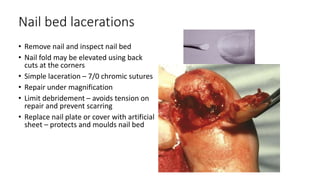
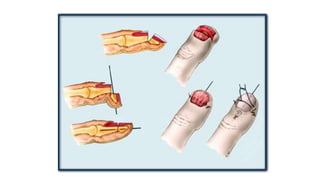
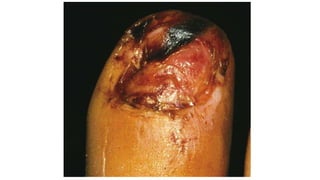
Nail bed lacerations
• Remove nail and inspect nail bed
• Nail fold may be elevated using back
cuts at the corners
• Simple laceration – 7/0 chromic sutures
• Repair under magnification
• Limit debridement – avoids tension on
repair and prevent scarring
• Replace nail plate or cover with artificial
sheet – protects and moulds nail bed
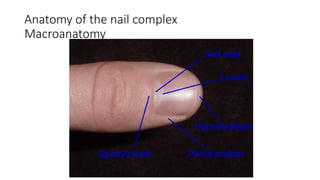
Anatomy of the nail complex
Macroanatomy
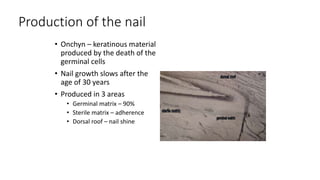
Production of the nail
• Onchyn – keratinous material
produced by the death of the
germinal cells
• Nail growth slows after the
age of 30 years
• Produced in 3 areas
• Germinal matrix – 90%
• Sterile matrix – adherence
• Dorsal roof – nail shine
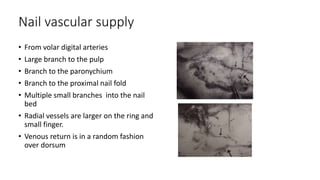
Nail vascular supply
• From volar digital arteries
• Large branch to the pulp
• Branch to the paronychium
• Branch to the proximal nail fold
• Multiple small branches into the nail
bed
• Radial vessels are larger on the ring and
small finger.
• Venous return is in a random fashion
over dorsum
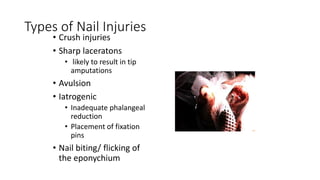
Types of Nail Injuries
• Crush injuries
• Sharp laceratons
• likely to result in tip
amputations
• Avulsion
• Iatrogenic
• Inadequate phalangeal
reduction
• Placement of fixation
pins
• Nail biting/ flicking of
the eponychium
Basic principles
• Injuries may involve several anatomic structures
• Loss of germinal matrix results in no hard nail growing
• Loss of sterile matrix results in non-adherence
• Radiographs to evaluate assoc. fractures
Paronychial injuries
• Simple lacerations – repaired primarily
• Loss of part of the paronychium
• VY advancement
• Cross-finger flap
• Thenar flap
• Dorsal roof laceration
• Primary suture
• Loss of tissue – grafting needed
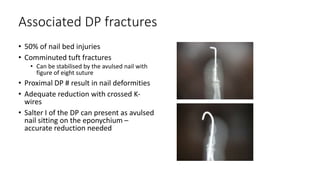
Associated DP fractures
• 50% of nail bed injuries
• Comminuted tuft fractures
• Can be stabilised by the avulsed nail with
figure of eight suture
• Proximal DP # result in nail deformities
• Adequate reduction with crossed K-
wires
• Salter I of the DP can present as avulsed
nail sitting on the eponychium –
accurate reduction needed
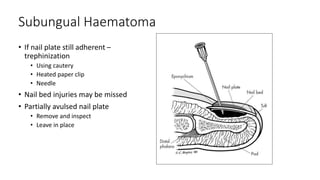
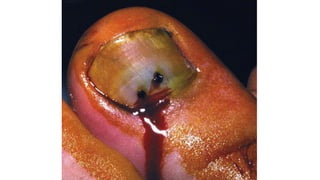
Subungual Haematoma
• If nail plate still adherent –
trephinization
• Using cautery
• Heated paper clip
• Needle
• Nail bed injuries may be missed
• Partially avulsed nail plate
• Remove and inspect
• Leave in place
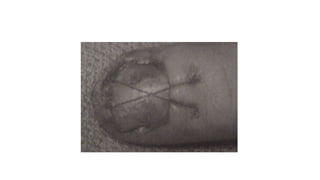
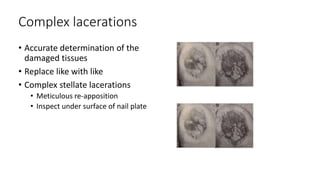
Complex lacerations
• Accurate determination of the
damaged tissues
• Replace like with like
• Complex stellate lacerations
• Meticulous re-apposition
• Inspect under surface of nail plate
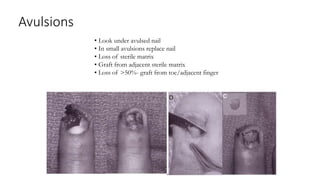
Avulsions
• Look under avulsed nail
• In small avulsions replace nail
• Loss of sterile matrix
• Graft from adjacent sterile matrix
• Loss of >50%- graft from toe/adjacent finger
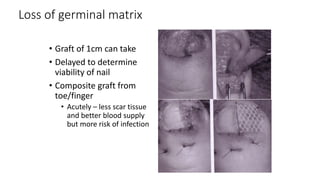
Loss of germinal matrix
• Graft of 1cm can take
• Delayed to determine
viability of nail
• Composite graft from
toe/finger
• Acutely – less scar tissue
and better blood supply
but more risk of infection
Partial amputations
• Ablate nail bed completely
• Cover the tip
• Shorten the nail bed
• Hook nail - Unsightly and interferes with function
• Loss of nail bed but reasonable bony support – combination of local
flap and nail bed graft
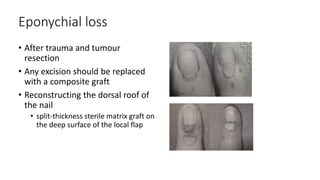
Eponychial loss
• After trauma and tumour
resection
• Any excision should be replaced
with a composite graft
• Reconstructing the dorsal roof of
the nail
• split-thickness sterile matrix graft on
the deep surface of the local flap
Onycholysis
• Non-adherence
• Caused
• Trauma
• Irritation
• Dissolving of hyponychial plug
• Age
• Onychomychosis
• Scarring in the sterile matrix
• Narrow – excised and primary sutured
• Wide - grafted
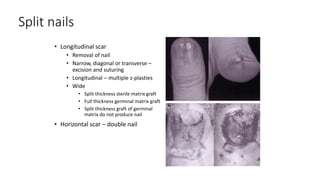
Split nails
• Longitudinal scar
• Removal of nail
• Narrow, diagonal or transverse –
excision and suturing
• Longitudinal – multiple z-plasties
• Wide
• Split thickness sterile matrix graft
• Full thickness germinal matrix graft
• Split thickness graft of germinal
matrix do not produce nail
• Horizontal scar – double nail
Bone irregularities
• Osteophytes
• Post traumatic inclusion cysts of
sterile matrix
• Deformity of nail and erosion of
bone
• Curettage of cysts
• Enchondromas
• Curettage and bone graft
• Fish-mouth incision
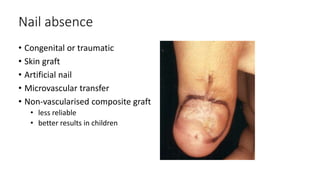
Nail absence
• Congenital or traumatic
• Skin graft
• Artificial nail
• Microvascular transfer
• Non-vascularised composite graft
• less reliable
• better results in children
Tech Hand Up Extrem Surg. 2005 Mar;9(1):42-6.
The aesthetic mini wrap-around technique for thumb reconstruction.
Adani R1, Marcoccio I, Tarallo L, Fregni U.
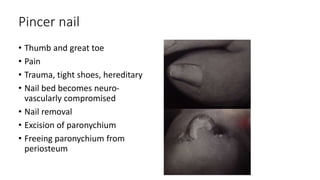
Pincer nail
• Thumb and great toe
• Pain
• Trauma, tight shoes, hereditary
• Nail bed becomes neuro-
vascularly compromised
• Nail removal
• Excision of paronychium
• Freeing paronychium from
periosteum
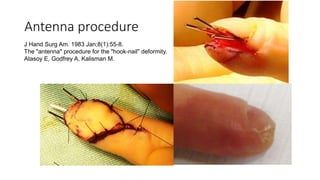
Hooked nail
• Growing nail follows nail matrix
• Tight closure of finger tip amputation
• Loss of bony support
• Absent distal phalanx
• Trim nail bed
• Replace bone
• Shorten nail
• Release pulled over nail bed – V-Y
• Bone graft
Antenna procedure
J Hand Surg Am. 1983 Jan;8(1):55-8.
The "antenna" procedure for the "hook-nail" deformity.
Atasoy E, Godfrey A, Kalisman M.
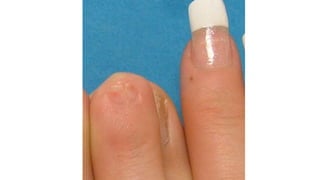
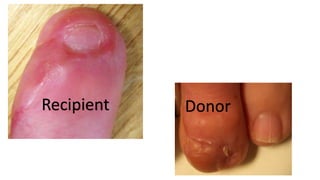
Br J Plast Surg. 1992 Nov-Dec;45(8):591-4.
Trimmed second toetip transfer for reconstruction of claw nail deformity of the fingers.
Koshima I1, Moriguchi T, Umeda N, Yamada A.
DonorRecipient

Nail bed injuries

  • 1.
  • 2.
    Learning outcomes • Understandthe relationship between anatomy , functions and injuries of the nail bed • Develop repair and reconstruction techniques for the injuries and their complications
  • 3.
    Nail bed lacerations •Remove nail and inspect nail bed • Nail fold may be elevated using back cuts at the corners • Simple laceration – 7/0 chromic sutures • Repair under magnification • Limit debridement – avoids tension on repair and prevent scarring • Replace nail plate or cover with artificial sheet – protects and moulds nail bed
  • 6.
    Anatomy of thenail complex Macroanatomy
  • 7.
    Production of thenail • Onchyn – keratinous material produced by the death of the germinal cells • Nail growth slows after the age of 30 years • Produced in 3 areas • Germinal matrix – 90% • Sterile matrix – adherence • Dorsal roof – nail shine
  • 8.
    Nail vascular supply •From volar digital arteries • Large branch to the pulp • Branch to the paronychium • Branch to the proximal nail fold • Multiple small branches into the nail bed • Radial vessels are larger on the ring and small finger. • Venous return is in a random fashion over dorsum
  • 9.
    Types of NailInjuries • Crush injuries • Sharp laceratons • likely to result in tip amputations • Avulsion • Iatrogenic • Inadequate phalangeal reduction • Placement of fixation pins • Nail biting/ flicking of the eponychium
  • 10.
    Basic principles • Injuriesmay involve several anatomic structures • Loss of germinal matrix results in no hard nail growing • Loss of sterile matrix results in non-adherence • Radiographs to evaluate assoc. fractures
  • 11.
    Paronychial injuries • Simplelacerations – repaired primarily • Loss of part of the paronychium • VY advancement • Cross-finger flap • Thenar flap • Dorsal roof laceration • Primary suture • Loss of tissue – grafting needed
  • 12.
    Associated DP fractures •50% of nail bed injuries • Comminuted tuft fractures • Can be stabilised by the avulsed nail with figure of eight suture • Proximal DP # result in nail deformities • Adequate reduction with crossed K- wires • Salter I of the DP can present as avulsed nail sitting on the eponychium – accurate reduction needed
  • 14.
    Subungual Haematoma • Ifnail plate still adherent – trephinization • Using cautery • Heated paper clip • Needle • Nail bed injuries may be missed • Partially avulsed nail plate • Remove and inspect • Leave in place
  • 16.
    Complex lacerations • Accuratedetermination of the damaged tissues • Replace like with like • Complex stellate lacerations • Meticulous re-apposition • Inspect under surface of nail plate
  • 17.
    Avulsions • Look underavulsed nail • In small avulsions replace nail • Loss of sterile matrix • Graft from adjacent sterile matrix • Loss of >50%- graft from toe/adjacent finger
  • 18.
    Loss of germinalmatrix • Graft of 1cm can take • Delayed to determine viability of nail • Composite graft from toe/finger • Acutely – less scar tissue and better blood supply but more risk of infection
  • 19.
    Partial amputations • Ablatenail bed completely • Cover the tip • Shorten the nail bed • Hook nail - Unsightly and interferes with function • Loss of nail bed but reasonable bony support – combination of local flap and nail bed graft
  • 20.
    Eponychial loss • Aftertrauma and tumour resection • Any excision should be replaced with a composite graft • Reconstructing the dorsal roof of the nail • split-thickness sterile matrix graft on the deep surface of the local flap
  • 21.
    Onycholysis • Non-adherence • Caused •Trauma • Irritation • Dissolving of hyponychial plug • Age • Onychomychosis • Scarring in the sterile matrix • Narrow – excised and primary sutured • Wide - grafted
  • 22.
    Split nails • Longitudinalscar • Removal of nail • Narrow, diagonal or transverse – excision and suturing • Longitudinal – multiple z-plasties • Wide • Split thickness sterile matrix graft • Full thickness germinal matrix graft • Split thickness graft of germinal matrix do not produce nail • Horizontal scar – double nail
  • 23.
    Bone irregularities • Osteophytes •Post traumatic inclusion cysts of sterile matrix • Deformity of nail and erosion of bone • Curettage of cysts • Enchondromas • Curettage and bone graft • Fish-mouth incision
  • 24.
    Nail absence • Congenitalor traumatic • Skin graft • Artificial nail • Microvascular transfer • Non-vascularised composite graft • less reliable • better results in children
  • 25.
    Tech Hand UpExtrem Surg. 2005 Mar;9(1):42-6. The aesthetic mini wrap-around technique for thumb reconstruction. Adani R1, Marcoccio I, Tarallo L, Fregni U.
  • 26.
    Pincer nail • Thumband great toe • Pain • Trauma, tight shoes, hereditary • Nail bed becomes neuro- vascularly compromised • Nail removal • Excision of paronychium • Freeing paronychium from periosteum
  • 27.
    Hooked nail • Growingnail follows nail matrix • Tight closure of finger tip amputation • Loss of bony support • Absent distal phalanx • Trim nail bed • Replace bone • Shorten nail • Release pulled over nail bed – V-Y • Bone graft
  • 29.
    Antenna procedure J HandSurg Am. 1983 Jan;8(1):55-8. The "antenna" procedure for the "hook-nail" deformity. Atasoy E, Godfrey A, Kalisman M.
  • 31.
    Br J PlastSurg. 1992 Nov-Dec;45(8):591-4. Trimmed second toetip transfer for reconstruction of claw nail deformity of the fingers. Koshima I1, Moriguchi T, Umeda N, Yamada A.
  • 32.