Reverse peroneal
artery flapDr sumer yadav
• Large soft tissue defects around the lower
third of the leg, ankle and foot always have
been challenging to reconstruct.
• Reverse sural flaps have been used for this
problem with variable success.
• Free tissue transfer has revolutionised
management of these problem wounds in
selected cases.
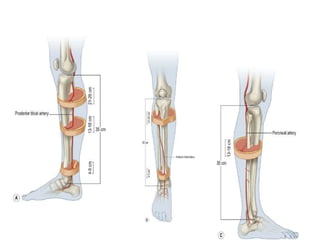
• Peroneal perforators supply skin over the
lateral and posterior aspects of the leg.
• These flaps include the skin supplied by the
peroneal perforators either as propeller flap
or as island flap with inclusion of peroneal
vessels.
• Multiple communications exist between the
peroneal artery and the tibial arteries
• Distally based islanded peroneal artery flap,
although a versatile tool for foot reconstruction, is
prone to venous congestion.
• Venous anastomosis in the foot to overcome this
problem has been suggested.
• flap designs of reverse sural and RPAF were
combined to get the advantages of both the systems.
• It also minimises disadvantages like low perfusion
pressure in the upper third and inadequate venous
drainage, respectively, of both flaps.
• Flap was planned in reverse with pivot point 5 cm above the lateral
malleolus
• tourniquet control
• Patients were kept in lateral position.
• flap can be safely extended to the upper end of the leg, up to the
line of the knee joint and laterally up to the mid lateral line on
either side.
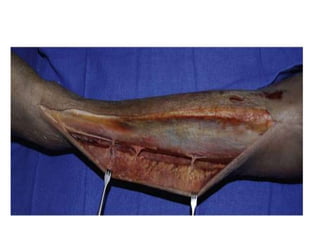
• The flap is raised in a subfascial plane
• The periosteum over the fibula is incised above the level of the
perforator and reflected with the septum medially to visualise
peroneal artery.
• Perfusion of the flap after clamping the artery indicates sufficient
perfusion of the limb and good communications with other arteries
distally.
THANKS

Reverse peroneal artery flap

  • 1.
  • 2.
    • Large softtissue defects around the lower third of the leg, ankle and foot always have been challenging to reconstruct. • Reverse sural flaps have been used for this problem with variable success. • Free tissue transfer has revolutionised management of these problem wounds in selected cases.
  • 3.
    • Peroneal perforatorssupply skin over the lateral and posterior aspects of the leg. • These flaps include the skin supplied by the peroneal perforators either as propeller flap or as island flap with inclusion of peroneal vessels. • Multiple communications exist between the peroneal artery and the tibial arteries
  • 4.
    • Distally basedislanded peroneal artery flap, although a versatile tool for foot reconstruction, is prone to venous congestion. • Venous anastomosis in the foot to overcome this problem has been suggested. • flap designs of reverse sural and RPAF were combined to get the advantages of both the systems. • It also minimises disadvantages like low perfusion pressure in the upper third and inadequate venous drainage, respectively, of both flaps.
  • 5.
    • Flap wasplanned in reverse with pivot point 5 cm above the lateral malleolus • tourniquet control • Patients were kept in lateral position. • flap can be safely extended to the upper end of the leg, up to the line of the knee joint and laterally up to the mid lateral line on either side. • The flap is raised in a subfascial plane • The periosteum over the fibula is incised above the level of the perforator and reflected with the septum medially to visualise peroneal artery. • Perfusion of the flap after clamping the artery indicates sufficient perfusion of the limb and good communications with other arteries distally.
  • 15.